I have relaxed my rule about posts from commercial concerns.
For the first time since July, 2009, I am presenting a guest post from a commercial business. This is how it evolved.
On the 11th February this year I received the following email:
Hi Paul,
Anne here from SpiritDog Training!
I came across Learning From Dogs while researching supplementary dog training materials and I am impressed with the articles you shared on your website.
I noticed that you are accepting guest contributions on your blog and I was wondering if our team can contribute an article for your site?
Our founder, Steffi Trott, has been featured in major publications such as Reader’s Digest, FitBark, Romper and Rachel Ray In Season so you can be assured that the content will be of high-quality.
I’ve prepared some topics here which I’m sure your readers would enjoy:
1. How Much Exercise is Too Much?
2. How To Teach Your Dog To Bark On Command
3. Which Doodle is The Best Fit For Busy Families?
4. Dog parks: Yay or nay?
5. Fetch or keep-away? How to teach your dog to return his ball every time
6. Nail trim horror? How to get your dog used to doggy pedicures
Please let me know if you are interested in any of these.
Looking forward to hearing from you, Paul!
Kind Regards,
Anne
I was minded to accept the invitation. I have received no income and I am not endorsing SpiritDog Training. But I thought that on balance this post should be allowed.
First, some words from Steffi Trott:

I am Steffi Trott, the dog trainer at SpiritDog Training (and hopeless dog enthusiast!). I am an energizer bunny who loves everything related to animals, the outdoors and – of course – training. I have four dogs of my own that I – of course – train every day and that participate in competitive agility as well.
I am always committed to finding the right approach for every dog and owner team – taking into consideration the individual disposition and natural strengths and weaknesses of everyone involved.
I have been teaching dog training to thousands of clients both locally and through online lessons since 2013.
I train with clients all over New Mexico and travel to teach seminars – which has taken me as far as Germany!
I studied dog training with European trainers such as multi-worldchampions in agility and European Open winners Silvia Trkman, Polona Bonac, Martina Klimesova and Anna Hinze as well as US trainers like Kim Terrill and Daisy Peel.
I have a lot of personal interest in dog cognition and behavior and keep up to date with all scientific publications on the matter.
Dog training is a very new field and just over the past couple decades trainers have gained an understanding of how much we can influence a dog’s behavior with positive, game-based methods. I firmly believe that every dog trainer needs to strive to perfect their own training skills and never stop learning and exploring.
Let me join you in finding the best possible approach for your dog!
So to the guest post submitted by Anne Handshack, the marketing associate, on behalf of Steffi.
ooOOoo
Adult dogs and playing – rethinking our expectations
By: Steffi Trott
In my work as a dog trainer, I frequently encounter the expectation that adult dogs should enjoy “playing” with other dogs. In many cases this is a misguided idea. It can cause owners to push their dogs into situations in which they are uncomfortable and may even show reactivity. Today we will look at how adult dogs interact and whether or not “playing” is a common behavior for them.
Puppies love to play
Everyone knows that puppies love to play. You can pretty much put any two puppies of any two breeds into the same space and they will run and wrestle with each other within minutes. This intense desire to play starts as soon as puppies can move around – as early as 3 or 4 weeks of age. Puppies retain the play drive until they are somewhere between 6 and 24 months old. In general, working or guard dog breeds stop to play with any other dog earlier, while companion dogs and many Doodles continue playing for longer. Some dogs completely stop any play – others get more selective in when, with whom and how they play.
Interaction yes, play no
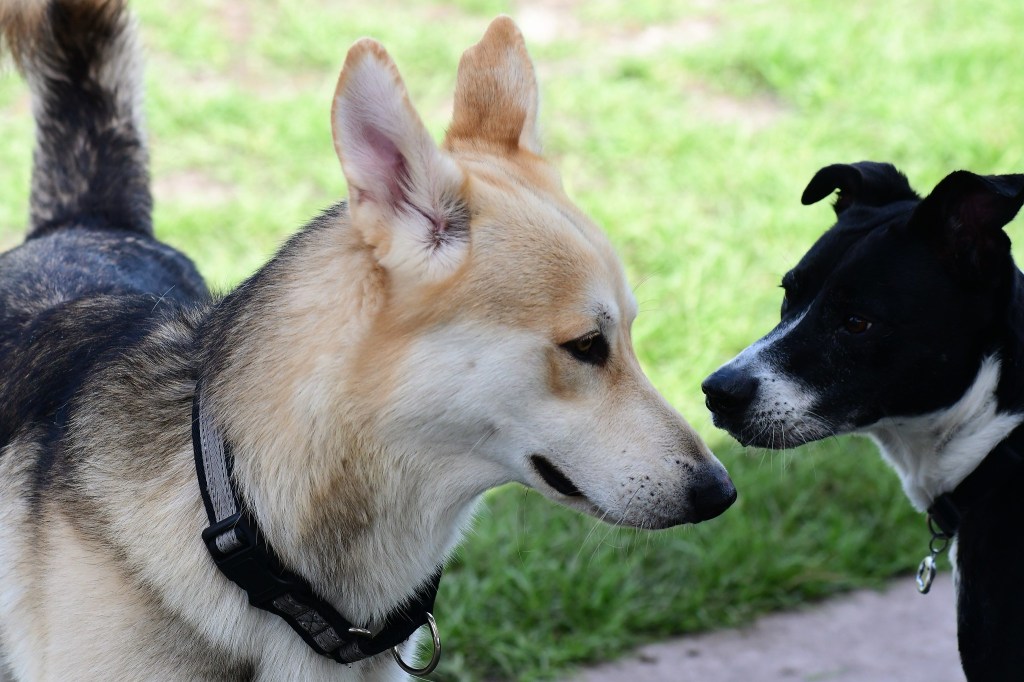
Most friendly and socialized dogs do not dislike other dogs once they stop actively playing. They simply don’t want to race, tug and wrestle anymore. A well-mannered and social adult dog will still greet other dogs, sniff them and wander around and mark bushes with them. If your dog e.g. was friends with the neighbor’s puppy, chances are that they will both stop the wild playing at roughly the same time and switch to more laid-back interactions.
Once a dog reaches this specific point in his life at which he stops to constantly seek out play with other dogs, we need to rethink the social situations which we put him in. Have you been taking your dog to a busy park regularly? Chances are there were many other, young and playful dogs there. If they bother your dog with incessant playbowing, barking and running up to him, he may not enjoy these outings anymore and you may want to change your walking routines.
Ideally you should find canine friends for your adult dog that have the same energy level and are looking for the same interactions.
Time to quit daycare?
My clients frequently come to me with the same concern: Their puppy used to do great at his doggy daycare, but around the first birthday he stops interacting and playing as much with the dogs there. Their report cards say that the dog spent time sniffing around by himself or perhaps even got a bit snarly with the other dogs. Of course, owners are worried – is their dog regressing in his social skills?
Not at all. Again – daycares are mainly filled with young, boisterous, energetic puppies who want to play all day long. As dogs grow up, most of them reach a point at which that just does not sound like fun anymore. This is completely normal and not a reason for concern. Again, it is important to take your dog’s cues into consideration when deciding on activities for him. For a lot of adult dogs, daycare just is not so fun anymore. They might need to quit going there as the energy level is too high and they do not participate in wild play.
How much play is appropriate?
Even if you have an adult dog who does still occasionally play with other dogs, you need to monitor his play behavior. Dogs should ideally always be supervised when playing together so that owners can intervene if issues arise.
It might be that your adult dog enjoys a bit of play, but eventually wants to just sniff by himself and be left alone. If the other dog now keeps on pestering your dog the situation might escalate. You need to always be the dog’s advocate. If your dog doesn’t want to keep playing, help him to make that happen!
Play drives can vary
While puppies always want to play with any other dog; the same adult dog might have varying interests in playing based on the day. It could depend on:
- What he has done so far on a given day – if he has only relaxed he may be more open to playing than if he has gone on a long hike or trained a bunch
- If “something better” is around – many adult dogs would prefer e.g. playing frisbee over playing with another dog, but if the owner puts away any toys the dog may choose to then play
- The environment of their interaction – in a new place many adult dogs want to first sniff and explore, whereas they may be more open to playing in a known and somewhat “boring” place such as their own yard
- Their play partner – adult dogs generally prefer to play with dogs they know rather than “doggy strangers”
The Bottom Line
Puppies love to play with any other dogs. Once they reach adulthood, it can be difficult for owners to recognize the signs that they are not so interested in this anymore. The change can be sudden or gradual.
It is important to never push adult dogs into playful interactions. Your dog will decide himself if or when he wants to play, and you should be mindful of his preferences. Perhaps he only wants to play with a certain other dog or only for a short time. Or maybe he does not want to play at all!
You need to always be his advocate and make sure that he can be comfortable in interactions with other dog.
ooOOoo
If any of the readers of today’s article have views as to whether or not this guest post should have been allowed then please I would love to hear from you.














:max_bytes(150000):strip_icc()/MaryJoDiLonardo-bw-fa7523e5e5f44cf784749ad554fe3d5d.jpg)