
ooOOoo
ooOOoo

ooOOoo

ooOOoo

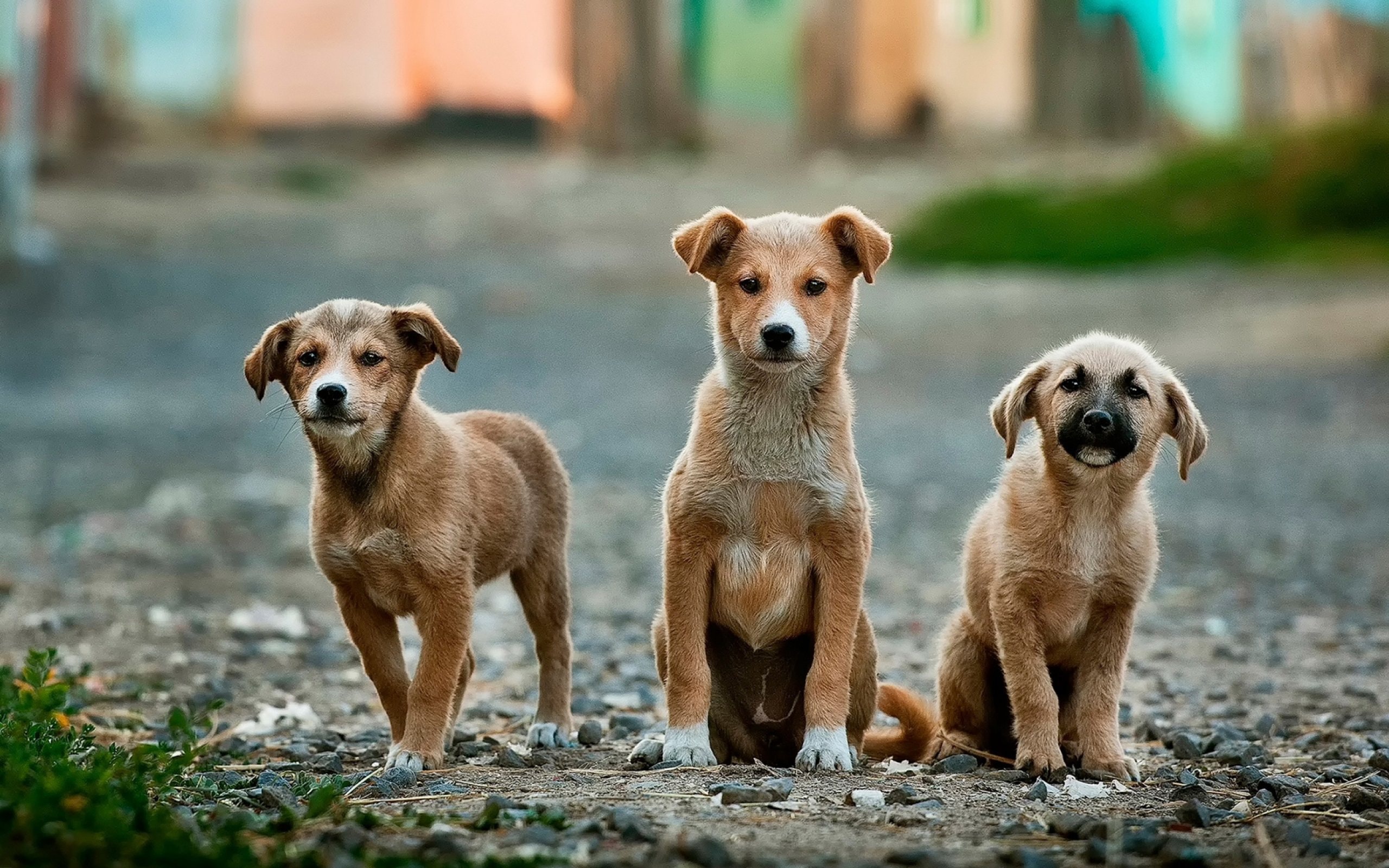
These pictures are all from the ‘Unsplash’ site, free of copyright, and I am indebted to the individual photographers.
Dogs are animals of integrity. We have much to learn from them.
Category: People and their pets
ooOOoo
ooOOoo
ooOOoo
ooOOoo
These pictures are all from the ‘Unsplash’ site, free of copyright, and I am indebted to the individual photographers.
And it is thanks to all of you!
There was such a wonderful response to when I recently posted some of Jeannie’s paintings from previous days that she picked up her paint brushes again.
To say that I was delighted is an understatement.
So I present a painting of Louis, a dog belonging to Jim and Janet Goodbrod, when he was a puppy, that’s Louis not Jim!
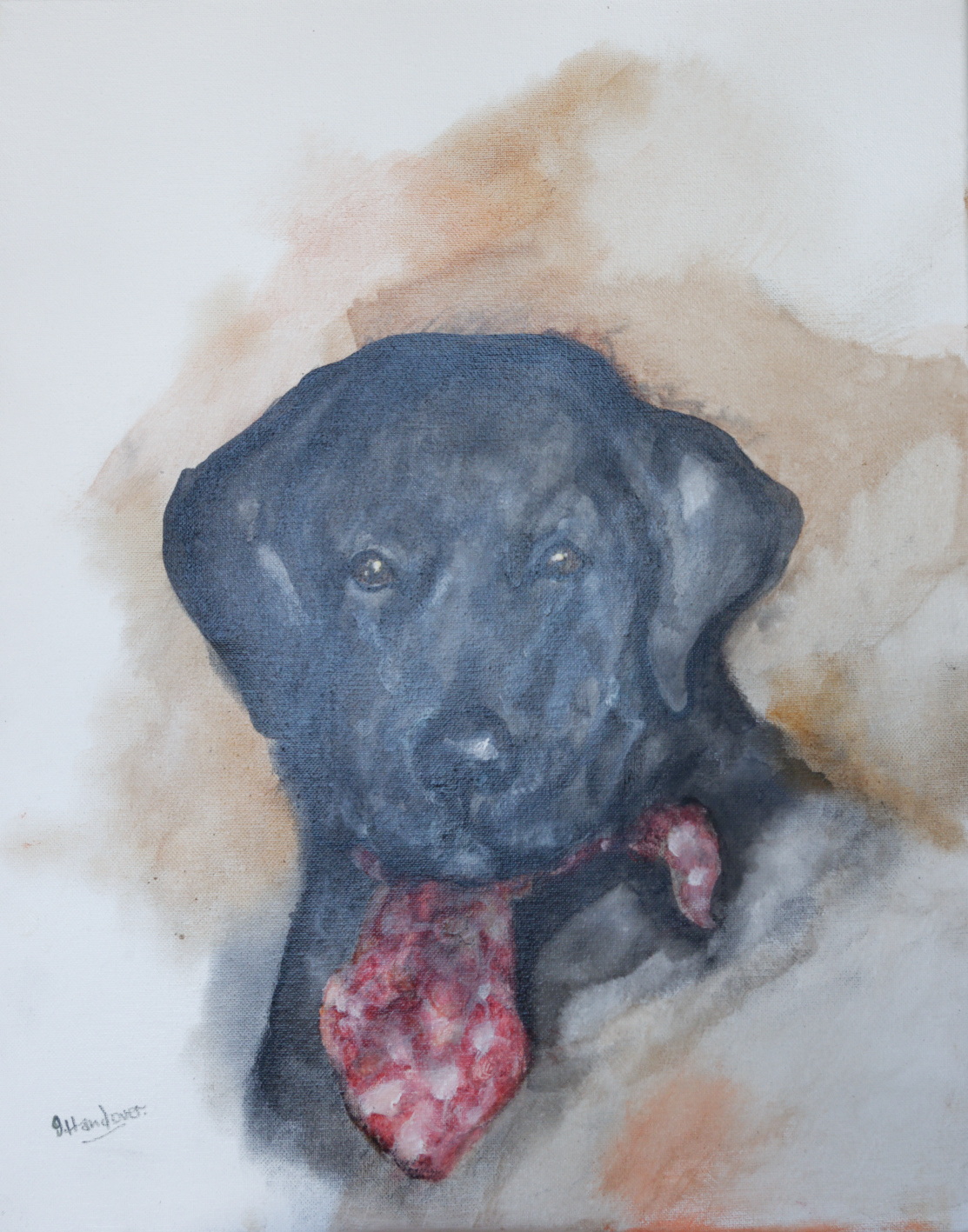
Jim and Janet used to live just around the corner from us but moved some time ago up to Roseburg. We are going to visit them today and Jean is taking the painting with her as a gift to the Goodbrods.
But to close with another thank you. Because it really made such a difference.
Dogs ought to live far longer!
I have spoken before of the bond that we humans make with our dogs, and vice versa, and the love that flows from such a bond.
But they don’t live long enough! And the end of their lives is a very difficult period for us.
Doug Goodman writes a blog. He is also an accomplished author.
Recently Doug wrote about the most difficult decision he had to make. Doug kindly gave me permission to republish his article.
ooOOoo
The Difficult Decision to Euthanize Ryder.
By Doug Goodman, April 20th, 2021

Unfortunately, all dogs die. There’s no easy way to do this, but it’s a fact of life as a pet owner. For me, the key decision was when is the right time to do it? I don’t want to wait too long so that Ryder suffers, but I’d feel guilty putting Ryder down too early.
We’ve talked about this many times, in fact. Often on walks or long rides in the car, my wife and I go through the bullets, like a checklist of emotional redemption. There are many “easy” decisions when owning a dog: which food? That bag of Purina over there. When do you pick up after the dog? At least twice a week in the spring and summer, sometimes every other day. Should you pet the dog? Well, it’s a German Shepherd, so if it wants to be petted, you better do it now because it may not want to be petted the rest of the day.
Deciding to euthanize is nothing so simple.
Years ago when we went through end-of-life with Mojo, a veterinarian recommended as a litmus test to pick the three things the dog enjoys most in life. When the dog can no longer do one or especially two of those things, it’s time to euthanize.
But that litmus test doesn’t apply to all dogs, and certainly not to Ryder. She’s always been a peculiar dog. She likes her backyard and playing with Koda, and she likes to eat*. She still does those things. For me, it is a pain factor based on arthritis and lack of mobility. People will talk about the dignity of life for a dog, and I think there is some truth to that. I remember laying in bed one day and Mojo walking in and telling me he was ready. A few months later, he again looked at me, and his eyes were full of truth. He wasn’t happy, he didn’t like this anymore. He was ready. Sometimes Ryder gives me that look, but I’m not sure. She’s always had a pained, scared-of-the-world emotion in her eyes.
But there is “pained” and there is “pain.” Ryder can’t put in words her suffering, so it’s up to me to observe her closely. Over the past few months, and certainly over the past year, my family and I have noticed changes to her behavior, physicality, and mental state:
-She had urination problems. She was diagnosed as a UTI and corrected. Alone, this is not a sign that she is close to dying, but I believe it may be a sign of the severity of her back arthritis. She’s not cleaning herself. This is especially troubling considering…
-She has problems holding in poop. Sometimes she’s sitting there, laying in it, and she doesn’t realize she’s pooped herself. Often, she can’t make it through the night without releasing her bowels in the house. If she isn’t able to clean herself, and she isn’t aware that she is going to the bathroom, this can lead to discomfort and additional UTIs.
-She stopped climbing the stairs. This was a subtle one because our dogs aren’t allowed upstairs. But last week we had a major thunderstorm, and as anyone who owns German Shepherds can attest, GSDs only want to be right next to you when the thunder booms and the lightning crashes. Koda busted down the dog gate and ran upstairs for solace. Ryder, who is usually the first one to bump against the bedroom door until we wake up, stayed downstairs and didn’t attempt coming to us. At least, I didn’t see her attempt it. She may have tried, failed, and gone back downstairs. That’s a first in her lifetime, and she wouldn’t have stayed down there if she didn’t absolutely have to remain on the first floor.
-She is stumbling. She often stumbles in the house, especially walking inside and out. She has fallen doing little playful jumps at my daughter. I’ve seen her fall to the floor and not be able to stand for thirty seconds or more.
-This will sound weird, but she sits a lot, and not on purpose. One of the things she does is get in the way of her people (helloooo, herding dog). She backs out when she realizes I want to get through. Now, she backs out, and her butt falls down, and she stares at me like “That wasn’t supposed to happen. What do I do now? Sorry!” until she can get back up.
-She is whining and yelping. This is the big one. My dogs don’t whine or yelp for no reason. They aren’t talkative dogs. For the past year, though Ryder will yelp when roughhousing with Koda. She wants to jump on him, but she’s incapable. Lately, she’s really reduced her roughhousing. Additionally, Koda is being a son of a bitch about this. A few days ago I noticed they were playing their favorite game of “I’ve got a thing and you don’t.” I posted about this when during one of these games, Ryder knocked the poop out of Koda. That old chestnut. But this last time when Koda wanted the random stick, he bumped her rear with his chest so that she went down. I scolded him, he didn’t understand, and eventually Ryder dropped the stick and guarded it with strong play-snaps. Koda wasn’t going to take any further action to take the prized random stick, but the fact that he knows to exploit this indicates to me that one day we could find out he’s hurt her, perhaps broken her back from bumping her, and now you have to put down Ryder immediately in your backyard. Nobody wants that.
So we have elected to euthanize Ryder.
Damn, there’s a lot of finality in that statement. She is a family member, and we lover her very much. I picked her up from the tiny town of Buda, Texas and drove her three or four hours back to Houston. She never liked car rides after that. We have a lot of memories with that dog, some I’m sure I will share in the coming weeks, but for now, I want to focus on the decision.
We are reaching out to companies that can euthanize at home. With all of Ryder’s fears, it seems like the best option. Of course, home euthanasias are the popular choice in the pandemic. Earlier in 2020, some of the vets we looked to wouldn’t allow owners to be present for euthanasias. So we will see if we can make the home euthanasia happen.
In the meantime, I give her half an aspirin to help with the pain, and my daughter purchased some CBD-infused peanut butter, too. We’ve had her on joint vitamins, but that only goes so far. We do as much as we can to keep Ryder comfortable, but it’s clear that she’s in near-constant pain and that her hips/back have greatly reduced function. She is an eleven and a half year old GSD, old for one. So as difficult as it is to decide to euthanize, I know that it is a necessary part of ownership. If I’m willing to own a dog, I must be willing to take care of it throughout it’s life, not just the happy puppy parts, but all of it, including her last days.
*Ryder only eats infrequently over the past few weeks. It is one of her three joys: play, eating, and protection/perimeter walking, and I would argue that food is her highest joy, so not eating is a big clue that her time is soon.
ooOOoo
I met Jean in 2007 in Mexico. Jean was rescuing street dogs, looking after them for a while, and then finding homes for them in the USA; primarily Arizona. I was then living in Devon, England together with my German Shepherd, Pharaoh. Jean loves all dogs irrespective of size. I moved out to Mexico, with Pharaoh, permanently in 2008. Living with so many dogs around the home quickly brought an awareness of the integrity of dogs, of their ability to love unconditionally, and I started this blog in 2009.
Now Jean and I live in Southern Oregon. Indeed we have been here since 2012. We are down to six dogs: Cleo; Brandy; Sheena; Oliver; Pedi and Sweeny. That means we have had many dogs die in the past. I still miss Pharaoh who died in 2017. Or rather it should be said that the decision to euthanise him was in June, 2017.
In the end we have to make that final decision for our beloved dogs. It is, frankly, so much better than leaving dogs to die because the last few weeks or days can be very brutal.
So we know only too well what Doug is going through. Our thoughts are with Doug and Ryder.
What a hero!
Time after time we read about the special bond between humans and dogs. And unlike us humans dogs seem to completely forget times in their past when they were treated cruelly.
Take this story of a dog that was an absolute hero.
ooOOoo
Dog Spots A Boy Being Swept Out To Sea And Rushes To Help Him
By Lily Feinn Published on 22nd March, 2021
Max was never trained to be a hero, but when the moment called for it, the Staffordshire terrier/bulldog mix answered the call.
Before Jamie and Rob Osborn adopted Max, he was a neglected pup. He lived mostly outside and was never taken out for walks. But the love of his new parents quickly changed the wary dog.

“When we got him, he was a bit antisocial,” Jamie Osborn told The Dodo. “If we were patting him too much, he’d get up and walk away. These days, Max is a completely different dog. He’s always happy! He’s really loving and gives us lots of love and affection.”
Max now lives inside as part of the family in Port Noarlunga, Australia. He loves sleeping in bed with his 11-year-old brother, Nev, and — most of all — splashing around in the water.
In the summer, Max spends most of his time at the beach with his family. “We have kayaks and he likes to swim along with us as we paddle, so we got him a life jacket so he wouldn’t get too worn out,” Osborn said. “Rob likes to surf and snorkel, so Max can often be seen at the beach hanging with the surfers waiting for a wave.”In January, Max was enjoying a quiet day at the beach with his dad and brother when something went wrong. A young boy got caught in the current and started to panic. Instead of swimming parallel to the shore to escape the current, he tried to swim against the current and quickly got stuck. Rob spotted the boy and called out to Max for help.

Later, Max acted as lifeguard yet again. “One of Nev’s friends also found it a bit tough, so he went back and got her, too,” Osborn wrote on Facebook.
Max was declared a hero — but he doesn’t know it. All he knows is that he’s getting a lot more pets and treats, and is happier than ever.
ooOOoo
Isn’t this a terrific story! Max is a real star and hero. But then so are many, many other dogs. All they need is love from us humans and then they bond with us for life.
Some dogs are always jealous
The fact that some dogs get jealous from time to time is nothing new. Our own Cleo, a female GSD, is especially jealous of some of our other dogs.

But researchers have found dogs exhibit three human-like signatures of jealous behaviour and I want to share the details with you.
ooOOoo
Your Dog Gets Jealous Just Imagining You With Another Canine, Study Finds
By Mary Jo DiLonardo, April 13th, 2021
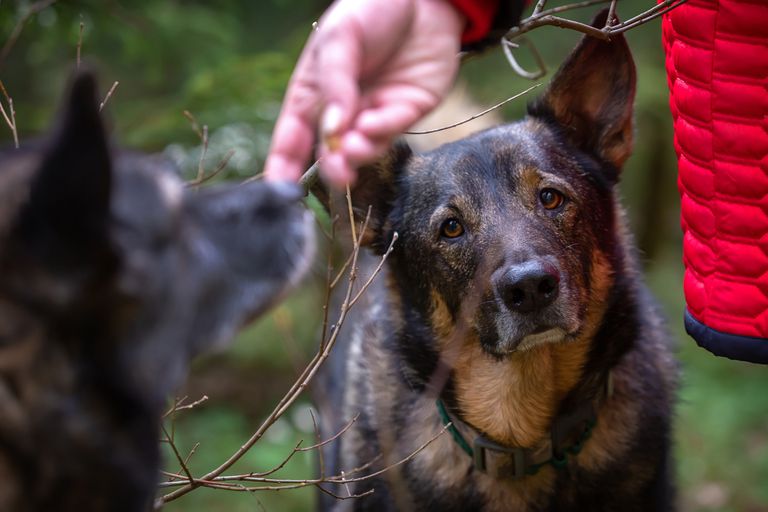
To the surprise of no dog owner anywhere, a new study finds that dogs get jealous.
You may know the feeling when you’re out on a walk and stop to pet another pooch. Your dog may bark or whine, or even come in between you and the offending canine.
New research published in the journal Psychological Science finds that dogs exhibit these types of jealous behaviors even when they only imagine their owner is interacting with another dog.1 In the case of this study, the perceived rival was an artificial dog.
In the past, some scientists have insisted jealousy is strictly a human trait and people are merely projecting emotions on their pets.1
“I think it is natural for dog owners to project a range of human thoughts and emotions onto their pets,” lead author Amalia Bastos, a Ph.D. candidate at the University of Auckland in New Zealand, tells Treehugger.
Bastos cites a study published in 2008 in the journal Cognition and Emotion where 81% of dog owners said their pets get jealous. But as much as pet owners love their animals, they are sometimes wrong about them, she says.2
That same study found that 74% of dog owners reported their pets feel guilty after misbehaving.2 But several studies have found that what people see as a “guilty look” is merely dogs responding to getting in trouble from their owners, whether they actually misbehaved or not.3,4
“Anecdotes from dog owners are interesting and can inspire fascinating research into dog intelligence and behavior, but it is important that this is taken only as a starting point for rigorous science before we can make such claims,” Bastos says.
She adds: “Work on dog jealousy to date is more promising than for guilt: our study shows that dogs exhibit three signatures of human jealous behavior. However, we caution that the fact that dogs display jealous behavior does not necessarily mean that they experience jealousy as we do.”
For the study, researchers set up an experiment where 18 dogs imagined their owners interacting with either a realistic-looking stuffed dog or a similarly sized fleece-covered cylinder that looked nothing like a dog. The fake dog played the role of a potential rival while the cylinder was a control.1
First, the dogs watched the stuffed dog next to their owner. Then, a barrier was placed between the dog and the stuffed animal so they could no longer see the potential rival. The dogs pulled strongly on their leashes when their owners appeared to be petting the fake dog behind the barrier. In a second experiment, the dogs pulled on the leashes with less force when the owners appeared to be petting the fleece cylinder.1
“We developed a novel methodology whereby we could directly measure the amount of force a dog used to pull on its lead,” Bastos explains. “This provided the first easily quantifiable, objective measure of how strongly dogs attempt to approach a jealousy-inducing interaction between their owner and a social rival.”
This is called the “approach response” as the dog tries to get closer to the owner and the potential rival. It’s also how babies and kids respond when they are jealous, Bastos says.
“The approach response is a straight-forward and clean measure which happens to be the single most universal reaction to jealousy-inducing situations in human infants and children,” she says. “Although infants and children show a range of behaviors when observing their mothers interact with another infant — including but not limited to attacking the rival, crying, seeking physical contact with the mother, throwing a tantrum, or screaming — almost all react primarily by approaching the jealousy-inducing interaction.”
Researchers were able to measure the actual strength of the approach response rather than relying on inconsistent behaviors like barking, whining, growling, or attempting to bite, which would vary among dogs.1
The researchers found the dogs exhibited three human-like signatures of jealous behavior.1
These findings were different from earlier research because it’s the first to show dogs can mentally represent — or imagine — social interactions that they can’t directly see, Bastos says.
“We know this because when their owners appeared to pet a fake dog the dogs could not see behind an opaque barrier, they reacted with an approach response, which is a common jealous behaviour in humans. This suggests that dogs could mentally simulate what their owners must have been doing out of their direct line of sight,” she says.
It also showed that, like humans, dogs reacted more strongly when their owners interacted with a potential rival than with an inanimate object. And the reactions happened due to the interaction, and not when the owner and the rival were in the same room but not interacting.1
“Previous studies confounded jealous behavior with play, interest, or aggression because they never tested dogs’ reactions to the owner and the social rival being present in the same room but not interacting,” Bastos says.
“In our control condition, where owners petted a fleece cylinder, the fake dog was still present nearby,” she adds. “Dogs did not try to approach it as they did when they were being petted by the owner, showing that the interaction itself triggered their approach response, and therefore this is caused by jealous behaviour.”
Although this research is the first step, more research is necessary to figure out if dogs experience jealousy the same way people do.1
“There is still much work to be done to establish what dogs subjectively experience while exhibiting jealous behaviours, and this is a very difficult question to answer scientifically,” Bastos says. “We may never have an answer!”
ooOOoo
The researchers went to some lengths to show that the dogs were able to detect real interaction with another dog rather than a fake dog. The video is very interesting and I hope you are able to watch it.
What a strange species we are!
Two days ago, just 3 miles down the road, someone reported seeing two dogs dumped in a yard and the culprit driving off at high speed. It was on the corner of Hugo Rd and Barker Rd, and Barker I know well because when I ride my bike I do an extra mile along Barker. (And we live on Hugo Rd.)
Then there’s the attitude adopted by the person who took puppies to a shelter. “… the breeder told her the coyotes can always use a meal.” As seen on the website Treehugger. Have a read.
ooOOoo
Rescued Blind and Deaf Puppies Are Incredibly Joyful
By Mary Jo DiLonardo Updated April 9th, 2021
:max_bytes(150000):strip_icc()/mary-jo-dilionardo-bw-22fe0236b1764918a4a0fa2cd2cd0108.jpg)
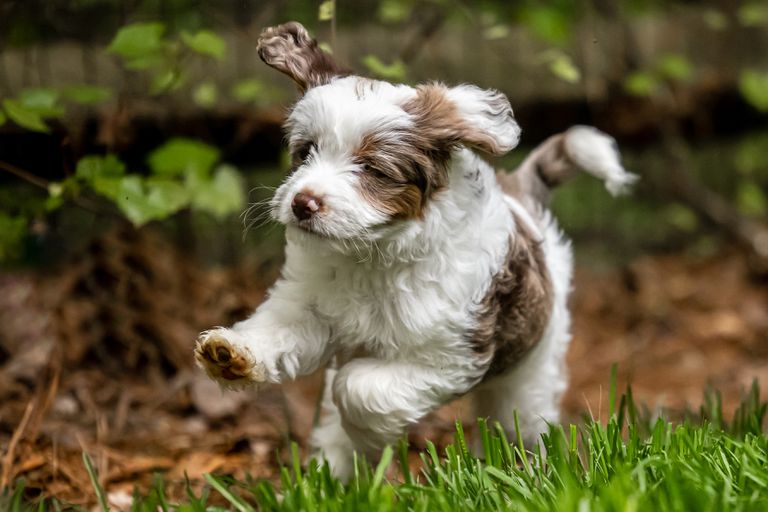
As I write this, it sounds like there are hyenas battling it out in my basement. Yelps and screams and torturous cries are storming up the stairs along with a few barks and high-pitched squeals.
It’s just another day in fostering some rambunctious blind and deaf puppies who happen to play very, very loudly.
Trudy and Zane are 9-week-old Australian shepherd mixes, maybe Aussiedoodles. They were dropped off at a rural shelter somewhere in Illinois by a breeder. When the beleaguered shelter worker asked what would happen to the puppies if she couldn’t take them, the breeder told her the coyotes can always use a meal. She couldn’t believe it.
The shelter, of course, took them. And Speak! St. Louis, the rescue I volunteer with, of course, stepped up. And somehow the puppies ended up here in Atlanta, playing “WWF Smackdown” in my basement.
Trudy and Zane are double merles like the Treehugger puppies. Merle is a swirly pattern in a dog’s coat that is very lovely and highly prized by breeders and people who want a pretty dog. When two dogs with the merle gene are bred together, there’s a 25% chance that their puppies will be blind, deaf, or both.
Sometimes this happens by accident, but it seems that it happens too often on purpose. In any case, there sure are plenty of puppies that end up needing homes. At least those are the ones that rescue groups hear about. Others just quietly disappear.
I’m pretty sure that Zane and Trudy weren’t handled much by their owner when they got here. They were awfully squirmy and bitey and didn’t want to be held or touched. They wouldn’t eat unless they were touching each other.
So I’ve been working on it. Hold one for a few seconds and put them down before they fidget. Pet them all over a little at a time. Feed them just a little farther apart at each meal.
In just a couple of weeks, they’ve learned that people are pretty cool.
Navigating the World
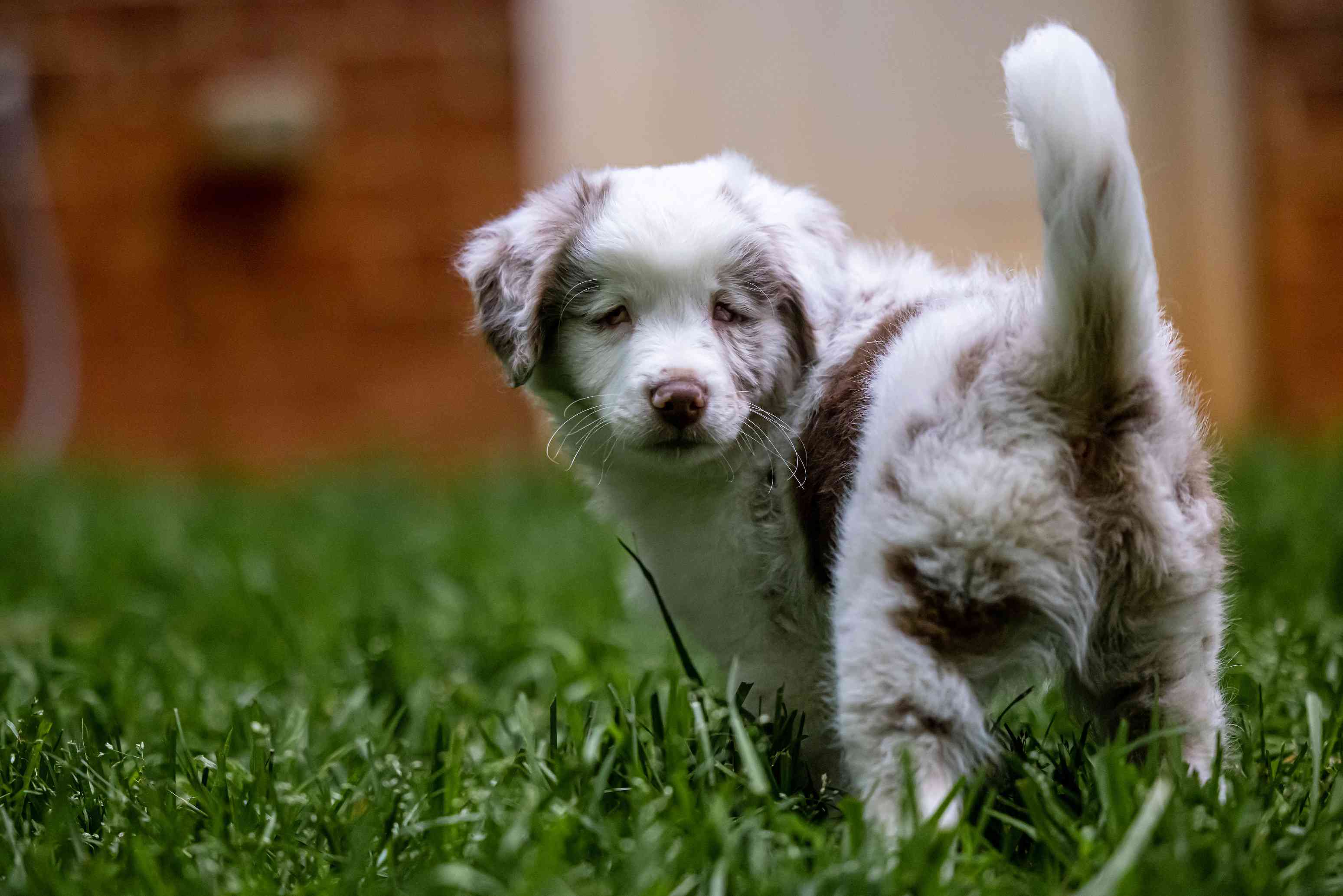
I’ve fostered a blind puppy, several deaf puppies, and two blind and deaf puppies including the famous Whibble Magoo, who is now competing in agility contests and is smarter than most people I know.
It’s just amazing to watch how they navigate the world. They quickly map out their area, learning where the walls, bushes, and furniture are. Sure, they bounce off a few things at first but puppy heads are pretty hard. They do a little bit of a cartoon-like head shake where the world, no doubt, spins a little bit inside their heads. Then they jump up and go back to exploring and running and being happy.
And, boy, are they happy.
People often say they feel sorry when they see blind or deaf puppies. They talk about how awful it must be for them.
But this is the only life they know and they are so joyful! When they go outside, they bounce in the grass like it is the best, most wonderful place in the world. When they play with a toy, it’s the coolest toy ever. When they find my dog, their tails wag so hard because they are ecstatic to be around him.
And when they find a person, they are elated because people are amazing, fun, and they give snuggles and treats.
They’ve come a long way from being just a step away from coyote dinner. Now they’ve learned to sit with two taps on their bottom and they are learning “down” is a tap on the front foot.
They are getting ready to look for their forever homes where their new people will appreciate that they aren’t just deaf and blind puppies. Instead, they are brilliant, silly, playful, gorgeous puppies with wonderful loving, sweet personalities.
They just happen to play and live with the volume turned up loud.
ooOOoo
Regarding that dog dump in Barker Road, I managed to find out which house it was and later on in the day went for a bike ride that took me that way. There was no sign of anything unusual.
But to get to the matter of today’s post that is all about puppies that are blind or deaf. As I am sure you are aware, dogs are very different to us humans when it comes to their senses. I have written before about the great power of their sense of smell. This is many ways is their leading sense and I have no doubt that in the case of dogs that are blind or deaf their smell allows them to function pretty well.
There are many, many good people in the world. Some are outstanding. But I regret that there are quite a few low lights. Shame but there it is.
The continuing story of Alfie.
Stop Press
Alfie has had his operation and all is well! I don’t know more than that at the moment but I do want to share the journey from New York to Minneapolis with you. Because it is such a story of love and devotion.
(And I have just heard that Prince Phillip, Duke of Edinburgh, has died – oh, dear.)
ooOOoo
April 5, 2021 By Mr Coyne
The week we travelled to the US, the East Coast was experiencing one of its winter storms. Snow threatening our progress overland to our destination. With this in mind, we worked with James Gallagher at Enterprise close to Westhampton Private Airport near Maine just outside NY, we arranged for a Jeep Gladiator to be waiting on the tarmac for us. The plan was to land, walk down the steps and into the Jeep, then drive around 20 hours across 9 States (New York, New Jersey, Pennsylvania, Ohio, Michigan, Indiana, Illinois, Wisconsin, and Minnesota) taking it in turns, and stopping only when tiredness took hold to sleep. When I say drive around 20 hours, that’s just driving, not stopping to fuel, use a bathroom, eat, rest. Over 1,300 miles. A mammoth task.

The plan hit the rocks as the jet approached Westhampton and were told the runway closed due to snow. We were diverted to JFK, and then Ubëred two hours back to our original airport. We could have tried to get a four wheel drive from JFK but we already knew getting something in the middle of a bad storm would be near impossible. Trying to fly internally from JFK to Minneapolis was off the table too as we had bought a lot of luggage with us, which we intended to leave in the US. Trying to get this through JFK, with all of this and a dog, a dog that potentially could have been turned away at the gate for being too big, was not worth trying to modify our plan.
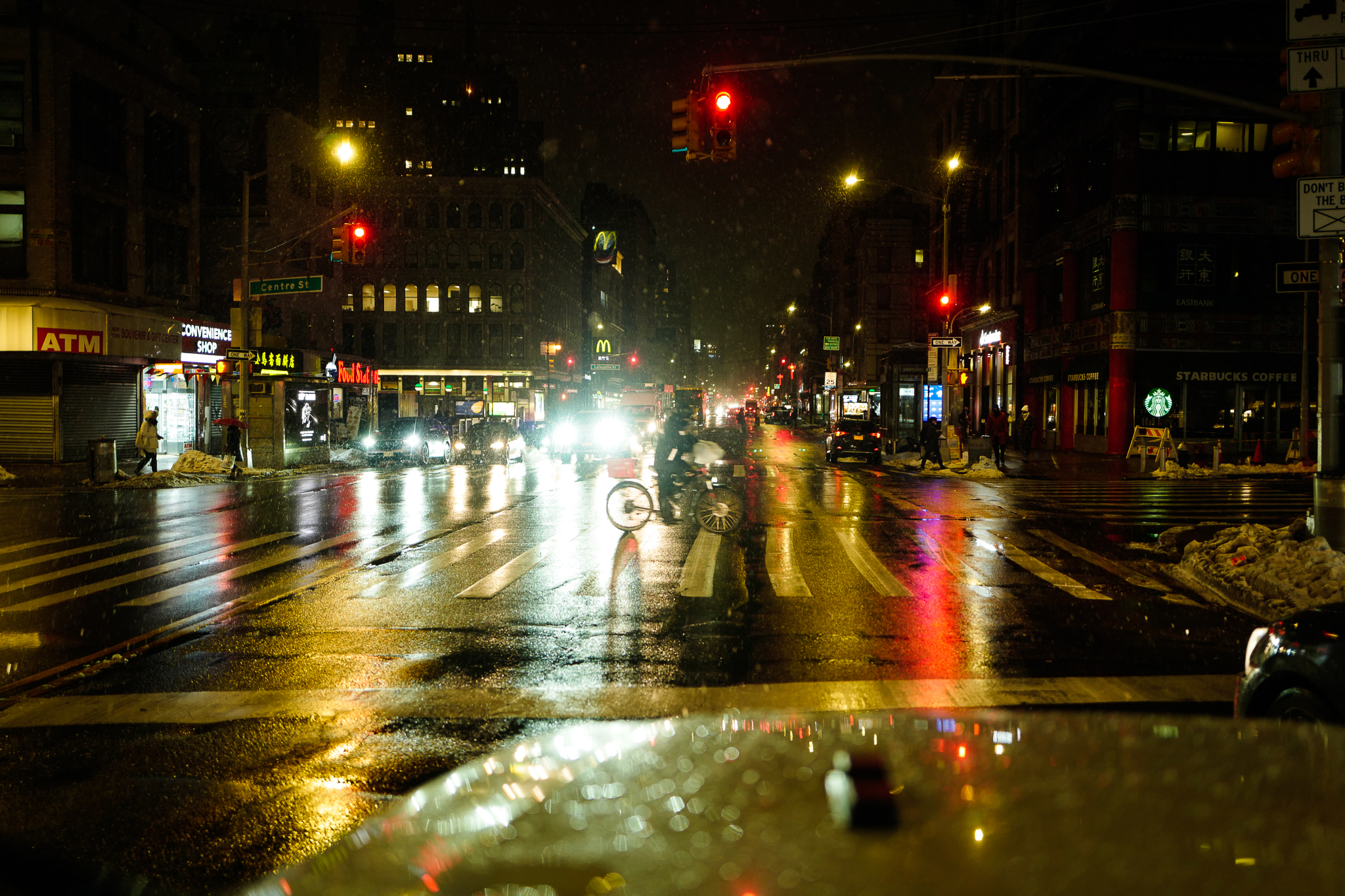
Snow on the ground we got our Jeep, and just had James had said when he sourced it for us – it looked unstoppable. He’d kindly shovelled out most of the snow from the pick-up bed. We headed out through rush hour NYC traffic towards Minnesota following the quickest route on Google Maps. Surprisingly through the Bronx. We made it through the other side and eventually stopped somewhere on the outskirts in search of a toilet and food. A Gladiator sits high off the ground, and we were already tired. As we pulled up outside a potential watering hole Renée opened the door and fell out, hitting the ground audibly so. Alfie was in her arms but had the foresight to recognise trouble and jump to safety. We went inside, one of us limping, to check ourselves over and eat. Luckily just bruising; limbs and pride. We were there a couple of hours, much longer than we intended, but the food and rest needed. It was a big, clean hotel and would have been a good place to stop, at the expense of making the next day even harder. We pushed on. Before doing so I looked at Google maps and realised I’d made a schoolboy error. Living in London and owning old cars is a constant maze avoiding paying the Congestion Charge and ULEZ (Ultra Low Emission Zone). My phone was still set to avoid these tolls, hence our route through the the centre on New York. Worse, the fastest route would now see us backtrack some of the way we’d just driven.
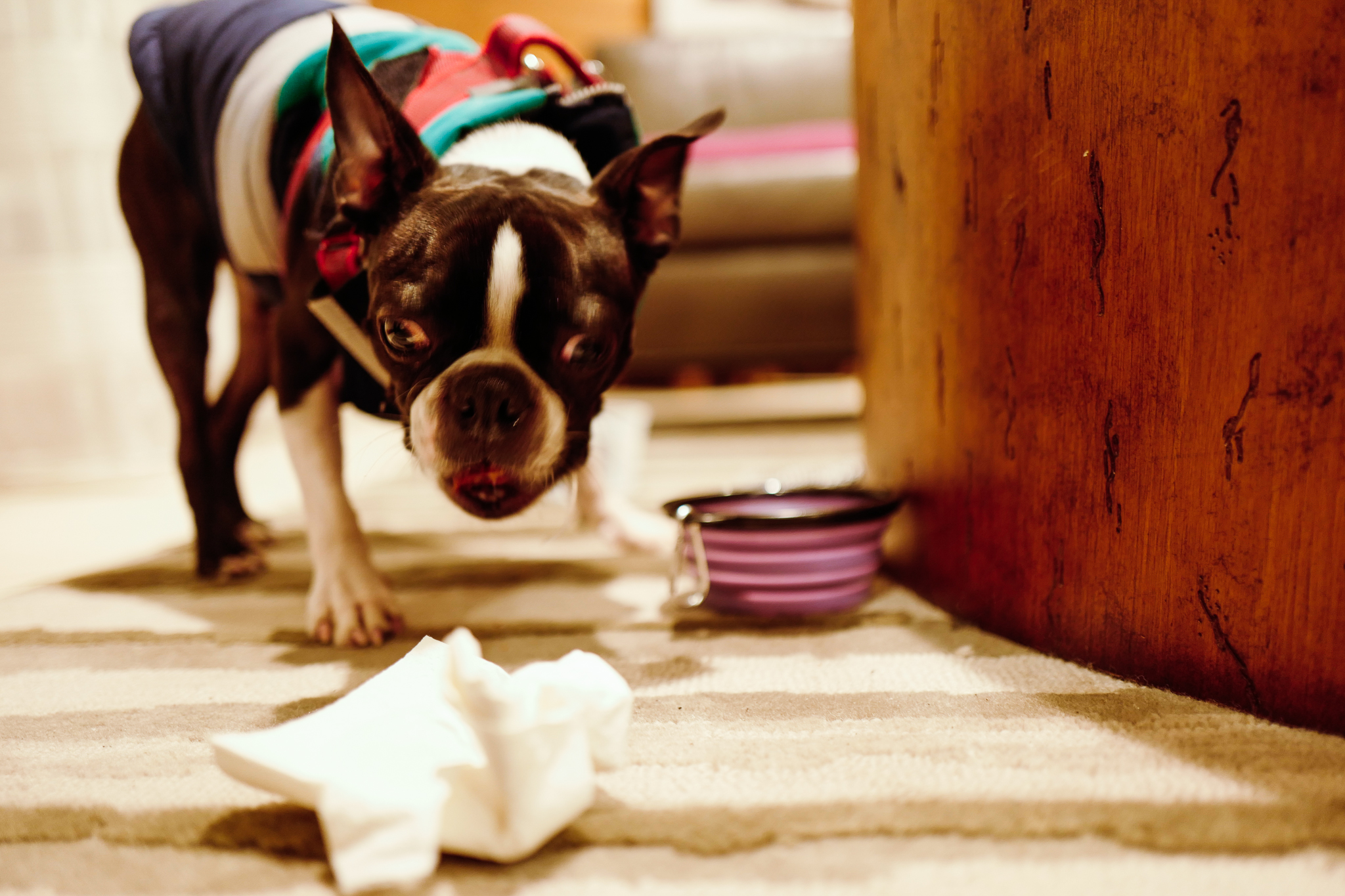
The Gladiator proved its worth as the elevation climbed and snowfall increased. We kept going until tiredness eventually became too dangerous to ignore and we stopped somewhere, somewhere being my best guess at where as I was so tired. A room at a Holiday Inn. Alfie making friends with the front desk saw the $80 dog fee waved. We didn’t sleep long, maybe three hours and returned to the Jeep early around sunrise. Throughout the entire trip Alfie had sat up front on Renée’s lap as the rear seats of our crew cab style truck full of luggage (the pick up bed empty so our stuff remained dry and safe). I’d read that these Jeeps were not great over long distances, and my previous longest time in one, a Rubicon, was between Fargo and Minneapolis on roads closed due to snow. It was cold and as a passenger I got leg ache. From the driver’s seat it wasn’t too bad. I’m sure most people buy slab sided trucks like this, original Land Rover Defenders and G Wagons simply because they look good, but there is no denying when the conditions get tough they are incredibly capable. Well, maybe not the G Wagon as that’s simply a fashion accessory.

“Watching a sleeping poorly dog, all of us crammed up front with the heater blowing full pelt to keep warm, hour after hour, made me question my original judgement of travelling this way
Watching Alfred, a poorly dog, asleep on Renée’s lap, all of us crammed up front with the heater blowing full pelt to keep warm, hour after hour, made me question my original judgement of travelling this way. My thinking was to have Alfred in the air for the minimum time and then get him the rest of the way by road where he would not be squashed in a bag, could go pee whenever he needed, and I could deal easily with any seizures. The whole private jet decision happened very fast and I hadn’t really adjusted to the revised plan. Also the plan had been to land at Westhampton, not JFK where we could have easily boarded a domestic flight to Minneapolis. Hindsight always great, and beating yourself up over something already done when tired completely pointless. The important think was we were in the USA, and on our way to get Alfred the help he needed. Given the obstacles in our way just two days ago we really should be patting ourselves n the back.

Eventually, around three hours out from our destination, I could drive no more and we stopped in one of the fantastic US rest areas. These places are free from gas stations, usually have vending machines, and clean toilet facilities. They feel safe and good places to stop for a snooze. It was cold though, with a lot of snow and ice on the ground. We slept a while with the engine running and heater keeping us warm. When it is this cold, global warming is the last thing on your agenda.
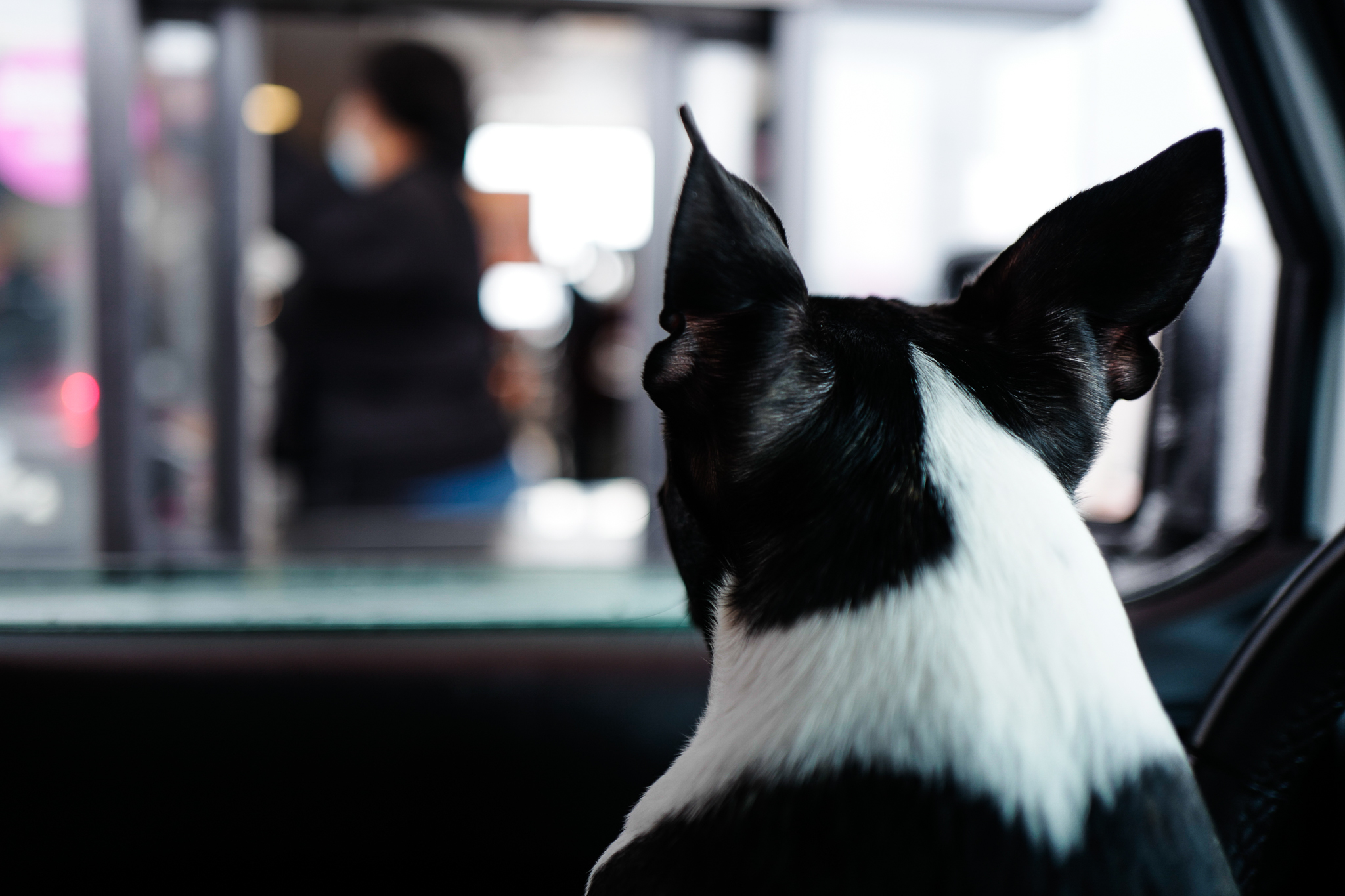
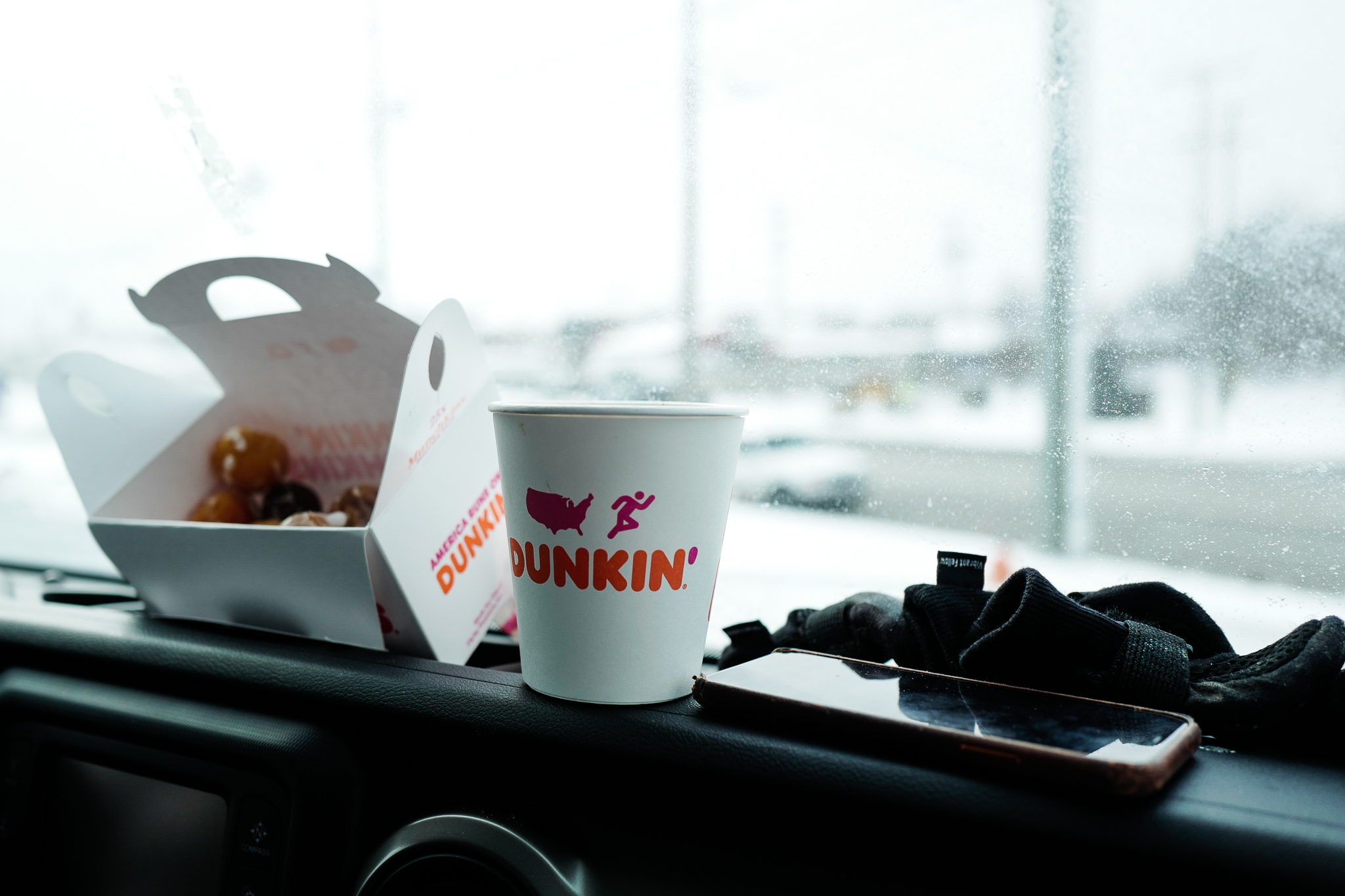
“We slept a while with the engine running and heater keeping us warm. When it is this cold, global warming is the last thing on your agenda.
I’ve been in this situation before. Driving while tired is super dangerous. I suspect more so than alcohol (within reason) and up there with texting. As a pilot once said over the tannoy of a flight to Bahrain years ago: better to get there late than not at all. But before long, Renée woke me and wanted to carry on. I managed the next hour before handing over the driving to her to get us the rest of the way. The two of us had dug really deep to make it.

Arriving at the Canopy in Minneapolis was a welcome sight. Alfred’s surgery was scheduled 10 days from now but we had an option to bring it forward should he deteriorate rapidly. We were where we needed to be. A huge victory and I could literally feel the stress lifting from me.
Of course, we were only actually part way there, the real challenge was to come.
ooOOoo
And of course, as I mentioned at the beginning of this post, little Alfie has arrived in Minneapolis and has had his operation. In due coarse I will bring you the latest.
Funny how things fall out!
My son, Alex, recently sent me a link to a blog he had come across. It was to a website called https://aircooledbug.co.uk
It was about Andrew Coyne who with his wife, Renée, had come across to America in order to have an operation on his dog, Alfred. It was very moving. I then made contact with Andrew and asked him if I could have permission to republish. It was granted. Furthermore, Andrew went on to say:
Hi Paul,
The only place we could find to perform surgery and give him immunotherapy was the US. Getting to the US a massive challenge as the lock down restrictions and freedom of movement issues implemented by governments here and in the EU stopped us being able to travel. Hence chartering a private jet direct to New York.
Alfred is currently doing well with us here in the US and will not return to the UK. We will move here with him permanently and make our home in the one place that gave him a chance.
Kind regards,
Anthony
So I am going to devote my next two posts to republishing two posts from Andrew’s blog. The first today is Coming to America.
ooOOoo
April 3, 2021 By Mr Coyne
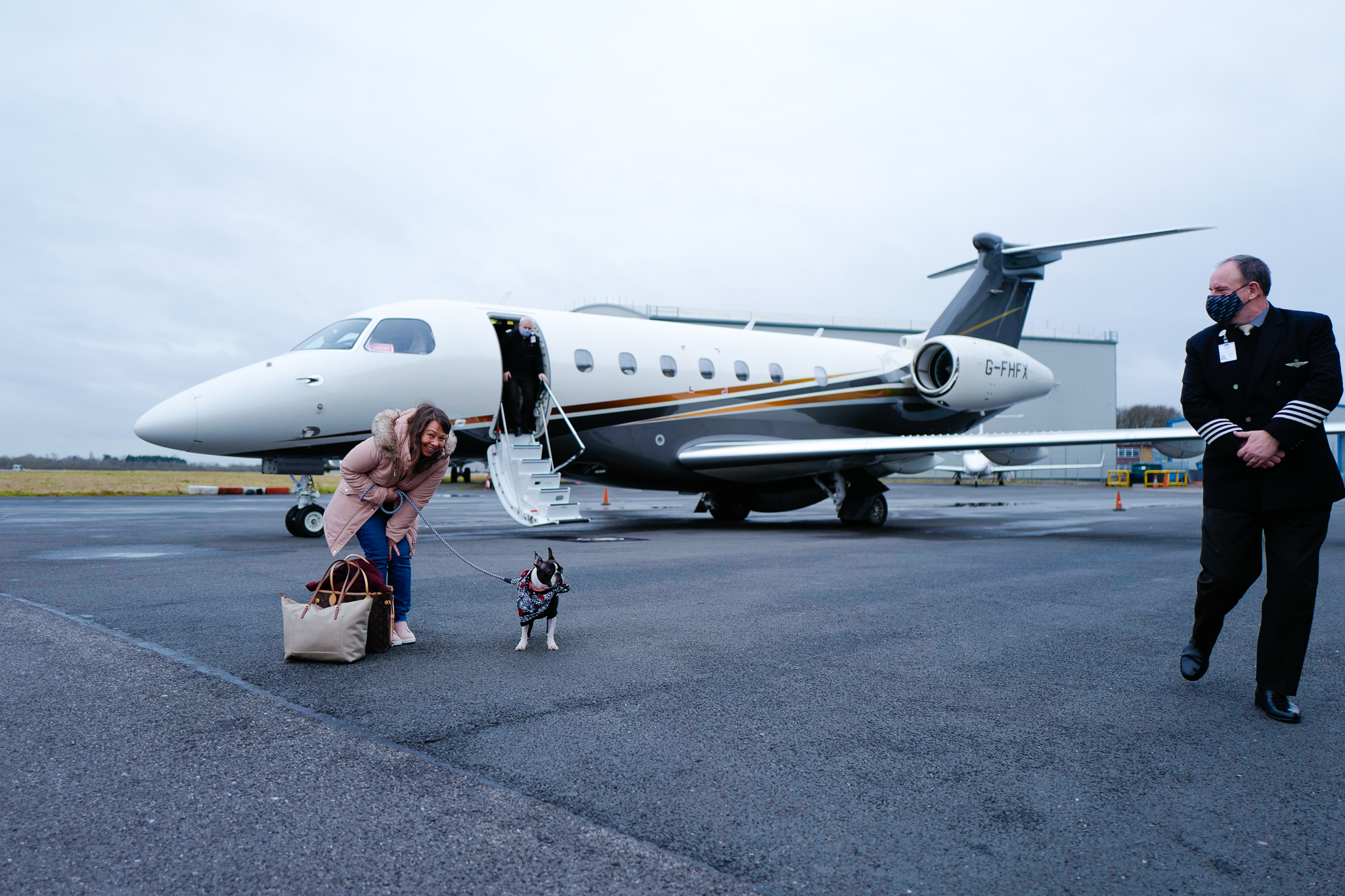
The relief that knowing we would travel brought was unmeasurable. Private jets don’t come cheap, even discounted empty legs, but in this instance it didn’t matter. It was a welcome solution.
Up until the world was introduced to Covid-19, I had been a regular traveller to the US both with Renée who’s American, and on business as thinkerdoer work with a lot of US companies. I had an ESTA in place and checked it was still valid on Monday after we decided to take the flight to NYC. On Tuesday morning it was pulled! I’m still not sure why but it would seem to be a response from the Biden Administration to control the recently announced ‘UK variant’. Mark at Charter-A and his team scrambled to get clearance for me from the US using our marriage certificate from Cornwall to prove I was a spouse of a US citizen and this initially appeared to satisfy them and clearance given.
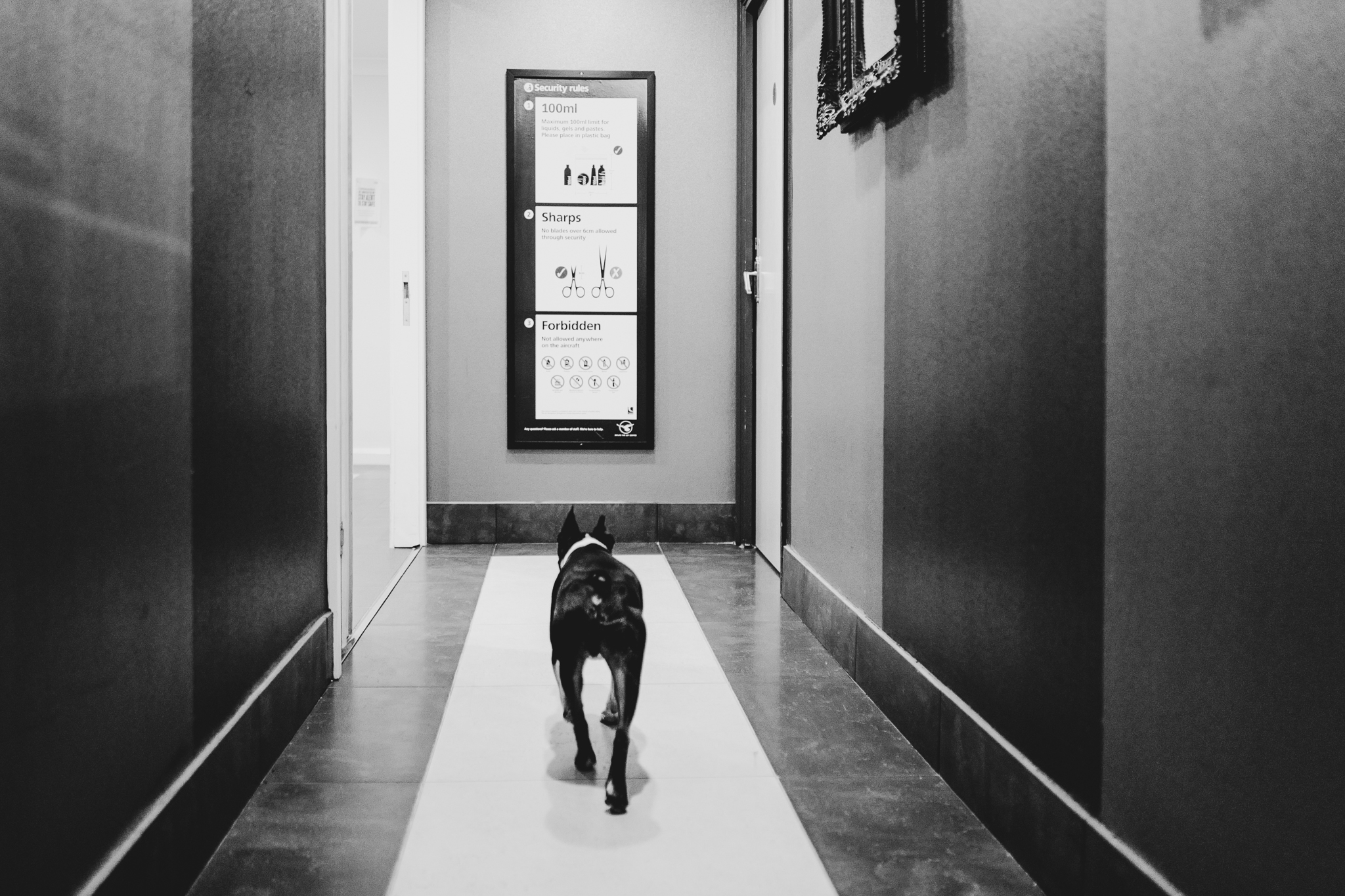
On Wednesday morning we set off to Stansted. Somewhere on the M11 the phone rang, it was Mark saying the US had pulled my clearance again due to me visiting ‘red list’ countries in the last few months. Utter nonsense, and I explained the last place I had travelled was the US just prior to the lockdown when I visited North Dakota and Arizona. I even volunteered my bank statements to prove my case. We waited at the Inflite Executive Jet Centre at Stansted with our luggage already loaded for clearance. Eventually the US backed down and removed their marker, but this now meant reapplying for entry. The decision was made to leave the jet on the tarmac overnight and return the following day to give us time to organise it. Partly this was because the crew had already started logging hours and by the time a clear to fly issued we’d need a new crew. Not that it would have mattered, but I thought I would not be flying and the one time in my life I have paid for a private jet it would be the dog flying on it, not me. And Renée of course.
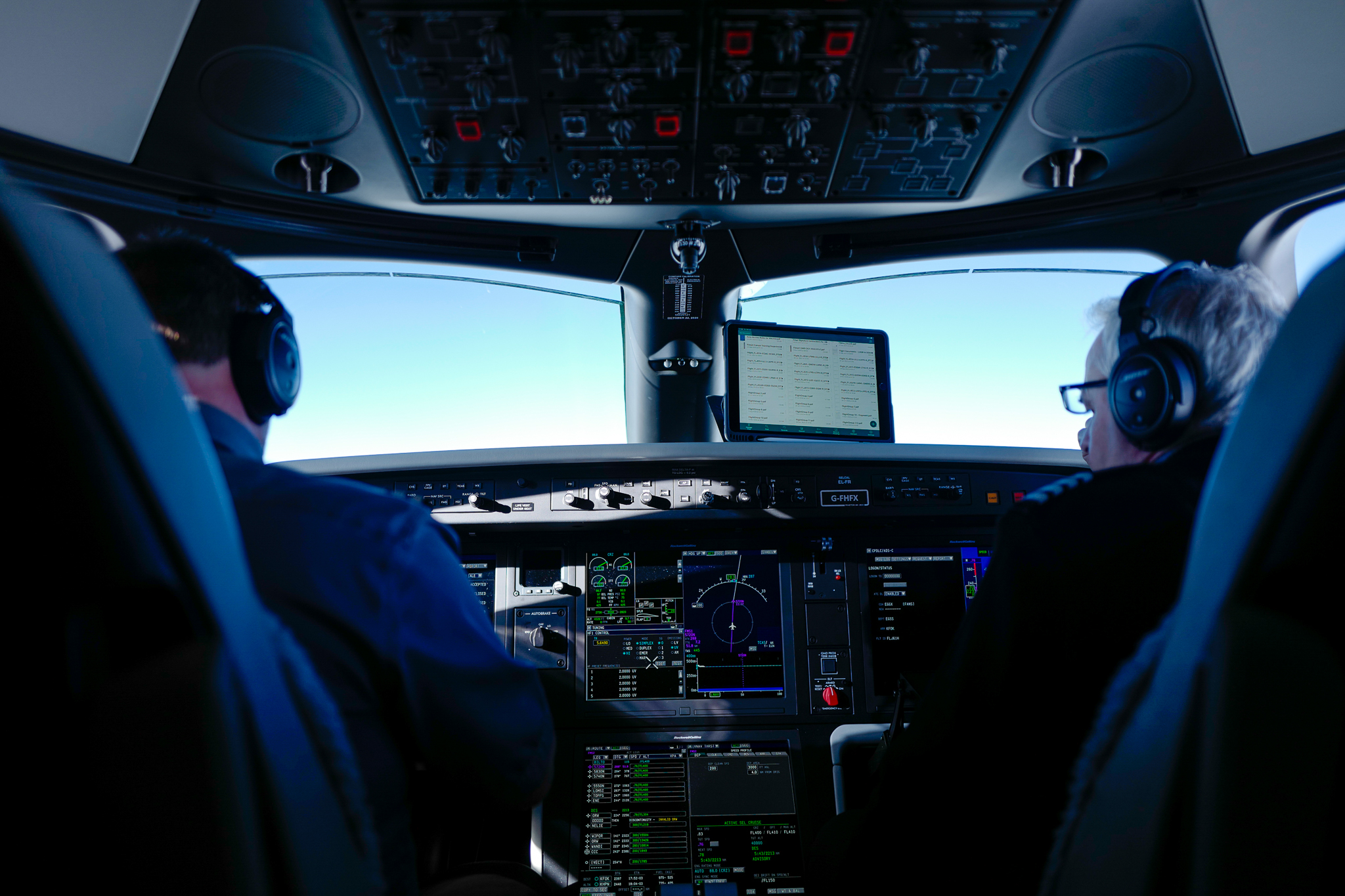
“The best part was we were truly on our way to get Alfred some help, a chance to save him
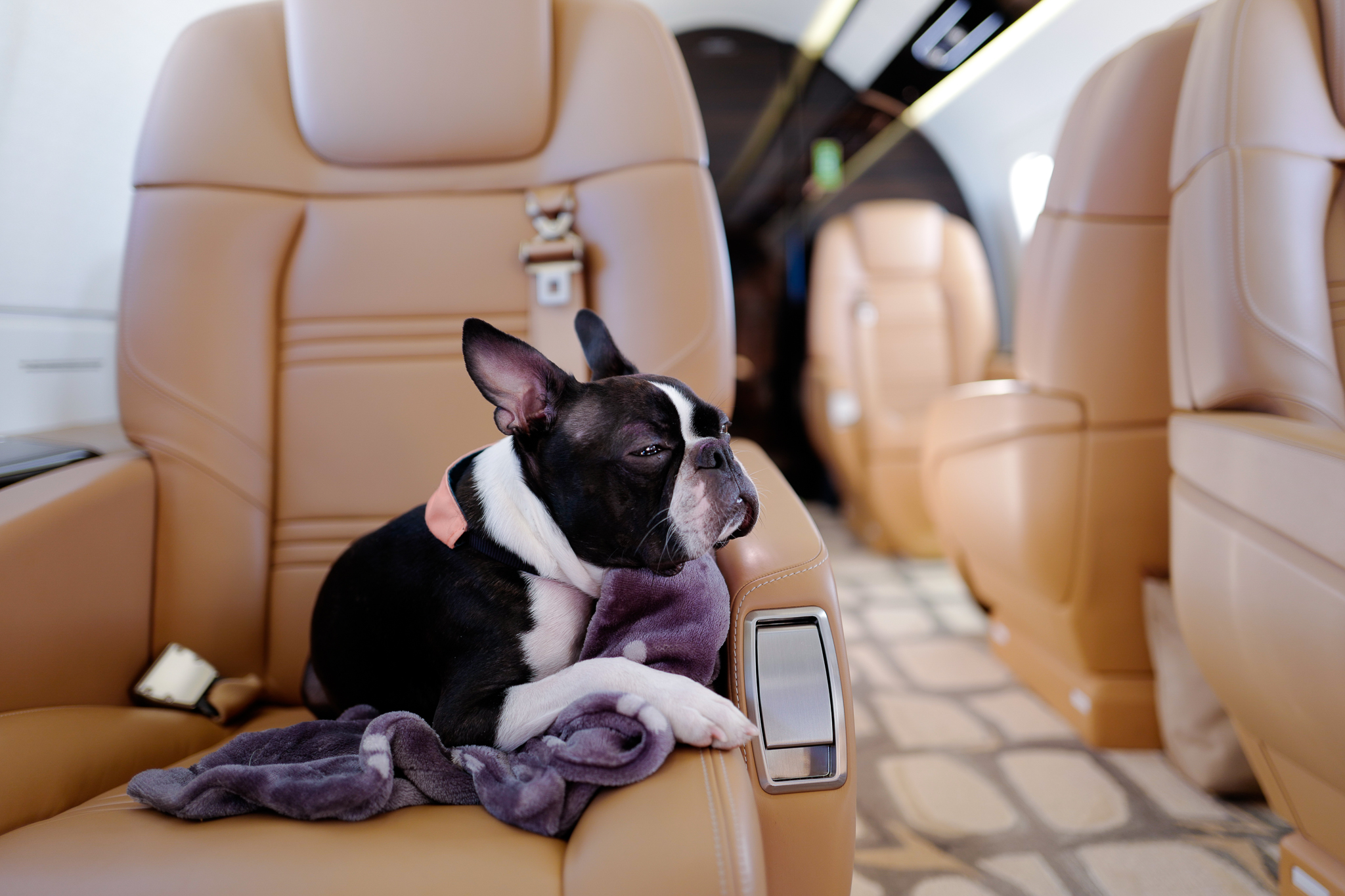
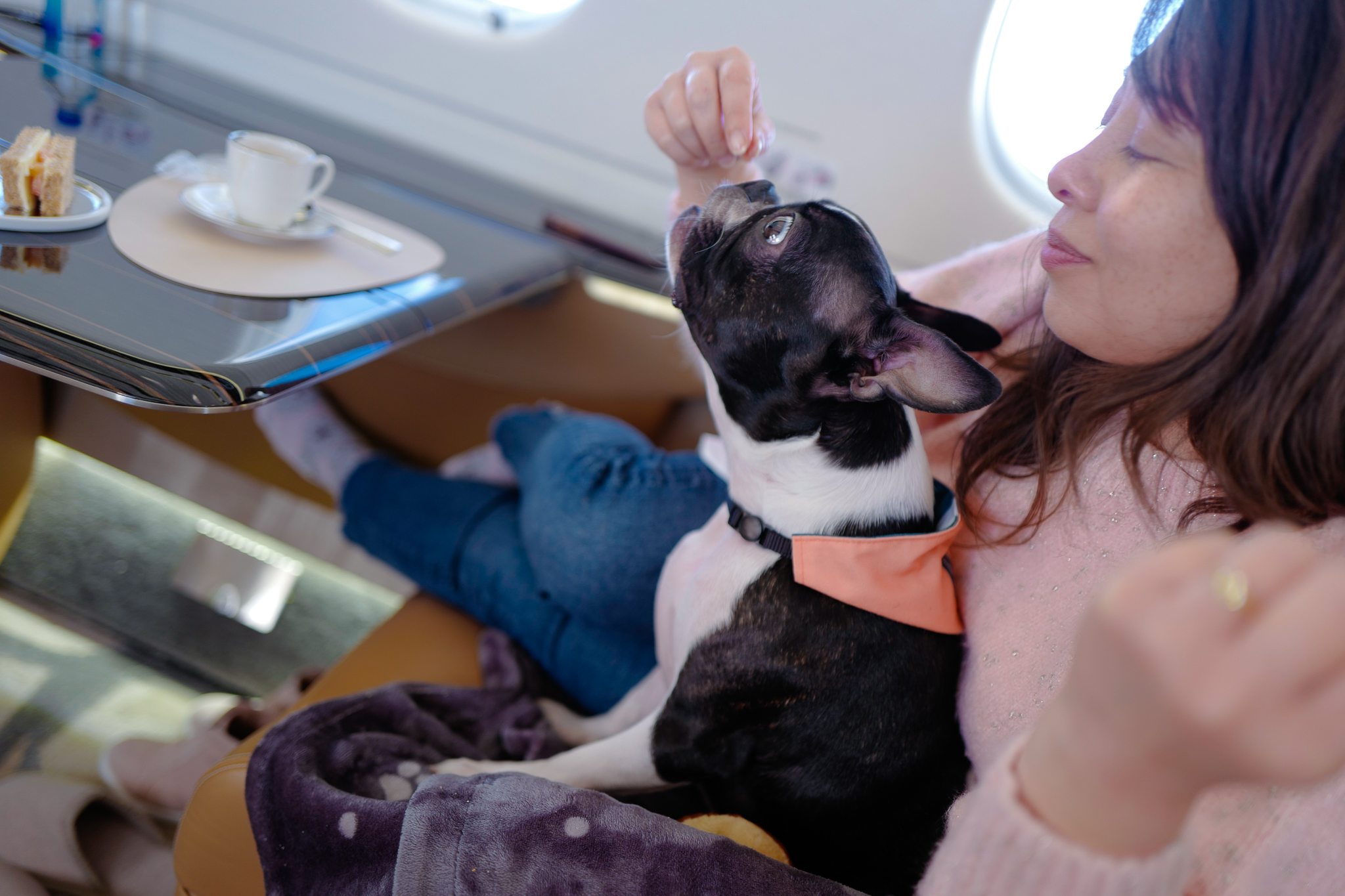
Thursday went smoothly. We turned up, parked the car, got on the jet, flew to NYC. On a commercial flight there are little increments of comfort between Economy, Premium Economy, Business and First. Compared to flying private those classes of travel are all the same. No difference. It’s all cattle class. The whole aircraft to ourselves, big luxurious seats, a sofa, your own bathroom with Diptyque toiletries. Want a lay flat bed? Just tell your own crew and they make you one up. And Alfred was free to sit where he wanted, roam around, was fed a chicken dinner off a china plate, and was even able to chase a ball along the aisle. The best part was we were truly on our way to get Alfred some help, a chance to save him.
We didn’t need reminding of the difficulties ahead. The novelty of traveling like rock stars soon faded when mid flight he suffered a seizure. By now I am well versed in how to deal with this, and Renée is able to spot the warning signs with incredible accuracy. I got him to the bathroom with a soft towel and comforted him just as his little body went into a full grand mal seizure. Since his diagnosis Alfie had been on strong barbiturate and steroid medication which had suppressed the seizures. Something that would only last so long. We were 10 days without a seizure and this a clear indication the efficacy of the medication was reducing, and the tumour growing. We were arriving just in time.
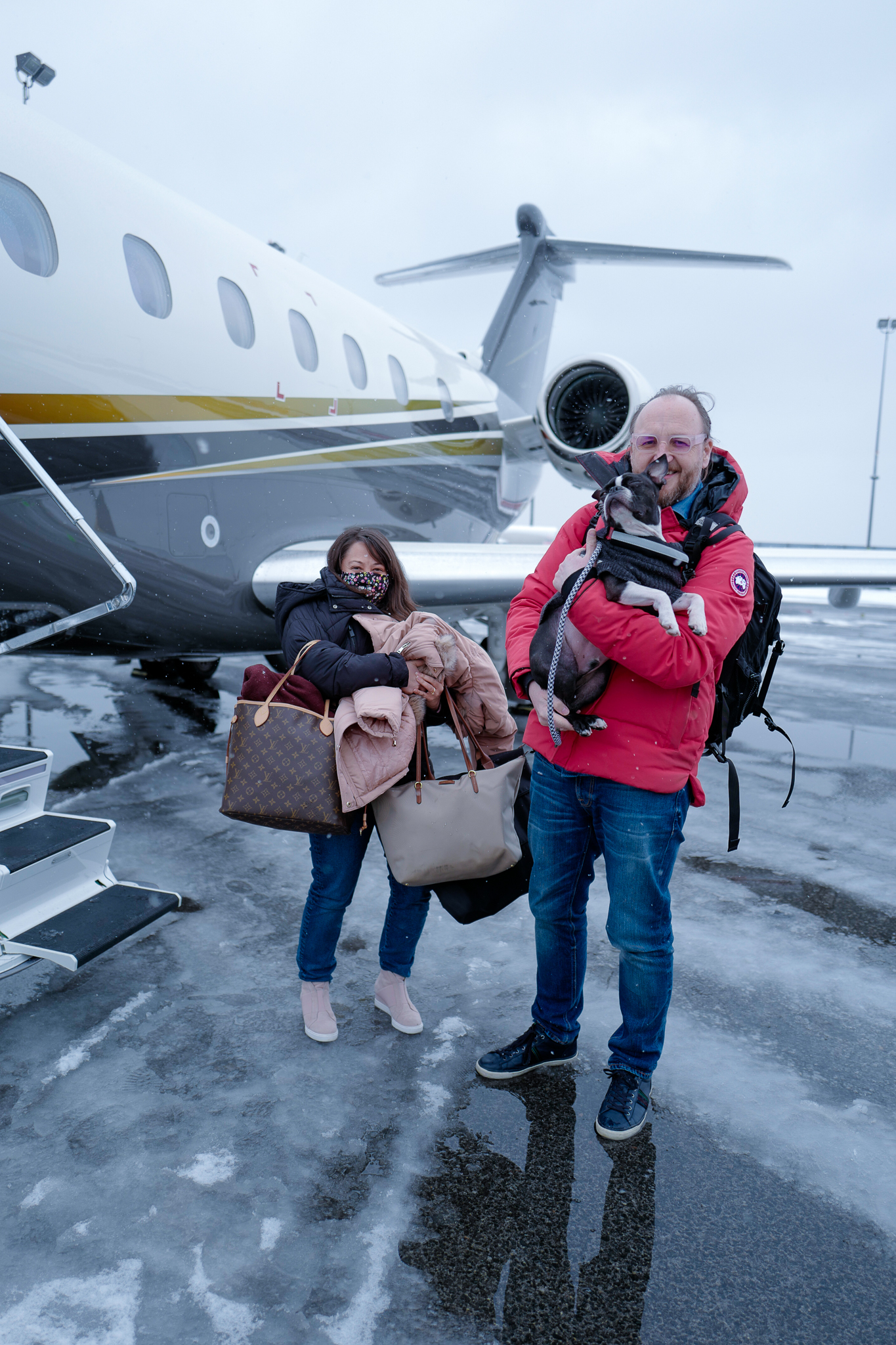
Carry on allowance an improvement over commercial.
ooOOoo
I am going to reproduce the contents of an email that I sent Anthony yesterday morning. It sums up how we feel about what Anthony and Renée are doing.
Dear Anthony,
I have now read very carefully your blog especially your posts of the last few weeks.
They are beautiful. In the sense of describing what you feel towards Alfred. Dogs bond to humans unconditionally. You love Alfred unconditionally.
It’s a little after 5am here in Southern Oregon. Jean and I are sitting back on top of our bed having had recently our first morning coffees. On the bed is also Oliver, an ex-rescue Labrador crossed with a Border Collie. Oliver’s bond with me is so precious. Beyond words but not beyond feelings!
I am going to write a couple of posts that essentially republish your posts about you getting Alfred to Minneapolis. But beyond that Jean and I want to wish you every success in Alfred’s treatment. Is there anything more practical that we can do to help? We are in our 70s. We are both English. We met in Mexico in December, 2007. Jean was rescuing dogs, spay or neutering them, then finding homes for them mainly in Arizona. I flew with my GSD, Pharaoh, to LAX from London, in 2008. Then down to Mexico. We came to the USA in 2010 to be married and to live with our then 16 dogs. Subsequently we came to Oregon in 2012.
I am so grateful for my son highlighting your blog.
With very best wishes,
Paul
A dog nicks a large bone
This is a delightful story about a dog in the country of Columbia. It just goes to show that dogs are, in the main, universally admired and loved. The story was originally published on The Dodo.
ooOOoo
Clever Dog Sneaks Into Pet Store And Makes Off With A Giant Bone
Published on 19th March, 2021
This is Agroveterinaria Los Paisas, a pet store and animal clinic in the town of Andalucia, Colombia.
It’s also the scene of a rather adorable crime.

The other day, Victoria Andrea Viviana was working in the shop, helping customers, when a certain someone evidently saw her distraction as a golden opportunity.
It was a dog. A dog with a plan.
While no one was looking, the dog quietly snuck into the store and slipped behind the counter. Then the object of his little mission became clear. He’d come to slyly steal a giant bone — but his getaway didn’t go unnoticed.
Here’s that scene on video:
“I was surprised by the cunning with which the dog took the bone,” Viviana told The Dodo. “One of our clients wanted to stop him, but he was very agile.”
The store had been robbed. But the culprit behind the crime was soon found out.
It was the dog’s own mom who turned him in.

“[The woman who owns the dog] came in to pay for the bone he stole, but we obviously didn’t take her money,” Vivian said. “It is something that happened unexpectedly, and the dog was able to amuse many people who watched the video.”
In the end, there were no hard feelings.
“The dog will always be welcome here,” Vivian said, “as well as any other animal who wants to visit.”
ooOOoo
Not much more to say except that our dogs everywhere are extraordinary in their similarity.
In fact, I am composing a post about the evolution of dogs and humans to show how far back we all go. I am not sure when it will see the light of day!
The unconditional love of dogs put to a very beneficial human use!
Yesterday while we were waiting to pay for a few food items in Winco we stopped behind a woman with a small service dog. The dog was a Dachshund and had a jacket on which were sewn badges saying that this was a service dog and not to make contact.
The woman suffered from panic attacks and strongly recommended an organisation that was called ADA. In fact it is a government organisation and ADA stands for Americans with Disabilities Act.
All of which makes a nice introduction to this next item that was published on The Conversation blog site.
ooOOoo
Training for service dogs starts very early.
By
March 26th, 2021
As many as 1 in 5 of the roughly 2.7 million Americans deployed to Iraq and Afghanistan since 2001 are experiencing post-traumatic stress disorder.
PTSD, a mental health problem that some people develop after experiencing or witnessing a life-threatening traumatic event, is a complex condition and can be hard to treat. Our lab is studying whether service dogs can help these military veterans, who may also have depression and anxiety – and run an elevated risk of death by suicide – in addition to having PTSD.
We’ve been finding that once veterans with post-traumatic stress disorder get service dogs, they tend to feel less depressed and less anxious and miss work less frequently.
Complementing other forms of treatment
The traditional treatments for PTSD, such as talk therapy and medication, do work for many veterans. But these approaches do not alleviate the symptoms for all veterans, so a growing number of them are seeking additional help from PTSD service dogs.
The nation’s estimated 500,000 service dogs aid people experiencing a wide array of conditions that include visual or hearing impairments, psychological challenges, epilepsy and multiple sclerosis.
For our PTSD research, we partner with K9s For Warriors and Canine Companions for Independence, two of many nonprofits that train service dogs to work with veterans with PTSD.
There is no single breed that can help people this way. These dogs can be anything from purebred Labrador retrievers to shelter mixes.
Unlike emotional support dogs or therapy dogs, service dogs must be trained to do specific tasks – in this case, helping alleviate PTSD symptoms. In keeping with the Americans with Disabilities Act, service dogs are allowed in public places where other dogs are not.
Reducing anxiety
Service dogs can help vets with PTSD in many ways. The most common tasks include helping veterans remain calm and interrupting their anxiety. The veterans said they are asking their dogs to calm or comfort them from anxiety five times per day and that their dogs independently interrupted their anxiety three times per day on average.
For example, a dog may “cover” a veteran at a supermarket, allowing its owner to calmly turn to take something off the shelf, because veterans with PTSD can get startled if they don’t know if someone is approaching and benefit if their dogs signal that this is happening. If a veteran starts to have a panic attack, a service dog can nudge its owner to “alert” and interrupt the anxiety. At that point, the veteran can focus on petting the dog to re-center on the present – ideally preventing or minimizing the panic attack.
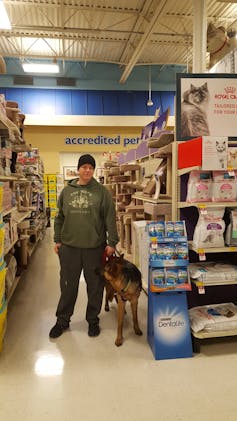
Aside from the tasks that their dogs are trained to do, veterans also shared that the love and companionship they get from simply being with their dogs is helping make their PTSD easier to manage.
Once veterans got service dogs, they described themselves in surveys as more satisfied with their lives, said they felt a greater sense of well-being and deemed themselves as having better relationships with friends and loved ones.
We have also measured levels of cortisol, commonly called the “stress hormone,” in veterans with service dogs. We found they had patterns closer to adults without PTSD.
Challenges and extra responsibilities
Not all veterans are willing or able to benefit from having their own service dogs.
Being accompanied by dogs in public can draw attention to the veterans. Some veterans appreciate this attention and the way it encourages them to get out of their shell, while others dread having to avoid well-meaning, dog-loving strangers. We’ve found that veterans do not expect this challenge, but often experience it.
Service dogs can also make it harder to travel, since bringing a dog along can require more planning and effort, especially because many people don’t understand the legal rights of people with service dogs and may ask inappropriate questions or create barriers that they aren’t legally allowed to do. Many experts believe educating the public about service dogs could alleviate these challenges.
What’s more, feeding, walking, grooming and otherwise taking care of a dog also entails additional responsibilities, including making sure they see a veterinarian from time to time.
There can also be a new sense of stigma that goes along with making a disability that might otherwise be hidden readily apparent. Someone who has PTSD might not stick out until they get a service dog that is always present.
Most veterans say it’s worth it because the benefits tend to outweigh the challenges, especially when appropriate expectations are set. Clinicians can play a role in helping veterans realize in advance what caring for the animal entails, to make the intervention positive for both the veterans and the dogs.
We are now completing the first registered clinical trial comparing what happens when these veterans get the usual PTSD interventions with what happens when they get that same treatment in addition to a trained service dog.
As our research proceeds, we are trying to see how the effects of a service dog last over time, how the service dogs affect veterans’ families and how we can support the partnership between veterans and their service dogs.
ooOOoo
I am still struggling with WordPress. For example I haven’t yet worked out how to place the credit for the photograph underneath the picture. (It did it all on its own!) And there doesn’t seem to be a ‘blockquote’ command.
But coming back to the article it was a perfect description of the way that dogs are so, so good to us humans whether we have a medical need for a service dog or not.
 Learning from Dogs