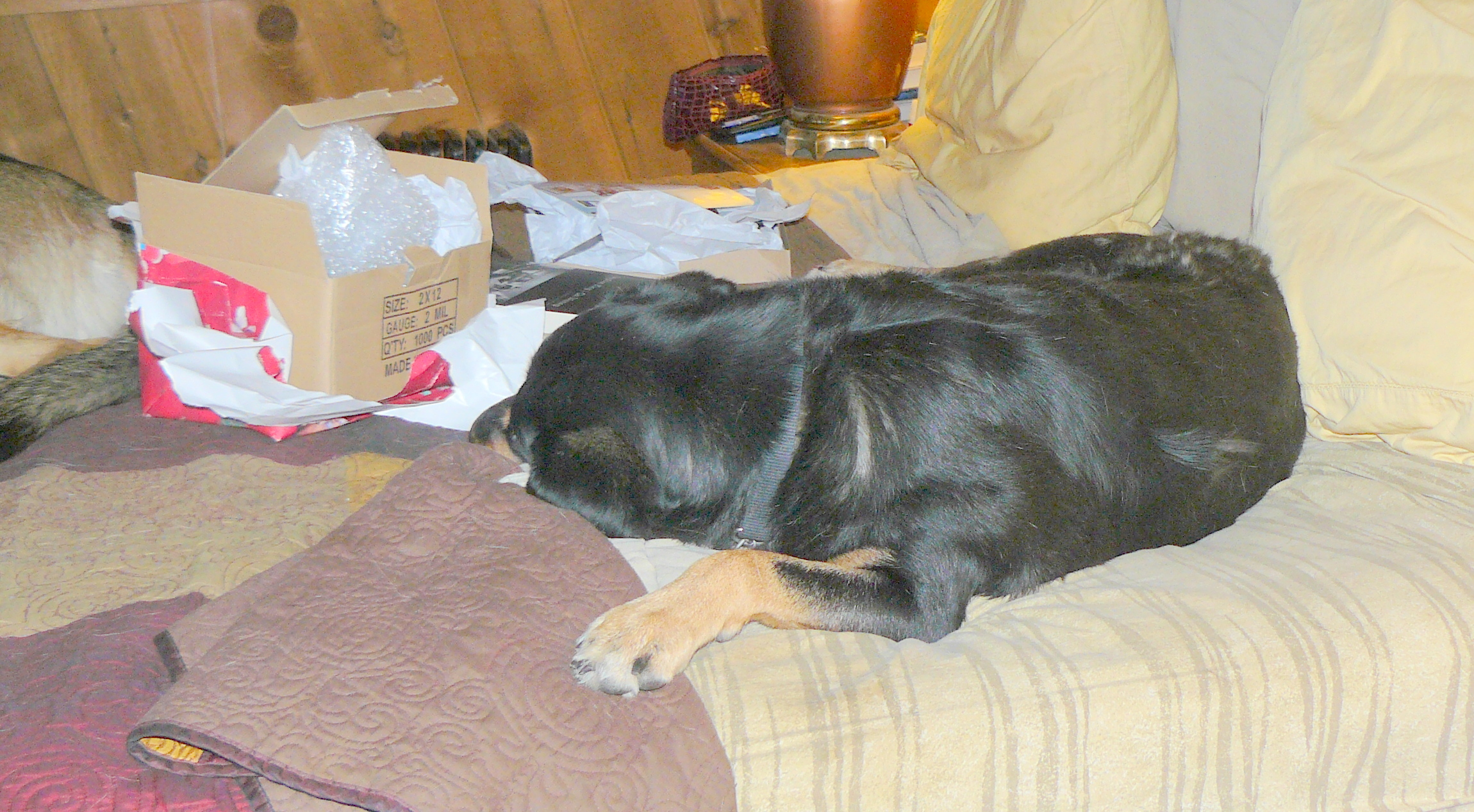
First up is a wonderful video showing a dog enjoying some guitar music.
oooo
Clearly popular because at the time of creating this post, the video had been watched 10,347,784 times!
Want to learn about how the video came about?
Then here’s the story.
oooo
And in stark contrast, here’s an item for all you parents out there, courtesy of Bob Derham.
A mother passing by her son’s bedroom was astonished to see the bed was nicely made, and everything was picked up. Then, she saw an envelope, propped up prominently on the pillow.
It was addressed, ‘Mum’. With the worst premonition, she opened the envelope and read the letter, with trembling hands.
‘Dear, Mum.
It is with great regret and sorrow that I’m writing you. I had to elope with my new girlfriend, because I wanted to avoid a scene with Dad and you.
I’ve been finding real passion with Stacy, and she is so nice, but I knew you would not approve of her, because of all her piercings, tattoos, her tight Motorcycle clothes, and because she is so much older than I am.
But it’s not only the passion, Mum. She’s pregnant.
Stacy said that we will be very happy. She owns a trailer in the woods, and has a stack of firewood for the whole winter. We share a dream of having many more children.
Stacy has opened my eyes to the fact that marijuana doesn’t really hurt anyone. We’ll be growing it for ourselves, and trading it with the other people in the commune, for all the cocaine and ecstasy we want.
In the meantime, we’ll pray that science will find a cure for AIDS, so Stacy can get better. She sure deserves it!!
Don’t worry Mum, I’m 15, and I know how to take care of myself. Someday, I’m sure we’ll be back to visit, so you can get to know your many grandchildren.
Love, your son, Nicholas.
PS: Mum, none of the above is true. I’m over at Jason’s house.
I just wanted to remind you that there are worse things in life than the school report that’s on my desk.
Yesterday’s long rant was the outcome of me promising ‘a debate’ with Patrice Ayme. Succinctly, I had disagreed with a comment from Patrice where he had written: “Force is the truth of man. Everything else is delusion, even the vegetarian style.” and wanted to respond within the space of a post rather than the more restrictive comment.
For my disagreement with Patrice had been essentially about his statement, ‘Force is the truth of man‘. I don’t recall a war in the last 50 years that has been a force for good.
But then it was Alex’s comment, see below, that stopped me short. For I realised that I was confusing ‘force’ with ‘war’ and that was probably a big mistake on my behalf. Of course, I’m writing this without the benefit of knowing better what Patrice meant in his comment! Blogging, as powerful a media as it is, does not provide for immediate interaction!
Nevertheless, Alex’s comment yesterday was powerfully inspirational. Because so many of us (and I include me in that ‘us’) all too often behave as though we are a species utterly divorced from Nature.
So what to do? Because I am fundamentally at odds with the sentiment expressed by Patrice Ayme; “Force is the truth of man. Everything else is delusion, even the vegetarian style.“
The answer takes us to tomorrow’s post, A return to integrity.
And, yes, it does mention dogs! Rather a lot as it happens!
Dogs are the one species that man has lived with longer than any other species. So when we refer to the qualities of the dog it is simply because we are so familiar with them. In no way does that exclude the numerous other species that bond with man and share the same wonderful qualities.
Qualities so easily seen: Love, Honesty, Loyalty, Trust, Openness, Faithfulness, Forgiveness and Affection. Together they are Integrity.
Of course dogs will kill a rabbit, for example, as readily as a cat will kill a mouse. In this respect force isthe truth of Nature.
The only way for species man to survive on this planet is for every element of man’s existence on this planet to be rethought of in terms of the natural order. Read the comment left by Alex in yesterday’s post:
Hi Paul, what you highlight are examples of disconnection between humanity with nature and each other. I have on my own blog highlighted a concept of Ubuntu – “I am because we are” – which is only possible when the self realises they are part of an inter-connected network of life. Your example of islands of fragmented forest where disconnected wildlife are dying out is how it is with disconnected humanity, we are doomed to destruction because we are cut off from the life-giving connection to nature.
All the problems you highlight are symptoms of the disease of disconnection, until there is reconnection to nature none of these symptoms can be successfully addressed.
War is an integral part of nature, when people seek to dismiss this then they add to the disconnection from nature. I was stung in the face by a drunken wasp a few days ago, this is how it is with nature, it is beautiful but also brutal. Peace and balance are illusions, life is in a becoming because of unbalance and strife. I advocate harmony, like a downhill skier we do not seek to control our surroundings, but instead act in harmony by moving around the obstacles such as rock and tree.
Disconnection can be as large as destroying whole forests by ignorant energy policies to those idiots who kicked a puffball to pieces before I could harvest it, or the new owners of my former home who have taken a chainsaw to all the trees and bushes in the garden. People who are disconnected do not consider how their actions impact nature or people contrary to the philosophy of Ubuntu.
“I am because we are!” Each and every one of us is where we are today, for good or ill, because of what we are: part of Nature. It’s so incredibly obvious – we are a natural species – yet who reading this wouldn’t admit at times to behaving “as though we are a species utterly divorced from Nature.”
Millions of us have pets and animals that we love. Yet we still miss the key truth of our pets. That we are a part of Nature, subject to Natural order, just as much as our pets are. We have so much to learn from our animals.
Take this rather sad story but, nonetheless, a formidable story of the integrity of one species for another. Watch the video.
oooo
Take this rather happier story about the integrity of one species for another. Watch the video.
oooo
Thus when we see the extraordinary benefits that arise from love and trust, from loyalty and faithfulness, and much more, why oh why is so much of our society fundamentally broken?
As John Hurlburt wrote in a recent email, it is because, “we are spiritual bankrupt. We spend too much of our time thinking about ourselves and what we want and too little of our time thinking about other people and what we all need.” John went on to add that this spiritual bankruptcy had preceded our moral and economical bankruptcy. He pointed out that the solution to our moral and financial problems, as well as our salvation as individuals and as a species, is spiritual. “We simply need to love the Nature of God, the earth and each other regardless of what we may believe God to be.”
Now whether you are a religious soul, or a heathen, or somewhere in the middle, it matters not. For if we continue to defy Nature and the natural laws of this planet we are going to be dust before the end of this century. Again in John’s powerful words:
Denying climate change is a death wish.
Nature always wins in the long run.
Nature is balanced. Are we?
As if to endorse the great examples that Nature offers us in terms of the benefits of love and trust, take a look at these three recent photographs from here in Oregon.
A young timid deer showing her trust of me as I sat quietly on the ground less than 30 feet away.
oooo
A mother and her fawn trusting Jean’s love for them, and getting a good feed!
oooo
Little Sweeny and Cleo converting trust to peace and happiness. (Not to mention Jean!)
Now these are not photographs to ‘ooh’ and ‘ah’ over, these are reminders that kindness, generosity, selflessness and trust are part of Nature. All the great virtues and values of man do not come from a vacuum, they come to us via Nature.
We have been blessed by an evolution that has allowed mankind to achieve remarkable things. Even to the point of leaving the confines of our planet and setting foot on the Moon and sending probes from out of our Solar System. There’s a sense, a distinctly tangible sense, that man has conquered all; that we have broken the link from being part of Nature; from being of Nature.
And now Mother Earth is reminding all of her species, every single one of them including species man, that everything is bound by her Natural Laws.
Does this mean that man has to revert to some form of pre-civilised stone-age era? Of course not! Progress can be as much within the Natural order than in competition with it, as it has been in recent times. In fact, Professor Pat Shipman explains our progress is benefited by being part of that Natural order. Here’s how Amazon describe her book, The Animal Connection.
The Animal Connection: A New Perspective on What Makes Us Human
A bold, illuminating new take on the love of animals that drove human evolution.
Why do humans all over the world take in and nurture other animals? This behavior might seem maladaptive—after all, every mouthful given to another species is one that you cannot eat—but in this heartening new study, acclaimed anthropologist Pat Shipman reveals that our propensity to domesticate and care for other animals is in fact among our species’ greatest strengths. For the last 2.6 million years, Shipman explains, humans who coexisted with animals enjoyed definite adaptive and cultural advantages. To illustrate this point, Shipman gives us a tour of the milestones in human civilization-from agriculture to art and even language—and describes how we reached each stage through our unique relationship with other animals. The Animal Connection reaffirms our love of animals as something both innate and distinctly human, revealing that the process of domestication not only changed animals but had a resounding impact on us as well.
It’s a powerful read and greatly recommended. Here’s an extract from the book [page 274, my emphasis]:
Clearly, part of the basis of our intimacy with tame or domesticated animals involves physical contact. People who work with animals touch them. It doesn’t matter if you are a horse breeder, a farmer raising pigs, a pet owner, a zoo keeper, or a veterinarian, we touch them, stroke them, hug them. Many of us kiss our animals and many allow them to sleep with us. We touch animals because this is a crucial aspect of the nonverbal communication that we have evolved over millennia. We touch animals because it raises our oxytocin levels – and the animal’s oxytocin levels. We touch animals because we and they enjoy it.
From the first stone tool to the origin of language and the most recent living tools, our involvement with animals has directed our course.
So to round this off. These last two posts came from my need to debate with Patrice the statement that “Force is the truth of man.” If Patrice’s meaning was that the truth of man is subject to the force of Nature, then I agree one-hundred percent.
For the time for man to recognise that the force of Nature is “the truth of man” is running out.
Each of us, whoever you are, for the sake of your children and for all of the children in the world, embrace today the qualities, the values of Nature.
Regular followers will be aware that both Monday’s post, The growth of empathy, and Tuesday’s post, Questions without answers, had a common theme. That of “the rising consciousness of all the millions of ordinary people just trying to leave the world in a better place”, as I wrote on Monday, in contrast, even stark contrast, with the blindness, for want of a stronger term, of those charged with governing our societies.
Around 12:45 on Monday I received a note that there was another follower of Learning from Dogs. Here is that note:
dcardiff just started following you at http://learningfromdogs.com. They will receive an email every time you publish a post. Congratulations.
You might want to go see what they’re up to! Perhaps you will like their blog as much as they liked yours!
Like many other bloggers I try and go to whatever blog site that follower has and leave a ‘thank you’ message.
So off I went to Gotta Find a Home. The blogsite is by Dennis Cardiff and the sub-title of the blog is The plight of the homeless.
Here’s how Dennis introduces his blog:
Throughout the past few years I have come to know many people, now friends, who for various reasons are, or were, homeless. Antonio, slept on a park bench and was beaten, had his teeth kicked out, for no other reason than his choice to sleep outdoors. He is a small, gentle man who has a phobia about enclosed spaces.
Craig, slept on the sidewalk in the freezing cold. I see him every morning and am never sure if, when I lift the corner of his sleeping bag, I will find him dead or alive. Sometimes, he confided, he would prefer never to awake.
Joy is a friend who fell on hard times. She slept behind a dumpster in back of Starbucks. I have seen her with blackened eyes, bruised legs, cracked ribs, cut and swollen lips. I usually see her sitting on the sidewalk ‘panning’ for change.
I can’t do much for these people except to show them love, compassion, an ear to listen, perhaps a breakfast sandwich and a coffee. I would like to do more. To know them is to love them. What has been seen cannot be unseen. I have started to write an account of their daily lives. I intend to turn this into a book and have it published. That is my goal.
I am writing articles and biographies of Joy and other street people. They have been informed that they don’t have to use their real names, that any profits would go back to the homeless and that it could be a vehicle to say whatever they want to the population at large.
Not only does that stir one’s heart and conscience but more so the fact that there are 6,069 followers of Dennis’s blog.
Please, please go along to Gotta Find A Home and embrace what wonderful people like Dennis and countless others are doing in this world. Go and read how the blogsite came about:
My lungs ached, as frost hung in the bitterly cold December morning air, making breathing difficult. I trudged in the falling snow toward Place Bell where I work, in the city’s gray, concrete, office tower canyon. I dodged other pedestrians, also trying to get to work on time, I noticed a woman seated cross-legged on the sidewalk with her back against the wall of the library. A snow-covered Buddha wrapped in a sleeping bag, shivering in the below freezing temperature. I guessed her to be in her forties. Everything about her seemed round. She had the most angelic face, sparkling blue eyes and a beautiful smile. A cap was upturned in front of her. I thought,There but for the grace of God go I. Her smile and blue eyes haunted me all day.
In the past I’ve been unemployed, my wife and I were unable to pay our mortgage and other bills, we went through bankruptcy, lost our house, my truck. Being in my fifties, my prospects looked dim. It could have been me, on the sidewalk, in her place.
I’ve been told not to give money to pan handlers because they’ll just spend it on booze. I thought to myself, What should I do, if anything? What would you do? I asked for advice from a friend who has worked with homeless people. She said, “The woman is probably hungry. Why don’t you ask her if she’d like a breakfast sandwich and maybe a coffee?”
That sounded reasonable, so the next day I asked, “Are you hungry? Would you like some breakfast, perhaps a coffee?”
“That would be nice,” she replied.
When I brought her a sandwich and coffee she said to me, “Thank you so much, sir. You’re so kind. Bless you.” I truly felt blessed.
This has become a morning routine for the past two and a half years. The woman (I’ll call Joy) and I have become friends. Often I’ll sit with her on the sidewalk. We sometimes meet her companions in the park. They have become my closest friends. I think of them as angels. My life has become much richer for the experience.
Reflect on how when you see a homeless person with so little, how so often they have a dog.
The power of love.
To close, let me tell you more about the photograph. I saw it on the blogsite Erick’s Odyssey in the following post.
This is how a real man treats his best friend
A friend of mine posted this photo on their Facebook wall. Like most people when they first see it, I was overwhelmed with several emotions.
First of all, I felt a swell of compassion for these two. I don’t even know them, but I was immediately concerned with their wellbeing. I wanted them to be warm and fed, and protected.
Secondly, I was touched with the apparent love and friendship shared by the two, even though they are not even of the same species. I thought, “They may have nothing, but they have each other, so they have everything.” I don’t know by what circumstance this man and this dog came to be together, living on the streets, but I think it is a reflection of the callousness of our society.
Whatever the reason they are homeless, they are an opportunity for us, those who have the necessities of life in abundance, to show kindness and compassion. Remember this the next time you drive by a similar scene in your warm car. Remember that if you were in their shoes, you would want, or even if you would be too ashamed to ‘want,’ you would ‘need’ someone to help you.
Our apathy is what makes us truly destitute.
Yet another example of the power of this new world of interconnectedness and how, ultimately, those connections between all those millions who care will bring about a new caring era!
My name is Noella and I am a writer and dog enthusiast from Portland, Maine. I am reaching out to you in hopes of contributing to Learning from Dogs as a guest blogger. I have an original, unpublished piece about Top Five Reasons to Pet a Pitbull Today, that I think would fit nicely with the current offering of blog topics you post. I would also be open to writing you a new piece, if there’s a specific topic you’d like covered.
Please let me know if you’d be interested in having a look at my piece and hopefully fitting it into your editorial calendar.
I hope to hear back from you soon!
Thanks,
Noella
Now to be honest, this type of writing offer is not that rare but almost without exception is connected to some form of commercial organisation seeking to advance their profile. My responses are ‘not interested’! Initially, that was my first impression of this email from Noella. But in reply to my query along that vein, Noella sent me this:
Paul,
You’re right, there will be revenue earned from dog friendly businesses that want to get involved and have ads featured on Harry’s Picks. As you can see, presently we have one dog bakery featured. The idea is to keep the website running and give back to the canine community. We are not affiliated with any brand or company.
Thank you,
Noella
Thus on that basis I was happy to go ahead with the guest post. Influenced in great part by the gorgeous temperament of our Casey, a Pit Bull that we adopted February, 2012 when we were still living in Payson, Arizona. Casey, as he was named, had been living in the Humane Centre for nearly a year with no-one taking a liking to him, and his days as a rescue dog were running out.
Jean loved Casey from first sight and in due course brought him home. He quickly settled into the most wonderful, caring and gregarious dog one could imagine. He continues to be a happy, warm dog with all of us here in Oregon.
Casey doing what dogs do so well – picking up scents of his new home. (28th February, 2012)
So with all that, let me turn to Noella’s guest post.
oooOOOooo
Top 5 Reasons To Love a Pittie
Sweet Addie.
This is Addie. She is my best friend. She is a Pit Bull mix and the sweetest dog I have ever known. I really didn’t know much about Pit Bulls when I adopted her. I hadn’t been spoiled by tales of their viciousness and I had not yet been brought into the fold by a devotee. So I had to learn fast!
Everything I know about Pit Bulls now has been through her or inspired by her.
Here are the top 5 things I love about Addie and Pit Bulls:
5) They are incredibly strong and athletic. They come in pretty small packages but they are dynamos. Addie can jump five feet straight up in the air from standing still. It’s awe inspiring to watch.
4) You will always be missed! They fuss when you come home. I’m sure lots of dogs do this, but I’ve noticed it in a lot of pitties. They whine and wiggle and snort in the most adorable way. They love people and are always ecstatic to see you. I’m lucky to get a raised eyebrow from my hound dog.
3) They love to play. Pitties are a very determined breed. They will play until you are completely worn out and they will be fully engaged and inquisitive the entire time.
2) THEY LOVE PEOPLE. In my experience Pit Bulls are the most affectionate breed. They are snuggle monsters and will use their gigantic noggins to nose their way into your personal space whether you are seeking their attention or not.
1) THEY NEED THE LOVE. Sadly Pit Bulls and Pit Bull mixes makeup 30%-40% of shelter intakes nationwide and that number goes up in urban areas (interesting article on the subject here). Pit Bulls are misunderstood and often times fall into the hands of the wrong people. They need good owners that have the love and patience to provide them solid training and safe homes.
Noella Schink, writes from Portland, Maine, where she lives and plays with her 3-year-old pit bull mix, Addie, 8-year old shih-tzu, Brutus, and 2-year old hound, Lula. For great tips and reviews about dog friendly businesses around the country, she recommends Harry’s Picks, a new online community for dog lovers.
I have often noticed how ideas come along and are then reinforced by other materials and comments. This struck me (again) as follows. In my post about the fabulous, loving bond between Jeff Guidry and his eagle Freedom one of the comments was from Patrice Ayme, and I quote:
Birds have completely different brains. Still, the smartest birds are more clever than most primates. And many parrots speak (although we have not learned their language yet).
Then going on to add:
Parrot language studies have progressed enough to tell us that there is something huge going on. They apparently use names, as dolphins do.
Certainly Jean would verify the amount of talking that goes on between our two budgerigars here at home!
Mr. Green and Mr. Blu!
Then in yesterday’s post The knowing of dogs, I referred to research that indicated that empathy between those that we know and trust, (a) can be measured, and (b) that “our minds are partly defined by their intersections with other minds.” I went on in that post to speculate that maybe dogs ‘reading’ the minds of humans that they know and trust wasn’t so far-fetched.
Wolves Howl Because They Care: Social Relationship Can Explain Variation in Vocal Production
Aug. 22, 2013 — When a member of the wolf pack leaves the group, the howling by those left behind isn’t a reflection of stress but of the quality of their relationships. So say researchers based on a study of nine wolves from two packs living at Austria’s Wolf Science Center that appears in Current Biology, a Cell Press publication, on August 22.
The findings shed important light on the degree to which animal vocal production can be considered as voluntary, the researchers say.
“Our results suggest the social relationship can explain more of the variation we see in howling behavior than the emotional state of the wolf,” says Friederike Range of the Messerli Research Institute at the University of Veterinary Medicine Vienna. “This suggests that wolves, to a certain extent, may be able to use their vocalizations in a flexible way.”
Scientists have known very little about why animals make the sounds that they do. Are they uncontrollable emotional responses? Or do animals have the ability to change those vocalizations based on their own understanding of the social context?
At the Wolf Science Center, human handlers typically take individual wolves out for walks on a leash, one at a time. On those occasions, they knew, the remaining pack mates always howl.
To better understand why, Range and her colleagues measured the wolves’ stress hormone levels. They also collected information on the wolves’ dominance status in the pack and their preferred partners. As they took individual wolves out for long walks, they recorded the reactions of each of their pack mates.
Those observations show that wolves howl more when a wolf they have a better relationship with leaves the group and when that individual is of high social rank. The amount of howling did not correspond to higher levels of the stress hormone cortisol.
“Our data suggest that howling is not a simple stress response to being separated from close associates but instead may be used more flexibly to maintain contact and perhaps to aid in reuniting with allies,” Range says.
For those that want to read the original research paper then it is available over at Current Biology, a Cell Press publication.
Wolf Howling Is Mediated by Relationship Quality Rather Than Underlying Emotional Stress
We investigated the influence of social and physiological factors on wolf howling
Wolves howl more to keep contact with affiliated partners and with pack leaders
Howling is mediated by the social relationship not cortisol level of the howlers
This pattern indicates that wolves have some voluntary control of their howling
Summary
While considerable research has addressed the function of animal vocalizations, the proximate mechanisms driving call production remain surprisingly unclear. Vocalizations may be driven by emotions and the physiological state evoked by changes in the social-ecological environment [1,2], or animals may have more control over their vocalizations, using them in flexible ways mediated by the animal’s understanding of its surrounding social world [3,4]. While both explanations are plausible and neither excludes the other, to date no study has attempted to experimentally investigate the influence of both emotional and cognitive factors on animal vocal usage. We aimed to disentangle the relative contribution of both mechanisms by examining howling in captive wolves. Using a separation experiment and by measuring cortisol levels, we specifically investigated whether howling is a physiological stress response to group fragmentation [5] and whether it is driven by social factors, particularly relationship quality [6,7]. Results showed that relationship quality between the howler and the leaving individual better predicted howling than did the current physiological state. Our findings shed important light on the degree to which animal vocal production can be considered as voluntary.
So, don’t know about you, but it all seems to be suggesting how little we know about how animals communicate with the world around them.
A fascinating study on human empathy strikes a chord with man and dog, perhaps.
Let me start with a true account from the evening of Monday, 19th August.
That evening, at 7pm, I had an appointment with my doctor in Grants Pass. Jean stayed at home looking after our guests and preparing the evening meal.
The journey from the doctor’s clinic back to home, a distance of 20 miles, takes a little over half-an-hour. The last 3 miles are along Hugo Road; about 6 minutes including opening and closing the gate across our driveway.
Anyway, according to Jean shortly after 8pm Pharaoh sprang up barking and went across to put his nose against one of the windows that looks out over our front drive and garden. Jeannie looked at the clock on the kitchen wall and made a note of the time: it was 8:10pm. She also came over to the window that Pharaoh was looking out of and searched for any reason for his outburst of barking: squirrels, deer, any kind of wildlife or other distraction. There was none.
A little before 8:20pm Jeannie saw the headlights of my car pull up and moments later I came in through the front door.
It appeared that Pharaoh had sensed the point where I had turned into Hugo Road.
One could easily dismiss this, perhaps by thinking that Jean had unconsciously signalled to Pharaoh that I was on my way home. But Jean had only the vaguest idea of when I might be back.
Or one could be drawn to the research undertaken by Dr. Rupert Sheldrake, as this extract from a post back in May, 2011 explains.
What an amazing book this is.
Amazing!
I have written about Dr Rupert Sheldrake a few times on Learning from Dogs for pretty obvious reasons! You can do a search on the Blog under ‘sheldrake’ but here are a couple of links. Serious Learning from Dogs on January 10th, 2011 and Time for a rethink on the 14th April, 2011.
Anyway, I am now well towards the end of Sheldrake’s revised book, Dogs That Know When Their Owners Are Coming Home and it is more than fascinating. Bit short of time just now so please forgive me if I do no more than show this video which sets out some of the background to the book. Sheldrake’s website is here, by the way.
Anyway, what’s this all leading up to?
I can’t recall where it was that I read about a report posted on the Forbes website about the new findings of the power of human empathy.
Study: To The Human Brain, Me Is We
A new study from University of Virginia researchers supports a finding that’s been gaining science-fueled momentum in recent years: the human brain is wired to connect with others so strongly that it experiences what they experience as if it’s happening to us.
This would seem the neural basis for empathy—the ability to feel what others feel—but it goes even deeper than that. Results from the latest study suggest that our brains don’t differentiate between what happens to someone emotionally close to us and ourselves, and also that we seem neurally incapable of generating anything close to that level of empathy for strangers.
The research revealed:
“The correlation between self and friend was remarkably similar,” said James Coan, a psychology professor in U.Va.’s College of Arts & Sciences who co-authored the study. “The finding shows the brain’s remarkable capacity to model self to others; that people close to us become a part of ourselves, and that is not just metaphor or poetry, it’s very real. Literally we are under threat when a friend is under threat. But not so when a stranger is under threat.”
The findings back up an assertion made by the progenitor and popularizer of “Interpersonal Neurobiology,” Dr. Daniel Siegel, who has convincingly argued that our minds are partly defined by their intersections with other minds. Said another way, we are wired to “sync” with others, and the more we sync (the more psycho-emotionally we connect), the less our brains acknowledge self-other distinctions.
Later in that Forbes article Professor Coan is reported:
“A threat to ourselves is a threat to our resources,” said Coan. “Threats can take things away from us. But when we develop friendships, people we can trust and rely on who in essence become we, then our resources are expanded, we gain. Your goal becomes my goal. It’s a part of our survivability.”
So if science is discovering that our subconscious minds are connecting “psycho-emotionally” with the minds of others whom we trust, then it doesn’t seem like too great a leap to embrace human minds psycho-emotionally connecting with the animals that we trust, and vice versa. Because for thousands upon thousands of years, the domesticated dog and man have depended on each other for food, protection, warmth, comfort and love.
Footnote.
References for those who wish to follow up on this article are:
Professor Robin Ian MacDonald Dunbar, British anthropologist, evolutionary psychologist and a specialist in primate behaviour. His theory known as Dunbar’s Numberexplained here.
The widely reported but nonetheless wonderful story of a man and an eagle.
This was sent to me by Dan Gomez but I very quickly found information all over the ‘web’. After reading many accounts, I decided to use the version of the story that was in Dan’s email.
oooOOOooo
Freedom and Jeff Guidry
Love and trust across the species gap.
Freedom and I have been together 11 years this summer. She came in as a baby in 1998 with two broken wings. Her left wing doesn’t open all the way even after surgery, it was broken in 4 places. She’s my baby.
When Freedom came in she could not stand and both wings were broken. She was emaciated and covered in lice. We made the decision to give her a chance at life, so I took her to the vet’s office. From then on, I was always around her. We had her in a huge dog carrier with the top off, and it was loaded up with shredded newspaper for her to lay in. I used to sit and talk to her, urging her to live, to fight; and she would lay there looking at me with those big brown eyes. We also had to tube feed her for weeks.
This went on for 4-6 weeks, and by then she still couldn’t stand. It got to the point where the decision was made to euthanize her if she couldn’t stand in a week. You know you don’t want to cross that line between torture and rehab, and it looked like death was winning. She was going to be put down that Friday, and I was supposed to come in on that Thursday afternoon. I didn’t want to go to the center that Thursday, because I couldn’t bear the thought of her being euthanized; but I went anyway, and when I walked in everyone was grinning from ear to ear. I went immediately back to her cage; and there she was, standing on her own, a big beautiful eagle. She was ready to live. I was just about in tears by then. That was a very good day.
We knew she could never fly, so the director asked me to glove train her. I got her used to the glove, and then to Jesse’s, and we started doing education programs for schools in western Washington.
We wound up in the newspapers, radio (believe it or not) and some TV. Miracle Pets even did a show about us.
In the spring of 2000, I was diagnosed with non-Hodgkin’s lymphoma. I had stage 3, which is not good (one major organ plus everywhere), so I wound up doing 8 months of chemo. Lost the hair – the whole bit. I missed a lot of work. When I felt good enough, I would go to Sarvey and take Freedom out for walks. Freedom would also come to me in my dreams and help me fight the cancer. This happened time and time again.
Fast forward to November 2000.
The day after Thanksgiving, I went in for my last checkup. I was told that if the cancer was not all gone after 8 rounds of chemo, then my last option was a stem cell transplant. Anyway, they did the tests; and I had to come back Monday for the results. I went in Monday, and I was told that all the cancer was gone.
So the first thing I did was get up to Sarvey and take the big girl out for a walk. It was misty and cold. I went to her flight and we went out front to the top of the hill. I hadn’t said a word to Freedom, but somehow she knew. She looked at me and wrapped both her wings around me to where I could feel them pressing in on my back (I was engulfed in eagle wings), and she touched my nose with her beak and stared into my eyes, and we just stood there like that for I don’t know how long. That was a magic moment. We have been soul mates ever since she came in. This is a very special bird.
On a side note: I have had people who were sick come up to us when we are out, and Freedom has some kind of hold on them. I once had a guy who was terminal come up to us and I let him hold her. His knees just about buckled and he swore he could feel her power course through his body. I have so many stories like that..
I never forget the honor I have of being so close to such a magnificent spirit as Freedom.
“Until one has loved an animal, a part of one’s soul remains unawakened.” Anatole France
This gorgeous video has been doing the rounds and came to me thanks to Suzann.
Enjoy!
Very Talented Russian Bear and His Awesome Friend
This unbelievably talented and cute Russian bear can roll over, play the trumpet, sit on a lawn chair, play the trumpet, you name it. Leave it to a random Russian guy to train such an awesome bear.
Jean and I have been involved in a research programme involving our own dogs here at home. So far, without much success. But it occurred to me that there may be readers who would like to participate. So here’s an email in response to my offer to post something in this place.
Companion Animal Research Group
Pam Smart and I are setting up a Companion Animal Research Group for people who would like to do research with their dogs, cats or other animals. If you have an animal that knows when you are coming home or who seems to respond to your thoughts and intentions telepathically, and if you would like to take part in a simple research project, please get in touch with Pam by email: p.e.smart (at) btinternet (dot) com She will send you further details.
Of course, if you do have such a telepathic animal then they will know about this post before you do! 😉
A beautifully written, soul-stirring account of strife, darkness, hope and, above all, love shared between dog and human.
Gracious, I don’t know where to start! Guess at the beginning.
Which was that a little over a month ago, I received this email:
Dear Paul:
I hope this note finds you well. We were in touch several years about Racing in the Rain, and I wanted to get in touch about another dog-related novel that may be of interest to you and your readers.
I am working with Forge Books to set up a blog tour for Andrea Thalasinos, whose novel Traveling Light hits bookshelves and e-readers on July 16th. Traveling Light is an inspiring story about fate, family, and healing; it also explores the special bond that exists between humans and canines.
Now I well remembered the book Racing in the Rain, writing about it in May 2011 and then a guest post from the author, Garth Stein, in September under the title of A game called Fetch.
Wiley included in his email a “flavour” of Andrea Thalasinos’ novel, as in:
Paula Makaikis is ashamed of her marriage. Driven out of their bedroom by Roger’s compulsive hoarding, she has spent the past ten years sleeping downstairs on her husband’s ratty couch. Distant and uninspired, Paula is more concerned with the robins landing on her office window ledge than her hard-earned position at the university. Until a phone call changes everything.
A homeless Greek man is dying in a Queens hospital and Paula is asked to come and translate. The old man tells her of his beloved dog, Fotis, who bit a police officer when they were separated. Paula has never considered adopting a dog, but she promises the man that she will rescue Fotis and find him a good home. But when Fotis enters her life she finds a companion she can’t live without. Suddenly Paula has a dog, a brand-new Ford Escape, an eight-week leave of absence, and a plan.
So Fotis and Paula begin the longest drive of their lives. In northern Minnesota, something compels her to answer a help-wanted ad for a wildlife rehabilitation center. Soon Paula is holding an eagle in her hands, and the experience leaves her changed forever.
Traveling Light explores what is possible when we cut the ties that hold us down and the heart is free to soar.
Of course, I wanted to read and review Andrea’s book. Wiley and I agreed that a review published on the 18th July, i.e. today, would be perfect. However, for reasons not entirely clear, the review copy of the book didn’t arrive until July 10th; just 8 days ago. That made it too tight for me to read in that time, so I gave the book to Jean for her to read first.
If I tell you that Jean devoured the book and had it finished in three days, you won’t get a better idea than that of how moving and captivating she found it. At the time of writing this post (9am yesterday) I was already up to page 160. So the review that follows a little later in today’s post is the combined feelings of Jean and me.
One of the other things that Wiley offered was for Andrea to write a guest post for Learning from Dogs. That now follows! I checked with Wiley: This is a true account from Andrea. (Trust me, you will be entranced!)
oooOOOooo
Andrea and Panda.
We’d come up to the edge of a wooden bridge that had almost as much space between the boards as the width of the boards themselves. Snow ordinarily covered the iffy-looking surfaces of such bridges, but the strength March’s early sun had melted clear down to the wood, leaving a full view of the snowy rocks in the creek bed below.
At the time, I didn’t know what my lead dog, Gorky, a red Siberian yearling (tiny in stature by Siberian standards) would do. From a puppy, she’d had more confidence in her furry little toe than I had in my whole body.
The dog positioned the team at the edge of the bridge and paused. She looked around, sniffing the wind, looking to the other side and then down through the slats into the creek bed below. I could tell she was thinking, calculating risks, odds and whether or not she had the moxie to cross. The other six dogs (including her father), were hooked up to the gangline behind her and by the set of their shoulders, their hedging and shirking back in their harnesses I could tell they were nervous.
It was a narrow trail, just wide enough for one dog team. Two more experienced teams were closing in from behind and I wondered what we would do. Rock walls butted up to either side of the trail, making it impossible to either turn around or move off the trail to let the others pass. I’d considered leading my dog team down into the gully, but the drop-off looked steep and as a rookie musher, I didn’t trust my skills to do so safely.
“Fifty bucks says she won’t take it,” the approaching musher called out from behind.
Thinking I’d be out the fifty before I could say boo, Gorky stepped up to the edge. Her body language changed. She’d committed to taking the bridge. As the red dog leaned into her harness, she gave the forward cue. The others fell in line, following her calm, forward gait with no signs of wavering.
After her first step I noticed that not once did Gorky look down, but rather kept her eye on the other side of the bridge as if she were already there.
Whenever I have to make difficult decisions, I think back to this moment. Sometimes I don’t have enough information or am waiting for some cosmic gut-affirmation that never seems to arrive when I need it. But one thing is clear. Like Gorky, once I set my mind on a course of action, I think of her and act.
Who knows if she was scared or not—she never said. The red dog lived to be 15 ½ and taught me more about not second-guessing than any person, place or thing I’ve come across since. Being brave doesn’t mean you’re not scared, it just means you do it anyway.
oooOOOooo
Traveling Light, a novel by Andrea Thalasinos
The opening of the book, In The Beginning, more of a prologue than anything else, firmly sets the context. For we read that the heroine of the story, Paula Makaikis, is tipped out of what is a highly unsatisfactory marriage into “the longest drive of her life” by a phone call from Celeste, Paula’s best friend.
The drive comes out of the tragic death of an old Greek man who pleads, in his last few breaths, that Paula takes his dog, Fotis, before the pound puts the dog to sleep.
If I tell you that by page 71, I had been brought to tears on two occasions then you will understand the depth of feeling that Andrea conveys: about life; about love; and the precious nature of a dog called Fotis .
This book, even as a work of fiction, seems to reach out to the reader, well to this reader anyway, with many messages of what life is all about. Take this for example, from page 104:
Paula few out of the Holland Tunnel into the early colors of the morning. Gas pedal depressed, windows open, her hair blowing, the faster she accelerated the better she felt. Getting up to eighty, then ninety, she thought maybe the wind would whisk her thoughts away.
Jersey was a blur except for periodic traffic congestion; Pennsylvania went on like a past life. The faster she drove, the clearer the sense that there was somewhere she needed to be. It wasn’t California or New York. It wasn’t a place. The map was nothing but lines, numbers, destinations. Wherever she was meant to be, she’d know it when she got there.
How many of us have shaken off our troubles as a dog shakes off water from its coat and ended up coming to a place and knowing that we were at the place we were meant to be!
In many ways, the book is a lovely fairy-tale, right up to the perfect ending. But in so many other ways the book is a reminder that we only have one life. Easy to say but less easy to embrace fully with heart and head. In fact, the book reinforces something that I wrote as a private letter to a family member in consequence of my sister’s recent death. I will share just a portion of that letter because I sense Andrea Thalasinos would love to see how her book reaches out to her readers.
Be clear about the purpose of life: your life. Do not put off what brings meaning, truth and happiness. Not even for a day. Live your beautiful life now; live it this day.
Thus for both Jean and me, this was the most beautiful of books and both of us have no hesitation in strongly recommending it.
Big thanks to Wiley Saichek for giving Jean and me the opportunity to read Traveling Light.
oooOOOooo
Now here’s an offer.
Wiley has offered a free copy of Andrea’s book as a ‘give-away’ from Learning from Dogs. Here’s the plan.
Would you like to write a story about any aspect of the relationship that dogs can have with humans?
Any length, truth or fiction; it doesn’t matter. Email your story to me (learningfromdogs (at) gmail (dot) com) to be received by the end of Wednesday, 31st July 2013, Pacific Daylight Time.
Then during the early part of August, I will publish every one received with some mechanism for readers to ‘score’ the stories and the winning author will be sent a free copy of the book.