With grateful thanks to Tricia for sending these on.
The following goes with the picture above. It has been published before but so what! It deserves repeated postings!
“Dogs Welcome”
A man wrote a letter to a small hotel in a Midwest town he planned to visit on his vacation. He wrote:
I would very much like to bring my dog with me. He is well-groomed and very well behaved. Would you be willing to permit me to keep him in my room with me at night?”
An immediate reply came from the hotel owner, who wrote:
SIR: “I’ve been operating this hotel for many years. In all that time, I’ve never had a dog steal towels, bedclothes, silverware or steal pictures off the walls or use them as a coloring book. I’ve never had to evict a dog in the middle of the night for being drunk and disorderly. And I’ve never had a dog run out on a hotel bill.
Yes, indeed, your dog is welcome at my hotel. And, if your dog will vouch for you, you’re welcome to stay here, too.”
oooo
oooo
oooo
oooo
You all have a great week and keeping loving those dogs of yours!
Another wonderful dog story, courtesy of Chris Snuggs.
Over four years ago, I published a post under the title of Faithful dog Hachikō. It was the heart-wrenching story of a Japanese Akita dog called Hachi, Hachikō in Japanese, that continued to wait for his master’s return, Hidesaburō Ueno, for years after the professor’s death. Here’s an extract from that post:
In 1924, Hidesaburō Ueno, a professor in the agriculture department at the University of Tokyo took in Hachikō as a pet. During his owner’s life Hachikō saw him out from the front door and greeted him at the end of the day at the nearby Shibuya Station. The pair continued their daily routine until May 1925, when Professor Ueno did not return on the usual train one evening. The professor had suffered from a cerebral hemorrhage at the university that day. He died and never returned to the train station where his friend was waiting. Hachikō was loyal and every day for the next nine years he waited sitting there amongst the town’s folk.
Hachikō was given away after his master’s death, but he routinely escaped, showing up again and again at his old home. Eventually, Hachikō apparently realized that Professor Ueno no longer lived at the house. So he went to look for his master at the train station where he had accompanied him so many times before. Each day, Hachikō waited for Professor Ueno to return. And each day he did not see his friend among the commuters at the station.
The permanent fixture at the train station that was Hachikō attracted the attention of other commuters. Many of the people who frequented the Shibuya train station had seen Hachikō and Professor Ueno together each day. They brought Hachikō treats and food to nourish him during his wait.
This continued for nine years with Hachikō appearing precisely when the train was due at the station
A loyal dog has shown up every day for two years at a hospital where her master passed away.
Masha appears at the Siberian hospital’s reception area every morning, the Siberian Times reports.
Her owner was admitted to the hospital in Novosibirsk region, south western Siberia, two years ago after falling ill.
Masha is well cared for by staff who make sure she has a warm bed and food every night. The faithful canine was the elderly man’s only visitor, staff say, and used to run home every night to stand guard before returning the next morning.
If we then go across to that Siberian Times story, we see that the wonderful Masha is linked to Hachikō.
Heartbroken little dog becomes Siberia’s own ‘Hachiko’
By Kate Baklitskaya and Derek Lambie – 24 November 2014
For past year devoted Masha has been waiting in a hospital for the beloved owner who will never return.
‘One day, and we very much want this day to come soon, our Masha will trust somebody.’ Picture: Svyatoslav Odarenko
A little dog that waits in vain at a Siberian hospital for the owner who has already died has been dubbed Russia’s own Hachiko. Heartbroken Masha has been turning up looking for her beloved master every day since he passed away at the facility in Novosibirsk last year.
It is a tale mirroring that of the famously loyal Akita dog Hachiko in Japan, who arrived at a train station every evening for 10 years to greet its owner even though he had died.
Masha has become a well-known, and much loved, figure at the Novosibirsk District Hospital Number One, where patients and workers ensure she has a warm bed and food to eat.
But, aware of her obvious sadness at being unable to find her owner, staff are hoping an animal lover will come forward to adopt her and give her a new home.
Chief doctor Vladimir Bespalov told Novosibirsk Vesti TV: ‘You see her eyes, how sad they are – it’s not the usual shiny eyes for when a dog is happy. You can see this in animals in the same way as with people.
‘There is nothing medicine can do for her here, but we are still hoping that Masha will be able to find another owner. One day, and we very much want this day to come soon, our Masha will trust somebody.’
Masha, who looks like a dachshund with short legs, has been coming into the reception at the hospital in Koltsovo every day for the past two years since her owner was admitted. The man, a pensioner from the village of Dvurechie several kilometres away, had fallen ill and had turned up with his pet.
There are three heart-rending photographs of Masha that you really must look at. The article then concludes:
Whilst he was staying on the ward, Masha was his only visitor and she even trotted off home to guard the house before returning to the hospital in the morning.
Sadly he died a year ago but the loyal dog has continued to turn up every day, perhaps because she has nowhere to live, or because she believes her master is still there.
Nurse Alla Vorontsova said: ‘She is waiting for him, for her owner. Just recently a family tried to adopt her, but Masha ran away and returned to the hospital. She was taken on Friday evening, and at 3am on Saturday she was back here.’
Masha’s story is similar to that of the famous Japanese dog Hachiko, who used to greet his master on his return from work at the Shibuya train station in Tokyo.
When his owner, agricultural science professor Hidesaburo Ueno, died in 1925 he continued to visit the station every night for 10 years still expecting to meet him off his 4pm train.
In 1935 the dog’s body was found in a Tokyo street and his remains were stuffed, mounted and put on display in Japan’s National Science Museum, while a bronze statue was erected outside Shibuya. A Hollywood movie of the sad story, starring Richard Gere, was released in cinemas in 2010.
There are also similarities to Greyfriars Bobby, a little Scottish terrier who was unwilling to leave his dead master’s grave in Edinburgh, Scotland, for 14 years in the 19th century.
What wonderful, loyal, loving friends dogs are to us humans.
An interesting article that appeared in the New Scientist.
Well I managed to write the 50,000 words required of me to be a ‘winner’ of NaNoWriMo14. I was validated in at 53,221 words, albeit the book is not yet completed. Together with my writings from 2013, I am within 10,000 words, give or take, of finishing the draft. Then the fun starts: the big edit!
Anyway, moving on!
The UK’s New Scientist magazine emailed me recently an article that they fathomed would be of interest. Presumably, hoping I would immediately sign up to be a subscriber. Well if that was there presumption, I will be disappointing them. But the article was certainly of interest and, as it was sent to me without my invitation, I don’t feel too bad about republishing it in full.
ooOOoo
Dog head-turning shows they do understand what you say
YOU’RE just so right-side. The left hemisphere of our brains seems to tune into the phonemes in speech that combine to form words, and the right hemisphere focuses on the rhythm and intonation of words, which can carry emotional information. Animals may do the same when processing sounds of their own species, and perhaps even when hearing humans speak.
To test whether domestic dogs have learned to process human speech as we do, Victoria Ratcliffe and David Reby at the University of Sussex in Falmer, UK, placed 25 dogs between two speakers. They played them snippets of speech, such as the command “come on then” (Current Biology article link). The assumption, based on previous research, was that an animal primarily using the left hemisphere to process a sound will turn its head to the right, and vice versa.
When a command was delivered in a flat emotionless tone, 80 per cent of the dogs turned their heads to the right, suggesting they were concentrating on the words, not the emotion. If the commands were said in an emotional tone but some consonants were removed to make the words unintelligible, most of the dogs turned to the left. This suggests that dogs, like us, process different components of human speech in different parts of the brain.
Ratcliffe and Reby’s work suggests that dogs have learned to recognise a handful of human words that carry meaning. So a dog really does listen to its master’s voice.
“It would be extremely exciting to see the neural background of these orienting asymmetries,” says Attila Andics of the Eötvös Loránd University in Budapest, Hungary, who is running functional MRI brain experiments in dogs to probe this further.
This article appeared in print under the headline “Dogs really do understand what you say”
ooOOoo
Don’t know about dogs recognising, “a handful of human words”, the dogs here in Oregon seem to know far more than ‘a handful’; way far more!
In fact, Jean and I have developed a sign language to communicate those intentions that our dogs need know verbal prompting for! Years ago, the dogs got so excited at the mention of the word ‘walk’ that we changed to spelling it out: w-a-l-k. That worked for a couple of weeks; at most! Then we tried, “Shall we take the dogs for a wa?” No better!
So now it is a subtle sign between Jean and me, such sign hidden from the eyes of the dogs!
Just wish I had many more to share with you as they have been so well received over the previous two Sundays. My thanks to Jim and Janet for sending them to me so that they could be shared. If you missed the first two sets, then you will find links after the last picture.
In my research travels across the internet, yesterday I came across this piece that had been aired on CBS back on October 5th.
I came to the video clip after visiting the home page of Dognition, a company that offers a way of learning how your dog sees the world through your dog’s eyes.
Despite the clip only being eight minutes long, it offers incredible evidence of the benefits, to man and dog, of the shared evolution of both species over thousands of years.
Not going to say any more because I don’t want to spoil your enjoyment of what is presented.
So, here’s the video.
Published on Oct 7, 2014
Anderson Cooper meets Chaser, a dog who can identify over a thousand toys, and the scientists who are studying the brain of man’s best friend.
Yesterday, on my blog post about the dog’s ancestor, the wolf, a kind reader commented, “So beautiful and such interesting information! Thanks so much for sharing your research! 🙂 ”
Mark Derr
That was very motivational for me because Part Two of my book, being driven along by NaNoWriMo!, is much tougher and requires significant research. Research to a much greater extent than I have been used to. Thus it was that my research wanderings brought me to the magazine The Bark and thence to an article written by Mark Derr back in 2006. I had previously heard of neither.
It was such a fantastic article, of such relevance to what I was writing about, that I took a deep breath and emailed Mark asking if I might have his permission to republish; both in the book and here on Learning from Dogs. Promptly, Mark replied in the affirmative. 🙂
I’m still deliberating how it will be included in the book but have no hesitation in publishing it here for your enjoyment.
That the dog is descended from the wolf—or more precisely, the wolf who stayed—is by now an accepted fact of evolution and history. But that fact is about all that is agreed to among the people who attempt to answer fundamental questions about the origins of the dog—specifically, the who, where, when, how and why of domestication.
Dates range from the dog’s earliest appearance in the archaeological record around 14,000 years ago to the earliest estimated time for its genetic sidestep from wolves around 135,000 years ago. Did the dog emerge in Central Europe, as the archaeological record suggests, or in East Asia, where the genetic evidence points? Were they tame wolves whose offspring over time became homebodies, or scavenging wolves whose love of human waste made them increasingly tame and submissive enough to insinuate themselves into human hearts? Or did humans learn to follow, herd and hunt big game from wolves and in so doing, enter into a complex dance of co-evolution?
Despite the adamancy of adherents to specific positions, the data are too incomplete, too subject to wildly different interpretations; some of the theories themselves too vague; and the physical evidence too sparse to say with certainty what happened. Nonetheless, some models—and not necessarily the most popular and current ones—more clearly fit what is known about dogs and wolves and humans than others. It is a field in high flux, due in no small measure to the full sequencing of the dog genome. But were I a bettor, I would wager that the winning view, the more-or-less historically correct one, shows that the dog is the result of the interaction of wolves and ancient humans rather than a self-invention by wolves or a “conquest” by humans.
Our views of the dog are integrally bound to the answers to these questions, and, for better or worse, those views help shape the way we approach our own and other dogs. It is difficult, for example, to treat as a valued companion a “social parasite” or, literally, a “shit-eater.” To argue that different breeds or types of dogs represent arrested stages of wolf development both physically and behaviorally is not only to confuse, biologically, description with prescription but also to overlook the dog’s unique behavioral adaptations to life with humans. Thus, according to some studies, the dog has developed barking, a little-used wolf talent, into a fairly sophisticated form of communication, but a person who finds barking the noise of a neotenic wolf is unlikely to hear what is being conveyed. “The dog is everywhere what society makes him,” Charles Dudley Warner wrote in Harper’s New Monthly Magazine in 1896. His words still hold true.
Since the dog is both a cultural and a biological creation, it is worth noting here that these opposing views of the dog’s origin echo the old theory that the sniveling, slinking pariah dogs and their like—“southern breeds”—derived from jackals, while “northern breeds”—Spitz-like dogs and Huskies—descended directly from the wolf. Darwin thought as much, so did the pioneering ethologist Konrad Lorenz until late in his life, when he accepted that the wolf was the sole progenitor of the dog. In the theories of Raymond Coppinger and others—and I think this transference is unconscious—the scavenging jackal becomes a camp-following, offal-eating, self-domesticating weenie of a tame wolf. In turn, those wolves become the ur-dog, still manifest in the pariahs of India and Asia, from which the dog we know is said to have emerged. It’s a tidy, convenient, unprovable story that has an element of truth—dogs are accomplished scavengers—but beyond that, it is the jackal theory with a tattered new coat. In dropping humans from the process, the scavenging, self-domesticating wolf theory ignores the archaeological record and other crucial facts that undercut it.
Fossils found at Zhoukoudian, China, have suggested to archaeologists such as Stanley Olsen, author of Origins of the Domestic Dog, that wolves and Homo erectus were at least working the same terrain as early as 500,000 years ago. The remains of wolves and Homo erectus dating to around 300,000 years ago have also been found in association with each other at Boxgrove in Kent, England, and from 150,000 years ago at Lauzerte in the south of France. It seems more likely that this omnivorous biped, with its tools and weapons, lived and hunted in proximity to that consummate social hunter, the wolf, through much of Eurasia, than that their bones simply fell into select caves together. Who scavenged from whom, we cannot say.
Wolves were far more numerous then than now, and they adapted to a wide range of habitats and prey. On the Eurasian steppes, wolves learned to follow herds of ungulates—in effect, to herd them. Meriwether Lewis observed the same behavior during his journey across North America in the opening years of the 19th century; he referred to wolves that watched over herds of bison on the Plains as the bisons’ “shepherds.” Of course, those “shepherds” liked it when human hunters attacked a herd because they killed many more animals than the wolves, and although the humans carried off the prime cuts, they left plenty behind.
Ethologists Wolfgang M. Schleidt and Michael D. Shalter refer to wolves as the first pastoralists in “Co-evolution of Humans and Canids,” their 2003 paper in the journal Cognition and Evolution. Early humans, they argue, learned to hunt and herd big game from those wolves; thus, the dog emerged from mutual cooperation between wolves and early humans, possibly including Neanderthal. There is no evidence yet of Neanderthal having tame wolves, much less dogs, but the larger point is that when modern humans arrived on the scene, they found wolves already tending their herds, and they immediately began to learn from them. That was long before humans began, in some parts of the world, to settle into more permanent villages, some 12,000 to 20,000 or 25,000 years ago.
Schleidt and Shalter based their model on wolf behavior and on genetic studies that have consistently shown that dogs and wolves diverged between 40,000 and 135,000 years ago. The first of those studies emerged from the lab of Robert K. Wayne, an evolutionary biologist at the University of California at Los Angeles who had already made headlines by showing definitively that the dog descended from the wolf alone. In a paper appearing in the June 13, 1997, issue of Science, Wayne and his collaborators said that dogs could have originated around 135,000 years ago in as many as four different places. They also argued that genetic exchanges between wolves and dogs continued—as they do to this day, albeit in an age during which dogs have become ubiquitous and wolves imperiled.
Since that paper appeared, the dog genome has been fully sequenced and provides a time frame for domestication of 9,000 generations, which the authors of a paper on the sequencing in the December 8, 2005, issue of Nature pegged at 27,000 years. But except for that, subsequent studies of mitochondrial DNA, which is most commonly used to date species divergence, have pointed to a time frame of 40,000 to 135,000, with 40,000 to 50,000 years ago looking like the consensus date.
Most of this work has been conducted in Wayne’s lab; in the Uppsala University lab of Carles Vilà, his former student and the lead researcher on the 1997 paper; and in the lab of Peter Savolainen of the Royal Institute of Technology, Stockholm, another collaborator on the original paper.
A signal problem with the early date is that it doesn’t appear to match the archaeological record. The dog is not only behaviorally but also morphologically different from the wolf, and such an animal first appears in the fossil record around 14,000 years ago in Bonn-Oberkassel, Germany. Archaeologists nearly universally peg the origin of the dog to that time.
Wayne, Vilà and their supporters have suggested from the start that behavioral change could predate morphological change, which would have occurred when humans began to create permanent settlements, thereby cutting—or at least reducing—their wolf-dogs’ contact with wild wolves. People might also have begun attempting to influence the appearance of their dogs at this point.
But those Germans get in the way again. Bonn-Oberkassel, site of the consensus first fossil dog, is not a permanent settlement.
Trying to square genetic and archaeological dates, Peter Savolainen resurveyed the mitochondrial DNA of dogs and wolves, recalibrated the molecular clock and proposed in a paper in Science, November 22, 2002, that the dog originated in East Asia 15,000 to 40,000 years ago. It was a good try, but now it appears that his “40,000 years ago” date was more accurate. Also, the earliest known dog appears in Germany, not East Asia, a region to which other genetic evidence points as well.
In many ways, the dispute over dates and places is just a precursor for the debate over how that happened. Archaeologists and evolutionary biologists who want the first dogs to look like dogs have tended to argue that the transition is a result of a biological phenomenon called “paedomorphosis.” That basically means that the animal’s physical development is delayed relative to its sexual maturation. It produces dogs with more domed heads; shorter, broader muzzles; and overall reduced size and slighter build than a wolf. Accelerated physical development relative to sexual maturation (hypermorphosis), on the other hand, produces dogs larger than the progenitor wolf.
When maturation is stopped early enough, the resulting animal is said to resemble a “neotenic,” or perpetually juvenilized, wolf. Coppinger and others have carried the argument further to argue that behaviorally, the dog resembles a neotenic wolf, with some breeds being more immature or less developed than others. There is general agreement that, beginning in the late 19th century when the dog began to move into the city as a pet, breeders sought to soften and humanize the appearance of some breeds to make them look like perpetual puppies. But beyond that, it is more correct to view the dog as an entity different from the wolf.
Currently, many researchers like to invoke an experiment in domestication launched in 1959 at the Institute of Cytology and Genetics in Novosibirsk, Siberia, by Dmitry Belyaev and continued after his death by Lyudmila Trut and her colleagues. Belyaev selectively bred foxes for “tameness” alone, defined as their level of friendliness toward people. He ended up with foxes that resembled dogs. A number of them had floppy ears, piebald coats, curly tails and a habit of submissively seeking attention from their human handlers with whines, whimpers and licks. (I wouldn’t want such a dog.)
Anthropologist Brian Hare tested the tame foxes in 2004 and found that they, like dogs, had the capacity to follow a human’s gaze, something wolves and wild foxes, not to mention chimpanzees, won’t do.
A number of researchers have embraced these tame foxes as a template for dog domestication. While they doubtless cast insight on the problem, I doubt that they will answer all questions. Arguments by analogy are suspect science and should be even more so in this case, since the selection criteria for these foxes were also against aggression—hardly the case for dogs—and foxes clearly are not wolves.
That said, the experiment does appear to confirm that selective breeding for behavior alone can also produce morphological changes similar to what the wolf experienced in becoming a dog.
Coppinger has invoked the fox experiment to support his theory that wolves that became dogs self-domesticated. As humans in some areas moved into permanent settlements, their refuse heaps became feeding grounds for wolves who were tame enough—or least-frightened enough—to feed near humans. Subsequent generations became more tame, and people began to allow them to wander their camps, eating feces, hunting rodents. From that group, people took some animals for food. Then, when the animals were thoroughly self-tamed, people began to train them to more wolfish behaviors, like hunting.
What he and others overlook in citing the fox experiment is that those animals were subjected to intense artificial selection by people. They also ignore the fact that the first dog appears in a seasonal camp, not a permanent settlement.
In their book, Dogs, Coppinger and his wife, Lorna, argue that these early protodogs would have resembled the ownerless dogs of Pemba Island, a remote part of the Zanzibar archipelago. As a model, Pemba suffers numerous problems, as does Coppinger’s theory. It is an Islamic island, and Islam has scarce place for dogs, believing them filthy, largely because they scavenge and eat excrement.
Beyond that, Pemba was a wealthy island in the 18th and 19th centuries due to its clove plantations, which were worked by African slaves and overseen by Arabs. The plantations have long since fallen into disrepair, on an island populated by the descendants of free slaves, where poverty is the rule. Attempting to read the past by looking at the present is a well recognized form of historical fallacy. It can’t be done, especially in a place where there is no strong cultural tradition.
Elsewhere in the developing world, free-ranging dogs are often more than scavengers or food. Some are fed; they protect territories or vendors’ carts. A few might be taken in, but, again, these dogs must be studied and understood in their current context and then placed in a broader historical context, if possible.
Moreover, Coppinger ignores the entire tradition of dogs and people in Europe, Japan and Korea—wherever dogs were employed from an apparently early date for a purpose, including companionship and ritual. Archaeologist Darcy F. Morey clearly demonstrated in the February 2006 issue of The Journal of Archaeological Science that people have been burying dogs and treating them with reverence and respect from the beginning, hardly the fate of scavengers.
People will argue, but I think the question of whether the dog is a juvenilized wolf is best answered with this observation: The dog follows human gaze, according to Hare, and is so attentive to people that it can imitate them, according to Vilmos Csányi, and it does so from an early age. No wolf of any age can replicate that basic behavior. It is far better to look at the dog as a differently developed wolf than as a developmentally retarded wolf.
Similarly, until shown otherwise, it seems more accurate to view domestication as a dynamic process involving wolves and people. At a time when the boundaries between human and wild were much more porous than now, people doubtless took in animals, especially young animals of all kinds, especially wolf pups, since in many places, they were hunting the same game and perhaps scavenging from each other.
As those pups matured, they returned to the wild to breed, with the naturally tamest among them denning close to the camp where they had been raised and, yes, could scavenge. Over the past year, researchers have shown that the area of the brain known as the amygdala is quite active when “fear of the other” begins to develop. In 2004, a team of researchers from Uppsala University, including Vilà, reported in the journal Molecular Brain Research on changes they had found in gene expression in the frontal lobe, hypothalamus and amygdala of wolves, coyotes and dogs. More than 40 years ago, J.P. Scott and John L. Fuller showed that the dog pup had a lengthened socialization period before fear of the other set in, compared with the wolf pup.
No one knows how fast the change happened, but in some places, tame wolves—dogs—resulted from this process. They provided territorial defense, helped with hunting (which they do well), scavenged, and were valued for companionship and utility. Some could be trained to carry packs. That early dog probably remained nearly indistinguishable from the wolf except in places where their gene pool became limited by virtue of some isolating event. The smaller gene pool forced inbreeding that, along with changing environmental conditions, somehow “destabilized” the genome.
Vilà and two colleagues suggested in an article published online on June 29, 2006, in Genome Research, that domestication relaxed “selective constraint” on the dog’s mitochondrial genome, and if that relaxation extended to the whole genome, as it appeared to, “it could have facilitated the generation of novel functional genetic diversity.”
European and North American breeders have taken full advantage of that or some other mechanism to create the most morphologically diverse mammal around. But other cultures did not follow that path.
There are other theories afloat in what is an exciting time for people who study dogs. But the one that succeeds will reflect the dynamic relationship between human and dog.
This article first appeared in The Bark, Issue 38: Sep/Oct 2006
Mark Derr is the author of A Dog’s History of America, Dog’s Best Friend, The Frontiersman: The Real Life and Many Legends of Davy Crockett, Some Kind of Paradise, and numerous articles on science, environment and transportation.
ooOOoo
Thank you, Mark.
Time and time again, I marvel at how this modern, wired world creates such beautiful connections.
Again, another long day of hammering away at the keyboard.
One of the items that I incorporated into ‘the book’ was a story told to me back in 2009. I had forgotten just how wonderful this true story was.
So it is repeated today. You will love it; of that I have no doubt!
oooo
An amazing true story of a relationship between a wild wolf and a man.
This is a story of a particular event in the life of Tim Woods told to me by his brother, DR. It revolves around the coming together of a man sleeping rough, with his dog, on Mingus Mountain, and a fully grown female Grey Wolf. Mingus is in the Black Hills mountain range between Cottonwood and Prescott in Arizona, USA.
DR and his brother, Tim, belong to a large family; there are 7 sons and 2 daughters. Tim had a twin brother, Tom, and DR knew from an early age that Tim was different.
As DR explained,
Tim was much more enlightened than the rest of us. I remember that Tim and Tom, as twin brothers, could feel each other in almost a mystical manner. I witnessed Tom grabbing his hand in pain when Tim stuck the point of his knife into his (Tim’s) palm. Stuff like that! Tim just saw more of life than most other people.
The incident involving the wolf was when Tim was in his late 40s and, as mentioned, was living in a rough shack on the mountain. The shack was simply a plywood shelter with an old couch and a few blankets for the cold nights. The dog was companion, guard and a means of keeping Tim in food; the dog was a great hunter. But Tim was no stranger to living in the wild.
DR again,
Tim was ex-US Army and a great horseman. There was a time when he was up in the Superstition Mountains, sleeping rough, riding during the day. At night Tim would get the horse to lay down and Tim would sleep with his back next to the horse for warmth.
Anyway, Tim was up on Mingus Mountain using an old disk from an agricultural harrow as both a cook-pan and plate. After he had finished eating, Tim would leave his ‘plate’ outside his shack. It would be left out in the open over night.
Tim became aware that a creature was coming by and licking the plate clean and so Tim started to leave scraps of food on the plate. Then one night, Tim was awoken to to the noise of the owner of the ‘tongue’ and saw that it was a large, female gray wolf.
The wolf became a regular visitor and Tim became sure that the wolf, now having been given the name Luna by Tim, was aware that she was being watched by a human.
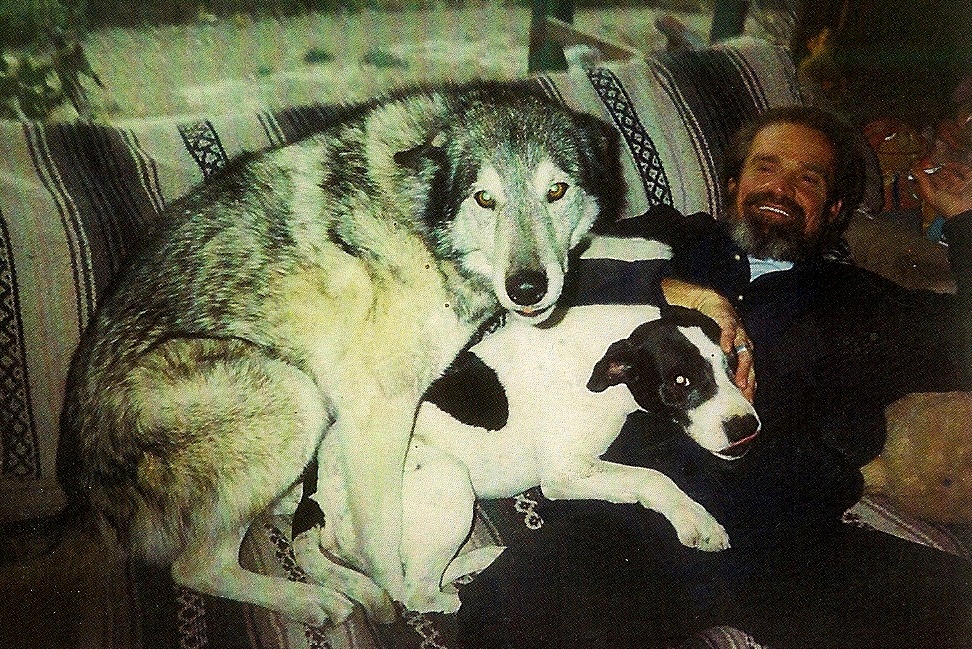
Over many, many months Luna built up sufficient trust in Tim that eventually she would take food from Tim’s outstretched hand. It was only now a matter of time before Luna started behaving more like a pet dog than the wild wolf that she was. The photo below is a scan from a traditional photograph and is unaltered.
Luna, the wild wolf, taken in 2006.
From now on, Luna would stay the night with Tim and his dog, keeping watch over them.
DR also recalls,
I remember Tim being distraught because, without warning, Luna stopped coming by. Then a few months later back she was. Tim never did know what lay behind her absence but guessed it might have been because she went off to have pups.
Unfortunately, this wonderful tale does have a sad ending.
About two years ago, Tim lost his dog. He was awakened to hear a pack of coyotes yelping and his dog missing.
Then tragically some 6 months later Tim contracted a gall bladder infection. Slowly it became worse.
By the time he realised that it was sufficiently serious to require medical treatment, it was too late. Despite the best efforts of modern medicine, Tim died on June 25th, 2009, just 51 years young.
So if you are ever out on Mingus Mountain and hear the howl of a wolf, reflect that it could just be poor Luna calling out for her very special man friend.
With very grateful thanks to DR for sharing such a special story.
















 Learning from Dogs