Category: People and their pets

The old ones take some beating!

A repeat posting of a wonderful joke from earlier times.

Good friend from my English days, Bob Derham, a few days ago sent me the well-known joke about the dog for sale. At first, I had forgotten that I had posted a slightly modified version back in April, 2012.  When I re-read it, I had to repost it today. It’s wonderful.

oooo

DOG FOR  SALE

New home needed for this wonderful animal.

A guy is driving around the back streets of Bristol, England.

He sees a sign in front of an unkempt terraced house: ‘Talking Dog For Sale‘, so he rings the bell and the owner appears and tells him the dog is in the garden.

The guy goes into the backyard and sees a nice looking Labrador retriever sitting there.

You talk?‘ he asks.

Yep,’ the Lab replies.

After the guy recovers from the shock of hearing a dog talk, he says ‘So, what’s your story?

The Lab looks up and says, ‘Well, I discovered that I could talk when I was pretty young.. I wanted to help the government, so I told the SAS.   [Special Air Service or SAS is a corps of the British Army]

In no time at all they had me jetting from country to country, sitting in rooms with spies and world leaders, because no one figured a dog would be eavesdropping.

I was one of their most valuable spies for eight years running…

But the jetting around really tired me out, and I knew I wasn’t getting any younger so I decided to settle down. I signed up for a job at the airport here in Bristol to do some undercover security. You know, wandering near suspicious characters and listening in, that sort of thing. I uncovered some incredible dealings and was awarded a batch of medals.’

‘Then I got married, had a load of puppies, and now I’m just retired.

The guy is amazed. He goes back in and asks the owner what he wants for the dog.

Ten quid,’ the guy says.

Ten quid? This dog is amazing! Why on earth are you selling him so cheap?

Because he’s a liar. He’s never been out of the garden all his life!’

It’s the way I tell ’em!

oooo

Really hope that many of you haven’t come across this wonderful joke before!

The tail of the dog!

Or should that be the tell of a dog!

In the funny way that items flow around the internet, I recently read an item that appeared on the daily email summary from EarthSky. It was entitled: Read the message your dog sends with his tail. That, in turn, had been prompted by an article published on the website ScienceDirect. It was a study announced in Current Biology and published on the 18 November 2013, (Pages 2279–2282). Here’s how that article opens (and go here to read the numbered references):

Seeing Left- or Right-Asymmetric Tail Wagging Produces Different Emotional Responses in Dogs
Marcello Siniscalchi, Rita Lusito, Giorgio Vallortigara, Angelo Quaranta

Summary

Left-right asymmetries in behavior associated with asymmetries in the brain are widespread in the animal kingdom [1], and the hypothesis has been put forward that they may be linked to animals’ social behavior [2 and 3]. Dogs show asymmetric tail-wagging responses to different emotive stimuli —the outcome of different activation of left and right brain structures controlling tail movements to the right and left side of the body. A crucial question, however, is whether or not dogs detect this asymmetry. Here we report that dogs looking at moving video images of conspecifics exhibiting prevalent left- or right-asymmetric tail wagging showed higher cardiac activity and higher scores of anxious behavior when observing left- rather than right-biased tail wagging. The finding that dogs are sensitive to the asymmetric tail expressions of other dogs supports the hypothesis of a link between brain asymmetry and social behavior and may prove useful to canine animal welfare theory and practice.

Graphical Abstract

Wagging tails

In terms of understanding for the non-scientific minded, then the EarthSky article is an easier read.

Read the message your dog sends with his tail

Tail-wagging is a reflection of what’s happening in your dog’s brain. Learn to read your dog’s tail signals, and you’ll know if he’s happy … or stressed.

Tail-wagging in dogs is the classic signal for happiness. But researchers have found that tail-wagging can mean that your dog is either happy or stressed.

Activation of the left-brain causes a dog’s tail to wag to the right. Activation of the right-brain causes a wag to the left. That’s not new knowledge. Scientists detected that difference seven years ago.

What is new is that, not surprisingly, other dogs can easily read the message your dog is sending with his tail. And so can you.

Researchers at the University of Trento in Italy tested 43 dogs of various breeds for their ability to distinguish between tail wags. They showed the dogs videos of other dogs wagging their tails (much like the one above) and monitored the dogs’ heart rates and reactions. How could they be sure that the dogs weren’t watching their canine buddies’ facial or body cues? The researchers also showed the dogs only a silhouetted version of a tail-wagging dog.

As it turned out, every dog responded the same way. Dogs watching other dogs wag their tails to the left looked anxious, and their heart rates increased. In other words, they, too, became stressed. But dogs watching others swing their tails to the right stayed calm and relaxed — an indication that right wags are an expression of companionship and confidence, according to these scientists.

Why study tail wags in dogs? The team said in the summary to their study, which was published in Current Biology last year:

The finding that dogs are sensitive to the asymmetric tail expressions of other dogs supports the hypothesis of a link between brain asymmetry and social behavior and may prove useful to canine animal welfare theory and practice.

Bottom line: A dog wagging his tail to the right is happy, but a dog wagging to the left is stressed, say researchers.

Let me finish off today’s post with the following video.

So here’s to dozens of people watching their dogs’ tails!

Nostalgia with wings!

Opening up the memory box.

Last Saturday, under the post title of The family flight, I wrote about the formation display given by five A350 XWB development aircraft.

That prompted a comment from Hariod Brawn:

He [my father] was an RAF pilot during the war and through to the early 1960’s. He test-piloted the Vulcan and Victor, though started on what he called ‘string bags’, by which he meant Tiger Moths. In between he flew the Spitfire, Lancaster, Meteor and specialised in flying in electrical storms, about which he wrote a manual for the RAF.

……

I took my father to see Vulcan XH558 fly what was then thought to be its final flight (it subsequently was overhauled and took to the skies again). It flew along the length of the runway at a 45 degree angle with its bomb bay doors open. On the inside of the doors in huge letters was the single word ‘farewell’. It was really quite an emotional experience both for my father and myself.

I thought it would be nice to include some video of XH558; that will be tomorrow’s post. For today, I wanted to reminisce from my own private flying days.

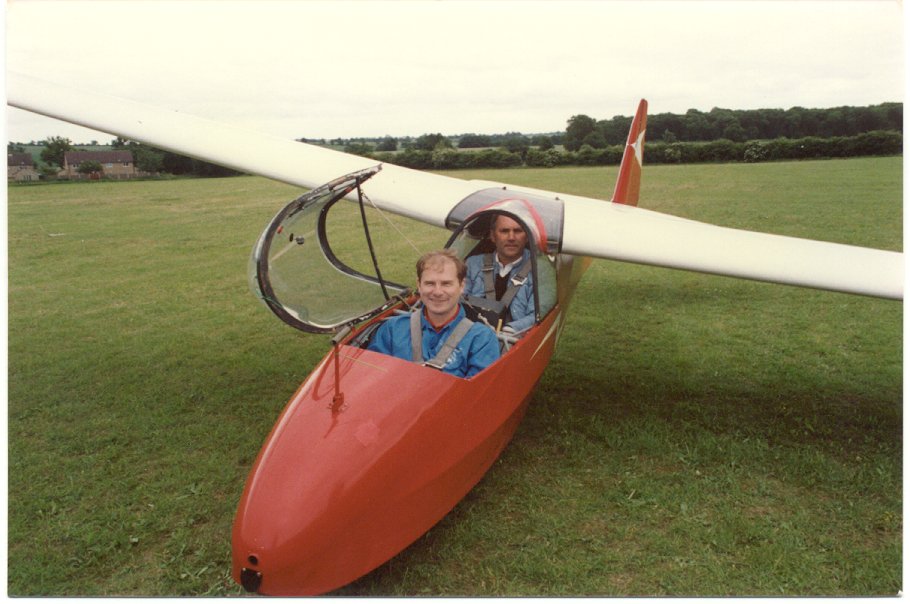
A K-7 two-seat glider.

My first exposure to private flying was on the 7th June, 1981 when, at Rattlesden Gliding Club in Suffolk, I was taken up for two air-experience circuits in a two-seater glider known as a ‘K7’.  I was immediately hooked! Those experience flights leading to a 4-minute flight (flight number 46) on the 6th September, 1981 that has the remark in my pilot’s log book: Solo!  Now fast forward to October, 1984 and my log book shows me attending a gliding instructor’s course at Lasham, resulting in me being issued with a British Gliding Association (BGA) Assistant Instructor Rating on the 14th October. (105/84).

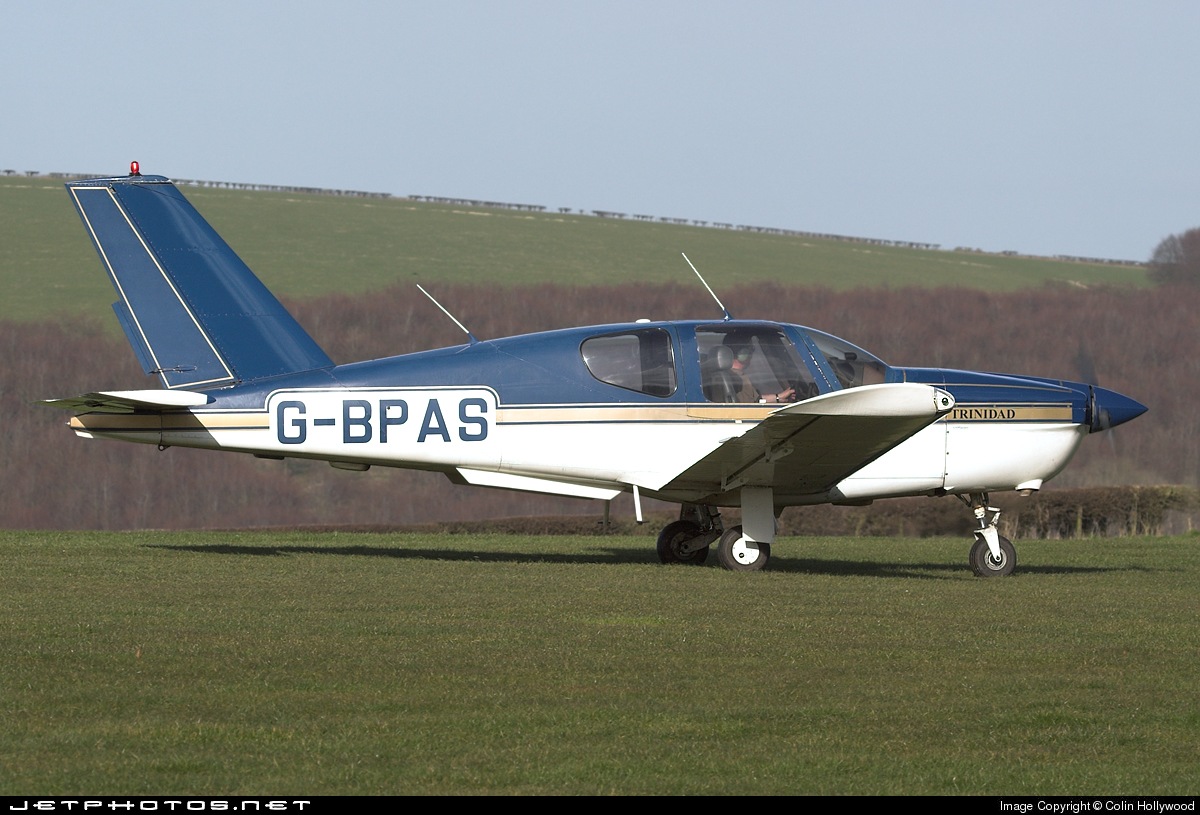
Over on the power side of things, in March, 1984, I started Private Pilot training at the Suffolk Aero Club at Ipswich Airport and gained my PPL on the 9th November, 1984.  Subsequently, gaining my Instrument Rating in July, 1999 when I was then operating from Exeter Airport and flying frequently for business purposes.  For that ‘serious’ flying I used a Socata TB20, a French retractable, single-engined aircraft, based at Exeter.  A very fine, long-distance aircraft.

TB20, G-BPAS, photographed at Compton Abbas airfield (EGHA).

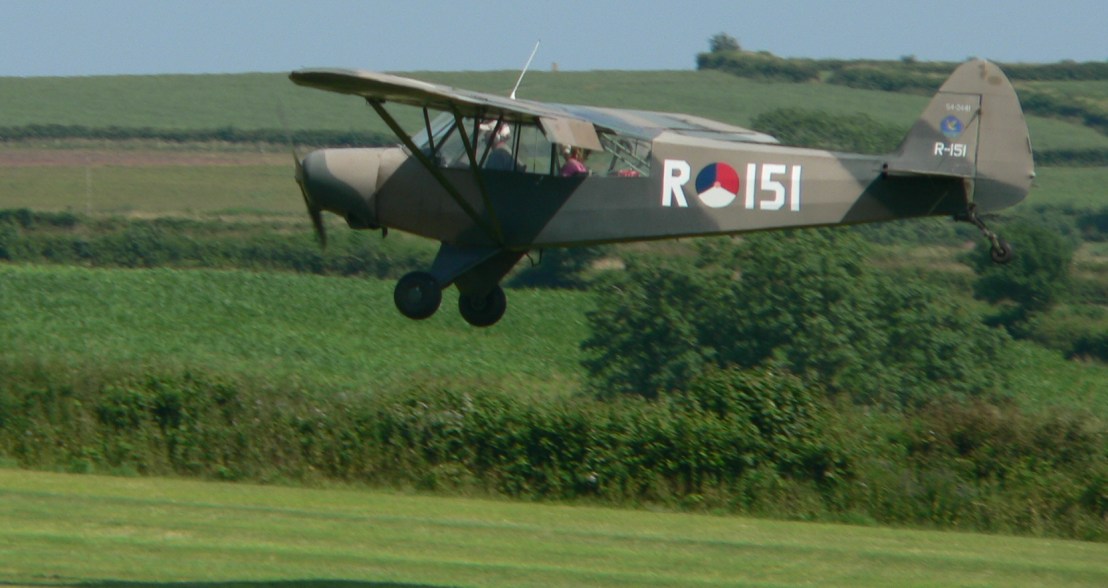
But the aircraft that I had the most fun flying was a dear old Piper Super Cub.  Here’s the background to the aircraft.

Piper Super Cub, L-21B, R-151

A/C Construction No. 18-3841, Frame No. 18-3843

Original Engine, Lycoming 135 Type 0-290-D2, 54/2441

Romeo 151 was one of a batch of 298 L-21’s delivered in 1954. There were 584 L-21B’s produced by Piper for military use, the ‘L’ standing for Liaison. The L-21B’s were PA-18-135’s with civil Lycoming 0-290-D2 engines, glasswork as most L-21A’s and L-18’s and a gross weight of 1760 lbs.

This aircraft was delivered to Koninklijke Luchtmacht, Dutch Air Force, on the 1st July, 1954 and registered R-151. After various homes R-151 transferred to the Dutch civil register as PH-GER, 1st April 1976 with 4,458 hours and shortly thereafter was registered to Vlieclub Hoogeveen, Certificate Number 2380.

On the 27th March, 1981 the aircraft was delivered to the UK with a total time of 5,043 hours and in September, 1981 became G-BIYR; ‘YR’. In April, 1983 YR was the first of type to be given a Public Transport CofA (Certificate of Airworthiness) and was used for training at Tollaton. YR reverted to a Private CofA in January, 1984 when purchased by Mike and Barbara Fairclough. The aircraft had by then accumulated 5,120 hours.

In 1992, YR was re-engined with a Lycoming 150HP, 0320-A2B No. L49809-27A (zero hours). Finally on the 2nd June, 1995 the aircraft was repainted in her original Dutch insignia and given CAA (UK Civil Aviation Authority) permission to use the original call-sign: Romeo 151.

The aircraft was based at and flown from Watchford Farm airstrip in South Devon, England.

Now forgive the nostalgic photographic memories!

Approaching home in South Devon, England
Yours truly approaching Watchford Farm airstrip in South Devon, England
Flying in the French Alps, Mt Blanc in sight
Flying in the French Alps with Mont Blanc in sight
9,300 ft up in the French Alps
9,300 ft up in the French Alps!

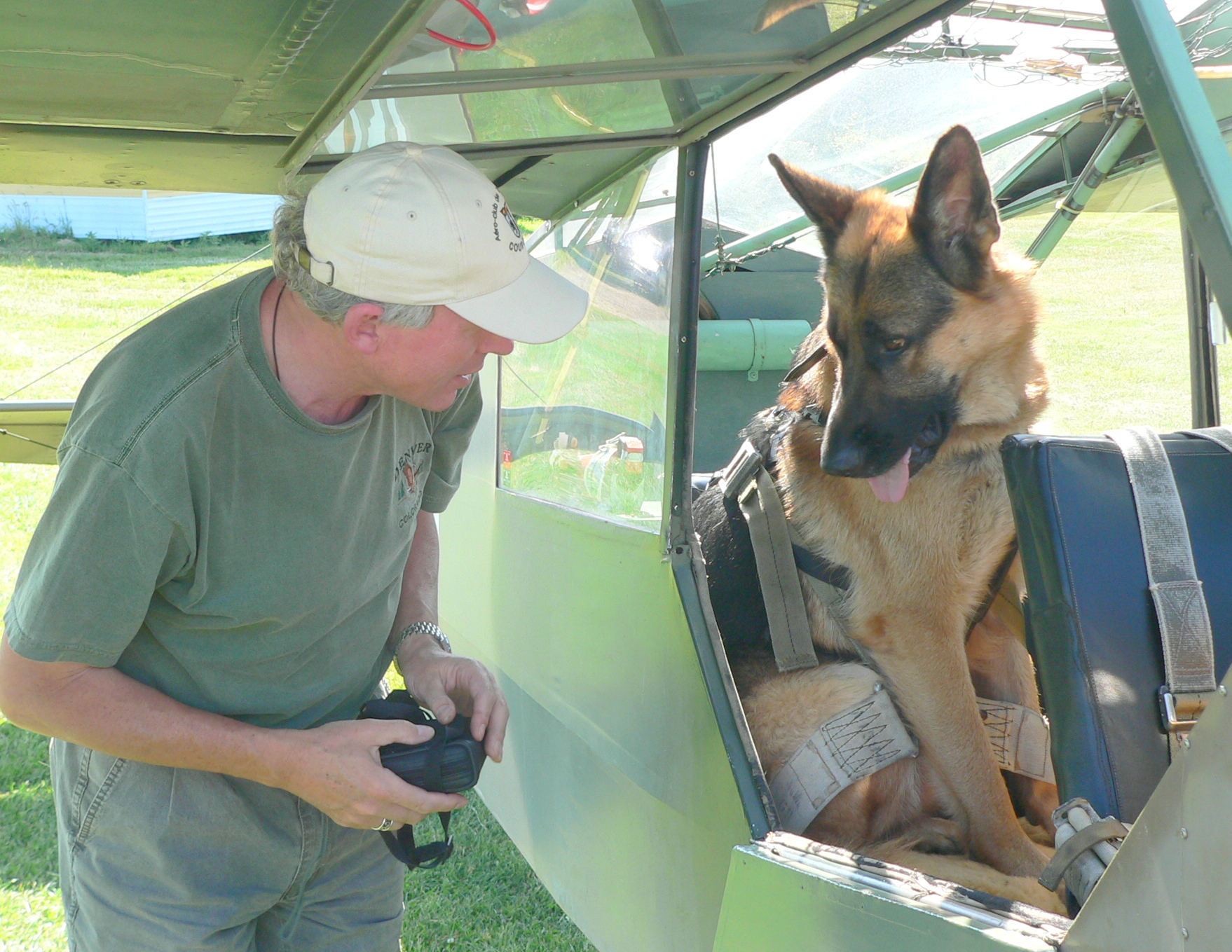
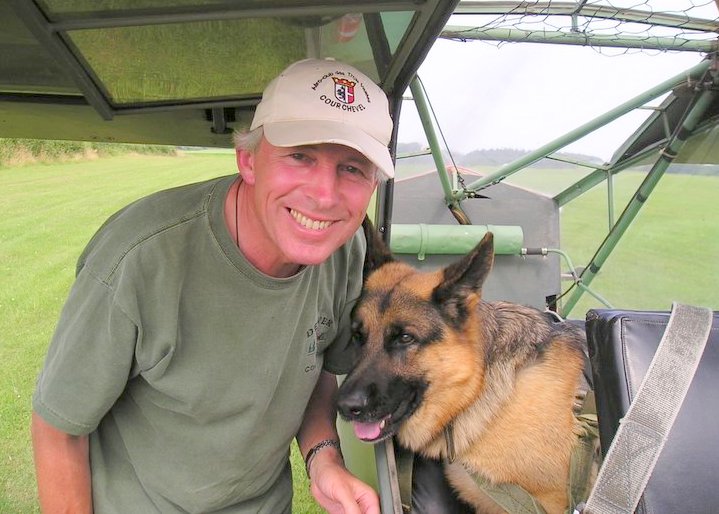
Every time I went to the airfield with Pharaoh he always tried to climb into the cockpit.  So one day, I decided to see if he would sit in the rear seat and be strapped in.  As the next picture shows, there was absolutely no problem with that!

Come on Dad, let's get this thing off the ground!
Come on Dad, let’s get this thing off the ground!

My idea had been to fly a gentle circuit in the aircraft.  First, I did some taxying around Watchford’s large grass airfield to see how Pharaoh reacted.  He was perfectly behaved.

But then I thought long and hard about taking Pharaoh for a flight.  In the Piper Cub there is no autopilot so if Pharaoh struggled or became agitated it would have been almost impossible to fly the aircraft and cope with Pharaoh sitting in the seat behind me.  So, in the end, I abandoned the idea.  The chances are that it would have been fine.  But if something had gone wrong, the outcome just didn’t bear thinking about.

Thus we elected for taxying all around the airfield which, as the next picture shows, met with full doggie approval.  The date was July 2006.

That was fun!
That was fun!

So enough of my recollections for today – tomorrow the Vulcan XH558.

Picture parade seventy-five

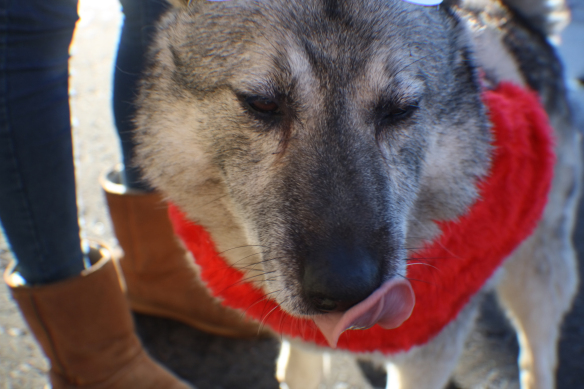
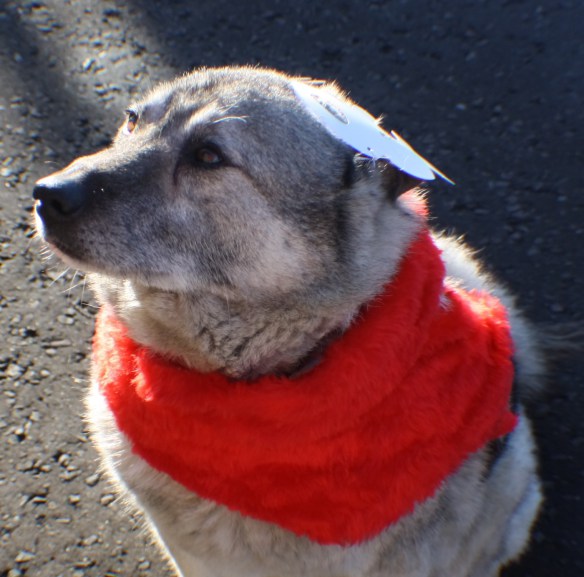
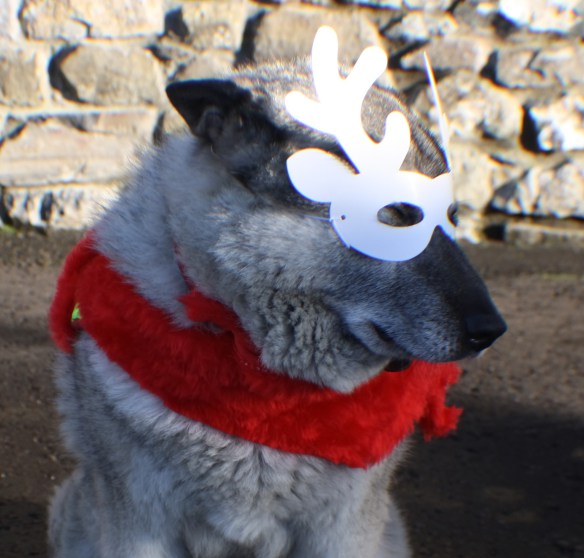
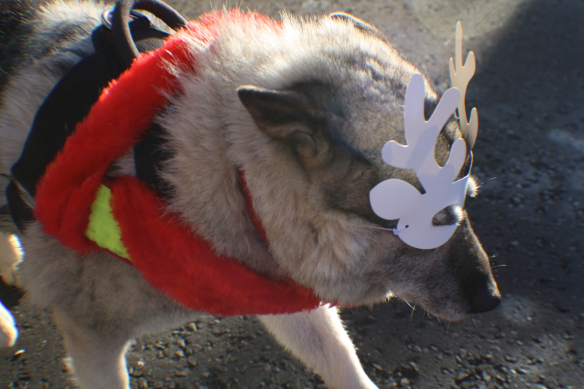
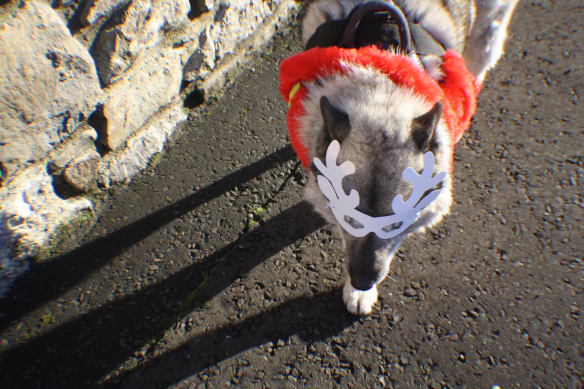
I saw the following images published over on the blogsite Decidingly Bob, that has the sub-heading of Life as I see it!  What was so perfect was that the ‘I’ is a dog! The post from which these images are taken, with Bob’s permission, was published on December 12th under the post title of “Bob’s Diary. ..I am not a Reindeer!

They seemed perfect for the last Picture parade before Christmas Day!

ooOOoo

Bob’s Diary. ..I am not a Reindeer!

“After the Christmas Reindeer story, I thought I was safe for a few weeks. Life can be cruel can’t it?

I knew there was trouble brewing when Maria and Sara offered me jelly babies.”

bob-1

oooo

But I didn’t expect this …

oooo

No sir, I got to talk to Sir Bob about this…

oooo

I am not a reindeer….

oooo

I have the answer..
I have the answer..

oooo

Bob-6

I am a Superhero.

ooOOoo

Listen everyone, have a wonderful week and please be safe out there.

The Book! Part Five: Adaptability.

Thanks to the wonders of the modern dictionary, I am able to understand that about two-hundred years ago, sometime around 1790 to 1800, the word ‘able’ that I just used was added to the word ‘adapt’ to make the word ‘adaptable’. I read that the word is an adjective and that from that comes a related word, a noun: adaptability. That same dictionary informs me that the meaning of adaptability is: “capable of being adapted” or “able to adjust oneself readily to different conditions: an adaptable person.

Now I would be the first to accept that the history of man, the long history of man, reveals a species, namely us, that is incredibly adaptable. Yet, (and you knew there was a ‘yet’ coming!) my sense of how adaptable any one person might be is inextricably wound up with change, and change is often a bitter fruit to taste.

You may recall that I closed the chapter on The process of change, in Part Four, with a snippet quotation from the film Interstellar: “We all want to protect the world, but we don’t want to change.”

That sentiment could be applied to so many aspects of our lives, especially to any form of change that heralded perceived uncertainty, or potential vulnerability; indeed anything that might be regarded as taking us outside our ‘comfort zone’. Granted not everyone, all of the time, yet not no-one at any one time.

Dogs, just like us humans, love routines. However, what strikes me from having lived for a number of years with a great many dogs in the home, variously from sixteen to the nine we have at present[1], is how amazingly easily a dog will adapt to new circumstances, both temporary and long-term changed circumstances.

Somewhere in my research, and I regret not being able to quote the reference, I came across a review of the author Jean Donaldson[2], in connection with her book Culture Clash. This book has shaped modern thinking about the behaviour of dogs and the relationship between dogs and humans.

The reviewer, in discussing the adaptability of dogs, proposes, “Maybe it’s the simple way they view their world. Each thing in their lives seems to fall neatly into its place in their world view. Things to seek out, things to avoid, things to keep, and things to leave behind.

Then a couple of sentences later, the reviewer adding: “I would guess that scavengers need that kind of mind set. Take it as it comes, deal with it, and move on. Dogs seem to have developed a sense of adaptation. They see what needs to be done and simply find a way to do it no matter what the impediments might be.

That last sentence describes an attitude towards adaptability that, in my opinion, would be very rare to find in a person.

I am going to devote the balance of this chapter to a true story. The true story about an Akita breed of dog that lived with its owner in Tokyo back in the first quarter of the 20th century. I included this account, despite the main theme of the story being about the extreme loyalty of the dog, because the dog’s ability to adapt is equally as impressive.

In 1924, Hidesaburō Ueno, a professor in the agriculture department at the University of Tokyo took in an Akita breed of dog as a pet and named him Hachikō. During his owner’s life, Hachikō not only saw Professor Ueno come out from the front door each morning but quickly learned to greet him at the end of the day by going to the nearby Shibuya Station. Hachikō continued this daily routine of going to the station until a day in May 1925, when that evening Professor Ueno did not return on his usual train. The reason being that the professor had suffered a cerebral haemorrhage at the university that day, had died and, therefore, never returned to the train station where his doggy friend was waiting.

Kind persons found Hachikō another home after his master’s death but he routinely escaped, showing up again and again at his old home. Eventually, Hachikō in some doggie manner realised that his master, Professor Ueno, clearly no longer lived at the house. So Hachikō went to look for his master at the train station, where he had accompanied him so many times before. Each day, Hachikō waited for Professor Ueno to return. And each day he did not see his friend among the commuters leaving the station.

Now almost a permanent fixture at the train station, Hachikō inevitably attracted the attention of other commuters. Many of the people who frequented the Shibuya train station had seen Hachikō and Professor Ueno together each day. They now brought Hachikō treats and food to nourish him during his long wait – Hachikō waiting at the train station at the end of every single day.

That same year, it happened that another of Ueno’s faithful students, who had become something of an expert on the Akita breed, saw the dog at the station and followed him when he went back to the home of the former gardener of Professor Ueno: Kikuzaboro Kobayashi. There the student learned the history of Hachikō’s life. Shortly after this meeting with Kikuzaboro, the former student published a documented census of Akitas in Japan. His research found only 30 purebred Akitas remaining, including Hachikō from Shibuya Station.

Professor Ueno’s former student returned frequently to visit the dog and over the years published several articles about Hachikō’s remarkable loyalty. In 1932, one of these articles, published in Tokyo’s largest newspaper, threw the dog into the national spotlight. Hachikō became a national sensation. His faithfulness to the memory of his master impressed the people of Japan as a spirit of family loyalty that all should strive to achieve. Teachers and parents used Hachikō’s vigil as an example for children to follow. A well-known Japanese artist rendered a sculpture of the dog, and throughout the country a new awareness of the Akita breed grew.

Hachikō was so loyal that every day for the next nine years he waited, sitting there amongst the town’s folk, appearing precisely when the train was due at the station.

Hachikō died on March 8, 1935. He was found on a street in Shibuya. His heart was infected with filarial worms and 3-4 yakitori sticks were found in his stomach. His stuffed and mounted remains are kept at the National Science Museum of Japan in Ueno, Tokyo. Hachiko’s legendary faithfulness became a national symbol of loyalty. There is a memorial statue of Hachikō in front of Shibuya Station.

This tale of Hachikō is an astounding tribute to the adaptability of the dog.

1,123 words. Copyright © 2014 Paul Handover

[1] December, 2014
[2] http://www.jeandonaldson.com

Picture parade seventy-four

The second set of wonderful pictures from Tricia.

(If you missed last week’s set they are here.)

Trish6

 oooo

Trish7

oooo

Trish9

oooo

Trish10

oooo

Trish11

oooo

Trish12

oooo

Trish13

oooo

What incredible, wonderful, loving animals they are!

The book! Part Five: Sharing

Dogs share so much of themselves in such an easy fashion. Here’s a story that made me laugh.

A man in a casino walks past three men and a dog playing poker.
“Wow!” he says, “That’s a very clever dog!“
“He’s not that clever,” replies one of the other players.
“Every time he gets a good hand he wags his tail!“

This very clever dog playing poker couldn’t hide his happiness and had to wag his tail!

One of the remarkable things that is noticed by those that have a number of dogs in their lives is the very natural way that they share so much. In our own case, we live with nine dogs, seven of whom are ex-rescue dogs. It would be fair to imagine that any dog that had come either straight off the street, a feral dog in other words, or from a dog rescue centre, would have some behavioural issues. To a small extent, this has been noticed by us; that some dogs come to us with a few minor, anti-social issues.

But the way that existing dogs in the home quickly assess and welcome a new dog, how they instinctively know that they are going to fit in, is a model of openness and acceptance. But more on that in the forthcoming chapters on those topics of openness and acceptance. Here, I want to stick specifically to sharing.

Sharing is synonymous with selflessness. One couldn’t openly share much of our life if it wasn’t easy to push to the back of one’s mind, one’s consciousness, our need for self. In more easy terms, our egos. For if our egos are dominant then selfless sharing would be very difficult; some might say impossible.

A dog seems to know with certainty that its best interest lays down the pathway of getting on with other dogs in the family. Inevitably, the boundaries of sharing, from the perspective of the dog, indeed from a philosophical angle of this quality in the dog, are intermingled with all the other qualities previously written about, and many of the qualities coming up in the next few chapters. So we observe how dogs will lick each other, snuggle up and sleep together, play together and share; all the attributes of a trustful, loving community.

That natural sharing sense of a dog links effortlessly with our human need for sharing. I had to look up and remind myself who it was that coined the expression: “No man is an island.” It was the English poet John Dunne[1], by the way. A beautiful, masterful reflection on our human need for sharing.

There are numerous benefits for having a dog, or two, in one’s life but possibly the core benefit is the one of never feeling alone. Think how often one sees a homeless person by the side of the road begging for food, money or for a lift somewhere else, and nearby is their dog. Irrespective of the fact, the certainty, that being homeless is tough, is the added certainty that it is a great deal tougher if there is a dog to feed and look after. My strong sense is that the sharing of the lives of two creatures, man and dog, more than offsets the added challenges of having a dog in your life if you have no permanent home.

No better underlined than by an article seen on the online presence of Flagpole Magazine[2], the “locally owned, independent voice of Athens, Northeast Georgia.”

The article[3] was called: Dogs and Their Homeless Owners Share Love, if not Shelter, and was written by Stephanie Talmadge. It opened:

If you walk down Clayton Street, specifically near the College Avenue intersection, you may have received a furry greeting from a little brown, scraggly pup. Usually a blur, due to near-constant wagging, this tiny dog, Malika, spends many of her days guarding that corner for her owners, David and Dorothy Gardener, who are experiencing temporary homelessness.

Though the Gardeners are homeless, little Malika is far from it. She’s not in the pound, waiting to be adopted or rescued before her time runs out. She’s not running around in the streets or woods, fending for herself.

Stephanie Talmadge then makes an important point towards the end of her piece:

Homeless or not, owning a pet is a huge responsibility, and obviously it can be extremely rewarding, well worth the complications it creates. Plus, a person doesn’t have to be homeless to have financial barriers to providing good care. Plenty of dogs who live in permanent housing are neglected and mistreated daily.

Just because someone’s homeless shouldn’t mean they’re not allowed to have a companion animal,” Athens-Clarke County Animal Control Superintendent Patrick Rives says, “And there may be some good reasons for them to [have one]… There is a psychological impact of having a companion animal, and I wouldn’t want to take that away from someone.”

Around 1870, Senator George C. Vest delivered a powerful and moving eulogy for the dog; delivered to the jury at the Old Courthouse in Warrensburg. It was in response to his dog, Old Drum, being shot the previous year. Here are his words:

The best friend man has in the world may turn against him and become his enemy. His son, or daughter, that he has reared with loving care, may prove ungrateful. Those who are nearest and dearest to us, those whom we trust with our happiness and good name may become traitors to their faith. The money a man has he may lose. It flies away from him, perhaps when he needs it most. A man’s reputation may be sacrificed in a moment of ill-considered action. The people who are prone to fall on their knees when success is with us may be the first to throw the stone of malice when failure settles its cloud upon our head.

The one absolutely unselfish friend that man can have in this selfish world, the one that never deserts him, the one that never proves ungrateful or treacherous, is his dog. A man’s dog stands by him in prosperity and poverty, in health and in sickness. He will sleep on the cold ground when the wintry winds blow and the snow drives fiercely, if only to be near his master’s side. He will kiss the hand that has no food to offer, he will lick the wounds and sores that come in encounters with the roughness of the world. He guards the sleep of his pauper master as if he were a prince.

When all other friends desert, he remains. When riches take wing, and reputation falls to pieces, he is as constant in his love as the sun in its journey through the heavens.

If fortune drives his master forth, an outcast in the world, friendless and homeless, the faithful dog asks no higher privilege than that of accompanying him, to guard him against danger, to fight against his enemies. And when that last scene of all comes, and death takes his master in its embrace and his body is laid away in the cold ground, no matter if all other friends pursue their way, there, by the graveside will the noble dog be found, his head between his paws, his eyes sad, but open in alert watchfulness, faithful and true, even in death.

Now when it comes to us humans learning the quality of sharing from our dogs, there is no shortage of examples of humans engaged in wonderful acts of sharing. In undertaking research, I came across an article in the Houston Chronicle[4] headed: What makes us human? Teaching, learning and sharing.

We wanted to understand how all of these behaviors came about specifically for humans,” said Steven Schapiro, an M.D. Anderson professor at the Bastrop facility. “And we wanted to understand why our closest living relatives can’t do all of the kinds of things we do.”

Professor Schapiro went on to explain: “To address their question the scientists devised a series of puzzles with escalating difficulty, the solving of which would produce rewards – stickers of increasing attractiveness for kids; carrots, apples and then grapes for the monkeys.

Then observing:

During the experiment the researchers observed that the children treated the puzzles as a social exercise, working them together and giving verbal instruction to one another. When successful, they shared the rewards.

In contrast the chimpanzees and capuchins appeared to only see the puzzles as a means to obtain rewards, and worked mostly independently and did not learn from their efforts. They never shared.

Humans, then, have ratcheted up their culture by teaching one another, imitating the successful behaviours of others and altruism.

When successful, they shared the rewards.

Who knows if us humans uniquely having dogs in our lives over thousands of years, way back to the times when we depended on our survival through hunting and gathering, if learning to share the hunting and the gathering with our dogs, embedded within us the sharing of rewards? I would like to think so.

I want to end this chapter by promoting two wonderful modern examples of a culture of sharing. Firstly, I’m referring to the Buy Nothing Project[5] that has as it’s subheading: Random Acts of Kindness All Day Long.

As the ‘About’ page[6] explains:

Buy Nothing. Give Freely. Share Creatively.

The Buy Nothing Project began as an experimental hyper-local gift economy on Bainbridge Island, WA; in just 8 months, it has become a social movement, growing to over 25,000 members in 150 groups, in 4 countries. Our local groups form gift economies that are complementary and parallel to local cash economies; whether people join because they’d like to quickly get rid of things that are cluttering their lives, or simply to save money by getting things for free, they quickly discover that our groups are not just another free recycling platform. A gift economy’s real wealth is the people involved and the web of connections that forms to support them. Time and again, members of our groups find themselves spending more and more time interacting in our groups, finding new ways to give back to the community that has brought humor, entertainment, and yes, free stuff into their lives. The Buy Nothing Project is about setting the scarcity model of our cash economy aside in favor of creatively and collaboratively sharing the abundance around us.

It has become a social movement …. collaboratively sharing the abundance around us.

Secondly, to a completely different example, that of software. Let me explain or, better, let me quote from the home-page of the website Open Source Initiative[7]: “Open source software is software that can be freely used, changed, and shared (in modified or unmodified form) by anyone.” [My emphasis]

Here’s the opening paragraph of an article[8] in Forbes Magazine; written by George Bradt.

Why Open Leadership Has Become Essential

You would not be reading this if open source software did not exist. Without open source standards, the Internet would not exist. This article would not exist. Those of you whose parents met on Match.com would not exist. All of you should be thankful for open source software. Now, as the world has changed, open source software’s principles of openness, transparency and meritocracy have become essential standards for leadership in general.

… principles of openness, transparency and meritocracy have become essential standards for leadership in general.” Not just for leadership but for all of mankind! Sharing seems like the way to go!

If I was a dog, it would be impossible to stop my tail wagging!

1,930 words Copyright © 2014 Paul Handover

[1] It was a famous line from “Meditation XVII,”
[2] http://www.flagpole.com/about-us
[3] http://www.flagpole.com/news/news-features/2014/10/08/dogs-and-their-homeless-owners-share-love-if-not-shelter
[4] http://www.chron.com/news/houston-texas/article/What-makes-us-human-Teaching-learning-and-3375389.php
[5] http://buynothingproject.org
[6] http://buynothingproject.org/about/
[7] http://opensource.org
[8] http://www.forbes.com/sites/georgebradt/2014/11/25/why-open-leadership-has-become-essential/

The book! Part Five: Trust

A dog offers loyalty, trust and love in exchange for being treated with integrity and compassion.

What do we mean by trust? Roget’s Thesaurus defines the word (in part): “Trust – noun: Absolute certainty in the trustworthiness of another: belief, confidence, dependence, faith, reliance.”

Accepting that this is a book called Learning from Dogs doesn’t prevent me from using two examples of trust from other animals, a wolf and a horse, before offering a personal experience of a dog learning to trust.

This true story was told to me by DR when we were living in Payson, Arizona. An amazing true story of a relationship between a wild wolf and a man. A story of a particular event in the life of Tim Woods; brother of DR.

It revolves around the coming together of a man sleeping rough, with his dog, on Mingus Mountain, and a fully grown female Grey Wolf. Mingus is in the Black Hills mountain range between Cottonwood and Prescott in the State of Arizona, USA.

DR and his brother, Tim, belong to a large family; there are 7 sons and 2 daughters. Tim had a twin brother, Tom, and DR knew from an early age that Tim was different.

As DR explained,

“Tim was much more enlightened than the rest of us. I remember that Tim and Tom, as twin brothers, could feel each other in almost a mystical manner. I witnessed Tom grabbing his hand in pain when Tim stuck the point of his knife into his (Tim’s) palm. Stuff like that! Tim just saw more of life than most other people.”

The incident involving the wolf was when Tim was in his late 40s and, as mentioned, was living rough in an old shack up in the Black Hill mountains. The shack was simply a plywood shelter with an old couch and a few blankets for the cold nights. The dog was a companion to Tim, his guard and a means of keeping Tim in food; the dog was a great hunter. But Tim was no stranger to living in the wild.

DR again,

“Tim was ex-US Army and a great horseman. There was a time when he was up in the Superstition Mountains, sleeping rough, riding during the day. At night Tim would get the horse to lay down and Tim would sleep with his back next to the horse for warmth.

Tim was up on Mingus Mountain using an old disk from an agricultural harrow as both a cook-pan and plate. After he had finished eating, Tim would leave his ‘plate’ outside his shack. It would be left out in the open over night.

Tim gradually became aware that a creature was coming by and licking the plate clean and so Tim started to leave scraps of food on the plate. Then one night, Tim was awakened to the noise of the owner of the ‘tongue’ and saw that it was a large, female grey wolf.”

DR went on to explain that the wolf became a regular visitor and Tim became sure that the wolf, now having been given the name Luna by Tim, was aware that she was being watched by a human.

Then DR continued, “Over many, many months Luna built up sufficient trust in Tim that eventually she would take food from Tim’s outstretched hand. It was only now a matter of time before Luna started behaving more like a pet dog than the wild wolf that she was. From now on, Luna would stay the night with Tim and his dog, keeping watch over both of them.

Not that I doubted DR’s retelling of the account of Tim and the wolf but, nevertheless, the next action by DR had me in floods of tears. For DR then showed me an unaltered photograph taken in 2006 showing Tim lying back on a blanket with his dog across his waist and there, sitting on its haunches just behind Tim and the dog, was Luna the wolf.

DR underlined this miraculous story by saying that he remembered Tim being distraught because, without warning, Luna stopped coming by. Then a few months later back she was. Tim never did know what lay behind her absence but guessed it might have been because she went off to have pups.

Unfortunately, this wonderful tale does have a sad ending.

Back to DR, “About two years ago, what would have been 2007, Tim lost his dog. He was awakened to hear a pack of coyotes yelping and his dog missing. Then tragically some 6 months later Tim contracted a gall bladder infection. Slowly it became worse. By the time he realised that it was sufficiently serious to require medical treatment, it was too late. Despite the best efforts of modern medicine, Tim died on June 25th, 2009, just 51 years young.

DR’s closing words to me were: “So if you are ever out on Mingus Mountain and hear the howl of a wolf, reflect that it could just be poor Luna calling out for her very special man friend.

One would have to go a very long way to come across a better story of such fabulous trust from an animal towards a human.

The second example of trust from an animal other than a dog is from the Spring of 2014. About that time, we decided that we had sufficient acres of pasture to have a horse. We were put in touch with a horse rescue centre, Strawberry Mountain Rescues, near Roseburg in Oregon; about an hour north from where we lived. Soon after arriving at Strawberry Mountain we took a liking to a 15-year-old gelding. His name was Ranger and he had been found abandoned in the Ochoco National Forest in central Oregon, subsequently arriving at Roseburg. Ranger had a delightful temperament plus his age was a bonus as both Jean and I were the wrong age to be taking on a horse that might outlive us.

A week before Ranger was brought down to us, there was a telephone call from Darla, who runs Strawberry Mountain, asking us if we could take two horses.

This other horse, Ben, was a younger horse that had been ‘rescued’ on the orders of Darla’s local Sheriff because of Ben being in private ownership. It turned out that Ben had been subjected to starvation, to beating and there was evidence that he had been fired at repeatedly in the chest with an air-gun. The Sheriff’s office took away Ben and placed him under the care of Darla. Very quickly, Ben had formed a close relationship with Ranger and Darla was in no doubt that Ben’s relationship with Ranger was part of his journey of returning to a healthy, confident horse. We couldn’t say no to taking both Ben and Ranger despite Darla explaining that Ben was a very wary horse, especially nervous of men and that I should never make any sudden movements around Ben, as much for my own safety.

Unlike Jean who had owned and ridden horses in her younger days, I hardly knew the front from the back of a horse. I decided to approach Ben as I would a new rescue dog.

In less than three weeks, Ben had recovered sufficient trust in men to allow me to stroke his neck. Six months after having Ben and Ranger with us, I can put my face against Ben’s muzzle and stroke the area on his chest that is covered in scars from the air-gun pellets fired into him.

If only us humans could learn to trust in such a manner. Indeed, many persons would harbour anger and distrust in their hearts forever.

So now to dogs.

It’s easy for me to understand the trust in a dog when I look at Pharaoh, my German Shepherd. For he has been part of my life since a few weeks after he was born in South Devon, England, on June 3rd, 2003.

So my experience of Pharaoh doesn’t really offer any insight as to how a dog that has been cruelly treated by other people learns to trust a new home. I had to wait until 2010 to learn the lesson of trust from a dog.

I first met Jean, my wife, in Mexico; to be precise, in San Carlos, Sonora, Mexico. We met just a few days before Christmas, 2007. Despite Jean, as with me, having been born in London, indeed we were born just twenty-three miles from each other, she had been living in Mexico for many years; since Jean and her American husband, Ben, moved down there twenty-five years previously. (Ben died in 2005.)

Very quickly I became aware that Jean was well-known for rescuing Mexican feral dogs. At that time that Jean and I met, she had sixteen dogs, all of them rescues off the streets in and around San Carlos.

In September, 2008, I travelled out to Mexico with my Pharaoh and, subsequently, in the February of 2010, we made plans to move from San Carlos to Payson, in Arizona; some 80 miles North-East of Phoenix. Primarily, because we wanted to be married, and to be married in the USA.

Just a few days before we were due permanently to leave San Carlos with all our animals and belongings and journey the 513 miles (827 km) to Payson, AZ, Jean went outside to the front of the house to find a very lost and disorientated black dog alone on the dusty street. The dog was a female who in the last few weeks had given birth to puppies that had been weaned. That was obvious to Jean because the dog’s teats were still somewhat extended.

The dog had been abandoned outside in the street. A not uncommon happening because many of the local Mexicans knew of Jean’s rescues over many years and when they wanted to abandon a dog it was done outside her house. The poor people of San Carlos sometimes resorted to selling the puppies for a few Pesos and casting the mother dog adrift.

Of course, the dog was taken in and we named her Hazel. Now, rationally, we humans can’t even start to imagine the emotional and psychological damage that a mother dog would incur from having had all her puppies stolen from her. It’s very unlikely that we could imagine the damage a human mother would receive from the violent loss of her young baby.

The one thing that it would be reasonable to assume is that our latest addition to our dog family, Hazel, would initially be a bit wary of ’the species that walks on two legs’!

Once Hazel had been fed and watered by Jean, her coat inspected for ticks and generally checked all over, the next step was to introduce her to some of the other dogs. It all went very smoothly. Then in the evening, when we were sitting down after our evening meal, Hazel came over to the settee and looked up at my eyes. In a way that couldn’t be put clearly into words, I sensed a lost soul in Hazel’s eyes and a desperate need for some loving. Those thoughts were paramount in my mind and, I hoped, available for Hazel to read via my eyes.
Then after a pause of half-a-minute or so, our eyes still locked together, Hazel climbed up next to me on the settee and carefully and cautiously settled her head and front paws across my lap. I caressed and stroked her for much of the rest of the evening. When Jean and I went to bed, Hazel jumped up and went to sleep, and stayed alongside my legs for the whole of the night. Setting a pattern that has continued to this very day.

How did Hazel know to trust me? Only Hazel knows the answer to that one. But ever since that day, nearly five years ago as I write this, the bond between Hazel and me has been perfect. In fact, as I write these words, Hazel is asleep on the rug just behind my chair.

Our society only functions in a civilised manner when there is a predominance of trust around and about us. When we trust the socio-politico foundations of our society. When we trust the legal processes. When we trust that while greed and unfairness are never absent, they are kept well under control.

Having trust in the world around us is an intimate partner to having faith in our world. For without trust there can be no faith and without trust there can be no love.

Unlike the previous chapter on love, no list of behaviours come to mind that allow the growth of unbridled trust. Maybe trust flows from the actions of love. As in one only gets back what you put out.

All that does come to mind is never wavering from offering trust to others and never accepting anything other than trustworthy actions from others.

For eventually that would lead, lead inexorably, to a world where trust was accepted as if it was the air we breathed.

The final thing that comes to mind is always remembering this lesson from our dogs and, by implication, from their ancient ancestor, the wolf.

Returning to that beautiful story of Tim and his wolf, Luna, may I plead that if you ever hear the howl of a wolf, please will you allow yourself to disappear into your inner thoughts for a few precious moments and know that tens of thousands of years ago there was another Tim and another wolf: the start of the long relationship between man and dog.

Or, perhaps, the next time you gaze deeply into your dog’s eyes, sense that first Tim cuddling up to that first Luna and know how far trust has brought us and our dogs.

2,318 words Copyright © 2014 Paul Handover

Picture parade seventy-three

With grateful thanks to Tricia for sending these on.

Trish1

The following goes with the picture above. It has been published before but so what! It deserves repeated postings!

“Dogs Welcome”

A man wrote a letter to a small hotel in a Midwest town he planned to visit on his vacation. He wrote:

I would very much like to bring my dog with me. He is well-groomed and very well behaved. Would you be willing to permit me to keep him in my room with me at night?”

An immediate reply came from the hotel owner, who wrote:

SIR: “I’ve been operating this hotel for many years. In all that time, I’ve never had a dog steal towels, bedclothes, silverware or steal pictures off the walls or use them as a coloring book. I’ve never had to evict a dog in the middle of the night for being drunk and disorderly. And I’ve never had a dog run out on a hotel bill.

Yes, indeed, your dog is welcome at my hotel. And, if your dog will vouch for you, you’re welcome to stay here, too.”

 Trish2

oooo

Trish3

oooo

Trish4

oooo

Trish5

oooo

You all have a great week and keeping loving those dogs of yours!