Back on the 13th September, I published a post under the title of Listening to our pets in more difficult times. I mentioned that Pharaoh was suffering pain in his rear hip joints and struggling at times to get up on all four feet and that we had started giving him Rimadyl.
Don’t wait around for a vet to tell you that your dog is in pain. You live in a state with legal MJ plus hemp oil is legal in all 50 states. I give CBD oil to my BC X Aussie 12 year old dog. He could not get up and yelped in pain before I began giving him 0.7ml daily that I drizzle over his food., After second dose he could stand up without help. Now he walks and runs with fluid movements of all limbs. It is totally safe and doesn’t require expensive tests, The danger of Rimadyl and other meds in that class used to treat arthritis, is that these types of meds cause kidney damage and your pet will have a shortened life span. Hemp oil works like a charm with no side effects.
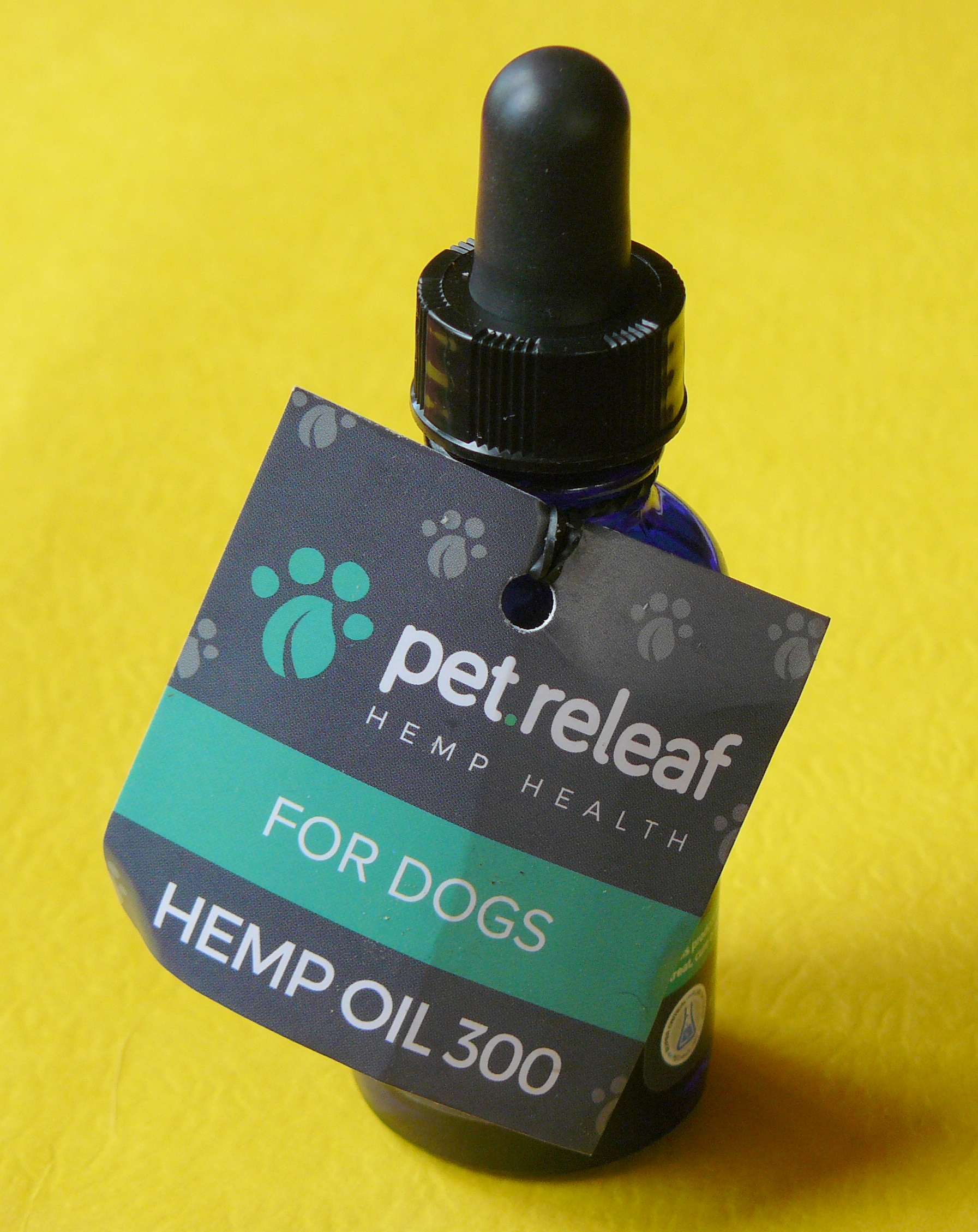
We did some research and came across the following brand of Hemp (CBD) Oil specifically for dogs. We ordered it and it arrived last Saturday. Jean did not delay in adding* it twice a day to the food for both Pharaoh and Paloma.
Here we are at the end of Tuesday, at the time of writing this post, and already we can see observable improvements in both dogs.
Yes, it’s early days but I wanted to share this with you now.
There will be a more extensive report from me once these dogs have been using the oil for a few weeks.
One dropperful twice a day for Pharaoh, approx. 105 lbs, and half a dropperful twice a day for Paloma, approx. 45 lbs.
Over the week-end Jean and I were down in Medford at this event promoting my book Learning from Dogs.
Inevitably, we saw many dogs and their owners come in to the store for we were positioned just inside the main door. Likewise, inevitably we saw a whole range of ‘relationships’ between those dogs and their human companions.
It reminded me of a recent TED Talk that was given by Ian Dunbar about dog training. For those who have not previously come across Mr. Dunbar, his bio reads as follows:
http://www.ted.com Speaking at the 2007 EG conference, trainer Ian Dunbar asks us to see the world through the eyes of our beloved dogs. By knowing our pets’ perspective, we can build their love and trust. It’s a message that resonates well beyond the animal world.
Veterinarian, dog trainer and animal behaviorist Ian Dunbar understands our pets’ point of view. By training dog owners in proper conduct (as much as he trains the dogs themselves), he hopes to encourage better relationships with dogs — not to mention their friends and children, too.
Why you should listen
We may call dogs man’s best friend, but according to Dr. Ian Dunbar, humans often fail to reciprocate. Dunbar’s decades of research on hierarchical social behavior and aggression in domestic animals truly give him a dog’s-eye view of human beings’ incomprehensible and spontaneous — if involuntary — cruelties.
Dunbar says we might break our unseemly, unflattering habits and usher in an “era of dog-friendly dog training” by coming to understand why dogs do what they do — Is Fido misbehaving, or just being a dog? — and the repercussions of our actions toward them. (We might foster better relationships with our fellow humans, too.) His Sirius Dog Training company focuses on training puppies to be playful, yet well-behaved. His second organization, Animalin, promotes games for dogs and puppies at an international level.
What others say
“There is no single person on the face of the planet to whom dog trainers and owners (not to mention dogs) owe more.” — Jean Donaldson, author, The Culture Clash
ooOOoo
I will close with another photograph from the PetSmart event.
(Sorry about the cardboard boxes under the table!)
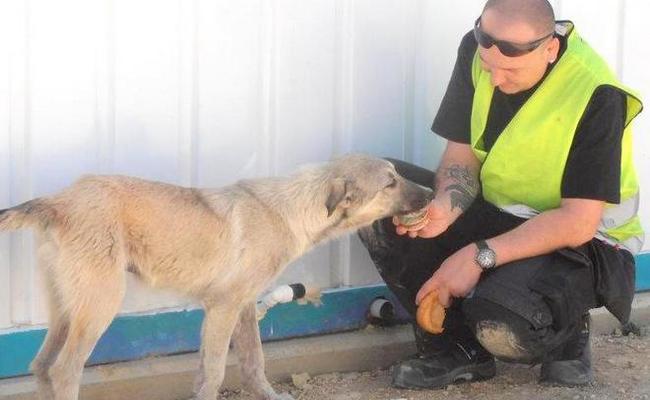
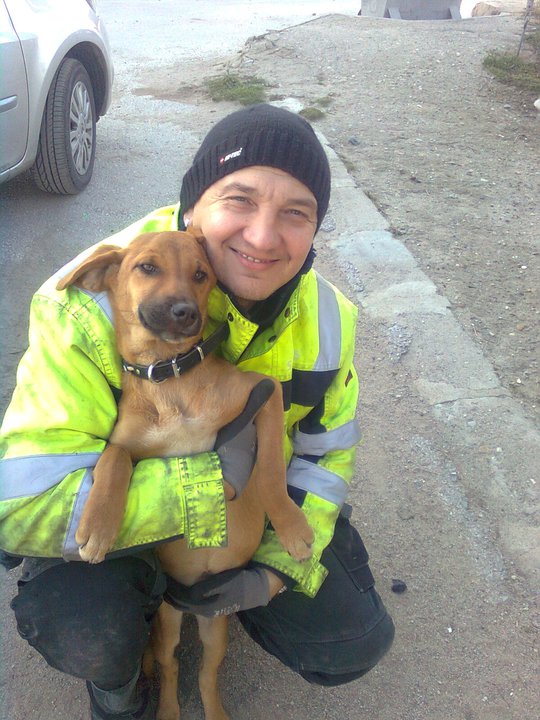
Max Kahrimanovic lives in his hard hat. It’s covered in the dust of three continents where he programs wind turbines, often at a dangerous height. But some may say Max’s greatest accomplishments unfold in the far less intricate scenarios down on the ground where he feeds hungry, and often very thirsty, stray dogs. This is the story of how Max won the trust of one of those dogs and the remarkable new life she is now beginning.
So close he could kiss the clouds, Max programs wind turbines internationally.
“I saw her the very first day I came to the construction site,” Max said of the shy sweetheart he encountered during his latest assignment in Turkey. “She was scared and wouldn’t approach no matter what. I would leave food and would have to walk away. Then, from the far, I would see her eating and drinking what I left for her. Slowly she started to trust me and one day she finally let me pet her on the head.”
From that day forward Karis (as Max named her) decided that she had adopted Max. She would keep watch outside his office door and she would be waiting for him when he arrived at work each morning.
Although she was once so afraid of human touch, Karis soon learned that Max was different than the others she’d encountered.
“She can be naughty at times,” Max laughs, thinking of the occasions Karis dumped over the trash cans. “She wasn’t hungry, I know that much. I was feeding her three times a day. But I guess the leftovers smelled delicious to her and she had to check it out.”
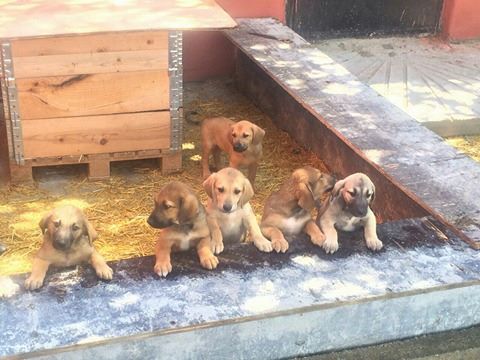
And one day, when Max arrived, Karis had a surprise for him. Overnight, she had delivered seven puppies.
“My first thought was devastation,” Max said candidly. “I know, you’ll think how can I be devastated seeing so much cuteness. But in all these years of traveling through Europe, Morocco, New Zealand, etc. I’ve seen so much misery involving these animals, that I couldn’t feel anything else at that moment.”
At this point, Max had already found a home for Karis in the U.S. and was making arrangements to transport her there. But with seven more lives to worry about, now what?
“How are we gonna manage 7 pups too?” Max wondered. “Knowing what will happen to them after I leave was devastating. I knew they will either die under car wheels, die of starvation, diseases or they will get killed by other bigger dogs that wander around there.”
So, despite the enormity of the costs and challenging logistics, Max and his wife Neli – back in Sweden – began making arrangements to transport the entire family of dogs to the U.S. for adoption. They turned to the Harmony Fund international animal rescue charity for help with the costs of the rescue.
The whole family will be coming to the U.S. soon, and Karis already has a permanent home with one of Max’s friends who has adopted internationally before. Max has no doubt that Karis will be very good to her pups during the transition as she has always been such an excellent mother.
Karis and her pups were moved to a safe location where they await travel to the U.S.
“When she had the puppies, I admired how she never went to eat their food that I gave them,” Max said. “She waited for me to get hers ready. One time I left 6 hard boiled eggs on the table for her lunch. I just stepped out to wash my hands and when I got back eggs were gone. She ate them like that, not peeled or anything.”
Max isn’t always admired for his devotion however. He said he’s known by management as “the guy who feeds strays” and that he has received warnings not to do so. But he simply can’t go against his own moral compass.
Max always makes time to offer food and water to strays like this one in Turkey.
“This is much stronger than me,” Max explains. “I can’t eat my lunch knowing there is a being, not far from me, starving and hasn’t had a piece of bread for days…. We usually work in small villages far from civilization or any bigger cities. If it is possible to buy it, then I always have one or two huge bags of dry food and some cans in the trunk of my car. And on my way from the site to my hotel, I stop and feed strays that I see. If it isn’t possible to buy dog food, then I improvise with our food by either taking extra breakfast from the hotel or just by buying extra food when I go shopping for myself. I know I can’t save them all. But for that day or that time when I meet that dog I can feed him at least and give him some water.”
ooOOoo
I am so pleased to promote what Max Kahrimanovic is doing and to thank Laura for writing this up in the first place.
Max’s admission in that last paragraph uses words that I have heard Jean using when I first met her back in December, 2006 when she was living in Mexico and rescuing so many street dogs and finding loving homes for them in the USA.
Oh, and before I republish the following, thanks for so many ‘Likes’ to yesterday’s post.
The following was first published back in March, 2014.
ooOOoo
Almost two months ago, January 30th to be exact, the first of this ‘Meet the dogs‘ series was published. It came out of an idea from Jean and that January 30th post introduced Paloma to you, dear reader. Since then we have told you about Lilly, Dhalia, Ruby, Casey, Hazel, Sweeny, and Cleo.
So today’s post is the last of the Meet the dogs stories; it is about Pharaoh. I’m going to indulge myself in telling you the story of this most wonderful of dogs.
ooOOoo
Pharaoh
Photograph taken on the 12th August, 2003, the first day I saw Pharaoh.
That is Sandra Tucker, owner of Jutone Kennels in Devon, England, where Pharaoh was born on June 3rd, 2003.
Here’s something I wrote a long time ago that conveys my feelings of that first day when I met this puppy.
oooo
In no time at all I was turning into the farm driveway, noticing the painted sign for Jutone & Felsental German Shepherds alongside the open, wooden gate.
I turned off the engine and was about to swing my legs out of the open driver’s door when I saw a woman coming towards me.
“Hi, you must be Paul, I’m Sandra. Did you have any trouble finding us?”
I shook hands with her.
“Not at all. I did as you recommended when we spoke on the phone and went in to the local store and got final directions.”
Sandra smiled, her glasses almost slipping off the end of her nose: “Dear Beth. She’s been running that local store since God was a boy.”
She continued with a chortle in her voice, “Some say that Beth was at the store before our local pub, The Palk Arms, opened for business. And the pub’s been in the village for well over four-hundred years.”
Sandra’s laugh was infectious and I caught myself already taking a liking to her. The sense of a strong, confident person struck me immediately. Indeed, a working woman evidenced by her brown slacks, revealing plenty of dog hairs, topped off with a blue T-shirt under an unbuttoned cotton blouse.
“Anyway, enough of me, Paul, you’ve come to get yourself a German Shepherd.”
She turned towards a collection of grey, galvanised-sheeted barns and continued chatting as I fell into step alongside her.
“After we discussed your circumstances over the phone; where you live down there in Harberton, why you specifically wanted a German Shepherd dog, I thought about the last set of puppies that were born, just a few weeks ago.”
Sandra paused and turned towards me.
“While, of course, you can select whatever puppy you feel drawn to, my advice is to go for a male. Listening to your experiences of befriending a male German Shepherd when you were a young boy, I have no doubt that a male dog would result in you and the dog building a very strong bond. Indeed, I have a young male puppy that I want to bring out to you. Is that OK?”
Before I could utter a reply, Sandra turned and walked out of sight around the corner of the first barn leaving me standing there, my positive response presumably being taken for granted.
Something in her words struck me in a manner that I hadn’t anticipated; not in the slightest. That was her use of the word bond. I was suddenly aware of the tiniest emotional wobble inside me from hearing Sandra use that word. Somewhere deep inside me was the hint that my decision to have a dog in my life was being driven by deeper and more private feelings.
My introspection came to an immediate halt as Sandra re-appeared. She came up to me, a beige-black puppy cradled under her left arm, her left hand holding the pup across its mid-riff behind his front legs, her right arm across her waist supporting the rear of the tiny animal.
I stood very still, just aware of feelings that I couldn’t voice, could hardly even sense, as I looked down at this tiny black, furry face, out-sized beige ears flopping down either side of his small head.
It was unusually warm this August day and I had previously unbuttoned my cuffs and folded the shirt sleeves of my blue-white, checked cotton shirt back above both elbows leaving my forearms bare.
Sandra offered me the young, fragile creature. As tenderly as I could, I took the pup into my arms and cradled the gorgeous animal against my chest. The pup’s warm body seemed to glow through its soft fur and as my bare arms embraced the flanks of this quiet, little dog I realised the magic, the pure magic, of the moment. Something was registering inside me in ways utterly beyond words but, nonetheless, as real as a rainbow might be across green, Devon hills.
“How old is he, Sandra?”
“This little lad was born on June 3rd. So what are we today? August 12th. So he is ten weeks old as of today.”
June 3rd, 2003. I knew that this date had now entered my life in just the same way as had the birth-dates of my son and daughter; Alex and Maija.
The power of this first meeting was beyond anything I had expected, or even imagined. I thought that it was going to be a fairly pleasant but, nonetheless, unsurprising process of choosing a puppy. How wrong could I have been!
What was captivating me was the pure, simple bodily contact between this young dog and me. No more than that. I was sensing in some unspoken manner that this was equally as captivating for this precious puppy-dog. For even at the tender age of ten weeks, the tiny dog appeared to understand that me holding him so longingly was bridging a divide of many, many years.
Sandra motioned with her arm, pointing out a bench-seat a few yards away alongside a green, well-manicured, lawn.
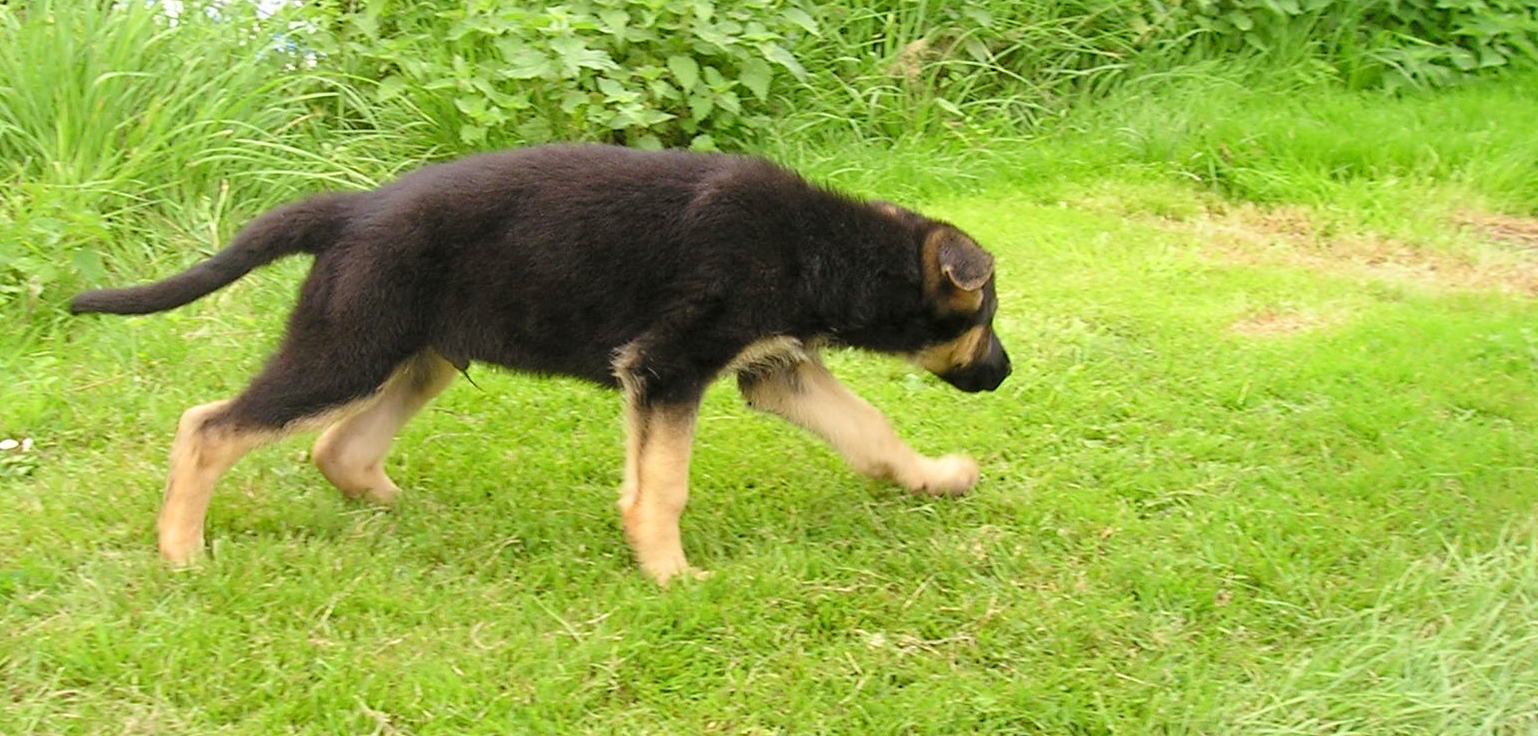
I very carefully sat down on the wooden-slatted bench and rested the beautiful animal in my lap. The puppy was adorable. Those large, over-sized ears flopping across the top of his golden black-brown furry head. His golden-brown fur morphing into black fur across his shoulders and then on down to the predominantly beige-cream colour of his soft, gangling, front legs. That creamy fur continuing along the little creature’s underbelly.
The puppy seemed almost to purr with contentment, its deep brown eyes gazing so very intently into mine. I was entranced. I was spellbound.
Never before had I felt so close to an animal. In a life-time of nearly sixty years including having cats at home when I was a young boy growing up in North-West London, and much later the family owning a pet cat when Alex and Maija were youngsters, I had never, ever sensed the stirrings of such a loving bond as I was sensing now. As this young puppy was clearly sensing as well. This was to be my dog. Of that I was in no doubt.
oooo
Early days at home in South Devon.
Let me leave you with a couple of other photographs taken from his early days.
Pharaoh, nine months old, taken in my Devon home in 2004.
oooo
First birthday: June 3rd 2004. Again, picture taken in Devon.
Never in my wildest dreams did I imagine that in the year 2014 I would be writing about Pharaoh from a home-office desk in Southern Oregon sharing a happy life with a wonderful London lady, Jean, and more gorgeous animals than one could throw a stick at.
ooOOoo
And here we are with Pharaoh, as with yours truly, well into his senior years.
As I explained yesterday, I am distracted from all things blogging right through to the end of this week-end.
So I’m republishing a post from June, 2013 that, hopefully, will be a fresh read for many of you.
ooOOoo
More on Pharaoh’s life.
First published June 4th, 2013.
What a wonderful relationship it has been.
Years ago if I was ever to own a dog, it had to be one breed and one breed only: a German Shepherd Dog.
The reason for this was that back in 1955 my father and mother looked after a German Shepherd dog called Boy. Boy belonged to a lovely couple, Maurice and Marie Davies. They were in the process of taking over a new Public House (Pub); the Jack & Jill in Coulsdon, Surrey. My father had been the architect of the Jack & Jill.
Jack & Jill, Longlands Avenue, Coulsdon, Surrey
As publicans have a tough time taking holidays, it was agreed that the move from their old pub to the Jack & Jill represented a brilliant opportunity to have that vacation. My parents offered to look after Boy for the 6 weeks that Maurice and Marie were going to be away.
Boy was the most gentle loveable dog one could imagine and I quickly became devoted to him; I was 11 years old at the time. So when years later it seemed the right time to have a dog, there was no question about the breed. Boy’s memory lived on all those years, and, as this post reveals, still does!
Pharaoh was born June 3rd, 2003 at Jutone Kennels up at Bovey Tracy, Devon, on the edge of Dartmoor, South-West England. As the home page of the Jutone website pronounces,
The Kennel was established in 1964 and it has always been the aim to breed the best German Shepherd Dogs for type and temperament. To this end the very finest German bloodlines are used to continue a modern breeding programme.
and elsewhere on that website one learns:
Jutone was established by Tony Trant who was joined by Sandra Tucker in 1976. Sandra continues to run Jutone since Tony passed away in 2004. Both Tony and Sandra qualified as Championship Show judges and Sandra continues to judge regularly. Sandra is the Secretary and a Life Member of the German Shepherd Dog Club of Devon.
Turning to Pharaoh, here are a few more pictures over the years.
Pharaoh, nine months old.
oooOOOooo
One year old: June 3rd 2004.
The next picture of Pharaoh requires a little background information.
For many years I was a private pilot and in later days had the pleasure, the huge pleasure, of flying a Piper Super Cub, a group-owned aircraft based at Watchford Farm in South Devon. The aircraft, a Piper PA-18-135 Super Cub, was originally supplied to the Dutch Air Force in 1954 and was permitted by the British CAA to carry her original military markings including her Dutch military registration, R-151, although there was a British registration, G-BIYR, ‘underneath’ the Dutch R-151. (I wrote more fully about the history of the aircraft on Learning from Dogsback in August 2009.)
Piper Cub R151
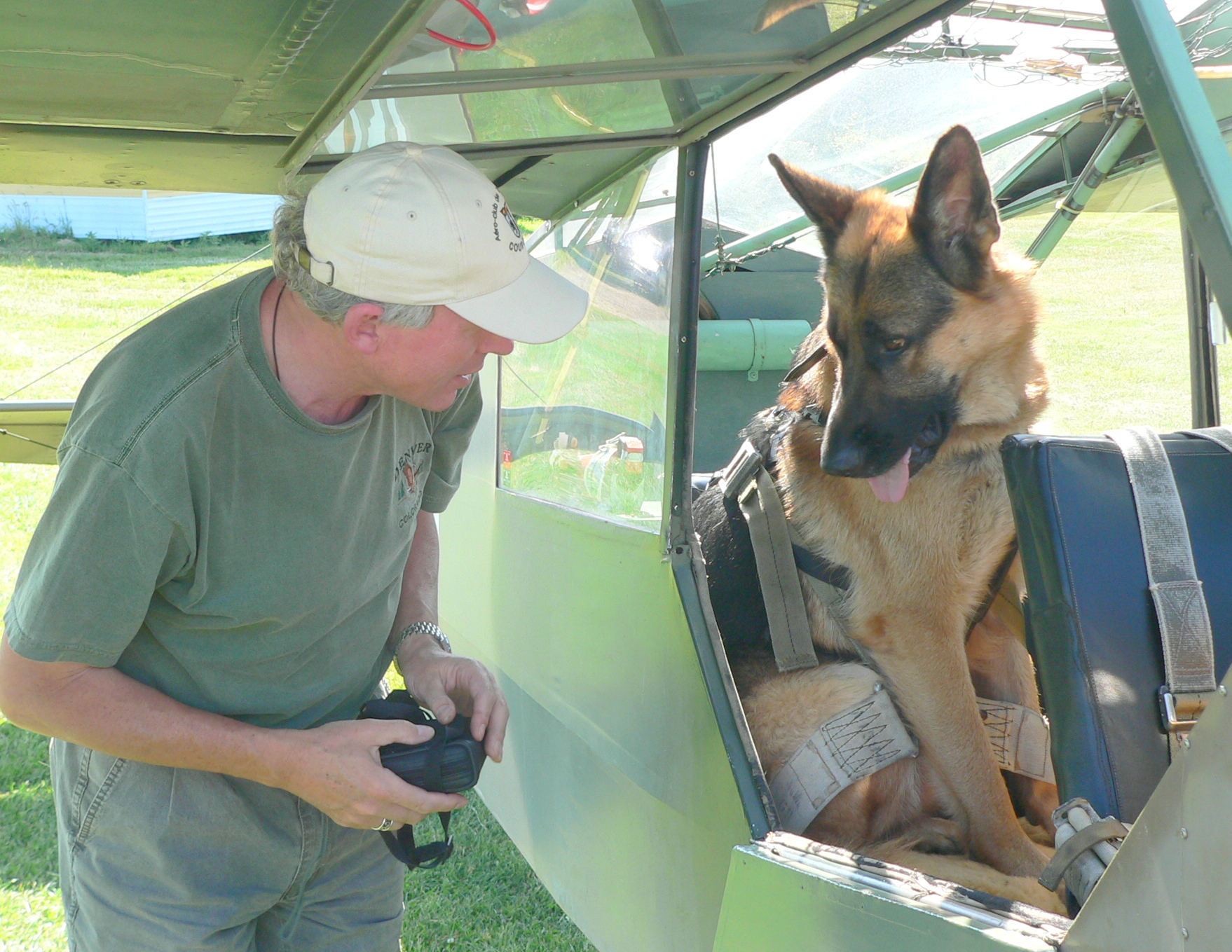
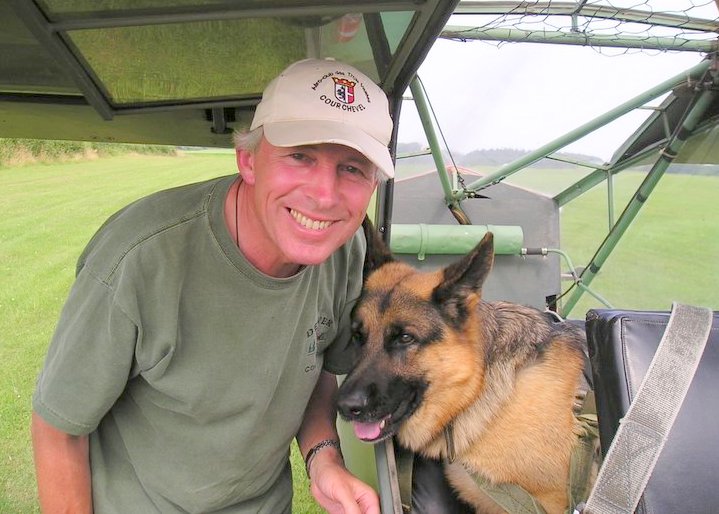
Anyway, every time I went to the airfield with Pharaoh he always tried to climb into the cockpit. So one day I decided to see if he would sit in the rear seat and be strapped in. Absolutely no problem with that!
Come on Dad, let’s get this thing off the ground!
My idea had been to fly a gentle circuit in the aircraft. First I did some taxying around the large grass airfield that is Watchford to see how Pharaoh reacted. He was perfectly behaved.
Then I thought long and hard about taking Pharaoh for a flight. In the Cub there is no autopilot so if Pharaoh struggled or worse it would have been almost impossible to fly the aircraft and cope with Pharaoh. So, in the end, I abandoned taking him for a flight. The chances are that it would have been fine. But if something had gone wrong, the outcome just didn’t bear thinking about.
So we ended up motoring for 30 minutes all around the airfield which, as the next picture shows, met with doggie approval. The date was July 2006.
That was fun!
What a dear dog he has been over all the years and, thankfully, still is!
As if to reinforce the fabulous dog he still is, yesterday it was almost as though he knew he had to show how youthful he still was.
Because, when I took his group of dogs out around 7.30am armed with my camera, Pharaoh was brimming over with energy.
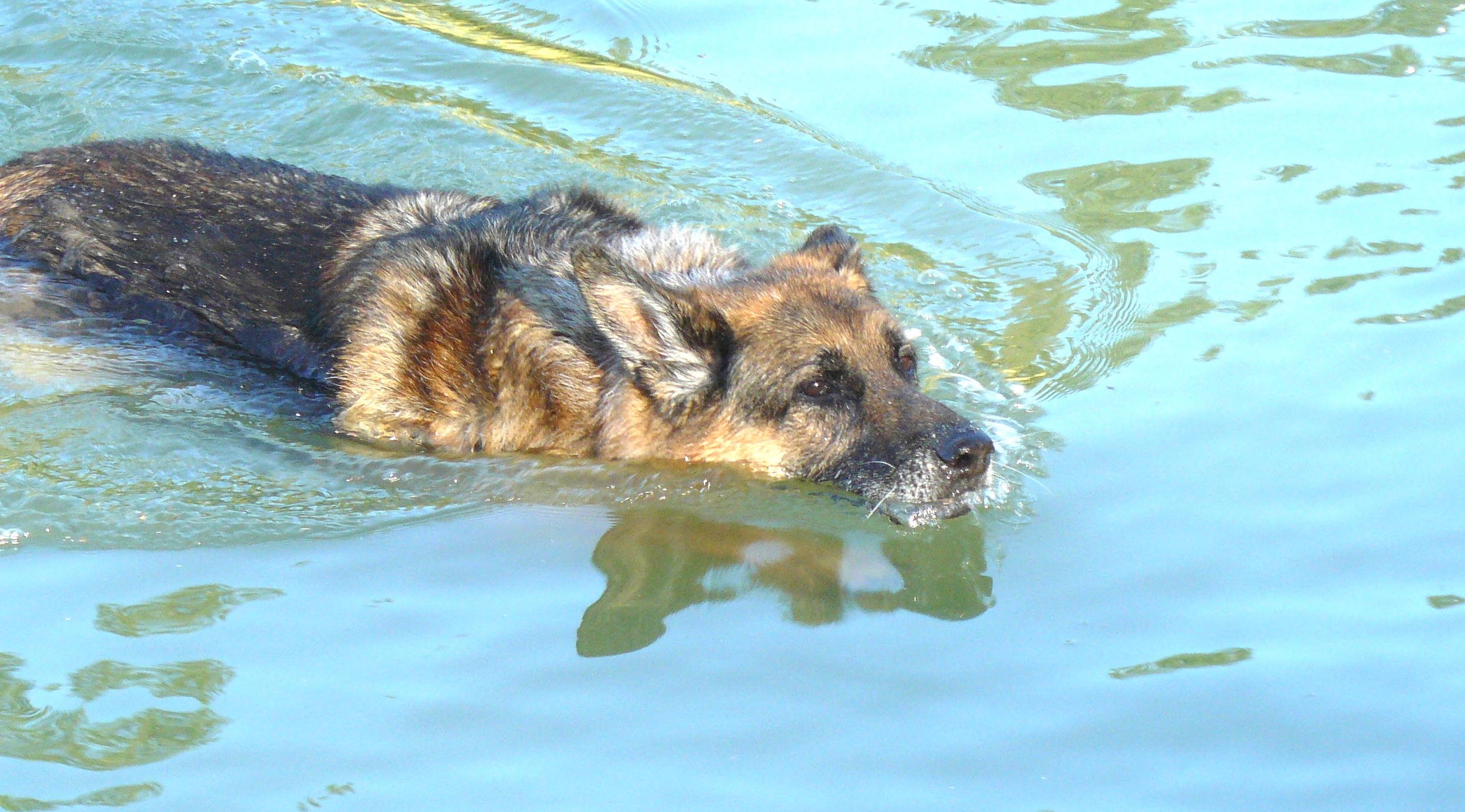
First up was a swim in the pond.
Ah, an early birthday dip! Bliss!
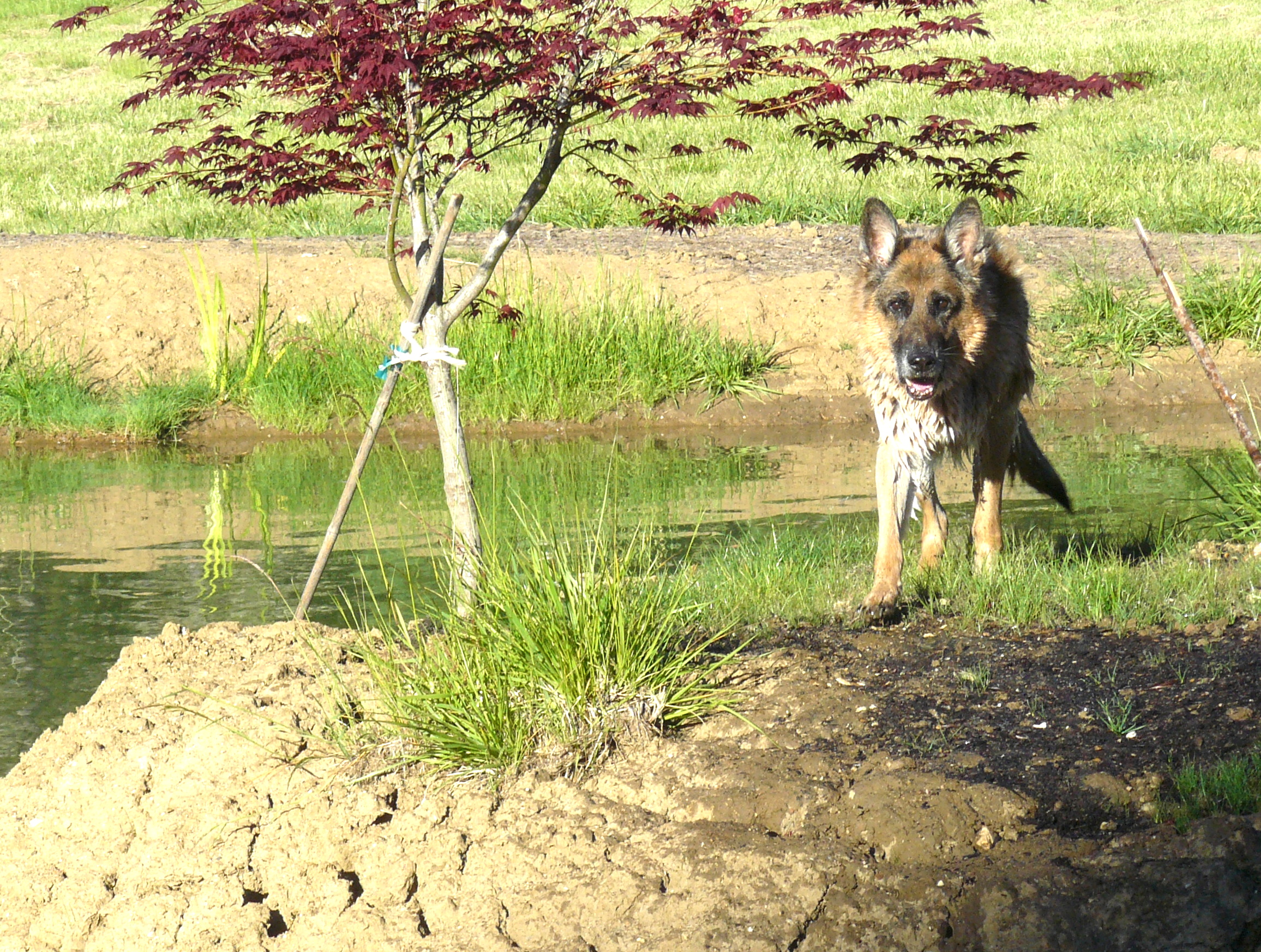
Then in a way he has not done before, Pharaoh wanted to play ‘King of my Island’, which is in the middle of the pond.
Halt! Who goes there!
ooo
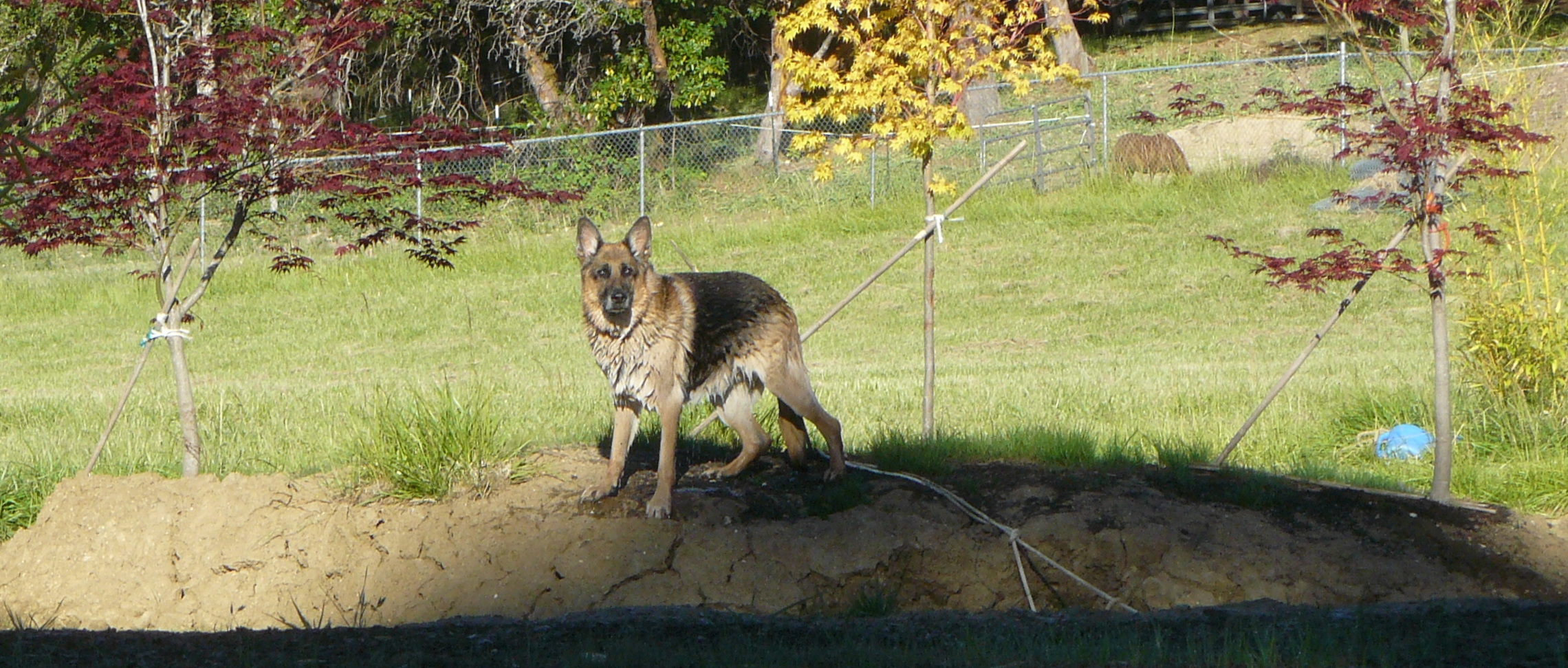
This is my island! So there!
Then a while later, when back on dry land, so to speak, it was time to dry off in the morning sunshine.
Actually, this isn’t a bad life!
Long may he have an enjoyable and comfortable life.
ooOOoo
Long may we all have enjoyable and comfortable lives!
Loving owners want so much to know when their pets may be in pain.
Our dear Pharaoh (born June, 2003) is getting very weak in his rear hip joints and Jean and I are very sensitive to understanding whether or not he is in pain. Any loving owner of a cat or a dog would be the same; and it doesn’t stop with our cats and dogs.
September is Animal Pain Awareness Month. My Lab, Sanchez, is 13-years-old. I still sometimes have a hard time identifying the difference between a behavior problem and a physical ailment. Our dogs are so adaptable and want to please us so much, it’s sometimes challenging to detect their pain.
These often subtle signs will help you determine when your pet may be showing signs of pain. Some require a veterinary visit, but other times there are simple things you can do to help. When Sanchez had a slipped neck disc at age 9, I thought he was in so much pain that he’d never recover. A few acupuncture sessions later, and he turned into a puppy!
1. Mouth Fluttering
It wasn’t until I made a video with Sanchez in it that I noticed he was making all sorts of mouth movements. (He starts the mouth movement at :28 seconds.) I knew he wasn’t stressed and his lip licking was not a calming signal. It sparked enough curiosity that I had my vet look at this mouth. Sure enough, he needed his molars pulled. As hesitant as I was to have this operation on a 13-year-old dog, he came through it just fine and started acting much younger post-surgery. I didn’t realize he was in pain for months.
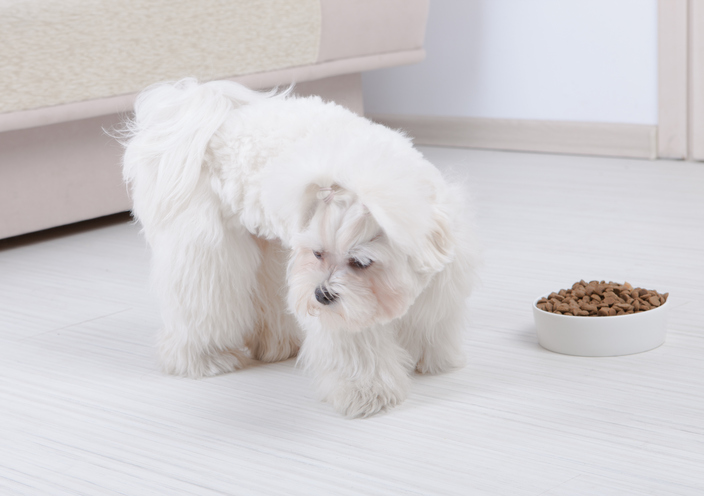
Little dog maltese refusing eating his food from a bowl in home
2. Decreased Appetite
A change in desire to eat is not always a sign of illness. It sometimes can also be about mouth pain. If you give Fido or Fluffy hard food, try some soft food and see if they want to eat. Experiment with different textures. Decreased appetite is a good reason to visit your vet.
3. Reluctance to Get In The Car
While this might happen throughout a cat’s entire life, dogs may show hesitancy getting in a car when it causes them pain to jump up (or down). Try using a ramp so that they can easily get in and out without adding any pressure to their joints.
4. Difficulty Standing Up
Older pets tend to sleep a lot and they can be slow at getting up. Give them plenty of time to stretch as they know how to listen to their own bodies. But, if Fido or Fluffy is hesitant to stand up, they may be feeling pain. Personally with Sanchez, this is one of the areas where it’s hard to tell the difference between behavior and pain. But, I can usually find out the answer quickly when I entice him with a yummy treat.
5. Decreased Activity and Engagement
When pets are in pain, they often want to be left alone. Watch for any signs of social behavior changes. Is Fido engaging with his dog buddies? Is Fluffy getting in more cat fights? Senior pets have a taxed nervous system in general and aren’t as curious as their puppy or kitty playmates. But notice if there has been any drastic change in their activity level. It may be a reason for a vet call.
The International Veterinary Academy of Pain Management (IVAPM) also offers this downloadable chart that helps you determine when you’ll need to make a vet visit.
ooOOoo
That downloadable chart is a graphical version, as in a pdf, of this post. Nonetheless, IVAPM are to be congratulated on producing the chart and for highlighting the important indicators when trying to decide whether or not to take your loved pet to see a vet.
Yesterday lunchtime was a very stressful period. Because I was speaking to various members of the family in England but especially to my sister, Eleanor, who had come over from South Africa to be with my mother, and to Rose, my cousin, who lives in Baldock, Hertfordshire, and is being so supportive.
In the middle of all of this Brandy came across to the low table where the remains of my lunchtime sandwich were still on my plate and started helping himself. I was striding around the room speaking to Eleanor and when I spotted Brandy eating my lunch I really showed my anger. I shouted “No!” and prodded him hard in the back. Brandy slunk off giving me a really foul look.
Fifteen minutes later Jean and I took the dogs outside for their regular ‘after-lunch’ leg-stretch and Brandy kept his distance from me. I went across to Brandy: “Oh, Brandy! I am so sorry for being cross with you Please forgive me.” There was real remorse in my voice and, undoubtedly, showing on my face too.
Brandy came over to me and nestled his wonderful, beautiful head against my thighs and I curled down and rubbed his chest with my left hand. As simply and as quickly as it could ever be, Brandy had forgiven me.
A short while ago I was approached by a Mary Neilsen who asked me if I would like her to write a post for Learning from Dogs. I agreed and in hindsight I am so pleased I did.
Read her wonderful post and you will understand why!
ooOOoo
Is Your Dog Holding a Grudge?
Your dog throws you that look – you know the one – and walks away. You’ve been snubbed! So what is causing this emotional outburst? Maybe your canine pal is holding a grudge.
“What have I done now?” you might ask yourself. Depending on the circumstances, you may not be guilty of anything. You may just be misinterpreting that look – or yes, indeed, your furry friend may be paying you back for some grievance.
No pet owner is perfect. We all make mistakes. We accidentally step on our pet’s tail; take away a favorite toy; or abandon them to a night alone in the house. These are things that can set our dog to turn their backs on us to teach us a lesson – if only for a little while. But is it true? Do dogs really hold grudges?
The Experts Say No
If you live with guilt every time your furry friend gives you a sideways look, you are reading too much into it, say the experts. They don’t hold grudges and they don’t act in petty ways or seek revenge. [Ed: The dogs that is not the ‘experts’! Sorry; couldn’t resist!] Their emotional lives are not as complicated as humans. Dogs are more simple creatures. They live in the moment.
According to famed canine expert Cesar Millan, dogs don’t hold long-term grudges simply because they can’t. They don’t think that way. Sure, they may act miffed now, but will soon forget what’s bothering them and move past it.
People, on the other hand, tend to hold onto negative feelings and expressing that kind of anger or anxiety can make your dog react too. In other words, if you express prolonged feelings of guilt over slamming your dog’s paw in the screen door, he may react by steering clear. It is not the action that is causing him to distance himself from you for a while; it’s your reaction to the event. In other words, it is your angst causing him to act this way.
What We Can Learn From Our Dogs
There may be some who still believe dogs can (and do) hold grudges, while research shows this assumption incorrect. Even so, there is one thing most canine psychological experts agree on and it is that we can learn an important lesson from our canine counterparts: how to let go.
Humans have a really hard time letting go of our grievances. In a recent Gallop poll, more than two thirds of participants acknowledged the importance of forgiveness, yet less than half actually were able to forgive those who hurt them. That equals a lot of grudge holding going on.
While our dogs move past every infraction, humans tend to hold on, dwelling on our hurts and allowing them to rule our lives. This can cause relational issues; depression, or worse. But, when we take after our dogs and let go of those negative feelings we can experience such benefits as:
Take a look at your dog. He seems happy enough. Wouldn’t you like to be able to experience the kind of true joy and relaxation he does? The trick to that kind of contentment is learning how to let go of those grudges and live in the moment.
Yes, people are going to hurt us. That is simply life. But those hurts do not have to cause you chronic pain. Take a cue from your dog. Allow yourself to feel the pain in the moment, and then move on. You will discover that life is a lot more enjoyable that way.
About the Author
Mary Nielsen is a passionate dog lover, blogger and part-time music teacher. She founded MySweetPuppy.net to share her ups and downs of being a pet parent to a bunch of adorable mutts. When she is not playing with them or teaching, you can find her experimenting in the kitchen.
ooOOoo
Please join with me in thanking Mary for such a delightful guest post and hoping that we will be reading more from her.
Yesterday I used the phrase, “A number of domestic circumstances are taking priority at the moment …” and I wasn’t overplaying that. I can’t say anymore at this stage other than to say that a very close family member has been diagnosed with a terminal illness (and it’s not Jeannie, my son or my daughter.)
Naturally, it has been dominating my thoughts and emotions these last 72 hours but my ability to comprehend what has happened and to weep from time to time would have been impossible without the love of my sweet, dear Jeannie and the emotional sensitivity of our dogs.
For example, yesterday morning when I swung myself out of bed a little after 5:15am, the room still dark, and then sat on the side of the bed wondering what the diagnosis would be from the consultant in London, Brandy came up to me and just buried his head in between my slightly opened legs. With his head held down he pressed himself into my crutch and I then bent my own chest and head down and buried my face in the warm fur of Brandy’s neck just behind his ears.
So on to a short film that has been shown before here on Learning from Dogs but is still worth seeing again.
Published on Mar 27, 2015
Hey:)
Thanks for watching my film. I really hope you share and comment as we love your feedback also feel free to email your thoughts as well. www.ShawnWellingVisuals.com for more info and my email.
The Director
-Shawn Welling Full Synopsis:
A friend to share the ups and downs of life with him — and, soon, his family. “If I Could Talk” gives this dog the one chance he wants to share his thoughts.
Director: Shawn Welling AXI
Story: Mark Galvin / Shawn Welling
Screenplay: Shawn Welling
Starring:
Max Welling / The White Lab
Shawn Welling / Shawn Welling
Michelle Simmons / Michelle Welling
Grace Calabrese / Grace Welling
Kalyssa Lauer / Kalyssa Welling
Music:
Reuel
Composer:
Phillip Glass
Cinematographer
Shawn Welling
Art Giraldo
Scott Budge
Thinking of every one of you and what your dogs mean to you!
Coping with an emergency includes looking after our dogs.
Most of us live our daily lives without paying too much attention to the likelihood of an emergency. But as Hurricane Hermine and the recent explosion of that SpaceX rocket show the unexpected does come along.
All of which is my preamble to a recent item over on the Mother Network Nature site that reviewed taking care of our beloved pets when an emergency does strike.
I have pleasure in sharing it with you.
ooOOoo
5 steps to ensure your pet is cared for in an emergency
Jaymi Heimbuch August 31, 2016
When an unexpected problem pops up, have a back-up plan for your pet. (Photo: Africa Studio/Shutterstock)
A car crash, an arrest, a natural disaster or a medical emergency. While no one wants to think about these awful possibilities, sometimes we should to protect and provide for those we love, in case one day we can’t make it home as planned. And those we love include our pets.
Imagine something happens to you and you can’t get home to your dogs, cats, birds or other critters. You need a way to not only alert others to the fact that you have pets at home, but also the information they need to care for your pets in your absence. Here are five ways you can ensure that your pets will be looked after.
Carry a card in your wallet
Create a card that you can carry in your wallet or purse. If you’re ever in a medical emergency, a rescue worker or paramedic looking through your wallet for identification will also know that there are animals at your home that need care.
The card can be as simple as a note that you have pets at home on one side, and on the other side lists contact information for friends or family members you’ve designated to care for them. Or it can be detailed, listing how many pets you have at home, their names and the kind of animal each pet is, your address, and emergency contact information for two people you trust to care for your pets. How much information you want to include is entirely up to you.
You can create your own card, download a free template online to print out, or buy cards online that you can fill in information with a pen.
Add a sign on your door or windows to save your pet
Another place to put an alert card is in your window or on the door to your home. An emergency pet alert sticker is ideal when you can’t get to your home but someone like a firefighter or rescue worker can.
Like a wallet card, a sticker should list how many pets are inside and what species they are, so any rescue worker would know if they’d found all the animals inside.
This is a small but potentially life-saving step in preparing for emergency situations such as after an earthquake, tornado, fire or flood, so that someone who is searching through homes can rescue your pet even if you can’t — or aren’t allowed — to get back to your home.
Ensure at least 2 separate people you trust have access to your home
Your emergency wallet card states contact information for people you trust to care for your pet if you’re in an emergency situation and can’t get home to them. The next step is ensuring they can get to your pet when needed.
Make sure each person listed as an emergency guardian has a set of keys, or that they know the secret hiding place for your spare set of keys. If you have an alarm system on your home, you’ll need to provide these friends with the access code.
Because these friends or family members not only have access to your home but also will take responsibility for your animal companion, you’ll need to put some thought into who you’ll have in place as a temporary caregiver or as a permanent caregiver.
When choosing a temporary caregiver, consider someone who lives close to your residence. He or she should be someone who is generally home during the day while you are at work or has easy access to your home. When selecting a permanent caregiver, you’ll need to consider other criteria. This is a person to whom you are entrusting the care of your pet in the event that something should happen to you. Be sure to discuss your expectations at length with a permanent caregiver, so he or she understands the responsibility of caring for your pet.
You may want to put down temporary caregiver contact information on your emergency cards, and ensure they know who is designated as the permanent caregiver should you not be able to return home to your pets for a long time, or at all.
An emergency kit with your pet’s medical information, extra food and other supplies will help rescuers. (Photo: rSnapshotPhotos/Shutterstock)
Create a kit for your pet
A disaster preparedness kit is a great idea both for you and your pet. This also benefits your pet not just for a natural disaster, but if you’re in an emergency and can’t get to them.
An emergency supply kit should include a document that a temporary caregiver or potential permanent guardian can use to understand your pet’s needs. This includes:
vet and vaccination records
pet insurance details
information about any medications your pet needs
an extra leash and collar
a carrier if you have a smaller pet
information on any behavior problems, quirks or habits that a caregiver should know about
Be sure to tell your emergency contacts and temporary caregivers where this information is located in your home, so they can access it should they need it.
Make formal long-term arrangements for your pet
We briefly discussed designating someone as a permanent caregiver for your pet should you not be able to return to them. You may want to consider setting up a formal arrangement for this to ensure that your pet definitely goes to the person you’ve designated and receives the care they need.
This could be a formal written arrangement with a permanent caregiver or it may be part of your will. You might also consider creating a trust or other financial arrangement to ensure your pet is cared for if you’re incapacitated. However, Petfinder notes:
Before making formal arrangements to provide for the long-term care of your pet, seek help from professionals who can guide you in preparing legal documents that can protect your interests and those of your pet. However, you must keep in mind the critical importance of making advance personal arrangements to ensure that your pet is cared for immediately if you die or become incapacitated. The formalities of a will or trust may not take over for some time.
Such a document may at first seem like a lot to handle for a “what if” situation, but by taking the appropriate precautions ahead of time, you can be sure that your pets are immediately cared for should something occur that prevents you from returning home to them.
ooOOoo
This all seems like very sound advice and, believe me, advice that Jeannie and I will review and adopt wherever we can.
Please, good people, do take care of yourselves including all your pets.
 Here we are at the end of Tuesday, at the time of writing this post, and already we can see observable improvements in both dogs.















 Learning from Dogs