Category: Musings

Nostalgic musings

Early days in London

In my recent post Electrosensitivity, I wrote about “spending a number of years studying for a Diploma in Electrical Engineering at Faraday House, Southampton Row, London and becoming a UK Radio Amateur at the age of 17 (G3PUK)“.

In reverse order, I shall start with becoming a UK Radio Amateur, now rather back in the mists of time!

After my father died in 1956 my mother subsequently remarried.  Her new husband was Richard Mills and he was very knowledgeable about radio matters; he was a technical author in the radio-communications industry.  It was Richard, my step-dad, who showed me how to make a crystal set and I started listening to the strange world of wireless radio.  It fascinated me and motivated me to save up my pennies and buy an ex-military radio receiver known as a R1155.

r1155

I had joined the Harrow Radio Society who, amazingly, are still active today, as their website demonstrates.

Under the fabulous tutelage of many of the older ‘hams’ I went on to sit my exams and on Valentine’s Day 1962 was awarded the Postmaster-General’s Amateur Radio Certificate.  I applied for a call-sign and was allocated G3PUK.  I was just 17 years old!

G3PUK0001

oooOOOooo

Now some memories of Faraday House.  I can do no better than refer you to an article that appeared on the Electrical Review website in the UK.  As the article was published over three years ago, I think republishing it on Learning from Dogs isn’t being too naughty.

faradayhouseplaque

Faraday House Association closes after 105 years

FRIDAY, 29 JANUARY 2010

It is with sadness we report the Faraday House Old Students Association (FHOSA) is to close after operating continuously over the last 105 years. It had been host to thousands of chartered electrical engineers. The Association membership is derived from old students of Faraday House.

In 1888 the revised Electric Lighting Act encouraged many local authorities to apply for Parliamentary Powers to establish generating stations to transmit power. Faraday House was founded to train engineers in this new practice. The college started life as the Electrical Standardising, Testing and Training Institution at Charing Cross but in June 1890 used the name Faraday House. It was located in the Charing Cross area, and fees were 100 guineas per annum. The first Faraday House Dinner was held in 1895 – it was free and some 170 attended. In 1905 the FHOSA was formed and 100 old students joined. A move was then made to Southampton Row. By now the college had 110 students.

In 1909 Dr Russell was appointed principal, and pioneered the sandwich course. This meant students had a year or so of theory and then experienced work in industry, returning again to more theory. By 1914 many old students joined up and a crash course was started to aid the war effort. By 1919 some 350 had been in the services and 34 had died. In 1920 the fees had risen to 300 guineas.

By 1928 1000 students had joined the Old Students Association and in 1929 a 40th anniversary dinner was held. In 1939 a discussion with the governors resulted in a decision to evacuate the college to Thurlestone in Devon. A new principal, Dr WRC Coode-Adams, took over from Dr Russell. Faraday House took over the Links Hotel. Staff and students who were married lived in the hotel or in houses that had been taken over by the college.

In 1942 the college returned to Southampton Row. After the war Faraday House had difficulty in recruiting, students were lured to other colleges and universities by grants. In 1957 Mr GH Randolph Martin was appointed Principal. He had been a lecturer at the college since 1948. The college closed its doors in 1967 as losses were now running at £20,000 per year.

During its lifetime Faraday House produced a succession of engineers who attained the most senior positions in industry and electrical supply in many countries, and six old students have been president of the Institution of Electrical Engineers (now the IET).

The Old Students Association has a membership that is steadily growing older and shrinking as members die. The closure was inevitable without younger people coming forward to run it. The FHOSA will shut its doors finally after the Annual General Meeting in March 2010.

Here’s the front of the building.

Faraday House, London

How the years have flown by!

Interconnectedness

All and every thing is connected on Planet Earth.

I must share the feelings of millions of others across the world when I admit to going through periods of quiet despair about where ‘modern man’ has got himself. (I don’t intend to be gender specific!)

It goes way beyond the disbelief at some of the things happening today; way beyond the anger that is generated by so many examples of greed and corruption.  It goes to a point where I just want to snuggle down with Jean, curl up with the dogs and kiss the rest of the world good-bye!

The expression that comes to mind is the one about the last person to leave the planet please switch the lights off!

(As if to demonstrate how sensitive dogs are to the feelings of us humans, Cleo just came into the room where I am writing this and laid her head across my left thigh.  I stroked her head and then she wandered back to our bed next door – I then took the following photograph)

P1120525

So what’s feeding my feelings?

Well, as many of you know yesterday and Sunday had posts about saving the Ecuadorian Jaguar and the African Lion.  In the case of the former, it’s:

The president of Ecuador claims to stand for indigenous rights and the environment, but he has just come up with a new plan to bring oil speculators in to 4 million hectares of jungle.  (That’s 9.9 million acres in old money!)

In the case of the African Lion, it’s:

In the past fifty years, the African lion population declined by as much as 90%. Many of the lion prides that do exist today are so genetically weak from being small and isolated by international borders that they can’t promise a future for African lions ….. two thirds of the African lions killed by trophy hunters end up in the U.S. That’s thousands of lions!

Last Friday I wrote about how community living for wolves and dogs had given those species “group survival and well-being“ that we humans couldn’t even dream about.

Then over at Liberated Way, Alex Jones recently wrote:

I attended a lecture at Essex University Colchester last Wednesday on the plight of indigenous indians in Canada, specifically those in Labrador. The Canadian government has embarked on a scheme to disenfranchise the indians of all their land, wipe out all their rights forever, and place them in perpetual bondage. Underlying this horror was what has happened to the indians themselves, a people tainted with mental illness, alcoholism and high suicide rates.

I asked the lecturer why it is that it appears all indigenous people across the globe share this common trait of high levels of abuse, mental illness, suicide and alcoholism. The answer given was that outsiders desired to force their alien world views upon these people destroying their sense of personal identity. For example many of these people see land as a shared resource, the capitalist ideas of land ownership is at odds with their world view. All Native American problem solving is through talking, and everyone has choice, whereas outsiders prefer to impose solutions and intellectualise with clever words.

Just read that last paragraph carefully again and note “outsiders desired to force their alien world views upon these people destroying their sense of personal identity.”

Back closer to home, the struggles of the North American Indians are well-known.

So no nice, neat solution to this place that I’m in just now other than to put down my pen and let the music from the following two videos wash over me.

If you read this far, thank you for suffering the ramblings of this silly old fart!

—-

Home on the ‘ranch’.

Some reflections of the last few days.

Just a dip into a few experiences.

Back on the 10th we had a few days of cold, overcast weather that brought temperatures down below freezing and some snow.

Here’s a scene looking towards the North-East corner of the property, taken just before 11 am.

P1120310

Then a few days later, on the 14th, the sun was out while the temperatures remained below freezing.  Shown clearly as the sunlight catches the frost on the tree.

P1120378

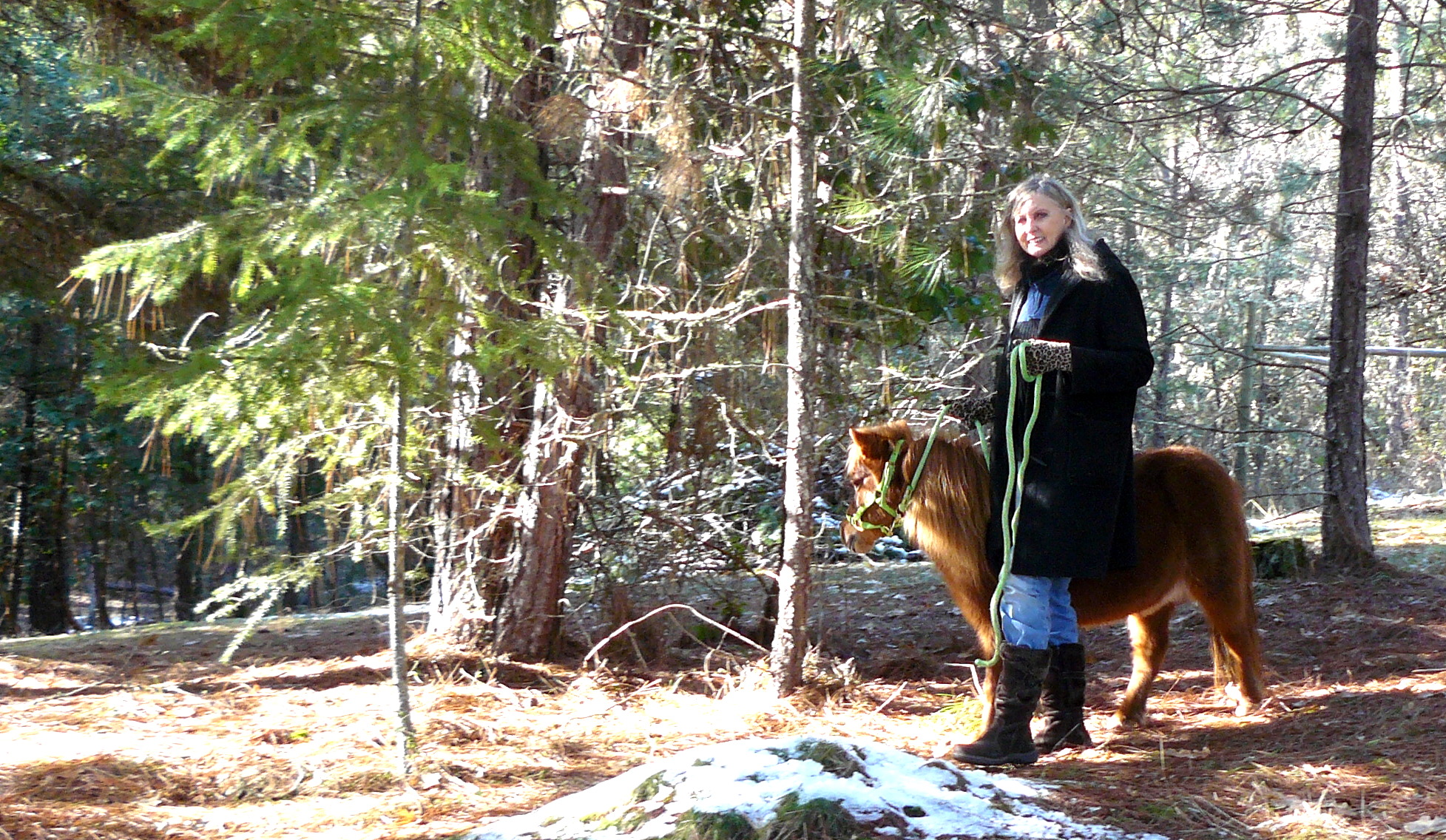
A few minutes later I swung the camera to take a picture of Dancer munching away in the morning sunshine, just a day after we collected her and Grace.

P1120388

The horses settled in quickly, adapting to the dogs who were very curious.

P1120394
Grace and Cleo being nonchalant with each other.

Jean unable to get her fill of her new companions.

P1120390

And in a very different vein, a sneak photograph taken of yours truly who had collapsed in front of the fire early evening last Friday, quickly becoming a cushion for Hazel.

P1120474

Wherever you are in the world, have a great day.

The wonder of dogs.

Never before has an integrous way of life been so critically important.

When I was preparing this post, I couldn’t make up my mind if it should come before or after the story of the release of The National Climate Assessment.  In the end I decided it should follow the post that I called The unacceptable face of The Daily Mail.

My reasoning was that the NCA report was such a stunning indictment of the madness, the myopic madness of mankind these last 100 years, that this appreciation of the wonder of dogs must act as a beacon for us all.  I use the word ‘beacon’ because the qualities demonstrated by these nine dogs are just the qualities that we need to adopt.

Every living person on Planet Earth has to embrace the stark choice coming up on us like a runaway train. If we don’t change our values, our behaviours and our relationship with this one, finite planet, in the next ten years, at most, then the consequences will be beyond imagination; a world of unimaginable terror and chaos.

Forgive me if I repeat what the Home page of Learning from Dogs offers:

As man’s companion, protector and helper, history suggests that dogs were critically important in man achieving success as a hunter-gatherer.  Dogs ‘teaching’ man to be so successful a hunter enabled evolution, some 20,000 years later, to farming,  thence the long journey to modern man.  But in the last, say 100 years, that farming spirit has become corrupted to the point where we see the planet’s plant and mineral resources as infinite.  Mankind is close to the edge of extinction, literally and spiritually.

On the 30th December, 2012 The Week magazine published an item written by Editor Lauren Hansen.  I ask Lauren if I might republish the article in full but that was denied.  However, I was given permission to refer extensively to the piece.  I will use it to underline just what we have to learn from dogs.

The 9 most newsworthy dogs of 2012

Dogs are the best. Here’s the proof… if you even need it
By Lauren Hansen | December 30, 2012
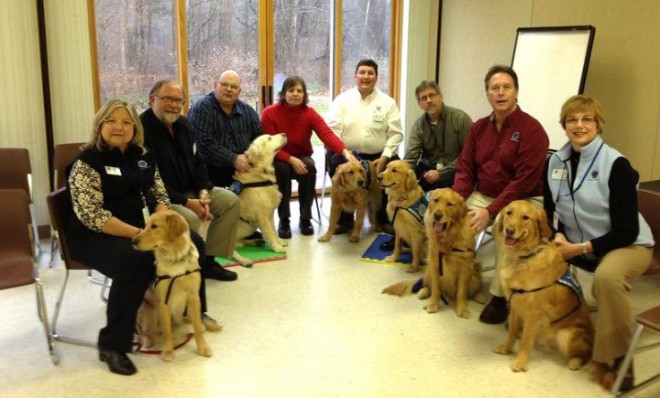
The K-9 Parish Comfort dogs (and their handlers) who helped the residents of Newtown, Conn., through their grief.

If you’re reading this, then you’re probably aware: Dogs rule. This year, a handful of canines rose above the rest, making headlines for their actions — whether facing imminent danger to save lives, enduring unimaginable physical hardships, or simply making us laugh. A look at nine of the year’s most newsworthy pups:

1. Chicago’s comfort dogs
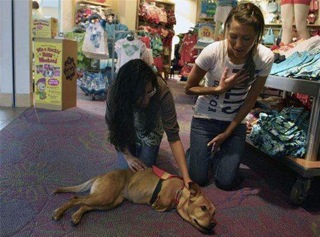
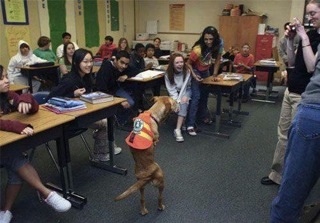
After the unimaginable events that befell Newtown, Conn., on Dec. 14 that left 27 people, including 20 children, dead at the hands of suspected gunman Adam Lanza, a team of golden retrievers was deployed from Chicago to the picturesque town. About 10 specially trained dogs, including Chewie, Ruthie, and Luther, made the 800-mile journey to sit with children and adults during masses and funerals. “Dogs are nonjudgmental. They are loving. They are accepting of anyone,” says one handler. “It creates the atmosphere for people to share.” The Chicago comfort dogs are notable not only for this caring venture but also for helping those who suffered through Hurricane Sandy and the tornado that hit Joplin, Mo., in 2011.

The next story was about the puppies that kept a lost boy warm.

That was followed by the hero dog that lost its snout saving two girls.

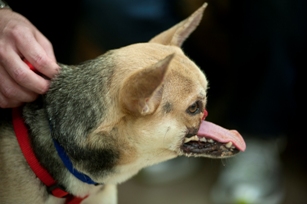
One dog’s heroism so disfigured her sweet little face that her photo is often preceded by a warning. This canine’s story started with a motorcycle careening through the streets of Zamboanga City, Philippines, earlier this year. Young cousins Dina Bunggal, 11, and Princess Diansing, 3, stepped unknowingly into its path. A mutt named Kabang came out of nowhere and jumped in front of the motorbike, stopping it in its tracks, and saving the little girls from serious injury. The driver and the girls emerged with superficial wounds, but Kabang wasn’t so lucky. Her head landed on the motorcycle’s front wheel and as the wheel rolled forward, Kabang’s upper snout was ripped right off. Her story quickly went viral and when local doctors could do no more to help her, specialty surgeons from the University of California, Davis, flew Kabang to their facilities, where she’ll endure six to eight weeks of treatment to repair her face. The cost of her surgeries, which could top $20,000, will be covered by her many supporters who have started an online fundraising campaign.

Here’s a photograph of Kabang found on the web.

kabang_7600
Vets at William R. Pritchard Veterinary Medical Teaching Hospital don’t plan to fullyy reconstruct Kabang’s snout, or fit her with a prosthetic. Instead, they are attempting to close the gaping wound on her face, preventing further infections.

Then my last dip into Lauren’s article is dog story eight.

8. The dog that saved its own life by calling the police

We’ve often heard the tale of the puppy that proves its “man’s best friend” status by saving its owner’s life. But this year, there was George, a 2-year-old basset hound in West Yorkshire, England, who reworked the well-worn script a bit, literally calling for help to save himself. Home alone, George had knocked the phone to the floor and was strangling himself with the handset’s cord when he apparently dialed 999 — England’s 911 equivalent — in a panic. The operator heard only frantic gasps and, assuming someone was desperately sick or reeling from an attack, sent police to the house. The dog was found and rescued from the cord. “Incredibly, you could see where his paw print was on the phone,” said the neighbor, “he literally saved his own life.”

The article also mentions a recent item in Huffington Post (UK):

Now, what fun-loving toddler can walk past a puddle without stopping for a little splash? Not this one!

Little Arthur was out for a stroll with his best mate, Watson the dog, when he noticed a tempting puddle. So he put down the leash and plunged straight in. And Watson? Well, he’s a more mature 12 years old, so he didn’t partake himself. But he was more than happy to wait while Arthur had his fun.

You know what this video is, don’t you? That’s right. Too. Cute. For. Words.

Here’s the video, seen over 4,800,000 times!

Finally, there’s the beautiful story of the dog befriending a Down’s Syndrome boy.

sweetmama

So what does this all add up to?  That the qualities of the dog; integrity, unconditional love, patience, loyalty, and their ability to live in harmony with nature really do send us humans a message for the future.

And a future not so far away.

New Year, Old Message

The deep values associated with having faith.

This was sent to me by Dan Gomez.  I take great pleasure in offering it to you, dear reader.

oooOOOooo

A dog named Faith.

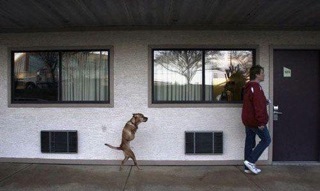
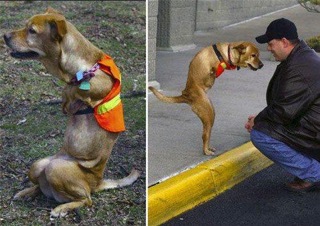
This dog was born in 2002. He was born with 2 legs. He of course could not walk when he was born. Even his mother did not want him.

faith1

His first owner also did not think that he could survive and he was thinking of putting him to sleep. But then, his present owner, Jude Stringfellow, met him and wanted to take care of him.

She became determined to teach and train this little dog to walk by himself.

She named him ‘Faith’.

faith2

In the beginning, she put Faith on a surfboard to let him feel the movement.  Later she used peanut butter on a spoon as a lure and reward for him for standing up and jumping around.  Even the other dog at home encouraged him to walk.

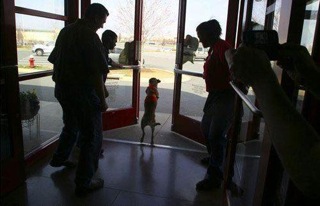
Amazingly, only after 6 months, like a miracle, Faith learned to balance on his hind legs and to jump to move forward.  After further training in the snow, he could now walk like a human being.

faith3

Faith loves to walk around now. No matter where he goes, he attracts people to him.

He is fast becoming famous on the international scene and has appeared on various newspapers and TV shows.  There is now a book entitled ‘With a Little Faith‘ being published about him.  He was even considered to appear in one of the Harry Potter movies.

faith4

His present owner Jude Stringfellew has given up her teaching post and plans to take him around the world to preach that even without a perfect body, one can have a perfect soul.

faith5

oooo

faith6

oooo

faith7

oooo

faith8

oooo

faith9

oooo

faith10

oooo

faith11

In life there are always undesirable things, so in order to feel better you just need to look at life from another direction.  I hope this message will bring fresh new ways of thinking to everyone and that everyone will appreciate and be thankful for each beautiful day.

Faith is the continual demonstration of the strength and wonder of life.

A small request: All you are asked to do is keep this story circulating.

oooOOOooo

We can never stop learning from dogs.

Thanks Dan!

On quietness.

Out of the quietness comes clarity

In yesterday’s post Sanity Anchors, I opened by saying, “A few days ago, I exchanged emails with Jon Lavin.  In the early days of Learning from Dogs, Jon used to write the occasional post, one of which seems highly relevant some three years later.  I will republish it tomorrow.”

So here it is, first presented on the 15th July, 2010.

oooOOOooo

On coming of age

It’s been a partly exhilarating and very scary 12 months since the launch of Learning from Dogs. I can’t remember a time when there has been so much change and uncertainty that hits right down to the foundations of everyone.

Twelve months ago these changes were merely hinted at, and then only to a few in the upper strata of the finance world, from my point of view anyway. How everything seems to have changed now!

Where lies ahead?

Warnings abound about our use of our world’s resources. Our seeming need to procreate without self imposed limit is leading us to a place that coupled with climate change, we will be unable to sustain the current world’s population, let alone the projected increase within 20 years or so. Water is becoming scarce in many parts of the world and so is food.

For those who are awakening from a media-induced slumber which distorts and bends reality to suit who can apply the greatest financial influence and weighting, the reality of the situation we are facing as a planet, is rapidly catching us up.

We still have choices – all is not lost and they will require a highly integrous group of people and thinkers to guide us through the next hundred years or so. In other words, in our children’s or children’s, children’s lifetimes. People who are not driven by the ego, but to serve the highest good.

So what can we do as individuals? Enjoy what we have, perhaps? I think, work on ourselves through awareness and expose ourselves to everything positive and integrous.

Most of our problems lie within, from that thing called an ego, that would rather drive us to death, rather than admit it might be wrong. The world would be an even more positive place if we worked on ourselves and our awareness rather than looking for all the answers ‘out there’, with somebody or something else.

So, how do we work with that? Well, no surprises there really – by bringing in awareness and coming out of the dream state, or nightmare state, depending on how you see things at the moment, and into the Present or Now, as some writers have called it.

How do we do that? It can simply begin by remembering to breathe! So by bringing our awareness to the breath, we come back into our bodies and out of the trance going on in the mind. Approximately 95% of our time is spent in this self-induced trance-like state, by the way.

Think you can’t survive without ‘your mind’ or ‘your thoughts’. There’s no such thing really. By coming out of the mind and back into the body, slowly, with practice and awareness, the noise gently starts to subside and we become aware of spaces of silence or no thought. That is where the answers lie, not in thinking.

The intellect and what we have learned kicks in after the quiet, to allow us to put into action what has come up through the silence.

Most of us have such a huge investment in ‘our thoughts’ or ‘our ideas’. If we could just make the time to sit still, in peace and quiet, so much more would be revealed to us.

So in this brave, new world going forward, to badly quote Einstein, we must aspire to move onto a higher level than the one that triggered this road we are relentlessly pursuing. We need to start becoming aware of the interconnectedness of all beings and focus on activities that are for the highest good, that benefit everyone, rather for the benefit of the few, to the detriment of the many.

By Jon Lavin

oooOOOooo

So let’s make this new year the year where we all slow down, embrace the peace and quiet, so that a clear world is revealed.

Sanity anchors.

The importance of staying grounded in the face of the oncoming storm.

A few days ago, I exchanged emails with Jon Lavin.  In the early days of Learning from Dogs, Jon used to write the occasional post, one of which seems highly relevant some three years later.  I will republish it tomorrow.

jon-lavin

Jon and I go back a few years and most who know me know that it was Jon’s counselling back in 2007 that opened my eyes to something that, literally, changed my life.  For the better, I hasten to add!

In our recent email exchange, Jon wrote this:

Just started back at work today. A bit of a shock to the old system! Am wondering what to set my sanity sights on for this coming year in the middle of almost total uncertainty.

Of course!  How obvious! The need to ensure that our lives contain anchors of stability, safe places to curl up in, metaphorically speaking, where we can seek refuge from the winds of change.  Otherwise, we run the very real risk of being overcome by the uncertainty of the future.

The resonance with small boats and the sea is obvious, and unavoidable in the case of yours truly.

songbird-of-kent1
Tradewind 33, Songbird of Kent

For five years I lived on and sailed a Tradewind 33, Songbird of Kent; my base being Larnaca on the island of Cyprus at the Eastern end of the Mediterranean Sea.  Contrary to the image of the Mediterranean, it wasn’t uncommon to experience some ‘interesting’ weather; there were times when it could turn very nasty!

The comfort, physical and mental, offered by being tucked up in a small bay, listening to the storm about one, while riding securely to your anchor was beyond imagination.

Jon’s comment underscores the incredible importance of each of us knowing what anchors us to a secure place.  So, like any sailor, always keep a weather eye open for those early signs of a storm, and cast your anchor in good time.

Needless to say, having a loving dog or two in one’s life provides a wonderful storm-proof anchor.

P1120182

Essence of wisdom, page two.

Doing the right thing has power.

Thus wrote Laura Leggett Linney.  Maybe Laura doesn’t fit into the same folder as Confucius (she’s well and truly alive for one thing) but the quote was perfect, hence the connection.

Yesterday, I offered an overview of the human brain.  Today I want to expand on the idea of “how we jumble up how we act with what is best for us” as was put in yesterday’s introduction.

In researching for today’s essay, the power of the Internet quickly found the quotation by ex-President Lyndon B. Johnson that “Doing what’s right isn’t the problem. It’s knowing what’s right.”  Reflecting on the escalation of America’s involvement in Vietnam that was a product of LBJ’s term of office, perhaps his quotation carries a certain pathos that wasn’t intended at the time of its pronouncement!  In other words, it’s not the ‘knowing‘ but the ‘doing‘ that is critical, as LBJ’s legacy so clearly illustrated.  Johnson might have better said, “Knowing what’s right is sometimes hard. Doing what’s right is sometimes even harder.

To illustrate the challenge of converting these fine concepts into the grind of daily life, I’m going to use a recent essay published by Ian Welsh.  Ian is a frustrated author who writes about his experiences in completing a book on Prosperity. It struck me as a fabulous insight into the vagaries of homo sapiens and one that lent itself beautifully to what I am trying to convey today.

Ian very promptly gave me written permission to republish his essay on Learning from Dogs.  So what I am going to do is to add my own thoughts to Ian’s essay in a way that hopefully supports the proposition that we are far from being logical creatures.

To know what to do is not enough

by Ian Welsh – January 2nd, 2013

For the past year I’ve been writing a book on prosperity, by which I mean widespread affluence. It’s been slow going, not because I don’t believe I know the general technical requirements of prosperity (I do, if I didn’t, I shouldn’t be wasting anyone’s time, including mine, writing the book), but because the real problem isn’t the technical details like eliminating bottlenecks, or redistributing income, or setting up positive feedback loops, or avoiding fraud, or stopping financialization, or any of the dozens of other subjects I either visit at chapter length or touch on briefly.  The problem as with, say, stopping smoking, isn’t so much what to do, it is how it comes that we do it.  When do we make the decision we’re willing to do what it takes, sufferer the negative consequences of getting to a better place, and then push ourselves through those consequences?

Let’s dally with that phrase, “isn’t so much what to do, it is how it comes that we do it.”  On the 1st January, I published an article called Why?  It included a film by Simon Sinek looking at the Why, How, and What of human decision-making.  The film supports the thesis that those who succeed act, think and do things differently; the crucial point being that spending time on understanding why you do what you do is very revealing.  You can see the resonance between Simon Sinek and Ian Welsh, can’t you?  If we better understand ‘why’ we want to do something, we can better think 0f what is the best way of achieving that.

Back to Ian’s essay.

This is a huge problem in individuals, as the weight loss, addiction, psychology, psychiatry and self-help industries attest.  There is, generally, more money in  not solving a problem, as drug makers with their palliatives understand, than in solving it.  The people who have power and money and influence in the status quo are not sure that in a new world, with a new economy, and the new ethics which must undergird that new economy, they will be on top.  They are right to believe so.  They are creatures of the current world, and in being created, have created the world they are unsteady masters of.  Their ethics and morals, their way of business, of living, of apportioning power and influence and money must go if there is to be widespread affluence.  Their methods have been tried for 40 odd years now, and if measured against the human weal, have failed.  They will not, they cannot adapt, not as a group. They were not selected for the skills it takes to create a new type of affluent society, they have not even been able to maintain the mass affluence of the old society, and not just because they have not wanted to.  They would be a different elite, made up of different people with different ethics, talents and skills if they did want to.

This paragraph is just laden with powerful ideas.

First, the recognition that millions opt for the palliative rather than the cure.  Second, that these same millions live in present times that are controlled undemocratically by plutocrats.  Thirdly, changing to a new, better order is not going to come easily.  Ergo, for the last few decades there has been a massive failure of wisdom.  Applying that failure to millions does not, of course, avoid the charge that each of us, individual by individual, each in our own tiny manner, has contributed to that failure of wisdom.

Ian amplifies this idea, as you will see by reading on.

Ordinary people also have the wrong ethics, the wrong morality.  Much is written about why consumerism is bad, but the ultimate problem of consumerism is not how it makes us feel but that the consumer passively chooses from a menu created by others, not to fill the consumer’s real needs, but to benefit those who created the menu.  Such a passive people cannot understand that choosing choices without creating choices is not choice, it is the illusion of choice.

So while my book has a lot of general principles of the sort which books on prosperity often have, such as about trade, and productivity and technological change, that isn’t the most important part.  The part that matters isn’t about the technical requirements of prosperity, it’s about why and when people do what is required to achieve prosperity, and when they don’t.  And when, having obtained it, they throw it away.

Such a passive people cannot understand that choosing choices without creating choices is not choice, it is the illusion of choice.”  Pick the bones out of that!

On we go.  Going to let you read Ian’s closing four paragraphs as one piece.

Our society is ours.  A tautology, but one we forget too often.  As individuals we often feel powerless, as a mass, we have created our own society.  There are real constraints, physical constraints on what society we can have, based on the resources we have, the technology we have mastered and what we understand about ourselves and our world, but those constraints are not, right now, so tight as to preclude widespread affluence, to preclude prosperity.

They are, however, tight enough to preclude continuing to do the same thing, led by the same sorts of people, and expect anything but decline, repeated disasters and eventual catastrophe.  We can be affluent and prosperous, we can spread that affluence and prosperity to those who do not have it now, but we cannot do it if we insist on keeping the current forms of our economy, including our current forms of consumption.  This does not mean doing with less, it means doing with different things, valuing different things.  Those new values will be better for us, objectively, they will make us both happier and healthier, just as most addicts are happier once they’ve broken their addiction, or rather once they’ve gone through withdrawal and rebuilt their lives.

We can choose not to do so.  We have, in certain respects, already chosen not to do so, as with our refusal to do anything about climate change until it is too late (the two problems are combined, climate change is a subset of the political and economic problems we have).  We can, also, choose to make the necessary changes, not only to avoid the worst catastrophes (disasters are now inevitable, there are consequences to failure, stupidity and greed), but to create an actual, better, world, a world in which the vast majority are healthier, happier and doing work they care about.

The monster facing us, as usual, is us.  The monsters are always us, our brothers and sisters, and the one in the mirror.  And it is those monsters I’ve been wrestling this past year.

Reflect on those three points that I made earlier: how we don’t put the cure as the top priority, how we are dominated by the greed and power of the relatively few, how difficult changing our present society would be.  Not a pretty picture!

Then look at yourself in that mirror, either literally or metaphorically, and say to the face you see peering back at you: “This is my society. Yes, I do feel powerless but I have to embrace the cold, hard truth that I am part of my society and that change will only occur if I subscribe to the new values that I require.

That has real power!

Essence of wisdom, page one.

By three methods we may learn wisdom: First, by reflection, which is noblest; Second, by imitation, which is easiest; and third by experience, which is the bitterest.

Thus spoke Confucius, albeit not in the English language!  But, nonetheless, those words from so, so long ago (he lived to the age of 73 – from 551 until 479 BCE) resonate very strongly 2,500 years later.

That was the easy bit!

I’m not entirely clear as to why a variety of items that have crossed my ‘in-box’ in recent days seem to offer some sort of cohesive sense.  But they do to me and I’m going to draw them together. I will leave you to be the judge as to how well it worked!

Thus over the next three days I am going to reflect on three topics.  The challenge of how we humans make sense of the world, how we confuse what we do with what is best for us, surely the essence of wisdom, and the growing gap between the wisdom of millions of citizens and their leaders.

I should quickly add that much of my musings are due to this scribe standing on the shoulders of giants than seeing clearly from his own level.

Today, I shall start with the brain. Your brain, my brain, the brains of humans.  The reason this trilogy starts with the brain is that, ultimately, everything we humans think, feel and do comes from this brain of ours.  Our brain is who we are.

Let me offer you this video made by Bristol University in England.  Just a little over 6 minutes long it sets out the functional story of our brain.

(An animated tour around the human brain commissioned for Brain Awareness Week in 2010)

But there is so much more to this ancient body organ.

The Big Think website has been publishing a series called The 21st Century Brain. The latest episode published on November 6th was called Consciousness: The Black Hole of Neuroscience.  It starts thus:

What’s the Big Idea?

“By the word ‘thought’ (‘pensée’) I understand all that of which we are conscious as operating in us.” –Renee Descartes

The simplest description of a black hole is a region of space-time from which no light is reflected and nothing escapes. The simplest description of consciousness is a mind that absorbs many things and attends to a few of them. Neither of these concepts can be captured quantitatively. Together they suggest the appealing possibility that endlessness surrounds us and infinity is within.

But our inability to grasp the immaterial means we’re stuck making inferences, free-associating, if we want any insight into the unknown. Which is why we talk obscurely and metaphorically about “pinning down” perception and “hunting for dark matter” (possibly a sort of primordial black hole). The existence of black holes was first hypothesized a decade after Einstein laid the theoretical groundwork for them in the theory of relativity, and the phrase “black hole” was not coined until 1968.

Likewise, consciousness is still such an elusive concept that, in spite of the recent invention of functional imaging – which has allowed scientists to visualize the different areas of the brain – we may not understand it any better now than we ever have before. “We approach [consciousness] now perhaps differently than we have in the past with our new tools,” says neuroscientist Joy Hirsch.

Later on is this:

So there’s no reason to assume that consciousness is eternally inexplicable. However, it may never be explained through neurobiology, says David Chalmers, the philosopher who originally made the distinction. “In so many other fields physical explanation has been successful… but there seems to be this big gap in the case of consciousness,” he says. “It’s just very hard to see how [neurological] interactions are going to give you subjective experience.”

The fascinating essay concludes:

It’s no different than any other aspect of the brain that we cannot presently explain, she [Hirsch] says:

For example, we don’t understand how the brain creates colors. That’s a perception that is very private – I don’t know that your perception of blue is like my perception of blue, for example. Smells are another one. I don’t know that your perception of the smell of an orange is like mine. These are the hard problems of neuroscience and philosophy that we haven’t made a great deal of progress on.

What do you think? Is the distinction between “hard problems” and “soft problems” useful, or reductive? Does the brain create consciousness? Will we ever empirically understand where it comes from or how it works?

But it was one of the comments to the piece that jumped off the screen at me. From Beatriz Valdes and slightly edited by me, the comment offered:

Human consciousness happens in the human brain.  The human brain’s functions are rooted in what the human senses relay to it.  Self consciousness, consciousness of what is around us, is the result of thinking.  There would be no thoughts if the brain were a tabula rasa (Latin for blank slate), had no input from the senses. Therefore, consciousness is quite local, quite mortal, quite dependent on the gray matter inside our skulls.

Local and mortal.  Very profound (I think!).

So, if you like me suffer from time to time from understanding oneself, don’t worry.  There are plenty of others – aren’t there?  As Professor Dan Dennett makes it all clear below.

Philosopher Dan Dennett makes a compelling argument that not only don’t we understand our own consciousness, but that half the time our brains are actively fooling us.

Philosopher and scientist Dan Dennett argues that human consciousness and free will are the result of physical processes and are not what we traditionally think they are. His 2003 book Freedom Evolves explores the way our brains have evolved to give us — and only us — the kind of freedom that matters.

Good, glad that’s all clear. 😉

Stay with me for ‘page two’ of Essence of wisdom coming out tomorrow.

Sometimes the meaning escapes us.

Much more than a house move.

Today, the 4th January, we have been at our new home in Oregon for exactly 72 days.  We knew there would be many differences between Payson, Arizona and Merlin, Oregon all of which could be described as objective, factual differences.   However, what was unexpected were the deep, complex emotions associated with moving to this rural part of Josephine County, Oregon.  We were utterly unprepared for that.

In fact, I have been staring at this screen for some time unable to put any structure or meaning to this post.  So I’m not going to try anymore, just offer some photographs and my reflections in the hope that you can sense where I am coming from.

P1120157

The Winter storm that came in on the 20th December was, according to locals, unprecedented.  We lost our power from the 20th until just before Christmas Eve.  It caught us unawares in terms of being ready for this type of winter event.  But then the sun came out one afternoon and I took this picture.

P1120274

It shows the flank of Mt. Sexton, the picture being taken from our deck in front of the house.  I found it impossible to describe the effect that this natural beauty had on me; being in awe just scratches the surface of my feelings.

Moving on.

We have been working hard preparing stables in readiness for two miniature horses that we have purchased from our neighbours, Margo and Clarence.  Last Tuesday, we were busy at this when I saw another breathtakingly beautiful sight.

Just some growth on the top of an old fence post.  But the words utterly fail the image.  Here it is.

P1120292

Then about an hour ago (yesterday), while struggling to write this post, I heard the dogs barking in the bedroom next door.  Went into the room and they were ‘speaking’ to some wild deer grazing our pasture land.

P1120306

Wish I could wrap this all up with some profound view, some wise observations about life and the meaning of the universe!

But I can’t!  Can’t make any sense of it at all. How did we get here?  How did I meet Jeannie, this most precious woman, back in Christmas 2007? How did I sell up and walk away from Devon, England, with just Pharaoh by my side, to start this unbelievable new life with Jean and all the dogs?

Anyone know the answers?

P1110454-001
“The silly old sod does mutter on at times!”