Category: Musings

Closing my Windows.

A big move on in my computing. 

Warning! Today’s post has almost nothing to do with dogs plus if you are not into computing then you may want to come back tomorrow! 😉

A little over a week ago I ordered an Apple Mac computer.

So what, I hear you say.

Well one way or another, I have been associated with personal computing for too many years and with the Microsoft Windows operating system equally for a long time.

Here’s that history and, be warned, I do go on a tad!

In 1970 I joined the Office Products (OP) Division of IBM in the United Kingdom.  I joined as an office products salesman and after my initial training was based at IBM OP’s London North branch in Whetstone in the London Borough of Barnet.  I loved both the job (remember the Selectric ‘Golfball’ typewriter?) and the company and conspired to win the prize of top UK salesman for the year 1977.  By that time, IBM was selling dedicated word-processing (WP) machines.  They offered powerful benefits for companies of many sizes and, as an experienced WP salesman, I was enjoying the fruits of that success.  Thus it was that in 1978 I attended IBM’s Golden Circle celebrations for 1977 country winners from all around the world.  The Golden Circle celebrations were held in Hawaii!

I returned from Hawaii with the clear idea in my mind that this was the time to move on; my ego didn’t like the idea of not being number one again!  So within a couple of days of returning to my sales branch, I announced to my manager, David Halley, that I wished to give three months notice.  I can still recall David’s rather shocked response with him saying, “But I always thought Golden Circle was an incentive event!

In those days New Scientist magazine was a regular read for me.  During my time of working out my notice I read in the magazine about this new personal computer from Commodore Business Machines that had been launched in the UK.  It was called the Commodore PET (Personal Electronic Transactor) and had been unveiled in 1977 at the US West Coast Computer Faire.  I was captivated by what I had read.

pet2001-black

I had casually mentioned it to Richard Maugham; a good friend and fellow office-products salesman working for Olivetti UK.  Richard said that coincidentally a close friend of many years had just been appointed sales manager for CBM UK Ltd.  That friend was Keith Hall and on making contact with Keith, I was invited to go and meet him and learn more about this funny device.  What I hadn’t bargained for was that Keith was yet another smart salesman; Keith and Richard had met when they were both salesmen working for Olivetti.

When I asked Keith the retail price of the ‘PET”, his immediate reply was, “Well why don’t you become a dealer and I can sell you one for 30% less!”  Like most salesmen, I was always a sucker to a good sales pitch! I signed the necessary paperwork. (It is very sad to say that Keith died a few years ago, at far too young an age.)

So it was that towards the end of 1978, I became the sixth Commodore computer dealer in the UK, opening my small store in what had once been a Barber’s shop in Church Street, off Head Street in the centre of Colchester, Essex.  I called my business Dataview Limited.

Frankly, I hadn’t a clue as to what I was doing!  If it hadn’t been for a gigantic stroke of luck I would not have lasted long!

That piece of luck was meeting someone who was a programmer for a large, traditional computing company, ICL, who had bought himself a Commodore PET and, just out of fun, was writing a word-processing program. Now if I didn’t know about computers, personal or otherwise, I certainly knew about word-processing.  When I looked at what Peter D. had written I practically wet myself.  Because, I was looking at a program that even incomplete already offered three-quarters, give or take, of the functionality of a £20,000 IBM Word Processor.

I offered to guide Peter in refining and honing his software which he graciously accepted.  Then a few weeks later Peter casually asked me if I would like to sell the software.  I jumped at the opportunity and in due course Wordcraft was launched under the Dataview umbrella.  (And do see my footnote!)

But back to my Windows journey.

In 1981 IBM announced the release of their own personal computer.

IBM PC
IBM PC

With my love affair with IBM not even dimmed, becoming an IBM PC dealer was a must.  An IBM PC version of Wordcraft was developed by Peter and now things were really rocking and rolling.  Then in 1983 Microsoft announced the development of Windows, a graphical user interface (GUI) for the operating system MS-DOS.  MS-DOS was the existing operating system on the IBM PC.

By the time I sold Dataview in 1986, Windows was well on its way to evolving into a full personal computer operating system and ever since that time my own PCs have been Windows based.  (Difficult to imagine now how in those early years Windows didn’t achieve any popularity!)

OK, fast forward 27 years to my present machine running Windows 7, Google Chrome web browser and all the fancy ‘cloud’-based applications of today.

Much of my time spent writing and blogging relies on me being online.  Like so many others, as soon as I turn on my computer it becomes an online PC.  On average, I am working in front of my PC for about 3 to 4 hours per day.  However, slowly but surely over the past few months I have become aware of a number of strange occurrences, the most annoying of which is the regular ‘hanging’ of my Chrome browser.  This was happening at least on a daily basis and required the complete rebooting of my PC – a right pain in the posterior!

Muttering about this to friends who know a lot more about computing than I, raised my awareness that the privacy and security of one’s computer was no longer to be assumed.  Then just recently, I read online,

A Special Surveillance Chip

According to leaked internal documents from the German Federal Office for Security in Information Technology (BSI) that Die Zeit obtained, IT experts figured out that Windows 8, the touch-screen enabled, super-duper, but sales-challenged Microsoft operating system is outright dangerous for data security. It allows Microsoft to control the computer remotely through a built-in backdoor. Keys to that backdoor are likely accessible to the NSA – and in an unintended ironic twist, perhaps even to the Chinese.

The backdoor is called “Trusted Computing,” developed and promoted by the Trusted Computing Group, founded a decade ago by the all-American tech companies AMD, Cisco, Hewlett-Packard, IBM, Intel, Microsoft, and Wave Systems. Its core element is a chip, the Trusted Platform Module (TPM), and an operating system designed for it, such as Windows 8. Trusted Computing Group has developed the specifications of how the chip and operating systems work together.

Its purpose is Digital Rights Management and computer security. The system decides what software had been legally obtained and would be allowed to run on the computer, and what software, such as illegal copies or viruses and Trojans, should be disabled. The whole process would be governed by Windows, and through remote access, by Microsoft.

Then a few paragraphs later:

It would be easy for Microsoft or chip manufacturers to pass the backdoor keys to the NSA and allow it to control those computers. NO, Microsoft would never do that, we protest. Alas, Microsoft, as we have learned from the constant flow of revelations, informs the US government of security holes in its products well before it issues fixes so that government agencies can take advantage of the holes and get what they’re looking for.

Now I’m using Windows 7 so imagine my angst when I then read:

Another document claims that Windows 8 with TPM 2.0 is “already” no longer usable. But Windows 7 can “be operated safely until 2020.” After that other solutions would have to be found for the IT systems of the Administration.

That did it for me – time to move on from Windows.

Many Apple-user friends said that I should switch to the Apple Mac; that it was the only logical way to go.  I checked that all my important software applications that I used under Windows were compatible with the Apple Mac Operating System and thankfully they were.  I was speaking of Open Office, WordPress, Scrivener, Picasa, Skype.  Then I started to browse the Apple website.  I was clear about wanting a desktop machine, an iMac, and pretty soon realised that my change of personal computing was going to cost me around $1,500, perhaps a little more.

Then Dan Gomez, both long-time friend and Apple user, in browsing the web came across the Mac mini.  He called me and I took a look.  For well under half the price of an iMac, I could get a great alternative to my Windows PC and use many of my existing peripherals.

A quick conversation with Zachary of the Apple Mac mini sales team and the deed was done!  So all that remained was the great transition!

The box arrived last Wednesday.

Surely too small for a full-blooded personal computer?

I resisted opening the box until last Friday when I had some decent spare time.

This is a long, long way from the Commodore PET!

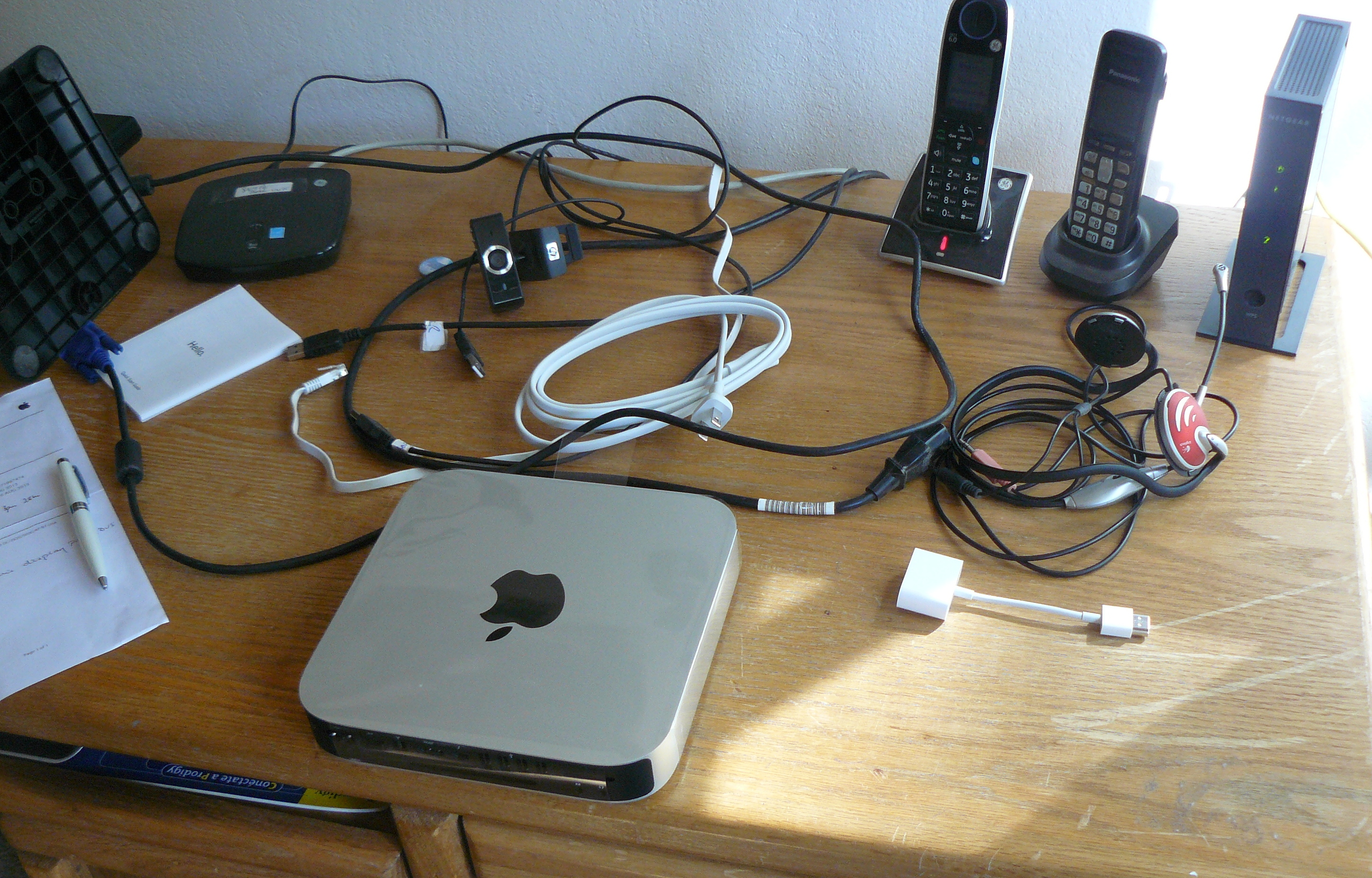
Plugging it all together was easier than I feared.

Just screen and keyboard/mouse and we are good to go!

Then the acid test. Could I even understand how to operate it?  I put that off until Saturday!

The new Mac mini system  on the right, all ready for me to play with!
The new Mac mini system on the right, all ready for me to play with!

I have to say that first impressions, especially of the elegance of the display and the icons, were great.

But this had to be a fully functional machine for me.  Where to start?  By downloading and installing the most critical of my software needs: Scrivener, my writing software.

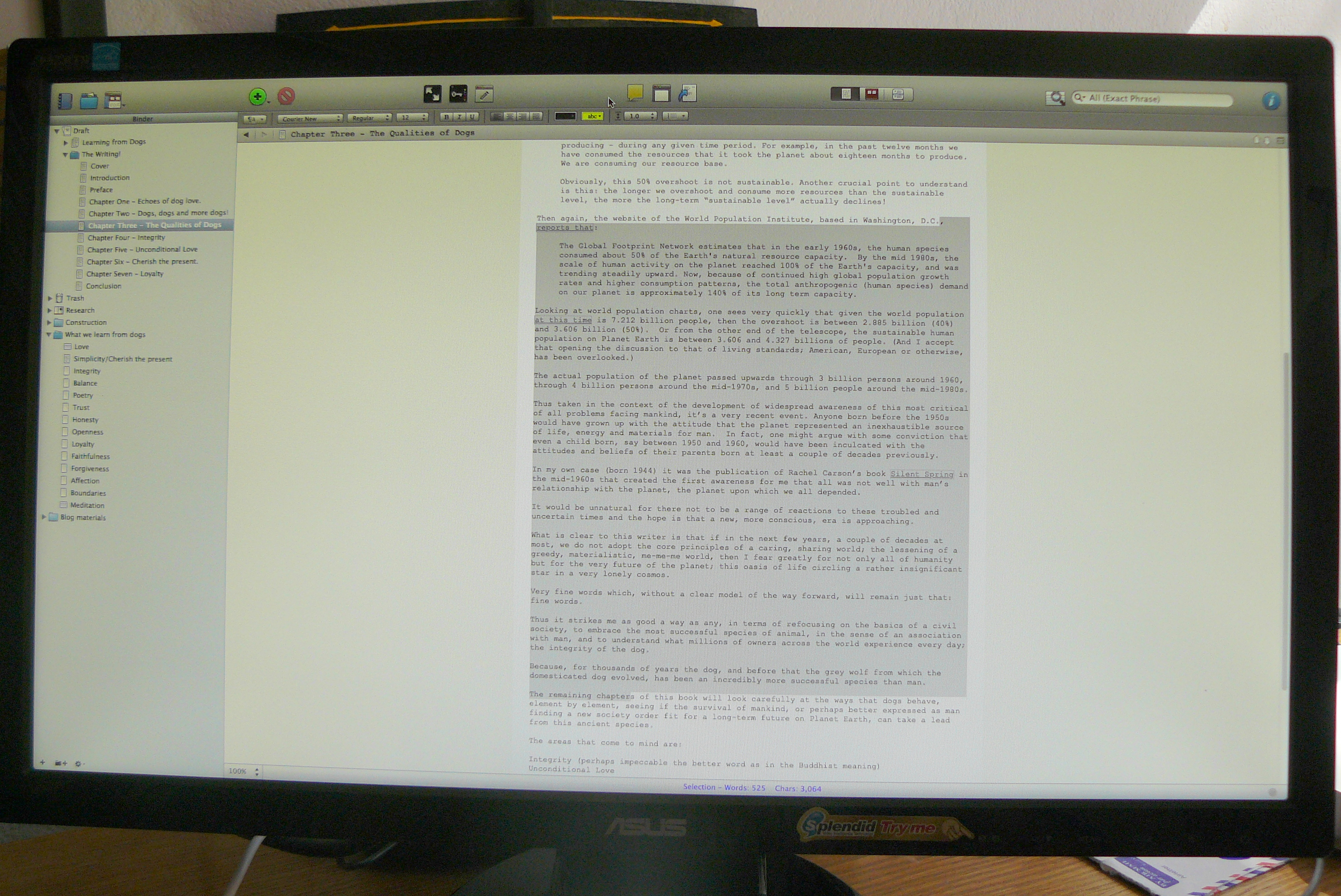
Imagine my great pleasure and huge relief when less than a couple of hours later, not only had I downloaded and installed Scrivener for Apple Mac OS but had passed the latest backup file across from my Windows PC and accessed it on the Apple.

My (very) draft book file installed and running on the Mac mini!

So, all in all, despite this being very early days, it’s starting to look like a great change.

However, I mustn’t close without thanking a few people:

Dan Gomez and John Hurlburt, friends and Apple users, and in John’s case experienced on both Windows and Apple systems. Guys, I couldn’t have made the decision to change without your kind, generous and supportive advice.

Zachary Brown of Apple sales, Mac mini team. Zach, I know it’s your job but nonetheless you did and said all the right things. (And the new screen is much better than my existing one!)

Last but not least, my dearest wife Jean, who just let me get on with things and even though I knew she didn’t have a clue as to what I kept muttering on about, never let on.

Footnote:

Earlier on I wrote about launching Wordcraft, the word-processing software for personal computers. That was in early 1979 and later that year I was invited to present Wordcraft at an international gathering of Commodore dealers held in Boston, Mass.

During my presentation, I used the word ‘fortnight’ unaware that Americans don’t know this common English word.  Immediately, someone about 10 rows back in the audience called out, “Hey, Handover! What’s a fortnight?”

It released the presenter’s tension in me and I really hammed my response in saying, “Don’t be so silly, everybody knows the word fortnight.” Seem to remember asking the audience at large who else didn’t know the word.  Of course, most raised their arms!

Now on a bit of a roll, I deliberately started using as many bizarre and archaic English words that came to me.  Afterwards, the owner of the voice came introduced himself.  He was Dan Gomez, a Californian based in Costa Mesa near Los Angeles and also involved in developing software for the Commodore.

Dan became my US West Coast distributor for Wordcraft and was very successful. When Dataview was sold, Dan and I continued to see each other regularly and I count him now as one of my dear friends.  Through knowing Dan I got to know Dan’s sister Suzann and her husband Don.  It was Su that invited me to spend Christmas 2007 with her and Don at their home in San Carlos, Mexico.  Jean also lived in San Carlos and was close friends with Su. Together they had spent many years rescuing feral dogs from the streets of San Carlos and finding new homes for them.

Thus it was that I met Jean.  Both Jean and I were born 20 miles apart in London!

So from ‘Hey, what’s a fortnight’ to living as happily as I have ever been in the rural countryside of Oregon.  Funny old world!

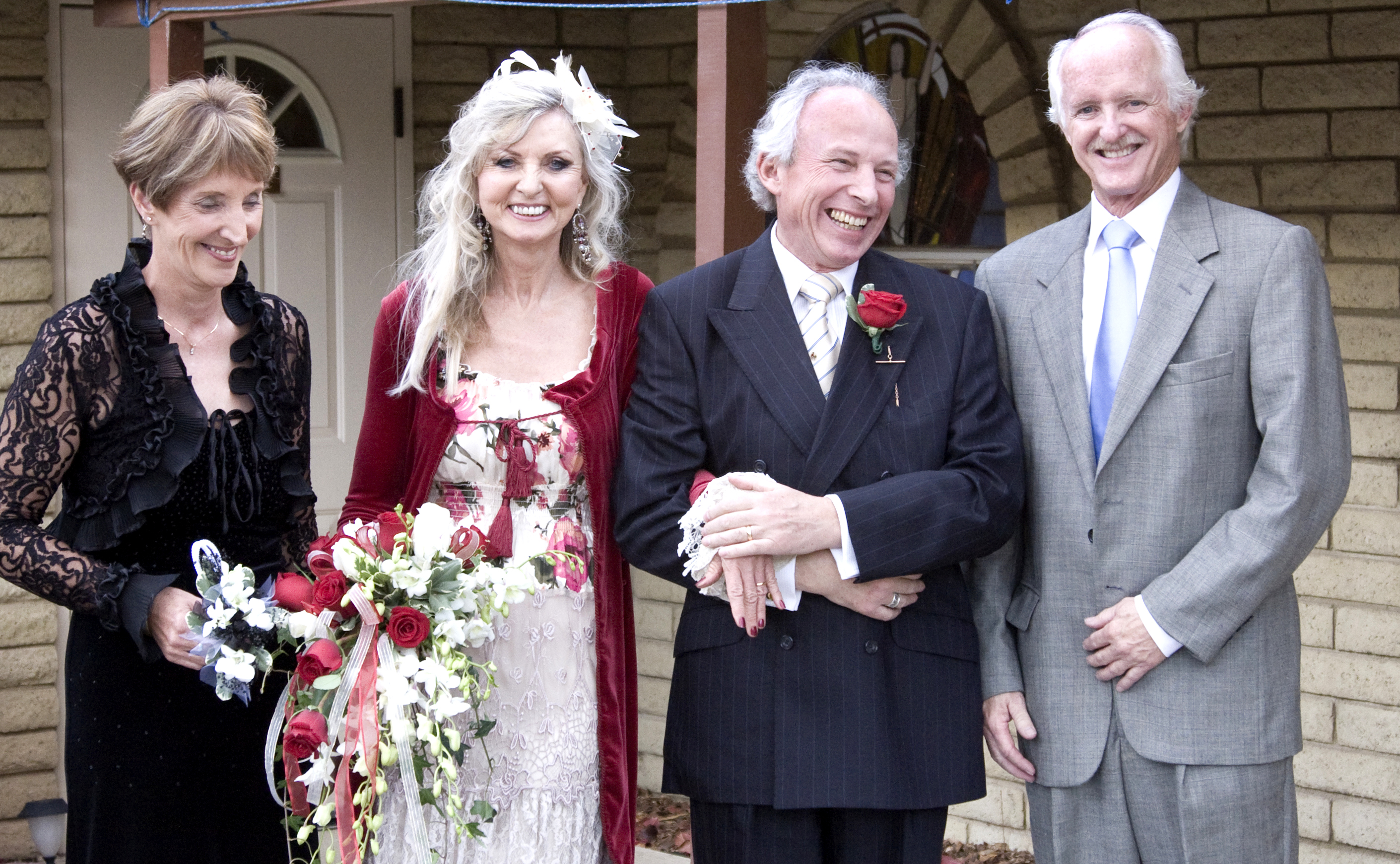
The marriage of Jean and Paul wonderfully supported by Diane, maid of honour, and best man, Dan Gomez.
The ‘voice’ Dan Gomez – Best Man at the marriage of Jean and me, November 20th 2010.

Sing for the trees.

What can we do for the trees?

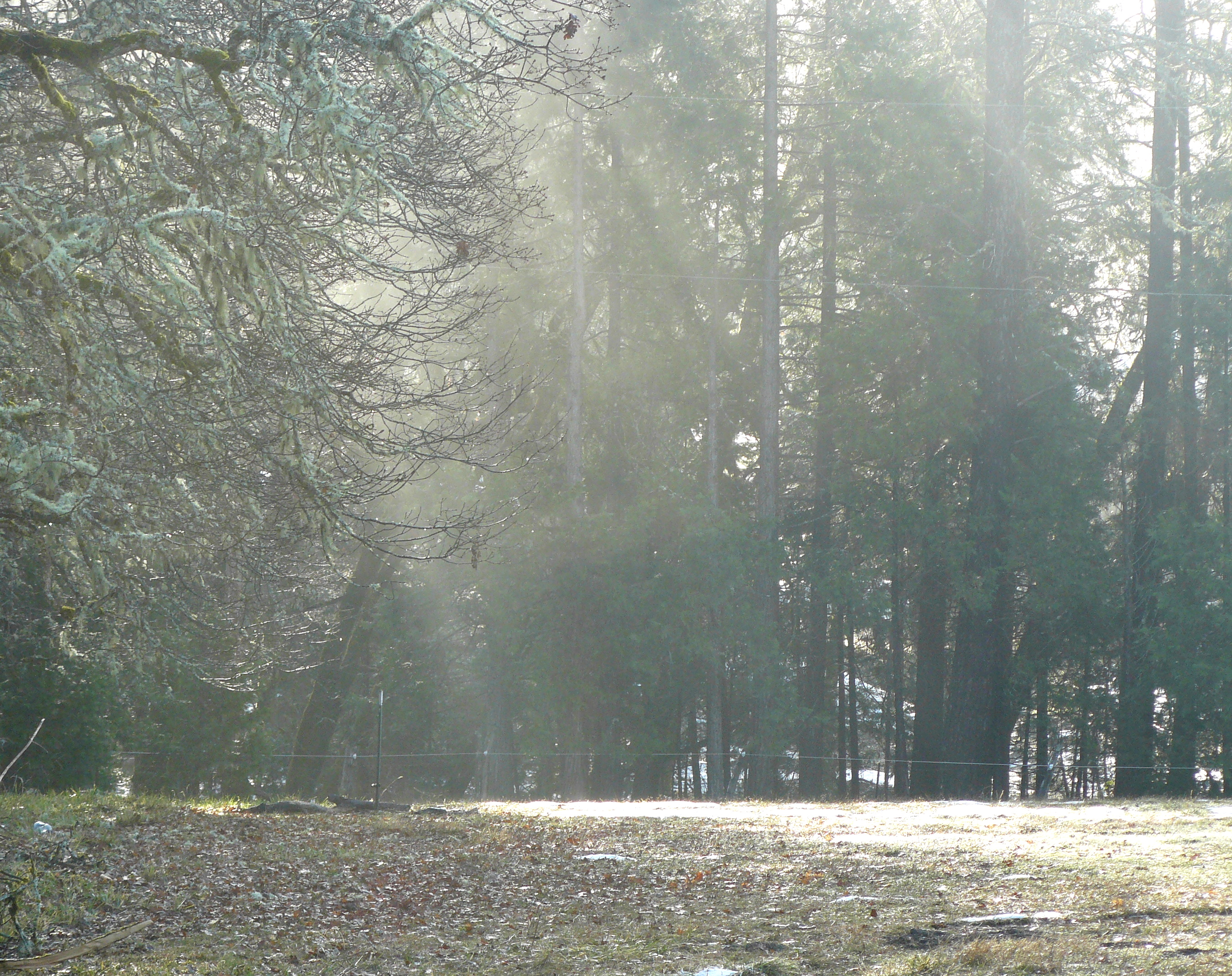
Winter sunlight filtering through the trees. Oregon, January 2013.

We don’t subscribe to television services here at home.  The only way I stay partially informed is via the BBC News website.  Thus it was a few days ago I saw the headline, “European forests near ‘carbon saturation point’”  This was a report by Mark Kinver, Environment reporter, BBC News.  It made me sit up and take notice.  For Mark Kinver wrote:

European forests are showing signs of reaching a saturation point as carbon sinks, a study has suggested.

Since 2005, the amount of atmospheric CO2 absorbed by the continent’s trees has been slowing, researchers reported.

Writing in Nature Climate Change, they said this was a result of a declining volume of trees, deforestation and the impact of natural disturbances.

Carbon sinks play a key role in the global carbon cycle and are promoted as a way to offset rising emissions.

Many of Europe’s forests are reaching an age where growth, and carbon uptake, slows down.

Writing in their paper, the scientists said the continent’s forests had been recovering in recent times after centuries of stock decline and deforestation.

The growth had also provided a “persistent carbon sink”, which was projected to continue for decades.

However, the team’s study observed three warnings that the carbon sink provided by Europe’s tree stands was nearing a saturation point.

It would be wrong to republish the full report but do go and read it here.  It contains much information, some of it counter-intuitive.  Such as Dr. Gert-Jan Nabuurs from Wageningen University and Research Centre, Netherlands saying of Europe’s forest;

“These forests have now reached 70-80 years old and are starting a phase in the life of a tree where the growth rate starts to come down,” he explained.

“So you have large areas of old forest and even if you add these relatively small areas of new forest, this does not compensate for the loss of growth rate in the old forests.”

The report includes the glaringly obvious, “However, mature woodlands have been recognised as a key habitat for supporting and conserving biodiversity.”!

The issue of knowing what is best for the wildlife, of all types and sizes, of balancing doing nothing to the forest or undertaking beneficial husbandry is one that is going to be in our minds here at home this coming Winter.

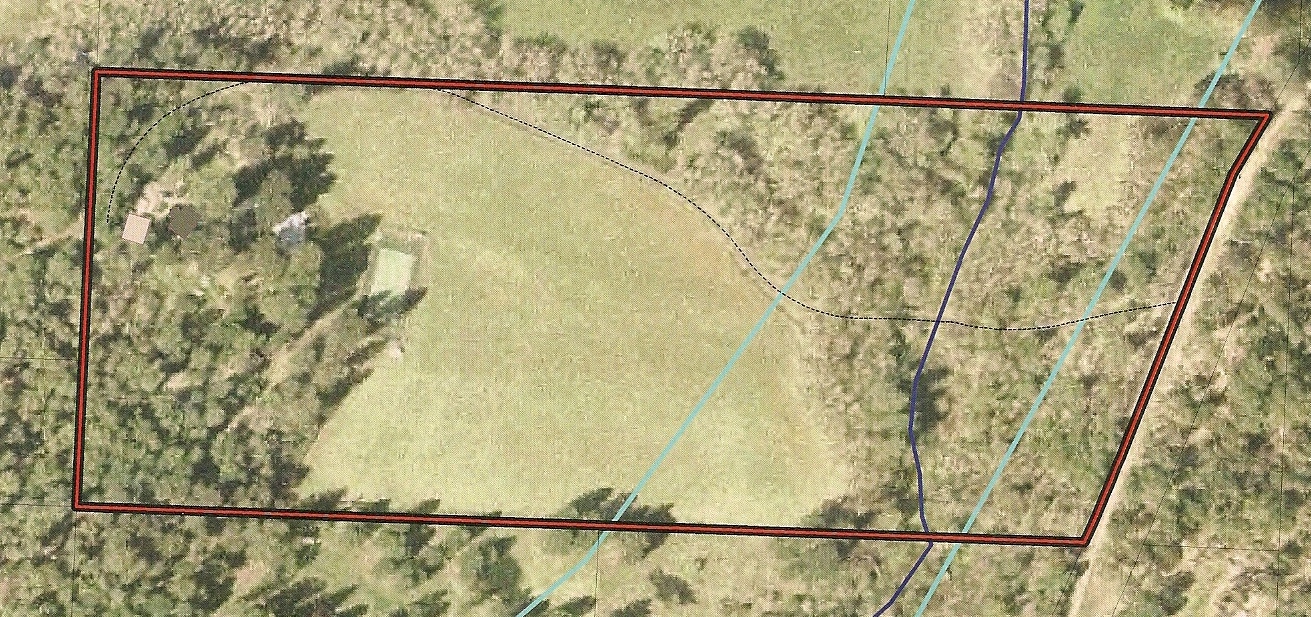
For much of our 13 acres is forest, as the following property map shows.

Assessor's Map 4000 Hugo Road.
Assessor’s Map 4000 Hugo Road.

When we first moved in to the house last October, the most common wild large creatures around were the deer.  The only way one could get close enough to take a photograph was when there wasn’t a dog in sight.  Even then, the slightest sudden sound or movement had a deer dashing into the forest.

Deer very cautiously meets new humans on the block!
Deer very cautiously meets new humans on the block! (Early November 2012)

Yet over the following weeks, the healthy grass made an irresistible Winter meal and the deer settled down to being regular visitors.  But always within a few leaps and bounds of the edge of the trees.

Nevertheless, the deer remained very cautious of feeding during the daytime as they soon became aware that without warning dogs could come rushing out from the house; as happened numerous times!  It seemed clear that having the forest close by enabled them to scatter as soon as the first bark was heard.

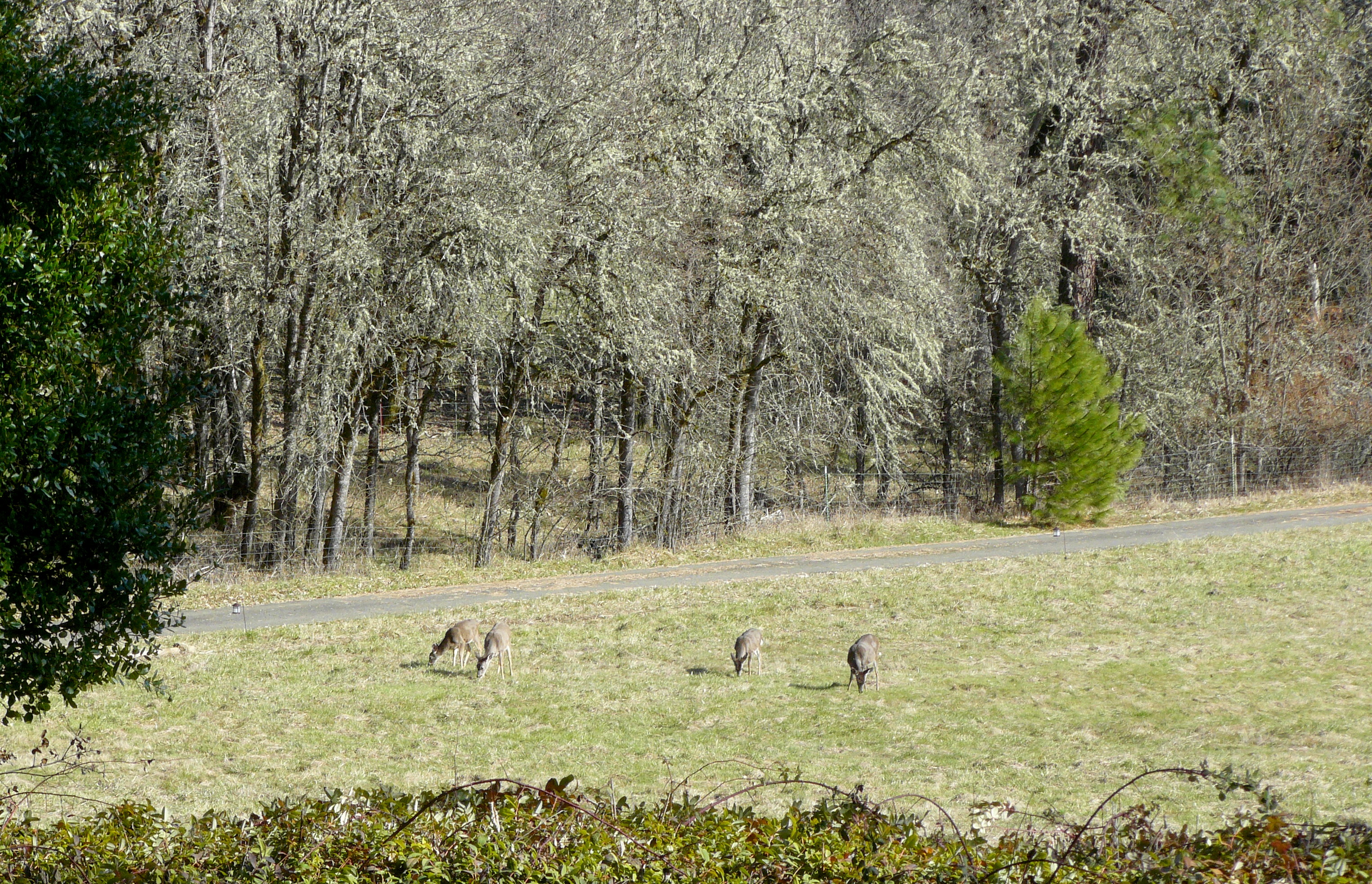
Months later, shown by this photograph taken early afternoon just a couple of weeks ago, these four wild deer still grazed close to the forest.

Wild deer feeding on the grass.

So this Autumn/Fall we shall be coming up with a plan to ensure that the forests on our property are reinvigorated to the best of our abilities.

Healing

Always the need for healing.

My posts from Monday and yesterday about the plight of our bees must to many, frequently me as well, engender a level of hopelessness as to where we, as in the peoples of this planet, are heading.  Too many times the news is discouraging; to say the least.

But hold on for just a moment!  Here’s a quotation from this week’s Sabbath Moment from Terry Hershey:

Tears have a purpose.

they are what we carry of the ocean, and

perhaps we must become sea,

give ourselves to it,

if we are to be transformed.

Linda Hogan

What this says to me is that feelings of sadness, of grief, even of despair are an essential part of the process of ‘letting go’; of being able to heal oneself.  Just as dogs and many other animals know when to crawl away and recuperate in some peaceful and quiet place, so too must we humans counter our feelings of pain and anguish with healing.

So with that all in mind, I’m delighted, and very grateful, to Sue of Dreamwalker’s Sanctuary for permission to repost her item on Sound Healing, published last Friday.

oooOOOooo

Friday Facts ~ Sound Healing

by Sue Dreamwalker

Healing music
Healing music

Have you ever wondered why we so enjoy Music? Why various styles seem to either lift our mood or sooth our spirits? Or some grate on our nerve endings?

Sound Healing comes in various forms. I have received healing from various sources: Crystal Singing Bowls, Tuning Forks and the Mighty Gongs. The Gong Bath  in particular shifted something within my being as I physically felt something leave my aura to be replaced with a new found peace within.

Sound Healing isn’t new and if you research back to ancient times many ceremonies were done through sound.

I know in the 90s when I was going through my own major self-healing after listening to some tapes by Deepak Chopra called Magical Mind Magical Body in which he speaks about our vowel sounds. I remember driving to work, and on occasion still do, chanting out Very Loudly the vowel sounds in a chant, each vowel holds its own frequency.  Chanting brings an awareness of our own voice, as we express outwards our feelings, and there are some interesting theories as how certain frequencies are powerfully connected to our body. This includes the frequency of 528hz,referred to as ancient solfeggio frequencies which has been researched for its proposed ability to heal and resonate with human DNA. I did my own research on the net, and came across this site and post Forgotten in Time: The Ancient Solfeggio Frequencies )

Interestingly too the author of that post went on to explain how Deepak Chopra was a big inspiration and listened to the same tapes I did where Deepak Chopra explained saying: “Quantum physics has found that there is no empty space in the human cell, but it is a teeming, electro-magnetic field of possibility or potential.” This made me smile as synchronicity seemed to be playing a role.

Within that same article the author went on to say how music makes waves which produces shapes and patterns and quoted a passage from a book by the first to make that connection, a German scientist, Ernst Chladni who in 1787 detailed his findings in his book “Discoveries Concerning the Theory of Music.” These patterns and figures are called Chladni figures with each note having a corresponding pattern or vibration.

My drum, as I painted it.

My own tool is the Drum and if we look back through time we see how the Drum beat has been used not only in rituals but also within our military as we march to its beat!  The Drum is very powerful and many join Drumming circles.  You, too, can find out how to call Healing from within a Drumming Circle from an article in the magazine Sacred Hoop of 2003 called Healing Power of the Drum Circle

Side view of my drum.

Sound Healing works, because we are all vibration, we all resonate with our own frequencies. For those wishing to learn more the links are below and of course there are many many articles covering this subject on the ‘web’.

For those who have not much time I will leave you with this one note of vibration from a Singing bowl. If you go to the YouTube site you will find more about this One note and how it heals.

… and for those who have 5 minutes to spare this Om Meditation.

Sue~Dreamwalker

Sources:
http://www.holistic-resonance.com/

http://gongsofjoy.com/articles/

http://www.amazon.co.uk/Magical-Body-Mind-Connection-Well-Being/dp/0743530136/ref=sr_1_1?ie=UTF8&qid=1376658622&sr=8-1&keywords=magical+mind+magical+body

http://www.somaenergetics.com/forgotten_in_time.php

http://theworlddrum.com/more.html

http://shamanicdrumming.com/healing_power_of_the_drum_circle.html

oooOOOooo

I thought it would be helpful to include the YouTube notes that were associated with those two videos.

First: 7th Chakra – Reiki Angel Crystal Singing Bowl Sound Healing

Chakra’s are energy centers in your body. There are 7 major Chakra’s. Each Chakra governs specific issues and lessons.By aligning the chakra system you can heal your mental, emotional, spiritual & physical bodies.

7th Chakra= Crown Chakra

Color: Purple

Location: top of head

Element: Superether

Musical note/ sound: B/ silence

Glands/ Organs: Pineal gland, cerebral cortex, central nervous system, right eye

Foods: Fasting

Essential Oils: Frankincense, Myrrh

Stones/ Crystals: amethyst, alexandrite,diamond, sugalite, purple fluorite, quartz, selenite

Purpose: vitalizes upper brain, unification with higher self. Being open to source, accepting our own Divinity, Beauty, healing, Inspiration. Perception beyond space & time, perceives “miracles”.

When Harmonious: Idealism, selfless service, One with divine, spiritual will, unity.

When Disrupted: lack of inspiration, confusion, depression, alienation, hesitation to serve, senility, crisis of faith.

Second: Aum Meditation

Working with Aums will resonate into all objects around you, effectively re-writing all undesirable environmental energy programming. Like a springboard of positivity. Use it to launch your spiritual work to new heights. This is just a small sample of the full meditation.

It’s not music; yet it is and more so!

The polyphonic me: Just be amazed.

Published on Aug 2, 2013

Frustrated by not being able to sing two notes at the same time, musical inventor Beardyman built a machine to allow him to create loops and layers from just the sounds he makes with his voice. Given that he can effortlessly conjure the sound of everything from crying babies to buzzing flies, not to mention mimic pretty much any musical instrument imaginable, that’s a lot of different sounds. Sit back and let the wall of sound of this dazzling performance wash over you.

Enjoy!

On being honest.

A reposting of an article by Jon Lavin, first published on the 3rd July, 2010.)

Conscientiousness isn’t all it’s cracked out to be!

(Foreword from Paul.)

Jon is one of those rare individuals who not only has been committed to a path of self-awareness for more than 30 years but who has also studied incredibly hard so as to be able to help others and do so from a base of real competence, as his own Blog describes.

But then I realised the great strength in what Jon has written.  It is this.

There are many notable teachers to whom thousands upon thousands have turned to for a deeper understanding of what life is all about.  As far back as time itself, teachers have surfaced and given spiritual guidance to those that come in need.  But it’s very difficult to read or listen to these great teachers and connect with the fact that they were born, as we are all born, with nothing.  And all of them, like many of us, went through Hell on wheels to come out the other side with a greater self-awareness and a deeper understanding of the real truths in nature.  Like all of us who wish to rise above our present place they first acknowledged their own frailties. It is the starting point.

So, let me get to the point.  Jon has the awareness and understanding to offer real help to those that seek answers that are currently beyond reach.  Jon’s article is an wonderful illustration that he experiences the same fears and feelings of helplessness that you and I feel.  You and I and Jon and all of humanity are much more closely connected than we realise.

Paul H.

oooOOOooo

To see in is to see out!

I’ve been running my own business for about 12 years now. In the beginning it started because I had a thirst for wanting to make a difference in small business in our local area and a passion for wanting to do it through working with people directly, on their behaviours. Still have, really.

I think this came as a form of acknowledgement to the few exceptional people managers I experienced while I was employed, and the all too common, terrible ones.

I was also mentored by a group of people to whom no developmental tool was barred. My eyes were well and truly opened to how a change of view could change outcomes.

The final boot up the backside was redundancy in the late 90s. I was all ready to go and just needed a kick.

My work ethic, trained at home and then through an engineering apprenticeship, was to conscientiously work hard and try hard and to treat people the way you want to be treated. Nothing wrong with that. I assumed automatic reward would follow as long as I did those things.

Over time I wised up and became a bit less idealistic and a little more politically aware but carried on in much the same way.

Much later I found myself embarking on a whole new adventure, with a lovely wife and family, all dependent on me, with a few contacts to start getting work from!

It took a year before the first jobs came in that didn’t necessitate robbing the almost non-existent savings and redundancy payment just to keep food on the table. Then, work slowly picked up and it started to get quite good for a one-man band. We were able to go on holiday once a year, camping, but still great, and then abroad.

All the time, I beavered away, trying hard, being very conscientious, as I’d been brought up to be, but slowly getting very stressed.

Time was when it took Friday night to de-stress, then 3 days, then 10 days and recently, not at all.

So faced with this present downturn, which is likely to go on for much longer than any of the others I’ve seen and survived, I’m wondering just what new strategy to adopt. Money is already getting very tight and everything is feeling very ‘hand to mouth’. Can’t really see one month in front of the other.

I notice our local farmer who I went to school with but didn’t really know.

I’ve got degrees, lived abroad, can speak Finnish fluently, (what use is that, I hear you say!), and can turn my hand to most things, but I still feel quite dis-empowered and at a bit of a loss.

My farmer friend is always smiling, he’s got a flock of geese he’s fattening up, the same with his beef cattle, does livery for half a dozen horses or so, has fields planted with various cereal crops, and has his finger in lots of different pies – and definitely does not look stressed. He is also renting his land plus another farm.

I honestly don’t know what to make of this all except for a few really important things – the importance of diversification, relationships and appreciating what you’ve got, especially people things, here, in the now.

I have also come to the realisation that I still haven’t cracked the main thing with being self-employed, and that is replacing fear with trust.

It’s been said by various enlightened people that we see a reflection of the world we hold in mind. Going forward into this brave new world I would like to see opportunities rather than fear, I will diversify into things which make more use of my wide range of talents, and I will swap fear for trust.

By Jon Lavin

Transformation

(A reposting of an article by Jon Lavin, first published on the 9th October, 2009.)

These are hard times for millions – transformation is the only practical option.

I’ve been working with most of my clients recently through painful transformation brought about by the recession.

deep riverAn interesting metaphor really because, since the first wave of uncertainty in the UK banking system triggered panic, I have been picking up on that uncertainty.

That uncertainty feels like it’s stalking the globe at the moment; one has been aware of an underlying fear that was difficult to name and source in me. It has been rather like a deep river in that whilst the surface feels slow moving, currents are moving things powerfully below.

For example, we now are the proud owners of 6 Light Sussex chickens. Our youngest son, Sam, and I have dug up the back lawn and planted vegetables and built a poly-tunnel. We are also planning to install a wood burning cooker. Right back down to the base of Maslow’s pyramid.

Maslow's Pyramid of Needs
Maslow’s Pyramid of Needs

These feelings have brought about such change everywhere and I wonder seriously whether we will ever return to what was, indeed, would we want to?

I might not have mentioned it in previous Posts but as well as an engineering background, in latter years, I have focussed on the interpersonal and success in business founded on quality relationships, integrity and, vitally, awareness.

To inform this, some 6 years ago, I embarked on an MA in Core Process Psychotherapy, primarily to work on myself so that I could be the best I could be in my relationships in and out of work.

The point I’m trying to make is that the same panic I notice in many of the companies I work in, and in me, is based on fear of the unknown and on a lack of trust in abundance in all it’s forms.

We get more of what we focus on. So we can choose to focus on the constant news of more difficulties, hardship and redundancies or, we can focus on what is working. In the workplace it has been pulling people together across functions and sites and pooling resources and ideas.

When we realise we’re not doing this alone it’s amazing how much lighter a load can feel and how much more inspired we feel. I also notice how humour begins to flow and what a powerful antidote for doom and gloom that is.

Transformation is never easy but the rewards exceed the effort put in ten fold.

So what is it going to be? Are we all going to bow down to the god of Doom & Gloom, fear and anxiety, heaping more and more gifts around it; as most media focusses on, or are we going to start noticing and focussing on the other neglected god of relationship; joy, trust, abundance and light?

Whatever the future holds for us, a belief in our inherent ability to adapt and change and focus on the greater good rather than fear, anxiety, greed and selfishness is the only sustainable way forward.

By Jon Lavin

Footnote from Paul: Considering that this was first published nearly four years ago, the level of uncertainty across the world seems practically undiminished!

Just about Arizona water.

A more intimate look at the water of Arizona.

Yesterday, I published a recent Tomgram essay by William deBuys: Goodbye to All That (Water).  The essence of what William was presenting was that, “The crucial question for Phoenix, for the Colorado, and for the greater part of the American West is this: How long will the water hold out?

Also in yesterday’s Learning from Dogs post, I closed with the statement, “If readers will forgive me, I will continue the theme tomorrow with a rather more personal perspective.

I have decided to delay the ‘personal’ aspect to today’s post until the very end.  So back to Arizona’s water.

As an indication that this is not a new problem, I recently came across an article that was published  in The Arizona Republic by  Shaun McKinnon in August 2009.  It was called Unabated use of groundwater threatens Arizona’s future. Here’s how that article opened:

Thirty years after Arizona tried to stop cities and towns from using up their groundwater, the state still can’t shake its thirst for one of its most finite resources.

The steady drain on underground reserves grows out of two realities: Canals and pipelines don’t reach far enough to deliver surface water to everyone, and laws don’t reach far enough to stop people from drilling.

If the groundwater addiction continues unabated and under-regulated, the effects will be broad and potentially disastrous: Scarcer supplies could push rates higher and create uncertainty about water availability, discouraging new business and slowing economic growth. If wells start to run dry and aquifers collapse, the landscape could be dotted with fissures and sinkholes.

Lawmakers adopted some of the nation’s most progressive water-protection laws to avert such crises, but the laws excluded rural areas and allowed changes that let cities and subdivisions resume well-drilling, further depleting exhaustible aquifers.

Meanwhile, the renewable resource intended to replace groundwater – surface water fed by the annual runoff of mountain snow – can’t meet the demand of urban areas too far from the delivery canals.

The result is holes in the state’s water bucket that are spreading as fast as the holes in the ground.

Then good friend, Dan Gomez sent me this link: Arizona’s Water: Uses and Sources. I would like to cover some of the information contained on that website.

Arizona’s Water: Uses and Sources

One acre-foot of water.

A land’s carrying capacity has always been determined by its access to usable water. Humans use water primarily for irrigation, industry, drinking water, and sanitation. Millions of non-human species depend on water for life itself. Only 1% of the earth’s water is freshwater, to be shared among more than 7 billion people and all freshwater aquatic ecosystems in the world. It is perhaps the most precious resource on the planet.

Large volumes of water are most commonly measured in acre-feet. One acre-foot is the amount of water required to cover one acre of area to the depth of one foot: 325,851 gallons. Approximately one acre-foot serves the needs of a family of five for one year. Arizona is one of the driest states in the U.S., and one of the fastest-growing. Arizona’s current population is over 6 million (2010 Census) and is projected to grow to as many as 9.5 million people by 2025. Encompassing four deserts, Arizona receives a statewide average of only 12.5 inches of rain per year. Our climate presents intense challenges in balancing our water needs between ourselves, our neighbors, and our riparian ecosystemsWater has defined our past and will determine our future.

“Water has defined our past and will determine our future”!

Let me skip a couple of paragraphs and continue, thus:

Water Budget: Usage and recharge

How much water do we ​use?

Based on Arizona Department of Water Resources (ADWR) data from 2001–2005, Arizona uses approximately 6.96 million acre-feet of water annually. A 2008 estimate by the University of Arizona Water Resources Research Center places that value as high as 8 million acre-feet. Collaborative estimates place the actual water used in Arizona at between 7.25 million and 7.75 million acre-feet annually. That’s about 2.4–2.5 trillion gallons a year.

 How do we use water?

Water in Arizona is used for cultural purposes (for and by people) and for in-stream uses, such as for the support of fish and riparian ecosystems.

Arizona's cultural use of water. Values based on Arizona Department of Water Resources.
Arizona’s cultural use of water. Values based on Arizona Department of Water Resources.
Approximately 69% of the available water supply in Arizona is used for agriculture.

Again, skipping forward.

Values based on Arizona Department of Water Resources ABC’s of Water.

Water Sources

Arizona gets water from three major sources: surface water (which includes Colorado River water and water from other major rivers and streams), groundwater, and effluent or reclaimed water.

Groundwater

About 43% of the state’s water use comes from groundwater sources. Groundwater is found beneath the earth’s surface in natural reservoirs called aquifers. In most cases the aquifers that store water have been in place for millions of years. Throughout the 20th and 21st centuries, groundwater has been pumped out more rapidly than it has been replenished, creating a condition called overdraft. Though a large amount of water remains stored in Arizona’s aquifers, its availability is limited by location, depth and quality. By continuing to overdraft the state’s groundwater supplies, we challenge our ability to ensure a secure water supply for the future. In recognition of this threat, Arizona implemented the Groundwater Management Code in 1980. The Groundwater Code promotes water conservation and long-range planning of our water resources.

Colorado River Water

A separate category of surface water in Arizona is the water supplied through the Colorado River. The federal government constructed a system of reservoirs on the river to harness its supplies for use in several states. Arizona, California, Nevada, New Mexico, Utah, Colorado, Wyoming, and Mexico share the river’s resources. Rights to use Colorado River water are quantified by a string of legal authorities known as the “Law of the River.” Based on this body of law, Arizona has the right to use 2.8 million acre-feet annually of Colorado River water. Mohave, La Paz, and Yuma county water users rely on Colorado River as their principal water supply. When fully utilized, the Central Arizona Project (CAP) will deliver an annual average of 1.5 million acre-feet of Colorado River water to Maricopa, Pinal and Pima Counties.

Other Surface Water

Surface water from lakes, rivers, and streams is Arizona’s major renewable water resource. However, because of our desert climate, the amount of surface water available can vary dramatically from year to year, season to season, and place to place. In order to make the best use of the surface water when and where it is needed, storage reservoirs and delivery systems have been constructed throughout the state. Most notable are the major reservoir storage systems located on the Salt, Verde, Gila and Agua Fria rivers. Almost all of the natural surface water in Arizona has been developed.

Effluent

Reclaimed water, or effluent, is the one increasing water source in our state. As our population and water use grows, more treated wastewater will be available. Reclaimed water is treated to a quality that can be used for purposes such as agriculture, golf courses, parks, industrial cooling, or maintenance of wildlife areas.

Information made available by the Arizona Department of Water Resources and the University of Arizona Water Resources Research Center.

Since it is impossible to measure the exact values of water used across a state, some variance of values must be tolerated.

oooOOOooo

So take the message from yesterday’s post and then from above: “Throughout the 20th and 21st centuries, groundwater has been pumped out more rapidly than it has been replenished, creating a condition called overdraft. Though a large amount of water remains stored in Arizona’s aquifers, its availability is limited by location, depth and quality. By continuing to overdraft the state’s groundwater supplies, we challenge our ability to ensure a secure water supply for the future.“, and remember that 2 + 2 = 4!  I.e. the power of logic.

Now to close with that personal perspective.

When Jean and I were living in Payson, Arizona, we were close to town but not so close as to be on Payson City’s water supply.  Thus we had a well on our land.  If I recall, the depth of the drilled well was about 250 feet and the water level was about 80 feet below ground surface.  We had been told from the house survey that the ‘normal’ water level was about 35 feet down.  While we were there the water level slowly, but steadily, continued to drop.

We were both very happy in Payson; indeed it is where Jean and I were married.

However, one night, I would guess last June, 2012, I had this weird dream that I had gone to the bathroom during the night, turned on the cold-water tap and nothing had flowed out.  Bizarre dream, wouldn’t you say!  But even more bizarre was that the image of no water was in my mind when I awoke in the morning, and I couldn’t shrug off a distinct feeling of disquiet.  That all lead to us coming up to Oregon, finding this wonderful property with an all-year creek, Bummer Creek, running through our land, and moving in on October 25th, 2012.

Funny old world at times!

Pharaoh enjoying Bummer Creek.

The habit of doing nothing!

Last word for a while on the power of meditation.

This is not a single topic blog. But the last few days have brought such a wealth of marvellous stuff that I couldn’t resist this final, for the time being, post on the benefits of slowing down, of taking a break – meditation, in other words.

First, and I wish I could remember from whence it came, I found this essay by Bertrand Russell In Praise of Idleness It’s a wonderful piece of writing from one of the great masters of the art.  Take this extract from just the first paragraph, (and the photo insertion is from me!):

Bertrand Russell (18 May 1872 – 2 February 1970)

I think that there is far too much work done in the world, that immense harm is caused by the belief that work is virtuous, and that what needs to be preached in modern industrial countries is quite different from what always has been preached. Everyone knows the story of the traveler in Naples who saw twelve beggars lying in the sun (it was before the days of Mussolini), and offered a lira to the laziest of them. Eleven of them jumped up to claim it, so he gave it to the twelfth. This traveler was on the right lines. But in countries which do not enjoy Mediterranean sunshine idleness is more difficult, and a great public propaganda will be required to inaugurate it. I hope that, after reading the following pages, the leaders of the YMCA will start a campaign to induce good young men to do nothing. If so, I shall not have lived in vain.

Then from out of the Transition Network stables came this interview by Rob Hopkins with Sophy Banks on the Power of Not Doing Stuff.  Just going to pick out a couple of exchanges that really struck me.

Sophy, I’m sure you get asked the question lots of times, but how would you describe Inner Transition ? What’s Inner Transition for you?

I gave a talk about Inner Transition in Canada just recently, and someone said “what I want from the talk is, what’s the most succinct story? What’s the E=mc² of Inner Transition?” The way that I’m talking about that at the moment is to say the absolute core of Inner Transition is that in our groups, within ourselves, in our relationships, in what we’re doing in our communities, how can we be creating a culture that supports us to be in a state of feeling resourced, feeling empowered, feeling seen and appreciated? With the understanding that when we have those kind of external conditions, we find ourselves in a state where we’re the most open to new ideas, the most open to connection, the most able to build relationships with people who are different from us.

That’s the core of it, to understand that internally we can be in different inner states, we can be in a state where we feel stressed and closed and driven or whatever, or we can be in a state where we’re open and creative and learning and available. That’s one way of framing Inner Transition, how do we keep recreating that?

Part of it, I think, is when we’re all in that state of being open and creative and connected with each other and with ourselves, we make the best decisions. We’re able to take the longest and the widest view, we’re able to see the consequences of what we do, so there’s also something which has really been resonating for me. That’s not only the process we need for Transition, that’s the end-state we want to get to. Part of what’s not working in our culture is that lots of the people with a lot of power who are making really key decisions are in a state of constant stress and pressure and having to make very narrow decisions, decisions based on very narrow viewpoints.

oooo

One of the expressions you’ve been using increasingly over the last couple of years is “healthy human culture” and this idea that that’s ultimately the aim of Transition, to enable that and to create that. What does that mean? Can you define “healthy human culture”?

This is where my enquiry took me. I got really interested in seeing polarities and dualities – people have been doing that for centuries – about our culture and calling it dualistic. I came across Riane Eisler’s work. She talks about basically two kinds of human culture. One is based on partnership and one is based on domination. I got really interested in that and the question what if that’s true? It’s a big proposition.

If that’s true, what’s underneath that and what is it about what goes on inside us that we’re constructed, the way we’ve evolved, that causes that to be so, that there are these two stable states? I feel like I’ve been looking at lots of different territories, I’m really interested in trauma and how that affects us in the creation of the unconscious that comes through trauma.

This whole thing about how we create unintended consequences. The idea that anybody could have sat down and designed the consequences that we’re living with is inconceivable. However dysfunctional people were and however much they’re interested in wealth or power or anything, I just don’t believe that anybody intended it to be like this. How do we get this as a by-product of something that’s natural and…just who we are, who we’ve evolved to be.

So for me, the question around “healthy human culture” is one of the inner. What’s the inner state of a culture that creates partnership, learns to live within its resources, that’s oriented towards joyful, pleasurable existence, that has a belief about ourselves as humans that we’re trustworthy and generous and want good things for the future, good things for our children. What I see very very strongly: in a lot of the depth work that I’ve done, what I see is when you peel away a lot of the damage, what you find is a profound and I could say universal. In my experience (I haven’t worked with the psychopaths and the most damaged people) but that sense that if we’re healed and whole what we want is to love each other and do good in the world.

Then there’s another state we could be in, which comes back to your first question, where we feel under-resourced, disempowered, under attack. There’s not enough and I’m taught that other people are selfish, violent and greedy so I need to fight for what I can get. In order to have status I’ve got to have stuff, I’ve got to prove myself. With that goes a whole lot of very difficult feelings.

I’m very interested in that idea, that in unhealthy culture we have a whole lot of unmanageable feelings centred around shame and not being good enough that we then disown – I can’t deal with that in myself, I’ll put it on to you, I’ll find somebody else to have that experience and then I’ll watch it in them and feel OK about myself. It’s really interesting to look at cultures of domination and colonialism and capitalism and power-over as being driven by the need to not feel stuff myself, but grab enough power so that I can do it to somebody else.

The whole driver for those things is a psychological state of splitting and projection. When I bring that back to me and what culture I create in my relationships and my groups, you see it out in those big systems in the world but it’s also a very precise way of understanding and discerning what culture do I make in this room with these people, around splitting and projection or unity.

That’s quite a big answer! The short answer is “healthy human culture” is that one where we reel resourced, empowered, connected, appreciated and safe. Those seem to be the 5 things. If we have those, we are in that state of openness and availability and connection and learning and receptivity and then taking good action instead of action that creates a problem somewhere else in the system.

It really is a fascinating and thought-provoking interview.  Go and read it in full, or better still, find somewhere to sit and relax, close your eyes and listen to it.

Moving on.

There was an article in Nature about the BrainNeuroscience: Idle minds – Neuroscientists are trying to work out why the brain does so much when it seems to be doing nothing at all.

For volunteers, a brain-scanning experiment can be pretty demanding. Researchers generally ask participants to do something — solve mathematics problems, search a scene for faces or think about their favoured political leaders — while their brains are being imaged.

But over the past few years, some researchers have been adding a bit of down time to their study protocols. While subjects are still lying in the functional magnetic resonance imaging (fMRI) scanners, the researchers ask them to try to empty their minds. The aim is to find out what happens when the brain simply idles. And the answer is: quite a lot.

Again, a very important read so do go across and read it in full.  Because, you will come to this:

Zen and the art of network maintenance

Raichle favours the idea that activity in the resting state helps the brain to stay organized. The connections between neurons are continually shifting as people age and learn, but humans maintain a sense of self throughout the upheaval. Spontaneous activity might play a part in maintaining that continuity. “Connections between neurons turn over in minutes, hours, days and weeks,” says Raichle. “The structure of the brain will be different tomorrow but we will still remember who we are.”

Or perhaps the activity is part of the reshaping process, tweaking connections while we idle. Several teams have reported changes in resting connectivity after language and memory tasks and motor learning. Chris Miall, a behavioural brain scientist at the University of Birmingham, UK, and his colleagues have shown that spontaneous activity at rest can be perturbed by what has just happened. The team scanned volunteers at rest, and then asked them to learn a task involving using a joystick to track a moving target. When the participants were scanned at rest again, the team could see the effects of motor learning in the resting networks. That study, and subsequent work along the same lines, suggests that “the brain is not only thinking about supper coming up, but it’s also processing the recent past and converting some of that into long-term memories”, says Miall. The network changes are specific to the tasks performed.

So, hopefully, anyone who has read this post and who would like to slow down, to practise the art of doing nothing, will be eager to learn how. Well, keep reading!

Yesterday, I referred to Leo Babauta’s website.  Thanks to Leo’s wonderful ‘uncopyright‘ offer, I am free to republish his ‘How To Meditate‘ guide.

How to Do It Daily

There are lots and lots of ways to meditate. But our concern is not to find a perfect form of meditation — it’s to form the daily habit of meditation. And so our method will be as simple as possible.

1. Commit to just 2 minutes a day. Start simply if you want the habit to stick. You can do it for 5 minutes if you feel good about it, but all you’re committing to is 2 minutes each day.

2. Pick a time and trigger. Not an exact time of day, but a general time, like morning when you wake up, or during your lunch hour. The trigger should be something you already do regularly, like drink your first cup of coffee, brush your teeth, have lunch, or arrive home from work.

3. Find a quiet spot. Sometimes early morning is best, before others in your house might be awake and making lots of noise. Others might find a spot in a park or on the beach or some other soothing setting. It really doesn’t matter where — as long as you can sit without being bothered for a few minutes. A few people walking by your park bench is fine.

4. Sit comfortably. Don’t fuss too much about how you sit, what you wear, what you sit on, etc. I personally like to sit on a pillow on the floor, with my back leaning against a wall, because I’m very inflexible. Others who can sit cross-legged comfortably might do that instead. Still others can sit on a chair or couch if sitting on the floor is uncomfortable. Zen practitioners often use a zafu, a round cushion filled with kapok or buckwheat. Don’t go out and buy one if you don’t already have one. Any cushion or pillow will do, and some people can sit on a bare floor comfortably.

5. Start with just 2 minutes. This is really important. Most people will think they can meditate for 15-30 minutes, and they can. But this is not a test of how strong you are at staying in meditation — we are trying to form a longer-lasting habit. And to do that, we want to start with just a two minutes. You’ll find it much easier to start this way, and forming a habit with a small start like this is a method much more likely to succeed. You can expand to 5-7 minutes if you can do it for 7 straight days, then 10 minutes if you can do it for 14 straight days, then 15 minutes if you can stick to it for 21 straight days, and 20 if you can do a full month.

6. Focus on your breath. As you breathe in, follow your breath in through your nostrils, then into your throat, then into your lungs and belly. Sit straight, keep your eyes open but looking at the ground and with a soft focus. If you want to close your eyes, that’s fine. As you breathe out, follow your breath out back into the world. If it helps, count … one breath in, two breath out, three breath in, four breath out … when you get to 10, start over. If you lose track, start over. If you find your mind wandering (and you will), just pay attention to your mind wandering, then bring it gently back to your breath. Repeat this process for the few minutes you meditate. You won’t be very good at it at first, most likely, but you’ll get better with practice.

And that’s it. It’s a very simple practice, but you want to do it for 2 minutes, every day, after the same trigger each day. Do this for a month and you’ll have a daily meditation habit.

Now to the close.

Beautifully rendered thanks to Terry Hershey.  For on his website there is this:

When I pause, I put myself in a new or different environment.
When I pause, I create spaces–or sanctuaries–in which renewal can be born.
When I pause, I allow my soul to savor, relish, value, honor, welcome, see, celebrate, wonder, and to experience grace.

Enough said!

Overload and rescue!

Starting to look like a bit of a theme!

Over the last few weeks there have been a number of posts touching on the role of meditation and the huge potential benefits of taking a little time out each day.  For those new to Learning from Dogs or to this particular thread, here are links to previous posts.

On the 19th June, there was a post called Maybe home is found in our quietness. In that post there were three references to the power of meditation, that is in a curative sense.  Here’s a small extract from that post:

A few weeks ago when meeting our local doctor for the first time since we moved to Oregon, I had grumbled about bouts of terrible short-term memory recall and more or less had shrugged my shoulders in resignation that there was nothing one could do: it was just part of getting older, I guessed!

“On the contrary”, responded Dr. Hurd, continuing, “There’s growing evidence that our information-crowded lives: cell phones; email; constant TV; constant news, is pumping too much for our brains to manage.”

Dr. Hurd continued, “Think about it! Our brains have to process every single sensory stimulus. The research is suggesting that our brains are being over-loaded and then the brain just dumps the excess data. If that is the case, and the evidence is pointing in that direction, then try thirty minutes of meditation each day; give your brain a chance to rest.”

Just hang on to what Dr. Hurd said, “There’s growing evidence that our information-crowded lives: cell phones; email; constant TV; constant news, is pumping too much for our brains to manage.

The second post was on the 25th June,  Unlocking the inner parts of our brain.  It included this:

The second was a recent science programme on the BBC under the Horizon series. The programme was called,The Truth About Personality.

…….

Within the programme came the astounding fact that even ten minutes a day meditation can help the brain achieve a more balanced personality (balance in terms of not being overly negative in one’s thoughts).

You will not have failed to note, “even ten minutes a day meditation can help the brain achieve a more balanced personality“.

So let me move on!

Not sure how I came across the website Natural health news but on July 03, 2013, Zach Miller wrote a piece under the title of Information Fatigue Syndrome (IFS): What it is and how it affects you.  I’m hoping it’s OK to republished Zach Miller’s article.  Because it so perfectly supports those referred posts.

oooOOOooo

Information Fatigue Syndrome (IFS): What it is and how it affects you

Wednesday, July 03, 2013 by: Zach C. Miller

(NaturalNews) These days, we’re living in an increasingly connected, electronic world. Every day we use the internet, computers, cell phones, Blackberries, and Bluetooth devices. We read newspapers, watch TV and listen to internet radio (and even read ads on billboards as we drive down the freeway). While all our media and technology is convenient and useful (we’re always just an internet search away from the answer to any question that pops into our heads, especially if our cellular phone has mobile internet), being connected so much results in something called “Information Overload”, a term coined by futurist Alvin Toffler back in 1970. The term refers to our inability to absorb and process all the information we’re exposed to, and this information is literally everywhere these days.

The problem defined

Information Overload, or “Information Fatigue Syndrome (IFS),” occurs when we over-expose ourselves to media, technology and information. Our brains have trouble keeping up with everything that we are feeding them, and the distorted-spin EMF energy fields we’re being exposed to don’t help the case (generated by cell phones and wi-fi). We end up having headaches and being exhausted and end up making mistakes and wrong decisions. The main point is, when exposed to too much information and technology, we tend to shut down.

Causes

Information Overload is now commonplace around the world, at work, at home and during leisure time. Some of the causes include:

– Widespread and easy access to the Internet

– Social networking sites such as Facebook and Twitter

– Cheap and accessible use of cell phones, texting, and mobile internet

– Online and offline news, media, and advertising: TV, newspapers, magazines, and billboards

Simple solutions

The only upside to these problems is that they have a relatively simple solution; take a day off occasionally from being connected to any media and the internet, and set limits on your internet in terms of hours per day. These restrictions may sound scary for us web-addicted techno-humans, but it’s absolutely imperative if we want to regain control of our energy levels, mental health, and life in general in an increasingly information-infused modern era.

Take a full day off from all media and electronic devices (including cell phones; this may be nearly impossible for some), and go out into nature and pursue outdoor interests. If you feel better, which you likely will, take a day off occasionally whenever you need one. If you’d rather a set schedule, take one day per week and set it aside as a internet-free day. If this is too often, make it bi-monthly. Pick a schedule that fits in with work or school. A key point being that even good things need to be used in moderation, including useful techo-goodies as the internet, Facebook, and Twitter updates.

Sources for this article include:

http://www.wnd.com

http://www.infogineering.net/understanding-information-overload.htm

http://psychcentral.com

https://en.wikipedia.org/wiki/Electromagnetic_field

About the author:
Zach C. Miller was raised from an early age to believe in the power and value of healthy-conscious living. He later found in himself a talent for writing, and it only made sense to put two & two together! He has written and published articles about health & wellness and other topics on ehow.com and here on NaturalNews. He holds a Bachelor’s degree in Applied Science.

oooOOOooo

The problem, I’m sure, is that the vast majority of readers of this post will give a sage nod because they intuitively  agree and …… do nothing about it!  Trust me, I’m just as guilty.  My short-term memory is really crap and it feeds my worry that this may be early stage dementia. (My sister’s recent death from dementia doesn’t help!)

So even though my doctor spoke about the benefits of meditation, even though there have been other articles recently posted on this blog, even though I would, supposedly, do anything to arrest or reverse my memory problems, guess what; I’m pathetic!  Kept up taking 30 minutes away from everything for a week and then the good intentions crumbled.

If this verbal slap across my wrists is resonating out there, dear reader, then that’s good.  Because, I am going to try harder!  From today!

So how to close this! Obviously with more advice about meditating! None better than from Leo Babauta over on Zen Habits.  It’s called How to Meditate Daily.  Starts thus:

The habit of meditation is one of the most powerful things I’ve ever learned.

Amazingly, it’s also one of the most simple habits to do — you can do it anywhere, any time, and it will always have immediate benefits.

How many habits can you say that about?

While many people think of meditation as something you might do with a teacher, in a Zen Center, it can be as simple as paying attention to your breath while sitting in your car or on the train, or while sitting at the coffee shop or in your office, or while walking or showering.

It can take just one or two minutes if you’re busy. There’s no excuse for not doing it, when you simplify the meditation habit.

So, go on, take a couple of minutes to read the rest of the article!

And then realise there’s yet another wonderful lesson we learn from dogs – chilling out!

Cleo and Sweeny - just chilling out!
Sweeny and Cleo – just chilling out!

The magic of clouds.

In appreciation of clouds.

Live with your head in the clouds.

In the wake of yesterday’s post about the power of meditation, this recent TED Talk seemed a perfect way to end the week.

Published on Jul 16, 2013

You don’t need to plan an exotic trip to find creative inspiration. Just look up, says Gavin Pretor-Pinney, founder of the Cloud Appreciation Society. As he shares charming photos of nature’s finest aerial architecture, Pretor-Pinney calls for us all to take a step off the digital treadmill, lie back and admire the beauty in the sky above.

Want to learn a little more about the different types of cloud?  Then go here.  Want to learn more about the Cloud Appreciation Society?  More details here.

And who knows, you may even see your dog in those clouds!

One is never far from a dog!