Category: Musings

Let there be lions.

The power and logic of nature.

In yesterday’s post Autumn ramblings, I mentioned:

There’s been a couple of posts that I want to refer to because they underline the fact that humans are so prone to forgetting that we are of the wild, from the wild and connected to the wild.

The first of those posts was a recent essay by Patrice Ayme under the title of Rewilding Us and is republished on Learning from Dogs with the kind permission of Patrice.

oooOOOooo

Rewilding Us.

REALITY IS WILD & FEROCIOUS. IGNORING IT IS INHUMAN.

And Presents A Civilizational Risk.

Princeton is freaking out. Flesh devouring aliens are lurking out in the woods, threatening academia’s fragile thoughts. Krugman:

‘From the Princeton Town Topics, which used to be all about (a) parking (b) deer:

A growing population of coyotes in the wooded area bordering the Institute for Advanced Study has motivated the Princeton Animal Control Advisory Committee to recommend that sharpshooters be hired to help handle the problem. “There is a big pack over at the Institute Woods,” officer Johnson said this week. “I’m having a lot of complaints that they follow people around.”‘

You Can’t Always Eat Who You Want

The “Mountain Lion”, is a relative of the Cheetah (erroneously put in the cat family, felis, until last year or so). It has 40 names, in English alone, and is found from the American Arctic to Patagonia, from the sea shore to the high mountains. The weight above is that of the female. Males are heavier (typically up to 100 kilograms). The heaviest puma shot in Arizona was 300 pounds (136 kilos).

The lion/cougar/puma is capable of jumping up twenty feet from a standstill (yes, 6 meters; horizontally, 14 meters). It is capable of killing a grizzly (pumas and ‘golden bears’ were famous for their naturally occurring furious fights to death in California). The feline’s crafty method consisted into jumping on top of the bear, and blinding him with furious pawing. Top speed: 50 mph, 80 km/h. (By the way, there used to be pure cheetahs in North America, recently exterminated by man. I propose to re-install the Asian cheetah in the USA, in a sort of cheetah diplomacy with Iran.)

The philosophical question here is: what is this world all about? Is it about living on our knees, or ruling among animals and wilderness?

Why would Princeton panic about small canids? Because they don’t obey the established order?

Coyotes are totally clever, and not at all dangerous (being so clever). They have very varied voices, when in packs. Going out and shooting them is really primitive, and misses the main point of having nature around. That is: to teach humility, and teach the richness of our planet, visit hearts with emotional diversity, and minds with complexity.

Bears and Mountain Lions are a completely different matter. They are both extremely clever too, but can be very dangerous.

Running and hiking in the Sierra, I got charged by scary bears several times. I view this dangerosity as a plus, but it never loses my mind, and I got scared nearly out my wits more than once.

Once, in a national Park on the coast, I literally ran into two large lions in 30 minutes! Then I got charged by a large elk before he realized I was not a lion. Other high notes were finding a bear cub on the trail in the near vertical mountain side, on the way down, as dusk was coming.

Another high point was the large bear by the trail, who was lying like a bear rug, at 9pm, in an apparent ruse to let me approach until he could jump at his prey, as he did, before realizing that I was not a deer, something that obviously infuriated him. He was torn between making the human into dinner, and the instinct that this would turn badly for him.

In Alaska I was charged by a moose with her progeny… although I did not go as fast as an experienced mountain biker who happened to be there too, the anti-grizzly cannister in my hand emboldened me to succeed in a circuitous move  to proceed towards my distant destination, something facilitated by the calf’s crash into some obstacle, drawing his mother’s concern. Mountain running often requires to proceed, no matter the obstacles in the way, when one is too far to turn around.

Bears know rocks, they have been hurt by them, and so they fear airborn rocks (throw the rock on something noisy, to impress; I had to hit, with a very large rock, a charging bear directly, once; it fled; it was killed by rangers later after he caused a flesh wound to somebody else; some will find all this very violent; well, it is, that’s part of the whole point).

Mountain Lions are better charged and/or, roared or barked at. They fear insane behavior.

In general making lots of noise helps, with bears and lions. I don’t have clever tricks to suggest for bathing safely in the murky icy Pacific. Although I assume that the presence of sea lions bobbing on the surface placidly is indicative of the absence of an obvious white shark prowling… In any case the pacific is so cold, you will probably die of cardiac arrest before you are devoured.

In Africa, there are about 500,000 elephants. 25,000 to 30,000 are killed, a year, to send the ivory to east Asia (China, Vietnam). So African elephants may disappear. This is beyond tragic, it’s irreplaceable. Elephants understand people’s gestures, without any learning (they apparently learn to use trunk gestures among themselves). One is talking about extremely intelligent animals here. (In contrast, chimpanzees have great difficulties understanding human gestures.)

Intelligence and culture are dominant among apex mammals. That’s what makes them so superior. Washington State had the smart idea to shoot full grown adult male mountain lions. Thus mountain lion society and culture collapsed, uneducated teenagers took over, and incidents with humans exploded (something about the quiet macho society!).

A Japanese specialist of chimpanzee intelligence who happens to have a bear in his lab, found that the bear did not underperform chimpanzees on mental tasks (that’s actually a problem with bears; being so clever, they can be unpredictable, one can never know what they have up their sleeve, like the one who mimicked a bear rug, above, or one who drove a car in Tahoe). A number of social mentally advanced animals (sea mammals, parrots) use advanced languages.

So what are my recommendations? The Princeton Institute for Advanced Studies ought to realize that, if it wants to become really brainy, it ought to give our fellow species a chance. They are part of what make our minds, in full.

Elephants and rhinoceroses used to be all over Europe and North America. They ought to be re-introduced right away, using Indian and African species (rare camels too; later, thanks to genetic engineering, part of those could be replaced by re-engineered ancient species, such as the Mammoth). Lions and leopard like species ought to be reintroduced too.

It can work: in the San Francisco Bay Area, there is an impressive population of mountain lions.  I had many close calls (in the most recent incident, a few weeks ago, a lion peed an enormous and dreadfully smelling amount on a trail I was making a loop on, obviously to show me he owned the territory, a total wilderness reserve a few miles from Silicon Valley… especially at dusk).

However, the lions are extremely good at avoiding people (although one got killed by police in downtown Berkeley in the wee hours of the morning). They will all be collared in the next ten years, to find out what is going on. With modern technology (collars!) and sophisticated human-animal culture, there is no reason why extremely dangerous, but clever species could not live in reasonable intelligence with humans.

So rewilding is possible. It’s also necessary. Why? So we humans can recover our hearts, and our minds.

Whether we like it or not, we are made for this wild planet. By forgetting how wild it is, by shooting it into submission, we lose track of the fact human life, and civilization itself, are much more fragile than they look.

And thus, by turning our back to the wilds, we lose track of what reality really is. Worse: we never discover all what our minds can be, and how thrilling the universe is. We are actually bad students who refuse to attend the most important school, that taught by reality itself.

Rewilding is necessary, not just to instill a mood conducive to saving the planet, but also to remake us in all we are supposed to be.

Expect Evil, And Don’t Submit.

These are the times when, once again, the plutocratic phenomenon is trying to take over. That’s when the few use the methods of Pluto to terrorize and subjugate the many (to constitute what is variously named an elite, oligarchy, or “nomenklatura“, or aristocracy, that is, a plutocracy).

And how is that possible? because the many have been made into a blind, stupid, meek herd (I refer to Nietzsche for the condemnation of the herd mentality).

How do we prevent that? Nietzsche advocated the mentality of the “blonde beast“. That meant the lion (and not what the Nazis claimed it was; few were as anti-Nazi as Nietzsche). Why lion? Because lions are domineering. I learned in Africa that one could go a long way with wild lions, as long as one gave them respect, and time to get out of the way. However, disrespecting a lion means death.

Lions don’t accept to live on their knees. When abominable forces from the giant Persian theocratic plutocracy put the tiny Athenian democracy in desperate military situations, Athenians fought like lions. And democracy won.

Yet, 150 years later, when fascist, plutocratic, but apparently not as abominable, Macedonian forces put Athens in a difficult situation, Athenians surrendered. They did not fight like lions. Democracy would not come back to Athens for 23 centuries (and only thanks to the European Union).

We will not defeat plutocracy if we do not rewild ourselves. First. Let there be lions.

***

Patrice Ayme

oooOOOooo

What I read in Patrice’s essay is this.  Man is, by definition, part of nature.  Yet man, uniquely of all the natural species on this planet, has contrived to ‘evolve’ a set of beliefs that run counter to the core integrity of nature.  Perhaps more accurately put: sections of modern man have evolved this way.

I have a background piece on Learning from Dogs called Dogs and integrity.  Here’s an extract:

Dogs:

  • are integrous ( a score of 210) according to Dr David Hawkins
  • don’t cheat or lie
  • don’t have hidden agendas
  • are loyal and faithful
  • forgive
  • love unconditionally
  • value and cherish the ‘present’ in a way that humans can only dream of achieving
  • are, by eons of time, a more successful species than man.

And have poetry written for them:

Inner Peace

If you can start the day without caffeine,

If you can always be cheerful, ignoring aches and pains,

If you can resist complaining and boring people with your troubles,

If you can eat the same food every day and be grateful for it,

If you can understand when your loved ones are too busy to give you any time,

If you can take criticism and blame without resentment,

If you can conquer tension without medical help,

If you can relax without liquor,

If you can sleep without the aid of drugs,

You are probably the family dog!

Those words apply equally to all the animals on this planet; all of Nature’s animals. In other words, integrity must be and has to be the one and only framework within which we live.

The second post I referred to is on Alex Jones’ wonderful blog The Liberated Way.  The post is called Nature Deficit Disorder.  Here is the text of Alex’s post.

I occasionally read sad stories in my local media of senseless cruelty against wildlife around my town of Colchester: the smashing of barn owl eggs; people suffocated badgers by closing their den up.  People have no opportunity to expose themselves to nature, and thus connect with nature, some experts call “Nature Deficit Disorder.”

Technology, far from liberating, enslaves the individual to a relentless need for entertainment and personal validation, backed by demands of television, homework, cellphones and money earning.  Many view nature as a health and safety risk, so that it is either managed or avoided.  The situation is best illustrated in a satirical YouTube video called“The discovery of the last child in the woods.”

The solution is simple: expose yourself to nature.

The indigenous Native American expresses a connection to nature in this video:

Here is that video.  Watch it without interruption.  In less that 3 minutes it spells out everything that we humans have to relearn about the world we live in; the world we are part of.  The integrous world we must fight for. Fight for as lions!

When all the trees have been cut down,
when all the animals have been hunted,
when all the waters are polluted,
when all the air is unsafe to breathe,
only then will you discover you cannot eat money.
~ Cree Prophecy ~

Autumn ramblings.

“Season of mists and mellow fruitfulness,”

The sub-heading is the first line of the poem To Autumn by John Keats.  The full poem closes today’s post.

Old habits from England die hard.  My way of explaining my reticence to adopt a whole panoply of American words including Fall.  Of course, it’s the perfect word to describe this time of the year but, nonetheless, Autumn feels like its ‘hard-wired’ into my personal vocabulary.

With the Summer heat behind us, the task-list for jobs to be done outside can no longer be fudged by “it’s too hot to work outside just now” excuse!

Frankly, the weather at the moment is so beautiful that it’s a privelege to be out in the open; to be enveloped by Nature.

Autumn colours on the trees along our Northern boundary.  Mt. Sexton in the distance.
Autumn colours on the trees along our Northern boundary. Mt. Sexton in the distance.

One job that we have been engaged in is installing a couple of raised vegetable beds on the flat area that used to be a tennis court.  We had the asphalt base torn up a few months back.  Yesterday, saw the first of the two beds filled ready for a crop of Winter vegetables to be planted in the coming weeks.

Anticipating eating our own vegetables for next year.

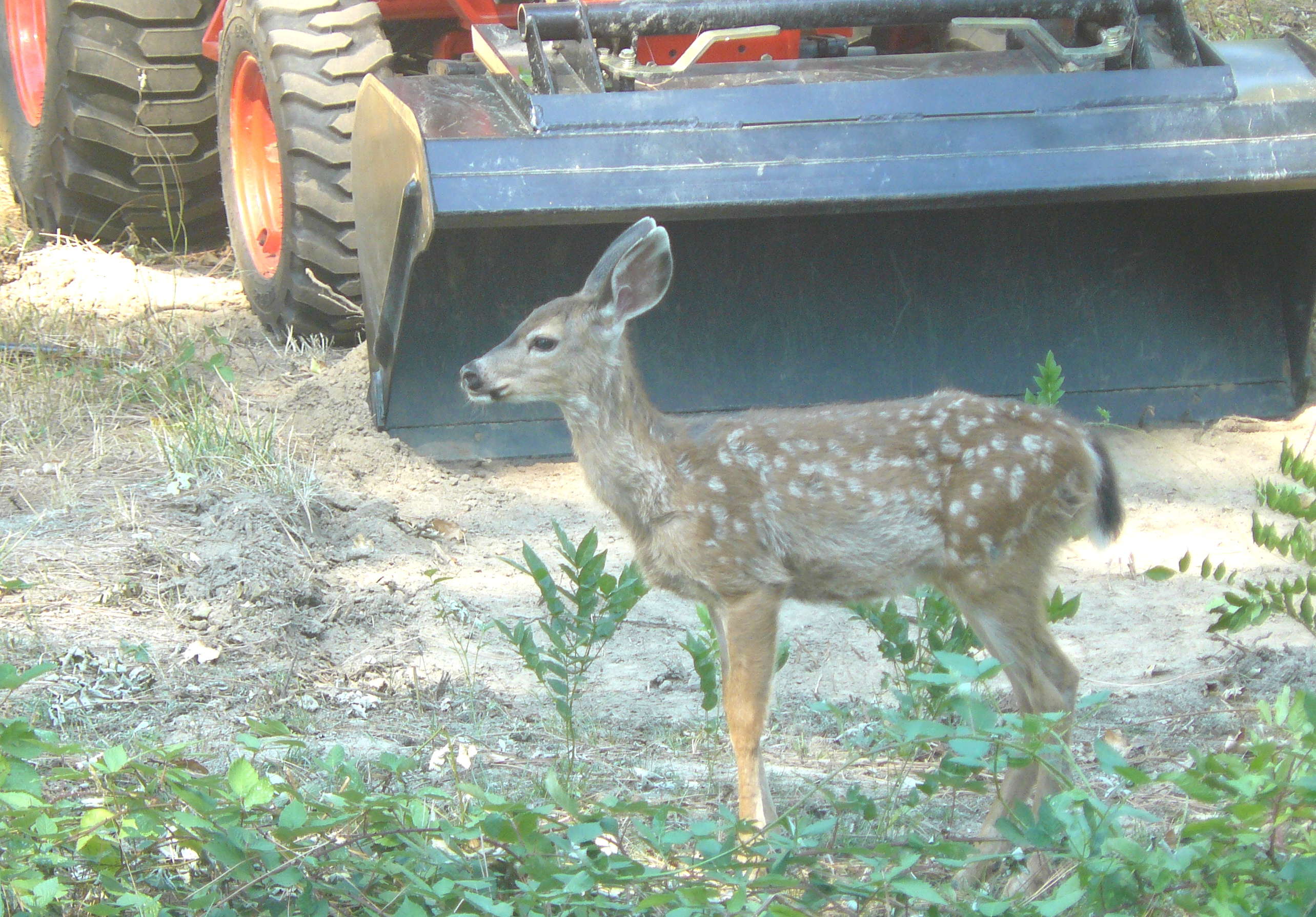
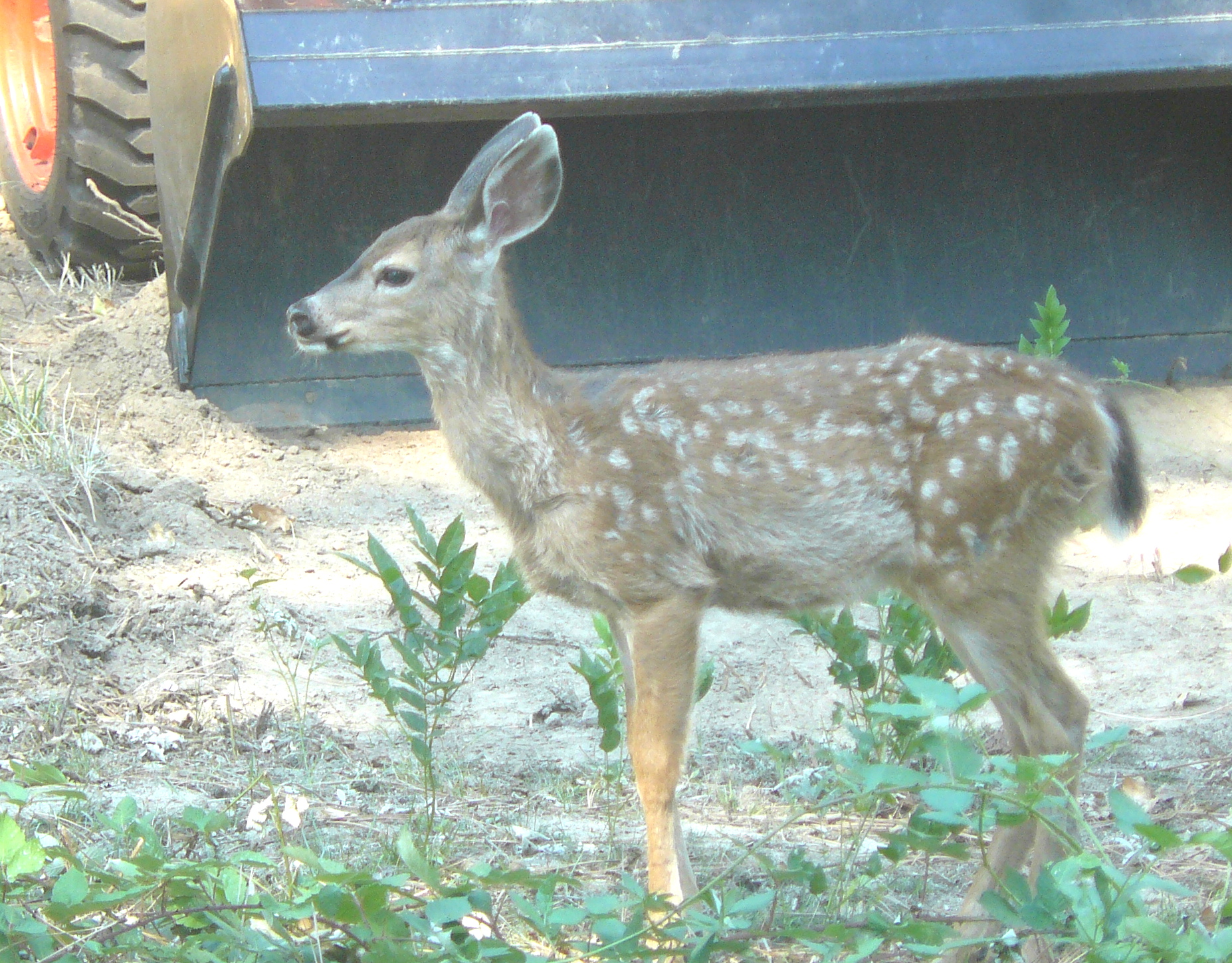
So many wild creatures, large and small, are storing up their body reserves for the long Winter months.  Our neighbours, Dordie and Bill, regularly feed the wild deer and we have joined in as well.  It’s fascinating to see how quickly they work out that we are not going to harm them.  The picture below shows a young deer that allowed me to jump off the tractor, go indoors to find my camera, and return to snap the gorgeous, pretty creature.

P1130809-001
Trusting little soul.

There’s been a couple of posts that I want to refer to because they underline the fact that humans are so prone to forgetting that we are of the wild, from the wild and connected to the wild.  That’s for tomorrow.

Thus will close today with a recent Autumnal picture of the early-morning mists across our open grass area.

Misty Autumnal mornings

So to that John Keats poem:

To Autumn

John Keats (1820)

Season of mists and mellow fruitfulness,
Close bosom-friend of the maturing sun;
Conspiring with him how to load and bless
With fruit the vines that round the thatch-eves run;
To bend with apples the moss’d cottage-trees,
And fill all fruit with ripeness to the core;
To swell the gourd, and plump the hazel shells
With a sweet kernel; to set budding more,
And still more, later flowers for the bees,
Until they think warm days will never cease,
For Summer has o’er-brimm’d their clammy cells.

Who hath not seen thee oft amid thy store?
Sometimes whoever seeks abroad may find
Thee sitting careless on a granary floor,
Thy hair soft-lifted by the winnowing wind;
Or on a half-reap’d furrow sound asleep,
Drows’d with the fume of poppies, while thy hook
Spares the next swath and all its twined flowers:
And sometimes like a gleaner thou dost keep
Steady thy laden head across a brook;
Or by a cyder-press, with patient look,
Thou watchest the last oozings hours by hours.

Where are the songs of Spring? Ay, where are they?
Think not of them, thou hast thy music too,—
While barred clouds bloom the soft-dying day,
And touch the stubble-plains with rosy hue;
Then in a wailful choir the small gnats mourn
Among the river sallows, borne aloft
Or sinking as the light wind lives or dies;
And full-grown lambs loud bleat from hilly bourn;
Hedge-crickets sing; and now with treble soft
The red-breast whistles from a garden-croft;
And gathering swallows twitter in the skies.

Being philosophical about philosophy!

Two more examples of deep thinking.

Note: We have a flooring contractor in the house all week and it’s making it a little tricky to spend the couple of hours a day that is my usual pattern for writing posts for LfD.  So apologies if this week’s posts are more dependent on the thoughts of others than is usual.

Alain de Botton
Alain de Botton

Alain de Botton is a familiar face on British television.  WikiPedia’s entry describes him, thus:

Alain de Botton, FRSL (born 20 December 1969) is a Swiss/British writer, philosopher, television presenter and entrepreneur, resident in the United Kingdom. His books and television programmes discuss various contemporary subjects and themes, emphasizing philosophy’s relevance to everyday life.

He has been the presenter of a BBC Six-part series called Philosophy: A Guide To Happiness.  And who wouldn’t be turned on by that!

Luckily, all six episodes are available on YouTube, at this overall link.

But I wanted to share the first episode because despite the title being Socrates on Self-Confidence it really speaks to our lives in this year of 2013.

Moving on.

A recent item on Big Think, again about philosophy, jumped off the page at me. It specifically looked at making our life, as in mental health, easier in these demanding times.  It was by Daniel Dennett and was called The Philosopher’s Self-Help Book. 

Daniel Dennett
Daniel Dennett

oooo

The Philosopher’s Self-Help Book (with Daniel Dennett)

by JASON GOTS

JULY 13, 2013,

While Silicon Valley and Silicon Alley busy themselves making every aspect of our lives more efficient (except, perhaps, for the process of discovering these new technologies, learning them, and integrating them into our lives), Daniel Dennett sits up at Tufts University in  Massachusetts, philosophizing. His latest book, Intuition Pumps and Other Tools for Thinking is an attempt to make transparent some of the tricks of the philosopher’s trade. In an accelerating age, it’s a self-help book designed to slow the reader down and improve our ability to think things through.

The kinds of things Mr. Dennett likes to think about include the nature of consciousness, evolution, and religious belief. But the mind-training his new book offers is applicable to any problem you want to consider thoroughly. In an age of quick fixes and corner-cutting, we’re in constant danger of bad decision making – of overreliance on what cognitive psychologist Daniel Kahneman calls “system 1”, and what most of us call intuition. This rapid decision making channel of the brain is helpful when we are in mortal danger, or pressed for a quick decision within our areas of expertise. But for most decisions, the slower, more deliberate channel (system 2) is much more reliable. What Dennett offers, then, in Intuition Pumps, is a workout for system 2 – a series of thought experiments you can apply to puzzles real and imagined to bulk up the slower, wiser parts of your consciousness.

Some of the tools Dennett offers in the book are more familiar than others. Reductio ad absurdum arguments, for example, in which we test the validity of a claim by taking it to its most outrageous illogical extreme (a: “all living things have a right to liberty.” b: “so let me get this straight – a blade of grass has a right to liberty? What does that even mean?”). But the true delights of the book are the far-out exercises Dennett and his colleagues have dreamed up in the course of their work, such as “Swampman Meets A Cow-Shark”, from Donald Davidson, which begins:

Suppose lightning strikes a dead tree in a swamp; I am standing nearby. My body is reduced to its elements, while entirely by coincidence (and out of different molecules) the tree is turned into my physical replica. My replica, The Swampman, moves exactly as I did; according to its nature it departs the swamp, encounters and seems to recognize my friends, and appears to return their greetings in English.

Walking us through Davidson’s considerations about whether and to what extent the Swampman is anything like Davidson, and related ones about a cow that gives birth to something that looks exactly like a shark (yet has cow DNA in all of its cells), Dennett teaches us a surprising lesson about the utility of wild philosophical speculation.

Cloaked in the breezy, familiar trappings of a self-help book, Intuition Pumps is in actuality a dark mirror of that genre – a field of rabbit holes designed to leave the reader with more questions than answers, and wiser for the long and indirect journey.


Watch for Daniel Dennett’s Tools For Better Thinking – a Big Think Mentor workshop coming soon. 

 oooOOOooo

I’m tempted to put the book on my own reading list.  If you want to drop into the appropriate Amazon page there is an audio link plus the option to read an extract.  Amazon describe the book, as follows:

One of the world’s leading philosophers offers aspiring thinkers his personal trove of mind-stretching thought experiments.

Over a storied career, Daniel C. Dennett has engaged questions about science and the workings of the mind. His answers have combined rigorous argument with strong empirical grounding. And a lot of fun.

Intuition Pumps and Other Tools for Thinking offers seventy-seven of Dennett’s most successful “imagination-extenders and focus-holders” meant to guide you through some of life’s most treacherous subject matter: evolution, meaning, mind, and free will. With patience and wit, Dennett deftly deploys his thinking tools to gain traction on these thorny issues while offering readers insight into how and why each tool was built.

Alongside well-known favorites like Occam’s Razor and reductio ad absurdum lie thrilling descriptions of Dennett’s own creations: Trapped in the Robot Control RoomBeware of the Prime Mammal, and The Wandering Two-Bitser. Ranging across disciplines as diverse as psychology, biology, computer science, and physics, Dennett’s tools embrace in equal measure light-heartedness and accessibility as they welcome uninitiated and seasoned readers alike. As always, his goal remains to teach you how to “think reliably and even gracefully about really hard questions.”

A sweeping work of intellectual seriousness that’s also studded with impish delights, Intuition Pumps offers intrepid thinkers—in all walks of life—delicious opportunities to explore their pet ideas with new powers.

Speaking of ‘pet ideas with new powers’ prompts one to reflect on the amount of time that dogs spend thinking!  As the following picture confirms!

Pharaoh contemplating the meaning of life!

The power of thinking

It’s easy to underestimate just how powerful the brain can be.

Last Friday’s post was called Instinctive behaviours and explored the notion of instinct, coming to the conclusion that almost everything the brain does is a result of learning rather than genetics.  Yet acknowledging the vast amount of brain activity that runs in ‘background’ mode or subconsciously.

That was brought home to me in spades as a result of being introduced to the flying of gliders, or sailplanes in American speak.  The year was 1981 and working near to me in my offices in Colchester, Essex was a gentlemen running his own company, like yours truly.  His name was Roger Davis and we were sharing a beer one day when the subject of flying came up.  It piqued my interest so, as my logbook declares, on the 7th June, 1981 I had the first of two flights in a glider with Roger at the controls.  The place was Rattlesden Airfield, an old wartime airfield near Felsham, Bury St. Edmunds in Suffolk.  The gliding club was Rattlesden Gliding Club.

RGC header

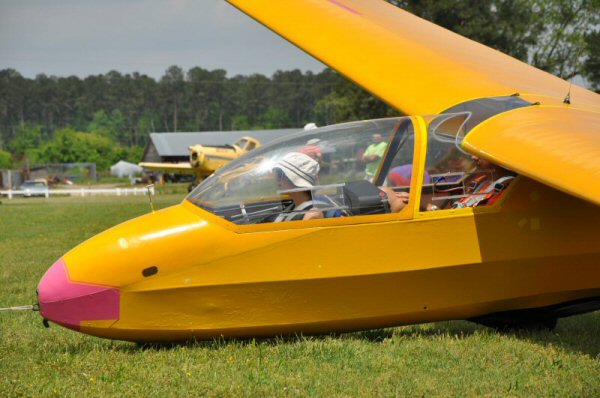
The glider we were in was known as a K-7, a high-wing, two-seater (naturally!) glider with the instructor sitting behind the student.
A K-7 typical of the glider I first flew in at Rattlesden GC.

Anyway, some 43 flights later, I was signed off to conduct my first solo flight in the K-7.  The date was 5th September, 1981 and my flight time was just 4 minutes!  I was hooked.

In over 10 years of flying amounting to more than 1,400 flights I had the great fortune to experience much of the magic of flying relying on nothing more than the currents of air.

Ahh! Memories!  Over 10 years of glider flying, amounting to more than 200 hours of flight-time, 17 different types of glider.  Longest flight was 5 hours, 16 minutes including a climb to over 6000 feet above sea-level on the 7th July, 1985 in a single-seater LS4 glider type.

So what’s this got to do with subconscious thinking?  Simply this.

One quickly learnt that once the decision had been made to land, most frequently because one was unable to find further, or any, rising air currents the brain had a major computing task in hand.  As the aircraft descends, the air currents change and the direction and velocity of the wind changes.  There is no engine to allow one to abort the landing; to do a ‘go round’!

One of the key visual judgments was determining the point of touchdown: not too early that might risk a ground contact before the start of the runway, and not too late which might risk running out of landing space.

Thus the brain was operating clearly in two modes.  Consciously, computing second by second where the touch-down point was going to be and, subconsciously, the flying of the glider as in operating the joystick and rudder pedals in support of the touch-down ‘computations’.

Moving on.

In last Friday’s post, I also wrote this: “Plus something that could just possibly be the key to mankind having a long-term sustainable future on this planet: The Power of Thinking.

That ‘something’ was me reflecting on an article in the October 7th edition of FORTUNE magazine.  Not something I read on a normal basis but just happened to come across that edition – and glad I did.  Because there was an article about IBM’s new supercomputer Watson.  The link to the summary is here, from which I republish this:

Dr. Mark Kris is among the top lung cancer specialists in the world. As chief of thoracic oncology at Memorial Sloan-Kettering (MSK) Cancer Center in New York City, he has been diagnosing and treating patients for more than 30 years. But even he is overwhelmed by the massive amount of information that goes into figuring out which drugs to give his patients — and the relatively crude tools he has to decipher that data. “This is the standard for treatment today,” he says, passing me a well-worn printout of the 2013 treatment guidelines in his office. We choose a cancer type. A paragraph of instructions says to pair two drugs from a list of 16. “Do the math,” he says. It means more than 100 possible combinations. “How do you figure out which ones are the best?”

It’s a huge problem. More than 230,000 Americans will be diagnosed with lung cancer this year. Almost all of them will receive chemotherapy. As crude as the existing guidelines are, says Kris, they won’t be followed more than half the time. If we bumped up adherence by just 10% to 20%, he says, as many as 30,000 people might live longer. Never mind curing cancer — shouldn’t we be able to get the best available combinations of medications to sick people now?

That’s the question that led Kris to IBM. He saw that more information was not the answer. What doctors needed was a better brain — one that could instantly vacuum up facts, draw deeper connections between data points, and remember everything. They needed Watson.

Just read that last paragraph again.  That it’s not about information, it’s about offering humanity computing power that can see things that humans might not easily see.

Thus, I mused that when mankind gets to the point where there is total and complete commitment to finding a non-carbon-burning way ahead for every living thing on this planet we won’t have the luxury of countless years working out the new journey directions.  Maybe, just maybe, computing power a la Watson might just be our saving grace.

Curious to learn more about IBM Watson?  Then here’s the relevant website.

Instinctive behaviours.

We see instinct as common across all species including man, so why is so little known about it.

There was an item seen on the BBC Capital website.  It was an article about intuition:

Trusting your gut: Smart management or a fool’s errand?

by Eric Barton*

Photographer Mindy Véissid woke up one winter morning in 2010 with a simple idea: dogs running in the snow.

“That’s all I had,” she recalled.

The Manhattan resident followed her gut and went across town to Central Park. There, Véissid found three dogs jumping around in a couple of inches of new snow covering the famed park’s Great Lawn. She plopped down in the field and waited. That’s when the dogs headed right for her. She snapped off a shot just before they barrelled over her.

The picture she took that morning, of happy-looking pups charging through a cloud of snow with the New York City skyline behind them, has become one of Véissid’s calling cards, maybe her most recognisable shot. It’s a photo she would have missed if she had not trusted her gut.

“What I realised is that if I follow my heart, if I follow my feelings, I get good photographs,” Véissid said. “We try to control everything in our lives, and sometimes you have to let go.”

It wasn’t long ago that decision-by-intuition would have been regarded as little more than magical thinking or a try at luck. But research has changed that and intuition has been embraced as a key component to business decision making.

There is, however, an inherent danger to it, and blindly following your gut can be worse than ignoring it altogether. For managers, that means learning how to trust your own instincts and encouraging employees to do the same. But it also means learning to recognise when careful planning trumps sudden inspiration.

Perhaps the thing that most changed the way businesses think about inspiration was a 2008 study co-authored by Gerard Hodgkinson, professor at Leeds University Business School in the United Kingdom. Hodgkinson found that intuition can be beneficial in specific circumstances. First, it’s best to rely on a gut feeling when you need to make a quick decision. Second, and this is the important part, trust your intuition only when you have extensive knowledge on the subject. In other words, the best intuition is pulled from a well of deep knowledge and expertise.

“A lot of people think intuition is general purpose, but intuition is actually domain specific,” said Massimo Pigliucci, a philosophy professor at City University of New York, and author of Answers for Aristotle: How Science and Philosophy Can Lead Us to A More Meaningful Life. “Intuition is the result of your subconscious brain picking up on clues and hints and calculating the situation for you, and that’s based solely on experience.”

(The rest of the story may be read here.)

Wrong to republish the whole piece, however I do want to republish the closing paragraphs as they are so relevant to today’s post.

Western cultures began to embrace intuition only recently, Pigliucci said, while research suggests Southeast Asian countries have long given credit to gut feelings being a good guide to decision making. Eastern managers, for instance, are more likely to rely on hunches and give them credit for successes afterward.

After photographer Véissid learned to rely on her gut feelings, she wanted to teach others how to do it. Her class, the Art of Intuitive Photography, teaches the photography basics, but her instruction is more about following hunches.

“You can get a good photograph and it will be technically correct,” she said. “But if you follow your heart, you can take photos that can be wonderful.”

Follow BBC Capital on Twitter @BBC_Capital or follow us and join the conversation about this or any other Capital story on Facebook: BBC Capital on Facebook.

—-

* Eric is a freelance journalist who lives in Fort Lauderdale, Florida. He is formerly a writer and editor at New Times in Fort Lauderdale and The Pitch in Kansas City, Missouri. His work has been featured by  the Florida Center for Investigative Reporting.

To my mind, what Eric Barton has written about is not instinctive.  That is if one believes that instinct is something that is ‘hard-wired’, so to speak, into our psyche at birth, a function of our genetic heritage.

When one reflects on the start of life, ergo for all warm-blooded species that are the result of a successful copulation between the two genders of that species, then one realises that there is little functioning at birth beyond those bodily functions vital to that new life.

But if we mean by instinctive those behaviours that are subconsciously acted out while the mind is engaged on other mental processes, then that’s different.

Read that last opening paragraph again [my emphasis]:

“A lot of people think intuition is general purpose, but intuition is actually domain specific,” said Massimo Pigliucci, a philosophy professor at City University of New York, and author of Answers for Aristotle: How Science and Philosophy Can Lead Us to A More Meaningful Life. “Intuition is the result of your subconscious brain picking up on clues and hints and calculating the situation for you, and that’s based solely on experience.

Think of when we drive a car how much of what we are doing in the ‘hand-eye’ department is being managed by our subconscious brain.  Think about the way we use a language, especially the language of our birth country.  One will immediately recognise that the brain is on auto-pilot.  Yet we were born unable to speak, or to drive a car!

Coincidentally, over at Patrice Ayme’s blog there was a post published yesterday on the same theme.  It was called Instinct is Fast Learning.  Here’s an extract:

INSTINCT IS FAST LEARNING.

SMALL ANIMALS, FAST MINDS.

HOW FORCE BECOMES THE TRUTH OF MAN.

Abstract: “Innate Knowledge” is a stupid idea. The truth is the exact opposite: KNOWLEDGE IS EVERYWHERE, OUT THERE.Knowledge is the opposite of innate. This insight has tremendous consequences on our entire prehension of the world.

(It will not escape the cognoscenti that Socrates, Plato, and Aristotle, were partisans of innateness. And that believing in the superiority of inheritance is a necessary condition for racism, fascism, slavery, and hereditary plutocracy as fairness. That makes the likes of Chomsky and Dawkins self contradictory)

Subjective time slows down in smaller brains.

Fastest Wings, Fastest Brains. Anna Hummingbird California
Fastest Wings, Fastest Brains.  Anna Hummingbird California

Those wings go at 100 Hertz, four time the human perception limit.

Thus time is relative; just as light-clock time slows down in a fast reference frame, or in a heavy gravitational field, neurological timeslows down in a small neurology.

(Interestingly, the deepest reason for the slowing of time… boils down to the same in the Relativity case as in the Neurological one! It’s all about energy.)

A lot of ideas on instinct came from studying insects: insects seem to know all, without having studied anything. However, if insect time flows slowly, insects actually have time to learn.

And that’s rendered easier by having brains adapted to their environment. If they have only a few tricks to learn, and what looks like ten seconds for us is an hour for them, no wonder they learn lots. Thus slow in small explains how “instinct” works.

Hence behaviors one describes as “instinctive” are just fast studies. A lot of the silliness about “genes” is thus dispelled, and the mind comes on top.

It’s an essay that deserves the full reading.  This is how it closes:

Conclusion:

Instinct As Fast Learning solves the nature-nurture problem. It also shows something else, even more important. It shows that the force of nature makes not just the force, but even the very geometry, of our minds.

(The construction of neuromorphology itself being forced by feedback from nature.)

The minds of sentient species, from bees to hummingbirds, are exquisitely tuned to be programmed by the (part of) nature they are made to respond to, all the way to the speed of time they need.

If we kill the environment, we kill out instruction set. The usual reason given to save the environment is that we would not want our descendants to live in a bad world. But what we see now is that a poor world gives poor minds, and that even time may go askew. Another, deeper than ever, reason to be a fanatical ecologist. Nature is not just our temple. Nature is where, and how, time itself is built, one neurological impulse at a time.

***

Patrice Ayme

On Monday, I have a sequel to this post.  It’s an insight into the conscious and unconscious skills that come from flying a glider, or sailplane in American speak!  Plus something that could just possibly be the key to mankind having a long-term sustainable future on this planet: The Power of Thinking.

But back to today.

You will recall that the item from the BBC website opened with photographer Mindy Véissid waking up one winter morning in 2010 with a simple idea: dogs running in the snow.  Too good not to miss for a blog called Learning from Dogs.

Mindy’s website is here and do go across there and browse.  You will quickly discover, for example:

we teach small sized group and private digital photography classes and workshops in fun locations throughout nyc, focusing on how to use your camera, how intuition can help guide you to images, and compositional improvement

So having given Mindy that small, but well-deserved, plug, I don’t feel too bad closing today with Mindy’s picture of those dogs running in the snow.

Picture by Mindy Veissid Photography

A return to integrity

Can we mend our broken ways? Just possibly.

Yesterday’s long rant was the outcome of me promising ‘a debate’ with Patrice Ayme.  Succinctly, I had disagreed with a comment from Patrice where he had written: “Force is the truth of man. Everything else is delusion, even the vegetarian style.” and wanted to respond within the space of a post rather than the more restrictive comment.

For my disagreement with Patrice had been essentially about his statement, ‘Force is the truth of man‘.  I don’t recall a war in the last 50 years that has been a force for good.

But then it was Alex’s comment, see below, that stopped me short.  For I realised that I was confusing ‘force’ with ‘war’ and that was probably a big mistake on my behalf.  Of course, I’m writing this without the benefit of knowing better what Patrice meant in his comment! Blogging, as powerful a media as it is, does not provide for immediate interaction!

Nevertheless, Alex’s comment yesterday was powerfully inspirational.  Because so many of us (and I include me in that ‘us’) all too often behave as though we are a species utterly divorced from Nature.

I closed yesterday’s post with these words;

So what to do?  Because I am fundamentally at odds with the sentiment expressed by Patrice Ayme; “Force is the truth of man. Everything else is delusion, even the vegetarian style.

The answer takes us to tomorrow’s post, A return to integrity.

And, yes, it does mention dogs!  Rather a lot as it happens!

Dogs are the one species that man has lived with longer than any other species.  So when we refer to the qualities of the dog it is simply because we are so familiar with them.  In no way does that exclude the numerous other species that bond with man and share the same wonderful qualities.

Qualities so easily seen: Love, Honesty, Loyalty, Trust, Openness, Faithfulness, Forgiveness and Affection. Together they are Integrity.

Of course dogs will kill a rabbit, for example, as readily as a cat will kill a mouse.  In this respect force is the truth of Nature.

The only way for species man to survive on this planet is for every element of man’s existence on this planet to be rethought of in terms of the natural order.  Read the comment left by Alex in yesterday’s post:

Hi Paul, what you highlight are examples of disconnection between humanity with nature and each other. I have on my own blog highlighted a concept of Ubuntu – “I am because we are” – which is only possible when the self realises they are part of an inter-connected network of life. Your example of islands of fragmented forest where disconnected wildlife are dying out is how it is with disconnected humanity, we are doomed to destruction because we are cut off from the life-giving connection to nature.

All the problems you highlight are symptoms of the disease of disconnection, until there is reconnection to nature none of these symptoms can be successfully addressed.

War is an integral part of nature, when people seek to dismiss this then they add to the disconnection from nature. I was stung in the face by a drunken wasp a few days ago, this is how it is with nature, it is beautiful but also brutal. Peace and balance are illusions, life is in a becoming because of unbalance and strife. I advocate harmony, like a downhill skier we do not seek to control our surroundings, but instead act in harmony by moving around the obstacles such as rock and tree.

Disconnection can be as large as destroying whole forests by ignorant energy policies to those idiots who kicked a puffball to pieces before I could harvest it, or the new owners of my former home who have taken a chainsaw to all the trees and bushes in the garden. People who are disconnected do not consider how their actions impact nature or people contrary to the philosophy of Ubuntu.

I am because we are!” Each and every one of us is where we are today, for good or ill, because of what we are: part of Nature.  It’s so incredibly obvious – we are a natural species – yet who reading this wouldn’t admit at times to behaving “as though we are a species utterly divorced from Nature.”

Millions of us have pets and animals that we love.  Yet we still miss the key truth of our pets.  That we are a part of Nature, subject to Natural order, just as much as our pets are.  We have so much to learn from our animals.

Take this rather sad story but, nonetheless, a formidable story of the integrity of one species for another.  Watch the video.

oooo

Take this rather happier story about the integrity of one species for another. Watch the video.

oooo

Thus when we see the extraordinary benefits that arise from love and trust, from loyalty and faithfulness, and much more, why oh why is so much of our society fundamentally broken?

As John Hurlburt wrote in a recent email, it is because, “we are spiritual bankrupt. We spend too much of our time thinking about ourselves and what we want and too little of our time thinking about other people and what we all need.”  John went on to add that this spiritual bankruptcy had preceded our moral and economical bankruptcy. He pointed out that the solution to our moral and financial problems, as well as our salvation as individuals and as a species, is spiritual. “We simply need to love the Nature of God, the earth and each other regardless of what we may believe God to be.”

Now whether you are a religious soul, or a heathen, or somewhere in the middle, it matters not.  For if we continue to defy Nature and the natural laws of this planet we are going to be dust before the end of this century.  Again in John’s powerful words:

Denying climate change is a death wish.

Nature always wins in the long run.

Nature is balanced. Are we?

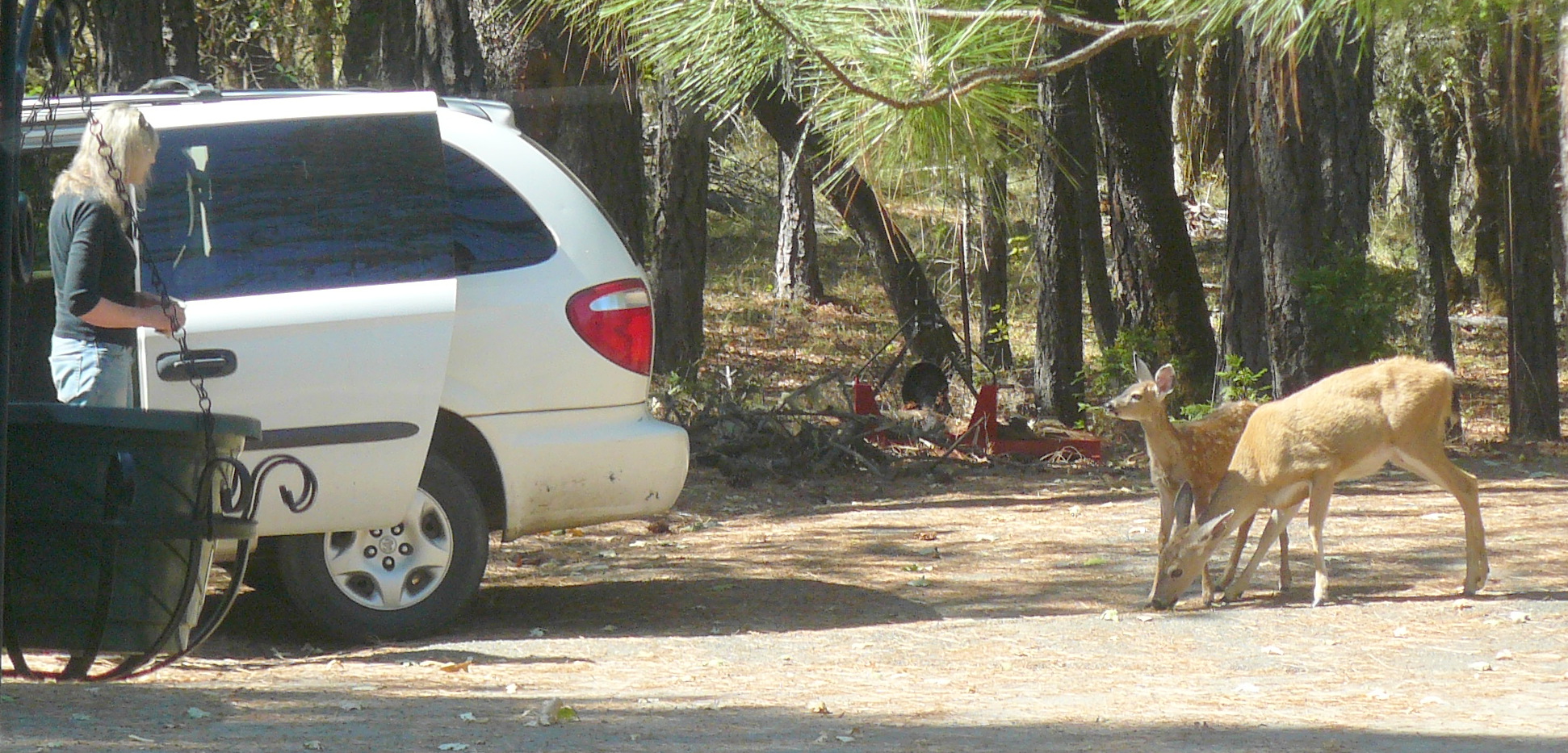
As if to endorse the great examples that Nature offers us in terms of the benefits of love and trust, take a look at these three recent photographs from here in Oregon.

A young timid deer responding to me sitting quietly on the ground.
A young timid deer showing her trust of me as I sat quietly on the ground less than 30 feet away.

oooo

A mother and her fawn trusting Jean's love for them, and getting a good feed!
A mother and her fawn trusting Jean’s love for them, and getting a good feed!

oooo

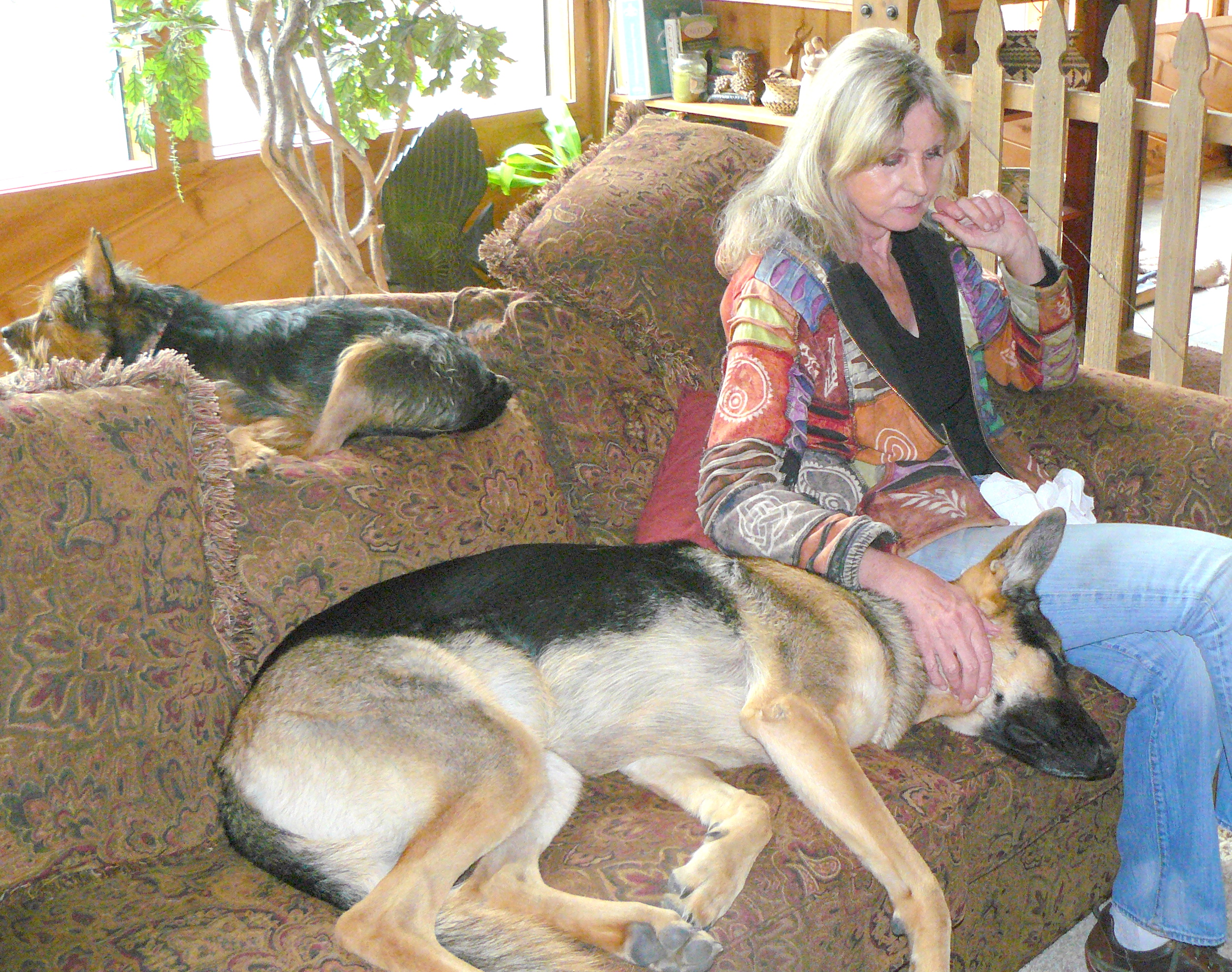
Sweeny, on back of settee, and Cleo in peace and comfort.
Little Sweeny and Cleo converting trust to peace and happiness.  (Not to mention Jean!)

Now these are not photographs to ‘ooh’ and ‘ah’ over, these are reminders that kindness, generosity, selflessness and trust are part of Nature.  All the great virtues and values of man do not come from a vacuum, they come to us via Nature.

We have been blessed by an evolution that has allowed mankind to achieve remarkable things.  Even to the point of leaving the confines of our planet and setting foot on the Moon and sending probes from out of our Solar System.  There’s a sense, a distinctly tangible sense, that man has conquered all; that we have broken the link from being part of Nature; from being of Nature.

And now Mother Earth is reminding all of her species, every single one of them including species man, that everything is bound by her Natural Laws.

Does this mean that man has to revert to some form of pre-civilised stone-age era?  Of course not!  Progress can be as much within the Natural order than in competition with it, as it has been in recent times.  In fact, Professor Pat Shipman explains our progress is benefited by being part of that Natural order.  Here’s how Amazon describe her book, The Animal Connection.

The Animal Connection: A New Perspective on What Makes Us Human

A bold, illuminating new take on the love of animals that drove human evolution.

Why do humans all over the world take in and nurture other animals? This behavior might seem maladaptive—after all, every mouthful given to another species is one that you cannot eat—but in this heartening new study, acclaimed anthropologist Pat Shipman reveals that our propensity to domesticate and care for other animals is in fact among our species’ greatest strengths. For the last 2.6 million years, Shipman explains, humans who coexisted with animals enjoyed definite adaptive and cultural advantages. To illustrate this point, Shipman gives us a tour of the milestones in human civilization-from agriculture to art and even language—and describes how we reached each stage through our unique relationship with other animals. The Animal Connection reaffirms our love of animals as something both innate and distinctly human, revealing that the process of domestication not only changed animals but had a resounding impact on us as well.

It’s a powerful read and greatly recommended.  Here’s an extract from the book [page 274, my emphasis]:

Clearly, part of the basis of our intimacy with tame or domesticated animals involves physical contact.  People who work with animals touch them.  It doesn’t matter if you are a horse breeder, a farmer raising pigs, a pet owner, a zoo keeper, or a veterinarian, we touch them, stroke them, hug them.  Many of us kiss our animals and many allow them to sleep with us.  We touch animals because this is a crucial aspect of the nonverbal communication that we have evolved over millennia.  We touch animals because it raises our oxytocin levels – and the animal’s oxytocin levels.  We touch animals because we and they enjoy it.

From the first stone tool to the origin of language and the most recent living tools, our involvement with animals has directed our course.

So to round this off.  These last two posts came from my need to debate with Patrice the statement that “Force is the truth of man.”  If Patrice’s meaning was that the truth of man is subject to the force of Nature, then I agree one-hundred percent.

For the time for man to recognise that the force of Nature is “the truth of man” is running out.

Each of us, whoever you are, for the sake of your children and for all of the children in the world, embrace today the qualities, the values of Nature.

Love, Honesty, Loyalty, Trust, Openness, Faithfulness, Forgiveness, Affection.

(Unknown author)

If you can resist treating a rich friend better than a poor friend,

If you can face the world without lies and deceit,

If you can say honestly that deep in your heart you have no prejudice against creed, colour, religion or politics,

Then, my friend, you are almost as good as your dog.

Let us learn from dogs.

Let us return to integrity.

Rethinking privacy?

Is the need for privacy a by-product of large society?

The other day, thanks to Naked Capitalism‘s regular set of web-links, I became aware of the website Popular Resistance.  To be exact, Naked Capitalism had linked to an article entitled, “New Intel Chips Contain Back-Door Processor, Hackable Even When Computer is Turned Off.

Regular readers of this place may well recall my decision to ditch Windows OS and buy a new Apple Mac Mini articulated in a post earlier in the month, Closing my Windows.  Here’s a brief extract from that post.

Muttering about this to friends who know a lot more about computing than I raised my awareness that the privacy and security of one’s computer was no longer to be assumed.  Then just recently, I read online,

A Special Surveillance Chip

According to leaked internal documents from the German Federal Office for Security in Information Technology (BSI) that Die Zeit obtained, IT experts figured out that Windows 8, the touch-screen enabled, super-duper, but sales-challenged Microsoft operating system is outright dangerous for data security. It allows Microsoft to control the computer remotely through a built-in backdoor. Keys to that backdoor are likely accessible to the NSA – and in an unintended ironic twist, perhaps even to the Chinese.

Then a few paragraphs later:

It would be easy for Microsoft or chip manufacturers to pass the backdoor keys to the NSA and allow it to control those computers. NO, Microsoft would never do that, we protest. Alas, Microsoft, as we have learned from the constant flow of revelations, informs the US government of security holes in its products well before it issues fixes so that government agencies can take advantage of the holes and get what they’re looking for.

Now I’m using Windows 7 so imagine my angst when I then read:

Another document claims that Windows 8 with TPM 2.0 is “already” no longer usable. But Windows 7 can “be operated safely until 2020.” After that other solutions would have to be found for the IT systems of the Administration.

That did it for me – time to move on from Windows.

OK, on to today’s thought.  The Popular Resistance article explained:

New Intel-Based PC’s Permanently Hackable

So you think no one can access your data because your computer is turned off. Heck it’s more than turned off, you even took the main hard drive out, and only the backup disk is inside. There is no operating system installed at all. So you KNOW you are safe.

Frank from across the street is an alternative operating systems hobbyist, and he has tons of computers. He has Free BSD on a couple, his own compilation of Linux on another, a Mac for the wife, and even has Solaris on yet another. Frank knows systems security, so he cannot be hacked . . . or so he thinks.

The government does not like Frank much, because they LOVE to look at everything. Privacy is a crime don’t you know, and it looks like Frank’s luck with privacy is about to run out.

The new Intel Core vPro processors contain a new remote access feature which allows 100 percent remote access to a PC 100 percent of the time, even if the computer is turned off. Core vPro processors contain a second physical processor embedded within the main processor which has it’s own operating system embedded on the chip itself. As long as the power supply is available and and in working condition, it can be woken up by the Core vPro processor, which runs on the system’s phantom power and is able to quietly turn individual hardware components on and access anything on them.

The author of the article, Jim Stone, later describing:

Accessing any PC anywhere, no matter what operating system is installed, even if it is physically disconnected from the internet. You see, Core vPro processors work in conjunction with Intel’s new Anti Theft 3.0, which put 3g connectivity into every Intel CPU after the Sandy Bridge version of the I3/5/7 processors. Users do not get to know about that 3g connection, but it IS there.

(The full article may be read here.)

Naturally, I huffed and puffed as I read the article.  However, later on came the thought that maybe this is a great journey of ‘ever-diminishing-returns’, as in this journey of ‘us’ versus ‘The State’.  A journey that misses something very fundamental.

This is what I mean.

I’m proposing that the drive for privacy is an inevitable by-product of the country that we live in being seeing as one huge society.  That in that huge society, we can only maintain our own unique individuality through a degree of privacy.  Otherwise, we are nothing more than an irrelevant tiny part in the big scheme of things.

But if one reflects on how smaller societies function; from local communities down to families, then that need for privacy is greatly reduced.  Because in those smaller communities, we are seen as an individual with all the associated hues of our own individual personality.  We get to know others, and those others get to know us, as individuals – that’s how communities function.  Then a much more important value comes into play; that of trust.  It’s my impression that we only properly engage with those that we trust.  Again, how communities function!

I continued to play with these thoughts.  Even putting the issue of privacy to one side, the range of benefits that flow from our local communities is over-whelming.  All the big issues facing humanity today can only be dealt with effectively at the local level;  the community level.

Coincidentally, echoed in an email from long-standing friend, Dan Gomez, in connection with a completely different topic.  He said:

Federal government is primarily for defense. Most other government can be pushed to local politicians.

…..

People need to be free and think free.  They need to hope. In too many countries around the world, there is little hope for a better life. People need to learn to be accountable and solve their own problems, first at local levels.

So, perhaps, worrying about our privacy and the increasing invasion of that privacy misses the point.

Because if in the next few years, a couple of decades at most, we do not adopt the core principles of a caring, sharing world; the lessening of a greedy, materialistic, me-me-me world, then I fear greatly for not only all of humanity but for the very future of the planet as an oasis of life circling a rather insignificant star in a very lonely cosmos.

So park privacy to one side.  See it as a symptom of these broken ‘focus-on-self’ times and look forward to a new caring, sharing world made up of countless conscious and mindful societies.  Embracing the values of animal societies, even to embrace the most successful species of animal ever; the dog. (As measured from the perspective of the dog’s association with man.)  Not only far back into ancient history but right now in these strange and troubling times. Embracing what millions of dog lovers across the world experience every day; the integrity of the dog.

Local societies and local communities are the only social structures where integrity makes sense, and can be seen to make sense.  Where the values of that society bring people together.  Where these qualities that we see in our dogs are mutually reinforcing.  I’m speaking of unconditional love, loyalty, stillness, play, openness, faithfulness, valuing the present, forgiveness, happiness, meditation, and sensitivity; all in that wrapper of integrity.

Think about it!  Do you ever see a dog worrying about privacy!

funny-dog-cat-photo-with-captions-08-could-we-have-a-little-privacy-please

The growth of empathy.

As they say in the old country, it’s an ill wind that doesn’t blow anyone any good!

So often when I stare at the screen wondering just what on earth to write about, along comes something to fire me up.

In this case, it was a small clutch of disconnected items that seemed to have a common thread for me.

The first was reading the links in this morning’s Naked Capitalism summary and seeing this:

The REAL Fukushima Danger

Posted on September 14, 2013 by WashingtonsBlog

The Real Problem …

The fact that the Fukushima reactors have been leaking huge amounts of radioactive water ever since the 2011 earthquake is certainly newsworthy.  As are the facts that:

But the real problem is that the idiots who caused this mess are probably about to cause a much biggerproblem.

Specifically, the greatest short-term threat to humanity is from the fuel pools at Fukushima.

If one of the pools collapsed or caught fire, it could have severe adverse impacts not only on Japan … but the rest of the world, including the United States.   Indeed, a Senator called it a national security concern for the U.S.:

The radiation caused by the failure of the spent fuel pools in the event of another earthquake could reach the West Coast within days. That absolutely makes the safe containment and protection of this spent fuel a security issue for the United States.

Nuclear expert Arnie Gundersen and physician Helen Caldicott have both said that people should evacuate the Northern Hemisphere if one of the Fukushima fuel pools collapses. Gundersen said:

Move south of the equator if that ever happened, I think that’s probably the lesson there.

Former U.N. adviser Akio Matsumura calls removing the radioactive materials from the Fukushima fuel pools “an issue of human survival”.

So the stakes in decommissioning the fuel pools are high, indeed.

But in 2 months, Tepco – the knuckleheads who caused the accident – are going to start doing this very difficult operation on their own.

The New York Times reports:

Thousands of workers and a small fleet of cranes are preparing for one of the latest efforts to avoid a deepening environmental disaster that has China and other neighbors increasingly worried: removing spent fuel rods from the damaged No. 4 reactor building and storing them in a safer place.

The Telegraph notes:

Tom Snitch, a senior professor at the University of Maryland and with more than 30 years’ experience in nuclear issues, said  “[Japan officials] need to address the real problems, the spent fuel rods in Unit 4 and the leaking pressure vessels,” he said. “There has been too much work done wiping down walls and duct work in the reactors for any other reason then to do something….  This is a critical global issue and Japan must step up.”

Apologies, that’s more than sufficient to ruin your day!  If you really want to read to the end, the item is here.

However, the next item carries a much more positive thread.  It was an essay that was highlighted on Linked-In back in June.

The Number One Job Skill in 2020

What’s the crucial career strength that employers everywhere are seeking — even though hardly anyone is talking about it? A great way to find out is by studying this list of fast-growing occupations, as compiled by the U.S. Bureau of Labor Statistics.

Sports coaches and fitness trainers. Massage therapists, registered nurses and physical therapists. School psychologists, music tutors, preschool teachers and speech-language pathologists. Personal financial planners, chauffeurs and private detectives. These are among the fields expected to employ at least 20% more people in the U.S. by 2020.

Did you notice the common thread? Every one of these jobs is all about empathy.

In our fast-paced digital world, there’s lots of hand-wringing about the ways that automation and computer technology are taking away the kinds of jobs that kept our parents and grandparents employed. Walk through a modern factory, and you’ll be stunned by how few humans are needed to tend the machines. Similarly, travel agents, video editors and many other white-collar employees have been pushed to the sidelines by the digital revolution’s faster and cheaper methods.

But there’s no substitute for the magic of a face-to-face interaction with someone else who cares. Even the most ingenious machine-based attempts to mimic human conversation (hello, Siri) can’t match the emotional richness of a real conversation with a real person.

Coincidentally, that thought about the ‘magic of a face-to-face interaction’ really echoed in me.  Why?  Because, I was ruminating on the wonderful world of human interaction this world of blogging delivers.  It seems to combine all the benefits of meeting real people with a global consciousness of those same real people spread way beyond our own local domains.

Hence  the reason why I offer the next seemingly unrelated item. The recent post from Sue Dreamwallker that I am republishing in full.

A Big Thank You to you ALL.

by Sue Dreamwalker

many-thanks-to-all_thumb

This is just a short post to say a Big thank you to all of my readers and to those who visit regular and comment upon my posts. You Bring with you such light and encouragement, and I often at a loss to say how much your kind support means.

I logged onto my Blog today and discover that my readership has swelled to 400 followers and so I just want to say a Big thank you for all of my oldest friends who have been with me since my beginnings of Windows Live Spaces days when I started in 2007, My first real post after transferring was called Finding Answers  here on WordPress.  And I remember well spending the best part of a Day getting to know and personalise my header  and  Blog back then as everything was alien that day was in Oct 2010.  A move I am so pleased to have made, as I just love the W.P. Community of friends we have gathered here and whom I have got to know and love.

And I just want to say a big thank you to all of my newest arrivals who have clicked the follow button.. I hope to get around to discovering your blogs as soon as time allows.And to say thank you to my email subscribers also.. And Welcome, I hope you enjoy my thoughts and if not please don’t be shy to air your opinions for that’s how we grow and learn by sharing knowledge and understanding.

Today I just want to post what I have been up to in recent days besides  the ‘Day-job’ in picture format.. So if you click the photos, you should be able to read more in the caption headings.. [Photos available on Sue’s blogsite.]

Take care all of you and I have a busy week a head in my Day Job, so I will catch you when I can…

Love and Blessings

~Sue~

Still the resonances continued.  For Rebecca Solnit published yesterday an incredibly powerful essay over on TomDispatch.  It was called Victories Come in All Sizes.  As always, Tom writes a wonderful introduction.  Let me skip to Rebecca’s opening paragraphs.

Joy Arises, Rules Fall Apart 
Thoughts for the Second Anniversary of Occupy Wall Street 
By Rebecca Solnit

I would have liked to know what the drummer hoped and what she expected. We’ll never know why she decided to take a drum to the central markets of Paris on October 5, 1789, and why, that day, the tinder was so ready to catch fire and a drumbeat was one of the sparks.

To the beat of that drum, the working women of the marketplace marched all the way to the Palace of Versailles, a dozen miles away, occupied the seat of French royal power, forced the king back to Paris, and got the French Revolution rolling. Far more than with the storming of the Bastille almost three months earlier, it was then that the revolution was really launched — though both were mysterious moments when citizens felt impelled to act and acted together, becoming in the process that mystical body, civil society, the colossus who writes history with her feet and crumples governments with her bare hands.

She strode out of the 1985 earthquake in Mexico City during which parts of the central city collapsed, and so did the credibility and power of the Institutional Revolutionary Party, the PRI that had ruled Mexico for 70 years. She woke up almost three years ago in North Africa, in what was called the Arab Spring, and became a succession of revolutions and revolts still unfolding across the region.

Such transformative moments have happened in many times and many places — sometimes as celebratory revolution, sometimes as terrible calamity, sometimes as both, and they are sometimes reenacted as festivals and carnivals. In these moments, the old order is shattered, governments and elites tremble, and in that rupture civil society is born — or reborn.

It really is an essay that you need to read in full.

However, this further extract covering the closing paragraphs explains why it resonated so strongly with me in terms of the rising consciousness of all the millions of ordinary people just trying to leave the world in a better place:

Part of what gave Occupy its particular beauty was the way the movement defined “we” as the 99%.  That (and that contagious meme the 1%) entered our language, offering a way of imagining the world so much more inclusive than just about anything that had preceded it. And what an inclusive movement it was: the usual young white suspects, from really privileged to really desperate, but also a range of participants from World War II to Iraq War veterans to former Black Panthers, from libertarians to liberals to anarchist insurrectionists, from the tenured to the homeless to hip-hop moguls and rock stars.

And there was so much brutality, too, from the young women pepper-sprayed at an early Occupy demonstration and the students infamously pepper-sprayed while sitting peacefully on the campus of the University of California, Davis, to the poet laureate Robert Hass clubbed in the ribs at the Berkeley encampment, 84-year-old Dorli Rainey assaulted by police at Occupy Seattle, and the Iraq War veteran Scott Olsen whose skull was fractured by a projectile fired by the Oakland police. And then, of course, there was the massive police presence and violent way that in a number of cities the movement’s occupiers were finally ejected from their places of “occupation.”

Such overwhelming institutional violence couldn’t have made clearer the degree to which the 1% considered Occupy a genuine threat. At the G-20 economic summit in 2011, the Russian Prime Minister, Dmitry Medvedev, said, “The reward system of shareholders and managers of financial institution[s] should be changed step by step. Otherwise the ‘Occupy Wall Street’ slogan will become fashionable in all developed countries.” That was the voice of fear, because the realized dreams of the 99% are guaranteed to be the 1%’s nightmares.

We’ll never know what that drummer girl in Paris was thinking, but thanks to Schneider’s meticulous and elegant book, we know what one witness-participant was thinking all through the first year of Occupy, and what it was like to be warmed for a few months by that beautiful conflagration that spread across the world, to be part of that huge body that wasn’t exactly civil society, but something akin to it, perhaps in conception even larger than it, as Occupy encampments and general assemblies spread from Auckland to Hong Kong, from Oakland to London in the fall of 2011. Some of them lasted well into 2012, and others spawned things that are still with us: coalitions and alliances and senses of possibility and frameworks for understanding what’s wrong and what could be right. It was a sea-change moment, a watershed movement, a dream realized imperfectly (because only unrealized dreams are perfect), a groundswell that remains ground on which to build.

On the second anniversary of that day in lower Manhattan when people first sat down in outrage and then stayed in dedication and solidarity and hope, remember them, remember how unpredictably the world changes, remember those doing heroic work that you might hear little or nothing about but who are all around you, remember to hope, remember to build. Remember that you are 99% likely to be one of them and take up the burden that is also an invitation to change the world and occupy your dreams.

Rebecca Solnit, author most recently of The Faraway Nearby spent time at Occupy San Francisco, Occupy Oakland, and Occupy Wall Street in 2011 and wrote about Occupy often for TomDispatch in 2011-2012. This essay is adapted from her introduction to Nathan Schneider’s new book, Thank You, Anarchy (University of California Press).

Copyright 2013 Rebecca Solnit

The final element was from an email yesterday in from Chris Snuggs.  Chris has previously written guest posts on Learning from Dogs, the last one being In Defence of Politics back on July 8th.  In that email was the following photograph.

"You touch my mate and I'll have ya."
“You touch my mate and I’ll have ya.”

Let me draw out the thread that I saw in all these items.

That is that the 1% that Rebecca Solnit wrote about are incredibly powerful people, with access to more power, money and control than one can even imagine.  But what that 1% cannot control is the growing consciousness, the growing mindfulness and awareness of millions of people across this planet that something as simple and pure and beautiful as unconditional love will conquer all.

The most fundamental lesson that we can learn from dogs!

The future is wild.

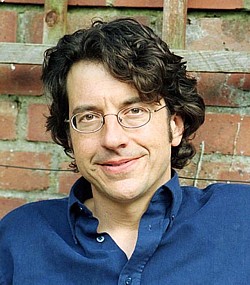
Fascinating presentation by George Monbiot.

I have long been a fan of George Monbiot as evidenced by a number of posts on Learning from Dogs from the said gentleman.  The last one was The Great Unmentionable, and before that DDT all over again?

George Monbiot is a man of passion about the planet we all live on and securing a sustainable future for us all.

So settle down comfortably for 15 minutes and listen to him.  You will understand both his passion and the vital message he offers us.

Published on Sep 9, 2013

Wolves were once native to the US’ Yellowstone National Park — until hunting wiped them out. But when, in 1995, the wolves began to come back (thanks to an aggressive management program), something interesting happened: the rest of the park began to find a new, more healthful balance. In a bold thought experiment, George Monbiot imagines a wilder world in which humans work to restore the complex, lost natural food chains that once surrounded us.

If you would like more of Mr. Monbiot’s writings, then here’s his website.

Just one in trillions!

The immensity of the universe and what it means for Planet Earth.

Jean and I have been watching the astounding BBC Series Wonders of Life presented by Professor Brian Cox.  Here’s the BBC trailer:

and there are more clips from the programmes on the relevant part of the BBC website.  There is so much about the series that is breath-taking.  So much that reminds one of what a beautiful and fragile planet we live on.  Quite rightly, the series received great reviews.  Here, for example, is a little of what the UK Daily Telegraph newspaper wrote:

Wonders of Life, BBC Two, review

Sarah Crompton reviews the first episode of Brian Cox’s latest series, Wonders of Life (BBC Two).

By 

10:00PM GMT 27 Jan 2013

When it comes to presenting styles, Professor Brian Cox is hard to keep still. There isn’t a beach he won’t feel compelled to stroll on, a mountain he won’t climb, or a river he won’t jump into. And what does he carry in that bag?

Once you got beyond these irritating stylistic tropes, however, Wonders of Life (BBC Two) was Cox at his absolute best, using his natural enthusiasm to communicate complicated ideas in very simple ways. He decided, for example, to show us his own DNA by spitting in a test tube – and missed.

“A physicist doing an experiment,” he giggled, with unforced charm. But when he actually succeeded, those little strands of white that you suddenly see brought everything he subsequently said to life.

He was brilliant at explaining his thesis, which was actually about the second law of thermodynamics, so not that much of a doddle to grasp. If I’ve got it right, what Cox thinks is that life itself may have been the inevitable consequence of the laws of physics and can be explained in the same terms as we explain “the falling of the rain and the shining of the stars”.

Sarah rounds off her review, thus:

The programme’s sophisticated use of graphics, and Cox’s patient repetition of his conclusions, all added to the sensation that this is a series that is actually going to tell you something. For the BBC to unveil both this and The Story of Music over a single weekend reveals a pretty impressive commitment to public service broadcasting. Long may it last.

One of the clear messages that comes from the program is the fact that our universe and the formation of life are intimately connected.  That the ‘big bang’ some 3.2 billion years ago, the huge interstellar gas clouds, the formation of the carbon atom and the subsequent long-chained molecules, the collapse of those gas clouds to form suns and planets, the start of life, evolution through natural selection to ever more complex life forms, and on and on and on were and are inevitable.  The science is clear. There is nothing mystical about it.

Yes, of course, anyone with half-an-ounce of sensitivity will be in awe of it all; the power and beauty of nature and of the natural world.

But here’s the rub.

As another BBC television programme explained, the universe is bigger than beyond imagination.  That was from the BBC Horizon broadcast of August, 2012: How Big is the Universe?  Here’s the trailer for that programme.

Stay with me a little longer!  Just look at the following image.

The Andromeda galaxy.

This image of the Andromeda galaxy, taken in infrared and X-ray, consists of over a trillion stars.

The detailed Spitzer Space Telescope view above features infrared light from dust (red) and old stars (blue) in Andromeda, a massive spiral galaxy a mere 2.5 million light-years away. In fact, with over twice the diameter of our own Milky Way, Andromeda is the largest nearby galaxy. Andromeda’s population of bright young stars define its sweeping spiral arms in visible light images, but here the infrared view clearly follows the lumpy dust lanes heated by the young stars as they wind even closer to the galaxy’s core. Constructed to explore Andromeda’s infrared brightness and stellar populations, the full mosaic image is composed of about 3,000 individual frames. Two smaller companion galaxies, NGC 205 (below) and M32 (above) are also included in the combined fields. The data confirm that Andromeda (aka M31) houses around 1 trillion stars, compared to 4 hundred billion for the Milky Way.

Please stay with me for a few more minutes.  Keeping the Andromeda galaxy in mind, now read this:

March 29, 2013

An ‘Infinity of Dwarfs’ –A Visible Universe of 7 Trillion Dwarf Galaxies

ESA astronomers say that for every ten far galaxies observed, a hundred go undetected.

Astronomers estimate that there are between 100 billion and 200 billion galaxies in the known universe. A single galaxy such as the Milky Way contain upwards of 200 billion normal stars. About 75 percent of all stars in the Milky Way are less than half as massive as our Sun. In the universe at large, the majority of galaxies are classified as dwarfs, each with less than a few hundred million stars. The image above is a computer simulation of a colliding dwarf galaxy triggering the formation of the Milky Ways spiral arms.

The largest project ever undertaken to map out the Universe in three dimensions using ESO telescopes has reached the halfway stage. An international team of astronomers has used the VIMOS instrument on the ESO Very Large Telescope to measure the distances to 55,000 galaxies as part of the VIPERS survey (VIMOS Public Extragalactic Redshift Survey). This has already allowed them to create a remarkable three-dimensional view of how galaxies were distributed in space in the younger Universe.This reveals the complex web of the large-scale structure of the Universe in great detail. The light of each galaxy is spread out into its component colours within VIMOS. Follow up analysis then allows astronomers to work out how fast the galaxy appears to move away from us — its redshift. This in turn reveals its distance and, when combined with its position on the sky, its location in the Universe.

Wow!

Millions of galaxies, trillions of suns, inconceivable numbers of planets.

Please pause and let the numbers sink in.

Now back to that Wonders of Life BBC series, during which Professor Brian Cox, said, “that it is inconceivable that there isn’t life elsewhere, that life is not present on countless other planets circling countless other suns …“.

In other words, if mankind is so intent on ‘fouling our nest’ on this most beautiful of planets, so what!

In the bigger scheme of things, it matters not.  Find that tough?  Then go and hug a dog and enjoy the moment.  For tomorrow may never come.