Depending on just where in the world you are, the New Year of 2014 is anything from a few to twenty-four hours away. How that year turns out will, to a very great extent, depend on millions and millions of behaviours. In other words, the behavioural choices each of us makes. Because, as millions of us already understand, our world on this, our only, Planet is facing changes potentially beyond our imagination. Caring for our Planet and all of life upon it is meaningless without those behavioural choices being the right ones for our Planet.
A couple of days ago, I read the following on Facebook. It seemed an appropriate tale for the start of 2014.
ooOOoo
Now what?
One day a farmer’s donkey fell down into a well. The animal cried piteously for hours as the farmer tried to figure out what to do. Finally, he decided the animal was old and the well needed to be covered up anyway; it just wasn’t worth it to retrieve the donkey.
He invited all his neighbors to come over and help him. They all grabbed a shovel and began to shovel dirt into the well. At first, the donkey realized what was happening and cried horribly. Then, to everyone’s amazement he quieted down.
A few shovel loads later, the farmer finally looked down the well. He was astonished at what he saw. With each shovel of dirt that hit his back, the donkey was doing something amazing. He would shake it off and take a step up.
As the farmer’s neighbors continued to shovel dirt on top of the animal, he would shake it off and take a step up. Pretty soon, everyone was amazed as the donkey stepped up over the edge of the well and happily trotted off!
MORAL :
Life is going to shovel dirt on you, all kinds of dirt. The trick to getting out of the well is to shake it off and take a step up. Each of our troubles is a steppingstone. We can get out of the deepest wells just by not stopping, never giving up! Shake it off and take a step up.
Remember the five simple rules to be happy:
Free your heart from hatred – Forgive.
Free your mind from worries – Most never happens.
Live simply and appreciate what you have.
Give more.
Expect less from people but more from yourself.
You have two choices … smile and close this page, or pass this along to someone else to share the lesson.
Shakespeare wrote The Winter’s Tale in 1623. The title came to my mind following another tale written slightly more recently; just five days ago to be exact.
It’s a story published by George Monbiot that has a wonderful shape. When I read it on Christmas Eve it seemed yet another story that Learning from Dogs readers would enjoy. So, as ever, grateful for Mr. Monbiot’s permission to republish it. His story is called Unearthed.
ooOOoo
Unearthed
December 23, 2013
A winter’s tale of guns, gold and greed.
By George Monbiot, published in the Guardian 24th December 2013.
Perhaps I should have been more careful. Last year I decided that every Christmas I would tell a winter’s tale or two(1). Through a long history of doing stupid things, I’ve accumulated a stock of ripping yarns. But I failed to explain myself. Some people interpreted the tale I told last Christmas as making a political point about Travellers I had no intention of suggesting; a point that is in fact the opposite of what I believe(2). So please read what follows as a story and no more: true to the best of my knowledge and memory but without a polemical purpose.
I was told this tale by a gold prospector in the garimpos of Roraima: the illegal mines exacavated among the river gravels in the forests of northern Brazil. He and his friends swore it was true. Though parts of the story must have been filled in later, in the light of what I had seen I found it easy to believe.
To say that the mines were lawless is not quite correct. They stood outside the laws of the state, but had established their own codes, which were informed by power and honour and greed and lust. Every week, thieves were taken into the forest to be shot. Duels were fought on the airstrips, in which men took ten paces, turned and fired: the miners circulated Wild West comics and acted out scenes that might once have been mythical, but there became horribly real.
To illustrate the point, before we get to the tale itself: one evening João, a remarkable man from the north-east of Brazil, who, after leaving home at 14 then spending ten years crossing and recrossing the Amazon on foot, had found work as a minder for two prostitutes, took me and his charges to a bar at the end of the airstrip village in which I was staying. The bar and the strip of dirt were owned by Zé, a man who spent some of his vast earnings on causing trouble: roaming around with his band of pistoleiros, starting fights and roughing people up. Zé, in whose house I was staying (by his choice, not mine) was said to have killed five men, starting with his business partner: by this means he had acquired control of the airstrip, and the extortionate fees for landing and leaving.
The bar was a flimsy shack in which a ghetto blaster was turned up so high that you could scarcely hear the music. Ragged men swayed and lurched and sprawled across the more sober prostitutes. On every table there was a bottle or two of white rum and a revolver. The men who had stayed in their seats drummed their fingers nervously on the tabletops, halfway between their drinks and their guns. The door was shoved open, and Zé and his thugs walked in.
His was at all times an arresting presence: charming, mercurial and terrifying. A machete scar ran from one cheek, over his nose and across the other cheek. He wore a sawn-off denim jacket and two revolvers on his belt. He opened his arms and announced, in a voice loud enough to carry above the music, that he would buy drinks for everyone. Zé moved through the bar, slapping backs and shaking hands, flashing his gold teeth. João’s eyes darted around, watching people’s hands. Bottles of cachaça were passed down from the bar.
Suddenly João shoved me so hard that I almost fell off my chair. He grabbed my arm, managing at the same time to seize the two prostitutes, and propelled us towards the door. As we hurtled out of the bar it erupted in gunfire. Amazingly, only one man was killed: he was dragged onto the airstrip with a hole the size of an apple in his chest. He was one of an estimated 1,700 people murdered, in a community of 40,000, in just six months.
So here’s the story. Two men established a small stake in the mines, in a remote valley some distance from the nearest airstrip. They cut down the trees and began to excavate. They found the digging and hosing and sifting of the gravel exceedingly hard and, though they had discovered very little, they decided to hire two other men to do it for them. They agreed to split any findings equally with the workers. The two hired men dug for four months without success: with high pressure hoses they scoured great pits into which the trees collapsed; they turned the clear waters of the forest stream they excavated red with clay and tailings; they winnowed the gravel through meshed boxes; they dissolved the residues in mercury and burnt it off; but they produced almost nothing. Then they hit one of the richest deposits ever discovered in Roraima: in one day they extracted four kilos.
If you find a lot of gold in the garimpos you keep quiet – very quiet. A single shout of triumph can amount to suicide. You gather it up, hide it in your bag and explain to anyone who asks on your way out that months of work have brought you nothing but disease and misery. But first it must be divided.
The two men who owned the stake began to comprehend, for the first time, the implications of the deal they had done. “We risked our lives to establish this stake. We spent every cent we had – and plenty we didn’t – travelling here, buying the equipment and the diesel, hacking out a clearing in the forest, hiring these men. And now we have to split the gold equally with people who are no more than manual labourers, who would normally be paid a few dollars a day.” They told the two workers that they wanted a special meal that night, and sent them to the nearest airstrip to buy the ingredients.
As the two workers walked they began to ruminate. “We’ve nearly killed ourselves in that pit. We’ve been up before dawn every day and have worked until dusk. We’ve had malaria, foot rot, screw worm, sunstroke, while those two bastards have done nothing but lie in their hammocks shouting instructions. Now we’re expected to give them an equal share of the gold that we and we alone found.” When they reached the store, they bought cachaça, rice, beans, a packet of seasoning and a box of rat poison. They mixed the poison into the seasoning and set off back to the camp. Before they reached it, they were ambushed by the two owners and shot. The owners then picked up the bags and went back to the camp to celebrate over the first hot dinner they had had in weeks.
Some time later a party of men moving through the forest to look for new stakes walked into the camp. They found two skeletons over which vines were already beginning to creep. And four kilos of gold.
Lovely item from Bob Derham who, as an airline Captain of many years, is clearly qualified to present this.
Health & Safety and Equality Considerations for Christmas Songs
Jingle Bells
Dashing through the snow
In a one horse open sleigh
O’er the fields we go
Laughing all the way
A risk assessment must be submitted before an open sleigh is considered safe for members of the public to travel on. The risk assessment must also consider whether it is appropriate to use only one horse for such a venture, particularly if passengers are of larger proportions. Please note, permission must be gained from landowners before entering their fields. To avoid offending those not participating in celebrations, we would request that laughter is moderate only and not loud enough to be considered a noise nuisance.
While Shepherds Watched
While shepherds watched
Their flocks by night
All seated on the ground
The angel of the Lord came down
And glory shone around
The union of Shepherds has complained that it breaches health and safety regulations to insist that shepherds watch their flocks without appropriate seating arrangements being provided, therefore benches, stools and orthopaedic chairs are now available. Shepherds have also requested that due to the inclement weather conditions at this time of year that they should watch their flocks via CCTV cameras from centrally heated shepherd observation huts.
Please note, the angel of the lord is reminded that before shining his / her glory all around she / he must ascertain that all shepherds have been issued with glasses capable of filtering out the harmful effects of UVA, UVB and Glory.
Rudolph the red nosed reindeer
Rudolph, the red-nosed reindeer
had a very shiny nose.
And if you ever saw him,
you would even say it glows.
You are advised that under the Equal Opportunities for All policy, it is inappropriate for persons to make comment with regard to the ruddiness of any part of Mr. R. Reindeer. Further to this, exclusion of Mr R Reindeer from the Reindeer Games will be considered discriminatory and disciplinary action will be taken against those found guilty of this offence. A full investigation will be implemented and sanctions – including suspension on full pay – will be considered whilst this investigation takes place.
Little Donkey
Little donkey, little donkey on the dusty road
Got to keep on plodding onwards with your precious load
The RSPCA have issued strict guidelines with regard to how heavy a load that a donkey of small stature is permitted to carry, also included in the guidelines is guidance regarding how often to feed the donkey and how many rest breaks are required over a four hour plodding period. Please note that due to the increased risk of pollution from the dusty road, Mary and Joseph are required to wear face masks to prevent inhalation of any airborne particles. The donkey has expressed his discomfort at being labelled “little” and would prefer just to be simply referred to as Mr. Donkey. To comment upon his height or lack thereof may be considered an infringement of his equine rights.
We Three Kings
We three kings of Orient are
Bearing gifts we traverse afar
Field and fountain, moor and mountain
Following yonder star
Whilst the gift of gold is still considered acceptable – as it may be redeemed at a later date through such organisations as ‘cash for gold’ etc, gifts of frankincense and myrrh are not appropriate due to the potential risk of oils and fragrances causing allergic reactions. A suggested gift alternative would be to make a donation to a worthy cause in the recipients name or perhaps give a gift voucher.
We would not advise that the traversing kings rely on navigation by stars in order to reach their destinations and suggest the use of RAC route finder or satellite navigation, which will provide the quickest route and advice regarding fuel consumption. Please note as per the guidelines from the RSPCA for Mr Donkey, the camels carrying the three kings of Orient will require regular food and rest breaks. Face masks for the three kings are also advisable due to the likelihood of dust from the camels hooves.
The Rocking Song
Little Jesus, sweetly sleep, do not stir;
We will lend a coat of fur,
We will rock you, rock you, rock you,
We will rock you, rock you, rock you:
Fur is no longer appropriate wear for small infants, both due to risk of allergy to animal fur, and for ethical reasons. Therefore faux fur, a nice cellular blanket or perhaps micro-fleece material should be considered a suitable alternative.
Please note, only persons who have been subject to a Criminal Records Bureau check and have enhanced clearance will be permitted to rock baby Jesus. Persons must carry their CRB disclosure with them at all times and be prepared to provide three forms of identification before rocking commences.
I am indebted to Per Kurowski who yesterday sent me an email about the atrocious recent act in North Korea. Per writes the blog A view from the Radical Middle and has been a good friend of Learning from Dogs.
Per’s email read:
Lowly opinions on dogs
Paul
With respect to the execution of Jang Song Thaek the North Korea government issued a statement calling him “Despicable human scum who was worse than a dog”… and I just felt you could have a real serious issue with that.
Merry Christmas
Per
My reply to Per included, “I did hear about the statement and your thought also crossed my mind, then something came along and I forgot to do anything about it. Will be corrected in a post coming out tomorrow.”
Per’s email included a link to a Financial Times article that is not visible unless one registers with the FT. However the relevant section reads thus:
Jang’s summary execution – reported by state media on Friday – marked a spectacular demise for a man seen until recently as the most powerful adviser to Kim Jong Un. It also raised questions about the potential for further instability in the court of the world’s youngest national leader.
Describing him as “despicable human scum”, state media said Jang had been put to death immediately after his conviction for treason by a military tribunal, where he confessed to having plotted a coup against Mr Kim.
It is an elementary obligation of a human being to repay trust with sense of obligation and benevolence with loyalty.
However, despicable human scum Jang, who was worse than a dog, perpetrated thrice-cursed acts of treachery in betrayal of such profound trust and warmest paternal love shown by the party and the leader for him.
Frankly, if one cogitates about just a few of the qualities of dogs: integrity, loyalty, unconditional love, trust, openness, forgiveness, affection – then this world would be one hell of a better place to live for all humans if only we learnt to live like dogs.
But on this Saturday in November it really is a fish story, or so I thought.
Earlier in the month, I received an e-mail from Dan Gomez. It told of this tale from Grand Lake St. Marys:
A guy who lives at Lake Saint Mary’s (60 miles north of Dayton, OH ) saw a ball bouncing around kind of strange in the lake and went to investigate.
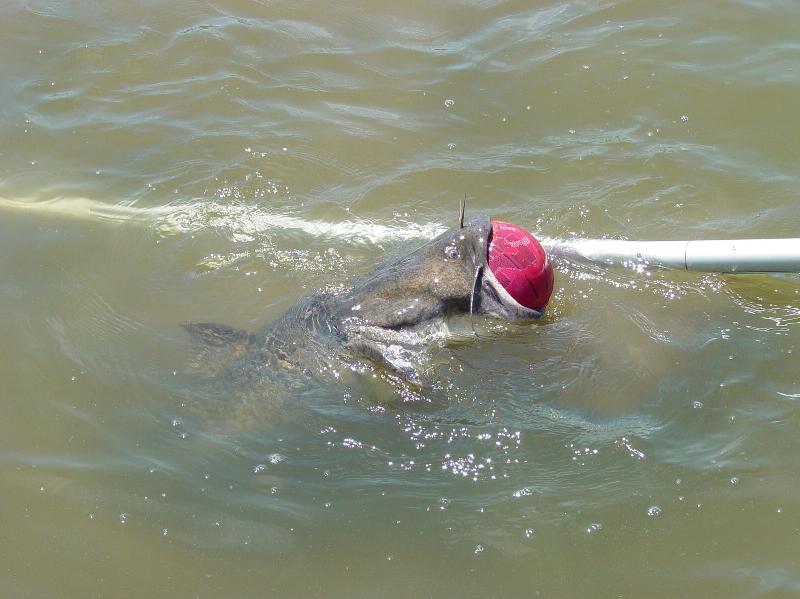
It turned out to be a flathead catfish that had apparently tried to swallow a basketball which became stuck in its mouth!!
The fish was totally exhausted from trying to dive, but unable to, because the ball would always bring him back up to the surface.
The guy tried numerous times to get the ball out, but was unsuccessful. He finally had his wife cut the ball in order to deflate it and release the hungry catfish.
You probably wouldn’t have believed this, if you hadn’t seen the following pictures:
oooo
oooo
oooo
oooo
oooo
Be kinder than necessary because everyone bites off more than they can chew sometime in life…
oooOOOooo
I loved the story but then wanted to know: was it true?
Sadly, the story is true but the location is false. Snopes.com researched this back in 2005. Hoax-Slayer.com wrote about it in 2007 after it “went viral”.
The true story originated in the Whichita (Kansas) Eagle on May 30, 2004. The man in the photo turns out to be Bill Driver, a fisherman at Sandalwood Lake who discovered the catfish with a taste for hardwood glory.
Two wonderful lessons to be learned from both the story and the story behind the story!
Don’t believe everything you read on the Internet and there’s always something fishy about a fisherman’s tale.
Today is our first anniversary of living in Oregon.
In many ways, it’s difficult to comprehend that we have now lived in our house a few miles from Merlin, OR, for a full year.
There are so many different, wonderful emotions associated with our move from Arizona to Oregon, of moving into a property quite unlike anything that Jean and I have ever lived in before, of seeing our dogs so happy with their surroundings, of being immersed in Nature, and so much more.
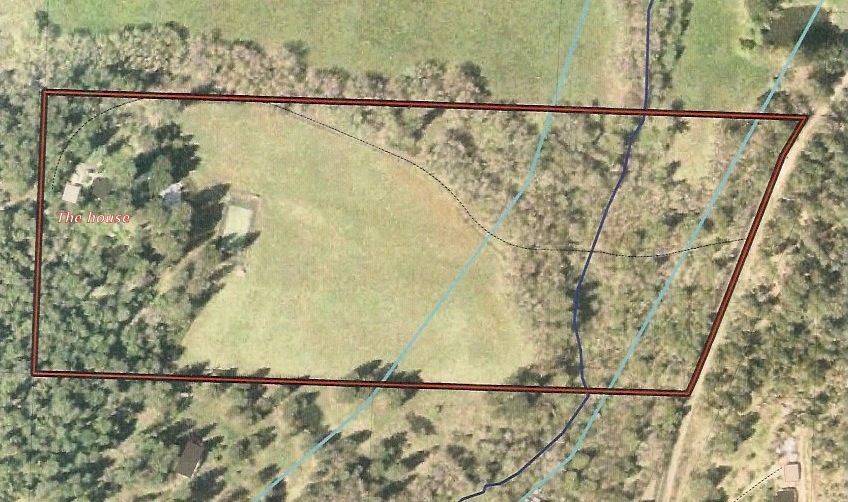
But rather than waffle on about everything in general and nothing in particular, I just want to write about the several acres of grassland that slope down from our house towards Bummer Creek, flowing North-South through the Eastern part of the property.
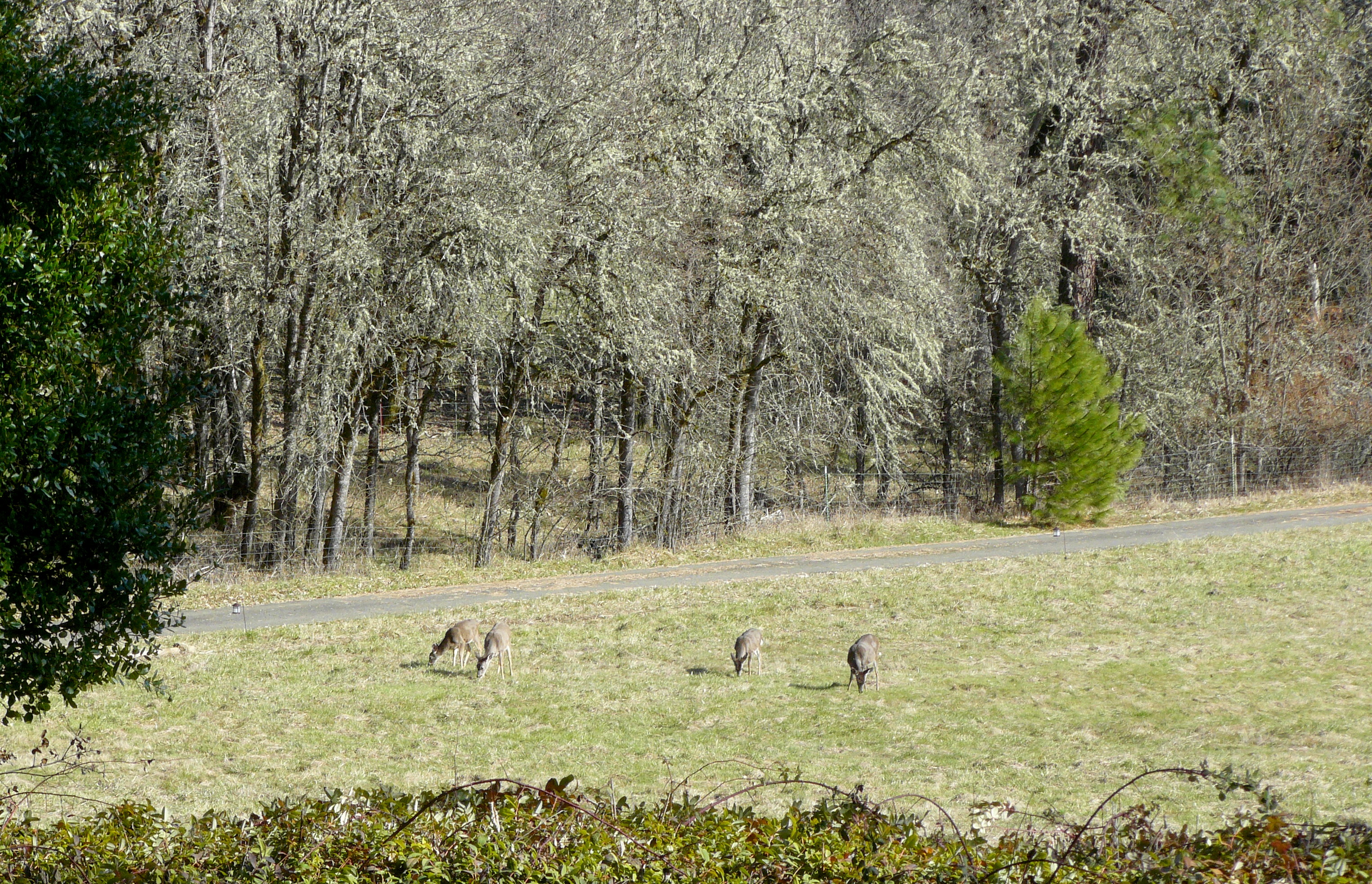
Wild deer feeding in the North-West corner of about 5 acres of our grassland.
Having mown the grassland a number of times in the Spring musing that there must be better ways to spend your time, a few weeks ago we came across an article about not mowing lawns. It was on the Mother Nature Network website and here’s how the article started.
Get off your grass and create an edible lawn
What would happen if you stopped watering, fertilizing, pesticiding and mowing your lawn?
Americans currently spend more than $30 billion, millions of gallons of gasoline, and countless hours to maintain the dream of the well-kept 31 million acres of lawns. An estimated 67 million pounds of herbicides, fungicides and insecticides are applied around homes and gardens yearly. Commercial areas such as parks, schools, playing fields, cemeteries, industrial, commercial and government landscapes, apply another 165 million pounds.
Lawn grasses are not native to the North American continent. A century ago, people would actually pull the grass out of their lawns to make room for the more useful weeds that were often incorporated into the family salad or herbal tea. It was the British aristocracy in the 1860s and ’70s, to show off their affluence, that encouraged the trend of weed-free lawns, indicating one had no need of the more common, yet useful plants. Homeowners were encouraged to cultivate lawns that would serve as examples to passers-by. These types of lawns also lent themselves to the popular lawn sports, croquet and lawn tennis. From the 1880s through 1920s in America, front lawns ceased to produce fodder for animals, and garden space was less cultivated, promoting canned food as the “wholesome choice.” Cars replaced the family horse and chemical fertilizers replaced manure.
It has been estimated that about 30 percent of our nation’s water supply goes to water lawns. In Dallas, Texas, watering lawns in the summer uses as much as 60 percent of the city water’s supply.
Next, a newsletter from The Xerces Society mentioned bee feed wildflower seed mixes from a company called Sunmark Seeds in Portland, OR. A call to them quickly produced the answer about what we could sow to help our local bees.
Hi Paul:
Upon further searching I did find 2 mixes that might fit what you are looking for. They are attached. The Bee Feed Mixture would be $36 per lb. The Honey Bee Flower Mixture would be $38 per lb. The price is a little higher but you would need a lot less. It is suggested 6-12 lbs per acre. You can still add the clover at $5 per lb and you should add 1 oz per lb of wildflower seed. There is still the option of the Knee High Low Profile mix which would be a little less at $30 per lb but the seeding rate is higher at 8-16 lbs per acre.
I have attached a spec sheet on all three mixes. Please let me know if you have any further questions.
Decision made. Three pounds of Bee Feed Mix to sow on a half-acre area as a test before we do all five acres next Spring.
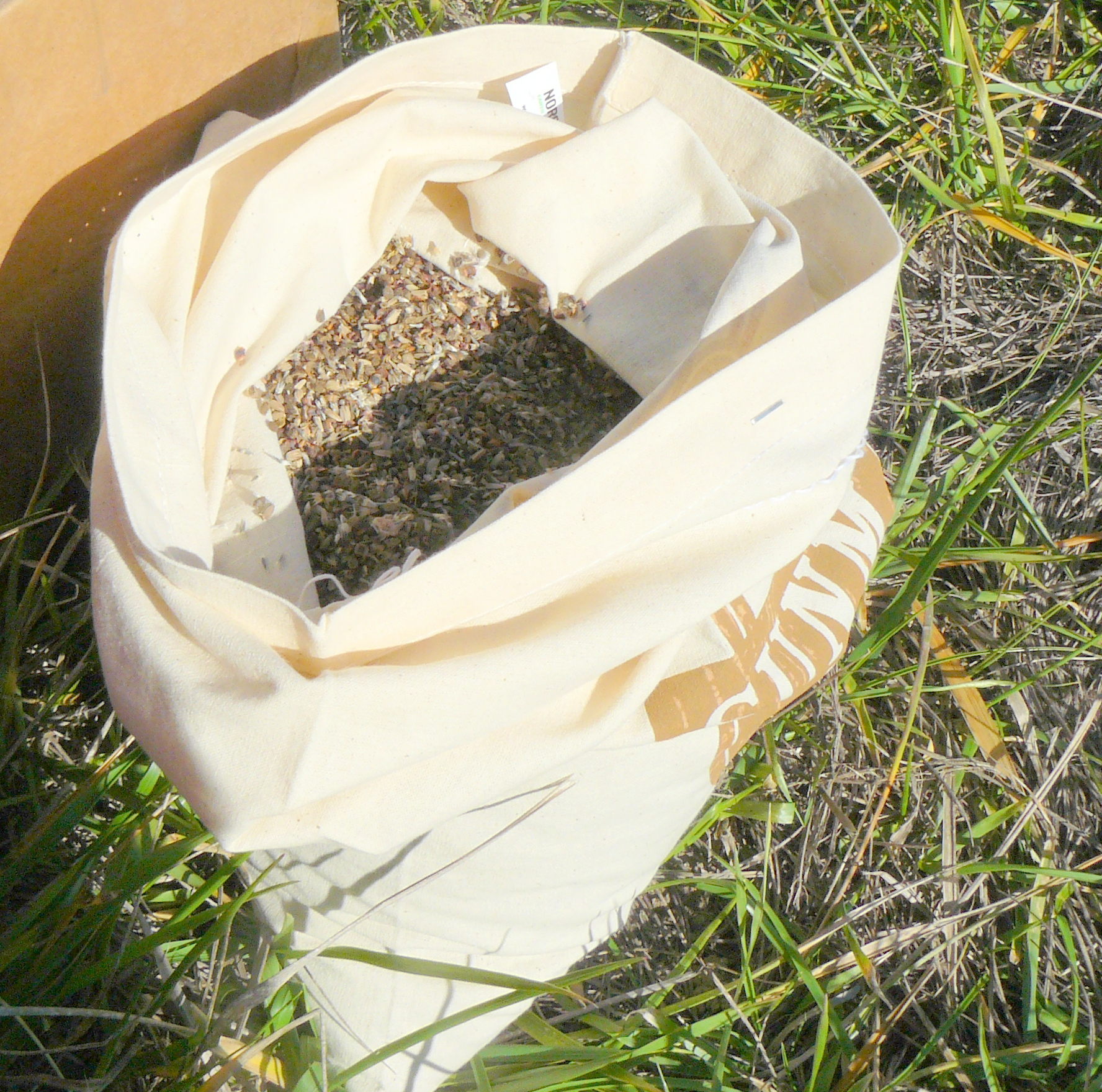
Thus not so much later a box arrived with our Bee Feed Mix and the next afternoon saw Jean and me marking out the test area and scattering the seed.
3 lbs of wild flower seed for next Spring’s bees!
oooo
Hand-scattering the seeds with Dhalia keeping an eye on things.
oooo
It’s been an amazing year with plenty of challenges as we learnt to be rural people; yet another thing the dogs were able to teach us! However, the joy of living in such beautiful surroundings will last for ever. And more or less picking up on the theme for the week, the sharing, caring community of neighbours around us doubles that joy.
Jean and I consider ourselves two very lucky people. And no more mowing grassland! 🙂
My post last Monday, The lure of patterns, appears to have resonated far and wide. In the sense of many echoes reinforcing the perilous nature of our present times and the desperately uncertain decades ahead. Tomorrow I shall be writing specifically about those echoes.
Those echoes, as I chose to call them, were kicked off by a recent item on the blog Economic Populist. The item was called Maps of Economic Disaster and had some sickening information. Such as:
Today 15% of Americans live in poverty. Below is a county map showing the previous year’s poverty rate and we see once again the South has high concentrations.
People are living on the edge. People living in liquid asset poverty is a whopping 43.9%. This means 132.1 million people lack the savings to cover basic expenses for three months if they lose their job, have a medical emergency or some other sort of crisis. The below map** breaks down that percentage state by state. Pretty much half the country is living on the edge, paycheck to paycheck.
** I’ve not included that map but it may be seen here. However, I did want to republish the closing map.
Finally, the next map shows how income inequality has grown in United States over time. The gini index is a measure of income inequality, the higher then index gets, the worse income inequality is. If there is ever a map which shows the the destruction of the U.S. middle class, it is this one.
[N.B.The following map is an automated GIF so just left-click on it to see the sequence. That sequence is essentially a coloured graphical image of each year, from 1977 through to 2012. Don’t struggle with it. All you have to note are the changing colours. More colours towards the green end of the spectrum indicate a worsening gini index, i.e. a worsening measure of income inequality. ]
America is clearly in dire straights and the above maps it all out. Why then has this government, this Congress not put wages and jobs as jobs #1 is a good question. Why America hasn’t outright revolted, demanding this government do so is a better one.
oooo
George Monbiot.
Let me now turn to George Monbiot, a British writer known for his environmental and political activism. WikiPedia describes Mr. Monbiot, in part, as:
Here are some of the things I love: my family and friends, salt marshes, arguments, chalk streams, Russian literature, kayaking among dolphins, diversity of all kinds, rockpools, heritage apples, woods, fishing, swimming in the sea, gazpacho, ponds and ditches, growing vegetables, insects, pruning, forgotten corners, fossils, goldfinches, etymology, Bill Hicks, ruins, Shakespeare, landscape history, palaeoecology, Gavin and Stacey and Father Ted.
Here are some of the things I try to fight: undemocratic power, corruption, deception of the public, environmental destruction, injustice, inequality and the misallocation of resources, waste, denial, the libertarianism which grants freedom to the powerful at the expense of the powerless, undisclosed interests, complacency.
Here is what I fear: other people’s cowardice.
There was a recent essay concerning the UK’s energy strategy posted by George Monbiot published in the Guardian on the 22nd October. It is also on his website.
The essay opens, thus [my emphasis]:
Fiscal Meltdown
The government is betting the farm on a nuclear technology that might soon look as hip as the traction engine.
Seven years ago, I collected all the available cost estimates for nuclear power. The US Nuclear Energy Institute suggested a penny a kilowatt hour. The Royal Academy of Engineering confidently predicted 2.3p. The British government announced that in 2020 the price would be between 3 and 4p. The New Economics Foundation guessed that it could be anywhere between 3.4 and 8.3p. 8.3 pence was so far beyond what anyone else forecast that I treated it as scarcely credible. It falls a penny short of the price now agreed by the British government.
Mr. Monbiot’s essay concludes:
An estimate endorsed by the chief scientific adviser at the government’s energy department suggests that, if integral fast reactors were deployed, the UK’s stockpile of nuclear waste could be used to generate enough low-carbon energy to meet all UK demand for 500 years. These reactors would keep recycling the waste until hardly any remained: solving three huge problems – energy supply, nuclear waste and climate change – at once. Thorium reactors use an element that’s already extracted in large quantities as an unwanted by-product of other mining industries. They recycle their own waste, leaving almost nothing behind.
To build a plant at Hinkley Point which will still require uranium mining and still produce nuclear waste in 2063 is to commit to 20th-Century technologies through most of the 21st. In 2011 GE Hitachi offered to build a fast reactor to start generating electricity from waste plutonium and (unlike the Hinkley developers) to carry the cost if the project failed. I phoned the government on Monday morning to ask what happened to this proposal. I’m still waiting for an answer.
That global race the prime minister keeps talking about? He plainly intends to lose.
NB. I edited out the links to a comprehensive set of references to make the essay easier to read off the screen. But all the facts reported by Mr. Monbiot may be seen here.
oooo
Just two more or less random pieces of writing that have graced my ‘in-box’. Nothing scientific about my selection; just the sense that they are representative of the reams and reams of articles, essays and reports coming in on an almost daily basis from right across the world showing an ever-increasing credibility gap between the peoples of many nations and those who purport to serve those peoples in their respective Governments.
Frankly, I can’t even imagine how or when we will ‘transition’ out of this present period. But one thing I am sure about. This schism between us, the people, and those who govern us is unsustainable!
“Minds together do not just bind together, they find together.”
My post last Monday, The lure of patterns, appears to have resonated far and wide. In the sense of many echoes reinforcing the perilous nature of our present times and the desperately uncertain decades ahead. Tomorrow I shall be writing specifically about those echoes.
Today, I wanted to spend a little time reflecting on dogs and communities! After all this blog is called Learning from Dogs!
In Monday’s post I opined that the future may well see a return to people re-evaluating and re-energising the benefits of local communities. Now when it comes to communities, there are no better examples than dogs and, so many thousands of years before dogs, grey wolves. These species have an incredibly strong social structure. I mean, of course, the pack. It’s a shame that the expression ‘pack of wolves’ or ‘pack of dogs’ has such misplaced negative connotations.
Before dogs were domesticated, as in when they first evolved from the grey wolf, they shared with wolves a natural pack size of around 50 animals. There was a very strong social cohesiveness within that pack yet a very ‘light’ status differential between those dogs having pack status and the mass of the pack group. Ditto with wolves.
In fact there were (still are) just three status roles: Mentor/Monitor/Nanny. Or has been described previously on this blog: Alpha/Beta/Omega roles. Even within the domesticated dog, thousands upon thousands of years later, those social instincts are alive and well. Many followers of Learning from Dogs will know that Pharaoh, him of the Home Page, now an elderly German Shepherd is a Monitor or Beta dog. I could write about this aspect of dogs for hours!
Pharaoh being a monitor for young Cleo.
So back to us funny old humans.
I closed last Monday’s post off with three predictions:
That the power of internet communications will allow more people, more quickly, to find their soul-mates wherever they are on this planet.
That the realisation of how dysfunctional many Governments are, of how truly poorly they serve the majorities of their citizens, will lead to mass rejections of these so-called Governments’ policies. Such rejections predominantly peaceful, as in taking the horse to water but being unable to make it drink.
That there will be a new form of localism. At two levels. Literally, people geographically close to each other creating 21st C. versions of local communities. Virtually, those local communities linking to other like-minded communities right across the world resulting in highly effective and innovative learning, accelerated common-sense, (call it wisdom if you wish), and extraordinarily efficient and sustainable ways of living on this planet.
Dear Paul: I like your predictions. They will play some role. But maybe somewhere in the bushes only. I think predictions of the future beyond the next 12 months are obsolete.
Jeremy remarked: (and do click the link and read some of Jeremy’s fantastic poetry)
I am hoping for a new localism. I see signs of this in the local food movement and a growing concern about factory farming, for one thing. I think people are really scrutinizing where their food comes from, where their medicines are made, and I think there also is a dawning awareness of how we are living on the backs of exploited third world workers (and poorly paid service workers here at home). I do see signs of these things permeating the consciousness of many people and leading them to want to become more “local.”
Your predictions are good, and I liked the one of communities from different parts of the world working with each other… that was creatively brilliant.
(Click on their names to see three wonderful blog sites, by the way.)
So my idea of a return to an era of localism, but a 21st C. version reflecting the way so many millions of us are connected electronically, wasn’t immediately rejected.
Patrice recently published a post called Devils In The Details. I mentioned in a comment to that post that I would be referring to it in this place. Patrice replied [my italics]:
Very good, Paul! No doubt you will bring more common sense to one more of these interesting collaborations you bring together! Internet debates! A long way from the paleolithique cave!… But still the same idea. Minds together do not just bind together, they find together.
I found that last sentence so powerful that it was used as the sub-heading to today’s post. Then Alexi Helligar commented:
The word consciousness, breaks down to con+scious+ness, which literally means together knowing or shared knowledge.
Adding in a subsequent comment:
In other words: Without society there is no consciousness. The sages of old knew this. Why has it been forgotten?
So right before my eyes (and yours!) we are seeing the power of ‘finding together‘.
Finally, just on the spur of the moment, I did a web search under an entry of ‘early caveman social structure’. Guess what! One of the top search returns was an essay by an Erik D. Kennedy under the title of On the Social Lives of Cavemen. From which jumped off the screen:
Human beings are no strangers to group living. Call it a family trait. Our closest animal relatives spend a good bulk of their time eating bugs off of their friends’ back. While I’m overjoyed we’re not social in that manner, I’m less pleased that we’re not social more to that degree. In study after study, having and spending time with close friends is consistently correlated with happiness and well-being. And yet, the last few decades in America have seen a remarkable decline in many things associated with being in a tight-knit social circle—things like family and household size, club participation, and number of close friends. Conversely, we’ve seen an increase in things associated with being alone—TV, commutes, and the internet, for example.
This trend is quite unhealthy. It’s no surprise that humans are social animals—but it may be surprising that we’re such social animals that merely joining a club halves your chance of death in the next year—or that living in a close-knit town of three-generation homes can almost singlehandedly keep you safe from heart disease.
My goodness me, this sharing idea may be core to a healthy society in ways that we need to return to. Erik’s essay goes on thus:
That particular case—of Roseto, Pennsylvania—is mentioned by Malcolm Gladwell in his book Outliers. In 1950’s Roseto, the incidence of heart disease in men over sixty-five was half the national average (and suicide, alcoholism, drug addiction, and serious crime were also basically unheard of[ii]). Bewildered doctors searched for solutions in genetics, diet, exercise, and geography, but finding nothing, reached the conclusion that it was the close-knit social life of the community that kept its residents so healthy. Dinners with grandma, friendly chats between neighbors, and a precocious level of civic involvement were the driving factors in the health of a town that nothing but old age could kill.
The happiness and health I’m describing are not, however, ingredients to a long-lost elixir of well-being. This sort of paleo social life occurs in cultures large and small all over the globe. America just happens to be an enormous exception (and the one that I live in). The whole reason Roseto was an outlier is because it was a town whose inhabitants more or less collectively moved from rural Italy to the middle of Pennsylvania over a few decades. This was basically an Italian village in the American countryside, and it stood out because Italy’s social culture was remarkable compared to America’s—and that was in the 1950’s. America’s social culture has only deteriorated even further since then. We’ve lost a lot, but my thesis is a positive one; we have as much to gain as ever.
So if wolves and dogs naturally settle into packs of 50 animals, what’s the optimum ‘pack’ size for humans? Dear Erik even offers that answer:
Along with that urban emigration came a shrink in residents per household and a widespread decline in community and organization engagement. This isolation has been taxing on our physical and mental health, and the reason has been clear from the beginning: it’s not good for man to be alone.
So we’ll spend more time with other people. Fine. But who should we spend our time with? What kind of groups should we hang out in? And how big of groups? The simple answer is: as long as you’re pretty close to the people you’re with, it hardly matters. Piles of research back up what is essentially obvious from everyday experience: that the more time you spend with people you trust, the better off you are. That’s not to discourage actively meeting new people, but seeing as though close friends push us towards health and happiness better than strangers, there does appear to be a limit on the number of people you can have in your “tribe”.
And that number is about 150, says anthropologist Robin Dunbar, who achieved anthropologist fame by drawing a graph plotting primates’ social group size as a function of their brain sizes. He inputted the average human brain size into his model, and lo and behold, the number 150 has been making a whirlwind tour of popular non-fiction books ever since. Beyond being the upper bound for both hunter-gatherer tribes and Paleolithic farming villages, it appears that everything from startup employee counts to online social networks show this number as a fairly consistent maximum for number of close social ties.
You really must read Erik’s essay in full; it really ‘spoke’ to me and maybe it will do the same for you.
So no other way to close than to say that of all the things we can learn from dogs, the power of sharing, of living a local community life, may just possibly be the difference between failure and survival of us humans.
Dogs and man should never be alone.
oooo
I’ll say it again! Dogs, and man, should never be alone!
Literally, as a long-case clock is tickled back to life.
We are experiencing a period of foggy mornings giving way to brilliantly clear and sunny afternoons.
Yesterday was no exception.
Looking out to the North-East with Mt. Sexton behind the mists.
oooo
Having walked some of the dogs around 9am it seemed a good idea to find a task indoors for the morning. How about sorting out the ‘grandfather’ clock, or long-case clock in proper speak!
Every since we came up from Arizona to settle here in Southern Oregon, now almost a year ago, that clock had not been running well. It’s nothing special in terms of its lineage but over many years of collecting and repairing clocks in my earlier days in Devon, UK, I’ve always had a soft spot for the long-case clock.
The project!
oooo
This particular clock, as seen in the above picture, is a real hotch-potch. The original face is nothing special and somewhere along the line a previous owner came across a more ‘antiquey’ face and screwed it over the original.
Possibly the original face?
oooo
Old over new!
oooo
Anyway, the first task was to even up the movement, again a real mess.
A long way from how this clock was originally built!
oooo
All this a long-winded way of saying that by the time the clock seemed to be running in a settled fashion it was coming up to 4pm and my creative juices for blog writing, such as they are, had evaporated.
Hence the clock story!
And in answer to those who might wonder why so much time and effort went into such a dreadful jumble of a clock, the one thing I adore about mechanical clocks is the sound of the ‘tick’ and the chimes.
There is no better sound than the steady tick of a long-case clock and those haunting chimes on the half-hour and on the hour.
The video below is a wonderful example of a real vintage clock!
This is a client’s beautiful longcase clock that I serviced not long ago. The clock is by J. Woolfenden – Royton and it dates to roughly 1785 (based on some research that was done on it).
In this video, you hear the clock striking 11 o’ clock on a nice original bell. The clock was running during testing, but it was not in beat (I had to fix the leveling later).
Somewhere in my aged brain cells is the memory of having heard that humans are great lovers of patterns. In other words, patterns are deemed to be very important for the progress and evolution of homo sapiens. Of course, it is not just humans who learn from patterns; I’m sure most of the animals who live around us are great pattern matchers. To support that proposition, anyone who has owned a dog or cat will have spotted how quickly they learn patterns. (As an aside, some months ago our puppy German Shepherd, Cleo, work me at around 4am because she needed to go outside for a ‘call of nature’. I now get woken every single night variously between 2am and 5am for Cleo’s benefit!)
The British mathematician G. H. Hardy who lived from the last quarter of the 19th Century well into the 20th Century, reputedly said (and I cheated and looked it up!):
A mathematician, like a painter or poet, is a maker of patterns. If his patterns are more permanent than theirs, it is because they are made with ideas.
So why has this post opened with the theme of patterns? Because, call it coincidence or what, within the last couple of weeks there have been three articles, each from very a different source, predicting that the present levels of inequality in society are both unsustainable and the beginning of the end.
Global wealth inequality: top 1% own 41%; top 10% own 86%; bottom half own just 1%
—–
Just 8.4% of all the 5bn adults in the world own 83.4% of all household wealth (that’s property and financial assets, like stocks, shares and cash in the bank). About 393 million people have net worth (that’s wealth after all debt is accounted for) of over $100,000, that’s 10% own 86% of all household wealth! But $100,000 may not seem that much, if you own a house in any G7 country without any mortgage. So many millions in the UK or the US are in the top 10% of global wealth holders. This shows just how little two-thirds of adults in the world have – under $10,000 of net wealth each and billions have nothing at all.
This is not annual income but just wealth – in other words, 3.2bn adults own virtually nothing at all. At the other end of the spectrum, just 32m people own $98trn in wealth or 41% of all household wealth or more than $1m each. And just 98,700 people with ‘ultra-high net worth’ have more than $50 million each and of these 33,900 are worth over $100 million each. Half of these super-rich live in the US.
Michael Robert’s essay closes:
All class societies have generated extremes of inequality in wealth and income. That is the point of a rich elite (whether feudal landlords, Asiatic warlords, Incan and Egyptian religious castes, Roman slave owners, etc) usurping control of the surplus produced by labour. But past class societies considered that normal and ‘god-given’. Capitalism on the other hand talks about free markets, equal exchange and equality of opportunity. But the reality is no different from previous class societies.
The uprisings in the Middle East, the unrest that is tearing apart nations such as the Ivory Coast, the bubbling discontent in Greece, Ireland and Britain and the labor disputes in states such as Wisconsin and Ohio presage the collapse of globalization. They presage a world where vital resources, including food and water, jobs and security, are becoming scarcer and harder to obtain. They presage growing misery for hundreds of millions of people who find themselves trapped in failed states, suffering escalating violence and crippling poverty. They presage increasingly draconian controls and force—take a look at what is being done to Pfc. Bradley Manning—used to protect the corporate elite who are orchestrating our demise.
We must embrace, and embrace rapidly, a radical new ethic of simplicity and rigorous protection of our ecosystem—especially the climate—or we will all be holding on to life by our fingertips. We must rebuild radical socialist movements that demand that the resources of the state and the nation provide for the welfare of all citizens and the heavy hand of state power be employed to prohibit the plunder by the corporate power elite. We must view the corporate capitalists who have seized control of our money, our food, our energy, our education, our press, our health care system and our governance as mortal enemies to be vanquished.
The PRI editor’s preamble to the Chris Hedges essay included a couple of videos that he recommended watching. One was a talk by Robert Reich: How Unequal Can America Get Before We Snap?
The other one was a recent TED Talk by Richard Wilkinson (his profile is here).
Mr. Wilkinson explains that for the majority of people there is an instinctive feeling that societies with huge income gaps and corresponding high levels of social inequality are somehow going wrong. He charts the hard data on such economic inequality and shows what gets worse when rich and poor are too far apart: ergo, the very real effects on health, lifespan, and even such basic values as trust.
Just 16 minutes long, it’s a very revealing talk. Do watch it.
oooo
The final, third piece of the pattern was me coming across an essay on the blog DeflationLand, not a blog I had come across before, on the same day that I saw the PRI article. This essay, published just two days before the PRI article, was about patterns; the patterns of the centuries. More specifically, how the characteristics of a century generally evolve to a new culture within the first 10 to 15 years of the following century. It was a most interesting proposition and, to my delight, I was given permission to republish that essay here on Learning from Dogs. So here it is.
oooOOOooo
Why I stopped worrying and learned to love the currency collapse
For the past 300 years, the historical pattern has been for the era marked by a century to continue into the following century by fourteen or fifteen years. Let me explain. Everyone knows that the 19th Century, its uprightness, its optimism and sense of purpose, the halcyon days of British Empire, came to an end with World War I, starting in 1914 and building to a nasty crescendo by 1916. The 20th Century had arrived, and it had some real horrors in store for us.
Germans before Kraftwerk
But if we return back another hundred years, we notice that the 18th Century ends in 1815 with the final defeat of Napoleon, that final project of the Enlightenment and of the French Revolution. With the Congress of Vienna in 1814-1815, we have a new Europe along the lines of Metternich’s plan, and the 19th Century at last is here.
“Sorry, guys. My bad.”
In 1713 and 1714, we have the Treaties of Utrecht, Baden, and Rastatt, bringing an end to the era of Spain as a major power, and the rise of the Habsburgs. Louis XIV dies in 1715, after reigning for 72 years. The Baroque period is over, and we are now firmly in the 18th Century.
War of Spanish Succession
We still live in the 20th Century. Nothing much significant has changed in our lives in the past twenty years. Symptoms of a deeper rot are appearing here and there, foreshadowing a larger crisis, but the crisis itself has not arrived yet. We still live in an era of Pax Americana, the old republic very much a strained and tired Empire now, with the U.S. Dollar as the world’s reserve currency.
That is going to change.
The next task for History is to dismantle the untenable structures and institutions put in place by late Modernity, which have been extended now as far as they can go. Our debt-based monetary system will collapse, our unbacked fiats will be worthless. The debts and unmeetable obligations will all default.
There are ironies and great contradictions as the former home and hope of Liberty becomes viciously unfree and increasingly despotic. Our leaders no longer govern, but try instead to rule us — they are less legitimate with each passing day, their laws corrupt or worse. They are nearly finished, and will be swept away with the tide.
Just as in 1914, the internationalist system will break down, dashing the hopes of the would-be first-world nations. We will probably have a pretty good war as well, or many local ones worldwide. These transitions tend to involve war.
Deflation first — it clears the way for the complete loss of faith and hyperinflation that will follow. The next big wave down in the financial markets is the battering ram. The U.S. national debt is about faith, so is quantitative easing, and so is the very idea of magical coins that could ever be “worth” a trillion dollars. When this faith breaks, in concert with loss of faith in perpetual growth and unlimited cheap energy, then things will move very, very quickly.
There is nothing any of us can do at this point, except navigate the rapids as well as possible, and to stay out of the way of a dying empire, which is still very dangerous in its death throes. We are actually very privileged to be alive and witnessing this next transition, to what we do not know just yet. But what an honor to live at this time, not in ignorance but with an existential resolve to come out of it alive and much the wiser.
Ass Americana.
oooOOOooo
** Chris Hedges is a Pulitzer Prize–winning author and former international correspondent for the New York Times. His latest book is The World As It Is: Dispatches on the Myth of Human Progress.
I am neither a scientist nor a historian; just someone who has lived in and observed the world for coming on for 60 years.
So you have to understand that my prediction is hardly worth the ‘paper I write upon’ (which certainly dates me!). But, undaunted, here are my predictions for the 21st Century:
That the power of internet communications will allow more people, more quickly, to find their soul-mates wherever they are on this planet.
That the realisation of how dysfunctional many Governments are, of how truly poorly they serve the majorities of their citizens, will lead to mass rejections of these so-called Governments’ policies. Such rejections predominantly peaceful, as in taking the horse to water but being unable to make it drink.
That there will be a new form of localism. At two levels. Literally, people geographically close to each other creating 21st C. versions of local communities. Virtually, those local communities linking to other like-minded communities right across the world resulting in highly effective and innovative learning, accelerated common-sense, (call it wisdom if you wish), and extraordinarily efficient and sustainable ways of living on this planet.