Category: Musings

More yawning!

This time from dogs

Two days ago, I wrote a post Empathy and bonding that revolved around some recent science about yawning in wolves.  The crux of the post was an essay in the Smithsonian by Helen Thompson. The article was called Yawning Spreads like a Plague in Wolves.

In my research for that post, I came across another Smithsonian article regarding the contagious nature of yawning in dogs.  I wanted to republish that here as a follow-up to the yawning in wolves piece.

ooOOoo

Dogs Yawn Contagiously Too

Like humans, dogs are prone to yawning when they see someone else do it—and a new study shows that they yawn most frequently in response to their owner.

By Joseph Stromberg
smithsonian.com
August 7, 2013

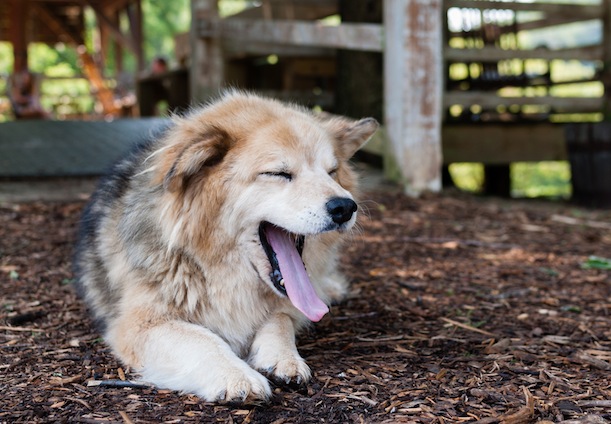
dog-1
New research shows that, like humans, dogs are prone to yawning when they see someone else do it—and they yawn most frequently in response to their owner. Image via Flickr user The Eggplant

Animals: they’re just like us. They have unique, individual personalities. They remember their friends after years apart.

And now, in one of the most groundbreaking scientific discoveries of the decade—and perhaps even the century—researchers from the University of Tokyo have discovered that, like humans, dogs yawn contagiously.

Okay, we kid. But in all seriousness, the finding does shed a bit of light on that most mysterious of behaviors, the yawn. Despite years of research, scientists still don’t understand why we do it in the first place. Most believe we yawn to help cool down when our brains are overheated. The fact that yawning is contagious in 60 to 70 percent of people, many argue, is a function of empathy, as people who score higher on empathy tests are more likely to experience contagious yawning.

In the new study, published today [Ed. August 7th, 2013] in PLOS ONE, the researchers found that more than half the dogs they tested yawned contagiously—and, most interesting, they were more likely to yawn after watching their owner yawn than seeing it done by an unfamiliar human. If empathy truly is at the heart of contagious yawning, these findings could suggest that canines, too, are capable of true empathy.

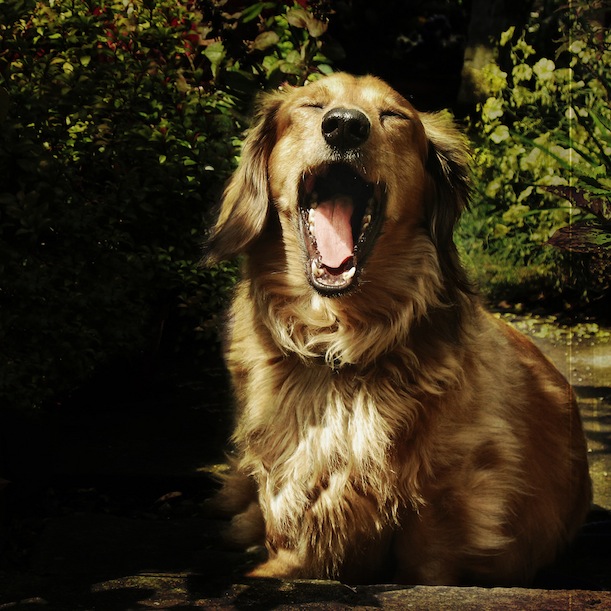
dsds
Image via Flickr user The hills are alive

This isn’t the first study to show that dogs yawn contagiously, but it is the first to get the dogs’ owners involved. The researchers visited the homes of 25 dogs from different breeds (ranging from golden retrievers to labs to chihuahuas) and had their owners sit in front of them, call their name, and then yawn. For a control, they also had their owners simply open and close their mouths, without a yawn’s characteristic jaw-stretching, deep inhalation or long sigh. As a comparison, they also had people that the dogs had never met before perform both actions. (Incidentally, the paper is vague on how they got the owners and strangers to yawn—although, as you might have discovered since starting this post, simply reading about yawning might have done the trick.)

In total, the 25 dogs yawned 22 times after seeing people yawn, and just 5 times after seeing people open and close their mouths. They were nearly three times more likely to yawn contagiously after seeing their owner yawn as compared to seeing a random person do it. This last finding, they say, provides further evidence for the role of empathy in yawning, as dogs are presumably more likely to empathize with their owners than another person.

Why would empathy be the explanation for why yawns are contagious? As social animals, humans often inadvertently copy the emotions and behaviors of those around them, whether it’s a smile or a frown.

Yawns, presumably, are no exception. And if the underlying function of yawning is to dissipate heat and cool the brain down, mimicking the yawns of others would make a lot of sense. “If I see a yawn, that might automatically cue an instinctual behavior that if so-and-so’s brain is heating up, that means I’m in close enough vicinity, I may need to regulate my neural processes too,” Steven Platek, a psychology professor at Georgia Gwinnett College, told my colleague Marina Koren in her recent post on the science of yawning.

Other work has found that chimpanzees yawn contagiously. That research, along with the new finding, suggests that to some extent, chimps and dogs operate based on the same sorts of social cues as we do.

ooOOoo

What more can I add!

Especially with a yawn coming up! (A younger version of me, you do understand!)

man-yawning

Empathy and bonding.

Who would have thought that yawning revealed so much more than one’s tonsils!

Alex Jones, he of the blog The Liberated Way, recently posted You need room to grow. On reading the post a section stood out for me:

The human eye needs the stimulation of sunlight and the outdoors to develop properly. The BBC [Ed: Massive rise in Asian eye damage] reports that a recent study of students in South Asian cities found 90% of the samples were short-sighted, a condition called myopia that needs glasses. Modern South Asian students spend a large part of their lives indoors studying or involved with electronic technology such as the internet. Young children in the UK are rapidly getting myopia as young as three because of being indoors and on computers for long periods of time according to the Daily Mail.

That got me thinking about both the ‘old’ and ‘new’ styles of social bonding.  In defence of our digital world, there is no question that social media programs (apps?) such as Facebook, Linked-In and Twitter are incredible means of communicating with people that one doesn’t know directly.  Even the funny old world of blogging delivers that. I would have stopped writing for Learning from Dogs years ago if it weren’t for the many ‘friends’ that have been made across the ‘blogosphere’!

But (and you knew there was a ‘but’ coming, didn’t you!), social intimacy, as in being able to rub shoulders with people, is the vital core to how we ‘wear’ the world around us.

That was brought home to me by a recent article on the Smithsonian website, an article that I am taking the liberty of republishing in this place. The article is about the contagious nature of yawning; not just for us humans but for wolves.

Note: there were many links to other content in the article making it almost impossible to replicate. So please go to the original to follow up those links.

ooOOoo

Yawning Spreads Like a Plague in Wolves

Evidence of contagious yawning in chimps, dogs and now wolves suggests that the behavior is linked to a mammalian sense of empathy

By Helen Thompson smithsonian.com
August 27, 2014

Chimps do it, birds do it, even you and I do it. Once you see someone yawn, you are compelled to do the same. Now it seems that wolves can be added to the list of animals known to spread yawns like a contagion.

Among humans, even thinking about yawning can trigger the reflex, leading some to suspect that catching a yawn is linked to our ability to empathize with other humans. For instance, contagious yawning activates the same parts of the brain that govern empathy and social know-how. And some studies have shown that humans with more fine-tuned social skills are more likely to catch a yawn.

Similarly, chimpanzees, baboons and bonobos often yawn when they see other members of their species yawning. Chimps (Pan troglodytes) can catch yawns from humans, even virtual ones, as seen in the video below. At least in primates, contagious yawning seems to require an emotional connection and may function as a demonstration of empathy. Beyond primates, though, the trends are less clear-cut. One study found evidence of contagious yawning in birds but didn’t connect it to empathy. A 2008 study showed that dogs (Canis lupus familiaris) could catch yawns from humans, and another showed that dogs were more likely to catch the yawn of a familiar human rather than a stranger. But efforts to see if dogs catch yawns from each other and to replicate the results with humans have so far had no luck.

Now a study published today in PLOS ONE reports the first evidence of contagious yawning in wolves (Canis lupus lupus). “We showed that the wolves were able to yawn contagiously, and this is affected by the emotional bond between individuals, which suggests that familiarity and social bonds matter in these animals the same way as it does in humans,” says study co-author Teresa Romero, who studies animal behavior at the University of Tokyo.

The prevalence of contagious yawning in primates and other mammals could give us some clues to the evolution of empathy—that’s in part what makes the phenomenon so interesting and so controversial. If dogs can catch yawns from humans, did they pick up the behavior because of domestication, or does the trait run deeper into evolutionary history?

The Tokyo team took a stab at those questions by looking at contagious yawning in dog’s closest relatives, wolves. For 254 hours over five months, they observed twelve wolves (six males and six females) at the Tama Zoological Park in Tokyo. They kept tabs on the who, what, when, where, how many and how long of every yawn, then separated out data for yawns in relaxed settings, to minimize the influence of external stimuli.

Next, they statistically analyzed the data and looked for trends. They found that wolves were much more likely to yawn in response to another’s yawn rather than not, which suggests that contagious yawning is at play.

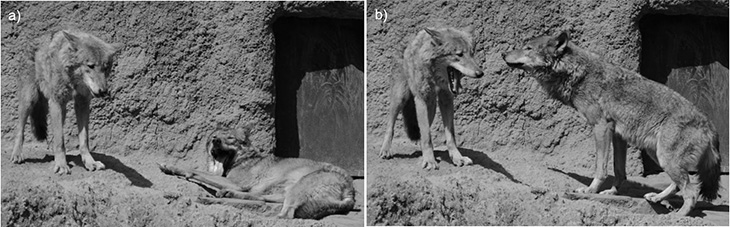
Smithyawning
In image A, an individual (right) yawned during a resting period, and a few seconds later, image B shows the subject (on the left) yawned contagiously. (Teresa Romero)

Wolves were more likely to catch the yawn if they were friends with the yawner. Females were also quicker on the yawn uptake when watching the yawns of those around them—possibly because they’re more attuned to social cues, but with such a small group it’s hard to say for sure.

The results seem to add to the case for empathy as the primary function of contagious yawning. “We have the strongest responses to our family, then our friends, then acquaintances, and so on and so forth,” says Matt Campbell, a psychologist at California State University, Channel Islands. “That contagious yawning works along the same social dimension supports the idea that the mechanism that allows us to copy the smiles, frowns and fear of others also allows us to copy their yawns.”

Empathy likely originated as an ancestral trait in mammals, and that’s why it emerges in such disparate species as wolves and humans. “More and more research is supporting this idea that basic forms of empathy are very ancient, and they are present in a wide number of species, at least in mammals,” says Romero. Elephants, for example, comfort their upset friends. Even rats exhibit a basic helping behavior toward other friendly rodents.

Why does contagious yawning between members of the same species show up in wolves and not dogs? The difference probably comes down to study design, not biology. “Most likely, dogs also catch yawns from [other dogs], as now shown for wolves,” says Elaine Madsen, a cognitive zoologist at Lund University in Sweden. Further studies might reveal the extent to which human interaction has affected present-day dogs’ susceptibility to catching another species’ yawns, she says.

It’s impossible to say what true function contagious yawning serves in wolves, but the researchers argue that such behavior could cultivate social bonds. “If an individual is not in sync with its group, it risks being left behind. That is not good,” says Campbell. Just watching wolves yawn can’t definitively prove that empathy drove the behavior, but it’s certainly compelling evidence that wolves might feel for their fellow lupines.

ooOOoo

Fascinating. As too is an article also on the Smithsonian website about dogs yawning.  Going to republish that in a few days.

However, this post was prompted by the reminder that there is no substitute for social bonding with others who we meet physically. That is why the Smithsonian essay seemed such an important reminder.  As was written (my emphasis):

Among humans, even thinking about yawning can trigger the reflex, leading some to suspect that catching a yawn is linked to our ability to empathize with other humans. For instance, contagious yawning activates the same parts of the brain that govern empathy and social know-how. And some studies have shown that humans with more fine-tuned social skills are more likely to catch a yawn.

Time for an afternoon nap!

The real you!

I am delighted to present the following guest post from Ruth Nina Welsh.

We seem to be on a bit of a roll in terms of seeking a better self-understanding.

Last Thursday I offered up some thoughts and reflections on meditation Quietening one’s self down and then the following day presented the film Inner worlds, Outer worlds, the wonderful film by Canadian film maker, musician and meditation teacher Daniel Schmidt. Daniel described his film “as the external reflection of his own adventures in meditation.” (And did you read the fascinating comments by ‘R’?)

Anyway, to today.

I forget how Ruth and I made contact with each other but that’s immaterial to today’s guest post. What is material is that we did make contact and through Ruth’s website I became aware of her talents. In her own words:

BE YOUR OWN COUNSELLOR & COACH shares psychology, memoirs and creativity to help and inspire you to live a happier, more fulfilling and purposeful life.

****

WHO AM I? – I’m a freelance writer, specialising in lifestyle, wellbeing and self-help; a former counsellor & coach and an erstwhile musician. I have a diverse educational Ruth-Profile-Photobackground – with degrees in arts and law – but psychology is my passion. You can find out more about me on my personal site.

  • As a singer-songwriter, I released my debut acoustic album – As I Breathe – in 2000.
  • As a counsellor and coach, I was in private practice from 2008-2011.
  • As a freelancer in the publishing field, I’ve been involved as an editor, formatter, copy-editor, proofreader and I’ve also managed book projects and manuscript submissions.
  • Now, as a freelance writer, I write articles and guest posts, and continue to build this free online self-help resource.

So back to the connection between Ruth and me.

A couple of weeks ago, Ruth asked me if I would like to publish an essay from her.

I read it and replied without hesitation that I would be honoured to publish said essay.

Thus with no further ado here it is. (And do read to the end to be informed about a very generous free offer from Ruth.)

ooOOoo

The Struggle To Be Authentic

Introduction

Of all the challenges we face in life, the struggle to be authentic is a vital one. It’s not always recognised that being authentic – being true to ourselves – is essential for our own wellbeing and happiness. We struggle with authenticity because it’s often hard to reveal the truth about how we feel. And, as strange as it may seem, sometimes we don’t even know how we truly feel. It can be painful and difficult to begin to speak from a place of truth and to unmask hidden feelings which may be covered over by years of denial, trauma and people pleasing.

How we learn to be authentic in childhood

Being authentic and true to ourselves is not innate; it’s something we learn how to do. We learn from those close to us as we grow up. As children we observe our parents, or others who care for us. We notice how truthful and genuine they are. We also learn that there is power in the gap between how we feel and what we actually reveal to others. During our childhood we sometimes find that it can be unwise to say what we honestly feel or think, it can get us into trouble. Bruising judgements from our parents can mean we stay quiet rather than speak up. If a parent constantly criticises and mocks us it’s likely that we’ll modify our behaviour around them. We’ll try to please them and avoid unnecessary pain by saying what they want to hear – even if this is not our own truth. Not being true to ourselves can also follow a traumatic event where we may feel the need to hide our feelings or bury painful grief. All of these things and more mean that, piece by piece, we can lose connection with ourselves and how we truly feel.

The struggle to be authentic in adulthood

As we leave childhood behind us we take the lessons we learn from it into our adult lives. If we felt unable to speak up truthfully when younger then this usually doesn’t change when we become an adult. We can find ourselves unable to speak up within an intimate relationship, downtrodden in our work life and unable to fully connect in our friendships. Over time, if we keep speaking the words only others want to hear – words that are not our own truth – we can lose touch with what we actually feel. We can lose touch with our true selves, our true desires and our true needs and wants. Having been a spokesperson for others for so long we can find ourselves lost and adrift, not knowing how we truly feel about anything, not knowing who we really are. And this can lead us to a treacherous place – living behind a mask, fearing disapproval, and not connecting at a genuine level with anyone. This damaging cycle will continue unless, or until, we see the need for change and realise that being authentic is vital for our own happiness and wellbeing.

Learning to be authentic

It’s difficult to be authentic when this has not been our normal way of being. We may have been used to white lies, outright untruths, or just unconsciously denying our own thoughts and feelings. We may have lived in a family where half-truths and masks were the norm. We may have had to hide our own feelings to survive. This is then our problem: without a template of truth-telling and speaking out in a genuine way, we often struggle to be authentic. We may even have to learn how to be honest and authentic from the bottom up.

Two steps to authenticity

As a starting point, our task is two-fold and can be seen in two distinct steps. Firstly, to find out how we actually feel about things and, secondly, to begin to reveal how we feel to others. This sounds straightforward but doing these two things can be intensely challenging. We are often beaten down by life, our words may have been ridiculed, our self-esteem may be low. We can feel worthless and feel that what we have to say doesn’t matter. If you are in this place, then the most important thing to understand, as a given, is that what you have to say does matter and you have a right to say it. Whatever you have learned in the past and whatever you have been told, know these vital, universal truths:

Each of us has value, has a voice, and we are entitled to speak out and have our own precious, individual opinions heard.

First Step: How do you feel?

With that as your starting point – that your true, individual voice matters – you can begin the first step: to find out how you actually feel. This can be easier said than done. You’ve spoken the words others wanted to hear for so long now that you may not actually know how you genuinely feel. To begin to make inroads into this takes time, an effort of will, and an increase in your own self-awareness. One of the easiest ways to begin this process is to record your thoughts, feelings and opinions down on paper. In a private way, in your own journal, you can start to look and search inside yourself for how you actually feel about things – what you believe, what your opinions are, what you want from life. You can uncover what your own personal likes and dislikes are – not to please others, but to please yourself. With time and patience your awareness will increase and you’ll begin to hear your own inner voice speak out. It may be a whisper at first, but, if nurtured, this will develop. Gradually you will begin to connect with your true self and start to know how you truly feel.

Second Step: Share how you feel

As you begin to know how you feel you can start to embark on the second step on the road to being authentic and true to yourself – revealing and sharing how you feel. You can begin to speak up for yourself and share your own beliefs and opinions. Your voice does not need to be loud or demanding, but with calm authority you can learn to speak out. This can be a difficult process at the beginning but try starting this process by speaking out in safe emotional surroundings. Find friends who are supportive and then begin to honestly and truthfully share your thoughts and feelings with them. As you begin to know how you feel, and start to voice your own opinions, you can create more meaningful relationships. You can connect at a deeper emotional level – from a place of truth and honesty.

Conclusion

It sounds simple, being true to ourselves, but it is a continual struggle and it is fraught with difficulty. Fraught with judgement, disapproval and fear. But the courageous speak out from a place of truth and in doing this they make deep, meaningful and honest connections. This impacts on all parts of a person’s life: from choices made to the quality of relationships enjoyed. Being authentic becomes a way of being, a way of life. With the voice of authenticity comes true connection and it is well worth the struggle it costs us. For if we are just a spokesperson for others, or a mouthpiece for others – fake, in other words – then what value and meaning can we attach to our own lives and to our relationships? And if we are not being true to ourselves and genuinely authentic in our words and deeds then who are we in this world and what is the point of our life?

© 2014 Ruth Nina Welsh

ooOOoo

So to that special offer.

Ruth asked me to include this invitation for all readers of Learning from Dogs.

Simply if you go across to Ruth’s website Be Your Own Counsellor & Coach and sign up as an email subscriber, you will get the free ebook when it becomes available in the autumn!!  The sign-up box is to the top right-hand corner of the home page, just above the following:

Free Ebook For Subscribers – Coming Autumn 2014

RNW ebook

FREE to Subscribers. The first book in my series will be free to subscribers of this site and also available on Amazon as an ebook.

Subscribe above to receive this free book when it becomes available.

oooo

Being authentic?

Do you share your life with a dog?  Learn!

Quietening one’s self down.

Not without a touch of serendipity.

I’m speaking of meditation.

That is all I seem to do when I approach the subject: speak and think about it but never do it!

However, I think I may be approaching a turning point. All thanks to a follower of Patrice Ayme’s blog.  It was a comment from ‘R.’ in response to my question on this PA post.  Here’s how the comments flowed (hope this isn’t too long-winded but I wanted to select all that seemed appropriate to the post):

R:

I run 5d/wk, and I notice my thinking/contemplation is “heightened” during cardio. I believe this is no different than the “high” you get when taking some drugs (mushroom, weed, etc).

Physical exercise also helps keep my rest of the day sharp. But this is just keeping the engine (physical body) fit, thus helps thinking straight. Nothing more.

Meditation/awareness is the main key. And you need some way to be in it 24/7, not just during (or little while after) exercise . And “calm and collected” is the way for it. You can sustain this through out the day, and even during sleep/dream states (according to advanced meditators). “Calm” not as in “looking at navel”; calm as in “focused, in control, zen-like”. This involves moral conditioning too, as it’s hard to be calm if you have any shred of fear. And the way to lose fear, is through ideal morals (aka dharma, natural law).

There are higher meditative states (permanent, sustained), humans can get into. Temporary highs are just that.

—-

Patrice:

R: To be answered mostly in a separate comment. Meditative states are numerous. They are even necessary to some physical activities. It can be called concentration in some cases. Deep diving in apnea is an example. There is a case when meditation is life saving. Miss the meditation, miss the resuscitation.paul, like any new habit, meditation takes time to cultivate. It is after all a life long endeavor of “understanding one’s self”. It is easier if we dont view it as some new task (or half-hour daily exercise in navel-gazing).

—-

Me:

Having re-read the essay and others’ comments, causes me to speak a little about my own short-term memory failings. I’m 70 later this year and in the last, oh I don’t know ( can’t remember 😉 ), 2 or 3 years, my ‘event’ memory has declined dreadfully. But it’s not uniform. Even after 2 years, I still struggle to find certain shops in nearby Grants Pass but do recall clearly when our bridge washed out after we moved into the house in October, 2012.

There is no discernible pattern, and other men of my general age frequently suffer the same way.

If there were mental exercises that helped stem this problem, I would love to know more; assuming I could remember the details!

—-

R:

If i may, try meditation. A simple meditation exercise is just to be aware of yourself in all activities you do (initially we find ourselves lost often, but if you keep at it, soon % of being with yourself greatly exceeds losing self. calm, control and clarity is developed.). A good barometer/progress is to see if the daily activities drive you, or you drive the daily activities.

Of course physical exercises/fitness are absolute minimum. For old-age i would recommend yoga (fancy word for stretching and proper breathing)

Meditation while doing yoga with proper breathing (pranayama) gives out of this world results (this whole process is collectively called “yoga”).

And you can “be in it” 24/7 (as yoga includes sitting, sleeping poses too; It just an art of proper physical + mental positioning through out the day).

If eastern keywords are disturbing, ignore those. Just like everything else, the more you do something, the more you become that. This is particularly (exponentially) true for mind stuff.

—-

Patrice:

R: Paul is obviously a very reflective person. I do not exactly know what would be the distinctive definition(s?) between reflective and meditative states. I do know, though, that some sports (solo climbing and apnea) require total neurological control.

R:

Reflection/contemplation/meditation all of these help in mind (habits, inertia, anything thats limiting/holds-back) transformation.

Meditation is reflection on self. Reflection on daily activities takes time away from reflection on self. Increasing self awareness makes apparent all blind spots (wisdom).

If you are a physically able, healthy human, almost all your problems (aka “suffering”) are mind related. Physical body (including physical brain) just needs basic (of course healthy) sustenance.

Me:

R, yes I concur entirely about the majority of ‘problems’ being mind related. I have on my bookshelf next to me Roy Masters’ book ‘How Your Mind Can Keep You Well – An Introduction to Stress Management.

But if there’s one thing I would like to crack is starting and maintaining a programme of meditation. So many have recommended this approach and, rationally and emotionally, I know it will offer benefits. However, for some reason I can’t translate that ambition into actually starting.

Would love to listen to your advice about how to get started. You don’t have a blog do you? If not, fancy writing a guest post for Learning from Dogs! 😉 Contact details on the home page.

(Sorry Patrice – didn’t mean to hog the channel!)

Patrice:

Hog all you want, Paul. Even when I disagree with you, I find you interesting. Meditation and memory are vast questions. I pointed out that too much memory could be bad,  basically. The first thing to get good memory, is to stop stressing about it, and thinking about what we really care about, without getting drawn to, and drowned, in formalism.
PA

R:

Paul, If you are just looking for basic stress relieving meditation, this one looks good.

‘R’ then very kindly sent me the following:

To permanently establish this habit, first our mind needs to be convinced of the benefits.

Like any hobby, we need to develop an interest in the topic. And this means reading up on theory, on what is mediation, why do we need it, what happens if we pretend it doesn’t exist.

There are different styles of meditation, and different end goals, different schools of thought.

Self-inquiry is my preferred approach, as it’s the only thing you can rely on (your own self). There is a lot of literature on this. But all of this is just food for thought, nothing more.

There is also vast Buddhist literature: you can ignore all the theology and just focus on basics. Theory becomes a burden , so all conceptual knowledge has to be discarded. So I don’t advocate any philosophy or sect or schools of thought: Only believe in your realisations.

The end-goal of all this is full wisdom; reality as-is; liberation (end of suffering); control of one’s self; “the world is truly yours”; you are capable of handling anything; you can exercise “real free-will”; you are at ease being you; your knowledge will be flaw-less; and, finally, you will naturally empathise with others (as you will be aware what others are going through).

This is not some mumbo-jumbo, you will realize and experience it for your self.

This is about wisdom as in practical common-sense.

I am totally convinced by those heartfelt words. I’m sure there are others who, like me, have talked about meditation but done no more, hence me sharing this with you.

Anything to learn from dogs?

Are you kidding!

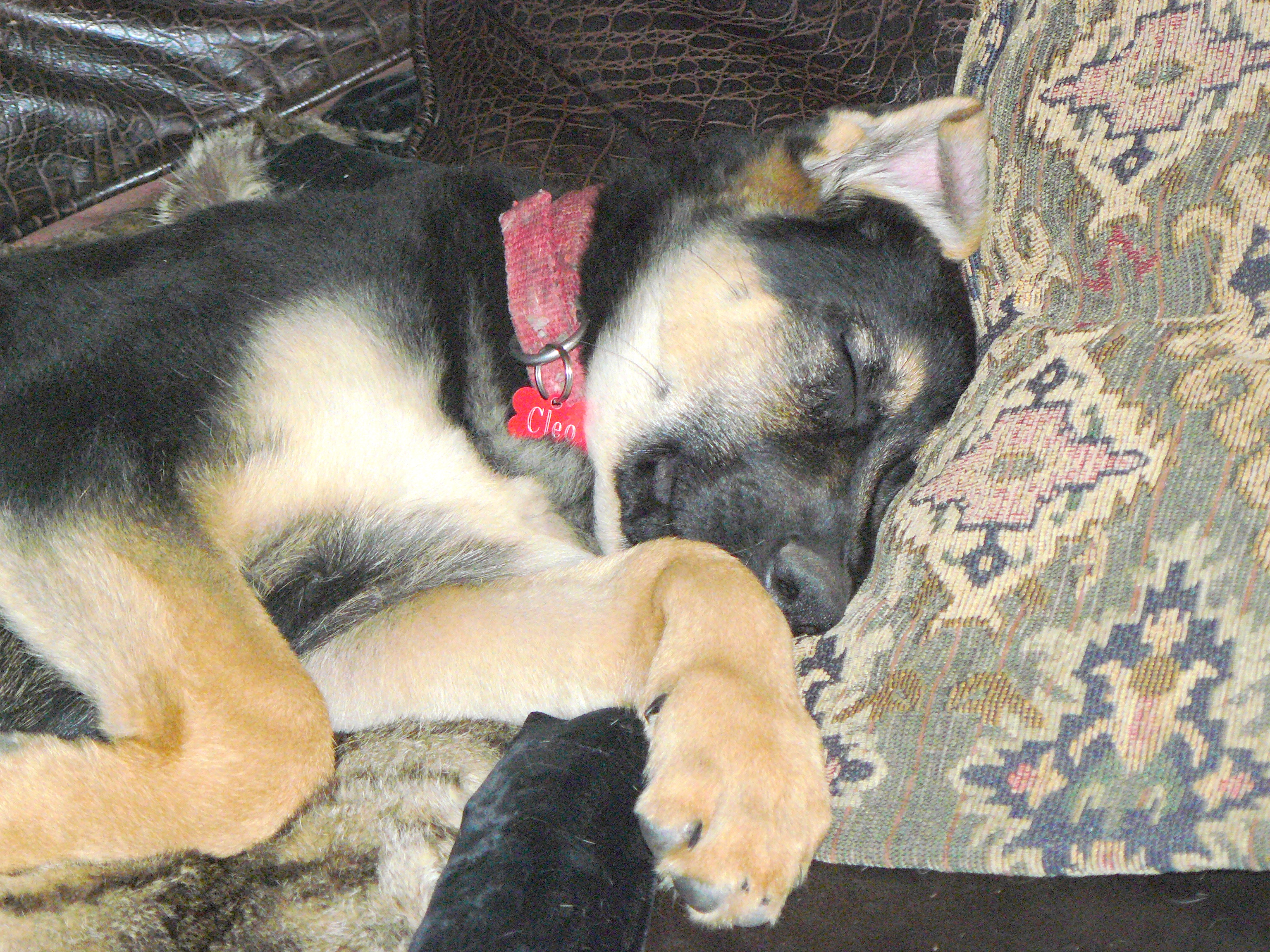
Cleo deep in meditation.

oooo

Pharaoh demonstrating the art of contemplation.

oooo

Cleo, deep in meditation.
Young Oliver, learning new ways in meditation.

My case rests!

Sorry to repeat myself, but ..

… I just want you to know something!

That is how grateful I am to all of you followers of Learning from Dogs.  Every single one of you.

It seemed just yesterday that I wrote a post offering my gratitude that there were now 1,000 followers of my humble scribblings.  In fact, the post was dated the 12th May.

Yesterday afternoon the number of dear followers had risen to 1,085. Amazing!

But here’s the reason I’m writing this.

The vast majority of followers are bloggers themselves.  It’s easy for me to pop along to ‘their place’ and leave a thank-you note.

But in recent days, there have been a number of new subscribers who are not bloggers and that makes it almost impossible for me to say ‘thank you’ directly.

So to those new subscribers who are not bloggers, and everyone else: Thank You!

Hazel sends her thanks!

Being proud to be a deviant!

A powerful essay from George Monbiot.

Many will be aware that on a fairly regular basis, I repost essays here from George Monbiot, the last being Monbiot Unmasked on the 6th August.

I do so because in a world where much of the media is ‘bought’, and do understand that I use the term loosely, solid and trustworthy correspondents are to be applauded and, in turn, their views shared.  Mr. Monbiot is a classic example of someone who adheres to a truthful perspective. I am more than grateful for the blanket permission given to me by GM for the republication of his essays.

Thus with no further ado, here is George Monbiot’s essay Deviant and Proud published in the UK’s Guardian newspaper on the 6th August, 2014.

ooOOoo

Deviant and Proud

August 5, 2014

Do you feel left out? Perhaps it’s because you refuse to succumb to the competition, envy and fear neoliberalism breeds.

By George Monbiot, published in the Guardian 6th August 2014

To be at peace with a troubled world: this is not a reasonable aim. It can be achieved only through a disavowal of what surrounds you. To be at peace with yourself within a troubled world: that, by contrast, is an honourable aspiration. This column is for those who feel at odds with life. It calls on you not to be ashamed.

I was prompted to write it by a remarkable book, just published in English, by a Belgian professor of psychoanalysis, Paul Verhaeghe (1). What About Me?: The Struggle for Identity in a Market-Based Society is one of those books that, by making connections between apparently distinct phenomena, permits sudden new insights into what is happening to us and why.

We are social animals, Verhaeghe argues, and our identity is shaped by the norms and values we absorb from other people. Every society defines and shapes its own normality – and its own abnormality – according to dominant narratives, and seeks either to make people comply or to exclude them if they don’t.

Today the dominant narrative is that of market fundamentalism, widely known in Europe as neoliberalism. The story it tells is that the market can resolve almost all social, economic and political problems. The less the state regulates and taxes us, the better off we will be. Public services should be privatised, public spending should be cut and business should be freed from social control. In countries such as the UK and the US, this story has shaped our norms and values for around 35 years: since Thatcher and Reagan came to power (2). It’s rapidly colonising the rest of the world.

Verhaeghe points out that neoliberalism draws on the ancient Greek idea that our ethics are innate (and governed by a state of nature it calls the market) and on the Christian idea that humankind is inherently selfish and acquisitive. Rather than seeking to suppress these characteristics, neoliberalism celebrates them: it claims that unrestricted competition, driven by self-interest, leads to innovation and economic growth, enhancing the welfare of all.

At the heart of this story is the notion of merit. Untrammelled competition rewards people who have talent, who work hard and who innovate. It breaks down hierarchies and creates a world of opportunity and mobility. The reality is rather different. Even at the beginning of the process, when markets are first deregulated, we do not start with equal opportunities. Some people are a long way down the track before the starting gun is fired. This is how the Russian oligarchs managed to acquire such wealth when the Soviet Union broke up. They weren’t, on the whole, the most talented, hard-working or innovative people, but those with the fewest scruples, the most thugs and the best contacts, often in the KGB.

Even when outcomes are based on talent and hard work, they don’t stay that way for long. Once the first generation of liberated entrepreneurs has made its money, the initial meritocracy is replaced by a new elite, which insulates its children from competition by inheritance and the best education money can buy. Where market fundamentalism has been most fiercely applied – in countries like the US and UK – social mobility has greatly declined (3).

If neoliberalism were anything other than a self-serving con, whose gurus and think tanks were financed from the beginning by some of the richest people on earth (the American tycoons Coors, Olin, Scaife, Pew and others) (4), its apostles would have demanded, as a precondition for a society based on merit, that no one should start life with the unfair advantage of inherited wealth or economically-determined education. But they never believed in their own doctrine. Enterprise, as a result, quickly gave way to rent.

All this is ignored, and success or failure in the market economy are ascribed solely to the efforts of the individual. The rich are the new righteous, the poor are the new deviants, who have failed both economically and morally, and are now classified as social parasites.

The market was meant to emancipate us, offering autonomy and freedom. Instead it has delivered atomisation and loneliness. The workplace has been overwhelmed by a mad, Kafka-esque infrastructure of assessments, monitoring, measuring, surveillance and audits, centrally directed and rigidly planned, whose purpose is to reward the winners and punish the losers. It destroys autonomy, enterprise, innovation and loyalty and breeds frustration, envy and fear. Through a magnificent paradox, it has led to the revival of a grand old Soviet tradition, known in Russian as tufta. It means the falsification of statistics to meet the diktats of unaccountable power.

The same forces afflict those who can’t find work. They must now contend, alongside the other humiliations of unemployment, with a whole new level of snooping and monitoring. All this, Verhaeghe points out, is fundamental to the neoliberal model, which everywhere insists on comparison, evaluation and quantification. We find ourselves technically free but powerless. Whether in work or out of work, we must live by the same rules or perish. All the major political parties promote them, so we have no political power either. In the name of autonomy and freedom we have ended up controlled by a grinding, faceless bureaucracy.

These shifts have been accompanied, Verhaeghe writes, by a spectacular rise in certain psychiatric conditions: self-harm, eating disorders, depression and personality disorders. Of the personality disorders, the most common are performance anxiety and social phobia; both of which reflect a fear of other people, who are perceived as both evaluators and competitors, the only roles for society that market fundamentalism admits. Depression and loneliness plague us. The infantilising diktats of the workplace destroy our self-respect. Those who end up at the bottom of the pile are assailed by guilt and shame. The self-attribution fallacy cuts both ways (5): just as we congratulate ourselves for our successes,we blame ourselves for our failures, even if we had little to do with it.

So if you don’t fit in; if you feel at odds with the world; if your identity is troubled and frayed; if you feel lost and ashamed, it could be because you have retained the human values you were supposed to have discarded. You are a deviant. Be proud.

www.monbiot.com

References:

1. Paul Verhaeghe, 2014. What About Me?: The struggle for identity in a market-based society. Scribe. Brunswick, Australia and London.

2. http://www.theguardian.com/commentisfree/2010/oct/18/conservative-financial-crisis-opportunity

3. http://www.theguardian.com/news/datablog/2012/may/22/social-mobility-data-charts

4. http://www.theguardian.com/commentisfree/2007/aug/28/comment.businesscomment

5. http://www.theguardian.com/commentisfree/2011/nov/07/one-per-cent-wealth-destroyers

ooOOoo

What powerful observations; what common-sense written by Paul Verhaeghe, and beautifully reported by Mr. Monbiot in an incredible essay.

You have probably guessed where I stand! 😉

Picture parade fifty-eight.

More of those glorious pictures from Sue via John Hurlburt.

If you missed the first set, then they may be found here.

SS9

oooo

SS10

oooo

SS11

oooo

SS12

oooo

SS13

oooo

SS14

oooo

SS15

oooo

SS16

oooo

Yet more next Sunday.  You good people out there have a happy and stress-free week.

Could be the start of a welcome trend!

Certainly dogs couldn’t be any worse!

I am referring to politicians; but you probably guessed that.

Just my way of a lead-in to a wonderful item seen recently over on ABC Eye Witness News.

Namely:

DOG ELECTED MAYOR IN CORMORANT, MINNESOTA

Duke, the mayor of Cormorant, Minnesota.

Tuesday, August 12, 2014

CORMORANT, Minnesota (WLS) — Duke, a 7-year-old dog, was elected mayor of Cormorant, Minnesota.

He won by a landslide,” Tricia Maloney said of the Great Pyrenees. “He’s used to coming to the pub and getting some burgers and some fries or something.”

The 12 people who live in Cormorant all paid $1 to vote.

Poor Richard Sherbrook that owns the Cormorant store, he didn’t even have half as many votes as Duke did,” Maloney said.

The farm dog is all bark, no bite. His term lasts one year.

oooo

A quick web search found a longer version of the news item over on the CBS News website:

Duke The Dog Sworn In As Mayor Of Cormorant, Minn.

(credit: CBS)
(credit: CBS)

MINNEAPOLIS (WCCO) – Every dog has his day and Saturday is it for Duke the dog.

Duke was elected mayor of the northwestern Minnesota community of Cormorant, and he was sworn in Saturday. Organizer Tammy Odegaard says Duke got gussied up Friday night, his second trip to the groomer since his election.

He spends a lot of time at the dairy farm next door,” Odegaard said, who notes she’s now a member of Duke’s staff. “So, twice in, like, seven days for him is, like, it’s never happened. So I’m sure he’s wondering what’s going on with just that.”

His first grooming took five hours and came after the majority of the town’s 12 voters backed him in the balloting. The town pulled out all the stops for the 10 a.m. ceremony during Cormorant’s annual fair.

We’ll have him put his little paw on the bible, going to have him have the little oath,” Odegaard said. “Of course, he’s not going to repeat it. It would be awesome if he would bark, but who knows? He’s a country dog, so he’s not used to performing on cue.

During the two-minute inauguration ceremony, Steve Sorenson, chairman of Cormorant Township, greeted Duke and set forth his duties.

You are about to em-bark upon a great time of service, tremendous personal and professional growth,” Sorenson said. “If you accept this challenge and these responsibilities, please bark or pant.

Duke panted.

I think that qualifies,” Sorenson said.

As for the mayor’s salary, a pet food store is donating a year’s supply of kibble to reward him for his service.

The village of Cormorant is located in northwestern Minnesota, near Pelican Rapids.

Duke is a seven-year-old, big, white, shaggy Great Pyrenees that loves to roll around in the dirt. Odegaard would not say if that activity qualifies Duke for a career in politics.

You said it, not me,” Odegaard laughed.

oooo

That inauguration ceremony was captured on video; see below.  Warning, the first seven minutes are a little slow! But it is worth watching, trust me!

The power of hope.

Funny how things happen.

Yesterday evening we had close friend Don Reeve staying with us.  To put this into context, it was Don and his wife, Suzann, who in 2007 invited me to spend Christmas with them at their Winter home down in San Carlos, Mexico. That, in turn, led me to meeting Jean, Suzann’s best friend, and look where that got me! 🙂

(Can’t resist adding that Jean and I were born in London, some 23 miles from each other!)

Fr. Dan Tantimonaco with the newly weds!
Fr. Dan Tantimonaco with the newly weds! Payson, AZ. November 20th., 2010.

Thus you can understand the pleasure it was for Jean and me again to see Don; albeit for a brief overnight stay.

What was an extra, unanticipated pleasure was meeting a young, rescue dog that Don had adopted in recent weeks.  Her name is Margarita and she was found and rescued by Suzann from the streets in San Carlos.  What was so glorious was to see the love and hope for a better future that flowed between Don and the sweet, young Margarita.  It resonated so perfectly well with Suzan’s post published here on Monday: Rescued dogs are life-savers.

By the time I sat down at my desk yesterday, I was conscious of a) not having a clue as to what to write, and b) inspired by the sense of hope that dogs offer us humans.  Serendipitously, the theme of hope led me to a post written by Jennifer Broudy de Hernandez over on her Transition Times blog.  It was called Warriors for the Planet and was the most beautiful essay.

I’m delighted to reblog that here with Jennifer’s approval.

ooOOoo

Warriors for the Planet

Another summer, another war. I wonder how many summers there have been in the last 5,000 years when human beings were not occupied with killing each other?

Correction: not “human beings,” “men.”

Let’s be frank: even though there may be women in the armed forces of many countries now, war still remains a masculine activity and preoccupation. The women who serve as soldiers must adhere to the masculine warrior code and become honorary “bros,” for whom the worst insult is still be called a “girl” or a “pussy.”

annebaring_a_lgI have been reading Anne Baring’s magisterial book The Dream of the Cosmos, in which she gives a detailed account of the shift, around the time of Gilgamesh, from the ancient, goddess- and nature-worshipping “lunar cultures” to the contemporary era of solar, monotheistic, warrior-worshipping cultures.

In her elaboration of this shift, I read the tragedy of our time, enacted over and over again all over the planet, and not just by humans against humans, but also by humans against the other living beings with whom we share our world. I quote at length from Baring’s remarkable book:

gilgamesh-187x300“The archetype of the solar hero as warrior still exerts immense unconscious influence on the modern male psyche, in the battlefield of politics as well as that of corporate business and even the world of science and academia: the primary aim of the male is to achieve, to win and, if necessary, to defeat other males. The ideal of the warrior has become an unconscious part of every man’s identity from the time he is a small child.

“With the mythic theme of the cosmic battle between good and evil and the indoctrination of the warrior went the focus on war and territorial conquest. War has been endemic throughout the 4000 years of the solar era. The glorification of war and conquest and the exaltation of the warrior is a major theme of the solar era—still with us today in George W. Bush’s words in 2005: ‘We will accept no outcome except victory.’ This call to victory echoes down the centuries, ensuring that hecatombs of young warriors were sacrificed to the god of war, countless millions led into captivity and slavery, countless women raped and widows left destitute. It has sanctioned an ethos that strives for victory at no matter what cost in human lives and even today glorifies war and admires the warrior leader. This archaic model of tribal dominance and conquest has inflicted untold suffering on humanity and now threatens our very survival as a species.

2014-06-15-mission
“The cosmic battle between light and darkness was increasingly projected into the world and a fascination with territorial conquest gripped the imagination and led to the creation of vast empires. It is as if the heroic human ego, identified with the solar hero, had to seek out new territories to conquer, had to embody the myth in a literal sense and as it did so, channel the primitive territorial drives of the psyche into a Dionysian orgy of unbridled conquest, slaughter and destruction. We hear very little about the suffering generated by these conquests: the weeping widows, the mothers who lost sons, the orphaned children and the crops and patterns of sowing and harvesting devastated and disrupted by the foraging armies passing over them, the exquisite works of art pillaged and looted….The long chronicle of conquest and human sacrifice, of exultation in power and the subjugation of enemies might truly be named the dark shadow of the solar age” (118;124).

Like Baring, I see our time as a critical era in the long history of homo sapiens on the planet. There is still hope that enough of us will be able to detach ourselves from the pressures and busyness of our lives—will become conscious of what is happening to the planet and human civilization writ large—will understand that there are other ways to relate to each other and to the Earth, ways that will seem increasingly possible and obvious once we focus on them and begin to put our energies into manifesting our visions of a creative, collaborative, respectful mode of being.

Baring ends her disturbing chapter on the ascendancy of the solar warrior culture with a hopeful quote from The Passion of the Western Mind by Richard Tarnas, from which she springs into her own positive vision of the potential of our time.

“’We stand at the threshold of a revelation of the nature of reality that could shatter our most established beliefs about ourselves and the world. The very constriction we are experiencing is part of the dynamic of our imminent release. For the deepest passion of the Western mind has been to reunite with the ground of its being. The driving impulse of the West’s masculine consciousness has been its quest not only to realize itself, to forge its own autonomy, but also, finally, to recover its connection with the whole, to come to terms with the great feminine principle in life; to differentiate itself from but then rediscover and reunite with the feminine, with the mystery of life, of nature, of soul. And that reunion can now occur on a new and profoundly different level from that of the primordial unconscious unity, for the long evolution of human consciousness has prepared it to be capable at last of embracing the ground and matrix of its own being freely and consciously.’

“As this deep soul-impulse gathers momentum, the ‘marriage’ of the re-emerging lunar consciousness with the dominant solar one is beginning to change our perception of reality. This gives us hope for the future. If we can recover the values intrinsic to the ancient participatory way of knowing without losing the priceless evolutionary attainment of a strong and focused ego, together with all the discoveries we have made and the skills we have developed, we could heal both the fissure in our soul and our raped and vandalized planet” (130-131).

My heart aches for the suffering of the innocent civilians trapped in the crossfire in Gaza this summer, and for the grieving families of the passenger plane heinously shot down by warriors who were either poorly trained or just plain evil.

I am heartsick when I think about the holocaust that is overtaking living beings on every quadrant of our planet as humans continue to ravage the forests and seas, to melt the poles with our greenhouse gases, and to poison the aquifers and soil with our chemicals.

The last Polar Bear

This is where the solar cultures, with their “great” warrior kings, have led us. And yet, as Baring says, they have also presided over the most amazing advances in science and technology that humans have ever known in our long history on the planet.

We don’t need or want to go back to the simple innocence of ancient lunar societies. We don’t have to bomb ourselves back into the Stone Age.

What we need is to go forward, wisely and joyously, into a new phase of consciousness, in which the masculine warrior spirit is used for protection and stewardship rather than destruction, and the Earth is honored as the Mother of all that she is.

Never let anyone tell you it can’t be done. It is already happening.

ooOOoo

May I tempt you to go back and re-read that penultimate paragraph.  A sentence that I cannot resist emphasising:

What we need is to go forward, wisely and joyously, into a new phase of consciousness, in which the masculine warrior spirit is used for protection and stewardship rather than destruction, and the Earth is honored as the Mother of all that she is.

 The power of hope!

Vive la différence.

It is the differences between us that are to be praised.

On the 10th August, Alex Jones, he of The Liberated Way, published a post under the title of Wisdom comes out of calm.  I read it and approved of the sentiments expressed.  Here’s a flavour of what Alex wrote:

My attitude towards dogs, and everything I do, is it is better to act in harmony with my world than impose violent control upon it. Nature is my teacher, and calm is one of its teachings. Calm is the sister of patience and tolerance, letting nature flow at its own pace and in its own way. When I planted acorns, I was unable to force them to grow, they acted in their own timing, at their own pace. I am like a parent rather than the master of eight strong oak saplings. I provide my saplings with opportunity through water, sun and good soil; protecting them from caterpillar and fungus; they follow their own nature in becoming fast growing little trees.

Then dear Patrice, he (or is it she?) of the blog Patrice Ayme’s Thoughts went on to write his own essay Calmly Thinking Up A Storm reflecting on Alex’s musings. One of the comments to me was:

Well, Paul, the entire essay answered why it’s wrong to equate calm with wisdom, as Alex does. If it was only him, it would be an interesting quirk. However, it’s pretty much a mass mood.

That philosophy of boiled vegetable leaves the plutocrats free to do a home run, home being, for them, hell. Part of the program is biospheric annihilation.

I didn’t agree with Patrice and my immediate reaction was try and take sides. Yet both writers were the authors of many fine essays. What to do?  As I expressed to Alex:

I have read both posts and, frankly, are bemused. It feels as though each is describing something utterly different to the other. I have a number of hours of electrical work today but will also give the matter a ‘coating of thought’ while working and offer my humble conclusions later on.

Serendipitously, the answered then arrived.

I’m about a third of the way through an audio course on Building Great Sentences delivered by Professor Brooks Landon, Professor at the University of Iowa English Department. Professor Landon talks about style and how difficult it is to define a particular author’s style.

It was at that moment that a flashbulb went off in my mind.  Wouldn’t literature be incredibly plain and boring if there were no real differences in the styles of all the many authors; past and present!

It brought me back to Patrice and Alex and, by default, hundreds of other authors of blogs right across the ‘blogosphere’.  Of course they express themselves differently! Of course they hold different opinions! It is those differences that are critical, utterly so, to each and every reader coming to their own conclusions; conclusions to a wide range of subjects and topics.

This was hammered home to me as I watched our dogs playing so well together.  The differences in each dog’s backgrounds and experiences contributed to the wonderful, unconditional way that they played and lived together.  The power of their unconditional love.

It is those differences that offer us insight into our own beliefs and prejudices.  It is those differences that allow us, and dogs, to make sense of ourselves. One might argue that it is the differences that deliver truth.

That feels much better! 🙂