Category: Musings

Rivers in the sky!

California’s recent rain storm.

The recent rain storm that has affected much of the Western seaboard of the USA; albeit primarily California.  The BBC News reported online that:

Storm pounds northern California

Streets were heavily flooded in the town of Healdsburg, California.

More than 220,000 people are without power after heavy rains and high winds slammed northern California.

The storm brought rainfall of more than an inch an hour in San Francisco and winds gusts of 140mph (225km/h) in the Sierra Nevada mountains.

Flooding has already closed two major motorways in the area, delayed public transport, cancelled 240 flights and shut ferry services.

The rain is much needed in the drought-hit state but mudslides are a concern.

Power cuts were widespread, from the suburban area south of San Francisco to Humboldt, near the Oregon border.

Thus the morning afterwards, it was wonderful to receive an email from Dan Gomez that put not only this last storm into context but also a long history of very significant deluges.  Bet you will be as surprised as I was when you read it!

ooOOoo

What Is This “Atmospheric River” That Is Flooding California?

By Mark Fischetti | December 11, 2014

The views expressed are those of the author and are not necessarily those of Scientific American.

——————-

SA1The San Francisco Bay Area is getting flooded with relentless rain and strong winds, just like it did a week ago, and fears of rising water are now becoming very serious. Major news stations, weather channels, Web outlets and social media are all suddenly talking about the “atmospheric river” that is bringing deluge after deluge to California, as well as the coast of Washington. What is this thing? How rare is it? And how big of a threat could it be? Here are some answers. And see our graphics, below, taken from a brilliant and prescient feature article written by Michael Dettinger and Lynn Ingram in Scientific Americanin January 2013.

Not interested? In 1861 an atmospheric river that brought storms for 43 days turned California’s Central Valley into an inland sea 300 miles long and 20 miles wide. Thousands of people died, 800,000 cattle drowned and the state went bankrupt. A similar disaster today would be much more devastating, because the region is much more populated and it is the single largest food producer in the U.S.

So maybe 1861 was an oddity. Not really. Geologic core samples show that extreme floods like the one in 1861 have happened in California about every 200 years, since the year 200 A.D. So the next disaster could be coming around the bend. The West Coast has actually been slowly constructing large, specialized, meteorological observatories that can sense atmospheric rivers as they develop, so forecasters can give early warnings.

An atmospheric river is a conveyor belt of vapor that extends thousands of miles from out at sea, carrying as much water as 15 Mississippi Rivers. It strikes as a series of storms that arrive for days or weeks on end. Each storm can dump inches of rain or feet of snow. Meteorologists sometimes call small occurrences “pineapple expresses,” because they tend to flow in a straight line from around Hawaii toward the U.S. West Coast. The graphic below explains the details.

SA2

Several regions of central California have been frequent targets in the past two millennia. Here’s the record from core samples showing that every 200 years or so a catastrophic atmospheric river many times greater than any pineapple express occurs.

SA3

The flow pattern of the atmospheric river now battering the West Coast is classic. The University of Wisconsin at Madison maintains a terrific Web site that shows the flows in real time, updated every five minutes. A snapshot from last night is below. The dark red swath across the equator is the tropical rain band that is usually present; the atmospheric river is the sweeping jet of water vapor (blue in the image) that shoots off towards the U.S.

SA4

If you want to know more about these monster storms, check out the feature articleby Dettinger and Ingram. Dettinger will also be speaking at the American Geophysical Union annual conference in San Francisco next week. I’ll be there, too—with 22,000 scientists, right in the thick of the storms, should they continue.

Top image courtesy of the University of Wisconsin at Madison

ooOOoo

Maybe those fluffy white clouds aren’t quite as innocent looking as one might imagine! Oh, and a cubic metre of water is one tonne! A 1,000 kgs! (Just a little short of a ton in old money.)

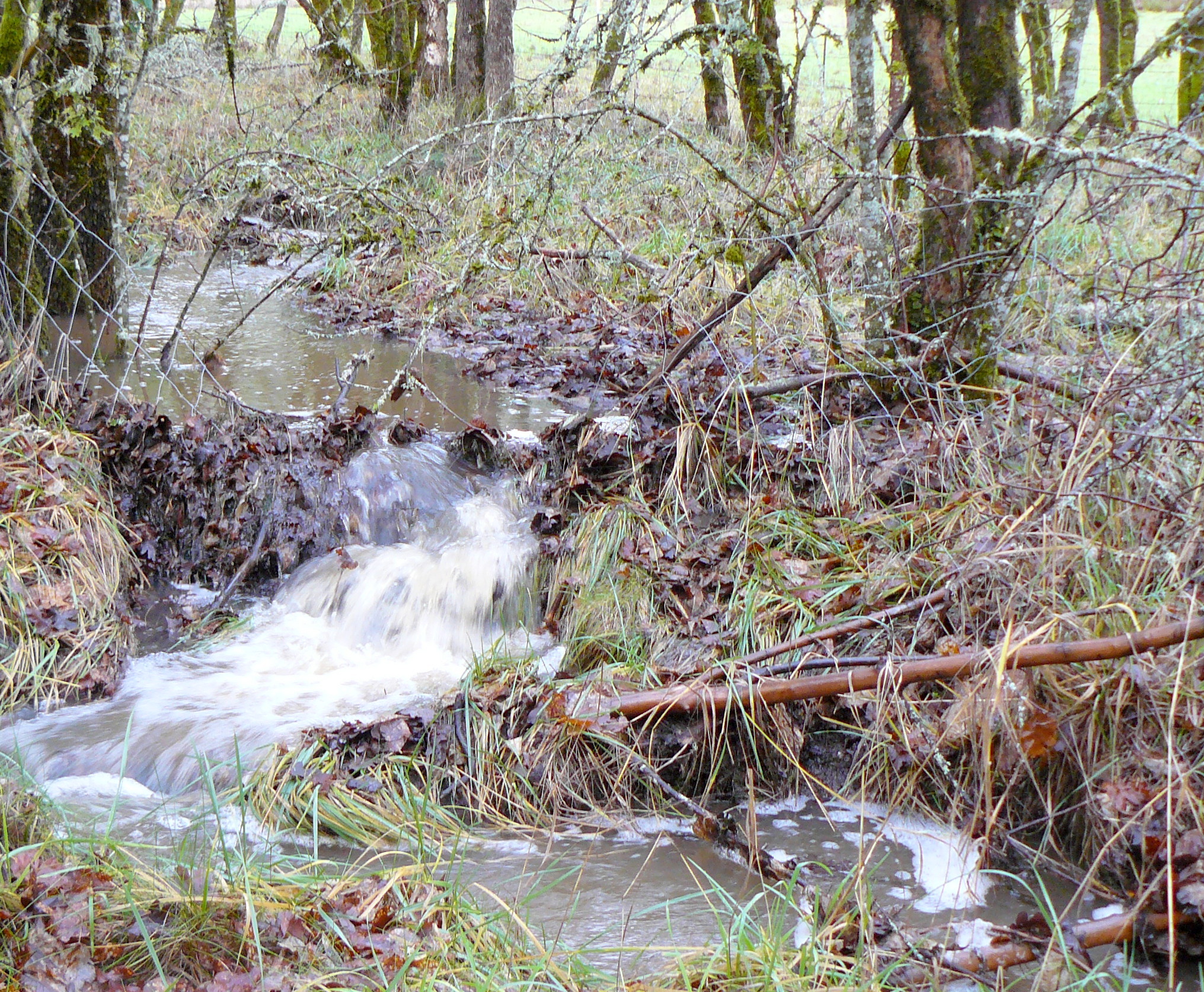
Finally, here in rural Southern Oregon, we received 1.70 inches of rain on Thursday and were grateful that it wasn’t more.  Nonetheless, it had the creek levels raised, as the following pictures reveal.

A small creek that only flows during periods of heavy rain. The creek is on the boundary between our property and our neighbour's to the North.
A small creek that only flows during periods of heavy rain. The creek is on the boundary between our property and our neighbour’s to the North.

oooo

This the raised water flowing over the irrigation dam on Bummer Creek, that flows North-South through the woods on the Eastern part of our land.
The raised water flowing over the irrigation dam on Bummer Creek, that flows North-South through the woods on the Eastern part of our land. Bummer Creek flows year-round.

The book! Part Five: Honesty.

In one very real sense, a chapter about the quality of honesty in dogs is bizarre. Surely, honesty, and dishonesty, are terms that exclusively describe human tendencies. When the term “dishonest” is used to describe a person, most often we are describing an effort by that person to deceive another. It is a description of someone who intentionally is trying to mislead or misinform us.

But in terms of honesty, or dishonesty, what I am about to say probably applies to all animals; I don’t know. Namely, that if there was one animal on Planet Earth that is incapable of guile or deceit, it has to be the dog. There is no doubt in my mind that dogs remain one of the most beautiful gifts nature has bestowed upon us humans.

Now that last bold statement is not to imply that dogs don’t try to manipulate us humans; far from it. Their attempts at manipulation would impress any three-year-old child! But there’s nothing dishonest about a dog trying to manipulate its owner into giving the dog whatever it wants; they are far too obvious in their motives and methods. As I read somewhere, dogs are: “Just scavengers looking for a way to get something with minimal effort.

Thus I think we can take it as a given that dogs are honest; fundamentally so.

OK, dear reader, you have no way of knowing that after writing that last sentence, I sat staring at the screen for a good ten minutes. I didn’t know how to continue the theme. I couldn’t think of anything to add to what every “good person and true” knows, and has known since time immemorial: honesty is a fundamental aspect of being a good person; the enviable of all titles, as George Washington is reputed to have said.

What was exercising my brain was to come at the subject of honesty in a way that offered a compelling reason for being honest; over and above the natural assumption about honesty, that it is so blindingly obvious not to require being spelt out; in a manner of speaking. It struck me that honesty is very different to the majority of the other qualities that we need to learn from dogs.
Different in the sense that the other qualities are open to being embraced as something that may be learnt, with clear rewards from so doing, whereas honesty seems a fundamental, core way of relating to the world around one. Mind you, there was a tiny voice in my head that was nagging away at me that said that honesty may not be so ‘black and white’. For example, the question of ‘white lies’. But, at heart, I was still lost as to how to proceed.

So, I spent another thirty minutes exploring the web looking for clarity; looking for some inspiration. Yet those web searches just ended up confusing me more. About the least confusing item I came across, more or less at random, was a section from an article read[1] on the website The New Atlantis. The full article was entitled: The truth about human nature.

The section that I read, and is reproduced below, seemed to confirm in my mind that honesty; something that, by rights, should be so fundamentally understood, was anything but simple.

Since Nietzsche, the choice of which version of ourselves we identify with has been widely understood as a choice between lying and truth-telling — to ourselves as much as to others. The moral ideal has become authenticity — a particular kind of honesty. Of course, just about any philosophical ideal is grounded in some sort of honesty: the search for Truth requires truth. Yet Aristotle describes honesty as a virtue only of self-presentation — the balance between self-deprecation and boastfulness. And Plato never lists honesty as a virtue at all, and even distinguishes between “true lies” and useful or noble lies. From the modern to the post-modern era, honesty and authenticity shifted to become much of the telos[2] of life, where before they had been but means in our progress toward that end.

Here was me looking for clarity only to find anything but that!

So what to make of all this?

I am going to fall back on the ideas expressed in the chapter on community. Rather on the closing words of that chapter, “… the power of sharing, of living a local community life, may just possibly be the difference between failure and survival of us humans.

There’s a sense of hope in me that we are heading for an era of new localism that will, in and of itself, reinforce a culture of honesty in one’s life. Why such hope? Because there are signs. Such as this one: the growing concern about factory farming, surfacing as increasingly more vibrant local food movements, demonstrating that people are really scrutinising where their food comes from. More than that! There are increasing concerns as to where our medicines are made and the possible side-effects, and a dawning awareness of how we are living on the backs of exploited third world workers (and poorly paid service workers here at home). Possibly all under a global umbrella of awareness that big government is no longer working as it should be; evidenced by falling voter turnout numbers at key elections in the USA and many other countries.

My hope is that this growing ‘honesty’ about the reality of our present world and where it appears to be heading is at the heart, in my opinion, of an expanding local consciousness permeating the hearts and minds of many people, leading them to want to become more “local.”

Should this come about, and I hope that it does in my lifetime, then an honesty of thought and deed will be, nay, has to be, a core attribute of life in a well-functioning local community.

982 words. Copyright © 2014 Paul Handover

[1] http://www.thenewatlantis.com/publications/the-truth-about-human-nature
[2] As in an end or purpose of life

Happiness is a state of BEING..

A wonderful post from Sue Dreamwalker.

A couple of weeks ago, back on the 26th November, Sue published a post over on her blog, Dreamwalker’s Sanctuary, that ‘spoke’ to me in ways beyond words.  For when we turn inside of ourselves, when we try to listen to our own deepest experiences, the word ‘soul’ might not be out of place here, we frequently struggle to translate those feelings, those inner voices, into words.  Words seem far too crude! It’s how a beautiful vision of nature can never be perfectly transferred into a photographic image.

So I won’t blather on! Just let your eyes feast on the following:

ooOOoo

Resurrecting a state of BEing.

I am the Sky

I am the Sea

I am in all you see

I am the Wind

Within your breath

I am with you even in Death

I am the space between your thoughts

And nothing of me should scare you naught

I am in everything you do

And all I do is Love You.

I AM

ME..

I wrote that poem sometime ago now.. and I often find myself still searching for that BEing within.. Below is what I posted about BEing in 2011…

What is this “Being” inside of me? inside of ALL of us.. What is it that drives us, makes us tick.. I often talk to that ‘Being’ don’t you? as I search inside and question and listen for the answers.

We call ourselves Human BE-ings.. but what does that mean? Many I think have forgotten that “Being” within themselves as we search externally to IammeBE that something else.. We get bombarded with being told who we should aspire to ‘Be’ like, who to follow, how to pray, etc etc.. we are told what we should wear, what to eat, what products to buy.. and our BE-ing has got lost, swamped by all the exterior material diversions of being told how to live our lives….

We get disillusioned and search outside of ourselves for the Guru or saviour to come and make our lives more meaningful as we endeavour to find that missing part that makes us whole.. .. We are never satisfied with our lot, some even change their own appearances as they strive to BE this image of a person that to them is not the one who looks back at them through the mirror.

Do we really Look into that Mirror and Do we really SEE?

SD2We are divided in schools, Higher education , Top/Bottom of the class,Class distinction, Grades- Culture and Creeds.. We judge each other,we condemn those who have differing views… We look down on those who appear of lesser means — We Label people and we put limits upon ourselves telling ourselves we are not worthy, for society has made us think in terms of possessions and wealth as status symbols..

We become jealous of those whose lives seemed enriched and full, but as we look closer are they enriched? Are they content with that ‘Being’ within? It seems not, for many too are still searching outside of themselves to find that which makes them Happy.. and all that money and wealth shows that Happiness still cannot be bought…

We think ourselves as separate beings, alone, and yet we are all of us part of the Human Race… We are ALL of us HUMAN BEINGS… Something I think many forget as we race to gather yet more and more material ‘Things’ around our selves thinking they will BE the Key to happiness…

Happiness is a state of BEING..

Happiness is not found in any-‘Thing’ other than Within Ourselves…

When we look at the I AM when we really Seek that Inner BEING when we truly Love ourselves the inner core-self.. when we come to LOVE ourselves and stop trying to BE something that we are seeking to BE… only then will we find our True BEING..

We are all connected within that Family of Light

We are ALL BEINGS OF LIGHT ENERGY within this Human Form.

ALL OF US ARE LIGHT BEINGS COME TO EXPERIENCE

..all of us seeking the same thing and all of us forgetting how to connect to that most basic thing..

ONE’s SELF

TO BE- One’s SELF!

We need look no further to make ourselves feel whole and complete, than to

Look WITHIN our BEING.

For instead of seeking to ‘BE’ this or that, Instead of trying to ‘BE’ Wealthy, Wise, … ,searching to ‘BE’ what ever else you think you need to make you Happy

ALL we have to BE is —LOVE

And to ‘BE’- Happy..

‘BE’ Wise,…

To ‘BE’ ALL of these things.

Remember that there is nothing you need do except

‘BE’ in the ‘Moment’ of ‘NOW!’..

and ‘BE’ the Best you know how to BE.. Right now!..

And start BEING who YOU choose to BE..

Love and Blessings

Dreamwalker

And one more thought to add to BE-responsible for your thoughts and Actions.. And BE -aware that your thoughts contribute to the creation of either positive or negative outcomes in the world..

So BE-prepared for the outcomes..

Blessings

Sue

ooOOoo

Do yourself a favour; a big favour – go and read it all through again!

Sue, many, many thanks for letting me republish this!

The book! Part Five: Love

It is incredibly easy and, yet, so difficult to write about the love of a dog. Now if that isn’t a dysfunctional way to start this chapter on love, then I don’t know what would be!

Let me try to open this up to a more rational line of thought.

Dogs are so quick to show their love for a human. It could be the wag of a tail, the way a dog’s eyes connect with our eyes, a gentle lean of a head against our legs, curling up on our lap, licking our hands or our faces, and more; so much more. All of these ways make sense to us. For they are familiar to us humans from the point of view of how we show our love to our partner or to our children.

But there are a myriad of stories about a dog offering love to a human that go way beyond anything that we could emotionally understand. Let me offer one that was published on my blog back in January, 2011. It was the story of a Skye Terrier called Bobby.

Namely, that on the 15th February 1858, in the City of Edinburgh in Scotland, a man named John Gray died of tuberculosis. Gray was better known as Auld Jock and on his death he was buried in the old Greyfriars kirkyard situated on Candlemaker Row in Edinburgh.

Bobby had belonged to John Gray, who had worked for the Edinburgh City Police as a night watchman, and the two of them, John and Bobby, had been virtually inseparable for the previous two years.

When it came to the funeral, Bobby led his master’s funeral procession to the grave at Greyfriars Cemetery, and later, when this devoted Skye Terrier tried to stay at the graveside, he was sent away by the caretaker of the church.

But Bobby returned and refused to leave; whatever the weather conditions. Despite the efforts of the keeper of the kirkyard, plus John’s family and many local people, Bobby refused to be enticed away from the grave for any length of time and, as a result, he touched the hearts of the local residents.

Although theoretically dogs were not allowed in the graveyard, people rallied round and built a shelter for Bobby and there he stayed, guarding Auld Jock his late master.

There Bobby stayed for fourteen years, laying on the grave, leaving only for food.

To this day, close by Greyfriars Kirkyard, there is a Bobby’s Bar and outside the bar a cast metal stature of Bobby on a plinth.

The love that a dog shows us is a form of unconditional love that is not unknown in our human world but is not common. I would vouch that few people have truly ever experienced unconditional love or are even clear as to what it is. For although one might define unconditional love as affection without any limitations, or love without conditions, in other words a type of love that has no bounds and is unchanging, the reality of the love of one person towards another, a spouse, lover or child, is that there are limits to how that one person is treated and that going past those limits, regularly and persistently, eventually destroys that love.

Let’s turn to the world of novels. Some book authors make a distinction between unconditional love and conditional love. In the sense that conditional love is love that is earned through conscious or unconscious conditions being met by the lover. Whereas in unconditional love, love is given to the loved one no matter what. Loving is primary: an acting of feelings irrespective of will.

Yet there’s another aspect of unconditional love that relates commonly between individuals and their dogs. That is that our love for a dog encompasses a desire for the dog to have the very best life in and around us humans. Take the example of acquiring a new puppy. The puppy is cute, playful, and the owner’s heart swells with love for this adorable new family member. Then the puppy urinates on the floor. One does not stop loving the puppy but recognises the need to modify the puppy’s behaviour through love and training than, otherwise, continue to experience behaviours that would be unacceptable in a particular situation.

Having explored the concept of love and how dogs offer us the beauty of unconditional love, how should we adopt a loving approach to the world, and why?

It’s the little things that count is a famous truism and one no better suited to the world of love. Little things that we can do in countless different ways throughout the day. Sharing a friendly word and a smile with a stranger, dropping a coin or two into a homeless person’s hands or, better still, a loaf or bread or a chocolate bar. Being courteous on the road, holding a door open for someone at your nearby store, showing patience in a potentially frustrating situation. Continuing, perhaps, with such little things as never forgetting that we have two ears and one mouth and should use them in that proportion, or be more attentive when a loved one is speaking with us, possibly engineer periods of quiet contemplation, understanding that the world will not come to an end if the television or ‘smartphone’ is turned off for a day. The list of loving actions is endless. Or in the words of Nelson Mandela, “No one is born hating another person…People must learn to hate, and if they can learn to hate, they can be taught to love, for love comes more naturally to the human heart than its opposite.”

Why this need for love?

Because this world of ours so desperately needs a new start and that start must come from a loving attitude to each other, to the plants and animals, and to the blue planet that sustains us.

We need our hearts to open; open enough to tell our heads about the world of love.

1,001 words Copyright © 2014 Paul Handover

Maybe I’m not even here.

Lovely interlude during the week.

I came across this a few weeks ago and made a mental note to share it with you before too long.

Here’s what I saw:

Here are the details:

A film by Shixie (Xiangjun Shi)

Graduation Project at Rhode Island School of Design 2013
A Science Communication Project at Brown University Department of Physics
NYC ACM SIGGRAPH MetroCAF 2013 Jury Award
Vimeo Staff Pick – October 27th 2013
10th NYC Downtown Short Film Festival

It is rather cute; and clever!

The book! Part Four: The Brahma Viharas

Time to reflect on the previous five chapters: Of change; Hope; Self-compassion; Goodness; Finding Happiness.

However, it wouldn’t be surprising if my opening sentence didn’t raise the odd question or two. Such as why a chapter that wants to round off the messages of change in thoughts and deeds is entitled The Brahma Viharas? What are the Brahma Viharas?

Let me offer my answers.

Long before I started into this book, I drew up a document that I called a Statement of Purpose (SoP). Writing such a document was prompted by an experienced author who made a link with me when I wrote the draft first half of this book, Part One: Man and Dog, under the umbrella of NaNoWriMo 2013. Or to give the organisation its full name: The National Novel Writing Month. I should explain for those unfamiliar with NaNoWriMo that each November, NaNoWriMo offers budding authors a compelling reason to sit down and write 50,000 words in one month. I should hasten to add that the word Novel is flexible and that non-fiction attempts are equally encouraged. Guess that’s pretty self-evident!

Back to my SoP. The purpose behind such a document is to provide a framework of what it is that you wish to say before plunging headlong in to the writing. My SoP included an Introduction, my intended Reading Audience, the themes of the five Sections and intended chapter headings.

Once I had that documented, I showed it to some close friends seeking reactions and recommendations. I included Jon Lavin. It was Jon who suggested that I include the Brahma Viharas.

As I researched the topic, I was moved by how relevant it was to what I was trying to say. This is what I discovered.

Firstly, from the website of the Brahma Viharas organisation I read this explanation:

The four brahma-viharas represent the most beautiful and hopeful aspects of our human nature. They are mindfulness practices that protect the mind from falling into habitual patterns of reactivity which belie our best intentions.

Also referred to as mind liberating practices, they awaken powerful healing energies which brighten and lift the mind to increasing levels of clarity. As a result, the boundless states of loving-kindness, compassion, appreciative joy and equanimity manifest as forces of purification transforming the turbulent heart into a refuge of calm, focused awareness.

Those two short paragraphs are laden with wonderful ideas, all of which resonated with the theme of Part Four of this book. However, I still was looking for something that spelt out just exactly what are the four brahma-viharas. A further web search brought me to a site described as The Dhamma Encyclopedia and thence to Page Four from where I read: “The four Brahma Viharas are considered by Buddhism to be the four highest emotions. The word brahma literally means ‘highest’ or ‘superior.’

A few sentences later, reading:

The Brahma Viharas are also known as the Four Divine Emotions or The Four Divine Abodes. They are the meditative states, thoughts, and actions to be cultivated in Buddhist meditation. They are the positive emotions and states that are productive and helpful to anyone of any religion or even to the one with no religion. The result will be a very nice and good person, free from hate and ill-will. Those who cultivate the brahma viharas are guaranteed to happiness. Those who further cultivate equanimity, may reach insightful states and wisdom of enlightenment experiences.

The Four Divine Emotions

1. Metta (Loving-kindness)
2. Karuna (Compassion)
3. Mudita (Joy with others)
4. Upekkha (Equanimity)
(from Anguttara Nikaya 3.65)

Loving-kindness, Compassion, Joy with others and Equanimity. A pathway to freedom from hate and ill-will. Who wouldn’t want to journey along such a pathway!

Yet it still didn’t envelope me in the way that I was expecting, so I continued with the research, and came across an essay by a Derek Beres under the title of The Trauma of Everyday Life. The essay had been published on The Big Think website and the opening lines tickled my interest; very much so. But first to find out a little more about the author: Derek Beres.

Derek Beres, a Los Angeles-based journalist and yoga instructor, looks at a range of issues affecting the world’s various spiritual communities in an attempt to sift through hyperbole and find truly universal solutions to prevalent issues facing humanity in the 21st century.

The opening lines of the essay answered an immediate question that was in my mind: “Like all major religions, there exists numerous ideas of what Buddhism is and how to practice it. Perhaps the hardest part about explaining Buddhism is that it’s nowhere near being a religion in the first place.”

Then me immediately warming to: “Rather it is a way of engaging and grappling with yourself and the world you live in, sans metaphysics and dogma.”

The essay then described much of the Buddha’s early days and his quest for a deep, inner meaning to life.

In Derek Beres’ words: “And so the Buddha set off, studying yoga and practicing extreme forms of asceticism, including nearly starving himself in hopes of transcending his body.” This eventually leading him to recognise, “ … trauma as a means of enlightenment, not a hindrance on the spiritual path. Awakening does not mean an end to difficulty; it means a change in the way those difficulties are met.

… a change in the way those difficulties are met.” What better way than that to round off this theme of change in thoughts and deeds. Me wanting to say straightaway that these chapters have been a wonderful pathway of exploration for me and, so too, I hope they have been for you. There can be no doubt in my mind, and I know this is shared by countless others, that the future for mankind, if we continue on the same ways of recent times, is clear and obvious: massive levels of extinction of man and many other higher species.

This is the time for change. Not tomorrow; not some day; but now.

1016 words Copyright 2014: Paul Handover

The book! Part Four: Finding happiness.

Aristotle is reputed to have said, “Happiness depends on ourselves.

For someone born nearly 2,400 years ago, at the time of penning this book, Aristotle’s (384 to 322 BCE) words of wisdom resonate very much with these modern times. Even granting the fact that Aristotle was a Greek philosopher and a scientist, it still has me in awe of the man. Consider, when one thinks about Aristotle’s reflections on mankind so long ago and finds, some 2,400 years later, that in a sense, in a very real sense, nothing much about the aspect of our happiness is new. Certainly when it comes to the behaviours of homo sapiens!

To underpin that last observation, that seeking happiness still fascinates us, just a few days ago (November 2104) I read an item on the BBC website reporting that a Google engineer, Chade-Meng Tan, “claims he has the secret to a contented, stress-free life.” The BBC reporter, David G Allan, author of the article, went on to write, “Deep inside the global tech behemoth Google sits an engineer with an unusual job description: to make people happier and the world more peaceful.

From Aristotle to Google – Talk about plus ça change, plus c’est la même chose!

Nevertheless, if the source of our happiness is something that has been known for thousands of years, why do we have the sense that happiness is elusive, (I use the word ‘we’ in the broad sense.), why the reason that happiness seems as far away from the common, everyday experience as the white, snowy peak of a magnificent mountain shining out from a dark, blue sky?

How can we understand more about happiness; whether or not it is, indeed, elusive?

Well there’s only one place to start looking for the answer to that question in these modern times and that’s a Google search! Wow! No shortage of places to go looking: that search for the word ‘happiness’ produced the response – About 50,000,000 results (0.15 seconds)! And a bonus: I laughed out aloud when I saw that figure.

50 million results! Happiness doesn’t appears to be that elusive after all!

Let’s come at the question of happiness from a different angle. What about happiness from the perspective of good mental health?

The leading mental health charity in the UK is the organisation MIND. Their website, not surprisingly, poses the question: What do we mean by good mental health? Then offers the response: “Good mental health isn’t something you have, but something you do. To be mentally healthy you must value and accept yourself.

See there’s the prescience of Aristotle again!

MIND continues the response to the question by underlining how we should “… care about yourself and you care for yourself. …. love yourself, not hate yourself. …. look after your physical health”, reminding us all to “eat well, sleep well, exercise and enjoy yourself.”

Gretchen Rubin, an expert on the topic of happiness and the author of several books on this aspect of us humans, has researched happiness for many years. Her conclusions are the following: that happiness is found in the enjoyment of ordinary things, in the everyday and in cherishing the small things in our lives.

There’s a distinct theme appearing here. All the way from Aristotle: That whether or not I am happy comes down to one person and one person alone: me! Happiness is about my response to my world; my world around me.

It doesn’t take much to see the incredible importance of being good to oneself. That finding happiness is firmly on the same page as self-compassion.

That is reinforced by Ruth Nina Welsh, a freelance writer specialising in lifestyle, wellbeing and self-help, and a former counsellor and coach (and, notwithstanding, an erstwhile musician). Ruth, on her website Be Your Own Counsellor and Coach, reminds us to, “see yourself as being a valuable person in your own right.” Then later, adding: “If you value yourself, you don’t expect people to reject you. You aren’t frightened of other people. You can be open, and so you enjoy good relationships.

Conclusion: It is totally clear that how we see ourselves is central to every decision we make. People who value and accept themselves, the essence of self-happiness, cope with life in ways that are just not available to people who are not happy with who they are.

That strikes me that being happy with ourself should be the first thing we should say to ourselves in the morning, and the last thing we should think about as we drop off to sleep.

Thus having spent a few paragraphs looking at happiness in its own right, how do we bring happiness into the central proposition of this section of the book: Of change in thoughts and deeds? How can happiness be a positive tool for change?

To put into context the need for change in our thoughts and deeds, let’s look back over our shoulders at the past fifty years or more and realise that despite the relentless growth in incomes, across the vast majority of countries, we are no happier than we were those five decades ago. Indeed, some might argue that we are much less happy. Certainly, in this same period of fifty years, we have seen an increase in wider social issues, including a very worrying rise in anxiety and depression in our young people.

If the premise that change is essential, that there is a growing motivation to turn away from where we, as in mankind, seem to be heading, and seek more peaceful and harmonious times, then finding happiness, as with faith in goodness, is an important ingredient but on its own does not deliver change.

For more years than I care to remember, BBC Radio 4 has been broadcasting a ten-minute programme: A Point of View; usually on a Friday evening if my memory serves me well. Back in 2013, writer and broadcaster, Al Kennedy, presented A Point of View on the theme of Why embracing change is the key to happiness. The ideas behind that programme were also published on the BBC News Magazine website: A Point of View: Why embracing change is the key to happiness. Al Kennedy proposing that, “Human happiness may rely on our ability to conquer a natural fear of upsetting the status quo.

Al Kennedy touched on a familiar aspect of change, “If you’re like me, you won’t want to change. Even if things aren’t wonderful, but are familiar, I would rather stay with what I know. Why meddle with something for which there is a Latin, and therefore authoritative, term: the status quo.

Thus, Al reminds us, that seeing happiness as a key to change, may be putting it in the wrong order. We have to welcome change, have it as a fundamental part of who we are and trust that this is the path to happiness. Back to Al Kennedy: “And every analysis of what makes lucky and happy people lucky and happy demonstrates they adapt fast and well to new situations and people, and so are defended by complex social circles and acclimatised to change.

That BBC article concludes, again with Al Kennedy’s words: “Approaching the changing reality of reality with sensible flexibility is the best strategy for happiness. I don’t believe it, but it’s true. And if I can change my mind, I can change anything else I need to.

Notions of Rome not being built in a single day come to mind. Or that other one about even the longest journey starting out with a single step.

Silly old me! Still looking for more sayings to crystallise the essence of happiness and the best one is right under my nose. The one that opened this chapter. From the wise Aristotle: “Happiness depends on ourselves.

1296 words Copyright 2014: Paul Handover

Removing the fear of the unknown

This was a post from Jon Lavin back in 2011.

I thought it would be nice to republish it today.

oooo

Removing the fear of the unknown

Seeing the light

I’ve been working with most of my clients recently through painful transformations brought about by the economic downturn.

An interesting metaphor really because since the first wave of uncertainty triggered panic, first noticed in the UK banking system, I have been picking up on that uncertainty that feels like it’s stalking the globe and has been for some time. Recent stock market crashes have simply exacerbated this and that, coupled with the riots taking place in major cities in the UK, make for pretty disturbing reading.

Interestingly, I, too, have been aware of an underlying fear that was difficult either to name or source.

It has been rather like a deep river in that whilst the surface feels slow-moving, currents are moving things powerfully below.

So this ‘fear’ has caused a few household changes.

1) We now are the proud owners of 12 chickens. Our youngest son and I have dug up the back lawn and planted vegetables and built a poly tunnel.

2) We have also installed a wood burning cooker. Right back down to the base of Maslow’s triangle really!

Maslow’s triangle of needs

These feelings have brought about such change everywhere and I wonder seriously whether we will ever return to what was; indeed would we want to?

I might not have mentioned it in previous blogs but as well as an engineering background, in latter years, I have focused on how success in business is linked directly to aspects of relationships and how we are in our relationships with others, so things like integrity, self-awareness and the ability to see the point of view of others, and modify our approach appropriately.

To inform this, some 7 years ago, I embarked on an MA in Core Process Psychotherapy, primarily to work on myself so that I could be the best I could be in my relationships, in and out of work.

The point I’m trying to make is that the same panic I notice in many of the companies I work in, and in me, is based on fear of the unknown and on a lack of trust in all its forms.  I’ve deliberately underlined that last phrase because it is so incredibly important.

The truth is that we get more of what we focus on.

So we can choose to focus on the constant news of more difficulties, hardship and redundancies, or we can focus on what is working.

In the workplace this positive focus has been pulling people together across functions and sites and pooling resources and ideas.

When we realise we’re not doing this alone it’s amazing how much lighter a load can feel and how much more inspired we all feel.

I also notice how humour begins to flow and what a powerful antidote for doom and gloom that is.

Transformation is never easy but the rewards far exceed the effort put in ten fold.

So what is it going to be? Are we all going to bow down to the god of Doom & Gloom, fear and anxiety, heaping more and more gifts around it, or are we going to start noticing and focusing on the other neglected god – that of relationship, joy, trust, abundance and lightness?

Whatever the future holds for us all a belief in our inherent ability to adapt and change and focus on the greater good rather than fear, anxiety, greed and selfishness is the only sustainable way forward.

By Jon Lavin

The book! Part Four: The process of change.

They didn’t bring us here to change the past!

That opening quote to this chapter comes from the blockbuster film Interstellar that was drawing in the crowds when I was up to my neck in the first draft of the book. Jean and I had taken an afternoon off, together with neighbours, Dordie and Bill, to go and watch it. It was the middle of November, 2014.

I’ll resist the temptation to include a review of the film in this place; this is meant to be a book about what we can learn from dogs! But there were two spoken lines that really jumped off the screen at me; one of them being the opening quote to this chapter.

Why did that opening quote strike me so forcibly?

Simply because when it comes to making deep, fundamental changes in who we are, how we see ourselves and, flowing from that, how we behave, or better put, how we wish to change how we behave, we have to change the past.

Sorry, I was being ‘tricky’; we can’t change the past in any real sense! But what we can change is our understanding of our past and how it made us the person we are; at this present moment in our life. That self-understanding is paramount before we set out along any journey of personal change. That was my motivation in recounting, in the opening chapter of Part Four, my discovery of my fear of rejection that for so many years had remained out of sight; albeit not quietly so within me.

Before continuing, I am minded to issue a ‘health’ warning. My writings and my conclusions are purely and solely my personal view of my life and the world as I see and experience it. Don’t empower me with talents and skills that I don’t have! Phew!

Moving on.

Anyone who has attempted a change in their behaviour, from a New Year’s Resolution, to a metaphorically large slap on the wrist for being dumb about some aspect of their life, will appreciate the difficulty of achieving a lasting change in behaviour. Changing our behaviour is rarely simple, straightforward or even, surprisingly, logical. Very often it requires a major commitment of time, effort and, perhaps most importantly of all, an emotional commitment.

The other vital thing to appreciate is that what works for one person, in all likelihood, will not work for another. Even trickier than that; what worked for you one time, may not work another time! That, just for the avoidance of doubt, is not me downgrading the need for change, when your intuition is saying to you that a change or two wouldn’t do any harm at all! Not at all!

So don’t worry about it not ‘speaking’ to you clearly in the first instance, in the sense of you not being clear as to how it is that you need to change, just embrace the fact that it is a process of trial-and-error, and keep reminding yourself why it is that you wish to change an aspect or two of your behaviour.

This important aspect of being relaxed about achieving change for yourself is more easily understood, as in understood rationally, when one takes an overview of the models (note the use of the plural) of change as used by therapists, physicians, and teachers. The researchers, that therapists and others base their knowledge and understanding upon, have multiple theories to explain how change occurs.
One of these theories, a popular one known as the Stages of Change model, demonstrates that change is rarely easy and often requires a gradual progression of small steps toward a larger goal.
In other words, only through understanding the elements of change, the stages of change, and the ways to work through each stage, can help one achieve a lasting behavioural change.

I’m not going to go much further because I’m conscious of potentially over-stepping boundaries. This is a book about learning from dogs, not an amateur self-help manual on change!

But I do want round off with the following; the product of my research and from speaking to a couple of professionals in the field of change.

Apparently, about 20 years ago, two researchers into alcoholism, Carlo C. DiClemente and J. O. Prochaska, proposed a multi-stage model of change. Their aim was to help professional ’change consultants’ understand their clients who had problems of addiction and how to motivate those clients to change. It was a model that was not based on theories but on the observations by DiClemente and Prochaska into how people tackled problem behaviours such as smoking, overeating and excessive drinking.

The multiple stages of the model were called: precontemplation; contemplation; determination; action; maintenance and termination. Six stages in all.

I’m only going to dip into that first stage: Precontemplation.

Precontemplation

Individuals in the precontemplation stage of change are not even thinking about changing their drinking behavior. They may not see it as a problem, or they think that others who point out the problem are exaggerating.

There are many reasons to be in precontemplation, and Dr. DiClemente has referred to them as “the Four Rs” —reluctance, rebellion, resignation and rationalization:

Right that’s enough from me. But for anyone that would like to read the full article by M. Gold (2006) Stages of Change, there’s a footnote [APA Reference Gold, M. (2006). Stages of Change. Psych Central.] that includes a link to a website that can offer you more detailed information about this multi-stage approach to change; indeed has the full article from Mark Gold, MD.

It’s never too late to change.

Oh, nearly forgot! I noted that the film Interstellar offered “two spoken lines that really jumped off the screen at me”, using one, “They didn’t bring us here to change the past!”, as the opening line of this chapter. The second spoken line couldn’t be more appropriate to close a chapter entitled: The process of change.

We all want to protect the world, but we don’t want to change.”

999 words. Copyright © 2014 Paul Handover

The beauty of flight.

Not, perhaps, in quite the way you might be anticipating!

A couple of weeks ago, I forwarded an item to my son, an airline Captain for some years now, that I read on the Big Think website. It was an item called The Accidental Beauty of Flight Paths.

The Accidental Beauty of Flight Paths
by FRANK JACOBS NOVEMBER 5, 2014

There is more between heaven and earth than bird migrations and weather fronts. These maps capture the poetic beauty of something utterly mundane and usually invisible: the flight patterns of the planes that bring us from airport A to airport B.

We live in the age of mass air travel. At any given moment, there are about 10,000 commercial planes airborne, carrying an estimated half a million passengers across the skies. We also live in the era of Big Data. Which means that the movements of those thousands of planes can be followed in real time on websites such as Plane Finder and Flightradar24.

London and the pretty holding patterns around its airports: Heathrow (LHR), Gatwick (LGW), City (LCY), Luton (LTN), Stansted (STN) and Southend-on-Sea (SEN).

You can read the full article here.

Alex, my son, then replied with a link to this item on the UK NATS website: Take a guided tour around UK airspace.

The skies above the UK have been brought to life like never before in a video showing a day of air traffic in less than three minutes.

Created from actual radar data showing over 7,000 flights, the video graphically illustrates the daily task facing air traffic controllers and the airspace features that help make it all work.


It finishes with an overview of the structure of UK airspace, highlighting the major air routes and showing how this ‘invisible infrastructure’ helps underpin the entire operation.

Matt Mills, NATS Head of Digital Communications, said: “We’ve made data visualisations in the past, but we wanted to now take people on a deeper journey into what makes UK airspace work and some of its important features.

Airspace might be the invisible infrastructure, but it is every bit as important as the airports and runways on the ground.

Created by air traffic management company, NATS, the video takes viewers on a unique tour of some of the key features of UK airspace – from the four holding stacks over London and the military training zones above Wales, to the helicopters delivering people and vital supplies to the North Sea oil and gas rigs.

It is a fascinating video.