Category: Musings

Into Diamonds

A rare post about a commercial concern.

On December 1st, David Miller emailed me with this:

Hi Paul
We feel honored that you mentioned us in your 2017 article titled “Let Us Always Remember Them”! https://learningfromdogs.com/2017/12/05/let-us-remember-them/

“Susan Combs” has published this post for us, but I was wondering if we could have a new guest post and pay the fees for that post directly to you? We would ghostwrite this, so it would have to published under your name.

Do let me know what you think and what you would charge for this!<

David

I then replied:

David,

I write my blog purely for pleasure, there is no charge.

Having said that, I also try hard not to promote commercial concerns and I’m unsure whether or not this applies to your goodself, I suspect not.

Please give me some further details about your intended article plus some information about yourself.

Regards,

Paul

Well the article came through a couple of days ago and it is a commercial, profit-seeking, company. I’m also in the unknown as to whether there are others in the same vein out there.

But I decided to publish it anyway because, who knows, there may be some out there who are interested in the service.

ooOOoo

A company turns people and pet’s ashes and hair into diamonds

By Melodie Beattie, a motivational author.

These powerful words ring true for the staff at Heart in Diamond (HID), where they make the impossible happen by taking cremated ashes or hair from a loved one or pet and turning it into diamonds.

Heartache led Anita to work with Heart in Diamond to help others

In particular, there is one employee at Heart in Diamond that can personally attest to this quote, and that is Anita Bolton. In 2011, Anita suffered the loss of her beloved husband. She was completely devastated following his death and Central England Cooperative Funeral Care was there to help her make the necessary plans for a memorial service and cremation for him.

Not only did the organization take care of all the arrangements for her, but they also informed her about Heart in Diamond, which is a company that allows people to pay tribute to the deceased by having a diamond created from some of their cremated ashes or a lock of hair. Anita talks about her first introduction to HID:

“I went to collect the ashes and that was when I was given a Heart in Diamond leaflet. I thought it was a beautiful way for me to remember my husband. I had never heard of the process at all. I had a white diamond created and my young son had a blue diamond.”

Anita also said that the beautiful white diamond ring has filled her with love, happiness, and it has created an everlasting bond. She believes that clients who reach out to the company to have their very own cremation diamond made will look at it and be reminded of their eternal love and it will become a treasured keepsake for many generations to come.

The company made such a great impact on Anita, that she decided to work with Heart in Diamond and became the business operations manager. In this role, she actually works very closely with the good people at Central England Cooperative Funeral Care, who are the same ones who helped her in those very dark and dreary days in her life. When talking about the work she does for Heart in Diamond, Bolton says:

“I’m very proud that Heart in Diamond has given me the opportunity to share my experience in a product I truly believe in and work within a dedicated professional caring team.”

If you would like to learn more about Anita, feel free to visit her employee page at the Heart in Diamond website.

HID is committed to providing personalized service

With an incredible combination of genuine love for people and an unerring passion for doing a good job, the team of dedicated professionals at Heart in Diamond was formed in 2005 when it set out to provide an extraordinary experience to every client they serve. According to the company’s About Us page:

“We pride ourselves by offering a personal service for your commemorative diamond.”

All the individuals that make up the HID team share a common vision and passion to demonstrate real care and love, inherent in each and every diamond they create. Some of the guiding principles of the company include:

  • We treat all samples with respect
  • Every customer is an individual and not a number
  • We provide personal service to each customer
  • We are committed to delivering a product of the highest quality
  • We are committed to delivering the best price on the market
  • We are committed to providing the shortest production time
  • We guarantee a genuine product through our unique authentication program.

Creating everlasting bonds worldwide since 2005

Heart in Diamond is a UK-based company that is also recognized as a world-renowned manufacturer of laboratory diamonds. If you or a loved one is dealing with grief from the loss of a close friend, spouse, family member, or even a pet, Heart in Diamond can provide you with unique tribute gifts that last a lifetime.

Carbon is extracted from either the ashes or hair of pets or people. Then, it is exposed to a laboratory-controlled environment that mimics the natural processes deep within the earth in order to grow the sample into a diamond. Lab-grown diamonds from HID are identical to mined diamonds in terms of physical, chemical, and optical properties, but they cost 20 to 30 percent less on average and they are a more ethical choice than conflict diamonds.

When you buy a commemorative diamond from HID, you not only receive a high-quality gem, but your cremation jewelry also serves as a living memory you can pass on to generation after generation.

ooOOoo

I then went across to the website hoping to get some pictures to share with you but they are not clear enough to view here.

But there’s a great deal of information that you may want to consider.

And, to state the obvious, I did not receive any compensation for publishing this.

This is a gorgeous story, and it’s true!

Piper lost and found!

There’s something almost beyond the world of words, pictures and blogging. That’s when a dog goes missing and then is found. Especially if the lover of the dog is a young boy who fears the worst.

Dogs bring out so much that is good in us. Dogs cross gender, age, country and ethnic boundaries.

This is what struck me with some force I will admit when I read this article on the Daily Dodo yesterday. It is republished for your own delight!

Oh, and welcome to Friday the 13th!

ooOOoo

Family Surprises Boy At School With His Lost Dog

So many happy tears 😭❤️️🐶

Photo Credit: Facebook/April Licata

The holidays aren’t about what’s under the tree; it’s who you’re with that matters. And no one understands that better than Carter Licata and his dog, Piper.

The 2-year-old pug loves everyone in her family, but her bond with her brother is special. “It was love at first sight for the two of them,” April Licata, Carter’s mom, told The Dodo.

But the family’s holiday season was nearly destroyed when the unthinkable happened — Piper went missing.

Photo Credit: April Licata

Last month, Licata let Piper and her other dog outside to use the bathroom. But when she opened the door to let them back in, Piper was nowhere to be seen.

The family searched everywhere, posted on social media, and reached out to neighbors and community groups. They prayed for Piper’s safe return, but as days turned to weeks, they feared that they would never see their pug again.

“We were all sick,” Licata said. “The older kids wanted nothing to do with decorating the Christmas tree and it was a very somber Thanksgiving for them.”

Then, Licata received a Facebook message from the Genesee County Animal Shelter. A dog matching Piper’s description had been dropped off at the shelter by a person who wanted to remain anonymous. “My husband and I were going out to dinner and honestly, there was an outcry of joy in the truck,” Licata said. “We were shocked and elated!”

Carter was out of town when they learned about Piper, so they decided to keep it a secret and surprise him with a special reunion when he returned. Piper, meanwhile, wandered around the house looking for her brother, until finally, their reunion day arrived.

Photo Credit: Facebook/April Licata

When Carter saw Piper in the front seat of the truck, decked out in bows, he immediately broke down in tears.

Piper’s tail went crazy at the sight of her brother and as soon as he stepped in the truck, she jumped in his arms, showering him with kisses.

The family couldn’t be happier to have Piper back again — and just in time for Christmas.

“My son loves his dog so much, was sick while she was gone, and tonight she’s sleeping next to him again,” Licata wrote on Facebook. “What a Christmas miracle for our family.”

You can see the heart-warming video below.

ooOOoo

I know that for the main part I just republish the work that others do. But that doesn’t mean that I’m not affected by the articles. This one in particular had me in tears.

Dogs mean so, so much to us!

Murmuration!

Alex and Lisa have put together a remarkable video

Yesterday, in came an email from my son, Alex, about an amazing starling murmuration at the Royal Society for the Protection of Birds (RSPB).

Lisa took the video and together they uploaded it to YouTube.

Enjoy!

Having watched the amazing video I then did a little bit of research. I came quickly across the science of murmuration and have included it below.

Murmuration refers to the phenomenon that results when hundreds, sometimes thousands, of starlings fly in swooping, intricately coordinated patterns through the sky.

Maybe you’ve seen a murmuration video before. But this one is especially beautiful. It was shot earlier this month in Wales, at Cosmeston Lakes in the Vale of Glamorgan, and posted on Facebook by the BBC Cymru Wales. (It’s not included, Ed.)

It’s all about science. Just how do the starlings manage to fly in such an amazingly coordinated way?

A few years ago, George F. Young and his colleagues investigated starlings’ “remarkable ability to maintain cohesion as a group in highly uncertain environments and with limited, noisy information” — a nice description of what goes on in a murmuration.

Going in, Young et al. already knew that starlings pay attention to a fixed number of their neighbors in the flock, regardless of flock density — seven, to be exact. Their new contribution was to figure out that “when uncertainty in sensing is present, interacting with six or seven neighbors optimizes the balance between group cohesiveness and individual effort.”

Young et al. analyzed still shots from videos of starlings in flight (flock size ranging from 440 to 2,600), then used a highly mathematical approach and systems theory to reach their conclusion. Focusing on the birds’ ability to manage uncertainty while also maintaining consensus, they discovered that birds accomplish this (with the least effort) when each bird attends to seven neighbors.

Wonderful!

Another example of the way that dogs look after us!

This is a story from the BBC from back in April.

Despite the fact that this was some months ago, it is another example of the unconditional love that canines or dogs have for us humans.

It’s a very powerful story.

ooOOoo

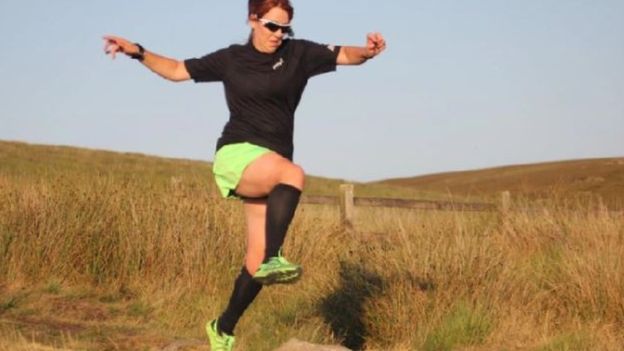
Leyland runner ‘saved by dogs’ after hill fall

10th April, 2019

Buddy and Merlyn behaved like a “tag team”, Pita Oates said

A runner who broke her leg on remote moorland was rescued after her dogs raised the alarm.

Pita Oates, 48, was left unable to stand after she fell on a three-mile run in Lancashire with her blue collies Buddy and Merlyn.

One of the dogs stayed with her as she inched down the hill, while the other ran around barking for help.

This attracted the attention of another dog walker who contacted emergency services.

Ms Oates, from Leyland, said: “They were like a tag team, Buddy never left me while Merlyn went for help.

“I would have died without a doubt, I wouldn’t have lasted the night.”

When help arrived Ms Oates, who had left her mobile phone in her camper van, was drifting in and out of consciousness and starting to suffer the effects of hypothermia.

She said: “It was the tail-end of Storm Gareth, it was freezing and I was soaking wet. The winds were horrendous.”

Ms Oates said she could have died on the moors without her dogs’ help

Ms Oates broke the femur behind her left knee and tore her anterior and cruciate ligaments on the run on Great Hill near Chorley on 12 March.

“I couldn’t stand up, I was having to bum-shuffle all the way down,” she said.

“Every time my leg touched the ground I was in pain so I rigged up a sling using the dog’s lead to keep my leg up.”

It took her 90 minutes to get down the hill by which time it had gone dark.

“Buddy never left me and Merlyn kept barking back at him – when this man came with his dog he knew something wasn’t right,” she said.

Paramedics and members of the Bowland Mountain Rescue Team, as well as two from Bolton Mountain Rescue, arrived to help rescue Ms Oates.

She spent eight days in hospital and had a titanium plate fitted but still needs another operation.

Pita Oates was on a three-mile run when she was injured

ooOOoo

Part of me is not surprised at the behaviour of Ms Oates’ dogs. Dogs show their care and attention in so many ways. But then again I was surprised because these two dogs knew exactly what to do. One to stay and one to seek help. Which is what they did.

It was a close-run thing (pardon the pun) as Pita was starting to fade away when help arrived.

Brilliant!

Being ever so grateful for one’s lot.

There’s a science background to being healthy and happy.

Especially as one gets older.

It’s Jean’s birthday today and we are grateful for our lot. I’m 75 now and Jean is a few years younger. But more importantly we are so grateful to have met and, subsequently, fallen in love.

As well as Jean’s love in return we have our gorgeous dogs as well (not to count in addition the two horses, the two parakeets and the cat) and they reinforce the feelings of happiness that surround us.

All of which is an introduction to an article on The Conversation that caught my eye yesterday.

I’m afraid it doesn’t mention dogs but then again we dog owners know for sure how they benefit us humans.

ooOOoo

Are you as grateful as you deserve to be?

November 26, 2019
By
Chancellor’s Professor of Medicine, Liberal Arts, and Philanthropy, Indiana University

Gratitude is not only a great feeling but a healthy one. Aaron Amat/Shutterstock.com

As a physician, I have helped to care for many patients and families whose lives have been turned upside down by serious illnesses and injuries. In the throes of such catastrophes, it can be difficult to find cause for anything but lament. Yet Thanksgiving presents us with an opportunity to develop one of the healthiest, most life-affirming and convivial of all habits – that of counting and rejoicing in our blessings.

Gratitude’s benefits

Research shows that grateful people tend to be healthy and happy. They exhibit lower levels of stress and depression, cope better with adversity and sleep better. They tend to be happier and more satisfied with life. Even their partners tend to be more content with their relationships.

Perhaps when we are more focused on the good things we enjoy in life, we have more to live for and tend to take better care of ourselves and each other.

When researchers asked people to reflect on the past week and write about things that either irritated them or about which they felt grateful, those tasked with recalling good things were more optimistic, felt better about their lives and actually visited their physicians less.

It is no surprise that receiving thanks makes people happier, but so does expressing gratitude. An experiment that asked participants to write and deliver thank-you notes found large increases in reported levels of happiness, a benefit that lasted for an entire month.

Philosophical roots

Giving thanks is important for our psyches and our souls. Love You Stock/Shutterstock.com

One of the greatest minds in Western history, the Greek philosopher Aristotle, argued that we become what we habitually do. By changing our habits, we can become more thankful human beings.

If we spend our days ruminating on all that has gone poorly and how dark the prospects for the future appear, we can think ourselves into misery and resentment.

But we can also mold ourselves into the kind of people who seek out, recognize and celebrate all that we have to be grateful for.

This is not to say that anyone should become a Pollyanna, ceaselessly reciting the mantra from Voltaire’s “Candide,” “All is for the best in this, the best of all possible worlds.” There are injustices to be righted and wounds to be healed, and ignoring them would represent a lapse of moral responsibility.

But reasons to make the world a better place should never blind us to the many good things it already affords. How can we be compassionate and generous if we are fixated on deficiency? This explains why the great Roman statesman Cicero called gratitude not only the greatest of virtues but the “parent” of them all.

Religious roots

Gratitude is deeply embedded in many religious traditions. In Judaism, the first words of the morning prayer could be translated, “I thank you.” Another saying addresses the question, “Who is rich?” with this answer: “Those who rejoice in what they have.”

From a Christian perspective, too, gratitude and thanksgiving are vital. Before Jesus shares his last meal with his disciples, he gives thanks. So vital a part of Christian life is gratitude that author and critic G.K. Chesterton calls it “the highest form of thought.”

Gratitude also plays an essential role in Islam. The 55th chapter of the Quran enumerates all the things human beings have to be grateful for – the Sun, Moon, clouds, rain, air, grass, animals, plants, rivers and oceans – and then asks, “How can a sensible person be anything but thankful to God?”

Other traditions also stress the importance of thankfulness. Hindu festivals celebrate blessings and offer thanks for them. In Buddhism, gratitude develops patience and serves as an antidote to greed, the corrosive sense that we never have enough.

Roots even in suffering

In his 1994 book, “A Whole New Life,” the Duke University English professor Reynolds Price describes how his battle with a spinal cord tumor that left him partially paralyzed also taught him a great deal about what it means to really live.

After surgery, Price describes “a kind of stunned beatitude.” With time, though diminished in many ways by his tumor and its treatment, he learns to pay closer attention to the world around him and those who populate it.

Reflecting on the change in his writing, Price notes that his books differ in many ways from those he penned as a younger man. Even his handwriting, he says, “looks very little like that of the man he was at the time of his diagnosis.”

“Cranky as it is, it’s taller, more legible, and with more air and stride. And it comes down the arm of a grateful man.”

A brush with death can open our eyes. Some of us emerge with a deepened appreciation for the preciousness of each day, a clearer sense of our real priorities and a renewed commitment to celebrating life. In short, we can become more grateful, and more alive, than ever.

Practicing gratitude

Good conversation, good friends and connections – not material possessions – bring great joy. Jacob Lund/Shutterstock.com

When it comes to practicing gratitude, one trap to avoid is locating happiness in things that make us feel better off – or simply better – than others. In my view, such thinking can foster envy and jealousy.

There are marvelous respects in which we are equally blessed – the same Sun shines down upon each of us, we all begin each day with the same 24 hours, and each of us enjoys the free use of one of the most complex and powerful resources in the universe, the human brain.

Much in our culture seems aimed to cultivate an attitude of deficiency – for example, most ads aim to make us think that to find happiness we must buy something. Yet most of the best things in life – the beauty of nature, conversation and love – are free.

There are many ways to cultivate a disposition of thankfulness. One is to make a habit of giving thanks regularly – at the beginning of the day, at meals and the like, and at day’s end.

Likewise, holidays, weeks, seasons and years can be punctuated with thanks – grateful prayer or meditation, writing thank-you notes, keeping a gratitude journal and consciously seeking out the blessings in situations as they arise.

Gratitude can become a way of life, and by developing the simple habit of counting our blessings, we can enhance the degree to which we are truly blessed.

[ Thanks for reading! We can send you The Conversation’s stories every day in an informative email. Sign up today. ]

ooOOoo

That reference to Reynolds Price and his challenges make one think. I have been fortunate that nothing really dreadful has happened to me; apart from my father’s death when I had just turned 12. I’m getting a little hazy in terms of certain memories but that’s an old age thing rather than an illness. But to go through what he did; I just don’t know the person that I am, in terms of how I wold react to that.

But to the general tone of the article, I would hope that I can get better and better.

For it’s splendid to cultivate that disposition.

One is to make a habit of giving thanks regularly – at the beginning of the day, at meals and the like, and at day’s end.

Perfect!

Now here’s a sight!

Walking improves vision!

Dogs are the masters of being on four legs. And, presumably, their sight benefits from being so active.

I have been following Tony who writes the blog One Regular Guy Writing about Food, Exercise and Living Past 100 for some time. Here is what he says about himself.

I’m Tony
I have been interested in eating healthy for more than 35 years. Unfortunately,  my actions haven’t always matched my aims. As Mae West said, “I used to be Snow White, but I drifted.”
I drifted too, for a long time, but after writing posts for this blog for nearly 10 years, I have gotten good at it. I used the Lose It! App for a while (iPhone, iPad, Touch) a calorie counter that also breaks down nutrients and gives you a daily weight chart to demonstrate your progress. It’s not the only tool like this around, but it’s a good one. I think you are better off using a tool than not using one, especially if you are just embarking on a weight loss program.

Using that tool and practicing some self discipline I now have complete confidence in my ability to maintain a healthy body weight. I still need to work on the lean muscle mass thing, though. I love riding my bicycle and have no problem logging lots of miles and putting calories into the bank to free up my eating. I average around 100 miles a week.  That covers a multitude of sins at the table. Biking is a wonderful cardio workout. Few people realize, however, it is also very stimulating for the brain. It’s a lot more fun than working with weights, but ya gotta do that, too. I write about the benefits of cardio exercise on the brain often in this blog as it is usually misunderstood and/or completely overlooked in most fitness writing. I had an aunt who died of Alzheimer’s, my mother who suffered from dementia in her final years, and my grandfather on my father’s side also had cognitive problems in his later years, so I am dead serious about protecting myself from mental decline. Check out my Page – Important facts about your brain – and exercise to read more about it.

I retired 19 years ago. I spent 20 years as a Reuters Correspondent and Editor after starting my career in men’s magazines. I taught journalism at Medill for a while and then wrote in the investment department of a major U.S. philanthropy where I spent my last few years managing $900 million in bond investments.

Now that I am retired, I have complete control over what I eat. My heart goes out to you folks who go to work every day. It is much harder to control your caloric intake. There are business lunches and dinners to attend, late days at the office, working through lunch as well as traveling. I think if I were still working I would seriously consider bringing lunch from home a day or two each week to keep a handle on my intake. With a fridge and microwave where you work, you are good to go.

When I started writing for this blog in March of 2010 I weighed 165 pounds, the lowest I had been in 15 years. I thought I had arrived at fitness and health. Now, in 2019, I weigh 155 pounds. That’s right, I have melted off a further 10 pounds from my best weight in years. My resting heart rate is under 50 beats per minute (bpm), a result of my cycling, but significantly under the ‘normal’ of 65 to 90 bpm for a guy in his upper 70’s. I have less than 16 percent body fat and a 31 inch waist (the first time since high school). I have reached this state of fitness and health following the ideas and techniques I write about in this blog. You can, too
When the blog started, I was talking the talk, over nine years later I am walking the walk. You can do the same. I am just a regular guy. If I can do it you can, too. Check out my page  How to Lose Weight and Keep it Off for a start. Lots of excellent, practical principles there that I have learned and now apply to my daily life.

Just over 20 years ago my weight got out of control and I ballooned over 220 pounds. I took off 50 pounds in a year, but that only got me down to the mid-170’s. You can read How I lost 50 pounds in 52 weeks if you want chapter and verse.

When I retired, I started taking courses from The Great Courses. They include “Nutrition Made Clear” by Professor Roberta Anding. She has an MS in Nutrition and is a registered Dietitian and a certified specialist in sports dietetics. Another superb course is “Lifelong Health: Achieving Optimum Well-Being at any Age” by Doctor Anthony Goodman. He also teaches “The Myths of Nutrition and Fitness.” By now, in 2019, I have probably taken more than a dozen courses on mental and physical health and wellness as well as  healthy aging.

I have about 40 games of backgammon going on the web. I was born January 26, 1940. I am an Aquarius and a senior citizen. At 79 years of age, I am healthier by far than I was over 20 years ago when I was in the work force and a relatively young man in my 50’s.

As a senior who presently is winning the war of the waistline,  I am also grappling with the experience of aging. As part of this blog’s focus on good health I look seriously into aging and what can be done about it. I know there is no fountain of youth, but there are techniques for aging gracefully and, more importantly, retaining one’s mental powers. I promise to share with you everything I can find out about it.

The masthead photo is a shot of me taken 40 years ago by a girlfriend when we were bike riding by the lakefront in Chicago. I had a lot more hair then.

Tony

Now Tony recently published a post that I found so interesting.

It’s all about improving one’s vision.

ooOOoo

Walking improves vision – Study.

By Tony, November 25th, 2019

As a big fan of walking I was thrilled to learn of this further benefit to the Cinderella of the exercise world. Walking leads to an increase of peripheral visual input, according to a study from the University of Wurzburg.

How do we perceive our environment? What is the influence of sensory stimuli on the peripheral nervous system and what on the brain? Science has an interest in this question for many reasons. In the long term, insights from this research could contribute to a better understanding of diseases such as ADHD and Parkinson’s disease.

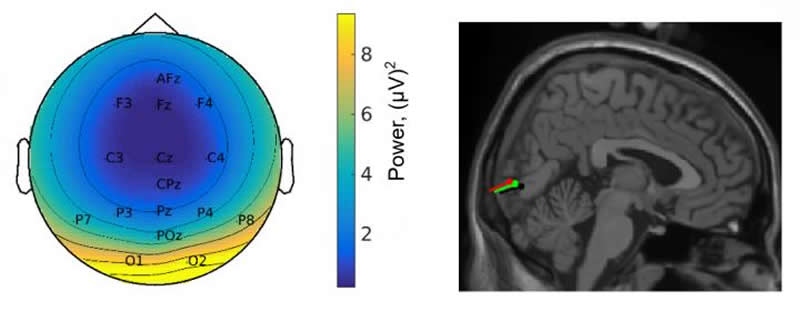
The topography of the EEG response (l) and its localization in the brain (r) show visual sensory processing during the walking conditions slow and normal – green and red, and standing – black. The image is credited to Barbara Händel.

Perception and the underlying neuronal activities are usually measured while subjects are sitting or lying, for example while doing magnetic resonance imaging. As a rule, the head is fixed and people are encouraged not to blink. The measurements therefore take place under well-controlled but rather unnatural conditions.

Shift of visual preference

When processing visual stimuli, however, it makes a difference whether the person is sitting or moving: When walking around, the peripheral part of the visual field shows enhanced processing compared to the central part. This can be proven both by the behaviorally measured perception of the test persons and by their brain response.

This shift in visual preference makes sense. “It is above all the peripheral visual input that provides information about the direction and speed of our movement and thus plays an important role for navigation,” says Dr. Barbara Händel. The neuroscientist from Julius-Maximilians-Universität (JMU) Würzburg in Bavaria, Germany, and her colleague Dr. Liyu Cao have published their findings in PLOS Biology

“It was known from animals that increased body movements lead to an increased firing rate in visual areas of the brain,” says Dr. Händel. So far, there are only a few behavioural experiments available for humans that investigate the influence of movement on sensory brain areas. However, there is evidence that cognitive processes are linked to the behavioural state. “For example, some studies show that people learn better when they move,” says the JMU researcher. However, the underlying neuronal mechanisms have not yet been tested in detail.

Mobile EEG, sensors and video glasses

It is precisely such gaps in knowledge that Barbara Händel wants to close with her work. In order to explore the link between movement and perception, sophisticated technical equipment is necessary. While the test subjects walk around, they wear electrode caps and a small amplifier that records their brain waves. The EEG data are sent wirelessly to a laptop, which the subjects carry in a backpack. Motion sensors, video glasses, and a mobile device for recording eye movements complete the setting.

Quite an effort. “But we have to take this step if we want to understand human perceptual strategies during natural behavior,” says Dr. Händel. Research into perception during movement is still in its infancy. It is now up to science to ask clever questions and find out which of them can be answered with mobile technical equipment.

Many exciting research questions

Next, the JMU scientist wants to further investigate the effect of altered perception during movement. Does it only occur for visual input or possibly also in other sensory areas? Does it, in addition to navigation, perhaps also play a role in other cognitive processes such as memory and creativity?

All this is possible: experiments with rats have shown that these animals learn better, when they are in motion. And the idea that walking increases creativity has existed since ancient times. “For example, the Peripatetics, a philosophical school around Aristotle, usually were discussing while walking, from which their name derives,” says Barbara Händel.

There is also a connection between creativity and eye movements: “It is known that people blink more often the more creatively they solve a task. And we found that people also blink more often when they walk around compared to being at rest.” Obviously, there are many connections between the movements of the body, the eyes and the mental performance. Their research could reveal many more interesting aspects.

To read further on the benefits of walking, check out my Page – Why you should walk more.

Tony

ooOOoo

I find this a very valuable article.

It shows that the benefits of walking are much more than the pure exercise.

I wonder if it applies to bike riding?

Finally, here’s wishing every one of you a Happy and Peaceful Thanksgiving Day!


FindShadow to the rescue!

There’s nothing so bad as losing one’s dog.

I was recently contacted by John Brooks. He writes of himself:

John Brooks loves animals from the core of his heart. Whenever he gets time, he tries to write regarding animal health & condition so that all pet lovers like you don’t fall in any hazardous situation.

He went on to explain that:

One day, Findshadow helped me to find my lost dog. So that I wrote about Findshadow.

So with no further ado, here is John’s post.

ooOOoo

What Is Findshadow How It Can Help You Find Your Missing Dog

Dog owners share a lot of the same grievances, annoyances, and frustrations. From getting up to your pet barking in the wee hours of the night to cleaning up after your dog’s mess during walks around the neighborhood, raising and taking care of a pet comes with a host of responsibilities. And with those responsibilities come work, and with work comes grievance, annoyance, and frustration.

However, one of the worst, most gut-wrenching feelings that dog owners can relate to is the moment you realize your dog is missing. After searching every room, backtracking to the park you were at with your dog in the morning, asking your neighbors if they have seen them and posting flyers on every telephone you can find, the hopelessness begins to set in.

Luckily for you, Findshadow, a free app that helps dog owners locate their missing companions, is harnessing the power of community and technology to reunite you with your lost pets. And it is doing a pretty darn good job.

So, what is Findshadow? It is is a free smartphone app that walks owners who have lost their pets step-by-step through the process of finding their dogs.

The app offers a wide array of services and tips for their users, all for free. First, you post your lost or found dog to the community. Then, the app gives you a completely personalized, step-by-step plan on how to use the app and other resources to locate your dog. While you may think of some of these steps yourself, you’ll be surprised how thorough the process can be.

After going through these first introductory steps, you can use Findshadow to print or download personalized street flyers. Although posting your pup to the community in-app will definitely increase visibility far more than strictly putting up posters, having physical images of your dog around the neighborhood will still help you get in front of a demographic that doesn’t have Findshadow downloaded.

You can share your post on social media to easily reach friends and family. With just the three aforementioned features, Findshadow has already allowed you to reach three different populations: Findshadow users, people in your neighborhood and your connections on social media.

Getting your dog’s photo in front of as many people as possible is the recipe to success for finding your dog as quickly as possible. The more people who see it, regardless if they use Findshadow or not, the more people who will be able to identify your pet if they see it.

Findshadow also has a nifty feature that makes it easier to contact nearby shelters to ask if they have seen your dog. Even if you don’t directly contact shelters yourself, Findshadow volunteers can help snap pictures of dogs in shelters and send them to you in-app to see if they match.

The sense of community behind Findshadow is powerful. Past users of Findshadow who have successfully been reunited with their dog because of the app give back to the community by becoming active volunteers. This creates a culture where owners are helping each other out. Every dog is considered important.

The interface of the app is easy-to-use and allows users to quickly switch between different features and services. You can browse through found dog listings to double-check posts to see if someone on Findshadow has already found your dog.

The amount of positive reviews and testimonials from dog owners who gush over the app is well-justified. The app has reunited countless owners with their dogs, oftentimes within the same day they went missing.

Even if you haven’t lost your dog, it is a great app to have downloaded just in case something does come up.

ooOOoo

This is the essence of blogging and sharing.

I hadn’t heard of Findshadow before now but will surely put the app on my phone.

Here’s the link to the FindShadow website.

How old is your dog?

Dan sends me a more accurate calculation.

Dear Dan and I recently had an email ‘conversation’ about the conversion of dog years to human years. Then, yesterday,  as in Thursday, he sent me the following article from ZME Science.

Enjoy!

ooOOoo

Here’s a better way to calculate dog years – backed by science.

Lets’s face it, 1 for 7 years is not accurate.

November 21, 2019

By Mihai Andrei

The formula is about mid-way through the article, and it includes a simple calculator.

We learn, as kids, to approximate dog age thusly: one dog year for seven human years. That’s a decent approximation in some cases, but the more you think about it, the more it starts to fall apart.

All dog breeds tend to follow a similar pattern: they reach puberty at 10 months old. Right off the bat, it’s clear that the approximation doesn’t work here, as humans don’t really reach puberty at 6 years. Dogs can also reach 20 years or even more, and 140 years has never been recorded for a human. All in all, while it can give a ballpark estimate, the 7-for-1 approach falls short in many regards.

But now, researchers have come up with a much more accurate formula to assess dog age in human years. This one, at least, is backed by science.

It started as a way to detect factors associated with dog aging, and it focused on a relatively new concept: DNA methylation. The idea is that as we age, our DNA undergoes chemical modifications which can be used as a sort of genetic clock. It’s a way of looking at our body’s wear and tear, as the influence of diseases and unhealthy lifestyle can also be observed (to an extent) with this approach.

It’s not just humans that have epigenetic clocks. Other species have them too — including dogs. Geneticist Trey Ideker of the University of California, San Diego, and colleagues, analyzed the DNA methylation patterns in the genomes of 104 dogs (all golden retrievers), ranging from 4 weeks to 16 years of age. Although just golden retrievers were analyzed, the patterns are very similar for all breeds.

There were remarkable similarities between the DNA methylation of dogs and humans. Although the two species diverged a very long time ago, dogs live in similar environments to humans, and they even have access to similar healthcare.

Simply put, the patterns of DNA methylation in young dogs tended to be similar to those in young humans — the same goes for older dogs and older humans.

Finally, the study also demonstrates that these patterns can be used to translate the age-related physiology of one organism (in this case, dogs) to another organism (humans).

The formula is not linear, and is not exactly simple, but here it is:

Human Years = 16 ln(Dog Years) + 31,

where ln is the natural logarithm.

Inputs

Dog_years:

Outputs

Human_years:

-∞

Powered by JSCalc.io


Logarithmic function for epigenetic translation from dog age (x-axis) to human age (y-axis). Tom Hanks for scale. Image credits: Wang et al

The natural logarithm is used because dogs and humans don’t age similarly. Dogs seem to age very quickly in the first part of their life (which is why the age of young pups seem very weird translated into human years), but their ageing process slows down massively compared to that of humans. So the translation dog to human years cannot be linear — it is logarithmic. When your dog is 1 year old, he’s approximately 30 in human years. When he’s 2 years old, he’s 42. He’s around 60 human years by the time he’s 6, but only 70 by the time he’s 12.

It’s a weird thing to wrap your mind around and it is definitely not a perfect translation from dog years to human years, but it works much better than all existing alternatives. It also works to explain why some dogs reach sexual adolescence as early as 6 months old — the onset for that is around 10-14 years for humans. Dogs are adolescent until about 2 years, which in humans lasts until 25 years old. Then, maturity for dogs is around 2-7 years, and for humans around 25-50 years. Similar calculations (but with a slightly different formula) can be carried out for other animals, including cats and mice, researchers conclude.

The study can be read in its entirety for free on biorXiv.

ooOOoo

M’mmm, I think I need a little more time to absorb that!

Part Two of that post about Pharaoh!

A wonderful dog!

I have re-read this post and have choked up. For Pharaoh was the supreme dog for me to have as a companion during this stage in my life. I suspect you will read that clearly in the post that follows.

ooOOoo

The concluding part-two of meeting Pharaoh 

Pharaoh, as of yesterday afternoon!

In yesterday’s first part of my recollection of having Pharaoh in my life for over ten years, I focussed on the early days.  Today, I want to take a more philosophical view of the relationship, right up to the present day.

The biggest, single reward of having Pharaoh as my friend goes back a few years.  Back to my Devon days and the time when Jon Lavin and I used to spend hours talking together.  Pharaoh always contentedly asleep in the same room as the two of us. It was Jon who introduced me to Dr. David Hawkins and his Map of Consciousness. It was Jon one day who looking down at the sleeping Pharaoh pointed out that Dr. Hawkins offered evidence that dogs are integrous creatures with a ‘score’ on that Map of between 205 and 210. (Background story is here.)

So this blog, Learning from Dogs, and my attempt to write a book of the same name flow from that awareness of what dogs mean to human consciousness and what Pharaoh means to me.  No, more than that!  From that mix of Jon, Dr. David Hawkins, experiencing the power of unconditional love from an animal living with me day-in, day-out, came a journey into my self.  Came the self-awareness that allowed me to like who I was, be openly loved by this dog of mine, and be able to love in return.  As is said: “You cannot love another until you love yourself.

Moving on.

Trying to pick out a single example of the bond that he and I have is practically impossible.  I have to rely on photographs to remind me of the thousands of times that a simple look or touch between Pharaoh and me ‘speaks’ to me in ways that words fail. Here’s an extract from my celebration of Pharaoh’s tenth birthday  last June 3rd; written the following day. It comes pretty close to illustrating the friendship bond.

oooo

For many years I was a private pilot and in later days had the pleasure, the huge pleasure, of flying a Piper Super Cub, a group-owned aircraft based at Watchford Farm in South Devon.  The aircraft, a Piper PA-18-135 Super Cub, was originally supplied to the Dutch Air Force in 1954 and was permitted by the British CAA to carry her original military markings including her Dutch military registration, R-151, although there was a British registration, G-BIYR, ‘underneath’ the Dutch R-151.  (I wrote more fully about the history of the aircraft on Learning from Dogs back in August 2009.)

Piper Cub R151
Piper Cub R151

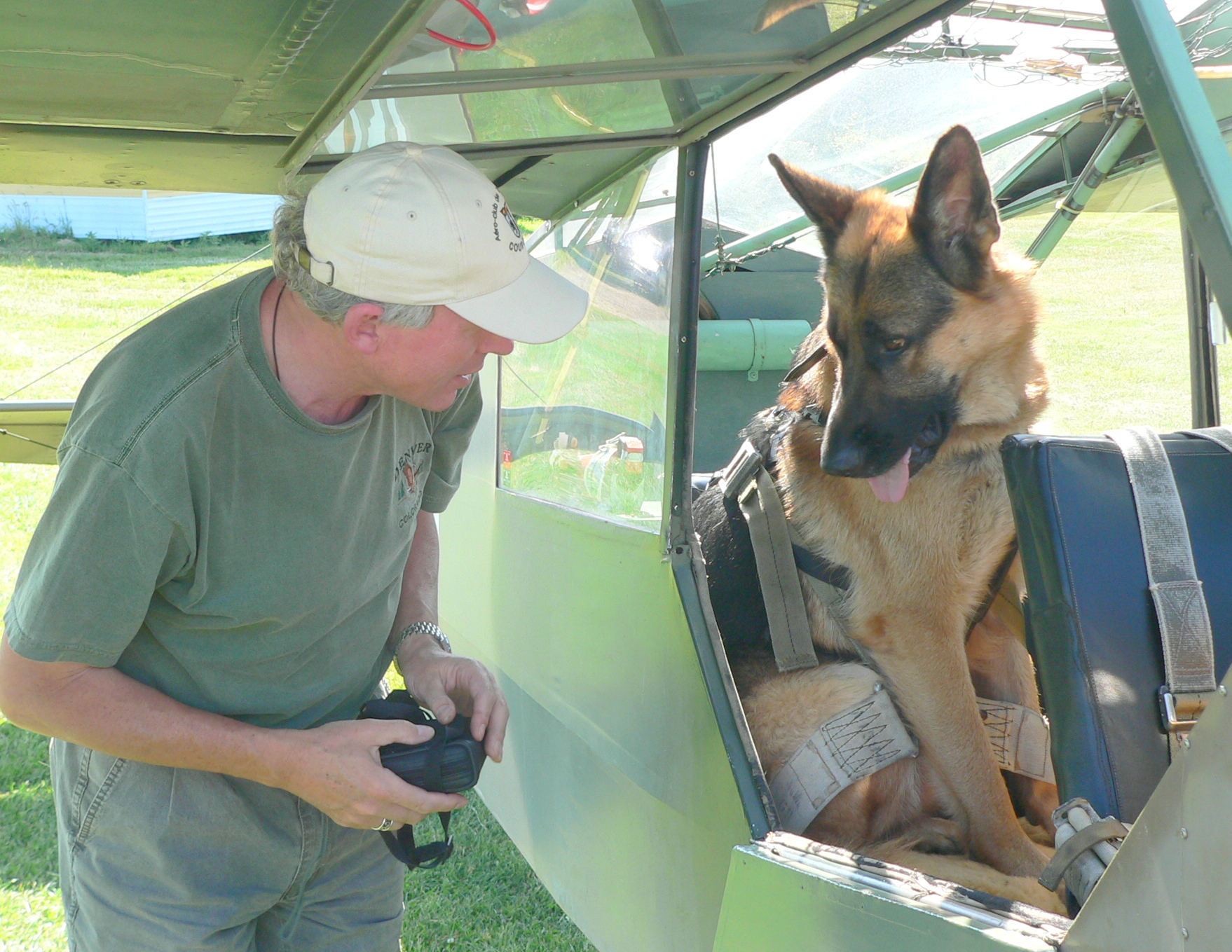
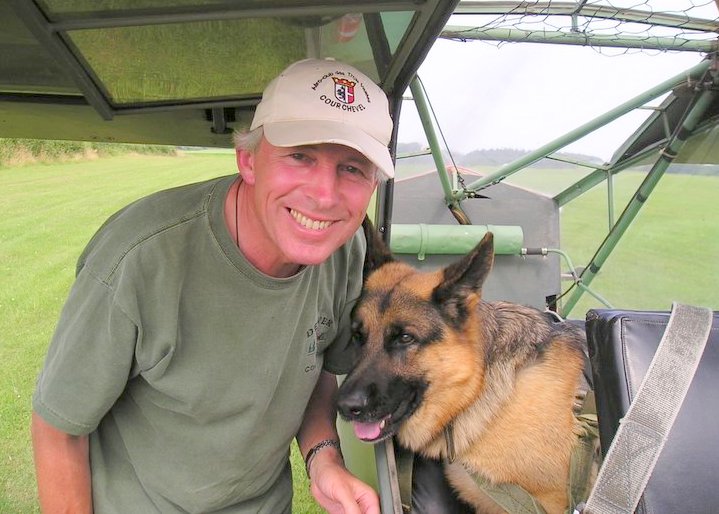
Anyway, every time I went to the airfield with Pharaoh he always tried to climb into the cockpit.  So one day, I decided to see if he would sit in the rear seat and be strapped in.  Absolutely no problem with that!

Come on Dad, let's get this thing off the ground!
Come on Dad, let’s get this thing off the ground!

My idea had been to fly a gentle circuit in the aircraft.  First I did some taxying around the large grass airfield that is Watchford to see how Pharaoh reacted.  He was perfectly behaved.

Then I thought long and hard about taking Pharaoh for a flight.  In the Cub there is no autopilot so if Pharaoh struggled or worse it would have been almost impossible to fly the aircraft and cope with Pharaoh.  So, in the end, I abandoned taking him for a flight.  The chances are that it would have been fine.  But if something had gone wrong, the outcome just didn’t bear thinking about.

So we ended up motoring for 30 minutes all around the airfield which, as the next picture shows, met with doggie approval.  The date was July 2006.

That was fun!
That was fun!

oooo

Moving on again.  This time to another flying experience.  To the day when Pharaoh and I flew out of London bound for Los Angeles and a new life with Jeannie and all her dogs (16 at that time) down in San Carlos, Sonora County, Mexico.  The date: September 15th, 2008.  Just ten months after I had met Jean in Mexico and realised that this was the woman that I was destined to love! (Now you will understand why I described earlier the Jon Lavin, Dr. Hawkins, Pharaoh mix as the biggest, single reward of having Pharaoh as my friend!)

There followed wonderful happy days for me and Pharaoh.  Gorgeous to see how Pharaoh became so much more a dog, if that makes sense, from having his own mini-pack around him.  Those happy days taking us all forwards to Payson, AZ, where Jean and I were married, and then on to Merlin, Oregon arriving here in October, 2012.

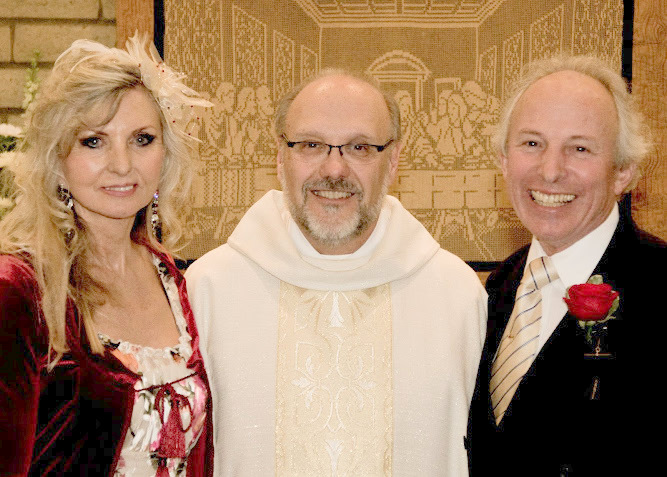
Fr. Dan Tantimonaco with the newly weds!

oooo

Pharaoh 'married' to his dearest friends. December, 2013.
Pharaoh ‘married’ to his dearest friends. December, 2013.

oooo

Perfect closeness. Pharaoh and Cleo with Hazel in the middle. Taken yesterday.
Smelling the flowers! Pharaoh and Cleo with Hazel in the middle. Taken yesterday.

I could go on!  Hopefully, you get a sense, a very strong sense, of the magical journey that both Pharaoh and I have experienced since I first clasped him in my arms back in September, 2003.

Both Pharaoh and I are in the Autumn of our lives, he is 11 in June; I am 70 in November, and we both creak a little. But so what! Pharaoh has been my greatest inspiration of the power of unconditional love; of the need to smell the flowers in this short life of ours.

One very great animal! (March 25th, 2014)

Thank you, my dear, dear friend!

ooOOoo

Yes, thank you, and thanks to all the dogs that love us and to whom we offer love in return.

Today, as in the 20th November, 2019, just happens to be our anniversary, nine years ago we were married. We met just before Christmas, 2007.