Category: Musings

The learning curve.

A guest post from Dr John W Lewis.  John and I have known each other for some years now, both of us sharing a group aircraft that was based in Exeter, SW England.  His areas of interest and competence are described here.  But these days when John and I chat about the world in general and nothing in particular we often come back to the topic of innovation.  So bear that in mind as John muses on the rather gloomy nature of a recent post on Learning from Dogs.

John writes:
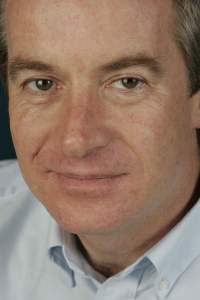
John Lewis

Having read the recent Post, Group Human Insanity, my first instinct is that I have nothing particular worthwhile to say that has not been said before.  But, of course, the time to apply minds is exactly when the answers don’t readily come to mind, so I will continue!

In a way, it’s probably a case of applying the sentiment on the old wartime poster, “Keep calm and carry on!” or as Winston Churchill said, “I’f you’re going through hell, keep going!”.

That doesn’t mean that we don’t need to change, because we do. It doesn’t mean that we don’t need to put a lot more effort into things that matter, because we do. But, as has been said before, “you can’t connect the dots looking forward, only looking backwards”. In other words, “it is very difficult to make predictions, especially about the future”.

Reading about this kind of thing in books, such as  “Freakonomics” or “Drive” or “Switch” suggests that we don’t really understand the mechanism by which behavioural changes happen in populations, although some of the discoveries of Everett Rogers about the diffusion of innovations is relevant here. To refer to another book, there is probably going to be a lot of “Who moved my cheese?” hemming and hawing behaviour going on too.

All we really know is that when the environment (in the most general sense) is changing rapidly, populations are much better off if they are diverse in their characteristics and behaviour; also I believe (but am not sure) that it’s true to say that increased communication assists populations in adapting to changes in the environment.

So the most important thing to do is to let lots of different people do lots of different things in search of ways forward.  If you like, we need to split up (within the multidimensional behavioural space in which we operate) into smaller groups to dodge the big boulders.

We need to communicate lots of information and lots of ways of interpreting and verifying not only the information itself, but also the operational implications of that information (which may be very different things). Hopefully this will reduce (but it will never eliminate) instances of mass movements (as in stampedes) based on partial information which misdirect substantial resources into activities that turn out to be dead ends.

If we don’t believe that there are any viable ways forward, then we might as well give up and just enjoy what’s left of the good times!

But if there are ways forward, then the way to find them is to have lots of people scouting ahead on lots of fronts and passing information around so that we maximise the chances of finding those ways forward, and having lots of other people striving to find ways to make use of that information and testing out those ways forward.

Whether this is all obvious, or not, I don’t know; but it probably is. One thing we do know is that telling people what to do is emphatically not going to work! Just look at some of the stories on the Breaking The Mould website.

Instead, we are better off when people are asking questions, gathering information and passing it around. I believe that if these behaviours are adopted in a population, as a result of ‘external’ pressures building up, then changes and innovations will inevitably occur, and this is about the best that we can do! Fortunately, I think that is what tends to happen anyway.

So, in a sense, as I referred to above: “Keep calm and carry on”  (By the way, a Google search on that phrase unearths a variety of interesting stuff and variations such as “Get excited and make stuff”)

Regards,
John

Dr John W Lewis
holosoft

Email: john.lewis@holosoft.com
Skype: john_w_lewis
Twitter: @JohnWLewis

Blog: http://observations.johnwlewis.info
LinkedIn: http://www.linkedin.com/in/johnwlewis
FriendFeed: johnwlewis

and it’s so insignificant!

Yesterday’s post It’s all we have showing the famous Earthrise picture taken from Apollo 8 generated a lovely follow-up.

One of the comments was from Mike Turner who wrote,

It’s all we have and it’s so insignificant!

The Pale Blue Dot

Mike included a link to an entry on WikiPedia about the tiny, small dot of light in the universe that is Earth, shown in a photograph taken by spaceship Voyager 1 from the edge of the Solar System on February 14th, 1990.  Here’s that photograph,

Planet Earth from 3,762,136,324 miles

Can you see our planet home?  Earth appears as a tiny dot (the blueish-white speck approximately halfway down the brown band to the right) within the darkness of deep space. In a 2001 article by Space.comSTScI‘s Ray Villard and JPL‘s Jurrie Van der Woude selected this photograph as one of the top ten space science images of all time.

Carl Sagan later wrote about his deep feelings about this photograph.  That was almost 20 years ago and, as I reflected just a few days ago, human insanity still seems alive and well; it’s about time that the majority of us recognised the fragility and vulnerability of where we live.

Sagan’s words are reproduced here and should be read by every inhabitant of this planet.

From this distant vantage point, the Earth might not seem of particular interest. But for us, it’s different. Look again at that dot. That’s here, that’s home, that’s us. On it everyone you love, everyone you know, everyone you ever heard of, every human being who ever was, lived out their lives. The aggregate of our joy and suffering, thousands of confident religions, ideologies, and economic doctrines, every hunter and forager, every hero and coward, every creator and destroyer of civilization, every king and peasant, every young couple in love, every mother and father, hopeful child, inventor and explorer, every teacher of morals, every corrupt politician, every “superstar,” every “supreme leader,” every saint and sinner in the history of our species lived there – on a mote of dust suspended in a sunbeam.The Earth is a very small stage in a vast cosmic arena. Think of the rivers of blood spilled by all those generals and emperors so that, in glory and triumph, they could become the momentary masters of a fraction of a dot. Think of the endless cruelties visited by the inhabitants of one corner of this pixel on the scarcely distinguishable inhabitants of some other corner, how frequent their misunderstandings, how eager they are to kill one another, how fervent their hatreds.

Our posturings, our imagined self-importance, the delusion that we have some privileged position in the Universe, are challenged by this point of pale light. Our planet is a lonely speck in the great enveloping cosmic dark. In our obscurity, in all this vastness, there is no hint that help will come from elsewhere to save us from ourselves. [my italics, Ed]

The Earth is the only world known so far to harbor life. There is nowhere else, at least in the near future, to which our species could migrate. Visit, yes. Settle, not yet. Like it or not, for the moment the Earth is where we make our stand.

It has been said that astronomy is a humbling and character-building experience. There is perhaps no better demonstration of the folly of human conceits than this distant image of our tiny world. To me, it underscores our responsibility to deal more kindly with one another, and to preserve and cherish the pale blue dot, the only home we’ve ever known.

You may also wish to watch this video.

Thanks Mike for prompting this piece.

Afghanistan and truth!

“But better to be hurt by the truth than comforted with a lie.”

The quote is from the film, The Kite Runner, which was based on the book  of the same name written by Khaled Hosseini.

This Post is not about taking a position, at any level, about the West’s involvement in the war in Afghanistan – far too dangerous territory!  But it is a reflection on what truth means.

At first that proposition might appear bizarre, of course we know what truth means. My Thesaurus offers three meanings: Correspondence with fact or truth; Freedom from deceit or falseness; The quality of being actual or factual.  Clear?  H’mmm not really in this instance.

OK, to the motivation behind this article.

Last Sunday two outwardly disconnected actions came together, as often seems to happen, to cause me to ponder on how my opinions are formed.  The actions concerned Afghanistan.

The first was that a friend from the congregation gave me his copy of TIME Magazine for January 17th.  In it was an article about a Black Hawk Medevac unit in Afghanistan.  From the TIME website:

The Birds Of Hope: With A Black Hawk Medevac Unit In Afghanistan

By James Nachtwey Monday, Jan. 17, 2011

General William Tecumseh Sherman got it right. War is hell. But even within the cruelty of war, there exists mercy.

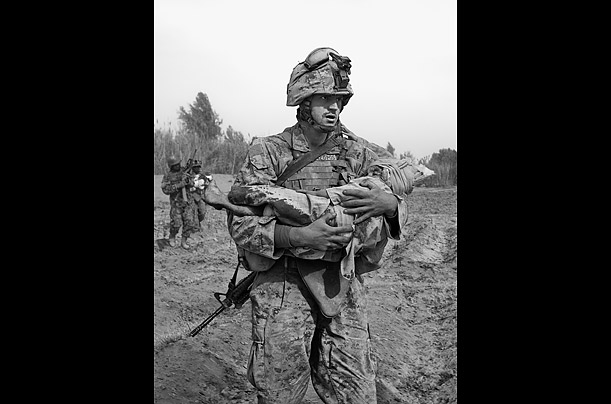
Across a dusty field, two U.S. Marines walk toward a helicopter, each carrying a bloodied and bandaged child. They hold the children as if they were their own. Although at this moment they appear as saviors, a few minutes earlier, they had called in air support in response to enemy fire. The shooter was among children, however (a fact that I have to believe was not known to the Marines), and two were seriously wounded by fragments from machine-gun rounds.

Innocent people are caught in the cross fire in all wars. That’s reality. The two Marines never signed up to hurt kids, and in the shock and confusion, their default reaction was to be protective of the children they indirectly had a hand in wounding. The kids were not left to die, as they might have been in another time and another place by other armies. Instead, a U.S. Army air-ambulance medevac crew was dispatched to fly them to the same medical facility that treats American casualties. If the shooter had survived, he too would have been helped.

Read more: http://www.time.com/time/magazine/article/0,9171,2041191,00.html#ixzz1Byu1S0xj

The article in TIME Magazine contained some emotionally powerful pictures, such as the one below.


A Marine carries an Afghan child.

The full description of the photograph, taken by James Nachtwey for TIME , is Helping Hand
A Marine carries an Afghan child, one of two wounded by coalition aircraft during an air support mission.

My reaction on reading the gruelling story was confused and difficult to articulate clearly but certainly not complimentary! Something along the lines of big and powerful nations, such as the USA, Russia and the United Kingdom, playing out their global strategies with no real insight into the pain and suffering caused by their big ‘war games’.

The second action was that Jean had returned a rental film to the local Blockbuster store and returned with another one that had caught her eye for us to watch on Sunday evening.  That film was The Kite Runner based on the book of the same name by Khaled Hosseini.

There’s a good summary of the plot of the film at WikiPedia.  Here’s a flavour.

In Kabul, prior to the Soviet invasion of Afghanistan, well-to-do young boy Amir and his loyal young Hazara servant Hassan are best of friends. Amir enjoys writing and literature, reading stories to the eager but illiterate Hassan. Amir’s Baba (father), is contemptuous of Amir’s writing and privately regards him as a weakling for letting Hassan protect him from bullies. Baba’s friend Rahim Khan demonstrates interest and encouragement to Amir. Assef, a bully with rancor towards Hazaras, and two accomplices confront Hassan and Amir, but Hassan prevents the attack with a slingshot, a birthday gift from Amir. Assef swears revenge, ridiculing their relationship as mere master and servant. .

Soon the Soviets invade Afghanistan; forcing Baba, a known anti-communist, to flee the country leaving Rahim Khan as property caretaker. En route to Pakistan, Baba bravely risks his life defending a female refugee from a Soviet soldier who demands to rape her in return for safe passage for all. Baba and Amir eventually reach the United States as humble refugees in Fremont, California. Baba tends a gas station while Amir attends community college and vends at a weekly flea market. There, Amir meets Soraya Taheri; Soraya is interested in Amir’s writing although her father, the ex-General Taheri, a proud traditional Pashtun, is contemptuous. Baba is stricken mortally ill but manages to obtain General Taheri’s permission for Amir to marry Soraya. Although Soraya feels bound to confess her previous relationships, they are happily married despite an inability to conceive children. As foreshadowed in the movie’s first scene, Amir’s debut novel is published, dedicated to Rahim Khan who encouraged his writing.

It was a fabulous film, one of the more thought-provoking films seen in many years.  If you haven’t seen it, do so.

So to the point of this article.

The film demonstrated to me that my rather black-and-white opinion of the West’s involvement in Afghanistan was based much more on my instincts that ‘war is bad’ and that the USA tends to throw its military weight around, than having a clue as to the enormous complexities, both at the level of a family and of the nation, that these conflicts entail.

The film showed a much more compassionate aspect to the activities of the USA, specifically in getting involved in Afghanistan and, more generally, in a policy of offering a new home and new hope to those from afar.

And for me, the realisation that while it may be said, ‘There is only one truth’, knowing what that truth is is something very much more challenging!

The first casualty when war comes is truth“. (Hiram W Johnson, senator for California, 1917)

A small epiphany.

A lovely and unexpected result from seeing Dr David R. Hawkins last Saturday.

Jean and I drove across to Cottonwood, just South-West of Sedona in Arizona, last Saturday to attend a Question and Answer meeting hosted by Dr David R. Hawkins.  It’s described on the website thus:

Question & Answer Sessions

These Saturday sessions open with a few remarks by Dr. Hawkins. He then receives and answers questions from the audience that relate to information presented in his books and lectures, as well as other spiritual matters and current events.

To my mind, apart from the pleasure of seeing this famous man in the flesh, so to speak, the event was not as inspirational as I might have hoped.  Largely, in my view, because so many of the people lining up to sit opposite the great man and ask their question seemed more motivated by hero worship than in a search of their personal truth.  In fact, many did not wish to ask a question, just to sit there in silence or shake his hand.

However, that isn’t the point of this piece.  The point is that Jean realised, deep in her heart, what really can be achieved through the power of love.  Jean had been reflecting, sitting there in the audience, about how quickly our sweet Corrie had died last Tuesday night.

Corrie was a young dog and despite the injuries she received having been fatal, Jean was still surprised that Corrie went from being conscious of her name and responding to touch to dead in about 45 minutes.  She was in a great deal of pain during the last 20 minutes or so.  Jean’s significant experience is that young, healthy dogs take many more hours to die from the sort of wounds that Corrie had sustained.

The epiphany that came to Jean on Saturday was that the love and comfort that Corrie was receiving from both Jean and me, gave Corrie the permission to stop fighting for her life and just go gracefully and peacefully.  It doesn’t in any way lessen the tragedy of losing Corrie but from that has come the revelation that our unconditional love for that small animal made a difference, a real tangible difference during the last few moments of her physical life.

It was an unexpected but very beautiful outcome from the day.

To understand everything is to forgive everythingBuddhist quote

Dr Bruce Lipton continued

The concluding videos from his lecture The Biology of Perception.

No point in going any further if you haven’t seen Parts 1 to 4 which are here.

Here are Parts 5 to 7.

In humble recognition of great writers

The technology of the Internet will prove to be of huge democratic value.

Those who know me know a disquieted man.  Someone, who despite being more at peace with himself than ever before, nonetheless senses that we, as in the mankind of Planet Earth, are already deep in the ‘no mans land’ of change between the last, say, forty years and a very different future just around the corner.

In the past opinion and commentary has been in the hands, more or less, of the giant media moguls.  But technology has changed that.  Now more than ever a huge people have access to the Internet.  Indeed, a quick Google search reveals that of a world population of 6.85 billion people, just under 2 billion (29%) have internet access.  In North America that percentage is 77.4% (226 million) and in Europe the percentage is 58.4% (475 million).  I.e. nearly a billion people in just North America and Europe!

My point is that, in a manner never before experienced in human history, the vast majority of us have the ability to read, learn and muse about the critically important issues facing us today, coming to conclusions that carry political weight.  We have almost infinite choice as to where and how we form opinions.

Thus having access, via the internet, to the scribblings of so many wise people may end up giving democracy the boost it really needs in the face of overwhelming powerful plutocratic forces.

Here are just a couple of those wise voices.

Simon Johnson

I first came across him in an article in The Atlantic Magazine back in May 2009.  That article was called The Quiet Coup.  If you haven’t read it, go here.  It is introduced thus:

The crash has laid bare many unpleasant truths about the United States. One of the most alarming, says a former chief economist of the International Monetary Fund, is that the finance industry has effectively captured our government—a state of affairs that more typically describes emerging markets, and is at the center of many emerging-market crises. If the IMF’s staff could speak freely about the U.S., it would tell us what it tells all countries in this situation: recovery will fail unless we break the financial oligarchy that is blocking essential reform. And if we are to prevent a true depression, we’re running out of time.

Simon is also one of the lead writers for the Blog Baseline Scenario.  Have a read of a recent article about the appointment of Bill Daley as President Obama’s new chief of staff.  That article concludes thus:

Top executives at big U.S. banks want to be left alone during relatively good times – allowed to take whatever excessive risks they want, to juice their return on equity through massive leverage, to thus boost their pay and enhance their status around the world.  But at a moment of severe financial crisis, they also want someone in the White House who will whisper at just the right moment: “Mr. President, if you let this bank fail, it will trigger a worldwide financial panic and another Great Depression.  This will be worse than what happened after Lehman Brothers failed.”

Let’s be honest.  With the appointment of Bill Daley, the big banks have won completely this round of boom-bust-bailout.  The risk inherent to our financial system is now higher than it was in the early/mid-2000s.  We are set up for another illusory financial expansion and another debilitating crisis.

Bill Daley will get it done.

Now let’s turn to that other writer, Patrice Ayme.

That name is a nom-de-plume but so what!  Having read Patrice for some time now and corresponded via email from time to time, I have to tell you this is one giant of an intellectual thinker.  Take this Post from example: Pluto Lie #1: Glass Beads Matter More It’s a beautifully written article but not something that you should try a skim read through; it deserves a really focussed mind on the words and the meanings expressed. Here’s a flavour:

Abstract: An American historian paid by the hyper rich, exhumed again the old fallacy that material riches matter more than anything else. He points at recent electronic gadgetry, and attributes it to Reagan. This article of faith in Reagan and American plutocracy amusingly gives, obviously without knowing, prominence to recent French and German governmental research, which allowed to make such gadgets.

I skewer this lamentable, not to say corrupt, piece of dismal propaganda which was published all over the American media, for Christmas. I use the occasion to give a new metric to evaluate riches over the last 100,000 years, explain why the USA does not use the metric system, and what European kings were really about.

Too great a disparity of riches is another name for plutocracy.  Indeed, money is power, and thus, too much money is too much power.

Here is how Patrice’s article closes (but it would be so much better if you read the article in its entirety):

Morality? Europeans Kings of old could live long, and lived strong.The best of them were working relentlessly, brandishing whatever it took to stabilize the situation ethically, politically, and civilizationally. They were incredibly brutal. They would die, and kill, just over the length of hair (kings and prospective kings wore it long, religious wore it nought). Even small children, if viewed as potential kings, would be presented with the scissors and the sword (if they did not go for the former, they would get the later).

So of course, kings of old would have made it to today’s highest class. Kings were often the richest people around, and they got there, or stayed there, by killing, in the name of new, and higher principles. This only happened because their subordinates agreed to strive towards the same new and higher principles. Hanson misses completely the spiritual dimension of the kings of old. Kings of old led an ethical revolution, which was their reason for being in power, and why people elected them (or elected to follow them).

Kings of old lived very comfortably by their metrics, with residences all around Europe, and wives, concubines, nobles under oaths to serve them (to death). Some, such as Charlemagne, were very healthy into old age. What’s more fun than to make war for decades, mostly winning, as Charlemagne did?

Dr. Victor Davis Hanson, a classicist and military historian, is a senior fellow at the Hoover Institution and a recipient of the 2007 National Humanities Medal.

That appurtenance, too, tells volumes. Hanson has tales to tell, and they sing of American plutocracy. It remains to be seen if history will sing along. Two things, though: history does not tell lies, and human beings are not reducible to gadget loving midgets.

So to repeat my point.  Whether or not one choses to agree with the likes of Simon Johnson and Patrice Ayme there is no doubt that in my mind it will be writers like these that, through the better education of millions of citizens, will not only preserve democracy in so many countries but will ensure that the age before us will be fairer and more just.

Change can be achieved by the threat of tomorrow being the same

even quicker than by the hope of tomorrow being different! C. Graham-Leigh.

Some old reminders for a New Year!

“When the student is ready, the teacher will appear.” Buddhist quote.

A number of thoughts and experiences came together to prompt the writing of this Post.  It’s a much longer and more reflective post than usual but is offered in the loving hope that there can be no caring without sharing.

Firstly, good American friends, Gordon and Linda, whom Jean and I got to know in Mexico, recently sent us a Happy New Year

George Carlin

email, that included a slide presentation entitled Philosophy of Old Age.  It was based on the writings and wisdom of George Carlin, one of the all-time great comedians of the world.  But George Carlin (1937-2008) was much more than a great comedian.  Much of his humour was a playful but very sharp form of social commentary on the ‘big world’.  (P.S. George Carlin’s website is here, a rather strange experience in the sense of a virtual life after death.)

Anyway, back to the slide presentation from Gordon and Linda.

The slide presentation felt worthy of a post on Learning from Dogs but, thankfully, it was available in a better format for a WordPress Blog, a YouTube video.  Here it is.

You can see that there are some very deep but simple messages about what, in the end, are the really important things in life.  Top of the list is ‘love’.  Especially unconditional love.

That takes me to second element of what motivated me to write this piece.

Just 14 days ago, I participated in a memorial service described as ‘A Memorial Service For the Lives of Loved Ones Lost‘ at our local St Paul’s Episcopal Church here in Payson.  The idea came out of a comment from friend, mentor and fellow Blog author, Jon Lavin, who had noted that the language that I used when speaking of my father, now dead for well over 50 years, was the language of a child who hadn’t been ‘released’ from that event (I was just 12 at the time) rather than that of an adult who accepts that death is part of the natural order of the world.

Losing a loved one is tough, incredibly tough, and full of pain and anguish in a very deep-seated and personal manner.  That’s the perspective from the loved ones left behind with more life ahead of them.  But if one thinks of it in reverse, what is the one thing that we would want to leave behind when we die?

It is, without doubt, that our death does not leave in the hearts and souls of those left behind, whom we loved and who loved us, pain and anguish that isn’t embraced and dealt with healthily.

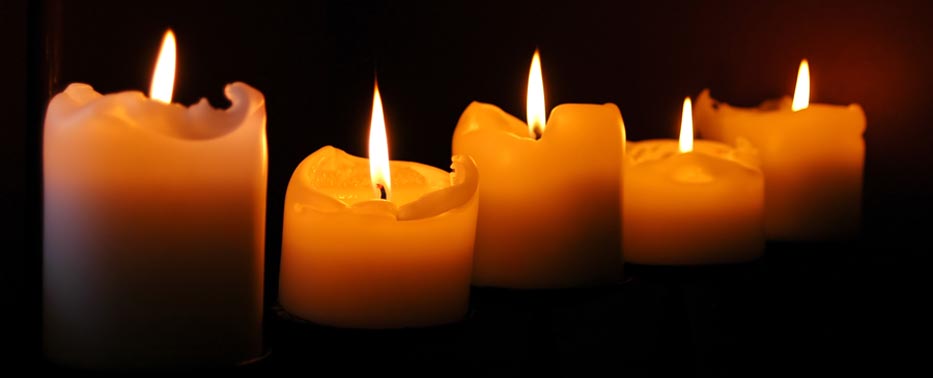
It was that collective unresolved pain and anguish that brought all of us together at that Service on the 20th.  It was a wonderful release for all present.  During the Service the Advent Wreath candles were lit.  Here are selection of the thoughts that were voiced and released as the four candles were lit.

This first candle we light is to remember those whom we have loved and lost.  We pause to remember their name, their face, their voice, the memory that binds them to us in this season.

This second candle we light is to redeem the pain of loss; the loss of relationships, the loss of jobs, the loss of health.  We pause to gather up the pain of the past and offer it to God, asking that from God’s hands we receive the gift of peace.

This third candle we light is to remember ourselves this Christmas time.  We pause and remember these past weeks and months and years; the disbelief, the anger, the down times, the poignancy of reminiscing, the hugs and handshakes of family and friends, all those who stood with us.

This fourth candle is lit to remember our faith and the gift of hope which the Christmas story offers us.

Light defeats darkness.

Go back and see those words that accompanied the lighting of the third candle. It included “to remember ourselves“. Once again, it’s loving ourselves, accepting that we spend our lives doing our best; in other words the answers to the unresolved issues that can haunt us is simple acceptance of who you are and being at peace with you!

Now I’m conscious that this is running on a bit but I pray that this is reaching out to others – we all need better clarity at times in our lives.  So before I go on to the third and last element which has me in front of this keyboard, let me share what I wrote, privately, a few days before the Service on the 20th in trying to make sense of my own feelings about the loss of my father.

    If we don’t embrace who we are and why we are who we are, i.e. real self awareness, we are condemned to being emotionally dysfunctional to a greater or lesser degree for a long time.  If we understand and love ourselves, avoiding the ‘easy’ route of constantly reminding ourselves what is ‘wrong’ with us, not being a victim to guilt, and on and on, then we see a better, softer, more loving world though our eyes.  Then the world reflecting back what we think about most rewards us with a better, softer, more loving world. 

    Loving ourselves, letting go, opening our arms to peace and joy is the true gift that we have really been given by the ‘loss’ of the loved one.

What I am embracing is that the emotional consequences of my father’s death, all those many, many years ago, created degrees of emotional dysfunction that went on for far too long.  Being free to walk clear of those emotional ‘hooks’ is not only so much better for me and those who love me, it is exactly what my father would have wanted!

Being clear of deep emotional burdens allows us to love ourselves and from that comes the greatest personal gift of all – unconditional love for others.  There’s that love word again!

OK, now to the third and final element!  Wake up at the back there!

The year 2010 was for me and Jean the epitome of a joyous journey that started, coincidentally, on a December 20th, this one in 2007.  On that evening in a bar/nightclub in San Carlos, Mexico, six days after I had arrived to stay with friends who had known Jean for many years, that I asked Jean for a dance, put my arm around her waist, and experienced something mystical – I knew she was the woman I would love to my last breath.

Thirty-five months later, on November 20th 2010, Jean and I were married in St. Paul’s Episcopal Church, Payson, Arizona.  We had been living together in Mexico since September 2008 and in Payson since February, 2010.  In Payson we have found a wonderfully interesting, generous and supportive community and our 13 dogs just love our rural home tucked into the forest; it is a very beautiful existence.

Frankly, I find it almost impossible to get my head around in any rational way as to how life can be so randomly alluring – we really have so little control over it all!  Save for how we accept and love ourselves.  Thus my own haltering and challenging steps to better self-awareness have given me more than I could ever have dreamed of.  This realisation has left me feeling pretty emotional over the Christmas period.

From those emotions has come, for the first time in my life, the awareness of mortality.  Not in some sort of intellectual homage to the notion that it doesn’t go on forever.  No, this is a real, hard-edged, realisation that I am going to die! It’s a clear vision, as clear as those beautiful stars shining out from the brittle cold, night sky over Payson very early on New Year’s Day. My mortal life is going to end.

And that, my dear readers is that.  Go back and watch that video from George Carlin, think about those past loved ones in your life and what they gifted you and, above all, feel your own love for you, savour it, and share it around.

“When the student is ready, the teacher will appear.” Buddhist quote.

Happy New Year greetings from Jon!

Just wanted to add my best wishes to all Learning from Dog readers to those of Paul from yesterday.

Plus I did want to expand, just a touch, on what Paul wrote yesterday, more or less reflecting on an article by Leo Babauta.  In that post, Paul quoted Leo writing:

The thing I’ve learned, and it’s not some new truth but an old one that took me much too long to learn, is that if you learn to be content with who you are and where you are in life, it changes everything.

In a very real sense what Leo is saying is that if you don’t love yourself you can’t possibly ‘love’ the world around you.  Now this is incredibly easy to consider, too easy in fact, because the truth of loving oneself first is, for the vast majority of people, a complex, confusing and unclear journey, as in ‘self-journey’.  Read that quote from Leo again and see how he writes, ‘an old one [as in truth] that took me much too long to learn‘.

I’m sure when Leo writes ‘too long to learn‘ he is, in effect, acknowledging the very individual circumstances that lead to a person developing the awareness that is expressed in that quote ‘if you learn to be content with who you are and where you are in life, it changes everything‘.

So if 2011 is going to be a challenging year then hang on to the only rock in your life – yourself!  Embrace the reality that you, like all of us, do your best.  Be good and kind to you.

Happy New Year

By Jon Lavin

2011!

A very Happy New Year to everyone!

I started writing this new Post on the 30th December with my mind full of predictions of a terribly difficult year ahead for millions of people.  Indeed, there is no question that there are endless accounts of what calamities may be ahead of us in this New Year.  But, as is said, it is what it is!  The challenge, as always, is how we deal with it.  As my fellow author, Jon, has often said, “The world reflects back what we think about most!

In other words how we relate to the exterior world is really, and fundamentally, a reflection of how we relate to ourselves.  Jon has penned a few words on this theme for tomorrow.

But serendipitously I came across a nice piece on Leo Babauta’s blog, Zen Habits called ‘you’re already perfect’.  The link to it is here.

Here are some extracts:

A lot of people come to Zen Habits (and read other personal development blogs and books) because they want to improve something about themselves. They’re not satisfied with their lives, they’re unhappy with their bodies, they want to be better people.

I know, because I was one of those people.

This desire to improve myself and my life was one of the things that led to Zen Habits. I’ve been there, and I can say that it leads to a lot of striving, and a lot of dissatisfaction with who you are and what your life is.

A powerful realization that has helped me is simply this: You’re already good enough, you already have more than enough, and you’re already perfect.

and later Leo writes:

The thing I’ve learned, and it’s not some new truth but an old one that took me much too long to learn, is that if you learn to be content with who you are and where you are in life, it changes everything.

Consider what changes:

  • You no longer feel dissatisfied with yourself or your life.
  • You no longer spend so much time and energy wanting to change and trying to change.
  • You no longer compare yourself to other people, and wish you were better.
  • You can be happy, all the time, no matter what happens in the world around you.
  • Instead of trying to improve yourself, you can spend your time helping others.
  • You stop spending so much money on things that will supposedly improve your life.

Read the full article here, and ponder.

And have a very, very happy (and perfect) New Year.


Or a song or three?

A few days ago I published an article that had first appeared on the CASSE Blog site entitled Top Ten Songs for a Steady State.  A long-term contributor to this Blog, Per Kurowski, then added a comment to that post that I thought deserved being made into a separate item on Learning from Dogs.  Here it is.

This is also a contender:

Where Do the Children Play?
Cat Stevens, Tea for the Tillerman (1970)

Well I think it’s fine, building jumbo planes.
Or taking a ride on a cosmic train.
Switch on summer from a slot machine.
Yes, get what you want to if you want, ’cause you can get anything.

Chorus: I know we’ve come a long way,
We’re changing day to day,
But tell me, where do the children play?

Well you roll on roads over fresh green grass.
For your lorry loads pumping petrol gas.
And you make them long, and you make them tough.
But they just go on and on, and it seems that you can’t get off.

Well you’ve cracked the sky, scrapers fill the air.
But will you keep on building higher
’til there’s no more room up there?
Will you make us laugh, will you make us cry?
Will you tell us when to live, will you tell us when to die?

By the way the following song should also classify as a contender… though excuse me if when I also use music to keep sane… I might drive others insane

http://ayearofsongs.blogspot.com/2010/06/color-of-wind.html

Thanks Per!