A remarkable story about two very clever men and an equally clever dog!
Five days ago, I received an email from a Richard Hake quite out of the blue! This is what it said,
Dear Paul Handover,
I’m taking the liberty of cc’ing this to Tim Pennings since he may be interested in your blog “Learning from Dogs.”
As founding author of the great blog “Learning from Dogs”, I thought you might be interested in the work of Tim Pennings.
Paraphrasing from the Hope College website:
*~*~*~*~*~*~*~*~*~*~*~*~*~*~*~*~*~*~*~*~*~*
Tim Pennings is a professor of mathematics at Hope College and owner of a famous Welsh Corgi dog, Elvis, who knows calculus. He has given over a hundred talks – including several speaking tours – based on his papers “Do Dogs Know Calculus?” [Pennings (2003)] and “Do Dogs Know Bifurcations?” [Minton & Pennings (2007)]. Articles about Elvis are easily found on Google and Youtube. For example:
1. “A Dog, a Ball, and Calculus” Ivars Peterson’s MathTrek,
2. “Calculating Dogs” Ivars Peterson’s MathTrek ,
3. “Dog Plays Fetch With Calculus” YouTube (see below)
4. “Elvis The Calculus Dog at Roanoke College” Vime0 Videos.
*~*~*~*~*~*~*~*~*~*~*~*~*~*~*~*~*~*~*~*~*~*
Regards,
Richard Hake, Emeritus Professor of Physics, Indiana University
Honorary Member, Curmudgeon Lodge of Deventer, The Netherlands
President, PEdants for Definitive Academic References which Recognize the Invention of the Internet (PEDARRII)
Well what fun!
Let me start with that YouTube video mentioned above:
Tim Pennings of Hope College in Madison, Wisconsin takes a look at the mathematics his dog Elvis uses to play fetch.
And here are a number of wonderful pictures of Elvis from which comes this one:
Elvis: Professor Tim Pennings' dog.
More may be learnt about Tim Pennings from here, from which I quote:
I am a professor of mathematics at Hope College. My areas of research and writing include dynamical systems (the shadowing property in particular), mathematical modeling, and the infinite. I have directed the Mathematics REU Site since 1995 and have mentored research students almost every year since 1990. A complete list of published papers, talks, and other professional activity is included in my vitae.
I have a famous Welsh Corgi dog, Elvis, who knows calculus. Here are some pictures of us. We have given over a hundred talks – including several speaking tours – based on our papers “Do Dogs Know Calculus?” and “Do Dogs Know Bifurcations?” (written with Roland Minton) both published in the The College Mathematics Journal of the MAA. Articles about Elvis are easily found on Google and Youtube.
Finally, the author of the email, Richard Hake, is no slouch! Here’s Richard’s Blog Hake’sEdStuff and information on his academic background.
How lady luck brought joy for a ‘down-and-out’ Londoner and a cat called Bob!
I was chatting with my son yesterday and he happened to mention that perhaps I should write about a cat for a change! Alex mentioned a book recently published in the UK called A Street Cat Named Bob: How One Man and His Cat Found Hope on the Streets.
This is how the book is described on Amazon (UK site),
When James Bowen found an injured, ginger street cat curled up in the hallway of his sheltered accommodation, he had no idea just how much his life was about to change. James was living hand to mouth on the streets of London and the last thing he needed was a pet. Yet James couldn’t resist helping the strikingly intelligent tom cat, whom he quickly christened Bob. He slowly nursed Bob back to health and then sent the cat on his way, imagining he would never see him again. But Bob had other ideas. Soon the two were inseparable and their diverse, comic and occasionally dangerous adventures would transform both their lives, slowly healing the scars of each other’s troubled pasts. A Street Cat Named Bob is a moving and uplifting story that will touch the heart of anyone who reads it.
A quick web search found volumes of material, so let’s start with this video,
The local London newspaper the Islington Tribune wrote this back in 2010,
Two cool cats… the Big Issue seller and a stray called Bob
Inseparable: musician James Bowen with Bob
Down-on-his-luck musician teams up with ‘wonderful loyal friend’ he rescued from streets
Published: 24 September, 2010
by PETER GRUNER
NOT since the legendary Dick Whittington has a man and his cat become such unlikely celebrities on the streets of Islington.
Big Issue seller James Bowen and his docile ginger cat Bob, who go everywhere together, have been attracting comments since they first appeared outside Angel Tube station.
The story of how they met – widely reported in blogs on the internet – is one of such extraordinary pathos that it seems only a matter of time before we get a Hollywood film.
James, 31, who lives off Seven Sisters Road, Holloway, is a musician who has fallen on hard times.
He ekes out a basic living selling the homeless people’s magazine Big Issue at Angel and Covent Garden.
Bob was a stray discovered by James outside his accommodation one day.
The cat was limping after apparently being attacked by another animal, possibly a fox.
After failing to discover the cat’s owner, James took him to the RSPCA hospital at Finsbury Park, which prescribed a course of antibiotics.
“I kept him for two weeks until he was well enough to go on his way,” said James. “But when I opened the front door to let him out Bob wouldn’t move. He seemed to me to be saying: ‘I want to stay with you.’
“Now we go everywhere together. I even have a cat harness when we go out and Bob gets really excited when I show it to him.”
Read the rest of the article here and if you want more information, a web search on Bob the Cat will finds loads more.
It’s a fabulous story with a great message of hope for not just for James and Bob but for all of us that find ourselves ‘up a creek without a paddle’ at points in our lives.
Here’s how the newspaper The Daily Mail wrote about it on their website,
[last half of the story]
But then Bob started following him and it became increasingly difficult to shoo him away, especially as there were dangerous roads to be crossed. One day there was nothing for it but to put Bob on a makeshift lead and take him along. Bob travelled sitting on James’s shoulders.
The trouble was, so many cat-mad passers-by stopped him to stroke the animal that James arrived late at his pitch, secretly cursing Bob for thereby costing him some of his usual £25-a-day takings. He couldn’t have been more wrong.
Within minutes, people who would normally have walked by without giving James a second glance were lingering to make a fuss of the cat sitting sedately in his guitar case, and most made a donation. By the end of the day, he’d racked up more than £60.
It was the beginning of a phenomenon as tourists and commuters befriended Bob and James, many bringing titbits for the cat. People were amazed at how placidly Bob would sit all day, quite happily watching the world go by while James earned a living. Not that it was always without a hitch; on a couple of occasions Bob bolted when startled, leading to a frantic chase through the crowded streets.
Bob’s popularity continued when James switched from busking to selling the Big Issue, the magazine produced and sold by homeless people. This change in direction was part of James’s growing sense of a need to get his life in order, which he puts down to the responsibility of looking after Bob, and the example the cat offered of the possibility of a second chance.
It enabled James to make the final push to end his drug dependency, going through the necessary cold turkey to get off heroin substitutes, and to mend broken contacts with his family. The final result of Bob’s influence came when a literary agent who passed the duo every day and had seen them on YouTube suggested James tell their story in a book. The result is this heart-warming tale with a message of hope that will appeal especially to the many cat obsessives out there.
A discovery of some writing from the past triggers memories.
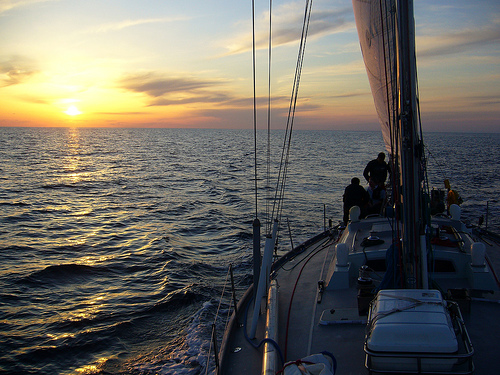
Way back on the 15th November, 2009, I wrote a post about single-handed sailing and how it caused me much disquiet. Rather than just leave you with a link to that reflection, I’m going to include the post again, below. The reason is that a few days ago, in looking through some of my earlier writings in conjunction with a writing group that Jean and I belong to, I came across a piece that I wrote following a solo voyage from Larnaca in Cyprus, west along the Mediterranean Sea and then out over the Atlantic from Gibraltar to Horta on the island of Faial in the Azores. That last leg was a little over 1,100 nautical miles (1,300 land miles) and took me eight days.
So first here’s that earlier post from 2009.
A personal reflection on this rather strange way of travelling!
The recent Post about young Jessica Watson sailing alone around the world raised a few comments but also reminded me of my own experiences of solo sailing.
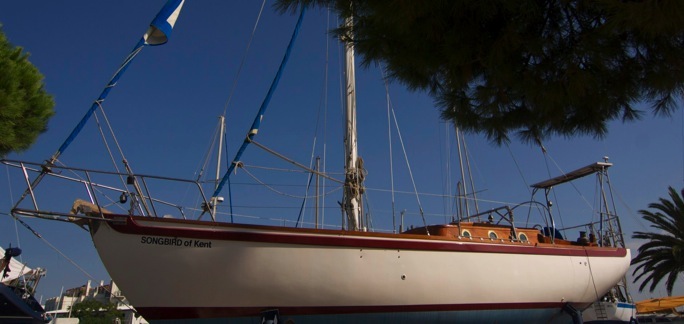
Some years ago, having successfully sold my own IT company, I warmed to the idea of being a full-time yachtie! A second-hand Tradewind 33 was discovered on the Island of Corfu. (Now here’s a surprise! I was just browsing the web looking for a picture of a Tradewind and came across my old yacht currently up for sale. Her name is Songbird of Kent! Picture below.)
Tradewind 33 - Songbird of Kent
Anyway, the deal was done and having sold my house in England I flew out to Corfu to collect Songbird of Kent. Inevitably it was a number of months before the boat was ready to head out into the Mediterranean but in early Spring 1988 it was time to explore the long coastlines of Greece and Turkey.
After a fantastic summer cruising from one idyllic anchorage to another mostly with friends or family on board, it was time to find a winter haven. Many recommended Larnaca Marina in Cyprus. Thus it was late in the summer of 1988 that I said goodbye to friends and set out on my own to cross from Antalya in Turkey to Cyprus and along the South coast of Cyprus to Larnaca, on the SE side of the island.
That sea crossing, a little over 200 nautical miles, was to become a regular solo experience at the start and end of each summer season. Impossible to do in a single day thus it always included a night at sea and rarely, if things didn’t go well with the weather, a couple of nights. I hated it! Maybe it was the sudden transition from coastal sailing to a deep water crossing, often going from having friends on board to being alone, but whatever it was I never enjoyed my time on my own and knew that long-distance solo sailing was never going to be my scene.
Anyway, I ended up spending several very happy winters in Larnaca.
One time, there was news of a Frenchman who had come into Larnaca on his way home to France having nearly completed a circumnavigation of the world. He was on his own!
I was astounded to hear how someone could do this and made a point of calling round to his berth. The boat was a beautiful, solid steel yacht, the very epitome of a craft that could challenge the oceans. The owner’s name was Pierre (it would be!). Pierre invited me aboard and we went down to his saloon to drink a hot coffee – real French coffee!
Inevitably the conversation turned to the challenges of sailing alone. Pierre said that the big cargo ships at sea moved quickly relative to the speed of a yacht so at night he set an alarm for every 15 minutes. That was the time that a ship could go from being hull down over the horizon to being close enough to be a hazard. Thus while at sea Pierre got up briefly every 15 minutes during the night to avoid being run down! It sounded totally exhausting.
Then Pierre asked me about the sailing I had done and whether I had sailed on my own. I declared my trivial journeys back and forth from Cyprus to Turkey and revealed that being on my own made me very, very unhappy. Pierre was surprised to hear that as he admitted that being at sea alone was one of the most tranquil and peaceful experiences ever. Pierre asked how long these solo journeys took. I replied, two or three days.
“Ah!”, he said, “That is the problem.” “I, too, hate the three days. It is always a period where you adjust and it is terrible.“
“My friend, you must find a way to be alone for more than three days. You will see that it is very different.“
It was some years before that opportunity came about but, in the end, I did undertake a solo journey of 8 days. Pierre was right. The first three days were hell, the rest were heaven!
Thank you, Songbird of Kent, you gave me some fabulous memories!
By Paul Handover
Now on to my writings about being out at sea alone on a small yacht.
Being at Sea
Going to sea in a small vessel is a profound experience.
In harbour we build up a reliance on things external. We have no need to worry if there is insufficient food on board, we can plug into the dockside power supply, sleep through the night undisturbed and we can wander off and enjoy the company of others if the boat feels a little claustrophobic.
Then slowly, imperceptibly, but with huge force, arrives the need to move on. The realisation that our cosy life connected to the busy, bustling and self-obsessed world of shoreside is not fulfilling our search for adventure and for the truths that lay over the horizon. It is time to leave.
The act of casting off is always exciting as it heralds a new adventure. But it also carries feelings of loss and apprehension as one lets go of the bonds of a previous certainty. The first few hours are filled with the workload of getting one’s craft shipshape and battened down for the unknown seas. Then gradually comes the realisation that the land is now less the dominating visual feature than the vastness of the seascape that is ahead. But with the land in sight, albeit a distant horizon behind one, you can still sense the life you are leaving.
Now all that surrounds you is the sea. You are now truly disconnected from the land. It is often at this point that despondency and uncertainty play with your mind; after all this new life is still very unfamiliar compared to the warmth of that island home that still resonates in your heart. Time to remind yourself of why you wanted to take this voyage.
A small boat is very fragile. Just a centimetre of hull separating you from the unimaginable depths of the ocean beneath your keel. Not until the end of your voyage, when you draw your boat up, metaphorically on to that beach, will you ever stop feeling how close fate is, how it rides on your shoulder night and day. That, of course, is why we go to sea. It is the place where we taste life, where we savour each moment of the present because the future seems too bound up in the mystery, the uncertainty of the ocean. You are in charge of your tiny craft. Your survival depends on how you manage your small ship, how you navigate these seas, how you read the weather ahead and avoid the storms.
Soon your life on the ocean becomes everything to you. You have time to reflect on so much that is left behind. The distance seems to dissolve all the nuisances, bring into focus all the things that are important to you. There is no certainty with the ocean apart from the knowledge that you are very small and very, very vulnerable and yet, in a sense, also so strong.
In the end, we have to break away from our insecurities and our emotional dependencies on external people and situations because, without that, we are never able to command our own life and the destiny that flows from that captaincy. There is a real strength in knowing ourselves as we would know our own boat. If we really know every spar, sail, rope and fitting, if we have real understanding of the strengths and weaknesses of our small vessel then we are able to know when to breast the waves or when to turn and run before the storm. We are secure that our small craft will protect us day and night.
Thus self-knowledge gives us the same freedom to manage our lives, to know when to fight and when to turn away. And just as after every long voyage the boat will need hours of careful maintenance so our own souls need regular love and caring from our spiritual keeper.
The first picture comes from Merci O. from here in Payson.
Lost for words!
The next two are from the camera of ‘yours truly’.
Tough work being a puppy!
Cleo has settled in so beautifully and we can’t believe that these two weeks have gone so quickly.
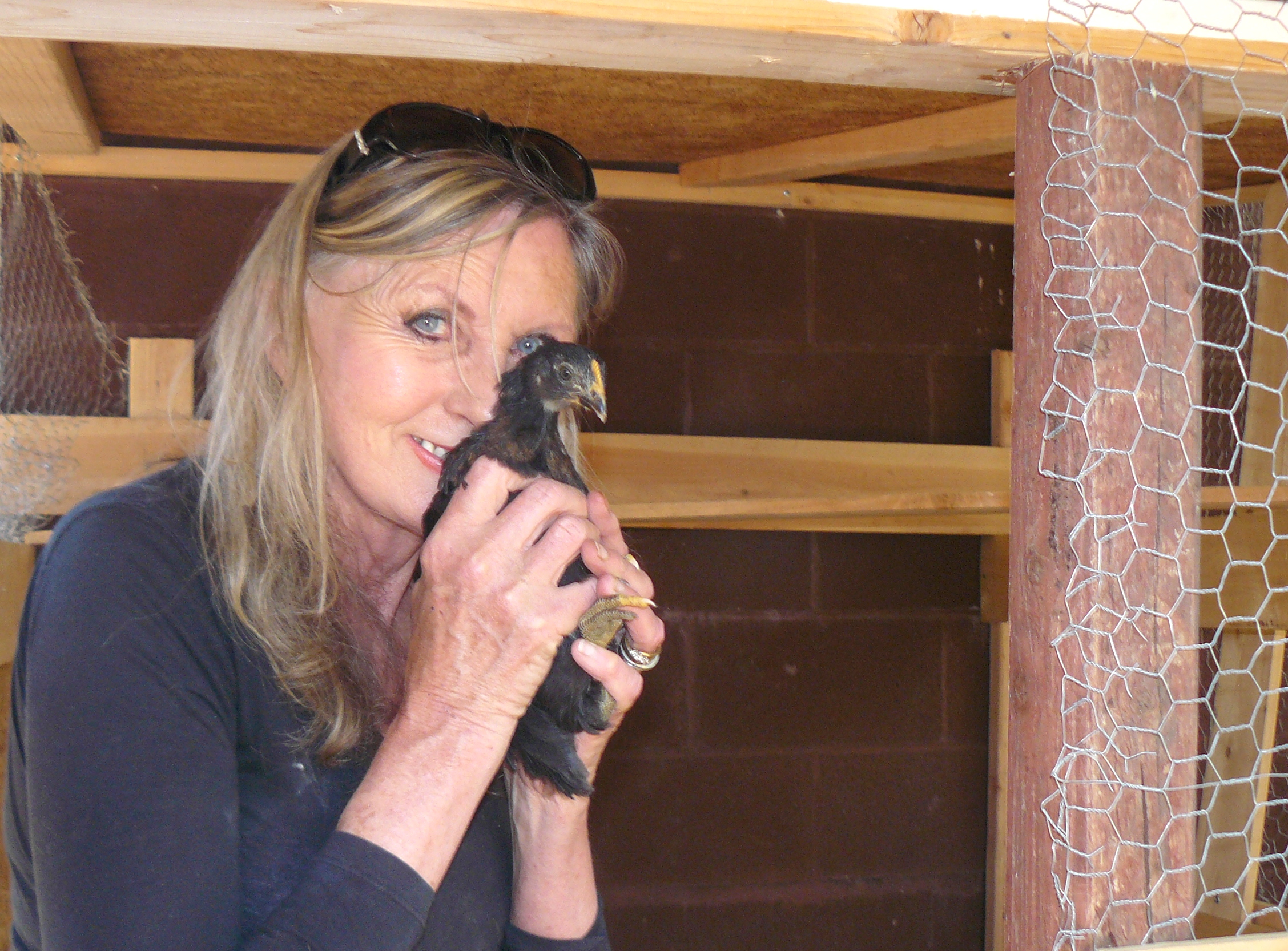
Finally, talking of settling in, our five young chicks have reached the stage where they could be housed outside in their new chicken house, the move taking place just five days ago.
Professor Nicole Darnall, ASU, outlines what can be done.
At home, we subscribe to the Payson Roundup, our local newspaper, and in the April 10th edition there was a full back-page article written by Pete Ayleshire, Editor, about …. well let me quote from the on-line copy,
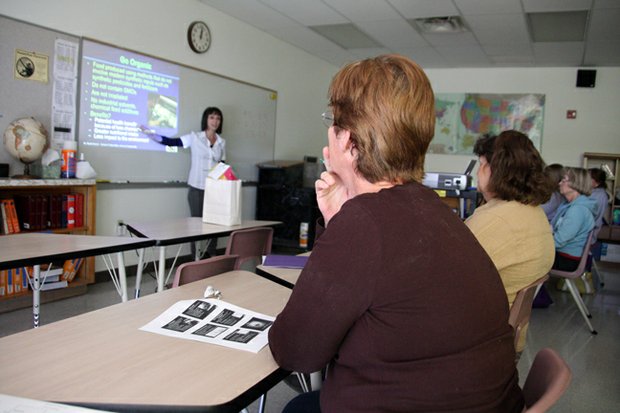
ASU professor Nicole Darnall taught a session on living a sustainable lifestyle at the Women’s Wellness Forum. Photo by Pete Aleshire.
Save money.
Get healthy.
Save the planet.
Why wait?
That’s the message Arizona State University professor Nicole Darnall delivered recently to a roomful of savvy planet
Prof. Nicole Darnall
huggers at the Women’s Wellness Forum. The daylong event drew about 240 women to listen to speakers on an array of topics.
Darnall offered a gripping presentation that started with global disaster, but ended with a reassuringly doable list of steps individuals can take to solve the seemingly overwhelming problems.
As I wrote at the end of last Friday’s article on Autism and bees, “I hope to publish a summary of a fascinating presentation given to a local women’s group here in Payson that shows the many obvious and easy steps we can all take to revert back to a resilient life on this planet.”
It’s so easy to be overwhelmed by the barrage of ‘doom and gloom’ stories that abound and, make no mistake, if each of us do nothing, the future does look ‘interesting’!
I don’t know about you but the degree of awareness of the changes we all need to make is huge and growing. So Prof. Darnall was right on the button when she spoke to that women’s forum. For instance,
“Livestock generates more greenhouse gases than all the planes, trains and automobiles on the planet,” said Darnall. In part, that’s because the methane from, well, the other end of cows, has 21 times the greenhouse gas warming effect as carbon dioxide.
Darnall’s solution? Meatless Mondays — to start curving that scary trend line.
A few paragraphs later,
The average person generates 4.5 pounds of trash daily. Of that, 75 percent can be recycled — but less than 30 percent actually ends up recycled.
Worse yet, we discard half of the food we produce, which works out to 474 pounds of wasted food per person.
Once again: The answer lies surprisingly close to home.
Start a composting bin: That would reduce discarded trash by about one-third — while increasing the health of your garden, not to mention averting the production of chemical fertilizers.
Then there’s this …..
Quit buying the plastic water bottles that add 25 million items to the waste stream every day. After all, tap water must meet higher health and purity standards than bottled water.
And not forgetting …..
Worried about all the bleach and other chemicals used in household cleaning products? No problem, said Darnall — before offering up a recipe for environmentally friendly scouring involving vinegar and baking soda. You can also ditch the ammonia in the window cleaner, with a mixture of corn starch — great for smudged mirrors and spots in the carpet.
Then this touched the spot for this part of Arizona with this year’s rainfall already far below the 30-year average.
Worried about the reckless use of fresh water, with predictions of longer deeper droughts well established?
Shorter showers can save 150 gallons each time — and a low-flow shower head can save 175 gallons a month. Get rid of the lawn, cut the water bill by 60 percent.
Rounding off by …..
But here’s the kicker, she said — you can save your wallet by saving the planet.
Make your cleaning products and you not only protect streams you also save money.
Change over to LED lights, you not only reduce greenhouse gas emissions — you save money.
Install solar tubes and you reduce greenhouse gases — and save money.
Eat less meat and reduce global warming — and also lose weight.
And heck: You might even make the cows happy.
Delightful close to the article that is Pete Ayleshire all over. (Pete teaches the creative writing class at the local extension college that Jean and I have been attending for two terms.)
It seems to me that one of the many lucky aspects of living in Payson is having the Arizona State University (ASU) School of Sustainability in the area and being able to draw on the expertise of people such as Prof. Darnall.
So look around and see what small steps you can take to make a difference, and start those small changes. As in the words of an old saying from my England days, ‘By the inch, it’s a cinch, by the yard it’s hard!‘
On April 14th, 1912, at 23.40 ships time, the Titanic struck an iceberg and the rest is history. I’m not going to add to the wealth of information available on this sad centenary except to say that 1,514 people lost their lives and they and their descendants should be held in our prayers. And to recognise that one of those who lost his life was young ‘Jack’ Phillips, Senior Wireless Operator, who persisted in sending out distress messages by Morse Code to the very last, thus enabling the RMS Carpathia to rescue 710 souls.
Rest In Peace
Below are some local times to assist you in offering up a quiet thought as one hundred years ago to the moment the sound of a liner hitting an iceberg reverberated around the world.
RMS Titanic Ships Time April 14th 2340 – 11.40 PM
GMT/UTC April 15th 0240 – 2.40 AM
British Summer Time April 15th 0340 – 3.40 AM
Arizona/California April 14th 1940 – 7.40 PM
New York April 14th 2240 – 10.40 PM
London April 15th 0340 – 3.40 AM
Paris April 15th 0440 – 4.40 AM
Moscow April 15th 0640 – 6.40 AM
Singapore April 15th 1040 – 10.40 AM
Sydney, Australia April 15th 1240 – 2.40 PM
More world times may be calculated from this website.
This Post includes the details of a live broadcast of an important event Feeding the World While the Earth Cooks from Washington D.C. If you would like to watch that broadcast then it starts at:
6am US Mountain Time Zone
9am US Eastern Daylight Time
13:00 Greenwich Mean Time (GMT/UTC)
2pm British Summer Time
Full details below.
H’mm, maybe the days of Oliver are well and truly numbered!
A quick ‘search’ found the lyrics of the famous song from the musical Oliver. Here’s a part of the chorus:
Food, glorious food!
Don’t care what it looks like —
Burned!
Underdone!
Crude!
Don’t care what the cook’s like.
Just thinking of growing fat —
Our senses go reeling
One moment of knowing that
Full-up feeling!
Not to be taken for granted.
However, a recent announcement from Arizona State University quite rightly points out the challenges that lay ahead in terms of feeding the world’s population. Here are the details of that ASU announcement.
The future of food: feeding the world while the Earth cooks
Editor’s Note: This event is presented by Future Tense, a partnership between Arizona State University, the New America Foundation and Slate, that examines emerging technologies, public policy and society.
The event considers the agricultural crisis that may ensue when today’s toddlers are parents themselves – a time when the world population will reach 9 billion. “A growing global middle class will demand more food. And climate change will leave farmers holding seeds that won’t sprout. By 2050, will our global appetite outgrow our agricultural capacity?”
Tune in to find out how everyone – growers, technologists, governments, business leaders, and carbon-conscious consumers – will be part of the solution.
Speakers include Nina Fedoroff, special advisor on science and technology to the Secretary of State; Fred Kirschenmann, Distinguished Fellow at the Leopold Center for Sustainable Agriculture and President of Stone Barnes Center; Debra Eschmeyer, founder and program director of FoodCorps; and Bill Hohenstein, director of the USDA Global Change Program Office.
Let me highlight that the event is being carried live and is available to view.
The link you need to that ASUtv programme is here. From where you will see that:
Arizona State University, the New America Foundation , and Slate present “Feeding the World While the Earth Cooks” live from Washington, D.C., this April 12 from 6:00 am to 12:15 pm. The program will air in it’s entirety onASUtv.
(From the New America Foundation): When today’s toddlers are parents themselves, they will face an agricultural crisis. The world population will reach 9 billion. A growing global middle class will demand more food. And climate change will leave farmers holding seeds that won’t sprout. By 2050, will our global appetite outgrow our agricultural capacity?
Join us to find out how everyone—growers, technologists, governments, business leaders, and carbon-conscious consumers—will be part of the solution.
The day’s speakers include Dr. Nina Fedoroff, Special Advisor on Science and Technology to the Secretary of State; Dr. Fred Kirschenmann, Distinguished Fellow at the Leopold Center for Sustainable Agriculture and President of Stone Barnes Center; Debra Eschmeyer, Founder and Program Director of FoodCorps; Bill Hohenstein, Director of the USDA Global Change Program Office; and many more.
So if you want to watch that event then here are the UTC times.
April 12 from 6:00 am to 12:15 pm US Mountain Time equates to 13:00 – 19:15 UTC (2 pm to 8:15 pm British Summer Time)
On April 10, 1912, the Titanic, largest ship afloat, left Southampton, England on her maiden voyage to New York City. The White Star Line had spared no expense in assuring her luxury. A legend even before she sailed, her passengers were a mixture of the world’s wealthiest basking in the elegance of first class accommodations and immigrants packed into steerage.
She was touted as the safest ship ever built, so safe that she carried only 20 lifeboats – enough to provide accommodation for only half her 2,200 passengers and crew. This discrepancy rested on the belief that since the ship’s construction made her “unsinkable,” her lifeboats were necessary only to rescue survivors of other sinking ships. Additionally, lifeboats took up valuable deck space.
Four days into her journey, at 11:40 P.M. on the night of April 14, she struck an iceberg. Her fireman compared the sound of the impact to “the tearing of calico, nothing more.” However, the collision was fatal and the icy water soon poured through the ship.
It became obvious that many would not find safety in a lifeboat. Each passenger was issued a life jacket but life expectancy would be short when exposed to water four degrees below freezing. As the forward portion of the ship sank deeper, passengers scrambled to the stern. John Thayer witnessed the sinking from a lifeboat. “We could see groups of the almost fifteen hundred people still aboard, clinging in clusters or bunches, like swarming bees; only to fall in masses, pairs or singly, as the great after part of the ship, two hundred and fifty feet of it, rose into the sky, till it reached a sixty-five or seventy degree angle.” The great ship slowly slid beneath the waters two hours and forty minutes after the collision
The next morning, the liner Carpathia rescued 705 survivors. One thousand five hundred twenty-two passengers and crew were lost. Subsequent inquiries attributed the high loss of life to an insufficient number of lifeboats and inadequate training in their use.
Read more of this fascinating account, especially the story of Elizabeth Shutes who, aged 40, was governess to nineteen-year-old Margaret Graham who was traveling with her parents. As Shutes and her charge sit in their First Class cabin they feel a shudder travel through the ship. At first comforted by her belief in the safety of the ship, Elizabeth’s composure is soon shattered by the realization of the imminent tragedy.
Also grateful to my cousin, Rose F., who sent me a link to a story in the British newspaper The Telegraph that came out in September, 2010. I don’t have permission to reproduce that story but hope that it being 18 months since it was published by the Telegraph makes my act forgiveable!
Titanic sunk by steering blunder, new book claims
It was always thought the Titanic sank because its crew were sailing too fast and failed to see the iceberg before it was too late.
But now it has been revealed they spotted it well in advance but still steamed straight into it because of a basic steering blunder.
According to a new book, the ship had plenty of time to miss the iceberg but the helmsman panicked and turned the wrong way.
By the time the catastrophic error was corrected it was too late and the side of the ship was fatally holed by the iceberg.
Even then the passengers and crew could have been saved if it had stayed put instead of steaming off again and causing water to pour into the broken hull.
The revelation, which comes out almost 100 years after the disaster, was kept secret until now by the family of the most senior officer to survive the disaster.
Second Officer Charles Lightoller covered up the error in two inquiries on both sides of the Atlantic because he was worried it would bankrupt the liner’s owners and put his colleagues out of job.
Since his death – by then a war hero from the Dunkirk evacuation – it has remained hidden for fear it would ruin his reputation.
But now his granddaughter the writer Lady (Louise) Patten has revealed it in her new novel. “It just makes it seem all the more tragic,” she said. “They could easily have avoided the iceberg if it wasn’t for the blunder.”
The error on the ship’s maiden voyage between Southampton and New York in 1912 happened because at the time seagoing was undergoing enormous upheaval because of the conversion from sail to steam ships.
The change meant there were two different steering systems and different commands attached to them.
Some of the crew on the Titanic were used to the archaic Tiller Orders associated with sailing ships and some to the more modern Rudder Orders.
Crucially, the two steering systems were the complete opposite of one another.
So a command to turn “hard a starboard” meant turn the wheel right under the Tiller system and left under the Rudder.
When First Officer William Murdoch spotted the iceberg two miles away, his “hard a-starboard” order was misinterpreted by the Quartermaster Robert Hitchins.
He turned the ship right instead of left and, even though he was almost immediately told to correct it, it was too late and the side of the starboard bow was ripped out by the iceberg.
“The steersman panicked and the real reason why Titanic hit the iceberg, which has never come to light before, is because he turned the wheel the wrong way,” said Lady Patten who is the wife of former Tory Education minister, Lord (John) Patten.
Whilst her grandfather Lightoller was not on watch at the time of the collision, her book Good as Gold reveals that a dramatic final meeting of the four senior officers took place in the First Officer’s cabin shortly before Titanic went down.
There, Lightoller heard not only about the fatal mistake, but also what happened next, up on the bridge.
While Hitchins had made a straightforward error, what followed was a deliberate decision.
Bruce Ismay, chairman of Titanic’s owner, the White Star Line, persuaded the Captain to continue sailing. For ten minutes, Titanic went “Slow Ahead” through the sea.
This added enormously to the pressure of water flooding through the damaged hull, forcing it up and over the watertight bulkheads, sinking Titanic many hours earlier than she otherwise would have done.
“Ismay insisted on keeping going, no doubt fearful of losing his investment and damaging his company’s reputation,” said Lady Patten. “The nearest ship was four hours away. Had she remained at ‘Stop’, it’s probable that Titanic would have floated until help arrived.”
The truth of what happened on that historic night was deliberately buried.
Lightoller, the only survivor who knew precisely what had happened, and who would later go on to be a twice-decorated war hero, decided to hide what he knew from the world, including two official inquiries into the sinking.
By his code of honour, he felt it was his duty to protect his employer – White Star Line – and its employees.
Lady Patten said: “The inquiry had to be a whitewash. The only person he told the full story to was his beloved wife Sylvia, my grandmother. As a teenager, I was enthralled by the Titanic. Granny revealed to me exactly what had happened on that night and we would discuss it endlessly.
She died when I was sixteen and, though she never told me to keep the knowledge to myself, I didn’t tell anyone. My mother insisted that everything remained strictly inside the family: a hero’s reputation was at stake.
Nearly forty years later, with Granny and my mother long dead, I was plotting my second novel and it struck me that I was the last person alive to know what really happened on the night Titanic sank.
My grandfather’s extraordinary experiences felt like perfect material for Good As Gold.
Brilliant mathematics without the need for a calculator!
Thanks to the bottomless resources of the Internet, I could quickly find a relevant quote or two to open up today’s Post. Rene Descartes (1596-1650) was reputed to have said, “Perfect numbers like perfect men are very rare.”
Sorry, couldn’t resist that! It wasn’t the quote relevant to this essay but it was too good to miss. (Descartes was also the person who coined the phrase: I think therefore I am!)
The quote that I thought was relevant was this one from Descartes, “With me everything turns into mathematics.” Well until I read something recently on the Big Think website I would have been certain that the emotions, such as happiness, were well beyond reach of the logical power of mathematics. I was wrong!
….. argues (against Einstein, as it happens), that everything that counts can and ought to be counted. A hotelier by trade, he says that GDP and the bottom line are blunt instruments for measuring the health of a society or a business. After the dot.com crash of 2001, and a visit to the Buddhist nation of Bhutan, which has a “Gross National Happiness” index, Conley and his team decided to create indices for measuring the well-being of their employees and customers.
And a paragraph later continues,
In Emotional Equations, Conley takes the mathematics of human happiness a step further, creating simple formulas like anxiety = uncertainty x powerlessness, which, when used systematically, he says, can give individuals and organizations a concrete method for addressing the human needs that drive them.
The description of the book on the Amazon website is thus,
Mr Chip Conley
Using brilliantly simple math that illuminates universal emotional truths, Emotional Equations crystallizes some of life’s toughest challenges into manageable facets that readers can see clearly—and bits they can control. Popular motivational speaker and bestselling author Chip Conley has created an exciting, new, immediately accessible visual lexicon for mastering the age of uncertainty. Making mathematics out of emotions may seem a counterintuitive idea, but it’s an inspiring and incredibly effective one in Chip Conley’s hands. When Conley, dynamic author of the bestselling Peak, suffered a series of tragedies, he began using what he came to call “Emotional Equations” (like Joy = Love – Fear) to help him focus on the variables in life that he could deal with, rather than ruminating on the unchangeable constants he couldn’t, like the bad economy, death, and taxes. Now this award-winning entrepreneur shares his amazing new self-help paradigm with the rest of us. Emotional Equations offers an immediately understandable means of identifying the elements in our lives that we can change, those we can’t, and how they interact to create the emotions that define us and can help or hurt our progress through life. Equations like “Despair = Suffering – Meaning” and “Happiness = Wanting What You Have/Having What You Want” (Which Chip presented at the prestigious TED conference) have been reviewed for mathematical and psychological accuracy by experts. Conley shows how to solve them through life examples and stories of inspiring people and role models who have worked them through in their own lives. In these turbulent times, when so many are trying to become “superhuman” to deal with our own and the world’s problems, Emotional Equations arms readers with effective formulas for becoming super human beings.
So it all seems not quite so daft as one might initially guess. Indeed, settle down for twenty minutes and watch Chip eloquently explain his ideas captured at that TED Conference referred to above.
There’s also an audio conversation with Mr. Conley that you can download free from here.
Finally, let me close with yet another quote from Rene Descartes, “It is not enough to have a good mind. The main thing is to use it well.” Amen to that!
I was clearing my desk yesterday (yet again) and came across an article that I wrote in 2007. It’s a message of love; the love of a dog for a human. But before going to that article, look at the photo below. It’s a wonderful example of the joy of having Pharaoh in my life. It was taken in July 2006 at the airfield in Devon, SW England, where a group of us shared a Piper Super Cub, about which I wrote in Learning from Dogs in August 2009.
If you think Pharaoh is smiling, I’m not going to argue with you. First time in the Cub, first time strapped in to the rear seat, everything utterly strange and Pharaoh is clearly more joyful than the pilot!
Happiness is sharing life with your dog!
Anyway, to the article. I wrote it in September, 2007, based on something that was sent to me from an unknown author, and modified to reflect the special relationship that I had, and still have, with my then four-year-old German Shepherd, Pharaoh.
I am your dog and have something I would love to whisper in your ear.
I know that you humans lead busy lives. Some have to work, some have children to raise, some have to do this alone. It always seems like you are running here and there, often much too fast, often never noticing the truly grand things in life.
Look down at me now. See the way my dark brown eyes look at yours.
You smile at me. I see love in your eyes. What do you see in mine? Do you see a spirit? A soul inside, who loves you as no other could in the world? A spirit that would forgive all trespasses of prior wrongdoing for just a simple moment of your time?
That is all I ask. To slow down, if even for a few minutes, and be with me.
So many times, you have been saddened by others of my kind, passing on. Sometimes we die young and oh so quickly, so suddenly it wrenches your heart out of your throat. Sometimes, we age so slowly before your eyes that you may not even seem to know until the very end, when we look at you with grizzled muzzles and cataract-clouded eyes. Still the love is always there, even when we must take that last long sleep dreaming of running free in a distant, open land.
I may not be here tomorrow. I may not be here next week. Someday you will shed the water from your eyes, that humans have when grief fills their souls, and you will mourn the loss of just ‘one more day’ with me. Because I love you so, this future sorrow even now touches my spirit and grieves me. I read you in so many ways that you cannot even start to contemplate.
We have now together. So come and sit next to me here on the floor and look deep into my eyes. Do you see how if you look deeply at me we can talk, you and I, heart to heart. Come not to me as my owner but as a living soul. Stroke my fur and let us look deep into the other’s eyes and talk with our hearts.
I may tell you something about the fun of working the scents in the woods where you and I go. Or I may tell you something profound about myself or how we dogs see life in general. I know you decided to have me in your life because you wanted a soul to share things with. I know how much you have cared for me and always stood up for me even when others have been against me. I know how hard you have worked to help me to be the teacher that I was born to be. That gift from you has been very precious to me. I know too that you have been through troubled times and I have been there to guard you, to protect you, to be there for you always.
I am very different to you but here I am. I am a dog but just as alive as you.
I feel emotion. I feel physical senses. I can revel in the differences of our spirits and souls. I do not think of you as a dog on two feet; I know what you are. You are human, in all of your quirkiness, and I love you still.
So come sit with me on the floor. Enter my world and let time slow down if only for a few minutes. Look deep into my eyes and whisper in my ears. Speak with your heart and I will know your true self.
We may not have tomorrow but we do have now.
Postscript.
Just three months after writing the above, on December 17th, 2007, I flew in to Hemosillo Airport in Mexico to spend Christmas with Suzann, sister of dear friend Dan Gomez, and her husband Don down in the coastal town of San Carlos. That’s when I met Jean, leading to me and Jean falling in love. Jean then came to England and I came back to Mexico in June, 2008. In September, 2008 Pharaoh and I left England permanently and travelled out to San Carlos to be with Jean and her dogs. In February, 2010, Jean and I, Pharaoh and twelve other dogs, and six cats all moved to Payson, Arizona.
In November, 2010 Jean and I were married. So the miracle for me and Pharaoh is that when I wrote that piece back in 2007 this most beautiful future was yet to unfold. I never miss a day when I don’t, “… come sit with me on the floor. Enter my world and let time slow down if only for a few minutes. Look deep into my eyes and whisper in my ears. Speak with your heart and I will know your true self.” Now not just with Pharaoh but with Hazel, Dhalia, Sweeny, Casey, Loopy, Lilly, Ruby, and all the other beautiful dog souls.