Category: Morality

Fracking Hell!

Is it me or are we all totally mad?  Only if we don’t take action!

I’ve quoted this expression before so forgive me for using it again.  That’s the old Devon expression, “All the world’s a little queer, ‘cept thee and me, and I ha’ me doubts about thee!”  It really does seem as if most of us are ‘a little queer!’

Yesterday, I expressed the tip of much frustration, nay incredulity, in a rant about why society showed such complacency towards the impending crisis of our civilisation.  As I wrote,

Why isn’t there such a huge outpouring of anger at the complacency of the world’s leaders?  How far does the collapse of the conditions, both social and physical, as in biosphere, have to go before we get real, urgent change?

Well today’s Post is taking a selection of recent items that have been published to show why I feel as I do.  I make no apologies for this being a longish Post but that doesn’t make it anything other than incredibly important; personal opinion, of course!

Let’s start with our love affair with carbon-based fuels, in this case natural gas (that’s methane you know).  Over on Lack of Environment Martin Lack recently published a piece on Fracking.  Here’s an extract,

Burning fossil fuels just because they are there is insane
For a long time, I have told anyone that would listen that we should leave unconventional hydrocarbons in the ground because of the extremely high probability that James Hansen is right; if we burn them all the runaway greenhouse effect is a “dead certainty” (i.e. on page 236 of Storms of My Grandchildren). However, thanks to the persistence of my many friends in the blogosphere, I have now also woken up to the reality that unconventional fossil fuel extraction – and hydraulic fracturing (known as fracking) in particular – is having significant immediate adverse environmental impacts. Pendantry has described this as humanity “fouling its own nest”; but I think my own description of it as “defecating in our own pig pen” conveys a more appropriate image.

In the USA, fracking has recently been prohibited in the State of Vermont and it must be hoped that other States will now do the same. The Vermont legislature took this action as a result of reports confirming the link between fracking and minor earthquakes; and because of high profile campaigns mounted by those communities already being adversely impacted by fracking. However, the latter should not be confused with NIMBYism. This is because opposition to fracking is a response to real environmental problems afflicting real people as a result of real stupidity on an industrial scale.
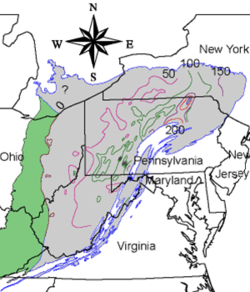
The Marcellus Shale formation

Martin also included a 17-minute feature from Link TV on the use, and dangers, of extracting natural gas from the Marcellus Shale in the US North-East.  It’s a sobering reminder of how we are playing with fire with the planet, both literally and metaphorically.  This is the video:

My next reference is an article published in the latest issue of Nature.  Only a summary is available freely online, but here it is anyway,

Approaching a state shift in Earth’s biosphere

Localized ecological systems are known to shift abruptly and irreversibly from one state to another when they are forced across critical thresholds. Here we review evidence that the global ecosystem as a whole can react in the same way and is approaching a planetary-scale critical transition as a result of human influence. The plausibility of a planetary-scale ‘tipping point’ highlights the need to improve biological forecasting by detecting early warning signs of critical transitions on global as well as local scales, and by detecting feedbacks that promote such transitions. It is also necessary to address root causes of how humans are forcing biological changes.

The overall theme of this issue of Nature is shown in their leading story, again taking the liberty of republishing an extract.  First how the article opens,

Return to Rio: Second chance for the planet

Twenty years ago, when the world’s leaders pledged to protect Earth’s climate and biodiversity at the Rio Earth Summit, they knew it would not be easy. But few could have guessed how much worse the situation would get. In 1992, the atmosphere held fewer than 360 parts per million (p.p.m.) of carbon dioxide; the concentration is now nearing 400 p.p.m. and surging upwards. At the same time, species are disappearing at an accelerating rate.

On the eve of the second Rio Earth Summit, Nature explores the causes and consequence of those changes, as well as the efforts that are being made to avert the worst outcomes. Our assessment shows how little progress nations have made towards honouring the commitments they made in 1992.

Then how that article closes,

Anthony Barnosky and his colleagues argue that the global ecosystem could eventually pass a tipping point and shift into a new state, the likes of which are hard for science to predict. But there are ways to avoid that fate, say Paul Ehrlich and his colleagues (page 68), who suggest techniques to make societies more sustainable and to head off many of the world’s chronic environmental problems.

Earth and its inhabitants have a second chance in Rio. They may not get many more.

There’s more and more of this but, yes, I know, one can only take so much.  So let me head for the close with a message of what you and I, and all of us, can do.

The United Nations Environment Programme recently released a video showing how inadequate have been our leaders.  Watch it first and then I’ll offer a solution.

The fifth edition of the Global Environmental Outlook (GEO-5), launched on the eve of the Rio+20 Summit, assessed 90 of the most-important environmental goals and objectives and found that significant progress had only been made in four.

More on the report findings here.

So join with me as I focus my rant from yesterday into something more valuable – asking you to take action – in whatever way you can!

Go here and sign the petition from 350.org.

Add your name to this:

To the G20 and World Leaders:

As concerned global citizens, we urge you to honour your previous commitments to end taxpayer handouts to the fossil fuel industry. To save our planet we need a game-changer now — we call on you to first lead by example, and then make ending all polluter payments the top global priority for the Rio Earth Summit.

So do it now – Go here and sign the petition from 350.org.

Then when you have signed that plea to world leaders to stop the subsidies to fossil fuels, pass this link to everyone you can – www.350.org/rio

And get close to 350.org and stay in touch.

Let’s do this; it’s so much better than ranting!

Climate change is not a right vs left issue.

A revealing article in The Atlantic by Professor Adler.

Yesterday, I published a Post called Denialists standing up for insanity.  Then within hours of writing that, up popped in my email ‘in-box’ the latest ‘What’s New’ from the Yale Forum on Climate Change and the Media.  One article that jumped off the page at me was this one,

How A Conservative Sees, Wants to Address, Climate Change

June 6, 2012

Law professor Jonathan Adler, no flaming liberal, accepts much of the science and outlines conservative property rights principles for addressing climate change challenges.

What is surprising about these quotations?

  • “… there is reason to believe many of the effects [of climate change] will be quite negative.
  • “Excesses” of climate campaigners and “bad behavior” by some scientists “do not, and should not, discredit the underlying science.”
  • Despite some “substantial uncertainty … this is not sufficient justification for ignoring global warming or pretending that climate change is not a serious problem.”
  • “… effects will be most severe in those nations that are both least able to adapt and least responsible for” the greenhouse problem.
  • “Even non-catastrophic warming should be a serious concern.”

What’s actually surprising about these points is not so much the messages, but the messenger.

Then a couple of paragraphs later, the Yale Forum article links to The Atlantic piece as in, “Adler expresses his views on the seriousness of climate change in “A Conservative’s Approach to Combating Climate Change.”

Let me just give you a taste of that Atlantic piece.

It opens thus,

A Conservative’s Approach to Combating Climate Change

Guest post by Jonathan H. Adler, a professor at the Case Western Reserve University School of Law and regular contributor to the Volokh Conspiracy

No environmental issue is more polarizing than global climate change.  Many on the left fear increases in atmospheric concentrations of greenhouse gases threaten an environmental apocalypse while many on the right believe anthropogenic global warming is much ado about nothing and, at worst, a hoax.  Both sides pretend as if the climate policy debate is, first and foremost, about science, rather than policy. This is not so. There is substantial uncertainty about the scope, scale, and consequences of anthropogenic warming, and will be for some time, but this is not sufficient justification for ignoring global warming or pretending that climate change is not a serious problem.

The fifth and sixth paragraphs present a powerful ‘constitutional’ perspective,

Accepting, for the sake of argument, that the skeptics’ assessment of the science is correct, global warming will produce effects that should be of concern.  Among other things, even a modest increase in global temperature can be expected to produce some degree of sea-level rise, with consequent negative effects on low-lying regions.  Michaels and Balling, for instance, have posited a “best guess” that sea levels will rise 5 to 11 inches over the next century.  Such an increase in sea levels is likely manageable in wealthy, developed nations, such as the United States.  Poorer nations in the developing world, however, will not be so able to adapt to such changes.  This is of particular concern because these effects will be most severe in those nations that are both least able to adapt and least responsible for contributing to the concentration of greenhouse gases in the atmosphere.

It is a well established principle in the Anglo-American legal tradition that one does not have the right to use one’s own property in a manner that causes harm to one’s neighbor.  There are common law cases gong back 400 years establishing this principle and international law has long embraced a similar norm.  As I argued at length in this paper, if we accept this principle, even non-catastrophic warming should be a serious concern, as even non-catastrophic warming will produce the sorts of consequences that have long been recognized as property rights violations, such as the flooding of the land of others.

Professor Adler closes the article, as follows,

Fourth and finally, it is important to recognize that some degree of warming is already hard-wired into the system.  This means that some degree of adaptation will be necessary.  Yet as above, recognizing the reality of global warming need not justify increased federal control over the private economy.  There are many market-oriented steps that can, and should, be taken to increase the country’s ability to adapt to climate change including, as I’ve argued here and here, increased reliance upon water markets, particularly in the western United States where the effects of climate change on water supplies are likely to be most severe.

I recognize that a relatively brief post like this is unlikely to convince many people who have set positions on climate change.  I can already anticipate a comment thread filled with charges and counter-charges over the science.  But I hope this post has helped illustrate that the embrace of limited government principles need not entail the denial of environmental claims and that a concern for environmental protection need not lead to an ever increasing mound of prescriptive regulation.  And for those who wish to explore these arguments in further detail, there’s lots more in the links I’ve provided throughout this post.

The links provided by Professor Adler, as he refers to above, are well-worth pursuing, so for that reason alone, I do recommend reading the whole Atlantic piece in full.

Denialists standing up for insanity!

Bill McKibben spells it out that climate-change deniers are on the ropes — But So Is the Planet !

Once again, I am deeply indebted to Tom Englehardt of Tom Dispatch fame for his permission allowing me reproduce a recent post.

But before so doing, let me natter on for a few words about why I am motivated to write a daily post for Learning from Dogs.  As I say on the Welcome page, “Mankind is close to the edge of extinction, literally and spiritually. Dogs know better, much better! Time again for man to learn from dogs!

To expand on that, I write about the purpose of this Blog, “... if society doesn’t eschew the games, half-truths and selfish attitudes of the last, say, 30 years or more, then civilisation, as we know it, could be under threat.”  Which is why the quotation on that page is so powerful:

There is nothing to fear except the persistent refusal to find out the truth, the persistent

refusal to analyse the causes of happenings.” Dorothy Thompson.

Stay with me for just a little longer.  Here’s an article that was published on the BBC’s News website on Tuesday (I’ve taken just a small extract and slightly re-arranged the order),

Virginia’s dying marshes and climate change denial

By Daniel Nasaw

BBC News Magazine, York River, Virginia

Trees die as rising salt water soaks their roots, Watts says

Dying wetland trees along Virginia’s coastline are evidence that rising sea levels threaten nature and humans, scientists say – and show the limits of political action amid climate change scepticism.

Dead trees loom over the marsh like the bones of a whale beached long ago.

In the salt marshes along the banks of the York River in the US state of Virginia, pine and cedar trees and bushes of holly and wax myrtle occupy small islands, known as hummocks.

But as the salty estuary waters have risen in recent years, they have drowned the trees on the hummocks’ lower edges. If – when – the sea level rises further, it will inundate and drown the remaining trees and shrubs, and eventually sink the entire marsh.

That threatens the entire surrounding ecosystem, because fish, oysters and crabs depend on the marsh grass for food.

“These are just the early warning signs of what’s coming,” says avian ecologist Bryan Watts, stepping carefully among the fallen pines.

And a little later in the article comes this,

“Here in Virginia there is very little political will to address the mitigation side of things – reducing our carbon footprint, reducing greenhouse gas emissions,” says Carl Hershner, who studies coastal resources management at the Virginia Institute of Marine Science.

So you can see what I can see and what a majority of the US population can see – denying the truth of dangers to our biosphere is nothing more than insane!

OK, now that’s off my chest, on to the Tom Dispatch essay from Bill McKibben introduced, as always by Tom.

oooOOOooo

Tomgram: Bill McKibben, Climate-Change Deniers Have Done Their Job Well

Posted by Bill McKibben

Here’s the thing about climate-change deniers: these days before they sit down to write their blog posts, they have to turn on the AC.  After all, it might as well be July in New York (where I’m writing this), August in Chicago (where a century-old heat record was broken in late May), and hell at the Indy 500.  Infernos have been raging from New Mexico and Colorado, where the fire season started early, to the shores of Lake Superior, where dry conditions and high temperatures led to Michigan’s third largest wildfire in its history.  After a March heat wave for the record books, we now have summer in late spring, the second-named tropical storm of the season earlier than ever recorded, and significant drought conditions, especially in the South and Southwest.  In the meantime, carbon dioxide (and other greenhouse gases) continue to head for the atmosphere inrecord quantities.  And in case anyone living in a big city doesn’t know it, heat can kill.

It’s true that no single event can be pinned on climate change with absolute certainty.  But anyone who doesn’t think we’re in a fierce new world of weather extremes — and as TomDispatch regular Bill McKibben has suggested, on an increasingly less hospitable planet that he calls Eaarth — is likely to learn the realities firsthand soon enough.  Not so long ago, if you really wanted to notice the effects of climate change around you, you had to be an Inuit, an Aleut, or some other native of the far north where rising temperatures and melting ice were visibly changing the landscape and wrecking ways of life — or maybe an inhabitant of Kiribati.  Now, it seems, we are all Inuit or Pacific islanders.  And the latest polling numbers indicate that Americans are finally beginning to notice in their own lives, and in numbers that may matter.

With that in mind, we really do need a new term for the people who insist that climate change is a figment of some left-wing conspiracy or a cabal of miscreant scientists.  “Denial” (or the more active “deniers”) seems an increasingly pallid designation in our new world.  Consider, for instance, that in low-lying North Carolina, a leading candidate for disaster from globally rising sea levels, coastal governments and Republicans in the state legislature are taking action: they are passing resolutions against policies meant to mitigate the damage from rising waters and insisting that official state sea-level calculations be made only on the basis of “historic trends,” with no global warming input.  That should really stop the waters!

In the meantime, this spring greenhouse-gas monitoring sites in the Arctic have recorded a startling first: 400 parts per million of carbon dioxide in the atmosphere.  It’s an ominous line to cross (and so quickly).  As in the name of McKibben’s remarkable organization, 350.org, it’s well above the safety line for what this planet and many of the species on it, including us, can take in the long term, and heat-trapping gases in the atmosphere are still on the rise.  All of this is going to get ever harder to “deny,” no matter what resolutions are passed or how measurements are restricted.  In the meantime, the climate-change deniers, McKibben reports, are finally starting to have troubles of their own. Tom

The Planet Wreckers
Climate-Change Deniers Are On the Ropes — But So Is the Planet

By Bill McKibben

It’s been a tough few weeks for the forces of climate-change denial.

First came the giant billboard with Unabomber Ted Kacynzki’s face plastered across it: “I Still Believe in Global Warming. Do You?” Sponsored by the Heartland Institute, the nerve-center of climate-change denial, it was supposed to draw attention to the fact that “the most prominent advocates of global warming aren’t scientists. They are murderers, tyrants, and madmen.” Instead it drew attention to the fact that these guys had over-reached, and with predictable consequences.

A hard-hitting campaign from a new group called Forecast the Facts persuaded many of the corporations backing Heartland to withdraw $825,000 in funding; an entire wing of the Institute, devoted to helping the insurance industry, calved off to form its own nonprofit. Normally friendly politicians like Wisconsin Republican Congressman Jim Sensenbrenner announced that they would boycott the group’s annual conference unless the billboard campaign was ended.

Which it was, before the billboards with Charles Manson and Osama bin Laden could be unveiled, but not before the damage was done: Sensenbrenner spoke at last month’s conclave, but attendance was way down at the annual gathering, and Heartland leaders announced that there were no plans for another of the yearly fests. Heartland’s head, Joe Bast, complained that his side had been subjected to the most “uncivil name-calling and disparagement you can possibly imagine from climate alarmists,” which was both a little rich — after all, he was the guy with the mass-murderer billboards — but also a little pathetic.  A whimper had replaced the characteristically confident snarl of the American right.

That pugnaciousness may return: Mr. Bast said last week that he was finding new corporate sponsors, that he was building a new small-donor base that was “Greenpeace-proof,” and that in any event the billboard had been a fine idea anyway because it had “generated more than $5 million in earned media so far.” (That’s a bit like saying that for a successful White House bid John Edwards should have had more mistresses and babies because look at all the publicity!) Whatever the final outcome, it’s worth noting that, in a larger sense, Bast is correct: this tiny collection of deniers has actually been incredibly effective over the past years.

The best of them — and that would be Marc Morano, proprietor of the website Climate Depot, and Anthony Watts, of the website Watts Up With That — have fought with remarkable tenacity to stall and delay the inevitable recognition that we’re in serious trouble. They’ve never had much to work with.  Only one even remotely serious scientist remains in the denialist camp.  That’s MIT’s Richard Lindzen, who has been arguing for years that while global warming is real it won’t be as severe as almost all his colleagues believe. But as a long article in the New York Times detailed last month, the credibility of that sole dissenter is basically shot.  Even the peer reviewers he approved for his last paper told the National Academy of Sciences that it didn’t merit publication. (It ended up in a “little-known Korean journal.”)

Deprived of actual publishing scientists to work with, they’ve relied on a small troupe of vaudeville performers, featuring them endlessly on their websites. Lord Christopher Monckton, for instance, an English peer (who has been officially warned by the House of Lords to stop saying he’s a member) began his speech at Heartland’s annual conference by boasting that he had “no scientific qualification” to challenge the science of climate change.

He’s proved the truth of that claim many times, beginning in his pre-climate-change career when he explained to readers of the American Spectator that “there is only one way to stop AIDS. That is to screen the entire population regularly and to quarantine all carriers of the disease for life.” His personal contribution to the genre of climate-change mass-murderer analogies has been to explain that a group of young climate-change activists who tried to take over a stage where he was speaking were “Hitler Youth.”

Or consider Lubos Motl, a Czech theoretical physicist who has never published on climate change but nonetheless keeps up a steady stream of web assaults on scientists he calls “fringe kibitzers who want to become universal dictators” who should “be thinking how to undo your inexcusable behavior so that you will spend as little time in prison as possible.” On the crazed killer front, Motl said that, while he supported many of Norwegian gunman Anders Breivik’s ideas, it was hard to justify gunning down all those children — still, it did demonstrate that “right-wing people… may even be more efficient while killing — and the probable reason is that Breivik may have a higher IQ than your garden variety left-wing or Islamic terrorist.”

If your urge is to laugh at this kind of clown show, the joke’s on you — because it’s worked. I mean, James Inhofe, the Oklahoma Republican who has emerged victorious in every Senate fight on climate change, cites Motl regularly; Monckton has testified four times before the U.S. Congress.

Morano, one of the most skilled political operatives of the age — he “broke the story” that became the Swiftboat attack on John Kerry — plays rough: he regularly publishes the email addresses of those he pillories, for instance, so his readers can pile on the abuse. But he plays smart, too. He’s a favorite of Fox News and of Rush Limbaugh, and he and his colleagues have used those platforms to make it anathema for any Republican politician to publicly express a belief in the reality of climate change.

Take Newt Gingrich, for instance.  Only four years ago he was willing to sit on a love seat with Nancy Pelosi and film a commercial for a campaign headed by Al Gore.  In it he explained that he agreed with the California Congresswoman and then-Speaker of the House that the time had come for action on climate. This fall, hounded by Morano, he was forced to recant again and again.  His dalliance with the truth about carbon dioxide hurt him more among the Republican faithful than any other single “failing.”  Even Mitt Romney, who as governor of Massachusetts actually took some action on global warming, has now been reduced to claiming that scientists may tell us “in fifty years” if we have anything to fear.

In other words, a small cadre of fervent climate-change deniers took control of the Republican party on the issue.  This, in turn, has meant control of Congress, and since the president can’t sign a treaty by himself, it’s effectively meant stifling any significant international progress on global warming.  Put another way, the variousright wing billionaires and energy companies who have bankrolled this stuff have gotten their money’s worth many times over.

One reason the denialists’ campaign has been so successful, of course, is that they’ve also managed to intimidate the other side. There aren’t many senators who rise with the passion or frequency of James Inhofe but to warn of the dangers of ignoring what’s really happening on our embattled planet.

It’s a striking barometer of intimidation that Barack Obama, who has a clear enough understanding of climate change and its dangers, has barely mentioned the subject for four years.  He did show a little leg to his liberal base in Rolling Stoneearlier this spring by hinting that climate change could become a campaign issue.  Last week, however, he passed on his best chance to make good on that promise when he gave a long speech on energy at an Iowa wind turbine factory without even mentioning global warming. Because the GOP has been so unreasonable, the President clearly feels he can take the environmental vote by staying silent, which means the odds that he’ll do anything dramatic in the next four years grow steadily smaller.

On the brighter side, not everyone has been intimidated.  In fact, a spirited counter-movement has arisen in recent years.  The very same weekend that Heartland tried to put the Unabomber’s face on global warming, 350.org conducted thousands of rallies around the globe to show who climate change really affects. In a year of mobilization, we also managed to block — at least temporarily — the Keystone pipeline that would have brought the dirtiest of dirty energy, tar-sands oil, from the Canadian province of Alberta to the Gulf Coast.  In the meantime, our Canadian allies are fighting hard to block a similar pipeline that would bring those tar sands to the Pacific for export.

Similarly, in just the last few weeks, hundreds of thousands have signed on to demand an end to fossil-fuel subsidies. And new polling data already show more Americans worried about our changing climate, because they’ve noticed the freakish weather of the last few years and drawn the obvious conclusion.

But damn, it’s a hard fight, up against a ton of money and a ton of inertia. Eventually, climate denial will “lose,” because physics and chemistry are not intimidated even by Lord Monckton. But timing is everything — if he and his ilk, a crew of certified planet wreckers, delay action past the point where it can do much good, they’ll be able to claim one of the epic victories in political history — one that will last for geological epochs.

Bill McKibben is Schumann Distinguished Scholar at Middlebury College, founder of the global climate campaign 350.org, a TomDispatch regular, and the author, most recently, of Eaarth: Making a Life on a Tough New Planet.

Follow TomDispatch on Twitter @TomDispatch and join us on Facebook.

Copyright 2012 Bill McKibben

Fighting pet homelessness, one animal at a time.

With big thanks to Trish for sending me these details.

It may seem entirely irrelevant to the wider world to focus on one homeless dog now taken into care and looking for a loving home but if one ‘raises’ the theme to that of which Learning from Dogs is all about, namely Dogs are integrous animals. We have much to learn from them then not so!

I’m not going to waffle around this for much longer except to ask you to go across to Patrice Ayme’s Blog and read his recent essay, Blood: Appetite Comes With Eating.  It’s a very erudite, and deeply upsetting, commentary on something I touched on in a recent Post.  Patrice writes, “Today we have just one civilization. If it dies, it will have no replacement.”  So go and read the full essay.

So when we wonder why there seems such a departure from integrity within the higher echelons of society, it makes my heart leap to be reminded of the innocence and integrity of dogs (and, of course, all of nature’s animals), and the outstanding beauty of all those who love and care for them.

So forget about the big, wide world for a while and read what Trish emailed me,

Tiny Tinker needs a forever home

Tinker

Found fending for himself on the hot streets of South Phoenix, Tinker is six and a half pounds of pure puppy love! This sweet survivor was in very tough shape when he was rescued from the county shelter and brought to the vet. But while he was being examined, Tinker wouldn’t stop trying to kiss everyone around him, and couldn’t stop wagging his tail! Currently recovering in a foster home, this little trooper desperately needs to find a forever home where he’ll be loved for the rest of his life.

Can you help?

Tinker is a spunky sweetheart who loves to snuggle with people. According to the vet, this 12-year-old Chihuahua is the victim of bad genes and neglect. The poor baby was born with only one good eye, permanently dislocated back knees, and terrible teeth. He’ll have dental work done soon, so he can go to his new home with a healthy smile. But first, he needs to recover completely from kennel cough. His ragged ears are most likely the result of flies biting off the edges.

Despite everything, Tinker is one of the happiest little dogs you’ll ever meet. Extremely affectionate and full of energy, blood tests show he’s in overall good health. He’s already neutered, housetrained and up-to-date on his shots. And once he recovers, all he’ll need is medication for his knees to make him more comfortable. Tinker seems to like other dogs, so would welcome canine companions.

Small Chihuahuas can lead very long lives. And if ever a dog deserved to enjoy many years as someone’s cherished pet, it’s Tinker! If you or someone you know can offer him a good home, please contact Jill at (480) 363-8449 or jill@cdsframing.com.  She’d be thrilled to hear from you and delighted to introduce you to the terrific Tinker, who is living in Phoenix.

You can also help Tinker find a home by posting his adoption flyer wherever you work, play or shop.

Thank you for anything you can do to help Tinker and for everything you do for the animals. Each act of kindness brings us one step closer to No More Homeless Pets®.

And from that flyer comes the following information …

Breed: Mix Chihuahua
Location: Phoenix, Arizona
Sex: Male
Age: Senior
Description: Little Tinker found himself abandoned and left to fend for himself on the rough lonely and HOT streets in Phoenix, Arizona. His previous life, he was not well loved or cared for. When I met this little bugger, I fell in immediate love with him and got him fully vetted. He still needs a couple of teeth extractions but he is in excellent health otherwise – all bloodwork came back negative and normal for any possible under-lying medical conditions.

This is one happy boy! GREAT SELF-ESTEEM, his tail never stops wagging and he only weighs 6 1/2 itty bitty little pounds and yes he is around 12 years old. He is now current on all his vaccinations and is neutered. He has a lot of life and spunk about him despite all he has been thru….very lovable, snuggly, and affectionate little pooch. Tinker would love nothing more than to be your sweet little lap boy and car rides – yes, he loves to go in the car with you.

Pleae consider giving him a loving home – he deserves it!!!!
Contact: Jill Lenz Phone: 480-363-8449 Email: jill@cdsframing.com

So if you know someone who could help, then please follow that up.  If you don’t, then circulate these details just as far and wide as possible.  And if you are a person who might be interested or know someone who might be, and you are in another US State, then email or call Jill Lenz and say you saw the details on Learning from Dogs and somehow we can all work out how to get little Tinker in to your arms.

Thank you.

Inequality, a rich man speaks!

A personal reflection offered by Nick Hanauer.

Mr. Nick Hanauer

I hadn’t come across Mr. Hanauer before but thanks to some Facebook comments by Patrice Ayme found this YouTube video that is well-worth watching.  That’s an understatement!

The fundamental message that is contained in this short video seems critical, well to me it does, to society (that’s all of us, by the way) understanding why so many things seem to be going so very wrong for so many people.  But let me stop there before it becomes another of my rants!

Who is Nick Hanauer?  Here is a small extract from Nick Hanauer’s website,

Nicolas J Hanauer is a partner with Second Avenue Partners, a Seattle venture capital partnership specializing in early state startups and emerging technology. He has had a hand in such companies as Amazon.com and aQuantive among others.

Hanauer’s career began with a position as executive VP of Sales and Marketing at Pacific Coast Feather Company, a family owned manufacturer of basic bedding. In his time in that role, he helped grow Pacific Coast from several million dollars to more than $300 million in sales. Hanauer subsequently served as the company’s Co-Chairman and Chief Strategy Officer and remains Chief Executive Officer.

In 1988, Hanauer co-founded Museum Quality Framing Company, a company that has emerged the largest of its kind on the west coast with 60 locations. Hanauer was also one of the first investors in Amazon.com in 1995, where he served as a Board Advisor until January of 2000.

In 1996, he founded and served as CEO of internet media company Avenue A Media (later re-named aQuantive, Inc.) and became Chairman of the Board upon the first public offering in 2000. aQuantive was purchased by Microsoft in August of 2007 for 6.4 billion dollars; the largest acquisition in Microsoft history.

Now the video; less than 6 minutes long – do watch it!

As  a one-time entrepreneur back in the 80’s I can vouch for much of what Mr. Hanauer proclaims in his video.  The essence of successful marketing for any business, large and small, is understanding your market. Seeing the customer’s world through the customer’s eyes would be another way of putting that.

In plain language that means carefully and closely understanding what your customers, both actual and prospective, require, objectively and subjectively, and providing it to them profitably.  As the middle-classes (don’t like the term but it will have to do) are often the largest market opportunity, then it does follow that a healthy and vibrant middle-class is going to be best overall for the health and vibrancy of a country.  Indeed, in this very inter-connected world, that really equates to the health and vibrancy of our planet.

Which so easily leads on to a core truth. This one.  If all the Governments democratically elected on this planet truly acknowledged the democratic foundation, as Lincoln so ably put it, “government of the people, by the people, for the people” then those governments would be united in the one most important task facing the people – creating a sustainable way for us to live on the only planet we have!

Apologies, it did turn into a rant!

You may also want to read this TED and inequality: The real story.

What part of the word ‘change’ are you having trouble with?

Climate change denialists and cloud cuckoo land!

Yesterday, I republished the recent Post from Martin Lack under my title of Playing with fire!  In that Post there was a reference to just one example of the very different climatic world that we all live in.  That reference was to the recent huge devastation of the apple and soft-fruit crops in Northern USA and Canada.

The website Climate Denial Crock of the Week carried the story in a clear and fine fashion.  Let me borrow some of that content,

Canada/US Great Lakes Area Fruit Growers “Wipeout” Due to Extreme Spring. Deniers: “They Need More CO2″

May 18, 2012

The brown centre of an apple blossom indicates a bloom that would not result in an apple being produced following this spring’s unusual weather.

Elsewhere on the blog, we are still hearing that “CO2 is good for Plants”. Meanwhile, here in the reality based community….

Windsor Star, May 5: 

A catastrophic freeze has wiped out about 80 per cent of Ontario’s apple crop and has the fruit industry looking at losses already estimated at more than $100 million.

“This is the worst disaster fruit growers have ever, ever experienced,” Harrow-area orchard owner Keith Wright said Friday. “We’ve been here for generations and I’ve never heard of this happening before.

“This is unheard of … all fruit growing areas in the Great Lakes area, in Michigan, Pennsylvania, New York State, Ontario, are all basically wiped out.”

Wright lost hundreds of thousands of dollars worth of apples and peaches Sunday morning when freezing temperatures killed the blossoms.

Warm temperatures caused fruit trees to bloom early and when temperatures plummeted Sunday morning it damaged or wiped out much of the $60-million apple crop and 20 to 30 per cent of Ontario’s $48-million tender fruit crop which includes peaches, cherries, pears, plums and nectarines.

Brian Gilroy, a Georgian Bay-area apple grower who is chairman of the Ontario Apple Growers, said the loss to fruit growers and the economy will easily be more than $100 million. On top of the lost yield or no crop at all, orchard workers and spinoff industries such as juice, packing, storage and farm supplies will be affected.

Gilroy said consumers will find locally grown apples pricey and difficult to find this fall. Some varieties of apples, such as Empire, will be very difficult to find.

Washington State has a good crop but consumers should expect apple prices to jump because all of northeastern North America was affected, he said.

The article goes on to report from the Globe and Mail and the Toronto Star.  It does not make for pretty reading!

Then in a private email, Martin referred me to this Think Progress article of May 19th,

April 2012: Earth’s 5th Warmest On Record And La Niña Officially Ends, So The Heat Is On.

By Climate Guest Blogger on May 19, 2012 at 3:09 pm

JR: It’s remarkable how warm it was globally in April considering that we were only just coming out of a double dip La Niña. If we don’t triple dip, we’ll set more temperature records soon. Indeed, NOAA models predict a good chance of an El Niño forming in the late summer, which would make it quite likely next year would be the hottest on record. As for April, you’ll note it was hot in the ‘wrong’ places again — over much of the tundra, which is a carbon time bomb

The Think Progress article then draws heavily on an extensive comment from Dr.Jeff Master’s WunderBlog that I am going republish, hopefully in the interests of helping to spread the truth about this planet of ours.

April 2012 was the globe’s 5th warmest April on record, according to the National Oceanic and Atmospheric Administration’s National Climatic Data Center (NCDC). NASA rated April 2012 as the 4th warmest April on record. April 2012 global land temperatures were the 2nd warmest on record, and the Northern Hemisphere land surface temperature was 1.74°C (3.13°F) above the 20th century average, marking the warmest April since records began in 1880. Global ocean temperatures were the 11th warmest on record, and April 2012 was the 427th consecutive month with ocean temperatures warmer than the 20th century average. The last time the ocean temperatures were below average was September 1976. The increase in global temperatures relative to average compared to March 2012 (16th warmest March on record) was due, in part, to warming waters in the Eastern Pacific, due to the La Niña event that ended in April. Global satellite-measured temperatures for the lowest 8 km of the atmosphere were 6th or 4th warmest in the 34-year record, according to Remote Sensing Systems and the University of Alabama Huntsville (UAH). April temperatures in the stratosphere were the 1st to 4th coldest on record. We expect cold temperatures there due to the greenhouse effect and to destruction of ozone due to CFC pollution. Northern Hemisphere snow cover during April was 4th smallest in the 46-year record. Wunderground’s weather historian, Christopher C. Burt, has a comprehensive post on the notable weather events of April in his April 2012 Global Weather Extremes Summary. Notably, national heat records (for warmest April temperature on record) occurred in the United States (a tie), Germany, Austria, Poland, Belarus, Lithuania, Moldova, Hungry, Croatia, Ukraine, and Slovakia as well as the cities of Moscow and Munich.

Figure 1. Departure of temperature from average for April 2012. The most notable extremes were the warmth observed across Russia, the United States, Alaska, and parts of the Middle East and eastern Europe. There were no land areas with large-scale cold conditions of note. Image credit: National Climatic Data Center (NCDC) .

La Niña officially ends

According to NOAA’s Climate Prediction Center (CPC), La Niña conditions are no longer present in the equatorial Pacific, where sea surface temperatures were approximately average as of May 13. The threshold for a La Niña is for these temperatures to be 0.5°C below average or cooler. CPC forecasts that neutral conditions will persist though the summer, with a 41% chance of an El Niño event developing in time for the August – September – October peak of hurricane season. El Niño conditions tend to decrease Atlantic hurricane activity, by increasing wind shear over the tropical Atlantic.

Figure 2. Arctic sea ice extent in 2012 (blue line) compared to the average (thick grey line.) The record low year of 2007 (dashed green line) is also shown. Arctic sea ice was near average during April, but has fallen well below average during the first half of May. Image credit: National Snow and Ice Data Center (NSIDC).

April Arctic sea ice extent near average
Arctic sea ice extent was near average in April 2012, the 17th lowest (18th greatest) extent in the 35-year satellite record, according to the National Snow and Ice Data Center (NSIDC). This was the largest April Arctic sea ice extent since 2001. However, ice in the Arctic is increasingly young, thin ice, which will make it easy for this year’s ice to melt away to near-record low levels this summer, if warmer than average weather occurs in the Arctic.

So to those that still think the jury is out on climate change, let me just repeat the title, “What part of the word change are you having trouble with?”

Playing with fire!

A republication of a powerful essay from Martin Lack.

Martin and I haven’t seen eye-to-eye on everything, as each of us would readily admit.  But there’s no taking away the power contained in many of Martin’s essays over on his Blog Lack of Environment.  Unlike me, Martin has strong academic credentials that he uses well to support his position.

Martin recently published a strong Post called It doesn’t have to be like this and has kindly given written permission for it to be republished on Learning from Dogs.

Tomorrow, I plan to expand on the fruit crop disaster that Martin refers to below.  So here is the essay,

—————

Planet Earth is not just another business!


It doesn’t have to be like this

In 1974, the former World Bank economist Herman E Daly published an article on ‘The Economics of the Steady State’, beginning with a quote from the famous scientist Sir Arthur Eddington: “But if your theory is found to be against the Second Law of Thermodynamics, I can give you no hope; there is nothing for it but to collapse in deepest humiliation.” Daly is also on record as having quoted Aleksandr Solzhenitsyn (from Letter to the Soviet Leaders [i.e. published in 1974]), who said: “Society must cease to look upon ‘progress’ as something desirable. Eternal ‘progress’ is a nonsensical myth. What must be implemented is a not a steadily expanding economy but a zero growth economy; a stable economy.”

The essential point of Thomas Malthus’ (1798) ‘Essay on the Principle of Population’ was that populations increase faster than the supply of food can be made available to meet their needs. With this in mind, in 1972, Meadows et al predicted that the biophysical limits to growth would be exceeded at some point within 100 years: “If the present growth trends in world population, industrialization, pollution, food production, and resource depletion continue unchanged, the limits to growth on this planet will be reached sometime within the next one hundred years. The most probable result will be a rather sudden and uncontrollable decline in both population and industrial capacity.”

Recent strange weather in the USA – specifically a very warm March followed by unseasonal frosts in May – has all but wiped out all kinds of fruit crops. This may not have been the industrial collapse envisaged by Meadows et al (that is yet to come), but it is evidence of the way in which anthropogenic climate disruption (ACD) – or what some would have us be more precise and call human induced rapid global overheating (HIRGO) – threatens our ability to feed ourselves.

In 1992, the Meadows et al team summarised their revised conclusions as follows:
— 1. Human use of many essential resources and generation of many pollutants have already surpassed rates that are physically sustainable. Without significant reductions in material and energy flows, there will be in the coming decades an uncontrolled decline in per capita food output, energy use and industrial production.
— 2. This decline is not inevitable. To avoid it two changes are necessary. The first is a comprehensive revision of policies and practices that perpetuate growth in material consumption and in population. A second is a rapid, drastic increase in the efficiency with which materials are used.
— 3. A sustainable society is still technically and economically possible. It could be much more desirable than a society that tries to solve its problems by constant expansion. The transition to a sustainable society requires a careful balance between long-term and short term goals, and an emphasis on sufficiency, equity, and quality of life rather than on quantity of output. It requires more than productivity and more than technology; it also requires maturity, compassion, and wisdom.

In general, Meadows et al have been consistently ignored. In 1993, frustrated by the absence of discussion on population growth in international politics, Garrett Hardin pointed out that: “Two centuries of intermittent wrestling with population problems have produced useful insights about the reality and nature of limits… Four centuries of sedation by the delusion of limitlessness have left humanity floundering in a wilderness of rhetoric… From this it must be inferred that someday political conservatism will once again be defined as contented living within limits. The limitless world view will have to be abandoned.”

In this context, the words growth and development should not be confused. As Daly has pointed out:
“the Earth may be developing but it is not growing.”!

In their 30-year update of Limits to Growth, in a section entitled ‘Why Technology and Markets Alone Can’t Avoid Overshoot’, the Meadows et al team pointed out that if we put off dealing with limits to growth we are more likely to come up against several of them simultaneously. With regard to the computer modelling undertaken, they observed that in most cases the simulations ran out of the ‘ability to cope’ when too much industrial output has to be diverted to solving problems; and concluded: “Growth, and especially exponential growth, is so insidious because it shortens the time for effective action. It loads stress on a system faster and faster, until coping mechanisms that have been adequate with slower rates of change finally begin to fail.”

Just because Meadows et al have not yet been proven right does not mean that they were wrong.

In Small is Beautiful (1973), E. F. Schumacher wrote: “The illusion of [mankind’s] unlimited powers, nourished by astonishing scientific and technological achievements, has produced the concurrent illusion of having solved the problem of production… based on the failure to distinguish between income and capital where this distinction matters most… A businessman would not consider a firm to have solved its problems of production and to have achieved viability if he saw that it was rapidly consuming its capital…”

What he meant was:

There is something fundamentally wrong in treating the Earth as if it were a business in liquidation. ― (Herman E. Daly)

Welcome Kylie Dunning

The second fascinating contribution from a guest author.

On Monday I mentioned that I had been approached by two authors who wanted to share their articles with the readers of Learning from Dogs and on that day I published a guest post from Dr. Jane Brackman.  Today, I’m delighted to share with you the thoughts of the second of those authors, Kylie Dunning, who describes herself as a writer who holds a strong passion for Psychology, especially in the field of Forensics.  She is a lover of animals and an avid hiker in her spare time.

Trainer Julio Simuel (left) watches as his student “Walker” gets congratulations from admirers following a graduation ceremony at Nash Correctional Institution last Wednesday.

Here now follows Kylie’s essay,

Psychology of Healing: Dogs and Inmate Rehabilitation

In 1981, Sister Pauline Quinn envisioned  a prison pet partnership program where inmates would train dogs for people with disabilities. Designed to benefit unwanted dogs, the inmates, and the future dog owners, the program was initiated in the Washington state prison for women. The success of the program led to dog training programs in prisons all over the country and has since become part of the material in forensic psychology programs and criminal rehabilitation programs.

Male and female inmates train anywhere from three to fifty dogs at a time for adoption into new families, as service animals, and sometimes for specialized purposes such as bomb-sniffing. There are other benefits. The prisoners who worked as trainers hope to find jobs in animal care as soon as they leave prison. Others, serving longer sentences, are given a sense of purpose and an improved outlook. Psychologically, having a dog to care for serves as a form of therapy and decreases depression, and it brings out good qualities in the inmates, even improving their attitude toward each other.

The Nash Correctional Institution in North Carolina has a program called “New Leash on Life,” in partnership with Southern Siberia Rescue, which pays for all the food and medical treatment for the dogs. Three dogs at a time are trained for eight weeks, then offered for adoption. Jerome Peterson, who has served 19 years for a second-degree murder charge, is one of the trainers. He says that teaching the dogs has taught him compassion and made him a better man. “You have to be patient with the dogs,” he explained. “Some have been abused, and some were left stranded.” He says that though only six of the inmates train the dogs, all 980 of the inmates at the medium-security prison benefit from the program. “A lot of guys wake up mad at the world for no reason,” he said. “When they see the dogs, they get happy — excited. Their whole demeanor just changes.”

Lansing Correctional Facility in Kansas, a combined medium- and maximum-security prison, has a population of 2,500 criminals. Their Safe Harbor Prison Dog Program rescues dogs from death row. About 50 of them are trained by about 100 inmates on any given day. So far, about 1,200 dogs of all breeds and ages have found new homes under the program. Inmate Jerry McMullin trains his dogs in 15-minute intervals four times a day, rewarding them with treats he buys for 45 cents a pound at the canteen (out of the dollar a day he earns at his prison job—prisoners aren’t paid for training the dogs). “You don’t want to work with them too long or they stop paying attention. They get bored,” he says. “I use no force or fear, positive reinforcement only.” Inmates like Pete Spencer will go to lengths to help troubled dogs. “I had one who was so physically abused, he had no trust in humans,” Spencer says. “I slept on the floor with him for a month to get his trust and then I taught him commands.”

The inmates can see positive changes from working with dogs. Spencer says of his fellow inmate, “When I first met (McMullin), he was … well, pretty grouchy,” Spencer says. “Now he’s more open and alive and he has a positive outlook.” Other work programs can help prepare inmates for a job after release, but working with dogs may psychologically be a more effective way to rehabilitate them. With prison populations stressing already taxed resources, and the more and more animals in need of homes, the use of dog training programs in prisons is more than a happy accident. It is a creative way of using state resources to do real and lasting change in society.

oooOOOooo

Well what another wonderfully interesting guest post.  Thank you, Kylie.  More please!

Using details in Kylie’s article, it was very easy to find this video, plus the photograph at the head of the article came from the Southern Siberian Rescue website.

Homeless dogs are getting special help from inmates.  The Columbia County Sheriff’s Office has launched their own “New Leash on Life” program that benefits inmates at the Columbia County Jail and the dogs.

Make your voice heard.

Center for American Progress Action Fund plea to all Americans

Friends,

For the first time in history, the Environmental Protection Agency has proposed to limit industrial carbon pollution from new power plants. This important action will slow the growth of the major pollutant responsible for global climate change. These new limits will have far-reaching public health impacts.

It’s up to all of us to demonstrate strong public demand for clean air: Make your voice heard now in support of carbon pollution limits for new and existing power plants

Power plants dump more than two billion tons of carbon and other toxic pollutants into the air each year—nearly 13,000 pounds for every man, woman, and child in the United States. With the proposed standard, though, a typical new coal-fired power plant would have to reduce its carbon pollution by 40 percent to 60 percent. Natural gas power plants should be able to comply with this standard without additional controls.

President Barack Obama has endorsed limits on carbon pollution from motor vehicles, which will ultimately reduce tailpipe emissions by six billion metric tons over the life of the program.

More than 120 health organizations have urged the government to reduce “the threat to public health posed by climate change and to support measures that will reduce these risks.” These health groups include the American Lung Association, American Public Health Association, American Thoracic Society, and others.

I proudly served as the administrator of the Environmental Protection Agency for eight years, and I know from experience how vitally important it is that citizens who support proposed public health standards that reduce pollution make their voices heard. Certainly, many of the companies emitting the pollution and other interests that oppose clean air standards will do so.

During the first month available for public comments, more than one million Americans took action to express their support for cleaner air, but we need your voice today!

Will you join us and more than one million Americans calling for cleaner air? Make your voice heard—click here to submit a favorable comment to the Environmental Protection Agency today! Thanks again! 

Sincerely,

Carol M. Browner
Distinguished Senior Fellow, Center for American Progress Action Fund

Just in case you want a reinforcing viewpoint, please do read this article from the Key Correspondents (KC) team website.

Coal-fired power damages health and the environment

Coal-fired power generation damages people’s health and contributes to climate change, according to a new study by academics at the University of Pretoria.

The study shows how coal-fired power stations run up large costs as a result of coincidental but often unavoidable side-effects electricity generation.

These ‘externalities’ include the creation of carbon dioxide, carbon monoxide, methane, oxides of nitrogen, sulphur oxide, mercury and a wide range of carcinogenic radio-nuclides and heavy metals during the combustion process.

The Business Enterprises department of the University of Pretoria conducted the study for Greenpeace Africa and Greenpeace International at Kusile power station in Emalahleni in September 2011.

According to the report: “In the generation of coal-fire power, the objective is electricity production, yet, as a side effect, emissions are also produced.

“Various epidemiological studies found that the mentioned pollutants contribute to the incidence of mortality.”

The study also measures the cost to the environment by determining the amount of potentially damaging emissions from a power station.

According to the report, Kusile power station emits 30m tons of carbon dioxide per year, on an annual consumption of 17m tons of coal.

The analysis provides strong evidence of the need for Eskom, the largest energy provider in Africa, to invest in alternative renewable energy sources and for the government to support such investment initiatives.

But Eskom is building more coal-fired power stations to add to new power stations in Kusile and Medupi in Lephalale, Limpopo, with the support of the Department of Energy.

Building new power plants also requires the construction of new coal mines and the expansion of existing coal mines.

There are fears that coal fired power plants like Kusile in South could severely contribute to climate change.

Just re-read that sentence above that spoke of Kusile power station, “Kusile power station emits 30m tons of carbon dioxide per year, on an annual consumption of 17m tons of coal.

So, please, if you are an American who cares for the future of your children and grandchildren, take action.

A journey of tears.

Day by day we threaten the planet we all live on.

It struck me recently that there is no easy journey of change.  Must have been like that since time immemorial.  Using the phrase ‘no easy journey’, is a safe interpretation!  The reality for all thinking, feeling individuals when we look at the madness of where mankind has arrived and the journey ahead must cause us all to weep; not all that infrequently I suspect.  Hence my choice of title for today’s Post on Learning from Dogs.

Maybe I am drawn to this reflective mood because I have finished James Hansen’s book, Storms of my Grandchildren.  To say it has disturbed me is a massive understatement.  But let me not wander off into some emotional haze but come back to the journey.

The road to hell.

Let’s take coal.  Here are Hansen’s thoughts on “Old King Coal” going back to 2007.  Note: CCS stands for carbon capture and sequestration.

Scientific data reveal that the Earth is close to dangerous climate change, to tipping points that could produce irreversible effects. Global warming of 0.6°C in the past 30 years has brought the Earth’s temperature back to about the peak level of the Holocene, the current period of climate stability, now of nearly 12,000 year duration, and more warming is “in the pipeline” due to human-made greenhouse gases already in the air. The Earth’s history tells us that the world is approaching a dangerous level of greenhouse gases, a level that would produce accelerating sea level rise, extermination of many animal and plant species, and intensification of regional climate extremes, including floods, storms, droughts and forest fires. It is urgent to slow emissions, as another decade of increasing emissions would practically guarantee elimination of Arctic sea ice, accelerating disintegration of the West Antarctic ice sheet, and regional climate deterioration during coming decades.

The most important time-critical action needed to avert climate disasters concerns coal. Consider: 1) one-quarter of fossil fuel CO2 emission remains in the air for more than 500 years, 2) conventional oil and gas reserves are sufficient to take atmospheric CO2 at least to the vicinity of the “dangerous” level, and it is impractical to capture their CO2 emission as it is mostly from small sources (vehicles), 3) coal reserves are far greater than oil and gas reserves, and most coal use is at power plants, where it is feasible to capture and permanently sequester the CO2 underground (CCS = carbon capture and sequestration). Clear implication: the only practical way to keep CO2 below or close to the “dangerous level” is to phase out coal use during the next few decades, except where CO2 is captured and sequestered.

The resulting imperative is an immediate moratorium on additional coal-fired power plants without CCS. A surge in global coal use in the last few years has converted a potential slowdown of CO2 emissions into a more rapid increase. But the main reason for the proposed moratorium is that a CO2 molecule from coal, in effect, is more damaging than a CO2 molecule from oil. CO2 in readily available oil almost surely will end up in the atmosphere, it is only a question of when, and when does not matter much, given its long lifetime. CO2 in coal does not need to be released to the atmosphere, but if it is, it cannot be recovered and will make disastrous climate change a near certainty.

The moratorium must begin in the West, which is responsible for three-quarters of climate change (via 75% of the present atmospheric CO2 excess, above the pre-industrial level), despite large present CO2 emissions in developing countries. The moratorium must extend to developing countries within a decade, but that will not happen unless developed countries fulfill their moral obligation to lead this moratorium. If Britain should initiate this moratorium, there is a strong possibility of positive feedback, a domino effect, with Germany, Europe, and the United States following, and then, probably with technical assistance, developing countries.

A spreading moratorium on construction of dirty (no CCS) coal plants is the sine quo non for stabilizing climate and preserving creation. It would need to be followed by phase-out of existing dirty coal plants in the next few decades, but would that be so difficult? Consider the other benefits: cleanup of local pollution, conditions in China and India now that greatly damage human health and agriculture, and present global export of pollution, including mercury that is accumulating in fish stock throughout the ocean.

There are long lists of things that people can do to help mitigate climate change. But for reasons quantified in my most recent publication, “How Can We Avert Dangerous Climate Change?” a moratorium on coal-fired power plants without CCS is by far the most important action that needs to be pursued. It should be the rallying issue for young people. The future of the planet in their lifetime is at stake. This is not an issue for only Bangladesh and the island nations, but for all humanity and other life on the planet. It seems to me that young people, especially, should be doing whatever is necessary to block construction of dirty (no CCS) coal-fired power plants. No doubt our poor communication of the matter deserves much of the blame. Suggestions for how to improve that communication are needed.

OK, before I finish off, enjoy Hansen’s interview on CBS’s “Late Show with David Letterman” which has found it’s way onto YouTube, (I found the sound level pretty low!)

All of us who embrace this beautiful planet and acknowledge the extraordinary set of circumstances that enabled man to achieve so much must now weep.  Weep for what we have unwittingly done to Planet Earth, and hope our tears bring about change.