The last couple of weeks of Posts seem to have been rather dominated by the risks to the planet’s biosphere from the highly probable actions of mankind. I feel a little uncomfortable about this as Learning from Dogs is not a single issue Blog. Well not in the sense of a tightly defined issue. But in another sense, it is about the issue of integrity; about raising the values of truth and openness so that it’s clear how we are to move forward as a species and pass through these ‘interesting times’ with hope and confidence.
Dogs are such pure creatures, as I try and explain in the Dogs and Integrity sidelink. As I wrote in the Vision,
Our children require a world that understands the importance of faith, integrity and honesty
Learning from Dogs will serve as a reminder of the values of life and the power of unconditional love – as so many, many dogs prove each and every day
Constantly trying to get to the truth …
The power of greater self-awareness and faith …
So that’s the issue!
If we don’t embrace the truth of what is happening to our planet, then we can’t embrace change.
Dianne was unaware when she contacted me that her timing was exquisite! Why? Because it had recently crossed my mind that many readers must wonder why a blog with the name of Learning from Dogs so infrequently had articles about dogs! Hopefully both the Welcome page and my piece on Dogs and integrity make it clear that it is the qualities of dogs, the examples they set to mankind, that inspire these writings. As I say in Dogs and integrity,
value and cherish the ‘present’ in a way that humans can only dream of achieving
are, by eons of time, a more successful species than man.
So it is a double pleasure to offer Dianne’s guest post today because it reminds us, so clearly, that the qualities of dogs are something very real for mankind.
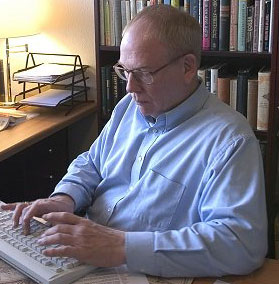
Dianne Gray
Dianne is a writer. As she explains on her blog site,
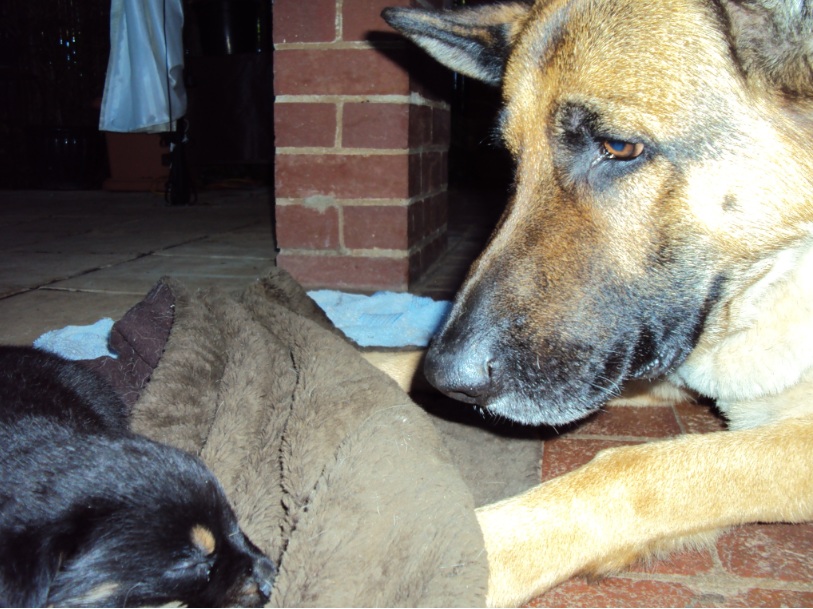
I live in Australia, have a sensitive-new-age Rottweiler called Kitty and a German Shepherd (in desperate need for The Dog Whisperer) called Sabre.
I’ve had interesting jobs, including working in a crocodile farm in Far North Queensland.
Sabre came into our lives in November 2004. He was seven weeks old. We were lucky enough to get Sabre from Bob Knight, a German shepherd breeder in Canberra, Australia. For those of you who don’t live in Australia you wouldn’t know that Bob was tragically shot and killed in 2010 while driving his truck through Sydney – the innocent victim of a gang war taking place several blocks away, he was hit by a stray bullet.
Bob was very passionate about his dogs and would interview those who were interested in buying one of the litter. If he didn’t think you were capable of managing a German shepherd he would not sell you one. He also ensured that each and every one of his puppies were brought back to him weekly (if possible) for free puppy training. So for over twelve months we (and the others who had bought one of the litter) met at the lake to take our dogs for a walk and training.
We live in the inner city and have an enormous yard so Sabre loved playing catch and patrolling the borders of our property. We live adjacent to a laneway and had some trouble with junkies shooting up near our fence and threatening to kill him if he barked at them. When he was two years old he became very ill very suddenly (it was Good Friday and near impossible to find a vet). We took him to the out-of-hours vet in the city who just looked at him and ($A800 later) told us not to feed him for the rest of the weekend.
By Saturday morning he could hardly move. We called Bob who told us about a woman called Jan who would be available to see him who lived in a nearby town. She was a country vet and looked after horses and cattle – so we loaded him in the car. This was the best move we ever made because, as it turned out, Jan would save his life a couple of times. When Jan saw him she couldn’t believe another vet would tell us not to feed him. “You don’t feed animals, they die,” she said. She gave us some horse paste (I still don’t know to this day what it was) and told us to put some in his mouth every hour. She said to try and give him his favourite food as often as possible and to call her every hour and tell her if he had eaten anything. She said he had the classic symptoms of having ingested a common bait (I’m not revealing what it was publically) and if we couldn’t get him to eat within four hours we had to bring him straight back to her. Basically he was starving to death.
We put the paste in his mouth as often as possible and tried to tempt him with cheese (his favourite) for three hours. Finally, he took a small mouthful of cheese and we celebrated like it was Christmas! We took him back to Jan for the next three days and he got stronger and stronger and within a week was back to his old playful self.
Twelve months later he began to walk with his head to one side and then he’d shake it and basically seemed very uncomfortable. We took him back to Jan who looked in his ear to find he had a chronic ear infection. She gave him antibiotics and cleaned his ear, but weeks passed and it just didn’t want to budge. We took him back to Jan every weekend and she would clean his ear (he wouldn’t let us touch it) and give him a penicillin injection. I surfed the net trying to find out what I could do to get rid of this damn infection – we were trying everything possible and it still wouldn’t budge. Then I read somewhere that yoghurt in a dog’s diet can be good for this kind of thing. I added yoghurt to his diet and within a week he was looking better. We still had him back to Jan’s every weekend for a few months and I still put yoghurt in his diet!
Six months later he started to change and became obnoxious and aggressive with us. We thought it may have had something to do with the ear infection so we took him back to Jan. She laid him on his back and felt his testies. He was kind of shocked and so were we, but she had definitely done the right thing because at this stage he had testicular cancer in both testies. She operated and found that the cancer was at the advanced stage. She was pretty sure she had got it all, but told us the signs to watch for over the next few months. She put him on ‘girly hormones’ as she called them and he was on those for about twelve months – and what a pleasure he became. He was behaving himself and not cranky or aggressive like before the operation. He was a different boy! If you have a male dog that is not de-sexed and he becomes even the slightest bit aggressive, I strongly suggest you have him checked for testicular cancer!
Because we’d had so much trouble with the junkies I decided to get cameras around the outside of the house. It was such a novelty at first – I’d come home from work and check the cameras to see what had happened during the day, but then I noticed something really sad. Sabre would say goodbye to me at the gate every morning and then just sit there ALL DAY waiting for me to come home. It was heartbreaking, I’d never realised until this time how lonely he was. I’d watch the tape on X30 and it reminded me of one of those television advertisements where someone stands still while everything around them speeds past. So hubby and I decided it was time for another dog. This is where Kitty comes into the picture. From the moment Sabre saw her he absolutely loved her and she loved him. She is obsessed with his tail and when we go anywhere she grips onto his tail and follows him.
First meeting Sabre and Kitty.
Sometimes when they’re playing in the yard she grabs his tail and runs past him so fast he ends up running sideways! Kitty has had her fair share of problems as well. She was spade (by a vet other than Jan because she doesn’t have the capacity or equipment to spade female pups) and three months later she went on heat! I took her back to the other vet and he had only removed one ovary. So she had to be spade again, the poor darling. Meanwhile, Sabre must have had enough male hormones left in him to want to mount her every five minutes. So what I did was rub eucalyptus oil on Kitty’s back and this was enough to keep him away (the smell made him sneeze). Now we find Kitty has arthritis (she’s only fifteen months old) so we’re back to see Jan every other weekend for treatment. We’re kind of like a family now!
Sabre and Kitty today.
Kitty and Sabre are a wonderful pair and now when I watch the cameras when I get home from work all I can see is the two of them playing all day long. It’s a wonderful life!
oooOOOooo
So back to me! Couple of items to close this lovely story from Dianne.
“Writing has nothing to do with publishing. Nothing. People get totally confused about that. You write because you have to – you write because you can’t not write. The rest is show-business. I can’t state that too strongly. Just write – worry about the rest of it later, if you worry at all. What matters is what happens to you while you’re writing the story, the poem, the play. The rest is show-business.” — Peter S. Beagle
Four days ago, there was a post on Learning from Dogs under the heading of We are what we eat! As is often the way, subsequently after writing that article (back on the 8th), there was a flurry of other associated items that I wanted to bring to your attention today.
The first was on the website of The Permaculture Research Institute of Australia. It was a very inspiring two-part article written by Anthea Hudson under the title of Preparing Our Children For a Resilient Future.
Part One was all about recycling and our role as facilitators. Here’s a little challenge for you, lifted from that first part,
Landfill — Our Dirty Legacy
Let’s begin by understanding a bit about how long the things we send to landfill last, before they break down.
Have a look at the list below and see if you can guess the order these items should be placed in, from the things that break down quickest, to those that take the longest. Then have a guess as to how long you think each one will take to break down.
paper bag
plastic jug
cigarette butt
glass bottle or jar
banana
aluminium can (soft drink can)
leather boot or shoe
plastic 6-pack rings
Styrofoam cup
cotton pillowcase
rubber sole of the leather boot (above)
wool sock or scarf
tin can (e.g. baked beans or soup can)
Don’t cheat by looking at the answers below, until you have made your own list.
Think you have worked it out? Now go here and check your answers! You may be suprised.
Part One is very comprehensive and Part Two even more so. Indeed, it serves as a wonderful check-list of all the reasons why and how we can be more responsible for what goes into our stomachs. It really is a most comprehensive review, nay tutorial, on how to grow your own. It includes such gems as this,
This video was created by the 2009 spring plant physiology class at Plymouth State University.
Next to the bad and ugly stuff.
Anyone who was shocked by the revelation of the harm being done to bees highlighted in my recent Post (the full article is on Food Freedom News) and to us humans,
A recent study showed that every human tested had the world’s best-selling pesticide, Roundup, detectable in their urine at concentrations between five and twenty times the level considered safe for drinking water.
will be further shocked, alarmed and (fill in your words) by this two-hour film introduced by Gary Null. We all need to watch it and yet I’m bound to say it will ruin your day! Jean and I have watched it in full and to all my readers, especially American ones, I say this – do watch this video, Please!
Progressive Radio Network presents
A Gary Null Production
WAR ON HEALTH: The FDA’s Cult of Tyranny
Introduced by the director (from his speech at the world premiere in New York City, June 15, 2012)
In the near future, American medical practice may change dramatically for the worse. No longer will maximal dose natural supplements—vitamins, natural compounds, and scientifically proven medicinal herbs—be available over the counter in local health and grocery stores. Holistic practice, which relies upon non-prescription natural treatments instead of Big Pharma drugs prescribed life-long, will diminish. American healthcare will be imprisoned, patients will be forced to abide by a single medical paradigm defined by corporate drug and food executives and dictated by a government enforcement agency, the Food and Drug Administration (FDA). This is the bleak scenario if the FDA succeeds in limiting Americans’ options to prevent and treat diseases.
‘War on Health’ is the first documentary detailing and challenging the FDA agenda and its allegiance with the international Codex Alimentarius, which hopes to establish a monolithic food and health regime. Betraying its founding mandate to assure drug, food and chemical safety in the interests of public health, the FDA today is a repressive bureaucracy serving pharmaceutical and agricultural greed and profits. Vaccines, medical devices, prescription drugs are fast tracked at alarming rates through the FDA at the expense of scientific oversight to assure their efficacy and safety. The
result is hundreds of thousands premature deaths annually from pharmaceutical drugs, vaccines and medical devices and an epidemic of medical incompetence and fraud sanctioned by federal health officials.
Featuring many pioneering American and European attorneys, physicians, medical researchers and advocates of health freedom, War on Health lifts the veil on FDA’s militaristic operations against organic food providers and alternative physicians. The film’s conclusion is perfectly clear: the FDA is a tyrannical cult founded upon the denial of sound medical science with little intention to improve the nation’s health and prevent disease.
Written and Directed by Gary Null
Produced by Valerie Van Cleve
Associate Producer: Richard Gale
Editor: Richie Williamson
Offline Editing: Valerie Van Cleve, L.A. Jones
Camera Operators: Marcello Coppuchino, Peter Bonilla, David Grier, L.A. Jones
Gregory Jason Russ, Jake Hammer Mesmire, Edson Tanakae, Valerie Van Cleve, Richie Williamson
As my dear friend of many, many years, Richard M., has a habit of saying, “Must go now, need to get back to Planet Earth!“
Not quite how you would expect a crocodile to behave!
With thanks to Christine over at 350 or bust who published on Saturday, 30th June.
Then a web search found a more extensive video.
Pocho, the “domesticated” Costa Rican crocodile that gained international attention for a weekly show he performed with owner Gilberto Sheedan, died Tuesday at Finca Las Tilapias in the Caribbean-slope town of Siquirres. Olga Valle, Sheedan’s wife, said the nearly 1,000-pound croc died a natural death at age 50. A funeral will be held for Pocho on Sunday at 1 p.m.
“All of the people in the village have offered their condolences and assistance,” Valle said.
On past Sundays, Pocho and “Chito,” as Sheedan was better known, performed a show for visitors in a 100-square-meter artificial lake at Finca Las Tilapias. Chito, 54, declared the one-eyed crocodile “domesticated.” He could command Pocho to do tricks such as winking its one good eye, lifting its head and tail out of the water, rolling over and permitting Chito to stick his head inside the massive reptile’s maw.
Chito found the 5-meter-long crocodile near death on the shore of the Parismina River, in the Limón province, 17 years ago. The crocodile had been shot in the left eye. Chito and several friends loaded the animal into a boat and took him to Siquirres, where Pocho was nursed back to health. Chito even slept with the crocodile during its recovery.
After an employee saw Chito swimming with Pocho one day, word of the duo’s friendship spread. In July 2000, Costa Rica’s Channel 7 filmed the unusual pair. Chito and Pocho became stars, receiving attention as far as the United States, Chile and the United Kingdom.
The Environment, Energy and Telecommunications Ministry allowed Chito to keep the crocodile as long as they could monitor it. Chito worked with a veterinarian and a biologist and fed Pocho 30 kilograms of fish and chicken a week.
Chito never imagined the fame that would come from the unique friendship. All he wanted was an animal companion. A sign on his ranch emphasized that relationship: “Chito and Pocho are best friends.”
“I just wanted him to feel that someone loved him, that not all humans are bad,” Chito told The Tico Times in 2007. “I love all animals, especially ones that have suffered.”
Love is really the solution to practically every problem in the world!
So why do we insist of manipulating the genetics of food!
I read somewhere recently, and of course now can’t find the reference, that the genetic modification of our food represents as big a danger to the long-term survival of man as does the damage to our biosphere.
So a recent item on the blog Food Freedom News jumped out at me. This was an item that was introduced as, “The author of Seeds of Destruction (about Monsanto) has a new piece out on pesticides and mass animal deaths… very sobering.”
Clicking on the ‘new piece’ link takes one to here, from which I quote the opening paragraphs,
“A recent study showed that every human tested had the world’s best-selling pesticide, Roundup, detectable in their urine at concentrations between five and twenty times the level considered safe for drinking water.”
Birds and bees are something most of us take for granted as part of nature. The expression “teaching about the birds and the bees” to explain the process of human reproduction to young people is not an accidental expression. Bees and birds contribute to the essence of life on our planet. A study by the US Department of Agriculture estimated that “…perhaps one-third of our total diet is dependent, directly or indirectly, upon insect-pollinated plants.”
The honey bee, Apis mellifera, is the most important pollinator of agricultural crops. Honey bees pollinate over 70 out of 100 crops that in turn provide 90% of the world’s food. They pollinate most fruits and vegetables–including apples, oranges, strawberries, onions and carrots. But while managed honey bee populations have increased over the last 50 years, bee colony populations have decreased significantly in many European and North American nations. Simultaneously, crops that are dependent on insects for pollination have increased. The phenomenon has received the curious designation of Colony Collapse Disorder (CCD), implying it could be caused by any number of factors. Serious recent scientific studies however point to a major cause: use of new highly toxic systemic pesticides in agriculture since about 2004.
That first paragraph alone made me sit up, “A recent study showed that every human tested had the world’s best-selling pesticide, Roundup, detectable in their urine at concentrations between five and twenty times the level considered safe for drinking water.” What a strange race we are!
Wlliam F. Engdahl
Then it was easy to find out more information about the author of the book Seeds of Destruction, William F. Engdahl, including his website. Mr. Engdahl is clearly no stranger to controversy as this YouTube video illustrates,
Back to that Food Freedom article. Further on, there is evidence of the size of the problem in the UK,
Alarming UK results
A private UK research organization, Buglife and the Soil Association, undertook tests to try to determine cause of the bee death. They found that the decline was caused in part by a group of pesticides called neonicotinoids. Neonicotinoids are “systemic” chemicals that kill insects by getting into the cell of the plant. In Britain it’s widely used for crops like oilseed rape and for production of potted plants.
The neonicotinoids are found in the UK in products including Chinook, used on oilseed rape and Bayer UK 720, used in the production of potted plants which then ends up in gardens and homes around the country. The new study examined in detail the most comprehensive array of peer-reviewed research into possible long-term effects of neonicotinoid use. Their conclusion was that neonicotinoid pesticides damage the health and life cycle of bees over the long term by affecting the nervous system. The report noted, “Neonicotinoids may be a significant factor contributing to current bee declines and could also contribute to declines in other non-target invertebrate species.” The organization called for a total ban on pesticides containing any neonicotinoids.
The president of the UK Soil Association, Peter Melchett, told the press that pesticides were causing a continued decline in pollinating insects, risking a multimillion pound farming industry. “The UK is notorious for taking the most relaxed approach to pesticide safety in the EU; Buglife’s report shows that this puts at risk pollination services vital for UK agriculture,” he said.
Indeed in March 2012 Sir Robert Watson, Chief Scientist at the British Government’s Department of Environment announced that his government was reconsidering its allowance of neonicotinoid use in the UK. Watson told a British newspaper, “We will absolutely look at the University of Stirling work, the French work, and the American work that came out a couple of months ago. We must look at this in real detail to see whether or not the current British position is correct or is incorrect. I want this all reassessed, very, very carefully.” To date no policy change has ensued however. Given the seriousness of the scientific studies and of the claims of danger, a prudent policy would have been to provisionally suspend further uise of neonicotinoids pending further research. No such luck.
And if the harm to bees wasn’t serious enough, try this extract,
Effect on Human Brain?
But most alarming of all is the evidence that exposure to neonicotinides has horrific possible effects on humans as well as on birds and bees.
Professor Henk Tennekes describes the effects:
“Today the major illnesses confronting children in the United States include a number of psychosocial and behavioral conditions. Neurodevelopmental disorders, including learning disabilities, dyslexia, mental retardation, attention deficit disorder, and autism – occurrence is more prevalent than previously thought, affecting 5 percent to 10 percent of the 4 million children born in the United States annually. Beyond childhood, incidence rates of chronic neurodegenerative diseases of adult life such as Parkinson’s disease and dementia have increased markedly. These trends raise the possibility that exposures in early life act as triggers of later illness, perhaps by reducing the numbers of cells in essential regions of the brain to below the level needed to maintain function in the face of advancing age. Prenatal and childhood exposures to pesticides have emerged as a significant risk factor explaining impacts on brain structure and health that can increase the risk of neurological disease later in life.”
There is also growing evidence suggesting persistent exposure to plants sprayed with neonicotinoids could be responsible for damage to the human brain, including the recent sharp rise in incidents of autism in children.
This really is an article that you should read in full, which also includes a full bibliography and notes section. Plus you can leave your responses as a comment – go for it!
A guest post from Martin Lack points to the crux of the issue of denying man-caused climate change.
Introduction
I saw this post on Martin’s Blog Lack of Environment the day after I wrote a piece called In praise of fairness. In my piece I mentioned the sad case of Mr. Bob Diamond and Martin continued with the theme in such a manner that I wanted to republish his article in full. Here it is.
oooOOOooo
Are you negligent, incompetent or complicit?
This was a question posed to former Barclays CEO Bob Diamond this week, when he appeared before a Parliamentary Select Committee of MPs on Wednesday. It is a question that I would like to ask Dr Richard Lindzen… In fact, I have asked the question and – just as Bob Diamond did – he has refused to answer it… Here is the evidence on which you should decide for yourself:
Many readers will recall that, following my visit to London to hear Lindzen speak to a room full of fake sceptics in the Palace of Westminster on 22 February this year, I attempted to get some answers to questions. Unfortunately, I failed. I have been particularly frustrated by one thing; possibly the most misleading aspect of Lindzen’s entire presentation – a combination of graphs of recent atmospheric CO2 and temperature data that was mysteriously omitted from the PDF of the presentation that was initially posted on the Internet. Although Lindzen never answered any of my questions, he did insert this slide into the PDF of his presentation despite my pointing out to him – MIT and the AGU – that it was essentially meaningless (as the y-axes could be stretched to show either correlation or no correlation as preferred by the speaker).
Here is a screenshot of the misleading graph from the video of the presentation:
Steeply inclined Keeling curve versus apparently non-correlating temperature – if you stretched the temperature axis enough it would appear to correlate quite well. Therefore slide neither proves not disproves anything.
This bears more than a passing resemblance to the World Climate Widget – a very similar-looking combination of graphs (i.e. manipulated to suggest that there is no correlation between recent atmospheric CO2 and temperature data) – that can be downloaded as a widget from Anthony Watts’ Watts Up With That? (WUWT) misinformation blog.
If you go to the WUWT widget page, you will find the two graphs in both of these images (above and right) are there presented separately. However, to prove my point – that anyone using these graphs to try and prove there is no correlation between long-term CO2 and temperature changes – just look at what happens when you take the graph of University of Alabama at Huntsville (UAH) global lower atmosphere data as used by WUWT (i.e. cooler than surface temperature data) and stretch it:
Clearing the fog of data misrepresentation created by Lindzen et al. – Note the clear upward trend in the temperature graph on the left (it was there all the time).
Therefore, for anyone – including Lindzen – to try and use the original combination of graphs to suggest there is no correlation between CO2 and temperature, this suggests that they are either negligent, incompetent, or deliberately trying to mislead people. For many people who are not scientists to be fooled by this is understandable but, for a prominent scientist like Lindzen to make this mistake – and not apologise for doing so – is unforgivable. Furthermore, it would seem that, no matter how many times he is criticised, he just keeps repeating the same old mistakes: Skeptical Science: Lindzen and Choi 2011 – Party Like It’s 2009
It would appear that, despite the best efforts of the majority of prominent climate scientists, Lindzen’s London Illusions are still fooling a lot of people. If you follow that last link, it will take you to the website of what I prefer to call The Global Wonky Policy Foundation, where it is reported that only 43% of the British adult population felt able to agree with the following statement: “Global warming is a fact and is mostly caused by emissions from vehicles and industrial facilities”.
It has been suggested to me that this question is carefully phrased to deter people from saying “yes” (i.e. they might agree that warming is occurring and/or that humans are the primary cause; but they might not agree that vehicles and factories are the primary source of emissions). However, this is ‘clutching at straws’ in my opinion; and leaves me wondering what percentage of the population would feel able to agree with this statement:
“The sunrise is a fact and is mostly caused by the Earth not being flat and spinning once a day whilst orbiting the Sun”…?
oooOOOooo
I’m very grateful to Martin for allowing me to republish this.
An original idea that shouldn’t be regarded as innovative.
We live in interesting times! Whenever I use that phrase, and it seems to slip from my lips too often these days, I am reminded of the ancient Chinese curse, “May you live in interesting times!”
There are a goodly number of countries that have legislation that ‘impose’ a minimum wage for employees. Here in the USA, the Federal level for 2012 is $7.25 per hour but it isn’t necessarily the same across all States. Based on a 40-hour working week, 50 weeks a year, that comes to a gross of $14,500 for the full year.
Let’s contrast that with a person who has been in the news recently, Mr. Bob Diamond, Chief Executive of Barclays.
Mr Diamond has said he will not take a bonus for this year as a result of the scandal.
It is not the first time the 60-year-old Boston-born former academic – he began his career as a university lecturer – has made the headlines.
Mr Diamond was previously best-known for his huge wealth: last year he topped the list of the highest-paid chief executives in the FTSE 100.
‘Unacceptable face’
In 2011 Mr Diamond earned £20.9m, comprising salary, bonuses and share options, and he is reported to have a personal wealth of £105m.
There has long been controversy about the amount he earns.
In 2010, Lord Mandelson described him as the “unacceptable face of banking”, saying he had taken a £63m salary for “deal-making and shuffling paper around”.
Barclays dismissed the figure as “total fiction” saying that his salary as head of Barclays Capital was actually £250,000.
BBC business editor Robert Peston said he believed Mr Diamond had earned £6m in 2009 from a long-term incentive scheme and £27m from selling his stake in a Barclays-owned business that had been sold.
So whether he earns £20.9m, £6m or even £250,000 frankly makes no difference to the fact that the gap between what the poorest may earn and the sorts of monies that are given to Mr. Diamond and his like is just plain wrong. [And since writing this on Monday, the news broke on Tuesday morning that Mr. Diamond is now unemployed.] Don’t often quote the bible in Learning from Dogs but 2 Corinthians 8:13-15 is irresistible (King James Version),
Our desire is not that others might be relieved while you are hard pressed, but that there might be equality. At the present time your plenty will supply what they need, so that in turn their plenty will supply what you need. The goal is equality, as it is written: “The one who gathered much did not have too much, and the one who gathered little did not have too little.” [my emphasis]
I subscribe to Naked Capitalism and the other day there was a deeply interesting article about France pushing for a maximum wage. Let me take the liberty of quoting all of it,
SUNDAY, JULY 1, 2012
France Pushing for a Maximum Wage; Will Others Follow?
A reader pointed out a news item we missed, namely, that the new government in France is trying to implement a maximum wage for the employees of state-owned companies. From the Financial Times:
France’s new socialist government has launched a crackdown on excessive corporate pay by promising to slash the wages of chief executives at companies in which it owns a controlling stake, including EDF, the nuclear power group.
In a departure from the more boardroom-friendly approach of the previous right-of-centre administration, newly elected president François Hollande wants to cap the salary of company leaders at 20 times that of their lowest-paid worker.
According to Jean-Marc Ayrault, prime minister, the measure would be imposed on chief executives at groups such as EDF’s Henri Proglio and Luc Oursel at Areva, the nuclear engineering group. Their pay would fall about 70 per cent and 50 per cent respectively should the plan be cleared by lawyers and implemented in full…
France is unusual in that it still owns large stakes in many of its biggest global companies, ranging from GDF Suez, the gas utility; to Renault, the carmaker; and EADS, parent group of passenger jet maker Airbus.
Of course, in the US, we have companies feeding so heavily at the government trough that they hardly deserve the label of being private, but the idea that the public might legitimately have reason to want to rein in ever-rising executive pay is treated as a rabid radical idea.
For those, however, receiving bailouts, deposit insurance, government guarantees, tax breaks, tax credits, other forms of public financing, government contracts of any sort – and so on – the top paid person cannot receive more than twenty-five times the bottom paid person. This ratio, by the way, is what business visionary Peter Drucker recommended as most effective for organization performance as well as society. It also echoes Jim Collins who, in his book Good To Great, found that the most effective top leaders are paid more modestly than unsuccessful ones. And, critically, it is a ratio that is in line with various European and other nations that have dramatically lower income inequality than the United States.
In other words, the French proposal isn’t that big a change from existing norms, at least in most other advanced economics (ex the UK, which has also moved strongly in the direction of US top level pay). But despite the overwhelming evidence that corporate performance is if anything negatively correlated with CEO pay, the myth of the superstar CEO and the practical obstacles to shareholder intervention (too fragmented; too many built in protections for incumbent management, like staggered director terms; major free rider problems if any investor tries to discipline extractive CEO and C level pay, which means it’s easier to sell than protest) means ideas like this are unlikely to get even a hearing in the US. Let the looting continue!
As Patrice Ayme commented on that Naked Capitalism article, “France will pass the 20 to 1 law, as the socialists control the entire state, senate, National Assembly, Regions, big cities, etc. Only the French Constitutional Court could stop it. That’s unlikely, why? Because one cannot have a minimum wage, without a maximum wage. It’s not a question of philosophy, but of mathematics.”
Let me go back and requote this,
…. the top paid person cannot receive more than twenty-five times the bottom paid person. This ratio, by the way, is what business visionary Peter Drucker recommended as most effective for organization performance as well as society. It also echoes Jim Collins who, in his book Good To Great, found that the most effective top leaders are paid more modestly than unsuccessful ones. And, critically, it is a ratio that is in line with various European and other nations that have dramatically lower income inequality than the United States.
Thus if society was to embrace this approach to fairness, in America the top paid person in 2012 in the USA would be on 25 times the minimum wage level of $14,500 a year or, in other words, $362,500 a year.
I’m not a raving liberal but I am bound to say that this sits pretty well with me. How about you?
As I opened, an original idea that shouldn’t be regarded as innovative.
Some of us think holding on makes us strong; but sometimes it is letting go. Hermann Hesse
Nuneaton in Warwickshire is a town about 100 miles North-West of London. It’s firmly in that part of England known as the Midlands, encircled by such places as Birmingham, Coventry, Rugby and Leicester. It is also the home of the Nuneaton & Warwickshire Wildlife Sanctuary So what, you might ask?
Watch this!
On the Wildlife Sanctuary’s website, there is the story of Jasmine,
Jasmine was a rescue dog who lived at the sanctuary until her passing in 2011. She was no ordinary rescue dog, she was the most amazing greyhound in the world!
She was only a young pup when she was locked in a shed and abandoned. When she was discovered by the police many days later she was emaciated, mange ridden and terrified. She was taken to the RSPCA quarters in Coventry where Geoff just happened to be visiting several weeks later. They were introduced and as they say ‘the rest is history’. She came to live with Geoff at the sanctuary. Each day her confidence grew and her personality flourished. But the most amazing thing was yet to come….
It turned out Jasmine was a natural ‘Mother hen’. One day a young fox cub was brought in to the sanctuary. She had been tied to railings and left to die. She was very small and weak and the outlook wasn’t bright. That was until Jasmine sauntered over to the fox cub’s basket and started to lick her. Geoff was immediately concerned, followed by bemusement, followed by amazement as he saw before his eyes the fox responding to Jasmine’s touch. He quickly realised that Jasmine was acting in the same way the fox cub’s mother would have done in the wild!
Over the next few days Jasmine continued to ‘mother’ the fox cub who Geoff had named Roxy. Roxy grew strong and grew up. She lives at the sanctuary with Jasmine who is mum and best friend all rolled into one.
Jasmine was truly one of a kind. She mothered many of the sanctuary’s residents back to health including Bramble the roe deer, Humbug the badger and two of the other sanctuary dogs, just to mention a few.
Sadly Jasmine passed away in 2011. She is greatly missed by all at the sanctuary.
So what’s Geoff’s story? That is beautifully explained here,
In February 2001, an injured swan was taken to a veterinary clinic in Warwickshire. The swan was injured, but needed only a week of rest before it was able to be released back into the wild. However, there was nowhere in the area for the swan to rest and receive care, so it was put to sleep. This was when Geoff decided to set up the sanctuary.
Geoff had worked as a security guard for many years but was injured at work and forced to retire. He used his savings to transform his garden into a haven for wildlife and has never looked back.
Geoff, all the caring people in the world salute you!
As of 2011, the Sanctuary has been open for ten years, and has had 6,500 birds and 4,250 animals.
The Sanctuary relies on the work of our dedicated team of volunteers; who accompany us on fundraising events, talks, and shows to help raise money for the Sanctuary.
So let me close by thanking Suzann for sending me the video link to this beautiful story. And do make a note to look in on Learning from Dogs next Saturday to marvel at yet another example of the way dogs (and Geoff!) throw off their pasts and rejoice in the present.
Trying to make sense of the utter nonsense of the Rio+G20 summit.
I share the deep frustration that must be felt by millions around the globe at the outcome of the Rio summit meeting, if outcome is the appropriate word! Martin Lack summarised his anger in a post last Friday and I’m going to publish an extract from his writings because they so perfectly reflect not only his anger but, I suspect, the anger of millions of others.
“It would have been naïve to pin too many hopes on a single conference, but undeniably we expected more from the outcome document. Entitled ‘The Future We Want’, the text doesn’t live up to the aspirations of the title – it’s more a case of ‘The Future We’ll Get If We Rely On Politicians’. Full of weak phrases, and re-confirmations of previous aspirations which they haven’t realised, the text fails to commit governments to actions, targets, timeframes and finance to which we can hold them accountable….What we have is an agreement within the bounds of what they thought politically possible; what we needed was an agreement to address what is scientifically necessary. This is no way to manage our planet!”
“World leaders have spent 20 years bracing themselves to express ‘deep concern’ about the world’s environmental crises, but not to do anything about them…Several of the more outrageous deletions proposed by the United States – such as any mention of rights or equity or of common but differentiated responsibilities – have been rebuffed. In other respects the Obama government’s purge has succeeded, striking out such concepts as “unsustainable consumption and production patterns” and the proposed decoupling of economic growth from the use of natural resources.”
I would like to be able to dismiss this as facile criticism from the liberal left. However, in reality, to do so would be to second-guess the scientists who have been telling us for decades that we need action not words. Our children and grandchildren will not forgive us for failing to act.
BUT a conversation I had with Lew L. here in Payson last Friday afternoon helped crystalise some thoughts that I would like to share with you.
Representative democracy a la British House of Commons
The first is about democracy, or more accurately representative democracy. Lew pointed out that some US Towns still employ direct democratic processes where all the people who attend a Town meeting vote in person for or against the motion. The challenge for a representative democratic process is that those elected representatives are vulnerable to a wide range of influences and between elections may be taking decisions that the people would neither support nor approve of.
The idea of direct democracy goes back a very long time, as Wikipedia reveals,
The earliest known direct democracy is said to be the Athenian Democracy in the 5th century BC,
So it could be argued that the fundamental flaw in the Rio+G20 meeting was not the lack of any real progress by our ‘leaders’, but in our expectations, as in the expectations of ‘you and me’, all across the world. The money and power that must be intertwined in such games of international politics doesn’t bear thinking about. It was Lord Acton, the British historian, who said: ‘Power tends to corrupt, absolute power corrupts absolutely‘.
So rather than expecting our representatives and leaders to do what we what them to do and being bitterly disappointed, time and time again, there is another equally valid way of bringing about change – create the change you desire by changing yourself.
As my friend Jon Lavin expressed in a very recent email,
People like something solid to relate to in such changing and unpredictable times and a dogs view is brilliant because dogs just are because they are in the present. All that matters is the ‘now’. Most of our problems can be traced back to our lack of ability to be in the ‘now’. Driven by regrets about the past, and a fear of what the future holds, we carry on hoping that all our problems can be solved by amassing material possessions.
Oh, well. The best way to save the world is to work on our selves.
So that leads on to my second thought, the urgency in tackling what is happening to the Earth’s climate. In Martin’s second angry post over at Lack of Environment, he writes,
Global average temperatures are rising. Since the 1980s, every decade has been warmer than the last. 1998 was a very warm year, but global warming has not stopped; it has morphed into Anthropogenic Climate Disruption (ACD). Some even suggest we should call it Human Induced Rapid Global Overheating (HIRGO) but I prefer ACD, because that is what we are experiencing: It will be decades before it becomes obvious that HIRGO is happening and, if we wait for it to be obvious, there will be no way to stop it.
We need to accept that ACD is a reality; it is an inevitable consequence of a warming atmosphere; one with more moisture in it more of the time and – as I said – it is exactly what the climate models have being tell us would happen for decades. That being the case, how is it that our politicians – seemingly led by members of a supposedly left-of-centre Democratic Party administration in the USA – can have such monumental tunnel vision as to offer up the planet itself as a sacrifice upon the altar of the god of Growth?
But do you see the fundamental error? The idea that our leaders have to create change: “.. how is it that our politicians …. can have such monumental tunnel vision as to offer up the planet itself as a sacrifice upon the altar of the god of Growth?”
As Jon Lavin revealed in his email to me, the agency of change is within each of us. It is not a “thing.” There’s a huge amount of information revealed by a simple Google search on change, the change process, change management process, etc., etc., so I’m not going to add to the noise by quoting the experts. It’s as simple as Jon wrote:
“The best way to save the world is to work on our selves.”
OK, moving on to my second thought, and for this I want to play a little mind-game.
That is what would be the impact if 50% of the combined populations of North America and Europe decided to save the power of one 60-watt lamp, or equivalent, for 36 hours a year, i.e. turning off one 60-watt lamp for less than one hour a day for a year!
Let’s take this a step at a time.
The combined population of the USA, Canada and Europe is 1,090,487,000 people, i.e. a little over 1 billion.
Thus half that population is 545,243,500 persons.
Saving 60 watts for 36 hours a year is 60 X 36 = 2,160 watts.
Thus 545,243,500 people times 2,160 watts = 1,177,725,960,000 watts. Which is 1.178 trillion watts. (rounded up)
I say again: 1.178 trillion watts.
How can one get any notion of what that means? The best I could find from a web search was this:
The U.S. electric power industry’s total installed generating capacity was 1,119,673 megawatts (MW) as of December 31, 2009—a 1.0-percent increase from 2008.
Ergo, in 2009 the USA had the capability of generating 1,119,673 megawatts. A megawatt is one million watts so 1,119,673 megawatts is 1,119,673,000,000 watts, or 1.119 trillion watts.
Wow! switching off a 60-watt lamp for less than an hour a day would save 1.178 trillion watts, more than the combined generating capacity of the entire USA in 2009 of 1.119 trillion watts.
I suspect that the current USA generating capacity isn’t that much different and, of course, one can’t run away with the idea that all of that is generated by fossil fuels.
But if I have done my mathematics correctly (and do please check my sums), the simple expediency of turning off one 60-watt lamp for 36 hours a year, if done by just half the populations of North America and Europe, would be the equivalent of saving 105% of the total US generating capacity!
So thinkabout the change you want in your life, and the lives of your children and grandchildren, and get on with it. Turn out that light!
“The best way to save the world is to work on our selves.”
And I can do no better in terms of reflecting on the power of our minds, than courtesy of this fabulous video which Christine of 350orbust had last Saturday:
Final thought! If one thinks of the way that we trust the Internet for so much these days, and the huge number of people that are now ‘wired’, it doesn’t seem to be beyond the wit of man to come up with a reliable, secure method of direct voting electronically. Wonder why that hasn’t caught on?
I’m talking about the film Fuel which Jean and I watched on Monday night.
Here’s the trailer,
This movie trailer gives insight into the impeding oil dependency problem and hints at the biofuel solution. The Fuel Film raises awareness of 9/11, global warming, and moreover, how we can switch to an alternative fuel called biofuel. It is based on renewable sources such as algae or ethanol, costs less, and combats the impeding destruction of the environment.
But Top Documentary Films has the full film available, the link is here. (And see below) TDF describe the film, thus,
Eleven years in the making, FUEL is the in-depth personal journey of filmmaker and eco-evangelist Josh Tickell, who takes us on a hip, fast-paced road trip into America’s dependence on foreign oil.
Combining a history lesson of the US auto and petroleum industries and interviews with a wide range of policy makers, educators, and activists such as Woody Harrelson, Sheryl Crow, Neil Young and Willie Nelson.
Animated by powerful graphics, FUEL looks into our future offering hope via a wide-range of renewable energy and bio-fuels. Winner of the Sundance Audience Award.
The events of Sept. 11 and Hurricane Katrina factor in both visually and thematically, providing provocative anchors for the movie’s indictment of what Tickell believes is the Big Oil-cozy, ecologically indifferent Bush administration.
Johnny O’Hara’s WGA Award-nominated script doesn’t dwell on muckraking, however; it’s more focused on broadly inspiring viewers than preaching to the converted.
Interviews with a wide range of environmentalists, policy makers and educators, along with such “green” celebrities as Woody Harrelson, Sheryl Crow and Larry Hagman offer serious fuel for thought – as well as for action.
Smartly animated interstitials, memorable archival material and a lively soundtrack round out the fast-paced proceedings.
Have to say that the film was powerful and compelling and a great reminder that a sustainable way of life for all of us doesn’t mean the end of the world as we know it. Far from it; the word ‘sustainable’ is the clue here!
Here’s the full film,
Director Josh Tickell takes us along for his 11 year journey around the world to find solutions to America’s addiction to oil. A shrinking economy, a failing auto industry, rampant unemployment, an out-of-control national debt, and an insatiable demand for energy weigh heavily on all of us. Fuel shows us the way out of the mess we’re in by explaining how to replace every drop of oil we now use, while creating green jobs and keeping our money here at home. The film never dwells on the negative, but instead shows us the easy solutions already within our reach.
Finally, a little footnote for all you Planet watchers out there. Summer starts, as in the summer solstice, today (the 20th) in North America at 7:09 P.M. EDT (UTC -4 hours) or 4:09 P.M. MST (UTC -7 hours) and in the UK at 23:09 UTC.