Category: Morality

Looking into self.

Rounding off the week.

Starting with Monday’s video of Carl Sagan reminding us all that Planet Earth is just a grain of sand in the vast cosmos right through to yesterday’s Dealing with madness post, much of the week has been reminding us all of one very fundamental truth.  No better expressed than in a comment from Patrice Ayme [my emphasis]:

… there is no healthy man without a healthy world.

Regulars will have noted the high levels of debate this week.  Thank you all for those comments.

I have also received a couple of emails with feedback and comments, sent to me on a personal basis.  One of those emails had such a powerful message that I begged for permission to publish it on Learning from Dogs.  I was asked to keep the author’s identity private but, trust me, it is from someone I know well who subscribes to ideas of integrity and honesty in spades.

The author also strongly recommended publishing in association with his personal essay an extract from Chris Hedges’ book “Death of the Liberal Class”.  That extract follows straight on from the essay.

oooOOOooo

Reflections from a Vietnam Combat Veteran

War is an unnatural dichotomy.  Both sides are morally and materially diminished.  A future World War would most probably finish us as the self-appointed predominant intelligent species on planet earth.  It seems worth noting that German industrialists coordinated fundamentalist propaganda to foster the bigotry, hatred and fear which fueled their profitable war engines prior to World War II.

United States commercial media today reflects a financially dominated military-industrial culture with liberty and justice for sale.  The results are divisive and lead to both a declared international war against nebulous assailants we have been taught to dislike and an internal political war that has polarized our once fair nation.

We’ve stopped investing in the future in response to radicals who want to destroy government, human rights and what remains of the earth’s surface resources.  There is an emerging police state mentality on display with a variety of candidates for local dictator.

It’s well past time for moderate republicans to ignore their uber-conservative brethren.  It’s well past time for moderate democrats to renounce their corporate ties.  This will only happen when our financial and political leaders awaken to the reality of what is in the best long-term interests for all life on this planet rather than our present unsustainable global economy.

To complicate the problem, our planet is under attack by a swarm of vociferous human locusts seeking profit without regard to the consequences.  Meanwhile, despite human denial, the universe continues to emerge.  Species which do not adapt to change do not survive.

It’s important to remember that we’re in the midst of a battle that’s as old as the conscious awareness of the human species.  We generally have very little idea of the inclusive nature of our being; let alone the nature of our collective being as a species. We have as yet to learn how to surrender to reality.  The battle is with our own species.

Committing collective suicide for quarterly profit is not a sane way of life.  What we’ve created is a neo-feudal global economy without any foundation that feeds on an empire of consumption.  When we combine a neo-feudal economy with neo-fascist politics we arrive at a moral and biological dead end.

The coup d’état of the current Corporate State is the Citizen’s United ruling that makes money a form of free speech.  Money has no DNA.  In case anyone missed how the “occupy” movement was crushed, there’s no question that we’re rapidly criminalizing all forms of dissent.  These actions are being taking under the 1917 Espionage Act and related state secrets acts.  No discernment of moral value is considered and no public hearings are conducted.  People who speak up are locked up.  We’ve become a fearful and secretive population.

Our self-appointed elite power structure is completely irrational in its belief that human reason is our ultimate power and money is its servant.  We are made of the stuff of the stars.  At best, we’re in our adolescence as a species.  We think we know the answers rather than admitting our ignorance.  What little we know is vastly less than what we have as yet to learn.  We are often unaware of being unaware.

The lives we presently lead can not be sustained in ways that we have become accustomed to; ways we take for granted.  What’s going to need to change?  The simple answer is everything.  Our species has systemically corrupted the small part of the cosmos which sustains our being.  Nature has no sense of humor, no patience for human squabbles and no financial interest.

Fortunately, we already know what we need to do to adapt.  We know how nature works through the wisdom of our earth sciences.  The answer is simple.  Love the earth.  Love life.  Share compassion.  Educate, naturally energize, and transform.  The resulting process of change will help re-establish a realistic world economic foundation.

oooOOOooo

‘Death of the Liberal Class’

By Chris Hedges

From the book “Death of the Liberal Class,” by Chris Hedges.  Excerpted by arrangement with Nation Books, a member of the Perseus Books Group.  Copyright © 2010.

The following selection is taken from the first chapter of the book, published in October 201 by Nation Books.

In a traditional democracy, the liberal class functions as a safety valve. It makes piecemeal and incremental reform possible. It offers hope for change and proposes gradual steps toward greater equality. It endows the state and the mechanisms of power with virtue. It also serves as an attack dog that discredits radical social movements, making the liberal class a useful component within the power elite.

But the assault by the corporate state on the democratic state has claimed the liberal class as one of its victims. Corporate power forgot that the liberal class, when it functions, gives legitimacy to the power elite. And reducing the liberal class to courtiers or mandarins, who have nothing to offer but empty rhetoric, shuts off this safety valve and forces discontent to find other outlets that often end in violence. The inability of the liberal class to acknowledge that corporations have wrested power from the hands of citizens, that the Constitution and its guarantees of personal liberty have become irrelevant, and that the phrase consent of the governed is meaningless, has left it speaking and acting in ways that no longer correspond to reality. It has lent its voice to hollow acts of political theater, and the pretense that democratic debate and choice continue to exist.

The liberal class refuses to recognize the obvious because it does not want to lose its comfortable and often well-paid perch. Churches and universities—in elite schools such as Princeton, professors can earn $180,000 a year—enjoy tax-exempt status as long as they refrain from overt political critiques. Labor leaders make lavish salaries and are considered junior partners within corporate capitalism as long as they do not speak in the language of class struggle. Politicians, like generals, are loyal to the demands of the corporate state in power and retire to become millionaires as lobbyists or corporate managers. Artists who use their talents to foster the myths and illusions that bombard our society live comfortably in the Hollywood Hills.

The media, the church, the university, the Democratic Party, the arts, and labor unions—the pillars of the liberal class—have been bought off with corporate money and promises of scraps tossed to them by the narrow circles of power. Journalists, who prize access to the powerful more than they prize truth, report lies and propaganda to propel us into a war in Iraq. Many of these same journalists assured us it was prudent to entrust our life savings to a financial system run by speculators and thieves. Those life savings were gutted. The media, catering to corporate advertisers and sponsors, at the same time renders invisible whole sections of the population whose misery, poverty, and grievances should be the principal focus of journalism.

In the name of tolerance—a word the Rev. Dr. Martin Luther King Jr., never used—the liberal church and the synagogue refuse to denounce Christian heretics who acculturate the Christian religion with the worst aspects of consumerism, nationalism, greed, imperial hubris, violence, and bigotry. These institutions accept globalization and unfettered capitalism as natural law. Liberal religious institutions, which should concern themselves with justice, embrace a cloying personal piety expressed in a how-is-it-with-me kind of spirituality and small, self-righteous acts of publicly conspicuous charity. Years spent in seminary or rabbinical schools, years devoted to the study of ethics, justice, and morality, prove useless when it comes time to stand up to corporate forces that usurp religious and moral language for financial and political gain.

Universities no longer train students to think critically, to examine and critique systems of power and cultural and political assumptions, to ask the broad questions of meaning and morality once sustained by the humanities. These institutions have transformed themselves into vocational schools. They have become breeding grounds for systems managers trained to serve the corporate state. In a Faustian bargain with corporate power, many of these universities have swelled their endowments and the budgets of many of their departments with billions in corporate and government dollars. College presidents, paid enormous salaries as if they were the heads of corporations, are judged almost solely on their ability to raise money. In return, these universities, like the media and religious institutions, not only remain silent about corporate power but also condemn as “political” all within their walls who question corporate malfeasance and the excesses of unfettered capitalism.

Unions, organizations formerly steeped in the doctrine of class struggle and filled with members who sought broad social and political rights for the working class, have been transformed into domesticated negotiators with the capitalist class. Cars rolling off the Ford plants in Michigan were said to be made by UAW Ford. But where unions still exist, they have been reduced to simple bartering tools, if that. The social demands of unions in the early twentieth century that gave the working class weekends off, the right to strike, the eight-hour workday, and Social Security, have been abandoned. Universities, especially in political science and economics departments, parrot the discredited ideology of unregulated capitalism and have no new ideas. The arts, just as hungry as the media or the academy for corporate money and sponsorship, refuse to address the social and economic disparities that create suffering for tens of millions of citizens. Commercial artists peddle the mythical narrative, one propagated by corporations, self-help gurus, Oprah and the Christian Right, that if we dig deep enough within ourselves, focus on happiness, find our inner strength, or believe in miracles, we can have everything we desire.

Such magical thinking, a staple of the entertainment industry, blinds citizens to corporate structures that have made it impossible for families to lift themselves out of poverty or live with dignity. But perhaps the worst offender within the liberal class is the Democratic Party.

The party consciously sold out the working class for corporate money. Bill Clinton, who argued that labor had nowhere else to go, in 1994 passed the North American Free Trade Agreement (NAFTA), which betrayed the working class. He went on to destroy welfare and in 1999 ripped down the firewalls between commercial and investment banks to turn the banking system over to speculators. Barack Obama, who raised more than $600 million to run for president, most of it from corporations, has served corporate interests as assiduously as his party. He has continued the looting of the U.S. Treasury by corporations, refused to help the millions of Americans who have lost their homes because of bank repossessions or foreclosures, and has failed to address the misery of our permanent class of unemployed.

Populations will endure the repression of tyrants, as long as these rulers continue to manage and wield power effectively. But human history has demonstrated that once those in positions of power become redundant and impotent, yet insist on retaining the trappings and privileges of power, their subject populations will brutally discard them. Such a fate awaits the liberal class, which insists on clinging to its positions of privilege while at the same time refusing to play its traditional role within the democratic state. The liberal class has become a useless and despised appendage of corporate power. And as corporate power pollutes and poisons the ecosystem and propels us into a world where there will be only masters and serfs, the liberal class, which serves no purpose in the new configuration, is being abandoned and discarded. The death of the liberal class means there is no check to a corporate apparatus designed to enrich a tiny elite and plunder the nation. An ineffectual liberal class means there is no hope, however remote, of a correction or a reversal. It ensures that the frustration and anger among the working and middle classes will find expression outside the confines of democratic institutions and the civilities of a liberal democracy.

Our unsustainable way of life

The second of two essays reflecting the ‘New World Order’.

Yesterday, I introduced the first essay from Patrice Ayme.  Today, the second essay is a complete ‘copy and paste‘ as it appeared on TomDispatch.  The importance of such writers as Patrice Ayme, the authors that are published on TomDispatch, and many more besides, is beyond measure.  As the old saying goes, “The only thing required for evil to triumph is for good men to do nothing“.

So without further ado, here is that TomDispatch essay.

oooOOOooo

Tomgram: Mattea Kramer and Jo Comerford, Congress Tweeted While America Burned

Posted by Mattea Kramer and Jo Comerford at 10:11am, May 21, 2013.
Follow TomDispatch on Twitter @TomDispatch.

[Note for TomDispatch Readers: Those of you who were struck by the recent TD piece “You Are a Guinea Pig: How Americans Became Exposed to Biohazards in the Greatest Uncontrolled Experiment Ever Launched” shouldn’t miss last Sunday’s fascinating Bill Moyers interview with its authors, David Rosner and Gerald Markowitz, who have written the new book Lead Wars: The Politics of Science and the Fate of America’s Children. Tom]

Three days after the terrorist attacks of September 11, 2001, Congress passed a joint resolution called an Authorization for Use of Military Force (AUMF). You might remember it. In layman’s terms, it was a carte blanche for the Bush administration to go to war wherever it wanted, whenever it wanted, however it wanted, under the guise of fighting anyone who “planned, authorized, committed, or aided” the September 11th attackers, or “harbored” any terrorists or terror organizations connected to the attacks. That document, more than any other, launched the Global War on Terror or GWOT. President Obama long ago ditched the name and acronym, but he kept the global war.

And don’t expect that to change. On Thursday, Assistant Secretary of Defense Michael Sheehan went before Congress and insisted that the Defense Department couldn’t be more “comfortable” with AUMF, as it was written, and that not a word should be altered or amended for changed circumstances. The Pentagon was so comfortable, in fact, that its officials foresee using that resolution to continue its drone-powered “dirty wars” in the Greater Middle East and Africa for years to come. “In my judgment,” Sheehan said, “this is going to go on for quite a while, yes, beyond the second term of the president… I think it’s at least 10 to 20 years.”

So there you have it. The military got its blank check for overseas wars, for sending out the drones and the special operations forces, and has no plans to change that before 2023, if not 2033. In other words, for at least the next decade, the GWOT, whatever label it’s given, will continue to be the central fixture of American foreign policy.  It’s not going anywhere. Today, TomDispatch regulars Mattea Kramer and Jo Comerford of the invaluable National Priorities Project look at the “homeland” a decade into the future, as the effects of Congress’s austerity policies sink in. Put the two together and what a grim scene you have: a country investing in war in distant lands as it crumbles here at home. Andy Kroll

How America Became a Third World Country 
2013-2023 
By Mattea Kramer and Jo Comerford

The streets are so much darker now, since money for streetlights is rarely available to municipal governments. The national parks began closing down years ago. Some are already being subdivided and sold to the highest bidder. Reports on bridges crumbling or even collapsing are commonplace. The air in city after city hangs brown and heavy (and rates of childhood asthma and other lung diseases have shot up), because funding that would allow the enforcement of clean air standards by the Environmental Protection Agency is a distant memory. Public education has been cut to the bone, making good schools a luxury and, according to the Department of Education, two of every five students won’t graduate from high school.

It’s 2023 — and this is America 10 years after the first across-the-board federal budget cuts known as sequestration went into effect.  They went on for a decade, making no exception for effective programs vital to America’s economic health that were already underfunded, like job training and infrastructure repairs. It wasn’t supposed to be this way.

Traveling back in time to 2013 — at the moment the sequester cuts began — no one knew what their impact would be, although nearly everyone across the political spectrum agreed that it would be bad. As it happened, the first signs of the unraveling which would, a decade later, leave the United States a third-world country, could be detected surprisingly quickly, only three months after the cuts began. In that brief time, a few government agencies, like the Federal Aviation Administration (FAA), after an uproar over flight delays, requested — and won — special relief.  Naturally, the Department of Defense, with a mere $568 billion to burn in its 2013 budget, also joined this elite list. On the other hand, critical spending for education, environmental protection, and scientific research was not spared, and in many communities the effect was felt remarkably soon.

Robust public investment had been a key to U.S. prosperity in the previous century. It was then considered a basic part of the social contract as well as of Economics 101. As just about everyone knew in those days, citizens paid taxes to fund worthy initiatives that the private sector wouldn’t adequately or efficiently supply. Roadways and scientific research were examples. In the post-World War II years, the country invested great sums of money in its interstate highways and what were widely considered the best education systems in the world, while research in well-funded government labs led to inventions like the Internet. The resulting world-class infrastructure, educated workforce, and technological revolution fed a robust private sector.

Austerity Fever

In the early years of the twenty-first century, however, a set of manufactured arguments for “austerity,” which had been gaining traction for decades, captured the national imagination. In 2011-2012, a Congress that seemed capable of doing little else passed trillions of dollars of what was then called “deficit reduction.” Sequestration was a strange and special case of this particular disease.  These across-the-board cuts, instituted in August 2011 and set to kick in on January 2, 2013, were meant to be a storm cloud hanging over Congress. Sequestration was never intended to take effect, but only to force lawmakers to listen to reason — to craft a less terrible plan to reduce deficits by a wholly arbitrary $1.2 trillion over 10 years. As is now common knowledge, they didn’t come to their senses and sequestration did go into effect. Then, although Congress could have cancelled the cuts at any moment, the country never turned back.

It wasn’t that cutting federal spending at those levels would necessarily have been devastating in 2013, though in an already weakened economy any cutbacks would have hurt. Rather, sequestration proved particularly corrosive from the start because all types of public spending — from grants for renewable energy research and disadvantaged public schools to HIV testing — were to be gutted equally, as if all of it were just fat to be trimmed. Even monitoring systems for possible natural disasters like river flooding or an imminent volcanic eruption began to be shut down.  Over time the cuts would be vast: $85 billion in the first year and $110 billion in each year after that, for more than $1 trillion in cuts over a decade on top of other reductions already in place.

Once lawmakers wrote sequestration into law they had more than a year to wise up. Yet they did nothing to draft an alternate plan and didn’t even start pointing out the havoc-to-come until just weeks before the deadline. Then they gave themselves a couple more months — until March 1, 2013 — to work out a deal, which they didn’t.  All this is, of course, ancient history, but even a decade later, the record of folly is worth reviewing.

If you remember, they tweeted while Rome burned. Speaker of the House John Boehner, for instance, sent out dozens of tweets to say Democrats were responsible: “The president proposed sequester, had 18 mo. to prioritize cuts, and did nothing,” he typically wrote, while he no less typically did nothing. For his part, Senate Majority Leader Harry Reid tweeted back: “It’s not too late to avert the damaging #sequester cuts, for which an overwhelming majority of Republicans voted.” And that became the pattern for a decade of American political gridlock, still not broken today.

Destruction Begins

March 1st came and went, so the budgetary axe began to fall.

At first, it didn’t seem so bad. Yes, the cuts weren’t quite as across the board as expected. The meat industry, for example, protested because health inspector furloughs would slow its production lines, so Congress patched the problem and spared those inspectors. But meat production aside, there was a sense that the cuts might not be so bad after all.

They were to be doled out based on a formula for meeting the arbitrary target of $85 billion in reductions in 2013, and no one knew precisely what would happen to any given program. In April, more than a month after the cuts had begun, the White House issued the president’s budget proposal for the following year, an annual milestone that typically included detailed information about federal spending in the current year. But across thousands of pages of documents and tables, the new budget ignored sequestration, and so reported meaningless 2013 numbers, because even the White House couldn’t say exactly what impact these cuts would have on programs and public investment across the country.

As it happened, they didn’t have to wait long to find out. The first ripples of impact began to spread quickly indeed. Losing some government funding, cancer clinics in New Mexico and Connecticut turned away patients. In Kentucky, Oregon, and Montana, shelters for victims of domestic violence cut services. In New York, Maryland, and Alabama, public defenders were furloughed, limiting access to justice for low-income people. In Illinois and Minnesota, public school teachers were laid off. In Florida, Michigan, and Mississippi, Head Start shortened the school year, while in Kansas and Indiana, some low-income children simply lost access to the program entirely. In Alaska, a substance abuse clinic shut down. Across the country, Meals on Wheels cut four million meals for seniors in need.

Only when the FAA imposed furloughs on its air traffic controllers did public irritation threaten to boil over. Long lines and airport delays ensued, and people were angry. And not just any people — people who had access to members of Congress.  In a Washington that has gridlocked the most routine business, lawmakers moved at a breakneck pace, taking just five days to pass special legislation to solve the problem. To avoid furloughs and shorten waits for airline passengers, they allowed the FAA to spend funds that had been intended for long-term airport repairs and improvements.

Flights would leave on time — at least until runways cracked and crumbled.  (You undoubtedly remember the scandal of 2019 at Cincinnati International Airport, when a bright young candidate for Senate met her demise in a tragic landing mishap.)

And then, of course, the Pentagon asked for an exemption, too. We’re talking about the military behemoth of planet Earth, which in 2013 accounted for 40% of military spending globally, its outlays exceeding the next 10 largest militaries combined.  It, too wanted a special exemption for some of its share of the cutbacks.

Meat inspectors, the FAA, and the Department of Defense enjoyed special treatment, but the rest of the nation was, as the history books recount, not so lucky. Children from middle-class and low-income families saw ever fewer resources at school, closing doors of opportunity. The young, old, and infirm found themselves with dwindling access to basic resources such as health care or even a hot dinner. Federal grants to the states dried up, and there was less money in state budgets for local priorities, from police officers to lowly streetlights.

And remember that, just as the sequestration cuts began, carbon concentration in the atmosphere breached 400 parts per million.  (Climate scientists had long been warning that the level should be kept below 350 for human security.) Unfortunately, as with the groundbreaking research that led to the Internet, it takes money to do big things, and the long-term effects of cutting environmental protection, general research, and basic infrastructure meant that the U.S. government would do little to stem the extreme weather that has, in 2023, become such a part of our world and our lives.

Looking back from a country now eternally in crisis, it’s clear that a Rubicon was crossed back in 2013. There was then still a chance to reject across-the-board budget cuts that would undermine a nation built on sound public investment and shared prosperity. At that crossroads, some fought against austerity. Losing that battle, others argued for a smarter approach: close tax loopholes to raise new revenue, or reduce waste in health care, or place a tax on carbon, or cut excessive spending at the Pentagon. But too few Americans — with too little influence — spoke up, and Washington didn’t listen.  The rest of the story, as you well know, is history.

Mattea Kramer is Research Director at National Priorities Project, where Jo Comerford is Executive Director. Both are TomDispatch regulars.  They wrote A People’s Guide to the Federal Budget.

Follow TomDispatch on Twitter and join us on Facebook or Tumblr. Check out the newest Dispatch book, Nick Turse’s The Changing Face of Empire: Special Ops, Drones, Proxy Fighters, Secret Bases, and Cyberwarfare.

Copyright 2013 Mattea Kramer and Jo Comerford

oooOOOooo

If it strikes you as utter, complete madness trust me, you are not alone.

Postscript.

Planet Earth; just a grain of sand

In my last essay on love that was published on Friday, I quoted Carl Sagan, “For small creatures such as we the vastness is bearable only through love.Carl Sagan” My conclusion about love was:

… that if we don’t love our planet with all the ardour and passion of a teenager’s first romance, all those other loves in our lives will ultimately become irrelevant.

In researching for that essay, I visited Carl Sagan’s website, a rich source of information and materials for anyone interested in the far Cosmos right down to our future on this planet.

Just a little over three months ago, I wrote a post with the title of Carl Sagan with the objective of promoting his beautiful and awe-inspiring film called Pale Blue Dot.

Back to the present. On YouTube I came across this short video that seems so relevant to our need to love the only planet we have.

Carl Sagan explains the immensity of space and time in this clip is from Carl Sagan’s Cosmos episode 8, “Journeys in Space and Time.

“Those worlds in space are as countless as all the grains of sand on all the beaches of the Earth. Each of those worlds is as real as ours. In every one of them, there’s a succession of incidence, events, occurrences which influence its future. Countless worlds, numberless moments, an immensity of space and time.

And our small planet, at this moment, here we face a critical branch-point in the history. What we do with our world, right now, will propagate down through the centuries and powerfully affect the destiny of our descendants. It is well within our power to destroy our civilization, and perhaps our species as well. If we capitulate to superstition, or greed, or stupidity we can plunge our world into a darkness deeper than time between the collapse of classical civilization and the Italian Renaissance.

But we are also capable of using our compassion and our intelligence, our technology and our wealth, to make an abundant and meaningful life for every inhabitant of this planet. To enhance enormously our understanding of the Universe, and to carry us to the stars.”

Today, in the USA it is Memorial Day. The day of remembering the men and women who died while serving in the United States Armed Forces.  It doesn’t seem out of order to reflect that all those courageous men and women died with a belief in the future.  That belief in the future surely must embrace “… using our compassion and our intelligence, our technology and our wealth, to make an abundant and meaningful life for every inhabitant of this planet.

Still musing about love.

Five days of writing about love and none the clearer!

So here I am penning Friday’s post about love.  You will recall that on Monday I wrote:

In last week’s telephone conversation MaryAnne spoke so easily about love that I promised her that I would dedicate a post on Learning from Dogs to her.

In fact, rather than one post, I’m setting myself the challenge of writing about love for the entire week, i.e. Monday to Friday.  I will readily admit that over and beyond today’s post, I don’t have more than the vaguest inkling of how the week will pan out.  You have been warned!

Ironically, up until yesterday things fell into place pretty easily.  But I must confess that today’s post has been a struggle. I read the love quotes over on the Brainy Quote website to find some inspiration.  None found.  Not that there weren’t many, many beautiful sayings but the incredible spread of quotations just magnified the difficulty of pinning down something to write about.

Then I did a web search for ‘love stories’.  Came across the story of The Lost Wallet.  It was moving but seemed too perfect a love story – try it yourself if you want.

Then back to the Brainy Quote website and once more meandered through the love quotes.  Saw this one.

For small creatures such as we the vastness is bearable only through love.Carl Sagan

That struck a chord.  A few hours earlier I had been sorting out my photographs and came across this one.

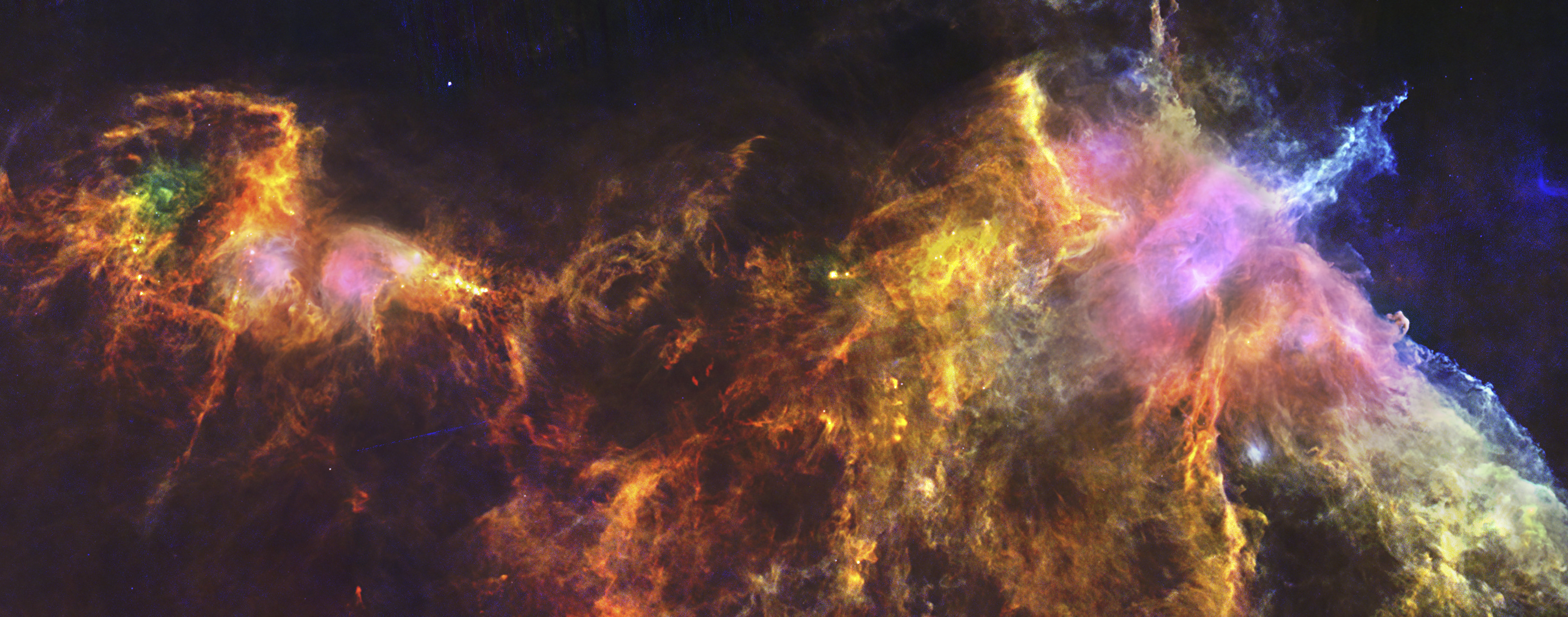
The Herschel Horsehead Nebula.

I had grabbed this image a month ago from the announcement on ESA’s website:

19 April 2013 New views of the Horsehead Nebula and its turbulent environment have been unveiled by ESA’s Herschel space observatory and the NASA/ESA Hubble space telescope.

The Horsehead Nebula lies in the constellation Orion, about 1300 light-years away, and is a popular target for amateur and professional astronomers alike. It sits just to the south of star Alnitak, the easternmost of Orion’s famous three-star belt, and is part of the vast Orion Molecular Cloud complex.

The new far-infrared Herschel view shows in spectacular detail the scene playing out around the Horsehead Nebula at the right-hand side of the image, where it seems to surf like a ‘white horse’ in the waves of turbulent star-forming clouds.

It appears to be riding towards another favourite stopping point for astrophotographers: NGC 2024, also known as the Flame Nebula. This star-forming region appears obscured by dark dust lanes in visible light images, but blazes in full glory in the far-infrared Herschel view.

The image is staggeringly beautiful yet a potent reminder that man, even the totality of our planet, is such an irrelevance in the scheme of things.  We are surrounded by beauty both within and without, yet the fragility of our existance is a ‘vastness’, both literally and psychologically.

Guess what!  Writing that last sentence brought to mind a photograph that I took Wednesday afternoon. As part of the Land Stewardship course Jean and I are taking, the class had gone to the Limpy Creek Botanical area in the Rogue River-Siskiyou National Forest not far from Grants Pass, Oregon.  Here’s that photograph.

P1130363

Reflect on the delicate beauty and vulnerability of that small wild flower. A perfect metaphor for the entire natural world.

So I am going to close this week’s perambulation through love with the thought that if we don’t love our planet with all the ardour and passion of a teenager’s first romance, all those other loves in our lives will ultimately become irrelevant.

Or as Carl Sagan put it:

Our mission is to awaken the broadest possible public to the wonders of nature as revealed by science.

Thank you, MaryAnne.

Anam cara

Love as seen through the Celtic spiritual belief of bonding souls.

Who hasn’t lifted their eyes to the skies above and become lost in themselves?  Whether the drama of a turbulent daytime sky or the deep mystery of an endless, clear night, sky?  Doesn’t matter who we are or where we have or haven’t been in our lives, experiencing that shift from ‘reality’ to a place of souls is familiar to all.

Right at the front of Richard Bach’s lovestory book The Bridge Across Forever, there’s this quotation from E.E. Cummings:

 – how fortunate are you and I, whose home

is timelessness: we who have wandered down

from fragrant mountains of eternal now

to frolic in such mysteries as birth

and death a day (or maybe even less)

Then on page 9, Richard Bach writes as part of his introduction:

We think, sometimes, there’s not a dragon left. Not one brave knight, not a single princess gliding through secret forests, enchanting deer and butterflies with her smile.

We think sometimes that ours is an age past frontiers, past adventures.  Destiny, it’s way over the horizon; glowing shadows galloped past long ago, and gone.

What a pleasure to be wrong.  Princesses, knights, enchantments and dragons, mystery and adventure …. not only are they here-and-now, they’re all that ever lived on earth!

Our century, they’ve changed clothes, of course.  Dragons wear government-costumes, today, and failure-suits and disaster-outfits.  Society’s demons screech, whirl down on us should we lift our eyes from the ground, dare we turn right at corners we’ve been told to turn left.  So crafty have appearances become that princesses and knights can be hidden from each other, can be hidden from themselves.

Yet masters of reality still meet us in dreams to tell us that we’ve never lost the shield we need against dragons, that blue fire voltage arcs through us now to change our world as we wish.  Intuition whispers true: We’re not dust, we’re magic!

Copyright (1984) Richard Bach.

Richard Bach’s hugely popular lovestory is widely summarised, thus:

‘Did you ever feel that you were missing someone you had never met?’.

Haunted by the ghost of the wise, mystical, lovely lady who lives just around the corner in time, Richard Bach begins his quest to find her, to learn of love and immortality not in the here-after, but in the here and now. Yet caught in storms of wealth and success, disaster and betrayal, he abandons the search, and the walls he builds for protection become his prison. Then he meets the one brilliant and beautiful woman who can set him free, and with her begins a transforming journey, a magical discovery of love and joy.

Just pause and listen. Hear your intuition whispering to you: You are not dust, you are magic!

oooOOOooo

Now let’s turn to another author: John O’Donohue.  WikiPedia has an entry that starts:

John O’Donohue (1 January 1956 – 4 January 2008) was an Irish poet, author, priest, and Hegelian philosopher. He was a native Irish speaker, and as an author is best known for popularizing Celtic spirituality.

His death in January 2008 just a few days past his 52nd birthday was a huge and tragic loss.  Not just to his family and all who knew him, but to all those in the world who dream the spiritual bonding with another person.

anamcara
John O’Donohue’s book is no better appreciated than by hugging the meaning of that Celtic phrase anam cara, assuming you aren’t a Celtic speaker!  A quick web search finds an explanation typically like this:

In the Celtic Spiritual tradition, it is believed that the soul radiates all about the physical body.  What some refer to as an aura. When you connect and become completely open and trusting with another person, your two souls begin to flow together. The forming of that deep bond is described as having found your anam cara or soul friend.

Your anam cara always accepts you as you truly are, holding you in beauty and light. Inevitably, to appreciate this relationship, you must first recognize your own inner light and beauty. This is not always easy to do! The Celts believed that forming an anam cara friendship would help you awaken to your own inner light and beauty, as a pathway to experiencing the joys of others.

According to John O’Donahue, an accomplished Irish poet, philosopher and Catholic priest, “…You are joined in an ancient and eternal union with humanity that cuts across all barriers of time, convention, philosophy and definition. When you are blessed with an anam cara, the Irish believe, you have arrived at that most sacred place: home.

Do you sense how the writings of Richard Bach and John O’Donohue are two hues from the same rainbow?

Take a few minutes and explore the John O’Donohue website that has much to remember about this wonderful man.  Embrace such profound insights on the universal themes of friendship, solitude, love, and death as:

  • Light is generous
  • The human heart is never completely born
  • Love as ancient recognition
  • The body is the angel of the soul
  • Solitude is luminous
  • Beauty likes neglected places
  • The passionate heart never ages
  • To be natural is to be holy
  • Silence is the sister of the divine
  • Death as an invitation to freedom

I’m going to offer two videos.  They are both of John O’Donohue.  One is 51 minutes and one is 5 minutes.  Do watch them both but if for whatever reason you cannot do that, then please watch the shorter one.


Now read this quotation from the book.

Your beloved and your friends were once strangers. Somehow at a particular time, they came from the distance toward your life. Their arrival seemed so accidental and contingent. Now your life is unimaginable without them. Similarly, your identity and vision are composed of a certain constellation of ideas and feelings that surfaced from the depths of the distance within you. To lose these now would be to lose yourself.

and recognising this post is day three of writing about love, here’s another quotation:

If you send out goodness from yourself, or if you share that which is happy or good within you, it will all come back to you multiplied ten thousand times. In the kingdom of love there is no competition; there is no possessiveness or control. The more love you give away, the more love you will have.

oooOOOooo

Are Jean and I touched by the spirit of anam cara?  Leave you, dear reader, to judge that.  In fact, leave you with the sign that is on our front gate!

P1130347

Love is??

Reflections on the meaning of love.

Yesterday, I explored love across the species; back to that first encounter between wolf and early man.

Today, I want to revisit what we mean when we use the word ‘love‘ and feel the emotion.  I say revisit because it’s not the first time I have dipped my toes into this particular pool.  Last August, I wrote a piece What is love?  It opened thus:

How the relationship that we have with domesticated animals taught us the meaning of love.

This exploration into the most fundamental emotion of all, love, was stimulated by me just finishing Pat Shipman’s book The Animal Connection.  Sturdy followers of Learning from Dogs (what a hardy lot you are!) will recall that about 5 weeks ago I wrote a post entitled The Woof at the Door which included an essay from Pat, republished with her permission, that set out how “Dogs may have been man’s best friend for thousands of years longer than we realized“.

The following day, I wrote a further piece introducing the book and then commenced reading it myself.  Please go there and read about the praise that the book has received.

What I want to do is to take a personal journey through love.  I should add immediately that I have no specialist or professional background with regard to ‘love’ just, like millions of others, a collection of experiences that have tapped me on the shoulder these last 67 years.

The challenge for us humans is that while we instinctively understand what emotions represent: love, fear, anger, joy, grief, sadness, happiness, et al, we really have no way of knowing precisely what another person is feeling and how that feeling compares to our own awareness and experience of that emotion.

Stay with me as I explore how others offer a meaning of love.

As it happens, this week’s Sabbath Moment from Terry Hershey was much about love.

If you judge people you have not time to love them. Mother Teresa

Where there is great love there are always miracles. Willa Cather

Someday, after we have mastered the winds, the waves, the tides, and gravity, we shall harness… the energies of love. Then for the second time in the history of the world man will have discovered fire. Pierre Teilhard de Chardin

Then some further reflections:

Here’s my take: Life is complicated and at times, very, very challenging. And sometimes, overwhelming.  Bad things can happen to good people. Decisions can be thorny and disconcerting. However. Even in the midst … where there is great love, there are always miracles.

and

Here’s the deal:

  • Love is not always where I predict it will be.
  • Love can grow and blossom even in the face of striving and anguish.
  • If we judge we cannot love. Just because I see something one way, doesn’t mean that I am right and you are wrong.
  • When we do love, we are present. When we are present, there is always a thread.  The good news is that we are in this together. One day you may be that thread for me. And one day, I may be that thread for you.

Powerful words! Words that will have many nodding.  Yet still nothing absolute that offers a definition of love that would be universally understood.  Because there can be no universal definition.  That is the magic of all emotions – they defy the ‘science of life’.  So let’s just treasure that magic.

A few days ago, Sue over at Dreamwalker’s Sanctuary wrote a post under the title of Cosmic Seeds of Thought.  With Sue’s kind permission, I republish that in full.

Last night I wrote this poem, its been a while since I posted one, so as my pen flew across the page I was inspired with these words.. Maybe due to the recent Solar flares, but my ears have been ringing ever louder as the energies have intensified.. The Silence space within is a place to reflect and absorb the peacefulness of Oneness with the Universe…. A place I often go, where we can just close our eyes to the constant noise as the Planet cries with yet more pain…  Meditation helps centre our minds. If you would like to follow a meditation I often do… You can find it Here on a post I did back in 2008 .

silence

Silence booms in an explosion of sound

Splintering static high pitched and loud

Morse Coded downloads in intermittent bursts

The Cosmos is talking-Do you hear its verse?

~~

I escape to the mountains and I run to the sea

But its chatter surrounds me as I long to be free

I hear cries of children, laments from the old

Each on a journey their stories to be told

~~

The Elephants and Dolphin their cries go unheard

Yet I hear their low rumbles and clicks how absurd

Each voice in the matrix – every thought in the mix

A Planet in Crisis – will it ever be fixed?

~~

So I turn down the volume as I shut the outer door

As I meditate inward finding higher-self law

Here I seek Peace in the stillness I find

The Key to the Cosmos we turn in the mind

~~

All things are great and all things are small

The Mind gives them power and shall overcome all

The Universal Plan- I am part and unique

Each one is searching to fit the pieces they seek

~~

And the answer is simple- but we make is so hard

With the choices we choose as we shuffle life’s cards

It seems we chose greed, possession is King

Forgetting how to love our fellow Human Being

~~

But it’s never too late for we each have a heart

To alter our ways – To care is a start

So clear out your Anger, your hatred and greed

Listen to your heartbeat –Start sowing Love Seeds

© Sue Dreamwalker – 2013 All rights reserved.

Start sowing love seeds!  Wonderful.

How to close it for today?  Frankly, I’m not sure.  So I’m going to ‘cheat’. By which I mean republish something else from last August. A guest essay about the loss of love.  Because it seems to me that one way (the only way?) to experience what love truly means is when we lose it. As Eleanore MacDonald describes below in the most heart-rending and beautiful fashion.

oooOOOooo

one of the seven great dogs

“Until one has loved an animal, a part of one’s soul remains unawakened.”
Anatole France

Djuna Cupcake, my heart of hearts,
photo by Breelyn MacDonald

A great squall came upon us here on our farmlet a week ago. I saw it first from a distance, in that dawning of the morning when Djuna usually announced the coming day with his gentle, breathy ‘woooof’, his polite plea to join us on the bed. Mysteriously disturbing, it surely was a sign of things to come, but we didn’t know how dangerous it really was until it was upon us.

And when it was suddenly there, a Great Joy was sucked from our world and an overwhelming sadness took its place … a raging stillness, hot and stifling, no breath, no heartbeat.

My springs of Joy are dry … (a sentiment stolen in part from that great old song, Long Time Traveler)

Djuna Cupcake was one of the Seven Great Dogs. If you’ve seen the film ‘Dean Spanley’, you will know what I mean. If you have loved and been loved by a dog of pure heart … one who was a great teacher of presence, of patience, one who was the dispenser of unconditional love and the blessings of an incomparable joy … one who was a great listener, guardian, and the embodiment of Buddha, Coyote, the Goddesses Eleos and Kuan Yin all in one soft coated body … one who was your loving shadow because he or she felt that it was their job to see you safe at all times … you will know what I mean.

He died quite suddenly. Like that squall, his death came with no warning and for days after Paul and I were sucked deep into that great black hole of grief. The dread attacked us at every turn, where we would always see him but now only a glaring emptiness stood. I felt as though my heart and soul had a raw, oozing, gaping, searingly painful wound where he had been torn away from me. Stolen. We cried a lot.

Some people will never understand. I try to feel compassion for them, rather than issuing the big ‘EFF YOU”, but I am only human. What is this BS about a ‘three day’ rule? What? Because he was ‘just a dog’ we should be over it all in 3 days? Djuna was surely a better person than most Humans and I will never stop missing him. I feel so deeply sorry for those people who have overlooked having such grace and beauty bless their lives –– the companionship of a great dog (or cat or horse, or human person) –– so that, when the monumental end comes and they’ve come through the great fires of sorrow, and have been washed by the flush of a million tears, they come through to the other side where they are able to see the remarkable love, joys and lessons they’d been gifted by that companionship. I can only hope now to ‘be’ the person Djuna thought me to be.

3 days and 3 more and 3 million more and even then more just won’t do it.

Paul and I were with Djuna on our bedroom floor when he died. I lay with him next to my heart, whispering love, my arm draped over his neck … and as he was leaving us, I saw him standing just beyond Paul. Alert, ears akimbo, head cocked, eyes bright, a wad of socks in mouth, standing in his particularly great exuberance, as he did each morning when the time for chores presented itself – “Come on! It’s time to go! Get with it you silly humans! There’s work to be done, there’s a barn to clean and a day to sniff, there’s delight to be found!” And then he left.

My ‘joyometer’, my daily dispenser of mirth, and my constant reminder of the importance of presence, has gone missing – his lessons of ‘Be Here Now’ measured in doses of ’Oh, sense the beauty in the music of the wind!’, ‘Let’s just run in circles and laugh’, ‘I love, love, love you!’ … gone. It is wholly up to me now to remember to stay in each moment, to just be a nice person, cry whenever I must, to laugh as much as possible and dance for the sheer joy of it. And when the cacophony of the deafening silence has quieted and the colors of sorrow have muted and gone transparent and I’ve had some time to let the Aegean clean up those bloodied wounds in my heart and soul, there will be room again here for another one of the Seven Great Dogs. And the cycles will continue on.

Almost every evening Djuna and I took an evening stroll down our quiet lane. I loved watching him dance his great joy, nose to the ground scenting all of the news of the day or nose to the sky, sensing what was coming on the breeze. On our walks I watched the seasons change, the rising of the full moon, the greening of the new spring and the evening skies, like snowflakes, no one ever alike … I watched the Canadian geese come and go, the Red Tail hawks courting in the air above me, and let the build up of my day fall away as I tread softly with my gentle friend. It took me several days after Djuna’s death for me to realize that here was yet again another gift he had left for me in his wake, and one I should continue to enjoy. The sky was black to the West, we’d had heavy winds and rain all day, but when there was a break I set off on ‘our’ walk. Wrapped tightly in sadness and hardly breathing with the missing of him, I shuffled along about a 1/2 mile and turned for home before the rains started up and the chill wind began to blow, fierce again, from the south. That wind battered and bashed me until it freed the tears from my eyes, and the freezing rain lashed my face until I grew numb. As though suddenly realizing I was about to drown, I surfaced, taking in great gulps of air as though I’d not been breathing for several days, and began to climb free of the suffocating bonds of my sadness.

Part of our family

My Djuna, my Cupcake … My Heart of Hearts who knew my soul, my every thought; great lover of Paul and I, and of Breelyn; great lover of his mare and his pony, of socks and his furry toys and his GWBush chew doll; great lover of his evening walkies and of riding in the car, and feeding the birds; great lover of sofa naps and sleeping in late with us on the bed and chasing BALL and rolling on the grass and of eating horse poop; bountiful bestower of stealthy kisses; joyful jokester, Greek scholar (he knew about 15 words and understood several phrases spoken to him in Greek; something we did only after he’d begun to understand words and phrases *spelled out* in English! ‘Car’, ‘dinner?’, ‘play with the ball?’, ‘feed the birds’, water, pony, get the goat, etc!); Djuna, beloved Honorary Cat, our timekeeper, our guardian angel, our boss, our playfully dignified friend (thanks for that Marija) and family member, and one of the Seven Great Dogs – we will love and miss you forever.

But now – there’s work to be done, there’s a barn to clean and a new day to sniff, there’s delight to be found!

love – photo by Breelyn MacDonald

Copyright (c) 2012 Eleanore MacDonald

oooOOOooo

The power in these words.

Day three of recognising the passing of 400 ppm atmospheric CO2.

In nearly four years of writing for Learning from Dogs, I can’t recall devoting three days of posts to a single subject. To put that into context, today’s post is number 1,683 since the first one was published on July 15th, 2009; not all of them from the brain of yours truly by any means you understand!

Today, I’m going to feature a recent essay written by George Monbiot finishing up three days of ‘reporting’ on the deeply disturbing, but fully anticipated, news that the planet’s atmosphere has reached a concentration of 400 ppm CO2.

Last Monday, I published What legacy do we wish to leave for others?

Then yesterday, a post under the title of 400 ppm, as the BBC reported it.  I closed with a reference to a remark made by Professor Sir Brian Hoskins, director of the Grantham Institute for Climate Change at Imperial College London; the remark being “A greater sense of urgency was needed.

I wrote that those wishy-washy words were pathetic.  That we needed the sort of words that George Monbiot penned a few days ago in the Guardian newspaper.  There it was entitled “Climate milestone is a moment of symbolic significance on road of idiocy“.

But I think the title that Mr. Monbiot chose to use on his own blog was far more apt: Via Dolorosa.  (Note that I haven’t formally requested permission to republish the essay but trust that the following is acceptable to both Mr. Monbiot and the Guardian newspaper.)

Here’s how it opened:

Via Dolorosa

May 10, 2013

Corruption and short-termism are pushing us along the path of sorrows.

By George Monbiot, published on the Guardian’s website, 10th May 2013

The records go back 800,000 years: that’s the age of the oldest fossil air bubbles extracted from Dome C, an ice-bound summit in the high Antarctic. And throughout that time there has been nothing like this. At no point in the pre-industrial record have concentrations of carbon dioxide in the air risen above 300 parts per million. 400 is a figure that belongs to a different era.

The difference between 399 and 400ppm is small, in terms of its impacts on the world’s living systems. But this is a moment of symbolic significance, a station on the Via Dolorosa of environmental destruction. It is symbolic of our collective failure to put the long term prospects of the natural world and the people it supports above immediate self-interest.

The symbolic significance of the planet’s atmospheric concentrations of CO2 passing 400ppm  is that, I hope, with all the hope that my heart can summon up, it will bring us back from the brink.  Then one ponders about this possibility as Monbiot’s next paragraph unfolds:

The only way forward now is back: to retrace our steps along this road and to seek to return atmospheric concentrations to around 350 parts per million, as the 350.org campaign demands. That requires, above all, that we leave the majority of the fossil fuels which have already been identified in the ground. There is not a government or an energy company which has yet agreed to do so.

“not a government or an energy company … has yet agreed to do so.”

I’m going to repeat that again, with emboldening; “not a government or an energy company … has yet agreed to do so.

In fact, one could reasonable argue that having any hope for a turning back is utterly naive. Look what the essay goes on to say:

Just before the 400-mark was reached, Shell announced that it will go ahead with its plans to drill deeper than any offshore oil operation has gone before: almost three kilometres below the Gulf of Mexico.

A few hours later, Oxford University opened a new laboratory in its department of earth sciences. The lab is funded by Shell. Oxford says that the partnership “is designed to support more effective development of natural resources to meet fast-growing global demand for energy.” Which translates as finding and extracting even more fossil fuel.

The European Emissions Trading Scheme, which was supposed to have capped our consumption, is now, for practical purposes, dead. International climate talks have stalled; governments such as ours now seem quietly to be unpicking their domestic commitments. Practical measures to prevent the growth of global emissions are, by comparison to the scale of the challenge, almost non-existent.

As an example of the scale of the hypocrisy in which we are all immersed, last week’s The Economist magazine carried a full-age advertisement from Chevron on page 5 under the banner of ‘Protecting The Planet Is Everyone’s Job – We agree‘ and going on to explain:

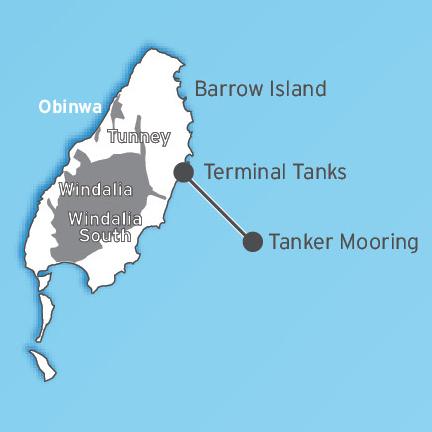
We go to extraordinary lengths to protect the integrity of the places where we operate.  Places all over the world, like Australia’s Barrow Island.  It’s home to hundreds of native species of wildlife, including wallabies, ospreys, and perenties.

We’ve been producing energy on the island for more than 40 years, and it remains a Class A Nature Reserve.

Didn’t take me two moments to find this image:

Barrow Island, Australia.  Taken from the Chevron Australia website.
Barrow Island, Australia. Taken from the Chevron Australia website.

To my mind this advertisement completely misses the point; deliberately or otherwise.  Chevron and all other oil producing companies in the world are endangering the future of the entire planet by continuing to ‘produce energy’, aka oil.  Period. Full stop.

Or to put it in the words of George Monbiot’s essay:

The problem is simply stated: the power of the fossil fuel companies is too great. Among those who seek and obtain high office are people characterised by a complete absence of empathy or scruples, who will take money or instructions from any corporation or billionaire who offers them, and then defend those interests against the current and future prospects of humanity. This new mark reflects a profound failure of politics, worldwide, in which democracy has quietly been supplanted by plutocracy. Without a widespread reform of campaign finance, lobbying and influence-peddling and the systematic corruption they promote, our chances of preventing climate breakdown are close to zero.

Thus the final sentence in GM’s essay carries a deep sadness.

So here we stand at a waystation along the road of idiocy, apparently determined only to complete our journey.

http://www.monbiot.com

Why are we not seeing, hearing and reading words of a similar weight and power from just about every ‘opinion maker’ in the world?

Why not?  Why not?

More on those poor rhinos

Awareness is the only way to go.

Two days ago, I published a post under the title of Reflections on pain and peace. The pain aspect was as a result of a shocking photograph of a rhino that had been slaughtered for its horn.

Subsequent to that piece coming out there has been more information that I wanted to cover.

I had an email from Avaaz that needed circulating:

Thanks for joining the campaign to protect the world’s rhinos. To win this campaign, we urgently need to build a massive outcry — every voice who joins us makes a difference!

Help spread the word by sending the email below to friends and family, and post this link on your Facebook wall.

http://www.avaaz.org/en/save_rhinos/?tta

Thanks again for your help,

The Avaaz team

——–

Dear friends,

The rhino is being hunted into extinction and could disappear forever unless we act now. Shocking new statistics show 440 rhinos were brutally killed last year in South Africa alone — a massive increase on five years ago when just 13 had their horns hacked off. European nations could lead the world to a new plan to save these amazing creatures but they need to hear from us first!

Fueling this devastation is a huge spike in demand for rhino horns, used for bogus cancer cures, hangover remedies and good luck charms in China and Vietnam. Protests from South Africa have so far been ignored by the authorities, but Europe has the power to change this by calling for a ban on all rhino trade — from anywhere, to anywhere — when countries meet at the next crucial international wildlife trade summit in July.

The situation is so dire that the threat has even spread into British zoos who are on red-alert for rhino killing gangs! Let’s raise a giant outcry and urge Europe to push for new protections to save rhinos from extinction. When we reach 100,000 signers, our call will be delivered in Brussels, the decision-making heart of Europe, with a crash of cardboard rhinos. Every 50,000 signatures will add a rhino to the crash — bringing the size of our movement right to the door of EU delegates as they decide their position. Sign the petition below then forward this email widely:

http://www.avaaz.org/en/save_rhinos/?tta

So far this year one rhino has been killed every day in South Africa, home to at least 80% of the world’s remaining wild rhinos. Horns now have a street value of over $65,000 a kilo — more expensive than gold or platinum. The South African Environment Minister has pledged to take action by putting 150 extra wardens and even an electric fence along the Mozambique border to try and stem the attacks — but the scale of the threat is so severe that global action is required.

Unless we act today we may lose this magnificent and ancient animal species permanently. Some Chinese are loudly lobbying for the trade in horn to be relaxed, but banning the trade in all rhinos will silence them. With the EU’s leadership, we can bring these international gangsters to justice, put the poachers in prison, and push for public awareness programmes in key Asian countries — and end this horn horror show for good.

In the next few weeks, the EU will be setting its agenda for the next big global meeting in just a few months — our best chance of turning the tide against the slaughter. We know that rhinos will be on their agenda, but only our pressure can ensure they challenge the problem at its source. Let’s build a giant outcry and deliver it in a spectacular fashion — sign now and together we can stop the slaughter across Africa:

http://www.avaaz.org/en/save_rhinos/?tta

In 2010, Avaaz’s actions helped to stop the elephant ivory trade from exploding. In 2012, we can do the same for the rhino. When we speak out together, we can change the world — last year was the worst year ever for the rhino, but this can be the year when we win.

With hope,

Iain, Sam, Maria Paz, Emma, Ricken and the whole Avaaz team

More Information:

Few Rhinos Survive Outside Protected Areas (WWF)
ttp://www.worldwildlife.org/species/finder/rhinoceros/rhinos.html

South Africa record for rhino poaching deaths (BBC)
http://www.bbc.co.uk/news/world-africa-15571678

‘Cure for cancer’ rumour killed off Vietnam’s rhinos (The Guardian)
http://www.guardian.co.uk/environment/2011/nov/25/cure-cancer-rhino-horn-vietnam

British Zoos on Alert as Rhino Poaching Hits the UK (International Business Times)
http://www.ibtimes.co.uk/articles/289792/20120130/british-zoos-uk-alert-rhino-poaching-hits.htm

—————–

Then as a reminder that sitting on our hands and doing nothing must be resisted, Chris sent me this link to a recent item in the British Telegraph newspaper, from which I include these portions:

Last rhinos in Mozambique killed by poachers

The last known rhinoceroses in Mozambique have been wiped out by poachers apparently working in cahoots with the game rangers responsible for protecting them, it has emerged

7:46PM BST 30 Apr 2013

The 15 threatened animals were shot dead for their horns last month in the Mozambican part of Great Limpopo Transfrontier Park, which also covers South Africa and Zimbabwe.

They were thought to be the last of an estimated 300 that roamed through the special conservation area when it was established as “the world’s greatest animal kingdom” in a treaty signed by the three countries’ then presidents in 2002.

Aislinn Laing finishes off her report, by writing:

Dr Jo Shaw, from the World Wide Fund for Nature, said the rhinoceroses had probably crossed into Mozambique from Kruger.

Whereas killing a rhino in South Africa can attract stricter punishments than killing a person, in Mozambique offenders generally escape with a fine if they are prosecuted at all.

“Rhinos being killed in Kruger are mostly by Mozambican poachers who then move the horns out through their airports and seaports,” she said. “With huge governance and corruption issues in Mozambique, it’s a huge challenge.”

Boy, do we have so much to learn from dogs!

Reflections on pain and peace.

Seeking solace in these times of insanity.

Not sure what it is about Tuesdays because exactly a week ago I wallowed in introspection with an essay Finding one’s true self and here we are again with another wallow!

The pain came about when good friend, Chris Snuggs, included a picture link that is on Facebook in an email exchange we were having.  Here’s that picture.

dead rhino

Here are a couple of comments left on that Facebook page.

Oh Dear God in Heaven. This is just so so so so so wrong. I am so ashamed of my species.

—-

Armina,you have said it right. Animals never sin,they never commit crime, they don’t go to war against each other. Humans do all these and they face the negative results of it. Who will save them? Who will protect them? The very humans that are to protect and save them, are the very heartless wicked people killing them … Sometimes I cry when I see animals being treated badly …. the world is a wicked place and they should not have been here among humans …. I wish there could be a place where there are no humans and no human can be able to go there no matter how hard they may try. So that all animals may go and live there ever safe.

 In his email Chris wrote, “Difficult to comprehend. And all in this bizarre quest to improve themselves, increase their sexual potency or some such tosh. Why do many humans not accept themselves for what they are, warts and all, and just try to do the best with what they can bring to the world?

To which I replied, “That is so disgusting a picture.  Sometimes, in fact too often these days, I seem to want to pull up the drawbridge and just forget this mad, insane world so many seem to ‘enjoy’.

Then yesterday, over on the Wibble blog, there was a post with the title of Schrödinger’s Leopard that generated a comment from Mikestasse, “Yes, we humans think we own everything. Copyright the planet, patent its contents, run amok, screw it all. I’m often ashamed to be human …….

So all of this was reinforcing the pain I was feeling.

I then turned to my email and there was a further reply in from Chris.

Yes, it is a terrible photo, but no doubt there are far worse somewhere. One of the worst things about rhinos (and other large creatures) is that they clearly have largish brains and probably a lot more “consciousness” and/or “understanding” than we appreciate. And therefore are very much aware of what is going on, have pain and other “emotional” sufferings we can’t fully comprehend but which undoubtedly exist. I mean, they are not like fish I guess (though some maintain that even fish feel pain) or even more clearly insects.

Was it Voltaire who said in response to the world’s evils: “Il faut cultiver son jardin.“? [We must cultivate our garden.]

He had a point – sometimes one has to shut oneself off, but on the other hand and at other times if we all do that then the bastards can get on with their evil unchecked – or even uncommented. At least you in particular are spreading good vibrations and a moral view of the world. I feel the same about my political rants and blog entries. It may not do much to change the world but it could perhaps confirm to others that they are not alone in their protests about whatever. I would like to get engaged more actively in a particular “charity” or movement. One, since one cannot do everything. I might go for tigers and rhinos, etc. The last three years have been horrendous for me but I hope things will settle down a bit in coming months so I can do something more positive.

I would just say to you that you SHOULD completely detach sometimes and WHEN you do you should relax TOTALLY and clear your mind of negative thoughts in order to return fully charged to the fray at a later stage!!!

NO, you DON’T need a shrink for this but I understand that the US is well-equipped in this department if needs be!!!

Now because of the time difference between here and Europe it was too late for me to check if Chris was comfortable about me sharing his personal email.  But I took a gamble that it would be OK because of the power of Chris’ advice; the plain common-sense of that penultimate paragraph.

Because if we end up consumed by the pain then, not to put too finer a point on it, the bastards have won!  If we can feel the pain but stay grounded, remaining at peace, then that poor rhino did not die in vain.

So please go now and sign the petition Save the Rhinos!

The Great Unmentionable by George Monbiot.

A real pleasure and privilege to republish this article from Mr. Monbiot.

For some time now I have subscribed to the articles published by The Permaculture Research Institute of Australia.  From time to time references have been made to PRI articles here on Learning from Dogs.

Recently, I read a PRI essay that had been penned by George Monbiot.  It was called The Great Unmentionable.  It blew me away.  So I took a deep breath and dropped George M. an email asking if I might republish it here.  George was very gracious in giving me such permission.

Mr. George Monbiot.
Mr. George Monbiot.

First some background to George Monbiot for those who are unfamiliar with his work and his writings.  As his website explains:

I had an unhappy time at university, and I now regret having gone to Oxford, even though the zoology course I took – taught, among others, by Richard Dawkins, Bill Hamilton and John Krebs – was excellent. The culture did not suit me, and when I tried to join in I fell flat on my face, sometimes in a drunken stupor. I enjoyed the holidays more: I worked on farms and as a waterkeeper on the River Kennet. I spent much of the last two years planning my escape. There was only one job I wanted, and it did not yet exist: to make investigative environmental programmes for the BBC.

After hammering on its doors for a year, I received a phone call from the head of the BBC’s natural history unit during my final exams. He told me: “you’re so fucking persistent you’ve got the job.” They took me on, in 1985, as a radio producer, to make wildlife programmes. Thanks to a supportive boss, I was soon able to make the programmes I had wanted to produce. We broke some major stories. Our documentary on the sinking of a bulk carrier off the coast of Cork, uncovering evidence that suggested it had been deliberately scuppered, won a Sony award.

Anyway, to the article in question that was published on the Guardian Newspaper’s website, 12th April 2013.

oooOOOooo

The Great Unmentionable

April 12, 2013

We have offshored both our consumption and our perceptions

By George Monbiot

Every society has topics it does not discuss. These are the issues which challenge its comfortable assumptions. They are the ones that remind us of mortality, which threaten the continuity we anticipate, which expose our various beliefs as irreconcilable.

Among them are the facts which sink the cosy assertion, that (in David Cameron’s words) “there need not be a tension between green and growth.”

At a reception in London recently I met an extremely rich woman, who lives, as most people with similar levels of wealth do, in an almost comically unsustainable fashion: jetting between various homes and resorts in one long turbo-charged holiday. When I told her what I did, she responded, “oh I agree, the environment is so important. I’m crazy about recycling.” But the real problem, she explained, was “people breeding too much”.

I agreed that population is an element of the problem, but argued that consumption is rising much faster and – unlike the growth in the number of people – is showing no signs of levelling off. She found this notion deeply offensive: I mean the notion that human population growth is slowing. When I told her that birth rates are dropping almost everywhere, and that the world is undergoing a slow demographic transition, she disagreed violently: she has seen, on her endless travels, how many children “all those people have”.

As so many in her position do, she was using population as a means of disavowing her own impacts. The issue allowed her to transfer responsibility to other people: people at the opposite end of the economic spectrum. It allowed her to pretend that her shopping and flying and endless refurbishments of multiple homes are not a problem. Recycling and population: these are the amulets people clasp in order not to see the clash between protecting the environment and rising consumption.

In a similar way, we have managed, with the help of a misleading global accounting system, to overlook one of the gravest impacts of our consumption. This too has allowed us to blame foreigners – particularly poorer foreigners – for the problem.

When nations negotiate global cuts in greenhouse gas emissions, they are held responsible only for the gases produced within their own borders. Partly as a result of this convention, these tend to be the only ones that countries count. When these “territorial emissions” fall, they congratulate themselves on reducing their carbon footprints. But as markets of all kinds have been globalised, and as manufacturing migrates from rich nations to poorer ones, territorial accounting bears ever less relationship to our real impacts.

While this is an issue which affects all post-industrial countries, it is especially pertinent in the United Kingdom, where the difference between our domestic and international impacts is greater than that of any other major emitter. The last government boasted that this country cut greenhouse gas emissions by 19% between 1990 and 2008. It positioned itself (as the current government does) as a global leader, on course to meet its own targets, and as an example for other nations to follow.

But the cut the UK has celebrated is an artefact of accountancy. When the impact of the goods we buy from other nations is counted, our total greenhouse gases did not fall by 19% between 1990 and 2008. They rose by 20%. This is despite the replacement during that period of many of our coal-fired power stations with natural gas, which produces roughly half as much carbon dioxide for every unit of electricity. When our “consumption emissions”, rather than territorial emissions, are taken into account, our proud record turns into a story of dismal failure.

There are two further impacts of this false accounting. The first is that because many of the goods whose manufacture we commission are now produced in other countries, those places take the blame for our rising consumption. We use China just as we use the population issue: as a means of deflecting responsibility. What’s the point of cutting our own consumption, a thousand voices ask, when China is building a new power station every 10 seconds (or whatever the current rate happens to be)?

But, just as our position is flattered by the way greenhouse gases are counted, China’s is unfairly maligned. A graph published by the House of Commons Energy and Climate Change Committee shows that consumption accounting would reduce China’s emissions by roughly 45%. Many of those power stations and polluting factories have been built to supply our markets, feeding an apparently insatiable demand in the UK, the US and other rich nations for escalating quantities of stuff.

gm1

The second thing the accounting convention has hidden from us is consumerism’s contribution to global warming. Because we consider only our territorial emissions, we tend to emphasise the impact of services – heating, lighting and transport for example – while overlooking the impact of goods. Look at the whole picture, however, and you discover (using the Guardian’s carbon calculator) that manufacturing and consumption is responsible for a remarkable 57% of the greenhouse gas production caused by the UK.

Unsurprisingly, hardly anyone wants to talk about this, as the only meaningful response is a reduction in the volume of stuff we consume. And this is where even the most progressive governments’ climate policies collide with everything else they represent. As Mustapha Mond points out in Brave New World, “industrial civilization is only possible when there’s no self-denial. Self-indulgence up to the very limits imposed by hygiene and economics. Otherwise the wheels stop turning”.

The wheels of the current economic system – which depends on perpetual growth for its survival – certainly. The impossibility of sustaining this system of endless, pointless consumption without the continued erosion of the living planet and the future prospects of humankind, is the conversation we will not have.

By considering only our territorial emissions, we make the impacts of our escalating consumption disappear in a puff of black smoke: we have offshored the problem, and our perceptions of it.

But at least in a couple of places the conjuring trick is beginning to attract some attention.

On April 16th, the Carbon Omissions site will launch a brilliant animation by Leo Murray, neatly sketching out the problem*. The hope is that by explaining the issue simply and engagingly, his animation will reach a much bigger audience than articles like the one you are reading can achieve.

(*Declaration of interest (unpaid): I did the voiceover).

On April 24th, the Committee on Climate Change (a body that advises the UK government) will publish a report on how consumption emissions are likely to rise, and how government policy should respond to the issue.

I hope this is the beginning of a conversation we have been avoiding for much too long. How many of us are prepared fully to consider the implications?

www.monbiot.com

oooOOOooo

So very difficult to pick out the sentence that carried the most power, for the essay is powerful from start to end.  But this one did hit me in the face, “The impossibility of sustaining this system of endless, pointless consumption without the continued erosion of the living planet and the future prospects of humankind, is the conversation we will not have.

Finally, I can’t resist reminding you, dear reader, of the point made by Prof. Guy McPherson in his book Walking Away from Empire, which I reviewed on March 6th.  particularly in the first paragraph of the first chapter; Reason:

At this late juncture in the era of industry, it seems safe to assume we face one of two futures. If we continue to burn fossil fuels, we face imminent environmental collapse. If we cease burning fossil fuels, the industrial economy will collapse. Industrial humans express these futures as a choice between your money or your life, and tell you that, without money, life isn’t worth living. As should be clear by now, industrial humans — or at least our “leaders” — have chosen not door number one (environmental collapse) and not door number two (economic collapse), but both of the above.

Maybe this is why we seem unable to have the conversation because to do so means we have to look at ourselves in the mirror.  Each one of us, you and me, has to address something so deeply personal.  Back to Prof. McPherson and page 177 of his book (my emphasis):

It’s no longer just the living planet we should be concerned about. It’s us. The moral question, then: What are you going to do about it?

For my money, Mr. Monbiot is yet another voice of reason in the wilderness; another voice that deserves to be followed.  I say this because by way of introduction to his philosophy, he opens thus:

My job is to tell people what they don’t want to hear. That is not what I set out to do. I wanted only to cover the subjects I thought were interesting and important. But wherever I turned, I met a brick wall of denial.

Denial is everywhere. I have come to believe that it’s an intrinsic component of our humanity, an essential survival strategy. Unlike other species, we know that we will die. This knowledge could destroy us, were we unable to blot it out. But, unlike other species, we also know how not to know. We employ this unique ability to suppress our knowledge not just of mortality, but of everything we find uncomfortable, until our survival strategy becomes a threat to our survival.

“… until our survival strategy becomes a threat to our survival.”

I sense the growing of this threat to the point where maybe within less than a year the vast majority of open-minded, thinking individuals know the truth of where we are all heading.