The incredible story of one stray dog and a desert racer.
This has been widely reported in many other places but, nonetheless, seemed a perfect fit for a blog called Learning from Dogs!
This is the story of a stray dog that took a liking to a runner participating in the 2016 Gobi March 4 Deserts race in China. I first saw the story when it was carried on the Care2 Causes site.
How hard are you willing to work to improve your position in life? For one stray dog, the answer is: pretty darn hard.
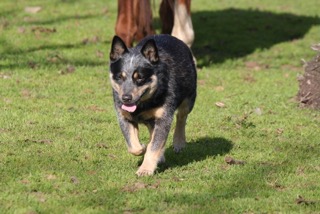
During the 2016 Gobi March 4 Deserts race in China, extreme runner Dion Leonard from Scotland was racing through the rugged terrain of the Tian Shan mountain range. That’s when a stray female pooch (eventually and aptly named) Gobi started following him.
The runner figured that she’d tire out eventually. She was a small dog, so keeping up with a life-sized human (who is an extreme jogger) probably didn’t seem likely. But amazingly, the little dog kept up.
Man who befriended stray dog during extreme desert marathon launches reunion appeal
The dog ran alongside Dion Leonard for 124 kilometres
May Bulman Tuesday 2 August 2016
Mr Leonard hopes to be reunited with the dog who ran with him during the 250 kilometre race in the Gobi desert 4Deserts.com / Omni Cai
An extreme marathon runner has launched an appeal to be reunited with a stray dog with whom he formed an “unbreakable bond” during a 250-kilometre (155 mile) race in the Gobi desert in China.
Dion Leonard, 41, hopes to raise the funds that will allow him to be reunited with the dog, named Gobi, who joined him during the annual 4 Deserts Race Series in March.
Gobi began running alongside the 101 competitors as they ran through the Tian Shan mountain range. Despite her small size the dog managed to run half of the race.
Later on in that Independent article it is reported:
Mr Leonard set up the crowdfunding page to raise funds towards organising for Gobi to be transported from China to live with him in Scotland.
The process will take up to four months and cost £5,000, with the dog having to be medically checked and quarantined before she can be cleared for entry.
A simple mouse click then takes the reader to that Crowdfunding page where the headline then shows that already over £19,000 has been raised.
That page explains:
Gobi, a friendly stray dog joined 101 other competitors running 250km over the Tian Shan Mountains down to the Black Gobi Desert during a 6 stage 7 day self sufficiency foot race. Gobi ran 4 stages including the final 10km stage to the finish line, showing unique strength and stamina for a little dog to keep up with the runners in such grueling conditions.
Everyone from the competitors, volunteers and race crew fell in love with this little dog that captured all our hearts. Gobi took a shine to me and over the week we developed an unbreakable bond as I shared my sleeping space, food/water and ultimately our companionship.
Now let’s hear from Dion.
Time and time again our wonderful dogs inspire us to reach out; to never say never!
The lesson of love from our dogs just keeps rolling along.
Neighbour Dordie had the following sent to her in an email and, subsequently, passed it on to me.
I share it with you and hope that it brightens your day.
ooOOoo
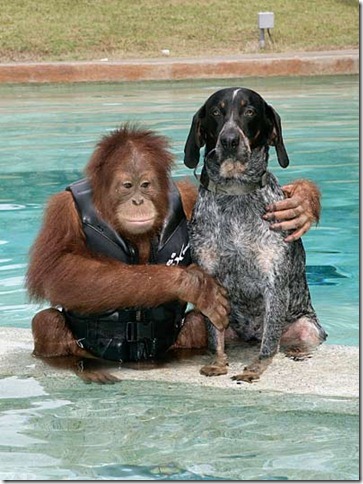
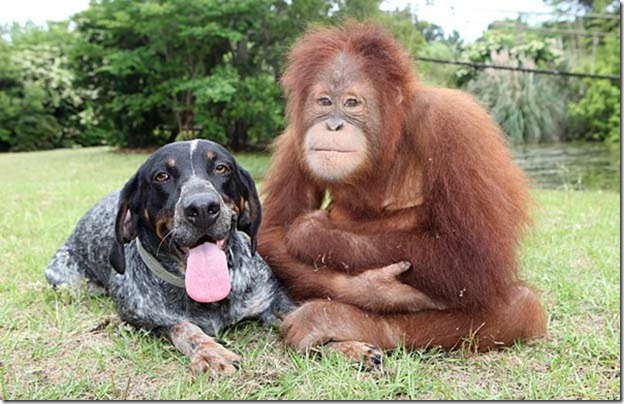
After losing his parents, this three-year-old orangutan was so depressed he wouldn’t eat and didn’t respond to any medical treatments. The veterinarians thought he would surely die from sadness.
The zoo keepers found an old sick dog on the grounds in the park at the zoo where the orangutan lived. They took the dog to the animal treatment center; the dog arriving at the same time that the orangutan was there being treated.
The two lost souls met and have been inseparable ever since. The orangutan found a new reason to live and each always tries his best to be a good companion to his new-found friend. They are together 24-hours-a-day in all their activities.
They live in Northern California where swimming is their favorite past-time, although Roscoe (the orangutan) is a little afraid of the water and needs his friend’s help to swim.
Another day yesterday where my creative juices had evaporated; if that’s what creative juices do!
But that doesn’t devalue the following article in the slightest! An article that was recently read on the Care2 blogsite and is republished here for your pleasure.
ooOOoo
Prisoners Care for Deaf Dogs Displaced by Wildfire
The so-called Sand Fire that burned for over a week near Los Angeles didn’t only threaten wildlife sanctuaries. Soon after the wildfire started on July 22, Mark and Lisa Tipton, owners of Deaf Dog Rescue of America (DDRA), a non-profit organization that rescues, trains and rehomes hearing-impaired dogs, decided it was better to be safe than sorry. They evacuated the rescue ranch’s nearly 50 residents.
“It was no small feat to assemble crates, pack them into trucks and trailers, and load the dogs,” Lisa wrote on the DDRA Facebook page. “Backbreaking and stressful. We have wonderful paid kennel staff here which is why we were able to evacuate the dogs so smoothly. Nobody got bitten, no loose dogs, no drugs were used. They stayed with us in our time of need and they were rock stars.”
The Tiptons were eventually able to find a temporary home for the dogs at the California state prison in Lancaster, which invited them to bring the dogs there. Mark happens to operate the Karma Rescue Paws for Life dog-training program for the prison’s inmates. It is California’s first and only dog program in a high-security prison. Many of the participants are serving life sentences.
In this program, dogs rescued from high-kill shelters around Los Angeles County live full-time with the participating inmates. Over a 12-week period, the inmates learn how to train the dogs for Canine Good Citizen certification. This certification helps the dogs become more adoptable and, in turn, helps save more dogs from shelters. The inmates benefit by learning real-world skills and giving back to society by helping these dogs get another chance at life.
“Paws for Life restored my faith in humanity that I’m a person, that I matter,” inmate trainer Jon Grobman told KABC. “It gave me the opportunity to care for something, love something.”
In the two years the program has been offered at the Lancaster prison, 75 former death-row dogs have found forever homes.
‘They Were Thriving Under Their Care’
After the Tiptons dropped off the dogs, they returned to the DDRA ranch to check on the fire, get some sleep and gather up more supplies for the dogs.
“The dogs were bewildered and watched us walk out the gates,” Lisa wrote on Facebook. “The looks on their faces made me cry when things quieted down and I had time to think about it. I have to admit that I felt guilty leaving them there.”
The couple returned to the prison the next morning with food for the dogs – which, along with the feelings of guilt, wasn’t necessary.
“The inmates had handled breakfast beautifully,” Lisa wrote. “They were getting the dogs out for exercise and cleaning their runs… I have never, ever seen anyone clean up dog poop with such glee.”
Nor had she ever seen the dogs so comfortable around strangers. “[They] were thriving under their care,” Lisa wrote, “and had wagging tales and smiles on their faces.”
Thankfully, DDRA survived the Sand Fire. All the dogs returned to their home July 30.
“Can pretty much guarantee that when they are all safely in their kennels snoring,” Lisa wrote, “I’m going to melt into a huge puddle of tears from sheer thankfulness and relief.”
Coincidentally, while the inmates at the Lancaster prison were caring for the displaced deaf dogs, L.A. County Supervisor Michael D. Antonovich proposed that, to help with overcrowding in animal shelters, a new one should be built at the Pitchess Detention Center in Castaic.
“Such a program could be a cost-effective and progressive way to integrate the needed care of animals with positive benefits to our inmates,” he wrote.
The feasibility of such a shelter is being analyzed by county animal welfare officials and the sheriff’s department. A report on their findings is expected later this month.
This essay from George Monbiot just has to be read as widely as possible.
Dear followers of this blog know that from time to time I dip into politics. I do so because something I read strikes me with such force that I want others to read the article or essay. Not infrequently, my ‘dip’ is in the form of republishing an essay from George Monbiot who, long ago, gave me blanket permission to republish his essays. That is the case today.
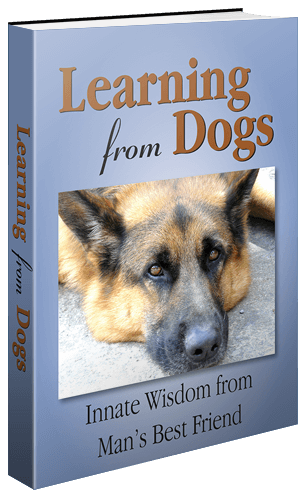
I was inspired to write my book, subsequently self-published last December, because I truly believe that the values that we see in our longest animal companions are values that we, as in our societies, from top to bottom, have to embrace if we are to stand any chance of surviving as a species.
Reflect on the fact that dogs do not lie, they do not set out to deceive or influence others for their own personal gain and they are utterly creatures of integrity.
OK, I can hear some of you thinking that dogs are dogs and humans are humans and it’s just plain daft to link the two in this fashion. My only answer to that is to read the book or, at the very least, download and read the first twenty-five pages (for free). Better still purchase the book and have 50% of my net income donated to the Rogue Valley Humane Society.
On the 28th July, George Monbiot published an essay entitled So Much For Sovereignty. I read the essay and, frankly, was apalled at what George was describing: the background of the UK’s new international trade secretary, Liam Fox, recently appointed by Theresa May.
Read it for yourself and see if you react the same way that I did!
ooOOoo
So Much For Sovereignty
28th July 2016
To this government, “taking back control” means handing Britain to a different set of foreign powers
By George Monbiot, published in the Guardian 27th July 2016
What does it mean to love your country? What does it mean to defend its sovereignty? For some of the leaders of the Brexit campaign, it means reducing the United Kingdom to a franchise of corporate capital, governed from head offices overseas. They will take us out of Europe to deliver us into the arms of other powers.
No one embodies this contradiction as much of the man now charged with determining the scope of our sovereignty: the new international trade secretary, Liam Fox. He explained his enthusiasm for leaving Europe thus: “We’ll be able to make our own laws unhindered by anyone else, and our democratic parliament will not be overruled by a European Court.” But of all the people Theresa May could have appointed to this post, he seems to me the most likely to ensure that our parliament and laws are overruled by foreign bodies.
Dr Fox looks to me like a corporate sleeper cell implanted in government. In 2011, he resigned his post as defence secretary in disgrace, after his extracurricular interests were exposed. He had set up an organisation called Atlantic Bridge, financed in large part by a hedge fund owner. Atlantic Bridge formed a partnership with a corporate lobbying group called the American Legislative Exchange Council, which is funded by tobacco, pharmaceutical and oil companies. Before it was struck off by the Charity Commission, it began assembling a transatlantic conclave of people who wished to see public services privatised and corporations released from regulation.
He allowed a lobbyist to attend his official meetings, without government clearance. He made misleading statements about these meetings, which were later disproved. It seems extraordinary to me that a man with such a past could have been brought back into government, let alone given such a crucial and sensitive role. Most newspapers have brushed his inconvenient history under the political carpet. He is, after all, their man.
This is the man who has been put in charge of making new trade agreements. What he wants to do with them is pretty clear. “We need to see a reinvigoration of our transatlantic relationship,” he argues. “We have a low regulation and low taxation environment which is only likely to improve outside the EU.” Improve, in this context, means becoming yet more hostile to human welfare, social mobility and the defence of the living world.
They threaten to reduce to the lowest common denominator the laws protecting us from predatory finance, the exploitation of workers, food adulteration, climate change and environmental destruction. They threaten to force the privatisation of public services. They would allow corporations to sue governments for compensation in offshore tribunals that – unlike the European Court Dr Fox professes to hate – are unaccountable, opaque and wildly imbalanced. The EU has no mandate to strike such agreements: a consultation on the offshore tribunals TTIP proposes attracted 150,000 responses, 97% of which were negative.
Leaving Europe should enable us to leave behind biased, destructive treaties of this kind; we will, after all, have to renegotiate most of our trade agreements. But by putting the Fox in charge of the chicken coop, Theresa May seems determined to replace them with something even worse.
The corporate army is already at the gates. The Republican senator Tom Cotton proposes that Britain should join the North American Free Trade Agreement (NAFTA). Using the kind of international tribunals that TTIP threatens to impose, NAFTA has undermined labour rights and environmental protection. It has blocked attempts to produce more progressive laws and greatly restricted legislative sovereignty. Whether we formally join NAFTA, or connect to that trading area through TTIP or another such agreement, the results will gravely threaten our sovereignty – unless negotiations are run on an entirely different basis.
In response to the Philip Green scandal, Theresa May says she wants to “tackle corporate irresponsibility” and “reform capitalism so that it works for everyone not just the privileged few.” We have no idea what she means, but here’s where it should begin. Before her government starts negotiating any new trade treaties, it should open a public consultation about their purpose and scope. The UK’s trading relationships should be debated in parliament and the people of this nation should be allowed to determine how much control over national life our representatives should retain, and how much should be ceded to international agreements and international bodies.
Does this mean a referendum? If we can be trusted to decide whether or not to share our sovereignty with Europe, should we not also be trusted to decide whether or not to share it with transnational capital?
But the Conservative vision of sovereignty is highly selective. People like Dr Fox appear to hate much of what others love about this country: the NHS, our public broadcasters, our social safety net, the protection of the countryside, the notion that power resides in the people, rather than in corporations and their shadowy lobbyists. There are traitors in our midst, who would rip down our most treasured institutions on behalf of the transnational elite and its offshore holdings. This, it seems, is what they mean by taking back control.
Sometimes the most obvious solutions take the longest to find.
I feel a little embarrassed that this introduction may come across as rather self-indulgent; I don’t intend that.
My purpose is to offer an introduction to a recent blogpost from Sue Dreamwalker that explains why her post really ‘spoke’ to me and why it felt important to share Sue’s post with all you good people.
Subsequently, I left a follow-up to my first comment, replying to a comment from Diane Husic. This is what Diane wrote:
Many of us realize what a critical junction the country faces in this election cycle. As an academic, I am trying to figure out the appropriate role I should play. We need to teach students to be respectful of difference, to be tolerant, to be problem solvers, and to be civically engaged, but we aren’t supposed to use our positions to “force” our political views on them. But given the magnitude of issues confronting the planet and humanity and the importance of having leadership that “gets it” (and displays compassion and empathy), this is a tough balance to try to find.
and this was my reply to Diane:
Diane, as someone who previously has run his own business and then, after selling it in 1986, spent a number of years as a mentor with the Prince’s Youth Business Trust in the UK, I have come to the conclusion that the best role model we adults can offer our ‘students’ is this: “Be the best you can be!” That flows from being fully aware of the person that one is. For self-awareness is the key to understanding oneself and, consequently, of understanding others. Understanding why people think and behave the way they do, for good and bad, is the only effective way of engaging with others and seeking that ‘civic engagement’ so critically important.
Apologies, that paragraph sounds like a damn speech! I didn’t intend it to be so. Plus, my own journey of self-awareness has been a long and tortuous one – but that doesn’t change my view just expressed.
Her recently released book on the effectiveness of Role Montage in building leadership skills is highly relevant to today’s students. In Jan’s words (and I have no commercial or financial link with Jan):
Role Montage: A Creative New Way to Discover the Leader Within You is written from Jan’s experience with her client work and her research. It helps leaders explore self-awareness and leadership using the role montage process.
I’ll creep back into my hole!
You can see why I offered a warning about coming across as self-indulgent!
But if you have stayed with me so far (and thank you) you will now understand why Sue’s post spoke so clearly to me. Republished here with Sue’s very kind permission.
ooOOoo
Set Yourself Free..
by Sue Dreamwalker. July 28th, 2016.
This morning I switched on the radio and the first record I heard was this one.. It was the very first time I had listened to this recording, never hearing it before.. It made me smile.. Especially when it mentioned taking Calcium and taking care of our knees.. So I decided to YouTube it to listen to again and to my delight found several versions..
Life has been busy within the Dreamwalker’s Domain this last week.. Last night I was so tired I went to bed at 7pm and slept for 12 hours.
Today the Universe thought to allow me to cool down in the showers of rain, so I thought I would share about my Busy time in the Sun on my Gardening Blog. And to share what brought such a smile to my face first thing this morning..
I particularly enjoyed the lyrics in the middle of this narrative of the inclusion of Rozalla’s Song Everybody’s Free to Feel Good, which is an old favourite of mine..
So Go On FEEL GOOD and DANCE.. LAUGH and SING..
And SHARE THE FEEL GOOD FACTOR
Sending Love and Blessings
Next time I will share with you the village I grew up in as we went back to see the Well Dressings.. Along with some of my thoughts..
Sue
ooOOoo
Feeling good about ourselves is the result of knowing and liking who we are. The foundation stone of knowing and liking all the many good people we interact with throughout our lives.
I was speaking recently with John Hurlburt whom Jean and I knew well when we were living in Payson, AZ. Subsequently, John sent me a wonderful essay with his permission for me to share it with all you good folks!
A quick web search found a photograph of Wildcat Canyon and that is at the end of today’s guest post.
ooOOoo
Midnight in Wildcat Canyon
The dirt road maze in our Arizona forests covers hundreds of miles. It’s quite possible to drive all day without encountering another human being. I once ended up at a place called Wildcat Canyon at midnight after taking a wrong turn on a wet rocky mountain road.
Cell phones are problematical in the high country. It would have helped if there had been a back woods road map on board. Fortunately there was a GPS that worked.
Wildcat Canyon in the moonlight was well worth visiting. The heavens were open above without a trace of man made light. The impact was awe inspiring. As we intuitively agree, everything fits together or we’d be random atoms.
Although, it may seem random to the casual observer, we scientifically know that the cosmos is unified from the quantum level of physics up with the classical level of physics and back again through fundamental forces we have barely begun to understand.
Einstein’s theories prove that the cosmos turns inside out without breaking. Slight earthly energy shifts can modify and potentially eliminate all life on earth. There’s no need to contribute to the problem by aggravating the negative effects of climate shift through either our deliberate negative action or our thoughtless lack of action.
It’s difficult to understand why we’re fussing and fuming as though we owned the earth, the moon, the sun, and the stars. There’s consensus on the body of scientific fact that supports a holistic understanding of our relative insignificance and our corresponding responsibilities as a consciously aware biological species which is presently the dominate life form on a remote garden planet.
Signs of our cultural crisis of consciousness are clear. Science is ignored or denied unless convenient and/or profitable. World economics are systemically corrupt. Slick politicians twist reality on its ear without regard for truth, justice, liberty, or equality.
Knowledge, understanding and wisdom are disparaged.
Insanity, driven by both conscious and unconscious human fears, masquerades as truth and reason. War is profitable and encouraged. Our politicians know better if they have any awareness or compassion at all in their hearts and souls. It seems that even when most politicians are aware of reality to some degree, they simply don’t care for much beyond themselves in the long run. Political ends justify the means without regard and without regret. Hyper concentrated economic power takes no prisoners.
Insanity is cold. We light a fire to keep us warm and to heat our food.
As the flame burns, we realize that matter and energy are interchangeable. We realize that the earth is finite. We know that we’re energized by the universe. We are children of the light. We are the voice of life and the hope of the future and we’ve lost our moral compass.
Nature always wins and doesn’t care about the quarterly bottom line. Peace is a verb.
Without a unifying purpose, surrender and unilateral acceptance are dubious. What could be more unifying than our instinctive need to survive? Our common objective is to sustain our natural balance. Our immediate practical objective is to save our planetary farm.
We don’t become fully consciously aware until we are born. We begin learning about our world in our cribs. Consider that we live in a garden cradle at the edge of the Milky Way. Change is constant as our universe emerges. Adapting to change is the prime directive for all life forms.
Our problems are complex. The simple answer is found in all our human wisdom traditions. “Be of service to the Earth which sustains all planetary life.” The answer to our political quandary is similarly simple. We can vote for the Nature of Creation or we can vote for Mammon.
We can vote for Sanity (Greek: sanos; balance, wholeness and well being) or we can vote for the meaningless night shades of human insanity. We may vote for Nature or we may vote for global corporate financial interests.
It’s important to note that the unaided human mind is limited. Dumb comes with the territory with no additional charge. Our lives are a learning experience with an ongoing purpose of growth and service.
It took about an hour to get back to a main highway from Wildcat Canyon. It was a matter of back tracking through landmarks noted along the way such as the occasional miniature lake in the middle of the trail or a stretch of jagged rocky out cropping. It was a relief to return to an asphalt road about an hour later.
A wave is breaking. Take care and maintain an even strain.
an old lamplighter
ooOOoo
Wildcat Canyon
You all have a very peaceful weekend. (Oh, and you may want to drop across to Sustainable Rim Country, a fabulous project that John and others have under way.)
Of there being a day where no animal lives out of sight of love.
Of course, when I speak of animals I have in mind those animals that end up in rescue shelters of one form or another: cats; horses; dogs; ponies; birds; and other species.
But on the broader topic of offering love to animals I must share something with you before going on to the main subject of today’s post.
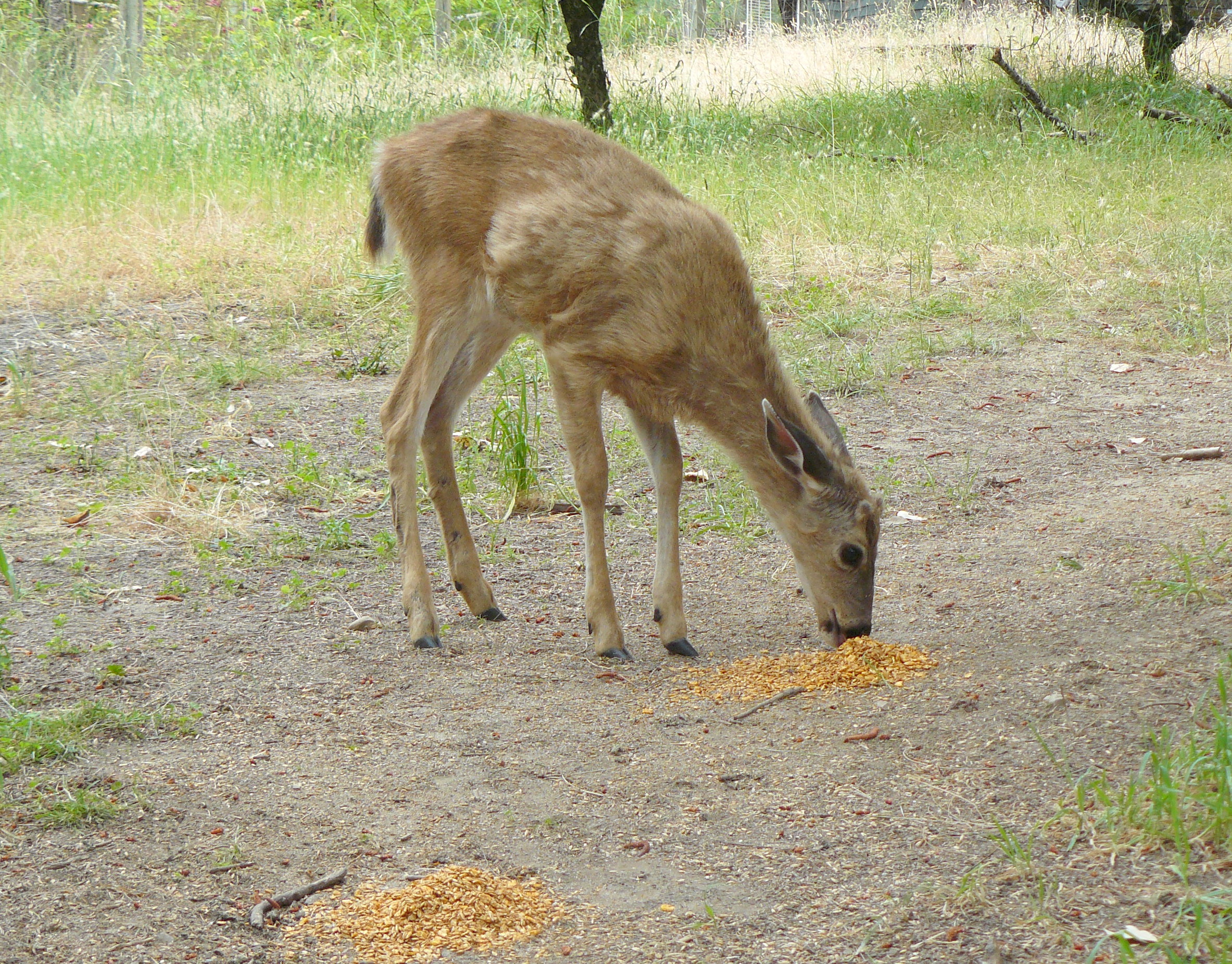
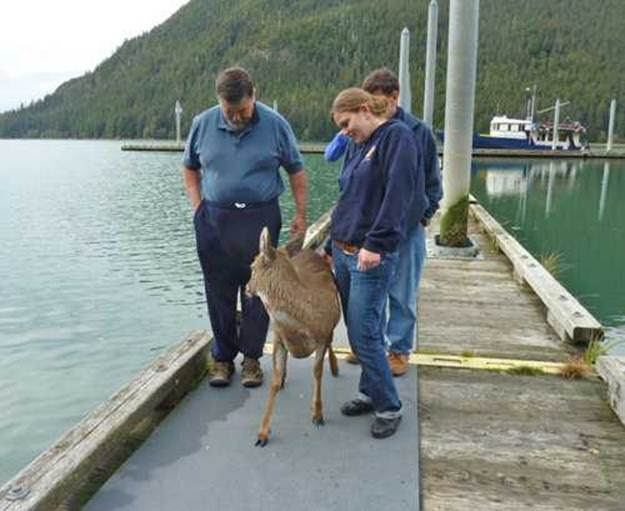
That is that for the last few years we have been feeding the wild deer.
Slowly a number of them have grown to trust Jean and me to the point where one particular young female became such a regular that we named her: Doris. It is Doris that is in the picture above eating the cob that we put out twice a day.
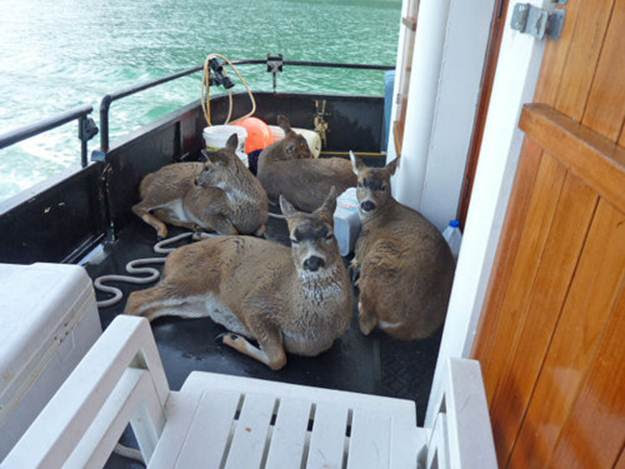
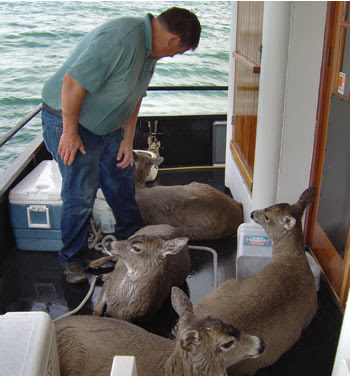
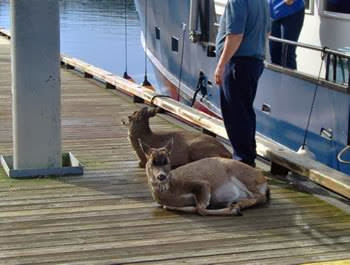
Doris doesn’t warm to strangers plus she doesn’t come every day. When she does it is clear that she is familiar with us and perceives no threat from this ‘neck of the woods’, as the next photograph supports:
In fact, I can now gently stroke her neck when she is feeding and will share those pictures with you all in a future Picture Parade post.
I call the closeness of me and Doris love. I love how this animal trusts me and, in turn, the care and responsibility that is called for from me.
My dream is that the love, care and responsibility offered by people will one day be so widespread and extensive that there comes no call for animal rescue shelters.
OK!
A couple of days ago Cori Meloney signed up to follow Learning from Dogs. Cori is the author of the blog Three Irish Cats. As is my usual way I went across to her blog to leave a ‘thank you’ note for her decision to follow my scriblings. I immediately saw her latest post and knew without doubt that it should be republished here. Cori very promptly gave me permission to so do.
ooOOoo
Every Day Should Be Clear the Shelters Day
July 25, 2016
Silly kitty Shadow.
I volunteer with a small (but mighty!) rescue group here in Southern Maryland called Rescue Angels of Southern Maryland. We mostly deal with cats, though we’ve recently begun to rescue dogs as well.
Most of the cats we find homes for come from owner surrenders, friendly cats and kittens from our feral colonies, and at-risk animals from our local municipal shelter, Tri-County Animal Shelter.
Saturday, Rescue Angels was one of the groups that participated in Tri-County’s annual Clear the Shelters Day celebration. Seventy-seven animals found forever homes that day. Watching the parade of happy animals and their new owners as they left the building was totally worth sweltering in the 95-degree heat.
As the only public animal shelter to serve the three Southern Maryland counties, Tri-County is a busy place. It frequently gets full, and organizations like Rescue Angels and others in the area step in when we can to remove animals from the shelter. This is not a no-kill shelter, so a full shelter means animals will die. New animals come in every day.
Gorgeous husky Damien.
Three things struck me when I was at Tri-County last weekend.
The first is that I wish Tri-County could be this busy every Saturday. Granted, adoption fees on Clear the Shelters Day were eliminated or reduced and there was a lot of publicity for this event, but there are always wonderful animals at the shelter that want to go home with a family. Many animals end up there because the owner surrendered them; the reason often given is “did not want.”
The second is that I am increasingly amazed by the dedication of the shelter staff. They have a difficult job, and it often goes without thanks. It’s not easy to be civil to an owner who is dropping off their pet because they don’t want it anymore. It’s not easy to put down perfectly healthy animals because humans have acted irresponsibly. I can only imagine that the staff constantly feels like it is in crisis mode; they may have nearly cleared the shelter on Saturday, but come midweek, those cages and pens will be filled again with animals in need.
The third thought is that we, the community, created this shelter, and we need to fix it. Tri-County has a terrible reputation here in Southern Maryland. The kill rate for cats is more than 50 percent. The facility is small and needs renovation and expansion. It is nearly always full to overflowing. Members of the community sometimes say terrible things about the staff.
Beautiful Nadine, who found a forever home on Clear the Shelters Day.
But Tri-County is constantly full because the Southern Maryland has let its companion animals down. Cats are not spayed or neutered, and they’re treated as disposable. Need to move? Drop your cat at the shelter, or worse, just leave it behind. Dog getting too big? Don’t feel like dealing with behavior or health issues? Drop the animal at the shelter.
I’ll be honest: My opinion of Tri-County and its staff has not always been positive. What makes it worse is that I had those opinions without actually visiting the shelter. I am ashamed of that fact. Since I started volunteering with Rescue Angels, I have visited the shelter many times to take cats that our rescue was putting into foster care. I have met some of the staff members, and they are always happy to talk with me about their animals. They’re ecstatic when an animal leaves the building. The shelter has a rescue coordinator whose job is to work with local rescue groups to remove animals from the shelter when they are at risk of being killed or when shelter life is impacting their well-being. These folks are animal lovers forced into a terrible situation by a community that treats its animals as disposable and Tri-County as its dumping ground.
So, now that Clear the Shelters Day has passed, I challenge my fellow residents of Southern Maryland: Visit Tri-County Animal Shelter. Talk with the staff. Visit with the cats in the free-roaming room. Take a dog for a walk. Take pictures and share them on Facebook. Volunteer. Follow Tri-County on Facebook and interact with their posts. Foster, which allows rescue groups to remove more animals from the shelter. Rescue Angels can help you become a foster family for dogs or cats.
All three Southern Maryland counties are working on plans to build their own shelter facilities. In the meantime, Tri-County Animal Shelter is our public shelter. It’s our job as the community to support the staff, help care for the animals, and reduce the number of animals killed there.
I hope to see you there, leash in hand.
By: Cori S. Meloney
ooOOoo
So if any reader is within reach of Southern Maryland and wants to offer an animal love, care and responsibility then please make your way across to Rescue Angels of Southern Maryland.
How to draw today’s post to a close?
In searching for inspiration about all animals living in the sight of love I realised that what I was dreaming of was more about compassion than love; albeit the two states of mind being very close to one another.
That led me to perusing the Dalai Lama’s teachings on compassion: Compassion and the Individual. Here’s how that teaching concludes:
Compassion and the world
In conclusion, I would like briefly to expand my thoughts beyond the topic of this short piece and make a wider point: individual happiness can contribute in a profound and effective way to the overall improvement of our entire human community.
Because we all share an identical need for love, it is possible to feel that anybody we meet, in whatever circumstances, is a brother or sister. No matter how new the face or how different the dress and behavior, there is no significant division between us and other people. It is foolish to dwell on external differences, because our basic natures are the same.
Ultimately, humanity is one and this small planet is our only home. If we are to protect this home of ours, each of us needs to experience a vivid sense of universal altruism. It is only this feeling that can remove the self-centered motives that cause people to deceive and misuse one another.
If you have a sincere and open heart, you naturally feel self- worth and confidence, and there is no need to be fearful of others.
I believe that at every level of society – familial, tribal, national and international – the key to a happier and more successful world is the growth of compassion. We do not need to become religious, nor do we need to believe in an ideology. All that is necessary is for each of us to develop our good human qualities.
I try to treat whoever I meet as an old friend. This gives me a genuine feeling of happiness. It is the practice of compassion.
Loving animals is very much part of protecting this home of ours.
“I’m 15 feet away and I can hear a two pound dog crying,” Great Plains SPCA’s Scott Poore says with frustration dripping in his voice, almost as much as the sweat on his brow in the 90 degree sun. “We’re going on about 45 minutes with this little dog in the back seat of this car.”
Standing in the parking lot of a Home Depot in Merriam, Kansas, Scott films a live stream broadcast that gives Facebook fans real-time access to the situation that every animal lover dreads: a dog locked inside a hot car.
But the circumstances of this particular rescue are even more bizarre than usual. First of all, this Home Depot allows dogs inside the store. Second, the puppy inside the vehicle was extremely young, only weeks old. Third, the woman went inside to shop without even slightly cracking the windows of the vehicle (although that would be of little benefit). Fourth, she actually lost her car keys so she wasn’t able to open the vehicle when she arrived.
“When the lady came out, she was absolutely blown away that anybody had an issue with this,” Scott said. “And that’s pretty typical.”
A misguided sense of affection actually seems to be at the root of most instances of dogs being left in hot cars. People bring the dogs along because they feel that the dogs will be lonely at home, but they don’t take into account the very real threat to the dog’s physical welfare.
According to the local news station, KCTV, the puppy was returned to his “owner” who was issued a citation. Watch the video and decide for yourself if the law enforcement action available to police under the current law will be sufficient to safeguard this puppy from additional neglect.
Independence Day should also apply to our beloved dogs!
So today is July 4th. One of the key days of the year in the American calendar, if not the key day.
Freedom and independence are the corner stones of a healthy nation. That ‘nation’ should include our dogs. Ergo, I have no hesitation in republishing the following that first was seen on the Care2 site.
The sight is heartbreaking: a sad animal, exposed to the heat or the cold, often without shelter, chained in a backyard. Sometimes all it takes to secure them is a thin rope tied around their collar on one end and a dog house on the other, in others it’s a thick metal chain that keeps the dog from moving away from a tree. Whatever the case, it’s enough to inspire any animal lover to change that dog’s life, but how? The answer is simpler than one would imagine: build a fence.
“Building a fence really changes the relationship between dogs and owners,” explains Michele Coppola, President of Fences for Fido, a nonprofit organization that builds fences in houses that have chained dogs so the dogs can run freely in the backyard. “Many times dogs who were outside 24/7 go on to become a family member, spending time in the house and outside because they’re no longer a location.”
Since 2009, Fences for Fido has been helping dogs in the Southwest Oregon and Washington state areas. People can anonymously nominate a house with a chained dog on their website or people can nominate themselves if they don’t have the means to build their own fence. According to the Coalition to Unchain Dogs, who helped Fences for Fido get started and has been building fences since 2006 in North Carolina, that lack of resources is the most common reason why people keep dogs chained.
“When we first started we thought we would we would build this fence and solve a problem but we quickly saw the problem is not chained dogs, it’s poverty,” explains Lori Hensley, Director of Operations at Coalition to Unchain Dogs. “No one wants to chain a dog. They just don’t have the means to build a fence.”
Other common reasons are not understanding that dogs are social animals that need to run around, an owner not knowing how to address behavioral problems and trying to keep the dog from running away, says the Humane Society of the United States.
“People chain their dogs for a variety of reasons so we always approach them without judgement because most times we’re not seeing the whole story,” says Coppola adding that those issues are addressed when building a fence for someone to make sure they’re educated on why chaining their dogs shouldn’t be a solution. “Maybe they didn’t have a fence to start with and someone, maybe a family member, dumped a dog with them and they’re keeping it out of the goodness of their hearts but they don’t have a fence. You don’t know.”
Between the two organizations, over 3,400 dogs have been freed from chains but since they only operate locally, they have created resources for people in other parts of the country who want to help. Unchained Planet, a Facebook group of volunteer fence builders, offers advice and tips to anyone looking to start their own fence building organization and a DIY tutorial is also available for free download.
From materials needed to step by step instructions, anyone can start building a fence to help chained dogs in their communities, though to complete novices, the guidance of a seasoned builder or a professional is encouraged.
“If you’re starting out for the very first time, it might be a good idea to pair up with a fence company who may be willing to help and even donate the materials,” suggests Coppola. “Or you want to find somebody who’s done a fence before and can kind of show you how to go about it.”
Fences for Fido is an Oregon-based organisation and I’m going to contact them and ask for more information to share with you all.
I am also going to contact local charity The Toby Fund of Wolf Creek (Oregon) who do great work in unchaining dogs and seek an article from them for you.
In yesterday’s post I mentioned that the first time I used a post title Affairs of the Heart was back in 2012. In fact it was January 20th, 2012. Many of you dear readers will, undoubtedly, not have read it then so here it is again. Both Hazel and Dhalia are now dead.
ooOOoo
Affairs of the Heart
That is, a la dog!
Hazel
This is Hazel. She is one of three dogs that ‘belong’ to Pharaoh.
Last Tuesday, we took Pharaoh and his mini-pack of 3 dogs out for our usual afternoon walk at the very end of Granite Dells Rd, out where the forest road ends and soon becomes the relative wilderness of the Tonto National Forest.
Pharaoh, and Hazel, Dhalia and little Sweeny.
However, on this occasion Hazel decided to leave us and link up with a stranger who was hiking the forest. That was the last we saw of Hazel for many hours. Miracle of miracles, the stranger, Joanie, was a dog-lover so when Hazel had followed Joanie and her dog all the way to Joanie’s car, the next stop for her, Hazel that is, was our local Payson Humane Center. Hazel’s tag very quickly linked her to Jean (a great reminder of the importance of tagging your dogs!) who is well-known as a volunteer assistant at the Humane Society Thrift store and the scare was over.
But during the hours of tramping those miles along challenging forest tracks, calling out Hazel’s name, both Jeannie and I had plenty of time to hurt. Here’s a small insight, that millions of pet owners will resonate with, that demonstrates the way that dogs offer us so much love which, in turn, opens our human hearts to the purity of unconditional love. (And I know it’s not just dogs but many animals in our lives that offer us such love!)
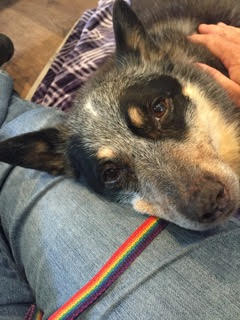
Pharaoh and his ‘team’ sleep in our bedroom. During the Winter months Hazel will often lay stretched out on the bed-cover alongside the back of my legs. If I need a trip to the bathroom during the night, not unknown at my age, I can almost guarantee that Hazel will shift her cuddly body up to the warm sheets just below my pillow.
Thus it was this last Tuesday morning when I returned from my bathroom run about 3am; Hazel asleep with her head on my pillow! I didn’t have the heart to push her off the bed, so just slipped in beside her and moments later back asleep, my head nestled against Hazel’s warm head. Sleeping so close to a dog is more than just nice, it seems to stir very ancient memories deep in the subconscious, perhaps back all those thousands of years to when domesticated dogs were an integral part of early man’s security.
So you can imagine the anguish that, in our own separate minds, Jeannie and I were experiencing. I just couldn’t go to the place where never again would I feel the warmth of Hazel’s body against mine. Jean was desperately hoping this wasn’t a tragic repeat of losing Poppy. Thus when I went round to the Humane Center just as they were closing up and Hazel came out to me, I dissolved in sobs of relief.
That’s the heart-felt closeness of dogs and humans.
The purity of a dog’s heart!
ooOOoo
All of you, including your loving animals, have a wonderful weekend.
Diane, as someone who previously has run his own business and then, after selling it in 1986, spent a number of years as a mentor with the Prince’s Youth Business Trust in the UK, I have come to the conclusion that the best role model we adults can offer our ‘students’ is this: “Be the best you can be!” That flows from being fully aware of the person that one is. For self-awareness is the key to understanding oneself and, consequently, of understanding others. Understanding why people think and behave the way they do, for good and bad, is the only effective way of engaging with others and seeking that ‘civic engagement’ so critically important.
Apologies, that paragraph sounds like a damn speech! I didn’t intend it to be so. Plus, my own journey of self-awareness has been a long and tortuous one – but that doesn’t change my view just expressed.
Coincidentally, I have been having some informal chats with Jan Schmuckle: http://www.janconsults.com/home
Her recently released book on the effectiveness of Role Montage in building leadership skills is highly relevant to today’s students. In Jan’s words (and I have no commercial or financial link with Jan):
Role Montage: A Creative New Way to Discover the
Leader Within You is written from Jan’s experience
with her client work and her research. It helps
leaders explore self-awareness and leadership using
the role montage process.
I’ll creep back into my hole!