Category: monetary policy

The Federal Reserve

To all people that live outside the US, and quite a few as well who don’t!

The Federal Reserve is the central banking system of the USA. I am going to republish most of the article that appears on WikiPedia. It is yet another example of how the United States set itself up taking the best from all around the world.

(And apologies for not posting a Picture Parade yesterday.)

ooOOoo

 The Federal Reserve System (often shortened to the Federal Reserve, or simply the Fed) is the central banking system of the United States. It was created on December 23, 1913, with the enactment of the Federal Reserve Act, after a series of financial panics (particularly the panic of 1907) led to the desire for central control of the monetary system in order to alleviate financial crises.[list 1] Although an instrument of the U.S. government, the Federal Reserve System considers itself “an independent central bank because its monetary policy decisions do not have to be approved by the president or by anyone else in the executive or legislative branches of government, it does not receive funding appropriated by Congress, and the terms of the members of the board of governors span multiple presidential and congressional terms.”[11] Over the years, events such as the Great Depression in the 1930s and the Great Recessionduring the 2000s have led to the expansion of the roles and responsibilities of the Federal Reserve System.[6][12]

Congress established three key objectives for monetary policy in the Federal Reserve Act: maximizing employment, stabilizing prices, and moderating long-term interest rates.[13] The first two objectives are sometimes referred to as the Federal Reserve’s dual mandate.[14] Its duties have expanded over the years, and include supervising and regulating banks, maintaining the stability of the financial system, and providing financial services to depository institutions, the U.S. government, and foreign official institutions.[15] The Fed also conducts research into the economy and provides numerous publications, such as the Beige Book and the FRED database.[16]

The Federal Reserve System is composed of several layers. It is governed by the presidentially appointed board of governors or Federal Reserve Board (FRB). Twelve regional Federal Reserve Banks, located in cities throughout the nation, regulate and oversee privately owned commercial banks.[17] Nationally chartered commercial banks are required to hold stock in, and can elect some board members of, the Federal Reserve Bank of their region.

The Federal Open Market Committee (FOMC) sets monetary policy by adjusting the target for the federal funds rate, which generally influences market interest rates and, in turn, US economic activity via the monetary transmission mechanism. The FOMC consists of all seven members of the board of governors and the twelve regional Federal Reserve Bank presidents, though only five bank presidents vote at a time: the president of the New York Fed and four others who rotate through one-year voting terms. There are also various advisory councils.[list 2] It has a structure unique among central banks, and is also unusual in that the United States Department of the Treasury, an entity outside of the central bank, prints the currency used.[23]

The federal government sets the salaries of the board’s seven governors, and it receives all the system’s annual profits after dividends on member banks’ capital investments are paid, and an account surplus is maintained. In 2015, the Federal Reserve earned a net income of $100.2 billion and transferred $97.7 billion to the U.S. Treasury,[24] and 2020 earnings were approximately $88.6 billion with remittances to the U.S. Treasury of $86.9 billion.[25] The Federal Reserve has been criticized for its approach to managing inflation, perceived lack of transparency, and its role in economic downturns.[26][27][28]

Purpose

The primary declared motivation for creating the Federal Reserve System was to address banking panics.[6] Other purposes are stated in the Federal Reserve Act, such as “to furnish an elastic currency, to afford means of rediscounting commercial paper, to establish a more effective supervision of banking in the United States, and for other purposes”.[29] Before the founding of the Federal Reserve System, the United States underwent several financial crises. A particularly severe crisis in 1907 led Congress to enact the Federal Reserve Act in 1913. Today the Federal Reserve System has responsibilities in addition to stabilizing the financial system.[30]

Current functions of the Federal Reserve System include:[15][30]

  • To address the problem of banking panics
  • To serve as the central bank for the United States
  • To strike a balance between private interests of banks and the centralized responsibility of government
    • To supervise and regulate banking institutions
    • To protect the credit rights of consumers
  • To conduct monetary policy by influencing market interest rates to achieve the sometimes-conflicting goals of
    • maximum employment
    • stable prices, interpreted as an inflation rate of 2 percent per year on average[31]
    • moderate long-term interest rates
  • To maintain the stability of the financial system and contain systemic risk in financial markets
  • To provide financial services to depository institutions, the U.S. government, and foreign official institutions, including playing a major role in operating the nation’s payments system
    • To facilitate the exchange of payments among regions
    • To respond to local liquidity needs
  • To strengthen U.S. standing in the world economy
Unemployment vs Inflation vs Inverted yield curve  Unemployment rate  Inflation CPI  10 year bond minus 2 year bond Inverted yield curve

Addressing the problem of bank panics

Further information: Bank run and Fractional-reserve banking

Banking institutions in the United States are required to hold reserves‍—‌amounts of currency and deposits in other banks‍—‌equal to only a fraction of the amount of the bank’s deposit liabilities owed to customers. This practice is called fractional-reserve banking. As a result, banks usually invest the majority of the funds received from depositors. On rare occasions, too many of the bank’s customers will withdraw their savings and the bank will need help from another institution to continue operating; this is called a bank run. Bank runs can lead to a multitude of social and economic problems. The Federal Reserve System was designed as an attempt to prevent or minimize the occurrence of bank runs, and possibly act as a lender of last resort when a bank run does occur. Many economists, following Nobel laureate Milton Friedman, believe that the Federal Reserve inappropriately refused to lend money to small banks during the bank runs of 1929; Friedman argued that this contributed to the Great Depression.[32]

Check clearing system

Because some banks refused to clear checks from certain other banks during times of economic uncertainty, a check-clearing system was created in the Federal Reserve System. It is briefly described in The Federal Reserve System‍—‌Purposes and Functions as follows:[33]

By creating the Federal Reserve System, Congress intended to eliminate the severe financial crises that had periodically swept the nation, especially the sort of financial panic that occurred in 1907. During that episode, payments were disrupted throughout the country because many banks and clearinghouses refused to clear checks drawn on certain other banks, a practice that contributed to the failure of otherwise solvent banks. To address these problems, Congress gave the Federal Reserve System the authority to establish a nationwide check-clearing system. The System, then, was to provide not only an elastic currency‍—‌that is, a currency that would expand or shrink in amount as economic conditions warranted‍—‌but also an efficient and equitable check-collection system.

Lender of last resort

In the United States, the Federal Reserve serves as the lender of last resort to those institutions that cannot obtain credit elsewhere and the collapse of which would have serious implications for the economy. It took over this role from the private sector “clearing houses” which operated during the Free Banking Era; whether public or private, the availability of liquidity was intended to prevent bank runs.[34]

Fluctuations

Through its discount window and credit operations, Reserve Banks provide liquidity to banks to meet short-term needs stemming from seasonal fluctuations in deposits or unexpected withdrawals. Longer-term liquidity may also be provided in exceptional circumstances. The rate the Fed charges banks for these loans is called the discount rate (officially the primary credit rate).

By making these loans, the Fed serves as a buffer against unexpected day-to-day fluctuations in reserve demand and supply. This contributes to the effective functioning of the banking system, alleviates pressure in the reserves market and reduces the extent of unexpected movements in the interest rates.[35] For example, on September 16, 2008, the Federal Reserve Board authorized an $85 billion loan to stave off the bankruptcy of international insurance giant American International Group (AIG).[36]

Central bank

Further information: Central bank

Obverse of a Federal Reserve $1 note issued in 2009

In its role as the central bank of the United States, the Fed serves as a banker’s bank and as the government’s bank. As the banker’s bank, it helps to assure the safety and efficiency of the payments system. As the government’s bank or fiscal agent, the Fed processes a variety of financial transactions involving trillions of dollars. Just as an individual might keep an account at a bank, the U.S. Treasury keeps a checking account with the Federal Reserve, through which incoming federal tax deposits and outgoing government payments are handled. As part of this service relationship, the Fed sells and redeems U.S. government securitiessuch as savings bonds and Treasury bills, notes and bonds. It also issues the nation’s coinand paper currency. The U.S. Treasury, through its Bureau of the Mint and Bureau of Engraving and Printing, actually produces the nation’s cash supply and, in effect, sells the paper currency to the Federal Reserve Banks at manufacturing cost, and the coins at face value. The Federal Reserve Banks then distribute it to other financial institutions in various ways.[37] During the Fiscal Year 2020, the Bureau of Engraving and Printing delivered 57.95 billion notes at an average cost of 7.4 cents per note.[38][39]

Federal funds

Main article: Federal funds

Federal funds are the reserve balances (also called Federal Reserve Deposits) that private banks keep at their local Federal Reserve Bank.[40] These balances are the namesake reserves of the Federal Reserve System. The purpose of keeping funds at a Federal Reserve Bank is to have a mechanism for private banks to lend funds to one another. This market for funds plays an important role in the Federal Reserve System as it is the basis for its monetary policy work. Monetary policy is put into effect partly by influencing how much interest the private banks charge each other for the lending of these funds.

Federal reserve accounts contain federal reserve credit, which can be converted into federal reserve notes. Private banks maintain their bank reserves in federal reserve accounts.

Bank regulation

The Federal Reserve regulates private banks. The system was designed out of a compromise between the competing philosophies of privatization and government regulation. In 2006 Donald L. Kohn, vice chairman of the board of governors, summarized the history of this compromise:[41]

Agrarian and progressive interests, led by William Jennings Bryan, favored a central bank under public, rather than banker, control. However, the vast majority of the nation’s bankers, concerned about government intervention in the banking business, opposed a central bank structure directed by political appointees. The legislation that Congress ultimately adopted in 1913 reflected a hard-fought battle to balance these two competing views and created the hybrid public-private, centralized-decentralized structure that we have today.

The balance between private interests and government can also be seen in the structure of the system. Private banks elect members of the board of directors at their regional Federal Reserve Bank while the members of the board of governors are selected by the president of the United States and confirmed by the Senate.

Government regulation and supervision

Ben Bernanke (lower right), former chairman of the Federal Reserve Board of Governors, at a House Financial Services Committee hearing on February 10, 2009. Members of the board frequently testify before congressional committees such as this one. The Senate equivalent of the House Financial Services Committee is the Senate Committee on Banking, Housing, and Urban Affairs.

The Federal Banking Agency Audit Act, enacted in 1978 as Public Law 95-320 and 31 U.S.C. section 714 establish that the board of governors of the Federal Reserve System and the Federal Reserve banks may be audited by the Government Accountability Office (GAO).[42]

The GAO has authority to audit check-processing, currency storage and shipments, and some regulatory and bank examination functions–though there are restrictions to what the GAO may audit. Under the Federal Banking Agency Audit Act, 31 U.S.C. section 714(b), audits of the Federal Reserve Board and Federal Reserve banks do not include (1) transactions for or with a foreign central bank or government or non-private international financing organization; (2) deliberations, decisions, or actions on monetary policy matters; (3) transactions made under the direction of the Federal Open Market Committee; or (4) a part of a discussion or communication among or between members of the board of governors and officers and employees of the Federal Reserve System related to items (1), (2), or (3). See Federal Reserve System Audits: Restrictions on GAO’s Access (GAO/T-GGD-94-44), statement of Charles A. Bowsher.[43]

The board of governors in the Federal Reserve System has a number of supervisory and regulatory responsibilities in the U.S. banking system, but not complete responsibility. A general description of the types of regulation and supervision involved in the U.S. banking system is given by the Federal Reserve:[44]

The Board also plays a major role in the supervision and regulation of the U.S. banking system. It has supervisory responsibilities for state-chartered banks[45] that are members of the Federal Reserve System, bank holding companies(companies that control banks), the foreign activities of member banks, the U.S. activities of foreign banks, and Edge Act and “agreement corporations” (limited-purpose institutions that engage in a foreign banking business). The Board and, under delegated authority, the Federal Reserve Banks, supervise approximately 900 state member banks and 5,000 bank holding companies. Other federal agencies also serve as the primary federal supervisors of commercial banks; the Office of the Comptroller of the Currency supervises national banks, and the Federal Deposit Insurance Corporation supervises state banks that are not members of the Federal Reserve System.

Some regulations issued by the Board apply to the entire banking industry, whereas others apply only to member banks, that is, state banks that have chosen to join the Federal Reserve System and national banks, which by law must be members of the System. The Board also issues regulations to carry out major federal laws governing consumer credit protection, such as the Truth in LendingEqual Credit Opportunity, and Home Mortgage Disclosure Acts. Many of these consumer protection regulations apply to various lenders outside the banking industry as well as to banks.

Members of the Board of Governors are in continual contact with other policy makers in government. They frequently testify before congressional committees on the economy, monetary policybanking supervision and regulationconsumer credit protectionfinancial markets, and other matters.

The Board has regular contact with members of the President’s Council of Economic Advisers and other key economic officials. The Chair also meets from time to time with the President of the United States and has regular meetings with the Secretary of the Treasury. The Chair has formal responsibilities in the international arena as well.

Regulatory and oversight responsibilities

The board of directors of each Federal Reserve Bank District also has regulatory and supervisory responsibilities. If the board of directors of a district bank has judged that a member bank is performing or behaving poorly, it will report this to the board of governors. This policy is described in law:

Each Federal reserve bank shall keep itself informed of the general character and amount of the loans and investments of its member banks with a view to ascertaining whether undue use is being made of bank credit for the speculative carrying of or trading in securities, real estate, or commodities, or for any other purpose inconsistent with the maintenance of sound credit conditions; and, in determining whether to grant or refuse advances, rediscounts, or other credit accommodations, the Federal reserve bank shall give consideration to such information. The chairman of the Federal reserve bank shall report to the Board of Governors of the Federal Reserve System any such undue use of bank credit by any member bank, together with his recommendation. Whenever, in the judgment of the Board of Governors of the Federal Reserve System, any member bank is making such undue use of bank credit, the Board may, in its discretion, after reasonable notice and an opportunity for a hearing, suspend such bank from the use of the credit facilities of the Federal Reserve System and may terminate such suspension or may renew it from time to time.[46]

National payments system

The Federal Reserve plays a role in the U.S. payments system. The twelve Federal Reserve Banks provide banking services to depository institutions and to the federal government. For depository institutions, they maintain accounts and provide various payment services, including collecting checks, electronically transferring funds, and distributing and receiving currency and coin. For the federal government, the Reserve Banks act as fiscal agents, paying Treasury checks; processing electronic payments; and issuing, transferring, and redeeming U.S. government securities.[47]

In the Depository Institutions Deregulation and Monetary Control Act of 1980, Congress reaffirmed that the Federal Reserve should promote an efficient nationwide payments system. The act subjects all depository institutions, not just member commercial banks, to reserve requirements and grants them equal access to Reserve Bank payment services. The Federal Reserve plays a role in the nation’s retail and wholesale payments systems by providing financial services to depository institutions. Retail payments are generally for relatively small-dollar amounts and often involve a depository institution’s retail clients‍—‌individuals and smaller businesses. The Reserve Banks’ retail services include distributing currency and coin, collecting checks, electronically transferring funds through FedACH (the Federal Reserve’s automated clearing house system), and beginning in 2023, facilitating instant payments using the FedNow service. By contrast, wholesale payments are generally for large-dollar amounts and often involve a depository institution’s large corporate customers or counterparties, including other financial institutions. The Reserve Banks’ wholesale services include electronically transferring funds through the Fedwire Funds Service and transferring securities issued by the U.S. government, its agencies, and certain other entities through the Fedwire Securities Service.

ooOOoo

There is more in that article including Structure, Board of Governors, the Federal Reserve Banks (there are 12), and more subjects. So if you want to read these then, please, go here.

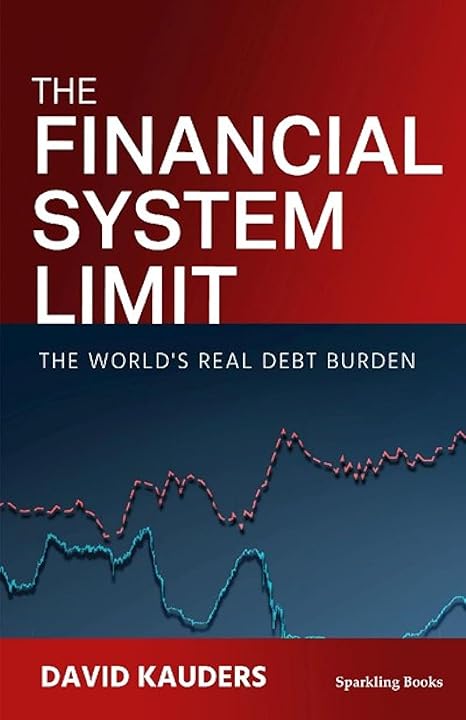
And I am bound to say that I have recently finished reading The FINANCIAL SYSTEM LIMIT by David Kauders. The sub-title of the book is The World’s Real Debt Burden. If you are at all interested in the subject then read the book.

Starting a veterinary clinic

Like any new start-up of a business venture, this requires knowledge, skills and quite a bit of luck!

I am delighted to offer this guest post by Penny.

ooOOoo

Image: Freepik

Vision to Reality: Building a Profitable Vet Clinic

Launching a veterinary clinic is a significant endeavor that requires meticulous planning and strategic decision-making. This venture combines a passion for animal care with the intricacies of managing a successful business. Aspiring clinic owners must navigate several critical steps to lay a strong foundation and ensure operational excellence. Starting your own clinic promises not only to fulfill a dream of helping animals but also to establish a thriving enterprise in the community.

Build a Strong Foundation with an Effective Marketing Strategy

A robust marketing strategy is essential to attract potential clients in the digital era. Establishing a professional online presence through a user-friendly website that details your services, team, and location builds trust among pet owners. Engage actively on social media with regular updates and client testimonials to showcase your expertise and commitment to animal care. Forge partnerships with local pet-related businesses to increase visibility and drive traffic to your clinic, enhancing both your and your partners’ customer bases.

Craft a Clear and Detailed Business Plan

A well-constructed business plan acts as your clinic’s roadmap, detailing your mission, services offered, and the specific target market. Identify your niche early—whether it’s specializing in certain animals or treatments—to attract the appropriate clientele. Include comprehensive financial projections and a marketing budget in your plan to ensure financial preparedness and support your clinic’s promotional activities.

Enhance Your Business Knowledge by Pursuing an MBA

Running a veterinary clinic demands a blend of clinical and business expertise. Pursuing a master’s of business administration online can boost your proficiency in key business areas such as strategy, management, and finance. An MBA not only deepens your understanding of business operations but also enhances leadership skills and self-assessment capabilities. These competencies are essential for balancing the medical and business demands of your clinic, ensuring its long-term success.

Safeguard Your Business with Proper Insurance

Operating a veterinary clinic comes with inherent risks, making comprehensive insurance coverage essential. Essential policies include malpractice insurance to handle legal issues and general liability insurance for accidents on your premises. Property insurance is crucial to protect your clinic’s infrastructure and equipment against unexpected events. Consulting with an insurance expert can ensure that you have thorough coverage to protect against potential financial setbacks.

Invest in High-Quality Veterinary Equipment

Providing top-tier care necessitates investing in high-quality veterinary equipment. Essential tools like X-ray machines, surgical instruments, and lab equipment should be of the highest standard to ensure accurate diagnoses and treatments. Modern technologies, such as digital imaging systems, not only enhance patient care but also improve operational efficiency. While the initial cost may be higher, investing in quality equipment pays off in the long run by boosting efficiency and minimizing errors.

Secure the Necessary Funding for Your Clinic

Securing sufficient funding is critical when starting a veterinary clinic. Estimate your startup costs accurately to understand your financial needs, including equipment, premises, staffing, and marketing. Explore diverse financing options, such as bank loans, private investors, and specialty medical practice loans that might offer favorable terms. Adequate initial funding prevents cash flow problems and supports your clinic’s growth trajectory.

Choose the Right Location for Your Clinic

The location of your clinic is pivotal to its success, necessitating a spot with a high demand for veterinary services. Conduct thorough market research to choose a community rich in pet owners who need your services. Select a location that is accessible, visible, and has ample parking to ensure convenience for your clients. Proximity to complementary services like pet groomers or dog trainers can further enhance client traffic and provide expansion opportunities.

Opening a veterinary clinic is both challenging and rewarding, demanding a careful blend of dedication and strategic foresight. Success in this field not only enhances the well-being of pets but also contributes positively to the local community. It requires ongoing commitment to adapt and grow in a dynamic environment. Ultimately, the fulfillment of running a successful veterinary clinic comes from both the impact on animal health and the achievement of entrepreneurial goals.

Discover the timeless wisdom that dogs offer at Learning from Dogs, where integrity and living in the present are celebrated. Dive into our content and embrace the lessons from our four-legged friends.

ooOOoo

This is a skilled summary of the needs of opening a vet’s clinic. And thank you, Penny, for your last paragraph. It has been a pleasure!

It’s all too much, or it could be!

This year, 2020, has been unlike any other year.

I am not saying anything new but just reiterating what has been said before: 2020 is going to go down as the year from hell! And I don’t think that is too strong a word!

Part of it are the news stories that sweep the world: Covid-19; Brexit; Climate change; up until yesterday what was President Trump going to do in his last few weeks; etc; etc.

Also part of it is the way that news and more news and, yes, more news is flashed around the globe. Most of it bad news as we all know that bad news sells!

Finally, part of it is the new world of social media especially messaging on a smartphone. President Trump isn’t the only one to communicate greatly via Twitter.

Now, speaking personally, I couldn’t have got through this year without Jeannie and our dogs.

Pure bliss!

But, nevertheless, something has changed and Mark Satta has written an article that tries to explain things.

ooOOoo

Three reasons for information exhaustion – and what to do about it

By Mark Satta, Assistant Professor of Philosophy, Wayne State University.

November 18th, 2020

An endless flow of information is coming at us constantly: It might be an article a friend shared on Facebook with a sensational headline or wrong information about the spread of the coronavirus. It could even be a call from a relative wanting to talk about a political issue.

All this information may leave many of us feeling as though we have no energy to engage.

As a philosopher who studies knowledge-sharing practices, I call this experience “epistemic exhaustion.” The term “epistemic” comes from the Greek word episteme, often translated as “knowledge.” So epistemic exhaustion is more of a knowledge-related exhaustion.

It is not knowledge itself that tires out many of us. Rather, it is the process of trying to gain or share knowledge under challenging circumstances.

Currently, there are at least three common sources that, from my perspective, are leading to such exhaustion. But there are also ways to deal with them.

1. Uncertainty

For many, this year has been full of uncertainty. In particular, the coronavirus pandemic has generated uncertainty about health, about best practices and about the future.

At the same time, Americans have faced uncertainty about the U.S. presidential election: first due to delayed results and now over questions about a peaceful transition of power.

Experiencing uncertainty can stress most of us out. People tend to prefer the planned and the predictable. Figures from 17th-century French philosopher René Descartes to 20th-century Austrian philosopher Ludwig Wittgenstein have recognized the significance of having certainty in our lives.

With information so readily available, people may be checking news sites or social media in hopes of finding answers. But often, people are instead greeted with more reminders of uncertainty.

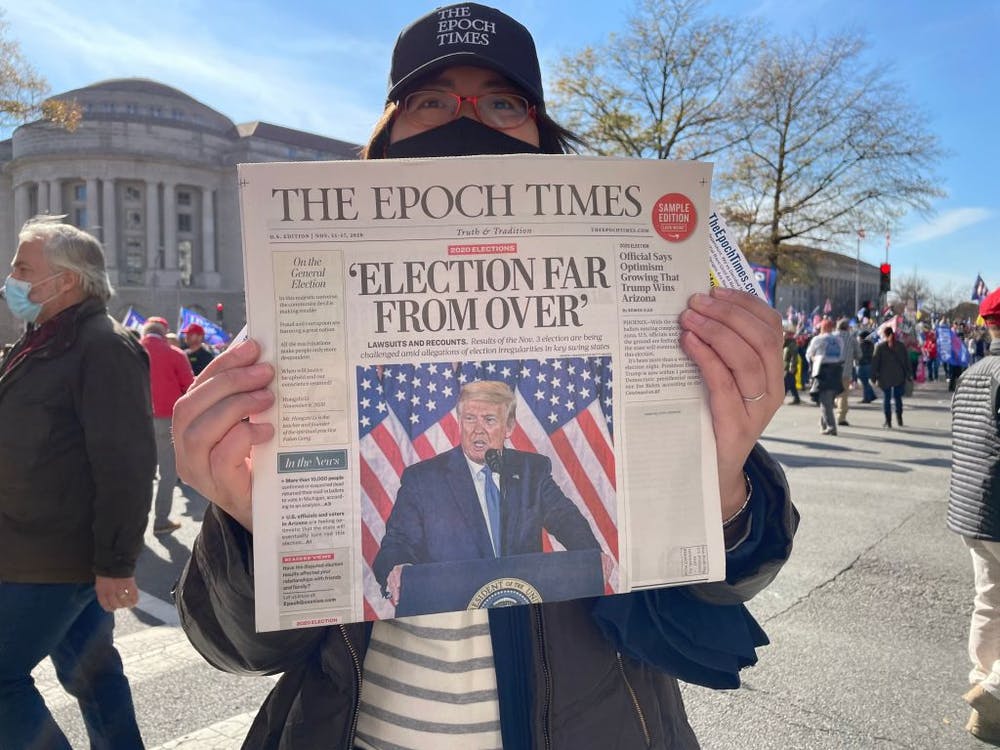
As Trump supporters denounce the 2020 election results, feelings of uncertainty can come up for others. Karla Ann Cote/NurPhoto via Getty Images

2. Polarization

Political polarization is stressing many Americans out.

As political scientist Lilliana Mason notes in her book, “Uncivil Disagreement: How Politics Became Our Identity,” Americans have been increasingly dividing politically “into two partisan teams.”

Many writers have discussed the negative effects of polarization, such as how it can damage democracy. But discussions about the harms of polarization often overlook the toll polarization takes on our ability to gain and share knowledge.

That can happen in at least two ways.

First, as philosopher Kevin Vallier has argued, there is a “causal feedback loop” between polarization and distrust. In other words, polarization and distrust fuel one another. Such a cycle can leave people feeling unsure whom to trust or what to believe.

Second, polarization can lead to competing narratives because in a deeply polarized society, as studies show, we can lose common ground and tend to have less agreement.

For those inclined to take the views of others seriously, this can create additional cognitive work. And when the issues are heated or sensitive, this can create additional stress and emotional burdens, such as sadness over damaged friendships or anger over partisan rhetoric.

3. Misinformation

Viral misinformation is everywhere. This includes political propaganda in the United States and around the world.

People are also inundated with advertising and misleading messaging from private corporations, what philosophers Cailin O’Connor and James Owen Weatherall have called “industrial propaganda.” And in 2020, the public is also dealing with misinformation about COVID-19.

As chess grandmaster Garry Kasparov put it: “The point of modern propaganda isn’t only to misinform or push an agenda. It is to exhaust your critical thinking, to annihilate truth.”

Misinformation is often exhausting by design. For example, a video that went viral,Plandemic,” featured a large number of false claims about COVID-19 in rapid succession. This flooding of misinformation in rapid succession, a tactic known as a Gish gallop, makes it challenging and time-consuming for fact checkers to refute the many falsehoods following one after another.

What to do?

With all this uncertainty, polarization and misinformation, feeling tired is understandable. But there are things one can do.

The American Psychological Association suggests coping with uncertainty through activities like limiting news consumption and focusing on things in one’s control. Another option is to work on becoming more comfortable with uncertainty through practices such as meditation and the cultivation of mindfulness.

To deal with polarization, consider communicating with the goal of creating empathetic understanding rather than “winning.” Philosopher Michael Hannon describes empathetic understanding as “the ability to take up another person’s perspective.”

[Deep knowledge, daily. Sign up for The Conversation’s newsletter.]

As for limiting the spread of misinformation: Share only those news stories that you’ve read and verified. And you can prioritize outlets that meet high ethical journalistic or fact-checking standards.

These solutions are limited and imperfect, but that’s all right. Part of resisting epistemic exhaustion is learning to live with the limited and imperfect. No one has time to vet all the headlines, correct all the misinformation or gain all the relevant knowledge. To deny this is to set oneself up for exhaustion.

ooOOoo

That last section, What to do?, is full of really sensible advice. In fact, the American Psychological Association has an article at the moment that appears to be freely available called Healing the political divide.

I intend to read it.

It finishes up saying:

Scientists must strive to share their research as broadly as possible. And they don’t have to do it alone. Organizations like More in Common work to conduct research and communicate findings to audiences where it can have the greatest impact.

Advocacy is essential as well. Other countries that have made strides in addressing the political divide relied heavily on government-led reconciliation efforts. The Truth and Reconciliation Commission, for example, in South Africa, has been fundamental in addressing disparities and conflict around Apartheid.

Were the United States to consider similar, government-backed efforts, psychologists must be part of the call to do so. And the behavioral expertise of the field would be central to success.

“The collective mental health of the nation is at risk,” says Moghaddam. “Just as we should rely on epidemiological science to tell us when there is a vaccine ready for mass use, we have to rely on psychological science to guide us through these mental health issues.”

And following an election that, for many, has felt like the most polarized of a lifetime, this piece seems critical. “ This is what our profession is all about,” says Moghaddam.

Good advice especially if you can take time off just losing oneself in nature.

Dawn behind nearby Mt. Sexton. Taken from our deck on the 21st August, 2019.

Enough said!

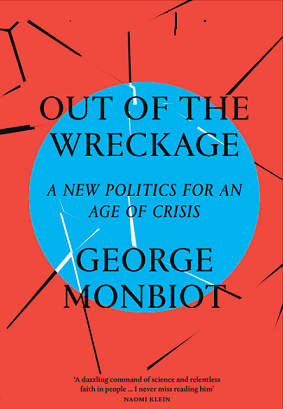
Out Of The Wreckage: A Review

This is one powerful book!

(Please note that I am letting this post run until Sunday, 15th Oct.)

For many years I have both read George Monbiot’s writings, especially those published by The Guardian newspaper, and deeply respected his insight, intelligence and analysis of the world in which we now live.

So when I heard of his latest book, published by Verso Books both sides of the ‘pond’, it was ordered immediately. It was a book I badly wanted to read. I was not disappointed.

So what is Mr. Monbiot’s message?

To answer that question let me lean on a forthcoming talk being given by him in Edinburgh in eight days time. For he is speaking at a Scottish Green Party event on October 20th.
Here’s the thrust of what is to be covered at that meeting:

What does the good life—and the good society—look like in the twenty-first century?

A toxic ideology rules the world – of extreme competition and individualism. It misrepresents human nature, destroying hope and common purpose. Only a positive vision can replace it, a new story that re-engages people in politics and lights a path to a better world.

Join us for an evening of discussion with George Monbiot as he talks about his new book: ‘Out of the wreckage: a new politics in an age of crisis‘. New findings in psychology, neuroscience and evolutionary biology cast human nature in a radically different light: as the supreme altruists and cooperators. George argues that we can build on these findings to create a new politics: a ‘politics of belonging’.

So what does this mean for social and environmental justice campaigning in Edinburgh? How do we create a politics of belongings here in Scotland? There will be plenty of opportunity for George Monbiot and the audience to share their insights.

Doors open: 6pm

George Monbiot will speak from 7-7.30pm and there will then be a Q&A, plus a chance buy books, mingle and browse stalls.

This event is jointly hosted by Global Justice Now and the Scottish Green party.

To my mind, this book not only addresses, full on, the madness (my word) of these present times but also offers strong, positive recommendations as to how we, as in the societies of all the major nations, can turn it around and offer a decent future for future generations. That’s why I am so strongly recommending it.

Take this extract from the review of George Monbiot’s book published by the Guardian newspaper on the 14th September this year:

For George Monbiot, neoliberalism should best be understood as a “story”, one that was conveniently on offer at precisely the moment when the previous “story” – namely Keynesianism – fell to pieces in the mid-1970s. The power of stories is overwhelming, as they are “the means by which we navigate the world. They allow us to interpret its complex and contradictory signals”. The particular story of neoliberalism “defines us as competitors, guided above all other impulses by the urge to get ahead of our fellows”.

Or this extract from the review published by The New Statesman:

It should be said at once that we are desperately in need of new ideas for a society and a democracy where trust in all established institutions is at a record low and even a Tory prime minister admits the country doesn’t work for everyone. Monbiot’s ideas are clear, well-reasoned and sometimes compelling. Many will mock his attempt at a “story of hope and restoration”; even some of his Guardian colleagues call him “George Moonshine”. Human beings, his critics will say, are inherently selfish and self-maximising. Give them the opportunity to freeload off others’ efforts and they will take it.

Such objections are easily dismissed. Yes, there’s a self-interested streak in all of us but, as Monbiot observes, we also have instincts for co-operation and sensitivity to others’ needs. Think of the hundreds who volunteer to run food banks and of the thousands more who donate to them. Think of those Europeans who, at great risk to themselves, sheltered Jews from the Nazis during the Second World War. The altruistic instinct can be kindled in almost anybody. It is suppressed, however, in a society that rewards the selfish but penalises – and brands as “mugs” – those who are more mindful of our needs, and the planet’s. That society has led to loneliness, high levels of mental illness and increasingly discordant political discourse. Shouldn’t we at least try developing a society that does more to nurture the better angels of our nature?

Better still, settle down with a cup of tea, put your feet up for fifteen minutes and listen to this:

This book struck me as the most important book I have ever read in my lifetime. Why? Because it gets to the heart of what is happening today. But it offers even more than that. For instead of a shrug of the shoulders or eyes turned skywards from a friend when one mutters about the fact that we are living in ‘interesting times’, George Monbiot offers hope and guidance.

Take the very last two paragraphs from the final chapter of his book.

Coming Home to Ourselves

Through restoring community, renewing civic life and claiming our place in the world, we build a society in which our extraordinary nature – our altruism, empathy and deep connection – is released.

When we emerge from the age of loneliness and alienation, from an obsession with competition and extreme individualism, from the worship of image and celebrity and power and wealth, we will find a person waiting for us. It is a person better than we might have imagined, whose real character has been suppressed. It is one who lives inside us, who has been there all along.

“- our altruism, empathy and deep connection -”

I see these persons every day of my life. Via the pages of this blog.

Yes, I am referring to all of you who wander in and out of this place, who demonstrate your compassion, your love and your dedication to the dogs and all the other animals of this world.

Read this book!

Never taking democracy for granted!

Cold-water shower time again!

All you good people who stick with this blog know that the majority of the posts are to do with dogs or cats in one form or another.

Yet, I am cognizant of the fact that no one can completely hide, metaphorically speaking, in the warm fur of our favourite dog or cat and let the rest of the world go tits up. From time to time I read an article or an essay that touches on something fundamentally important to a civil society and am compelled to share same with you.

That was the case on July 5th when I published a post called The Implications of Inequality.

OK – moving on!

Regulars know that I am a great admirer of the writings of essayist George Monbiot. He is a very regular contributor to The Guardian newspaper. Just a few days ago, Mr. Monbiot published an essay that really does need to be read as widely as possible. It is called Missing Link and is republished here with George Monbiot’s very kind permission.

ooOOoo

Missing Link

21st July 2017
How a secretive network built around a Nobel prizewinner set out to curtail our freedoms

By George Monbiot, published in the Guardian 19th July 2017

It’s the missing chapter: a key to understanding the politics of the past half century. To read Nancy MacLean’s new book Democracy in Chains: the deep history of the radical right’s stealth plan for America is to see what was previously invisible.

The history professor’s work on the subject began by accident. In 2013 she stumbled across a deserted clapboard house on the campus of George Mason University in Virginia. It was stuffed with the unsorted archives of a man who had died that year, whose name is probably unfamiliar to you: James McGill Buchanan. She writes that the first thing she picked up was a stack of confidential letters concerning millions of dollars transferred to the university by the billionaire Charles Koch.

Her discoveries in that house of horrors reveal how Buchanan, in collaboration with business tycoons and the institutes they founded, developed a hidden programme for suppressing democracy on behalf of the very rich. The programme is now reshaping politics, and not just in the US.

Buchanan was strongly influenced by both the neoliberalism of Friedrich Hayek and Ludwig von Mises and the property supremacism of John C Calhoun, who argued, in the first half of the 19th century, that freedom consists of the absolute right to use your property – including your slaves – however you may wish. Any institution that impinges on this right is an agent of oppression, exploiting men of property on behalf of the undeserving masses.

James Buchanan brought these influences together to create what he called “public choice theory”. He argued that a society could not be considered free unless every citizen has the right to veto its decisions. What he meant by this was that no one should be taxed against their will. But the rich were being exploited by people who use their votes to demand money that others have earned, through involuntary taxes to support public spending and welfare. Allowing workers to form trade unions and imposing graduated income taxes are forms of “differential or discriminatory legislation” against the owners of capital.

Any clash between what he called “freedom” (allowing the rich to do as they wished) and democracy should be resolved in favour of freedom. In his book The Limits of Liberty, he noted that “despotism may be the only organisational alternative to the political structure that we observe.” Despotism in defence of freedom.

His prescription was what he called a “constitutional revolution”: creating irrevocable restraints to limit democratic choice. Sponsored throughout his working life by wealthy foundations, billionaires and corporations, he develop both a theoretical account of what this constitutional revolution would look like and a strategy for implementing it.

He explained how attempts to desegregate schooling in the American South could be frustrated by setting up a network of state-sponsored private schools. It was he who first proposed the privatisation of universities and the imposition of full tuition fees on students: his original purpose was to crush student activism. He urged the privatisation of Social Security and of many other functions of the state. He sought to break the links between people and government and demolish trust in public institutions. He aimed, in short, to save capitalism from democracy.

In 1980, he was able to put the programme into action. He was invited to Chile, where he helped the Pinochet dictatorship to write a new constitution, which, partly through the clever devices Buchanan proposed, has proved impossible to reverse in its entirety. Amid the torture and killings, he advised the government to extend its programmes of privatisation, austerity, monetary restraint, deregulation and the destruction of trade unions: a package that helped trigger economic collapse in 1982.

None of this troubled the Swedish Academy, that, through his devotee at Stockholm University, Assar Lindbeck, in 1986 awarded James Buchanan the Nobel Memorial Prize for economics. It is one of several decisions that have turned this prize toxic.

But his power really began to be felt when Charles Koch, currently the seventh richest man in the US, decided that Buchanan held the key to the transformation he sought. Koch saw even such ideologues as Milton Friedman and Alan Greenspan as “sellouts”, as they sought to improve the efficiency of government rather than destroying it altogether. But Buchanan took it all the way.

MacLean says that Charles Koch poured millions into Buchanan’s work at George Mason University, whose law and economics departments look as much like corporate-funded thinktanks as they do academic faculties. He employed the economist to select the revolutionary “cadre” that would implement his programme (Murray Rothbard, at the Cato Institute that Koch founded, had urged the billionaire to study Lenin’s techniques and apply them to the libertarian cause). Between them, they began to develop a programme for changing the rules.

The papers Nancy Maclean discovered show that Buchanan saw stealth as crucial. He told his collaborators that “conspiratorial secrecy is at all times essential.” Instead of revealing their ultimate destination, they would proceed by incremental steps. For example, in seeking to destroy the Social Security system, they would claim to be saving it, arguing that it would fail without a series of radical “reforms”. (The same argument is used by those attacking the NHS over here). Gradually they would build a “counter-intelligentsia”, allied to a “vast network of political power” that would eventually become the new establishment.

Through the network of thinktanks that Koch and other billionaires have sponsored, through their transformation of the Republican Party, and the hundreds of millions they have poured into state congressional and judicial races, through the mass colonisation of Trump’s administration by members of this network and lethally effective campaigns against everything from public health to action on climate change, it would be fair to say that Buchanan’s vision is maturing in the USA.

But not just there. Reading this book felt like a demisting of the window through which I see British politics. The bonfire of regulations highlighted by the Grenfell Tower disaster, the destruction of state architecture through austerity, the budgeting rules, the dismantling of public services, tuition fees and the control of schools: all these measures follow Buchanan’s programme to the letter. I wonder how many people are aware that David Cameron’s free schools project originated with an attempt to hamper racial desegregation in the American South.

In one respect, Buchanan was right: there is an inherent conflict between what he called “economic freedom” and political liberty. Complete freedom for billionaires means poverty, insecurity, pollution and collapsing public services for everyone else. Because we will not vote for this, it can be delivered only through deception and authoritarian control. The choice we face is between unfettered capitalism and democracy. You cannot have both.

Buchanan’s programme amounts to a prescription for totalitarian capitalism. And his disciples have only begun to implement it. But at least, thanks to Maclean’s discoveries, we can now apprehend the agenda. One of the first rules of politics is know your enemy. We’re getting there.

http://www.monbiot.com

ooOOoo

I found it very difficult to write these closing thoughts; as is obvious as you read this sentence!

Looking up quotations online under the headings of fairness or equality brought up many that could have worked here. Yet they seemed too trite, too obvious, too remote from the reality of what Mr. Monbiot describes here today.

So let me leave you with this: US income inequality is the highest it’s been since 1928. (Source: Pew Research.) But worse than that, US wealth inequality is even greater than income inequality. (Source: Pew Research.) (I’m certain that this is not exclusive to the USA.)

That is wrong! Plain and Simple!

The implications of inequality

What on earth has inequality to do with dogs!

A fair question one might think. Because this blog is primarily about what we humans should be learning from our dogs. Well, I do see a connection, a message of learning for us. Stay with me for a while.

But first, here’s how I open up Chapter 18 Sharing in my book – Learning from Dogs.

Here’s a silly story that made me laugh when I first came across it.

A man in a casino walks past three men and a dog playing poker.
“Wow!” he says, “That’s a very clever dog.“
“He’s not that clever,” replies one of the other players.
“Every time he gets a good hand he wags his tail.“

This clever dog couldn’t hide his happiness and had to share it by wagging his tail. OK, it was a little bit of fictional fun but we all recognise that inherent quality in our dogs, how they share so much of themselves in such an easy and natural fashion.

Now if one was being pedantic one would say that sharing is not the same as equality. Yet I see them as two separate seats in life’s common carriage.

Many lovers of dogs know that when they lived a life in the wild, slowly evolving from the grey wolf, they replicated, naturally, the pack characteristics of wolves. As in the pack size was around 25 to 30 animals. Yes, there was a hierarchy in the pack but that really only presented itself in the status of three animals: the female ‘alpha’ dog; the male ‘beta’ dog; the ‘omega’ dog that could be of either gender. Ninety percent of the pack were animals on equal standing. If only that was how we humans lived.

A few days ago there was an essay published on The Conversation blogsite under the title of Why poverty is not a personal choice, but a reflection of society.

It opened with this photograph.

A homeless camp in Los Angeles, where homelessness has risen 23 percent in the past year, in May 2017. AP Photo/Richard Vogel

Let me emphasize this: “A homeless camp in Los Angeles, where homelessness has risen 23 percent in the past year, in May 2017.”

Here are two small extracts from that article:

Research Investigator of Psychiatry, Public Health, and Poverty Solutions, University of Michigan


As someone who studies poverty solutions and social and health inequalities, I am convinced by the academic literature that the biggest reason for poverty is how a society is structured. Without structural changes, it may be very difficult if not impossible to eliminate disparities and poverty.


About 13.5 percent of Americans are living in poverty. Many of these people do not have insurance, and efforts to help them gain insurance, be it through Medicaid or private insurance, have been stymied. Medicaid provides insurance for the disabled, people in nursing homes and the poor.

Four states recently asked the Centers for Medicare and Medicaid Services for permission to require Medicaid recipients in their states who are not disabled or elderly to work.

This request is reflective of the fact that many Americans believe that poverty is, by and large, the result of laziness, immorality and irresponsibility.

In yesterday’s post celebrating July 4th, where I shared that lovely picture sent to me by Neil Kelly from my Devon days, there was an exchange of comments between me and author Colin Chappell. Colin is the author of the book Who Said I Was Up For Adoption.

First, in response to Colin saying “That pic really says it all doesn’t it!”, I replied:

No question. Indeed, one might ‘read’ that picture at many levels. From the level of providing a smile for the day all the way through to a very profound observation on life itself.

Colin then replied to me:

I ‘ll go straight for the profound perspective! As I recently noted on another blog, I cannot recall anybody from history who became famous for their material possessions. In fact, I recently read an article written after an individual had surveyed a few thousand gravestones… and they drew the same conclusion. There was not a single epitaph which alluded to a material possession. Dogs know all that intuitively, so why does our superior (?) mind have trouble grasping such a simple perspective?

I then responded by saying that I thought it would make a fabulous introduction to today’s post. The heart of which I am now coming to.

Here in our local city, Grants Pass, there is a Freethinkers and Humanists group. They meet once a month. Jerry Reed from that group some time ago recommended to me reading the book The Spirit Level authored by Richard Wilkinson and Kate Pickett.
Jerry and I were exchanging emails in the last couple of days and he reminded me of that book.

There it was sitting on my bookshelf with a bookmark in at page 62. For reasons that escape me, I had become distracted and forgotten to stay with the book. Despite me being very interested in the proposition.

I said as much in an email reply to Jerry. He then replied to my email with this:

Hey, that happens to me a lot too, very frequently. So, I frequently settle for a video that might capture the essence of the book in considerably less time, while also maintaining my attention much better.

So, if you want a video about what Wilkinson has to say, here’s the one I recommend:

Here is that video. It is a little under 17 minutes long. Please watch it.

Published on Oct 24, 2011

http://www.ted.com We feel instinctively that societies with huge income gaps are somehow going wrong. Richard Wilkinson charts the hard data on economic inequality, and shows what gets worse when rich and poor are too far apart: real effects on health, lifespan, even such basic values as trust.

I haven’t got anything profound to say by way of closing today’s post.

But what I will say is that if our societies, especially in certain countries not a million miles from home, more closely emulated the sharing and caring that we see in our dogs then that really would be wonderful.

Image seen on this website: http://enlightendogs.com/about/testimonials-2/

A love for the wild!

Why can’t we leave nature to do what’s best for our world!

Now, I would be the first to ‘tut-tut’ a little over my sub-heading. For here I am sitting in front of a computer in a room in a reasonably-sized home that undoubtedly has denuded the natural world formerly underneath the present foundations.

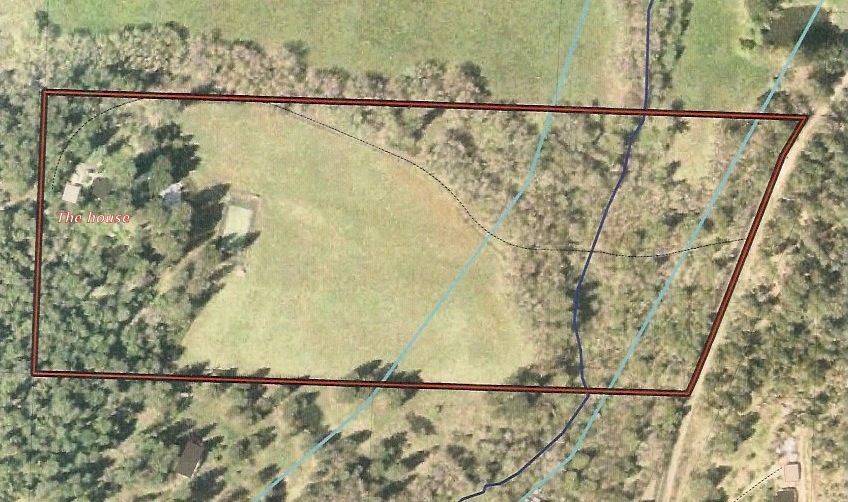
Thirteen acres orientated West-East.

Plus, as the property boundary shown on the above picture confirms, about 50% of our acreage is no longer wilderness.

Ergo, it is impossible for humans to live on this planet without there being consequences that conflict with the natural order of the wild.

But homes to live in are one thing. A planned madness for the Lake District in Northern England is another thing altogether.

Read this latest essay from George Monbiot, republished with Mr. Monbiot’s kind permission.

ooOOoo

Fell Purpose

The attempt to turn the Lake District into a World Heritage site would be a disaster

By George Monbiot, published in the Guardian 9th May 2017

If this bid for power succeeds, the consequences for Britain will be irreversible. It will privilege special interests over the public good, shut out the voices of opposition and damage the fabric of the nation, perhaps indefinitely. No, I’m not writing about the election.

In the next few weeks Unesco, the UN’s cultural organisation, will decide whether or not to grant World Heritage status to the Lake District. Once the decision is made, it is effectively irreversible.

Shouldn’t we be proud that this grand scenery, that plays such a prominent role in our perceptions of nationhood, will achieve official global recognition? On the contrary, we should raise our voices against it. World Heritage status would lock the Lake District into its current, shocking state, ensuring that recovery becomes almost impossible.

Stand back from the fells and valleys and try to judge this vista as you would a landscape in any other part of the world. What you will see is the great damage farming has inflicted: wet deserts grazed down to turf and rock; erosion gullies from which piles of stones spill; woods in which no new trees have grown for 80 years, as every seedling has been nibbled out by sheep; dredged and canalised rivers, empty of wildlife and dangerous to the people living downstream; tracts of bare mountainside on which every spring is a silent one. Anyone with ecological knowledge should recoil from this scene.

This photo was used as the frontispiece of the “State of Conservation” section of the bid documents. It is meant to show how beautiful the fells are. If we saw it anywhere else, we would recognise it as an environmental disaster.

The documents supporting the bid for world heritage status are lavishly illustrated with photos, that inadvertently reveal what has happened to the national park. But this slow-burning disaster goes almost unmentioned in the text. On the contrary, the bid repeatedly claims that the park is in “good physical condition”, and that the relationship between grazing and wildlife is “harmonious”. Only on page 535, buried in a table, is the reality acknowledged: 75% of the sites that are meant to be protected for nature are in “unfavourable condition”.

This is another photo from the bid document, showing St John’s Beck in Thirlmere. The beck is notorious for its flashy response to rainfall – rising dangerously fast. It’s not hard to see why. As the photo shows, it has been dredged and canalised on behalf of the farmers in the valley, and now contains almost no natural features that can slow the flow.

This great national property has degenerated into a sheepwrecked wasteland. And the national park partnership, that submitted the bid, wants to keep it this way: this is the explicit purpose of its attempt to achieve world heritage status. It wants to preserve the Lake District as a “cultural landscape”. But whose culture? Whose landscape? There are only 1080 remaining farms in the district. Should the entire national park be managed for their benefit? If so, why? The question isn’t raised, let alone answered.

I can see the value and beauty of the traditional shepherding culture in the Lake District. I can also see that the farming there, reliant on subsidies, quad bikes and steel barns, now bears little relationship to traditional practice. As the size of landholdings has increased, it looks ever more like ranching and ever less like the old system the bid describes. The bid’s claim that farming there is “wholly authentic in terms of … its traditions, techniques and management systems” is neither intelligible nor true. Remnants of the old shepherding culture tend to be represented ceremonially, as its customs are mostly disconnected from the farm economy.

Shepherding is not the only cultural legacy in play. The other is that the Lake District is the birthplace of the modern conservation movement. Inspired by the Picturesque and Romantic movements, much of our environmental ethic and the groups representing it, such as the National Trust, originated here. Attempts to preserve natural beauty in the district began in the mid-18th century, with complaints against the felling of trees around Derwent Water. Today, the national park cares so little for this legacy that, as the bid admits, “there are no data available” on the condition of the Lake District’s woodlands.

The small group favoured by this bid sees environmental protection as anathema. Farmers’ organisations in the Lake District have fought tooth and nail against conservation measures. They revile the National Trust and the RSPB, whose mild efforts to protect the land from overgrazing are, with the help of a lazy and compliant media, treated like bubonic plague. As one of these farming groups exults, world heritage status “gives us a powerful weapon” that they can wield against those who seek to limit their impacts. If the plan is approved, this world heritage site would be a 230,000-hectare monument to overgrazing and ecological destruction.

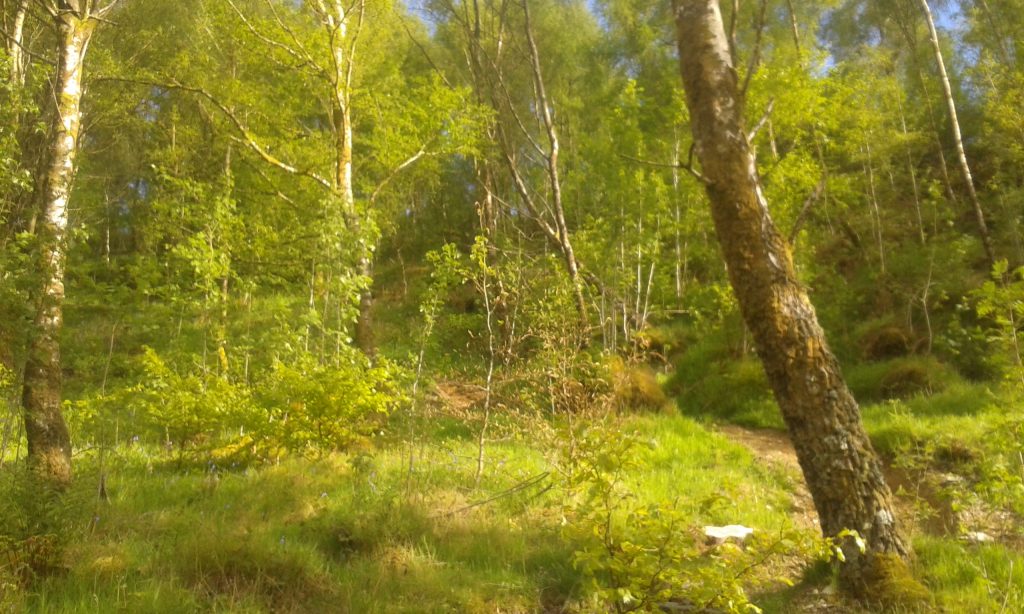
30 years ago, this was a bare sheep pasture (with a couple of seeding birch trees). This is a photo I took (with my failing phone) on a hill elsewhere in Britain. It gives an idea of what parts of the Lake District fells could look like if they were allowed to recover.

This is not the only sense in which the bid is unsustainable. Nowhere in its 700 pages is Brexit mentioned. It was obviously written before the referendum, and has not been updated. Yet the entire vision relies, as the bid admits, on the economic viability of the farming system, which depends in turn on subsidies from the European Union.

Without these payments, there would be no sheep farming in the Lake District: it operates at a major loss. European subsidies counteract this loss, delivering an average net farm income of £9,600. Unsurprisingly, people are leaving the industry in droves: the number of farms in the national park is declining by 2% a year. And this is before the payments cease.

What is the national park partnership, that prepared this bid, going to do – march people onto the fells at gunpoint and demand they continue farming? Or does it hope that the government, amid the massacre of public investment that will follow Brexit, will not only match but exceed the £3bn of public money currently being passed to UK farmers by the European Union? Your guess is as good as mine. This omission alone should disqualify the bid.

The failure to mention this fatal issue looks to me like one of many attempts to pull the Herdwick wool over Unesco’s eyes. The entire bid is based on a fairy tale, a pretence that the rural economy of the Lake District hasn’t changed for 200 years. If Unesco grants world heritage status on these grounds, it will inflict irreparable harm on both our natural heritage and its own good standing.

The hills, whose clothes so many profess to admire, are naked. The narrative we are being asked to support is false. The attempt to ensure that the ecological disaster zone we call the Lake District National Park can never recover from its sheepwrecking is one long exercise in woolly thinking.

http://www.monbiot.com

ooOOoo

When one reads this one is left with a feeling of great sadness. A sadness that our ‘movers and shakers’ can’t resist the urge to meddle. Can’t understand the beauty that is found in nature in the raw.

Earlier on I illustrated how our own property has ‘interfered’ with the wilderness of this most beautiful Oregonian countryside. But as I hope to show you with the following photographs taken on our property back in 2014 that wild beauty can be hung on to in some measure.

Looking upstream along Bummer Creek from the driveway bridge.

oooo

Looking farther downstream from the bridge.

oooo

Pharaoh also appreciating the wild.

Finally, back to that Unesco proposition.

The details may be found on the Unesco site here: http://whc.unesco.org/en/tentativelists/5673/

I have sent a message to Unesco asking if the views of the public are being taken into account and, if so, how those views are to be communicated to Unesco. If you wish to contact them then the details are on this page: http://whc.unesco.org/en/world-heritage-centre/

Any replies from Unesco will be posted here.

UPDATE 0815 PDT May 22nd.

My email yesterday to Unesco was ‘bounced back’ as an invalid email address (despite me using the email address on the Unesco website!!).

But following George Monbiot’s reply to me, giving me the name of James Bridge (jbridge@unesco.org.uk) at Unesco, I have now sent Mr. Bridge the following email:

Dear Mr. Bridge,

I write as a British citizen, born a Londoner in 1944, to protest in the strongest possible terms to the proposal to turn the English Lake District into a World Heritage Site. This is your Tentative List reference http://whc.unesco.org/en/tentativelists/5673/.

Would you please provide me with the details of where or whom within Unesco I can write setting out in detail my objections to this proposal?

Your soonest reply would be very much appreciated.

Sincerely,

Paul Handover

I won’t hold my breath over getting a quick reply.

Economic marginalisation.

For those looking for answers to the crisis in liberal democracy, this may well be it.

In yesterday’s post Tensions abound in many societies I offered a viewpoint that the ‘left’ arguing with the ‘right’ in politics was utterly inappropriate. Simply for we, as in the people who live on this planet, have to start working together if we wish to have a future for mankind on Planet Earth.

Yesterday’s post also referred to Inductive and Deductive Reasoning with me proposing that the future had to be built on a universally acknowledged relationship between ’cause’ and ‘effect’. A relationship that was built on a clear axiom, or theorem; as we see all around us in both the physical and natural worlds.

This idea does take a little time to filter through and I would be the first to say that I had to spend quite a while reflecting on the idea to fully understand the difference, the power, of deductive reasoning. Plus how something that was a behaviourial ‘law’ could be seen as much as an axiom as is, for example, the calculation of the speed of light, or the relationship of gravity to mass.

So returning to economics.

Quite recently there was an essay published on The Conversation blogsite written by Professor Andrew Cumbers of the University of Glasgow.

His thesis is that there is a direct relationship between “… about how well dispersed economic decision-making power is and how much control and financial security people have over their lives.

That relationship is the core message of his essay.

In other words, as I see it, there is an axiom, a theorem, that governs the relationship between the leadership process of a country and the degree to which that country’s society could be classed as a democratic society.

Here is Professor Cumbers’s essay as published by The Conversation blogsite and republished here within the terms of The Conversation.

ooOOoo

New index of economic marginalisation helps explain Trump, Brexit and alt.right

January 12, 2017 10.03am EST

Author:

image-20170111-4585-12s1o8d
“My fellow disenfranchised Americans …” EPA

If 2016 brought Brexit, Donald Trump and a backlash against cosmopolitan visions of globalisation and society, the great fear for 2017 is further shocks from right-wing populists like Geert Wilders in Holland and Marine Le Pen in France. A new mood of intolerance, xenophobia and protectionist economics seems to be in the air.

In a world of zero-hour contracts, Uber, Deliveroo and the gig economy, access to decent work and a sustainable family income remains the main fault line between the winners and losers from globalisation. Drill into the voter data behind Brexit and Trump and they have much to do with economically marginalised voters in old industrial areas, from South Wales to Nord-Pas-de-Calais, from Tyneside to Ohio and Michigan.

These voters’ economic concerns about industrial closures, immigrants and businesses decamping to low-wage countries seemed ignored by a liberal elite espousing free trade, flexible labour and deregulation. They turned instead to populist “outsiders” with simplistic yet ultimately flawed political and economic narratives.

Much has been said about the crisis of liberal political democracy, but these trends look inextricably linked with what is sometimes referred to as economic democracy. This is about how well dispersed economic decision-making power is and how much control and financial security people have over their lives. I’ve been involved in a project to look at how this compares between different countries. The results say much about the point we have reached, and where we might be heading in future.

The index

Our economic democracy index looked at 32 countries in the OECD (omitting Turkey and Mexico, which had too much missing data). While economic democracy tends to focus on levels of trade union influence and the extent of cooperative ownership in a country, we wanted to take in other relevant factors.

We added three additional indicators: “workplace and employment rights”; “distribution of economic decision-making powers”, including everything from the strength of the financial sector to the extent to which tax powers are centralised; and “transparency and democratic engagement in macroeconomic decision-making”, which takes in corruption, accountability, central bank transparency and different social partners’ involvement in shaping policy.

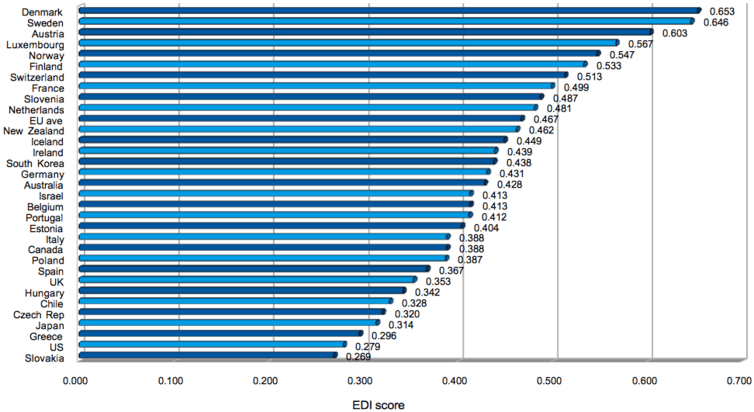
What is striking is the basic difference between a more “social” model of northern European capitalism and the more market-driven Anglo-American model. Hence the Scandinavian countries score among the best, with their higher levels of social protection, employment rights and democratic participation in economic decision-making. The reverse is true of the more deregulated, concentrated and less democratic economies of the English-speaking world. The US ranks particularly low, with only Slovakia below it. The UK too is only 25th out of 32.

 Economic Democracy Index, figures from 2013. Andrew Cumbers
Economic Democracy Index, figures from 2013. Andrew Cumbers

Interestingly, France ranks relatively highly. This reflects its strong levels of job protection and employee involvement in corporate decision-making – the fact that the far right has been strong in France for a number of years indicates its popularity stems from race at least as much as economics.

Yet leading mainstream presidential candidates François Fillon and Emmanuel Macron are committed to reducing France’s protections. These are often blamed – without much real evidence – for the country’s sluggish job creation record. There is a clear danger both here and in the Netherlands that a continuing commitment to such neoliberal labour market policies might push working class voters further towards Le Pen and Wilders.

One other notable disparity in the index is between the scores of Austria and Germany, despite their relatively similar economic governance. Germany’s lower ranking reflects the growth of labour market insecurity and lower levels of job protection, particularly for part-time workers as part of the Hartz IV labour market reforms in the 1990s that followed reunification.

The index also highlights the comparatively poor levels of economic democracy in the “transition” economies of eastern Europe. The one very interesting exception is Slovenia, which merits further study. It might reflect both its relatively stable transition from communism and the civil war in the former Yugoslavia, and the continuing presence of active civil society elements in the trade union and cooperative movements. Southern European economies also tend to rank below northern European countries, as does Japan.

Poverty and inequality

The index provides strong evidence that xenophobic politics may be linked to changing levels of economic participation and empowerment – notwithstanding the French data. We found that the greater the poverty and inequality in a country, the lower the rates of economic democracy.

These findings suggest, for example, that the Anglo-American-led attack on trade unions and flexible labour policies may actually drive up poverty and inequality by cutting welfare benefits and driving up individual employment insecurity. While the OECD itself advocated these policies until recently, countries with high levels of economic democracy such as Norway, Denmark and Iceland have much lower levels of poverty than countries such as the US and UK.

 Far right activists in Budapest, Hungary, February 2016. EPA
Far right activists in Budapest, Hungary, February 2016. EPA

Far-right populism is on the march everywhere, including the Nordic countries. But Brexit, Trump and the more serious shift to the far right in Eastern Europe have been accompanied by diminishing economic security and rights at work, disenfranchised trade unions and cooperatives, and economic decision-making concentrated among financial, political and corporate elites.

We will monitor these scores in future to see what happens over time. It will be interesting to see how the correlations between economic democracy, poverty and voting patterns develop in the coming years. For those looking for answers to the crisis in liberal democracy, this may well be it.

ooOOoo

 I shall be writing to Professor Cumbers asking if my analysis of that relationship is supported by his research.

For if it is then we do have a very clear axiom that few would disagree with. That is the political consensus this world needs now.

Oh, and we will be back to dogs tomorrow! 😉

Private power.

The power of corporations must never be permitted to override democratic choice.

The main thrust in yesterday’s post was a plea by , Lecturer on Anthropology, University of Colorado, Denver for our natural lands to be given the legal status of a person. Here’s how Prof. Colwell concluded his essay (my emphasis):

In New Zealand, the Te Urewera Act offers a higher level of protection, empowering a board to be the land’s guardian. The Te Urewera Act, though, does not remove its connection to humans. With a permit, people can hunt, fish, farm and more. The public still has access to the forest. One section of the law even allows Te Urewera to be mined.

Te Urewera teaches us that acknowledging cultural views of places as living does not mean ending the relationship between humans and nature, but reordering it – recognizing nature’s intrinsic worth and respecting indigenous philosophies.

In the U.S. and elsewhere, I believe we can do better to align our legal system with the cultural expressions of the people it serves. For instance, the U.S. Congress could amend the NHPA or the American Indian Religious Freedom Act to acknowledge the deep cultural connection between tribes and natural places, and afford better protections for sacred landscapes like New Mexico’s Mount Taylor.

Until then, it says much about us when companies are considered people before nature is.

Chip Colwell was alerting us, as in humanity, that our natural resources are way, way too important for them to be considered corporate assets.

The days between a Christmas Day and a New Year’s Day are frequently a time for introspection; well they are for me! A few days to reflect on what did or did not work in the year just coming to an end and to find some clarity about the important issues for the new year.

That mood of introspection, of reflection, seems to be creeping into my blog posts this last week of 2016. For following Chip Colwell comes George Monbiot and an essay he published on the 6th December, 2016, that is republished here with Mr. Monbiot’s very kind permission.

Regarding the power of corporations there are strong echoes between Prof. Colwell and Mr. Monbiot.

ooOOoo

The Golden Arches Theory of Decline

Why is there a worldwide revolt against politics as usual? Because corporate globalisation has crushed democratic choice.

By George Monbiot, published in the Guardian, 6th December 2016

A wave of revulsion rolls around the world. Approval ratings for incumbent leaders are everywhere collapsing. Symbols, slogans and sensation trump facts and nuanced argument. One in six Americans now believes that military rule would be a good idea. From all this I draw the following, peculiar conclusion: no country with a McDonald’s can remain a democracy.

Twenty years ago, the New York Times columnist Thomas Friedman proposed his “golden arches theory of conflict prevention”. This holds that “no two countries that both have McDonald’s have ever fought a war against each other since they each got their McDonald’s”.

Friedman’s was one of several end-of-history narratives suggesting that global capitalism would lead to permanent peace. He claimed that it might create “a tip-over point at which a country, by integrating with the global economy, opening itself up to foreign investment and empowering its consumers, permanently restricts its capacity for troublemaking and promotes gradual democratization and widening peace.” He didn’t mean that McDonald’s ends war, but that its arrival in a nation symbolised the transition.

In using McDonalds as shorthand for the forces tearing democracy apart, I am, like him, writing figuratively. I do not mean that the presence of the burger chain itself is the cause of the decline of open, democratic societies (though it has played its part in Britain, using our defamation laws against its critics). Nor do I mean that countries hosting McDonald’s will necessarily mutate into dictatorships.

What I mean is that, under the onslaught of the placeless, transnational capital McDonald’s exemplifies, democracy as a living system withers and dies. The old forms and forums still exist – parliaments and congresses remain standing – but the power they once contained seeps away, re-emerging where we can no longer reach it.

The political power that should belong to us has flitted into confidential meetings with the lobbyists and donors who establish the limits of debate and action. It has slipped into the dictats of the IMF and the European Central Bank, which respond not to the people but to the financial sector. It has been transported, under armed guard, into the icy fastness of Davos, where Mr Friedman finds himself so warmly welcomed (even when he’s talking cobblers).

Above all, the power that should belong to the people is being crushed by international treaty. Contracts such as NAFTA, CETA, the proposed TransPacific Partnership and Trade in Services Agreement and the failed Transatlantic Trade and Investment Partnership are crafted behind closed doors in discussions dominated by corporate lobbyists. They are able to slip in clauses that no informed electorate would ever approve, such as the establishment of opaque offshore tribunals, through which corporations can bypass national courts, challenge national laws and demand compensation for the results of democratic decisions.

These treaties limit the scope of politics, prevent states from changing social outcomes and drive down labour rights, consumer protection, financial regulation and the quality of neighbourhoods. They make a mockery of sovereignty. Anyone who forgets that striking them down was one of Donald Trump’s main promises will fail to understand why people were prepared to risk so much in electing him.

At the national level too, the McDonalds model destroys meaningful democracy. Democracy depends on a reciprocal sense of belief, trust and belonging: the conviction that you belong to the nation and the nation belongs to you. The McDonalds model, by rooting out attachment, could not have been better designed to erase that perception.

As Tom Wolfe observes in his novel A Man in Full, “the only way you could tell you were leaving one community and entering another was when the franchise chains started repeating and you spotted another 7-Eleven, another Wendy’s, another Costco, another Home Depot.” The alienation and anomie this destruction of place promotes are enhanced by the casualisation of labour and a spirit-crushing regime of monitoring, quantification and assessment (at which McDonald’s happens to excel). Public health disasters contribute to the sense of rupture. After falling for decades, for example, death rates among middle-aged white Americans are now rising. Among the likely causes are obesity and diabetes, opioid addiction and liver failure, diseases whose vectors are corporations.

Corporations, released from democratic constraints, drive us towards climate breakdown, an urgent threat to global peace. McDonald’s has done more than its fair share: beef production is among the most powerful causes of climate change.

In his book The Globalisation Paradox, the Harvard economist Dani Rodrik describes a political trilemma. Democracy, national sovereignty and hyperglobalisation, he argues, are mutually incompatible. You cannot have all three at once. McDonalisation crowds out domestic politics. Incoherent and dangerous as it often is, the global backlash against mainstream politicians is, at heart, an attempt to reassert national sovereignty against the forces of undemocratic globalisation.

An article about the history of the Democratic party by Matt Stoller in The Atlantic reminds us that a similar choice was articulated by the great American jurist Louis Brandeis. “We may have democracy, or we may have wealth concentrated in the hands of a few, but we can’t have both.” In 1936, the congressman Wright Patman managed to pass a bill against the concentration of corporate power. Among his targets was A&P, the giant chainstore of his day, that was hollowing out towns, destroying local retailers and turning “independent tradesmen into clerks”.

In 1938, President Roosevelt warned that “the liberty of a democracy is not safe if the people tolerate the growth of private power to a point where it becomes stronger than their democratic state itself. That, in its essence, is fascism.” The Democrats saw concentrated corporate power as a form of dictatorship. They broke up giant banks and businesses and chained the chainstores. What Roosevelt, Brandeis and Patman knew has been forgotten by those in power, including powerful journalists. But not by the victims of this system.

One of the answers to Trump, Putin, Orban, Erdogan, Salvini, Duterte, Le Pen, Farage and the politics they represent is to rescue democracy from transnational corporations. It is to defend the crucial political unit that’s under assault by banks, monopolies and chainstores: community. It is to recognise that there is no greater hazard to peace between nations than a corporate model which crushes democratic choice.

http://www.monbiot.com

ooOOoo

It’s very easy to pick out from Mr. Monbiot’s essay what the theme should be for 2017, and beyond. What each and every one of us who cares about the future and understands the huge changes that have to take place if our grandchildren are to have a viable future.

It was that compelling quotation by Louis Brandeis:

We may have democracy, or we may have wealth concentrated in the hands of a few, but we can’t have both.

It’s as simple as that!

We live in interesting times!

The impending ‘banquet of consequences’.

The Welcome page of this blog includes this:

Dogs ‘teaching’ man to be so successful a hunter enabled evolution, some 20,000 years later, to farming,  thence the long journey to modern man.  But in the last, say 100 years, that farming spirit has become corrupted to the point where we see the planet’s plant and mineral resources as infinite.  Mankind is close to the edge of extinction, literally and spiritually.

I continue that theme in Part Two of my book (Chapter 7: This Twenty-First Century)

Bad news sells! Bad news also causes stress and worry. In my previous explanation, I explained that the last thing you want is a catalogue of all the things that have that power to cause you stress and worry. However, I do see three fundamental aspects of this new century that have their roots in that loss of principles that I referred to in the previous chapter. They are

1. the global financial system,
2. the potential for social disorder, and
3. the process of government.

Because they are at the heart of how the coming years will pan out.

The first aspect, our global financial system, was selected because it underpins all our lives in so many ways. When I was living in southwest England I was a client of Kauders Portfolio Services[1]. The founder of the company, David Kauders, published[2] a book, The Greatest Crash, in 2011. It was an obvious read for me at that time and I still have the book on my shelves here in Oregon.
David explained that whether we like it or not, our lives are inextricably caught up in the twin dependencies of the global financial system: credit and debt. As he wrote in his opening chapter:

Households can barely afford their existing debts, let alone take on more. Since households now prefer not to borrow, indeed some even choose to pay back debt, it follows that those who have already borrowed, as a group, can no longer contribute to economic expansion.
People can be divided into borrowers and savers. With existing borrowers unable to afford or unwilling to take on extra debt, can new borrowers be found instead? Those who do not need to borrow are unlikely to volunteer. Except for the young wishing to buy houses, facing the reality that house prices are beyond their pockets, where are the new borrowers?
Businesses are also under pressure. There has been an inadequate recovery from recession, business prospects are poor as households cut back their spending. Lack of bank lending is a symptom rather than a cause, for if existing businesses were to be given more credit, they would probably be unlikely to find profitable growth opportunities in a world of austerity.

Later on in the book David describes this as “the financial system limit”. In other words, the period of growth and expansion, especially of financial and economic expansion, has come to an end in a structural sense. This was his perspective from 2011.

Recently, I chose to reread The Greatest Crash. What struck me forcibly, reading the book again some four years later on, was how visible this “system limit” appeared in the world today. Everywhere there are signs that the era of growth has come to an end. Many countries are now indebted to a point that reinforces the proposition of there being a financial system limit. The United States is greatly in debt[3] but the only thing mitigating that situation, for the time being anyway, is that the American dollar is the quasi dominant global currency.
The changing nature of the global population is also reinforcing the fact that this is the end of a long period of growth. Even without embracing the question of how much longer we can increase the number of people living on a finite planet, the demographics spell out a greater-than-even chance of a decline in consumption and economic activity. Simply because in all regions of the planet, except for India where there is still a growing youth element in the country, people are ageing. To state the obvious, ageing persons do not consume as much as middle-aged and younger persons.
Thus, the world’s economy that is just around the corner is certainly going to be very different to what it has been in the past. It is not being widely discussed. Worse than that, there is a widespread assumption adopted by many governments that a return to the “normal” economic growth of previous times is a given. Many do not share that assumption.

The second aspect that isn’t being spoken about is the potential for massive, widespread social disorder. All summed up in just three words: greed, inequality, and poverty. Just three words that metaphorically appear to me like a round, wooden lid hiding a very deep, dark well. That lifting this particular lid, the metaphorical one, exposes an almost endless drop into the depths of where our society appears to have fallen.
Even the slightest raising of awareness of where this modern global world is heading is scary. I have in mind the author Thomas Piketty who warned[4] that, “the inequality gap is toxic, dangerous.” Then there was the news in 2015[5] that, “Billionaires control the vast majority of the world’s wealth, 67 billionaires already own half the world’s assets; by 2100 we’ll have 11 trillionaires, while American worker income has stagnated for a generation.”

The third and final aspect that isn’t being widely discussed is the process of government. Not from the viewpoint of “left” or “right”, Labour or Conservative, Democratic or Republican (insert the labels appropriate to your own country), that is being discussed ad nauseum, but from the viewpoint of good government. It might be a terrible generalisation but it is still a fair criticism to say that many peoples of many countries have lost faith in their governments.
There appears to be a chronic absence of open debate about the need for good government, what that good government would look like, and how do societies bring it about.

If we were a dog pack, then our leader, our female mentor dog, would have moved us all to a new, pristine territory!


[1] My relationship was terminated when I became a resident of the United Staes in 2011.
[2] 2011, Sparkling Books.
[3] http://www.usgovernmentdebt.us offers on the 14th November, 2014 that the Federal Debt of the United States was about $18,006,100,032,000.
[4] In his book Capital in the Twenty-First Century (Belknap Press, 2014).
[5] http://www.marketwatch.com/story/capitalism-is-killing-americas-morals-our-future-2015-05-22.

Yes, these are indeed very interesting times!

So, dear reader, you can understand why a recent article over on Naked Capitalism spoke to me. It was penned by Satyajit Das, a former banker and the author of a number of books. Both Satyajit and Yves, of Naked Capitalism, were delighted to offer me permission to republish the full post.

ooOOoo

Satyajit Das: Age of Stagnation or Something Worse?

Yves here. If you’ve read Das regularly, one of the characteristics of his writing is wry detachment. The shift to a sense of foreboding is a big departure.

By Satyajit Das, a former banker and author whose latest book, The Age of Stagnation, is now available. The following is an edited excerpt from Age of Stagnation (published with the permission of Prometheus Books)

If you look for truth, you may find comfort in the end; if you look for comfort you will not get either comfort or truth, only . . . wishful thinking to begin, and in the end, despair. C.S. Lewis

The world is entering a period of stagnation, the new mediocre. The end of growth and fragile, volatile economic conditions are now the sometimes silent background to all social and political debates. For individuals, this is about the destruction of human hopes and dreams.

One Offs

For most of human history, as Thomas Hobbes recognised, life has been ‘solitary, poor, nasty, brutish, and short’. The fortunate coincidence of factors that drove the unprecedented improvement in living standards following the Industrial Revolution, and especially in the period after World War II, may have been unique, an historical aberration. Now, different influences threaten to halt further increases, and even reverse the gains.

Since the early 1980s, economic activity and growth have been increasingly driven by financialisation – the replacement of industrial activity with financial trading and increased levels of borrowing to finance consumption and investment. By 2007, US$5 of new debt was necessary to create an additional US$1 of American economic activity, a fivefold increase from the 1950s. Debt levels had risen beyond the repayment capacity of borrowers, triggering the 2008 crisis and the Great Recession that followed. But the world shows little sign of shaking off its addiction to borrowing. Ever-increasing amounts of debt now act as a brake on growth.

Growth in international trade and capital flows is slowing. Emerging markets that have benefited from and, in recent times, supported growth are slowing.

Rising inequality and economic exclusion also impacts negatively upon activity.

Financial problems are compounded by lower population growth and ageing populations; slower increases in productivity and innovation; looming shortages of critical resources, such as water, food and energy; and manmade climate change and extreme weather conditions.

The world requires an additional 64 billion cubic metres of water a year, equivalent to the annual water flow through Germany’s Rhine River. Agronomists estimate that production will need to increase by 60–100 percent by 2050 to feed the population of the world. While the world’s supply of energy will not be exhausted any time soon, the human race is on track to exhaust the energy content of hundreds of millions years’ worth of sunlight stored in the form of coal, oil and natural gas in a few hundred years. 10 tons of pre-historic buried plant and organic matter converted by pressure and heat over millennia was needed to create a single gallon (4.5 litres) of gasoline.

Europe is currently struggling to deal with a few million refugees fleeing conflicts in the Middle East. How will the world deal with hundreds of millions of people at risk of displacement as a resulting of rising sea levels?

Extend and Pretend

The official response to the 2008 crisis was a policy of ‘extend and pretend’, whereby authorities chose to ignore the underlying problem, cover it up, or devise deferral strategies to ‘kick the can down the road’. The assumption was that government spending, lower interest rates, and the supply of liquidity or cash to money markets would create growth. It would also increase inflation to help reduce the level of debt, by decreasing its value.

It was the grifter’s long con, a confidence trick with a potentially large payoff but difficult to pull off. Houses prices and stock markets have risen, but growth, employment, income and investment have barely recovered to pre-crisis levels in most advanced economies. Inflation for the most part remains stubbornly low.

In countries that have ‘recovered’, financial markets are, in many cases, at or above pre-crisis prices. But conditions in the real economy have not returned to normal. Must-have latest electronic gadgets cannot obscure the fact that living standards for most people are stagnant. Job insecurity has risen. Wages are static, where they are not falling. Accepted perquisites of life in developed countries, such as education, houses, health services, aged care, savings and retirement, are increasingly unattainable.

In more severely affected countries, conditions are worse. Despite talk of a return to growth, the Greek economy has shrunk by a quarter. Spending by Greeks has fallen by 40 percent, reflecting reduced wages and pensions. Reported unemployment is 26 percent of the labour force. Youth unemployment is over 50 percent. One commentator observed that the government could save money on education, as it was unnecessary to prepare people for jobs that did not exist.

Future generations may have fewer opportunities and lower living standards than their parents. A 2013 Pew Research Centre survey conducted in thirty-nine countries asked whether people believed that their children would enjoy better living standards: 33 percent of Americans believed so, as did 28 percent of Germans, 17 percent of British and 14 percent of Italians. Just 9 percent of French people thought their children would be better off than previous generations.

The Deadly Cure

Authorities have been increasingly forced to resort to untested policies including QE forever and negative interest rates. It was an attempt to buy time, to let economies achieve a self-sustaining recovery, as they had done before. Unfortunately the policies have not succeeded. The expensively purchased time has been wasted. The necessary changes have not been made.

There are toxic side effects. Global debt has increased, not decreased, in response to low rates and government spending. Banks, considered dangerously large after the events of 2008, have increased in size and market power since then. In the US the six largest banks now control nearly 70 percent of all the assets in the US financial system, having increased their share by around 40 percent.

Individual countries have sought to export their troubles, abandoning international cooperation for beggar-thy-neighbour strategies. Destructive retaliation, in the form of tit-for-tat interest rate cuts, currency wars, and restrictions on trade, limits the ability of any nation to gain a decisive advantage.

The policies have also set the stage for a new financial crisis. Easy money has artificially boosted prices of financial assets beyond their real value. A significant amount of this capital has flowed into and destabilised emerging markets. Addicted to government and central bank support, the world economy may not be able to survive without low rates and excessive liquidity.

Authorities increasingly find themselves trapped, with little room for manoeuvre and unable to discontinue support for the economy. Central bankers know, even if they are unwilling to publicly acknowledge it, that their tools are inadequate or exhausted, now possessing the potency of shamanic rain dances. More than two decades of trying similar measures in Japan highlight their ineffectiveness in avoiding stagnation.

Heart of the Matter

Conscious that the social compact requires growth and prosperity, politicians, irrespective of ideology, are unwilling to openly discuss the real issues. They claim crisis fatigue, arguing that the problems are too far into the future to require immediate action. Fearing electoral oblivion, they have succumbed to populist demands for faux certainty and placebo policies. But in so doing they are merely piling up the problems.

Policymakers interrogate their models and torture data, failing to grasp that ‘many of the things you can count don’t count [while] many of the things you can’t count really count’. The possibility of a historical shift does not inform current thinking.

It is not in the interest of bankers and financial advisers to tell their clients about the real outlook. Bad news is bad for business. The media and commentariat, for the most part, accentuate the positive. Facts, they argue, are too depressing. The priority is to maintain the appearance of normality, to engender confidence.

Ordinary people refuse to acknowledge that maybe you cannot have it all. But there is increasingly a visceral unease about the present and a fear of the future. Everyone senses that the ultimate cost of the inevitable adjustments will be large. It is not simply the threat of economic hardship; it is fear of a loss of dignity and pride. It is a pervasive sense of powerlessness.

For the moment, the world hopes for the best of times but is afraid of the worst. People everywhere resemble Dory, the Royal Blue Tang fish in the animated film Finding Nemo. Suffering from short-term memory loss, she just tells herself to keep on swimming. Her direction is entirely random and without purpose.

Reckoning Postponed

The world has postponed, indefinitely, dealing decisively with the challenges, choosing instead to risk stagnation or collapse. But reality cannot be deferred forever. Kicking the can down the road only shifts the responsibility for dealing with it onto others, especially future generations.

A slow, controlled correction of the financial, economic, resource and environmental excesses now would be serious but manageable. If changes are not made, then the forced correction will be dramatic and violent, with unknown consequences.

During the last half-century each successive economic crisis has increased in severity, requiring progressively larger measures to ameliorate its effects. Over time, the policies have distorted the economy. The effectiveness of instruments has diminished. With public finances weakened and interest rates at historic lows, there is now little room for manoeuvre. Geo-political risks have risen. Trust and faith in institutions and policy makers has weakened.

Economic problems are feeding social and political discontent, opening the way for extremism. In the Great Depression the fear and disaffection of ordinary people who had lost their jobs and savings gave rise to fascism. Writing of the period, historian A.J.P. Taylor noted: ‘[the] middle class, everywhere the pillar of stability and respectability . . . was now utterly destroyed . . . they became resentful . . . violent and irresponsible . . . ready to follow the first demagogic saviour . . .’

The new crisis that is now approaching or may already be with us will be like a virulent infection attacking a body whose immune system is already compromised.

As Robert Louis Stevenson knew, sooner or later we all have to sit down to a banquet of consequences.

ooOOoo

henrifredericamiel148210Very interesting times indeed!