A new animated short film from Lucas Martell, the creator of Pigeon: Impossible.
Back on the 4th December, 2011 I published a post under the title of Pigeon: Impossible. Here’s some of what I wrote:
A truly remarkable example of the level of film animation being produced.
The second item that came to me from Bob D. (yesterday’s is here) has clearly done the rounds; the YouTube video has been watched nearly 7 million times! But if you haven’t seen this short film, just over 6 minutes long, then do watch it. It shows just how close to reality film animation has become! The story behind the film is from here, reproduced below.
Pigeon: Impossible is the tale of Walter, a rookie secret agent faced with a problem seldom covered in basic training: what to do when a curious pigeon gets trapped inside your multi-million dollar, government-issued nuclear briefcase.
The film took nearly 5 years to complete and is the first attempt at animation by writer/director Lucas Martell: “When the project started, it was mostly an excuse to learn 3D animation, but by the end of the project I had spent so much time reworking and polishing the story that I just wanted people to laugh.“
The end-result is a hilarious 6-minute romp through the streets of Washington D.C. as our hero fights to save himself, and the world from the chaos reigned down by a hungry pigeon. Breathtaking visuals and a sweeping soundtrack showcase the work of nearly one-hundred talented artists and musicians, and the film stands as a testament to what can be accomplished by a team of dedicated volunteers working for the love of their craft.
Personally, I think that last sentence is still an understatement. Just watch this – and be amazed.
If you haven’t seen the film then you can watch it here.
Anyway, yesterday Lucas Martell left a comment to that post, as follows:
Lucas Martell
Hi, I’m the creator of Pigeon: Impossible and am so glad you enjoyed the film! We’re trying to finish our next animated short, and would love it if you could check it out and help us spread the word.
Thanks!
It seemed a worthwhile thing to do just that. That next animated short is called The OceanMaker. Enjoy 4 minutes of it:
This is the website associated with the venture that explains more and also gives details of the way you can financially support the project, starting from as little as $10. The website is great fun! (I couldn’t resist republishing the following)
oooOOOooo
About the Film
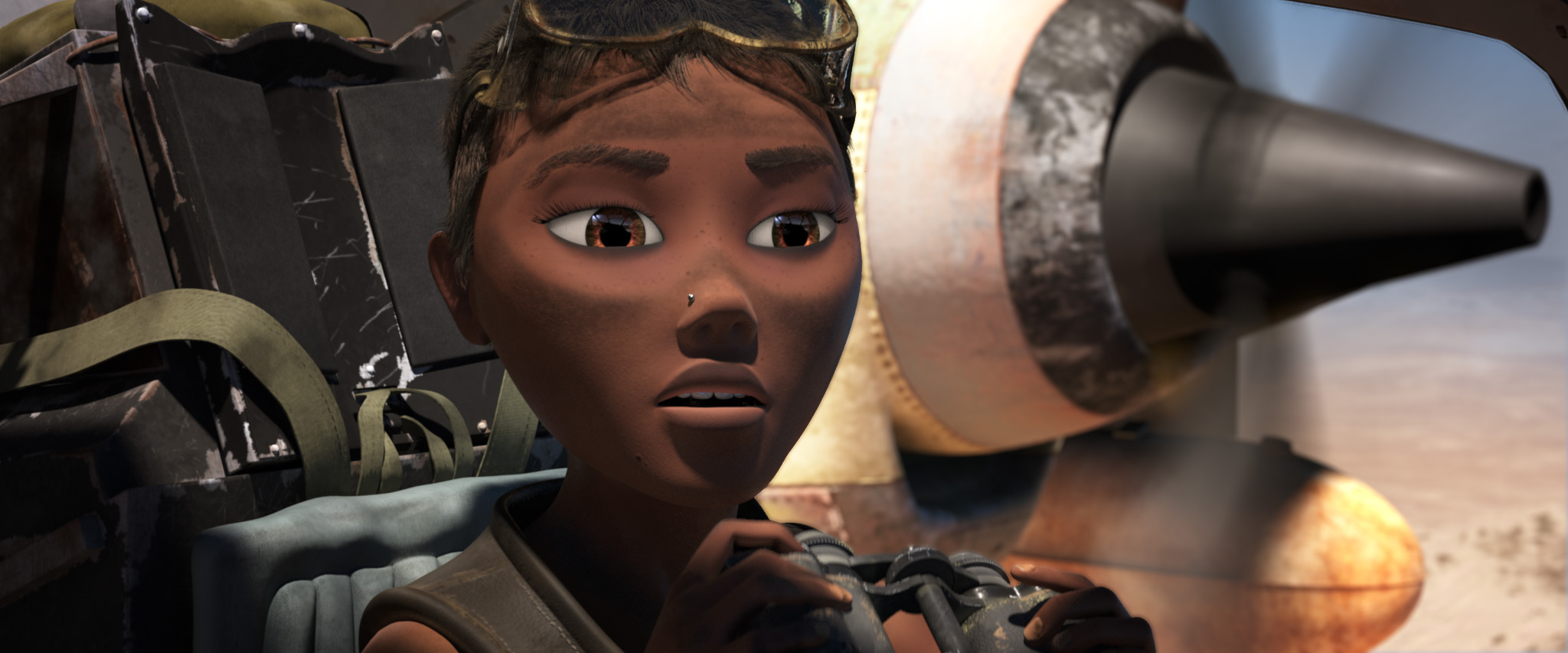
The OceanMaker is a 9-minute animated short film that takes place after Earth’s oceans have disappeared. It tells the tale of one courageous pilot who fights against vicious sky pirates for control of the last remaining source of water: the clouds.
From a visual standpoint, we’re steering away from the air pirates often found in steampunk and going straight-up “Mad Max” in the sky. The film is packed with old, beat-up planes that have been cobbled together from spare parts found in airplane graveyards.
Tonally, The OceanMaker is filled with exciting action, but the ending is emotional and powerful in a way that even feature-length films rarely achieve. The film also contains no dialogue, which means that the visuals and soundtrack need to be top notch in order to tell this story properly.
Finally, this film is unique in that it’s a complete story which stands on its own as a self-contained short film, but it’s also part of a even larger, more epic tale. Contributing to this project means a double dose of good karma, as you’re not only helping us complete the short, you’re getting us one step closer to making the feature! Our sights are set high and it’s going to be an amazing ride. We hope you’ll come along and share the adventure with us!
Goals
$10,000 – We can finish the models! – At the moment we have our hero models finished, but the story requires several other assets in order to set up the world and show how the loss of the oceans has affected life on earth. At $10,000, we’ll be able to bring on two model/texture artists to finish these assets.
$20,000 – We can finish the animation! – Animation is about 70% completed, but the remaining shots are the most challenging ones in the film. We’ll need two animators to bring these awesome shots to life!
$30,000 – We can finish the lighting! – Lighting and rendering are what make things pretty. It’s also a very technically challenging process, with each frame taking about an hour to render. At 24 frames per second, that’s just under 13,000 frames!
$40,000 – We can finish the film! – The last major step is the effects. In a word: clouds. They’re very tough to do right, and they’re pretty important for this whole story to work. Plus, these aren’t just static clouds in the background. We’re flying through them, scooping them up and making them grow!
$50,000 – Post Production! – This first stretch goal would allow us to hire a professional sound designer, as well as doing the final mix, color correction and output in a proper studio. This is crucial in order to submit the film to festivals and put it up on the big screen. If we reach this stretch goal, then all donors will also recieve a PDF copy of the script!
$60,000 – Live orchestra! – With this stretch goal, we could record Chris Reyman’s amazing score with a real live orchestra. This would be HUGE, as the film is extremely reliant on music, and the production value will increase dramatically. All donors at every level would receive a DRM-free copy of the score.
$70,000 – Expanded cast! – One thing that will make the film even better, is a second character. We already have a temporary version of that character in our animatic, but she’s very difficult to create and quite expensive for the few shots she’s in. However, that small addition would take the emotion and complexity of the story to a whole new level.
$80,000 – $100,000 The OceanMaker extended universe – As you can imagine, the OceanMaker is a really BIG story… too big to fit entirely within a short, but we’ve done an excellent job capturing the essence of it in a way that feels complete and stands on its own. However, if we hit $80,000, we can start to explore this broader story. This would be in the form of a graphic novel that delves deeper into the world both before and after the short film. The higher into this range we get, the longer this graphic novel could be and the more of the expanded story we could tell. Donors at every level would get a free digital copy of the graphic novel.
$100,000 and up – Feature!!! – OK, I realize we’re really reaching for the stars here, but you don’t do something like this without being a dreamer. If we somehow manage to reach the 100k mark, we’ll be able to start working on the feature film! It would be based in part on the content from the extended universe. The first step would be a treatment, then a script, then visual development and finally an animatic. Should we be able to complete any of these stages with money raised from this campaign, all donors will receive a digital copy of the completed work. You can take a sneak peek or remain unspoiled, but its the least we can do if your hard-earned dollars end up funding development of the feature.
oooOOOooo
So I hope you can contribute whatever you can afford.
Oh, and I should make it clear that neither Jean nor I have any financial or commercial connection with the project.
Prediction is very difficult, especially if it involves the future. Niels Bohr
I have seen a number of versions of this quotation from Niels Bohr but no matter the inference is clear. My way of putting it is that the future has a habit of observing the law of unintended consequences!
This gentle immersion into today’s muse is on the back of two events. The first was the reading of Guy McPherson’s book, Walking Away from Empire, that I reviewed last week. The second was watching a fascinating presentation about reversing climate change.
Just stay with Guy McPherson for a moment longer. He is of the very firm opinion that we face imminent environmental collapse and the collapse of the industrial economy. His bet is that the environment is already in the grip of ten feedback loops that guarantee making the environment unsustainable for the majority of species on this planet within a couple of decades. If you want more then take a mouse click across the Guy’s blog Nature Bats Last.
So, given that one embraces this prediction, free of the clouds of delusion that it couldn’t possibly come to that, then what? (I’m assuming that you have the basic motivation to get out of bed in the morning!)
(Clifford) Allan Redin Savory (born September 15, 1935) is a Zimbabwean biologist, farmer, soldier, exile, environmentalist, and winner of the 2003 Banksia International Award and the 2010 Buckminster Fuller Challenge. He is the originator of holistic management.
Savory had begun working on the ancient problem of land degradation (desertification) in 1955 in Northern Rhodesia, where he served in the Colonial Service as Provincial Game Officer, Northern and Luapula Provinces. He subsequently continued this work in Southern Rhodesia first as a research officer in the Game Department, then as an independent scientist and international consultant. When in exile, Savory worked from the Cayman Islands into the Americas introducing his new discoveries about both the cause of desertification and how to reverse it using increased numbers of livestock.
He subsequently wrote up this work in the book Holistic Management: A New Decision Making Framework, written with his wife Jody Butterfield and published by Island Press (1989; 1999 2nd edition).
In 1992, he co-founded the Africa Center for Holistic Management with his wife Jody Butterfield and, in 2009, the Savory Institute, headquartered in Boulder, Colorado, which he currently heads. The Savory Institute works globally with individuals, government agencies, NGOs, and corporations to restore the vast grasslands of the world through the teaching and practice of holistic management and decision making.
The institute’s consulting and training activities are turning deserts into thriving grasslands, restoring biodiversity, bringing streams, rivers, and water sources back to life, combating poverty and hunger, and increasing sustainable food production, all mitigating global climate change through carbon sequestration. In 2010, Savory and the Africa Center for Holistic Management won The Buckminster Fuller Challenge.
In a 2012 address to the International Union for Conservation of Nature World Conservation Congress, on the urgent need to bring agriculture and conservation back together, Prince Charles lauded Savory’s nature based approach.
OK, enough from me. Watch Allan Savory’s fascinating and potentially life-saving idea, as presented to the TED2013 conference.
“Why do you get out of bed in the morning, and why should anyone care?”
These words are spoken by Simon Sinek just before the three-minute mark in the video that follows. As Wikipedia explains,
Simon O. Sinek (born October 9, 1973) is an author best known for popularizing a concept of The Golden Circle.
He joined the RAND Corporation in 2010 as an adjunct staff member, where he advises on matters of military innovation and planning. His first TEDx Talk on “How Great Leaders Inspire Action” is the 7th most viewed video on TED.com.
His 2009 book on the same subject, Start With Why: How Great Leaders Inspire Everyone to Take Action (2009) delves into what he says is a naturally occurring pattern, grounded in the biology of human decision-making, that explains why we are inspired by some people, leaders, messages and organizations over others.
He has commented for The New York Times, Wall Street Journal, The Washington Post, Houston Chronicle, FastCompany, CMO Magazine, NPR and BusinessWeek, and is a regular contributor to The Huffington Post, BrandWeek, IncBizNet.
This new year that we are now in is going to require millions of us to think and do differently. As Einstein so famously quoted, “Insanity: doing the same thing over and over again and expecting different results“. More than ever before we need different results and that means thinking and doing differently.
A really clever and innovative idea – the gravity light.
Saw this item on the Australian Permaculture Research website on the 18th.
Lighting in much of the ‘developing’ world is provided via expensive and polluting kerosene. Kerosene lamps are dangerous, require constant replenishment, and come with significant negative health impacts.
So, for the potential benefit of millions of people, London based designers, Martin Riddiford and Jim Reeves, have spent four years working on an inexpensive, safe and health-neutral alternative — a gravity powered LED light! It’s clever, and well intentioned. Nice!
Martin and Jim initially looked at creating a light that would be powered by solar, as would most of us. But the idea of utilising gravity took hold of them — where the end user can do away with the need for expensive solar panels and batteries, which use a lot of resources in their manufacture — and the gravity light was born. The gravity light will work whether it’s day or night, sunny or cloudy.
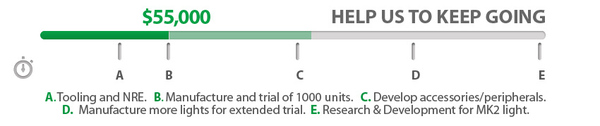
At time of writing, Martin and Jim’s Indiegogo campaign to raise funds has already surpassed its basic goal of $55,000, but if you wish to donate it’ll help them further their goal of refining the design to make it even more useful, efficient and inexpensive.
Then it was only a moment to track down the project on a website called Indiegogo, from which one reads,
GravityLight is a revolutionary new approach to storing energy and creating illumination. It takes only 3 seconds to lift the weight which powers GravityLight, creating 30 minutes of light on its descent. For free.
Following the initial inspiration of using gravity, and years of perspiration, we have refined the design and it is now ready for production. We need your help to fund the tooling, manufacture and distribution of at least 1000 gravity powered lights. We will gift them to villagers in both Africa and India to use regularly. The follow-up research will tell us how well the lights met their needs, and enable us to refine the design for a more efficient MK2 version. Once we have proved the design, we will be looking to link with NGOs and partners to distribute it as widely as possible. When mass produced the target cost for this light is less than $5.
Why GravityLight?
Did you know that there are currently over 1.5 billion people in the World who have no reliable access to mains electricity? These people rely, instead, on biomass fuels (mostly kerosene) for lighting once the sun goes down.
Go here and read the information in full and admire the photographs. But I will include this from the end of the item.
Credentials
We are Martin Riddiford and Jim Reeves, London based designers who have spent 4 years developing GravityLight as an off-line project. We work for therefore.com, which has over 20 years of experience in designing and developing hand held computing and communication products for a host of pioneers including Psion, Toshiba, NEC, TomTom, Inmarsat, ICO, Sepura, Racal Acoustics, Voller Energy, FreePlay and SolarAid.
We’re using a tried and tested manufacturer who has the right expertise to make GravityLight. We have some links to partner organisations in Africa and need to do the same for India. If you’re part of an organisation and would like to get involved then please contact us. We are particularly looking for contacts in South America.
Carrots in the car park. Radishes on the roundabout. The deliciously eccentric story of the town growing ALL its own veg
Admittedly, it sounds like the most foolhardy of criminal capers, and one of the cheekiest, too.
Outside the police station in the small Victorian mill town of Todmorden, West Yorkshire, there are three large raised flower beds.
If you’d visited a few months ago, you’d have found them overflowing with curly kale, carrot plants, lettuces, spring onions — all manner of vegetables and salad leaves.
Today the beds are bare. Why? Because people have been wandering up to the police station forecourt in broad daylight and digging up the vegetables. And what are the cops doing about this brazen theft from right under their noses? Nothing.
Follow the links on the left to see in detail what we’re up to. Or you can get involved yourself. Our growing around town is organised by our community growers’ group: find out about that here.
From our beginnings with herb gardens, we’ve taken to planting and growing veggies and trees round town we’ve planted several orchards and there are more to come, and we’re working with public bodies round town to use their land – like the fire station and the railway station – or to work with them on their own Incredible ideas – like social landlord Pennine Housing.
We’re reaching back into local memories and knowledge with our History project.
Our campaigns aim to make different futures happen, through local campaigns like Every Egg Matters, and by spreading the word locally, regionally and nationally.
We hope to make a difference with major projects. We now have Lottery funding for our food hub at Tod High School and are just waiting for the final planning permission. That bid included the work of a food-inspirer a position now held by Sally.
We have also branched out to greenfield sites, working on donated land in Walsden to create a major resource for growing and learning, and on donated land in Gorpley to develop ideas about hill-top farming. More about them here
Growing herbs at the Station – of course!
What an absolutely fabulous example to the rest of the world!
This came in from Suzann, Su to her friends, a few days ago. Suzann is Dan Gomez’s sister and if Dan’s name is familiar it’s because he, too, sends in items for Learning from Dogs, the recent Tad too much cabin pressure being an example. It was Su that invited me out to San Carlos, Mexico for Christmas 2007 which resulted in me meeting Jean, a long-time friend of Su, and, as they say, the rest is history! OK, to the article from Su.
oooOOOooo
Here’s a question?
Think about railroad (railways in ‘English’!) tracks. The US standard railroad gauge (distance between the rails) is 4 feet, 8.5 inches. That’s an exceedingly odd number.
Why was that gauge used? Because that’s the way they built them in Scotland, and Scots expatriates designed the US railroads.
Why did the Scots build them like that? Because the first rail lines were built by the same people who built the pre-railroad tramways, and that’s the gauge they used.
Why that gauge then? Because the people who built the tramways used the same jigs and tools that they had used for building wagons, which used that wheel spacing.
Why did the wagons have that particular odd wheel spacing? Well, if they tried to use any other spacing, the wagon wheels would break on some of the old, long-distance roads in Scotland, because that’s the spacing of the wheel ruts.
So who built those old rutted roads? Imperial Rome built the first long distance roads in Europe (including Scotland) for their legions. Those roads have been used ever since. [And rarely repaired! 😉 Ed. ]
And the ruts in the roads? Roman war chariots formed the initial ruts. Which forever more everyone else had to match for fear of destroying their wagon wheels.
Since the chariots were made for Imperial Rome, they were all alike in the matter of wheel spacing. Therefore the United States standard railroad gauge of 4 feet, 8.5 inches is derived from the original specifications for an Imperial Roman war chariot.
Bureaucracies live forever….
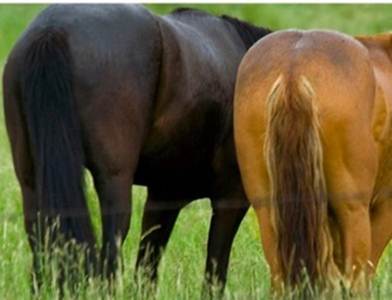
So the next time you are handed a specification or a procedure or process and wonder ‘What horse’s ass came up with this?‘, you may be exactly right. Imperial Roman army chariots were made just wide enough to accommodate the rear ends of two war horses.
Now, the twist to the story. When you see a Space Shuttle sitting on its launch pad, there are two big booster rockets attached to the sides of the main fuel tank. These are solid rocket boosters, or SRBs. The SRBs are made by Thiokol at their factory in Utah.
The engineers who designed the SRBs would have preferred to make them a bit fatter, but the SRBs had to be shipped by train from the factory to the launch site. The railroad line from the factory happens to run through a tunnel in the mountains, and the SRBs had to fit through that tunnel.
The tunnel is slightly wider than the railroad track, and the railroad track, as you now know, is about as wide as two horses’ behinds.
oooOOOooo
Just a fabulously interesting account of something we all take for granted, or had done until now! Thank you so much, Su, for sharing that with everyone.
Hopefully, you were able to watch the Amory Lovins talk in yesterday’s post? If not, then do find time to watch how Professor Lovins sets out the powerful argument that the USA could soon, relatively speaking, be energy self-sufficient.
So on top of the Lovins presentation, I wanted to draw your attention to an item on Climate Crocks last October 5th.
One of the great stories untold in the American media is the ongoing revolution in one of the world’s most advanced economies – as Germany undertakes a bold and serious transition from powering a great engine of prosperity on fossil fuels, to plentiful and inexhaustible renewable energy.
Listening to Mitt Romney double and triple down on the bogus Fox/Fossil narrative about “clean coal” and failed renewables, it might be well to consider how one of our toughest manufacturing competitors is going all-in on the high stakes renewable energy revolution of the new century.
The article is a detailed analysis of how Germany is powering ahead, pardon the pun, in the provision of non carbon-based power, as this reference illustrates,
German use of coal to generate electricity has declined steadily from 1990 to 2011, according to readily available statistics on the German electricity system. The percentage of coal-fired electricity in German electricity generation has fallen from 56.7% in 1990 to 43.5% last year–a decrease of more than 10% despite a increase in total electricity generation during the same period of about 10%. At the same time the share of renewable energy in the electricity mix has increased from 3.6% to 19.9%, mostly due to the rapid development of wind energy and biomass.
Here is one for you- http://www.solarroadways.com/intro.shtml – the idea is totally leftfield, but it fulfils certain issues such as distribution, decentralisation of power and offers a recharge network for electric cars and it has received a big chunk of government funding. It is so out there that I wonder if it could possibly be the answer but you never know.
Very quickly one finds that Solar Roadways are involved in something VERY interesting, namely,
Years ago, when the phrase “Global Warming” began gaining popularity, we started batting around the idea of replacing asphalt and concrete surfaces with solar panels that could be driven upon. We thought of the “black box” on airplanes: We didn’t know what material that black box was made of, but it seemed to be able to protect sensitive electronics from the worst of airline crashes.
Suppose we made a section of road out of this material and housed solar cells to collect energy, which could pay for the cost of the panel, thereby creating a road that would pay for itself over time. What if we added LEDs to “paint” the road lines from beneath, lighting up the road for safer night time driving? What if we added a heating element in the surface (like the defrosting wire in the rear window of our cars) to prevent snow/ice accumulation in northern climates? The ideas and possibilities just continued to roll in and the Solar Roadway project was born.
Now watch this!
and then watch this, as nearly 1.5 million others have!
The Solar Roadways project is working to pave roads with solar panels that you can drive on. Co-founder Scott Brusaw has made some major steps forward since our first visit back in 2007, so we visited him again for an exclusive update on the project, including the first ever video recorded of the Solar Roadways prototype! For more information visit http://www.solarroadways.com . This Solar Roadway project is highlighted as one of many planet-friendly solutions in the feature film by YERT – Your Environmental Road Trip. To learn more about YERT, visit http://yert.com .















 Learning from Dogs