Next Monday, the 21st September, is going to be the most important day this year. No! The most important day ever!
Because next Monday is the date of the People’s Climate March in New York. It is predicted to be the largest climate march in history. Well over 100,000 are expected to attend. I shall write more about this event during the coming week.
But also the 21st September will be International Day of Peace. That coincidence strikes me as highly significant. For a world at peace would cause the most massive reduction in our use of carbon-based fuels.
Thus without any embarrassment, I intend to republish in full [Ed: but see my comment] a recent item on the Permaculture News website: Seven Reasons Why World Peace is Possible.
Do I mention dogs? Read through to the end to find out! (Probably not difficult to guess the answer!)
ooOOoo
Seven Reasons Why World Peace is Possible
Introduction
The 21st of September will be International Day of Peace. It may seem a little premature to declare that world peace is due to break out by the end this month. I do not deny that the amount of killing and death and war and torture and death and coercion and abuse and death all over everywhere can be overwhelming. Nor do I deny that considering this, it is a natural assumption to believe people are sinners, destined for extinction. However, I do argue that compassion is as much a part of human nature as cruelty.
There is evidence that humankind did not always live violent lives. In fact, I assume most people reading this article are not habitually violent, and do not desire to watch someone suffer. All animals have the capacity to enrich the lives of others. We have the capacity to be both selfish and kind. What matters is which quality we chose to focus on; bringing that quality into focus within ourselves, the world, and our children.
Here I have collected an array of research demonstrating that there is a positive potential within each social group and person. I argue that humans can learn to build societies which are not founded on the expectation of organised violence. Here are seven reasons why world peace is possible. You won’t believe your own strength of belief: There is at least some hope.
The balance of this powerful and fascinating article may be read here.
ooOOoo
How many links did you follow? Most of them are wonderful links to organisations that many readers, including me, may not have come across before.
So to close.
I was about half-way through arranging today’s post when I realised that dogs have evolved without the need to have their own police forces or armies. It’s not as silly as it first sounds. Of course, dogs fight and some fights can be brutal and, occasionally, fatal to one or more of the participants. But they have a keen sense of their locality, of their tribal space; so to speak. Even as domestic animals, they are fiercely protective of what is their own place. Before dogs were domesticated, like the wolves from whence dogs evolved, the pack size was around fifty animals with just three animals having any form of status; something that has been mentioned many times before in this place.
The point is that dogs are creatures that have evolved to live in a local community and to live peacefully; by and large. My sense is that ancient man also evolved to be most complete within a community environment.
This is the end of the era of huge federal and national social constructions.
We must return to locally run and managed communities, which is the pathway to peace across this planet.
An incredible discovery about the motion of the sun, and the planets.
Serendipity
I have turned on my computer. It’s 15:30 on Sunday. My creative juices re Monday’s blog post are not flowing. Why? Because, together with a young helper who comes over most Sunday mornings, this morning we have shifted 100 bales of hay from outside the garage, taken them down to the hay-loft and stacked them floor to ceiling: all two and a half tons of them! To use an old English colloquial expression: I am fair knackered!
Then I am rescued!
Top of my email inbox is an email from Dan Gomez that is an item sent to him from his brother Chris. It’s a truly incredible discovery. One that requires us all to tear up what we understand about the Solar System and start again.
If you walk into any classroom today, and likely ever since you were a kid yourself , there is one model being taught regarding the structure of our Solar System. It’s the model that looks like this:
It’s the traditional orbiting model of the Solar System, or the Heliocentric Model, where our planets rotate around the sun.
While this isn’t entirely wrong, it’s omitting one very important fact. The sun isn’t stationary. The sun is actually travelling at extremely fast speeds, upward of 828,000 km/hr, or 514,000 miles an hour.
Our whole Solar System is orbiting the Milky Way Galaxy. In fact it takes 220-Million Years for the Sun to orbit our Galaxy.
Knowing this to be true, our visual model of the Solar System needs to change, and has been inaccurate this whole time. In fact, our planets are barreling through space with the sun, and literally creating a giant Cosmic DNA Helix, and a vortex similar to our Milky Way Galaxy.
Like this but in space, creating a never ending Sine Wave.
This entails that our Sun & the Planets of our Solar System are never in the same place. When we make one rotation around the sun, we have already traveled millions of miles through space, meaning these Cosmic Cycles are far grander than we might have previously imagined.
Here are two video examples of the Helical Model of our Solar System:
This is one by Physicist Nassim Haramein, which clarifies the difference:
Here is a beautiful digital representation of how our solar system is actually a vortex.
Thanks & Spread the Word! Let’s get this changed in Classrooms all around the World.
About the author: Amateo Ra is the co-founder of Creator Course, an Online School for Conscious Living which is currently being built. For the last 4-years, he has been training with Global leaders in Spirituality, Channeling & Conscious Business.
ooOOoo
Don’t know about you but reading this for the first time and watching the two videos really invigorated me. What an amazing universe it is out there!
I have been a follower of Alex Jones’ blog The Liberated Way for many months; possibly much longer. Frequently, I republish one of Alex’s posts here.
Nearly six months ago, I read a lovely essay of his and made a mental note to republish that in the next few days. Then the world overtook me and now April 30th, when Alex published this piece, has become September 8th!
Yet it hasn’t lost a heartbeat of meaning.
Read on and you will agree.
ooOOoo
The hidden gifts of nature.
The western education system ignores nature.
Nature is all around us with its gifts of philosophy, wisdom and creativity; qualities the West devalues at its loss.
The holidays are over in the UK, the students return to school, some to their exams. I reflect upon the sad treatment of creativity, wisdom, nature and natural philosophy in education, and in Western society as a whole, treated as worthless and unworthy of consideration.
On most days I walk past the former home of William Gilbert, some consider the father of electricity and magnetism. Born to a wealthy merchant family in my town of Colchester, Gilbert invested his personal wealth in an extensive study of magnetism with view to assisting the explorers of the Elizabethan age when Britain was building an empire in a period of great prosperity and confidence. Gilbert invented the term electricity. Gilbert wrote De Magnete, considered possibly the first work using the scientific method. In addition to being a scientist, a doctor to Elizabeth I, Gilbert was also a natural philosopher who used the empirical method of observation, demonstration and experience of nature to form his theories.
Each day I watch and interact with nature, like Gilbert I am a natural philosopher, and this forms the basis of my business ideas, my scientific understanding and my personal philosophies. Rather than a worthless study nature opens the door to the philosophy of the understanding of self, the world, and the relationship of self to the world. Wisdom is born of action and experience, the interactions with nature gives birth to wisdom. Nature encourages people to do new things in new ways, so rerouting electric signals in the brain causing new connections to form of creativity. The philosophy emerges from nature by causing the mind to question, observe and experiment, the basis of science and success in any discipline.
ooOOoo
Colchester, in the English county of Essex, goes way back to Roman times when the town was called Camulodunon (which was latinised as Camulodunum). That name is believed to date back to the Celtic fortress of “Camulodunon”, meaning Stronghold of Camulos. It served as the first capital of Roman Britain making a claim to be the oldest town in Britain.
It is where Alex Jones lives, the author of The Liberated Way, and where during the 1980’s I ran a business under the name of Dataview Ltd. In fact, the business was located in a very old, listed building known as The Portreeve’s House. It was at the bottom of town near Hythe Quay on the River Colne and the name “Portreeve” is old English for harbour master, i.e. it was originally the harbour master’s house.
The timber-framed building at 1–2 East Bay, Colchester, known as the Portreeve’s House is situated on the main eastern approach to the town centre. The building is on the junction of Brook Street and East Bay and is 375 metres east of the former position of East Gate and 150 metres west of East Bridge, the river Colne and East Mill. The building is believed to date back to the 16th Century.
I was doing a quick search through previous posts and, to my horror, found that I had published a post when the ‘web’ was twenty-years old. It was a post called Even more Tim Berners-Lee and was published on the 25th March, 2010; some four-and-a-half years ago. Ouch!
Now Tim’s at it again speaking about the ‘web’ being twenty-five years old.
Last March we launched this site, kicking off a year-long celebration of the Web’s 25th birthday, which will culminate in an Anniversary Symposium and gala dinner on 29 October in Santa Clara (USA), to focus on potential and challenges of the future Web.
Last March in Vancouver, Tim Berners-Lee gave a TED Talk: A Magna Carta for the web, that was just released by the TED conference. Enjoy!
Sir Tim Berners-Lee invented the World Wide Web 25 years ago. So it’s worth a listen when he warns us: There’s a battle ahead. Eroding net neutrality, filter bubbles and centralizing corporate control all threaten the web’s wide-open spaces. It’s up to users to fight for the right to access and openness. The question is, What kind of Internet do we want?
This talk was presented at an official TED conference, and was featured by our editors on the home page.
I will leave you with the conclusion of Tim’s talk (the emphasis is mine (Coralie’s) ):
What sort of web do you want? I want one which is not fragmented into lots of pieces, as some countries have been suggesting they should do in reaction to recent surveillance. I want a web which is, for example, a really good basis for democracy. I want a web where I can use healthcare with privacy and where there’s a lot of health data, clinical data is available to scientists to do research. I want a web where the other 60 percent get on board as fast as possible. I want a web which is such a powerful basis for innovation that when something nasty happens, some disaster strikes, that we can respond by building stuff to respond to it very quickly.
So this is just some of the things that I want, from a big list, obviously it’s longer. You have your list. I want us to use this 25th anniversary to think about what sort of a web we want. You can go to webat25.org and find some links. There are lots of sites where people have started to put together a Magna Carta, a bill of rights for the web. How about we do that? How about we decide, these are, in a way, becoming fundamental rights, the right to communicate with whom I want. What would be on your list for that Magna Carta? Let’s crowdsource a Magna Carta for the web. Let’s do that this year. Let’s use the energy from the 25th anniversary to crowdsource a Magna Carta to the web. (Applause)
Thank you. And do me a favor, will you? Fight for it for me. Okay? Thanks.
Get’s my vote. Just wish the last twenty-five years hadn’t gone by just so quickly 😦
I am referring to politicians; but you probably guessed that.
Just my way of a lead-in to a wonderful item seen recently over on ABC Eye Witness News.
Namely:
DOG ELECTED MAYOR IN CORMORANT, MINNESOTA
Duke, the mayor of Cormorant, Minnesota.
Tuesday, August 12, 2014
CORMORANT, Minnesota (WLS) — Duke, a 7-year-old dog, was elected mayor of Cormorant, Minnesota.
“He won by a landslide,” Tricia Maloney said of the Great Pyrenees. “He’s used to coming to the pub and getting some burgers and some fries or something.”
The 12 people who live in Cormorant all paid $1 to vote.
“Poor Richard Sherbrook that owns the Cormorant store, he didn’t even have half as many votes as Duke did,” Maloney said.
The farm dog is all bark, no bite. His term lasts one year.
oooo
A quick web search found a longer version of the news item over on the CBS News website:
Duke The Dog Sworn In As Mayor Of Cormorant, Minn.
(credit: CBS)
MINNEAPOLIS (WCCO) – Every dog has his day and Saturday is it for Duke the dog.
Duke was elected mayor of the northwestern Minnesota community of Cormorant, and he was sworn in Saturday. Organizer Tammy Odegaard says Duke got gussied up Friday night, his second trip to the groomer since his election.
“He spends a lot of time at the dairy farm next door,” Odegaard said, who notes she’s now a member of Duke’s staff. “So, twice in, like, seven days for him is, like, it’s never happened. So I’m sure he’s wondering what’s going on with just that.”
His first grooming took five hours and came after the majority of the town’s 12 voters backed him in the balloting. The town pulled out all the stops for the 10 a.m. ceremony during Cormorant’s annual fair.
“We’ll have him put his little paw on the bible, going to have him have the little oath,” Odegaard said. “Of course, he’s not going to repeat it. It would be awesome if he would bark, but who knows? He’s a country dog, so he’s not used to performing on cue.”
During the two-minute inauguration ceremony, Steve Sorenson, chairman of Cormorant Township, greeted Duke and set forth his duties.
“You are about to em-bark upon a great time of service, tremendous personal and professional growth,” Sorenson said. “If you accept this challenge and these responsibilities, please bark or pant.”
Duke panted.
“I think that qualifies,” Sorenson said.
As for the mayor’s salary, a pet food store is donating a year’s supply of kibble to reward him for his service.
The village of Cormorant is located in northwestern Minnesota, near Pelican Rapids.
Duke is a seven-year-old, big, white, shaggy Great Pyrenees that loves to roll around in the dirt. Odegaard would not say if that activity qualifies Duke for a career in politics.
“You said it, not me,” Odegaard laughed.
oooo
That inauguration ceremony was captured on video; see below. Warning, the first seven minutes are a little slow! But it is worth watching, trust me!
Apologies again for today’s post being largely the republication of other essays but looking after our guests is, as it should be, taking first priority.
The first one was something I read on the Cliff Mass weather blogsite. It was a forecast as to which of the lower US 48 States would remain habitable. It opens:
Will the Pacific Northwest be a Climate Refuge Under Global Warming?
As global warming takes hold later in the century, where will be the best place in the lower 48 states to escape its worst effects?
A compelling case can be made that the Pacific Northwest will be one of the best places to live as the earth warms. A potential climate refuge.
and offers this conclusion:
So what conclusion does one inevitably reach by studying the IPCC reports, the U.S. Climate Assessment, and the climate literature?
The Northwest is the place to be during global warming.
Temperatures will rise more slowly than most of the nation due to the Pacific Ocean (see below)
We will have plenty of precipitation, although the amount falling as snow will decline (will fall as rain instead). But we can deal with that by building more reservoir and dam capacity (and some folks on the eastern slopes of the Cascades have proposed to do exactly that).
The Pacific Ocean will keep heat waves in check and we don’t get hurricanes.
Sea level rise is less of a problem for us due to our substantial terrain and the general elevation rise of our shorelines. Furthermore, some of our land is actually RISING relatively to the sea level because we are still recovering from the last ice age (the heavy ice sheets pushed the land down and now it is still rebounding).
There is no indication that our major storms…cyclone-based winds (like the Columbus Day Storm)… will increase under global warming.
Increased precipitation may produce more flooding, but that will be limited to river valleys and can be planned for with better river management and zoning.
The second item was this:
Antarctica’s Point of No Return
POTSDAM – Recent satellite observations have confirmed the accuracy of two independent computer simulations that show that the West Antarctic ice sheet has now entered a state of unstoppable collapse. The planet has entered a new era of irreversible consequences from climate change. The only question now is whether we will do enough to prevent similar developments elsewhere.
What the latest findings demonstrate is that crucial parts of the world’s climate system, though massive in size, are so fragile that they can be irremediably disrupted by human activity. It is inevitable that the warmer the world gets, the greater the risk that other parts of the Antarctic will reach a similar tipping point; in fact, we now know that the Wilkes Basin in East Antarctica, as big or even bigger than the ice sheet in the West, could be similarly vulnerable.
There are not many human activities whose impact can reasonably be predicted decades, centuries, or even millennia in advance. The fallout from nuclear waste is one; humans’ contribution to global warming through greenhouse-gas emissions from burning fossil fuels, and its impact on rising sea levels, is another.
Indeed, the latest Intergovernmental Panel on Climate Change (IPCC) report stated, in uncharacteristically strong terms, that the sea level is “virtually certain” to continue to rise in the coming centuries or millennia. Moreover, the greater our emissions, the higher the seas will rise.
Simply, because the quicker that the awareness of the critical challenges ahead becomes widespread knowledge, right around the world, the quicker that there will be political movements to change our relationship with our planet.
It’s never about not needing governments, it’s always about needing the right sort of governments.
Yesterday, I published a post under the title of Just to focus our minds. It featured a chart that demonstrated how long Planet Earth would take to ‘recover’ if the human race disappeared today.
Why today’s post seemed a perfect companion was because it explores how we could think better. For if the human race doesn’t quickly find a way to think better, then that aforementioned chart may not be such an academic abstract after all.
The post is more or less a copy of what appeared on the Big Think blogsite, a site I have been following for some time now.
ooOOoo
Want to Make a Difference in the World? Think Small
Stephen Dubner
Ambition can work against you by leading you to set unrealistic and overwhelming goals. Want to make a difference in the world? Think small. It’s much less complicated, you’ll have easier access to the data that you’ll need. Most importantly, you will preserve one of your most precious resources: optimism.
Having the will to attack an issue at its root—from launching a socially conscious business to demanding more green spaces in your neighborhood—requires energy and enthusiasm to see the project through. By being less ambitious in your plans you’re more likely to stick with them and be successful.
Besides, when you first developed your problem-solving skills you were small—a child. Stephen Dubner, the co-author, with economist Steven Levitt, of Freakonomics and Think Like a Freak, wants you to go back to that way of thinking:
One of the most powerful pieces of thinking like a child that we argue is thinking small. So I realize that this runs exactly counter to the philosophy of the arena in which I’m appearing which is thinking big, Big Think, but our argument is this. Big problems are by their nature really hard to solve for a variety of reasons. One is they’re large and therefore they include a lot of people and therefore they include a lot of crossed and often mangled and perverse incentives. But also a big problem – when you think about a big problem like education reform. You’re dealing with an institution or set of institutions that have gotten to where they’ve gotten to this many, many years of calcification and also accidents of history. What I mean by that is things have gotten the way they’ve gotten because of a lot of things a few people did many, many years ago and traditions were carried on.
Want to break those traditions and build something new and forward-thinking? Then curb your ambition. Start to look at the world again with the eyes of a child.
Stephen Dubner talks about [that YouTube link reveals the transcript of the talk. PH] the importance of thinking small in order to tackle some of the world’s biggest problems piece by piece. Dubner is the co-author of Think Like a Freak
ooOOoo
Stephen Dubner and economist Steven Levitt co-authored the book Freakonomics. If you are interested, the Freakonomics website is here.
The second, and last, episode of the BBC Clouds Lab programme offers an intriguing message.
On Monday, I published a post under the title of The clouds above us. The second episode demonstrated that even in atmospheric conditions of near vacuum, intense cold and very low humidity, conditions that would kill a human in seconds, there was microscopic bacteriological material to be found.
Exploring the troposphere
The troposphere is a turbulent layer of air that begins at the Earth’s surface and ranges from 23,000-65,000 feet above sea level, depending on the latitude, season and the time of day. Its name originates from the Greek word tropos, meaning change. It’s now known that bacteria actually exists in clouds and scientists believe that it plays a significant part in the creation of rain but little is known about life higher up. Microbiologist Dr Chris Van Tulleken has discovered that living bacteria can exist well above 10,000ft in a hostile environment with low pressure, increased UV radiation, freezing temperatures, high winds and no oxygen or water.
What I took away from watching the programme was that the minimum conditions necessary for living bacteria were far more harsh than one might expect. In other words, finding living bacteria in other solar systems might not be such a science-fiction idea.
With that in mind, I’m republishing an essay that Patrice Ayme wrote in 2013. I’m grateful for his permission to so do.
ooOOoo
40 Billion Earths? Yes & No.
Up to twenty years ago, a reasonable opinion among scientists was that there might be just one solar system. Ours. Scientists like to project gravitas; having little green men all over didn’t look serious.
However, studying delicately the lights of stars, how they vary, how they doppler-shift, more than 1,000 planets have been found. Solar systems seem ubiquitous. Astronomers reported in 2013 that there could be as many as 40 billion habitable Earth-size planets in the galaxy. However, consider this:
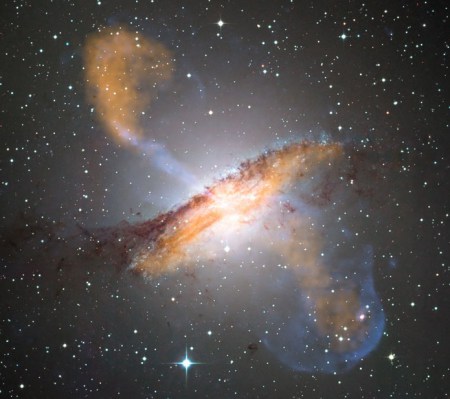
Centaurus A: Lobes Of Tremendous Black Hole Explosion Fully Visible.
Yes, that’s the center of a galaxy, and it has experienced a galactic size explosion from its central black hole.
One out of every five sun-like stars in our galaxy has a planet the size of Earth circling it in the Goldilocks zone, it seems — not too hot, not too cold — with surface temperatures compatible with liquid water. Yet, we have a monster black hole at the center of our giant galaxy, just like the one exploding above.
The Milky Way’s black hole is called Sagittarius A*. It exploded last two million years ago. Early Homo Erectus, down south, saw it. The furious lobes of the explosion are still spreading out, hundreds of thousands of light years away.
We are talking here about explosions potentially stronger than the strongest supernova by many orders of magnitude (depending upon the size of what’s falling into Sagittarius. By the way, a cloud is just heading that way).
Such galactic drama has a potential impact on the presence of advanced life. The richer the galaxy gets in various feature the situation looks, the harder it looks to compute the probability of advanced life.
The profusion of habitable planets is all the more remarkable, as the primitive methods used so far require the planet to pass between us and its star.
(The research, started on the ground in Europe, expanded with dedicated satellites, the French Corot and NASA’s Kepler spacecraft.). Sun-like stars are “yellow dwarves”. They live ten billion years.
From that, confusing “habitable” and “inhabitated”, the New York Times deduced: “The known odds of something — or someone — living far, far away from Earth improved beyond astronomers’ boldest dreams on Monday. “
However, it’s not that simple.
Primitive bacterial life is probably frequent. However advanced life (animals) is probably very rare, as many are the potential catastrophes. And one needs billions of years to go from primitive life to animals.
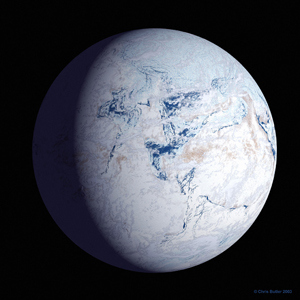
After life forms making oxygen on Earth appeared, the atmosphere went from reducing (full of strong greenhouse methane) to oxidizing (full of oxygen). As methane mostly disappeared, so did the greenhouse. Earth froze, all the way down to the equator:
When Snowball Earth Nearly Killed Life.
Yet volcanoes kept on belching CO2 through the ice. That CO2 built up above the ice, caused a strong greenhouse, and the ice melted. Life had survived. Mighty volcanism has saved the Earth, just in time.
That “snowball Earth” catastrophe repeated a few times before the Earth oxygen based system became stable. Catastrophe had been engaged, several times, but the disappearance of oxygen creating life forms had been avoided, just barely.
Many are the other catastrophes we have become aware of, that could wipe out advanced life: proximal supernovas or gamma ray explosions.
Cataclysmic eruption of the central galactic black hole happen frequently. The lobes from the last one are still visible, perpendicularly high off the galactic plane. The radiation is still making the Magellanic Stream simmer, 200,000 light years away. Such explosions have got to have sterilized a good part of the galaxy.
In 2014 when part of the huge gas cloud known as G2 falls into Sagittarius A*, we will learn better how inhospitable the central galaxy is for advanced life.
Many of the star systems revealed out there have surprising feature: heavy planets (“super Jupiters“) grazing their own stars. It’s unlikely those giants were formed where they are. They probably swept their entire systems, destroying all the rocky planets in their giant way. We don’t understand these cataclysmic dynamics, but they seem frequent.
Solar energy received on Earth fluctuated and changed a lot, maybe from one (long ago) to four (now). But, as it turned out just so that Earthly life could survive. Also the inner nuclear reactor with its convective magma and tectonic plates was able to keep the carbon dioxide up in the air, just so.
The Goldilocks zones astronomers presently consider seem to be all too large to allow life to evolve over billions of years. They have to be much narrower and not just with red dwarves (the most frequent and long living stars).
One of our Goldilocks, Mars, started well, but lost its CO2 and became too cold. The other Goldilocks, Venus, suffered the opposite major technical malfunction: a runaway CO2 greenhouse.
Mars’ axis of rotation tilts on the solar system’s plane enormously: by 60 degrees, over millions of years. So Mars experiences considerable climatic variations over the eons, as it goes through slow super winters and super summers (it’s imaginable that, as the poles melt, Mars is much more habitable during super summers; thus life underground, hibernating is also imaginable there).
Earth’s Moon prevents this sort of crazy hyper seasons. While, differently from Venus, Earth rotates at reasonable clip, homogenizing the temperatures. Venus takes 243 days to rotate.
It is startling that, of the four inner and only rocky planets, just one, Earth has a rotation compatible with the long term evolution of advanced life.
Earth has also two striking characteristics: it has a very large moon that store much of the angular momentum of the Earth-Moon system. Without Moon, the Earth would rotate on itself once every 8 hours (after 5 billion years of braking by Solar tides).
The Moon used to hover at least ten times closer than now, when earth’s days were at most 6 hours long.
The tidal force is the difference between gravitational attraction in two closely separated places, so it’s the differential of said attraction (which is proportional to 1/dd; d being the distance). Hence the tidal force is inversely proportional to the cube of the distance.
Thus on early Earth tides a kilometer high were common, washing back and forth every three hours. a hyper super tsunami every three hours, going deep inside the continents. Not exactly conditions you expect all over the universe.
Hence biological material fabricated on the continental margins in shallow pools would get mixed with the oceans readily. That would guarantee accelerated launch of life (and indeed we know life started on Earth very fast).
The theory of formation of the Moon is wobbly (recent detailed computations of the simplest impact theory do not work). All we know for sure, thanks to the Moon rocks from Apollo, is that the Moon is made of Earth mantle materials.
Somehow the two planets split in two. (Fission. Get it? It maybe a hint.)
Another thing we know for sure is that Earth has, at its core, a giant nuclear fission reactor, keeping Earth’s core hotter than the surface of the sun. An unimaginable liquid ocean of liquid iron deep down inside below our feet undergoes iron weather. Hell itself, the old fashion way, pales in comparison.
Could the Moon and the giant nuclear reactor have the same origin? This is my provocative question of the day. The Moon, our life giver, could well have formed from giant nuclear explosions, of another of our life givers, what became the nuke at the core. I can already hear herds of ecologists yelp in the distance. I present the facts, you pseudo-ecologists don’t decide upon them. It’s clear that nuclear fission is not in Drake equation: if nothing else, it’s too politically incorrect.
All the preceding makes this clear:
Many are the inhabitable planets, yet few will be inhabitated by serious denizens.
This means that the cosmos is all for our taking. The only question is how to get there. The closest stars in the Proxima, Beta and Alpha Centauri system are not attainable, for a human crew, with existing technology.
However, if we mastered clean colossal energy production, of the order of the entire present energy production of humanity, we could get a colony there (only presently imaginable technology would be fusion).
Giordano Bruno, professor, astronomer, and priest suggested that there were many other inhabitated systems around the stars. That insult against Islam meant Christianity was punished the hard way: the Vatican, the famous terrorist organization of god crazies, put a device in Giordano’s mouth that pierced his palate, and having made sure that way that he could not tell the truth, the terrorists then burned him alive. After seven years of torture.
The horror of truth was unbearable to theo-plutocrats.
Now we face something even worse: everywhere out there is very primitive life. It is likely gracing 40 billion worlds. But, if one has to duplicate the succession of miracles and improbabilities that made Earth, to earn advanced life, it may be just here that civilization ever rose to contemplate them.
Congratulations to India for launching yesterday a mission to Mars ostensibly to find out if there is life there (by finding CH4; while life is presently unlikely, Mars has much to teach, including whether it started there). That’s the spirit!
The spirit is to have minds go where even imagination itself did not go before.
If we sit back, and look at the universe we have now, from Dark Matter, to Dark Energy, to Sagittarius, to the nuclear reactor below, to billions of Earths, to a strange Higgs, to Non Aristotelian logic, we see a wealth, an opulence of possibilities inconceivable twenty years ago.
Progress is not just about doing better what was done yesterday. It’s also about previously inconceivable blossoms of entirely new mental universes.
A team of scientists take to the skies in one of the world’s largest airships, for a unique exploration of Earth’s most precious and mysterious environment – the atmosphere.
In an example of what might be called a massive change of topic from yesterday’s post on Integrity and democracy, today’s offering to you, dear reader, is about the magnificent atmosphere upon which we all depend.
Here’s a clue.
Sunrise to our North-East at a little after 7am on Sunday, 13th July, 2014.
Every Breath We Take: Understanding Our Atmosphere
The air around us is not just empty space; it is an integral part of the chemistry of life. Plants are made from carbon dioxide, nitrogen nourishes the soil and oxygen gives us the energy we need to keep our hearts pumping and our brains alive. But how did we come to understand what air is made of? How did we come to know that this invisible stuff around us contains anything at all?
Gabrielle Walker tells the remarkable story of the quest to understand the air. It’s a tale of heroes and underdogs, chance encounters and sheer blind luck that spans the entire history of science. It began as a simple desire to further our knowledge of the natural world, but it ended up uncovering raw materials that have shaped our modern world, unravelling the secrets of our own physiology and revealing why we are here at all.
There is much more to explore on the website, including this trailer to the programme.
Oh, here’s another ‘clue’ from Oregon.
Same morning, same sunrise.
The presenter of the BBC series is Felicity Aston who writes on her BBC Blog:
I joined Operation Cloud Lab: Secrets Of The Skies as the expedition leader and also as a meteorologist.
The plan was to fly from Florida to California, looking at the science of the skies.
But as well as scientists, there were plenty of other people on the team including three pilots, a ground crew of 14 that followed the airship by road and a full production team including two camera crews. Not everyone could be on board at once – the airship would never have got off the ground!
But I was really fortunate to spend a lot of time on board and flew most of the way across the continent.
Exploring in three dimensions rather than being limited to making observations from the ground was a revelation to me.
The clouds in the tropics around the Gulf of Mexico are huge, and being in the sky with them really brought home the vast scale of the forces at work.
Towering cumulus cloud in Florida.
We were able to travel over, under and through these monsters, revealing that clouds are about as far from the popular image of light and fluffy floating puffs of cotton wool as you can get! They are dense and heavy and full of destructive energy.
I remember looking down at the cloud layer from a plane as a child, and daydreaming about exploring this new world of unknown places, so I was very excited the first time we flew straight through a cloud.
I leaned out of the airship as far as I dared into the heart of a cloud and found that it was a dark, damp mass of floating fog (of course!) – no mysterious worlds – my childhood fantasies were crushed!
There’s more to read on her blog as well as some stupendous photographs of clouds.
So if this gives you a thrill then don’t delay in watching the full-length Episode One on YouTube before it gets taken down. (Warning: if you watch the opening first few minutes you will be hooked for the full hour!)
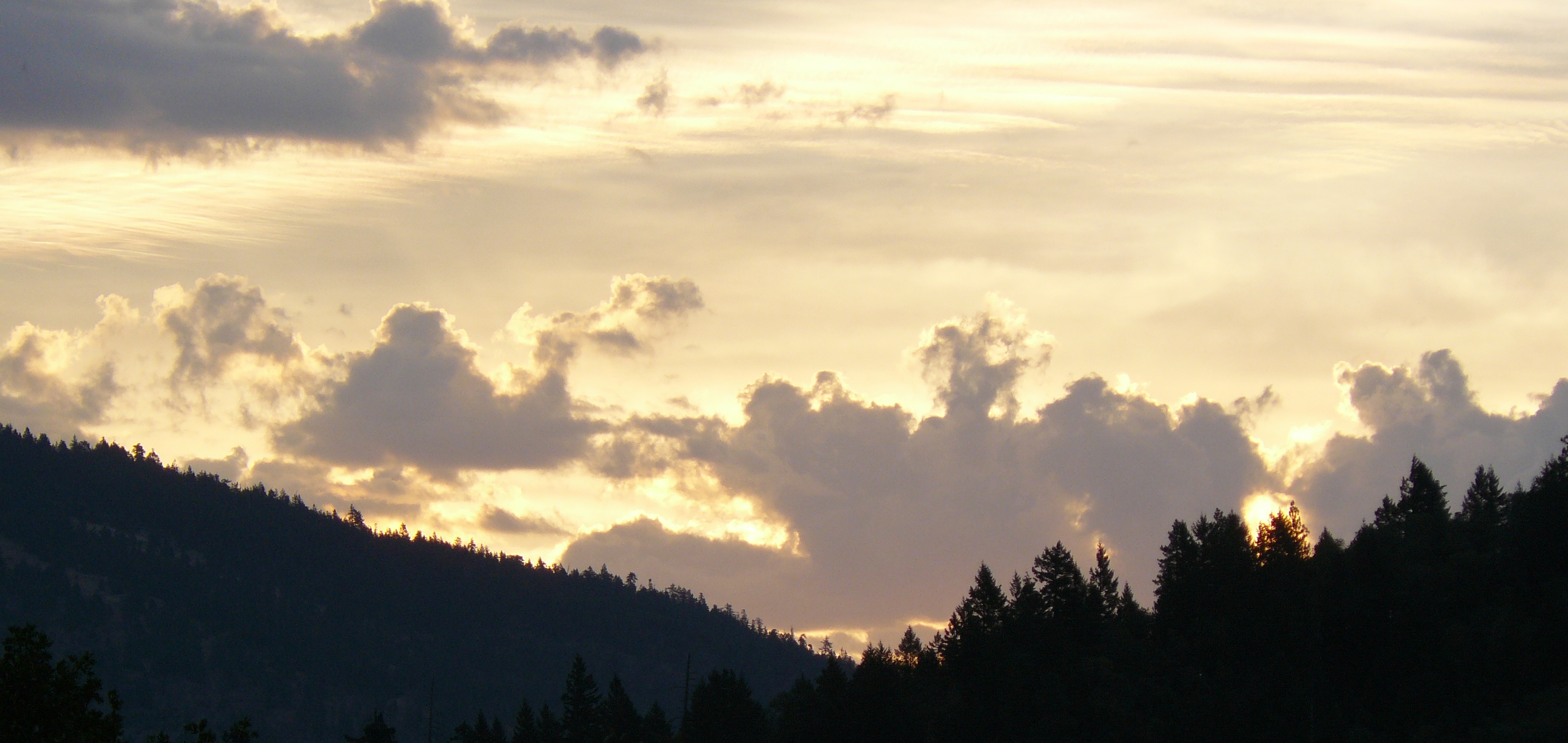
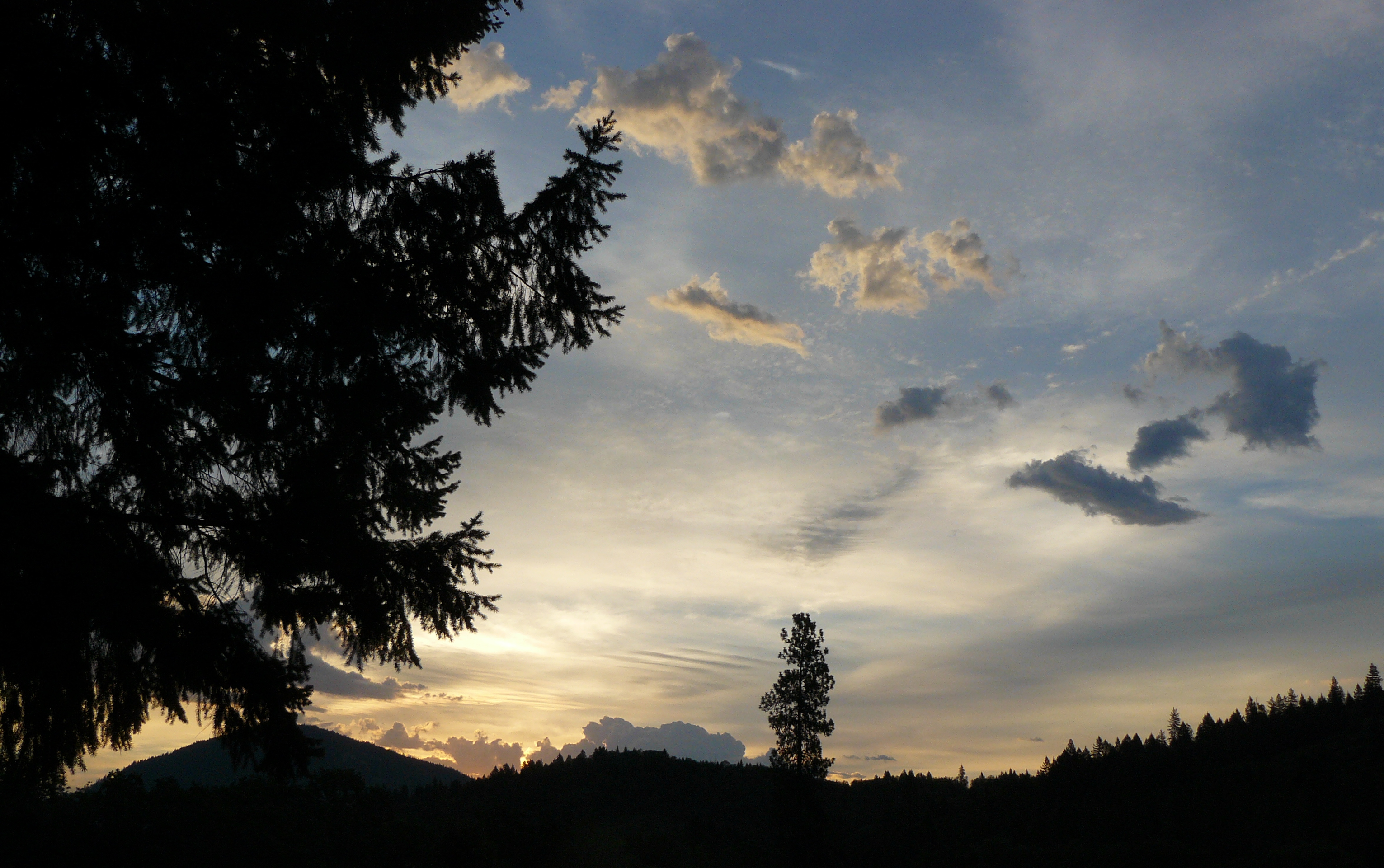
Now to close with, yes you guessed it, my final ‘clue’ from Oregon.








 Learning from Dogs