Dave Isay opened the first StoryCorps booth in New York’s Grand Central Terminal in 2003 with the intention of creating a quiet place where a person could honor someone who mattered to them by listening to their story. Since then, StoryCorps has evolved into the single largest collection of human voices ever recorded. His TED Prize wish: to grow this digital archive of the collective wisdom of humanity. Hear his vision to take StoryCorps global — and how you can be a part of it by interviewing someone with the StoryCorps app.
It was a remarkable and fascinating talk and, thanks to YouTube, I’m able to share it with you.
I have no doubt that after watching Dave Isay’s talk you will want to go to the StoryCorps website.
Dogs watch us all the time and read our body language like a sixth sense.
A fascinating, and inspiring, insight into our favourite animal companion.
Published on Jan 26, 2014
Check out BBC Earth on BBC online
Dogs watch us all the time and read our body language like a sixth sense. They also smell our bodies for changes.
Max smelt cancer in Maureen before any medical scans could pick it up. Dogs do this naturally and can be trained to pick up on tiny volatile chemicals given off by cancerous tumors. They can even be taught to alert diabetics to low blood sugar levels.
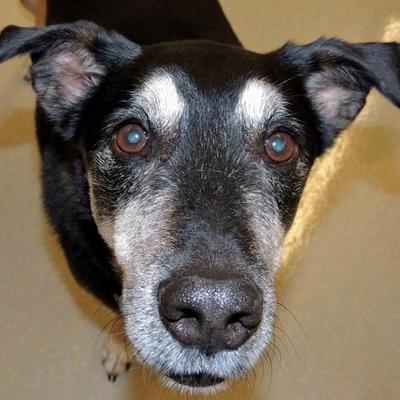
This is Frankie, a German shepherd mix. He can sniff out thyroid cancer in patients’ urine samples with 88% accuracy, according to a new study.
Image via The Endocrine Society.
A trained scent dog accurately identified whether patients’ urine samples had thyroid cancer or were benign (noncancerous) 88 percent of the time, according to a new study by researchers at University of Arkansas for Medical Sciences (UAMS). The results were presented March 6 at the Endocrine Society’s annual meeting in San Diego.
Approximately 62,450 new cases of thyroid cancer will be diagnosed in the US this year, and around 1,950 Americans will die from the disease.
Techniques used to diagnose thyroid cancer include fine-needle aspiration biopsy, which involves the patient having a thin needle inserted into the thyroid gland in the neck to obtain a tissue sample. Donald Bodenner, MD, PhD chief of endocrine oncology at UAMS is the study’s senior investigator. Bodenner said:
Scent-trained canines could be used by physicians to detect the presence of thyroid cancer at an early stage and to avoid surgery when unwarranted.
Study-coauthor Arny Ferrando previously “imprinted,” or scent-trained, a rescued male German Shepherd-mix named Frankie to recognize the smell of cancer in thyroid tissue. Ferrando, who noted that dogs have at least 10 times more smell receptors than humans, said:
Frankie is the first dog trained to differentiate benign thyroid disease from thyroid cancer by smelling a person’s urine.
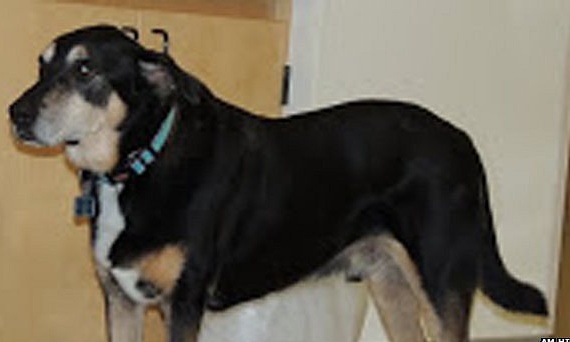
German shepherd mix Frankie, a formerly stray dog rescued in Little Rock, Arkansas, was trained to diagnosis thyroid cancer through scent imprinting. Image credit: AM Hinson/BBC
In this study, 34 patients gave a urine sample before they went on to have a biopsy of suspicious thyroid nodules and surgery. The surgical pathology result was diagnosed as cancer in 15 patients and benign thyroid disease in 19. These urine samples were presented one at a time to Frankie to sniff. Frankie had been trained to alert to a cancer sample by lying down, and turning away from a benign sample to alert the absence of cancer.
The dog’s alert matched the surgical pathology diagnosis in 30 of the 34 study samples, the investigators reported.
Bottom line: A new study by University of Arkansas for Medical Sciences (UAMS) researchers presented March 6, 2015 at the Endocrine Society’s annual meeting in San Diego described Frankie, a trained scent dog that accurately identified whether patients’ urine samples had thyroid cancer or were benign 88 percent of the time.
Yet another wonderful item sent across to me by neighbours Dordie and Bill.
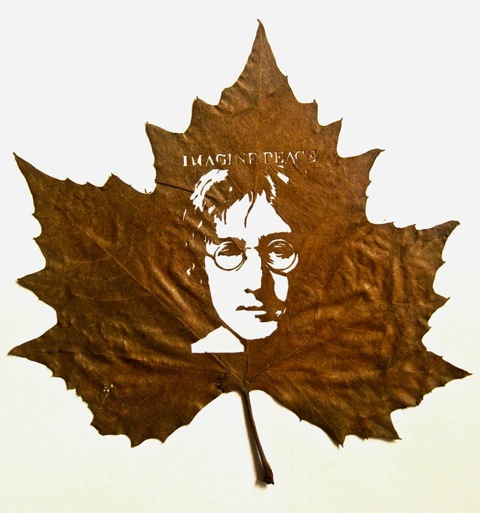
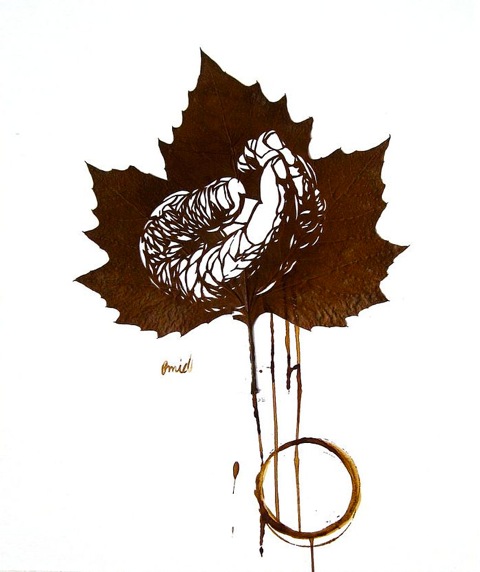
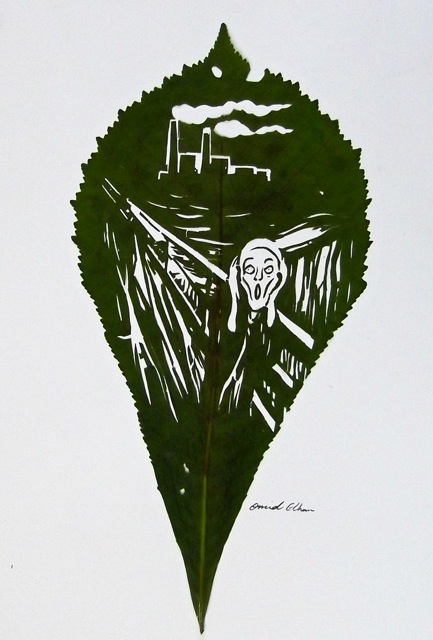
Delicate Leaf Cuttings By Omid Asadi
My name is Omid Asadi and I currently live in Manchester, United Kingdom. I created this work with carving and cutting techniques on actual fallen leaves using a craft knife and a needle. I always try to create pieces with a message, not just beautiful art. Some of these messages or ideas come from my world view, poems, stories, global problems and philosophy. I’m also inspired by other artists’ and designers’ works.
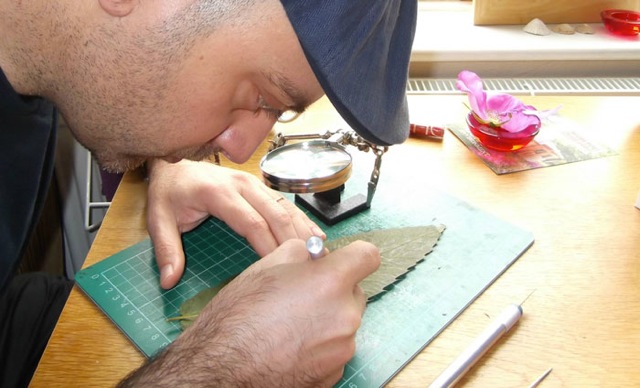
Here’s the man in action.
I use a craft knife or scalpel and needle. It is not like a paper cutting because each part needs a certain pressure to cut. If I make a mistake, I destroy maybe hundreds of hours of work.
oooo
Leaf’s Mind. I’m very attentive to beautiful fallen leaves. Suddenly, I started SEEING them, not simply looking at them.
oooo
Carriage. I believe that we look at many things everyday, but don’t SEE them. For example, apples had been falling from trees for thousands of years, but only Isaac Newton truly saw that and, thanks to him, our lives have changed forever.
oooo
Dandelion
oooo
Che Guevara
oooo
Love
oooo
Eagle
Another set of these remarkable cuttings in a week’s time.
A most fabulous idea of sharing poetry in the wild.
One of the great advantages of having a dog, or nine, is that there are endless opportunities to go walking with them.
The other day, Jean and I became aware of the most wonderful idea: The Stanza Stones Walk. Here’s how that walk is explained on the website:
THE STANZA STONES PROJECT
The Stanza Stones Walk: An Alternative devised by Mick Melvin.
A fifty mile upland walk from Marsden to Ilkley visiting the six Stanza Stones carved with poems written by Simon Armitage.
Why create an alternative walk?
I have created this walk as an alternative to the 47 mile trail created by the team working with the Ilkley Literature Festival, not because it is my intention to denigrate the walk which was produced by the team. Far from it, the trail which they created is a fine outing and one that will satisfy the desires of most people wishing to visit the Stanza Stones.
My purpose was to devise an upland walk linking the stones which did not stick to recognised footpaths or to existing well-known walking trails. This has not always been possible, since I felt that it was necessary to follow the Pennine way or Millennium Way on occasions, in order to visit significant places of interest i.e. Blackstone Edge.
In addition I believe that considering the walk was motivated by literature, it should visit the places that inspired some of the area’s finest writers, Haworth and Mytholmroyd. My objective is to create six more circular walks to each of the stones which will be suitable for a day’s walking. These walks will be posted on the site as I complete them.
The seven Stanza Stones, each carved with a poem written by the poet Simon Armitage, are at locations which in general follow the Pennine watershed. The Stanza Stones project, which started at Ilkley Festival in August 2010, is focused on poems specially written by Simon stirred by his response to the Pennine Watershed and the relationship between the landscape and language of Yorkshire. The seven stones will form a permanent moorland trail across the watershed from Ilkley to Marsden the home town of the poet. The Stanza Stones poems are reproduced here by kind permission of Simon Armitage.
Isn’t that an incredibly wonderful idea!
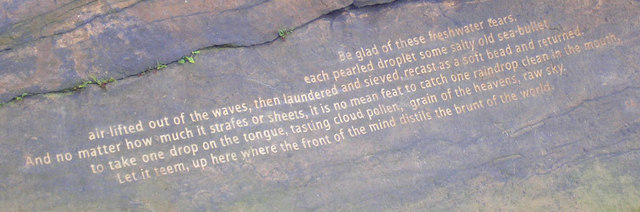
Here’s a photograph of one of the stones bearing Simon Armitage’s poetry.
Cows Mouth Quarry
Blackstone Edge
The third Stanza Stone has now been completed at Cow’s Mouth Quarry near Blackstone Edge. The quarry is situated about 20 minutes walk along the track (Pennine Way) which starts at the White House pub. The Pub is on the A58 road between Halifax and Littleborough just beyond Blackstone Edge Reservoir. As you approach the quarry from the White House, watch for a small stone arched bridge spanning the catch water drain on you right about 75 yards before the crags. The path from the bridge affords a close up view of the face carrying the carving. The poem can also be seen from the main path if you continue along the gravelled track. A circular walk can be made if you continue on the track, taking the right turn to White Holme Reservoir returning to Blackstone edge and the White House on a good path over Byron Edge.
Whether or not you will ever have the chance to enjoy this walk, do go across to the Stanza Stones website and just revel in the poetry and the nature.
The following were sent to me from Dan Gomez. They offer a fascinating insight into the power of graphically representing any number of ideas. Hope you find them as fascinating as I did!
This map shows the world divided into 7 sections (each with a distinct color) with each section containing 1 billion people.
oooo
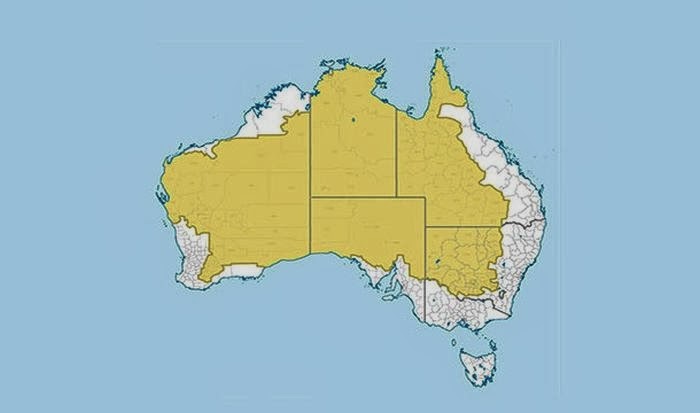
This map shows (in white) where 98 percent of Australia’s population lives.
oooo
It may not come as a surprise but more people live inside the circle than outside of it.
oooo
This map shows what is on the other side of the world from where you are standing. For the most part it will probably be water.
oooo
Apparently you can’t get Big Macs everywhere. This map shows (in red) the countries that have McDonalds.
oooo
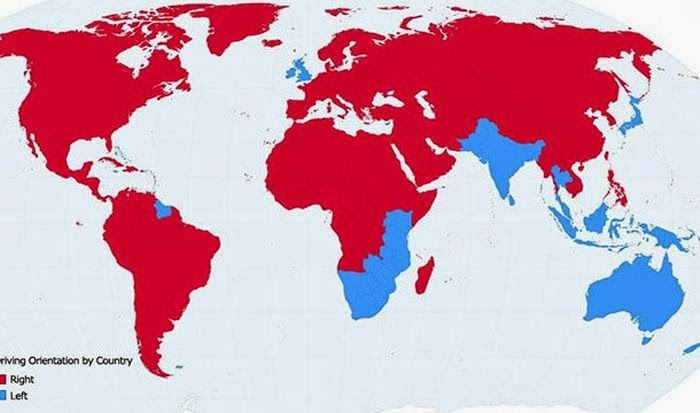
This map shows the countries (in blue) where people drive on the left side of the road.
oooo
This map shows countries (in white) that England has never invaded. There are only 22 of them.
oooo
The line in this map shows all of the world’s Internet connections in 1969.
oooo
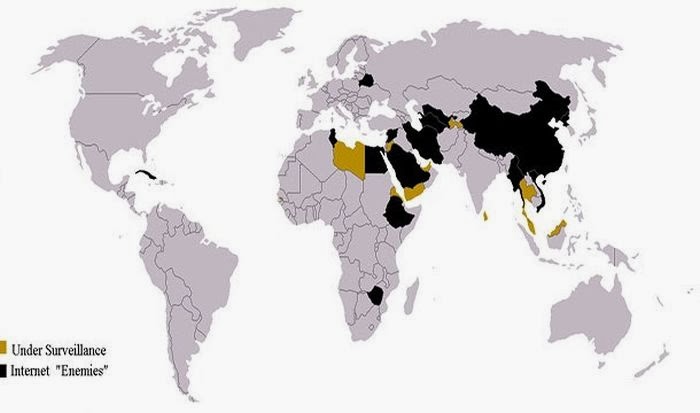
This map shows the countries that heavily restricted Internet access in 2013.
oooo
This map shows (in red) countries that were all Communist at one point in time.
oooo
This map shows (in red) the countries that don’t use the metric system.
oooo
This map shows (in blue) places where Google street view is available.
oooo
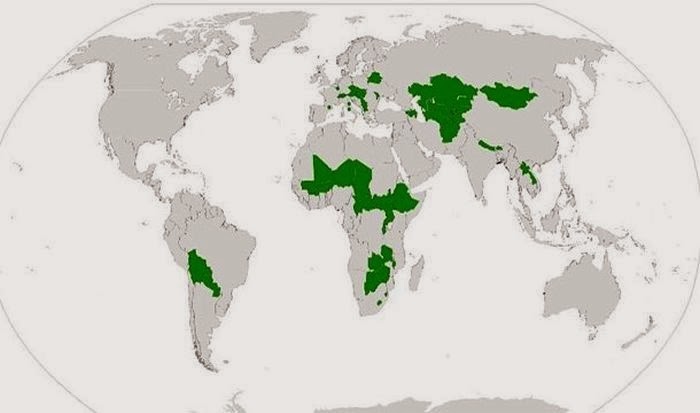
This map shows (in green) all the landlocked countries of the world.
oooo
And this is what the world would look like if all the countries with coast lines sank.
oooo
This is a map of the all the rivers in the United States.
oooo
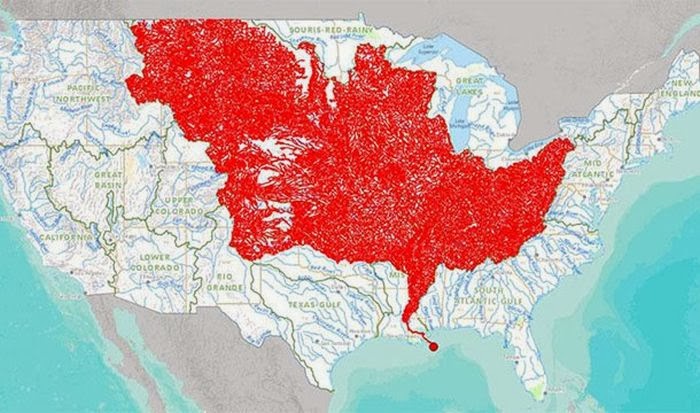
And these are all the rivers that feed into the Mississippi River.
oooo
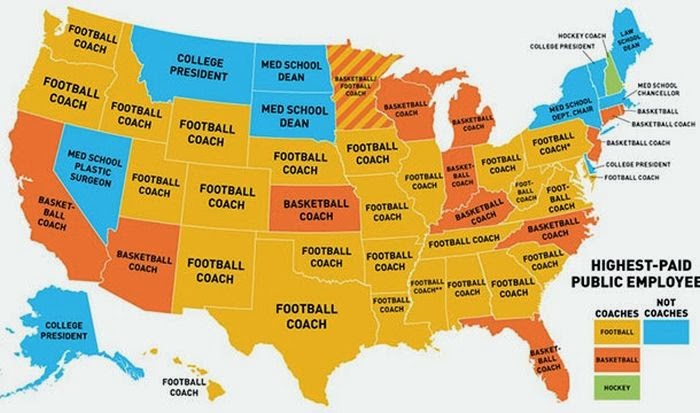
This is a map of the highest paid public employees in the United States.
oooo
This map shows how much space the United States would occupy on the moon.
Would love to hear which of the maps you found most interesting, and why?
Not only to the aircraft but to all the many individuals who made it happen!
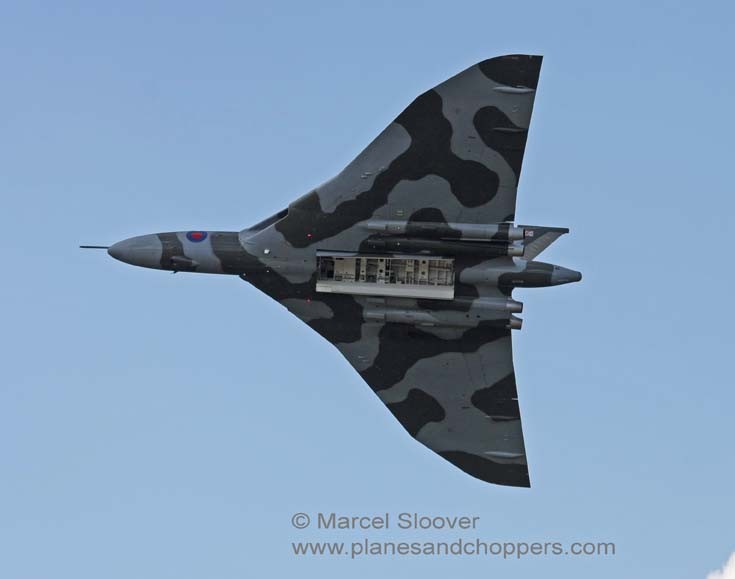
As I mentioned in yesterday’s post Nostalgia with wings, today I was going to write about a particular aircraft: The Avro Vulcan.
I chose the image above because it resonated so strongly with the comment left by Hariod Brawn that I included in yesterday’s post. Namely:
I took my father [who test-piloted the Vulcan and Victor. PH] to see Vulcan XH558 fly what was then thought to be its final flight (it subsequently was overhauled and took to the skies again). It flew along the length of the runway at a 45 degree angle with its bomb bay doors open. On the inside of the doors in huge letters was the single word ‘farewell’. It was really quite an emotional experience both for my father and myself.
There’s a lengthy item on WikiPedia about this aircraft. I will repost a couple of parts of that article.
Avro Vulcan XH558 (civil aircraft registration G-VLCN) The Spirit Of Great Britain is the only airworthy example of the 134 Avro Vulcan V bombers that were operated by the Royal Air Force from 1953 until 1985. Vulcan XH558 served with the RAF between 1960 and 1985 in the bomber, maritime reconnaissance and air-to-air refuelling roles. The RAF operated XH558 as a display aircraft from 1986 until 1992, when budget cuts forced its retirement.
It is operated by the Vulcan to the Sky Trust as a display aircraft, funded entirely by charitable donations and the UK Heritage Lottery Fund. It is registered with the United Kingdom Civil Aviation Authority as G-VLCN but has an exemption to fly in Royal Air Force markings as XH558.
Restoration to flight
The engineering staff of the Vulcan Operating Company (the engineering arm of Vulcan to the Sky Trust, owners of XH558) worked to return Vulcan XH558 to flight, with the first test flight taking place on 18 October 2007. They were supported by the “Vulcan to the Sky” club, a supporters and fundraising organisation. Though the website carried an announcement on 1 August 2006 that the project was in danger of being abandoned due to lack of finance, the target of raising the remaining £1.2m was achieved on 31 August 2006, thanks to a high-profile publicity campaign orchestrated by the supporters club, Vulcan to the Sky Club (formerly Vulcan 558 Club).
Time had almost run out for XH558 when Sir Jack Hayward, a British philanthropist, donated £500,000, which topped off the £860,000 already raised by Vulcan to the Sky Club and Friends. Although the aircraft restoration was nearly complete, the aircraft was not ready for the flypast down The Mall in London for the 25th Anniversary of the Falklands conflict on 17 June 2007 or the RAF Waddington Airshow and the Royal International Air Tattoo (RIAT).
It was intended that the Vulcan would fly during at least one UK airshow during the 2007 season, but due to delays in returning the aircraft to flight, mainly down to delays in the return of refurbished flight-critical components, the aircraft was not ready for the display season.
On 16 August 2007, the aircraft started engine testing on the airfield at Bruntingthorpe. On the next day, XH558’s No.3 Rolls-Royce Olympus 202 jet engine was run for the first time in over 20 years. This is a different engine from that used by XH558 during its final season with the RAF’s Vulcan Display Flight in 1992, with all four of the Vulcan’s original Olympus 202 engines having been replaced by zero-hour units which had been stored since 1982. The VTS Team also has another four fully inhibited engines in stock. The removed engines were either scrapped, sectioned for display or passed on to VRT’s XL426 at Southend. Another milestone in the restoration project was achieved on 22 August 2007, when all four of XH558’s Olympus engines were run at nearly full power settings, for short intervals.
The first post-restoration flight, which lasted 34 minutes, took place on 18 October 2007.
What a great project!
Now to a couple of videos. (There are many to chose from on YouTube, by the way.)
The first is a 45-minute documentary that I have only watched for the first few minutes, but it looks a good one.
and the second is much shorter but reveals to great effect the wonderful sound of the Vulcan’s engines.
Published on Oct 28, 2012
When the engines exceed 92% power, the Vulcan makes this cool howl sound.
(and trust me, it’s highly watchable even for non-aviation bods!)
Dan Gomez recently sent me a link to a news item and video of a quite extraordinary formation flight. It concerns the fleet of five development A350 XWB development aircraft.
The Airbus A350 XWB
This picture was taken from a Press Release in 2013 on the Airbus website announcing the first flight:
14 June 2013
A new chapter has opened in Airbus’ 43-year history as the first A350 XWB, the world’s most efficient large twin-engined commercial aircraft, powered aloft this morning for its maiden flight at Blagnac in Toulouse, France at 10.00 hours local time. Equipped with Rolls-Royce Trent XWB turbofans, the A350 XWB first flight is taking place over south-western France.
An international crew of six is on board, comprising two Flight Test Pilots, one Test Flight Engineer and three Flight Test Engineers. At the controls of the A350 XWB’s first flight are Peter Chandler, Airbus’ Chief Test Pilot, and Guy Magrin, Project Pilot for the A350 XWB. Accompanying them in the cockpit is Pascal Verneau, the A350 XWB Project Test Flight Engineer. At their flight test stations in the main aircraft cabin and monitoring the progress of the flight via an extensive array of flight test instrumentation are the three flight test engineers: Fernando Alonso, Head of Airbus Flight & Integration Test Centre; Patrick du Ché, Head of Development Flight Tests; and Emanuele Costanzo, lead Flight Test Engineer for the Trent XWB engine.
This first flight marks the beginning of a test campaign totaling around 2,500 flight hours with a fleet of five development aircraft. The rigorous flight testing will lead to the certification of the A350-900 variant by the European EASA and US FAA airworthiness authorities, prior to entry into service in the second half of 2014 with first operator Qatar Airways.
Anyway, moving on to the video. Here it is:
Published on Dec 2, 2014
The five test and development A350-900s took to the skies for a formation flight in September 2014, bringing together all of the aircraft used for Airbus’ successful campaign leading to certification of this latest Airbus wide-body jetliner.
(Interesting to note that the video has already been watched approaching 1.7 million times!)
Just at the moment there seems to be an incredible explosion of awareness about the need to change. Won’t say anymore other than from the day of the Winter Solstice, less that two weeks away, I will be publishing a number of posts about this new awareness and the implications, the positive implications, for the coming years.
To set the tone, I am republishing an article that appeared on the website of the organisation Nature Needs Half. I am grateful for their permission to so do.
Conservation group promoting an ambitious new proposal for wilderness protection
During the last half century conservationists around the world have won some impressive victories to protect wild places. Here in the US, the Wilderness Act preserves some 110 million acres of public land. Private holdings by groups like The Nature Conservancy safeguard tens of millions of additional acres. The idea of protecting ecosystems from industrial development has spread around the world. There’s the Mavuradonha Wilderness in Zimbabwe, the El Carmen ecosystem in northern Mexico, Kissama National Park in Angola, and the Tasmanian Wilderness in Australia, to name just a few stunning parks and preserves; UNESCO’s world heritage list includes 197 sites of special beauty and/or biodiversity.
Photo by Trey Ratcliff Nature Needs Half has set out an unbelievable challenge: to formally, legally set aside one half of Earth’s land and water as interconnected natural areas.
But conservation biologists now recognize that these sanctuaries are limited in what they can accomplish precisely because they are special — which is to say, rare. Parks and preserves are all too often islands of biological integrity in a sea of human development. To really protect natural systems, healthy biomes need to be the rule, not the exception.
To achieve that vision, The WILD Foundation, a multinational NGO based in Boulder, Colorado, is pushing a bold concept called “Nature Needs Half.” In a world in which even the wealthiest governments routinely abdicate their responsibilities toward future generations and the environment, Nature Needs Half has set out an unbelievable challenge: to formally, legally set aside one half of Earth’s land and water as interconnected natural areas.
This is, of course, a hugely ambitious endeavor, opposing as it does the assumption that Earth’s resources are here to be exploited solely by humans. We live in what some have called the “Anthropocene,” the Age of Man, a world in which every aspect of physical being, from the oceanic depths to the troposphere, has been radically altered by humankind. Rivers are being dammed, forests leveled, oceans emptied and wildlife eradicated. It’s not a pretty picture, but as an empiric truth it’s difficult to refute. Consider a few facts:
The long-term acidification of the oceans by our ongoing buildup of industrial carbon dioxide is killing off coral reefs around the world, resulting in the loss of a critical barrier to storm surge and further endangering coastal areas at heightened risk from rising seas and stronger and more frequent storms.
Hydropower is increasingly being developed in South America, South Asia and sub-Saharan Africa, preventing the migration of anadromous fishes and destroying the elaborate flood-regime ecosystems of biomes like the Amazon.
The accelerating rate of animal and plants extinctions under the twin hammers of climate change and habitat loss is being compared to Earth’s five other extinction events that followed catastrophic geophysical change such as meteor impact or sudden tectonic shifts. In the case of the sixth great extinction, however, the root cause is purely biotic: us. Either from directly causing species decline through poaching, habitat conversion and the introduction of competitive exotic species, or by indirectly altering ecosystems through our industrial assault on the planet’s atmosphere, one in eight birds, one in four mammals, one in five invertebrates, one in three amphibians, and half of the world’s turtles are facing the eternal night of extinction.
Given those facts, the Nature Needs Half goal is startling in the grandiosity of its vision and the ambitious range of its projects. It is also, in a word, fair. “Half the world for humanity, half for the rest of life, to make a planet both self-sustaining and pleasant,” is how eminent naturalist E.O. Wilson explains the idea in his book The Future of Life. Other endorsers include marine explorer Sylvia Earle and the Zoological Society of London. And while the scope and scale of Nature Needs Half is unprecedented, conservation groups such as the World Wildlife Fund recognize that connecting biodiverse “hotspots” must guide preservation efforts.
The stated goal of Nature Needs Half is “to ensure that enough wild areas of land and water are protected and interconnected (usually at least about half of any given ecoregion) to maintain nature’s life-supporting systems and the diversity of life on Earth, to ensure human health and prosperity, and to secure a bountiful, beautiful legacy of resilient, wild nature.” Underlying this objective is the assumption that humanity, despite its often destructively “unnatural” behavior, is inescapably a part of life on Earth, and that efforts to preserve and protect untrammeled wilderness areas are ultimately means of assuring that the ecosystem services people depend upon are available to us in the distant future. We’re all in this together, and the sooner H. sapiens gets that through its pointy little head, the better off we’ll all be.
How is “protected” defined? The International Union for the Conservation of Nature defines it quite flexibly: “A protected area is a clearly defined geographical space, recognized, dedicated and managed, through legal or other effective means, to achieve the long term conservation of nature with associated ecosystem services and cultural values.” Thus any number of means may be put into play to preserve land, from conservation easements in Virginia to armed ranger patrols in Namibia; what matters is the end result, namely the retention of naturally functioning ecosystems over time.
During the past two decades scientists have determined that the planet’s ecoregions need at least 50 percent ecological integrity, and in some cases more, to ensure the survival of their biological productivity over the long term. (In plain language, “ecological integrity” means that an area’s biodiversity and basic processes are mostly intact.) The goals of Nature Needs Half simply echo the empirical scientific reality: to function over time the world’s biomes need at least half of their structural integrity preserved from human alteration. We are currently falling short of that. A recent report from Yale’s Environmental Performance Index states that just17 percent of Earth’s terrestrial areas and inland waters, and less than 10 percent of marine areas, are currently protected (though for many parks and refuges in poorer countries this protection is often illusory), while about 43 percent remains relatively open and undeveloped, with low human populations and generally undamaged ecosystems.
Nature Needs Half is pursuing its aim in two simultaneous directions: the protection of at least half of the planet’s mostly intact contiguous wilderness areas — concentrating on Eurasian boreal forests, the Amazon basin and Antarctica — and the identification and protection of those fragments or hotspots of abundant biodiversity that have become isolated islands in a sea of human activity.
The aims of Nature Needs Half are precisely the kind of bold approach, rooted in cutting-edge science, which our increasingly desperate times call for. In an Anthropocene of radical climate change and accelerating species extinctions, nothing less than a grand vision of what might yet be achieved will bring about the preservation of our remaining unspoiled landscapes. As the most farsighted wilderness preservation program on Earth, Nature Needs Half promises to be the kind of revolutionary undertaking that, if its aims are fully or even mostly achieved, will be looked back on centuries from now as perhaps the most important attainment in modern human history.
William H. Funk
William H. Funk is a freelance writer, documentary filmmaker and environmental lawyer living in Virginia’s Shenandoah Valley. His work explores the confluences of the natural world, history, culture, law and politics, and as an attorney he has had broad experience with land preservation and endangered species. He may be contacted at williamfunk3@icloud.com or williamhfunk.weebly.com
ooOOoo
Rather puts my next book chapter, Community, into perspective; that chapter being published in thirty minutes time.
A reposting of a fascinating item regarding Ra Paulette.
As is the way of our interconnected world, I clicked on a link in a recent post over on Sue Dreamwalker’s blog that then took me to an item on a new blog site from Vision Keeper called World Metamorphosis. The item was about an American, Ra Paulette, who …
The American artist Ra Paulette has spent the last 10 years carving wondrous creations in the walls of a cave located in Northern New Mexico. For many years now, Paulette has walked to work into the hot desert, with only his faithful dog by his side. After much hard work, Paulette has finally allowed the public to view the incredible masterpiece he has been working on all of this time.
It all began with a mile long walk into the wilderness where Paulette discovered the cave. He has since transformed the everyday limestone walls into gorgeous hallways and spaces that are surprisingly full of light. Learn more about the man behind the carvings and check out the magnificent cave artwork here! (Source: Phoenix is Risen)
Then it was a ‘hop, skip and a jump’ to go across to Ra Paulette’s website, where one reads such glorious details as:
Manual labor is the foundation of my self expression. To do it well, to do it beautifully, is a “whole-person” activity, engaging mental and emotional strengths as well as physical strength.
When digging and excavating the caves I break down all the movements into their simplest parts and reassemble them into the most efficient patterns and strategies that will accomplish the task while maintaining bodily ease. Like a dancer, I “feel” the body and its movement in a conscious way.
I’m fond of calling this “the dance of digging”, and it is the secret of how this old man can get so much done.
LUMINOUS CAVES
the world within the earth and ourselves
My final and most ambitious project is both an environmental and social art project that uses solitude and the beauty of the natural world to create an experience that fosters spiritual renewal and personal well being. It is a culmination of everything I have learned and dreamed of in creating caves.
A mile walk in the wilderness becomes a pilgrimage journey to a hand dug, elaborately sculpted cave complex illuminated by the sun through multiple tunneled windows. The cave is both a shared ecumenical shrine and an otherworldly venue for presentations and performances designed to address issues of social welfare and the art of well being.
In social art, creating the work of art is not the objective in itself, as in an exhibit, but is a means to bring about social change. The response to the artwork is not merely left to its audience as an endpoint in the process but is an element in a larger encompassing creative process. In the analogy of art being one of the colors on the social artist’s palette, the canvas would be society itself, its social conditions in a particular location. In using the aesthetic to address societal suffering, social art is not content with merely decorating the world; its intent is to change it.
Changing the world is a tall order. Art doesn’t attempt to force change through direct action but to catalyze it by affecting the emotional basis from which change can occur.
Begging the question, “How can we change what we do before we change how we feel?” Its underlying premise is that when through wonder and the sense of beauty we move from the emotional realm of our desires and fears to the more expansive and deeper feelings of thanksgiving and appreciation of life with a sense of its sacredness, our actions will automatically be modified, creating a better world – ‘like magic’.
This is the magic of art, music, theatre, and of the beauty of the natural world. We need for that magic to play a more direct role in our lives.


















 Learning from Dogs