This post should be read in conjunction with the post that came out an hour ago: Dogs and Learning. It was first published on Learning from Dogs on March 19th, 2014.
Cleo
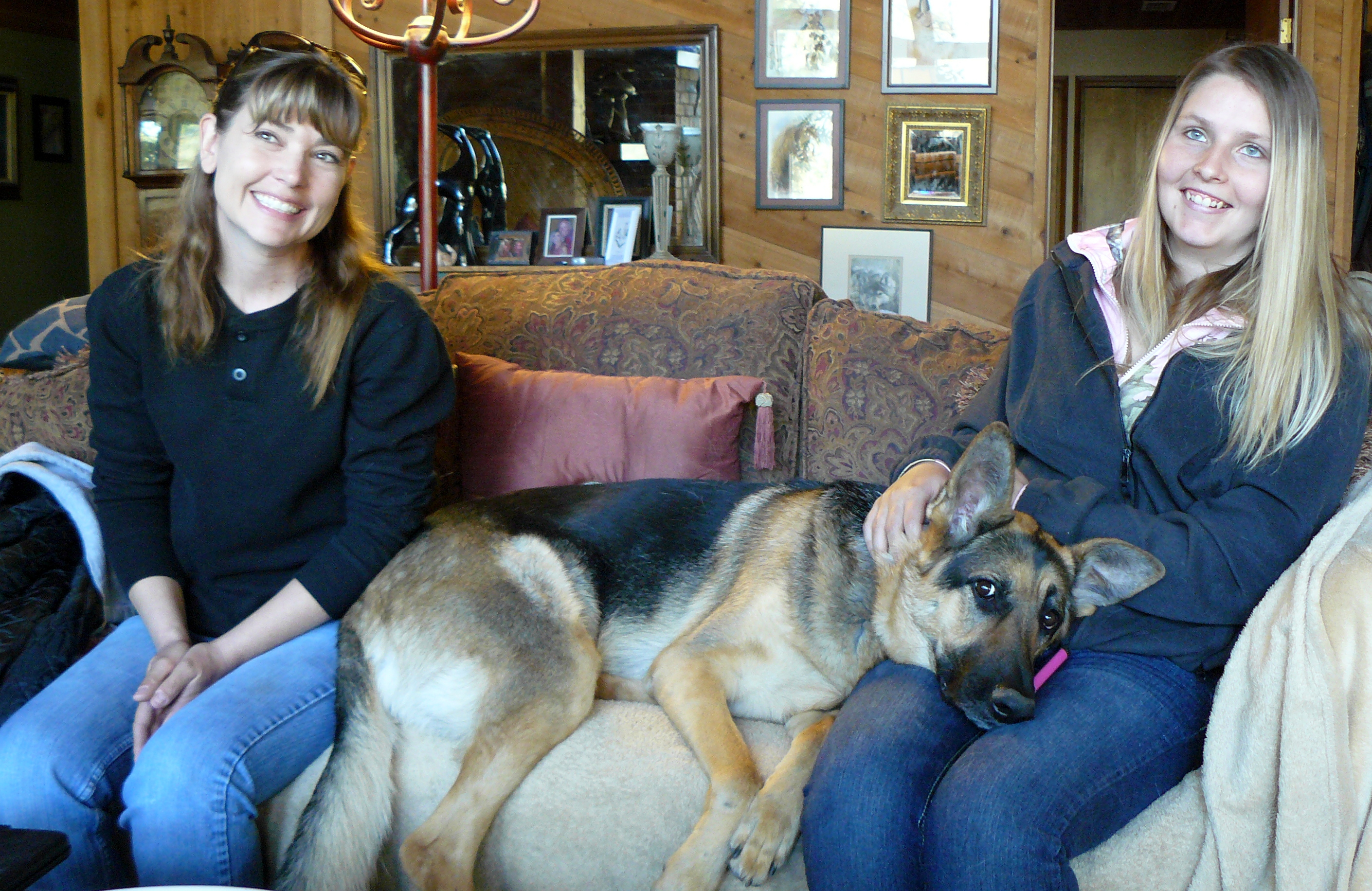
Cleo between guests Darla and Cody- picture taken yesterday (March 18th, 2014).
Where to start this story about Cleo?
I guess by going back to the days when I was living in the village of Harberton, near Totnes in South Devon, England. That means going back to 2003, the year when it seemed the right time for me to get a dog. (Jean and I first met in December, 2007) There was always only one breed to be considered; the German Shepherd dog.
Thus that desire for a German Shepherd led me to Sandra Tucker who lived not too many miles away who owned the GSD breeders Jutone. It was at Jutone where I saw the wonderful puppy dog who became my Pharaoh.
But Sandra did better than breed the dog that has meant more to me than words can ever describe, she gave me some fantastic advice. That being that when Pharaoh was getting on in life, then bring in a German Shepherd puppy. There were two solid reasons why this made sense. The first was that Pharaoh would teach the new puppy many of the skills and disciplines that Pharaoh had learnt as a young dog and, secondly, the puppy would keep Pharaoh active.
That puppy was Cleo.
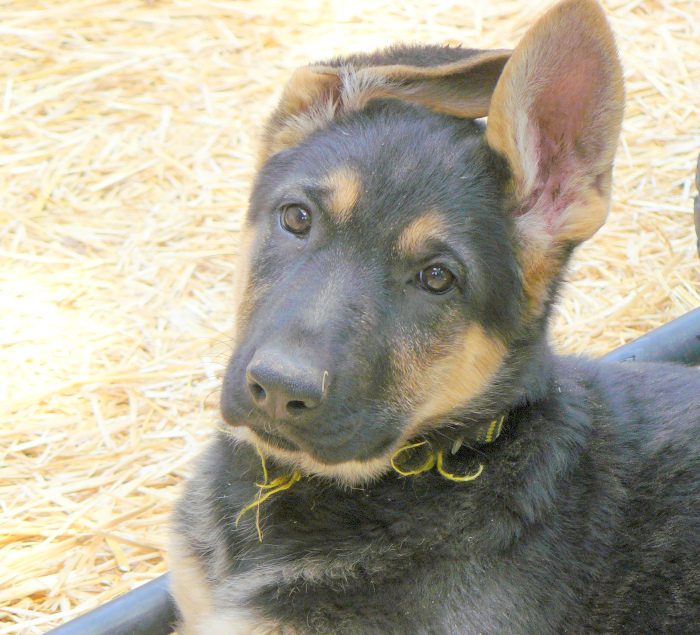
First picture of what was to be our puppy – 4th April, 2012, just two days before we brought her home.
oooo
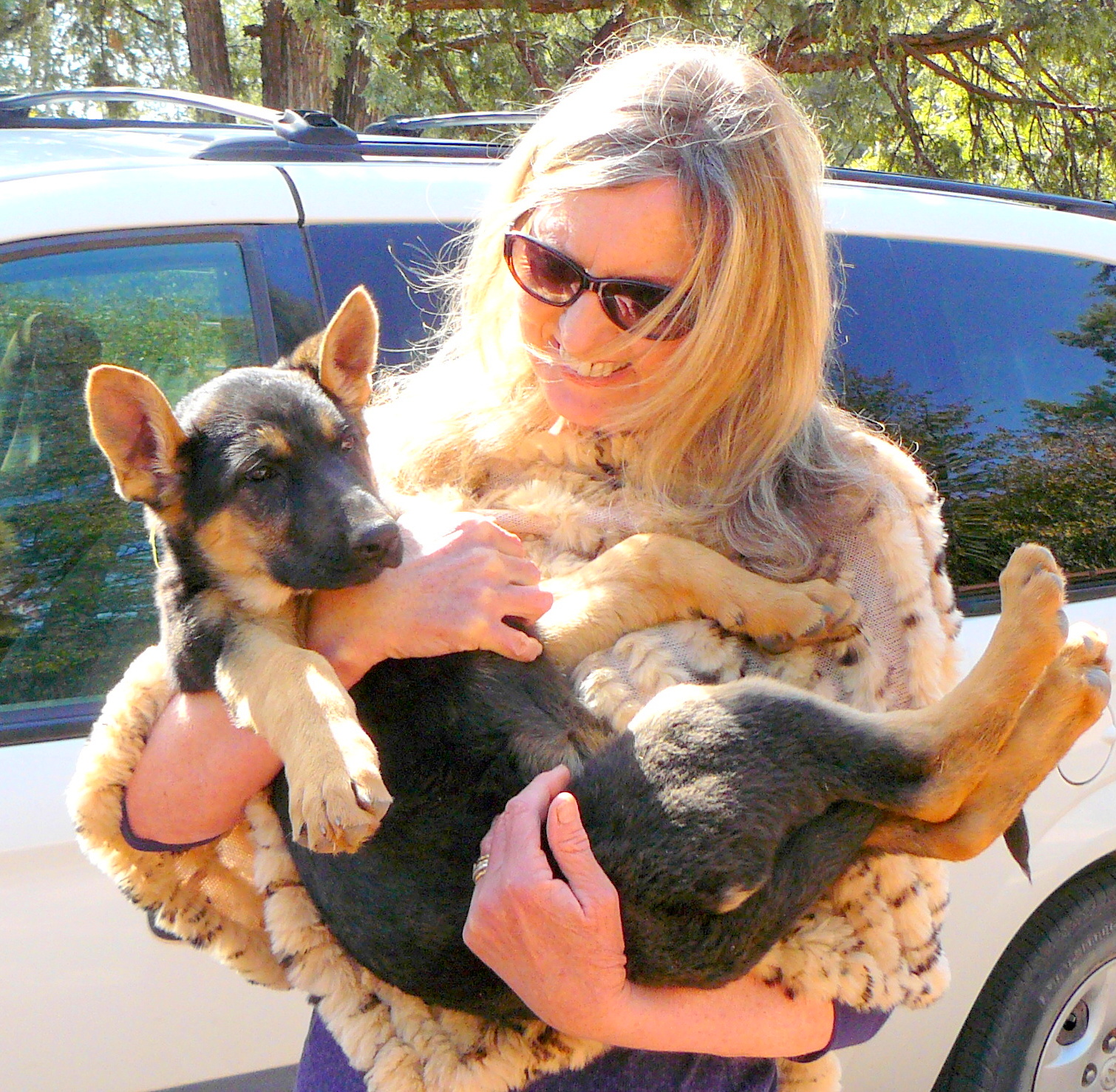
Puppy Cleo coming home – April 6th, 2012
Cleo was born on the 23rd January, 2012. At that time we were still living down in Payson, Arizona. Right from the start she was, and still is, the most joyful, loving dog one could imagine. That top photograph shows in her eyes the openness of her heart and soul.
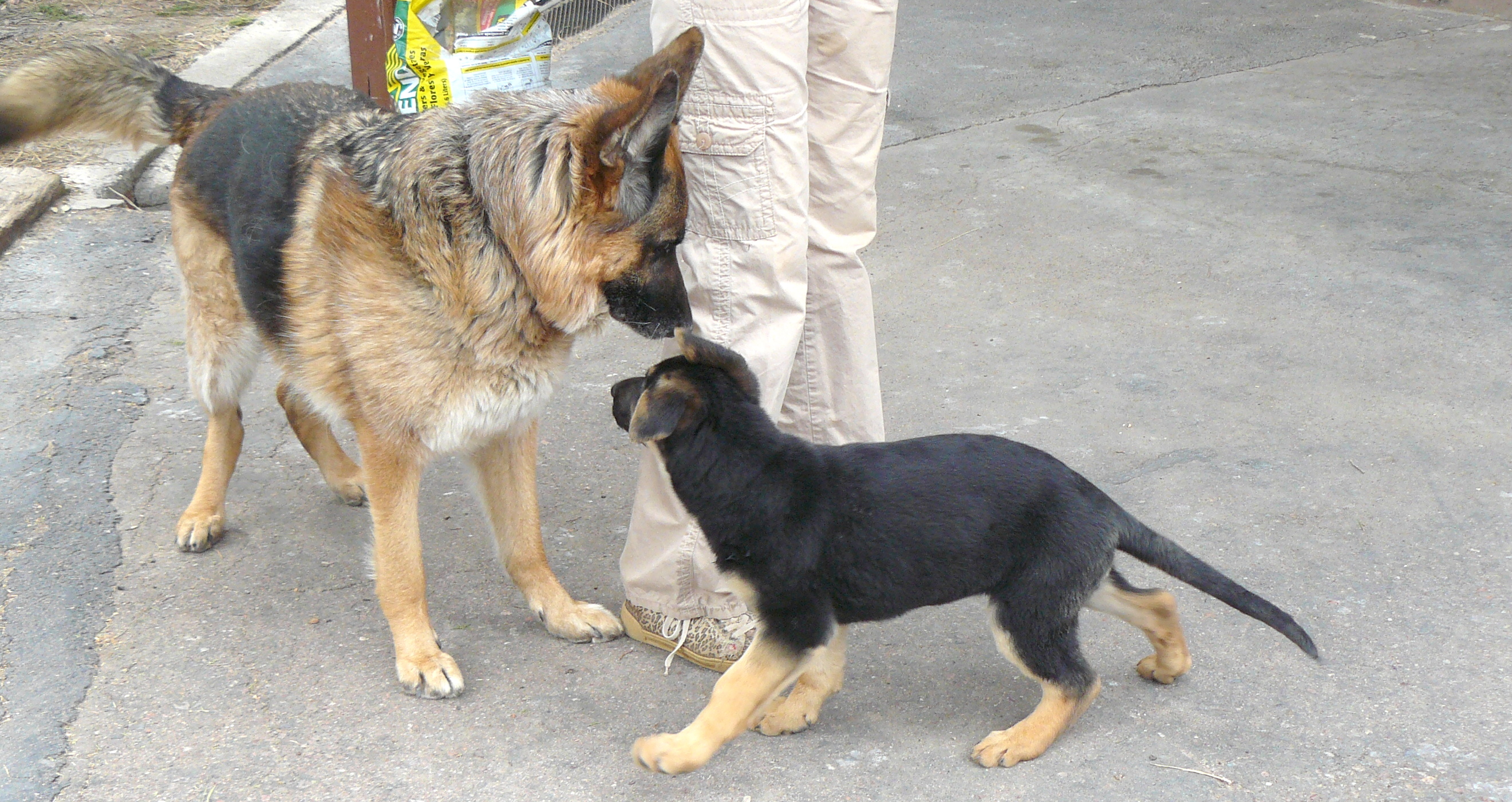
First meeting between Pharaoh and Cleo; April 7th, 2012.
So here we are coming rapidly up to the two-year anniversary (6th April, 2014) of when Cleo entered our lives.
Cleo continues to be the most loving, gentle, sweet German Shepherd.
However, as Sandra so correctly predicted, Pharaoh has ‘taught’ Cleo a number of commands such as Sit, Stay, Lie Down, Come, and more. Not a minute’s training of Cleo has come from Jean and me.
Cleo is very fond of Pharaoh and it’s obvious that Pharaoh gets a huge amount from having Cleo around him.
ooOOoo
Fast forward to now, as in January, 2017, and the relationship between Pharaoh and Cleo is still incredibly important. Cleo senses that Pharaoh is in the last ‘phase’ of his life but still shows him incredible respect.
Cleo is a very intuitive dog who appears at times to really understand what Jean and I are talking about, even when it has nothing to do with dogs. For instance, Cleo knows when I am finishing up my lunch and that the next thing that will follow is Jeannie and me taking the dogs out for their afternoon walk.
Cleo is almost certainly the most knowledgeable and obedient of all of our dogs and it’s all down to Pharaoh’s skills as a teaching dog.
Actually, some recent very interesting research on how puppies relate to the sounds of people around them.
A recent mailing under the SmartNews banner used by The Smithsonian Magazine seemed too good not to share with all you dog lovers.
Plus, our internet connection is not good at the moment so not going to dilly dally but go straight to the article that may be seen on the Smithsonian website here.
ooOOoo
Why Puppies Love Baby Talk
New research shows puppies respond strongly to high-pitched chatter, but most adult dogs could care less.
Anyone who has lived with a dog will find themselves occasionally cooing to their pup in slow-paced, high-pitched baby talk (OK, maybe most of the time). And a new study suggests that our canines respond to such dulcet tones—well, puppies do at least.
The study, published this week in the Proceedings of Royal Society B, shows that the baby-talk, also known as dog-directed speech, gets a big response from puppies. Older dogs, however, aren’t super impressed, reports Virginia Morell at Science.
The study’s researchers had 30 female volunteers look at photographs of dogs while reading standard dog-directed phrases, like “Who’s a good boy?” and “Hello cutie!” (they didn’t use real dogs to minimize the speakers going off script). The volunteers also read the doggie praise to a human. The researchers found that women used the higher-pitched, sing-song baby-talk tone when reading the passages to the photos, making their voices 21 percent higher when reading to the puppy images. With the human, they spoke in their normal voice.
That was more or less expected. But when the researchers played recordings of the women’s voices to ten puppies and ten adult dogs at a New York animal shelter, there was a stark difference. The puppies went wild when they heard the dog-directed voices. Morell reports they barked and ran toward the loudspeaker, crouching down in a pose used to start a round of horseplay. When researchers played the same phrases using the women’s normal tone of voice, the puppies weren’t nearly as enthused.
The adult dogs, however, were a different story. “They didn’t care at all,” Nicolas Mathevon, a bioacoustician at the University of Lyon in Saint-Étienne, France, and co-author of the study tells Morell. “They had a quick look at the speaker, and then ignored it.”
There’s no clear reason why the puppies reacted so strongly to the baby talk and the mature animals didn’t. It’s possible the higher-pitched tones stimulate a special response in the puppies. Mathevon tells Helen Briggs at the BBC that it may be related to a theory called the baby schema. In that hypothesis, humans evolved to find big eyes, big heads and round cheeks irresistibly cute. That helps parents bond with children, convincing them to spend the endless hours required to feed and tend to infants. Many of those cues are also found in baby animals.
But there may be more to the response. “One of the hypotheses was that we humans use this dog-directed speech because we are sensitive to the baby cues that come from the face of a small baby [animal] as we are sensitive to the faces of our babies,” he tells Briggs. “But actually our study demonstrates that we use pet-directed speech or infant-directed speech not only because of that but maybe we use this kind of speech pattern when we want to engage and interact with a non-speaking listener. Maybe this speaking strategy is used in any context when we feel that the listener may not fully master the language or has difficulty to understand us.”
Over time humans have bred dogs to be more baby-like, which only makes humans bond with them more, Evan Maclean, an evolutionary anthropologist at the University of Arizona not involved in the study tells Nicola Davis at The Guardian. “As a result of selection for juvenile traits, dogs emit a lot of signals that scream ‘baby’ to humans, which can facilitate special kinds of interactions with dogs that are normally reserved for children,” he says. “The question we don’t have a great answer to is whether there are long term functional consequences of interacting with dogs in this way (e.g. effects on word learning), or if this is just a byproduct of the baby-like cues that dogs inundate us with.”
So why did the older dogs just keep chewing their bones when they heard the strangers’ voices coming from the speaker? “[M]aybe older dogs do not react that way because they are just more choosy and they want only to react with a familiar person,” Mathevon tells Briggs.
ooOOoo
I think there’s more to this than the slightly light-hearted tone that came across in the article (well to my ears anyway!).
If you want to study the published proceedings from The Royal Society, referred to by Jason Daley in the second paragraph, then the paper is here:
Dog-directed speech: why do we use it and do dogs pay attention to it?
For those looking for answers to the crisis in liberal democracy, this may well be it.
In yesterday’s post Tensions abound in many societies I offered a viewpoint that the ‘left’ arguing with the ‘right’ in politics was utterly inappropriate. Simply for we, as in the people who live on this planet, have to start working together if we wish to have a future for mankind on Planet Earth.
Yesterday’s post also referred to Inductive and Deductive Reasoning with me proposing that the future had to be built on a universally acknowledged relationship between ’cause’ and ‘effect’. A relationship that was built on a clear axiom, or theorem; as we see all around us in both the physical and natural worlds.
This idea does take a little time to filter through and I would be the first to say that I had to spend quite a while reflecting on the idea to fully understand the difference, the power, of deductive reasoning. Plus how something that was a behaviourial ‘law’ could be seen as much as an axiom as is, for example, the calculation of the speed of light, or the relationship of gravity to mass.
His thesis is that there is a direct relationship between “… about how well dispersed economic decision-making power is and how much control and financial security people have over their lives.“
That relationship is the core message of his essay.
In other words, as I see it, there is an axiom, a theorem, that governs the relationship between the leadership process of a country and the degree to which that country’s society could be classed as a democratic society.
If 2016 brought Brexit, Donald Trump and a backlash against cosmopolitan visions of globalisation and society, the great fear for 2017 is further shocks from right-wing populists like Geert Wilders in Holland and Marine Le Pen in France. A new mood of intolerance, xenophobia and protectionist economics seems to be in the air.
In a world of zero-hour contracts, Uber, Deliveroo and the gig economy, access to decent work and a sustainable family income remains the main fault line between the winners and losers from globalisation. Drill into the voter data behind Brexit and Trump and they have much to do with economically marginalised voters in old industrial areas, from South Wales to Nord-Pas-de-Calais, from Tyneside to Ohio and Michigan.
These voters’ economic concerns about industrial closures, immigrants and businesses decamping to low-wage countries seemed ignored by a liberal elite espousing free trade, flexible labour and deregulation. They turned instead to populist “outsiders” with simplistic yet ultimately flawed political and economic narratives.
Much has been said about the crisis of liberal political democracy, but these trends look inextricably linked with what is sometimes referred to as economic democracy. This is about how well dispersed economic decision-making power is and how much control and financial security people have over their lives. I’ve been involved in a project to look at how this compares between different countries. The results say much about the point we have reached, and where we might be heading in future.
The index
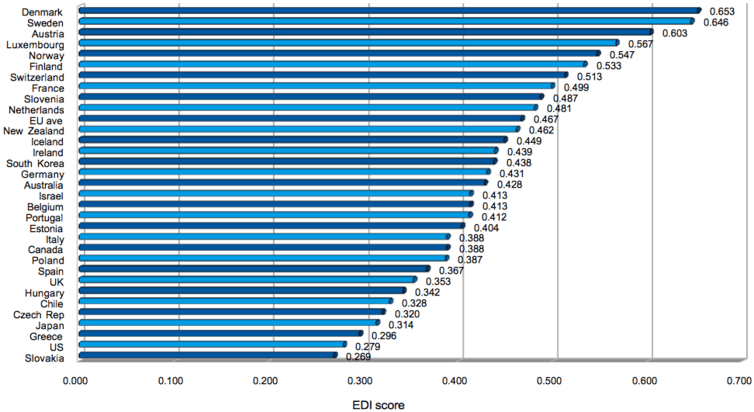
Our economic democracy index looked at 32 countries in the OECD (omitting Turkey and Mexico, which had too much missing data). While economic democracy tends to focus on levels of trade union influence and the extent of cooperative ownership in a country, we wanted to take in other relevant factors.
We added three additional indicators: “workplace and employment rights”; “distribution of economic decision-making powers”, including everything from the strength of the financial sector to the extent to which tax powers are centralised; and “transparency and democratic engagement in macroeconomic decision-making”, which takes in corruption, accountability, central bank transparency and different social partners’ involvement in shaping policy.
What is striking is the basic difference between a more “social” model of northern European capitalism and the more market-driven Anglo-American model. Hence the Scandinavian countries score among the best, with their higher levels of social protection, employment rights and democratic participation in economic decision-making. The reverse is true of the more deregulated, concentrated and less democratic economies of the English-speaking world. The US ranks particularly low, with only Slovakia below it. The UK too is only 25th out of 32.
Economic Democracy Index, figures from 2013. Andrew Cumbers
Interestingly, France ranks relatively highly. This reflects its strong levels of job protection and employee involvement in corporate decision-making – the fact that the far right has been strong in France for a number of years indicates its popularity stems from race at least as much as economics.
Yet leading mainstream presidential candidates François Fillon and Emmanuel Macron are committed to reducing France’s protections. These are often blamed – without much real evidence – for the country’s sluggish job creation record. There is a clear danger both here and in the Netherlands that a continuing commitment to such neoliberal labour market policies might push working class voters further towards Le Pen and Wilders.
One other notable disparity in the index is between the scores of Austria and Germany, despite their relatively similar economic governance. Germany’s lower ranking reflects the growth of labour market insecurity and lower levels of job protection, particularly for part-time workers as part of the Hartz IV labour market reforms in the 1990s that followed reunification.
The index also highlights the comparatively poor levels of economic democracy in the “transition” economies of eastern Europe. The one very interesting exception is Slovenia, which merits further study. It might reflect both its relatively stable transition from communism and the civil war in the former Yugoslavia, and the continuing presence of active civil society elements in the trade union and cooperative movements. Southern European economies also tend to rank below northern European countries, as does Japan.
Poverty and inequality
The index provides strong evidence that xenophobic politics may be linked to changing levels of economic participation and empowerment – notwithstanding the French data. We found that the greater the poverty and inequality in a country, the lower the rates of economic democracy.
These findings suggest, for example, that the Anglo-American-led attack on trade unions and flexible labour policies may actually drive up poverty and inequality by cutting welfare benefits and driving up individual employment insecurity. While the OECD itself advocated these policies until recently, countries with high levels of economic democracy such as Norway, Denmark and Iceland have much lower levels of poverty than countries such as the US and UK.
Far right activists in Budapest, Hungary, February 2016. EPA
Far-right populism is on the march everywhere, including the Nordic countries. But Brexit, Trump and the more serious shift to the far right in Eastern Europe have been accompanied by diminishing economic security and rights at work, disenfranchised trade unions and cooperatives, and economic decision-making concentrated among financial, political and corporate elites.
We will monitor these scores in future to see what happens over time. It will be interesting to see how the correlations between economic democracy, poverty and voting patterns develop in the coming years. For those looking for answers to the crisis in liberal democracy, this may well be it.
ooOOoo
I shall be writing to Professor Cumbers asking if my analysis of that relationship is supported by his research.
For if it is then we do have a very clear axiom that few would disagree with. That is the political consensus this world needs now.
For both humans and, in consequence, for those dogs close to us.
Effectively, the whole of the New Year has been a tad challenging here in Merlin, OR. For even before the snows arrived early on in January, leading to power outages and frozen pipes, the local weather service was warning of unusually severe storms. Indeed, more than once we have heard locals speaking of this looking like a one-hundred-year-storm.
So it was inevitable that there were some anxious periods. Plus the challenging weather may not be not fully behind us. For this is the current (Sunday 18:00 PST) weather warning:
HYDROLOGIC OUTLOOK
NATIONAL WEATHER SERVICE MEDFORD, OR
134 PM PST SUN JAN 15 2017
…Flood Potential Outlook for main stem river flooding, snow melt flooding, and quick rises on rivers and streams in the following counties…in California…Siskiyou…and in Oregon…Coos… Curry…Douglas…Jackson…Josephine…
A strong atmospheric river event is expected to arrive in Southern Oregon and Northern California by Wednesday. While models have trended towards a faster progression of the front, and therefore lesser rainfall amounts, this event may still produce high snow levels, periods of heavy rain, and significant melting of lower level snow-pack Wednesday and into Thursday. With the extensive snow-pack, saturated soils and high river levels, there is a potential for flooding and rapid rises along main stem rivers and small creeks and streams. Urban areas may also experience high water from blocked culverts and runoff.
Continue to monitor forecasts for any updates as this potentially hazardous situation develops.
Anyone who has a dog (or several) in their lives will know how our anxiety is so quickly picked up by our dogs. Ergo, looking after our dogs, as in keeping them relaxed, is really important.
Now read this article that was published over on the Care2 site. I am republishing here for all you good people.
Does your dog suffer from anxiety? A lot of rescued dogs do, and often we don’t know the exact cause for their nervousness. Abuse, neglect or even a single bad experience before you adopted your dog could cause mild to debilitating anxiety. These natural remedies for dog anxiety have worked wonders for my very anxious dog.
We adopted my dog, Jenna, two years ago. Jenna was three years old when we rescued her, and her story still breaks my heart. Lifeline Animal Project rescued Jenna from an animal hoarder when she was six months old. For those first six months, she lived in a crate 24/7. They didn’t even take her out to pee and poop, they just changed the newspaper or laid new paper down. Jenna lived in Lifeline’s no-kill shelter for two and a half years before she was socialized enough to be adoptable.
Even after those years of care, Jenna was still incredibly fearful when we got her home. For the first 36 hours that we had her, she didn’t pee or poop at all. She basically sat on her bed, shaking. By the end of second day we could get her to eat and use the bathroom, but it took weeks for her to finally trust us.
We’ve had Jenna for two years now, and she is a completely different dog. She is still wary of strangers and has her nervous moments, but she loves to run and play. She’s even warmed up to family and friends who visit us often. Jenna is always going to have a high base level of anxiety, but thanks to the natural remedies I’m going to get into below, she also can relax and behave like a normal dog the vast majority of the time.
Look at this mellow, happy gal!
Natural Remedies for Dog Anxiety
Every dog’s situation is different, so what worked for Jenna may not work for your dog. If one of these natural remedies isn’t doing it for your nervous dog, try another one! This is a laundry list of everything that’s worked and one thing that didn’t work for us but does for too many other dog owners to leave out of the list. Pick and choose natural remedies as you find out what helps with your dog’s anxiety.
1. Obedience Training
I can’t recommend a good trainer enough. Training gives your anxious dog confidence, and a good trainer can help you with commands that are especially important. I’ve been taking Jenna to training on and off the entire time that we’ve had her, and it has been a miracle for us. It took a few months for us to start seeing results, so don’t expect a quick fix from this. The long-term benefits for you and your dog are well worth it.
2. Exercise
Getting exercise with your dog is a bonding experience, and it also helps her work off some of that nervous energy. Jenna and I run 9-15 miles a week together, when I can swing it, and she loves to run more than anything else. We had to stop running towards the end of my pregnancy, and on that first run back, she had a huge puppy grin on the whole time we were out.
Running is just one way to get your dog exercise. You can go for walks, play catch, or play training games like “touch.” Whatever you choose to do, talk to your vet first. Some breeds of dog are great runners, but others (like pugs) can overheat easily and need lower-key exercise.
3. Essential Oils
One fear that Jenna is definitely not over is thunderstorms. She shuts down during storms, which can be rough during spring and summer when it storms frequently here in Atlanta. Essential oils combined with Rescue Remedy (more on that below) have helped her out a lot. Choose a calming scent like lavender, and just put a couple of drops onto the dog’s collar. Putting it on the collar is key, because then your dog can smell the soothing oil but can’t eat it.
4. Rescue Remedy
Rescue Remedy is a blend of flower extracts, and they make blends for pets and for humans. We use the liquid for pets and feed it to her in a lump of peanut butter. (**** See my Footnote below) It calms her down considerably. Though, to be honest, I do wonder if getting her favorite treat (peanut butter) has something to do with it. You can find Rescue Remedy at natural food stores or online.
5. Focus Toys
Redirecting your dog’s attention when she’s feeling anxious can be a big help. You can try using commands that you learned in training class, or you can give your dog a focus toy. There are all varieties of these. You can go with a rawhide bone or one of those puzzle toys that dispenses treats when the dog gets it right. Jenna’s favorite toy is a Nylabone. She’s a 50 pound lab mix, so she tears through a rawhide in minutes. She’s had the same Nylabone for months, and it’s still pretty much intact.
6. Watching Your Tone
When your dog is scared, how do you react? Do you say, “It’s OK, sweetie!” in a higher-pitched voice than usual? This is a normal reaction, but it’s actually not the best one when your dog is scared. If your dog sees you as the alpha in the pack, she’s going to take her cues from you, and that kind of attention rewards your dog’s fear, reinforcing it.
Next time your dog is scared, try to react as if everything is normal. You can put a hand on her back, so she knows that you’re there, but try not to make a big deal out of the situation. Don’t say “It’s OK.” Instead, show her that everything is OK with your body language.
7. Crate Training
We were lucky that Jenna was crate trained when we adopted her. For an anxious dog, the crate can be a “safe place” they can retreat to. When there’s a thunderstorm or our neighbors decide to shoot off fireworks, Jenna often curls up in her crate. Dogs like a small, cozy space. If you’re not into crate training, I’d suggest setting up a dog bed in a quiet corner or even under an end table, so your dog has a cozy place that’s hers where she can go when she is scared.
8. The Thunder Shirt
This is the one natural remedy on this list that has not worked for us at all. Jenna is more afraid of the Thunder Shirt than she is of thunder! We are definitely outliers here, though. Every dog owner I know that has an anxious dog recommends the Thunder Shirt to me when I mention Jenna’s fear of storms. This is a great example of how different natural remedies work for some dogs and not others. The Thunder Shirt is definitely worth a shot! If it doesn’t work for you, you can pass it on to a fellow dog owner or donate it to your local shelter.
ooOOoo
Footnote!
Regarding feeding dogs peanut butter, do not, repeat not, do this until you are sure that the brand of peanut butter you are considering is free of the ingredient xylitol.
I wrote of the dangers of xylitol in a post last December 8th. It is being republished in an hour’s time just to make sure the widest number of readers of this place are aware of the danger.
Anyway, this seemed like a very useful article. Plus there’s another benefit of having one’s loved dogs in a relaxed state. It helps the people around those dogs remain relaxed as well!
Brandy and Jean enjoying mutual relaxation!
Chill out everyone! Both the two-legged and the four-legged ones!
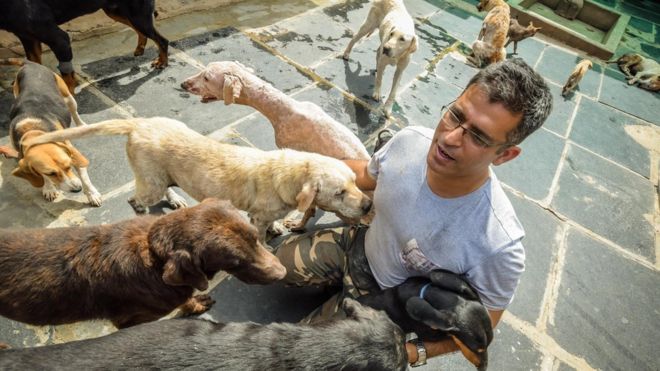
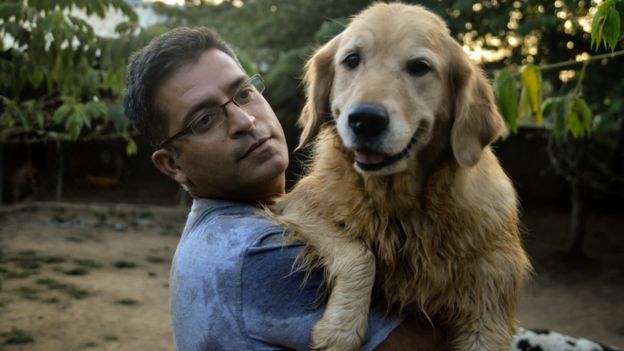
Rakesh runs a charity called The Voice of Stray Dogs (VoSD).The WikiPedia entry is a bit light on details but the UK arm of The Huffington Post makes up for that. Here’s an extract from the news item:
VoSD was founded by Mr Rakesh Shukla, affectionately known as the “Dog Father”. It was set up single-handedly after he felt obliged to do something about the plight of stray dogs in India. Well known for keeping dogs in his home [ the VoSD Sanctuary] and in his office, Rakesh has worked tirelessly to raise funds for the care of stray dogs [ with greater than 90% contributed by himself]. One visitor said ““Rakesh’s growing family of rescued dogs is a sight to behold. It is amazing how so many dogs together get on so well“.
He operates a system that has rescued more than 3000 dogs in 2 years with 400+ permanent dogs under his care. VoSD offers the highest standard of service and is equipped with the latest technology so that stray dogs get the best possible care.
Back to the BBC item that I am taking the liberty of republishing in full.
ooOOoo
The man who looks after 735 dogs
19 December 2016, India
Rakesh Shukla is a software engineer who’s found his life’s calling in looking after dogs that no-one wants, writes the BBC’s Geeta Pandey in Bangalore.
The car pulled up outside a dusty farmhouse near the capital of the southern Indian state of Karnataka and suddenly dogs were everywhere, yelping and barking, jumping with joy.
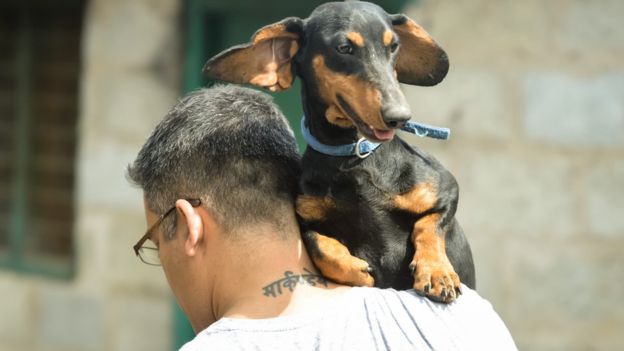
Within seconds, they were all over Rakesh Shukla, nuzzling him and licking him, and Mr Shukla was as delighted to see them. He spoke to them, patted some, scratched one behind the ears, and lofted another onto his shoulder.
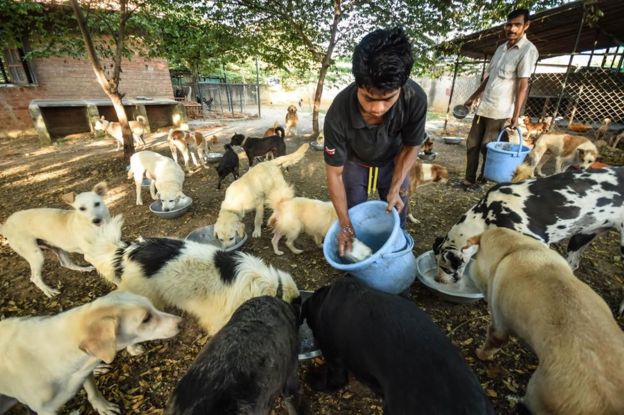
Then he gave me a tour of his three and a half acre farm. At last count, Mr Shukla had 735 dogs.
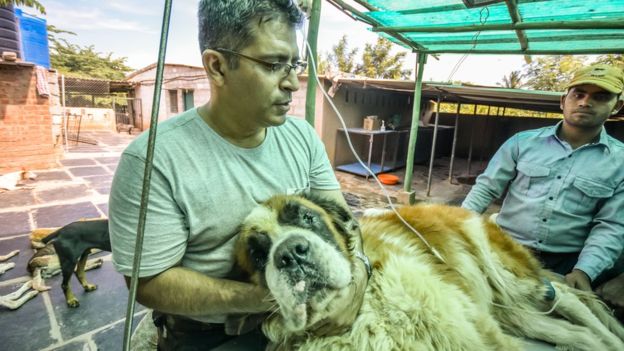
There are Labradors on the farm, there are Golden Retrievers, Great Danes, Beagles, Dachshunds, Rottweilers, Saint Bernards and even a pug. There are hundreds of mongrels too.
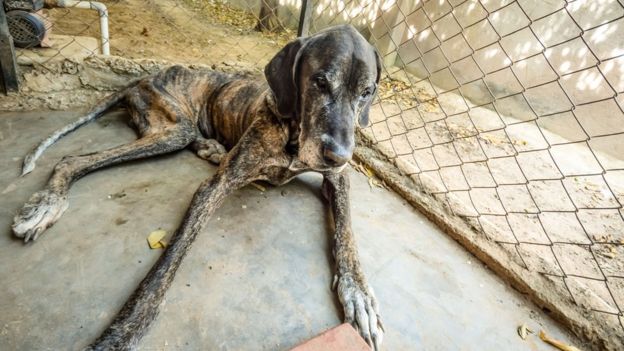
Most of the dogs are strays, the others have been abandoned by their owners. The latest arrivals was a group of 22 pedigreed dogs whose owner, a city businessman, was shot dead recently by criminals.
“I’m the last stop for these dogs. They are no longer cute and cuddly. Many are sick and no longer wanted,” said Mr Shukla, 45.
Affectionately known as the “Dog Father”, he calls the dogs his babies and him their “papa”.
Mr Shukla, who founded a software company along with his wife 10 years ago, spends three to four days every week on the farm, taking care of his canines.
“I had worked in Delhi, in the United States and then set up my own company in Bangalore,” he said. “Life was all about buying big cars and expensive watches and living a fancy life. I had travelled and seen the world many times over, but then I was not happy.”
Then Kavya came into his life: a beautiful 45-day-old Golden Retriever that he fell hopelessly in love with. It was in June 2009, and Mr Shukla remembers clearly the day he brought her home.
“When we got home, she went and hid in a corner. I got down to her level on the floor and I was calling out to her. She was looking at me, she was scared, but I could see she wanted to trust me,” he said.
“And that’s when the moment happened – it was a physical feeling, my hair was tingling, I could feel a warm glow. And I’ve never needed to ask myself that question – ‘why am I here?’ – again after that.”
Mr Shukla’s second dog, Lucky, came to him three months later when he rescued her from the streets. “It had been raining for 12-13 days, she was wet and miserable, so I brought her home too,” he said.
Over the coming days and weeks, whenever he met a stray or abandoned dog, he brought it home. Initially he kept them there but when his wife protested, he moved some of them to the office, where the top floor was turned into a home for dogs.
In 2012, as the pack grew, Mr Shukla bought land in Doddballapur town and set up the farm – a haven for dogs that are old, ailing or simply unwanted.
The farm is designed for its canine residents, with lots of open spaces for them to run around and ponds to swim in, and there’s double fencing to keep them safe.
Every time we entered an enclosure, a cacophony of barks greeted us.
The farm employs about 10 people, including trained veterinary assistants, to look after the dogs, cook for them and feed them. The dogs are fed 200kg of chicken and another 200kg of rice daily and many of the sick ones need regular medicines and attention.
The daily cost of running the centre is 45,000 to 50,000 rupees ($663; £532 to $737; £592), according to Mr Shukla, who said he provided 93% of the funds.
In the past year though, he has run into problems with some animal activists, who have demanded that they be allowed onto the farm. He has also faced complaints that he is creating public unrest by keeping so many dogs. There have also been demands that he shut down the farm.
He has refused to concede.
“I’ve made a pact with my dogs,” he said. “We will part only when one of us kicks the bucket.”
ooOOoo
You know that there are many who are desperately worried about 2017 and beyond. The next few years, ten at most, will see the results of this great experiment that humanity is conducting.
Now, I’m happy to put my hand up as someone who does worry at what my generation is leaving for our grandchildren.
Then one comes across people like Rakesh and, somehow, the future doesn’t seem quite so grim.
What a wonderful man.
Published on Oct 8, 2014
Rakesh Shukla is the go-to guy for dog rescue in Bangalore. His privately-funded venture, ‘The Voice of Stray Dogs’ champions the cause of India’s stray/ street dogs with research, publication, litigation, veterinary and healthcare services for stray dogs.
See you all on the other side of Christmas!
But promise me one thing: Never turn your back on a dog in need.
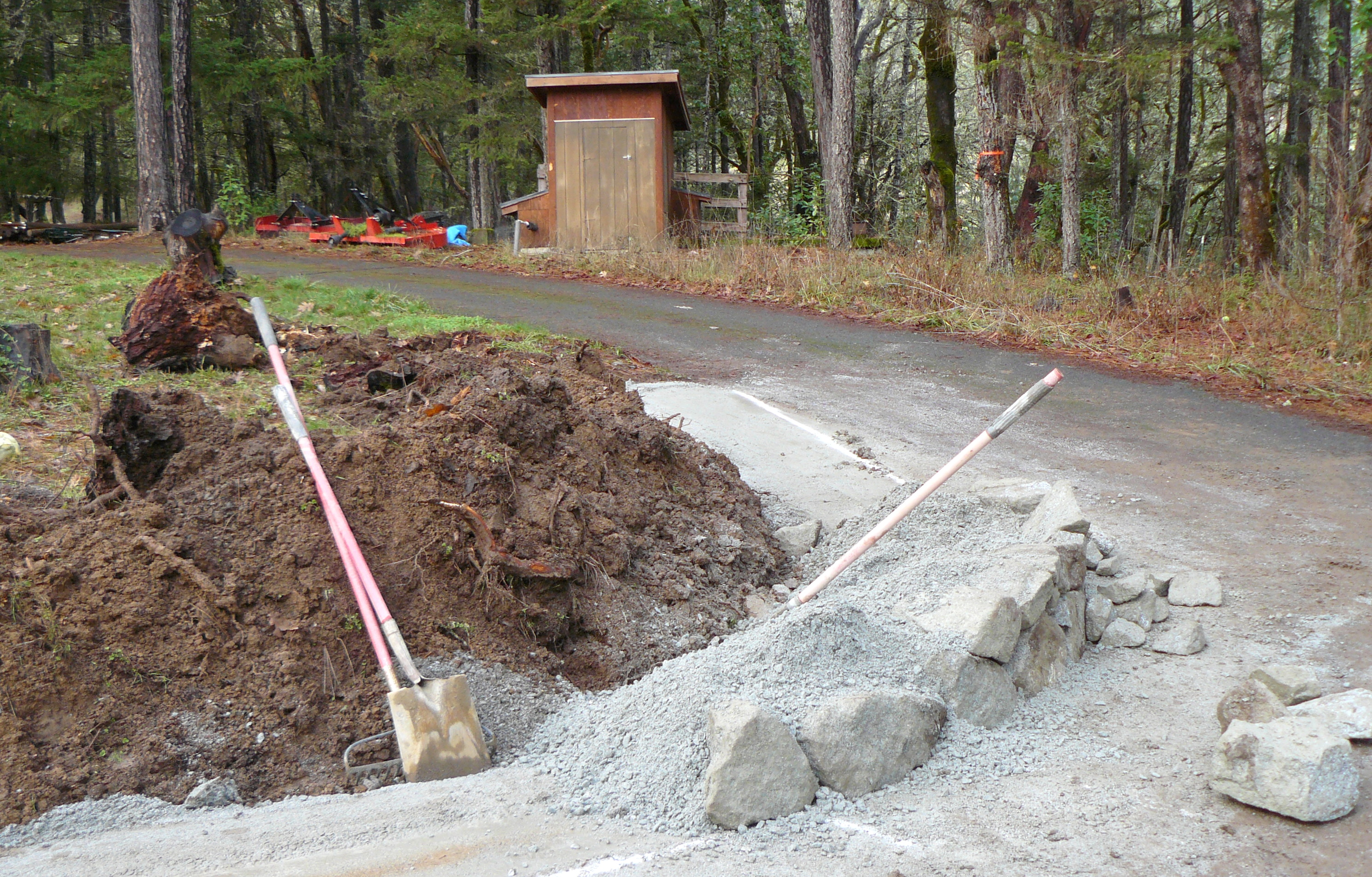
Not long before my mother died we contracted with a local landscaper, Leif Monchallin, to do quite an extensive improvement to the area of land that is to the front of the house. One of the improvements is putting in a dry-stone wall at the top of the driveway just before it splits into a turning circle. The photograph below shows the early stages of that wall.
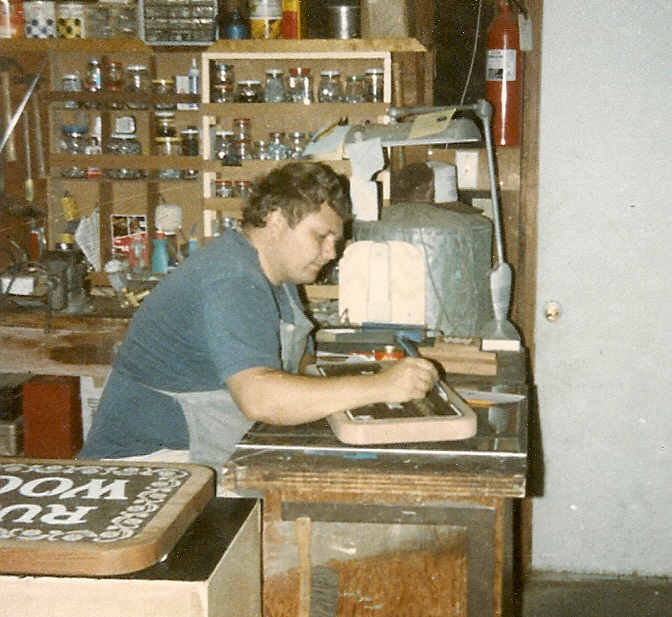
Anyway, Jeannie came up with the idea of putting in some sort of engraved stone right in the centre of the wall. Leif knew of a local stone mason, Oregon Valley Sign Company, and off Jean and I went to meet Bryan Schram, who with his wife, run the business.
Bryan Schram at work.
Between the three of us we came up with a form of words that seemed highly appropriate.
But first off Jean and I had to locate a suitable stone for the engraving and take it over to Bryan’s premises.
Once that was done then it was about a week before we went to collect the engraved stone with the lettering also painted (that was Bryan’s wife’s area of expertise).
Finally, Leif placed the engraved stone in the wall after taking meticulous care to ensure it was perfectly positioned.
Here’s the result.
My mother was a musician and music teacher for most of her life and Jeannie’s Mum, Florence, was a great lover of music and dancing. Hence the clefs either side of the wording.
A rather special reminder of our mothers; don’t you think!
Taken in the round I don’t think I’m ageing too badly. But there is one aspect of my world that does drive me bonkers from time to time. That is a decline (and that’s putting it politely) in my short-term memory. Everything from forgetting what it was I wanted to say to Jeannie to still being unsure of finding regularly visited places in Grants Pass, our local city. To put that last point into context we moved here to Merlin, some 12 miles from Grants Pass, back in September, 2012.
Turning to the cognitive skills of our wonderful dogs it is clear to me that we can only go so far in understanding how our dogs think and how much of their world is dealing with the present supported by their memories of previous events. (Frankly, in writing the last sentence I realised how even that premise was more of a guess than a known fact.)
A recent study at Eotvos Lorand University in Budapest about the memories of dogs has been widely referred to across many news outlets. So when it appeared on the Care2 site it was a natural to republish it for all you good people.
My doorbell has been broken for a few years, but every time my 9-year-old dog, Leroy, hears one chiming on a TV show, he looks at the front door.
Many pet owners have similar tales to tell about their dogs being able to remember long-ago experiences and events. And now we have proof that this really is possible. A new study found that dogs may have a more complex form of memory than most other nonhuman animals (sorry, elephants).
“Every move you make, every step you take, I’ll be watching you,” Sting once sang, and these lyrics could apply to our dogs, too. They’re not only watching us, but they’re remembering what they’re observing, no matter how trivial it may seem to us.
In the study at Eotvos Lorand University in Budapest, published Nov. 23 in Current Biology, 17 dogs were taught a training method called “Do As I Do.” The dogs would watch their owners perform an action. When the dogs were told, “Do it” and imitated their owners’ action, they were rewarded with a treat.
Next, the owners performed various actions but told the dogs to lie down instead of “Do it.” After a while, the dogs began lying down without being told to do so. The study’s authors noted that this showed the dogs had lost the expectation that they would be given the “Do it” command to imitate their owners.
Finally, the owners performed various actions, and when their dogs would lie down, the owners would wait either a minute or an hour and then give them the “Do it” command.
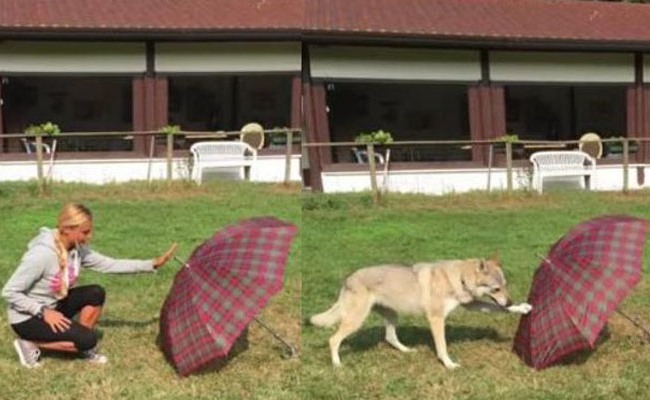
Some of the actions were unfamiliar to the dogs, such as their owners tapping on an open umbrella. The dogs would be led behind a partition, and a minute to an hour later would be led back to the umbrella and given the “Do it” command.
The dogs were able to remember what their owners had done, and tapped the umbrella with their paws.
“We cannot directly investigate what is in the dog’s mind,” psychologist Claudia Fugazza, an author of the study and owner of a Czechoslovakian Wolfdog who participated, told the Washington Post. “So we have to find behavioral evidence of what they expect or not.”
Remembering events in our lives is known as episodic memory. Until recently, only humans were thought to have this ability, but studies have found evidence that rats, monkeys and birds also have it, and so do dogs.
However, the researchers said the dogs don’t have full-fledged episodic memory, which would give them self awareness. Fugazza told NPR she didn’t think there was a method available to test whether dogs are self aware.
Victoria Templer, a behavioral neuroscientist at Providence College who wasn’t involved in the study, told NPR the results could be useful in helping scientists understand how episodic memory developed in humans and how it’s helped us to survive.
One interesting possibility Templer suggested is that “we evolved the ability to relive the past in order to imagine the future.”
ooOOoo
Of course what would be a marvelous aspect of a dog’s memory is being able to take note and remember where his male human companion left items around the house!
This was a day when a massage would have been perfect treatment!
On Wednesday afternoon Jean and I hooked a big flatbed trailer, borrowed from a neighbour, to our pickup truck and went into town to collect a new sectional settee that we had recently purchased at a furniture sale.
Yesterday, Michael who comes in to help us on a regular basis turned up at 8:30 and we all set to. First up was to dismantle an old sectional in our den that had seen much better days and then carry that out to the front.
Next we moved a settee from our living-room to the den.
Last up was to unpack all three units that comprised the new sectional. Oh, nearly forgot! Then the old sectional from the den was loaded on to the trailer and taken to the tip!
By the end of the day this Brit, who will be 72 in a couple of weeks time, was feeling the odd aching muscle or two!
Most animals can benefit from massage, but whether it’s theraputic or not, they sure enjoy it, just like we do. (Photo: Serjey Saraschenko/Shutterstock)
I get massages whenever I’m able, and it’s my answer to the fun party question: “What would you do with a million dollars?” Well, first I’d pay off my grad school loans, but second on the list would definitely be weekly massage. Every time I get one, I end up walking on air; for me it’s like doing a yoga class without the effort.
But watching massage can be relaxing too — not watching people (that’s icky), but animals. I’m not the only one: My Facebook feed is littered with people posting and reposting cute furry animals both wild and domesticated getting backs kneaded and shoulders rubbed. My favorites are below, so if you need a moment of chill, check out a couple of these and relax.
This corgi’s face massage is a joy to watch, and it’s funny too — check out his reclining position which is more guy-napping-on-a-pool-float than canine.
This sweet gray kitten getting an ever-so-gentle facial massage in the sunshine starts out asleep and seems to get more relaxed as you watch. Is that even possible?
Guinea pigs are known for being snuggly creatures, but also nervous ones. Watching this one slowly relax does the same thing for me.
If you get sucked into this video like I did, you’ll be rewarded with a soft-as-marshmallow white bunny, which follows the gray bunny. Spoiler alert: Both get lots of love.
The relaxation and happiness of this pregnant cow getting a solid rubdown is crystal clear even though the video quality is low.
Aside from dogs, horses are probably the domesticated animal that gets the most serious massage attention, since many of them are performers and athletes, either in the dressage ring or on a racecourse. So there are lots of instructional videos about horse massage, but I think Jess, a trained horse massage therapist, shows it best.
There are a lot of animals that give themselves massages, especially otters. This one is clearly an expert — after a solid minute of scalp massage, she has a nap!
ooOOoo
Well I have to say that receiving a massage directly would have been a tad better than watching these animals get their massages, but it was way, way better than nothing!
NB: Regular readers will find that today’s post is rather different to my usual run of things. But I do hope that you end up sharing my feelings of mystery; sharing what seems to me utterly incomprehensible. I am speaking of The Infinite.
Let me start with this quotation:
The infinite has always stirred the emotions of mankind more deeply than any other question.
The infinite has stimulated and fertilised reason as few other ideas have. But also the infinite, more than another other notion, is in need of clarification.
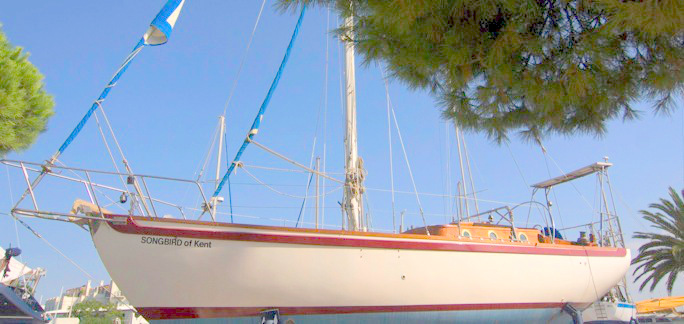
Let me now take you back many years, back to the Autumn of 1969 when I left Gibraltar bound for The Azores on my yacht Songbird of Kent. I was sailing solo.
My home for five years – Songbird of Kent; a Tradewind 33.
Despite me being very familiar with my boat, and with sailing in general, there was nonetheless a deep sense of trepidation as I headed out into a vast unfamiliar ocean.
On the third or fourth night, I forget which, when some four hundred miles into the Atlantic and therefore far from the light pollution from the land, I came on deck and was emotionally moved in a way that has never ever been surpassed.
For way up in the heavens above me was the Andromeda galaxy, clearly visible with the naked eye.
Josh Blash captured this image of the Andromeda galaxy.
Although a couple of dozen minor galaxies lie closer to our Milky Way, the Andromeda galaxy is the closest major galaxy to ours. Excluding the Large and Small Magellanic Clouds, which can’t be seen from northerly latitudes, the Andromeda galaxy – also known as M31 – is the brightest galaxy in all the heavens. It’s the most distant thing you can see with your unaided eye, at 2.3 million light-years. To the eye, it appears as a smudge of light larger than a full moon.
Not only could I not take my mind off seeing the Andromeda galaxy, I couldn’t easily comprehend seeing the stars come all the way down to the horizon; all 360 degrees about me. Right down to the edge of my ocean horizon; a swirling blackness out to where it kissed that glorious night sky.
That image of that dome of stars would be forever burnt into my memory. An image that both made no sense, yet made every sense
Fast forward forty-seven years to now!
Recently we have had some beautiful clear nights here in Southern Oregon. Just the other night, before the moon had risen, there up in the night sky just a short distance from the constellation Cassiopeia was Andromeda. Immediately, my memory of that dark night sky out in the Atlantic came rushing back at me
The Andromeda galaxy is 2.3 million light-years away. But how can one possibly comprehend the distance? The fact that light travels at 186,000 miles per second or 671 million miles per hour (the exact value is 299,792,458 metres per second (approximately 3.00×10⁸ m/s) has no meaning whatsoever. Think about it! Light is traveling at the equivalent speed of going around our planet 7.46 times every second!
But if you can’t fathom the distance to the Andromeda galaxy try this!
Back in March, 2016 a new galaxy that has been named GN-z11 was spotted by the Hubble space telescope 13.4 billion light years away. That’s approximately 5,830 times more distant than the Andromeda galaxy!
Now it is starting to become very difficult to comprehend.
But it was episode eight that made me lose my mind. Just like that night so many years ago on Songbird of Kent.
For that episode was called The Cosmos. You can listen to it here. Please, please do so! This is how that episode is presented:
Does space go on for ever? Are there infinitely many stars? These are some of the questions Adrian Moore explores in the eighth episode in his series about philosophical thought concerning the infinite.
With the help of the theories of the Ancient Greeks through to those of modern cosmologists, Adrian examines the central question of whether our universe is finite or infinite.
For most of us, looking up at the stars gives us a sense of infinity but, as Adrian discovers, there is a strong body of opinion which suggests that space is finite, albeit unbounded. This is a difficult idea to grasp, but by inviting us to think of ourselves as ants, astrophysics professor Jo Dunkley attempts to explain it.
Adrian also tackles the idea of the expanding universe and the logic that leads cosmologists to argue that it all started with a big bang, and may all end with a big crunch.
Finally, we discover from cosmologist John Barrow how the appearance of an infinity in scientists’ calculations sends them straight back to the drawing board. The infinite, which the Ancient Greeks found so troubling, has lost none of its power to disturb.
A Juniper production for BBC Radio 4.
If you find that episode compelling beyond belief then all the episodes are available on the BBC iPlayer and may be found here.
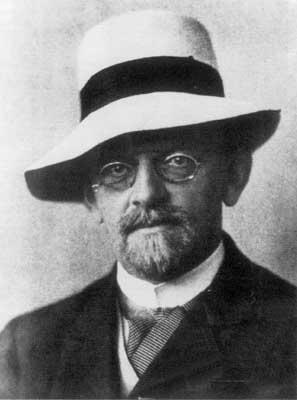
I started with a quotation that is the opening of the final episode. It is a quotation from the German mathematician David Hilbert. As Wikipedia explains, in part:
David Hilbert (German: [ˈdaːvɪt ˈhɪlbɐt]; 23 January 1862 – 14 February 1943) was a German mathematician. He is recognized as one of the most influential and universal mathematicians of the 19th and early 20th centuries.
I will return to that first sentence in Hilbert’s quotation:
The infinite has always stirred the emotions of mankind more deeply than any other question.
For me that sight of the Andromeda galaxy and the stars back in 1969 was in every meaning of the word a sight of the infinite and it has forever stirred my emotions very deeply indeed!
Here Are Some Heavy Duty Dog Toys You Can Make Yourself
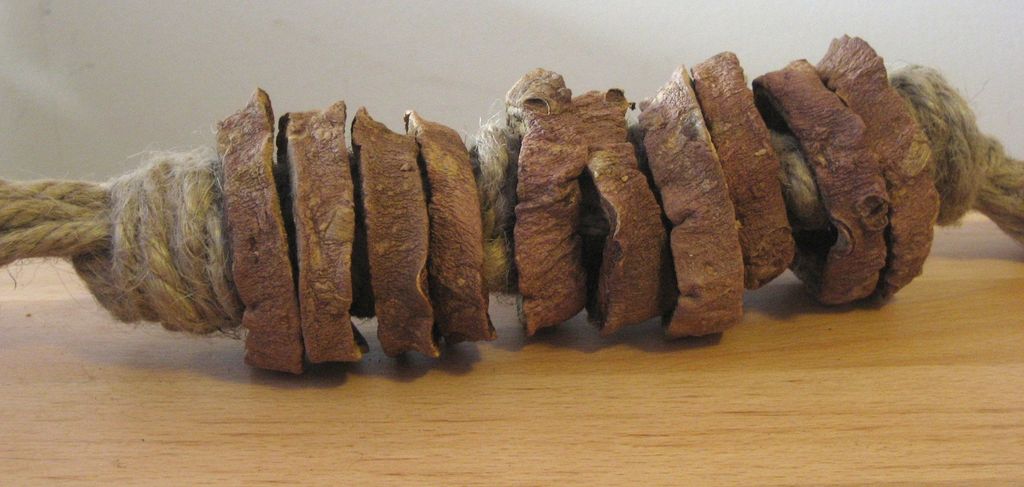
#1: “Indestructible Dog Toy (Made with Dried Sweet Potato)
I love this toy because it’s both healthy for my dog and has no unnecessary additives. It’s a great chew toy and treat all in one.
Shesparticular on instructibles.com came up with this idea for a DIY chew toy for her mom’s dog. Her mom’s dog, Molly, loves to play. She says when Molly plays it “usually involves rounding up all her toys and ripping them to shreds.”
In Shesparticular’s pictures of Molly, you can tell she’s a little dog. It may seem surprising, but little dogs can do just as much damage as big ones. So this recipe she’s come up with is pure genius if you want to make strong dog toys that are healthy for your dog.
Here’s what you’ll need and instructions on how to make this toy at home:
Hemp or jute rope. Nine 2 1/2 foot ropes braided together to make a larger rope works for medium sized dogs. You’ll need to adjust the length of the rope based on your dog’s size.
Sweet potatoes or yams. One potato for a smaller toy, two for a medium toy and three to four for a larger toy
Sheet pan and parchment or foil
A sharp knife
Round cookie cutter a bit larger than the diameter of your rope
Vegetable peeler (optional)
Instructions:
Preheat your oven to 250 degrees Fahrenheit
Wash your sweet potatoes well. Peeling them isn’t necessary unless you prefer it.
Slice the sweet potato into rounds approximately 1/2″ thick
Using the cookie cutter, remove the center of each round
Place rounds on cookie sheet and bake for 2 1/2 hours then flip them over and bake for another 2 1/2 hours.
They’re done when they’re dried out and hard. If there are any soft parts, bake them longer and check them every 30 minutes.
Once they’re done, allow them to cool.
These sweet potato rings look like hollowed out dog bones, without the risk of splintering
Once your sweet potato rings have cooled, you can start making your toy.
Start by tying a knot at the end of your hemp rope. If you’re using many thinner pieces, braid them together. This will make it easier to string the sweet potato pieces on.
String two potato rings onto your rope then tie a knot in the rope. Continue adding two rings at a time and tying a knot after each pair until you reach the end of the rope.
When you’ve finished, hand this toy over to your dog and watch them chew for hours.
# 2: Knotted Hand Towel Toy
I have so many old hand towels that I didn’t know what to do with until I saw this clever idea.
This toy’s so easy to make, even a dog could do it. Taylor Martin from cnet.com came up with this simple way to repurpose old linens and make a great dog toy.
All you have to do is take an old, tattered hand towel and tie a knot in the middle. You can even use a full sized towel and make several knots.
My dog is a Pitbull mix, so though this is a tough toy, he would likely still rip it to shreds. The good news is, it doesn’t cost a cent. So even if it only lasts a few days, you didn’t lose any money on it.
#3: Ring Dog Toy
Just looking at this toy, you can tell it’s tough. No way my Pitt mix will be able to destroy this.
A user called J3443RY at instructables.com designed this indestructible dog toy. This is just a basic rope knot toy.
If you know how to tie a crown knot, all you need to do is create two lengths of rope by tying 4 lengths of rope in crown knots. All you need to make this toy is some nylon repelling rope.
Here are some step by step instructions for creating this toy
Cut 4 equal lengths of rope. You can adjust the size of the toy based on the size of your dog. 4 Inches of rope is equal to 1 inch of the finished toy. For example; for a 6 inch finished knot you would need 24 inches of rope to start.
Use 2 of the 4 ropes to create a 7″ long finished crown knot.
For step three, the user has included an instructional video. This will help you to combine the two finished knots into one ring.
When you’re finished with this toy, you will have a nearly chew proof dog toy that your dog can enjoy for hours.
For more advice on caring for your dog and other great recipes, visit metroeastrba.com.
Now Check Out Some Cool Doggy Dental Treats
#4: Darla Cook’s Homemade Greenies
I can’t get over how adorable these little tooth brush shapes are.
Darla Cook is a blogger and a lover of culinary arts. She is a student at The Culinary Institute of America, so you know her recipes must be the best.
Darla’s blog focuses on general cooking and there aren’t many dog recipes on her blog. But I found a pretty great recipe there for homemade Greenies for dogs. She calls these adorable toothbrush shaped treats Franks Breath Brushes.
If you’re a pet owner, you know that Greenies are a great dental treat for your dog, but they’re expensive to buy.
If you want to save money and have more control over what goes into your dog’s treats, make them yourself at home.
Here is Darla’s recipe.
Franks Breath Brushes
Ingredients:
3 1/2 brown rice flour plus 2 cups more (rice flour for crunch)
1 tablespoon of activated charcoal (I opened 12 capsules for 1 tablespoon.)
Preheat over to 400F. Line your baking sheet with parchment paper.
Combine the charcoal with 3 1/2 cups brown rice flour and set it aside.
Put parsley, mint oil and 1/4 cup of broth or water into food processor. Process until chopped, like pesto. Add 3-4 droppers full of chlorophyll. Pulse a few times to mix. Add this green paste to flour mixture and mix well. Beat egg and mix in. Knead adding the rest of water/broth. By this time you should have a sticky dough ball. Flour the work surface and knead dough until an even green color. Divide dough into workable portions and roll out to about 1/4 inch thick. Add flour to the work surface and dough surface as needed to take away stickiness as you work. Cut out with your favorite shapes, and dock with a fork to keep puffiness down. Bake for 25 or 20 minutes. Cool and store in an airtight container in the fridge.
I will be trying these treats on my dog, for sure. I feel much more confident in the treats I feed my dog when I can make them myself and I know what’s in them.
#5 DIY Doggy Breath Mints
These treats look good enough for even humans to eat.
I’ve found yet another great dog breath freshening recipe. This recipe, by Clifford Genece at skinnyms.com, has something in common with Darla’s recipe. It doesn’t contain any wheat flour.
It is so important to avoid giving your dog anything that contains wheat flour. Many dogs are allergic to wheat products. It can cause some pretty intense itching and skin irritation.
Rather than using flower at all, this recipe calls for oatmeal. This recipe also calls for eggs. So Clifford even provides advice for people whose dogs are allergic to poultry products.
Here’s Clifford’s simple recipe for these yummy treats.
Ingredients:
2 1/2 cups old-fashioned oats
1/2 cup fresh parsley, finely chopped
1/2 cup fresh mint, finely chopped
1 large egg
1/4 cup of water, plus 1 teaspoon
3 tablespoons coconut oil (unrefined extra-virgin is best)
Directions:
Preheat the oven to 325° F
Add oats to a blender and pulse to a flour like consistency. In a large bowl whisk together diced parsley and mint, egg, water, and oil. Add oat flour and stir to combine. Knead dough a few times then turn out onto a lightly floured surface.
Using your hands or a rolling pin, flatten dough to about 1/8″ thick. Using a cookie cutter or knife cut out approximately 40 (1-inch mints) mints. Place mints about 1/4-inch apart on a parchment lined or non-stick cookie sheet. Bake 35-40 minutes, or until golden and crispy.
Allow mints to cool completely before serving. Store in an airtight container.
Tip: For dogs with allergies to chicken products, substitute one large egg with 1/4 cup unsweetened applesauce.
These are some of my favorite DIY dental treats and dog toys for powerful chewers. These treats and toys are a great way to keep your dog’s jaws strong and breath fresh. Don’t forget to take a look in your dog’s mouth every now and then and make sure their teeth are in good condition.
Description: Dental treats and dog toys for powerful chewers can be expensive, so why not make your own at home? Give these helpful recipes and DIY dog toys a try.
ooOOoo
Don’t know about you but we think this has been a very valuable and useful article from Sarah!