Category: Humour

Having fun with history.

Nothing to do with dogs but, nonetheless, a neat way to finish the week.

I was looking at a recent George Monbiot essay and getting myself all wound up about it, thinking that it should be today’s post. Then I thought, “Come on, Paul, end the week on a gentle tone.”

So with that in mind, let me offer you an item on British history that Su sent me a week ago. I can’t authenticate the details but my instinct is that everything mentioned is correct.

ooOOoo

There is an old Pub in Marble Arch, London, which used to have a gallows adjacent to it. Prisoners were taken to the gallows (after a “fair” trial of course) to be hanged. The horse-drawn dray, carting the prisoner, was accompanied by an armed guard, who would stop the dray outside the pub and ask the prisoner if he would like ”ONE LAST DRINK.” If he said YES, it was referred to as ONE FOR THE ROAD. If he declined, that prisoner was ON THE WAGON.

So there you go … On with some more history.

They used to use urine to tan animal skins, so families used to all pee in a pot and then once a day the pot was taken and sold to the tannery. If you had to do this to survive you were “piss poor”, but worse than that were the really poor folk, who couldn’t even afford to buy a pot, they “didn’t have a pot to piss in” and were the lowest of the low. The next time you are washing your hands and complain because the water temperature isn’t just how you like it, think about how things used to be.

Here are some more facts about the 1500s:

Most people got married in June, because they took their yearly bath in May and they still smelled pretty good by June. However, since they were starting to smell, brides carried a bouquet of flowers to hide the body odor. Hence the custom today of carrying a bridal bouquet when getting married.

Baths consisted of a big tub filled with hot water. The man of the house had the privilege of the nice clean water, then all the other sons and men, then the women and finally the children. Last of all came the babies. By then the water was so dirty you could actually lose someone in it. Hence the saying, “Don’t throw the baby out with the bath water!”

Houses had thatched roofs, thick straw piled high on the rafters, with no wood underneath. It was the only place for animals to get warm, so all the cats and other small animals (mice, bugs) lived in the roof. When it rained it became slippery and sometimes the animals would slip and fall off the roof. Hence the saying “It’s raining cats and dogs.” There was nothing to stop things from falling into the house.

This posed a real problem in the bedroom, where bugs and other droppings could mess up your nice clean bed. Hence, a bed with four big posts and a sheet hung over the top afforded some protection. That’s how canopy beds came into existence.

The floor was dirt. Only the wealthy had something other than a dirt floor. Hence the saying, “dirt poor.” The wealthy had slate floors that would get slippery in winter when wet, so they spread thresh (straw) on floor to help keep their footing. As the winter wore on they added more thresh until, when you opened the door, it would all start slipping outside. A piece of wood was placed in the entrance. Hence: a threshold.

In those old days, they cooked in the kitchen with a big kettle that always hung over the fire. Every day they lit the fire and added things to the pot. They ate mostly vegetables and did not get much meat. They would eat the stew for dinner, leaving leftovers in the pot to get cold overnight, then start over the next day. Sometimes stew had food in it that had been there for quite a while. Hence the rhyme: ”Peas porridge hot, peas porridge cold, peas porridge in the pot, nine days old.” Sometimes they could get pork, which made them feel quite special. When visitors came over they would hang up their bacon, to show off.

It was a sign of wealth that a man could, “Bring home the bacon.” They would cut off a little to share with their guests and would all sit around talking and ”chew the fat.”

Those with money had plates made of pewter. Food with high acid content caused some of the lead to leach onto the food, causing lead poisoning and death. This happened most often with tomatoes, so for the next 400 years or so, tomatoes were considered poisonous.

Bread was divided according to status. Workers got the burnt bottom of the loaf, the family got the middle, and guests got the top, or ”The Upper Crust.”

Lead cups were used to drink ale or whisky. The combination would sometimes knock the imbibers out for a couple of days. Someone walking along the road would take them for dead and prepare them for burial. They were laid out on the kitchen table for a couple of days and the family would gather around and eat and drink and wait and see if they would wake up. Hence the custom of ”Holding a Wake.”

England is old and small and the local folks started running out of places to bury people, so they would dig up coffins and would take the bones to a bone-house and reuse the grave site. When reopening these coffins, 1 out of 25 coffins were found to have scratch marks on the inside and they realised they had been burying people alive. So they would tie a string on the wrist of the corpse, thread it out through the coffin and up through the ground and tie it to a bell. Someone would have to sit out in the graveyard all night (the graveyard shift) to listen for the a bell; thus someone could be, ”Saved by the Bell ”or was considered a ”Dead Ringer.” And that’s the truth.

Now, whoever said history was boring ! ! !
So ….. get out there and educate someone!

ooOOoo

Just out of curiosity, I did a web search on that Pub in Marble Arch. Quickly came across this, from which I quote, in part:

The site of the Tyburn Tree is said to be at what is now Marble Arch, at the north-east corner of Hyde Park. Some historians give a more precise location as slightly to the north-west at Connaught Square. In fact, many bodies were found there when the square was being built in the 1820s, so it’s possible that some Tyburn victims were buried right where they died.

Mass executions took place on Mondays, when prisoners were transported from Newgate Prison to Tyburn in an open wagon, often in their finest clothes. The procession, which was watched by a large and enthusiastic crowd, wound down Snow Hill, across Holborn Bridge into Holborn, down Broad St Giles into Oxford Street and on to Tyburn.

And it was but a moment to find a photograph of the place.

Tyburn

 You all have a wonderful, relaxing week-end and don’t lose your head over anything!

There’s another year gone!

Yesterday was my 71st birthday.

Consequently, writing a blog post for today wasn’t high on my list of things to do.

So this is to offer my thanks to everyone who sent me greetings; it was wonderful to hear from so many friends, old and new.

Thus my post today is to share three items that came from family back in England.

First, my mother, who is still teaching piano and oboe at the age of 95, sent me this:

Secondly, my son, Alex, and his long-term partner, Lisa, sent me this in an card chosen from the Friends of the Earth selection:

dog cake
(All dog owners know, I’m sure, that dogs must never eat chocolate.)

Lastly, my grandson, Morten, who despite being just five-years-old, is already a dab hand with an iPhone and sent me the following picture of himself with Dad in the background:

photo

Finally, my love and gratitude to Jeannie for making me feel special yesterday, as she has done every day since we first met.

Picture parade one hundred and twenty-one.

The second welcome to the season of mists and autumnal colours.

With thanks to Mother Nature Network where these wonderful photographs were published. Last week’s set are here.

mix8
Photo: Scott Kinmartin/flickr

oooo

Photo: Tanya Uralova/Shutterstock

oooo

Photo: Tanya Uralova/Shutterstock
Photo: AJU_photography/flickr

oooo

Photo: Kichigin/Shutterstock

oooo

Photo: Josh McGinn/flickr

oooo

Photo: otsphoto/Shutterstock

oooo

Photo: Mark Jones/flickr

The third and final welcome will be in a week’s time.

You all take care out there.

Saturday smile

Just think what it would be like if all our nine dogs were as helpful as this!

Please, all of you dear readers, have a happy and relaxed weekend.

Friday frolics.

Let’s end the week on a light-hearted note.

There have been some pretty serious posts in recent days and I wanted to close off the week with something completely different!

The following was sent to me from Dan earlier on this week. It is socially incorrect and, for the sake of clarity, I don’t subscribe to this form of gender bias in any way.

But it sure is funny!

Why Some Men Have Dogs And Not Wives:

dogs1

1. The later you are, the more excited your dogs are to see you.

dogs2

2. Dogs don’t notice if you call them by another dog’s name.

dogs3

3. Dogs like it if you leave a lot of things on the floor.

dogs4

4. A dog’s parents never visit.

dogs5

5. Dogs agree that you have to raise your voice to get your point across.

dogs6

6. You never have to wait for a dog; they’re ready to go 24 hours a day.

dogs7

7. Dogs find you amusing when you’re drunk..

dogs8

8. Dogs like to go hunting and fishing.

dogs9

9. A dog will not wake you up at night to ask, “If I died, would you get another dog?”

dogs10

10. If a dog has babies, you can put an ad in the paper and give them away.

dogs11

11. A dog will let you put a studded collar on it without calling you a pervert.

dogs12

12. If a dog smells another dog on you, they don’t get mad. They just think it’s interesting.

dogs13

13. Dogs like to ride in the back of a pickup truck.

And last, but not least:

14. If a dog leaves, it won’t take half of your stuff.

To test this theory:

Continue reading “Friday frolics.”

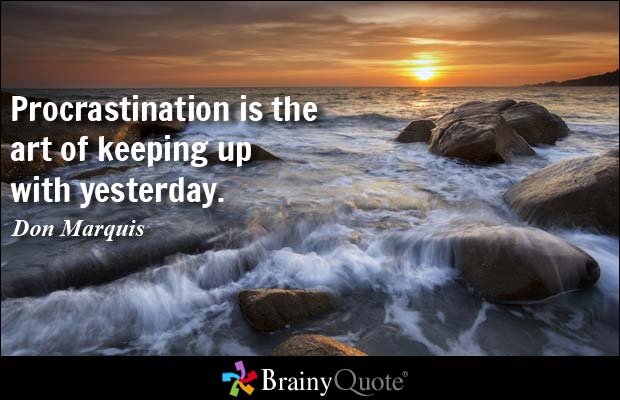
Keeping up with yesterday!

Procrastination is the art of keeping up with yesterday.

Can’t claim credit for the sub-heading; it was taken from BrainyQuote.

donmarquis107414

However, the reason I went looking for a quotation on procrastinating was that I’m doing research for a fairly “heavy” post for tomorrow, and was looking for something quick and easy for today.

My blog folder came up with an essay from The Conversation website that is rather fun. It is republished here on Learning from Dogs within the terms of The Conversation.

ooOOoo

The psychological origins of procrastination – and how we can stop putting things off

October 7, 2015

Authors: Elliot Berkman, Assistant Professor, Psychology, University of Oregon, and Jordan Miller-Ziegler, PhD Candidate in Psychology, University of Oregon.

“I love deadlines,” English author Douglas Adams once wrote. “I love the whooshing noise they make as they go by.”

We’ve all had the experience of wanting to get a project done but putting it off for later. Sometimes we wait because we just don’t care enough about the project, but other times we care a lot – and still end up doing something else. I, for one, end up cleaning my house when I have a lot of papers to grade, even though I know I need to grade them.

So why do we procrastinate? Are we built to operate this way at some times? Or is there something wrong with the way we’re approaching work?

These questions are central to my research on goal pursuit, which could offer some clues from neuroscience about why we procrastinate – and how to overcome this tendency.

To do, or not to do

It all starts with a simple choice between working now on a given project and doing anything else: working on a different project, doing something fun or doing nothing at all.

The decision to work on something is driven by how much we value accomplishing the project in that moment – what psychologists call its subjective value. And procrastination, in psychological terms, is what happens when the value of doing something else outweighs the value of working now.

This way of thinking suggests a simple trick to defeat procrastination: find a way to boost the subjective value of working now, relative to the value of other things. You could increase the value of the project, decrease the value of the distraction, or some combination of the two.

For example, instead of cleaning my house, I might try to focus on why grading is personally important to me. Or I could think about how unpleasant cleaning can actually be – especially when sharing a house with a toddler.

It’s simple advice, but adhering to this strategy can be quite difficult, mainly because there are so many forces that diminish the value of working in the present.

The distant deadline

People are not entirely rational in the way they value things. For example, a dollar bill is worth exactly the same today as it is a week from now, but its subjective value – roughly how good it would feel to own a dollar – depends on other factors besides its face value, such as when we receive it.

The tendency for people to devalue money and other goods based on time is called delay discounting. For example, one study showed that, on average, receiving $100 three months from now is worth the same to people as receiving $83 right now. People would rather lose $17 than wait a few months to get a larger reward.

Other factors also influence subjective value, such as how much money someone has recently gained or lost. The key point is that there is not a perfect match between objective value and subjective value.

Delay discounting is a factor in procrastination because the completion of the project happens in the future. Getting something done is a delayed reward, so its value in the present is reduced: the further away the deadline is, the less attractive it seems to work on the project right now.

Studies have repeatedly shown that the tendency to procrastinate closely follows economic models of delay discounting. Furthermore, people who characterize themselves as procrastinators show an exaggerated effect. They discount the value of getting something done ahead of time even more than other people.

One way to increase the value of completing a task is to make the finish line seem closer. For example, vividly imagining a future reward reduces delay discounting.

No work is ‘effortless’

Not only can completing a project be devalued because it happens in the future, but working on a project can also be unattractive due to the simple fact that work takes effort.

New research supports the idea that mental effort is intrinsically costly; for this reason, people generally choose to work on an easier task rather than a harder task. Furthermore, there are greater subjective costs for work that feels harder (though these costs can be offset by experience with the task at hand).

This leads to the interesting prediction that people would procrastinate more the harder they expect the work to be. That’s because the more effort a task requires, the more someone stands to gain by putting the same amount of effort into something else (a phenomenon economists call opportunity costs). Opportunity costs make working on something that seems hard feels like a loss.

Sure enough, a group of studies shows that people procrastinate more on unpleasant tasks. These results suggest that reducing the pain of working on a project, for example by breaking it down into more familiar and manageable pieces, would be an effective way to reduce procrastination.

Your work, your identity

When we write that procrastination is a side effect of the way we value things, it frames task completion as a product of motivation, rather than ability.

In other words, you can be really good at something, whether it’s cooking a gourmet meal or writing a story, but if you don’t possess the motivation, or sense of importance, to complete the task, it’ll likely be put off.

It was for this reason that the writer Robert Hanks, in a recent essay for the London Review of Books, described procrastination as “a failure of appetites.”

The source of this “appetite” can be a bit tricky. But one could argue that, like our (real) appetite for food, it’s something that’s closely intertwined with our daily lives, our culture and our sense of who we are.

So how does one increase the subjective value of a project? A powerful way – one that my graduate students and I have written about in detail – is to connect the project to your self-concept. Our hypothesis is that projects seen as important to a person’s self-concept will hold more subjective value for that person.

It’s for this reason that Hanks also wrote that procrastination seems to stem from a failure to “identify sufficiently with your future self” – in other words, the self for whom the goal is most relevant.

Because people are motivated to maintain a positive self-concept, goals connected closely to one’s sense of self or identity take on much more value.

Connecting the project to more immediate sources of value, such as life goals or core values, can fill the deficit in subjective value that underlies procrastination.

ooOOoo

So there; glad that’s clear for us all.

Cosy-Lists-2

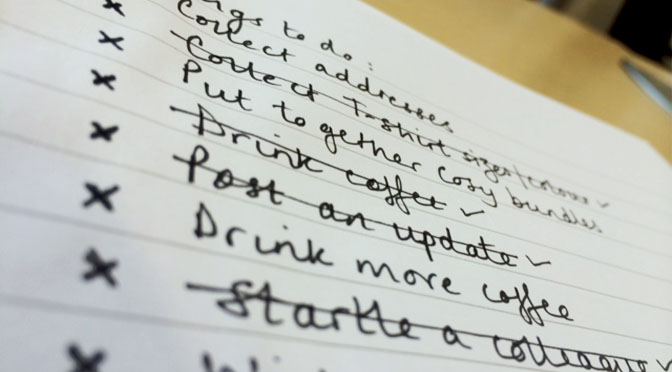
Mustn’t delay – I need to write down a list of all the things I’m not doing today!

Picture parade one hundred and twenty

Welcome to the season of mists and autumnal colours.

With thanks to Mother Nature Network where these wonderful photographs were published.

mix1

oooo

mix2

oooo

mix3

oooo

mix4

oooo

mix5

oooo

mix6

oooo

mix7

oooo

Happy November 1st to you all.

“Fido, may I have this next dance?”

Is there no end to the relationship between our dogs and us!

maxresdefault
The BBC recently carried a gorgeous news item under the heading of: ‘Fido, may I have this dance?’: The women who dance with dogs.

Meet the women who spend years training their pooches to pirouette, plié, and polka – in the competitive global sport of Musical Canine Freestyle.

Spanish film maker Bego Antón has travelled across the USA documenting this curious, and heart-warming, hobby.

She spoke to BBC World Update’s Dan Damon about the skill and practice – and good humour – involved.

Luckily, in this interconnected world we now live in, the BBC video interview made it on to YouTube.

Let me close with a further photograph.

p035wp60

Rather produces a new twist to that old expression, “He dances as if he had two left feet!”

See you tomorrow!

Best laid plans, and all that!

Another lesson from our dogs…..

…. that of not taking life too seriously at times!

I didn’t get to my PC until after 4pm yesterday afternoon and, frankly, didn’t have a clue as to what to post for today.

Then in comes Per Kurowski to rescue me with an email sent earlier in the day, titled: “I do not know if you saw this?”

“This” being the following video.

English: How She is Spoken!

For all those who love the English language.

With thanks to neighbour Dordie who forwarded the following under her introduction of: “This will give you something else to ponder while editing.”

ooOOoo

Heteronyms…

Homographs are words of like spelling but with more than one meaning. A homograph that is also pronounced differently is a heteronym.

You think English is easy?

I think a retired English teacher was bored…THIS IS GREAT!

1) The bandage was wound around the wound.

2) The farm was used to produce produce.

3) The dump was so full that it had to refuse more refuse.

4) We must polish the Polish furniture.

5) He could lead if he would get the lead out.

6) The soldier decided to desert his dessert in the desert.

7) Since there is no time like the present, he thought it was time to present the present.

8) A bass was painted on the head of the bass drum.

9) When shot at, the dove dove into the bushes..

10) I did not object to the object.

11) The insurance was invalid for the invalid.

12) There was a row among the oarsmen about how to row.

13) They were too close to the door to close it.

14) The buck does funny things when the does are present.

15) A seamstress and a sewer fell down into a sewer line.

16) To help with planting, the farmer taught his sow to sow.

17) The wind was too strong for me to wind the sail.

18) Upon seeing the tear in the painting I shed a tear..

19) I had to subject the subject to a series of tests.

20) How can I intimate this to my most intimate friend?

oooo

Let’s face it – English is a crazy language. There is no egg in eggplant, nor ham in hamburger; neither apple nor pine in pineapple. English muffins weren’t invented in England or French fries in France . Sweetmeats are candies while sweetbreads, which aren’t sweet, are meat. We take English for granted. But if we explore its paradoxes, we find that quicksand can work slowly, boxing rings are square and a guinea pig is neither from Guinea nor is it a pig.

And why is it that writers write but fingers don’t fing, grocers don’t groce and hammers don’t ham? If the plural of tooth is teeth, why isn’t the plural of booth, beeth? One goose, 2 geese. So one moose, 2 meese? One index, 2 indices? Doesn’t it seem crazy that you can make amends but not one amend? If you have a bunch of odds and ends and get rid of all but one of them, what do you call it?

If teachers taught, why didn’t preachers praught? If a vegetarian eats vegetables, what does a humanitarian eat? Sometimes I think all the English speakers should be committed to an asylum for the verbally insane. In what language do people recite at a play and play at a recital? Ship by truck and send cargo by ship? Have noses that run and feet that smell?

How can a slim chance and a fat chance be the same, while a wise man and a wise guy are opposites? You have to marvel at the unique lunacy of a language in which your house can burn up as it burns down, in which you fill in a form by filling it out and in which, an alarm goes off by going on.

English was invented by people, not computers, and it reflects the creativity of the human race, which, of course, is not a race at all. That is why, when the stars are out, they are visible, but when the lights are out, they are invisible..

PS. – Why doesn’t ‘Buick’ rhyme with ‘quick’?

You lovers of the English language might enjoy this.

There is a two-letter word that perhaps has more meanings than any other two-letter word, and that is ‘UP.’

It’s easy to understand UP, meaning toward the sky or at the top of the list, but when we awaken in the morning, why do we wake UP?

At a meeting, why does a topic come UP?

Why do we speak UP and why are the officers UP for election and why is it UP to the secretary to write UP a report?

We call UP our friends.

And we use it to brighten UP a room, polish UP the silver; we warm UP the leftovers and clean UP the kitchen.

We lock UP the house and some guys fix UP the old car.

At other times the little word has real special meaning.

People stir UP trouble, line UP for tickets, work UP an appetite, and think UP excuses.

To be dressed is one thing, but to be dressed UP is special..

A drain must be opened UP because it is stopped UP.

We open UP a store in the morning but we close it UP at night.

We seem to be pretty mixed UP about UP!

To be knowledgeable about the proper uses of UP, look the word UP in the dictionary.

In a desk-sized dictionary, it takes UP almost 1/4th of the page and can add UP to about thirty definitions.

If you are UP to it, you might try building UP a list of the many ways UP is used.

It will take UP a lot of your time, but if you don’t give UP, you may wind UP with a hundred or more.

When it threatens to rain, we say it is clouding UP.

When the sun comes out we say it is clearing UP..

When it rains, it wets the earth and often messes things UP.

When it doesn’t rain for a while, things dry UP.

One could go on and on, but I’ll wrap it UP,

for now my time is UP,

so…….it is time to shut UP!

Now it’s UP to you what you do with this email.

ooOOoo

Well, I’m glad that’s all clear then!