Last mutterings for now regarding man’s effect on our Planet!
There’s been a string of items on Learning from Dogs in recent days about mankind’s footprint changing our planet but this Blog is not a single issue Blog unless learning the values of life from dogs is to be seen as a single issue.
So I’m going to include a few more items about climate change/global warming here and leave it for a while. (But, please, don’t let that stop you sending me interesting stuff, as so many of you lovely readers do!)
So more evidence about how the planet has warmed up in this video released by NASA.
Global temperatures have warmed significantly since 1880, the beginning of what scientists call the “modern record.” At this time, the coverage provided by weather stations allowed for essentially global temperature data. As greenhouse gas emissions from energy production, industry and vehicles have increased, temperatures have climbed, most notably since the late 1970s. In this animation of temperature data from 1880-2011, reds indicate temperatures higher than the average during a baseline period of 1951-1980, while blues indicate lower temperatures than the baseline average. (Data source: NASA Goddard Institute for Space Studies. Visualization credit: NASA Goddard Space Flight Center Scientific Visualization Studio)
The global average surface temperature in 2011 was the ninth warmest since 1880, according to NASA scientists. The finding continues a trend in which nine of the 10 warmest years in the modern meteorological record have occurred since the year 2000.
NASA’s Goddard Institute for Space Studies (GISS) in New York, which monitors global surface temperatures on an ongoing basis, released an updated analysis that shows temperatures around the globe in 2011 compared to the average global temperature from the mid-20th century. The comparison shows how Earth continues to experience warmer temperatures than several decades ago. The average temperature around the globe in 2011 was 0.92 degrees F (0.51 C) warmer than the mid-20th century baseline.
“We know the planet is absorbing more energy than it is emitting,” said GISS Director James E. Hansen. “So we are continuing to see a trend toward higher temperatures. Even with the cooling effects of a strong La Niña influence and low solar activity for the past several years, 2011 was one of the 10 warmest years on record.”
The difference between 2011 and the warmest year in the GISS record (2010) is 0.22 degrees F (0.12 C). This underscores the emphasis scientists put on the long-term trend of global temperature rise. Because of the large natural variability of climate, scientists do not expect temperatures to rise consistently year after year. However, they do expect a continuing temperature rise over decades.
The first 11 years of the 21st century experienced notably higher temperatures compared to the middle and late 20th century, Hansen said. The only year from the 20th century in the top 10 warmest years on record is 1998.
Higher temperatures today are largely sustained by increased atmospheric concentrations of greenhouse gases, especially carbon dioxide. These gases absorb infrared radiation emitted by Earth and release that energy into the atmosphere rather than allowing it to escape to space. As their atmospheric concentration has increased, the amount of energy “trapped” by these gases has led to higher temperatures.
Global temperature difference
The carbon dioxide level in the atmosphere was about 285 parts per million in 1880, when the GISS global temperature record begins. By 1960, the average concentration had risen to about 315 parts per million. Today it exceeds 390 parts per million and continues to rise at an accelerating pace.
The temperature analysis produced at GISS is compiled from weather data from more than 1,000 meteorological stations around the world, satellite observations of sea surface temperature and Antarctic research station measurements. A publicly available computer program is used to calculate the difference between surface temperature in a given month and the average temperature for the same place during 1951 to 1980. This three-decade period functions as a baseline for the analysis.
Hansen said he expects record-breaking global average temperature in the next two to three years because solar activity is on the upswing and the next El Niño will increase tropical Pacific temperatures. The warmest years on record were 2005 and 2010, in a virtual tie.
“It’s always dangerous to make predictions about El Niño, but it’s safe to say we’ll see one in the next three years,” Hansen said. “It won’t take a very strong El Niño to push temperatures above 2010.”
Finally, the blogsite Skeptical Science have recently published a fascinating graphic that shows how a single set of data can be interpreted in different ways. That graphic may be seen by clicking here and it comes from a revealing article Still Going Down the Up Escalator. Go read it!
Charles Dickens was born on the 7th February, 1812.
Just a short item from me today.
Charles Dickens
Inevitably, the bicentenary of someone as well known as Charles Dickens is going to be widely celebrated. WikiPedia has a nice summary for someone, such as me, who isn’t too familiar with the writings or life history of Charles Dickens, from which I quote,
Charles John Huffam Dickens (7 February 1812 – 9 June 1870) was an English novelist, generally considered the greatest of the Victorian period. Dickens enjoyed a wider popularity and fame than had any previous author during his lifetime, and he remains popular, having been responsible for some of English literature’s most iconic novels and characters.
Many of his writings were originally published serially, in monthly instalments, a format of publication which Dickens himself helped popularise. Unlike other authors who completed novels before serialisation, Dickens often created the episodes as they were being serialised. The practice lent his stories a particular rhythm, punctuated by cliffhangers to keep the public looking forward to the next instalment. The continuing popularity of his novels and short stories is such that they have never gone out of print.
From the BBC website, there is a podcast that can be downloaded, introduced thus,
Docs: Dreaming Dickens: Feb 03 12
Fri, 3 Feb 12
Duration: 24 mins
In this documentary-fantasy we bring the danger back to Dickens. Slipping in and out of his weird and brilliant imagination, we see modern London as he might have done, travelling through the city’s streets at night to crack dens and strip-joints as the police sirens wail. We meet characters from his novels and characters who would be in his novels if he were still alive today.
By Bryony Jones, CNN
updated 9:16 AM EST, Mon February 6, 2012
London (CNN) — Charles Dickens is one of the world’s best-loved writers, whose books — and the countless film and TV adaptations they inspire — still keep readers (and viewers) on the edge of their seats.
Now, 200 years on from his birth, his genius is to be feted with a host of events marking the bicentenary of one of Britain’s most famous sons.
Dickens 2012 will see everything from readings to royal visits, celebrating the man who gave the world “Oliver Twist,” “David Copperfield” and “Great Expectations.”
In London, the special events will begin with a celebrity performance, by actors Simon Callow and Joanna Lumley, at the Dickens family’s graves in Highgate Cemetery on Monday.
And on Tuesday, the anniversary of Dickens’ birth, the Prince of Wales will lay a wreath at Dickens’ grave in Poet’s Corner, Westminster Abbey, while actor Ralph Fiennes, Dickens’ biographer Claire Tomalin and the author’s great-great-grandson, Mark Dickens give readings.
So, quite rightly, a broad appreciation for the great man.
Two days ago, I wrote a piece about how the evolution of the domestic dog has been reliably re-calibrated back to around 33,000 years ago. I quoted from an article in the Arizona Republic, here are the opening paragraphs of that article.
Tamed dogs may go back 33,000 years
by Anne Ryman – Jan. 24, 2012 11:33 PM
The Republic | azcentral.com
Dogs have been “man’s best friend” longer than any other animal. And, as it turns out, longer than previously thought.
A pair of research papers published in the past few years, one most recently by a team that includes the University of Arizona, significantly pushes back the timeline for domestication of dogs from about 14,000 years ago to more than 30,000 years ago.
Researchers at UA and universities in England and the Netherlands used radiocarbon dating to determine that the skull of a Siberian dog was about 33,000 years old. Slightly older dog remains were identified in Belgium a few years ago by a separate research team.
So moving on, and apologies for a bit of a personal muse.
Last night (the night of the 30th/31st Jan.) a single, gentle yelp from Pharaoh had me instantly awake. Initially hadn’t a clue about the time but instinctively knew it was an un-Godly hour! Jean and I had been late to bed and I was pretty tired when the lights went out – off to sleep in an instant. Ergo, waking up at 2am as it turned out to be, the classic deep-sleep time of the night, was challenging! It is also relevant to mention that Pharaoh is reliably a very good sleeper at night.
Yet, in literally an instant of time, I had transitioned from being totally asleep to being mentally alert wondering what had caused him to cry out. Pharaoh came to the side of the bed and let me rub his head, then went back to near the door and uttered another soft yelp. I knew without any doubt at all that he was in pain and lay on my back anticipating what would be coming – putting a dressing-gown on and leading his nibs out into a very cold and dark night!
Then a clawed paw on the door told me to get moving, and within moments of Pharaoh being outside, it was clear that he had a badly upset tummy.
The whole episode was repeated around 4.45 am.
It was later in the morning that I was reflecting with Jean about the evolution of the dog-human relationship that a) gave the dog the instinctive confidence to call out to his ‘master’ in a different ‘I need help‘ tone, and b) that the call was so rapidly interpreted by a human as a call for help from another species.
But dogs sleeping near or around their human companions for more than 30,000 years allows plenty of time for species bonding to develop in ways that are both beautiful and mysterious. Long may that bonding remain beautiful and mysterious.
Fabulous animals!
Pharaoh. June 2008, 3 months before we both left for Mexico!
Some recent published research shows just how far back goes man’s relationship with the domesticated dog!
First, a big thank you to Merci O. who originally sent me the link to the item that I will refer to later on. But first, a recap as to the origins of this Blog Learning from Dogs.
Dr David Hawkins of Veritas Publishing, Sedona, Arizona.
Way back in 2007 I was working with a good friend of mine who lives in SW England who, professionally, makes good use of the philosophies of Dr. David Hawkins. David Hawkins has written a number of books including Truth vs Falsehood: How to Tell the Difference which I read a few years ago and found very convincing. Here’s how Amazon describes the book,
The exploration into the truth of man’s activities is unique, intriguing, and provocative. From a new perspective, one quickly grasps the levels of truth expressed by the media, the arts, writers, painters, architecture, movies, TV, politics, and war, as well as academia and the greatest thinkers and philosophies through the ages and up to present-day science and advanced theories of the nature of the universe. Most importantly, the ego and its structure are revealed to facilitate the understanding of religious and spiritual truths expressed by the mystics and enlightened sages over the centuries. It becomes apparent why the human mind, unaided, has been intrinsically incapable of discerning truth from falsehood. A simple test is described that, in seconds, can solve riddles that have been irresolvable by mankind for centuries. This book delivers far more than it promises.
Reveals a breakthrough in documenting a new era of human knowledge. Only in the last decade has a science of Truth emerged that, for the first time in human history, enables the discernment of truth from falsehood. Presented are discoveries of an enormous amount of crucial and significant information of great importance to mankind, along with calibrations of historical events, cultures, spiritual leaders, media, and more.
A science of consciousness developed which revealed that degrees of truth reflect concordant calibratable levels of consciousness on a scale of 1 to 1,000. When this verifiable test of truth was applied to multiple aspects of society (movies, art, politics, music, sociology, religion, scientific theories, spirituality, philosophy, everyday Americana, and all the countries of the world), the results were startling.
Trust me, I am (slowly) getting to the point!
Dr. Hawkins created a ‘map’ of those calibrated levels of consciousness, see details of that map here. Also, it wasn’t too difficult to find a plain B&W version on the Web, reproduced below.
As you can see when you study the map, the boundary between ‘truth’ and ‘falsehood’ is the calibrated level of 200, the blue line in the above described as ‘The beginning of integrity’.
Anyway, back to my psychotherapy friend, Jon, in SW England. When I used to visit him, I always had Pharaoh with me and he would settle down behind my chair and let the human talk just flow over him, happy at some dog level to be included.
One day Jon was talking about the different levels on consciousness and looked over at Pharaoh asleep on the floor and said, “Do you that dogs are integrous!” I responded that I didn’t know that, please tell me more.
Jon continued, “Yes, dogs have been calibrated as having a level of consciousness in the zone of 205 to 210.”
Wow! What a revelation, that in a way didn’t strike me as foolish. After 4 years of having Pharaoh as my companion, qualities such as unconditional love towards me, trust, courage, integrity and forgiveness were an obvious part of his character. See where those levels and emotions appear on the map above.
Later back home, I was idly browsing domain names and saw that ‘learningfromdogs’ was available! Little did I realise then that in September 2008, Pharaoh and I would move out to live with Jeannie and her 12 other dogs in San Carlos, Mexico and subsequently in February, 2010, all of us move to Payson, Arizona. I started writing the Blog Learning from Dogs on July 15th, 2009 when still down in Mexico.
Still awake out there? 🙂
As part of my research into the domesticated dog in the early days of putting the Blog together, I explored the science behind the separation, or perhaps better described as the evolution, of the domestic dog (Canis lupus familiaris) from the wolf (Canis lupus). That the domesticated dog was originally a form of the gray wolf, a member of the Canidae family of the order Carnivora.
It was clear that scientists were divided on when this happened. Some argue it occurred 100,000 years ago, others that it was a far more recent development, closer to 15,000 years ago. I wrote here under the heading of Dogs and Integrity,
Dogs are part of the Canidae, a family including wolves, coyotes and foxes, thought to have evolved 60 million years ago. There is no hard evidence about when dogs and man came together but dogs were certainly around when man developed speech and set out from Africa, about 50,000 years ago. See an interesting article by Dr. George Johnson.
On the Home Page, I say,
Yet they have been part of man’s world for an unimaginable time, at least 30,000 years. That makes the domesticated dog the longest animal companion to man, by far!
As man’s companion, protector and helper, history suggests that dogs were critically important in man achieving success as a hunter-gatherer. Dogs ‘teaching’ man to be so successful a hunter enabled evolution, some 20,000 years later, to farming, thence the long journey to modern man.
Those words were more of an instinctive assessment than based on hard science. Now we have the science!
by Anne Ryman – Jan. 24, 2012 11:33 PM
The Republic | azcentral.com
Dogs have been “man’s best friend” longer than any other animal. And, as it turns out, longer than previously thought.
A pair of research papers published in the past few years, one most recently by a team that includes the University of Arizona, significantly pushes back the timeline for domestication of dogs from about 14,000 years ago to more than 30,000 years ago.
Researchers at UA and universities in England and the Netherlands used radiocarbon dating to determine that the skull of a Siberian dog was about 33,000 years old. Slightly older dog remains were identified in Belgium a few years ago by a separate research team.
The two findings indicate the process of domestication was occurring in separate regions at a time when early humans, including Neanderthals, in Europe and Siberia were small-group hunter-gatherers. About 14,000 years ago, Neanderthals were gone and humans were more mobile, living and hunting in larger groups.
The latest study’s co-author, UA professor Gregory Hodgins, said the finding broadens the timeline of humans interacting with the natural world. While humans have depended on animals since the dawn of the human species, domestication of animals indicates a symbiotic relationship between the two.
“It suggests living in close quarters and some sort of emotional bond,” he said.
Then just a couple of paragraphs later, came confirmation of my speculative position,
Before the most recent discoveries in Siberia and Belgium, the first signs of dog domestication appeared about 14,000 years ago. At some point, humans began relying on dogs for things like protection, hunting and companionship.
Dogs allowed humans to become a different, more effective predator, said Michael Barton, an Arizona State University anthropology professor who was not a co-author of either recent study. A dog’s keen sense of smell allowed humans to track animals better.
“They give us an edge,” he said.
The article closes,
The UA research on dogs was published recently in Public Library of Science One, a peer-reviewed journal. The team included scientists in Russia, Canada, England and the Netherlands. Research on the Belgian dog was published in 2008 in the Journal of Archeological Science.
It really is worth reading in full and a brilliant find by Merci. It may be entirely the case that without dogs man could not have evolved beyond hunter-gatherers to farmers.
That’s Life was a very long-running programme on BBC TV in the UK. As Wikipedia writes, “That’s Life! was a magazine-style television series on BBC1 between 26 May 1973 and 19 June 1994, presented by Esther Rantzen throughout the entire run, with various changes of co-presenters.”
I had just about forgotten this silly item presented on That’s Life back in 1986 but thanks to fellow Brit, Dusty M. living here in Payson, it has re-surfaced.
Still fun to watch some 25 years later. (Can’t explain why this YouTube video has Dutch subtitling!)
And for those that enjoy sentimental recollections, the video below is the last few minutes from the very last programme on the 19th June, 1994.
Money must be guided by morality. – A powerful essay courtesy of Resurgence Magazine
(Because the essay, by Satish Kumar, is so well-worth reading, let me postpone my background chit-chat until later!)
Here it is.
If we take care of people and Nature, then the economy will take care of itself.
Money was a clever and convenient invention; it was designed as a means of exchange and a measure of wealth. But somehow that has changed; what was once solely a means to an end has become the end itself, and what was a measure of wealth has become wealth itself.
Take for example agriculture, the purpose of which was to produce nutritious food whilst ensuring that the land remained in good heart for all future generations and for the good health of biotic communities. Agriculture was a way of life that gave farmers their dignity, and in turn they cultivated the crops with tender loving care and considered their work intrinsically good.
Then came money, which changed everything: agriculture turned into agribusiness and the paramount purpose of it became the making of money. Food became a commodity and yet another means of making large profits. As a result British farmers – even those with 2,000 acres of land – cannot make a living, and farm labourers are paid £10 an hour whilst bankers are paid £1,000 an hour.
The example of agriculture turned to agribusiness is only one illustration of how our society has lost sight of right and wrong. We can cut down the rainforest to make money, we can pollute the rivers and over-fish the oceans for profit, we can destroy the local economy in search of cheaper goods, no matter how much CO2 is omitted in the process. The bottom line always comes first. We can hire and fire people at will for the sake of boosting the economy; people have become little more than the instruments of making money. GM crops, nuclear energy, cloning and animal experimentation – nothing is forbidden, just as long as it adds to GDP and increases the share value of corporations and companies.
Ethics, morals and human dignity are all secondary and subservient to the profit margin. Bankrupt bankers have to be bailed out even though we can all see that they and other business leaders are utterly incapable of solving the economic crisis. Politicians and policymakers have to obey their desires. No wonder then that our governments are completely incapable of creating conditions for the stability and wellbeing of people – because all social, political, educational and communal values exist solely to serve economic growth, which simply means growth in money supply, in GDP and in consumption.
As long as we are wedded to this financial paradigm and its money model, the strong will exploit the weak, and our social and environmental fabric (and morals) will continue to fall apart.
The current economic crisis gives us an opportunity to look deeper and examine the consequences of confusing the means with the ends. Money has a place, of course, but we must keep it in its place and not allow it to dominate our lives in such a manner that we lose all our bearings and become its slaves. Money was made to serve people, not the other way around. Unfortunately, we have allowed money to become the master and override all other moral, ethical and ecological values. There is more to life than an endless pursuit of money and profit.
Money is not wealth; real wealth is land, forest, rivers, animals and people. Wealth is created by the imagination, creativity and skill. Bankers and business leaders in search of ever-increasing profit are not the wealth creators; at best they are wealth counters and at worst wealth destroyers. So let’s honour the true wealth creators: skilled workers, architects and artists, craftsmen and women, teachers and doctors, builders and farmers; the economy is safe in their hands. Let us respect the generous Earth and wild Nature, the eternal source of wellbeing and prosperity. If we take care of people and Nature, then the economy will take care of itself.
Some people might say that this is too idealistic; but what have the realists done? They have made a complete mess of the world economy. Normally, we need idealism and realism in equal measure, but for the time being a little extra idealism will be helpful. We have had far too much realism.
Money must be guided by morality. And we are delighted to present this ideal in this issue of Resurgence, the first of a brand-new year.
Satish Kumar is Editor-in-Chief at Resurgence magazine.
with written permission from Resurgence magazine – at the heart of earth, art and spirit
published by The Resurgence Trust, Ford House, Hartland, Bideford, Devon EX39 6EE
oooOOOooo
OK, back to me!
I hope you enjoyed the essay, it certainly jumped off the page, as it were, for me hence my email to Emma Cocker, Picture Researcher & Assistant Editor at Resurgence Magazine which resulted in a very prompt approval for re-publishing on Learning from Dogs.
Satish Kumar
Satish Kumar is an extraordinary person as a dip into his biographical details here will underline. Please do read about Satish; you will be amazed by his background! It includes this fact,
During this time, he has been the guiding spirit behind a number of now internationally-respected ecological and educational ventures including Schumacher College in South Devon where he is still a Visiting Fellow.
Schumacher College was well-know to me, 2006 and before, as I lived in the small village of Harberton, just outside Totnes in South Devon, England and Schumacher College at Dartington was less than 5 miles away. The College description includes,
People from all over the world, of all ages and backgrounds, have been informed, inspired and encouraged to act, by our 20 years of transformative courses for sustainable living.
Then later, this,
It is precisely at this time of global upheaval that we want you to come to the College to share with us the ways in which you are moved to live and act differently.
No wonder that Bill McKibben of 350.org fame and often quoted on this Blog is quoted on the Schumacher website,
Schumacher is a very special place. As we try and figure out what on earth we’re going to do with this unraveling planet, it’s become a thinktank for hope, a battery for positive vision!
Bill McKibben, founder of 350.org
Finally, there are a number of videos presented by Satish that I propose to include in subsequent Posts on Learning from Dogs.
Powerful prose, stunning pictures and an insight into the last 1.8 billion years of our planet.
The Payson Roundup is the local newspaper for Payson. To be frank, most weeks it’s a fairly quick read. That’s not a reflection of the quality of the newspaper, just an acknowledgement that Payson is a small American city some 80 miles NE of Phoenix up in the high desert. Indeed, the Roundup has a good record of winning awards.
However on the 6th January, there was a stunning article about the Grand Canyon, less than 4 hours driving from Payson. It was written by Pete Aleshire, a Staff Reporter with the Roundup. I can vouch for Pete’s literary skills as he teaches the creative writing course at the local college that Jean and I attended last term (semester) and will be restarting tomorrow.
I am very grateful to the Payson Roundup for their permission to republish this wonderful work. So here it is.
Woe and beauty on an ancient edge
by Pete Aleshire
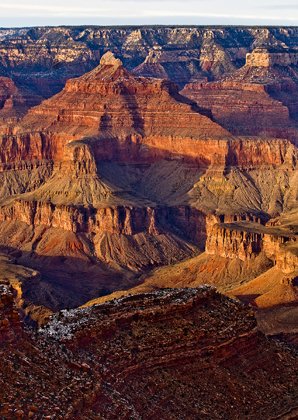
This view of the canyon reveals the layers of limestones and sandstones that testify to vanished seas and deserts. Note the strong, narrow white layer of Coconino Sandstone near the top, composed of 260-million year-old sand dunes. Also note in the center of the photo the 500-foot-tall cliff of Redwall Limestone formed on a seabottom 300-400 million years ago. Photo Tom Brossart/Roundup
I took a step — a long step — a million years step. Then I stopped, turned and faced north. Perched on the jagged edge of my life, I looked down deep into the shadowed layers of lost worlds — terrible deaths, fractured continents, vanished seas, mass extinctions.
Taking a breath, I took another step — a long step — another million years.
Curiously, I felt better — my troubles for the moment shrunk to no more than a ledge of Tapeats Sandstone in the wall of the Grand Canyon opposite. A layer of fossilized beach sand laid down 570 million years ago, the Tapeats Sandstone lies atop a mystery of missing stone — dubbed the “Great Unconformity.”
I studied that light, crumbling layer of sandstone in the canyon wall just across the way, knowing that all the great, riotous thrust of life that took us from pond scum to troubled writers has taken place since the lapping waves of a vanished sea left that layer of crumbling gray stone on a barren beach.
Perched on the wind-tormented branch of a twisted juniper nearby, a glossy black raven croaked at me.
“Nevermore,” he gurgled in my mind’s ear.
“You raise a good point,” I said to the raven and the wind that rose up out of the canyon’s 1.8-billion-year gash of time. I let loose a breath, a sigh, a puff of steam — frail and fleeting as life in the shadow of so much time. It should have depressed me, to stand so mite-like on the edge of such immensity. All I had dreamed or hoped or failed to do would not amount to a swirl of dust on this crumbling edge. I ought to have felt insignificant. Instead, I felt obscurely better.
So I took another step. A long step — a million years.
They had not built the Trail Through Time along the edge of the Grand Canyon between the El Tovar and Yaqui Point the last time I lingered on this edge. Now, it offers the most exciting crash course in geology I’ve ever encountered, although I’ve sought after rocks and unconformities all my life — and have even written geology books for confused people.
The 1.2-mile-long trail presents sliced and polished rocks representing almost all of the 24 major rock layers laid bare in the canyon wall from the 240-million-year-old limestone, siltstone, gypsum and chert layers of the Kaibab Formation to the 1.8-billion-year-old Vishnu Schist in the canyon bottom, among the oldest exposed rock’s on the planet’s surface.
Each step along the 1.2-mile path represents a million years, starting in the present and ending up at the 1.8-billion-year-old start of everything.
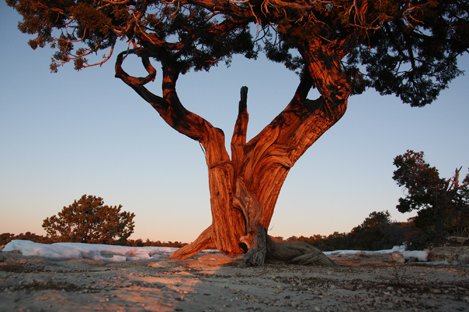
The Grand Canyon reveals a 1.8-billion year glimpse into Earth’s past from views like these along the 1.2-mile-long Trail of Time, with displays of rocks from each of the two dozen rock layers in the mile-deep canyon. A juniper catches the last light. Photo by Pete Aleshire
The Grand Canyon represents the most vividly revealed slice of Earth’s history anywhere on the planet. That makes the canyon one of the few places a person can grasp both the astonishing violence and the tormented timescale of the planet that sustains us all. This unique cross-section of time comes as a result of the relatively level uplift of the Colorado Plateau in the past 5 million to 8 million years. In most places, such a vast uplift would jumble the buried rock layers. But much of the 130,000 square miles of the Colorado Plateau rose at the rate your fingernails grow without deforming the miles-deep layers of sandstones, limestones and shales laid down on the bottoms of long-vanished seas and deserts.
As the Colorado Plateau rose, the northern edge crumpled into the Rocky Mountains. The southern edge dropped away along a 200-mile-long chain of 1,500-foot cliffs — which north of Payson forms the Mogollon Rim. Oak Creek cut back into that rising edge of the plateau to uncover the striking red rock formations of Sedona.
The Colorado River did the same thing, but on a grand scale. Many geologists believe the Colorado River originally ran north into a vast, interior sea. But as the Colorado Plateau rose, another river that ran south cut backward until it captured the north-flowing ancestral Colorado River, reversing the flow so that it now ran south into the Gulf of California.
This capture some 6 million years ago began the process of carving out the Grand Canyon. As the plateau rose, the flood-prone Colorado River cut down through it, like pressing a log up against a chain saw. Meanwhile, the steep tributaries widened the canyon by carrying those soft layers of sedimentary rock down to the main stem of the Colorado.
A layer of 230-million year old Kaibab Limestone caps the rim. The Grand Canyon reveals a 1.8-billion year glimpse into Earth’s past from views like these along the 1.2-mile-long Trail of Time, with displays of rocks from each of the two dozen rock layers in the mile-deep canyon. Photo by Pete Aleshire
That process started at about the time the genetic evidence suggests humans, chimps and gorillas last shared a common ancestor and continues to this day.
As a result of this vast uplift, the relatively young Colorado River has revealed in the walls of the Grand Canyon the long buried history of the Earth going back nearly halfway to its creation. That encompassed the entire period in which life progressed from single celled organisms in the ocean to its present, dazzling complexity.
The meander down that Trail Through Time reveals much of that history, preserved in the rock layers and the fossils they contain. Of course, erosion has already removed more than 200 million years of that history, so that the youngest rocks on the rim of the canyon are older than the dinosaurs.
A few dominant layers stand out.
Near the top, the fossilized desert sand dunes of the light Coconino Sandstone bear witness to a vast desert that covered the Southwest some 260 million years ago. At that time, what would become North America was part of a “supercontinent” that gathered almost all the dry land on the planet into a single mass.
In the middle of the canyon, lies the great, blood-red wall of Redwall Limestone, formed on the bottom of a shallow sea between 300 million and 400 million years ago. Today, the fused layers of microscopic skeletons of ancient sea creatures forms a sheer 500-foot-tall band of cliffs that pose the greatest single barrier to reaching the canyon bottom from the rim. All of the trails to the bottom must pass through fault lines in the Redwall Limestone, stained red by iron oxides leaching out of the layers above.
Farther down, the easily eroded Bright Angel Shale forms the shelf above the 1,800-foot-deep inner gorge. Shales form on shallow sea bottoms, compared to the deeper marine environments that create limestones. Most of the trails in the canyon run along its wide shelf. Formed 530 million years ago, the Bright Angel Shale represents the era when trilobites ruled the world.
Just below the Bright Angel Shale lies the Great Unconformity, where erosion in the inconceivably distant past removed 1.2 billion years worth of rock. This records another period of uplift, when erosion carried off layers of rock many times higher than Mt. Everest.
Below that unconformity, the story continues — down through a dozen more layers in the inner gorge, each one mounted alongside the trail and polished smooth. The Grand Canyon Supergroup spans the period between 570 million and 1.2 billion years ago, again recording the meanderings of the continents and the ebb and flow of oceans, as the planet breathes in, breathes out.
After another, smaller unconformity, the river finally reveals the inconceivably ancient Vishnu Schist and Zoraster Granite. The schists started as sandstone, limestone and shale, before they were buried, reheated and fused into this dense, primordial rock. The Zoraster Granite ooze up from the molten depths of the Earth, forming veins revealed finally by the relentlessly downcutting river.
I could not see the metamorphosed Vishnu Schist from my perch atop the rim, but I have seen it on raft trips in the dark heart of the canyon where it has been fluted and carved and sandblasted by eons of floods.
Finally I stood stock still, my breath coming still in moist, warm, puffs as the planet spun so that the dust of the atmosphere gave the sun’s long light a warm red glow, reflected off the ancient worlds across the way.
My raven friend — or one of his kin — flew past with an audible whoosh of his wings, then banked to consider the possibilities. He croaked, that guttural warble that only ravens dare.
Odds are, he noted my proximity to the edge and so paused to ponder my potential as carrion.
But I prefer to think that he felt our shared pulse of life and caught the updraft of my yearning.
In either case, he settled on the branch of a weirdly stunted ponderosa pine nearby and we shared the sunset.
The shadows rose up out of the canyon, swallowing continents and oceans.
I kept my gaze on the glow of the Redwall Limestone until the shadow took it, then shifted to the luminous yellow of the Coconino Sandstone.
For I came to the canyon full of woe holding my life in my fingernails, my heart in the shadows. But now my troubles seemed fleeting, the world full of marvels, my life aglow like that desert turned to sandstone in the last light of day.
My breath came in a puff, transparent but warm in the still, cold air.
“Nevermore,” quoth the raven, “nevermore.”
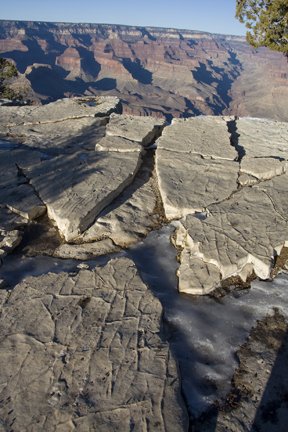
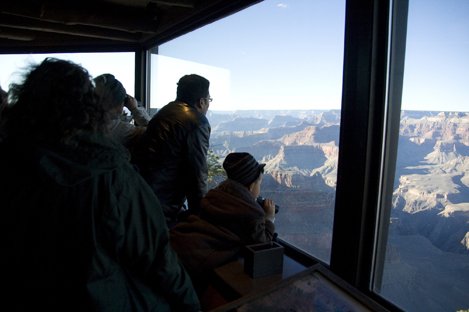
Visitors study the colorful layers of the Grand Canyon from the observation window in the geology museum at Yaqui Point. Photo by Pete Aleshire
oooOOOooo
Such beautiful words. Any additional thoughts from yours truly are utterly superfluous.
A powerful lecture by the eminent Lord Martin Rees
Martin Rees at Jodrell Bank, 2007
I came across this interview a few days ago in connection with some book research that I was undertaking. Please don’t be put off by the 56 minute length because Martin Rees is one of the most pre-eminent cosmologists around today, as well as being the UK’s Astronomer Royal since 1995.
Make a promise to yourself to settle down sometime soon and watch the lecture, given at the University of Melbourne’s Medical School in 2010. And a warning! I going to pick up on some of the important points made by Martin Rees in a couple of posts next week.
Here’s how the lecture was reported by the Australian science website, SixOne Science,
Lord Rees in Melbourne
In a packed Sunderland Lecture Theatre in the University of Melbourne’s Medical School, Lord Martin Rees gave the inaugural Derek Denton Lecture in Science and the Arts. Lord Rees, an eminent and accomplished astrophysicist and cosmologist, is coming to the end of his five year tenure as the president of The Royal Society. The event even managed to attract or Prime Minister, Kevin Rudd, who entered without a noticeable entourage and with no fanfare, and the Governor of Victoria, Professor David de Kretser, a scientist himself.
The lecture was entitled “Life and the Cosmos”, a grand and sweeping title if ever there was one. It seemed like an impossible amount of material to cover in the allotted hour. However, Rees delivered an entertaining, humorous account of life from the big bang, through the formation of stars and galaxies, to the origins of life and perhaps the biggest crowd pleaser, the search for extra-terrestrial life. Most in the lecture theatre would not have learnt anything new, but this lecture was aimed at a general audience and the material was interesting enough to keep everyone interested for the hour despite being squashed into an ageing undergraduate lecture theatre complete with squeaky desks and a slightly musty smell. Perhaps Mr. Rudd was sufficiently uncomfortable to increase university funding, we can hope.
Whist this was predominately an overview of the subject material, Rees expressed some opinions about space exploration. He seemed torn between his human curiosity and the cost of human exploration. Given the advances in robotic exploration vehicles, Rees has difficulty in justifying the cost of sending humans on planetary exploration missions. Perhaps the best case for robotic exploration was made by the amazing photos he showed from the surfaces of Mars (photos) and Titan (photos), a moon of Saturn. Interestingly, Rees believes that if human exploration does proceed in the future it will be led by the Chinese or groups of private individuals. He also raised the issue of exploitation of other planets, something not often mentioned in the debate over human space travel. We need to decide if other bodies in our solar system are open for exploitation or if they should be preserved as wilderness, in a similar way to Antarctica. Given the pressures faced by places like Antarctica and the Amazon this will be an important debate should human exploration resume.
Rees concluded his lecture with the almost obligatory call for us to take better care or our own planet. He, like many others, recognises the unique place in history that we occupy. For the first time a single species is capable of exerting profound changes on the Earth’s natural and physical environments (although it might be argued that the first photosynthesizing cyanobacteria had a similarly singular influence by increasing the proportion of oxygen in the atmosphere). It is interesting to note that he does not see colonisation of other planets as a solution as the Earth is still the only known planet capable of sustaining us. Although he did discuss the likelihood of discovering Earth-like planets (pretty good given advances in technology). However, Rees did not paint an overly pessimistic picture and he generally came across as optimistic and enthusiastic about the future.
The organisers of the Derek Denton Lecture series should be commended for attracting such a high profile speaker for the first of the series. Hopefully the series will be successful, and if so may need to be moved to a bigger venue. If you want to see the lecture it will soon be available here. The next lecture of this series hasn’t been announced yet, it will be on the Arts, but you can check here for future public events at The University of Melbourne.
A series of 10 delightful short films, courtesy of Transition Culture – For the introduction and the first three films, click here, for the next three click here.
Film Seven – Transition Town Totnes’s Transition Streets Origin: Transition Town Totnes
In December 2009, Transition Town Totnes, the UK’s first Transition initiative, was chosen as one of 20 community groups in England and Wales to win the ‘Low Carbon Communities Challenge’. Its project, ‘Transition Streets’, was awarded £625,000. In the last 18 months, nearly 500 households have participated in Transition Streets, each, on average, cutting their carbon emissions by 1.5 tonnes.
About a third of those have gone on to install solar photovoltaic systems. However, the main benefits that people who have participated talk about are the social connections they have made and how they now feel so much more a part of their community. It has also acted as a platform for all kinds of other initiatives as neighbours start to get a taste for working together.
Film Eight – A Small Pennant Flag Origin: Transition Town Monteveglio (Bologna, Italy)
Transition Town Monteveglio (TTM) was the first Italian Transition initiative. In 2009 its local Comune (local Council) passed an amazing resolution that offers a stateof-the-art taste of what it looks like when a council really ‘gets’ peak oil and climate change, stating: “… a view of the future (the depletion of energy resources and the significance of a limit to economic development), methods (bottom-up community participation), objectives (to make our community more resilient, i.e. better prepared to face a low energy future) and the optimistic approach (although the times are hard, changes to come will include great opportunities to improve the whole community’s quality of life)”.
It has led to all kinds of initiatives and projects, including a local currency and renewable energy installations. Our object here is the Comune’s official pennant.
Film Nine – A Small Bag of Topsoil Origin: Transition Norwich’s food initiatives
It is one thing to start local food projects, but quite another to think strategically about how those projects sit in the larger context of the intentional relocalisation of the area. Transition Norwich, together with East Anglia Food Link, produced a study called ‘Can Norwich Feed Itself?’ which worked out that it could, albeit with a simpler diet, but that it would need certain new infrastructures put in place. This included a new mill to enable locally produced grains to be milled, two CSA farms (hence our object, a soil sample from their first CSA site), community gardens and research into varieties of beans and oats that will grow well in the area.
A successful application to the Local Food Fund enabled these to become a reality. It is a fascinating example of why we need to think strategically about the localisation of food. As Tully Wakeman, one of the co-ordinators, told me: “A trap a lot of NGOs fall into is over-thinking about vegetables (yet) only one tenth of what we consume, in calorific terms, comes from fruit and vegetables… where is the other 90% going to come from? Growing vegetables in gardens, allotments, community gardens and so on offers a degree of food security and can happen relatively rapidly.
However the other 90% requires the rebuilding of the infrastructure required for growing, processing, cleaning, storing, milling and distributing grains and cereals, and that takes longer and requires more planning”.
Film Ten – Beer, A Bottle of Sunshine Ale Origin: The Lewes Community Power Station
The Ouse Valley Energy Service Company (OVESCO) is one of the offshoots of Transition Lewes focused on the installation of renewables in and around the town as well as promoting energy conservation and local economic resilience. In 2011 it took on its most exciting and ambitious project to date installing a 98kW solar photovoltaic array on the roof of local brewery, Harveys. This will turn the building into one of the first community-owned solar power stations in the country.
The 544 photovoltaic (PV) panels will generate 93,000kWh of green electricity each year – enough to save more than 40 tonnes of CO2 annually.
A community share launch event took place in April 2011 attended by 300 people. Within five weeks the target of £307,000 had been reached. Money invested will be repaid in full at the end of the 25 year scheme, or earlier at the request of the investor and subject to conditions. While the investment is held a dividend will be paid after the first year which is expected to be around 4%.
Our object is a bottle of ‘Sunshine Ale’, a special commemorative beer brewed to celebrate the launch of the scheme. Very nice it is too.
A final few words from Rob Hopkins.
Whittling down to these 10 objects has been very difficult but I hope what you have gained is a sense of something infectious, reaching beyond the idea of small individual initiatives, and arguing that localisation is the best way for the places in which we live to return to health. Various learned writers and academics have tried to encapsulate what Transition is, but I still think the best description of its spirit comes from Tove Jansson in Comet in Moominland in 1946, who wrote: “It was a funny little path, winding here and there, dashing off in different directions, and sometimes even tying a knot in itself from sheer joy. (You don’t get tired of a path like that, and I’m not sure that it doesn’t get you home quicker in the end).”
Rob Hopkins is the co-founder of Transition Town Totnes and Transition Network and blogs at www.transitionculture.org
More of the fun collection of short films about Transition.
A series of 10 delightful short films, courtesy of Transition Culture – For the introduction and the first three films, click here.
Film Four – An Egg Origin: Transition Town Forres’s Community Garden
Like many Transition initiatives, Transition Town Forres (TTF) saw the rebuilding of food resilience as a key part of its work. It sought to bring land into community management for new food production. TTF was invited to negotiate a lease with Moray Council for 0.59ha (1.45 acre) of horticultural land starting on the 1st April 2009.
With an 11 year lease, work began on the site. Rather than divide it into the traditional rectangles of allotments, it was divided into circular allotments, called ‘pods’, each one 250m2, and shared by 4-6 people. The garden now has 75 gardeners, 60 local scouts and 26 chickens (hence the egg). Participation is from a broad cross section of the community, and the dropout rate has been less than half that of other local allotments. The next step that is planned is a Farmers’ Market in the town.
Film Five – Mini Draughtbusters Origin: Transition Belsize’s Draughtbusters
Transition Belsize, one of over 40 Transition initiatives active within London, was inspired by ‘Draught Busting Saturdays’ created in South London by Sue Sheehan and a group from Hyde Farm Climate Action Network. They started working with Camden Council to deliver Draughtbusters in Belsize. The idea is a simple one. The area has many Victorian homes with leaky sash and casement windows.
Up to 15 people meet in someone’s house and learn to draught-proof by working on the host’s house. The host gets given £50 of materials, and the participants £20 worth each. It has proven very popular, and 15 local schools have also been draught-proofed by keen Draughtbusters. It has now spread to many other London Transition groups, just one example of how Transition groups can incubate ideas that can then be rapidly replicated by others. Our object here is a miniature version of the Draughtbusters team: Patrick (doing the door) and Sarah and Lauren (working on the window).
Film Six – A Clove of Garlic Origin: The Green Valley Grocer, Slaithwaite
When the local greengrocer went out of business, members of Marsden and Slaithwaite Transition Towns (MASTT) in Yorkshire wondered if perhaps the community might take over the running of the shop. They realised this would only work with the support of the community so they held a public meeting where people expressed enthusiasm for the idea.
Time was tight, so they set up an Industrial and Provident Society and designed a share launch which was unveiled three weeks later. The goal was to raise £15,000, and this was achieved within 10 days.
From initial idea to the shop opening? Two months. The shop is now a busy thriving community enterprise, and MASTT is setting up a growing co-operative called ‘Edibles’ to supply the shop with local produce.
Early on in running the shop, they found that all the wholesale garlic available to them was imported from China, and so they set up the Green Valley Grocer Garlic Challenge, making garlic cloves available to customers at cost and offering to buy back whatever people produce, with the aim of making Slaithwaite self-sufficient in garlic within two years (well you have to start somewhere…).
The final four films will be shown shortly after Christmas.