Firstly, there was Paloma and then Lilly. Last week, it was Jean’s story about how she found Dhalia. Today, Jean recounts how Ruby came in to the family.
ooOOoo
Ruby
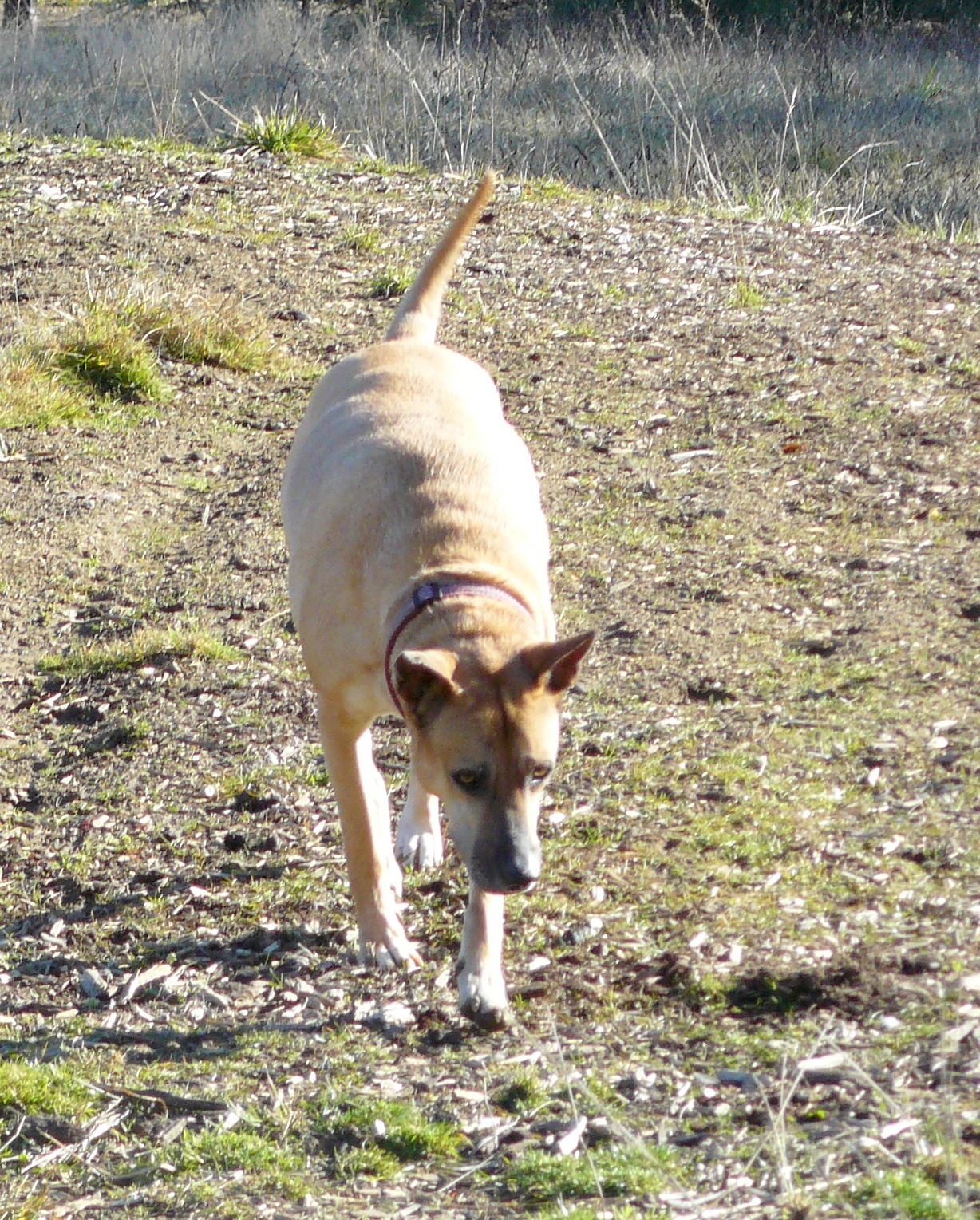
Ruby – picture taken at the end of January, this year.
My house in Mexico was on the beach. There was a door in the wall of the rear courtyard that lead almost directly on to the sand. Most mornings I would rise before dawn to run two or three dogs together along the shore. It was a good arrangement for all of us!
Next door to my house was a duplex that had been rented out to a family that lived in Hermosillo; the capital of the State of Sonora. Every month or so this family would visit for a long weekend. This family, unfortunately, had an autistic daughter who, when not supervised, would open my front gate that led on to the dusty road so she could come in to play with my cats that lived in the front area of my house. That was fine by me when the daughter was in a calm mood but frequently she had screaming fits that would send both my cats and dogs into a state of frenzy. In addition, the family owned a Chihuahua dog that the daughter often carried as if it were a doll.
One month, the family arrived ‘sans Chihuahua‘ with the news that it had died; adding that their daughter was bereft at the loss.
The following day the mother knocked on my door. She explained that they had acquired a new puppy but that it was not eating. What could they do? Would I help?
Of course I went with them to have a look. Sure enough, they had a small puppy, probably no more that three weeks old. “It’s a Chihuahua”, they said. I replied, “Firstly, it’s not a Chihuahua and secondly, it’s far too young to be without it’s mother – you must take the puppy back to the mother”.
Despite much pleading, I could not convince the family to do this. So I did the next best thing and went back home to get replacement milk formula and a tiny feeding bottle. I showed the family how to feed the little puppy and also how to massage its tummy to help it go to the toilet. I was more than a little concerned, to say the least. I just couldn’t see the family going to the effort of feeding the puppy every couple of hours or so; essential to ensuring the tiny dog survived.
I planned to check up how things were going the following day. But didn’t need to. For when opening my front door I found the puppy left on my doorstep. Not even left in a box. The family had returned to Hermosillo.
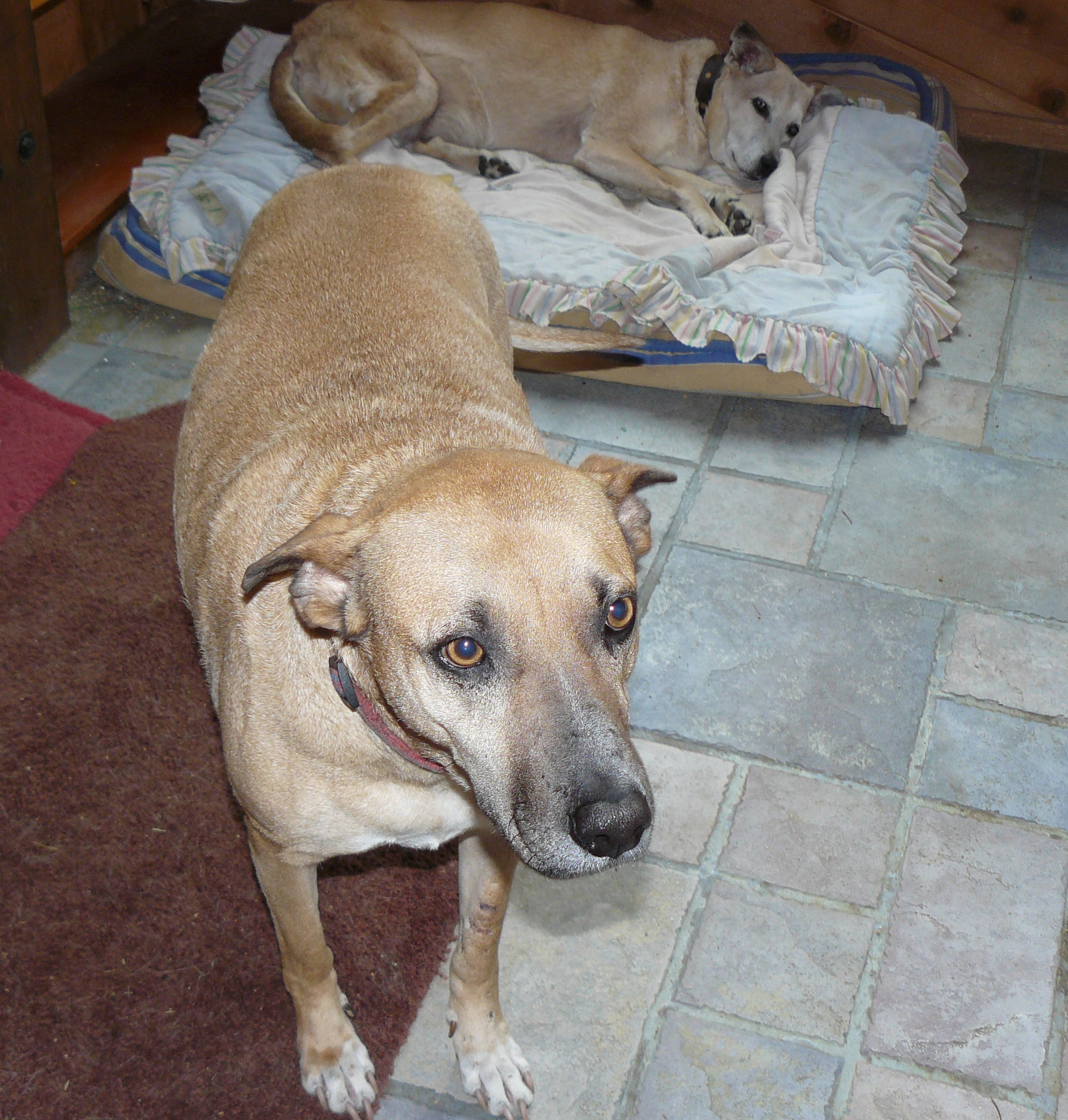
That little three-week-old puppy is now Ruby; an eight-year-old 80 lbs Shar-Pei mix. After a few weeks of investigation I tracked down Ruby’s mother. She had had 13 pups and was unable to feed them all.
Ruby suffers from skin problems as do many Shar-Peis. Ruby clearly missed out on the mother-puppy relationship; so important for the development of social skills. Accordingly, she is a bit scatty when playing with the other dogs, frequently bowling them over in her enthusiasm. Luckily the other dogs seem to realise that she is missed out as a young puppy and are very forgiving.
After such a shaky start I didn’t even try to find her a home. With countless puppy feeds in the middle of too many nights, I had bonded too deeply.
The family returned to the duplex a couple of months later with a new Chihuahua in tow. I confronted them about Ruby. Their answer was that they had given the puppy to a couple on the beach and it was they who had left the puppy on my front door-step.
Yeah! And the moon is made of green cheese!
Ruby in our kitchen area – picture taken yesterday.
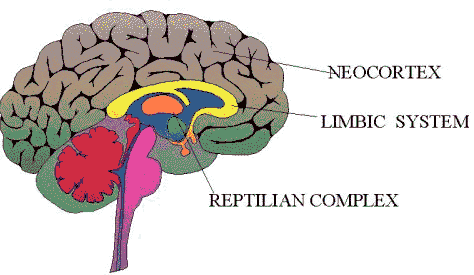
Now of all the things I am not, I am neither a biologist nor a scientist of any description. However, general knowledge told me years ago that the human brain is composed of three areas, as the following diagram shows.
The first time you observe the anatomy of the human brain, its many folds and overlapping structures can seem very confusing, and you may wonder what they all mean. But just like the anatomy of any other organ or organism, the anatomy of the brain becomes much clearer and more meaningful when you examine it in light of the evolutionary processes that created it.
The most efficient model for understanding the brain in terms of its evolutionary history is the famous triune brain theory developed by Paul MacLean. According to this theory, the following three distinct brains emerged successively in the course of evolution and now co-inhabit the human skull:
The reptilian brain, the oldest of the three, controls the body’s vital functions such as heart rate, breathing, body temperature and balance. Our reptilian brain includes the main structures found in a reptile’s brain: the brainstem and the cerebellum. The reptilian brain is reliable but tends to be somewhat rigid and compulsive.
The limbic brain emerged in the first mammals. It can record memories of behaviours that produced agreeable and disagreeable experiences, so it is responsible for what are called emotions in human beings. The main structures of the limbic brain are the hippocampus, the amygdala, and the hypothalamus. The limbic brain is the seat of the value judgments that we make, often unconsciously, that exert such a strong influence on our behaviour.
The neocortex first assumed importance in primates and culminated in the human brain with its two large cerebral hemispheres that play such a dominant role. These hemispheres have been responsible for the development of human language, abstract thought, imagination, and consciousness. The neocortex is flexible and has almost infinite learning abilities. The neocortex is also what has enabled human cultures to develop.
These three parts of the brain do not operate independently of one another. They have established numerous interconnections through which they influence one another. The neural pathways from the limbic system to the cortex, for example, are especially well developed.
I’m well into reading the book Waking The Tiger: Healing Trauma authored by Peter A. Levine. As early as Chapter One, Peter Levine explains [my emphasis]:
The involuntary and instinctual portions of the human brain and nervous system are virtually identical to those of mammals and even reptiles. Our brain, often called the ‘triune brain,’ consists of three integral systems. The three parts are commonly known as the ‘reptilian brain’ (instinctual), the ‘mammalian or limbic brain (emotional), and the ‘human brain or neo-cortex’ (rational). Since the parts of the brain that are activated by a perceived life threatening situation are the parts we share with animals, much can be learned by studying how certain animals, like the impala, avoid traumatization. To take this one step further, I believe that the key to healing traumatic symptoms in humans lies in our being able to mirror the fluid adaptation of wild animals as they ‘shake out’ and pass through the immobility response and become fully mobile and functional.
Unlike wild animals, when threatened, we humans have never found it easy to resolve the dilemma of whether to fight or flee. This dilemma stems, at least in part, from the fact that our species has played the role of both predator and prey. Prehistoric peoples, though many were hunters, spent long hours each day huddled together in cold caves with the certain knowledge that they could be snatched up at any moment and torn to shreds.
Anyway, to get back to what triggered today’s post.
If you read yesterday’s post you will recall me chatting with Jon Lavin and Jon reminding me that humans are drawn to positive messages. But in stark contrast, the news media industry excels in promoting ‘doom and gloom’. Why is this? Why are we so fascinated by danger?
Well here’s my theory.
That is our evolution would not have succeeded if early man didn’t become pretty smart at identifying animal behaviours and plants and fruits that had the capacity to harm or even kill. For example, what parent hasn’t made it a priority to teach their children the difference between harmful fungi and edible mushrooms. Indeed to the extent that most of us would think long and hard before eating any fungi found in the wild unless we were 150% certain it was edible. Look at the following picture. Your instinct tells you if it’s safe to eat or not – it’s not!
So early man became over-sensitised to dangers to his health for his own good and continued existence. While modern man functions in ways almost unrecognisable from early man, that good old reptilian brain still is doing it’s best to protect us (flight, fight or freeze). Think how we all respond to a sudden alarming sound, such as a gun shot or a scream, to know that the old reptilian brain is still alive and well.
Thus while all of us hate negativity we all seem to have this fascination with doom and gloom – just in case it helps us and our loved ones survive.
Back to Jon Lavin. He makes it very clear that anything more than a small amount of ‘doom and gloom’ speaking to our consciousness increases the odds of depression and introversion.
Thus the message is that we humans should allow our Neocortex to tell our Reptilian ‘neighbour’ to go easy on the bad news, go and open a beer and watch the world go by! Whoops! Watch the world go by with a smile!
Yet another wonderful opportunity to chuckle at the world.
Sent to me by dear Cynthia Gomez.
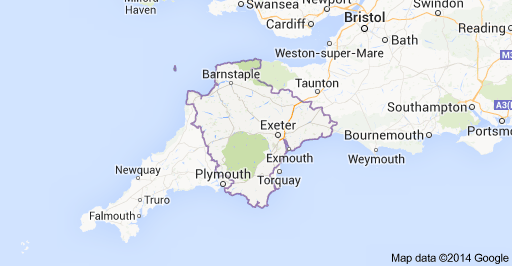
This wonderful collection of sayings from America’s ‘South’ reminded me of the incredibly rich local accents that one experienced all over Britain. Despite being born a Londoner, I spent many of the years before switching home countries from England to America living in the County of Devon in the South-West of England. Here are two images to show those unfamiliar with England where I was living.
County of Devon. Cornwall to the West. Somerset to the East.
oooo
Home used to be in the village of Harberton, 3 miles South-West of Totnes.
Thus anyone born and bred in this part of Devon frequently had a strong South Devon accent. My brother-in-law, John, used to chat to some old Devon fella’s in the local pubs that had accents impossible to understand by such newcomers as me.
So with no further ado, enjoy the following.
ooOOoo
Florida
A Florida senior citizen drove his brand new Corvette convertible out of the dealership. Taking off down the road, he pushed it to 80 mph, enjoying the wind blowing through what little hair he had left. “Amazing,” he thought as he flew down I-95, pushing the pedal even more.
Looking in his rear view mirror, he saw a Florida State Trooper, blue lights flashing and siren blaring. He floored it to 100 mph, then 110, then 120. Suddenly he thought, “What am I doing? I’m too old for this!” and pulled over to await the trooper’s arrival.
Pulling in behind him, the trooper got out of his vehicle and walked up to the Corvette. He looked at his watch, then said, “Sir, my shift ends in 30 minutes. Today is Friday. If you can give me a new reason for speeding — a reason I’ve never before heard — I’ll let you go.
“The old gentleman paused then said: “Three years ago, my wife ran off with a Florida State Trooper. I thought you were bringing her back.
“Have a good day, Sir,” replied the trooper.
Georgia
The owner of a golf course in Georgia was confused about paying an invoice, so he decided to ask his secretary for some mathematical help.
He called her into his office and said, “Y’all graduated from the University of Georgia and I need some help. If I wuz to give yew $20,000, minus 14%, how much would you take off?”
The secretary thought a moment, and then replied, “Everthang but my earrings.”
Louisiana
A senior citizen in Louisiana was overheard saying … “When the end of the world comes, I hope to be in Louisiana .”When asked why, he replied, “I’d rather be in Louisiana ’cause everythang happens in Louisiana 20 years later than in the rest of the world.”
Mississippi
The young man from Mississippi came running into the store and said to his buddy, “Bubba, somebody just stole your pickup truck from the parking lot!”
Bubba replied, “Did y’all see who it was?”
The young man answered, “I couldn’t tell, but I got the license number.”
North Carolina
A man in North Carolina had a flat tire, pulled off on the side of the road, and proceeded to put a bouquet of flowers in front of the car and one behind it. Then he got back in the car to wait.
A passerby studied the scene as he drove by, and was so curious he turned around and went back. He asked the fellow what the problem was.
The man replied, “I got a flat tahr.”
The passerby asked, “But what’s with the flowers?”
The man responded, “When you break down they tell you to put flares in the front and flares in the back. I never did understand it neither.”
Tennessee
A Tennessee State trooper pulled over a pickup on I-65. The trooper asked, “Got any ID?”
The driver replied, “Bout whut?”
Texas
The Sheriff pulled up next to the guy unloading garbage out of his pick-up into the ditch. The Sheriff asked, “Why are you dumping garbage in the ditch? Don’t you see that sign right over your head.”
“Yep,” he replied. “That’s why I’m dumpin’ it here, ’cause it says: ‘Fine For Dumping Garbage.’
ooo
“Y’all kin say whut y’all want ’bout the South, but y’all never heard o’ nobody retirin’ an’ movin’ North.
According to the online version of the Merriam Webster dictionary, one of the two definitions of synchronicity is:
: the coincidental occurrence of events and especially psychic events (as similar thoughts in widely separated persons or a mental image of an unexpected event before it happens) that seem related but are not explained by conventional mechanisms of causality —used especially in the psychology of C. G. Jung
That seems sufficiently apt to warrant the choice of title for today’s post.
Here’s why!
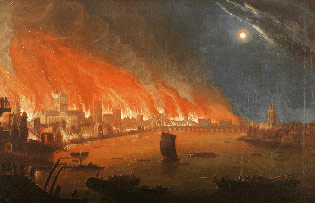
Yesterday, Chris Snuggs left a comment to my post Unconditional love. Essentially, Chris made the argument that much of what we see as wrong with the world is not new; not new at all [my insertion of the image of and link to the Great Fire of London].
Great Fire of London. September 2nd-5th, 1666.
What I mean is, the danger of thinking that today’s events are somehow special and different in kind than throughout history, a feeling generated by the fact that WE are living NOW. However, is it not true that ALL ages of Mankind have seen disasters, wars, dangers, catastrophes, including natural ones? How must those have felt who lived through the 30 Years War, the plague, the Great Fire of London, Stalin’s purges and of course the holocaust?
Even in these present times, Chris doubted that mankind had not been here before [my emphasis]:
WHAT then is special about OUR era? Well, Patrice is and rightly very concerned about the kleptocracy. The staggering statistic that emerged the other day about 85 individuals having as much wealth as 3,5 BILLION people was yet another wake-up call, especially as history seems to tell us that A) there have ALWAYS been kleptocracies and B) they ALWAYS end in revolution, dictatorship or social collapse. But the point is, this is nothing NEW. On the contrary, it has in many societies been the normal progression of things for millenia.
So what about Global Warming, as in man-caused? Chris wrote:
No, all my uncertainties lie in the area of GW. It’s pretty clear that there Is global warming, but A) Is it our fault? B) What should we DO about it? and C) Is it too late anyway?
The notion that it is too late to prevent widespread, major consequences from the heating of our planet is widely shared; I sing the siren’s song myself.
So when an item came along yesterday from Transition Network’s blog courtesy of Rob Hopkins pointing out that Chris, me and many others may be wrong to sing the ‘doom and gloom’ song, it naturally caught my eye. A quick call to the Transition Network team in Totnes, Devon gave me permission to republish on Learning from Dogs, so here it is. Thanks TN team. (My thoughts follow the TN piece.)
ooOOoo
Lipkis on Holmgren: “Our job is to make viable the alternative and have it ready”
You know how sometimes someone will just put something you were thinking far more eloquently and clearly than you would have been able to? On Thursday we’ll be posting an interview with Andy Lipkis of TreePeople in Los Angeles. When I talked to Andy last week, it was 80°F, and a state of drought emergency had just been declared (in LA, not Totnes, it was raining here, as usual). At the end of the interview, I asked for his thoughts on the recent debate sparked by David Holmgren’s Crash on Demand article. I asked him “Can we achieve the action on climate change that we need within the existing paradigm, or do we need to deliberately bring the economy down, to deliberately crash it?”. Here’s what he told me.
Andy Lipkis
“This system is so armoured to defend itself from a deliberate crash that much of our resources and intelligence networks are focused on exactly stopping that. On the flip side, the crash is already happening. We don’t have to engineer it: it’s already been engineered into the system. Check it out: Infrastructure systems are in breakdown in major cities around the world, with severe climate exceeding the designed capacity for storms, floods, water shortages, heat events resulting in increasing numbers of people being dislocated, injured or killed. In the US, taxpayers are unwilling or unable to pay for the rapidly inflating costs for upgrading and climate-proofing the outmoded infrastructure systems, all the while, climate change denial campaigns prevent communities from preparing for and protecting themselves from the impacts.
I think our job is to make viable the alternative and have it ready. If we’ve really done our homework, we could scale this thing in a flash in California right now because this crash is upon us. And I hope we’re going to be able, perhaps within months…I invented a cistern that could replace the backyard fence or wall, that could hold 5,000 – 20,000 gallons and could be manufactured locally. The City’s going “hey, maybe we should do that now”. Now. Because it’s going to rain again, even if this drought lasts some years, we could deploy them quickly, just as they did in Australia’s 12 year drought.
I think we’ve been trained to spend time on these battles, on the negativity, and we lose people. We’ve lost precious decades. The crash is on its way. We don’t have to do anything. We need the time to convert people and move people. We need to use examples of Australia and what’s happening now in California to tell those stories, because I agree, denial, defending the system is keeping it pumping. But as you saw from Snowden and all the evidence, for those of us who went through the ‘60s and ‘70s in protest, I don’t think that’s going to succeed. If we focus on that our best leaders are going to end up in jail for too long.
When you look at how fast people change when you add inspiration, when you add attraction, people change on a dime! When we were growing up, there were – I don’t know if you had The Munsters? One of the only people who we all knew who was doing yoga and eating yoghurt was Uncle Fester. But when we started seeing beautiful, sexy male and female bodies doing that, it started selling, moving people by the millions and then billions to choose these lifestyles.
I’m not saying the marketplace is the only answer, I’m just saying that if we choose attraction and inclusion we can create those markets, as you’re starting to do. Your stories over and over again on what’s happening with local currency – it’s time to tell the stories better and use those market forces, because people will choose those because they’re less painful and more attractive. And to be smart, to say wow, yeah.
The Bush administration was ready for all Americans to be protesting to try to stop the Iraq war. They expected that, they built that into their design. I was so amazed that they could say they didn’t care what the people said, that I had to think through why they did not care about that. How did they make it resilient? Because all they cared about was as long as people kept consuming, especially petroleum, their objective was being met. They were counting on no-one changing lifestyles.
The most radical thing sometimes that you can do is actually vote with your feet and vote with your dollars. I was going – “wow, yeah, they’re counting on people complaining”. Protesting and not changing. I started thinking that even the Obama administration is still using the same metrics as the Bush administration was, saying people won’t change on energy. “It’s going to take 35 years to reduce our energy use by 30%”. Well that’s bullshit, because we can choose to do that in a week.
So, I decided that I was going to show that that’s possible even in my own lifestyle. I drive a Prius which is especially fuel efficient, but I’m going to stop driving that car two or three days a week. I told my secretary to book meetings downtown where I could get the bus to. I got out of the car, took the bus, and it actually became a really cool thing. I started investing my dollars in the local bus system. I did it for over two years. I blogged about it. A lot of other people stopped full time car use, and right at the right time as gasoline prices were spiking, a proposal came out to build a new transit system. It’s always been rejected in LA, but the voters at that moment chose to fund 40 billion dollars to build a new subway system in Los Angeles so we could get out of our cars. It’s a radical move, but it’s starting to happen.
So maybe that’s a long complicated answer, but we’ve built the right foundation. Our happiness, our health is the answer. It’s infectious. Our job is to be that much more infectious and inclusive. And don’t put up barriers of titles. Don’t put up barriers of shame and blame. Be open to learning fast and welcoming people in. We’re hacking the system and making it so much better. If we invite that kind of creativity, the generation that’s inheriting this right now is really ready to take this home.
ooOOoo
Don’t know about you but I find that compelling. It’s far too easy to wait for others to fix the problems. Too easy to see the issues as insurmountable. Each of us has the ability and the common-sense to make a change in our lives. Whether it is a small, medium or large change in your behaviour, you will make a difference.
So if you have been inspired by this, as Jeannie and I have been, commit to making a difference.
How something so fundamental as humans talking with each other can so often be mysterious.
When I composed this sub-heading, I wasn’t sure of what word to use to end the sentence. Some of the words that sped through my mind were: complex, distorted, difficult, obtuse and …. well, you get the message.
“The single biggest problem in communication is the illusion that it has taken place.” George Bernard Shaw is reputed to have once said!
Today’s essay on the challenges of speaking clearly to another, perhaps better described as communicating in a clear and unambiguous fashion, came out of a recent conversation with Jon Lavin, a good friend from my Devon days. (Jon offers services for business owners and entrepreneurs under his business banner of The People Workshop.)
Jon was explaining that the number one hurdle for businesses that are managing change, and for so many businesses managing change is practically a constant, is having clear communications within the team.
Seems clear enough to me! 😉
Yet, what we hear and what we say are both modified, frequently unconsciously, by past events, experiences and trauma. That being the case, then it is key, critically so, that we achieve the best possible self-awareness. Because it is only through an understanding of our past that we come to learn of our sensitivities and our associated ‘tender spots’ and their potential for ‘pulling our strings’. Here’s a personal story.
In 1956, when I was 12, I experienced a trauma that was interpreted by my consciousness as emotional rejection. By the age of 14 that sensitivity to rejection had descended into my subconscious. For fifty years, that sensitivity remained hidden yet continued to influence my life in many unseen ways, not all of them negatively by a long measure. In 2007 a period of counselling revealed that hidden emotional rejection; brought it to the surface. It changed beyond imagination how I felt, how I behaved, how I was. Nonetheless, that sensitivity to rejection is still there, albeit now visible. Thus when I hear or experience something that tickles that sensitivity I still react. But because I can now see and feel myself reacting, I can sidestep the emotional strings.
The following is a short, twenty-minute, documentary film about fear. Do watch it. The message that we are so profoundly a product of our past is beautifully presented.
HEIST: Who Stole the American Dream? is stunning audiences across the globe as it traces the worldwide economic collapse to a 1971 secret memo entitled Attack on American Free Enterprise System. Written over 40 years ago by the future Supreme Court Justice Lewis Powell, at the behest of the US Chamber of Commerce, the 6-page memo, a free-market utopian treatise, called for a money fueled big business makeover of government through corporate control of the media, academia, the pulpit, arts and sciences and destruction of organized labor and consumer protection groups.
But Powell’s real “end game” was business control of law and politics. HEIST’s step by step detail exposes the systemic implementation of Powell’s memo by BOTH U.S. political parties culminating in the deregulation of industry, outsourcing of jobs and regressive taxation. All of which led us to the global financial crisis of 2008 and the continued dismantling of the American middle class. Today, politics is the playground of the rich and powerful, with no thought given to the hopes and dreams of ordinary Americans. No other film goes as deeply as HEIST in explaining the greatest wealth transfer of our time. Moving beyond the white noise of today’s polarizing media, HEIST provides viewers with a clear, concise and fact- based explanation of how we got into this mess, and what we need to do to restore our representative democracy.
It’s an incredibly interesting film, but more of that later. For me, what was stunningly enlightening was at last understanding the powerful forces at work since Lewis Powell published ‘the memo’ back on August 23, 1971. Because for me over in Britain, the era of the ’70s’ and ’80s’ were incredibly fulfilling. First, as a salesman for IBM UK – Office Products Division, from 1970 through to 1978, and then forming and managing my own company through to 1986 when I succumbed to an attractive purchase offer. Then, when my company was sold, taking a few years off cruising a sailboat in the Mediterranean; based out of Larnaca, Cyprus.
Thus I was immune to the global money and power plays, albeit enjoying rising house prices! Only Lady Luck protected me from the collapse of 2008 in that I had sold my Devon home in early 2007 and was renting. Then Lady Luck arranging for me to meet Jean in Mexico, Christmas 2007 (we were born 23 miles apart in London) and subsequently moving out to Mexico with Pharaoh in September, 2008, to be with Jean and all her dogs. Lady Luck’s magic continued in that we came to Merlin, Oregon because we were able to take advantage of a bank-owned property; moving there in October, 2012.
Of course, the scale of the downturn was obvious and there were many instances of people that I knew losing jobs or homes, or both, and generally having a very rough time.
So back to the film. Here’s the official trailer.
Uploaded on Feb 17, 2012
Please watch the newly updated trailer for “Heist: Who Stole the American Dream?,” the new, explosive documentary from Frances Causey and Donald Goldmacher exposing the roots of the American economic crisis and the destruction of the American dream. Visit www.Heist-TheMovie.com for more information on how to see the feature film and how to Take Action in restoring democracy and economic justice in the United States.
But here’s another thing that now makes sense: The legitimate anger of so many people, especially those who have some insight into what had been taking place. No, amend that! What is still taking place!
Just one example of that legitimate anger, that of Patrice Ayme. Just go across and read his blog post of two days ago: American Circus.
My strong recommendation is that you take an evening off and watch the film. Here’s another preview:
Frances Causey, Co-producer & co-director-Heist & Donald Goldmacher, Co-producer & co-director-Heist join Thom Hartmann. Corporate America is the biggest Welfare reciepient in the country – but that wasn’t always the case. The makers of Heist will tell you how organized money has been able to pull off the biggest “Heist” of the American Dream!
The film also concludes by offering many ways in which individuals can take back control of their lives, reinvigorate local communities, actively show that people-power is unstoppable. As it always has been and always will be.
This post started with a quote and I’m going to close with another.
“The day the power of love overrules the love of power, the world will know peace.” -Mahatma Gandhi
“There IS very intelligent life, but somehow it can’t seem to achieve dominance over the other kind.” Chris Snuggs.
In yesterday’s Part One, I offered three independent essays, about the USA, the UK and Europe, that contained a common message. A message of “the abject failure of modern nation-state democracy — not only in Europe, but across the globe.“ (In the words of one of the essayists: Don Quijones.)
As with Part One, Part Two brings together disconnected commentators offering an interconnected theme.
One of the commentators was Chris Snuggs who writes the blog Nemo Insula Est. It was his post about the slaughter of elephants for their tusks that I featured last Tuesday: Legitimate anger. Chris and I recently exchanged emails on the curious issue of why those who are charged with governing our democratic societies so often fail to do so in a fair and balanced manner; to put it mildly.
Here’s some of that exchange from Chris:
My theory is that intelligent people are too nice. Take you, for example – someone so intelligent, informed and civilised should be in government, but you are not ruthless, nasty and/or ambitious enough!!!
Another way to put it is that people like you – and I on a more modest, brutish and disorganised level – are doing their bit to spread civility in general, but we have NO POWER because we are too nice.
A related theory is that most people are in fact basically nice but that the rest have a disproportionate influence, both because a greater proportion of them have power and because of the “rotten apple” theory – one apple rots the barrel eventually.
I should open a school to teach nice and intelligent people how to be more nasty to nasty people! ………. Indeed, it is our duty to be more ruthless to stand up to the bad guys.
Moving swiftly over the flattery of yours truly, there is a strong message from Chris. The message that nice people are not being sufficiently active in registering their disgust over what is being done in the supposed name of the people.
The next item, as part of this theme, was a recent article on Permaculture News. The article was called Majority Voting is Inadequate and was based around an interview with Peter Emerson. I hadn’t heard of Mr. Emerson before but very quickly established that Peter Emerson is the director of the de Borda Institute in Belfast, Northern Ireland. He is a leading authority on voting systems for use in both decision-making and elections.
Here is a flavour of that interview.
Marcin Gerwin (Poland): There are many divisions and even hostility in the Polish parliament. The ruling coalition currently has 232 votes in a parliament with 460 seats. This slight majority allows them to run all the ministries, and they can pass almost any bill they want. Do you think that creating an all-inclusive government, where all parties have their representatives, could help to tone down the atmosphere and create a more cooperative environment?
Peter Emerson
Peter Emerson: In a word – yes. However, I think I should argue the other point first. There is no justification for majority rule. When I was in Russia, it was quite interesting, because when Gorbachev started perestroika, all sorts of experts rushed over to Moscow, to tell him what to do to be democratic. They advised the system that we have here in Northern Ireland and that you now have in Poland and pretty well everyone else has as well – and that is that you elect your parliament by one of many electoral systems, apparently they all are democratic, even though some are bad and some are worse. But when it comes to what happens in parliament, nearly every parliament in the world debates things and then takes a majority vote.
These experts talked in Russia about majority rule but Mikhail Sergeyevich doesn’t speak English, so they had to use the Russian word. And the Russian word for majoritarianism is bolshevism. It comes from the Russian word for majority which is bolshinstvo, so the member of the majority was a bolshevik and a member of the minority was a menshevik. The decision to split into bolsheviks and mensheviks was taken in 1903 in London by the mathematical accident of just one vote. The whole thing was nonsense. But God, such a dangerous one.
MG: If not a majority vote, what are the other ways that decisions can be made?
PE: There are lots of voting methodologies – Borda count, Condorcet…. One of these could be used. And in fact Dublin City Council recently took a vote by means of a Borda count, which is brilliant. It was partly because they had more than two options on the agenda, so you almost have to move beyond majority voting.
And when you look at it, the majority vote is actually the most inaccurate measure of collective opinion ever invented. It’s over two thousand years old, it was used by the Greeks and the Chinese. But there is no justification to for its use today because it’s so inaccurate.
You did register what Peter said in that last paragraph? “the majority vote is actually the most inaccurate measure of collective opinion ever invented.”
If you have only the slightest curiosity about better methods of voting then do read the interview in full. For the interview contains links to other voting systems, most of which I hadn’t heard of before. There is the Borda count, the Condorcet method, the Ranked voting system (otherwise known as Preferential voting), and the proportional voting process known as the Matrix vote.
Moving on.
The final coincidence was John Hurlburt sending me the following essay, that is published with his permission.
ooOOoo
Apocalypse and Epiphany
Apocalypse, n. [Gr. apokalypsis, from apokalypto, to disclose and to discover.] Revelation; discovery; disclosure. (The New Webster Encyclopedic Dictionary)
Apocalypse is a word which describes a human awakening to change. Change is a constant. Our species has been living through apocalypse for fourteen million years. Conservative groups deny change. For example financial interests spent 14 million dollars to refute the scientific reality of climate change during 2013. We are in the midst of worldwide financial wars, energy wars, cultural wars, and political wars. Has there been progress in emerging human species intelligence?
Perhaps more importantly, has there been progress in human morality? We’ve been around as a species for roughly 14 million years. Have we truly learned anything in the process? For the last two hundred years we’ve been industrially poisoning the environment which sustains our existence at a steadily increasing rate.
We’re needlessly killing ourselves and a significant portion of the life on our shared garden planet in the pursuit of artificial symbols of trust we call money. No one knows for sure how deep and how devastating an impending economic, cultural, political and geophysical collapse may become.
We’ve reached a critical tipping point between species survival and a severely diminished quality of human life. We’re in the process of falling off the edge. The good news is that we know what needs to be done and we know how to do it. So why don’t we do what we know needs to be done?
There are a variety of reasons. The seven deadly sins are a starting point for systemic corruption. The seven deadly sins are pride, greed, lust, anger, gluttony, envy and sloth. Add ignorance, denial and indifference. Serve bread and circuses for dessert. In terms of action, compete more than cooperate. Rush ever faster without reflection, contemplation or meditation. As a final touch, become consumed by “now” without regard for the future.
Epiphany, n. [Gr. epiphaneia, appearance; from epiphanio, to appear] an appearance or a becoming manifest. (The New Webster Encyclopedic Dictionary) Epiphany provides us a way to deal with apocalypse. As what’s going on is revealed, we realize that something needs to be done about it and that we are capable of creating and implementing solutions in concert with Nature.
To paraphrase Shakespeare’s “Hamlet”, “The fault, Dear Brutus, lies not in our stars but in ourselves.” What do we need to personally change both spiritually and practically? Today is the tomorrow – we imagined yesterday.
Considering our steadily increasing demographic and our systemic global failure, it’s half past time to clean house. We begin with our “self”. We take inventory. We honestly look at our thoughts and actions. What do we personally have to offer that’s useful and productive in terms of a resilient tomorrow? What’s standing in our way today?
We accept that we are a very young consciously aware species on a fragile garden planet that’s 14 Billion years old in a universe that’s roughly 33 billion years old. We accept that we are a species component of the matter and energy of Creation. We accept responsibility for sustaining our being and by extension responsibility for the being of life on earth.
We realize our purpose as stewards of Creation.
an old lamplighter
ooOOoo
So put those three perspectives together and the message is clear. This is a period of significant change and, as with previous periods in history, change only comes along when there is dissatisfaction with the present. Ergo, there is widespread acceptance that the present way of life is not working for millions and millions around the world.
Reinforced only this morning (Thursday) by a recent announcement from Gallup regarding the voting intentions of Americans.
January 8, 2014
Record-High 42% of Americans Identify as Independents
Republican identification lowest in at least 25 years
by Jeffrey M. Jones
PRINCETON, NJ — Forty-two percent of Americans, on average, identified as political independents in 2013, the highest Gallup has measured since it began conducting interviews by telephone 25 years ago. Meanwhile, Republican identification fell to 25%, the lowest over that time span. At 31%, Democratic identification is unchanged from the last four years but down from 36% in 2008.
Let me include this section:
Fourth Quarter Surge in Independence
The percentage of Americans identifying as independents grew over the course of 2013, surging to 46% in the fourth quarter. That coincided with the partial government shutdown in October and the problematic rollout of major provisions of the healthcare law, commonly known as “Obamacare.”
The 46% independent identification in the fourth quarter is a full three percentage points higher than Gallup has measured in any quarter during its telephone polling era.
Taking everything into consideration, from yesterday’s evidence and what is presented today, it’s hardly surprising to read in that Gallup report [my italics]:
The increased independence adds a greater level of unpredictability to this year’s congressional midterm elections. Because U.S. voters are less anchored to the parties than ever before, it’s not clear what kind of appeals may be most effective to winning votes. But with Americans increasingly eschewing party labels for themselves, candidates who are less closely aligned to their party or its prevailing doctrine may benefit.
Fascinating times! Thank goodness there’s always a dog to remind us of how to cope!
A collection of essays and ideas that unite in a common theme.
Back in those times before dogs became the domesticated friends of man, the leader of the pack, the alpha female, had two key pack roles. One of them was having first pick of the males, for mating purposes, and the other was knowing when their territory was no longer conducive to her pack’s interests. When that happened the ‘boss lady’ was the one to signal that the pack had to find another, more beneficial, homestead.
While mankind is in desperate need of learning so many of the qualities of dogs the one example that is beyond us is finding a new homestead. This planet is the only homestead we have.
This basic and fundamental concept seems to be missing from the minds of leaders and power-brokers. Missing big time!
Coincidentally, over recent days there have been three essays from three different authors that scream out the madness, to put it nicely, of the way of our world just now. Let me dip into those three essays.
First, to a recent essay from Tom Engelhardt over at TomDispatch.
American Jihad 2014 The New Fundamentalists
By Tom Engelhardt
In a 1950s civics textbook of mine, I can remember a Martian landing on Main Street, U.S.A., to be instructed in the glories of our political system. You know, our tripartite government, checks and balances, miraculous set of rights, and vibrant democracy. There was, Americans then thought, much to be proud of, and so for that generation of children, many Martians were instructed in the American way of life. These days, I suspect, not so many.
Still, I wondered just what lessons might be offered to such a Martian crash-landing in Washington as 2014 begins. Certainly checks, balances, rights, and democracy wouldn’t top any New Year’s list. Since my childhood, in fact, that tripartite government has grown a fourth part, a national security state that is remarkably unchecked and unbalanced. In recent times, that labyrinthine structure of intelligence agencies morphing into war-fighting outfits, the U.S. military (with its own secret military, the special operations forces, gestating inside it), and the Department of Homeland Security, a monster conglomeration of agencies that is an actual “defense department,” as well as a vast contingent of weapons makers, contractors, and profiteers bolstered by an army of lobbyists, has never stopped growing. It has won the undying fealty of Congress, embraced the power of the presidency, made itself into a jobs program for the American people, and been largely free to do as it pleased with almost unlimited taxpayer dollars.
The expansion of Washington’s national security state — let’s call it the NSS — to gargantuan proportions has historically met little opposition. In the wake of the Edward Snowdenrevelations, however, some resistance has arisen, especially when it comes to the “right” of one part of the NSS to turn the world into a listening post and gather, in particular, American communications of every sort. The debate about this — invariably framed within the boundaries of whether or not we should have more security or more privacy and how exactly to balance the two — has been reasonably vigorous. The problem is: it doesn’t begin to get at the real nature of the NSS or the problems it poses.
If I were to instruct that stray Martian lost in the nation’s capital, I might choose another framework entirely for my lesson. After all, the focus of the NSS, which has like an incubus grown to monumental proportions inside the body of the political system, would seem distinctly monomaniacal, if only we could step outside our normal way of thinking for a moment. At a cost of nearly a trillion dollars a year, its main global enemy consists of thousands of lightly armed jihadis and wannabe jihadis scattered mainly across the backlands of the planet. They are capable of causing genuine damage — though far less to the United States than numerous other countries — but not of shaking our way of life. And yet for the leaders, bureaucrats, corporate cronies, rank and file, and acolytes of the NSS, it’s a focus that can never be intense enough on behalf of a system that can never grow large enough or be well funded enough.
It’s a long, deeply thoughtful essay that deserves your full read. This is how it closes:
After 12 long years in Afghanistan and an Obama era surge in that country, the latest grim National Intelligence Estimate from the U.S. intelligence community suggests that no matter what Washington now does, the likelihood is that things there will only go from bad enough to far worse. Years of a drone campaign against al-Qaeda in the Arabian Peninsula hasstrengthened that organization; an air intervention in Libya led to chaos, a dead ambassador, and a growing al-Qaeda movement in northern Africa — and so it repetitively goes.
Similarly, intelligence officials brag of terrorist plots — 54 of them! — that have been broken up thanks in whole or in part to the National Security Agency’s metadata sweeps of U.S. phone calls; it also claims that, given the need of secrecy, only four of them can be made public. (The claims of success on even those four, when examined by journalists, have proved less than impressive.) Meanwhile, the presidential task force charged with reviewing the NSA revelations, which had access to a far wider range of insider information, came to aneven more startling conclusion: not one instance could be found in which that metadata the NSA was storing in bulk had thwarted a terrorist plot. “Our review,” the panel wrote, “suggests that the information contributed to terrorist investigations by the use of section 215 telephony meta-data was not essential to preventing attacks.” (And keep in mind that, based on what we do know about such terror plots, a surprising number of them were planned or sparked or made possible by FBI-inspired plants.)
In fact, claims of success against such plots couldn’t be more faith-based, relying as they generally do on the word of intelligence officials who have proven themselves untrustworthy or on the impossible-to-prove-or-disprove claim that if such a system didn’t exist, far worse would have happened. That version of a success story is well summarized in the claim that “we didn’t have another 9/11.”
In other words, in bang-for-the-buck practical terms, Washington’s national security state should be viewed as a remarkable failure. And yet, in faith-based terms, it couldn’t be a greater success. Its false gods are largely accepted by acclamation and regularly worshiped in Washington and beyond. As the funding continues to pour in, the NSS has transformed itself into something like a shadow government in that city, while precluding from all serious discussion the possibility of its own future dismantlement or of what could replace it. It has made other options ephemeral and more immediate dangers than terrorism to the health and wellbeing of Americans seem, at best, secondary. It has pumped fear into the American soul. It is a religion of state power.
Now let’s move from the USA to the UK. George Monbiot penned an essay on the 6th January about the growing loss of freedoms in my old home country. He opens:
Dead Zone
January 6, 2014
A shocking new bill threatens to make this country feel like a giant shopping mall.
By George Monbiot, published in the Guardian 7th January 2014
Until the late 19th Century, much of our city space was owned by private landlords. Squares were gated, streets were controlled by turnpikes. The great unwashed, many of whom had been expelled from the countryside by acts of enclosure, were also excluded from desirable parts of town.
Social reformers and democratic movements tore down the barriers, and public space became a right, not a privilege. But social exclusion follows inequality as night follows day, and now, with little public debate, our city centres are again being privatised or semi-privatised. They are being turned by the companies that run them into soulless, cheerless, pasteurised piazzas, in which plastic policemen harry anyone loitering without intent to shop.
Streetlife in these places is reduced to a trance-world of consumerism, of conformity and atomisation, in which nothing unpredictable or disconcerting happens, a world made safe for selling mountains of pointless junk to tranquilised shoppers. Spontaneous gatherings of any other kind – unruly, exuberant, open-ended, oppositional – are banned. Young, homeless and eccentric people are, in the eyes of those upholding this dead-eyed, sanitised version of public order, guilty until proven innocent.
Then a few paragraphs later, the essay continues:
The existing rules are bad enough. Introduced by the 1998 Crime and Disorder Act, anti-social behavour orders (Asbos) have criminalised an apparently endless range of activities, subjecting thousands – mostly young and poor – to bespoke laws. They have been used to enforce a kind of caste prohibition: personalised rules which prevent the untouchables from intruding into the lives of others.
You get an Asbo for behaving in a manner deemed by a magistrate as likely to cause harassment, alarm or distress to other people. Under this injunction, the proscribed behaviour becomes a criminal offence. Asbos have been granted which forbid the carrying of condoms by a prostitute, homeless alcoholics from possessing alcohol in a public place, a soup kitchen from giving food to the poor, a young man from walking down any road other than his own, children from playing football in the street. They were used to ban peaceful protests against the Olympic clearances.
Inevitably, over half the people subject to Asbos break them. As Liberty says, these injunctions “set the young, vulnerable or mentally ill up to fail”, and fast-track them into the criminal justice system. They allow the courts to imprison people for offences which are not otherwise imprisonable. One homeless young man was sentenced to five years in jail for begging: an offence for which no custodial sentence exists. Asbos permit the police and courts to create their own laws and their own penal codes.
All this is about to get much worse. Tomorrow the Anti-social Behaviour, Crime and Policing Bill reaches its report stage (close to the end of the process) in the House of Lords. It is remarkable how little fuss has been made about it, and how little we know of what is about to hit us.
The bill would permit injunctions against anyone of 10 or above who “has engaged or threatens to engage in conduct capable of causing nuisance or annoyance to any person.” It would replace Asbos with Ipnas (Injunctions to Prevent Nuisance and Annoyance), which would not only forbid certain forms of behaviour, but also force the recipient to discharge positive obligations. In other words, they can impose a kind of community service on people who have committed no crime, which could, the law proposes, remain in force for the rest of their lives.
The bill also introduces Public Space Protection Orders, which can prevent either everybody or particular kinds of people from doing certain things in certain places. It creates new dispersal powers, which can be used by the police to exclude people from an area (there is no size limit), whether or not they have done anything wrong.
Please read the original essay in full as well as refer to background links that were included in that original. I will offer the closing paragraphs.
The Home Office minister, Norman Baker, once a defender of civil liberties, now the architect of the most oppressive bill pushed through any recent parliament, claims that the amendments he offered in December will “reassure people that basic liberties will not be affected”(11). But Liberty describes them as “a little bit of window-dressing: nothing substantial has changed.”(12)
The new injunctions and the new dispersal orders create a system in which the authorities can prevent anyone from doing more or less anything. But they won’t be deployed against anyone. Advertisers, who cause plenty of nuisance and annoyance, have nothing to fear; nor do opera lovers hogging the pavements of Covent Garden. Annoyance and nuisance are what young people cause; they are inflicted by oddballs, the underclass, those who dispute the claims of power.
These laws will be used to stamp out plurality and difference, to douse the exuberance of youth, to pursue children for the crime of being young and together in a public place, to help turn this nation into a money-making monoculture, controlled, homogenised, lifeless, strifeless and bland. For a government which represents the old and the rich, that must sound like paradise.
The last of the three essays was about Europe, being an essay on Naked Capitalism two days ago.
Written by Don Quijones, a freelance writer and translator based in Barcelona, Spain who also publishes the blog Raging Bull-Shit, the essay was originally posted at Testosterone Pit.
Death By A Thousand Cuts: The Silent Assassination Of European Democracy
As is gradually dawning on more and more people across the old continent, the European Union is riddled with fatal flaws and defects. Chief among them is the single currency which, rather than serving as the Union’s springboard to global dominance, could well be its ultimate undoing.
Another huge problem with the EU is its acute lack of transparency. Staggering as it may seem, in the last 20 years the Union has not passed a single audit. Indeed, so opaque is the state of its finances that in 2002 Marta Andreasen, the first ever professional accountant to serve as the Commission’s Chief Accountant, refused to sign off the organization’s 2001 accounts, citing concerns that the EU’s accounting system was “open to fraud.” After taking her concerns public, Andreasen was suspended and then later sacked by the Commission.
However, by far the EU’s greatest — and certainly most dangerous — structural flaw is its gaping democratic deficit. To paraphrase Nigel Farage, the stridently anti-EU British MEP, not only is the EU undemocratic, it is fundamentally anti-democratic.
Yet again, the essay must be read in full. As with the others, I will include the closing paragraphs:
Of course none of this would be possible if it weren’t for the abject failure of modern nation-state democracy — not only in Europe, but across the globe. As Mair wrote in the first paragraph of his book, although the political parties themselves remain, “they have become so disconnected from the wider society, and pursue a form of competition that is so lacking in meaning, that they no longer seem capable of sustaining democracy in its present form.”
The European elites have masterfully exploited this crisis of representative democracy and the resultant voter disaffection and apathy to enshrine a new system of rule by bureaucrats, bankers, technocrats and lobbyists (as I reported in Full Steam Ahead For the EU Gravy Train, Brussels is home to the second biggest lobby industry in the world, just behind Washington). If anything, we can expect this trend to accelerate in 2014 as the Eurocrats seek to consolidate their power grab through the imposition of EU-wide banking and fiscal union. Once that’s done, the quest for the holy grail of full-blown political union will begin in earnest.
Whether the EU is able to pull of this ultimate coup de grace in its decades-long coup d’état will depend on two vital factors: its ability to continue preventing economic reality from impacting the financial markets; and the willingness of hundreds of millions of European people to be herded and corralled into a new age of technocracy.
oooo
“the abject failure of modern nation-state democracy — not only in Europe, but across the globe.”
Don Quijones wrote that with a focus on Europe. But also a recognition that right across the world the rights and safeguards of everyday citizens are being dangerously undermined. I will return tomorrow with Part Two and an insight into the growing power of those everyday citizens.
It sounds counter-intuitive but it may be the only way forward.
Regular visitors to Learning from Dogs will know that from time to time I refer to the essays of George Monbiot. I was recently browsing Mr. Monbiot’s website and learnt that in July 2013 he gave a TED Talk on Rewilding. It was called: For more wonder, rewild the world.
Wolves were once native to the US’ Yellowstone National Park — until hunting wiped them out. But when, in 1995, the wolves began to come back (thanks to an aggressive management program), something interesting happened: the rest of the park began to find a new, more healthful balance. In a bold thought experiment, George Monbiot imagines a wilder world in which humans work to restore the complex, lost natural food chains that once surrounded us.
The talk reminded me that a couple of months ago Patrice Ayme published an essay called REWILDING US. With Patrice’s permission that essay is republished here in full.
ooOOoo
REWILDING US.
REALITY IS WILD & FEROCIOUS. IGNORING IT IS INHUMAN.
And Presents A Civilizational Risk.
Princeton is freaking out. Flesh devouring aliens are lurking out in the woods, threatening academia’s fragile thoughts. Krugman:
A growing population of coyotes in the wooded area bordering the Institute for Advanced Study has motivated the Princeton Animal Control Advisory Committee to recommend that sharpshooters be hired to help handle the problem. “There is a big pack over at the Institute Woods,” officer Johnson said this week. “I’m having a lot of complaints that they follow people around.”‘
You Can’t Always Eat Who You Want
The “Mountain Lion”, is a relative of the Cheetah (erroneously put in the cat family, felis, until last year or so). It has 40 names, in English alone, and is found from the American Arctic to Patagonia, from the sea shore to the high mountains. The weight above is that of the female. Males are heavier (typically up to 100 kilograms). The heaviest puma shot in Arizona was 300 pounds (136 kilos).
The lion/cougar/puma is capable of jumping up twenty feet from a standstill (yes, 6 meters; horizontally, 14 meters). It is capable of killing a grizzly (pumas and ‘golden bears’ were famous for their naturally occurring furious fights to death in California). The feline’s crafty method consisted of jumping on top of the bear, and blinding him with furious pawing. Top speed: 50 mph, 80 km/h. (By the way, there used to be pure cheetahs in North America, recently exterminated by man. I propose to re-install the Asian cheetah in the USA, in a sort of cheetah diplomacy with Iran.)
The philosophical question here is: what is this world all about? Is it about living on our knees, or ruling among animals and wilderness?
Why would Princeton panic about small canids? Because they don’t obey the established order?
Coyotes are totally clever, and not at all dangerous (being so clever). They have very varied voices, when in packs. Going out and shooting them is really primitive, and misses the main point of having nature around. That is: to teach humility, and teach the richness of our planet, visit hearts with emotional diversity, and minds with complexity.
Bears and Mountain Lions are a completely different matter. They are both extremely clever too, but can be very dangerous.
Running and hiking in the Sierra, I got charged by scary bears several times. I view this dangerosity as a plus, but it never loses my mind, and I got scared nearly out my wits more than once.
Once, in a national Park on the coast, I literally ran into two large lions in 30 minutes! Then I got charged by a large elk before he realized I was not a lion. Other high notes were finding a bear cub on the trail in the near vertical mountain side, on the way down, as dusk was coming.
Another high point was the large bear by the trail, who was lying like a bear rug, at 9pm, in an apparent ruse to let me approach until he could jump at his prey, as he did, before realizing that I was not a deer, something that obviously infuriated him. He was torn between making the human into dinner, and the instinct that this would turn badly for him.
In Alaska I was charged by a moose with her progeny… although I did not go as fast as an experienced mountain biker who happened to be there too, the anti-grizzly cannister in my hand emboldened me to succeed in a circuitous move to proceed towards my distant destination, something facilitated by the calf’s crash into some obstacle, drawing his mother’s concern. Mountain running often requires to proceed, no matter the obstacles in the way, when one is too far to turn around.
Bears know rocks, they have been hurt by them, and so they fear airborn rocks (throw the rock on something noisy, to impress; I had to hit, with a very large rock, a charging bear directly, once; it fled; it was killed by rangers later after he caused a flesh wound to somebody else; some will find all this very violent; well, it is, that’s part of the whole point).
Mountain Lions are better charged and/or, roared or barked at. They fear insane behavior.
In general making lots of noise helps, with bears and lions. I don’t have clever tricks to suggest for bathing safely in the murky icy Pacific. Although I assume that the presence of sea lions bobbing on the surface placidly is indicative of the absence of an obvious white shark prowling… In any case the Pacific is so cold, you will probably die of cardiac arrest before you are devoured.
In Africa, there are about 500,000 elephants. 25,000 to 30,000 are killed, a year, to send the ivory to east Asia (China, Vietnam). So African elephants may disappear. This is beyond tragic, it’s irreplaceable. Elephants understand people’s gestures, without any learning (they apparently learn to use trunk gestures among themselves). One is talking about extremely intelligent animals here. (In contrast, chimpanzees have great difficulties understanding human gestures.)
Intelligence and culture are dominant among apex mammals. That’s what makes them so superior. Washington State had the smart idea to shoot full grown adult male mountain lions. Thus mountain lion society and culture collapsed, uneducated teenagers took over, and incidents with humans exploded (something about the quiet macho society!).
A Japanese specialist of chimpanzee intelligence who happens to have a bear in his lab, found that the bear did not underperform chimpanzees on mental tasks (that’s actually a problem with bears; being so clever, they can be unpredictable, one can never know what they have up their sleeve, like the one who mimicked a bear rug, above, or one who drove a car in Tahoe). A number of social mentally advanced animals (sea mammals, parrots) use advanced languages.
So what are my recommendations? The Princeton Institute for Advanced Studies ought to realize that, if it wants to become really brainy, it ought to give our fellow species a chance. They are part of what make our minds, in full.
Elephants and rhinoceroses used to be all over Europe and North America. They ought to be re-introduced right away, using Indian and African species (rare camels too; later, thanks to genetic engineering, part of those could be replaced by re-engineered ancient species, such as the Mammoth). Lions and leopard-like species ought to be reintroduced too.
It can work: in the San Francisco Bay Area, there is an impressive population of mountain lions. I had many close calls (in the most recent incident, a few weeks ago, a lion peed an enormous and dreadfully smelling amount on a trail I was making a loop on, obviously to show me he owned the territory, a total wilderness reserve a few miles from Silicon Valley… especially at dusk).
However, the lions are extremely good at avoiding people (although one got killed by police in downtown Berkeley in the wee hours of the morning). They will all be collared in the next ten years, to find out what is going on. With modern technology (collars!) and sophisticated human-animal culture, there is no reason why extremely dangerous, but clever species could not live in reasonable intelligence with humans.
So rewilding is possible. It’s also necessary. Why? So we humans can recover our hearts, and our minds.
Whether we like it or not, we are made for this wild planet. By forgetting how wild it is, by shooting it into submission, we lose track of the fact human life, and civilization itself, are much more fragile than they look.
And thus, by turning our back to the wilds, we lose track of what reality really is. Worse: we never discover all what our minds can be, and how thrilling the universe is. We are actually bad students who refuse to attend the most important school, that taught by reality itself.
Rewilding is necessary, not just to instill a mood conducive to saving the planet, but also to remake us in all we are supposed to be.
Expect Evil, And Don’t Submit.
These are the times when, once again, the plutocratic phenomenon is trying to take over. That’s when the few use the methods of Pluto to terrorize and subjugate the many (to constitute what is variously named an elite, oligarchy, or “nomenklatura“, or aristocracy, that is, a plutocracy).
And how is that possible? Because the many have been made into a blind, stupid, meek herd (I refer to Nietzsche for the condemnation of the herd mentality).
How do we prevent that? Nietzsche advocated the mentality of the “blonde beast“. That meant the lion (and not what the Nazis claimed it was; few were as anti-Nazi as Nietzsche). Why lion? Because lions are domineering. I learned in Africa that one could go a long way with wild lions, as long as one gave them respect, and time to get out of the way. However, disrespecting a lion means death.
Lions don’t accept to live on their knees. When abominable forces from the giant Persian theocratic plutocracy put the tiny Athenian democracy in desperate military situations, Athenians fought like lions. And democracy won.
Yet, 150 years later, when fascist, plutocratic, but apparently not as abominable, Macedonian forces put Athens in a difficult situation, Athenians surrendered. They did not fight like lions. Democracy would not come back to Athens for 23 centuries (and only thanks to the European Union).
We will not defeat plutocracy if we do not rewild ourselves. First: Let there be lions.
***
Patrice Ayme
ooOOoo
Yet something else we need to learn from dogs.
Photograph taken 25th April, 2012.
The above photograph was taken of young Cleo, just fifteen months old, showing that her innate skills of being in the wild were alive and well, despite thousands of years of dogs being domesticated animals. Ergo, humans could manage just as well.
I am indebted to Per Kurowski who yesterday sent me an email about the atrocious recent act in North Korea. Per writes the blog A view from the Radical Middle and has been a good friend of Learning from Dogs.
Per’s email read:
Lowly opinions on dogs
Paul
With respect to the execution of Jang Song Thaek the North Korea government issued a statement calling him “Despicable human scum who was worse than a dog”… and I just felt you could have a real serious issue with that.
Merry Christmas
Per
My reply to Per included, “I did hear about the statement and your thought also crossed my mind, then something came along and I forgot to do anything about it. Will be corrected in a post coming out tomorrow.”
Per’s email included a link to a Financial Times article that is not visible unless one registers with the FT. However the relevant section reads thus:
Jang’s summary execution – reported by state media on Friday – marked a spectacular demise for a man seen until recently as the most powerful adviser to Kim Jong Un. It also raised questions about the potential for further instability in the court of the world’s youngest national leader.
Describing him as “despicable human scum”, state media said Jang had been put to death immediately after his conviction for treason by a military tribunal, where he confessed to having plotted a coup against Mr Kim.
It is an elementary obligation of a human being to repay trust with sense of obligation and benevolence with loyalty.
However, despicable human scum Jang, who was worse than a dog, perpetrated thrice-cursed acts of treachery in betrayal of such profound trust and warmest paternal love shown by the party and the leader for him.
Frankly, if one cogitates about just a few of the qualities of dogs: integrity, loyalty, unconditional love, trust, openness, forgiveness, affection – then this world would be one hell of a better place to live for all humans if only we learnt to live like dogs.






 Learning from Dogs