As many know, yesterday was the fourteenth anniversary of when those two planes struck the towers of the World Trade Centre. Thus it seemed beautifully appropriate to recognise the life of the last living 9/11 rescue dog by republishing the article just published on Mother Nature News.
ooOOoo
Last living 9/11 rescue dog rewarded with epic day
Bretagne traveled to NYC to be honored for her weeks of service at Ground Zero.
By: Laura Moss, September 11, 2015.
At 16, Bretagne is a senior dog, but that hasn’t slowed her down. She now volunteers at schools. (Photo: BarkPost)
About 100 search-and-rescue dogs scoured the twisted steel beams and crumbled concrete of the World Trade Center in the aftermath of the 9/11 attacks, and today, Bretagne (pronounced “Brittany”) is the last known living 9/11 search-and-rescue dog. And she just had the best day ever.
To honor Bretagne for her service and celebrate her 16th birthday, BarkPost teamed up with the dog-friendly 1 Hotel Central Park to give the golden retriever a “Dog’s Best Day” that included a full day of treats and activities in New York City.
When Bretagne arrived in New York with her owner and handler Denise Corliss, she was greeted by a personalized billboard in Times Square.
Photo: BarkPost
Then she was off to play in the water at Hudson River Park, where she was presented with the doggie version of the Key to the City.
Former search-and-rescue teammates attended Bretagne’s sweet-16 party later that day, where she received a variety of toys and treats — and her very own birthday cake.
Photo: BarkPost
Corliss was also presented with a $1,000 donation for Texas Task Force 1, Bretagne’s search-and-rescue team, which is the most active one in the country.
In addition to her recovery work at Ground Zero, Bretagne and Corliss also worked in New Orleans following Hurricane Katrina, and today, the senior dog serves her community by volunteering at school programs that teach children to read.
Corliss adopted Bretagne as an 8-week-old puppy in 1999, and after undergoing rigorous training, the two joined Texas Task Force 1. Their first deployment was to Ground Zero, where a search for survivors quickly turned into a search for human remains.
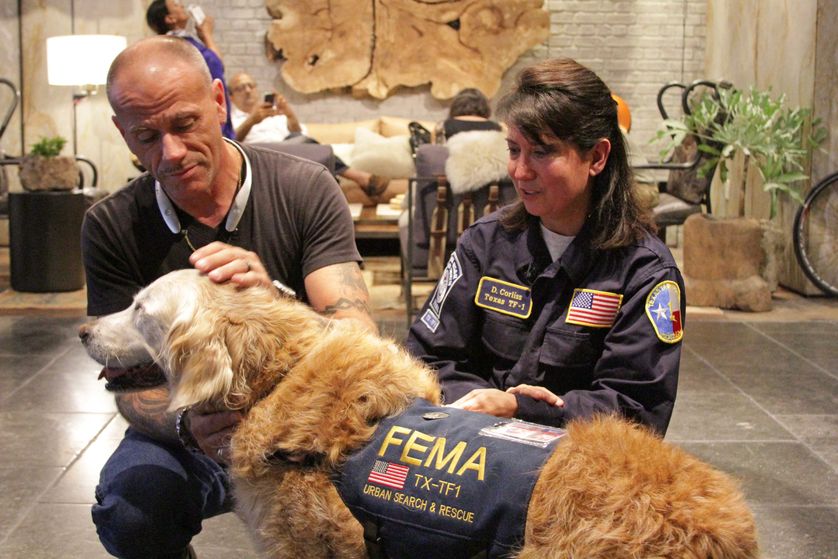
Bretagne with a firefighter and her owner and handler, Denise Corliss during her “Dog’s Best Day.” (Photo: BarkPost)
For two weeks, the golden retriever tirelessly worked 12-hour shifts at the former site of the World Trade Center, and one day, Bretagne walked away from Corliss, ignoring commands to come back. The 2-year-old dog made her way to a firefighter sitting on the ground, laid next to him and put her head in his lap.
“When we deploy to some of the disasters, what I didn’t anticipate is the role that they take on as a therapy dog,” Corliss told BarkPost. “It provides an opportunity for people to have support from the dog and comfort from the dog in a real difficult environment.”
Watch Bretagne enjoy her best day in the video below.
ooOOoo
Don’t these wonderful, fabulous animals just make your heart ache!
Jean and I salute Bretagne and all the other Search & Rescue dogs both here in America and all around the world.
The wonderful way that animals have evolved to survive life on the go.
It is very easy to look at our wonderful domesticated dogs and forget that genetically they are still very much hunting dogs. Of all the dogs that we have had Dhalia seemed the most closely connected with those instincts, and she is still missed more than a year after she died. So much so that I’m going to republish part of the post that commemorated her life just after she died. Here it is:
Dhalia, as with so many other dogs, offered lasting lessons. April 8th, 2014
Inevitably, as Jean and I went around our ‘stuff’ yesterday after burying Dhalia in the morning, there were moments of quiet contemplation and gentle discussion. Interludes over a hot drink where we reflected on the special dog that she was.
Much has already been written in this place but there can’t be too many reminders for us quirky humans of how valuable are the qualities of trust and love given to us by our dogs.
We need reminding how dogs are so intuitive and can reach out to a stranger without a moment of hesitation. As Jean described when recalling how she first came across Dhalia.
Dhalia – domesticated but still the wild dog shows through.
It was a Sunday around the middle of the month of September in the year 2005. My friend, Gwen, and I had set off for La Manga, a small fishing village three miles from San Carlos, Mexico. As the trip would take us through areas of desolate desert and the day was forecast to be a sizzler, we left early. The purpose of the journey was to feed a pack of dogs that were living on the outskirts of La Manga. These wild dogs were gradually getting used to our presence and with the aid of a humane trap we had previously caught two of them, a small puppy and her mother. Those two dogs were at my home and were gradually becoming tame so that good homes could be found for them.
Half-way to our destination, we saw two dogs running by the side of the road. It wasn’t unusual to see strays searching for road-kill. I stopped the car and prepared food and water for them. One dog took off almost immediately but the other just stood perfectly still looking intently at me. She was rail-thin and full of mange. Her ears and chest were scabbed with blood, and I could see that previously she had had pups. Tentatively, I pushed the food towards her. She took a bite and sat on her haunches; her eyes never leaving mine. Then she lifted a paw and reached out to me. Immediately, I burst into tears and scooped her into my arms. I carried her back to the car where she lay quietly in my lap whilst we went on to do our feeding. She was bloody and very smelly. However, I didn’t care.
Dhalia was always a gentle dog. One that would mix with any of the other dogs. A dog that loved people, of all types and ages.
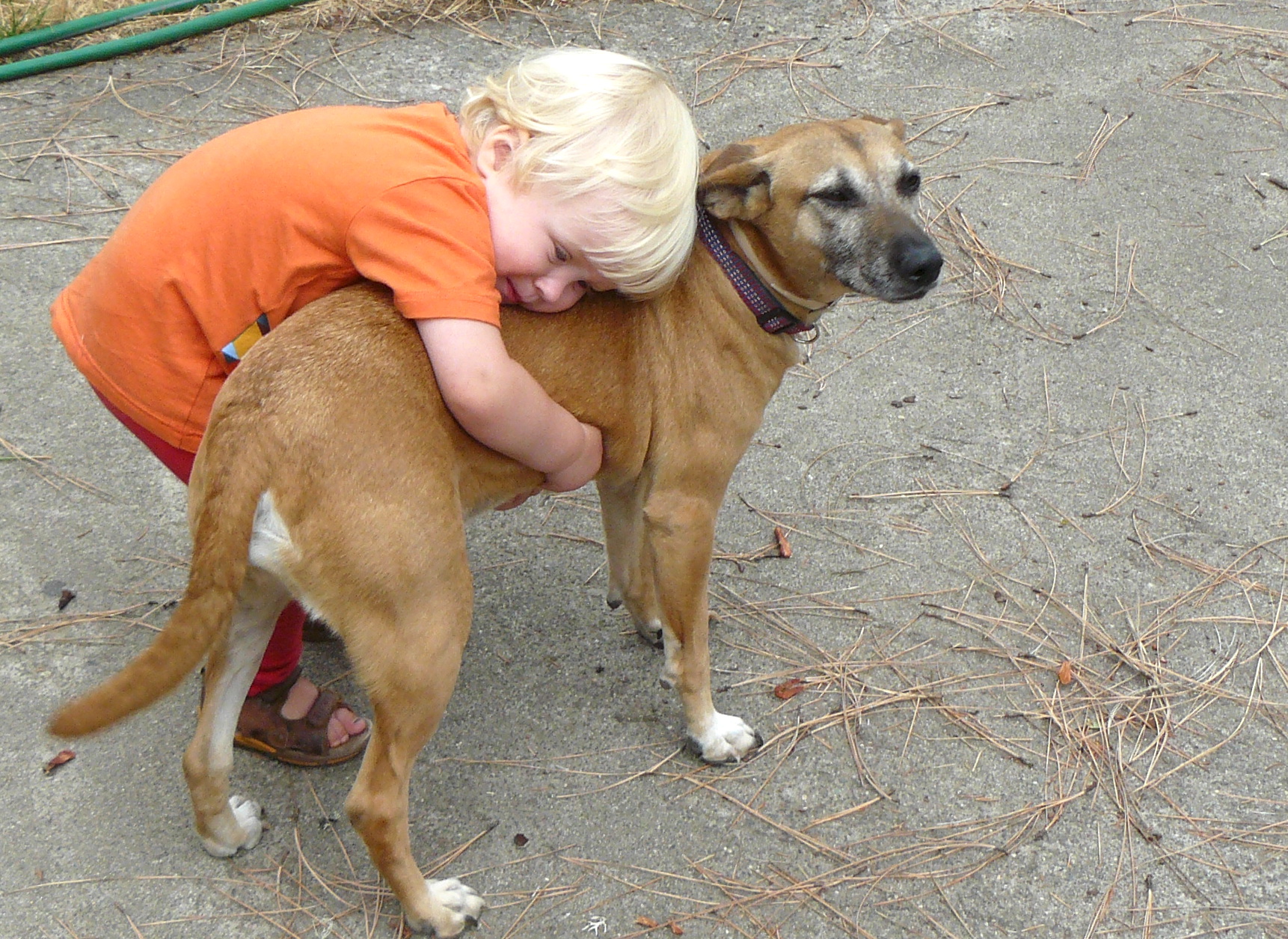
Love and Trust – Grandson Morten hugging Dhalia, September 2013.
The reason that my post from last year came to mind was as a result of a recent article on The Conversation blogsite. It was called Motion dazzle: spotting the patterns that help animals outsmart predators on the run and seemed ideal to share with all you good people who support this place.
ooOOoo
Motion dazzle: spotting the patterns that help animals outsmart predators on the run
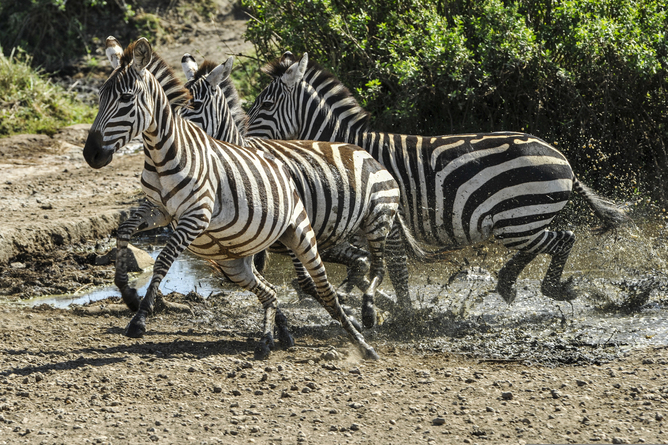
Zebra are seen running at the Serengeti National Park in Tanzania Nov. 14, 2013. (U.S. Navy photo by Mass Communication Specialist 1st Class Eric Dietrich/Released)
Many animals use the colours and patterns on their bodies to help them blend into the background and avoid the attention of predators. But this strategy, crypsis, is far from perfect. As soon as the animal moves, the camouflage is broken, and it is much easier for a predator to see and catch it. So how do animals protect themselves when they’re on the move?
Researchers are exploring whether high-contrast patterns during motion, such as stripes and zigzags, may be distorting the predator’s perception of where the animal is going. But, as little is known about such “motion dazzle”, we have built an online game to help shed light on it.
Lessons from war
The idea is that it may be more effective for animals to focus on preventing capture, rather then preventing detection or recognition, is actually more than 100 years old. It was naturalist Abbott Thayer who suggested that high-contrast patterns may distort the perceived speed or direction of a moving object, making it harder to track and capture.
Such motion dazzle patterns were actually used in World War I and II, where some ships were painted with black and white geometric patterns in an attempt to reduce the number of successful torpedo attacks from submarines. However, due to many other factors affecting wartime naval losses, it is unclear whether motion dazzle patterns actually had the desired effect.
HMS Argus displaying a coat of dazzle camouflage in 1918. wikimedia
What about the natural world? Zebras have bold stripes, and scientists have debated the function of their patterns since Darwin’s time. A recent modelling study suggested that when zebras move, their stripes create contradictory signals about their direction of movement that is likely to confuse predators. There are potentially two visual illusions responsible for this, which could form the basis of motion dazzle effects: the wagon wheel effect and the barber pole illusion.
The wagon wheel effect is named after Western movies, where the wheels on wagons often appear to be moving backwards. This is because the visual system takes “snapshots” over time and links them to create a continuous scene, in the same manner as recording film. If a wheel spoke moves forward rapidly between sampling events, it will appear to have moved backwards as it will be misidentified as the following spoke.
The barber pole illusion (also known as the aperture effect) occurs because the moving stripes provide ambiguous information about the true direction of movement. These illusory effects produced by stripes could therefore lead to difficulties in judging the speed and movement of a moving target. However, the zebra study was entirely theoretical and didn’t test whether striped patterns actually affected the judgements of real observers.
Dazzle Bug
Surprisingly, the first experimental tests of the effectiveness of motion dazzle patterns weren’t carried out until recently. Some studies have shown that strikingly patterned targets can be more difficult to catch than targets with other patterns in studies using humans as “predators” playing touch screen computer games. However, other studies have found no clear advantage for motion dazzle patterns So although patterns can affect our perception of movement, it’s still not clear which are most effective at doing so.
Can you see the spider? Crypsis can be pretty effective – as long as you don’t move. J Kelley, Author provided
We are addressing the question of which patterns are best for avoiding predators during movement using Dazzle Bug – an online game that asks players to imagine themselves as a predator, trying to catch a moving bug as fast as possible. Each bug has a different body pattern as well as a random pattern of movement. Bugs with easy to catch patterns will disappear, whereas those that are particularly tricky to catch will survive ––just like in nature. Over time, the patterns on the bugs’ body will evolve so that they become harder to catch with each successive generation.
This citizen science project will allow us to see what patterns are most effective at evading capture. We can then use these results to look at what visual effects these patterns have, and to see whether these patterns match up with those found on real animals in the wild.
Our findings will offer insight into the role of stripes, which are common in many species. While these patterns may have evolved to confuse the visual perception of a predator, they may also be a result of other selection pressures, such as attracting a mate or regulating body temperature. If striped patterns survive and evolve in the game, this would provide strong evidence that these patterns do act to confuse human predators, perhaps by producing the illusions described above. As motion perception seems to be highly conserved across a wide range of populations, these illusions may occur for many other predators too.
If we find that patterns other than stripes – such as speckles, splotches or zigzags – are most effective in preventing capture, this then leads to new and interesting questions about how these patterns may act to confuse or mislead. Whatever the outcome, Dazzle Bug will provide insight into how bodily patterns may have evolved to help animals to survive life on the go.
Yesterday was the moment when Queen Elizabeth II became the longest-reigning UK monarch. As the BBC reported (in part) yesterday:
Queen Elizabeth II becomes longest-reigning UK monarch
The Queen has thanked well-wishers at home and overseas for their “touching messages of kindness” as she becomes Britain’s longest-reigning monarch.
Speaking in the Scottish Borders, the 89-year-old monarch said the title was “not one to which I have ever aspired”.
At 17:30 BST she had reigned for 23,226 days, 16 hours and approximately 30 minutes – surpassing the reign of her great-great-grandmother Queen Victoria.
David Cameron said the service the Queen had given was “truly humbling”.
Dressed in turquoise with her trusty black handbag at her side, the Queen spoke briefly to the gathered crowds earlier.
“Inevitably a long life can pass by many milestones – my own is no exception – but I thank you all and the many others at home and overseas for your touching messages of great kindness,” she said.
Newly released official photographs show the Queen with her official red box, containing the day’s policy papers, cabinet documents, Foreign Office papers and other letters.
Here’s a video that is worth viewing:
So that was the ‘good’ news.
Now here is the ‘ugly’ news; the latest essay by George Monbiot republished here with Mr. Monbiot’s kind permission.
ooOOoo
Britain’s Mafia State
8th September 2015
Where does legitimate business end and organised crime begin?
By George Monbiot, published in the Guardian 9th September 2015
Be reasonable in response to the unreasonable: this is what voters in the Labour election are told. Accommodate, moderate, triangulate, for the alternative is to isolate yourself from reality. You might be inclined to agree. If so, please take a look at the reality to which you must submit.
To an extent unknown since before the First World War, economic relations in this country are becoming set in stone. It’s not just that the very rich no longer fall while the very poor no longer rise. It’s that the system itself is protected from risk. Through bail-outs, quantitative easing and delays in interest rate rises, speculative investment has been so well cushioned that, as Larry Elliott puts it, financial markets are “one of the last bastions of socialism left on earth.”
Public services, infrastructure, the very fabric of the nation: these too are being converted into risk-free investments. Social cleansing is transforming inner London into an exclusive economic zone for property speculation. From a dozen directions, government policy converges on this objective. The benefits cap and the bedroom tax drive the poor out of their homes. The forced sale of high-value council houses creates a new asset pool. An uncapped and scarcely regulated private rental market turns these assets into gold. The freeze on council tax banding since 1991, the lifting of the inheritance tax threshold and £14 billion a year in breaks for private landlords all help to guarantee stupendous returns.
And for those who wish simply to sit on their assets, the government can help here too, by ensuring that there are no penalties for leaving buildings empty. As a result, great tracts of housing are removed from occupation. Agricultural land has proved an even better punt for City money: with the help of capital gains, inheritance and income tax exemptions, as well as farm subsidies, its price has quadrupled in 12 years.
Property in this country is a haven for the proceeds of international crime. The head of the National Crime Agency, Donald Toon, notes that “the London property market has been skewed by laundered money. Prices are being artificially driven up by overseas criminals who want to sequester their assets here in the UK.”
It’s hardly surprising, given the degree of oversight. Private Eye has produced a map of British land owned by companies registered in offshore tax havens. The holdings amount to 1.2 million acres, including much of our prime real estate. Among those it names as beneficiaries are a cast of Russian oligarchs, oil sheikhs, British aristocrats and newspaper proprietors. These are the people for whom government policy works, and the less regulated the system that enriches them, the happier they are.
The speculative property market is just one current in the great flow of cash that sluices through Britain while scarcely touching the sides. The financial sector exploits an astonishing political privilege: the City of London is the only jurisdiction in the UK not fully subject to the authority of parliament. In fact, the relationship seems to work the other way. Behind the Speaker’s chair in the House of Commons sits the Remembrancer, whose job is to ensure that the interests of the City of London are recognised by the elected members. (A campaign to rescind this privilege – Don’t Forget the Remembrancer – will be launched very soon). The City has one foot in the water: it is a semi-offshore state, a bit like the UK’s Crown dependencies and overseas territories, tax havens legitimised by the Privy Council. Britain’s financial secrecy undermines the tax base while providing a conduit into the legal economy for gangsters, kleptocrats and drug barons.
Even the more orthodox financial institutions deploy a long succession of scandalous practices: pension mis-selling, endowment mortgage fraud, the payment protection insurance con, Libor rigging. A former minister in the last government, Lord Green, ran HSBC while it engaged in money laundering for drugs gangs, systematic tax evasion and the provision of services to Saudi and Bangladeshi banks linked to the financing of terrorists. Sometimes the UK looks to me like an ever-so-civilised mafia state.
At next month’s Conservative party conference, corporate executives will pay £2,500 to sit with a minister. Doubtless, because we are assured that there is no link between funding and policy, they will spend the day discussing the weather and the films they have seen. If we noticed such arrangements overseas, we might be inclined to regard them as corruption. But that can’t be the case here, not least because the invitation explains that “fees associated with business day & dinner are considered a commercial transaction and therefore do not constitute a political donation.”
The government also insists that there is no link between political donations and seats in the House of Lords. But a study by researchers at Oxford University found that the probability of so many major donors arriving there by chance is 1.36 x 10-38: roughly “equivalent to entering the National Lottery and winning the jackpot 5 times in a row”. Why does the Lords remain unreformed? Because it permits plutocratic power to override democracy. Both rich and poor are kept in their place.
Governed either by or on behalf of the people who fleece us, we cannot be surprised to discover that all public services are being re-engineered for the benefit of private capital. Nor should we be surprised when governments help to negotiate, without public consent, treaties such as TTIP and CETA (the Comprehensive Economic and Trade Agreement), which undermine the sovereignty of both parliament and the law. Aesop’s observation that “we hang the petty thieves and appoint the great ones to public office” remains true in spirit, though hanging has been replaced by community payback.
Wherever you sniff in British public life, something stinks: I could fill this newspaper with examples. But, while every pore oozes corruption, our task, we are told, is merely to trim the nails of the body politic.
To fail to confront this system is to collaborate with it. Who on the left would wish to stand on the sidelines as this carve-up continues? Who would vote for anything but sweeping change?
Ma’am’s best friend: The Queen has owned corgis for more than 60 years. Picture seen in the UK’s Daily Mail newspaper.
Taking the two stories together, all that comes to mind is that we could do much better if the United Kingdom, and other countries, were governed by dogs!
So said Sir Winston Churchill. It applies equally to the price of power.
There was an essay recently written and published by Hariod Brawn over on her blog Contentedness.net that was incredibly thought-provoking and very beautiful besides. Hariod has given me permission to republish it and it follows shortly.
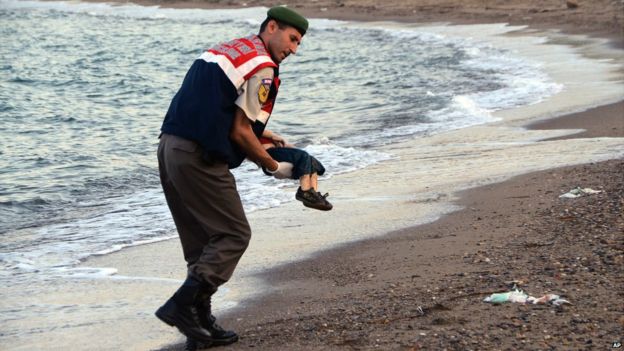
I have no doubt that Hariod’s essay was, in part, inspired by that terrible photograph that has been circulated and commented upon by thousands around the world.
In the words of the BBC, “The pictured boy is reported to be three-year-old Aylan, who drowned along with his five-year-old brother Galip and their mother, Rihan. Their father, Abdullah Kurdi, survived.”
The emotions created by this and other tragic photographs are disturbing, and I am no exception to having those same emotions. But as friend, Chris Snuggs, mentioned in a telephone call between us yesterday morning, what has been happening in Syria is no less terrible, perhaps even more so when one looks at the blood that is, metaphorically, on the hands of a number of western governments. The old saying of reaping what we sow comes to mind.
None of which takes away the intense beauty of Hariod’s essay: Empathetic apes.
ooOOoo
Empathic apes
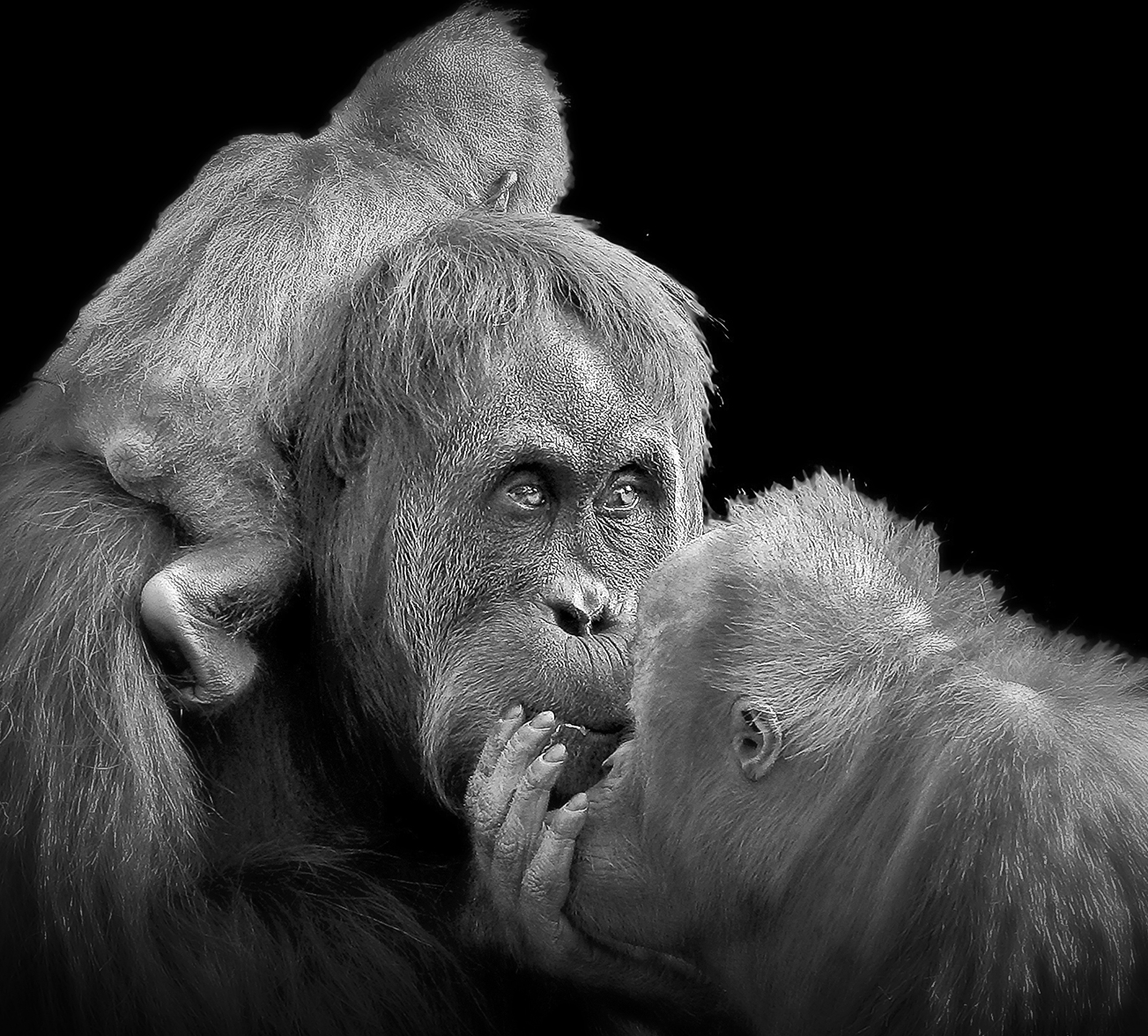
Orangutan mother and kids. By Patrick Bouquet, Chantilly.
The year is 1955, and far from the nearest village, somewhere within the Northwestern jungle region of Thailand, a 48 year-old Englishman and ordainee to the Buddhist monkhood sits quietly in studious attention. A few feet away, a female ape sits, arms carefully wrapped around some precious possession. The monk first chanced upon her the previous day, and due to the curiosity roused in observing her melancholic countenance, has remained respectfully nearby to her. A trust has developed, the ape sensing the monk’s gentle disposition and harmlessness. He really ought to be making his way to the village for alms, yet somehow senses that he should stay. A silent, palpable communication has developed between the two, and slowly, carefully and deliberately, the ape, her sadness still etched upon her face, finally unfolds her arms and offers a first sight of what she has been protecting. The monk slowly approaches to within a pace or two, sensing the invitation, only to catch sight of her lifeless and terribly deformed baby.
Two empathic apes, ancestrally and psychologically speaking, separated by little more in this moment than a distant, lineage-splitting, speciation event. Opposable thumbs, one hers and one his, in turn chase away a monk’s tear and a delicately mottled butterfly as it alights from the baby’s forehead, though cannot do the same for their conjoined feelings. Eyes meet, evincing as they do a deepening rush of sadness. Nothing can be done – is this what she is thinking in her way? In his unknowing, the saffron-robed wanderer radiates compassion, yet knows he has nothing to do with it; an offering from wisdom, not from the self. All that need be known arrives in the fullest of measures. What use now the venerable elder’s sagacity, his knowledge of emptiness, renunciation, equanimity, the void? She inhabits the void, is the void, her bleak knowing piercing its veils. Without turning, the monk slowly retreats, still reverently holding her gaze alongside a shared understanding. A slight suggestion of a bowing head betokens what passes between them.
It is the ability to empathise which in part distinguishes the psychopathic mind from its otherwise healthy state, and the primary orbit of empathy is that of feeling, not the mere gyrations of intellect. This is why many species of sentience can empathise, and we human animals are but one of them. We may erroneously presume that an ability to reflect upon others’ situations facilitates human empathic capacity; yet the state of those others and their situations need not be known as verbally abstracted objects in the mind – little stories packaged in words. We may just as well occupy others’ frames of reference by intuited means; and vitality, morbidity, distress and joy may all be recognised across species in differing ways; one need not indulge any anthropomorphisation, for clear evidence abounds. What is intuited here, or instinctively known, is the nature of the other’s felt emotional condition; and in this way, 60 years ago, the grieving mother ape and mendicant monk shared that intense experience – a wordless world of deep, primate feeling.
Engraving of Orangutan. By Willem Piso (1611-1678). Courtesy Wellcome Trust
Was the mother ape empathic? Well, she came to appreciate the monk’s amity; she felt able to extend trust; she intuited the monk’s concern for her as well as his desire for understanding as to the reasons for, and significance of, her sadness; and finally, she recognised that the monk would feel something of that sadness in revealing its causes to him. This is all to say that she significantly placed herself within the monk’s frame of reference and innately understood that emotions can be matched in shared experience – the personal does not expire at the boundary of the body. Her empathic appreciation was sophisticated, certainly moreso than any psychopathic human ape. Now, one way to cheat the system is to mimic expressions and gestures, which results in a like proprioceptive sense. This means our feelings echo the other’s, so affecting an emotional contagion of sorts, whether volitionally induced or not. Yet neither jungle dweller did so, their empathic link being forged in mind purely intuitively, and silently.
Empathy subsists in knowledge; it is in part to know the mind of the other, and whilst its currency is both cognitive (knowing) and emotional (feeling) in nature, it is the latter that strengthens the connective link to altruistic and prosocial leanings, as well as ameliorating aggressive traits. Primates’ mirror-neuron systems help forge innate empathic leanings, with research suggesting that empathy evolved in part as a survival mechanism. Right now, tens of thousands of refugees are fleeing war-torn regions of Africa and the Middle East so as to seek sanctuary, and survival, in Europe. A few hours ago, a three year-old Syrian boy, Aylan Kurdi, drowned and was washed up on the shores of the Greek island of Kos. Equally tragically, his five year-old brother met a similar fate. Whilst Europe’s politicians exhibit an ongoing empathy gap, innocent children are dying. We live, not literally, though metaphorically, in a jungle, sharing the empathic faculties of the monk and bereaved mother ape. Are we wise enough to nurture the same?
ooOOoo
We need leaders who understand the integrity that is required from them. We need leaders that accept and understand the responsibilities that they have embraced, indivisible from the power that society has lent to them. We need leaders that understand a different aspect of their power, the power of those unanticipated consequences from their actions.
Until we the people understand that electing leaders who do not embrace integrity then Aylan Kurdi and thousands of others in those ‘hot spots’ around the world will continue dying in vain.
Integrity equates to being truthful, to being honest. It doesn’t mean being right all the time, of course not, but integrity does mean accepting responsibility for all our actions, for feeling remorse and apologising when we make mistakes. Integrity means learning, being reliable, being a builder rather than a destroyer. It means being authentic. That authenticity is precisely and exactly what we see in our dogs.
The starting point for what we must learn from our dogs is integrity.
With the memory of Hurricane Katrina refreshed in our minds as we acknowledge the recent passing of the tenth anniversary of that ghastly disaster, a link to an item from May, 2013 that was published on Mother Nature Network seems perfect for this place.
ooOOoo
Why we turn to dogs when disaster strikes
From aiding search-and-rescue missions to lending a shoulder to cry on, man’s best friend can often be found at the site of tragedy.
By: Laura Moss, May 21, 2013.
Photo: K-9 Parish Comfort Dogs/Facebook
Disaster relief is flooding into Moore, Okla., but along with volunteers and supplies, there are dogs.
Some, including the 11 canine disaster search teams trained by the Search Dog Foundation or SDF, are scouring tornado debris for survivors. Others are en route to comfort the devastated city’s residents. Lutheran Church Charities, whose therapy dogs have worked with victims of the Boston bombings and the Newtown, Conn., shootings, is sending six dogs from its Chicago headquarters.
When disaster strikes, man’s best friend is often there, working on the frontlines of rescue efforts, as well as behind the scenes, helping people cope with trauma and loss.
Super sniffers
Experts estimate that one search-and-rescue (SAR) dog can accomplish the work of 20 to 30 human searchers. Because of these unparalleled abilities, the number of trained SAR dogs has been rising across the United States.
Dogs make efficient searchers due to their superior vision, hearing and sense of smell. A dog’s nose is about 100 times more sensitive than a human nose, and SAR dogs are trained to locate human scents amid countless other smells. They track our scents by the 30,000 to 40,000 dead skin cells we drop every minute.
“Dogs aren’t miracle workers, but their noses are so precious,” said SDF founder Wilma Melville. “They can find those people who survived a horrific ordeal.”
Air-scent dogs are trained to work in specific types of terrain. Some search in wilderness settings while others search urban environments, which often can involve scouring collapsed buildings.
Because they must navigate unstable terrain, urban SAR dogs are some of the most highly trained canines. The only national standards for such dogs are the Federal Emergency Management Agency’s certification standards for urban disaster work. Currently, fewer than 100 dog-handler teams in the U.S. have this certification.
In addition to air-scent dogs, there are dogs taught to seek out both skin cells and the smell of human decomposition. During major disasters, such as the 1995 Oklahoma City bombing and the 2001 collapse of the World Trade Center, both air-scent dogs and cadaver dogs were used to search for people.
This caused problems for SAR dogs because they became discouraged when they found only dead bodies. At both Oklahoma City and Ground Zero, handlers hid in rubble so that dogs could occasionally find a living person. The dogs’ desire to elicit a response from a found person may be a result of their training, which involves seeking feedback and rewards, but experts say it could also speak to a deeper connection with humans.
Man’s best friend
When disasters occur, dogs do much more than just aid search-and-rescue missions. They’re often there to provide a source of comfort for us in ways that only an animal can.
In an interview with American Thinker, Debra Tosch, executive director of SDF, explained how her SAR dog Abby was able to console a firefighter at Ground Zero. “When someone was found, work would stop, and I watched as the tears rolled down the firefighters’ faces. I remember one firefighter who hugged Abby and buried his face in her neck after just finding out a fellow firefighter was found,” she said.
Research show that petting dogs can lower anxiety, regulate breathing and decrease blood pressure, and a Japanese study found that simply looking at a dog can increase oxytocin levels. Oxytocin is a chemical released by the pituitary gland that’s associated with human bonding and affection.
But while the firefighter may have found comfort in Abby’s presence, was the dog able to empathize? Research says it’s very likely.
A 2012 study at Portugal’s University of Porto found that dogs yawn even when they hear only the sound of a person yawning, providing strong evidence that dogs are able to empathize with us.
And a study at the University of London Goldsmiths College found that dogs comforted people — both their owners and strangers — when the person pretended to cry.
“I think there is good reason to suspect dogs would be more sensitive to human emotion than other species,” Custance told Discovery News. “We have domesticated dogs over a long period of time. We have selectively bred them to act as our companions. Thus, dogs that responded sensitively to our emotional cues may have been the individuals that we would be more likely to keep as pets and breed from.”
ooOOoo
Time and time again, the facts support what the vast majority of those who care for and love dogs truly know: the bond between dog and human is the most special that there has ever been between an animal and mankind.
Fewer than five minutes ago, at 11:52 PDT today, Sunday 23rd August 2015, Jim Goodbrod euthanised our Lilly.
Lilly, aged seventeen, started to decline about a year ago. In the last few weeks she had become progressively weaker, she was hardly eating and had lost much body mass, her kidneys were close to total failure and it was clear to Jean and me that she was close to what could in all likelihood be a painful end. So much better for Lilly that her end should be peaceful and pain-free, as it most clearly was.
Lilly was found by Jean sixteen years ago with her five young, suckling puppies in a car mechanics workshop in San Carlos, Mexico and has been loved and cared for by Jean right up to the end. Most Mexican street dogs barely live for a couple of years.
All of our dogs are special yet the odds of any other of our dogs living seventeen human years is very low.
I intend to republish tomorrow and Tuesday two posts of Lilly in homage of this wonderful, gentle and loving dog.
Let me leave you with this photograph of Jean and Lilly from earlier last year.
We rarely get to know what a rescue dog has been through.
Of the ten dogs that we have here at home, two are pedigree dogs purchased from breeders, that’s Pharaoh and Cleo, two are rescue dogs that came from known sources, Oliver from neighbours who couldn’t cope with him and Pedy from the local Merlin dog pound, and the rest are all ex-rescue dogs that Jean took from the streets of San Carlos, Mexico.
The last rescue dog to be taken in by Jean before we both left Mexico was Hazel who was abandoned outside Jean’s house in San Carlos a few weeks before we left for Arizona. The picture below is of Hazel taken in March 2014.
Hazel is the most loving and adorable of dogs and the love that I feel coming from her towards me is real, tangible and precious. Yet this is a mother dog who very shortly before she was deposited in front of Jean’s house in Mexico had had all her puppies removed from her as Hazel was still in milk. (The poor in San Carlos frequently sell young puppies for a few Pesos.) It’s beyond the comprehension of us humans, especially women, to imagine what it must be like for a mother to so catastrophically lose her young babies.
That’s why a recent article over on Mother Nature Network really reached out to me. We never know what homeless dogs have to contend with before they find loving homes.
ooOOoo
Why our Great Dane is so scared to be alone
Most of us will never know what our rescue dogs have been through. We found out.
By: Ali Berman, August 12, 2015
Author Ali Berman discovered she had a new shadow when she met Cooper. (Photo: Ali Berman)
In February 2015, David and Glenda Berman — that’s my mom and dad — drove from New York to Connecticut to meet Cooper, a 13-month-old Great Dane. When they were introduced, 100-pound Cooper rushed over to give them an enthusiastic greeting, burying his head in their legs, leaning on them, and asking to be petted. My mom and dad fell in love, and Cooper took the two-hour drive back to their house, the place that would become his forever home.
During those first few weeks, my parents got to know Cooper. They went for walks in the snow, played together, and snuggled. (He’s a major snuggler.) But, in addition to those normal doggy behaviors, they noticed something else. Cooper was reluctant to leave their sides. If they left the room, he went with them. He took trip after trip to the kitchen, to the bathroom, to the laundry room. When they moved, he moved.
I didn’t believe the extent of it until I got the chance to meet him myself. I traveled back to New York to visit my family in May. For me and Coop, it was love at first sight. We played, we ran, we cuddled, and by the end of the first day, I found myself with a 115-pound shadow. As soon as I showed any sign of movement, his head perked up and he was ready to follow me. In the morning when he opened his eyes, he went directly to my room to wake me up. When I napped in the afternoon, he came with me, opting to sleep right next to the bed. And when I went out to dine with a friend, my parents distracted him so he wouldn’t see that I was leaving.
Now, when a small dog follows you everywhere, it’s not a big deal. But when a Great Dane follows you around, it’s not stealthy. Seeing how much he craved to be near people, I welcomed him wherever I went — even the bathroom. Still, I wondered: Why was he so reluctant to be alone? Did he not believe we’d come back?
If there’s a hug going on, Cooper wants to be a part of it. (Photo: Ali Berman)
Thinking we knew the full story behind his upbringing, we all wrote it off as him being a little insecure. In just over a year he had experienced four different homes. After he left the breeder (his first home), Cooper went to live with a young woman who loved him very much. Unfortunately, they learned that while Cooper enjoys meeting other dogs on his walks, he has trouble living with other dogs. He got into fights with another pooch in the house and with great difficulty, the young woman sent Cooper to live with her uncle. As he also had animals at home, the problem repeated itself.
Cooper needed to live with a one-dog family. The uncle — who could easily have sold purebred Cooper for a handsome sum — instead decided to put him up for adoption to find the best family possible. My parents had been looking for a Great Dane to adopt, so they sent their references, along with pictures with their previous Great Dane who had died two years before, and a heartfelt message. They were chosen to be Cooper’s new and final family.
Because Cooper was loved and well treated in all of his homes, my parents thought the insecurity came from the many moves.
But that wasn’t the full story. Not even close.
In an email from the woman who originally took Cooper in, my mother learned the truth. Cooper had been born with the rest of his litter in the home of an Iowa breeder. One night, when the breeders were out bowling, their home caught on fire. Everything went up in flames. Cooper’s mother and siblings all tragically perished. Baby Cooper was found alone in the debris in the yard. In just one night, he had lost his entire family, suffering more trauma in an instant than most experience in a lifetime.
After the fire, the breeders had to rebuild their lives, so they put Cooper up for adoption. That’s when he started to move from house to house, finally finding his perfect match with my parents. Now, he starts out every day with a multi-mile walk, a nap in the office while my dad works, and then Cooper spends an hour or two playing with his friends in the dog park in the afternoon. If he’s not snoozing or walking, he’s out in the garden with my mom soaking up the sun.
Some serious trauma as a puppy made Cooper never want to be alone. (Photo: Ali Berman)
Just part of the story
When we rescue an animal, most of the time we never get to know their complete history. Why do some cry when their humans leave the house? Or some bark and growl at men who wear hats? Like people, animals remember the various difficulties and tragedies they have suffered. Those scars go through life with them, just like our own scars follow us. The only difference is they can’t tell us their fears, and we can’t explain to them that they are safe. The best we can do is show them they are loved and hope with enough repetition, they’ll get the message.
In an ideal world, every dog would only have good memories. Their first Frisbee catch or trip to the beach, their favorite person who knows how to pet the ears just right, and the safety of a single home where they will live their life right through to ripe old age. That’s not the case for every dog. Some need a little extra help from us as they learn to trust, move on from the past and accept that their new reality is the one they can count on.
With time, Cooper might just learn to keep snoozing while his mom or dad goes to get a cup of tea. Until then, we’ll all keep showing him that he’s loved, and that this home and this family are forever.
ooOOoo
When one thinks of how dogs, Cooper, Hazel and tens of thousands of others, so beautifully offer their unlimited love to us humans it is just a great shame that we humans haven’t emulated our beloved dogs across mankind in such a widespread manner.
Picture taken by our guest Don Reeve of Hazel (and me) Wednesday afternoon.
Gorgeous Hazel. Who would have thought from that smiling face of hers that she had ever suffered the catastrophic loss of her puppies that she had.
We have a guest staying with us for twenty-four hours and the last thing I wanted to do was to spend time at a keyboard composing a new post for today.
So just for fun, I thought of reposting what appeared on this blog five years ago: August 18th, 2010.
It’s almost unimaginable that Planet Earth could go the same way. Then again, anyone over the age of, say 60, would find where we are today, in terms of mankind’s long-term survival, equally unimaginable from how the world looked 40 years ago.
This is an article that I saw on Mother Nature Network in the middle of June and thought at the time it would interest readers of this place.
ooOOoo
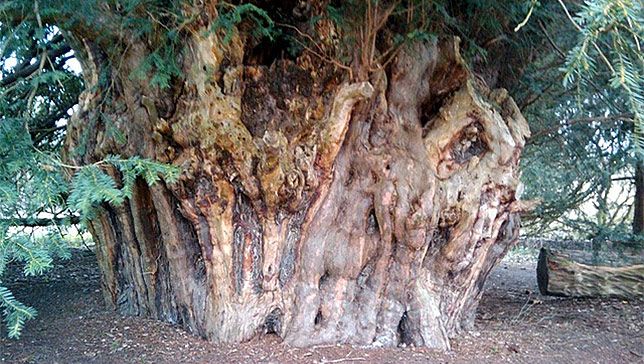
2,500-year-old tree witnessed Magna Carta signing
The Ankerwycke Yew in Berkshire, England, has been an important meeting spot for hundreds of years.
By: Michael d’Estries
June 15, 2015,
The Ankerwycke yew is estimated to be between 2,000-2,500 years old. (Photo: Wiki Creative Commons)
As the world celebrates the 800th anniversary of the signing of the Magna Carta, [Ed. That was on June 15th, 2015] a document that laid the foundation for modern liberties and law, it’s worth remembering that one silent witness to that historical event remains alive and well.
According to some historians, King John signed the Magna Carta beneath the Ankerwycke yew, a 30-foot-wide behemoth, which in June 1215 was already a well-known ancient landmark. Estimates of its age today range from 2,000-2,500 years — making it one of oldest trees in the United Kingdom and the world.
The famous yew is located along the banks of the River Thames on grounds previously occupied by a 12th-century nunnery called St. Mary’s Priory. Historians point to a 19th-century reference to the nunnery, now in ruins, that hints at its importance in the signing of the Magna Carta.
Here the confederate Barons met King John, and having forced him to yield to the demands of his subjects they, under the pretext of securing the person of the King from the fury of the multitude, conveyed him to a small island belonging to the nuns of Ankerwyke [the island], where he signed the Magna Carta, wrote J.J. Sheahen in 1822.
History credits the yew as playing host to several other important meetings, from a place of council for Saxon kings to secret meetings between Henry VIII and a young Anne Boleyn. Earlier this year, saplings grown from the cuttings of famous yews from all over the U.K., including the Ankerwycke, were planted in a hedge in Edinburgh’s Botanic Gardens.
‘We are losing ancient yews all the time, to climate change, development and vandalism,” said Martin Gardner, who is leading the preservation initiative. “These are the most iconic trees in the world. We have to conserve every single one.”
Published on Apr 9, 2013
A short film about a remarkable ancient tree in England. It is the oldest known tree on National Trust land and is believed to be the location where the Magna Carta was signed in 1215. Surrounded by myth and legend, this tree is also believed to be the place where King Henry VIII began his first liaisons with his future (ill-fated) wife, Anne Boleyn in the 1530’s.
ooOOoo
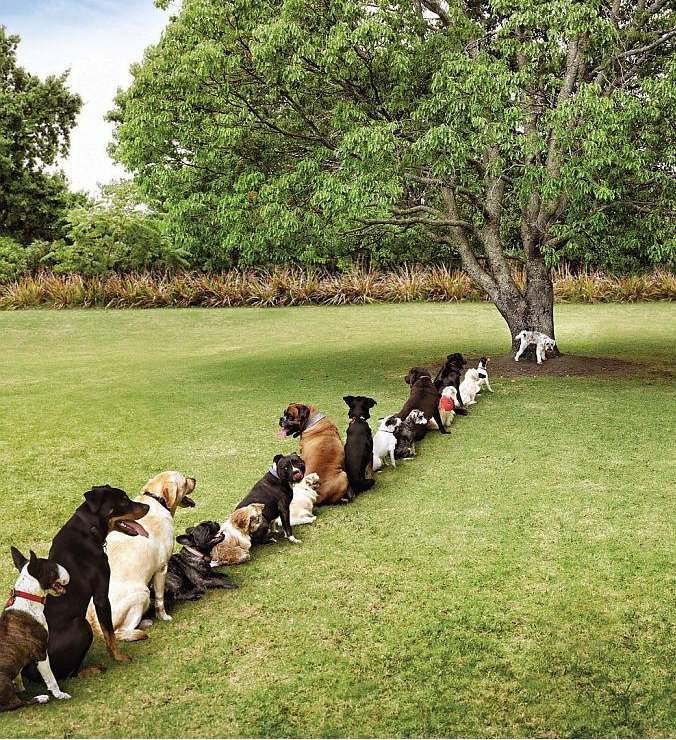
I will close the post with this much-circulated picture reinforcing the fact that trees have been an important meeting spot for hundreds of years.
When I first started writing this blog, more than six years ago now, I had no idea whatsoever that the community of friends who read and follow Learning from Dogs would develop to the point where the volume of ideas and suggestions sent in are, are by far, the biggest source of creative posts.
Take today’s for example. The link to the article was sent to me by Chris Gomez a little over a week ago and yesterday was the first time that I read the article in full.
It’s a fascinating and incredibly interesting piece.
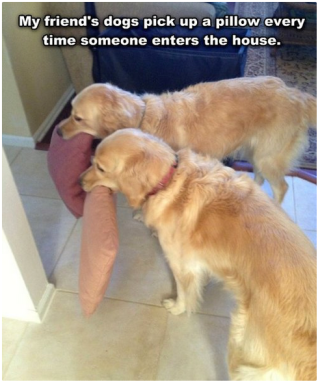
Unlike a certain companion animal that will go unnamed, dogs lose their minds when reunited with their owners. But it’s not immediately obvious why our canine companions should grant us such an over-the-top greeting—especially considering the power imbalance that exists between the two species. We spoke to the experts to find out why.
Call of the Wild
In order to gain an appreciation for dog behavior, it’s important to understand that dogs are descended from wolves (or at least a common wolf-like ancestor). Clearly, the two species, separated by about 10,000 to 15,000 years, share a lot in common.
Like dogs, wolves greet each other with vigorous face licking (Credit: Sander van der Wel CC A-SA 2.0)
But there’s only so much we can extrapolate from wolves; dogs are categorically different by virtue of the fact that their ancestors actively sought out the company of humans. Making matters even more complicated is the realization that Paleolithic era wolves are not the same as the ones around today. Consequently, any inferences we make about dog behavior and how it relates to wolves is pure speculation.
Neuroscientist Gregory Berns, author of How Dogs Love Us, says there’s a fundamental difference between modern wolves and those that lived long ago.
“The most social of those ancestral dogs who were hanging around humans had to have been the most social of those wolves,” he told io9. “They joined humans and eventually evolved to become dogs. The remainder of the wolf population were among the most antisocial of those animals, and did not want to have anything to do with humans.”
That said, however, Berns says we can clearly see behaviors in wolves that are similar to those expressed by dogs. For instance, wolves greet each other by licking each others’ faces. For these pack animals, this licking behavior serves as an important social greeting, but also as a way to check out and determine what the other wolves have brought home in terms of food.
Wolves, says University of Trento neuroscientist Giorgio Vallortigara, greet each other in different ways depending on the type of individual relationships they’ve forged. Feral dogs, he says, behave in similar ways. But the big change in terms of adaptive sociality has been the ability of domesticated dogs to interact with humans using our own communicative signals, such as gazes and gestures.
Dog expert Jessica Hekman, who blogs at DogZombie, has witnessed greeting behaviors among wolves first hand.
“When I’m at Wolf Park in Battle Ground, Indiana, I am always struck by how much some of the specific wolf behaviors resemble behaviors I see in dogs—but so much more ritualized, and sort of writ large,” she told io9. “I witnessed one behavioral study there in which wolves who knew each other well had been separated for a few days and were put back together. The greeting rituals were fascinating, with lots of crouching and chin-licking from the subordinate wolves. You do see these behaviors in dogs, but more sporadically, without such intensity.”
At the same time, dogs exhibit behaviors that are markedly different from wolves. As Hekman explained to me, one of the most dramatic differences between dogs and wolves is the ability of dogs to accept novelty. Simply put, dogs are less fearful than wolves.
“It may sound a little odd to say that a wolf, who can easily kill you, is afraid of you, but that is precisely why they can be dangerous: because they may choose to take proactive measures to protect themselves, using their teeth,” says Hekman. “Dogs are a lot less likely to do this.”
Indeed, given their wolf ancestry, it’s remarkable that dogs get along with humans so well. But as Berns pointed out to me, sociability has turned out to be a rather powerful adaptation, one that has worked a lot better for dogs than it has wolves.
“I mean, look around the world and see how many dogs there are,” he says. “With dogs, it’s proven to be a highly effective evolutionary strategy. There are in the order of tens of millions of dogs in the world, so in many ways, dogs have out-evolved wolves.”
Berns says that whatever the sociality that dogs have evolved, one of the defining traits of a dog is the degree to which they will interact with humans as well as other animals.
How Dogs See Humans
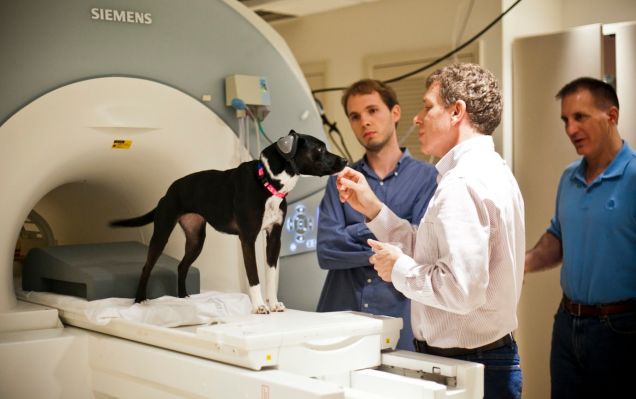
A key aspect of Berns’ brain imaging research is to study how dogs perceive us. We humans know that dogs are a separate species, but are dogs cognizant of this as well? Or do they see us as members of their pack, or as some kind of weird dog?
Callie gets outfitted with ear protection prior to entering the noisy fMRI machine. The research team includes, from left, Andrew Brooks, Gregory Berns and Mark Spivak. (Credit: Bryan Meltz, Emory University)
According to Berns’ research, dogs that are presented with certain smells in scanners can clearly tell the difference between dogs and humans, and also discern and recognize familiar and strange odors. In particular, the scent of a familiar human evokes a reward response in the brain.
“No other scent did that, not even that of a familiar dog,” Berns told io9. “It’s not the case that they see us as ‘part of their pack as dogs,’ they know that we’re something different— there’s a special place in the brain just for us.”
Berns stresses that dogs are social with us not just because of their scavenging tendencies.
“What we’re finding with the imaging work is that dogs love their humans—and not just for food,” he says. “They love the company of humans simply for its own sake.”
Hekman says it’s hard to know what dogs are thinking, but she suspects they understand that we’re not quite like them. As evidence, she points to aggressiveness in dogs as it’s directed to other dogs and humans—differences that aren’t correlated. She says it’s quite common for a dog to have a problem with one and not the other. In other words, dogs appear to perceive other dogs as one group, and humans as a separate group. What’s more, dogs will seek the help of humans and not other dogs—a possible sign that dogs understand that humans have resources that dogs do not, and are thus a different kind of social entity.
But do dogs see us as part of the pack?
“It’s important to note that a pack of wolves is a family—literally, usually mom, dad, puppies, and some young offspring from previous years who haven’t gone off on their own yet,” says Hekman. “Do dogs see us as part of their family? I think they do.”
So Happy to See Us
Virtually all experts agree that the happiness dogs feel is comparable to what humans experience, and that it’s similar to how humans feel towards each other.
One happy dog (Credit: Lars Curfs/CC-A-SA 3.0)
“All the things that we’ve done with the brain imaging—where we present certain things to the dogs and map their reward responses—we see analogous brain responses in humans,” says Berns. “Seeing a person that’s a friend or someone you like, these feelings are exactly analogous to what a dog experiences.”
Berns says that dogs don’t have the same language capacities as humans, and that they’re not capable of representing things in their memory like we can. Because dogs don’t have labels or names for people, he suspects that they have an even purer emotional response; their minds aren’t filled with all sorts of abstract concepts.
It’s also important to consider the dog-human bond and the degree of attachment each feels toward each other. When used with dogs, the “Strange Situation Test” devised by developmental psychologist Mary Ainsworth, suggests that during absence and then at the rejoining with the owners, a dog’s behavior is very similar to that observed in children and mothers in similar situations. As Vallortigara pointed out to me, it’s appropriate and correct to speak of the dyad dog/owner in terms of “attachment.”
A dog’s particular greeting, however, is dependent on several factors, such as the dog’s temperament, the personality of the owner, the nature of their relationship, the level of stress and anxiety, and the dog’s tendency/capacity for self-control.
It’s important to note, however, that stress manifests differently in dogs than it does in humans.
“The separation from the owner for the dog is not voluntary,” says Vallortigara. “It is always unnatural for a dog to detach and abandon the pack.”
Dogs will sometimes go solo on a temporary basis if they’re sufficiently motivated to do so, but they do it knowing that social contact can be resumed at virtually any time.
“The exaggerated level of greeting that can be observed in some dogs is likely due to the fact that they have not yet learned to accept the possibility of non-voluntary detachment,” says Vallortigara.
When trying to appreciate a dog’s over-the-top greeting, Hekman says we need to imagine what it was like for a dog to be alone all day while we were gone.
So bored. (Credit: Pixabay/Pinger/10 images/CC0 Public Domain)
“This dog probably had a pretty boring day without much enrichment, and moreover may have been alone all day, which is unpleasant for a social animal,” she told io9. “So in addition to being glad to see us, they are probably feeling some relief that they will get to do something interesting, like go for a walk, and have someone else around. Some people are able to have a dog walker come in or send their dogs to daycare—this is a great solution to what can otherwise be a difficult lifestyle for a dog.”
And as Berns points out, the greeting ritual is a social bonding mechanism—but it’s also a function of curiosity.
“When they jump up, they’re trying to lick you in the face,” says Berns. “Part of that is a social greeting, but they’re also trying to taste and smell you to figure out where you’ve been and what you’ve done during the day. So some of it is curiosity. If I’ve been with other dogs, for instance, my dogs know it, and they resort to sniffing intensely.”
How to Greet Your Dog Back
It’s obviously important to respond to your dog when you get home, but according to Marcello Siniscalchi, a veterinary physician from the University of Bari, how you should react will depend on the context of the situation and the needs of the dog itself.
“The greeting ritual will vary from dog to dog because any individual dog perceives and reacts to detachment from the owner in a very personal way,” he told io9. “Some dogs need to be greeted, in others it is better to avoid any escalation in the level of excitation, others need to learn strategies for coping with the stress associated with detachment.”
Hekman says there’s definitely a tension between our buttoned-down greeting rituals (“Hi, honey, I’m home!”) and theirs (“I want to lick you on the face repeatedly!”).
“My dog Jenny is a very enthusiastic greeter, and I hate having her jump all over me in her efforts to get at my face,” she says. “So I have taught her to get on a couch when I come home. I generally have to remind her to ‘get on your couch,’ but now she does with great enthusiasm, and waits for me to come over. The couch puts her more on my level, so she doesn’t have to jump, and I can bend forward and let her lick my cheek, which is a very important part of the ritual for her.”
Hekman stresses that, for any dog, it’s important for us not to tell them what not to do (e.g. “don’t jump on me!”), but to tell them what to do.
“Many is the retriever owner who has taught their dog to get a toy when they come home to channel their excitement,” she added.
The main point, she says, is that it’s important for dogs to have the greeting ritual, but it can be redirected in ways to make it easier on the owners such that everyone enjoys it.
ooOOoo
So a huge thank you to all of you that send in remarkable items for Learning from Dogs.












 Learning from Dogs