I have just finished reading John’s recently published book On the Problem of Good. I am writing a review of the book that, fingers crossed, I will publish on Friday. But many of you that are recent converts to this blog (you poor, lost souls!) will not remember my review of John’s first book and my reaction to that book when I was only just into it.
So, for both today and tomorrow I am republishing two blog posts. Today, one that was originally published on the 16th September, 2015, and tomorrow the post that was first published on 1st October, 2015.
ooOOoo
Of paradoxes, and headaches!
The interconnectedness of everything – even beyond our wildest imagination.
A while ago John Zande signed up to follow Learning from Dogs. Naturally, I went across to John’s blog to thank him. There I discovered that John is an animal lover and an author. For he states, referring to his book, that, “BUY IT. ALL PROCEEDS GO TO ANIMAL RESCUE AND SHELTER IN BRAZIL”. Fabulous!
(I did buy the book, am about 20% through it and finding it very stimulating, – if you would like to buy it then click the image of the book on John’s home page.)
Anyway, a few days later we watched the BBC Horizon programme on multiple universes. Here’s how the BBC introduced the programme:
Which Universe Are We In?
Horizon, 2014-2015 Episode 17 of 19
Imagine a world where dinosaurs still walk the earth. A world where the Germans won World War II and you are president of the United States. Imagine a world where the laws of physics no longer apply and where infinite copies of you are playing out every storyline of your life.
It sounds like a plot stolen straight from Hollywood, but far from it. This is the multiverse.
Until very recently the whole idea of the multiverse was dismissed as a fantasy, but now this strangest of ideas is at the cutting edge of science.
And for a growing number of scientists, the multiverse is the only way we will ever truly make sense of the world we are in.
Horizon asks the question: Do multiple universes exist? And if so, which one are we actually in?
Horizon is always great to watch but this episode was incredibly stimulating and interesting. Later, in a exchange of comments to one of John’s posts, where I referred to that programme, John wrote:
The mulitverse is actually the more reasonable explanation for why there is something, and although I don’t understand the maths, the people who do say its simplistically beautiful. Matt Rave is an associate professor of physics and comments here regularly. He has a great book on it all, Why is There Anything?
That lead me to purchasing Matthew Rave’s book that, likewise, is a most fascinating and unusual approach to this topic. His Amazon author’s page reveals that, “Dr. Matthew Rave is an assistant professor of physics at Western Carolina University, in the mountains of North Carolina. His research interests include interpretations of quantum mechanics, the geometric phase, solid state physics, and physics education.” Matthew Rave’s blogsite is here.
Matthew Rave’s book further illustrates the paradox, to my mind, that comes from thinking about why are we here, are we here and, if so, how do we know we are here?
So if that isn’t enough for you and me, then very recently The Conversation blogsite published the following from Geraint Lewis who is Professor of Astrophysics at the University of Sydney. It is republished here within the terms of The Conversation. Did I mention paradoxes and headaches!
To a human, the universe might seem like a very inhospitable place. In the vacuum of space, you would rapidly suffocate, while on the surface of a star you would be burnt to a crisp. As far as we know, all life is confined to a sliver of an atmosphere surrounding the rocky planet we inhabit.
But while the origin of life on Earth remains mysterious, there are bigger questions to answer. Namely: why do the laws of physics permit any life at all?
Hang on, the laws of physics? Surely they are a universal given and life just gets on with it?
But remember that the universe is built of fundamental pieces, particles and forces, which are the building blocks of everything we see around us. And we simply don’t know why these pieces have the properties they do.
There are many observational facts about our universe, such as electrons weighing almost nothing, while some of their quark cousins are thousands of times more massive. And gravity being incredibly weak compared to the immense forces that hold atomic nuclei together.
Why is our universe built this way? We just don’t know.
But what if…?
This means we can ask “what if” questions. What if the electron was massive and quarks were fleeting? What if electromagnetism was stronger than the nuclear strong force? If so, what would that universe be like?
Let’s consider carbon, an element forged in the hearts of massive stars, and an element essential to life as we know it.
Initial calculations of such stellar furnaces showed that they were apparently inefficient in making carbon. Then the British astronomer Fred Hoyle realised the carbon nucleus possesses a special property, a resonance, that enhanced the efficiency.
But if the strength of the strong nuclear force was only fractionally different, it would wipe out this property and leave the universe relatively devoid of carbon – and, thus, life.
The story doesn’t end there. Once carbon is made, it is ripe to be transmuted into heavier elements, particularly oxygen. It turns out that oxygen, due to the strength of the strong nuclear force, lacks the particular resonance properties that enhanced the efficiency of carbon creation.
This prevents all of the carbon being quickly consumed. The specific strength of the strong force has thus resulted in a universe with an almost equal mix of carbon and oxygen, a bonus for life on Earth.
Death of a universe
This is but a single example. We can play “what if” games with the properties of all of the fundamental bits of the universe. With each change we can ask, “What would the universe be like?”
The answers are quite stark. Straying just a little from the convivial conditions that we experience in our universe typically leads to a sterile cosmos.
This might be a bland universe, without the complexity required to store and process the information central to life. Or a universe that expands too quickly for matter to condense into stars, galaxies and planets. Or one that completely re-collapses again in a matter of moments after being born. Any complex life would be impossible!
The questions do not end there. In our universe, we live with the comfort of a certain mix of space and time, and a seemingly understandable mathematical framework that underpins science as we know it. Why is the universe so predictable and understandable? Would we be able to ask such a question if it wasn’t?
Our universe appears to balance on a knife-edge of stability. But why?
We appear to be very lucky to live in a universe that accommodates life. Zdenko Zivkovic/Flickr, CC BY
One of a multiverse
To some, science will simply fix it all. Perhaps, if we discover the “Theory of Everything”, uniting quantum mechanics with Einstein’s relativity, all of the relative masses and strengths of the fundamental pieces will be absolutely defined, with no mysteries remaining. To others, this is little more than wishful thinking.
Some seek solace in a creator, an omnipotent being that finely-tuned the properties of the universe to allow us to be here. But the move from the scientific into the supernatural leaves many uncomfortable.
There is, however, another possible solution, one guided by the murky and confused musings at the edge of science. Super-strings or M-theory (or whatever these will evolve into) suggest that the fundamental properties of the universe are not unique, but are somehow chosen by some cosmic roll of the dice when it was born.
This gives us a possible explanation of the seemingly special properties of the universe in which we live.
We are not the only universe, but just one in a semi-infinite sea of universes, each with their own peculiar set of physical properties, laws and particles, lifetimes and ultimately mathematical frameworks. As we have seen, the vast majority of these other universes in the overall multiverse are dead and sterile.
They only way we can exist to ask the question “why are we here?” is that we happen to find ourselves in a universe conducive to our very existence. In any other universe, we simply wouldn’t be around to wonder why we didn’t exist.
If the multiverse picture is correct, we have to accept that the fundamental properties of the universe were ultimately dished out in a game of cosmic roulette, a spin of the wheel that we appear to have won.
Let me give way to Hariod Brawn and part of an extensive comment she left back then:
John Zande is most certainly one of the most thoughtful, perceptive, well-informed and sharp-witted bloggers I have ever come across, and I wish him well with his book, which by the way, appears so far to have been met only with a deluge of 5-star reviews on Amazon. I daresay that you and I will both lengthen that list.
The village of Chalhuani in Peru has a horrific annual tradition where a dog is tied to the back of a bull at a bullfight as punishment for “bad” behavior. Both of the animals are then painfully killed during the fight.
Video posted by the Mirror exposed this cruel Virgen de la Asuncion tradition in action, sparking global outrage. The video shows a dog being forced onto the back of a bull while it yelps and barks in fear. The terrified dog is tied spread-eagle to the bull, with the ropes so tight it cannot move.
The bull then enters the ring, where it is viciously killed. All the while, the dog is trapped on the bull’s back, unable to save itself from an excruciating death.
One villager tried to justify the cruelty in an interview with a local news station:
“We pick a dog that was disobedient over the past 12 months and has caused trouble,” the villager said. “As a community we see this as a fitting punishment for the dog’s bad behavior.”
But “bad” behavior is no excuse for animal cruelty. No dog deserves this horror.
These bullfights are barbaric and must be stopped. Sign this petition to urge the Peruvian ambassador to the United States to end this terrible practice, so no more animals suffer this horrific fate.
This petition will be delivered to: Ambassador Miguel Castilla
ooOOoo
Good people!
This is the letter to be delivered to the Ambassador:
Letter to Ambassador Miguel Castilla
Stop Tying Dogs to Bulls’ Backs in Cruel Bullfighting ‘Punishment’
The village of Chalhuani in Peru has a horrific annual tradition where a dog is tied to the back of a bull at a bullfight as punishment for “bad” behavior. Both of the animals are then painfully killed during the fight.
These bullfights are barbaric and must be stopped. Not only is animal cruelty an unacceptable form of punishment for dogs, but bulls do not deserve to be forced into fights, where they are tortured and killed for entertainment.
I urge the Peruvian government to ban this horrific practice at once, so no more animals must suffer for this cruel “tradition.”
Huge pleasure in me introducing Natalie Derham-Weston
Those who take a close interest in this place (you poor, lost souls!) will have noticed from time to time me posting items that have been sent to me by Bob Derham. He and I first met when we were both based in Larnaca, Cyprus in the late 80’s/early 90’s and we have remained good and close friends ever since.
Natalie is Bob’s beautiful daughter and recently contacted me to ask if she might offer a guest post on her traveling experiences. Natalie has ambitions to be a travel writer and, as you are about to see, would make an excellent one.
So, that’s more than enough from me. Over to Natalie.
ooOOoo
Travel Blog: Instalment 1: The Introduction
After having spent much time over the last few years travelling, I have arrived home and really feel at a slight loss. I miss so many aspects of the backpacking lifestyle and writing about it brings it all back so vividly. I have never blogged or publicly documented anything before. However, here goes…
I have always been extremely privileged in the department of exploring, having grown up with a pilot as my father. By 9 months old I was perched on his lap in the flight deck of a BAC 1-11 drinking milk and probably mumbling loudly, on my way to Spain.
Since then, things have only picked up. We have taken family holidays across Europe, America, the UAE and latterly I have completed some independent travel through South East Asia, India, Nepal, South America and Indonesia. I even spent time being schooled in South Africa in my early teens and despite the gruelling slog of their strict education system, we had a blast on a farm at the weekends in the Karoo, racing around on quad bikes and roaming the many acres of raw land they had there.
My mother was an air hostess and my step mum a tours manager on the ocean liners. So I would presume this travelling bug I seem to have caught so ferociously has been somewhat inherited.
As part of my Dads job, he and my Mother used to live in Kenya for some time and I have grown up hearing stories of their escapades and have always been very open to the idea of other cultures and ways of life.
After 17 years of constant education and not confidently knowing which direction to take with my life, I decided backpacking around South East Asia would be a good stop gap. So this plan started to take shape, along with Hannah, my best friend from University. We began as most people do nowadays with some tentative Google searches and tried to create a clearer picture of where we should go and why. This is very difficult to gauge through a screen and since then I have taken this information with a generous pinch of salt. I do peruse the Lonely Planet books and like to have them as reference.
Regardless, we began to tally up costs, buy creams, tablets and lotions to cover every disease known to man and pay through the nose for a concoction of injections promised to keep us safe and which seemed to appease my Mother! I have to say both my parents have been exceedingly supportive every time I spring on them that I am fleeing the country and any responsibilities.
So, struggling under a bag almost as big as me, I met Hannah at Gatwick in March 2015, waved goodbye to Ma and Pa and we pranced off through security, eager to make a start.
We landed in Bangkok and convinced we would be living as cheaply as possible, which included transport, headed for some public transport system. Having vaguely fathomed the measure of the currency, Baht, we found a train to take us further into the depths of the area.
Our destination was Khao San Road, the tourist tapered high street. Our journey was broken into parts and we ended up on a street where we were accosted by a tuk tuk driver. Naively we accepted a lift. I have now learnt to agree on a fee before entering the vehicle!
Anyway, after repeating the address of our hostel more times than I would like to recount, we rocked up outside. Our room was totally terrifying to two novice travellers. Again, another thing I’ve learnt not to be too fussy about. It was a luminescent green, although this was barely visible through the crude graffiti, it was bug ridden and the sheets looked like they had been used to clean the floors. We swiftly requested a change of rooms, which wasn’t much of an improvement and led to Hannah sleeping on her important belongings. In turn, leading to a broken phone. However, this did not dampen our enthusiasm and we immediately immersed ourselves in the heaving road, trying the fresh phad thai, for about 40p made by street vendors and tried our hand at haggling. We finished the day with some local ‘Tiger’ beer.
Over the next few days we ticked off some tourist spots in Bangkok, drinking our weight in water to compensate for the insane temperatures and removing our shoes 80% of the day, an Asian custom.
We had deliberately left our time very free but had one pre planned event in Chang Mai. This was an elephant sanctuary where we would have the chance to feed, wash and ride them. As two animal lovers, we had checked the ethos of the organisation and had found the elephants were ridden bareback to avoid aggravating them with cages and ropes.
However, we had to first make our way there and made our first overnight train journey, a surprisingly comfy affair. We ended up in a cheap hotel in Chang Mai. We checked in and headed upstairs to shower and generally relax. Hannah went in the bathroom first and I was just rifling through some paperwork when I heard a loud crash followed by some mild expletives. Hannah fell out the door looking a little sheepish. I glanced past her and saw the remains of what had been the basin, now strewn all over the floor in bits.
Unluckily, the thing must have been loose before and when Hannah had been brushing her teeth, it had chosen that moment to fall off. We went immediately down to reception to explain the situation and they waved it away as nothing and re-homed us across the corridor. We were very grateful and had a good night’s sleep.
Going downstairs early the next morning ready for the pick-up vehicle to the sanctuary, the reception began laying into us and demanded we pay for the damage. The police were threatened and this was when Hannah became overwhelmed, burst into tears and ran out! I was left to smooth the argument and try to rationally explain there may have been some lapse in due care of their maintenance. We finally escaped unscathed and both look back at this as another of our funny incidences.
The experience of caring for the elephants was extremely special. They had a one year old baby there who was so cheeky and constantly stole bananas. The first day we spent in a group of about 20 but we were the only ones to stay overnight. We both were invited to the nearby camp of the Burmese mahout (elephant guardians) and spent the evening drinking their homemade whisky, playing music with cups and pans and bottles and playing with their children.
The next day the two of us, one mahout and two elephants walked into the jungle. We made a camp fire, and whittled cups and chopsticks from bamboo we cut down and cooked our lunch. It was so raw and adventurous and I loved it.
Next, we made our way to Pai, a secluded place tucked away behind some mountains North West of Chang Mai that some fellow travellers had recommended to us. This was one of my favourite stops and life here was spent at a very relaxed pace. We hired mopeds to be independent and discovered natural hot springs, forest parties, waterfalls and otherwise spent time in hammocks on the veranda of our private hut overlooking the incredible landscape.
This really concludes our first couple of weeks and I look back on this with very fond memories. More to follow…
ooOOoo
I know you, as with me, will look forward to Natalie’s second installment.
Just want to go straight to what Jeannie wrote and I published back in January, 2014. There will be more memories of Paloma coming along on Monday.
ooOOoo
Preface.
Before I met Jean in December 2007, she had been rescuing feral dogs in the Mexican beach town of San Carlos for many, many years. Over those years, Jean must have rescued and found homes for 60 dogs or more. In the month that I met Jean, she had 12 dogs and 6 cats at her home. Ten months later, in September 2008, I flew out to be permanently with Jean with my German Shepherd, Pharaoh – that’s him on the home page of Learning from Dogs – taking the total up to 13 dogs.
When we moved up to Payson, Arizona in February, 2010 we brought all 13 dogs and 6 cats with us, much to the amazement of the US Immigration officers at the US-Mexican border town of Nogales! Indeed, our particular officer left his booth excitedly to explain to his colleagues that our dogs and cats represented a border crossing record! Paul.
oooo
Paloma
By Jean Handover 30th January, 2014
Paloma, December 29th 2011
The old white dog padded down the dusty pavement. Sway-backed and dull-eyed, her teats, heavy with milk, grazed the ground. An anonymous creature in a cruel world. The pavement sizzled in the afternoon Mexican summer sun blistering her tired feet, but she could not hurry. She had to conserve her energy. Her pups were soon coming and finding a safe place to give birth to them was her priority. The beach that had been her home was not a good place. .. needed cool shelter. She would find it.
She was alone among a sea of human legs in this scruffy Mexican beach town. No-one noticed her plight. No-one cared. She was used to it. She had long been adept at finding dried fish, discarded tortillas, sometimes a tasty morsel thrown by a tourist sunning in front of the big hotel.
This would be her eighth litter and she was very tired. As a puppy she belonged to a family with small children. There were plenty of leftovers. But when she became pregnant they drove her to the beach, threw her out and left her to fend for herself.
Her babies were always beautiful. She had Labrador in her genes donating a coat that was pure white. Humans always took her pups; she could only ever hope their fate was always a better one than hers.
Anonymity. She had perfected the art; never make eye contact, move low to the ground, escape the stray kick with a quick sideways leap.
She remembered at the very end of the long beach there was a house with a pool. Plenty of water. Onward she padded.
The lawn surrounding the pool was moist with sprinklers and the hibiscus hedge close to the house made a safe nest. Soon she had dug into the damp earth a big enough hole to curl into; it was cool under the canopy of red flowers.
A human voiced shouted, “Carlos, get that dog out of the hedge.” Then the long hose filling that tempting pool was turned on her and a burst of water hit her in the face. She uttered a low growl. Carlos, the gardener, backed away, “Señor, the dog, she is having babies.”
The owner of the house turned abruptly and went inside. He picked up his phone, made a call to the local English lady who over the years had acquired the nickname ‘Dog Lady’. He practically shouted down the phone, “I have a dog in my hedge having pups. You had better do something about it or I shall dispose of them, and I won’t be pretty about it!”
‘Dog Lady’ was used to this. Had been many years since she took on the practically impossible task of rescuing Mexican feral dogs and she was well-known for never turning a dog away. In less than 15 minutes, she had walked to the fine house overlooking the beach and quietly looked under the hedge. As anticipated, the dog was incapable of being moved, her focus entirely now on the safe birth of her pups. With appropriate feminine wiles, the white dog’s human saviour persuaded the disgruntled owner to allow the mother dog a stay of a few days. ‘Dog Lady’ promised that she would take them away as soon as possible.
“She’s a mean and wild dog, you’ll never tame her,” came the angry response from the house owner.
‘Dog Lady’ just smiled and said nothing.
But every day she took food to the white dog then sat quietly close by on the grass reading her book. The white dog had just the one pup, which ‘Dog Lady’ called Solovino, the Spanish for ‘comes alone’. The mother dog she called Paloma, Spanish for ‘Dove’. Many white dogs in Mexico were called Paloma and maybe years earlier that was what the children named her as the name did seem to resonate with this gentle dog.
Patiently, ‘Dog Lady’ moved closer and closer until Paloma would take meat from her hand, rapidly followed by allowing her ears to be caressed. Ten days later, while Paloma was eating, ‘Dog Lady’ picked up the little Solovino and put him into her car. Paloma’s response was immediate; she frantically ran to her child, her mothering instinct so great that she leapt without hesitation into this strange vehicle. Paloma and Solovino were safe.
The house owner graciously admitted that he had been taught a lesson in empathy and how sorry he was for being so rude and cruel.
Back at ‘Dog Lady’s’ home, a quiet sanctuary for so many dogs over the past years, Paloma and Solovino were quickly settled into a cool room. Paloma soon utterly trusted her ‘Dog Lady’ human companion and became the tame and loving dog she always wanted to be. Her shining eyes embraced her new world and she even regained her figure! Solovino grew quickly and found a wonderful family home in Tucson, Arizona.
Now some 6 years after ‘Dog Lady’ rescued Paloma from under that hedge, she is a beloved part of the Handover family. Indeed, she travelled in peace in February 2009 with her twelve dog friends from her sanctuary in San Carlos, Mexico to this dog paradise in the Arizonan forest just outside Payson.
Resolving the falsehoods may not be so straightforward as one thinks.
I’m going straight into this last post of my mini-series looking at the state of things. Namely a recent essay published by Professor Ronald Pies:
Professor of Psychiatry, Lecturer on Bioethics & Humanities at SUNY Upstate Medical University; and Clinical Professor of Psychiatry, Tufts University School of Medicine, Tufts University
I am a psychiatrist and ethicist affiliated with SUNY Upstate Medical University, Syracuse, NY; and Tufts University School of Medicine in Boston. I write on a variety of cross-disciplinary topics, ranging from mental health to philosophy of mind to spirituality. Most recently, I have authored the novella, “The Late Life Bloom of Rose Rabinowitz;” and the poetry chapbook, “The Myeloma Year.”
Here is that post, republished within the terms of The Conversation.
ooOOoo
‘Alternative facts’: A psychiatrist’s guide to twisted relationships to truth
March 1, 2017
The phrase “alternative facts” has recently made the news in a political context, but psychiatrists like me are already intimately acquainted with the concept – indeed, we hear various forms of alternate reality expressed almost every day.
All of us need to parse perceived from actual reality every day, in nearly every aspect of our lives. So how can we sort out claims and beliefs that strike most people as odd, unfounded, fantastical or just plain delusional?
Untruths aren’t always lies
First, we need to make a distinction often emphasized by ethicists and philosophers: that between a lie and a falsehood. Thus, someone who deliberately misrepresents what he or she knows to be true is lying – typically, to secure some personal advantage. In contrast, someone who voices a mistaken claim without any intent to deceive is not lying. That person may simply be unaware of the facts, or may refuse to believe the best available evidence. Rather than lying, he’s stating a falsehood.
Some people who voice falsehoods appear incapable of distinguishing real from unreal, or truth from fiction, yet are sincerely convinced their worldview is absolutely correct. And this is our entree into the psychiatric literature.
In clinical psychiatry, we see patients with a broad spectrum of ideas that many people would find eccentric, exaggerated or blatantly at odds with reality. The clinician’s job is, first, to listen empathically and try to understand these beliefs from the patient’s point of view, carefully taking into account the person’s cultural, ethnic and religious background.
Sometimes, clinicians can be wildly mistaken in their first impressions. A colleague of mine once described a severely agitated patient who was hospitalized because he insisted he was being stalked and harassed by the FBI. A few days into his hospitalization, FBI agents showed up on the unit to arrest the patient. As the old joke goes, just because you’re paranoid doesn’t mean they aren’t after you!
We can think of distortions of reality as falling along a continuum, ranging from mild to severe, based on how rigidly the belief is held and how impervious it is to factual information. On the milder end, we have what psychiatrists call over-valued ideas. These are very strongly held convictions that are at odds with what most people in the person’s culture believe, but which are not bizarre, incomprehensible or patently impossible. A passionately held belief that vaccinations cause autism might qualify as an over-valued idea: it’s not scientifically correct, but it’s not utterly beyond the realm of possibility.
On the severe end of the continuum are delusions. These are strongly held, completely inflexible beliefs that are not altered at all by factual information, and which are clearly false or impossible. Importantly, delusions are not explained by the person’s culture, religious beliefs or ethnicity. A patient who inflexibly believes that Vladimir Putin has personally implanted an electrode in his brain in order to control his thoughts would qualify as delusional. When the patient expresses this belief, he or she is not lying or trying to deceive the listener. It is a sincerely held belief, but still a falsehood.
Falsehoods of various kinds can be voiced by people with various neuropsychiatric disorders, but also by those who are perfectly “normal.” Within the range of normal falsehood are so-called false memories, which many of us experience quite often. For example, you are absolutely certain you sent that check to the power company, but in fact, you never did.
As social scientist Julia Shaw observes, false memories “have the same properties as any other memories, and are indistinguishable from memories of events that actually happened.” So when you insist to your spouse, “Of course I paid that electric bill!” you’re not lying – you are merely deceived by your own brain.
A much more serious type of false memory involves a process called confabulation: the spontaneous production of false memories, often of a very detailed nature. Some confabulated memories are mundane; others, quite bizarre. For example, the person may insist – and sincerely believe – that he had eggs Benedict at the Ritz for breakfast, even though this clearly wasn’t the case. Or, the person may insist she was abducted by terrorists and present a fairly elaborate account of the (fictional) ordeal. Confabulation is usually seen in the context of severe brain damage, such as may follow a stroke or the rupture of a blood vessel in the brain.
Lying as a default
Finally, there is falsification that many people would call pathological lying, and which goes by the extravagant scientific name of pseudologia fantastica (PF). Writing in the Psychiatric Annals, Drs. Rama Rao Gogeneni and Thomas Newmark list the following features of PF:
A marked tendency to lie, often as a defensive attempt to avoid consequences. The person may experience a “high” from this imaginative story-telling.
The lies are quite dazzling or fantastical, though they may contain truthful elements. Often, the lies may capture considerable public attention.
The lies tend to present the person in a positive light, and may be an expression of an underlying character trait, such as pathological narcissism. However, the lies in PF usually go beyond the more “believable” stories of persons with narcissistic traits.
Although the precise cause or causes of PF are not known, some data suggest abnormalities in the white matter of the brain – bundles of nerve fibers surrounded by an insulating sheath called myelin. On the other hand, the psychoanalyst Helene Deutsch argued that PF stems from psychological factors, such as the need to enhance one’s self-esteem, secure the admiration of others or to portray oneself as either a hero or a victim.
Who cares about facts anyway?
Of course, all of this presumes something like a consensus on what constitutes “reality” and “facts” and that most people have an interest in establishing the truth. But this presumption is looking increasingly doubtful, in the midst of what has come to be known as the “post-truth era.” Charles Lewis, the founder of the Center for Public Integrity, described ours as a period in which “up is down and down is up and everything is in question and nothing is real.”
Are lies becoming our rose-colored glasses? Christian Bucad, CC BY-NC-ND
Even more worrisome, the general public seems to have an appetite for falsehood. As writer Adam Kirsch recently argued, “more and more, people seem to want to be lied to.” The lie, Kirsch argues, is seductive: “It allows the liar and his audience to cooperate in changing the nature of reality itself, in a way that can appear almost magical.”
Psychiatrists are not in a position to comment on the mental health of public figures they have not personally evaluated or on the nature of falsehoods sometimes voiced by our political leaders. Indeed, the “Goldwater Rule” prohibits us from doing so. Nevertheless, psychiatrists are keenly aware of the all-too-human need to avoid or distort unpleasant truths. Many would likely nod in agreement with an observation often attributed to the psychoanalyst Carl Jung: “People cannot stand too much reality.”
ooOOoo
With Carl Jung’s words echoing in one’s mind the reaction that does come to me and, undoubtedly, to many others, is that the time for limiting what degree of reality we can take on board is rapidly coming to a close.
Or so much more elegantly conveyed by Maya Angelou.
Back to more gentle and soft ideas tomorrow – and that’s the Truth!
James Ephraim Lovelock CHCBEFRS[2] (born 26 July 1919) is an independent scientist, environmentalist and futurist who lives in Devon, England. He is best known for proposing the Gaia hypothesis, which postulates that the Earth functions as a self-regulating system.[5]
Moving on.
These times in this fine country, The United States of America, are troubling as Rebecca Gordon set out so compellingly in yesterday’s post.
But what is so terrible about these times is the failure to put integrity at the heart of every pronouncement that comes from a Government. And it would be grossly unfair to pick on the present US Government as the only example of this failure.
Because just a few mouse clicks can inform millions of us as to the real issues. Such as the effect that Climate Change is having on our health, as this recent Grist article so aptly put it in the opening paragraphs:
Here are 4 ways climate change is messing with our brains — for the worse.
We might think of climate change as purely physical: wildfires blazing through forests, rising seas lapping at the doors of coastal homes.
But those brutal conditions also affect our mental health, changing how we think and act. Mental health professionals are paying attention to the link between climate change and emotional health — and health insurance companies are, too.
Or take the issue of the state of America’s water. Recently the subject of an important essay just presented by Naked Capitalism:
Yves here. Grist has been doing an admirable job of keeping on top of this important yet oddly still-under-the-radar story. In the US, the big driver of rising water costs is the need to invest in aging, neglected water works. But water is going to become an issue in many places for differing reasons. As we have been saying for years, the natural resource that is projected to come under pressure first is potable water. And please don’t push desalination as a magic bullet. That costs money (both the plants and new transportation infrastructure, uses energy, plus has the not-trivial problem of how to dispose of the salt residues.
By Ciara O’Rourke, a freelance writer and 2015-16 Ted Scripps Fellow in Environmental Journalism at the University of Colorado Boulder. Originally published by Fusion and reproduced at Grist as part of the Climate Desk collaboration
When Elizabeth Mack wondered about a future in which Americans wouldn’t be able to pay for water, a couple of colleagues waved her off. “Don’t be ridiculous,” they said. But the idea niggled at Mack, an assistant professor at the Department of Geography, Environment, and Spatial Sciences at Michigan State University. And in January, in an article published in the science journal PLOS ONE, she asked a new question: Is there a burgeoning water affordability crisis in the United States?
Mack, along with research assistant Sarah Wrase, determined that if water rates increase at projected amounts over the next five years, the percentage of households that can’t pay their water bills could triple from 11.9 percent to more than a third. Nearly 14 million households nationwide already struggle to afford water services. An additional 27.18 million — or 8.5 percent of the country’s population — could soon face the same challenges.
Yes, integrity in politics is more, so much more, than a nice idea from this silly old Brit now living in Oregon. Here’s a post I published some four years ago that says it as clearly as it needs to be said.
ooOOoo
Reflections on Integrity.
Going back to basics.
Many will know the origins of this blog; a chance comment by Jon Lavin back in England in early 2007 that dogs were integrous, (a score of 210 as defined by Dr David Hawkins).
“There is nothing to fear except the persistent refusal to find out the truth, the persistent refusal to analyse the causes of happenings.” Dorothy Thompson.
When I started Learning from Dogs I was initially rather vague but knew that the Blog should reflect the growing need for greater integrity and mindfulness in our planetary civilisation. Here are some early musings,
Show that integrity delivers better results … integrity doesn’t require force … networking power of a group … demonstrate the power of intention … cut through the power of propaganda and media distortion …
Promulgate the idea that integrity is the glue that holds a just society together … urgent need as society under huge pressures …. want a decent world for my grandchildren … for all our grandchildren …. feels like the 11th hour….
But as the initial, rather hesitant, start to the Blog settled into a reliable, daily posting, and as the minuscule number of readers steadily grew to the present level of many hundreds each day, the clarity of the purpose of Learning from Dogs also improved.
Because, while it may sound a tad grandiose and pompous, if society doesn’t eschew the games, half-truths and selfish attitudes of the last, say, 30 years or more, then civilisation, as we know it, could be under threat.
Or, possibly, it’s more accurate to say that our civilisation is under threat and the time left to change our ways, to embrace those qualities of integrity, truth and consciousness for the very planet we all live on, is running out.
“Time left to change our ways is running out.”
So what’s rattled my cage, so to speak, that prompted today’s reflection? I’ll tell you! (You knew I was going to anyway, didn’t you!)
I’m drafting these thoughts around noon Pacific Standard Time on Sunday, 17th. At the same time, tens of thousands of ordinary good folk (40,000 plus at the latest estimate) are gathering by the Washington Monument ready to march past the White House demanding that President Obama block the Keystone XL pipeline and move forward toward climate action.
Do I trust the US Government to take this action? On balance, no! That hurts me terribly to write that. I really want to trust and believe what the President of my new home country says.
State of the Union speech 2013. AP photo.
Here’s a snippet of what the President did say in his State of the Union speech on February 12th.
Now, it’s true that no single event makes a trend. But the fact is, the 12 hottest years on record have all come in the last 15. Heat waves, droughts, wildfires, floods, all are now more frequent and more intense.
We can choose to believe that Superstorm Sandy, and the most severe drought in decades, and the worst wildfires some states have ever seen were all just a freak coincidence. Or we can choose to believe in the overwhelming judgment of science and act before it’s too late.
A frank admission that the climate is changing in dramatic ways; the overwhelming judgment of science – fantastic!
The evidence that burning carbon-based fuels (coal, oil, gas) is the primary cause of today’s high CO2 levels is overwhelming. As a recent BBC radio programme reveals (being featured tomorrow) huge climate changes going back millions of years are a natural part of Earth’s history. However, as one of the scientists explains at the end of that radio programme, the present CO2 level, 395.55 ppm as of January, is now way above the safe, stable limit for the majority of life species on the planet.
But say you are reading this and are not yet convinced?
Let me borrow an old pilot’s saying from the world of aviation: If there’s any doubt, there’s no doubt!
That embracing, cautious attitude is part of the reason why commercial air transport is among the most safest forms of transport. If you had the slightest doubt about the safety of a flight, you wouldn’t board the aircraft.
If you had the slightest doubt about the future for civilisation on this planet likewise you would do something! Remember, that dry word civilisation means family, children, grandchildren, friends and loved ones. The last thing you would do is to carry on as before!
Which is where my lack of trust of leaders comes from!
Back to that State of the Union speech. Just 210 words after the spoken words “act before it’s too late” (I counted them!) Pres. Obama says, “That’s why my administration will keep cutting red tape and speeding up new oil and gas permits.”
Here’s the relevant section:
I will direct my cabinet to come up with executive actions we can take, now and in the future, to reduce pollution, prepare our communities for the consequences of climate change, and speed the transition to more sustainable sources of energy.
Now, four years ago, other countries dominated the clean-energy market and the jobs that came with it. And we’ve begun to change that. Last year, wind energy added nearly half of all new power capacity in America. So let’s generate even more. Solar energy gets cheaper by the year. Let’s drive down costs even further. As long as countries like China keep going all-in on clean energy, so must we.
Now, in the meantime, the natural gas boom has led to cleaner power and greater energy independence. We need to encourage that. That’s why my administration will keep cutting red tape and speeding up new oil and gas permits.
We don’t require any more oil to be used. We are already using a staggering amount of it. Let me refer you to an essay on Nature Bats Last called Math. The scary kind, not the fuzzy kind. Prof. McPherson wrote:
I performed a little rudimentary math last week. A little because even a little pushes my limit for math, these days. And rudimentary for the same reason. The outcome was staggering: We’re using oil at the rate of 5,500 cubic feet per second (cfs).
“5,500 cubic feet per second” Don’t know about you but I have some trouble in visualising that flow rate. Try this from later in the essay:
Here’s another shot of perspective: We burn a cubic mile of crude oil every year. The Empire State Building, the world’s ninth-tallest building, towers above New York at 1,250 feet. The world’s tallest building, Taipei 101, is 1,667 feet from ground to tip.
Put those buildings together, end to end, and you have one side of a cube. Do it again, and you have the second side. Once more, but this time straight up, and you have one big cube. Filling that cube with oil takes nearly 200 billion gallons … which is about one-sixth the size of the cube of oil we’re burning every year.
Burning a cubic mile every year! Yes, Mr. President, more oil permits is a wonderful way of taking action before it’s too late!
So let’s see what transpires? Let’s see if integrity is given the highest political focus. As in “adherence to moral and ethical principles; soundness of moral character; honesty.” Because if there’s ever been a time when all of us, from every spectrum of society need honesty about what we are doing to the planet, it’s now!
As the tag on the home page of this blog says, “Dogs are integrous animals. We have much to learn from them.”
ooOOoo
Going to close with two more quotations from Mr. Lovelock.
The first:
You never know with politicians what they are really saying. And I don’t say that in a negative way-they have an appalling job.
And the second one to close today’s post:
If you start any large theory, such as quantum mechanics, plate tectonics, evolution, it takes about 40 years for mainstream science to come around. Gaia has been going for only 30 years or so.
As you all know, my world is dominated by love. My love for my Jeannie and all the wonderful creatures that inhabit this home and these few acres here in Southern Oregon. Time and time again I share with you stories and articles that I come across that underpin that loving umbrella. Time and time again I am deeply moved by your interest in my scribbles. As I said, my world is dominated by love, and your friendship across this blogging world added to Jean’s love for and attachment to me, has created a little paradise for me.
But! (And you may have sensed there was a ‘But’ coming up.)
But that doesn’t mean that I am immune to being deeply affected by other, more worldly issues, that are as far away from love as one could imagine; more accurately, as far away from love for this wonderful planet as one could imagine.
So for today and the next two days I am going to share with you the pain and angst that I do feel, and feel all too easily, at what we, as in the collective global ‘we’, are up to. Madness doesn’t even seem to touch it!
Today, I am going to republish a recent TomDispatch essay, with Tom’s very kind permission. Tomorrow, I am going to contrast what fellow Brit James Lovelock has been predicting for years with where we really are heading in terms of the future of Planet Earth. Then on Friday, I will finish up with an essay by Professor Ronald Pies regarding the “twisted relationships to truth”.
Donald Trump, now preparing to lead the country into the latest version of our endless wars, recently offered this look back at American military prowess: “We have to start winning wars again. I have to say, when I was young, in high school and college, everybody used to say we never lost a war. We never lost a war, remember?… And now we never win a war. We never win. And don’t fight to win.”
It was a curious bit of “history.” Logically, his memories should have been of victory-less wars, given the ones of his growing up years: Korea and Vietnam (which he evidently avoided thanks to a trumped-up medical condition and whose massive oppositional movement he seems to have ignored).
Born in July 1944, [Ed: I’m a November 1944 baby.] I’m two years older than President Trump and so understand just where he’s coming from: the movies. In those years of his youth and mine, sitting in the darkness catching Hollywood’s vivid version of reality, we both watched Americans win wars ad infinitum. In fact, this is hardly the first time I’ve thought about the on-screen wars of my childhood, actual war, and an American president. Here’s what I wrote back in January 2006, while considering the experiences of George W. Bush and Dick Cheney:
“In the 1940s and 1950s, when the generation of men now ruling over us were growing up, boys could disappear into a form of war play — barely noticed by adults and hardly recorded anywhere — that was already perhaps a couple of hundred years old. In this kind of play, there was no need to enact the complicated present by recreating a junior version of an anxiety-ridden Cold War garrison state… For children in those years, there was still a sacramental, triumphalist version of American history, a spectacle of slaughter in which they invariably fell before our guns. This spectacle could be experienced in any movie theater, and then played out in backyards and on floors with toy six guns (or sticks) or little toy bluecoats, Indians, and cowboys, or green, inch-high plastic sets of World War II soldiers. As play, for those who grew up in that time, it was sunshine itself, pure pleasure. The Western (as well as its modern successor, the war film) was on screen everywhere then.
“When those children grew up (barely), some of them went off to Vietnam, dreaming of John Wayne-like feats as they entered what they came to call ‘Indian country,’ while others sallied off to demonstrate against the war dressed either in the cast-off World War II garb of their fathers or in the movie-inspired get-ups of the former enemy of another age — headbands and moccasins, painted faces, love beads… as well as peace (now drug) pipes. Sometimes, they even formed themselves into ‘tribes.’
“As it turns out, though, there was a third category of young men in those years: those who essentially steered clear of the Vietnam experience, who, as our vice president put it inelegantly but accurately, had ‘other priorities in the sixties.’ Critics have sometimes spoken of such Bush administration figures as ‘chickenhawks’ for their lack of war experience. But this is actually inaccurate. They were warriors of a sort — screen warriors. They had an abundance of combat experience because, unlike their peers, they never left the confines of those movie theaters, where American war was always glorious, our military men always out on some frontier, and the Indians, or their modern equivalents, always falling by their scores before our might as the cavalry bugle sounded or the Marine Hymn welled up. By avoiding becoming either the warriors or the anti-warriors of the Vietnam era, they managed to remain quite deeply embedded in centuries of triumphalist frontier mythology. They were, in a sense, the Peter Pans of American war play.
“…From that same childhood undoubtedly came President Bush’s repeated urge to dress up in an assortment of ‘commander-in-chief’ military outfits, much in the style of a G.I. Joe ‘action figure.’ (Think: doll). It’s visibly clear that our president has long found delight — actual pleasure — in his war-making role, as he did in his Top Gun, ‘mission accomplished’ landing on that aircraft carrier back in 2003…”
Only the other day, Donald Trump made his own landing on an aircraft carrier and strode its deck togged out in a USS Gerald R. Ford green bomber jacket and baseball cap, showing similar pleasure in the experience. It should have had an eerie resonance for us all as we pondered just where our next movie commander-in-chief might lead us. Who could have imagined that, so many decades after the onscreen childhood that The Donald and I shared, we’d all still be at the movies and, as TomDispatch regular and American Nuremberg author Rebecca Gordon points out today, in an American world of forever war as well? Tom American Carnage Fighting the Forever War
By Rebecca Gordon
In his inaugural address, President Trump described a dark and dismal United States, a country overrun by criminal gangs and drugs, a nation stained with the blood seeping from bullet-ridden corpses left at scenes of “American carnage.” It was more than a little jarring.
Certainly, drug gangs and universally accessible semi-automatic weapons do not contribute to a better life for most people in this country. When I hear the words “American carnage,” however, the first thing I think of is not an endless string of murders taking place in those mysterious “inner cities” that exist only in the fevered mind of Donald Trump. The phrase instead evokes the non-imaginary deaths of hundreds of thousands of people in real cities and rural areas outside the United States. It evokes the conversion of millions of ordinary people into homeless refugees. It reminds me of the places where American wars seem never to end, where new conflicts seem to take up just as the old ones are in danger of petering out. These sites of carnage are the cities and towns, mountains and deserts of Iraq, Afghanistan, Yemen, Libya, and other places that we don’t even find out about unless we go looking. They are the places where the United States fights its endless wars.
During the 2016 election campaign, Donald Trump often sounded like a pre-World War II-style America First isolationist, someone who thought the United States should avoid foreign military entanglements. Today, he seems more like a man with a uniform fetish. He’s referred to his latest efforts to round up undocumented immigrants in this country as “a military operation.” He’s similarly stocked his cabinet with one general still on active duty, various retired generals, and other military veterans. His pick for secretary of the interior, Montana Congressman Ryan Zinke, served 23 years as a Navy SEAL.
Clearly, these days Trump enjoys the company of military men. He’s more ambivalent about what the military actually does. On the campaign trail, he railed against the folly that was — and is — the (second) Iraq War, maintaining with questionable accuracy that he was “totally against” it from the beginning. It’s not clear, however, just where Trump thinks the folly lies — in invading Iraq in the first place or in failing to “keep” Iraq’s oil afterward. It was a criticism he reprised when he introduced Mike Pompeo as his choice to run the CIA. “Mike,” he explained, “if we kept the oil, you probably wouldn’t have ISIS because that’s where they made their money in the first place.” Not to worry, however, since as he also suggested to Pompeo, “Maybe we’ll have another chance.” Maybe the wrong people had just fought the wrong Iraq war, and Donald Trump’s version will be bigger, better, and even more full of win!
Perhaps Trump’s objection is simply to wars we don’t win. As February ended, he invited the National Governors Association to share his nostalgia for the good old days when “everybody used to say ‘we haven’t lost a war’ — we never lost a war — you remember.” Now, according to the president, “We never win a war. We never win. And we don’t fight to win. We don’t fight to win. So we either got to win, or don’t fight it at all.”
The question is, which would Trump prefer: Winning or not fighting at all? There’s probably more than a hint of an answer in his oft-repeated campaign promise that we’re “going to win so much” we’ll “get tired of winning.” If his fetish for winning — whether it’s trade wars or shooting wars — makes you feel a little too exposed to his sexual imagination, you’re probably right. In one of his riffs on the subject, he told his audience that they would soon be pleading they had “a headache” to get him to stop winning so much — as if they were 1950s housewives trying to avoid their bedroom duty. But daddy Trump knows best:
“And I’m going to say, ‘No, we have to make America great again.’ You’re gonna say, ‘Please.’ I said, ‘Nope, nope. We’re gonna keep winning.’”
There’s more than a hint of where we’re headed in Trump’s recent announcement that he’ll be asking Congress for a nearly 10% increase in military spending, an additional annual $54 billion for the Pentagon as part of what he calls his “public safety and national security budget.” You don’t spend that kind of money on toys unless you intend to play with them.
Trump explained his reasoning, in his trademark idiolect, his unique mangling of syntax and diction:
“This is a landmark event, a message to the world, in these dangerous times of American strength, security, and resolve. We must ensure that our courageous servicemen and women have the tools they need to deter war and when called upon to fight in our name only do one thing, win. We have to win.”
So it does look like the new president intends to keep on making war into the eternal future. But it’s worth remembering that our forever wars didn’t begin with Donald J. Trump, not by a long shot.
The Forever Wars
Joe Haldeman’s 1974 novel, The Forever War, which won the three major science fiction prizes, a Hugo, a Nebula, and a Locus, was about a soldier involved in a war between human beings and the Taurans, an alien race. Because of the stretching of time when traveling at near light-speed (as Einstein predicted), while soldiers like Haldeman’s hero passed a few years at a time at a front many light-years from home, the Earth they’d left behind experienced the conflict as lasting centuries. Published just after the end of the Vietnam War — fought for what seemed to many Americans like centuries in a land light-years away — The Forever War was clearly a reflection of Haldeman’s own experience in Vietnam and his return to an unrecognizable United States, all transposed to space.
In 1965, Haldeman had been drafted into that brutal conflict, probably one of those that Donald Trump thinks we didn’t “fight to win.” It certainly seemed like a forever war while it lasted, especially if you included the French colonial war that preceded it. But it did finally end, decisively, with an American loss (although, in a sense, it’s still being fought out by the thousands of Vietnam veterans who live on the streets of our country).
After the attacks of 9/11 and George W. Bush’s declaration of a Global War on Terror, some people found the title of Haldeman’s novel a useful shorthand for what seemed to be an era of permanent war. It gave us a way of describing then-Secretary of Defense Donald Rumsfeld’s vision of a new kind of war against an enemy located, as he told NBC’s Meet the Press on September 30, 2001, “not just in Afghanistan. It is in 50 or 60 countries and it simply has to be liquidated. It has to end. It has to go out of business.”
More than 15 years later, after a decade and a half of forever war in the Greater Middle East and parts of Africa, al-Qaeda and the Taliban are still in business, along with a set of new enemies, including Boko Haram in Nigeria, Chad, Niger, and Cameroon; al-Shabaab in Somalia; and ISIS, which, if we are to believe the president and his cronies, is pretty much everywhere, including Mexico. In a war against a tactic (terrorism) or an emotion (terror), it’s hardly surprising that our enemies have just kept proliferating, and with them, the wars. It’s as if Washington were constantly bringing jets, drones, artillery, and firepower of every sort to bear on a new set of Taurans in another galaxy.
Decades before Haldeman’s Forever War, George Orwell gave us an unforgettable portrait of a society controlled by stoking permanent hatred for a rotating cast of enemies. In 1984, the countries of the world have coalesced into three super-nations — Oceania, Eurasia, and Eastasia. Winston Smith, the novel’s protagonist, recalls that, since his childhood, “war had been literally continuous, though strictly speaking it had not always been the same war.” Smith joins thousands of other citizens of Oceania in their celebration of Hate Week and observes the slick substitution of one enemy for another on the sixth day of that week:
“…when the great orgasm was quivering to its climax and the general hatred of Eurasia had boiled up into such delirium that if the crowd could have got their hands on the two thousand Eurasian war-criminals who were to be publicly hanged on the last day of the proceedings, they would unquestionably have torn them to pieces — at just this moment it had been announced that Oceania was not after all at war with Eurasia. Oceania was at war with Eastasia. Eurasia was an ally.”
Except that there is no actual announcement. Rather, the Party spokesman makes the substitution in mid-oration:
“The speech had been proceeding for perhaps twenty minutes when a messenger hurried onto the platform and a scrap of paper was slipped into the speaker’s hand. He unrolled and read it without pausing in his speech. Nothing altered in his voice or manner, or in the content of what he was saying, but suddenly the names were different. Without words said, a wave of understanding rippled through the crowd. Oceania was at war with Eastasia!
And it had always been thus. “Oceania was at war with Eastasia. Oceania had always been at war with Eastasia.”
1984 is, of course, a novel. In our perfectly real country, human memories work better than they do in Orwell’s Oceania. Or do they? The United States is at war with Iraq. The United States has always been at war with Iraq. Except, of course, when the United States sided with Iraq in its vicious, generation-destroying conflict with Iran in the 1980s. Who today remembers Ronald Reagan’s “tilt toward Iraq” and against Iran? They’re so confusing, those two four-letter countries that start with “I.” Who can keep them straight, even now that we’ve tilted back toward what’s left of Iraq — Trump has even removed it from his latest version of his Muslim ban list — and threateningly against Iran?
Many Americans do seem to adapt to a revolving enemies list as easily as the citizens of Oceania. Every few years, I ask my college students where the terrorists who flew the planes on 9/11 came from. At the height of the (second and still unfinished) Iraq War, when many of them had brothers, sisters, lovers, even fathers fighting there, my students were certain the attackers had all been Iraqis. A few years later, when the “real men” were trying to gin up a new opportunity to “go to Tehran,” my students were just as sure the terrorists had been from Iran. I haven’t asked in a couple of years now. I wonder whether today I’d hear that they were from Syria, or maybe that new country, the Islamic State?
I don’t blame my students for not knowing that the 9/11 attackers included 15 Saudis, two men from the United Arab Emirates (UAE), one Egyptian, and one Lebanese. It’s not a fact that’s much trumpeted anymore. You certainly wouldn’t guess it from where our military aid and American-made weaponry goes. After Afghanistan ($3.67 billion) and Israel ($3.1 billion), Egypt is the next largest recipient of that aid at $1.31 billion in 2015.
Of course, military aid to other countries is a windfall for U.S. arms manufacturers. Like food money and other forms of foreign aid from Washington, the countries receiving it are often obligated to spend it on American products. In other words, much military “aid” is actually a back-door subsidy to companies like Boeing and Lockheed Martin. Being wealthy oil states, the Saudis and the UAE, of course, don’t need subsidies. They buy their U.S. arms with their own money — $3.3 billion and $1.3 billion worth of purchases respectively in 2015. And they’re putting that weaponry to use, with U.S. connivance and — yes, it should make your head spin in an Orwellian fashion — occasional support from al-Qaeda in the Arabian Peninsula, by taking sides in a civil war in Yemen. U.S.-made fighter planes and cluster bombs have put more than seven million Yemenis in imminent danger of starvation.
War Without End, When Did You Begin?
When did our forever war begin? When did we start to think of the president as commander-in-chief first, and executor of the laws passed by Congress only a distant second?
Was it after 9/11? Was it during that first Iraq war that spanned a few months of 1990 and 1991? Or was it even earlier, during the glorious invasion of the tiny Caribbean island of Grenada in 1983, codenamed Operation Urgent Fury? That was the first time the military intentionally — and successfully — kept the press sequestered from the action for the first 48 hours of that short-lived war. They did the same thing in 1989, with the under-reported invasion of Panama, when somewhere between 500 and 3,500 Panamanians died so that the United States could kidnap and try an erstwhile ally and CIA asset, the unsavory dictator of that country, Manuel Noriega.
Or was it even earlier? The Cold War was certainly a kind of forever war, one that began before World War II ended, as the United States used its atomic attacks on Hiroshima and Nagasaki to, as we now say, “send a message” to the Soviet Union. And it didn’t end until that empire imploded in 1991.
Maybe it began when Congress first abdicated its constitutional right and authority to declare war and allowed the executive branch to usurp that power. The Korean War (1950-1953) was never declared. Nor were the Vietnam War, the Grenada invasion, the Panama invasion, the Afghan War, the first and second Iraq wars, the Libyan war, or any of the wars we’re presently involved in. Instead of outright declarations, we’ve had weasely, after-the-fact congressional approvals, or Authorizations for the Use of Military Force, that fall short of actual declarations of war.
The framers of the Constitution understood how important it was to place the awesome responsibility for declaring war in the hands of the legislative branch — of, that is, a deliberative body elected by the people — leaving the decision on war neither to the president nor the military. Indeed, one of the charges listed against King George III in the Declaration of Independence was: “He has affected to render the Military independent of and superior to the Civil power.”
Thomas Jefferson, John Adams, and the others who met in the stifling heat of that 1776 Philadelphia summer, close enough to battle to hear the boom of British cannons, decided they could no longer abide a king who allowed the military to dominate a duly constituted civil government. For all their many faults, they were brave men who, even with war upon them, recognized the danger of a government controlled by those whose sole business is war.
Since 9/11, this country has experienced at least 15 years of permanent war in distant lands. Washington is now a war capital. The president is, first and foremost, the commander-in-chief. The power of the expanding military (as well as paramilitary intelligence services and drone assassination forces, not to mention for-profit military contractors of all sorts) is emphatically in presidential hands. Those hands, much discussed in the 2016 election campaign, are now Donald Trump’s and, as he indicated in his recent address to Congress, he seems hell-bent on restoring the military to the superiority it enjoyed under King George. That is a danger of the first order.
Editor’s note: This post is a Care2 favorite, back by popular demand. It was originally published on September 29, 2015. Enjoy!
Written by Edina Pasic in Sarajevo, Bosnia
In the middle of the busy highway we saw a female dog running totally confused between cars and trucks. The cars were passing very fast, so I screamed. My teammate Caki stopped the car and tried to get over to her slowly. She was so scared that she started to run away from him. Luckily he managed to chase her over to a widening, so I called on her while Caki went back to get the car. We had left it in the middle of the highway.
After a while, I didn’t even know what I was talking to her about anymore. I begged her to stay there with me. She looked at me obediently. Her eyes were sad and looked bad. She was full of scars. I cried with her. Her breasts were hanging to the floor.
Luckily we had some food in the car. When we gave her some food she ate very fast. It was hard to believe, she ate big cans of food. She was so puffed that we didn’t know if she was with puppies or if she had already had them. We also gave her some doggy crackers. She ate two, took the third in her mouth and started to walk away from us, back towards the highway. It was warm. The cracker (she was planning to give to her puppies) melted in her mouth. She swallowed it and continued going towards the road.
We realized that she had puppies waiting for her, since she was going back. I followed her on foot and Caki with the car. She didn’t run from me anymore. We walked on the edge of the highway together. My heart stopped every time a big truck or a car rushed by. I’ll never forget that. Even now, while I’m writing this, I start to cry.
We walked for about 1.5 kilometers. Just imagine how far she has walked to find food. Imagine how hungry she must have been. She kept turning around to see if I was still following her, like she was taking me to see her babies. We came to a hill and she started going up. There was only one house there, only one. We went to the house and she led me to a shed. I heard the puppies cry for their mother. I couldn’t see how many there were because the shed was filled with clutter.
I decided to knock on the front door of the house and ask them about this little family. An older man opened the door and immediately got mad when I asked about them. I was already upset about this poor dog, so this was the last thing I needed. He told me he was planning to take them somewhere far away when his son came over with the car. He had already planned this for a very long time, but sadly for him and luckily for them, he didn’t have a car. I asked him to help me gather them up and I would take them with me. He was shocked. I asked him how many babies there were. He told me that she had originally given birth to five puppies, but three had died and only two survived. Poor Mimosa was wagging her tail when the owner of the house came towards her. Even though he didn’t love her, she still loved him.
His wife, being more humane than him, started to cry and told me she had been feeding them in secret from her husband. These poor lives. We first placed the puppies in a box, then the mother. She didn’t protest, she trusted me. I started to cry again. Thinking back, I think it was more from the shock.
She Gave Me Kisses the Whole Way
The mommy gave me kisses the whole way. She’s now in a pension with her son and daughter, waiting for their forever homes. She’s great with people. When she’s outside with her babies at the pension, she growls at the other dogs that get too close to her babies, looking out for them. She is very kind. We are now struggling to keep them safe here until they get new homes. I rescue hundreds of animals like these all year long.
This will take us away from the daily beat of life!
On the 18th. February the BBC News website carried an article that I found incredible. It was the story of Naica’s crystal caves in Mexico.
oooo
Naica’s crystal caves hold long-dormant life
By Jonathan Amos, BBC Science Correspondent, Boston, 18 February 2017.
The caves were discovered by miners 100 years ago. Picture credit: Penelope J. Boston
It is a remarkable discovery in an amazing place.
Scientists have extracted long-dormant microbes from inside the famous giant crystals of the Naica mountain caves in Mexico – and revived them. [Ed: my emphasis]
The organisms were likely to have been encased in the striking shafts of gypsum at least 10,000 years ago, and possibly up to 50,000 years ago.
It is another demonstration of the ability of life to adapt and cope in the most hostile of environments.
“Other people have made longer-term claims for the antiquity of organisms that were still alive, but in this case these organisms are all very extraordinary – they are not very closely related to anything in the known genetic databases,” said Dr Penelope Boston.
The new director of Nasa’s Astrobiology Institute in Moffett Field, California, described her findings here at the annual meeting of the American Association for the Advancement of Science (AAAS).
oooo
I was delighted to find more details in many other places on the ‘web’.
Creatures that thrive on iron, sulfur, and other chemicals have been found trapped inside giant crystals deep in a Mexican cave. The microbial life-forms are most likely new to science, and if the researchers who found them are correct, the organisms are still active even though they have been slumbering for tens of thousands of years.
If verified, the discovery adds to evidence that microbial life on Earth can endure harsher conditions in isolated places than scientists previously thought possible. (See “Life Found Deep Under Antarctic Ice for First Time?”)
“These organisms have been dormant but viable for geologically significant periods of time, and they can be released due to other geological processes,” says NASA Astrobiology Institute director Penelope Boston, who announced the find today at a meeting of the American Association for the Advancement of Science. “This has profound effects on how we try to understand the evolutionary history of microbial life on this planet.”
By Neil Shea, National Geographic Staff
In a nearly empty cantina in a dark desert town, the short, drunk man makes his pitch. Beside him on the billiards table sits a chunk of rock the size of home plate. Dozens of purple and white crystals push up from it like shards of glass. “Yours for $300,” he says. “No? One hundred. A steal!” The three or four other patrons glance past their beers, thinking it over: Should they offer their crystals too? Rock dust on the green felt, cowboy ballads on the jukebox. Above the bar, a sign reads, “Happy Hour: 8 a.m. to 9 p.m.”
This remote part of northern Mexico, an hour or so south of Chihuahua, is famous for crystals, and paychecks at the local lead and silver mine, where almost everyone works, are meager enough to inspire a black market. “Thirty dollars.” He leans in. “Ten.” It’s hard to take him seriously. Earlier in the day, in a cave deep below the bar, I crawled among the world’s largest crystals, a forest of them, broad and thick, some more than 30 feet long and half a million years old. So clear, so luminous, they seemed extraterrestrial. They make the chunk on the pool table seem dull as a paperweight.
Nothing compares with the giants found in Cueva de los Cristales, or Cave of Crystals. The limestone cavern and its glittering beams were discovered in 2000 by a pair of brothers drilling nearly a thousand feet below ground in the Naica mine, one of Mexico’s most productive, yielding tons of lead and silver each year. The brothers were astonished by their find, but it was not without precedent. The geologic processes that create lead and silver also provide raw materials for crystals, and at Naica, miners had hammered into chambers of impressive, though much smaller, crystals before. But as news spread of the massive crystals’ discovery, the question confronting scientists became: How did they grow so big?
It takes 20 minutes to get to the cave entrance by van through a winding mine shaft. A screen drops from the van’s ceiling and Michael Jackson videos play, a feature designed to entertain visitors as they descend into darkness and heat. In many caves and mines the temperature remains constant and cool, but the Naica mine gets hotter with depth because it lies above an intrusion of magma about a mile below the surface. Within the cave itself, the temperature leaps to 112 degrees Fahrenheit with 90 to 100 percent humidity—hot enough that each visit carries the risk of heatstroke. By the time we reach the entrance, everyone glistens with sweat.
That article continues here.
Finally, lose yourself in this video. (If the voice doesn’t get to you!)
How to close today’s post?
Both by embracing the power of the natural order of things, life and death, and by reminding us all that there are in the order of over two billion stars in this universe.
That universe must be teeming with life, current and dormant, and the day when we truly confirm that will put everything into perspective!
By Pallab Ghosh Science correspondent, BBC News
Scientists have discovered what they say could be fossils of some of the earliest living organisms on Earth.
They are represented by tiny filaments, knobs and tubes in Canadian rocks dated to be up to 4.28 billion years old.
That is a time not long after the planet’s formation and hundreds of millions of years before what is currently accepted as evidence for the most ancient life yet found on Earth.
The researchers report their investigation in the journal Nature.
As with all such claims about ancient life, the study is contentious. But the team believes it can answer any doubts.
The scientists’ putative microbes from Quebec are one-tenth the width of a human hair and contain significant quantities of haematite – a form of iron oxide or “rust”.
Matthew Dodd, who analysed the structures at University College London, UK, claimed the discovery would shed new light on the origins of life.
I am going to republish a ‘Meet the dogs” essay that was written and first published February 25th, 2014.
But before doing so, Jean and I would like to extend our very great thanks to all the staff at the Southern Oregon Vet Specialty Center (SOVC) who have been so professional and so loving and caring.
Here is that essay. It is worth noting that we moved from Payson, AZ to Merlin, OR in 2012.
ooOOoo
Casey
by Jean Handover.
Casey, at home; picture taken a month ago.
It is 2011.
Every Friday, the Payson Roundup newspaper would devote a full page to the Humane Society, displaying some of the cats and dogs they had for adoption. I would read about each animal and quietly wish I could bring them all home.
I was particularly taken with one dog that had appeared several times in this Friday page. His name was Casey and he was a six-year-old Pit Bull mix. Unfortunately, at home we were ‘maxed out’ with a total of 14 dogs in three different sections of our house. We just couldn’t take Casey.
I had volunteered to be a dog-walker at the Humane Society dog shelter. But after two sessions walking dogs, I just couldn’t look at these sad little faces without breaking down in tears. I switched my efforts to working at the Society’s Thrift Store. That was great fun and, at least, it felt as though I was still helping the animals. Nonetheless, I was very impressed with the animal shelter. They did their utmost to re-home the animals in their care.
Ruby’s ‘pack’ here at home included Phoebe and Tess, rescue dogs from Mexico. Recently, Phoebe had died with leukaemia and Tess with bone cancer leaving Ruby on her own. Ruby was a dog that didn’t mix at all well with the other dogs, as was explained in last week’s post.
The next Friday, the Payson Roundup showed the Society’s ‘lonely hearts club’, highlighting animals that had been in care for a long time. The first dog shown was Casey. I telephone Chandra, the lady responsible for adoptions, and asked if Paul and I could bring Ruby to the shelter to find a companion for her. When we were at the shelter, Chandra asked us if we had anything against Pit Bulls. Of course we didn’t. Ruby was introduced to Casey and, as they say, the rest was history. Casey and Ruby right from the start were just wonderful together.
Ruby behind Casey.
Subsequently, I learned from Chandra that Casey had been in care for over a year and, had we not taken him home, his days were numbered at the shelter. There were many cheers and tears when I signed the adoption paper for Casey.
Fast forward to the year 2012 to when we are now living at Merlin, OR.
Casey now lives in the kitchen group here in Oregon: Paloma, Ruby, Lilly and Casey. As with all our dogs, Casey is so happy to have our 14 acres to play in. He is also the sweetest natures of dogs and will try to climb on to your lap at the first opportunity. I have always been a great advocate of Pit Bulls and Pit Bull mixes and have never come across a mean one.
Thus, if you are in the position to adopt a dog, please consider Pit Bulls and Pit Bull mixes for the Pit Bull is a much-maligned breed.
Casey demonstrating a dog’s focussing skills!
ooOOoo
This is how Casey will be remembered.
Finally, recalling how close and good friends Ruby was with Casey, one couldn’t see a clearer expression on a dog’s face that Casey was being missed than on the face of Ruby. The picture was taken just before 6pm yesterday evening.
Trust me, Ruby’s normal face truly has a smile on it.

 That lead me to purchasing Matthew Rave’s book that, likewise, is a most fascinating and unusual approach to this topic. His Amazon author’s page reveals that, “Dr. Matthew Rave is an assistant professor of physics at Western Carolina University, in the mountains of North Carolina. His research interests include interpretations of quantum mechanics, the geometric phase, solid state physics, and physics education.” Matthew Rave’s blogsite is here.
 Geraint Lewis, Professor of Astrophysics, University of Sydney
 ooOOoo
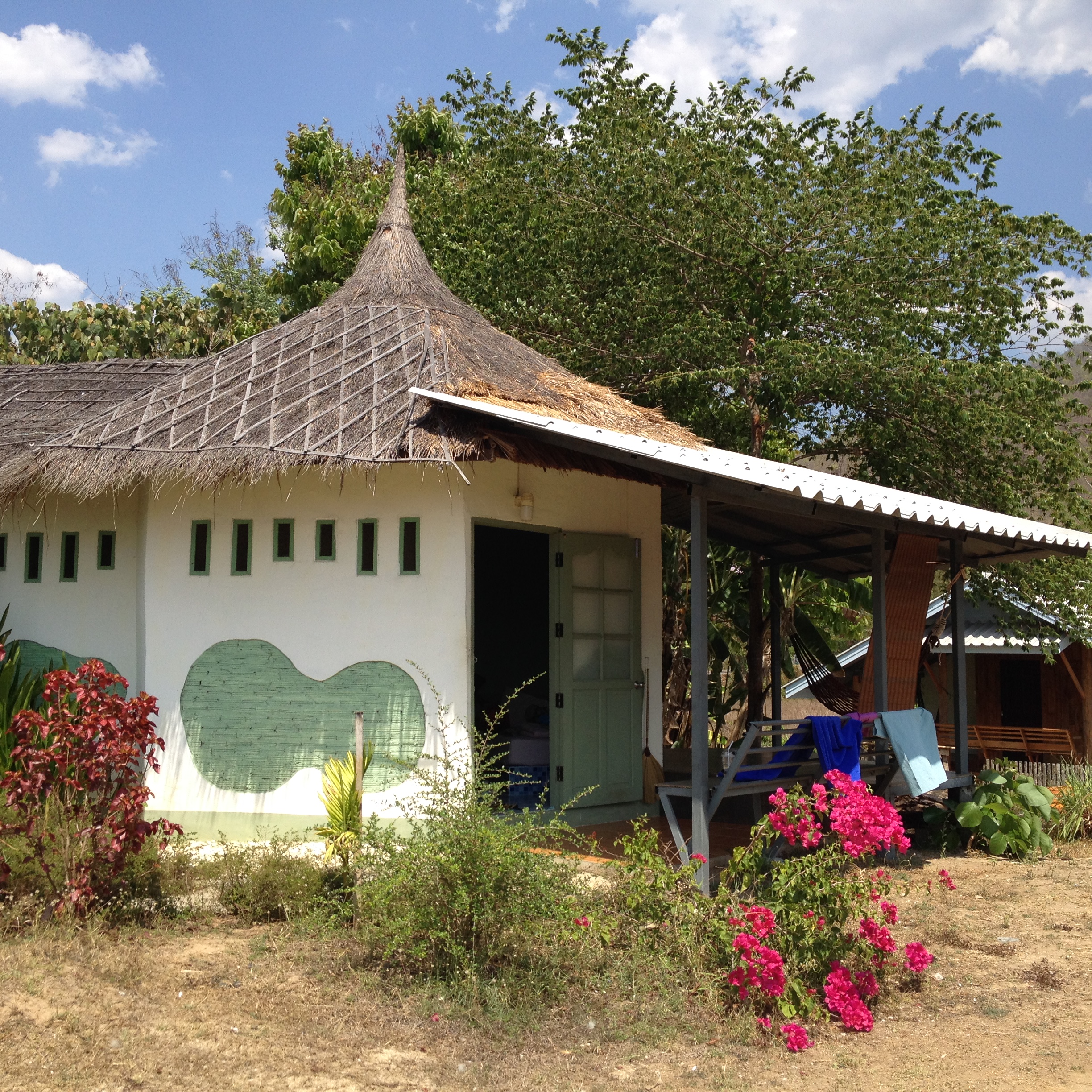
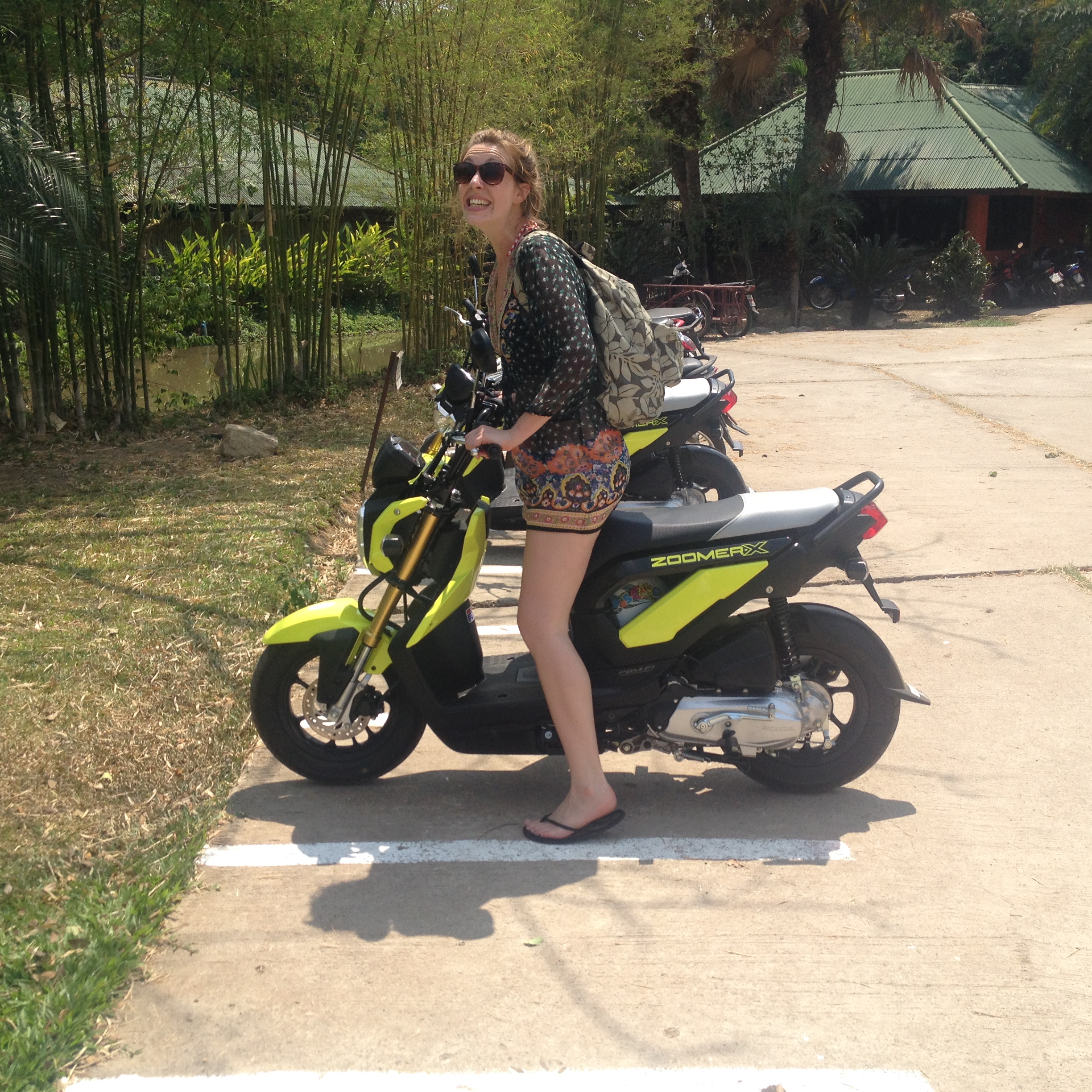








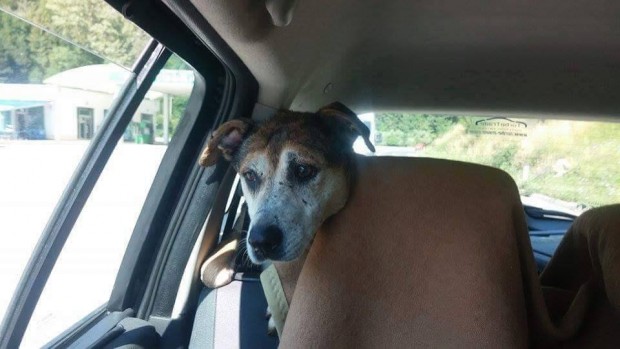
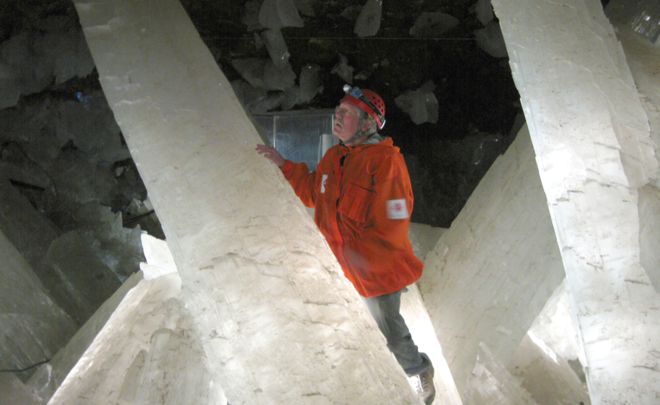
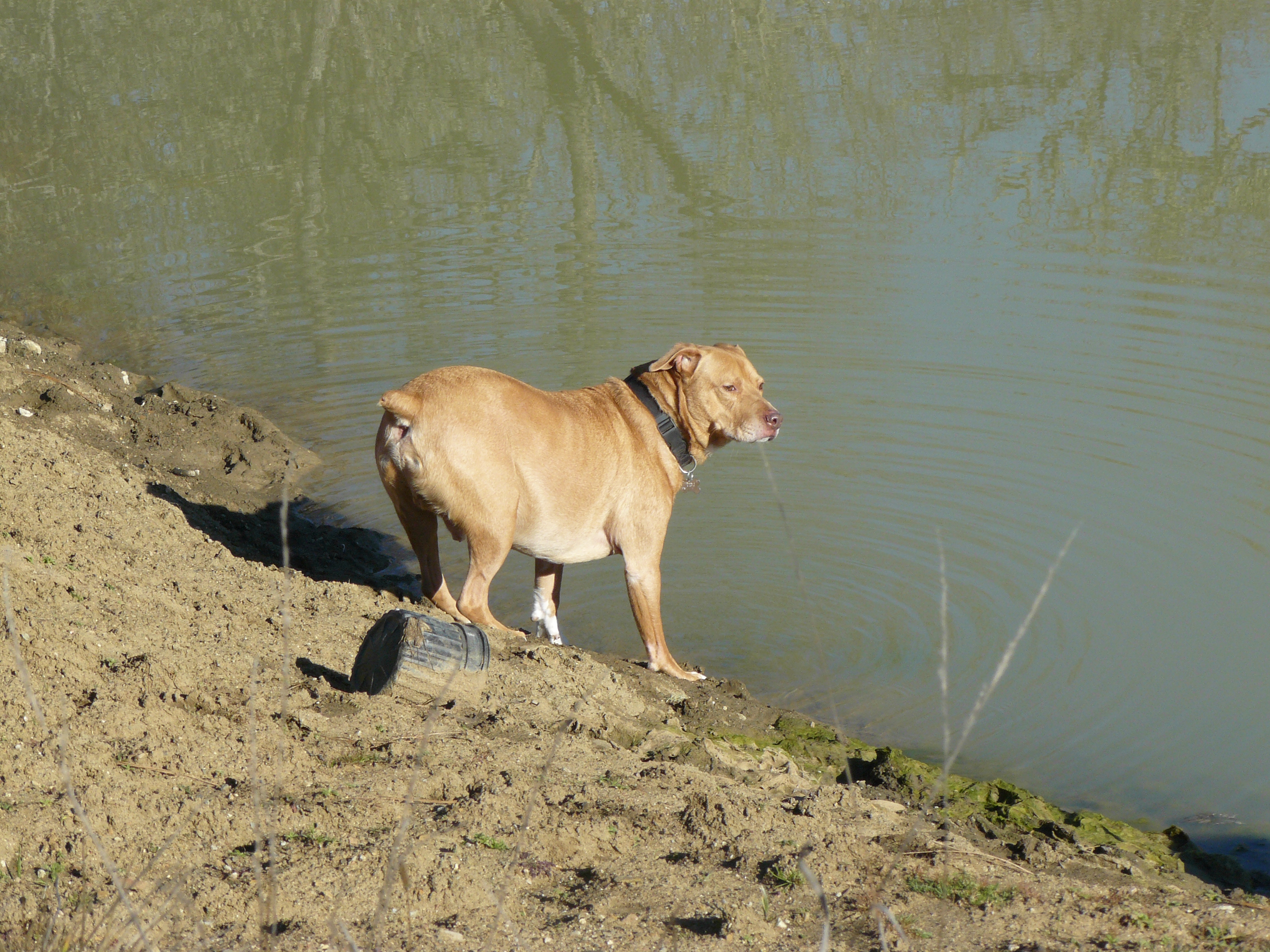

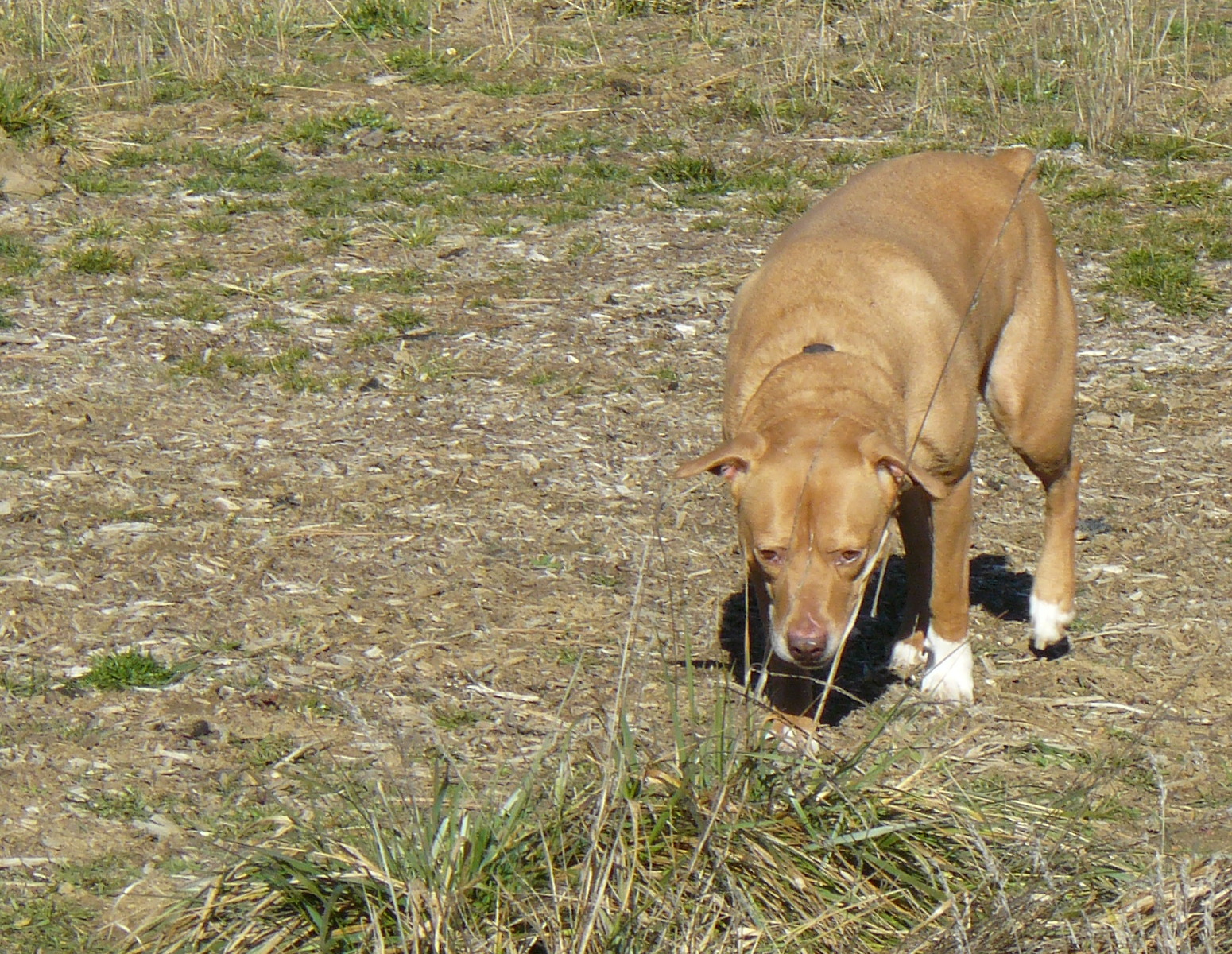

 Learning from Dogs