I’m sure I have mentioned previously the fun, education and sheer enjoyment that I, and many, many others, get from the photography forum Ugly Hedgehog. I drop into the forum several times a day.
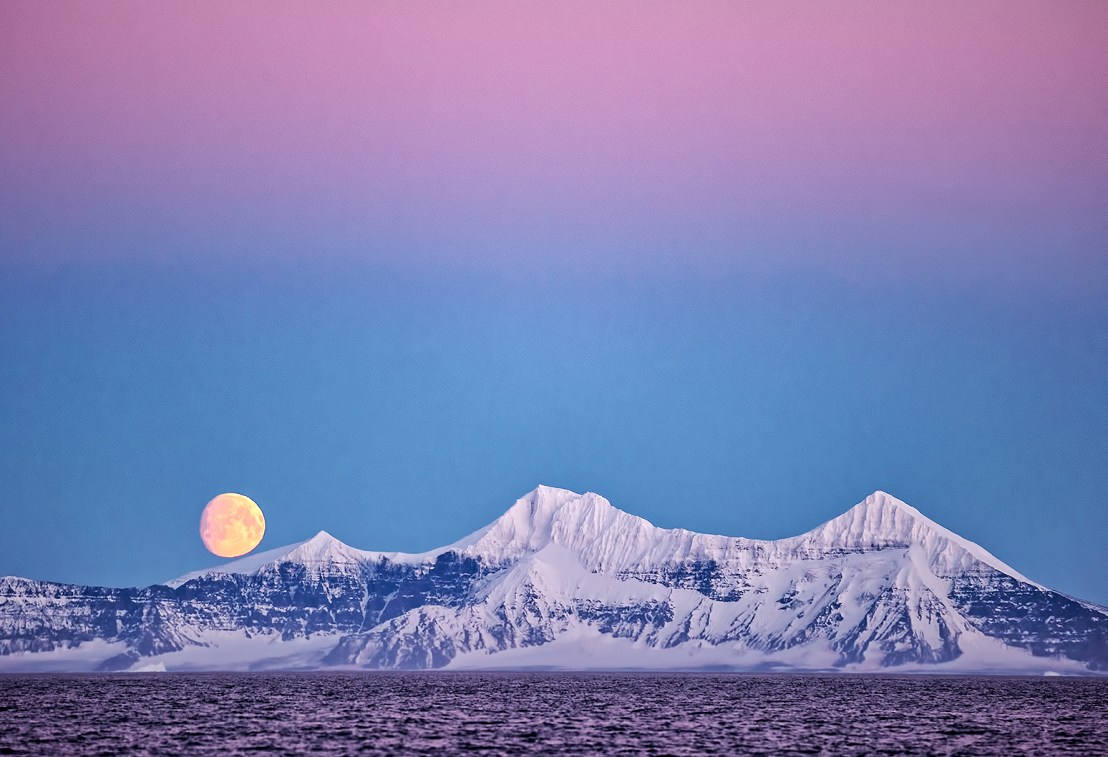
Thus it was that yesterday morning I went to an item posted by Kalina. It was called Moonset in Greenland.
This is the photograph that Kalina had shared on the forum:
And how that photograph was described by Kalina.
This is a moon, not a supermoon, not a fancy moon, not even a full moon, just a moon rising outside of Scoresby Sound, Greenland. What a magical place..
Later on, as I was seeking, and being given, permission to share the image with all you good people, Kalina answered my question as to what had brought her to Greenland. Her answer:
I love the absolute raw beauty in Greenland. I was on a schooner built in 1909 sailing through the largest fjord system in the world, words cannot describe the beauty. We never encountered another soul the entire time, there is no evidence of humans..polar bears and musk ox but no people. I will add that this image is not photoshopped..
Just go back to that image and get lost in it.
Get lost in one’s dreams!
Then when you return to your real world, go across to WikiPedia and read more about this magical place. Here’s an extract from that WikiPedia entry.
ooOOoo
Scoresby Sound
Scoresby Sund (Danish: Scoresby Sund, Greenlandic: Kangertittivaq) is a large fjord system of the Greenland Sea on the eastern coast of Greenland. It has a tree-like structure, with a main body approximately 110 km (68 mi)[2] long that branches into a system of fjords covering an area of about 38,000 km2 (14,700 sq mi). The longest of the fjords extends 340–350 km (210-216 mi) inland from the coastline.[1] The depth is 400–600 m (1,310-1,970 ft) in the main basin, but depths increase to up to 1,450 m (4,760 ft) in some fjords.[1] It is one of the largest and longest fjord systems in the world.[3][4][5]
On the northern side of the mouth of the Scoresby Sund stands Ittoqqortoormiit, the only permanent settlement in the region, with a population of 469 (in 2010). The name of the sound honours English explorer William Scoresby, who in 1822 mapped the fjord area in detail.
ooOOoo
Plus wanted to share another photograph of Scoresby Sund taken by Hannes Grobe, seen on that WikiPedia page.
Dr. Hannes Grobe 20:10, 16 December 2007 (UTC) – Own work
Or more specifically living a long and healthy life assisted by our dogs!
Recently the Care 2 site published a wonderful item about the real benefits of having a dog in our life when we are the ‘wrong’ side of (fill in your own number!).
So here it is for all you good people. I know without a doubt that there will be many nodding heads out there as the article is being read.
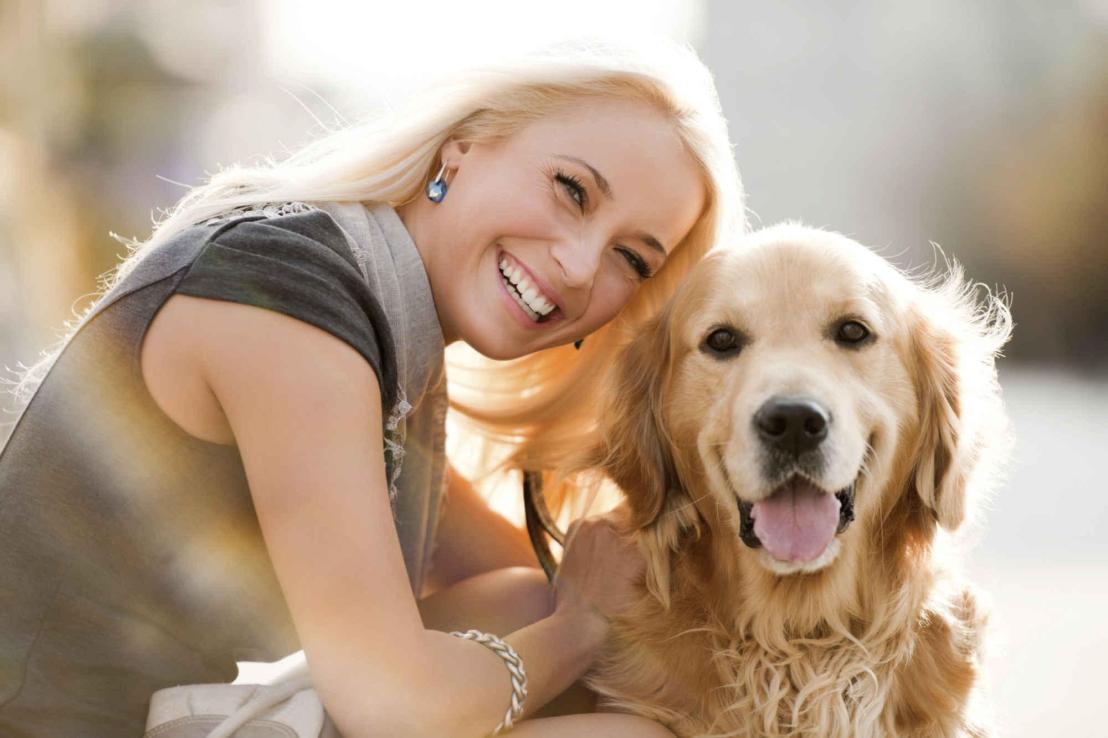
According to a 2016 Gallup poll, 44 percent of Americans own a dog. That is a pretty significant number. In fact, dogs are easily the most popular pet among US pet owners—sorry cat lovers. But what is it that makes dogs so great? Well, they’re fun loving, energetic, make excellent companions and… may actually help you live longer.
A recent Swedish study suggested that owning a dog may be linked to a reduced risk of cardiovascular disease and premature death. According to the study, owning a dog was associated with a 20 percent reduced risk of overall death and a 23 percent reduced risk of dying from cardiovascular disease. The study tracked 3.4 million people over the course of 12 years, including both dog owners and non-dog owners. Interestingly, the effects of dog ownership were most pronounced when subjects lived alone and were the sole caretakers for the dog, as they experienced a 33 percent reduced risk of death.
So what is it that makes dogs so beneficial to our health and our lives? Here are a few theories:
EXERCISE
Dogs need exercise as much as we do, but, oftentimes people prioritize their pup’s needs above their own. Many people would more readily take their dog on a walk than walk alone down the block to get some fresh air and take care of themselves. But lucky for us, exercising a dog means exercising yourself, too! It is well established that regular exercise reduces your likelihood of developing cardiovascular disease. A dog may provide irrefutable motivation to get you off the couch and on a walk, which could be saving your life.
OUTDOOR TIME
Along the same lines, dogs encourage us to get outside more. Being outside reduces stress, can increase vitamin D levels and promotes happiness. It can be easy for us to get lazy and stay snuggled up inside when the weather is less than ideal, but dogs need regular outside access. Our pups encourage us to get outside on a regular basis, which can have a small but significantly healthful impact on overall mood and stress levels.
BENEFICIAL BACTERIA
Having a dog is essentially like consuming a powerful probiotic every single day. Dogs go out in nature, roll in mud and grass, chew on sticks, sniff all sorts of bacteria-ridden substances and then track little microscopic bits of this array of bacteria back into our homes. But that may actually be a good thing. According to the New York Times, “Epidemiological studies show that children who grow up in households with dogs have a lower risk for developing autoimmune illnesses like asthma and allergies — and it may be a result of the diversity of microbes that these animals bring inside our homes.” The wider the spectrum of bacteria we subject ourselves to, the more balanced our own microbiomes will become. Since the microbiome can affect all areas of our health, including the likelihood of developing cardiovascular disease, the long term health benefits of diverse bacterial populations should not be underestimated. Dogs, and other pets, do an incredible job of strengthening our microbiomes, which has a profound impact on our health.
EMOTIONAL SUPPORT
There is something to said for the emotional stability a dog provides. Chronic stress has been linked to increased risk of cardiovascular disease and premature death, which makes it even more significant that dogs are great at reducing our stress and anxiety levels. They are like our little furry therapists—they are always there for us, through good times and bad, and they always love us indiscriminately. The companionship of a dog and a human is one of the purest, most mutually beneficial relationships one can have. It’s pretty powerful.
Of course, just giving your parents a dog doesn’t mean they will necessarily live longer—especially if they aren’t ‘dog people.’ But for those who are, next time you come home to a wagging tail and a wild tongue, be grateful to your pup pal for all the amazing things they bring to your life.
ooOOoo
Again and again one realises just how incredible it is to have a dog, or several!, in one’s life!
Some eighteen months ago I published a guest post from Susan entitled: How To Meet The Nutritional Needs Of Pregnant Dogs
I am delighted to offer another guest post from Susan.
ooOOoo
7 Wonderful Ways to Cherish and Honor the Memories of Your Beloved Dog
by Susan Combs.
Our relationship with our dogs is arguably the most genuine and pious one. The shear nature of dogs to shower unconditional love to their owners makes them no less a family member. Their honesty, faithfulness and a deep sense of belonging to their families is the reason as to why they are so adored across all the cultures, communities and societies.
Since it is also the hard truth that dogs tend to live much shorter lives than their owners; which renders the relationship end abruptly in their passing away. This is certainly not a happy stage for any pet owner either.
Therefore, losing a beloved pet, especially a dog is one of the most painful situations for owners. Their affection towards owners in the times of adversity is the most nostalgic part of their memories long after they have gone. By being together through thick and thin with relentless love their owners’ lives are impacted in many ways, and their absence is deeply felt.
If you are also mourning the loss of your dog, it must be difficult for you to cope with this undesirable situation. However, we have some wonderful ways with which you can cherish and honor the memories of your beloved dog.
Here are they:
Plant a tree in his honor
Planting a tree in the honor of your dog is an excellent way to let his legacy live on for a long time to come. Choose a nice spot in your garden or backyard and plant a young tree, preferably an eternity plant. As the day will pass, it will grow up signifying a new life form from the previous one. Eventually, you will witness a sapling grow into a beautiful and strong tree. Till the time you live, this tree will remind you about that special bond with your canine friend.
Make jewelry with his ashes
If you want to keep your furry pal all the time with you, creating jewelry with his remains would be a perfect idea. You can turn his ashes into diamond and wear it in the form of a ring. So there cannot be a better way to pacify his soul than this. Whether you make a ring or wear it as a locket, the shine of the diamond will keep on reflecting his memories. Your friends will also see in awe that the sparkle of the diamond was once your dog himself.
Donate in the name of your dog
You dog meant everything to you, he still does. So, what else would be more heart-felt gesture than to donate for a good cause in the name of your dog? It is also a great way to give back what your dog gave you unflinchingly. You can give money to animal shelters because donating to these organizations is the best possible way to support the lives of other pets. In the situation of cash crunch, you can still donate another valuable asset: time. You can be there, spend some time with them and take care of them. Helping an animal in need is the best chance to remember your beloved dog.
Create a picture book
Since you spent a lot of time with your dog, you must also have taken plenty of pictures of his. So collect all the past photos of your dog at one place; you can also ask your friends and family members if in case they had also taken his pictures. With these photographs you can either create a photo album or a picture book by forming a large collage. It would be better if you take printouts of these pictures and cut & paste them on the wall.
Write an obituary
Didn’t you ever think to pen down the journey of your dog since he was cute little puppy? Now is the time since he is not there with you anymore. So document an insightful journey from the moment when you took him in your hands for the first time to his final moments. Write down how you used to spend time with him, how you used to play with him, what activities did he do at home, and whose life did he touch besides yours. You can post this personal obituary online.
Bury him with honor
From giving him a memorable funeral to making his cemetery, your dog deserves honor in his last rites. Gather all your friends and family in order to say final goodbye to him.
You can also often visit his burial site whenever you like. You can place a gravestone at this spot and write your message for him or whatever you used to feel about him.
Adopt again
If the pain of separation is not endurable for you or if you do not want to let go off your happy life with him, adopting again is the only option for you. This is also a good way to pay your tribute to him as he would also want to pass on a chance to another dog in need.
ooOOoo
As was mentioned in Susan’s previous guest post here again is her background:
Susan works as a Pet Health and Safety Expert and holds expertise in the area of animal/pet care. She has over 6 years of experience in pet healthcare and is a pet parent to a dog named chilly.
Finally, I would like to add a wonderful way of my own to remember our dear dogs. That is write up your own memories of your dog and post them to the special section on this blog: We Shall Not Forget Them.
A few days ago Jean and I listened to an episode from the BBC Radio 4 series The Art of Living. Or as the home page of the programme’s website explains, The Art of Living is a …
Documentary series revealing how engagement with art has transformed people’s lives.
Anyway, the episode that we listened to was a delightful 30-minute discussion between Marie-Louise Muir and the Belfast-born poet Frank Ormsby. The reason we selected this episode to listen to in particular is revealed by republishing how the BBC introduced the programme. (For Jean was diagnosed with Parkinson’s Disease in December, 2015.)
Frank Ormsby’s Parkinson’s
The Art of Living
When the poet Frank Ormsby was diagnosed with Parkinson’s Disease, his response was unexpected. He embarked on a newly fertile creative period, documenting his experiences and finding a voice in his poetry that he was beginning to lose in his daily communications.
His first act was to search Google – for jokes. “Which would you rather have, Parkinson’s or Alzheimer’s. Obviously Parkinson’s! I’d rather spill half my pint than forget where I left it.”
As he discusses with Marie-Louise Muir, the illness has changed him. It’s mellowed him. After a career as a school teacher, his daily life is now quieter and more solitary. There’s a poetry, almost, in his pauses and silences.
Frank belongs to the generation of Northern Irish writers that has followed in the footsteps of Seamus Heaney and Michael Longley. His medication, he believes, has aided his creativity. But it has also induced hallucinations. He finds himself sitting on his own in his study but surrounded by people, by the ghosts of his mother-in-law and unidentified visitors. And he’s also haunted by a fear that the earth will open up and swallow him.
But if you ask how he’s doing, he writes, “I’ll tell you the one about ‘parking zones disease’.
I’ll assure you that the pills seem to be working”.
Photo credit: Malachi O’Doherty, With readings by Frank himself and Ciaran McMenamin from The Darkness of Snow. Produced by Alan Hall. A Falling Tree production for BBC Radio 4.
That wonderful joke offered by Frank, this one: “Which would you rather have, Parkinson’s or Alzheimer’s. Obviously Parkinson’s! I’d rather spill half my pint than forget where I left it.” comes a little after the 5-minute point in the interview. I strongly encourage you to listen to the full interview. Here’s the link to the radio programme.
Jean and I were sitting up in bed a couple of mornings ago reflecting on how recent it has been since we ‘got it’ in terms of what becoming old really means. For me and Jean, for different reasons, it is only in the last twelve months that ageing, the process of becoming older, the decline in one’s faculties, and more and more, has been truly understood. Yes, before then of course one understood that we were getting old. But it was an intellectual understanding not the living it on a daily basis understanding we now experience.
Back to Frank Ormsby. Or rather to a feature in the Belfast Telegraph published in 2015.
Frank Ormsby: Life at Inst was very different from my upbringing
Leading Belfast poet and former Inst. Head of English Frank Ormsby on his tough Fermanagh upbringing, losing his father when he was 12 and how humour has helped him cope with a Parkinson’s diagnosis.
Write stuff: Frank Ormsby at his home in north Belfast
March 23, 2015
As Frank Ormsby sits in the study of his beautifully-appointed 1930s home in north Belfast there is no hint of his much more austere upbringing. As befits the workspace of a poet and long-time English teacher at one of Belfast’s leading schools, the bookcases that line the walls are crammed with a wide range of literature.
It could not be a more different environment from the rural home where he grew up just after the Second World War.
When Frank was born in 1947, his father Patrick was already in his 60s. “I remember him as an old, grey-haired man”.
It was Patrick’s second marriage. His first had produced 10-12 children. “I was never totally sure of the exact number”, Frank recalls.
“I never met them as they had dispersed to Scotland and other places by the time my father, by then a widower, had married my mother. As far as I know the last one of them died last year.”
Frank’s home was about a mile and half outside Irvinestown. His mother Anne had worked on a relative’s farm – “she could build hay or cut turf as well as any man” – and his father as a farm labourer who occasionally sought work in the factories in Scotland.
“The conditions in which we lived were lacking in luxury. We had no running water. We had to carry it in buckets from a well half a mile away. There was no electricity and it was a long time before we even had a radio, or wireless as it was called then,” Frank says.
Here’s one of Frank’s poems that was published by The New Yorker in March, 2013.
BOG COTTON
By Frank Ormsby
They have the look
of being born old.
Thinning elders among the heather,
trembling in every wind.
My father turns eighty
the spring before my thirteenth birthday.
When I feed him porridge he takes his cap off. His hair,
as it has been all my life, is white, pure white.
Maybe that’s how it is. Having the look of being born old!
But there’s one thing that I treasure beyond gold itself. Having the fortune to be living out my final days, however many there are, in the company of my beautiful Jeannie and all the loving dogs around me.
That ‘we’ being all the animals, plants, insects and humans there are.
I’m not saying anything new and not making this plea for the first time in this place.
But just take a few minutes out of your busy day to reflect that for you, for me, for everyone wherever they are in the world, physically and culturally, doing nothing is not an option.
More of that in a minute.
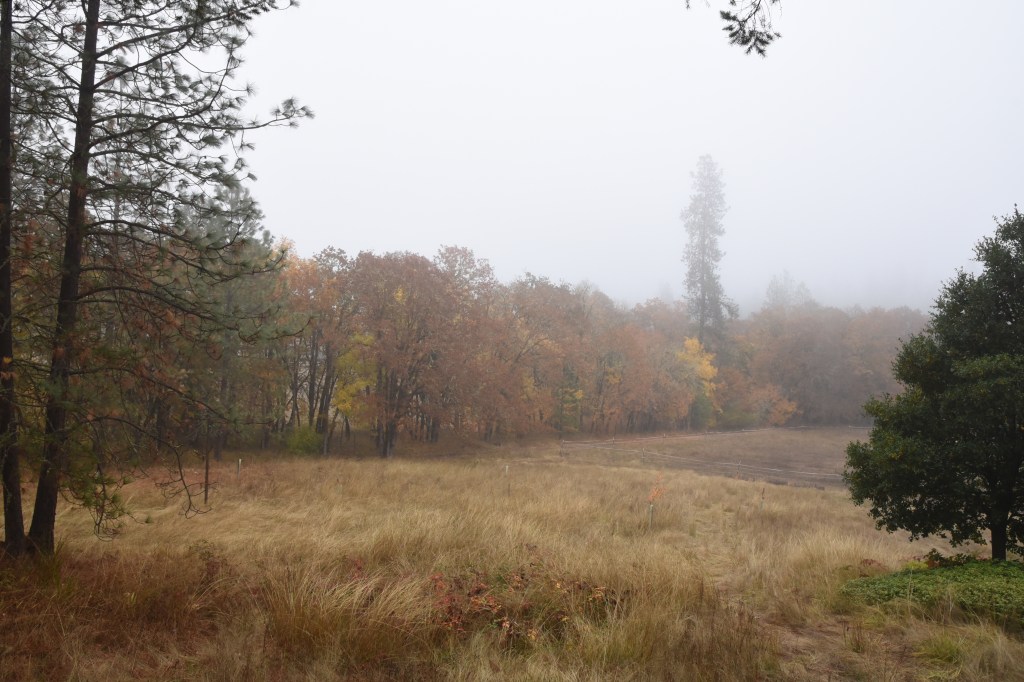
First I want to share with you a few autumnal photographs of our home here in Oregon.
Below was taken at 9am on October 24th showing the mountain mist right down to the tops of our trees that mark the edge of our driveway from the house to our Hugo Road entrance.
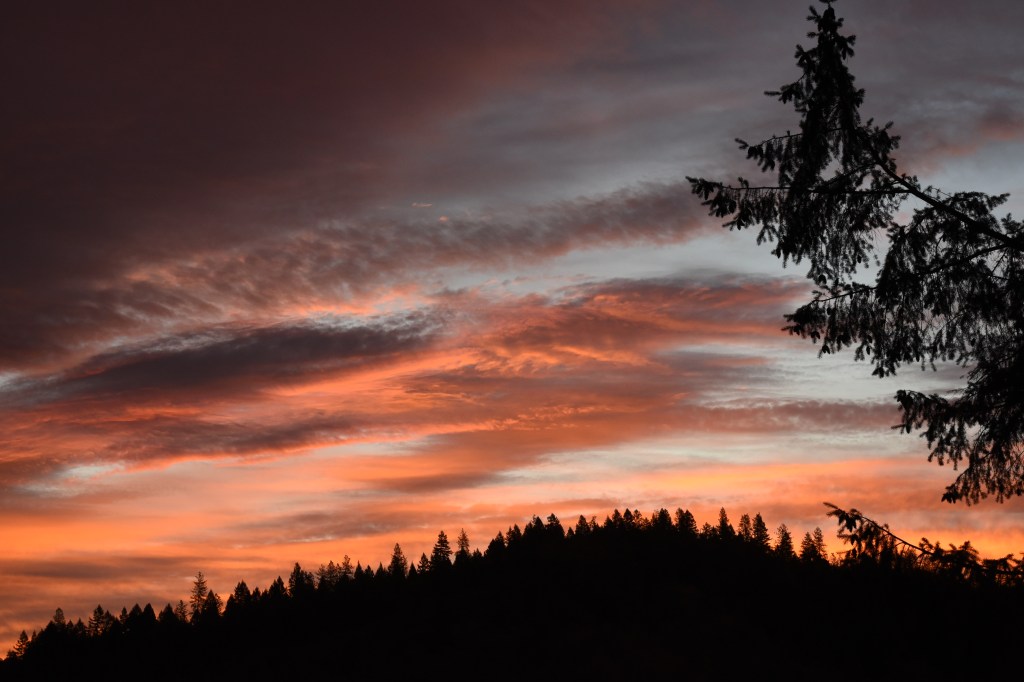
Next, a sunrise photograph with the camera pointing to the East. The tree line follows the ridge of some hills the other side of Hugo Road. The picture taken on the 19th October at 07:20. Now a close-up of the remains of a very old tree trunk with the trees that border Bummer Creek, that runs through our land, just showing through the morning mist. Taken on the 24th October at 09:05.
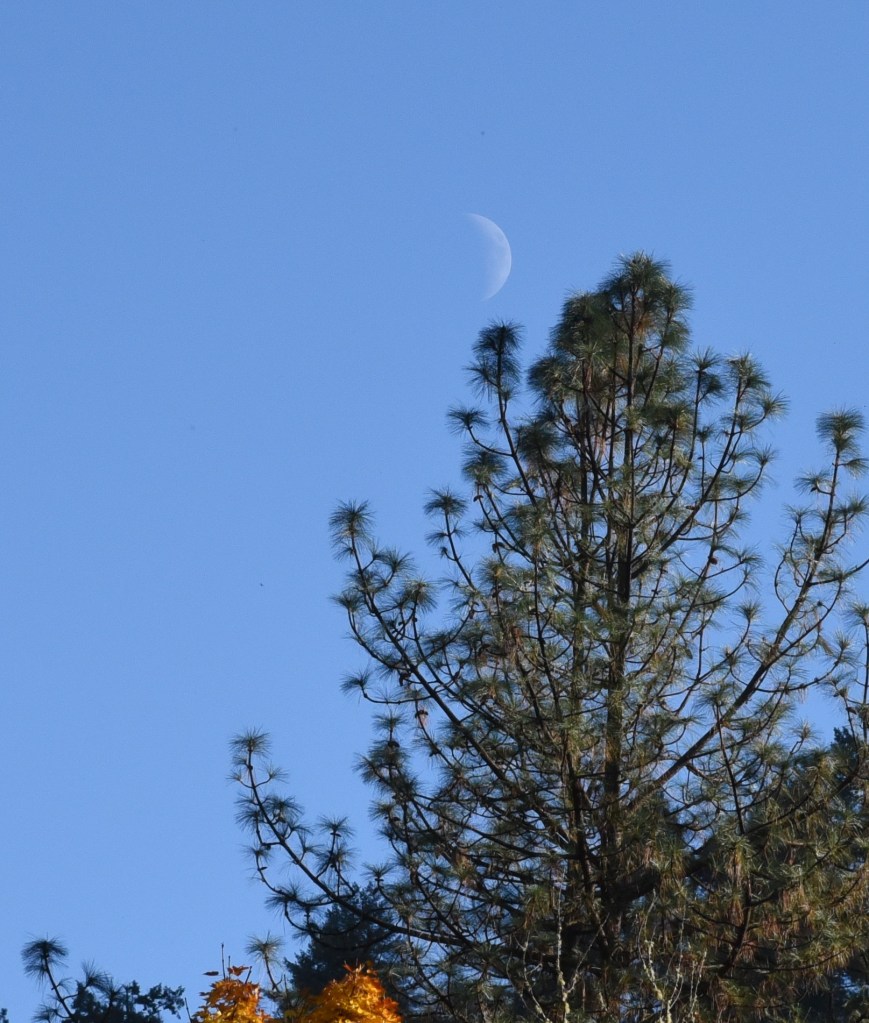
Final photograph I wanted to share with you is this beautiful sight of the moon taken from our property at 16:05 on the 25th. October.
Regular readers will know that Jean and I are not believers in any religion; we are atheists. But to my way of thinking that puts even more pressure on me and Jean to try to make a difference. We do all that we can but there’s no doubt that we can do more.
Yesterday, I referred to Bill Ripple, or to give him his full signature: William J. Ripple, Distinguished Professor of Ecology, Department of Forest Ecosystems and Society, Oregon State University, Corvallis, Oregon.
I sent Bill an email:
Dear Bill (and forgive the over familiarity if that offends),
I am a Brit, just turned 73, living with my beautiful wife, Jean, London-born as I was, down in Merlin, Oregon.
We live on 13 wonderful acres of rural property with 6 dogs (down from 12 when we moved here 5 years ago) and 4 horses, the majority of whom are ex-rescues.
I am the author of the blog Learning from Dogs and want to publish a post highlighting that viewpoint article. Because I believe with every neuron left in my ageing brain that the political changes that this world so urgently needs can only come when 99.9% of the public are screaming out “enough is enough”!
But there’s another saying that comes to mind, the one about being the change you want to see or something like that.
Is there information anywhere online that spells out, almost in words of one syllable, what lifestyle changes each of us can and need to commit to today? Changes that are as appropriate for elderly authors living in the country as young people seeking their first job or those up to their necks in working and raising families?
For that is what I want to publish on my blog!
If it would be easier for me to make an appointment to call you and take notes over the phone then I am just as happy to do that.
Sincerely,
Paul Handover
Hugo Road, Merlin,
Bill promptly replied:
Hi Paul, how long of a list of lifestyle changes do you want to make? Would three or four be enough? Bill
then followed that up with another email:
Paul, Consider suggesting that if people want to help, they could have fewer children, reduce energy consumption such as driving autos and flying, avoid meat and eat mostly plant-based foods and avoid wasting food. Below are quotes from our paper. Bill
“It is also time to re-examine and change our individual behaviors, including limiting our own reproduction (ideally to replacement level at most) and drastically diminishing our per capita consumption of fossil fuels, meat, and other resources ….
… reducing food waste through education and better infrastructure; promoting dietary shifts towards mostly plant-based foods
Now watch this video
I will close this post by listing out all the things that you and I can do now!
Set a target for reducing your car mileage next year compared to 2017,
If you are a regular aircraft passenger, then set a target for flying fewer hours in 2018 compared to 2017,
reduce or stop eating meat,
do not waste food,
reduce the use of heating and cooling in your home/s for next year,
commit to a dietary change away from meats and processed foods to a plant-based diet.
Then for younger couples who want a family around them, limit the number of children to a “replacement level” at most. Adopt??
The recent news that many scientists have signed an open letter warning about how soon it will be too late to “save Earth” has been widely broadcast; not that this stops me from republishing the version of the news story that I read on the EarthSky blog site.
Here it is.
oooooh
Scientists warn: Soon it will be too late to save Earth
By Eleanor Imster in EARTH | HUMAN WORLD | November 16, 2017
More than 15,000 scientists in 184 countries have signed a letter urging the world to address major environmental concerns. “Soon it will be too late to shift course away from our failing trajectory, and time is running out.”
A letter to all of us, signed by more than 15,000 scientists (and counting) in 184 countries, warns that human well-being will be severely jeopardized by continuing trends in environmental harm, including our changing climate, deforestation, loss of access to fresh water, species extinctions and human population growth.
Entitled World Scientists’ Warning to Humanity: A Second Notice, it was published in the international journal Bioscience on November 13, 2017.
In 1992, more than 1,700 scientists signed a World Scientists’ Warning to Humanity published by the Union of Concerned Scientists. But global trends have worsened since 1992, the authors wrote in the new letter. In the last 25 years, trends in nine environmental issues suggest that humanity is continuing to risk its future.
Soon it will be too late to shift course away from our failing trajectory, and time is running out. We must recognize, in our day-to-day lives and in our governing institutions, that Earth with all its life is our only home.
The letter also says …
By failing to adequately limit population growth, reassess the role of an economy rooted in growth, reduce greenhouse gases, incentivize renewable energy, protect habitat, restore ecosystems, curb pollution, halt defaunation, and constrain invasive alien species, humanity is not taking the urgent steps needed to safeguard our imperiled biosphere.
The article was written by an international team led by William Ripple of Oregon State University led the international team of scientists who created the letter. Ripple said in a statement:
Some people might be tempted to dismiss this evidence and think we are just being alarmist. Scientists are in the business of analyzing data and looking at the long-term consequences. Those who signed this second warning aren’t just raising a false alarm. They are acknowledging the obvious signs that we are heading down an unsustainable path. We are hoping that our paper will ignite a wide-spread public debate about the global environment and climate.
Progress in some areas — such as a reduction in ozone-depleting chemicals and an increase in energy generated from renewable sources — shows that positive changes can be made, the authors wrote. There has been a rapid decline in fertility rates in some regions, which can be attributed to investments in education for women, they added. The rate of deforestation in some regions has also slowed.
The warning came with steps that can be taken to reverse negative trends, but the authors suggested that it may take a groundswell of public pressure to convince political leaders to take the right corrective actions. Such activities could include establishing more terrestrial and marine reserves, strengthening enforcement of anti-poaching laws and restraints on wildlife trade, expanding family planning and educational programs for women, promoting a dietary shift toward plant-based foods and massively adopting renewable energy and other “green” technologies.
Scientists who did not sign the warning prior to publication can endorse the published warning here.
Bottom line: A letter entitled World Scientists’ Warning to Humanity: A Second Notice, urging the world to address major environmental concerns. was signed by more than 15,000 scientists in 184 countries.
As is the way with this modern inter-connected world it was but a moment to track down said William Ripple, find his email address and ask him what he recommended as the top things that you and I should be doing now.
Not just for you and me but for all the animals as well on this very beautiful planet.
Bill’s reply is part of tomorrow’ post. See you then!
In a reply to Colette following my post of last week Caring for animals, I wrote:
Jean is on a diet that is predominantly fruit and vegetables as part of slowing down the progression of her Parkinson’s disease. The diet is essentially a no-dairy, no-grain, no-meat diet to eliminate the risk of any gut inflammation. She is advised by a professional nutritionist here in Grants Pass, OR. I follow along with Jean motivated to slow down my own cognitive decline.
Colette then responded to my reply with quite extensive details of her own diet. Her reply opening:
I have some food sensitivities that started my dietary changes a number of years ago. I found I was allergic to eggs after struggling with severe joint pain that doctors couldn’t explain. Then I began to find that a few other things were problematic including gluten, also prompting dietary change. The animal protein side came into sharper focus during a moment of epiphany at an elephant sanctuary and I started a vegetarian diet. However, I soon switched to a completely (almost except for some contamination in the odd thing now and again) vegan diet.
I am healthier, my cholesterol dropped from a total of 212 mg/dlto 135mg/dl and I have more stamina, fewer infections, colds and illness. (Nothing terrible to put me to bed since I became Vegan).
I do try to get a balance of a variety of fresh fruit and veg, protein and fats in my diet.
… that was then followed by her describing what a typical day looked like in terms of what she eat.
I offered to describe what Jean and I eat.
Fundamentally, Jean was advised to have a diet that reduced the chance of her having any gut inflammation but, if she did, a diet that would bring that inflammation to a close. All to do with Leaky Gut Syndrome and how the brain can be negatively affected.
So …
Breakfast
Two tablespoons of milled flax,
One tablespoon of hemp hearts,
A sprinkling of chia seed,
Prunes, banana, dried apricots, walnuts, berries when available,
Coconut milk or almond milk
Lunch
Mainly salad greens, raw vegetables, tomatoes, avocado, some canned herring,
Mixed fruits, as in oranges, apples,
‘Naked Green’ smoothie
Dinner
Mixed vegetables,
Baked chicken breast,
Green salad with tomatoes and avocado,
Almonds or other nuts
Drinks during the day
Herb teas, ‘V8’ juice, green tea, ‘Naked Green’ smoothies, almond milk.
We are also taking a course of Juice-Plus tablets; a recommendation from our local nutritionist.
Anyway, that’s enough from me for today.
If there’s good interest in me sharing some of the many links to this whole area of diet, the gut and how it can affect the brain, then do sing out! (But I have no professional knowledge; will just report our findings!)
oooo
Wow! What an incredibly useful link thanks to Colette. I am referring to the NutritionFacts website.
Then how easy it was on that site to find a video specifically about diet and PD.
Jean and I are removing chicken and fish from our diet immediately; in other words going vegan.
Last October 11th, I published a guest post that had been sent in by Linley Achtenhagen. The published post was called Life with Luna and was incredibly well-received.
So here’s another guest post from Linley that I have no doubt will be equally well-received.
ooOOoo
Unconditional Love
by Linley Achtenhagen, October 29th, 2017.
Up until January 12, 2017, I had never lost a loved one. I grew up with three grandparents, one grandpa passing away shortly after I was born, so I was pretty lucky to grow up with three out of four grandparents. Sure, I had been to funerals for distant relatives I had met once or twice or my friend’s grandparents, and I grieved for them because they were hurting and I hate seeing people hurt. I, however, had no idea what that pain felt like until one of my best friends passed away in a tragic accident while she was on a family vacation in Mexico.
Abbey Connor, my sweetest, sassiest, most beautiful friend and fellow UW-Whitewater student, taken away far too soon. Getting the news that she was gone rocked me to the core. I had just celebrated New Year’s Eve with her a few short weeks ago, and now I was never going to see her again. How is that possible? Why would this happen to her? I had absolutely no idea how to handle this. Going from losing no one to losing one of my best friends so suddenly was something I was not prepared to deal with but is anyone? I cried and cried and cried and listened to people tell me it was going to be okay, but those words didn’t mean anything. Of course, I appreciated the support of my friends and family, but nothing made the pain in my chest go away when I thought of Abbey. I hurt so much for her family, if I felt this horrible, I couldn’t imagine how her family felt. The only thing that I found comfort in was the one thing that couldn’t tell me they were sorry and that it was going to be okay, Luna.
There is no doubt in my mind that Luna knew I was hurting. I am convinced that dogs have a 6th sense and are much more aware of our emotions than we give them credit. Luna would just lay with me while I cried and her presence alone eased that pain. My crazy and energetic dog would just sit and let me pet her for as long as I needed to.
Not even a month later, February 11th, our family dog, Will, passed away after a long battle with cancer. For fellow dog lovers, you know how hard it is to let your furry companions go. We had Will since he was a puppy, so he grew up with my siblings and me. He was my four-legged brother and letting him go ripped my healing heart wide open again. This time, my whole family was hurting, including Will’s sister, Grace. Will and Grace had never spent a day apart; they slept in their dog crate together, chased chipmunks together, protected my family together, and she just couldn’t understand where he went. We couldn’t explain to her that he wasn’t coming back and that made the pain that much worse. The one thing that brought a smile to everyone’s face in the days, weeks, and months to come was Luna. She would grab her squeaker toy and run up to everyone shaking and squeaking it just begging for someone to play tug with her. She would light up the room and bring a smile, even if only for a second, to our faces. She was helping us cope, and she didn’t realize it.
Two months later, April 13th, my grandma passed away. I couldn’t believe that I had to deal with another death. I was still grieving Abbey and Will’s passing, and now I had another death to try and cope with. My grandma lived in Florida for half of the year, so while we weren’t the closest, she was my grandma, my dad’s mother, and of course, I loved her. I hurt for my dad as he had to say goodbye to his mom. I hurt for all of my cousins, aunts, and uncles. I hurt for my mom and my siblings and I. We had never lost a grandparent, and now we had to deal with this while still grieving Will’s passing, I still grieving Abbey’s. It was such an overwhelming and stressful time, and once again the one thing that got me through each day was Luna. No matter how hard of a day it was, each night when I crawled into bed, Luna would lay right next to me, her head on my chest and just be there. I cannot put into words what that feeling is like.
John Grogan, author of Marley and Me, (if you haven’t seen the movie or read the book, add it to your list) wrote one of my favorite quotes. He said, “A dog doesn’t care if you’re rich or poor, educated or illiterate, clever or dull. Give him your heart, and he will give you his.” This quote is undeniably accurate and I saw this proof in the months to come after I lost all of these loved ones. Luna didn’t care if I didn’t have time to take her for a long walk, or I didn’t want to get out of bed, or I didn’t have the energy to play fetch with her that day, she was there for me and comforted me every moment. She knew I loved her, and that was enough. The most comforting part of all of this is that Luna didn’t even know she was doing it. If more people loved each other like dogs love their humans, this world would be a much better place.
ooOOoo
Linley’s closing sentence is perfect and requires nothing more from me to close today’s post than for me to repeat her words: “If more people loved each other like dogs love their humans, this world would be a much better place.“
My posts of the last few days have been in the ‘cuddly, cosy’ vein of life and, as many would say, a long way from the reality of this 21st century.
The reality is tough and scary and many, including me, favour running away from scary places. I’m sure that the urge to flee and hide is a survival behaviour from long time ago. BUT!! But the only hope for us humans is to face the facts full on.
Take, for example, the Ganges River. We have all heard of this famous river (my emphasis below):
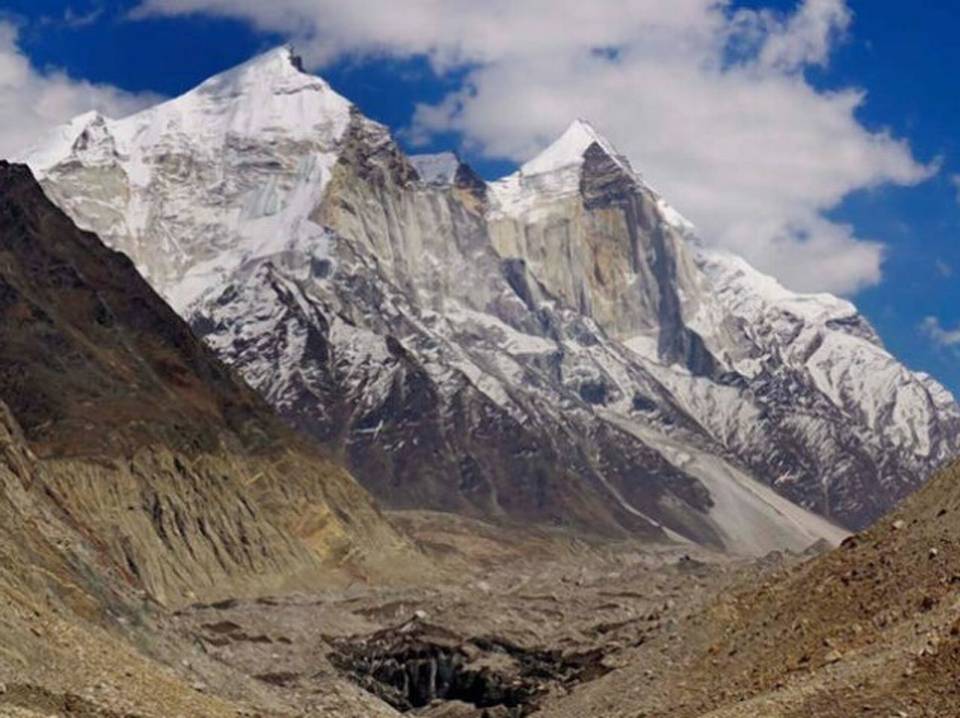
The source of the Ganges is the Gangotri glacier. Here it is:
Gaumukh, snout of the Gangotri glacier,surrounded by the Bhagirathi peaks of Garhwal Himalayas, at an altitude of over 4,000 metres. Photo: Vidya Venkat.
Scientists say dwindling snowfall affects volume of water fed to the Bhagirathi, the main source of the Ganga
After a four-hour-long trek from Bhojwasa, the final camping spot in Gangotri, when a brown, fractured pile of rocks finally came into view it was hard to believe that this was the mouth of the glacier from which the ‘holy’ Ganga emerged.
Gaumukh, the snout of the Gangotri glacier, named after its shape like the mouth of a cow, has retreated by over 3 kilometres since 1817, says glaciologist Milap Chand Sharma of Jawaharlal Nehru University.
It was nearly two centuries ago that the retreat of the glacier was first documented by John Hodgson, a Survey of India geologist.
With 10 Indian States reeling under drought and the country facing a severe water crisis after two weak monsoons, the story of retreating freshwater sources such as the Himalayan glaciers is worrying. And though a three-kilometre retreat over a period of two centuries might seem insignificant at first glance, data shows that the rate of retreat has increased sharply since 1971. The rate of retreat is 22 metres per year.
Twenty-two metres or seventy-two feet a year!
Wringing our hands is no good. All of us who care for our Living Planet have to shout out just what is going on. As George Monbiot continues to do. Take his latest essay, for example, that is republished here in full with GM’s very kind permission.
ooOOoo
Insectageddon
The scale and speed of environmental collapse is beyond imagination.
By George Monbiot, published in the Guardian 20th October 2017
Which of these would you name as the world’s most pressing environmental issue? Climate breakdown, air pollution, water loss, plastic waste or urban expansion? My answer is none of the above. Almost incredibly, I believe that climate breakdown takes third place, behind two issues that receive only a fraction of the attention.
This is not to downgrade the danger presented by global heating – on the contrary, it presents an existential threat. It is simply that I have come to realise that two other issues have such huge and immediate impacts that they push even this great predicament into third place.
One is industrial fishing, which, all over the blue planet, is now causing systemic ecological collapse. The other is the erasure of non-human life from the land by farming.
And perhaps not only non-human life. According to the UN Food and Agriculture Organisation, at current rates of soil loss, driven largely by poor farming practice, we have just 60 years of harvests left. And this is before the Global Land Outlook report, published in September, found that productivity is already declining on 20% of the world’s cropland.
The impact on wildlife of changes in farming practice (and the expansion of the farmed area) is so rapid and severe that it is hard to get your head round the scale of what is happening. A study published this week in the journal Plos One reveals that flying insects surveyed on nature reserves in Germany have declined by 76% in 27 years. The most likely cause of this Insectageddon is that the land surrounding those reserves has become hostile to them: the volume of pesticides and the destruction of habitat have turned farmland into a wildlife desert.
It is remarkable that we need to rely on a study in Germany to see what is likely to have been happening worldwide: long-term surveys of this kind simply do not exist elsewhere. This failure reflects distorted priorities in the funding of science. There is no end of grants for research on how to kill insects, but hardly any money for discovering what the impacts of this killing might be. Instead, the work has been left – as in the German case – to recordings by amateur naturalists.
But anyone of my generation (ie in the second bloom of youth) can see and feel the change. We remember the “moth snowstorm” that filled the headlight beams of our parents’ cars on summer nights (memorialised in Michael McCarthy’s lovely book of that name). Every year I collected dozens of species of caterpillars and watched them grow and pupate and hatch. This year I tried to find some caterpillars for my children to raise. I spent the whole summer looking and, aside from the cabbage whites on our broccoli plants, found nothing in the wild but one garden tiger larva. Yes, one caterpillar in one year. I could scarcely believe what I was seeing – or rather, not seeing.
Insects, of course, are critical to the survival of the rest of the living world. Knowing what we now know, there is nothing surprising about the calamitous decline of insect-eating birds. Those flying insects – not just bees and hoverflies but species of many different families – are the pollinators without which a vast tract of the plant kingdom, both wild and cultivated, cannot survive. The wonders of the living planet are vanishing before our eyes.
Well, I hear you say, we have to feed the world. Yes, but not this way. As a UN report published in March explained, the notion that pesticide use is essential for feeding a growing population is a myth. A recent study in Nature Plants reveals that most farms would increase production if they cut their use of pesticides. A study in the journal Arthropod-Plant Interactions shows that the more neonicotinoid pesticides were used to treat rapeseed crops, the more their yield declines. Why? Because the pesticides harm or kill the pollinators on which the crop depends.
Farmers and governments have been comprehensively conned by the global pesticide industry. It has ensured its products should not be properly regulated or even, in real-world conditions, properly assessed. A massive media onslaught by this industry has bamboozled us all about its utility and its impacts on the health of both human beings and the natural world.
The profits of these companies depend on ecocide. Do we allow them to hold the world to ransom, or do we acknowledge that the survival of the living world is more important than returns to their shareholders? At the moment, shareholder value comes first. And it will count for nothing when we have lost the living systems on which our survival depends.
To save ourselves and the rest of the living world, here’s what we need to do:
We need a global treaty to regulate pesticides, and put the manufacturers back in their box.
We need environmental impact assessments for the farming and fishing industries. It is amazing that, while these sectors present the greatest threats to the living world, they are, uniquely in many nations, not subject to such oversight.
We need firm rules based on the outcomes of these assessments, obliging those who use the land to protect and restore the ecosystems on which we all depend.
We need to reduce the amount of land used by farming, while sustaining the production of food. The most obvious way is greatly to reduce our use of livestock: many of the crops we grow and all of the grazing land we use are deployed to feed them. One study in Britain suggests that, if we stopped using animal products, everyone in Britain could be fed on just 3m of our 18.5m hectares of current farmland (or on 7m hectares if all our farming were organic). This would allow us to create huge wildlife and soil refuges: an investment against a terrifying future.
We should stop using land that should be growing food for people to grow maize for biogas and fuel for cars.
Then, at least, nature and people would have some respite from the global onslaught. And, I hope, a chance of getting through the century.
I am far from certain but I have this notion in my head that ‘Common Land’ is an English thing. Here’s a Wikipedia extract:
Common land is land owned collectively by a number of persons, or by one person, but over which other people have certain traditional rights, such as to allow their livestock to graze upon it, to collect firewood, or to cut turf for fuel.[1]
A person who has a right in, or over, common land jointly with another or others is called a commoner.[2]
This article deals mainly with common land in England, Wales and Scotland. Although the extent is much reduced due to enclosure of common land from the millions of acres that existed until the 17th century, a considerable amount of common land still exists, particularly in upland areas, and there are over 7,000 registered commons in England alone.[3][4]
Despite the idea of common land having an English ‘ring’ to it common land is also found in the USA. Back to that Wikipedia reference:
Common land, an English development, was used in many former British colonies, for example in Ireland and the United States. The North American colonies adopted the English laws in establishing their own commons. A famous example is the New Haven Green in New Haven, Connecticut.
When I was living in Devon it was not unusual to take a walk with Pharaoh on some very famous open access land: Dartmoor.
Dartmoor: English countryside at its best.
So where the devil am I going with today’s post?
Last Thursday week, the 12th, I published my review of George Monbiot’s valuable book Out Of The Wreckage.
This book struck me as the most important book I have ever read in my lifetime. Why? Because it gets to the heart of what is happening today. But it offers even more than that. For instead of a shrug of the shoulders or eyes turned skywards from a friend when one mutters about the fact that we are living in ‘interesting times’, George Monbiot offers hope and guidance.
The day after I published my review George Monbiot published an article in The Guardian newspaper that threw more light on the commons philosophy and why, as in his book, he “offers hope and guidance”.
It is republished here with Mr. Monbiot’s generous permission. Yes, the focus is on British politics but GM’s core message applies equally to the USA and other countries.
ooOOoo
Labouratory
13th October 2017
We should use the political space being opened by the Labour resurgence to develop a new, participatory economy
By George Monbiot, published in the Guardian 11th October 2017
We are still living in the long 20th Century. We are stuck with its redundant technologies: the internal combustion engine; thermal power plants; factory farms. We are stuck with its redundant politics: unfair electoral systems; their capture by funders and lobbyists; the failure to temper representation with real participation.
And we are stuck with its redundant economics: neoliberalism, and the Keynesianism still proposed by its opponents. While the latter system worked very well for 30 years or more, it is hard to see how it can take us through this century, not least because the growth it seeks to sustain smacks headlong into the environmental crisis.
Sustained economic growth on a planet that is not growing means crashing through environmental limits: this is what we are witnessing, worldwide, today. A recent paper in Nature puts our current chances of keeping global heating to less than 1.5°C of at just 1%, and less than 2° at only 5%. Why? Because while the carbon intensity of economic activity is expected to decline by 1.9% a year, global per capita GDP is expected to grow by 1.8%. Almost all investment in renewables and efficiency is cancelled out. GDP, the index that was supposed to measure our prosperity, instead measures our progress towards ruin.
But the great rupture that began in 2008 offers a chance to change all this. The challenge now is to ensure that the new political movements threatening established power in Britain and elsewhere create the space not for old ideas (such as 20th Century Keynesianism) but for a new politics, built on new economic and social foundations.
There may be a case for one last hurrah for the old model: a technological shift that resembles the Second World War’s military Keynesianism. In 1941, the US turned the entire civilian economy around on a dime: within months, car manufacturers were producing planes, tanks and ammunition. A determined government could do something similar in response to climate breakdown: a sudden transformation, replacing our fossil economy. But having effected such a conversion, it should, I believe, then begin the switch to a different economic model.
The new approach could start with the idea of private sufficiency and public luxury. There is not enough physical or environmental space for everyone to enjoy private luxury: if everyone in London acquired a tennis court, a swimming pool, a garden and a private art collection, the city would cover England. Private luxury shuts down space, creating deprivation. But magnificent public amenities – wonderful parks and playgrounds, public sports centres and swimming pools, galleries, allotments and public transport networks – create more space for everyone, at a fraction of the cost.
Wherever possible, I believe such assets should be owned and managed by neither state nor market, but by communities, in the form of commons. A commons in its true form is a non-capitalist system, in which a resource is controlled in perpetuity by a community, for the shared and equal benefit of its members. A possible model is the commons transition plan commissioned by the Flemish city of Ghent.
Land value taxation also has transformative potential. It can keep the income currently siphoned out of our pockets in the form of rent – then out of the country and into tax havens – within our hands. It can reduce land values, bringing down house prices. While local and national government should use some of the money to fund public services, the residue can be returned to communities.
Couple this with a community right to buy, enabling communities to use this money to acquire their own land, with local commons trusts that possess powers to assemble building sites, and with a new right for prospective buyers and tenants to plan their own estates, and exciting things begin to happen. This could be a formula for meeting housing need, delivering public luxury and greatly enhancing the sense of community, self-reliance and taking back control. It helps to create what I call the Politics of Belonging.
But it doesn’t stop there. The rents accruing to commons trusts could be used to create a local version of the citizens’ wealth funds (modelled on the sovereign wealth funds in Alaska and Norway) proposed by Angela Cummine and Stewart Lansley. The gain from such funds could be distributed in the form of a local basic income.
And the money the government still invests? To the greatest extent possible, I believe it should be controlled by participatory budgeting. In the Brazilian city of Porto Allegre, the infrastructure budget is allocated by the people: around 50,000 citizens typically participate. The results – better water, sanitation, health, schools and nurseries – have been so spectacular that large numbers of people now lobby the city council to raise their taxes. When you control the budget, you can see the point of public investment.
In countries like the UK, we could not only adopt this model, but extend it beyond the local infrastructure budget to other forms of local and even national spending. The principle of subsidiarity – devolving powers to the smallest political unit that can reasonably discharge them – makes such wider democratic control more feasible.
All this would be framed within a system such as Kate Raworth’s doughnut economics which, instead of seeking to maximise growth, sets a lower bound of wellbeing below which no one should fall, and an upper bound of environmental limits, that economic life should not transgress. A participatory economics could be accompanied by participatory politics, involving radical devolution and a fine-grained democratic control over the decisions affecting our lives – but I will leave that for another column.
Who could lead this global shift? It could be the UK Labour Party. It is actively seeking new ideas. It knows that the bigger the change it offers, the greater the commitment of the volunteers on which its insurgency relies: the Big Organising model that transformed Labour’s fortunes at the last election requires a big political offer. (This is why Ed Miliband’s attempts to create a grassroots uprising failed).
Could Labour be the party that brings the long 20th Century to an end? I believe, despite its Keynesian heritage, it could. Now, more than at any other time in the past few decades, it has a chance to change the world.



 Next, a sunrise photograph with the camera pointing to the East. The tree line follows the ridge of some hills the other side of Hugo Road. The picture taken on the 19th October at 07:20.
 Now a close-up of the remains of a very old tree trunk with the trees that border Bummer Creek, that runs through our land, just showing through the morning mist. Taken on the 24th October at 09:05.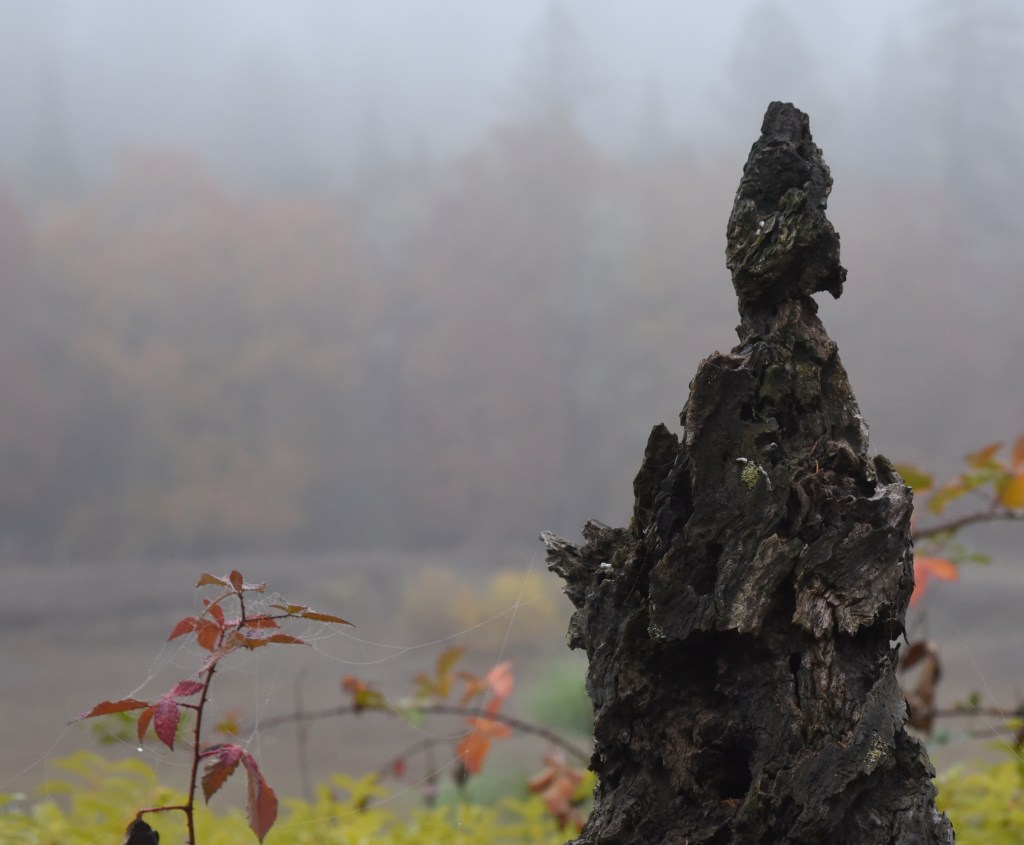
 Regular readers will know that Jean and I are not believers in any religion; we are atheists. But to my way of thinking that puts even more pressure on me and Jean to try to make a difference. We do all that we can but there’s no doubt that we can do more.