In a reply to Colette following my post of last week Caring for animals, I wrote:
Jean is on a diet that is predominantly fruit and vegetables as part of slowing down the progression of her Parkinson’s disease. The diet is essentially a no-dairy, no-grain, no-meat diet to eliminate the risk of any gut inflammation. She is advised by a professional nutritionist here in Grants Pass, OR. I follow along with Jean motivated to slow down my own cognitive decline.
Colette then responded to my reply with quite extensive details of her own diet. Her reply opening:
I have some food sensitivities that started my dietary changes a number of years ago. I found I was allergic to eggs after struggling with severe joint pain that doctors couldn’t explain. Then I began to find that a few other things were problematic including gluten, also prompting dietary change. The animal protein side came into sharper focus during a moment of epiphany at an elephant sanctuary and I started a vegetarian diet. However, I soon switched to a completely (almost except for some contamination in the odd thing now and again) vegan diet.
I am healthier, my cholesterol dropped from a total of 212 mg/dlto 135mg/dl and I have more stamina, fewer infections, colds and illness. (Nothing terrible to put me to bed since I became Vegan).
I do try to get a balance of a variety of fresh fruit and veg, protein and fats in my diet.
… that was then followed by her describing what a typical day looked like in terms of what she eat.
I offered to describe what Jean and I eat.
Fundamentally, Jean was advised to have a diet that reduced the chance of her having any gut inflammation but, if she did, a diet that would bring that inflammation to a close. All to do with Leaky Gut Syndrome and how the brain can be negatively affected.
So …
Breakfast
Two tablespoons of milled flax,
One tablespoon of hemp hearts,
A sprinkling of chia seed,
Prunes, banana, dried apricots, walnuts, berries when available,
Coconut milk or almond milk
Lunch
Mainly salad greens, raw vegetables, tomatoes, avocado, some canned herring,
Mixed fruits, as in oranges, apples,
‘Naked Green’ smoothie
Dinner
Mixed vegetables,
Baked chicken breast,
Green salad with tomatoes and avocado,
Almonds or other nuts
Drinks during the day
Herb teas, ‘V8’ juice, green tea, ‘Naked Green’ smoothies, almond milk.
We are also taking a course of Juice-Plus tablets; a recommendation from our local nutritionist.
Anyway, that’s enough from me for today.
If there’s good interest in me sharing some of the many links to this whole area of diet, the gut and how it can affect the brain, then do sing out! (But I have no professional knowledge; will just report our findings!)
oooo
Wow! What an incredibly useful link thanks to Colette. I am referring to the NutritionFacts website.
Then how easy it was on that site to find a video specifically about diet and PD.
Jean and I are removing chicken and fish from our diet immediately; in other words going vegan.
Last October 11th, I published a guest post that had been sent in by Linley Achtenhagen. The published post was called Life with Luna and was incredibly well-received.
So here’s another guest post from Linley that I have no doubt will be equally well-received.
ooOOoo
Unconditional Love
by Linley Achtenhagen, October 29th, 2017.
Up until January 12, 2017, I had never lost a loved one. I grew up with three grandparents, one grandpa passing away shortly after I was born, so I was pretty lucky to grow up with three out of four grandparents. Sure, I had been to funerals for distant relatives I had met once or twice or my friend’s grandparents, and I grieved for them because they were hurting and I hate seeing people hurt. I, however, had no idea what that pain felt like until one of my best friends passed away in a tragic accident while she was on a family vacation in Mexico.
Abbey Connor, my sweetest, sassiest, most beautiful friend and fellow UW-Whitewater student, taken away far too soon. Getting the news that she was gone rocked me to the core. I had just celebrated New Year’s Eve with her a few short weeks ago, and now I was never going to see her again. How is that possible? Why would this happen to her? I had absolutely no idea how to handle this. Going from losing no one to losing one of my best friends so suddenly was something I was not prepared to deal with but is anyone? I cried and cried and cried and listened to people tell me it was going to be okay, but those words didn’t mean anything. Of course, I appreciated the support of my friends and family, but nothing made the pain in my chest go away when I thought of Abbey. I hurt so much for her family, if I felt this horrible, I couldn’t imagine how her family felt. The only thing that I found comfort in was the one thing that couldn’t tell me they were sorry and that it was going to be okay, Luna.
There is no doubt in my mind that Luna knew I was hurting. I am convinced that dogs have a 6th sense and are much more aware of our emotions than we give them credit. Luna would just lay with me while I cried and her presence alone eased that pain. My crazy and energetic dog would just sit and let me pet her for as long as I needed to.
Not even a month later, February 11th, our family dog, Will, passed away after a long battle with cancer. For fellow dog lovers, you know how hard it is to let your furry companions go. We had Will since he was a puppy, so he grew up with my siblings and me. He was my four-legged brother and letting him go ripped my healing heart wide open again. This time, my whole family was hurting, including Will’s sister, Grace. Will and Grace had never spent a day apart; they slept in their dog crate together, chased chipmunks together, protected my family together, and she just couldn’t understand where he went. We couldn’t explain to her that he wasn’t coming back and that made the pain that much worse. The one thing that brought a smile to everyone’s face in the days, weeks, and months to come was Luna. She would grab her squeaker toy and run up to everyone shaking and squeaking it just begging for someone to play tug with her. She would light up the room and bring a smile, even if only for a second, to our faces. She was helping us cope, and she didn’t realize it.
Two months later, April 13th, my grandma passed away. I couldn’t believe that I had to deal with another death. I was still grieving Abbey and Will’s passing, and now I had another death to try and cope with. My grandma lived in Florida for half of the year, so while we weren’t the closest, she was my grandma, my dad’s mother, and of course, I loved her. I hurt for my dad as he had to say goodbye to his mom. I hurt for all of my cousins, aunts, and uncles. I hurt for my mom and my siblings and I. We had never lost a grandparent, and now we had to deal with this while still grieving Will’s passing, I still grieving Abbey’s. It was such an overwhelming and stressful time, and once again the one thing that got me through each day was Luna. No matter how hard of a day it was, each night when I crawled into bed, Luna would lay right next to me, her head on my chest and just be there. I cannot put into words what that feeling is like.
John Grogan, author of Marley and Me, (if you haven’t seen the movie or read the book, add it to your list) wrote one of my favorite quotes. He said, “A dog doesn’t care if you’re rich or poor, educated or illiterate, clever or dull. Give him your heart, and he will give you his.” This quote is undeniably accurate and I saw this proof in the months to come after I lost all of these loved ones. Luna didn’t care if I didn’t have time to take her for a long walk, or I didn’t want to get out of bed, or I didn’t have the energy to play fetch with her that day, she was there for me and comforted me every moment. She knew I loved her, and that was enough. The most comforting part of all of this is that Luna didn’t even know she was doing it. If more people loved each other like dogs love their humans, this world would be a much better place.
ooOOoo
Linley’s closing sentence is perfect and requires nothing more from me to close today’s post than for me to repeat her words: “If more people loved each other like dogs love their humans, this world would be a much better place.“
My posts of the last few days have been in the ‘cuddly, cosy’ vein of life and, as many would say, a long way from the reality of this 21st century.
The reality is tough and scary and many, including me, favour running away from scary places. I’m sure that the urge to flee and hide is a survival behaviour from long time ago. BUT!! But the only hope for us humans is to face the facts full on.
Take, for example, the Ganges River. We have all heard of this famous river (my emphasis below):
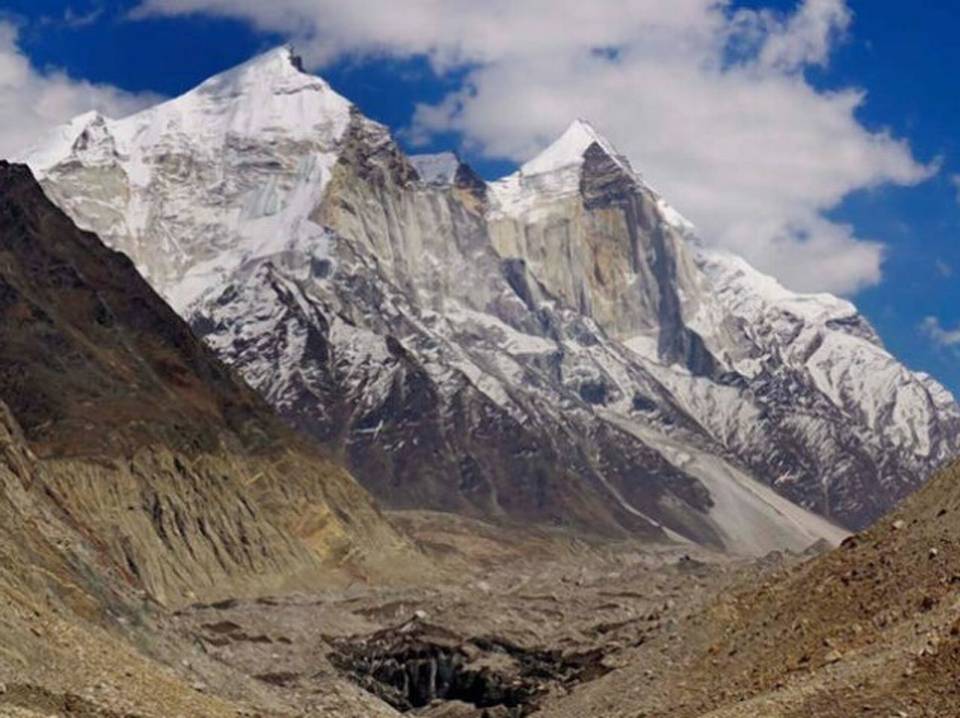
The source of the Ganges is the Gangotri glacier. Here it is:
Gaumukh, snout of the Gangotri glacier,surrounded by the Bhagirathi peaks of Garhwal Himalayas, at an altitude of over 4,000 metres. Photo: Vidya Venkat.
Scientists say dwindling snowfall affects volume of water fed to the Bhagirathi, the main source of the Ganga
After a four-hour-long trek from Bhojwasa, the final camping spot in Gangotri, when a brown, fractured pile of rocks finally came into view it was hard to believe that this was the mouth of the glacier from which the ‘holy’ Ganga emerged.
Gaumukh, the snout of the Gangotri glacier, named after its shape like the mouth of a cow, has retreated by over 3 kilometres since 1817, says glaciologist Milap Chand Sharma of Jawaharlal Nehru University.
It was nearly two centuries ago that the retreat of the glacier was first documented by John Hodgson, a Survey of India geologist.
With 10 Indian States reeling under drought and the country facing a severe water crisis after two weak monsoons, the story of retreating freshwater sources such as the Himalayan glaciers is worrying. And though a three-kilometre retreat over a period of two centuries might seem insignificant at first glance, data shows that the rate of retreat has increased sharply since 1971. The rate of retreat is 22 metres per year.
Twenty-two metres or seventy-two feet a year!
Wringing our hands is no good. All of us who care for our Living Planet have to shout out just what is going on. As George Monbiot continues to do. Take his latest essay, for example, that is republished here in full with GM’s very kind permission.
ooOOoo
Insectageddon
The scale and speed of environmental collapse is beyond imagination.
By George Monbiot, published in the Guardian 20th October 2017
Which of these would you name as the world’s most pressing environmental issue? Climate breakdown, air pollution, water loss, plastic waste or urban expansion? My answer is none of the above. Almost incredibly, I believe that climate breakdown takes third place, behind two issues that receive only a fraction of the attention.
This is not to downgrade the danger presented by global heating – on the contrary, it presents an existential threat. It is simply that I have come to realise that two other issues have such huge and immediate impacts that they push even this great predicament into third place.
One is industrial fishing, which, all over the blue planet, is now causing systemic ecological collapse. The other is the erasure of non-human life from the land by farming.
And perhaps not only non-human life. According to the UN Food and Agriculture Organisation, at current rates of soil loss, driven largely by poor farming practice, we have just 60 years of harvests left. And this is before the Global Land Outlook report, published in September, found that productivity is already declining on 20% of the world’s cropland.
The impact on wildlife of changes in farming practice (and the expansion of the farmed area) is so rapid and severe that it is hard to get your head round the scale of what is happening. A study published this week in the journal Plos One reveals that flying insects surveyed on nature reserves in Germany have declined by 76% in 27 years. The most likely cause of this Insectageddon is that the land surrounding those reserves has become hostile to them: the volume of pesticides and the destruction of habitat have turned farmland into a wildlife desert.
It is remarkable that we need to rely on a study in Germany to see what is likely to have been happening worldwide: long-term surveys of this kind simply do not exist elsewhere. This failure reflects distorted priorities in the funding of science. There is no end of grants for research on how to kill insects, but hardly any money for discovering what the impacts of this killing might be. Instead, the work has been left – as in the German case – to recordings by amateur naturalists.
But anyone of my generation (ie in the second bloom of youth) can see and feel the change. We remember the “moth snowstorm” that filled the headlight beams of our parents’ cars on summer nights (memorialised in Michael McCarthy’s lovely book of that name). Every year I collected dozens of species of caterpillars and watched them grow and pupate and hatch. This year I tried to find some caterpillars for my children to raise. I spent the whole summer looking and, aside from the cabbage whites on our broccoli plants, found nothing in the wild but one garden tiger larva. Yes, one caterpillar in one year. I could scarcely believe what I was seeing – or rather, not seeing.
Insects, of course, are critical to the survival of the rest of the living world. Knowing what we now know, there is nothing surprising about the calamitous decline of insect-eating birds. Those flying insects – not just bees and hoverflies but species of many different families – are the pollinators without which a vast tract of the plant kingdom, both wild and cultivated, cannot survive. The wonders of the living planet are vanishing before our eyes.
Well, I hear you say, we have to feed the world. Yes, but not this way. As a UN report published in March explained, the notion that pesticide use is essential for feeding a growing population is a myth. A recent study in Nature Plants reveals that most farms would increase production if they cut their use of pesticides. A study in the journal Arthropod-Plant Interactions shows that the more neonicotinoid pesticides were used to treat rapeseed crops, the more their yield declines. Why? Because the pesticides harm or kill the pollinators on which the crop depends.
Farmers and governments have been comprehensively conned by the global pesticide industry. It has ensured its products should not be properly regulated or even, in real-world conditions, properly assessed. A massive media onslaught by this industry has bamboozled us all about its utility and its impacts on the health of both human beings and the natural world.
The profits of these companies depend on ecocide. Do we allow them to hold the world to ransom, or do we acknowledge that the survival of the living world is more important than returns to their shareholders? At the moment, shareholder value comes first. And it will count for nothing when we have lost the living systems on which our survival depends.
To save ourselves and the rest of the living world, here’s what we need to do:
We need a global treaty to regulate pesticides, and put the manufacturers back in their box.
We need environmental impact assessments for the farming and fishing industries. It is amazing that, while these sectors present the greatest threats to the living world, they are, uniquely in many nations, not subject to such oversight.
We need firm rules based on the outcomes of these assessments, obliging those who use the land to protect and restore the ecosystems on which we all depend.
We need to reduce the amount of land used by farming, while sustaining the production of food. The most obvious way is greatly to reduce our use of livestock: many of the crops we grow and all of the grazing land we use are deployed to feed them. One study in Britain suggests that, if we stopped using animal products, everyone in Britain could be fed on just 3m of our 18.5m hectares of current farmland (or on 7m hectares if all our farming were organic). This would allow us to create huge wildlife and soil refuges: an investment against a terrifying future.
We should stop using land that should be growing food for people to grow maize for biogas and fuel for cars.
Then, at least, nature and people would have some respite from the global onslaught. And, I hope, a chance of getting through the century.
I am far from certain but I have this notion in my head that ‘Common Land’ is an English thing. Here’s a Wikipedia extract:
Common land is land owned collectively by a number of persons, or by one person, but over which other people have certain traditional rights, such as to allow their livestock to graze upon it, to collect firewood, or to cut turf for fuel.[1]
A person who has a right in, or over, common land jointly with another or others is called a commoner.[2]
This article deals mainly with common land in England, Wales and Scotland. Although the extent is much reduced due to enclosure of common land from the millions of acres that existed until the 17th century, a considerable amount of common land still exists, particularly in upland areas, and there are over 7,000 registered commons in England alone.[3][4]
Despite the idea of common land having an English ‘ring’ to it common land is also found in the USA. Back to that Wikipedia reference:
Common land, an English development, was used in many former British colonies, for example in Ireland and the United States. The North American colonies adopted the English laws in establishing their own commons. A famous example is the New Haven Green in New Haven, Connecticut.
When I was living in Devon it was not unusual to take a walk with Pharaoh on some very famous open access land: Dartmoor.
Dartmoor: English countryside at its best.
So where the devil am I going with today’s post?
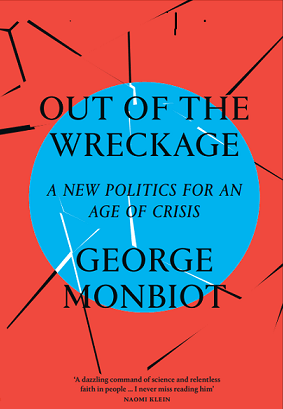
Last Thursday week, the 12th, I published my review of George Monbiot’s valuable book Out Of The Wreckage.
This book struck me as the most important book I have ever read in my lifetime. Why? Because it gets to the heart of what is happening today. But it offers even more than that. For instead of a shrug of the shoulders or eyes turned skywards from a friend when one mutters about the fact that we are living in ‘interesting times’, George Monbiot offers hope and guidance.
The day after I published my review George Monbiot published an article in The Guardian newspaper that threw more light on the commons philosophy and why, as in his book, he “offers hope and guidance”.
It is republished here with Mr. Monbiot’s generous permission. Yes, the focus is on British politics but GM’s core message applies equally to the USA and other countries.
ooOOoo
Labouratory
13th October 2017
We should use the political space being opened by the Labour resurgence to develop a new, participatory economy
By George Monbiot, published in the Guardian 11th October 2017
We are still living in the long 20th Century. We are stuck with its redundant technologies: the internal combustion engine; thermal power plants; factory farms. We are stuck with its redundant politics: unfair electoral systems; their capture by funders and lobbyists; the failure to temper representation with real participation.
And we are stuck with its redundant economics: neoliberalism, and the Keynesianism still proposed by its opponents. While the latter system worked very well for 30 years or more, it is hard to see how it can take us through this century, not least because the growth it seeks to sustain smacks headlong into the environmental crisis.
Sustained economic growth on a planet that is not growing means crashing through environmental limits: this is what we are witnessing, worldwide, today. A recent paper in Nature puts our current chances of keeping global heating to less than 1.5°C of at just 1%, and less than 2° at only 5%. Why? Because while the carbon intensity of economic activity is expected to decline by 1.9% a year, global per capita GDP is expected to grow by 1.8%. Almost all investment in renewables and efficiency is cancelled out. GDP, the index that was supposed to measure our prosperity, instead measures our progress towards ruin.
But the great rupture that began in 2008 offers a chance to change all this. The challenge now is to ensure that the new political movements threatening established power in Britain and elsewhere create the space not for old ideas (such as 20th Century Keynesianism) but for a new politics, built on new economic and social foundations.
There may be a case for one last hurrah for the old model: a technological shift that resembles the Second World War’s military Keynesianism. In 1941, the US turned the entire civilian economy around on a dime: within months, car manufacturers were producing planes, tanks and ammunition. A determined government could do something similar in response to climate breakdown: a sudden transformation, replacing our fossil economy. But having effected such a conversion, it should, I believe, then begin the switch to a different economic model.
The new approach could start with the idea of private sufficiency and public luxury. There is not enough physical or environmental space for everyone to enjoy private luxury: if everyone in London acquired a tennis court, a swimming pool, a garden and a private art collection, the city would cover England. Private luxury shuts down space, creating deprivation. But magnificent public amenities – wonderful parks and playgrounds, public sports centres and swimming pools, galleries, allotments and public transport networks – create more space for everyone, at a fraction of the cost.
Wherever possible, I believe such assets should be owned and managed by neither state nor market, but by communities, in the form of commons. A commons in its true form is a non-capitalist system, in which a resource is controlled in perpetuity by a community, for the shared and equal benefit of its members. A possible model is the commons transition plan commissioned by the Flemish city of Ghent.
Land value taxation also has transformative potential. It can keep the income currently siphoned out of our pockets in the form of rent – then out of the country and into tax havens – within our hands. It can reduce land values, bringing down house prices. While local and national government should use some of the money to fund public services, the residue can be returned to communities.
Couple this with a community right to buy, enabling communities to use this money to acquire their own land, with local commons trusts that possess powers to assemble building sites, and with a new right for prospective buyers and tenants to plan their own estates, and exciting things begin to happen. This could be a formula for meeting housing need, delivering public luxury and greatly enhancing the sense of community, self-reliance and taking back control. It helps to create what I call the Politics of Belonging.
But it doesn’t stop there. The rents accruing to commons trusts could be used to create a local version of the citizens’ wealth funds (modelled on the sovereign wealth funds in Alaska and Norway) proposed by Angela Cummine and Stewart Lansley. The gain from such funds could be distributed in the form of a local basic income.
And the money the government still invests? To the greatest extent possible, I believe it should be controlled by participatory budgeting. In the Brazilian city of Porto Allegre, the infrastructure budget is allocated by the people: around 50,000 citizens typically participate. The results – better water, sanitation, health, schools and nurseries – have been so spectacular that large numbers of people now lobby the city council to raise their taxes. When you control the budget, you can see the point of public investment.
In countries like the UK, we could not only adopt this model, but extend it beyond the local infrastructure budget to other forms of local and even national spending. The principle of subsidiarity – devolving powers to the smallest political unit that can reasonably discharge them – makes such wider democratic control more feasible.
All this would be framed within a system such as Kate Raworth’s doughnut economics which, instead of seeking to maximise growth, sets a lower bound of wellbeing below which no one should fall, and an upper bound of environmental limits, that economic life should not transgress. A participatory economics could be accompanied by participatory politics, involving radical devolution and a fine-grained democratic control over the decisions affecting our lives – but I will leave that for another column.
Who could lead this global shift? It could be the UK Labour Party. It is actively seeking new ideas. It knows that the bigger the change it offers, the greater the commitment of the volunteers on which its insurgency relies: the Big Organising model that transformed Labour’s fortunes at the last election requires a big political offer. (This is why Ed Miliband’s attempts to create a grassroots uprising failed).
Could Labour be the party that brings the long 20th Century to an end? I believe, despite its Keynesian heritage, it could. Now, more than at any other time in the past few decades, it has a chance to change the world.
Towards the end of September in came an email addressed to learningfromdogs.
Hi Paul,
Pete here from The Goody Pet.
Firstly – A big thank you for writing all those amazing articles on dogs. Been sharing these articles with my friends and they really enjoyed reading them. Was wondering if I could contribute a guest post for your website? I have been a dog owner for the past 15 years and would love to share some of my tips to your readers.
If you are interested, please let me know? I will be more than happy to prepare a few topics to send across to you.
Kind Regards,
Pete
Goes without saying that I was delighted to receive Pete’s email and his offer of an article. Here it is!
ooOOoo
DOGS: A LESSON IN LOYALTY
by Pete Decker, October 8th, 2017
Dog is a man’s best friend, this is something we have said and heard enough number of times. They can be better friends that any human can ever be, this is a fact that almost all dog owners can surely vouch for.
A dog’s loyalty has been seen and heard of in many famous incidents as well as stories like Hawkeye, the dog who grieved the death of his Navy SEAL owner by lying down near his casket day in and out. Or the story of Hachiko, the dog who greeted his owner at the train station every day and continued to look for his owner at the same place daily even after the sudden death of the owner.
What makes dogs so loyal?
There have been some people who say that they depend on humans for food and shelter and so have to be loyal without a choice. But when you see the dog of a street dweller loving him unconditionally or when you see the reaction of a dog after meeting his master who has been away for a long time, you know it’s not just about food and shelter.
They are colonial creatures who like to live together, whether it is a colony of humans, dogs or even other animals. They just want to love and be loved back.
Dogs are not like human beings, they are much better. They do not cheat or betray. They only need one master and that is enough for them to live happily. Unknowingly, dogs teach us many important lessons that help us be better and more loyal people. Let us consider some of them:
They teach you never to betray
Your closest human friend or companion may betray you when the time comes, but a dog never ever will. If needed he will lay his life for you, but betraying is out of question. A human being is capable of telling lies, manipulating, or twisting facts, a dog is not capable of any of that.
A dog can never lie
No matter how close you are to a person, they still may not tell you everything or all the truth. As humans, we think withholding information is not considered lying and do that all the time. But a dog can never lie, he doesn’t even know how to. There is no pretense or withholding information with a dog. For a dog the world is only about you. And it only has ways to show you how much it loves you, nothing more.
They teach you never to judge
Your dog does not care whether you are rich or poor, whether you are ugly or beautiful. It does not even care if you are thin, fat, or what nationality you belong to. A dog will not judge if you have failed at anything, or hold prejudices against you. With a dog you can never be scared of being ridiculed or humiliated. As long you it is with you, you mean the world to him, and he will never leave you no matter what.
Forgiving is another lesson they teach us
A dog is not capable of holding grudges, or being revengeful. These qualities are for us humans. Even if you hurt your dog knowing or unknowingly they will still forgive you at all times. They will not hold your mistakes against you. They will forget your flaws and love you as it always did.
Love is beyond everything
This is one thing that differentiates a human from a dog. Your best friend of one time may not be the same anymore, but a dog will be your best friend as long as you live. They will be by your side at all times, through thick or thin.
You can always repay the favor by ensuring that your dog is responsibly cared for, well fed with regular grooming.
These are some important lessons of loyalty that a dog teaches us. If only we humans imbibe even a part of their qualities, the world will be a much happier place to live in.
ooOOoo
That closing photograph, that was also supplied by Pete, says it all.
Naturally, I asked Pete to offer a little background information on his goodself and this is what he wrote me:
The author of this post is Pete Decker, the Lead Editor at The Goody Pet. Pete loves to share his passion for pets through snippets of interesting and helpful information. You can find more of Pete at his website, Twitter or Facebook.
(Please note that I am letting this post run until Sunday, 15th Oct.)
For many years I have both read George Monbiot’s writings, especially those published by The Guardian newspaper, and deeply respected his insight, intelligence and analysis of the world in which we now live.
So when I heard of his latest book, published by Verso Books both sides of the ‘pond’, it was ordered immediately. It was a book I badly wanted to read. I was not disappointed.
So what is Mr. Monbiot’s message?
To answer that question let me lean on a forthcoming talk being given by him in Edinburgh in eight days time. For he is speaking at a Scottish Green Party event on October 20th.
Here’s the thrust of what is to be covered at that meeting:
What does the good life—and the good society—look like in the twenty-first century?
A toxic ideology rules the world – of extreme competition and individualism. It misrepresents human nature, destroying hope and common purpose. Only a positive vision can replace it, a new story that re-engages people in politics and lights a path to a better world.
Join us for an evening of discussion with George Monbiot as he talks about his new book: ‘Out of the wreckage: a new politics in an age of crisis‘. New findings in psychology, neuroscience and evolutionary biology cast human nature in a radically different light: as the supreme altruists and cooperators. George argues that we can build on these findings to create a new politics: a ‘politics of belonging’.
So what does this mean for social and environmental justice campaigning in Edinburgh? How do we create a politics of belongings here in Scotland? There will be plenty of opportunity for George Monbiot and the audience to share their insights.
Doors open: 6pm
George Monbiot will speak from 7-7.30pm and there will then be a Q&A, plus a chance buy books, mingle and browse stalls.
This event is jointly hosted by Global Justice Now and the Scottish Green party.
To my mind, this book not only addresses, full on, the madness (my word) of these present times but also offers strong, positive recommendations as to how we, as in the societies of all the major nations, can turn it around and offer a decent future for future generations. That’s why I am so strongly recommending it.
For George Monbiot, neoliberalism should best be understood as a “story”, one that was conveniently on offer at precisely the moment when the previous “story” – namely Keynesianism – fell to pieces in the mid-1970s. The power of stories is overwhelming, as they are “the means by which we navigate the world. They allow us to interpret its complex and contradictory signals”. The particular story of neoliberalism “defines us as competitors, guided above all other impulses by the urge to get ahead of our fellows”.
It should be said at once that we are desperately in need of new ideas for a society and a democracy where trust in all established institutions is at a record low and even a Tory prime minister admits the country doesn’t work for everyone. Monbiot’s ideas are clear, well-reasoned and sometimes compelling. Many will mock his attempt at a “story of hope and restoration”; even some of his Guardian colleagues call him “George Moonshine”. Human beings, his critics will say, are inherently selfish and self-maximising. Give them the opportunity to freeload off others’ efforts and they will take it.
Such objections are easily dismissed. Yes, there’s a self-interested streak in all of us but, as Monbiot observes, we also have instincts for co-operation and sensitivity to others’ needs. Think of the hundreds who volunteer to run food banks and of the thousands more who donate to them. Think of those Europeans who, at great risk to themselves, sheltered Jews from the Nazis during the Second World War. The altruistic instinct can be kindled in almost anybody. It is suppressed, however, in a society that rewards the selfish but penalises – and brands as “mugs” – those who are more mindful of our needs, and the planet’s. That society has led to loneliness, high levels of mental illness and increasingly discordant political discourse. Shouldn’t we at least try developing a society that does more to nurture the better angels of our nature?
Better still, settle down with a cup of tea, put your feet up for fifteen minutes and listen to this:
This book struck me as the most important book I have ever read in my lifetime. Why? Because it gets to the heart of what is happening today. But it offers even more than that. For instead of a shrug of the shoulders or eyes turned skywards from a friend when one mutters about the fact that we are living in ‘interesting times’, George Monbiot offers hope and guidance.
Take the very last two paragraphs from the final chapter of his book.
Coming Home to Ourselves
Through restoring community, renewing civic life and claiming our place in the world, we build a society in which our extraordinary nature – our altruism, empathy and deep connection – is released.
When we emerge from the age of loneliness and alienation, from an obsession with competition and extreme individualism, from the worship of image and celebrity and power and wealth, we will find a person waiting for us. It is a person better than we might have imagined, whose real character has been suppressed. It is one who lives inside us, who has been there all along.
“- our altruism, empathy and deep connection -”
I see these persons every day of my life. Via the pages of this blog.
Yes, I am referring to all of you who wander in and out of this place, who demonstrate your compassion, your love and your dedication to the dogs and all the other animals of this world.
Another movie, another dog! Correction: another world-famous dog!
Monday’s post Hail the Hero was about Max.
Max, a feature film by the producers of the doggie classic Marley and Me, intends to explore a soldier dog’s journey that doesn’t end with this heartbreaking image of a pup chasing down his fallen brother, but rather begins with it.
So it’s rather nice to welcome a guest post from Emily Ridgewell that features a dog that became known far and wide thanks to television and the cinema.
ooOOoo
An Incredible Rescue: An Often Forgotten “Tail” From The Golden Age Of Hollywood
By Emily Ridgewell
In the shadow of recent world tragedies, and long before cute puppies and kittens graced the internet, there were former movie legends in the form of incredible canines that found their way onto the big screen in the golden age of Hollywood. Think of adorable dogs like Toto from The Wizard of Oz or Lassie from many different types of these movies and television shows.
But there’s another “tail” (pardon the pun) about a German Shepherd named Rin Tin Tin who stole America’s heart and eventually had millions of fans all around the world long before the advent of the internet. Few of us today know the real-life story of this precious little puppy who was rescued from a war zone long before Toto or Lassie gained their fame and fortune as canine celebrities.
According to a historically-related biography published long-after this rag-tag dog shot to fame in the late twenties and early thirties, there was a young American soldier stationed in Europe shortly before the end of World War I. Corporal Lee Duncan was traipsing through the aftermath of formerly German-occupied farming village in France when he came across a single building, actually it was a kennel, that remained somewhat intact after a devastating bombing had leveled the entire town.
After cautiously entering the building, the young trooper painfully walked over more than a dozen dead German Shepherd dogs. These canine soldiers were trained for combat and left behind by the Third Reich. Corporal Duncan heard whimpering coming from deeper inside this solitary structure and continued on with his mission. To his amazement, Lee discovered some unlikely survivors of this terrible tragedy.
AFTER THE UNTHINKABLE – LIVING & LOVABLE
Lying in the rubble, there Lee saw a female shepard with five young puppies who were just a few days old. Corporal Duncan was no stranger to abandonment since his own father had left him and his mother to fend for themselves back in 1898. Just a year later, his Mom took him and a younger sibling to an orphanage. Perhaps this tugged on his heartstrings and he couldn’t leave behind this young family so he took them all underneath his wing.
He took the entire brood back to his barracks in a living and loving rescue effort. The young Corporal quickly realized he couldn’t care for all of them and found loving homes for all but two of the pups. He kept a little boy and girl, named them Nanette and Rin Tin Tin, both titles given to good luck charms found in France.
THE CANINES AFTER CHAOS
Lee continued to care for his beloved best buddies as the chaos of the war continued. After the conflict had concluded, Corporal Duncan was bound and determined to take his little war refugees home with him. Imagine the red-tape he was faced with and, long story short, he lost Nanette to pneumonia after bringing them both home to the states.
The WWI veteran got a job in his home state of California and began training Rin Tin Tin to perform some tricks in their spare time. After some filming occurred, the former Corporal wrote a screenplay and the rest (as they say) is history.
There’s an old saying (later turned into a Beatles song – also from many days gone by) that rings true in this case, you “Can’t Buy Me Love.” And that’s the whole point.
You can’t purchase the love and affection of an animal, but if you rescue one, you’ll find unconditional love that lasts forever. You might not become rich and famous after rescuing an animal, but you’ll never find a deeper love and connection with your four-legged best friend.
ooOOoo
Emily Ridgewell is an arts professional and a pet enthusiast from sunny LA. Emily has a creative energy and an aesthetic sense of living, where everything beautiful is worth sharing. She loves her yorkie Olivia and writes original and fun articles on ways to learn and improve your pet-best friend’s life. She finds exciting new things to explore and experience! Don’t forget to connect with her on Twitter: @ridgewell_j
Picking up on that ‘old saying’ with regard to The Beatles makes it easy to close today’s post. (And sorry if this makes some of you feel old!)
Can’t Buy Me Love was The Beatles’ sixth British single, released with the b-side You Can’t Do That. It was written while the group were in Paris for a 19-date residency at the city’s Olympia Theatre.
An emotional post that is potentially upsetting to readers. Especially English readers.
Yesterday, September 14th, saw the opening of the inquiry into the Grenfell Tower fire that happened on June 14th. As the BBC News reported:
The inquiry into the Grenfell Tower fire has opened, with its chairman promising it will provide answers to how the disaster could have happened in 21st century London.
Sir Martin Moore-Bick said he would not shrink away from making recommendations that could lead to prosecutions.
Yesterday morning, I woke at 5am PDT (1pm UK time) and picked up my tablet that has a BBC Radio 4 app installed. I lay there in the dark, Jeannie still fast asleep alongside me, and listened to the World at One: Forty-five minutes of news, analysis and comment, with Martha Kearney. Naturally the opening stages of the inquiry were one of the main items covered.
I was born in London. At the maternity ward at the hospital in Park Royal, West London. Some 5 miles from Grenfell Tower. I was brought up in Wembley, London again some 5 miles straight line distance from the tower.
For much of my early life as a young adult I was in and around that part of London. So while I was not personally familiar with Grenfell Tower itself, the news coverage of the disaster at the time relayed sights of a part of London that seemed like an old friend from the past.
A ghost of my life from over 50 years ago.
Yesterday on the World at One Martha Kearney interviewed Kareem Dennis better known as the rapper Lowkey:
Lowkey: A song for Grenfell, a call for justice
Hip Hop artist Lowkey lives opposite Grenfell tower. He has written a song called Ghosts of Grenfell, featuring people from the local community, which demands justice for those who died.
Lowkey told the World at One about his song and the night of the fire.
(Photo: Lowkey. Credit: BBC)
The interview included snippets of Lowkey’s song.
After I had finished listening to the World at One I did a web search to learn more about the poor animals that lost their lives in the inferno. It broke my heart reading the stories.
Then I started watching the full video of Lowkey’s song: Ghosts of Grenfell. Sixty seconds into the song I could hold my emotions no longer and burst into deep sobs.
[Intro: Lowkey] The night our eyes changed Rooms where, love was made and un-made in a flash of the night Rooms where, memories drowned in fumes of poison Rooms where, futures were planned and the imagination of children built castles in the sky Rooms where, both the extraordinary and the mundane were lived Become forever tortured graves of ash Oh you political class, so serve out to corporate power
[Chorus: Mai Khalil & Lowkey]
Did they die, or us?
Did they die, or us?
Did they die, for us? Ghosts of Grenfell still calling for justice Now hear ’em, now hear ’em scream
Did they die, or us?
Did they die, or us?
Did they die, for us? This corporate manslaughter will haunt you Now hear ’em scream
[Verse 1: Lowkey]
Words can not express
Please allow me to begin though
1:30am heard the shouting from my window
People crying in the street
Watchin’ the burning of their kinfolk
Grenfell Tower, now historically a symbol
People reaching, from their windows
Screaming, for their lives
Pleading, with the cries
Tryna reason with the skies
Dale youth birthed champions
Comparison is clear though
That every single person in the building was a hero
So don’t judge our tired eyes in these trying times
‘Cause we be breathing in cyanide, the entire night
They say Yasin saw the fire and he ran inside
Who’d thought that would be the site where he and his family died
The street is like a graveyard, tombstones lurching over us
Those shouting out to their windows, now wish they never woke them up
Wouldn’t hope your worst enemy to go in this position
Now it’s flowers for the dead and printed posters for the missing, come home
[Chorus: Mai Khalil & Lowkey]
Did they die, or us?
Did they die, or us?
Did they die, for us? Ghosts of Grenfell still calling for justice Now hear ’em, now hear ’em scream
Did they die, or us?
Did they die, or us?
Did they die, for us? This corporate manslaughter will haunt you Now hear ’em scream
[Verse 2: Lowkey]
I see trauma in the faces of all those that witnessed this
Innocence in the faces of all those on the missing list
See hopes unfulfilled
Ambitions never achieved
No I’m not the only one that sees the dead in my dreams
Strive for the bravery of Yasin, artistic gift of Khadija
Every person, a unique blessing to never be repeated
Strive for the loyalty of siblings that stayed behind with their parents
Pray that every loved one lost can somehow make an appearance
We are, calling like the last conversations with their dearest
Until we face, what they face we will never know what fear is
We are, calling for survivors rehoused in the best place
Not to be left sleeping in the West Way for 10 days
We’re, calling for arrests made and debts paid
In true numbers known for the families that kept faith
We’re, calling for safety in homes of love
They are immortalised forever, the only ghosts are us
I wonder
[Chorus: Mai Khalil & Lowkey]
Did they die, or us?
Did they die, or us?
Did they die, for us? Ghosts of Grenfell still calling for justice Now hear ’em, now hear ’em scream
Did they die, or us?
Did they die, or us?
Did they die, for us? This corporate manslaughter will haunt you Now hear ’em scream
[Bridge: Mai Khalil (Arabic)]
Olooli win arooh
Nas a’am tehtere’a fe sa’at sahoor
Ahess ennee be alam tanee
Ahess ennee be alam tanee
Olooli win arooh
Nas a’am tehtere’a fe sa’at sahoor
Ahess ennee be alam tanee
Ahess ennee be alam tanee
[Speech: Lowkey & Various Voices] To whom it may concern, at the Queen’s royal borough of Kensington in Chelsea. Where is Yasin El-Wahabi? Where is his brother Mehdi? Where is his sister Nur Huda? Where is their mother and where is their father? Where is Nura Jamal and her husband Hashim? Where is their children, Yahya, Firdaus and Yaqoob? Where is Nadia Loureda? Where is Steve Power? Where is Dennis Murphy? Where is Marco Gottardi? Where is Gloria Trevisian? Where is Amal and her daughter Amaya? Where is Mohammed Neda? Where is Ali Yawar Jafari? Where is Khadija Saye? Where is Mary Mendy? Where is Mariem Elgwahry? Where is her mother Suhar?
Tell us, where is Rania Ibrahim and her two daughters? Where is Jessica Urbano Remierez? Where is Deborah Lamprell? Where is Mohammed Alhajali? Where is Nadia? Where is her husband Bassem? Where are her daughters, Mirna, Fatima, Zaina and their grandmother? Where is Zainab Dean and her son Jeremiah? Where is Ligaya Moore? Where is Sheila Smith? Where is Mohammednour Tuccu? Where is Tony Disson? Where is Maria Burton? Where is Fathaya Alsanousi? Where is her son Abu Feras and her daughter Esra Ibrahim? Where is Lucas James? Where is Farah Hamdan? Where is Omar Belkadi? Where is their daughter Leena? Where is Hamid Kani? Where is Esham Rahman? Where is Raymond Bernard? Where is Isaac Paulos? Where is Marjorie Vital? Where’s her son Ernie? Where is Komru Miah? Where is his wife Razia? Where are their children Abdul Hanif, Abdul Hamid, Hosna? Where are Sakineh and Fatima Afraseiabi? Where is Berkti Haftom and her son Biruk?
Tells us, where is Stefan Anthony Mills? Where is Abdul Salam? Where is Khadija Khalloufi? Where is Karen Bernard? Where are these people? Where are these people? Where is Gary Maunders? Where is Rohima Ali? Where is her six year old daughter Maryam, her five year old daughter Hafizah and her three year old son Mohammed? God bless you all! Where are all these people?
[Outro]
Where are all these people?
The blood is on your hands
There will be ashes on your graves
Like a Phoenix we will rise
The blood is on your hands
There will be ashes on your graves
Like a Phoenix we will rise
On the 6th September last I offered a guest post from Lea of the blog Paws Give Me Purpose that carried the title More Doggie Language. It was well-received by all of you.
So it was easy for me to say “Yes” to Lea offering an update. Here it is.
ooOOoo
September 1, 2017, by Lea
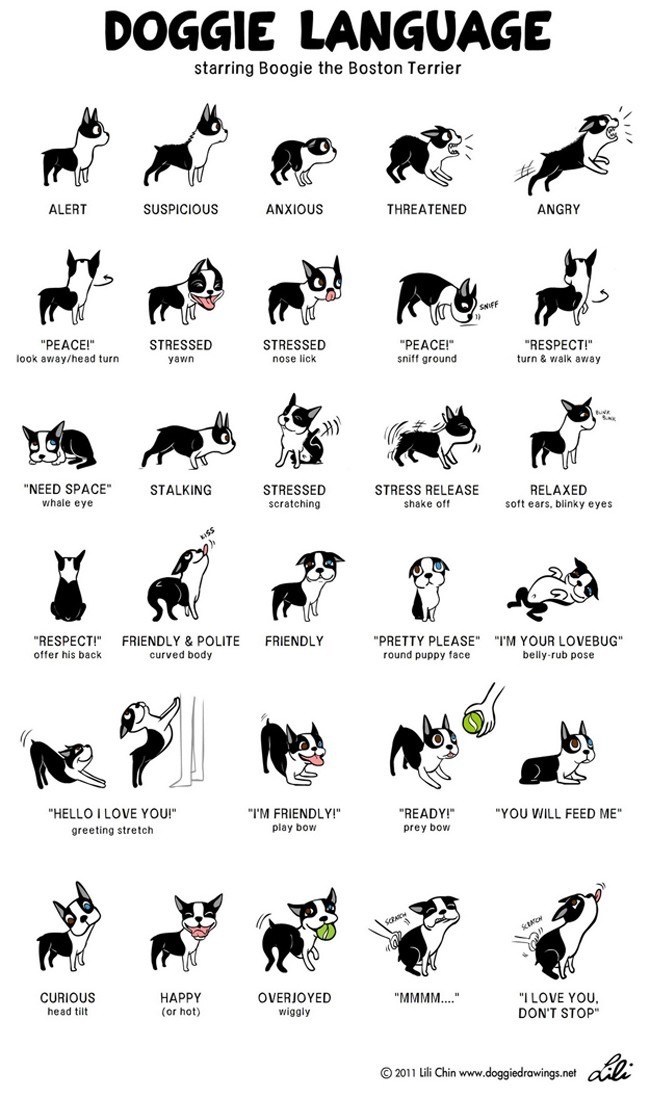
Doggie Language Continued
Lately, I have seen many articles written on dog language and what your dog may be telling you. I published my own post entitled “Doggie Language” back on June 25th, the link can be found here:
There are just so many ways our dogs speak to us that one post will never be enough. Even when you think you have it all covered you suddenly think of something else, see your dog do something new, or read something else from another individual’s perspective. That is why today I am writing about this subject once again.
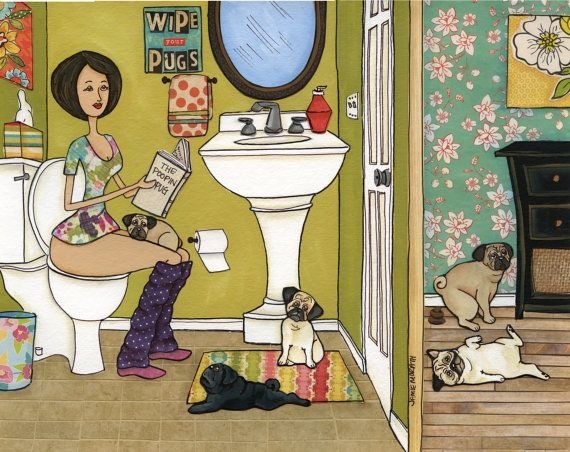
So here’s an interesting question that I have been asked a few times, and it makes me laugh every time I see someone on Facebook, or another site posting a joke or photo about it. Why do dogs follow you into the bathroom?
(image courtesy of Pinterest.com)
Having a loyal dog in your household ensures an incredible amount of love between you and your pup. Understanding your dog can be easy and it’s not hard to understand that your pup wants to give you some love with kisses, however your pup may often behave in more subtle manners as well.
Now, most of us aren’t mentalists or even Dr. Doolittle, so here are some things your dog may do and what they are trying to say to you:
Puppy dog eyes – puppy dog eyes are often used by young children whenever they really want something. Your pup may use them to show love and it enforces a greater trust between you both.
Following you around – you must agree that it is absolutely adorable when your pup follows you all over the house. According to some Veterinarians, following behavior is a dog’s instinct, to always do things with their pack/family.
Giving you gifts – I have had my dogs bring me dead birds, squirrels, and even once a live baby squirrel into the house. The gift is not always as interesting or gross, sometimes it’s a ball to play fetch or a stuffed toy, but turns out that our pups simply want to share their joy with us and there’s no better person to share it with!
Cuddle time after dinner – most of us are used to our dogs cuddling at bedtime or on the couch when we watch tv, but cuddling with you after their bellies are filled with a hearty meal shows that your pup is truly comfortable around you.
Licking your face and body – there are some people who love it, others find it gross, but all dogs like giving licks once in a while. Licking is actually a submissive behavior and it actually helps your pup ease their stress level as well as of course being a sign of loving you.
Going “crazy” when you come home – the second your dog hears you coming back home, chaos ensues. I know at my house it starts the minute I pull into the driveway, I can hear them even before I put my key in the lock.. Your pup is just happy you’re home, happy to see you! This enthusiastic response is just their way of saying “I missed you”.
Knowing when something is wrong – Your pet doesn’t need to be able to actually talk to you to sense that something is wrong or if you’re feeling sad. They read your body language and use their senses to detect if something is wrong. They are also more than willing to help you feel better.
Crawling into your bed – not everyone sleeps with their dogs, it’s a personal preference. Perhaps once every so often, your pup will join you in your bed, they won’t just sit there, they keep you close. Often they will cuddle you, they lay on you. When you’re not home and away for work, they may just want to smell you so they climb in the bed because they miss you.
Raising a single paw or tapping you with a paw – raising one of two paws usually means your dog is in the mood for some playtime or wants attention. Sometimes, they’ll do this when they see something interesting in their environment, they will sit with one paw raised like a statue.
Leaning against you – if your dog is actively leaning against you, it means he or she is looking for some extra love, hugs, pets from you. Dogs always love to have your undivided attention!
Try to get your opinion – have you ever had the feeling that your dog was looking for your approval? Your pup actually really appreciates and values your opinion. A little love and affection go a long way!
(image courtesy of Pinterest.com)
Whether you have a new dog or you and your pup have been together for a while, it’s helpful to know the meaning of their communication signals so that you can adjust your own behavior as needed and also you know how your pup is feeling.
Dogs make vocalizations and gestures using their face and body just as us humans do in order to express their feelings. While some of these gestures can appear similar to ours, they can have very different meanings. It is my hope that my original post on the subject and in this follow up, I have helped you learn a little more about how to interpret your dog’s various actions and that you’ve learned something new about how to communicate more effectively with your own pup!
When I was reading this I was struck by Lea reminding me, and all other dog lovers, that the role of the gestures and faces of our dogs so closely matches how we humans communicate non-verbally. No wonder the bond between dog and human can be so close and wonderful.
You loved Sam Grant’s photos of Casper and Scotland. Learn more about her.
Last Sunday my Picture Parade was primarily a recent item that appeared on the BBC website.
Meet Scotland’s ‘most well-travelled dog’
By Ewan Murrie, BBC Scotland news website, 3rd June 2017
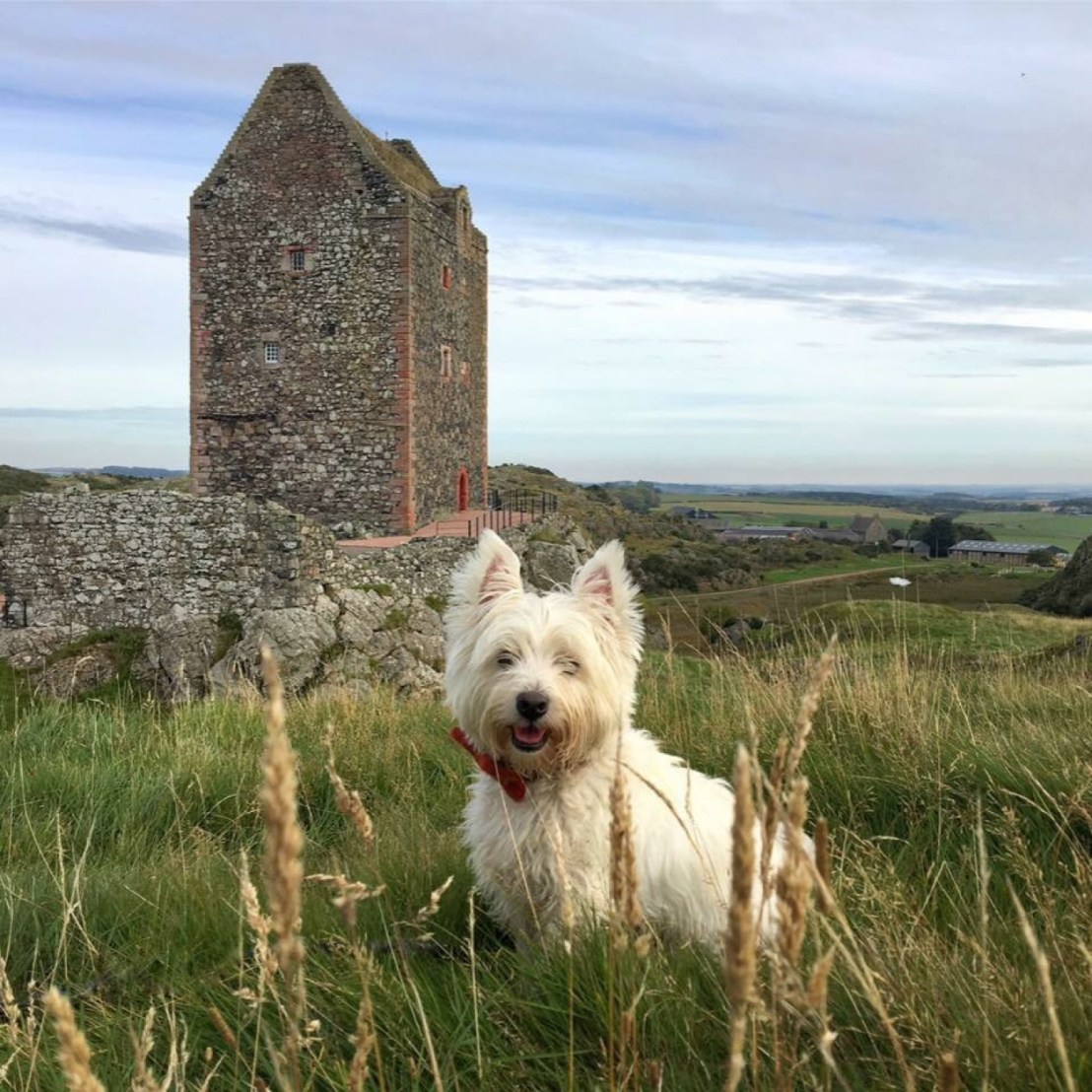
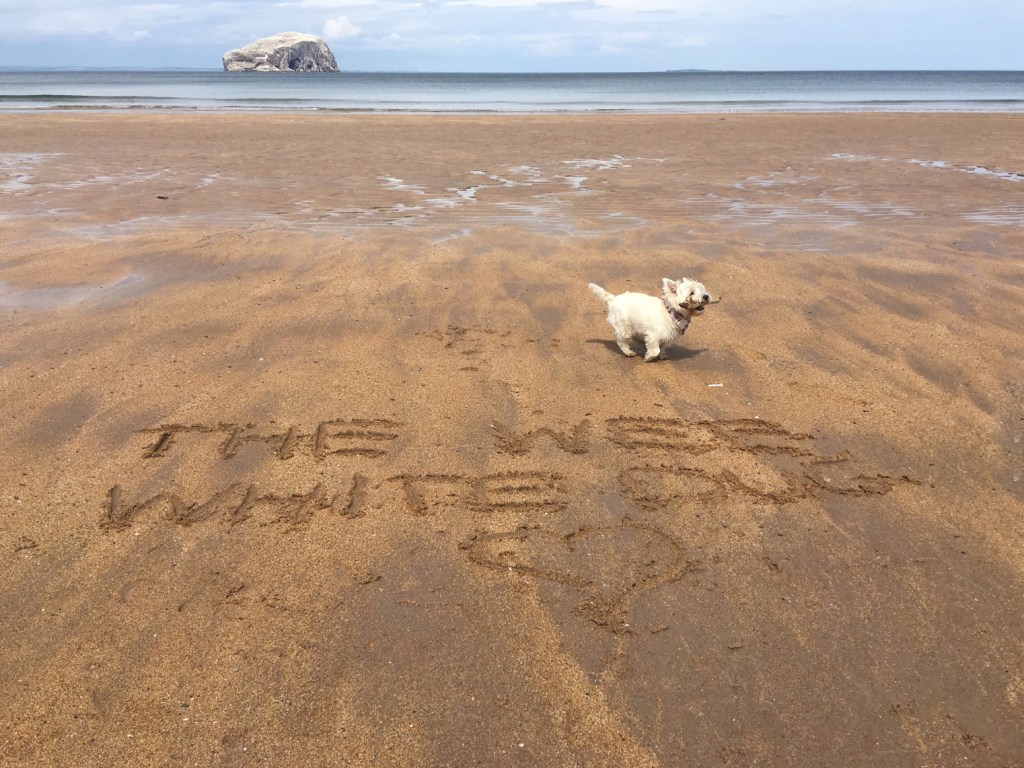
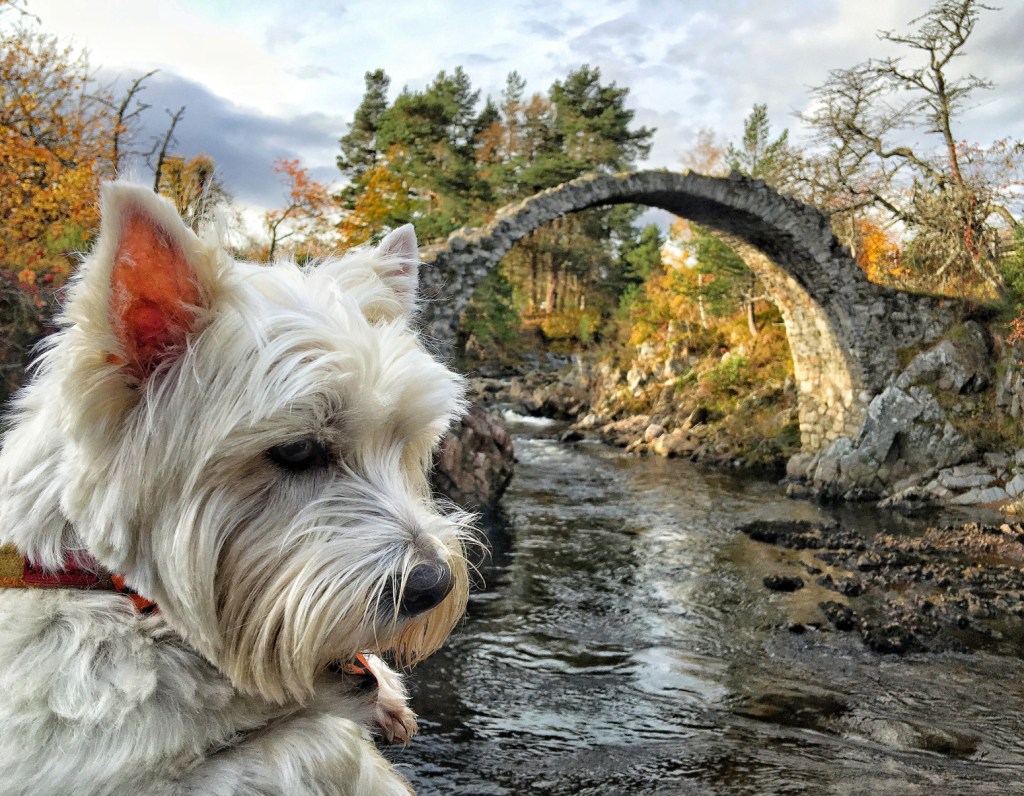
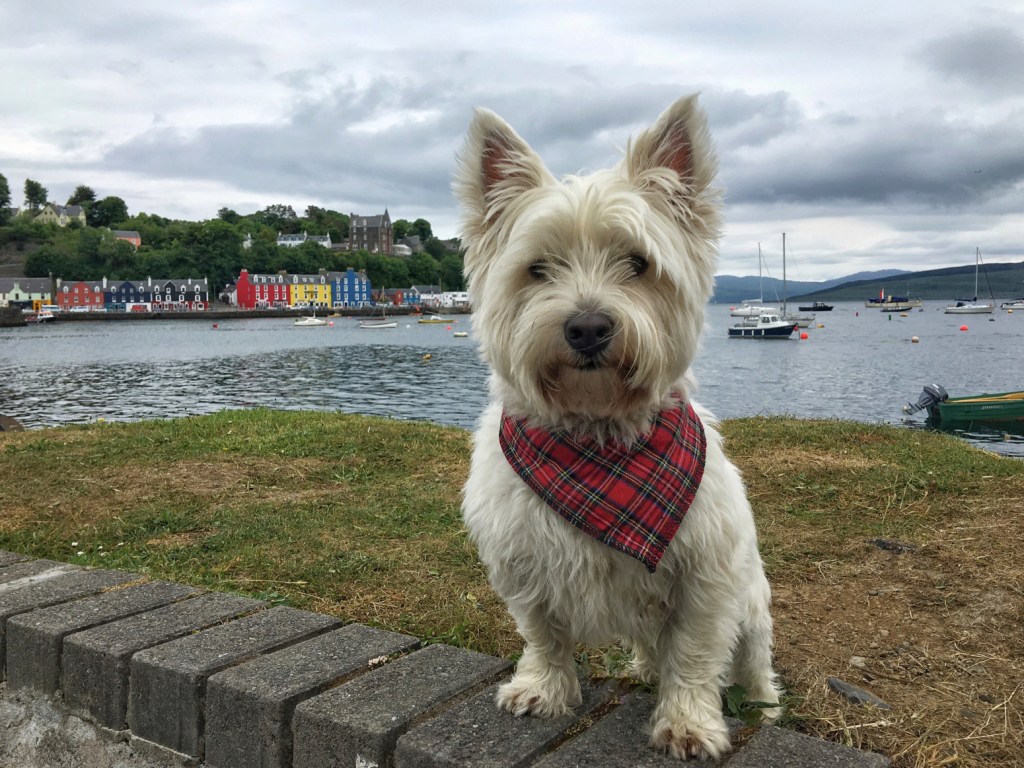
After photographs of her West Highland Terrier received more “likes” on social media than even the most stunning Glencoe landscapes she could capture, Sam Grant conceded that “the wee white dug” should star in her Scottish travel blog.
I went on to republish a wonderful set of photographs that had been taken by Sam. You all loved them and that led me to ask Sam if I could republish her About Me page on her blog. Sam very kindly said that would be fine.
ooOOoo
Scotland with the Wee White Dug
A Scottish travel blog showcasing the best of Scotland. Scotland with the Wee White Dug is a comprehensive and informative guide to Scotland, covering history, outdoor activities, events, visitor attractions, accommodation, eating out and more.
About Me
A little bit about me
Hello and welcome to my Scottish travel blog which I hope you’ll find informative and interesting, but most of all fun.
I’m Samantha but am generally known as Sam, Mrs G or Mum. I’m married to Alex (Mr G) and we live in Edinburgh with a well travelled wee white dug called Casper. We also share our home with the The Teen, Casper’s sloth like and gadget obsessed big sister.
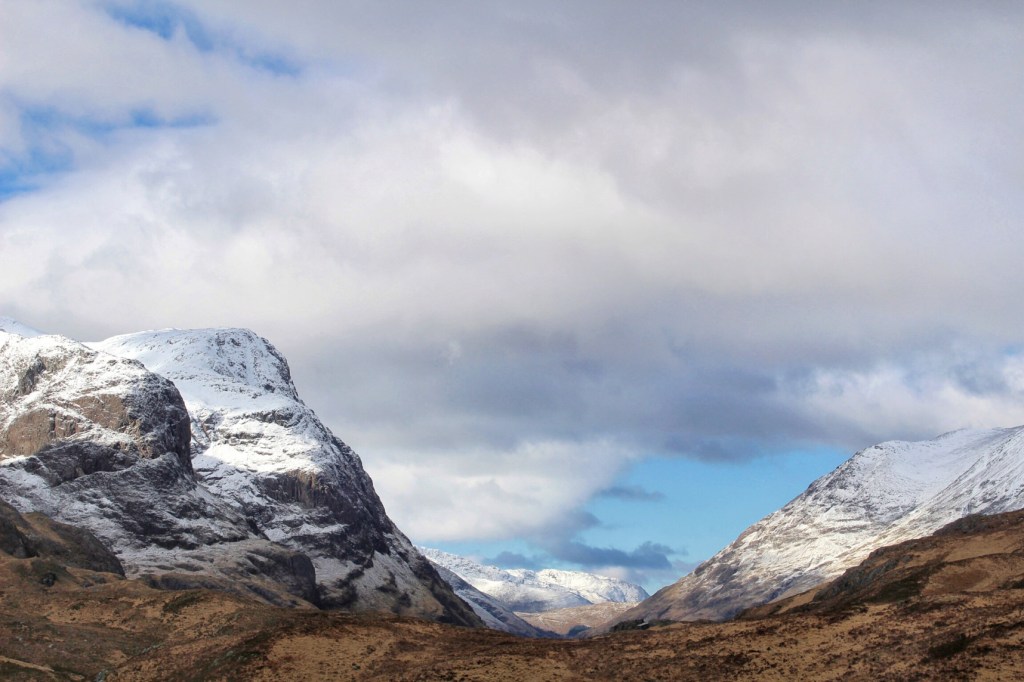
All of my free time is spent road-tripping around Scotland. I’ve travelled extensively throughout the country and never tire of its jawdropping and diverse beauty.
I have a vast knowledge of where to stay, eat and what to do in Scotland. Whether it be an afternoon out, a day trip or an extended tour. I also know all of the best places to go with your four legged friend.
I’m a Visit Scotland Ambassador and I helped launch their online Community in the spring of 2016. The Community is a Scottish travel forum for sharing insider hints and tips about visiting Scotland. Visit Scotland’s Ambassadors were selected for their expert knowledge of the country.
In January 2017 I took up the role of resident blogger for East Lothian Council on their Visit East Lothian website. I write a fortnightly post for their blog, highlighting the delights of East Lothian.
I’m passionate about the history, language, literature, customs and myths of Scotland. I read History at the University of Edinburgh and during my time there I studied Scottish History, Literature and Politics which gave me an excellent understanding of how Scotland became the country that it is today.
I absolutely adore the great outdoors – it’s my happy place. I love hiking, have been known to summit a Munro or two and am happiest when surrounded by lochs, moors and mountains.
My photography
I’ve been an avid hobby photographer since joining Instagram several years ago. I’m part of a diverse group of Scottish Instagrammers with a passion for sharing Scotland with the World.
My feed @bean_nighe has appeared on Instagram’s prestigious Suggested User list. You’ll find the Wee White Dug on Instagram too @theweewhitedug. His feed is also dedicated to sharing our Scottish travels.
My photos appear regularly on various social media channels including those of Canon UK, BBC, Skyscanners, Scottish Memories Magazine, Scotrail, Historic Scotland, Visit Scotland and The Guardian.
I share my Scottish travels on Facebook and Twitter too so if you’re on those sites stop by and say hello.
I’m passionate about promoting Scotland as a wonderful place to visit. It’s a country with a rich history and heritage. A country full of stories just waiting to be told.
I appreciate you taking the time to stop by my blog to join me on my travels. I hope ‘Scotland with the Wee White Dug’ inspires you to visit Scotland, helps you to plan for a forthcoming trip or makes you reminisce fondly about a past visit.
If you’re interested in working with me you can find out more here.








 Learning from Dogs