But the single most important lesson is integrity.
Again, another post from previous times. Albeit just a couple of years ago.
ooOOoo
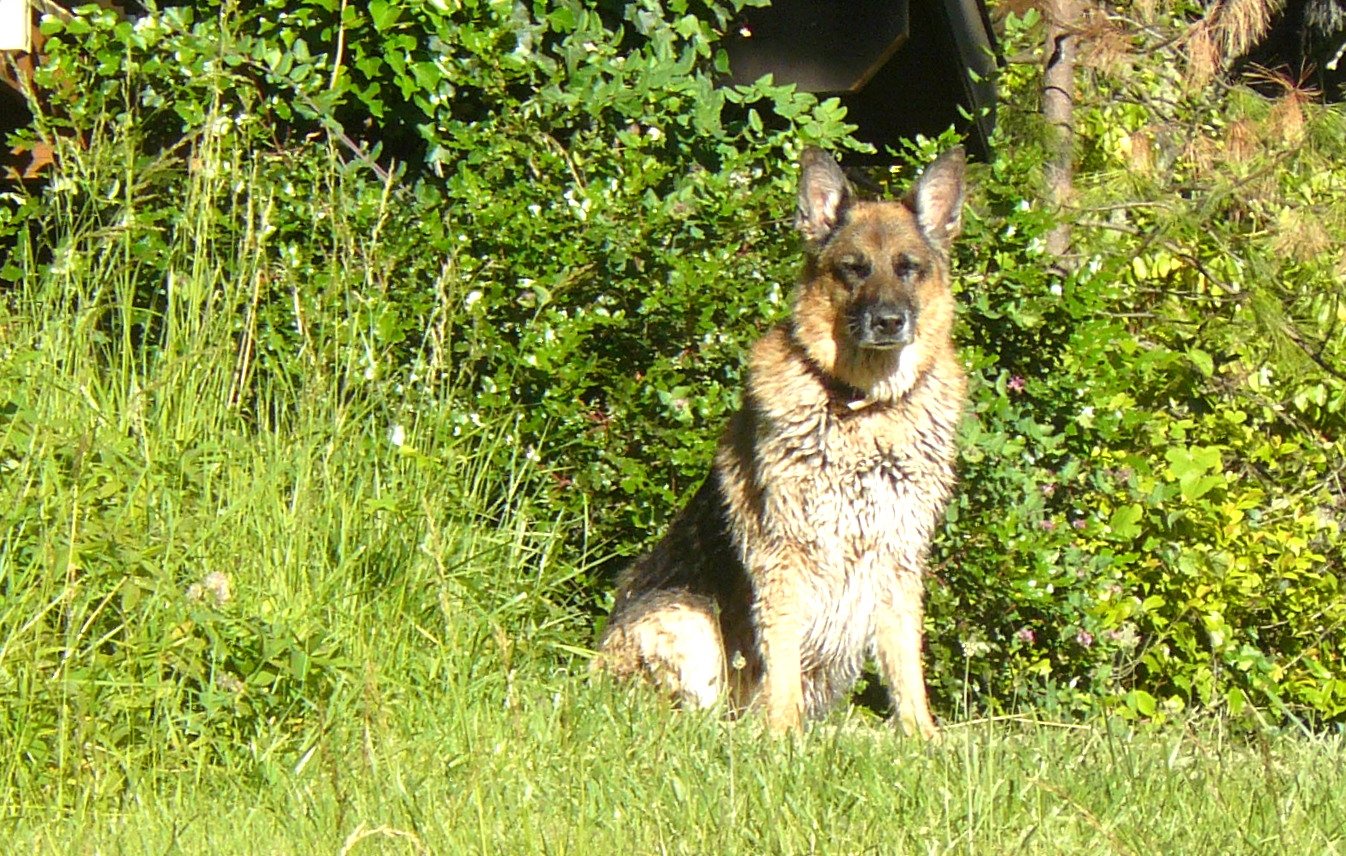
Another tribute to dear Pharaoh.
The most profound thing that I learned from Pharaoh is that dogs are creatures of integrity. That goes back to a day in June, 2007. Some six months before I met Jeannie in Mexico in December, 2007. I was sitting in Jon’s home office just a few miles from where Pharaoh and I were then living in South Devon.
It was a key chapter in Part Four of my book where I examine all the qualities that we humans need to learn from our dogs.
So here is Chapter 13 from my book Learning from Dogs. (Written in ‘English’ English!)
ooOOoo
Chapter 13 Integrity
In the Introduction to this book I mentioned how the notion of “learning from dogs” went back to 2007 and me learning that dogs were creatures of integrity. Let me now elaborate on that.
It is a Friday morning in June in the year 2007. I am sitting with Jon at his place with Pharaoh sleeping soundly on the beige carpet behind my chair. I didn’t know it at the time but it was to become one of those rare moments when we gain an awareness of life that forever changes how we view the world, both the world within and the world without.
“Paul, I know there’s more for me to listen to and I sense that we have established a relationship in which you feel safe to reveal your feelings. However, today I want to talk about consciousness. Because I would like to give you an awareness of this aspect of what we might describe under the overall heading of mindfulness.”
I sat quietly fascinated by what was a new area for me.
“During the years that I have been a psychotherapist, I’ve seen an amazing range of personalities, probably explored every human emotion known. In a sense, explored the consciousness of a person. But what is clear to me now is that one can distil those different personalities and emotions into two broad camps: those who embrace truth and those who do not.”
Jon paused, sensing correctly that I was uncertain as to what to make of this. I made it clear that I wanted him to continue.
“Yes, fundamentally, there are people who deny the truth about themselves, who actively resist that pathway of better self-awareness, and then there are those people who want to know the truth of whom they are and seek it out when the opportunity arises. The former group could be described as false, lacking in integrity and unsupportive of life, while the latter group are diametrically opposite: truthful, behaving with integrity and supportive of life.”
It was then that Jon lit a fire inside me that is still burning bright to this day. For he paused, quietly looking at Pharaoh sleeping so soundly on the carpet, and went on to add, “And when I look at dogs, I have no question that they have a consciousness that is predominantly truthful: that they are creatures of integrity and supportive of life.”
That brought me immediately to the edge of my seat, literally, with the suddenness of my reaction causing Pharaoh to open his eyes and lift up his head. I knew in that instant that something very profound had just occurred. I slipped out of my chair, got down on my hands and knees and gave Pharaoh the most loving hug of his life. Dogs are creatures of integrity. Wow!
****
Later, when driving home, I couldn’t take my mind off the idea that dogs were creatures of integrity. What were those other values that Jon had mentioned? It came to me in a moment: truthful and supportive of life. Dogs have a consciousness that is truthful, that they are creatures of integrity and supportive of life: what a remarkable perception of our long-time companions.
I had no doubt that all nature’s animals could be judged in the same manner but what made it such an incredibly powerful concept, in terms of dogs, was the unique relationship between dogs and humans, a relationship that went back for thousands upon thousands of years. I realised that despite me knowing I would never have worked it out on my own, Jon’s revelation about dogs being creatures of integrity was so utterly and profoundly obvious.
As I made myself my usual light lunch of a couple of peanut butter sandwiches and some fruit and then sat enjoying a mug of hot tea, I still couldn’t take my mind off what Jon had revealed: dogs are examples of integrity and truth. I then thought that the word “examples” was not the right word and just let my mind play with alternatives. Then up popped: Dogs are beacons of integrity and truth. Yes, that’s it! Soon after, I recognised that what had just taken place was an incredible opening of my mind, an opening of my mind that didn’t just embrace this aspect of dogs but extended to me thinking deeply about integrity for the first time in my life.
Considering that this chapter is titled “Integrity”, so far all you have been presented with is a somewhat parochial account of how for the first time in my life the word “integrity” took on real meaning. That until that moment in 2007 the word had not had any extra significance for me over the thousands of other words in the English language. Time, therefore, to focus directly on integrity.
“If goodness is to win, it has to be smarter than the enemy.”
That was a comment written on my blog some years ago, left by someone who writes their own blog under the nom-de-plume of Patrice Ayme. It strikes me as beautifully relevant to these times, times where huge numbers of decent, law-abiding folk are concerned about the future. Simply because those sectors of society that have much control over all our lives do not subscribe to integrity, let alone giving it the highest political and commercial focus that would flow from seeing integrity as an “adherence to moral and ethical principles; soundness of moral character; honesty.” To quote my American edition of Roget’s Thesaurus.
Let me borrow an old pilot’s saying from the world of aviation: “If there’s any doubt, there’s no doubt!”
That embracing, cautious attitude is part of the reason why commercial air transport is one of the safest forms of transport in the world today. If you had the slightest doubt about the safety of a flight, you wouldn’t board the aircraft. If you had the slightest doubt about the future for civilisation on this planet, likewise you would do something! Remember, that dry word civilisation means family, children, grandchildren, friends, and loved ones. The last thing you would do is to carry on as before!
The great challenge for this civilisation, for each and every one of us, is translating that sense of wanting to change into practical, effective behaviours. I sense, however, that this might be looking down the wrong end of the telescope. That it is not a case of learning to behave in myriad different ways but looking at one’s life from a deeper, more fundamental perspective: living as a person of integrity. So perfectly expressed in the Zen Buddhist quote: “Be master of mind rather than mastered by mind.” Seeing integrity as the key foundation of everything we do. Even more fundamental than that. Seeing integrity as everything you and I are.
It makes no difference that society in general doesn’t seem to value integrity in such a core manner. For what is society other than the aggregate of each and every one of us? If we all embrace living a life of integrity then society will reflect that.
Integrity equates to being truthful, to being honest. It doesn’t mean being right all the time, of course not, but integrity does mean accepting responsibility for all our actions, for feeling remorse and apologising when we make mistakes. Integrity means learning, being reliable, and being a builder rather than a destroyer. It means being authentic. That authenticity is precisely and exactly what we see in our dogs.
The starting point for what we must learn from our dogs is integrity.
Continuing the theme of revisiting earlier posts this week!
ooOOoo
More on Pharaoh’s life
What a wonderful relationship it has been.
Years ago if I was ever to own a dog, it had to be one breed and one breed only: a German Shepherd Dog.
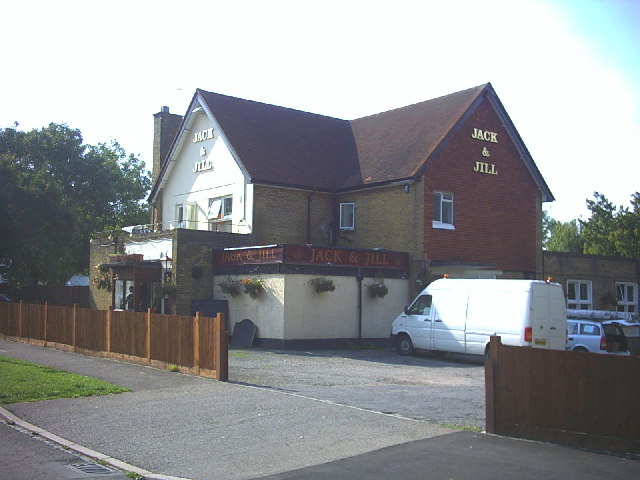
The reason for this was that back in 1955 my father and mother looked after a German Shepherd dog called Boy. Boy belonged to a lovely couple, Maurice and Marie Davies. They were in the process of taking over a new Public House (Pub); the Jack & Jill in Coulsdon, Surrey. My father had been the architect of the Jack & Jill.
Jack & Jill, Longlands Avenue, Coulsdon, Surrey
As publicans have a tough time taking holidays, it was agreed that the move from their old pub to the Jack & Jill represented a brilliant opportunity to have that vacation. My parents offered to look after Boy for the 6 weeks that Maurice and Marie were going to be away.
Boy was the most gentle loveable dog one could imagine and I quickly became devoted to him; I was 11 years old at the time. So when years later it seemed the right time to have a dog, there was no question about the breed. Boy’s memory lived on all those years, and, as this post reveals, still does!
Pharaoh was born June 3rd, 2003 at Jutone Kennels up at Bovey Tracy, Devon, on the edge of Dartmoor. As the home page of the Jutone website pronounces,
The Kennel was established in 1964 and it has always been the aim to breed the best German Shepherd Dogs for type and temperament. To this end the very finest German bloodlines are used to continue a modern breeding programme.
and elsewhere on that website one learns:
Jutone was established by Tony Trant who was joined by Sandra Tucker in 1976. Sandra continues to run Jutone since Tony passed away in 2004. Both Tony and Sandra qualified as Championship Show judges and Sandra continues to judge regularly. Sandra is the Secretary and a Life Member of the German Shepherd Dog Club of Devon.
Tony Trant
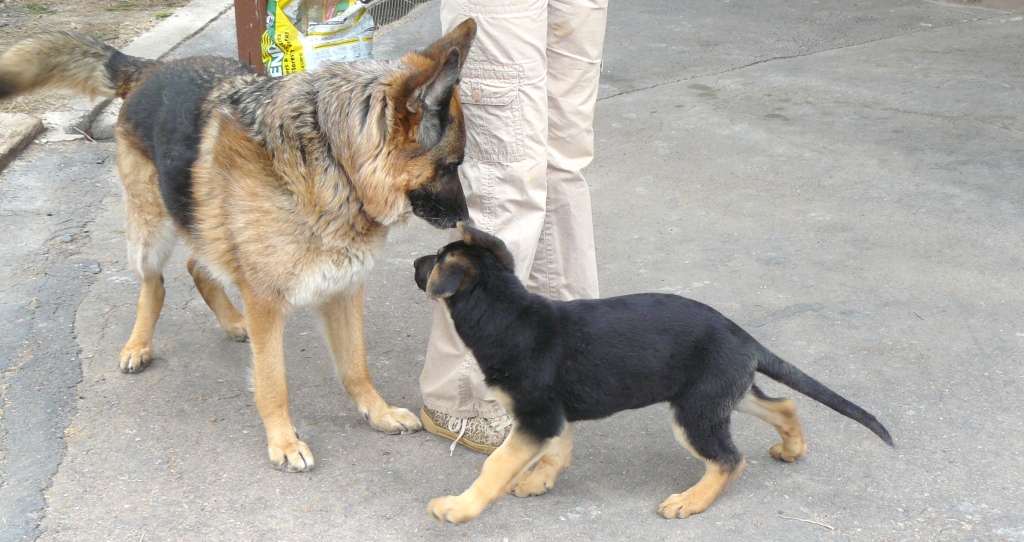
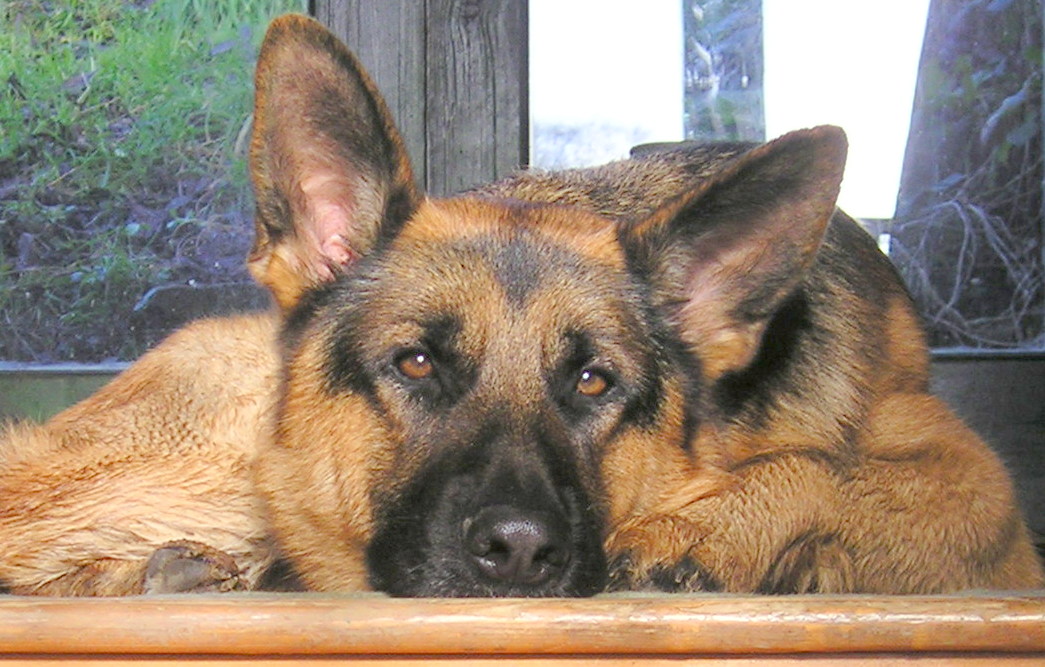
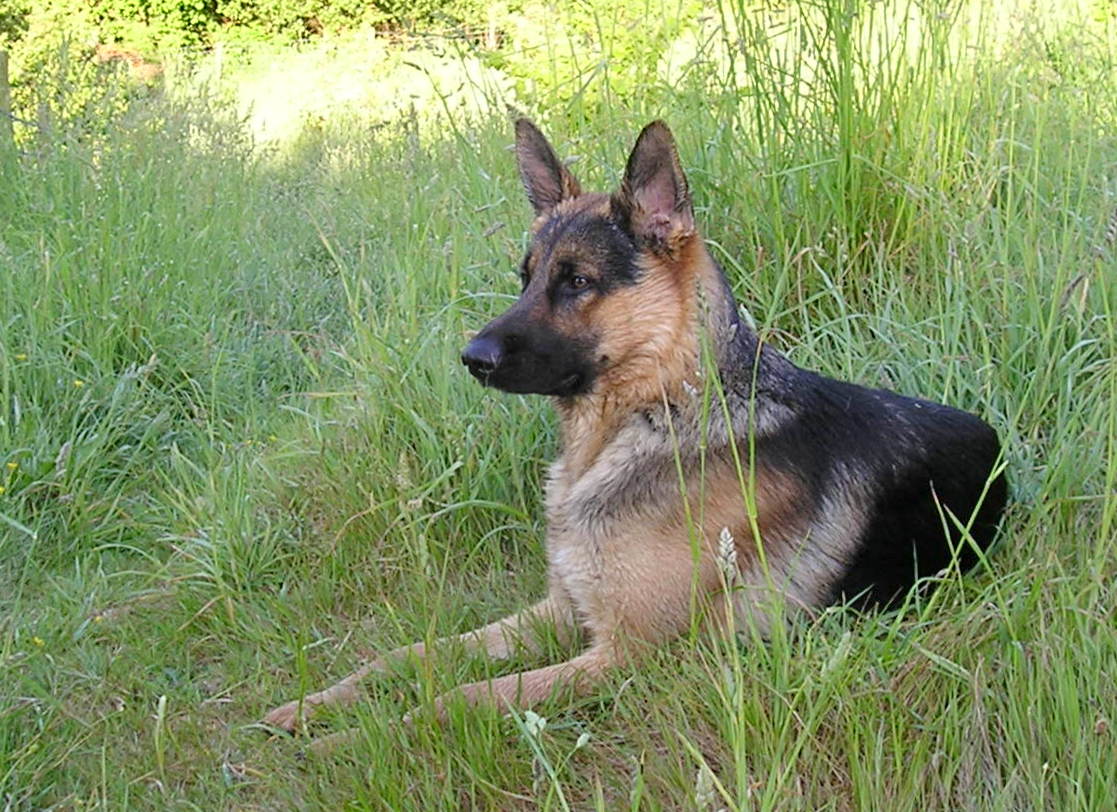
Turning to Pharaoh, here are a few more pictures over the years.
Pharaoh, nine months old.
oooOOOooo
One year old: June 3rd 2004.
The next picture of Pharaoh requires a little background information.
For many years I was a private pilot and in later days had the pleasure, the huge pleasure, of flying a Piper Super Cub, a group-owned aircraft based at Watchford Farm in South Devon. The aircraft, a Piper PA-18-135 Super Cub, was originally supplied to the Dutch Air Force in 1954 and was permitted by the British CAA to carry her original military markings including her Dutch military registration, R-151, although there was a British registration, G-BIYR, ‘underneath’ the Dutch R-151. (I wrote more fully about the history of the aircraft on Learning from Dogsback in August 2009.)
Piper Cub R151
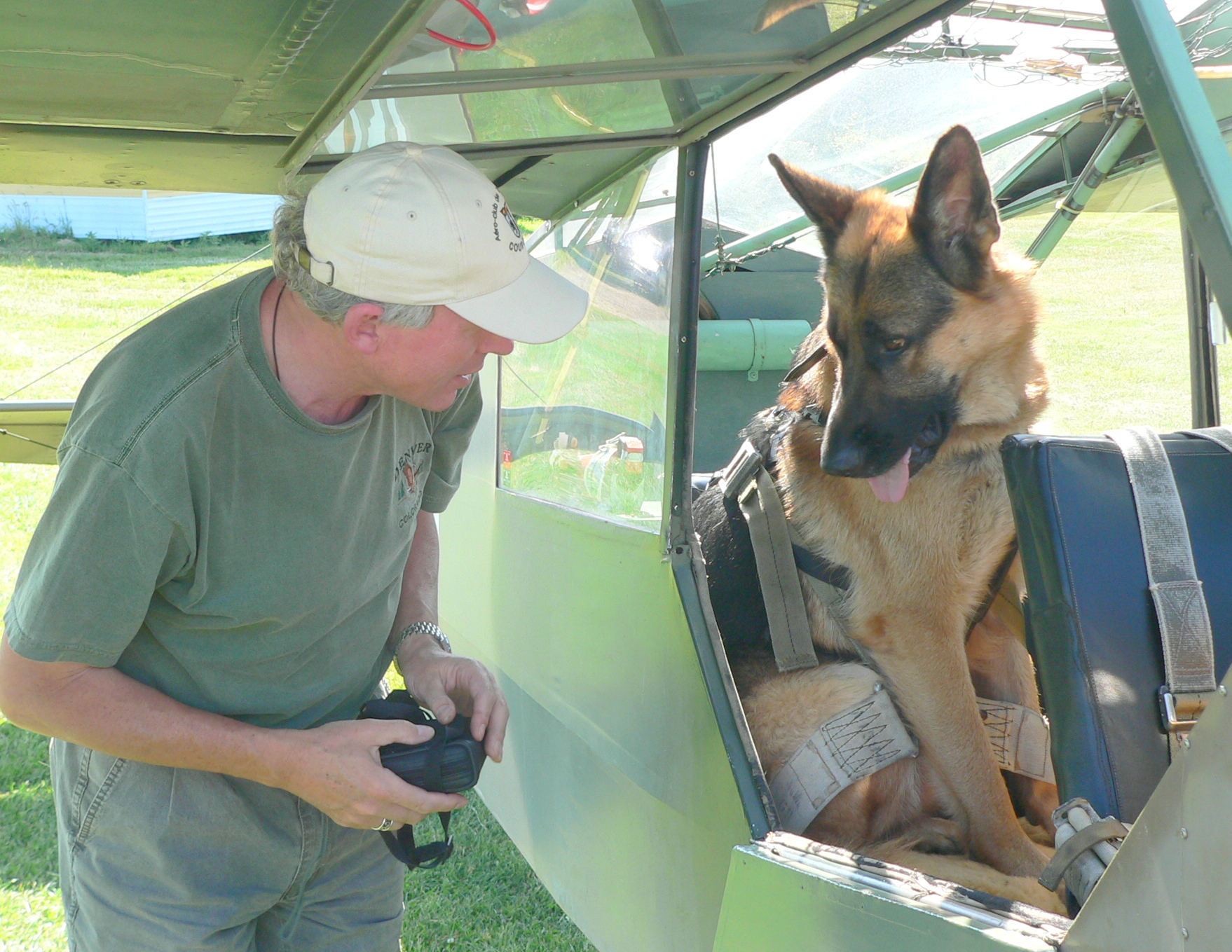
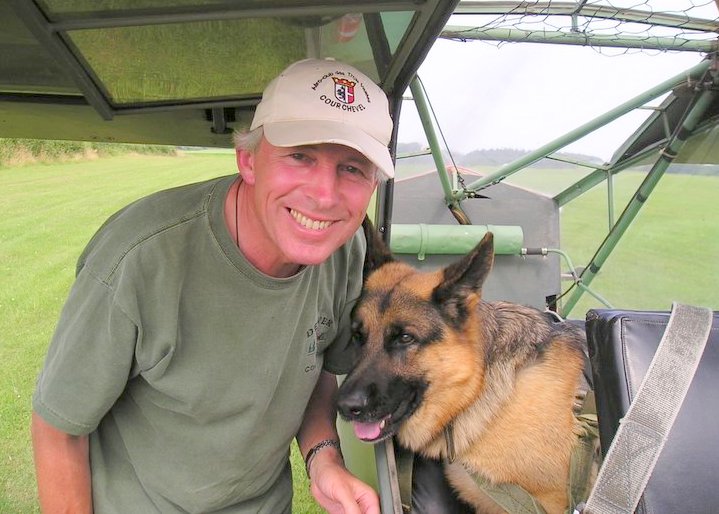
Anyway, every time I went to the airfield with Pharaoh he always tried to climb into the cockpit. So one day, I decided to see if he would sit in the rear seat and be strapped in. Absolutely no problem with that!
Come on Dad, let’s get this thing off the ground!
My idea had been to fly a gentle circuit in the aircraft. First I did some taxying around the large grass airfield that is Watchford to see how Pharaoh reacted. He was perfectly behaved.
Then I thought long and hard about taking Pharaoh for a flight. In the Cub there is no autopilot so if Pharaoh struggled or worse it would have been almost impossible to fly the aircraft and cope with Pharaoh. So, in the end, I abandoned taking him for a flight. The chances are that it would have been fine. But if something had gone wrong, the outcome just didn’t bear thinking about.
So we ended up motoring for 30 minutes all around the airfield which, as the next picture shows, met with doggie approval. The date was July 2006.
That was fun!
What a dear dog he has been over all the years and, thankfully, still is!
As if to reinforce the fabulous dog he still is, yesterday it was almost as though he knew he had to show how youthful he still was.
Because, when I took his group of dogs out around 7.30am armed with my camera, Pharaoh was brimming over with energy.
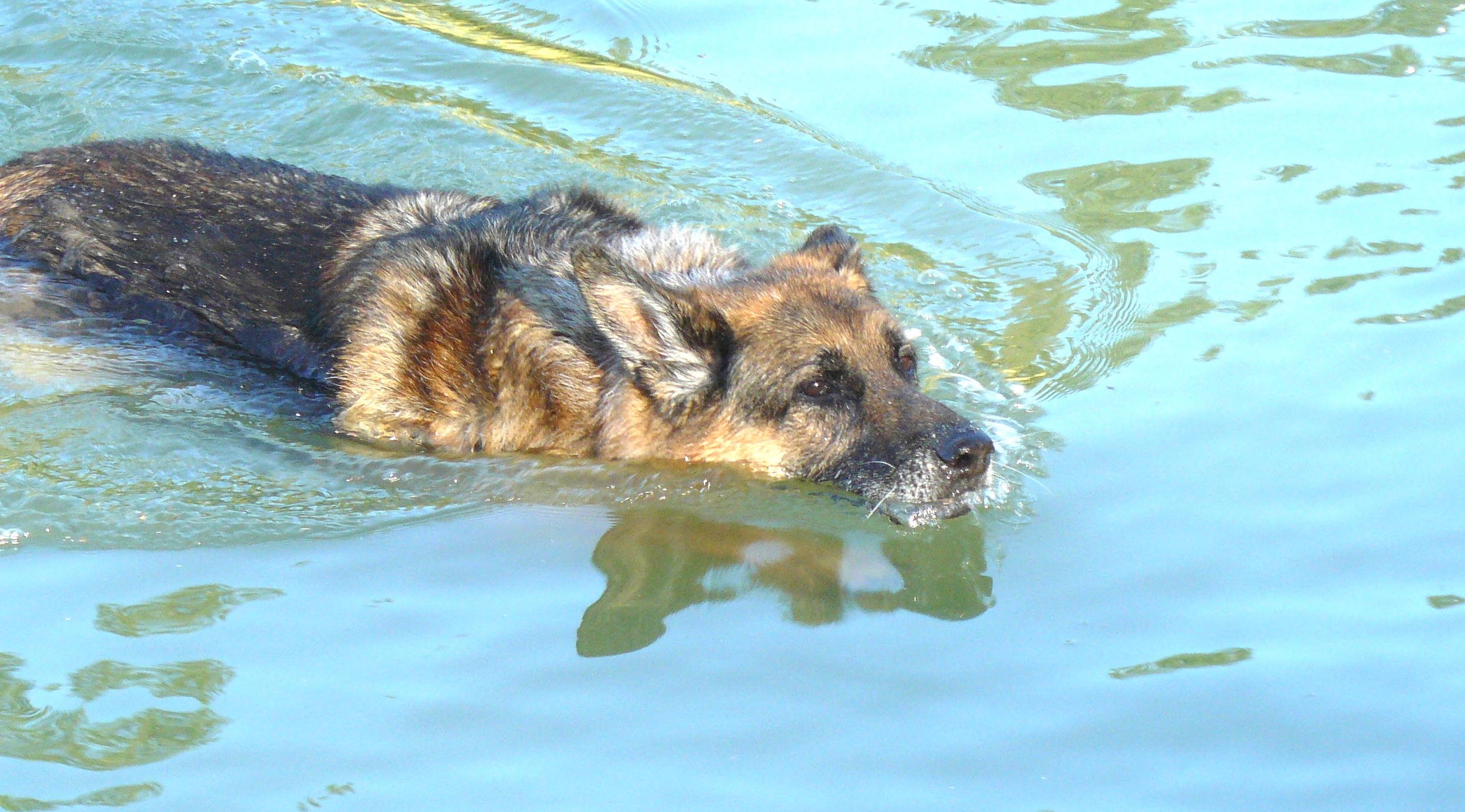
First up was a swim in the pond.
Ah, an early birthday dip! Bliss!
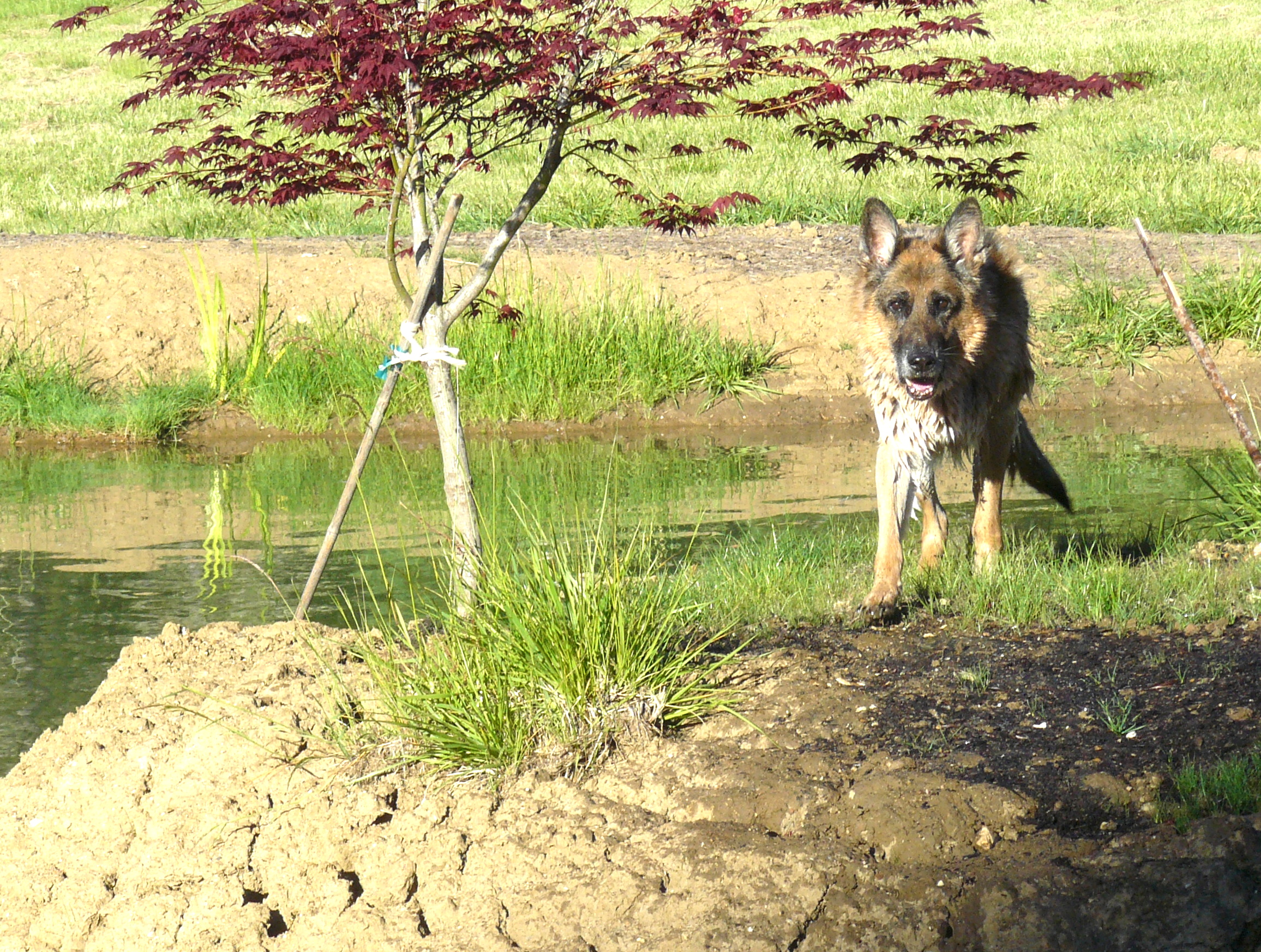
Then in a way he has not done before, Pharaoh wanted to play ‘King of my Island’, which is in the middle of the pond.
Halt! Who goes there!
ooo
This is my island! So there!
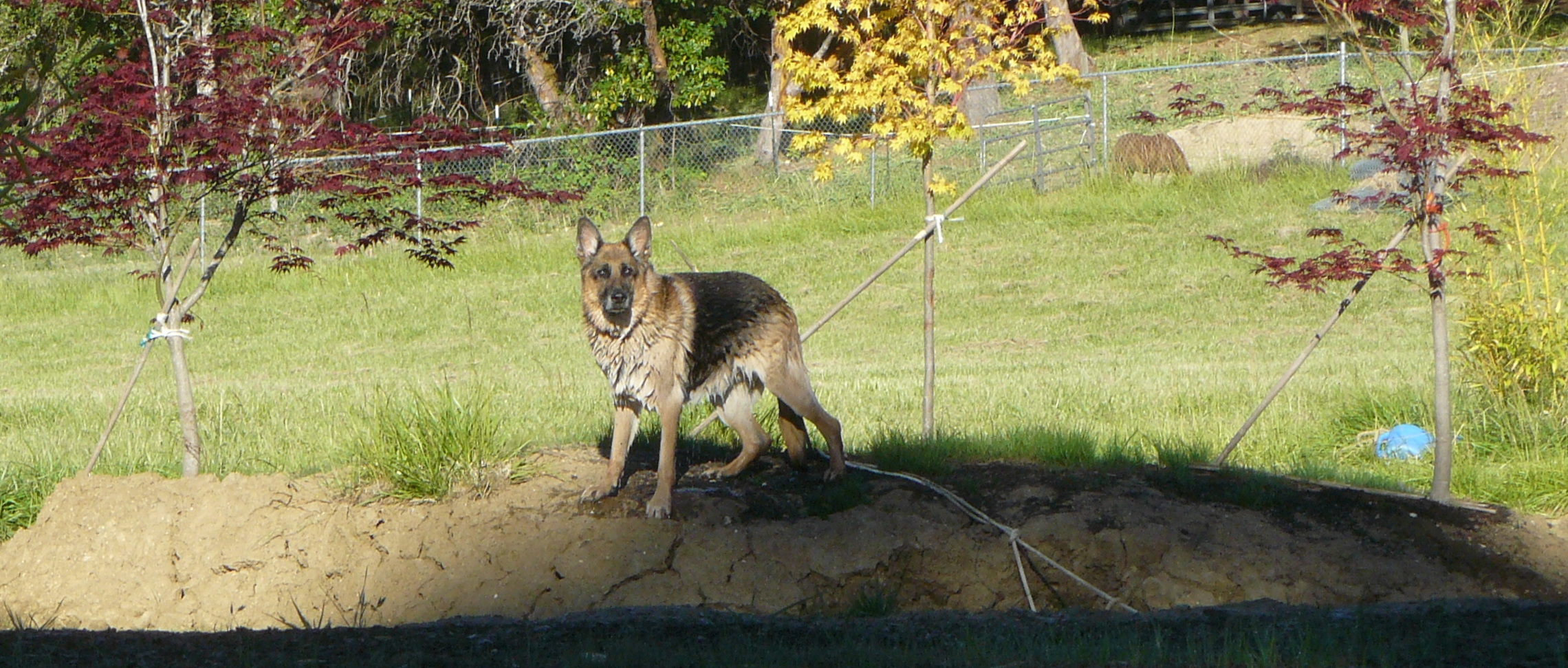
Then a while later, when back on dry land, so to speak, it was time to dry off in the morning sunshine.
Actually, this isn’t a bad life!
Long may he have an enjoyable and comfortable life.
ooOOoo
Pharaoh died of old age on June 19th, 2017. He was 14!
Despite the fact that we have six wonderful dogs including Cleo there is still a twinge of sadness when Pharaoh is mentioned. And now you know the origins of Pharaoh!
Let me close by sharing a photograph of Cleo.
Picture taken of puppy Cleo on the 13th April, 2012 when she was then aged 11 weeks.
I was at the Club NorthWest yesterday wearing my ‘U.S.’ shorts and Piper Cub T-shirt, something that I exercise in regularly, and Austin, my trainer, said why don’t you wear them tomorrow.
But then I couldn’t put a photograph in a post that came out at midnight, Oregon summer time, so I busied myself with a camera yesterday afternoon.
Here are the results!
And one to show the colours of the shorts a little better.
This is a wonderful story and one that I shall go straight into. Reason I have software problems that I’m trying to fix today!
This article was first published by The Smithsonian magazine.
ooOOoo
A Perfectly Preserved 32,000-Year-Old Wolf Head Was Found in Siberian Permafrost
Given the head’s state of preservation, researchers are hopeful that they can extract viable DNA and use it to sequence the wolf’s genome.
The specimen is the first (partial) carcass of an adult Pleistocene steppe wolf—an extinct lineage distinct from modern wolves—ever found (Courtesy of Dr. Tori Herridge)
Last summer, a mammoth tusk hunter exploring the shores of the Tirekhtyak River in Siberia’s Yakutia region unearthed the fully intact head of a prehistoric wolf. Preserved by the region’s permafrost, or permanently frozen ground, for some 32,000 years, the specimen is the first partial carcass of an adult Pleistocene steppe wolf—an extinct lineage distinct from modern wolves—ever found.
The discovery, first reported by the Siberian Times, is poised to help researchers better understand how steppe wolves compared with their contemporary counterparts, as well as why the species eventually died out.
As Marisa Iati writes for the Washington Post, the wolf in question was fully grown, likely aged 2 to 4 years old, at the time of its death. Although photographs of the severed head, still boasting clumps of fur, fangs and a well-preserved snout, place its size at 15.7 inches long—the modern gray wolf’s head, in comparison, measures 9.1 to 11 inches—Love Dalén, an evolutionary geneticist at the Swedish Museum of Natural History who was filming a documentary in Siberia when the tusk hunter arrived on the scene with the head in tow, says that media reports touting the find as a “giant wolf” are inaccurate.
“It is not that much bigger than a modern wolf if you discount the frozen clump of permafrost stuck to where the neck would [normally] have been,” Dalén explains to Smithsonian.com.
According to CNN, a Russian team led by Albert Protopopov of the Republic of Sakha’s Academy of Sciences is currently building a digital model of the animal’s brain and the interior of its skull.
David Stanton, a researcher at the Swedish Museum of Natural History who is leading genetic analysis of the remains, tells Smithsonian.com that given the head’s state of preservation, he and his colleagues are hopeful that they can extract viable DNA and use it to sequence the wolf’s genome. This work, expected to last at least another year, will eventually be published in a peer-reviewed scientific journal.
A Russian team is currently building a digital model of the animal’s brain and the interior of its skull (Albert Protopopov)
For now, it remains unclear exactly how the wolf’s head became separated from the rest of its body. Speaking with Smithsonian.com, Tori Herridge, an evolutionary biologist at London’s Natural History Museum who was part of the team filming in Siberia at the time of the discovery, says that a colleague, Dan Fisher of the University of Michigan, thinks scans of the animal’s head may reveal evidence of it being deliberately severed by humans—perhaps “contemporaneously with the wolf dying.” If so, Herridge notes, the find would offer “a unique example of human interaction with carnivores.” Still, she concludes in a post on Twitter, “I am reserving judgment until more investigation [is] done.”
Dalén echoes Herridge’s hesitancy, saying that he has “seen no evidence convincing” him that humans cut off the head. After all, it’s not uncommon to find partial sets of remains in the Siberian permafrost. If an animal was only partially buried and subsequently frozen, for example, the rest of its body could have decomposed or been eaten by scavengers. Alternatively, it’s possible that shifts within the permafrost over thousands of years led the carcass to break into multiple pieces.
According to Stanton, steppe wolves were “probably slightly larger and more robust than modern wolves.” The animals had a strong, wide jaw equipped for hunting large herbivores such as woolly mammoths and rhinos, and as Stanton tells USA Today’s N’dea Yancey-Bragg, went extinct between 20,000 to 30,000 years ago, or roughly the time when modern wolves first arrived on the scene. If the researchers successfully extract DNA from the wolf’s head, they will attempt to use it to determine whether the ancient wolves mated with modern ones, how inbred the older species was, and if the lineage had—or lacked—any genetic adaptations that contributed to its demise.
To date, the Siberian permafrost has yielded an array of well-preserved prehistoric creatures: among others, a 42,000-year-old foal, a cave lion cub, an “exquisite ice bird complete with feathers,” as Herridge notes, and “even a delicate Ice Age moth.” According to Dalén, these finds can largely be attributed to a surge in mammoth tusk hunting and increased melting of permafrost linked with global warming.
Speaking with Smithsonian.com, Stanton concludes, “The warming climate … means that more and more of these specimens are likely to be found in the future.”
At the same time, he points out, “It is also likely that many of [them] will thaw out and decompose (and therefore be lost) before anyone can find … and study them.”
ooOOoo
It’s an ill wind that blows no-one any good. That saying comes to mind when I read about the warming climate and more specimens being found.
Though dogs are humanity’s oldest and most consistent animal friend, scientists have long struggled to figure out just how Canis familiaris came to be. Though researchers agree dogs are descended from wild wolves, they aren’t sure when and where domestication occurred. And as Tina Hesman Saey at Science News reports, a new study has revived the debate, suggesting that dogs were domesticated one time between 20,000 and 40,000 years ago.
Dog domestication has gotten a lot of attention in recent years. In 2016, researchers looked at the mitochondrial DNA of modern and ancient dog species, determining that dogs come from two different wolf populations, one found in Europe and one found in Asia. That means that wolves would have been domesticated in two different places, with the two lineages eventually mixing in modern dogs.
But this latest research contradicts the double-domestication hypothesis. According to Ben Guarino at the Washington Post, researchers looked at the well-preserved DNA of two ancient dogs found in Germany, one 7,000 years old and one 4,700 years old, as well as the complete genomes of 100 modern dogs and snippets of DNA from 5,600 other wolves and dogs.
They traced the rate of mutations in the over time in the dog genomes. This technique, which creates a “molecular clock,” indicates that dogs diverged from wolves 36,900 years ago to 41,500 years ago in a single domestication event. But they can’t determine exactly where the split occurred. About 20,000 years later, the molecular clock indicates dogs split into European and Asian groups. They published their results in the journal Nature Communications
Not everyone is convinced by the study. Greger Larson, Oxford evolutionary biologist and author of the earlier domestication study, tells Guarino that the latest research does not explain the “ridiculously deep split” between the genetics of ancient European and Asian dogs. He also points out that while ancient dog bones have been found in far eastern Asia and western Europe, the middle of Eurasia seems to be empty of dog bones, suggesting that there were two ancient populations, separated by vast distances.
Krishna Veeramah, a palaeogeneticist at Stony Brook University and author of the new study says he doesn’t anticipate that the paper will put the issue to rest. “More ancient dog DNA from genomes will ultimately solve the problem,” he tells Rachael Lallensack at Nature. Researchers are hoping to find more geographically diverse DNA from dogs as well as samples from different time periods.
Whether it happened once or twice, how and why did domestication occur?
As Veeramah tells Helen Briggs at the BBC that it’s likely dogs evolved from wolves that began hanging around human camps, scavenging their scraps. ”Those wolves that were tamer and less aggressive would have been more successful at this,” he says. “While the humans did not initially gain any kind of benefit from this process, over time they would have developed some kind of symbiotic relationship with these animals, eventually evolving into the dogs we see today.”
One early benefit of domesticated dogs may have been that they could help transport meat from carcasses or hunt dangerous game like cave bears and cave lions, Saey writes in an earlier Science News article.
For now, however, exactly when and where Fido first approached humans will remain a mastiff question.
ooOOoo
For my money the origins of the domestic dog are as Krishna Veeramah puts it: ”Those wolves that were tamer and less aggressive would have been more successful at this,” he says. “While the humans did not initially gain any kind of benefit from this process, over time they would have developed some kind of symbiotic relationship with these animals, eventually evolving into the dogs we see today.”
Humans and Dogs May Have Hunted Together in Prehistoric Jordan
Bones at a settlement called Shubayqa 6 show clear signs of having been digested—but were much too large to have been eaten by humans
Selection of gazelle bones from Space 3 at Shubayqa 6 displaying evidence for having been in the digestive tract of a carnivore. ( Credit: University of Copenhagen)
When and where dogs came to be domesticated is a subject of scientific debate, but there is a wealth of research that attests to the long, intertwined history of humans and their best animal buddies. One theory about the early origins of this relationship posits that dogs were used to help early humans hunt. And, as Ruth Schuster reports for Haaretz, a new study suggests that this may have been the case among prehistoric peoples of what is now Jordan.
A team of archaeologists from the University of Copenhagen and University College London studied a cache of animal bones at an 11,500-year-old settlement called Shubayqa 6, which is classified as “Pre-Pottery Neolithic A,” or belonging to the first stage of Neolithic culture in the Levant. In the Journal of Anthropological Archaeology, the researchers write that they found bones from a canid species, though they could not identify which one because the remains were poorly preserved. They also unearthed the bones of other animals that had been butchered. But perhaps most intriguing were the bones of animals—like gazelle, for instance—that bore clear signs of having passed through a digestive tract.
These bones were too big for humans to have eaten, leading the researchers to surmise that they “must have been digested by dogs,” says lead study author Lisa Yeomans, a zooarchaeologist at the University of Copenhagen. And the researchers don’t think this was a case of wild carnivores sneaking into the settlement to grab a bite.
For one, archaeological evidence indicates that Shubayqa 6 was occupied year-round, suggesting that “dogs were allowed to freely roam around the site picking over the discarded waste, but also defecating in the vicinity of where humans were inhabiting,” the study authors write.
There was also a noticeable surge in hare bones around the time that dogs started to appear at the site, and the researchers think this may be because the dogs were helping humans hunt small prey. Previously, the people of Shubayqa 6 might have relied on tools like netting to catch hares and other animals, says Yeomans, but it wouldn’t have been very effective. Dogs, on the other hand, could selectively target elusive prey.
Humans and dogs thus appear to have forged a reciprocal relationship in Jordan more than 11,000 years ago. There is in fact evidence to suggest that dogs were domesticated by humans in the Near East as early as 14,000 years ago, and some of that evidence seems to point to dogs being used during hunts. Rock art from a site near Shubayqa, for instance, seems to show dogs driving gazelle into a trap.
In light of such archaeological finds, “it would be strange not to consider hunting aided by dogs as a likely explanation for the sudden abundance of smaller prey in the archaeological record,” Yeomans says. Among the ancient peoples of Jordan, in other words, the complex history of dog domestication may have been well underway.
ooOOoo
That scientific debate mentioned in the first line of the article has been published in this place before. But I’m going to republish it tomorrow as it so perfectly goes with today’s post.
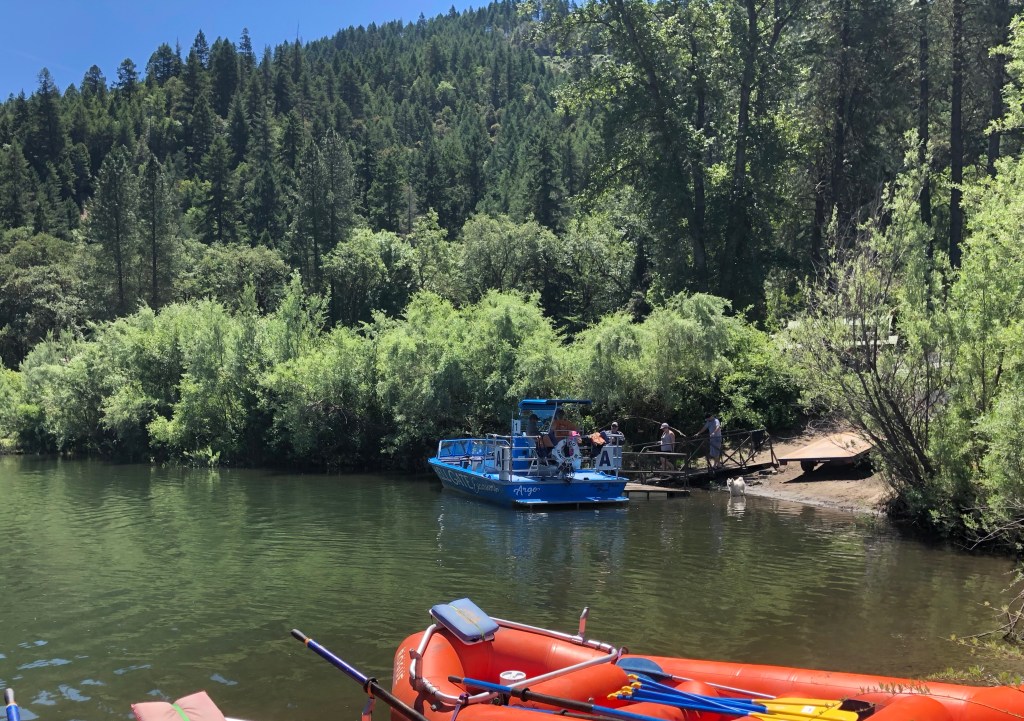
The last day of our experience of rafting downstream the Rogue River.
We are into the section of the Rogue River where it narrows and ‘white water’ appears. (In case you wondering why there are no photographs of real white-water it’s because I had to hang on with both hands and the iPhone stayed in my pocket!)
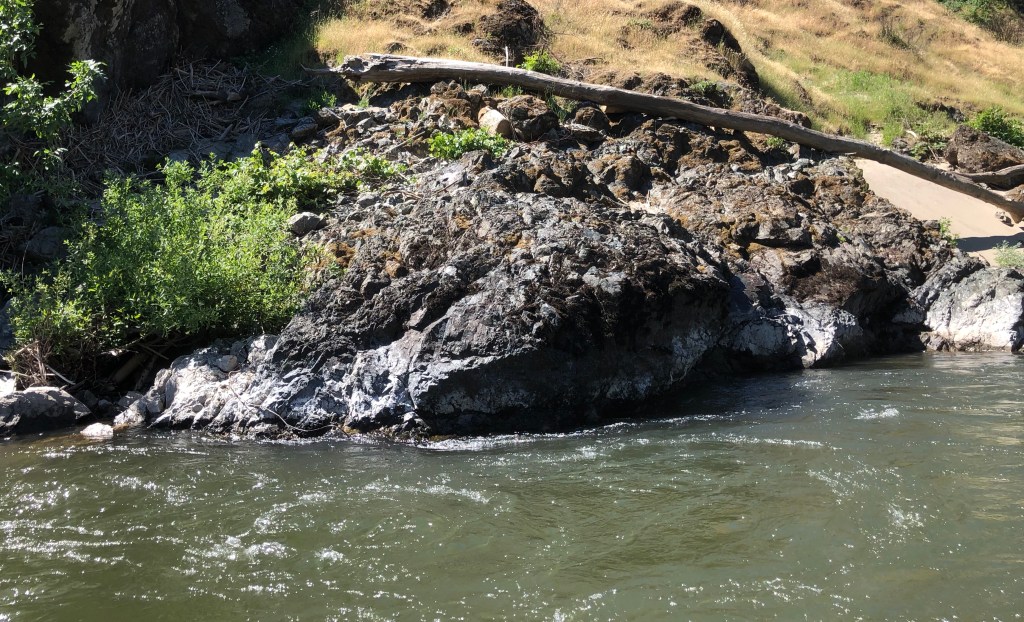
And there are times when we are being carried down by the flow very close to the rocks.
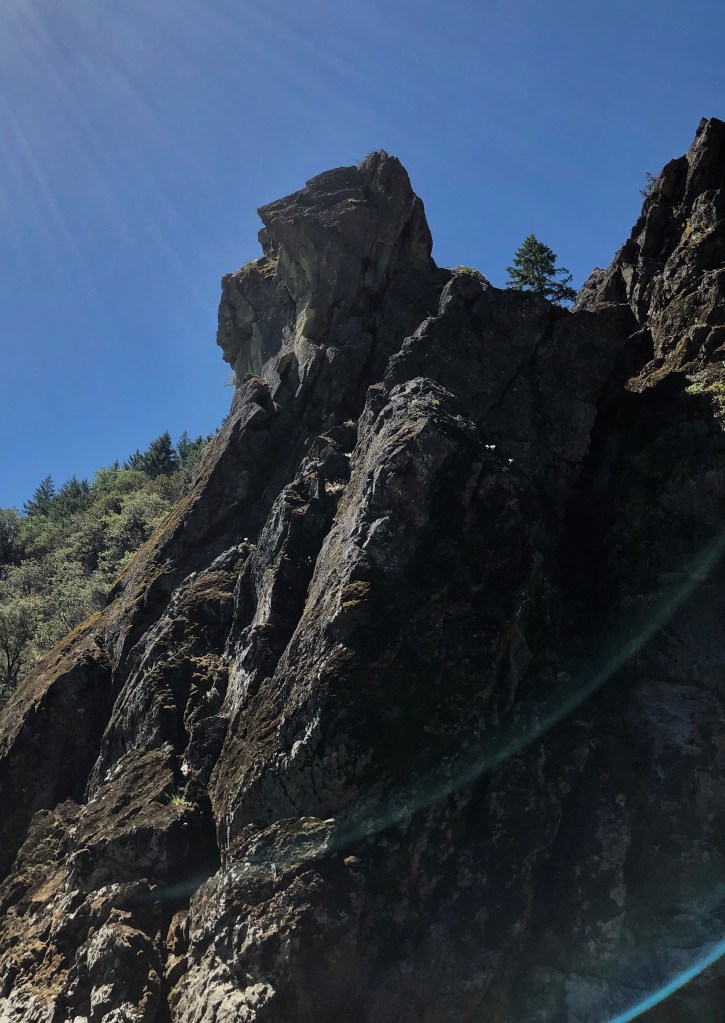
Some of the scenery is dramatic; ergo this rock towering over the edge of the river.
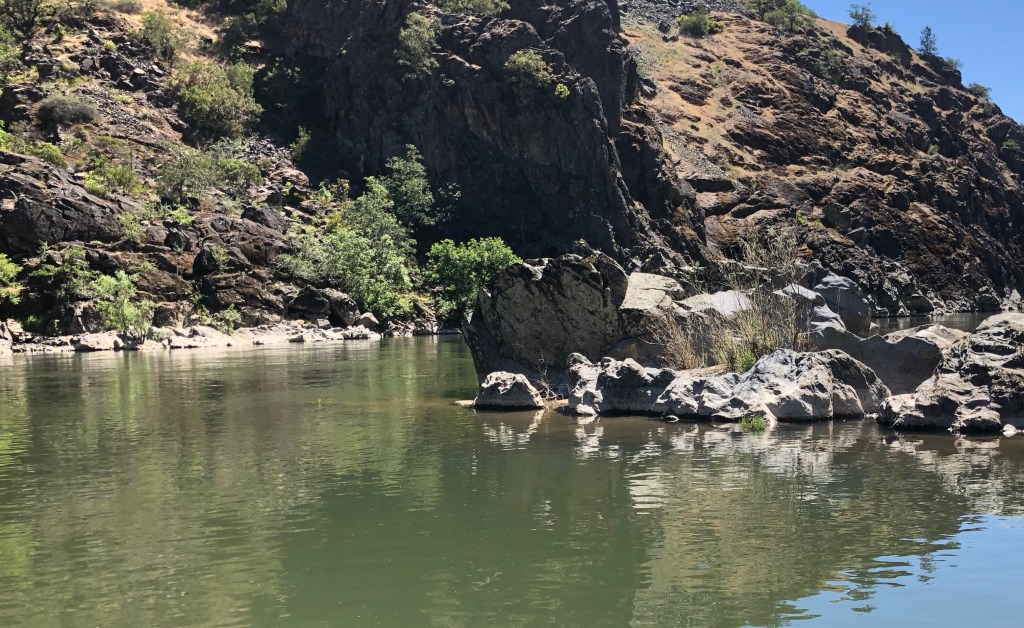
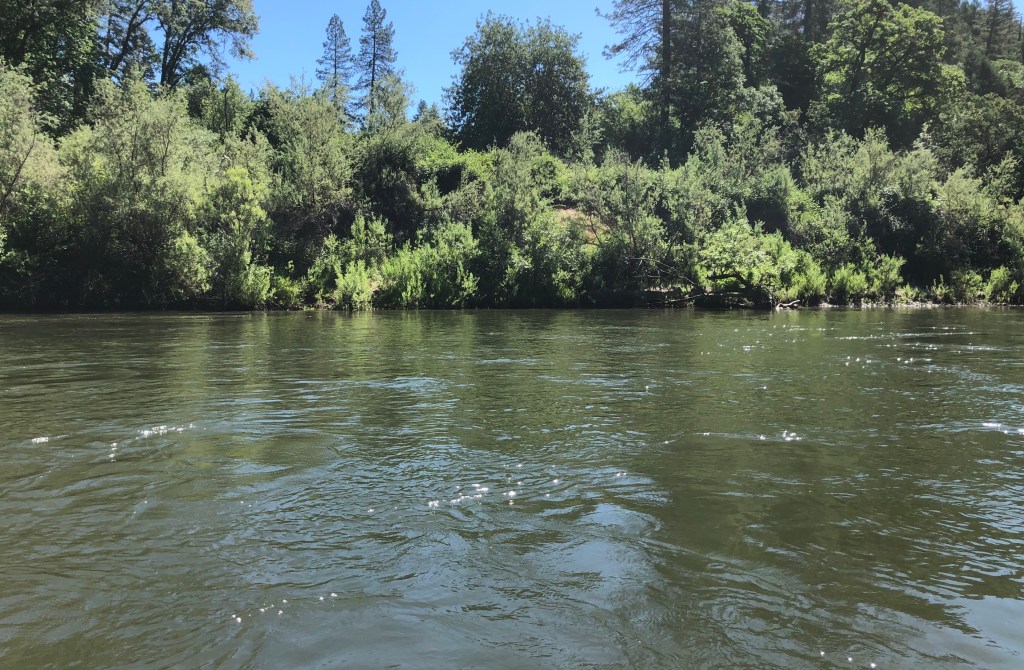
Another detail of the shoreline.
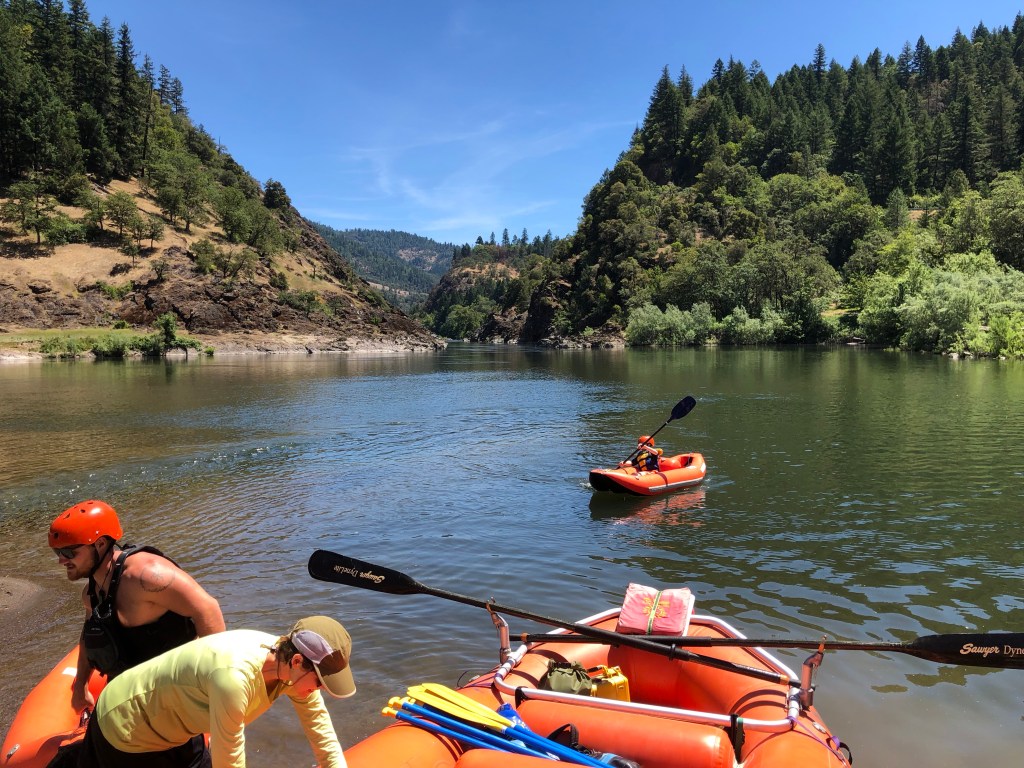
Then it was time for another to enter the kayak. We nudged the dinghy into a quiet edge of the river.
It was a 12-year-old girl who wanted to have a go in the kayak. She was excellent!
Once again, we moved out from the ‘resting’ area to join the main river.
And before we know it we had arrived at our destination.
We are at Morrisons Rogue River Lodge where there is a stop for lunch while Jean and I are to return by coach back to Grants Pass. We have only drifted 9 miles!
But it has been a wonderful 9 miles!
And for the close a picture of Morrisons Rogue River Lodge halt from the Morrisons website.
P.S. There is an interesting article on the total Rogue River in Wikipedia that is worth reading. It starts:
The Rogue River (Tolowa: yan-shuu-chit’ taa-ghii~-li~’,[7]Takelma: tak-elam[8]) in southwestern Oregon in the United States flows about 215 miles (346 km) in a generally westward direction from the Cascade Range to the Pacific Ocean. Known for its salmon runs, whitewaterrafting, and rugged scenery, it was one of the original eight rivers named in the Wild and Scenic Rivers Act of 1968. Beginning near Crater Lake, which occupies the caldera left by the explosive volcanic eruption of Mount Mazama, the river flows through the geologically young High Cascades and the older Western Cascades, another volcanic province. Further west, the river passes through multiple exotic terranes of the more ancient Klamath Mountains. In the Kalmiopsis Wilderness section of the Rogue basin are some of the world’s best examples of rocks that form the Earth’s mantle. Near the mouth of the river, the only dinosaur fragments ever discovered in Oregon were found in the Otter Point Formation, along the coast of Curry County.
Continuing our journey downstream the Rogue River.
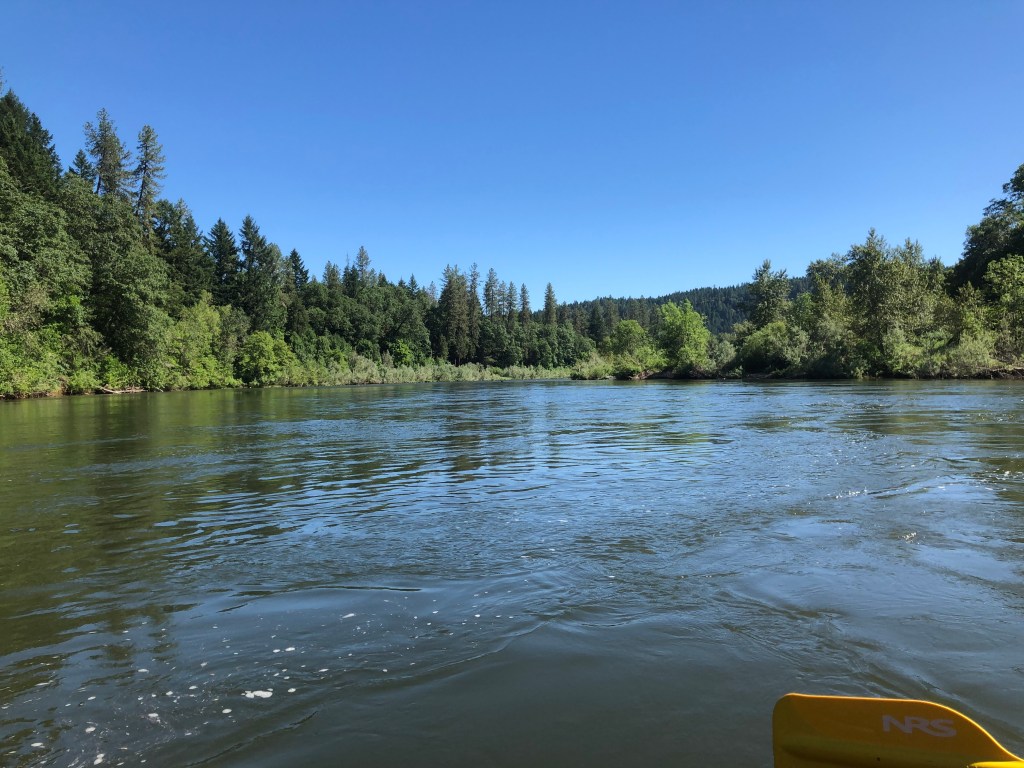
Now we are rafting!
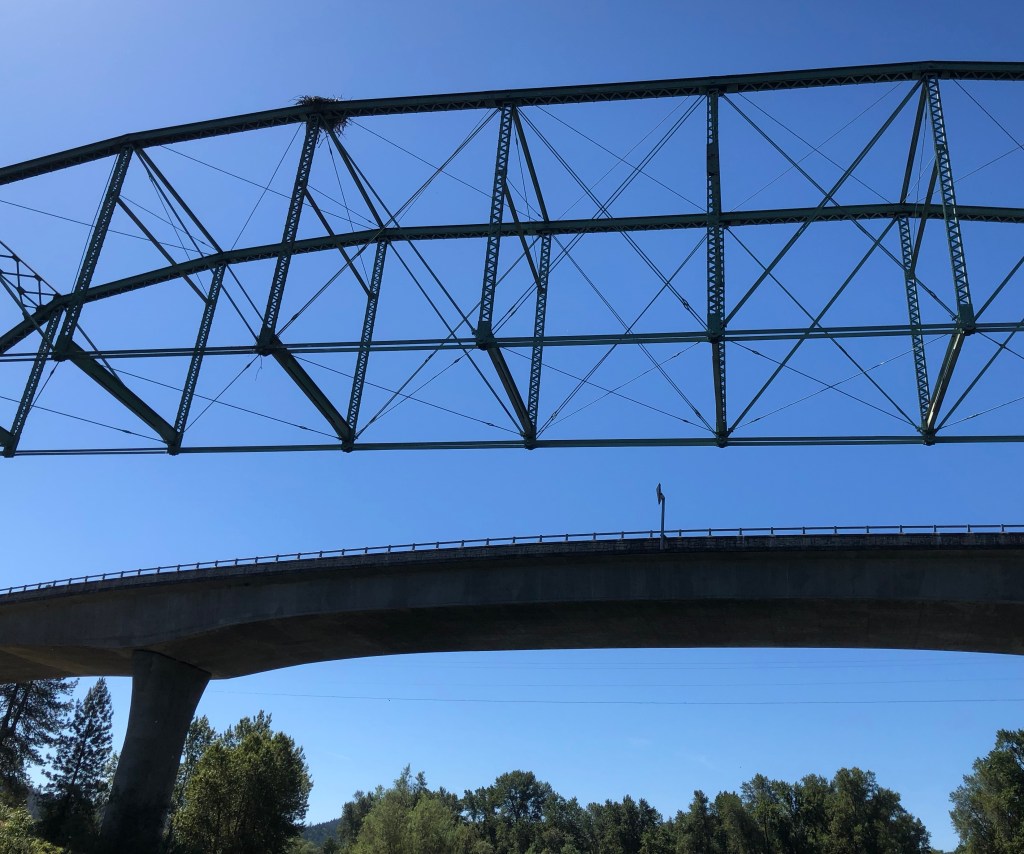
Fairly quickly we pass under Robertson Bridge.
In fact there are two bridges; the old metal one and the modern concrete one.
But way on top of the metal bridge is an osprey’s nest.
We continue.
The river, flowing at 2,800 cubic feet per second we are told, flows into the gorge.
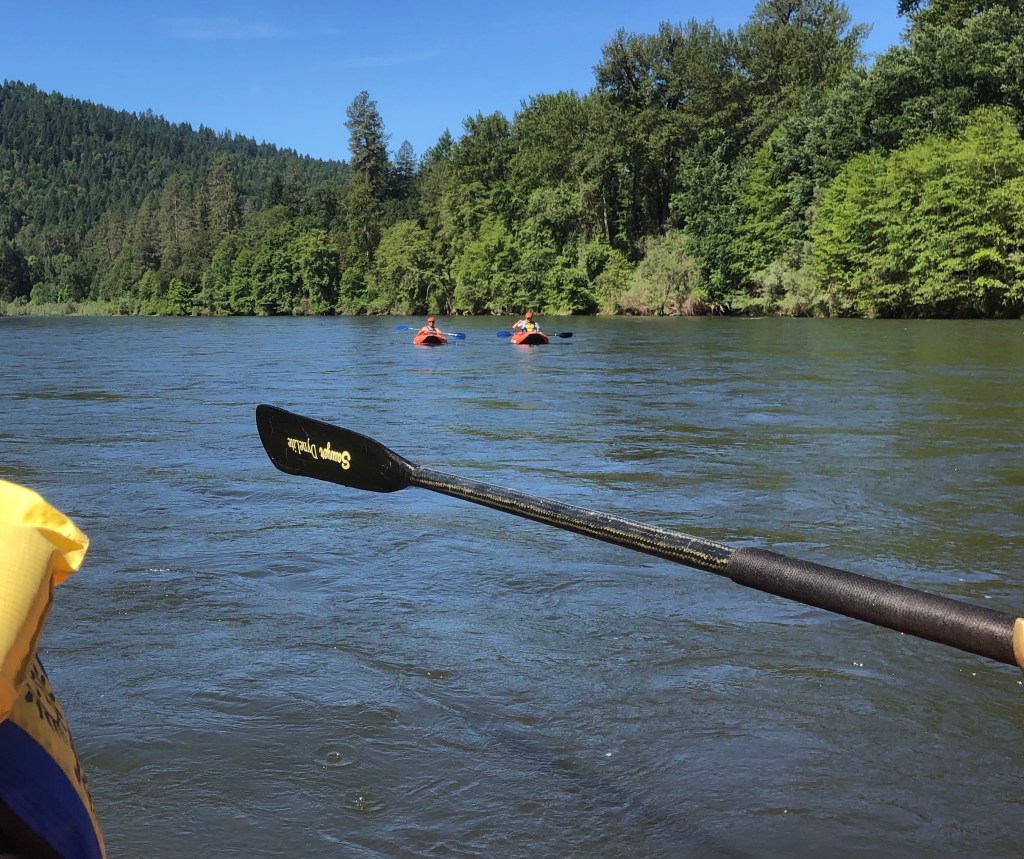
Behind us are the two kayaks. The one on the left is permanently manned by Christian, one of the guides, and the other one is available for anyone who wants to have a go.
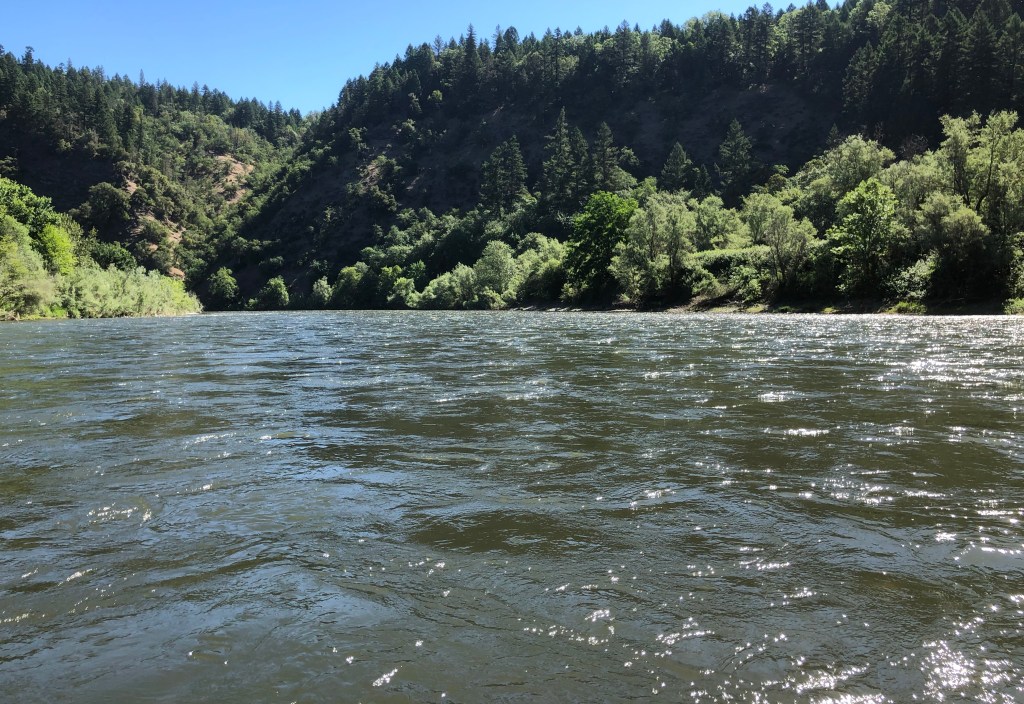
Deeper into the gorge we go.
It is wild country.
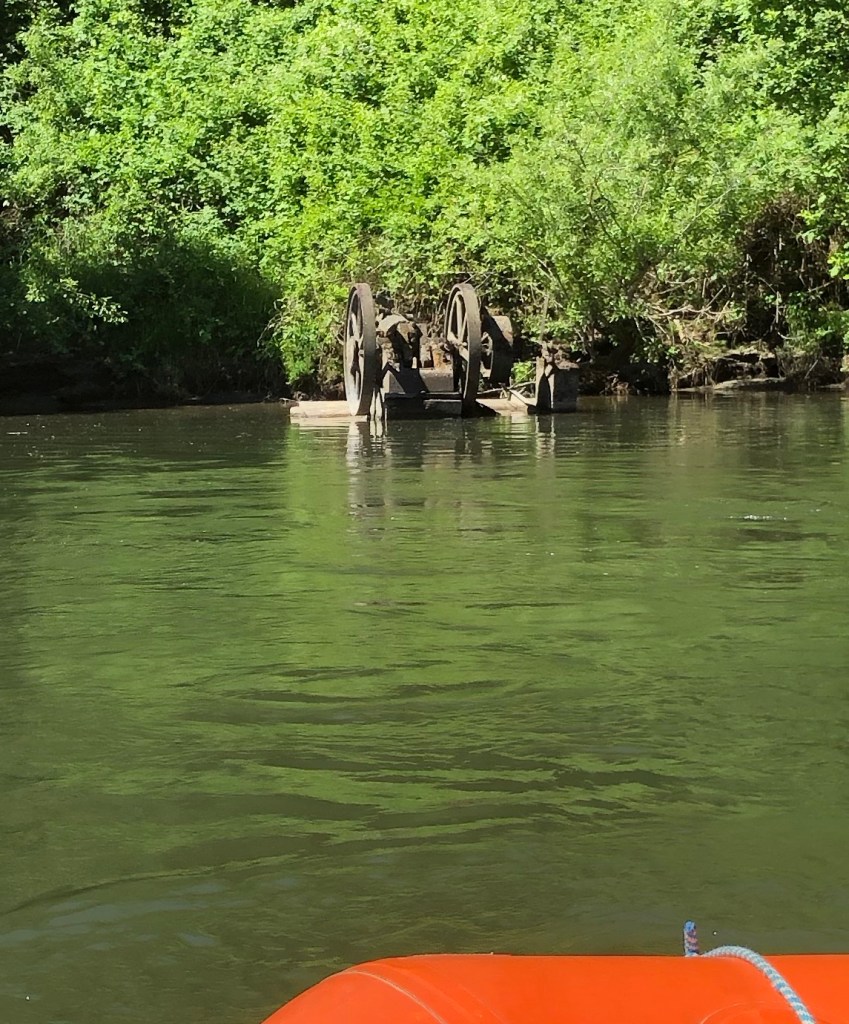
We pass an old pump that some years ago was displaced by a flooding Rogue!
And as the gorge narrows the flow of the river becomes more agitated and the start of the white-water section beckons.










/https://public-media.si-cdn.com/filer/95/cd/95cd30a1-3999-431d-8f96-3e8fa5f5d616/screen_shot_2019-06-14_at_113850_am.png)