Category: History

Offering a clue

A republication of an earlier post from The Smithsonian

Those who read yesterday’s post will find today’s post highly interesting.

A copy of an article from two years ago in The Smithsonian.

ooOOoo

New Study Has a Bone to Pick With Dog Domestication Findings

Contrary to past research, a new DNA study suggests fido was only tamed once

One wave of domestication or two? The debate rages on. (Dageldog/iStock)

By Jason Daley
smithsonian.com
July 19, 2017

Though dogs are humanity’s oldest and most consistent animal friend, scientists have long struggled to figure out just how Canis familiaris came to be. Though researchers agree dogs are descended from wild wolves, they aren’t sure when and where domestication occurred. And as Tina Hesman Saey at Science News reports, a new study has revived the debate, suggesting that dogs were domesticated one time between 20,000 and 40,000 years ago.

Dog domestication has gotten a lot of attention in recent years. In 2016, researchers looked at the mitochondrial DNA of modern and ancient dog species, determining that dogs come from two different wolf populations, one found in Europe and one found in Asia. That means that wolves would have been domesticated in two different places, with the two lineages eventually mixing in modern dogs.

But this latest research contradicts the double-domestication hypothesis. According to Ben Guarino at the Washington Post, researchers looked at the well-preserved DNA of two ancient dogs found in Germany, one 7,000 years old and one 4,700 years old, as well as the complete genomes of 100 modern dogs and snippets of DNA from 5,600 other wolves and dogs.

They traced the rate of mutations in the over time in the dog genomes. This technique, which creates a “molecular clock,” indicates that dogs diverged from wolves 36,900 years ago to 41,500 years ago in a single domestication event. But they can’t determine exactly where the split occurred. About 20,000 years later, the molecular clock indicates dogs split into European and Asian groups. They published their results in the journal Nature Communications

Not everyone is convinced by the study. Greger Larson, Oxford evolutionary biologist and author of the earlier domestication study, tells Guarino that the latest research does not explain the “ridiculously deep split” between the genetics of ancient European and Asian dogs. He also points out that while ancient dog bones have been found in far eastern Asia and western Europe, the middle of Eurasia seems to be empty of dog bones, suggesting that there were two ancient populations, separated by vast distances.

Krishna Veeramah, a palaeogeneticist at Stony Brook University and author of the new study says he doesn’t anticipate that the paper will put the issue to rest. “More ancient dog DNA from genomes will ultimately solve the problem,” he tells Rachael Lallensack at Nature. Researchers are hoping to find more geographically diverse DNA from dogs as well as samples from different time periods.

Whether it happened once or twice, how and why did domestication occur?

As Veeramah​ tells Helen Briggs at the BBC that it’s likely dogs evolved from wolves that began hanging around human camps, scavenging their scraps. ”Those wolves that were tamer and less aggressive would have been more successful at this,” he says. “While the humans did not initially gain any kind of benefit from this process, over time they would have developed some kind of symbiotic relationship with these animals, eventually evolving into the dogs we see today.”

One early benefit of domesticated dogs may have been that they could help transport meat from carcasses or hunt dangerous game like cave bears and cave lions, Saey writes in an earlier Science News article.

For now, however, exactly when and where Fido first approached humans will remain a mastiff question.

ooOOoo

For my money the origins of the domestic dog are as Krishna Veeramah puts it: ”Those wolves that were tamer and less aggressive would have been more successful at this,” he says. “While the humans did not initially gain any kind of benefit from this process, over time they would have developed some kind of symbiotic relationship with these animals, eventually evolving into the dogs we see today.

When did we come together?

A cache of animal bones 11,500 years old suggests an answer.

Brigit Katz of The Smithsonian wrote an article in January that revealed that dogs and humans hunted together many thousands of years ago.

Here it is:

ooOOoo

Humans and Dogs May Have Hunted Together in Prehistoric Jordan

Bones at a settlement called Shubayqa 6 show clear signs of having been digested—but were much too large to have been eaten by humans

Selection of gazelle bones from Space 3 at Shubayqa 6 displaying evidence for having been in the digestive tract of a carnivore. ( Credit: University of Copenhagen)

By Brigit Katz
SMITHSONIAN.COM
JANUARY 17, 2019

When and where dogs came to be domesticated is a subject of scientific debate, but there is a wealth of research that attests to the long, intertwined history of humans and their best animal buddies. One theory about the early origins of this relationship posits that dogs were used to help early humans hunt. And, as Ruth Schuster reports for Haaretz, a new study suggests that this may have been the case among prehistoric peoples of what is now Jordan.

A team of archaeologists from the University of Copenhagen and University College London studied a cache of animal bones at an 11,500-year-old settlement called Shubayqa 6, which is classified as “Pre-Pottery Neolithic A,” or belonging to the first stage of Neolithic culture in the Levant. In the Journal of Anthropological Archaeology, the researchers write that they found bones from a canid species, though they could not identify which one because the remains were poorly preserved. They also unearthed the bones of other animals that had been butchered. But perhaps most intriguing were the bones of animals—like gazelle, for instance—that bore clear signs of having passed through a digestive tract.

These bones were too big for humans to have eaten, leading the researchers to surmise that they “must have been digested by dogs,” says lead study author Lisa Yeomans, a zooarchaeologist at the University of Copenhagen. And the researchers don’t think this was a case of wild carnivores sneaking into the settlement to grab a bite.

For one, archaeological evidence indicates that Shubayqa 6 was occupied year-round, suggesting that “dogs were allowed to freely roam around the site picking over the discarded waste, but also defecating in the vicinity of where humans were inhabiting,” the study authors write.

There was also a noticeable surge in hare bones around the time that dogs started to appear at the site, and the researchers think this may be because the dogs were helping humans hunt small prey. Previously, the people of Shubayqa 6 might have relied on tools like netting to catch hares and other animals, says Yeomans, but it wouldn’t have been very effective. Dogs, on the other hand, could selectively target elusive prey.

Humans and dogs thus appear to have forged a reciprocal relationship in Jordan more than 11,000 years ago. There is in fact evidence to suggest that dogs were domesticated by humans in the Near East as early as 14,000 years ago, and some of that evidence seems to point to dogs being used during hunts. Rock art from a site near Shubayqa, for instance, seems to show dogs driving gazelle into a trap.

In light of such archaeological finds, “it would be strange not to consider hunting aided by dogs as a likely explanation for the sudden abundance of smaller prey in the archaeological record,” Yeomans says. Among the ancient peoples of Jordan, in other words, the complex history of dog domestication may have been well underway.

ooOOoo

That scientific debate mentioned in the first line of the article has been published in this place before. But I’m going to republish it tomorrow as it so perfectly goes with today’s post.

Rafting the Rogue River, Conclusion

The last day of our experience of rafting downstream the Rogue River.

We are into the section of the Rogue River where it narrows and ‘white water’ appears. (In case you wondering why there are no photographs of real white-water it’s because I had to hang on with both hands and the iPhone stayed in my pocket!)

And there are times when we are being carried down by the flow very close to the rocks.

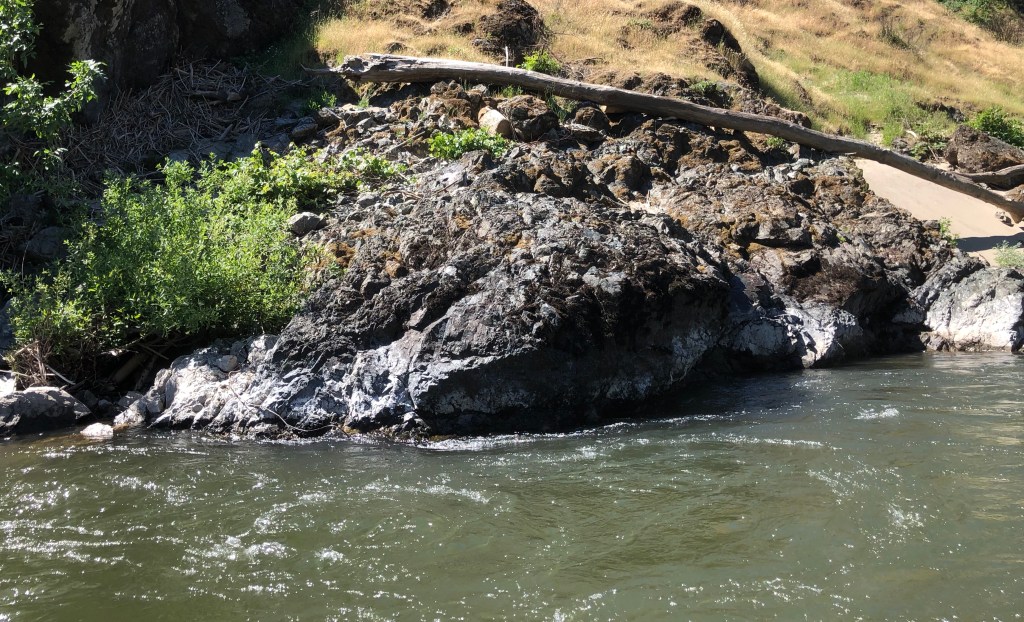
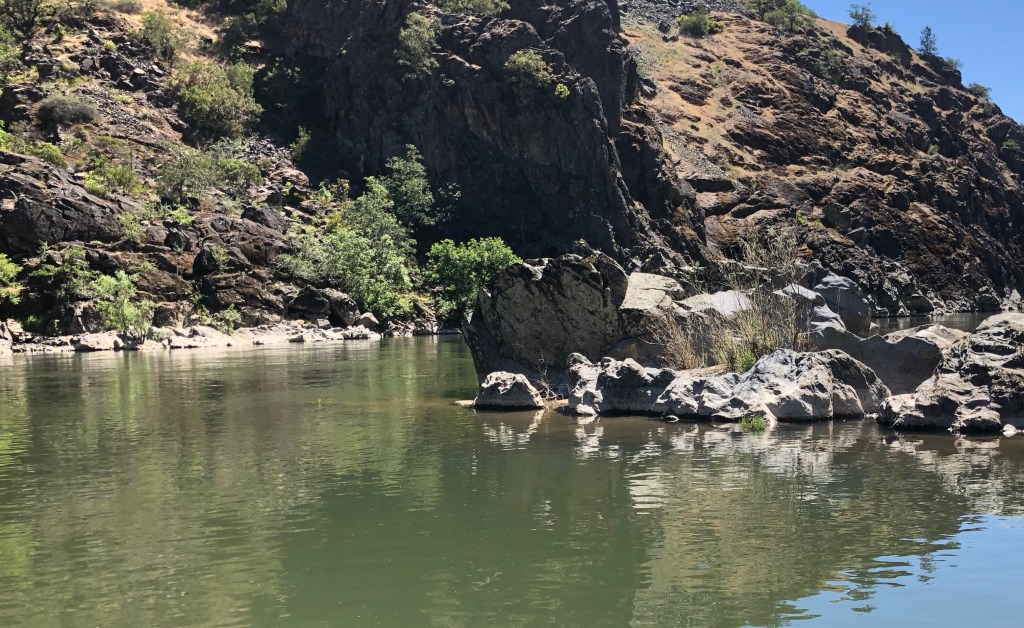
Some of the scenery is dramatic; ergo this rock towering over the edge of the river.

Another detail of the shoreline.

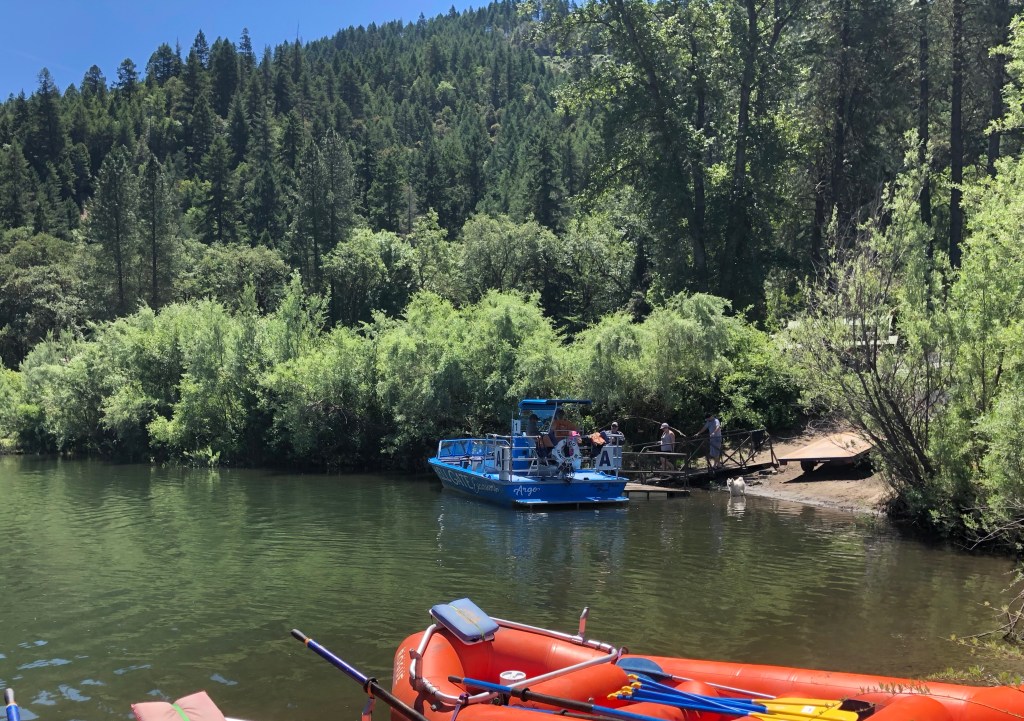
Then it was time for another to enter the kayak. We nudged the dinghy into a quiet edge of the river.

It was a 12-year-old girl who wanted to have a go in the kayak. She was excellent!

Once again, we moved out from the ‘resting’ area to join the main river.

And before we know it we had arrived at our destination.

We are at Morrisons Rogue River Lodge where there is a stop for lunch while Jean and I are to return by coach back to Grants Pass. We have only drifted 9 miles!

But it has been a wonderful 9 miles!

And for the close a picture of Morrisons Rogue River Lodge halt from the Morrisons website.

P.S. There is an interesting article on the total Rogue River in Wikipedia that is worth reading. It starts:

The Rogue River (Tolowa: yan-shuu-chit’ taa-ghii~-li~’,[7] Takelma: tak-elam[8]) in southwestern Oregon in the United States flows about 215 miles (346 km) in a generally westward direction from the Cascade Range to the Pacific Ocean. Known for its salmon runs, whitewater rafting, and rugged scenery, it was one of the original eight rivers named in the Wild and Scenic Rivers Act of 1968. Beginning near Crater Lake, which occupies the caldera left by the explosive volcanic eruption of Mount Mazama, the river flows through the geologically young High Cascades and the older Western Cascades, another volcanic province. Further west, the river passes through multiple exotic terranes of the more ancient Klamath Mountains. In the Kalmiopsis Wilderness section of the Rogue basin are some of the world’s best examples of rocks that form the Earth’s mantle. Near the mouth of the river, the only dinosaur fragments ever discovered in Oregon were found in the Otter Point Formation, along the coast of Curry County.

That’s all folks!

Rafting the Rogue River, Part Two

Continuing our journey downstream the Rogue River.

Now we are rafting!

Fairly quickly we pass under Robertson Bridge.

In fact there are two bridges; the old metal one and the modern concrete one.

But way on top of the metal bridge is an osprey’s nest.

We continue.

The river, flowing at 2,800 cubic feet per second we are told, flows into the gorge.

Behind us are the two kayaks. The one on the left is permanently manned by Christian, one of the guides, and the other one is available for anyone who wants to have a go.

Deeper into the gorge we go.

It is wild country.

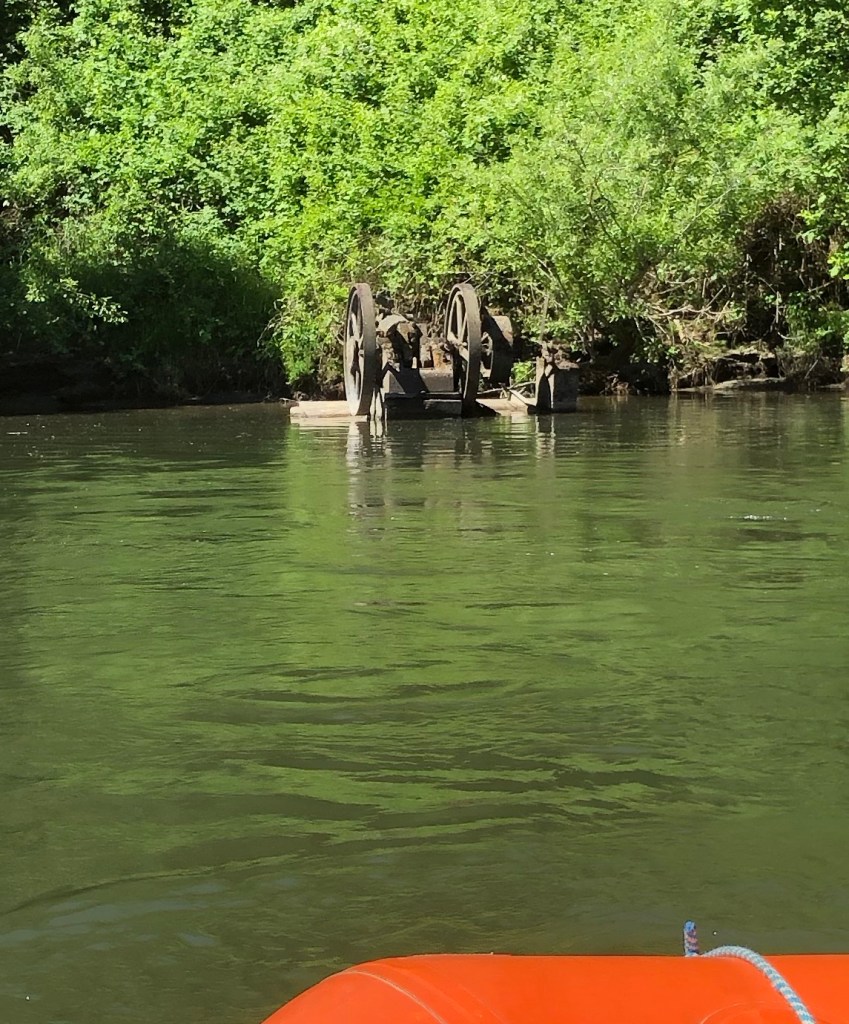
We pass an old pump that some years ago was displaced by a flooding Rogue!

And as the gorge narrows the flow of the river becomes more agitated and the start of the white-water section beckons.

The final post tomorrow!

Rafting the Rogue River, Part One

The experience of rafting downstream the Rogue River.

It is Tuesday, 4th June. It is 08:45.

We are early because we are excited and because the location that we have to go to is just four miles from home.

Morrisons Rafting

Neither of us have done anything like this before. But we decided to book just a half-day trip because a) the weather was warm but not roasting, and b) it was a local event and we would be back home by lunchtime to let the dogs out.

Inevitably we are early so I can’t resist wandering around the back to where the guides were loading up the truck.

Then it is time to check in.

Almost immediately we are fitted with the appropriately sized personal buoyancy protector.

Jean is ready to go!

At first we thought we were the only people going on the 9:30 trip but then a family booked in but they were going for an all-day rafting trip. But all of us on the same first raft.

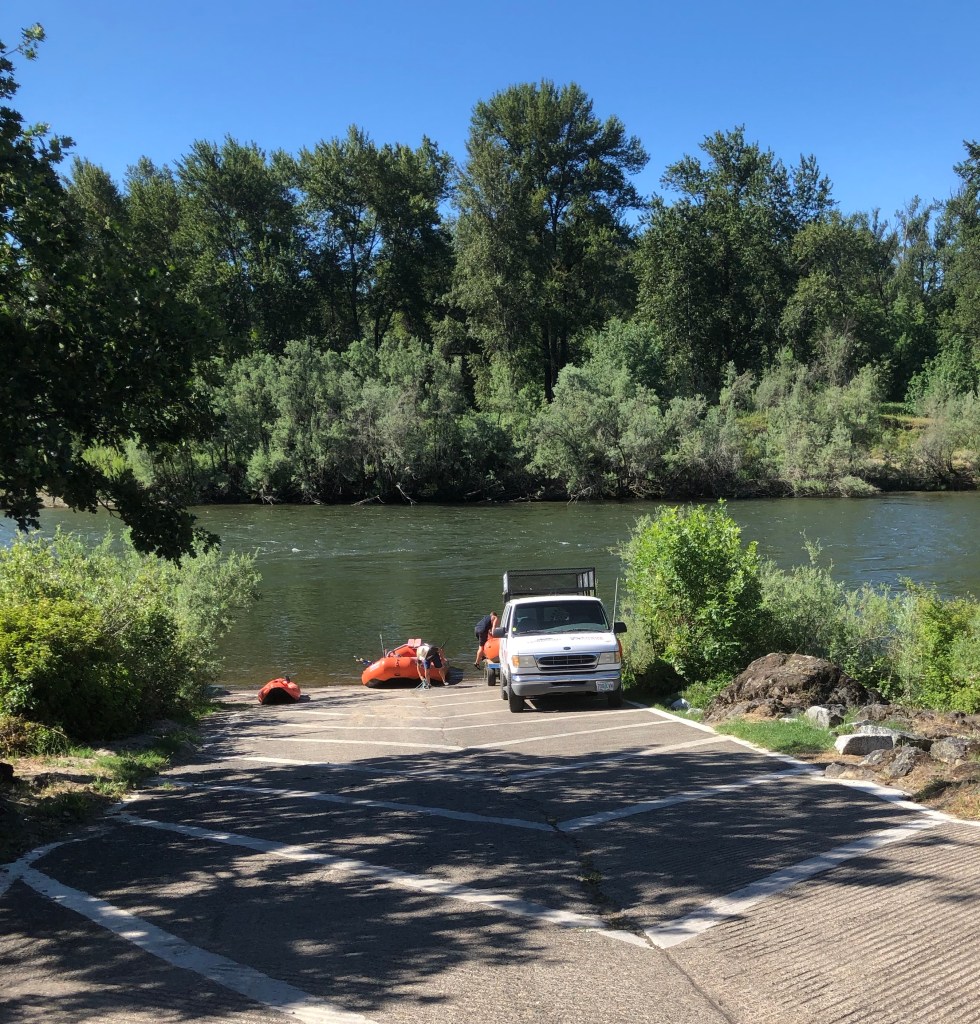
The coach towing the dinghies and kayaks, and carrying all of us, left Merlin and in about 15 minutes time came down to Robertson Bridge boat jetty where we all stepped out and assembled  at the head of the ramp while the crew unshipped the dinghies and kayaks and got them ready for boarding.

oooo

We were all going in a single dinghy and the other one was, I guess, a spare. It was put to one side. But the two kayaks were coming.

Then it was time to board.

And we were off!

More of our adventure tomorrow!

More on meteorites.

I saw this story very late yesterday.

This was read quickly towards the end of the day, as in yesterday, but I thought it well worthwhile rescheduling my doggie article until Saturday and putting this in for today.

Later on yesterday it was read more thoroughly and it is full of fascinating information such as the weight of meteorites that fall onto Planet Earth each day. I wasn’t aware of that.

Anyway, hope you too find it of interest.

ooOOoo

The tell-tale clue to how meteorites were made, at the birth of the solar system

By

Professor of Astronomy, Wesleyan University

and

Assistant Professor of Earth and Environmental Sciences, Wesleyan University

June 6th, 2019.

April 26, 1803 was an unusual day in the small town of L’Aigle in Normandy, France – it rained rocks.

Over 3,000 of them fell out of the sky. Fortunately no one was injured. The French Academy of Sciences investigated and proclaimed, based on many eyewitness stories and the unusual look of the rocks, that they had come from space.

The Earth is pummeled with rocks incessantly as it orbits the Sun, adding around 50 tons to our planet’s mass every day. Meteorites, as these rocks are called, are easy to find in deserts and on the ice plains of Antarctica, where they stick out like a sore thumb. They can even land in backyards, treasures hidden among ordinary terrestrial rocks. Amateurs and professionals collect meteorites, and the more interesting ones make it to museums and laboratories around the world for display and study. They are also bought and sold on eBay.

Despite decades of intense study by thousands of scientists, there is no general consensus on how most meteorites formed. As an astronomer and a geologist, we have recently developed a new theory of what happened during the formation of the solar system to create these valuable relics of our past. Since planets form out of collisions of these first rocks, this is an important part of the history of the Earth.

This meteor crater in Arizona was created 50,000 years ago when an iron meteorite struck the Earth. It is about one mile across. W. Herbst, CC BY-SA

The mysterious chondrules

Drew Barringer (left), owner of Arizona meteor crater, his wife, Clare Schneider, and author William Herbst in the Van Vleck Observatory Library of Wesleyan University, where an iron meteorite from the crater is on display. W. Herbst

About 10% of meteorites are pure iron. These form through a multi-step process in which a large molten asteroid has enough gravity to cause iron to sink to its center. This builds an iron core just like the Earth’s. After this asteroid solidifies, it can be shattered into meteorites by collisions with other objects. Iron meteorites are as old as the solar system itself, proving that large asteroids formed quickly and fully molten ones were once abundant.

The other 90% of meteorites are called “chondrites” because they are full of mysterious, tiny spheres of rock known as “chondrules.” No terrestrial rock has anything like a chondrule inside it. It is clear that chondrules formed in space during a brief period of intense heating when temperatures reached the melting point of rock, around 3,000 degrees Fahrenheit, for less than an hour. What could possibly account for that?

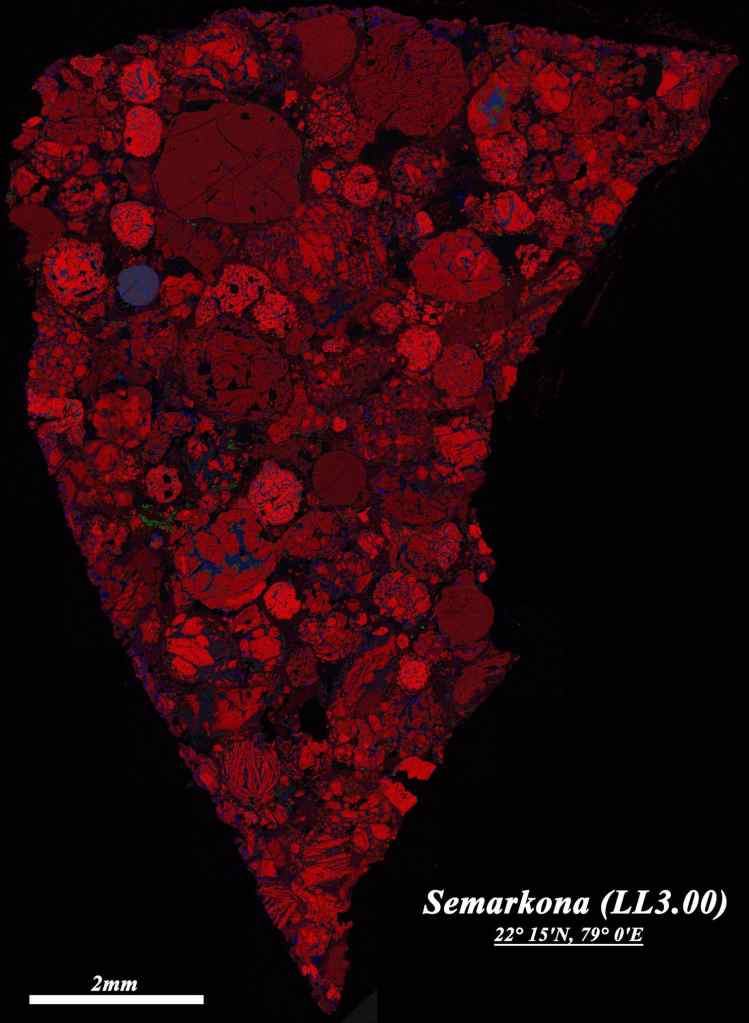
A closeup of the Semarkona meteorite showing dozens of chondrules. Kenichi Abe

Researchers have come up with many hypotheses through the last 40 years. But no consensus has been reached on how this brief flash of heating happened.

The chondrule problem is so famously difficult and contentious that when we announced to colleagues a few years ago that we were working on it, their reaction was to smile, shake their heads and offer their condolences. Now that we have proposed a solution we are preparing for a more critical response, which is fine, because that’s the way science advances.

The flyby model

Our idea is quite simple. Radioactive dating of hundreds of chondrules shows that they formed between 1.8 and 4 million years after the beginning of the solar system – some 4.6 billion years ago. During this time, fully molten asteroids, the parent bodies of the iron meteorites, were abundant. Volcanic eruptions on these asteroids released tremendous amounts of heat into the space around them. Any smaller objects passing by during an eruption would experience a short, intense blast of heat.

To test our hypothesis, we split up the challenge. The astronomer, Herbst, crunched the numbers to determine how much heating was necessary and for how long to create chondrules. Then the geologist, Greenwood, used a furnace in our lab at Wesleyan to recreate the predicted conditions and see if we could make our own chondrules.

Laboratory technician Jim Zareski (top) loads a programmable furnace as co-author Jim Greenwood looks on, in his laboratory at Wesleyan University. This is where the synthetic chondrules are made. W. Herbst

The experiments turned out to be quite successful.

We put some fine dust from Earth rocks with compositions resembling space dust into a small capsule, placed it in our furnace and cycled the temperature through the predicted range. Out came a nice-looking synthetic chondrule. Case closed? Not so fast.

Two problems emerged with our model. In the first place, we had ignored the bigger issue of how chondrules came to be part of the whole meteorite. What is their relationship to the stuff between chondrules – called matrix? In addition, our model seemed a bit too chancy to us. Only a small fraction of primitive matter will be heated in the way we proposed. Would it be enough to account for all those chondrule-packed meteorites hitting the Earth?

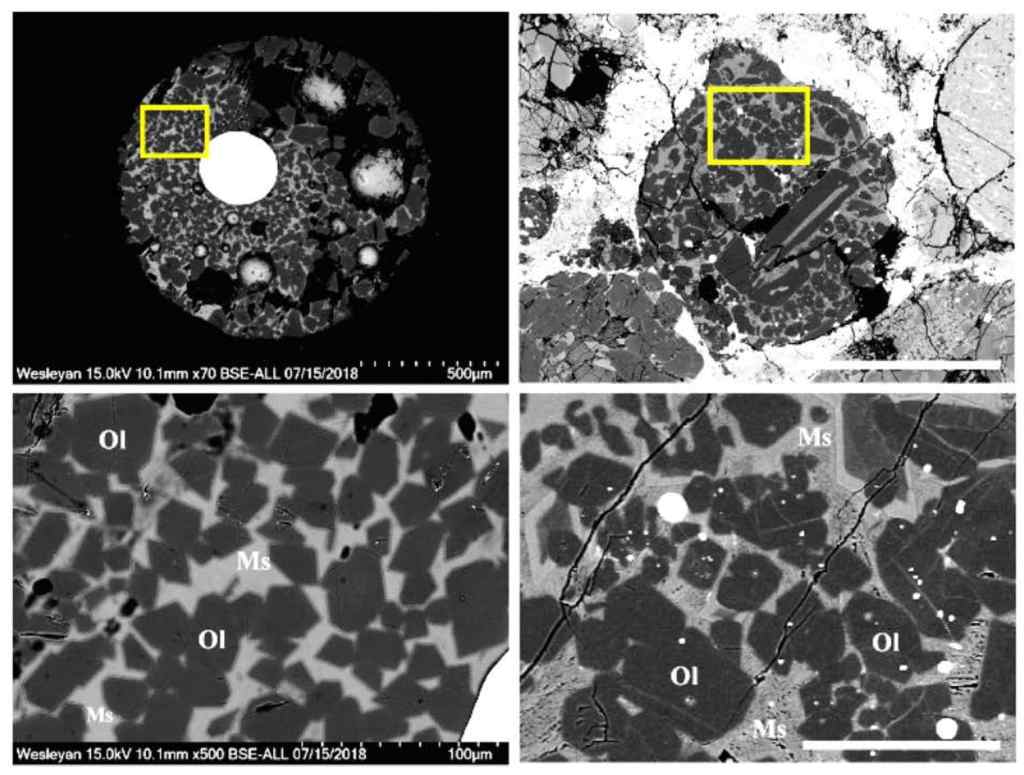
A comparison of a synthetic chondrule (left) made in the Wesleyan lab with a heating curve from the flyby model, with an actual chondrule (right) from the Semarkona meteorite. The crystal structure is quite similar, as shown in the enlargements (bottom row). J. Greenwood

Making whole meteorites

To address these issues, we extended our initial model to consider flyby heating of a larger object, up to a few miles across. As this material approaches a hot asteroid, parts of it will vaporize like a comet, resulting in an atmosphere rich in oxygen and other volatile elements. This turns out to be just the kind of atmosphere in which chondrules form, based on previous detailed chemical studies.

We also expect the heat and gas pressure to harden the flyby object into a whole meteorite through a process known as hot isostatic pressing, which is used commercially to make metal alloys. As the chondrules melt into little spheres, they will release gas to the matrix, which traps those elements as the meteorite hardens. If chondrules and chondrites form together in this manner, we expect the matrix to be enhanced in exactly the same elements that the chondrules are depleted. This phenomenon, known as complementarity, has, in fact, been observed for decades, and our model provides a plausible explanation for it.

The authors’ model for forming chondrules. A small piece of rock (right) — a few miles across or less — swings close to a large hot asteroid erupting lava at its surface. Infrared radiation from the hot lava briefly raises the temperature on the small piece of rock high enough to form chondrules and harden part of that object into a meteorite. W. Herbst/Icarus

Perhaps the most novel feature of our model is that it links chondrule formation directly to the hardening of meteorites. Since only well-hardened objects from space can make it through the Earth’s atmosphere, we would expect the meteorites in our museums to be full of chondrules, as they are. But hardened meteorites full of chondrules would be the exception, not the rule, in space, since they form by a relatively chancy process – the hot flyby. We should know soon enough if this idea holds water, since it predicts that chondrules will be rare on asteroids. Both Japan and the United States have ongoing missions to nearby asteroids that will return samples over the next few years.

If those asteroids are full of chondrules, like the hardened meteorites that make it to the Earth’s surface, then our model can be discarded and the search for a solution to the famous chondrule problem can go on. If, on the other hand, chondrules are rare on asteroids, then the flyby model will have passed an important test.

ooOOoo

Perfect timing!

Funny what falls from the sky!

Mud ball meteorites!

We took a rafting trip down the Rogue River yesterday (the 4th) and when I have finished transferring the photographs from my iPhone to my computer I will write a post on the journey.

But for today’s post I want to republish an item that appeared also yesterday in EarthSky.

And it does involve dogs!

ooOOoo

Mud ball meteorites rain down in Costa Rica

“Mud ball” meteorites – full of clays, organics and water – are unique among space rocks. And a lot of them fell in April 2019 on a small town in Costa Rica, much to the delight of scientists.

This meteorite from the fall at Aguas Zarcas, Costa Rica, in April hit a doghouse. Luckily, the dog – Rocky – was unharmed. Image via Michael Farmer/ASU.

Meteorite falls on Earth are fairly common, but not all meteorites are the same. Some of them are “mud balls,” rich in clays, organic compounds and water-bearing minerals, called carbonaceous chondrites. They are of great interest to scientists, due to their unique composition, and now a bunch more prime specimens have been found, which rained down after a large fireball was seen over Aguas Zarcas, a small town in Costa Rica, on April 23, 2019.

The fireball was a meteor, or space rock, entering the Earth’s atmosphere that broke apart into hundreds of smaller pieces. When the pieces of this rock hit the ground, their name changed to meteorite. One meteorite fragment weighed about two pounds and smashed through the roof of a house, destroying the owner’s dining table. Another one crashed through the roof of a dog house, narrowly missing a sleeping dog. Close calls!

The doghouse with the hole in its roof from the April 2019 meteorite in Costa Rica. The dog, Rocky, was sleeping in the doghouse at the time; he was unharmed, but probably surprised! Image via Michael Farmer/ASU.

Several of the meteorites were collected and sent to Arizona State University (ASU) for study, donated by meteorite collector Michael Farmer. ASU will also be able to purchase additional meteorites from the fall, thanks to a private donor. This is the first time in 50 years that the university has had a chance to analyze such pristine samples of extraterrestrial mud balls. As Laurence Garvie, a research professor at ASU and a curator for its Center for Meteorite Studies, said:

Many carbonaceous chondrites are mud balls that are between 80 and 95 percent clay. Clays are important because water is an integral part of their structure. These had to be collected quickly and before they got rained on. Because they are mostly clay, as soon as these types of meteorites get wet, they fall apart.

Luckily, the researchers were able to collect their samples before it rained again, and they got a nice little haul, too, about 55 pounds (25 kilograms) of the precious space rocks.

A composite element map from one of the meteorites showing the distribution of different minerals. Orange-yellow colors show tochilinite, deep-blue colors represent olivine, and red colors are pentlandite and pyrrhotite. Image via ASU.

Analysis of the meteorites was carried out at ASU’s campus in Tempe, Arizona. According to Garvie:

I was in the lab by 5 a.m. the next morning after picking up the samples to get them ready for the initial analyses. Classification of new meteorites can be like a race with other institutions, and I needed ASU to be first so that we’ll have the recognition of being the collection that holds and curates the type specimen material.

Air-sensitive meteorites like these are kept in special nitrogen cabinets. The nitrogen gas helps to preserve the meteorites, which can degrade easily due to their composition. As Garvie explained:

If you left this carbonaceous chondrite in the air, it would lose some of its extraterrestrial affinities. These meteorites have to be curated in a way that they can be used for current and future research, and we have that ability here at ASU.

This mud ball meteorite fragment from April’s meteorite fall in Aguas Zarcas, Costa Rica, looks a bit like an arrowhead. Image via ASU.

The classification of these meteorites is part of a broader international classification effort. Garvie is also working with Karen Ziegler from the Institute of Meteoritics at the University of New Mexico. They studied the oxygen isotopes of the meteorites, to determine how similar they are to other carbonaceous chondrites.

Sandra Pizzarello, an organic chemist from ASU’s School of Molecular Sciences, is also involved in the studies, focusing on the organic content of the meteorites. These kinds of organics could have provided the material needed for life to begin on Earth.

Additional scientific analysis will follow later, but first the meteorites need to be approved, classified and named by The Meteoritical Society‘s nomenclature committee. This group of 12 scientists is responsible for approving all meteorite samples for study.

These new meteorite samples are currently on display at ASU’s Tempe campus in the Center for Meteorite Studies collection.

So, why are mud ball carbonaceous chondrite meteorites so significant?

They are thought to originate from asteroids that are leftovers from early planetesimals, planets that started to form in the early solar system billions of years ago but now no longer exist. Those planets had organic materials and water, making them places where the chemical precursors to life could have started. In the case of the asteroid that these new meteorites originated from, Garvie said:

It formed in an environment free of life, then was preserved in the cold and vacuum of space for 4.56 billion years, and then dropped in Costa Rica last week.

As CMS Director Meenakshi Wadhwa also said:

Carbonaceous chondrites are relatively rare among meteorites but are some of the most sought-after by researchers because they contain the best-preserved clues to the origin of the solar system. This new meteorite represents one of the most scientifically significant additions to our wonderful collection in recent years.

Because these meteorites contain so much mineral-bound water, they could also be useful in learning how water can be extracted from asteroids, a great resource for future astronauts. According to Garvie:

Having this meteorite in our lab gives us the ability, with further analysis, to ultimately develop technologies to extract water from asteroids in space.

Location of Aguas Zarcas in Costa Rica. Image via Google Maps.

The last time a carbonaceous chondrite meteorite fall similar to this one occurred was in 1969 near Murchison, Australia. Those meteorites were curated by another ASU professor and founding director of ASU’s Center for Meteorite Studies, Carleton Moore.

The meteorites in Aguas Zarcas have also been found to be similar in composition to asteroid Bennu, now being explored by NASA’s OSIRIS-REx spacecraft. Bennu is thought to be a remnant carbonaceous chondrite planetesimal. OSIRIS-REx is carrying ASU’s Phil Christensen-designed Thermal Emissions Spectrometer (OTES) instrument, which is being used to make mineral and temperature maps of the asteroid.

Garvie and other scientists will be studying these mud ball meteorites for years to come, unlocking more secrets as to how our solar system formed and evolved, and how the ingredients of life originated and were spread throughout the solar system, including to Earth.

Bottom line: This new meteorite fall in Costa Rica has provided scientists with a great opportunity to study multiple mud ball meteorites, one of the most unusual kinds of meteorites known to exist, and one that could help answer the question of how life started on Earth.

Via ASU

ooOOoo

I don’t know about you but I found this very interesting indeed. I guess I hadn’t looked at meteorites as different entities, depending on the source, before.

Fascinating!

Must repeat that closing paragraph again: “Garvie and other scientists will be studying these mud ball meteorites for years to come, unlocking more secrets as to how our solar system formed and evolved, and how the ingredients of life originated and were spread throughout the solar system, including to Earth.

America’s lost dogs

A fascinating story.

A wild dog.

I am a member of AAAS, the American Association for the Advancement of Science, and pulled a story from their Science journal and to my amazement found that I did this nearly a year ago.

The article, by Linda Goodman and Elinor K. Karlsson, is unavailable for complete republishing owing to copyright.

But on the AAAS website there is a summary, as follows:

Summary

Few traces remain of the domesticated dogs that populated the Americas before the arrival of Europeans in the 15th century. On page 81 of this issue, Ní Leathlobhair et al. (1) shed light on the origins of the elusive precontact dog population through genetic analysis of ancient and modern dogs. Building on earlier work, they show that American dogs alive today have almost no ancestry from precontact dogs, a monophyletic lineage descended from Arctic dogs that accompanied human migrations from Asia. Instead, the authors found that their closest remaining relative is a global transmissible cancer carrying the DNA of a long-deceased dog. It remains unclear why precontact dogs survived and thrived for thousands of years in the Americas only to swiftly and almost completely disappear with the arrival of Europeans.

From the article I would add:

It is unclear why there is so little evidence today of this thriving precontact dog population. Early European colonists may have discouraged the sale and breeding of native dogs, or even actively persecuted them (10). Yet, cultural preferences alone seem insufficient to explain their rapid decline. Most dogs worldwide are free-breeding scavengers, with minimal human control and high reproductive rates (11); native American dogs were likely similar.

There is a chart in the same article that shows the first human sites in the Americas were about 15,000 years ago with the oldest dog remains, also in America, being about 10,000 years ago.

Fascinating stuff!

Breathing problems in certain dogs

This is of interest to many but especially lovers of bulldogs and similar.

There was an article on May 17th in The Smithsonian that caught my eye. So much so that I wanted to republish it for you.

Here it is.

ooOOoo

Breathing Problems in Pugs and Bulldogs Might Have a Genetic Component

It might not be their smushed-up snouts after all

They’re all good dogs. ( Frank Gaglione / Getty)

By Jason Daley

smithsonian.com
May 17, 2019
Smushed-up faces are what make certain dog breeds, like French and English bulldogs or pugs, so ugly-cute. But those good looks come with a cost. Many dogs in these breeds suffer from a disease called Brachycephalic Obstructive Airway Syndrome (BOAS). The compact architecture of their skull results in deformation, which make their nostrils or soft palate too small, obstructing airflow and leaving the pups gasping for breath. Researchers long thought that the main cause was their shortened faces. But genes found in another breed suggest that the shortness of breath might be in their DNA, according to a new study published in the journal PLOS Genetics.

Ed Cara at Gizmodo reports that veterinarians began to notice that another small breed of dog, the Norwich terrier, was increasingly coming down with similar respiratory symptoms, a disease called upper airway obstructive syndrome. Unlike flat-faced pugs and bulldogs, however, the Norwich—bred for chasing rodents—has a nice, proportional skull. That got study author Jeffrey Schoenebeck, a veterinary scientist at the University of Edinburgh, wondering if the breathing problems in all the small dogs were genetic.

“That made us wonder if there was something similar shared across these different breeds, or if we were seeing two different diseases that just looked very similar,” he says.

Schoenebeck and his team decided to dig into the terrier’s DNA to find out. The team assessed 401 Norwich terriers for signs of the airway syndrome and also examined their genomes. Cassie Martin at Science News reports the researchers discovered one gene mutation in particular, ADAMTS3, was associated with the breathing disorder. Dogs with two copies of the mutation showed signs of fluid retention and swelling around the lungs. They had worse breathing scores than dogs with just one copy of the mutation or the normal gene.

When the team examined the genome of bulldogs and pugs, they also found that ADAMTS3 was common, meaning their funky faces might not be the only cause of BOAS.

“BOAS is a complex disease. Although skull shape remains an important risk factor, our study suggests that the status of ADAMTS3 should be considered as well,” Schoenebeck says in a press release. “More studies are needed to dissect the complex nature of this devastating disease.”

Cara reports that Norwich terrier breeders are already inadvertently combating the mutation. In Switzerland, Schoenebeck’s team has been working with breeders to give dogs breathing tests, identifying pups likely to develop the disease. As a result, the younger generation of terriers is less like to develop the disease than older dogs.

“In the 90s, something like 80 percent of the Norwich terriers that came into their clinic had poor breathing and this mutation,” Schoenebeck tells Cara. “But it’s decreasing further and further over time. They didn’t know it at the time, but they were actually selecting against this thing that we think is causing this disease.”

The genetic finding means that researchers can now screen directly for the mutation, and perhaps rid the terrier population of the disease.

The problem in flat-faced breeds may not be quite as simple to deal with. Wonky skull shape still makes the risk of developing BOAS higher, and the gene mutation adds to that risk. The team needs to do a similar study with bulldogs to figure out how much of their breathing problems come from their genes and how much comes from their cute little smushed-up skulls.

Smushed-up faces are what make certain dog breeds, like French and English bulldogs and pugs, so ugly-cute. But those good looks come with a cost. Many dogs in these breeds suffer from a disease called Brachycephalic Obstructive Airway Syndrome (BOAS). The compact architecture of their skull results in deformation, that make the nostrils or soft palate too small, obstructing airflow and leaving the pups gasping for breath. Researcher long thought that the main cause was their shortened faces. But genes found in another breed suggest that the shortness of breath might be in their DNA.

Ed Cara at Gizmodo reports that veterinarians began to notice that another small breed of dog, the Norwich Terrier, was increasingly coming down with similar respiratory symptoms, a disease called Upper Airway Syndrome. Unlike flat-faced pugs and bulldogs, however, the Norwich, bred for chasing rodents, has a nice, proportional skull. That got Jeffrey Schoenebeck of the Roslin Institute at the University of Edinburghand and lead author of the study in the journal PLOS Genetics wondering if the breathing problems in all the small dogs were genetic.

“That made us wonder if there was something similar shared across these different breeds, or if we were seeing two different diseases that just looked very similar,” he says.

Schoenebeck and his team decided to dig into the terrier’s DNA to find out. The team assessed 401 Norwich Terriers for signs of the airway syndrome and also examined their genomes. Cassie Martin at Science News reports the researchers discovered one gene mutation in particular, ADAMTS3, was associated with the breathing disorder. Dogs with two copies of the mutation showed signs of fluid retention and swelling around the lungs. They had worse breathing scores than dogs with just one copy of the mutation or the normal gene.

When the team examined the genome of bulldogs and pugs, they also found that ADAMTS3 was common, meaning their funky faces might not be the only cause of BOAS.

“BOAS is a complex disease. Although skull shape remains an important risk factor, our study suggests that the status of ADAMTS3 should be considered as well,” study leader Jeffrey Schoenebeck says in a press release. “More studies are needed to dissect the complex nature of this devastating disease.”

Cara reports that Norwich Terrier breeders are already inadvertently combating the mutation. In Switzerland, Schoenebeck’s co-authors have been working with breeders to give dogs breathing tests, identifying doggos likely to develop the disease. As a result, the younger generation of terriers is less like to develop the disease than older dogs.

“In the 90s, something like 80 percent of the Norwich Terriers that came into their clinic had poor breathing and this mutation,” Schoenebeck tells Cara. “But it’s decreasing further and further over time. They didn’t know it at the time, but they were actually selecting against this thing that we think is causing this disease.”

The genetic finding means that researchers can now screen directly for the mutation, and perhaps rid the terrier population of the disease.

The problem in flat-faced breeds may not be quite as simple to deal with. Wonky skull shape still makes the risk of developing BOAS higher, and the gene mutation adds to that risk. The team needs to do a similar study with bulldogs to figure out how much of their breathing problems come from their genes and how much comes from their cute little smushed-up skulls.

Jason Daley is a Madison, Wisconsin-based writer specializing in natural history, science, travel, and the environment. His work has appeared in Discover, Popular Science, Outside, Men’s Journal, and other magazines.

ooOOoo

How great it would be if the problem facing these flat-faced breeds was slowly done away with.

Think you are being clear about the breed of dog you own?

Now this is interesting!

I first received notice of this story from a news release put by Uppsala University. That news release is what I publish as it is a short-form of the full scientific report. But I will also include an extract of the report as there may be some of you that will want to go further into this.

ooOOoo

Owning a dog is influenced by our genetic make-up

NEWS RELEASE 

UPPSALA UNIVERSITY

A team of Swedish and British scientists have studied the heritability of dog ownership using information from 35,035 twin pairs from the Swedish Twin Registry. The new study suggests that genetic variation explains more than half of the variation in dog ownership, implying that the choice of getting a dog is heavily influenced by an individual’s genetic make-up.

Dogs were the first domesticated animal and have had a close relationship with humans for at least 15,000 years. Today, dogs are common pets in our society and are considered to increase the well-being and health of their owners. The team compared the genetic make-up of twins (using the Swedish Twin Registry – the largest of its kind in the world) with dog ownership. The results are published for the first time in Scientific Reports. The goal was to determine whether dog ownership has a heritable component.

“We were surprised to see that a person’s genetic make-up appears to be a significant influence in whether they own a dog. As such, these findings have major implications in several different fields related to understanding dog-human interaction throughout history and in modern times. Although dogs and other pets are common household members across the globe, little is known how they impact our daily life and health. Perhaps some people have a higher innate propensity to care for a pet than others.” says Tove Fall, lead author of the study, and Professor in Molecular Epidemiology at the Department of Medical Sciences and the Science for Life Laboratory, Uppsala University.

Carri Westgarth, Lecturer in Human-Animal interaction at the University of Liverpool and co-author of the study, adds: “These findings are important as they suggest that supposed health benefits of owning a dog reported in some studies may be partly explained by different genetics of the people studied”.

Studying twins is a well-known method for disentangling the influences of environment and genes on our biology and behaviour. Because identical twins share their entire genome, and non-identical twins on average share only half of the genetic variation, comparisons of the within-pair concordance of dog ownership between groups can reveal whether genetics play a role in owning a dog. The researchers found concordance rates of dog ownership to be much larger in identical twins than in non-identical ones – supporting the view that genetics indeed plays a major role in the choice of owning a dog.

“These kind of twin studies cannot tell us exactly which genes are involved, but at least demonstrate for the first time that genetics and environment play about equal roles in determining dog ownership. The next obvious step is to try to identify which genetic variants affect this choice and how they relate to personality traits and other factors such as allergy” says Patrik Magnusson, senior author of the study and Associate Professor in Epidemiology at the Department of Medical Epidemiology and Biostatistics at Karolinska Insitutet, Sweden and Head of the Swedish Twin Registry.

“The study has major implications for understanding the deep and enigmatic history of dog domestication” says zooarchaeologist and co-author of the study Keith Dobney, Chair of Human Palaeoecology in the Department of Archaeology, Classics and Egyptology at the University of Liverpool. “Decades of archaeological research have helped us construct a better picture of where and when dogs entered into the human world, but modern and ancient genetic data are now allowing us to directly explore why and how?”

ooOOoo

Now here’s the full report as published by Nature.com. And below I present the Introduction.

ooOOoo

Evidence of large genetic influences on dog ownership in the Swedish Twin Registry has implications for understanding domestication and health associations

The relationship between humans and dogs is the longest of all the domestic animals, yet the origin and history of perhaps our most iconic companion animal remains an enigma, and a topic of much ongoing scientific debate1. Decades of archaeological and more recent genetic investigations across the world have so far failed to resolve the fundamental questions of where, when and why wolves formed the transformational partnership with humans that finally resulted in the first domestic dog.

Although recent claims for the existence of so-called “Palaeolithic dogs”2,3,4,5 as early as 30,000 years ago remain controversial6,7, there is incontrovertible evidence for the existence of domestic dogs in pre-farming hunter-gatherer societies in Europe at least 15,000 years ago, the Far East 12,500, and the Americas 10,000 years ago8,9,10.

Over the subsequent millennia this ‘special relationship’ developed apace throughout most cultures of the world and is as strong and complex today as it has ever been. Dogs have long been important as an extension to the human ‘toolkit’, assisting with various tasks such as hunting, herding, and protection, as well as for more social activities such as ritual and companionship. The diverse roles that dogs fulfilled most likely introduced a range of selective advantages to those human groups with domesticated dogs. The anthropologist Dr. Pat Shipman went so far as to suggest that the close connection between dogs, other animals and their domesticators had a significant and tangible influence on our bio-cultural history – the animal connection hypothesis11. A number of experimental studies demonstrate that the view of dogs and other animal stimuli influence human behavior and interest from early childhood onward implicating innate mechanisms12,13, whilst others conversely highlight innate adverse responses to spiders and snakes in humans, indicating the evolutionary benefits of avoiding snakes and spiders14.

Inspired by assumed physical and psychosocial benefits of dog ownership, pet dogs are now increasingly being used in interventions for the rehabilitation of prisoners15, in-patient care16 and during pediatric post-surgical care17. A large number of studies have shown dog owners to be more physically active18,19,20, leading to acquisition of a dog being recommended as an intervention to improve health. There is also evidence that dog-owners feel less lonely21 and have an improved perception of wellbeing, particularly with regard to single people and the elderly22,23,24. We have previously shown that dog ownership is associated with longevity25 and lower risk of childhood asthma26. However, there are studies showing no relation (or even an inverse one) between dog ownership and these health outcomes27,28,29. One of the important limitations of the available evidence regarding health effects of dog ownership is that it is uncertain whether health differences between dog owners and non-dog owners reflect effects of dog ownership itself, or underlying pre-existing differences in personality, health and genetics. Such factors may impact the choice to acquire a dog in adult life as well as health outcomes – although these factors are difficult to disentangle.

Previous research has indicated that exposure to pets during childhood is positively associated with more positive attitudes towards pets30 and ownership in adulthood31,32, but it is unclear if genetic differences between families contribute to this association. The heritability of a trait can be estimated from studies comparing concordance of the trait in monozygotic (MZ) and dizygotic twins (DZ) using structural equation modeling. These estimations rely on the underlying assumptions that MZ and DZ twin pairs share environment to a similar degree, that MZ twins share their entire genome, and that DZ twins on average share 50% of their segregating alleles33. A previous study of twin pairs aged 51–60 indicated that genetic factors account for up to 37% of the variation in the frequency of pet play and that less than 10% is attributable to the shared childhood environment34 indicating a strong contribution of genetic factors to the amount of playful interaction with pets.

Increased understanding of a potential genetic adaption towards dog ownership would support theories of co-evolution of humans and dogs and could also aid the understanding of differences in health outcomes today. However, there are no empirical data supporting a genetic contribution to dog ownership, likely due to lack of information on dog ownership in large twin cohorts. However, it is now possible to study this using register data in Sweden. It is mandatory by law that every dog in Sweden is registered with the Swedish Board of Agriculture. Moreover, all dogs sold with a certified pedigree are also registered with the Swedish Kennel Club. A survey conducted by Statistics Sweden in 2012 estimated that 83% (95% confidence interval (CI), 78–87) of dogs are registered in either or both of the two registers35. In this study, we aimed to estimate the heritability of dog ownership in the Swedish Twin Registry, the largest twin cohort in the world.

ooOOoo

If you wish to follow up the references that appear above then please go here.

Also if you wish to examine the Tables and Figure 1 that appear in the Results then you also need to go to the same place.

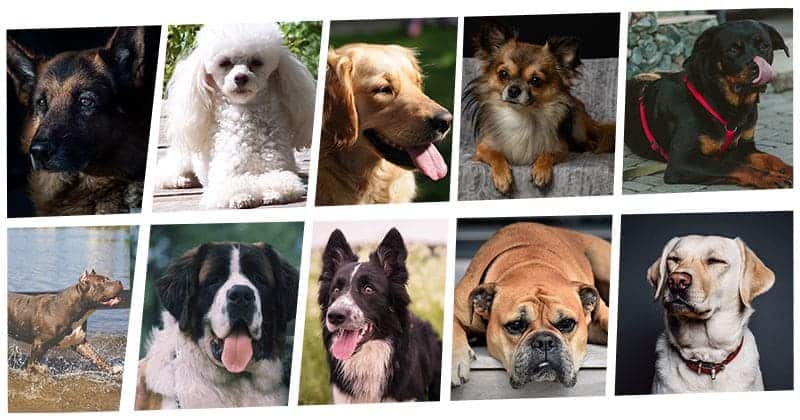
Now let me close with a picture!

Images may be subject to copyright.