The incredible story of one stray dog and a desert racer.
This has been widely reported in many other places but, nonetheless, seemed a perfect fit for a blog called Learning from Dogs!
This is the story of a stray dog that took a liking to a runner participating in the 2016 Gobi March 4 Deserts race in China. I first saw the story when it was carried on the Care2 Causes site.
How hard are you willing to work to improve your position in life? For one stray dog, the answer is: pretty darn hard.
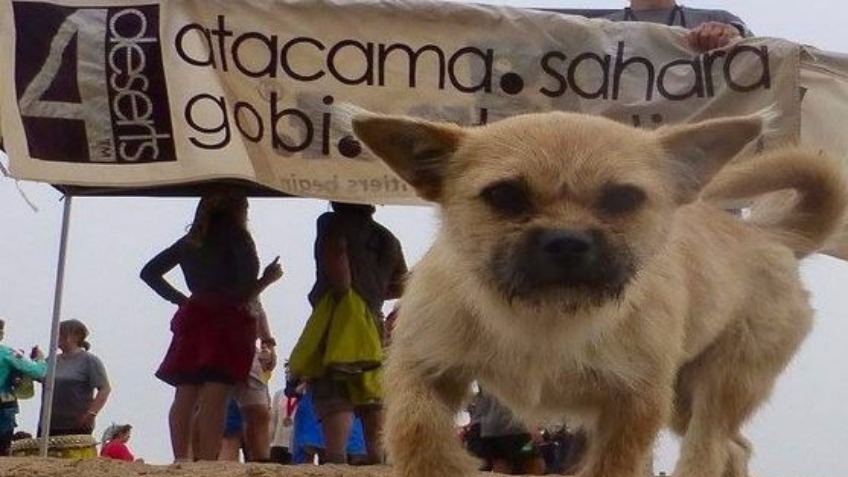
During the 2016 Gobi March 4 Deserts race in China, extreme runner Dion Leonard from Scotland was racing through the rugged terrain of the Tian Shan mountain range. That’s when a stray female pooch (eventually and aptly named) Gobi started following him.
The runner figured that she’d tire out eventually. She was a small dog, so keeping up with a life-sized human (who is an extreme jogger) probably didn’t seem likely. But amazingly, the little dog kept up.
Man who befriended stray dog during extreme desert marathon launches reunion appeal
The dog ran alongside Dion Leonard for 124 kilometres
May Bulman Tuesday 2 August 2016
Mr Leonard hopes to be reunited with the dog who ran with him during the 250 kilometre race in the Gobi desert 4Deserts.com / Omni Cai
An extreme marathon runner has launched an appeal to be reunited with a stray dog with whom he formed an “unbreakable bond” during a 250-kilometre (155 mile) race in the Gobi desert in China.
Dion Leonard, 41, hopes to raise the funds that will allow him to be reunited with the dog, named Gobi, who joined him during the annual 4 Deserts Race Series in March.
Gobi began running alongside the 101 competitors as they ran through the Tian Shan mountain range. Despite her small size the dog managed to run half of the race.
Later on in that Independent article it is reported:
Mr Leonard set up the crowdfunding page to raise funds towards organising for Gobi to be transported from China to live with him in Scotland.
The process will take up to four months and cost £5,000, with the dog having to be medically checked and quarantined before she can be cleared for entry.
A simple mouse click then takes the reader to that Crowdfunding page where the headline then shows that already over £19,000 has been raised.
That page explains:
Gobi, a friendly stray dog joined 101 other competitors running 250km over the Tian Shan Mountains down to the Black Gobi Desert during a 6 stage 7 day self sufficiency foot race. Gobi ran 4 stages including the final 10km stage to the finish line, showing unique strength and stamina for a little dog to keep up with the runners in such grueling conditions.
Everyone from the competitors, volunteers and race crew fell in love with this little dog that captured all our hearts. Gobi took a shine to me and over the week we developed an unbreakable bond as I shared my sleeping space, food/water and ultimately our companionship.
Now let’s hear from Dion.
Time and time again our wonderful dogs inspire us to reach out; to never say never!
The lesson of love from our dogs just keeps rolling along.
Neighbour Dordie had the following sent to her in an email and, subsequently, passed it on to me.
I share it with you and hope that it brightens your day.
ooOOoo
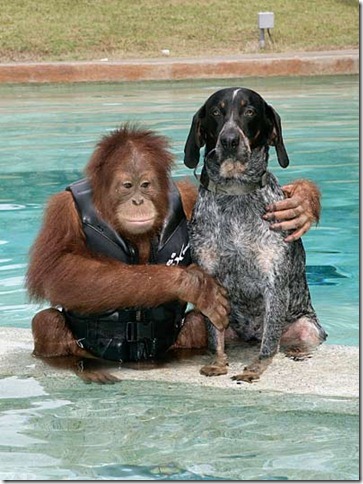
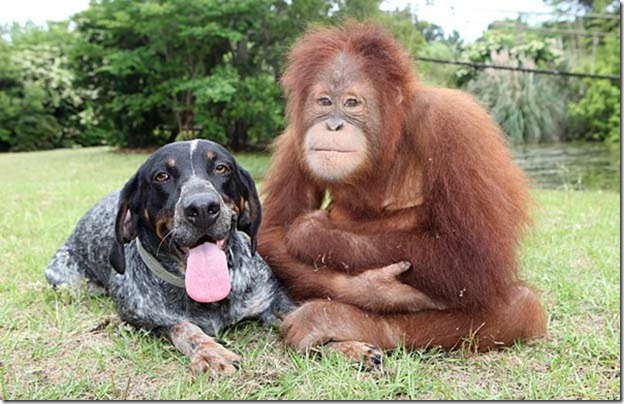
After losing his parents, this three-year-old orangutan was so depressed he wouldn’t eat and didn’t respond to any medical treatments. The veterinarians thought he would surely die from sadness.
The zoo keepers found an old sick dog on the grounds in the park at the zoo where the orangutan lived. They took the dog to the animal treatment center; the dog arriving at the same time that the orangutan was there being treated.
The two lost souls met and have been inseparable ever since. The orangutan found a new reason to live and each always tries his best to be a good companion to his new-found friend. They are together 24-hours-a-day in all their activities.
They live in Northern California where swimming is their favorite past-time, although Roscoe (the orangutan) is a little afraid of the water and needs his friend’s help to swim.
Setting a fabulous example of what an animal shelter should be like!
The chances are that the great majority of domestic animal lovers have an impression of the standard animal shelter. The chances are that this impression is not one of wall-to-wall approval. It is tragic that animal shelters are required but it is a fact of life that they are needed. Many of them depend heavily on volunteers and donated money.
But that’s not to say that there can’t be a shelter setting a very high example of how a shelter should be.
The words “county animal services” don’t really evoke thoughts of luxury, comfort or state of the art anything, but Miami-Dade is about to change that.
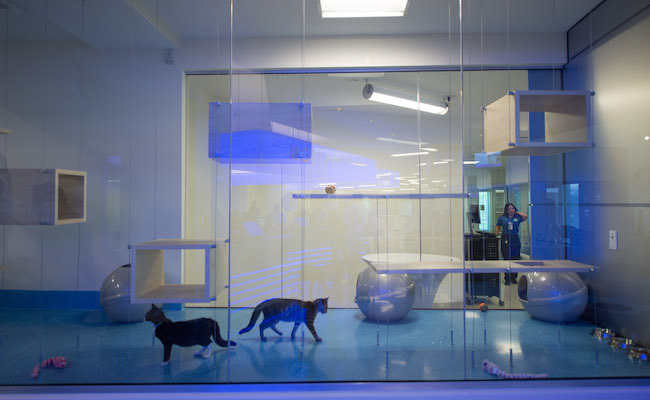
In June, the county opened its first ever “adoption mall,” an air-conditioned, high tech building where potential adopters can “shop” for their new furry best friend without even realizing they’re in a shelter.
“The old shelter was outdated and we wanted more capacity and to improve the wellness of the shelter pets,” explains Alex Muñoz, Director of the Animal Services Department about the project. “We have both cages and free roaming rooms and all areas for pets are air-conditioned.”
The Miami-Dade Animal Services Pet Adoption and Protection Center is a massive 72,000 square-foot facility that sits on five acres. Instead of sitting in kennels that don’t have much more than a small bed or sometimes just a couple of blankets on the concrete floor, adoptable dogs have plenty of space to move around and they stay stimulated in the outdoor canine exercise areas. When they’re done playing they can then retreat inside where the temperature controlled rooms keep them safe from the Florida heat.
For the kitties, a lounge area filled with toys allows them to play or just communally nap–after all, they are cats.
In 2015, Miami-Dade became a no-kill county, reaching a 90 percent save rate for all animals going into its shelters. Now with the larger building, the department was also able to expand the number of animals it houses. The new facility has 25 percent more dogs and 50 percent more cats than the previous shelter.
Since disease outbreaks are not uncommon in shelters, the new facility was built to prevent the spread of viruses among the animals.
“The HVAC System includes multiple air exchanges per hour to clean the air in order to avoid air borne diseases,” says Muñoz adding that “dogs are separated in different pods to avoid cross contamination.”
With the new spiffy location, the county is also hoping to fight the association people make of shelters being depressing and its animals sad or broken.
A 2013 study done by Best Friends Animal Society found that 46 percent of people considered shelter pets second-rate compared to dogs from breeders and only 31 percent of young people were willing to consider a shelter adoption.
In addition to happier and more comfortable animals, the building also houses professionals and volunteers who will spearhead programs advocating for rescuing, fostering, caring for neonatal kittens and working with Miami-Dade County Public Schools to teach kids about responsible pet care.
This new type of shelter comes with a hefty price tag of $15 million but Muñoz says it could definitely be implemented anywhere.
And, please, if anyone who reads this is thinking of getting another cat or dog then do make a visit to your nearest shelter your first step. For if all the dogs and cats in shelters were found good homes there would be no need for shelters. An idyillic dream, I know!
Yesterday, Val published a post over on her blog Find Your Middle Ground that really ‘spoke’ to me. That’s not to imply, by the way, that her other posts don’t very often reach out to me and, undoubtedly, to many others.
Val’s post was called The Depths of our Relationships and explored the different levels of relationships that we have with others in and around our lives.
Instinctively most people would regard us humans as far more complex than our animal companions. As the old Devon (South-West England) expression goes, “There’s now’t so queer as folk.”
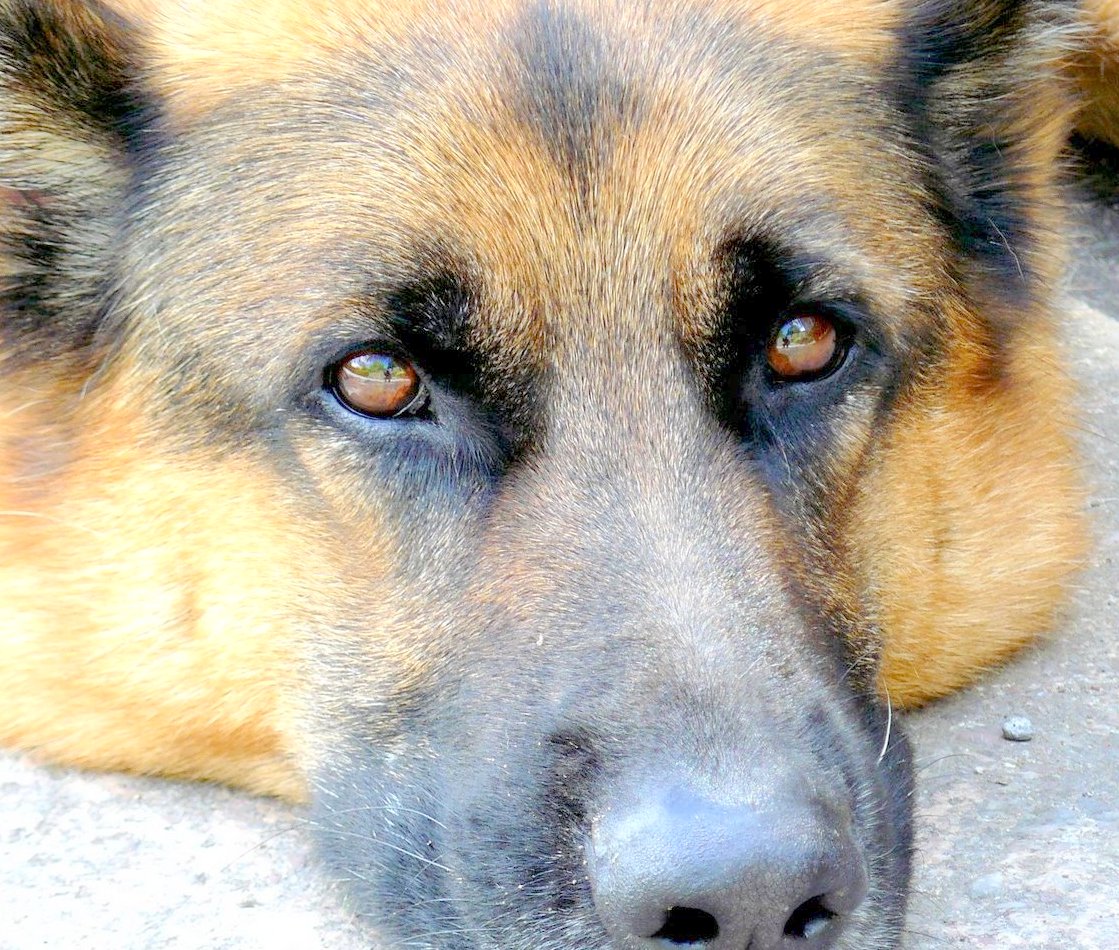
Yet, once we have really got to know a dog there will be many who will see behind those fabulous eyes a sense of a depth of character, a soul comes to mind, that suggests that the brain of the dog offers a canine psychological complexity most of us don’t allow for.
To support that proposition just look at the eyes of Pharaoh in this photograph going back to June, 2007.
However, today I am republishing Val’s recent post and I do so with great pleasure.
I read an interesting article some time ago by coach Michael Neill on how there are different levels in our relationships with others. I’m not talking about literal closeness, for example a brother is closer than a colleague at work, but more about our ability to truly connect in an authentic way with another person.
Have you noticed that you can feel a deep connection almost immediately with a stranger? Or feel like a member of your family is hiding behind a mask and being superficial? … That’s what I am talking about.
Surface Level – How we pretend to be
On the surface, people present themselves to the world in whatever ways they would like to be seen. They may be clever or cynical, light and cheerful or intellectual and deep. This is our persona or the “mask” of our personality, often revealing our fears, judgments, and insecurities in the very attempt to hide them.
Whether we enjoy or dislike someone’s personality is fairly arbitrary – an accidental coming together of our own innocently acquired preferences and prejudices from a young age.
But like it or not, at some point the mask slips and we see through to…
One Level Deep – The selfish self
Underneath the masks of personality, we’re continually navigating the world through a swirl of thought. Because we feel that thinking is coming at us from the outside world, we tend to see our actions, as one of my clients once put it, as being ‘the only sane response to an insane world’.
This is how we justify our ambition and ruthlessness; our cruelty to ourselves and others. After all, if it wasn’t a dog eat dog world out there, who would ever want to eat a dog?
When we see through someone’s “nice person” or “tough guy” mask, we often see only as far as this level. And it’s difficult for most of us to feel warmly towards someone who is seemingly only out for their own self-aggrandizement or self-preservation.
Until, that is, we see through to…
Two Levels Deep – Doing the best we can as we’re all in this together
There is a quote often attributed to Philo of Alexandria that we should “Be kind, for everyone you meet is fighting a hard battle.” This is not only true in the physical world, where our bodies begin to decay long before our thoughts are ready to let go, but also in our innate psychology.
Every human being I know wants to love and be loved; to be happy more and suffer less; and to feel like in some way their life had meaning and value. How they go about achieving these aims is a product of their level of understanding and experience of the world.
It’s easy to love people “two levels deep”, because we see ourselves reflected in them. We all have a natural compassion for the suffering of others and an abiding conscience which ensures that while we may at times act in ways that are harmful to ourselves and others, we do it in spite of and not because of who we are at core.
Loving people at this level doesn’t mean we have to live with them or let them get away with murder, literally or figuratively. It just means that we don’t get so upset by their humanness or carried away by our own delusions that we can escape the human condition.
While seeing through to people’s innate humanity makes for richer and more wholesome relationships, there is a level beyond even that which takes us past the illusion of separation which allows us to play judge and jury to our fellow humans…
Three Levels Deep – Who we are before the fact of thought
Who are you before thought comes into the equation? Mystics throughout time have described our essential nature as being made of spirit – a name for the invisible life force that makes up the visible world of form.
It’s difficult to even talk about “loving someone” at this level because rather than two or seven or even seven billion separate people, there is simply the presence of Love with a capital “L” – and as we dissolve and surrender into that Love, we fulfill the age-old proverb that “we are that which we seek”.
We are one in shared consciousness and spirit.”
p.s. This makes me think about how that pesky neighbor, or annoying colleague and Donald Trump appear one level deep for many of us.
ooOOoo
Val concluded her post with the proverb “we are that which we seek”. I used a very similar idea as the title to today’s post, “We are what we think of most!“. I am clear in my own mind that those two sayings are opposite sides of the same coin.
All of which reinforces in spades the benefits that flow from open and honest self-awareness.
If only for the wonderful quality of a deep sleep that results from that self-awareness.
Anyone who has been close to dogs in their lives knows that they are frequently very vocal creatures. Likewise, anyone who has been close to a dog or two quickly learns to understand the basic emotions being conveyed by a dog’s vocal sounds.
But, nonethless, there was an item over on the Care2.com site recently that provided a comprehensive tutorial on listening and interpreting the sounds from our dogs. I wanted to share it with you today.
Your dog communicates with you and other dogs in a variety of ways — including growling. Depending on the context, a growl can be anything from a sign of enthusiastic play to a warning of an impending attack. It is important to understand why your dog growls and when you should be concerned about this behavior.
A growl doesn’t always signal an unfriendly dog. Here are some common reasons your dog might growl and some situations where you may need to seek outside help.
Growling in Play
Dogs often growl during friendly play with other canines. This type of growling is typically higher pitched and shorter in length than other growls. To ensure that play is friendly, watch for the proper play signals and keep arousal levels low by taking frequent breaks.
Your dog may also growl when he plays with you. Pay attention to your dog’s body language during play — sometimes growling can indicate discomfort. Avoid rough play with hands and physical wrestling. If you are unsure about the distinction between acceptable play interactions and aggression, seek help from a professional.
Growling as a Warning
A dog who is afraid of something may growl to fend off potential harm; the message he’s sending is that he will defend himself if necessary. Some dogs may growl at any unfamiliar person, while others may respond only to specific types of people, like men with beards, or to sights they are uncomfortable with, such as a horse. If your dog growls only at specific people or things, remedial socialization help is needed.
Or your dog may growl at another dog as a way to tell him to back off before a confrontation occurs. Many times, the other dog will heed the growl and give your dog the space he desires. There are dogs, however, who will not back down when they are growled at; in this situation, a fight may ensue.
If your dog’s warnings to back off go unheeded, his growling may increase into other aggressive behaviors, making it difficult for him to be around other canines. Some dogs do best with only select doggy playmates, while others should be limited to socializing only with humans.
Growling for Medical Reasons
If your dog suddenly starts to growl when he is approached or touched, it may be a sign that he is in pain. Dogs with arthritis, abscessed teeth or other forms of illness or injury may experience increased pain when they are moved or touched and may growl to avoid it. A pet in pain is also more likely to bite than a healthy pet.
Pregnant or lactating dogs, or dogs in false pregnancy, are more likely to be protective and defensive with people and other animals, and are also more likely to growl at approaching humans. If you think your dog is growling for medical reasons, talk to your veterinarian.
Growling Out of Frustration
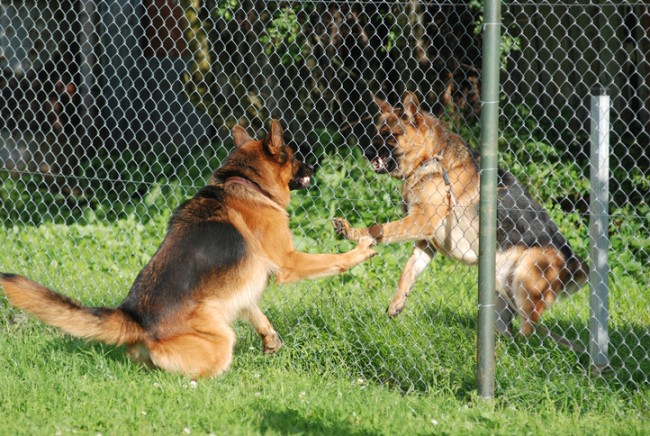
Your otherwise-friendly dog may growl as an expression of barrier frustration. A dog may growl or bark when he is on leash or behind a fence, even if he is comfortable with other dogs when he is off leash. Dogs who growl in these situations need to be trained to relax when on a leash or behind a fence, as territorial or frustration-based behavior can escalate over time. Your dog should never be chained up outside, as this can lead to extreme territorial and protective behavior, which puts the dog, other animals and people in danger.
When to Seek Outside Help
Growling is a way of communicating — for instance, his way of saying, “Give me space,” “Stop it,” or “Back off.” But certain situations — growling when approached or handled, and growling as part of resource guarding — require professional help. A dog who is engaging in resource guarding may be protecting food, toys or people, or his favorite places, like a sleeping space. Even with the best management plan in place, a guarding dog may escalate his aggression, which is why this behavior calls for professional intervention.
Your dog may also growl when he is handled, either because he is uncomfortable or afraid. He may growl when his collar is grabbed, his toenails are trimmed, his ears are touched or his mouth is opened. He may also be uncomfortable with direct eye contact, a person leaning over him, hugs or other forward greetings. Again, this behavior can escalate to something much more dangerous.
Talk with your veterinarian about these behaviors as soon as possible; have your pet’s health evaluated and, if necessary, ask for a referral to a behaviorist or trainer who can help you teach your dog strategies for coping with these situations.
By Mikkel Becker | Vetstreet.com
ooOOoo
You can imagine that with nine dogs here in the house there are times when Jean and I struggle to hear each other over the top of the doggy conversations.
Another day yesterday where my creative juices had evaporated; if that’s what creative juices do!
But that doesn’t devalue the following article in the slightest! An article that was recently read on the Care2 blogsite and is republished here for your pleasure.
ooOOoo
Prisoners Care for Deaf Dogs Displaced by Wildfire
The so-called Sand Fire that burned for over a week near Los Angeles didn’t only threaten wildlife sanctuaries. Soon after the wildfire started on July 22, Mark and Lisa Tipton, owners of Deaf Dog Rescue of America (DDRA), a non-profit organization that rescues, trains and rehomes hearing-impaired dogs, decided it was better to be safe than sorry. They evacuated the rescue ranch’s nearly 50 residents.
“It was no small feat to assemble crates, pack them into trucks and trailers, and load the dogs,” Lisa wrote on the DDRA Facebook page. “Backbreaking and stressful. We have wonderful paid kennel staff here which is why we were able to evacuate the dogs so smoothly. Nobody got bitten, no loose dogs, no drugs were used. They stayed with us in our time of need and they were rock stars.”
The Tiptons were eventually able to find a temporary home for the dogs at the California state prison in Lancaster, which invited them to bring the dogs there. Mark happens to operate the Karma Rescue Paws for Life dog-training program for the prison’s inmates. It is California’s first and only dog program in a high-security prison. Many of the participants are serving life sentences.
In this program, dogs rescued from high-kill shelters around Los Angeles County live full-time with the participating inmates. Over a 12-week period, the inmates learn how to train the dogs for Canine Good Citizen certification. This certification helps the dogs become more adoptable and, in turn, helps save more dogs from shelters. The inmates benefit by learning real-world skills and giving back to society by helping these dogs get another chance at life.
“Paws for Life restored my faith in humanity that I’m a person, that I matter,” inmate trainer Jon Grobman told KABC. “It gave me the opportunity to care for something, love something.”
In the two years the program has been offered at the Lancaster prison, 75 former death-row dogs have found forever homes.
‘They Were Thriving Under Their Care’
After the Tiptons dropped off the dogs, they returned to the DDRA ranch to check on the fire, get some sleep and gather up more supplies for the dogs.
“The dogs were bewildered and watched us walk out the gates,” Lisa wrote on Facebook. “The looks on their faces made me cry when things quieted down and I had time to think about it. I have to admit that I felt guilty leaving them there.”
The couple returned to the prison the next morning with food for the dogs – which, along with the feelings of guilt, wasn’t necessary.
“The inmates had handled breakfast beautifully,” Lisa wrote. “They were getting the dogs out for exercise and cleaning their runs… I have never, ever seen anyone clean up dog poop with such glee.”
Nor had she ever seen the dogs so comfortable around strangers. “[They] were thriving under their care,” Lisa wrote, “and had wagging tales and smiles on their faces.”
Thankfully, DDRA survived the Sand Fire. All the dogs returned to their home July 30.
“Can pretty much guarantee that when they are all safely in their kennels snoring,” Lisa wrote, “I’m going to melt into a huge puddle of tears from sheer thankfulness and relief.”
Coincidentally, while the inmates at the Lancaster prison were caring for the displaced deaf dogs, L.A. County Supervisor Michael D. Antonovich proposed that, to help with overcrowding in animal shelters, a new one should be built at the Pitchess Detention Center in Castaic.
“Such a program could be a cost-effective and progressive way to integrate the needed care of animals with positive benefits to our inmates,” he wrote.
The feasibility of such a shelter is being analyzed by county animal welfare officials and the sheriff’s department. A report on their findings is expected later this month.
Sometimes the most obvious solutions take the longest to find.
I feel a little embarrassed that this introduction may come across as rather self-indulgent; I don’t intend that.
My purpose is to offer an introduction to a recent blogpost from Sue Dreamwalker that explains why her post really ‘spoke’ to me and why it felt important to share Sue’s post with all you good people.
Subsequently, I left a follow-up to my first comment, replying to a comment from Diane Husic. This is what Diane wrote:
Many of us realize what a critical junction the country faces in this election cycle. As an academic, I am trying to figure out the appropriate role I should play. We need to teach students to be respectful of difference, to be tolerant, to be problem solvers, and to be civically engaged, but we aren’t supposed to use our positions to “force” our political views on them. But given the magnitude of issues confronting the planet and humanity and the importance of having leadership that “gets it” (and displays compassion and empathy), this is a tough balance to try to find.
and this was my reply to Diane:
Diane, as someone who previously has run his own business and then, after selling it in 1986, spent a number of years as a mentor with the Prince’s Youth Business Trust in the UK, I have come to the conclusion that the best role model we adults can offer our ‘students’ is this: “Be the best you can be!” That flows from being fully aware of the person that one is. For self-awareness is the key to understanding oneself and, consequently, of understanding others. Understanding why people think and behave the way they do, for good and bad, is the only effective way of engaging with others and seeking that ‘civic engagement’ so critically important.
Apologies, that paragraph sounds like a damn speech! I didn’t intend it to be so. Plus, my own journey of self-awareness has been a long and tortuous one – but that doesn’t change my view just expressed.
Her recently released book on the effectiveness of Role Montage in building leadership skills is highly relevant to today’s students. In Jan’s words (and I have no commercial or financial link with Jan):
Role Montage: A Creative New Way to Discover the Leader Within You is written from Jan’s experience with her client work and her research. It helps leaders explore self-awareness and leadership using the role montage process.
I’ll creep back into my hole!
You can see why I offered a warning about coming across as self-indulgent!
But if you have stayed with me so far (and thank you) you will now understand why Sue’s post spoke so clearly to me. Republished here with Sue’s very kind permission.
ooOOoo
Set Yourself Free..
by Sue Dreamwalker. July 28th, 2016.
This morning I switched on the radio and the first record I heard was this one.. It was the very first time I had listened to this recording, never hearing it before.. It made me smile.. Especially when it mentioned taking Calcium and taking care of our knees.. So I decided to YouTube it to listen to again and to my delight found several versions..
Life has been busy within the Dreamwalker’s Domain this last week.. Last night I was so tired I went to bed at 7pm and slept for 12 hours.
Today the Universe thought to allow me to cool down in the showers of rain, so I thought I would share about my Busy time in the Sun on my Gardening Blog. And to share what brought such a smile to my face first thing this morning..
I particularly enjoyed the lyrics in the middle of this narrative of the inclusion of Rozalla’s Song Everybody’s Free to Feel Good, which is an old favourite of mine..
So Go On FEEL GOOD and DANCE.. LAUGH and SING..
And SHARE THE FEEL GOOD FACTOR
Sending Love and Blessings
Next time I will share with you the village I grew up in as we went back to see the Well Dressings.. Along with some of my thoughts..
Sue
ooOOoo
Feeling good about ourselves is the result of knowing and liking who we are. The foundation stone of knowing and liking all the many good people we interact with throughout our lives.
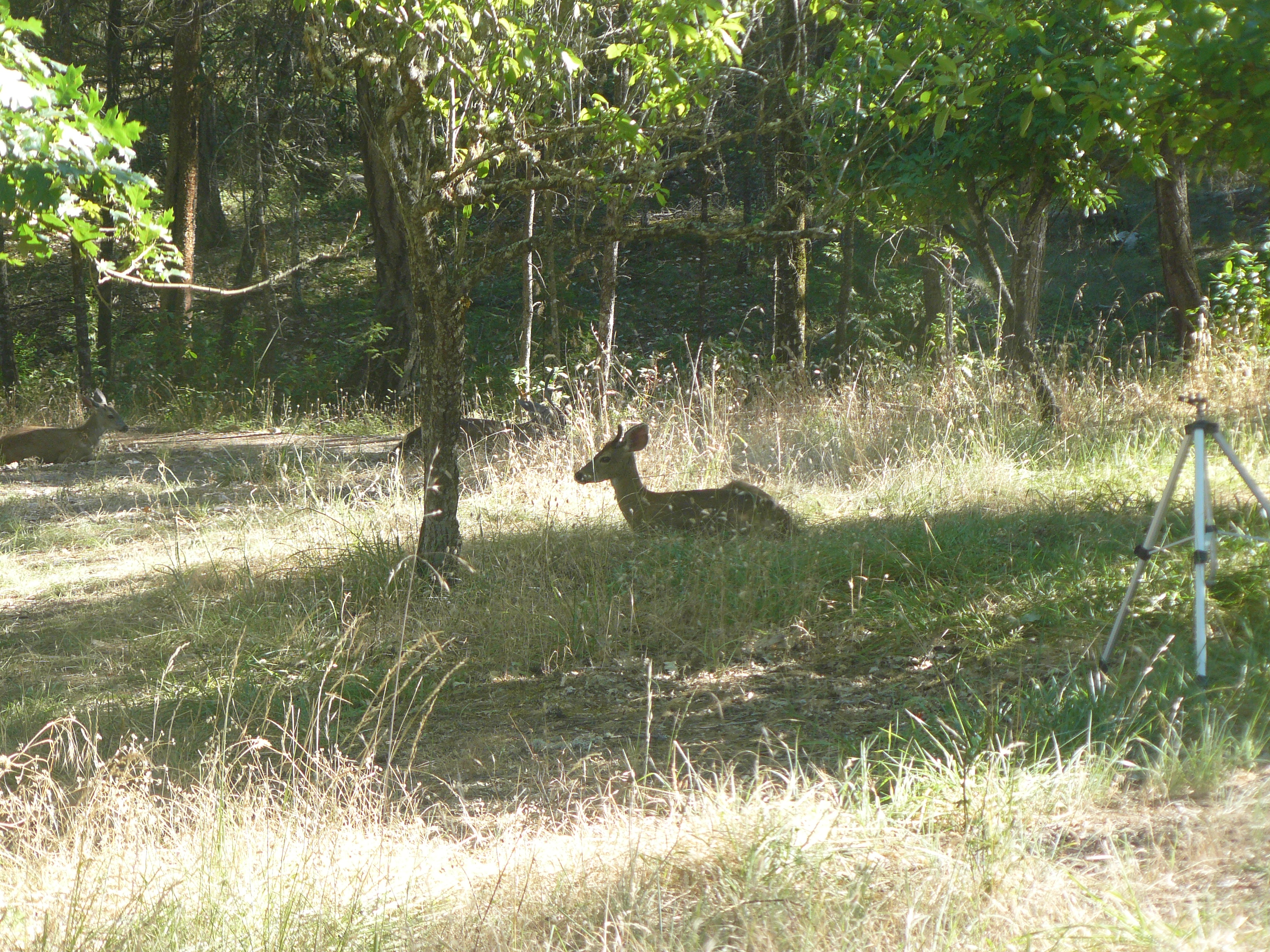
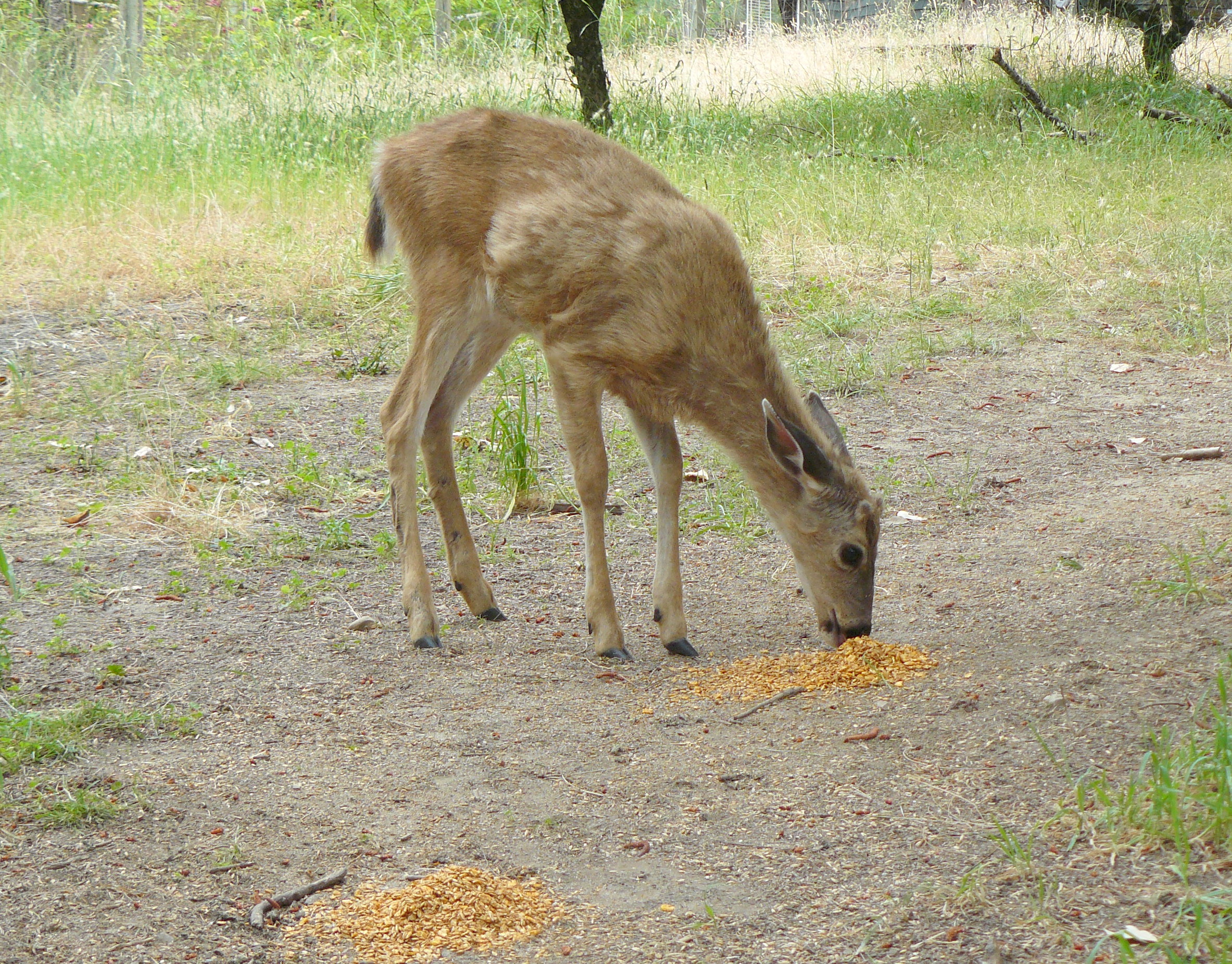
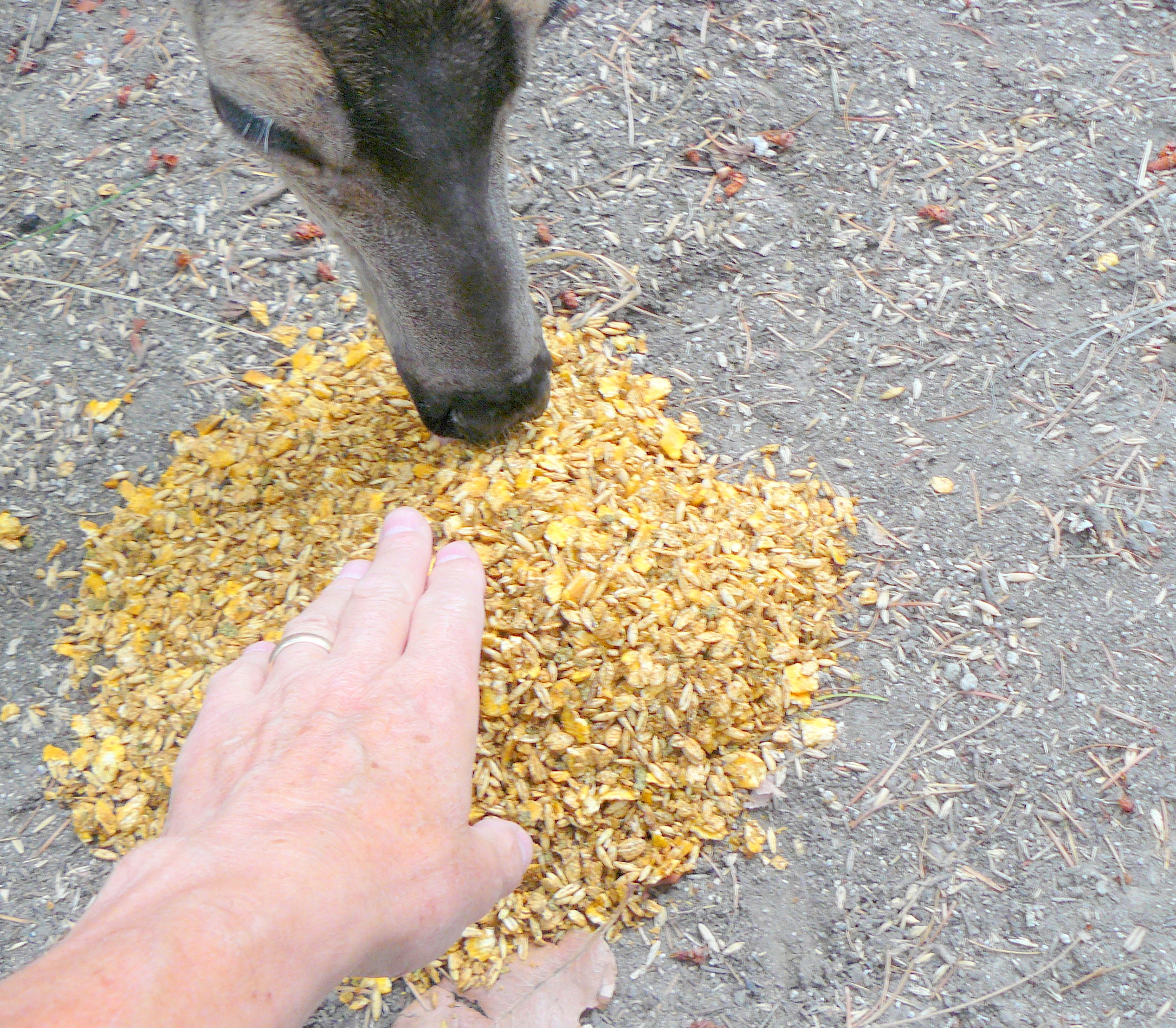
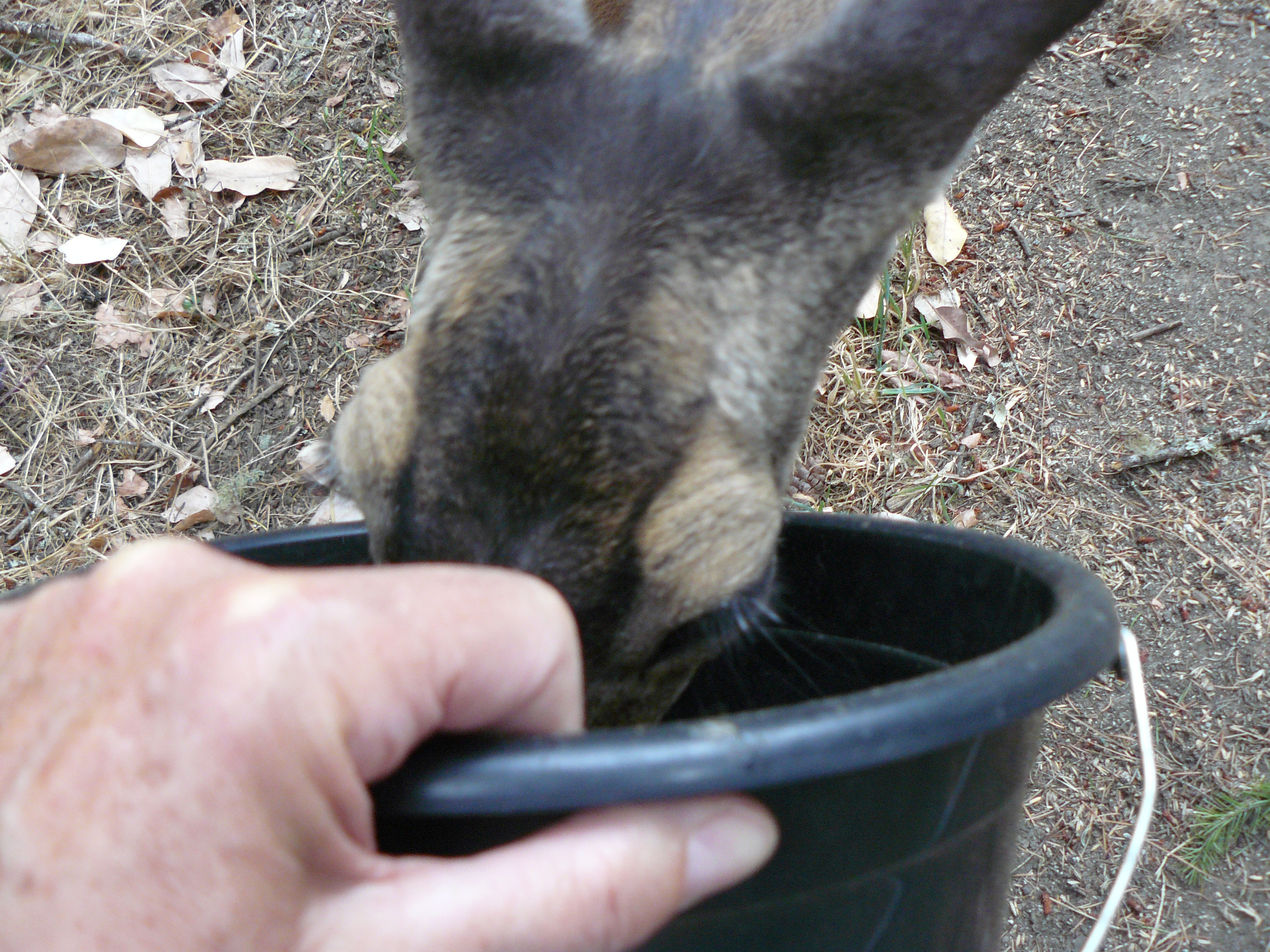
Returning to the photographs of the deer that come to our property.
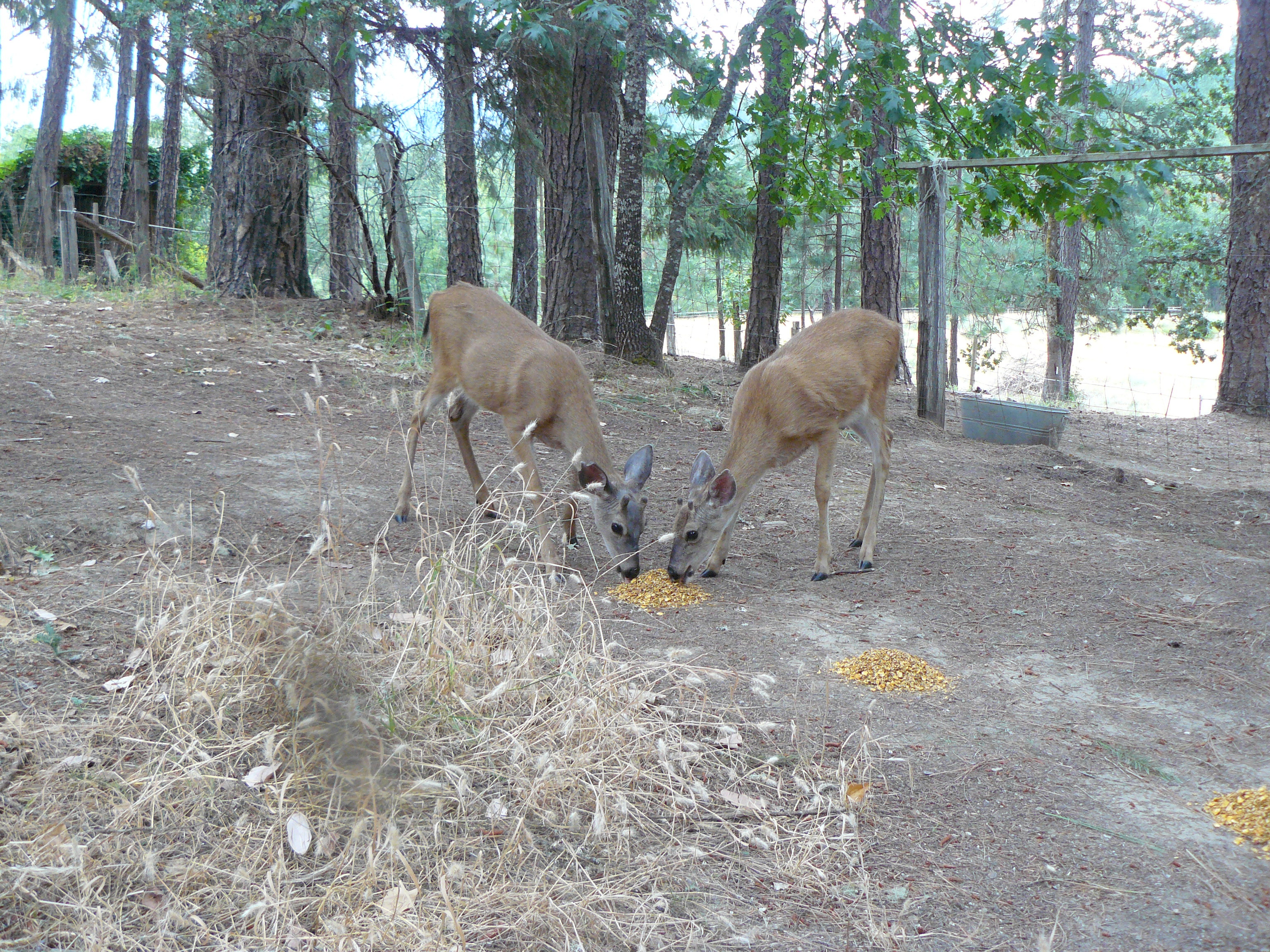
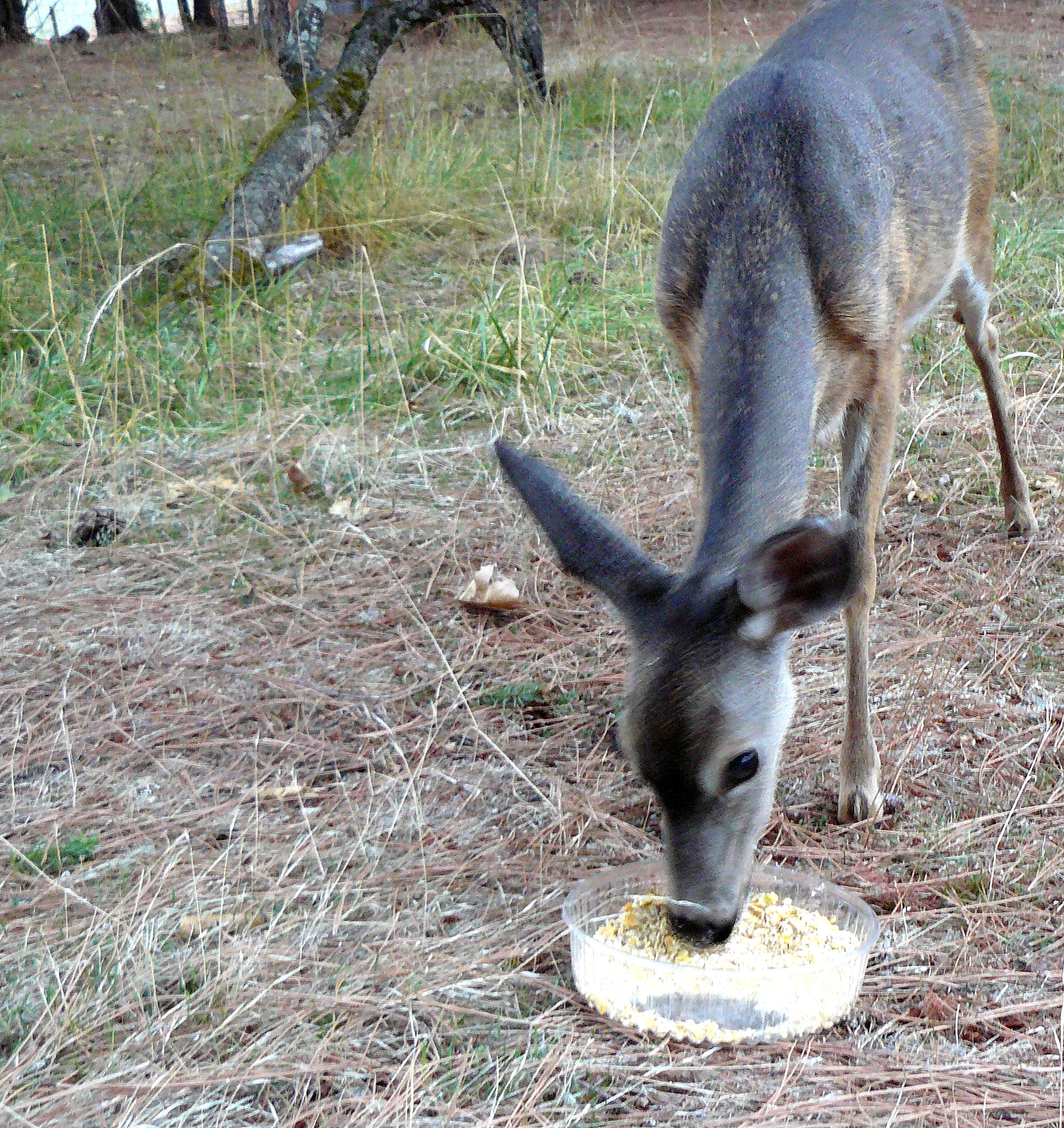
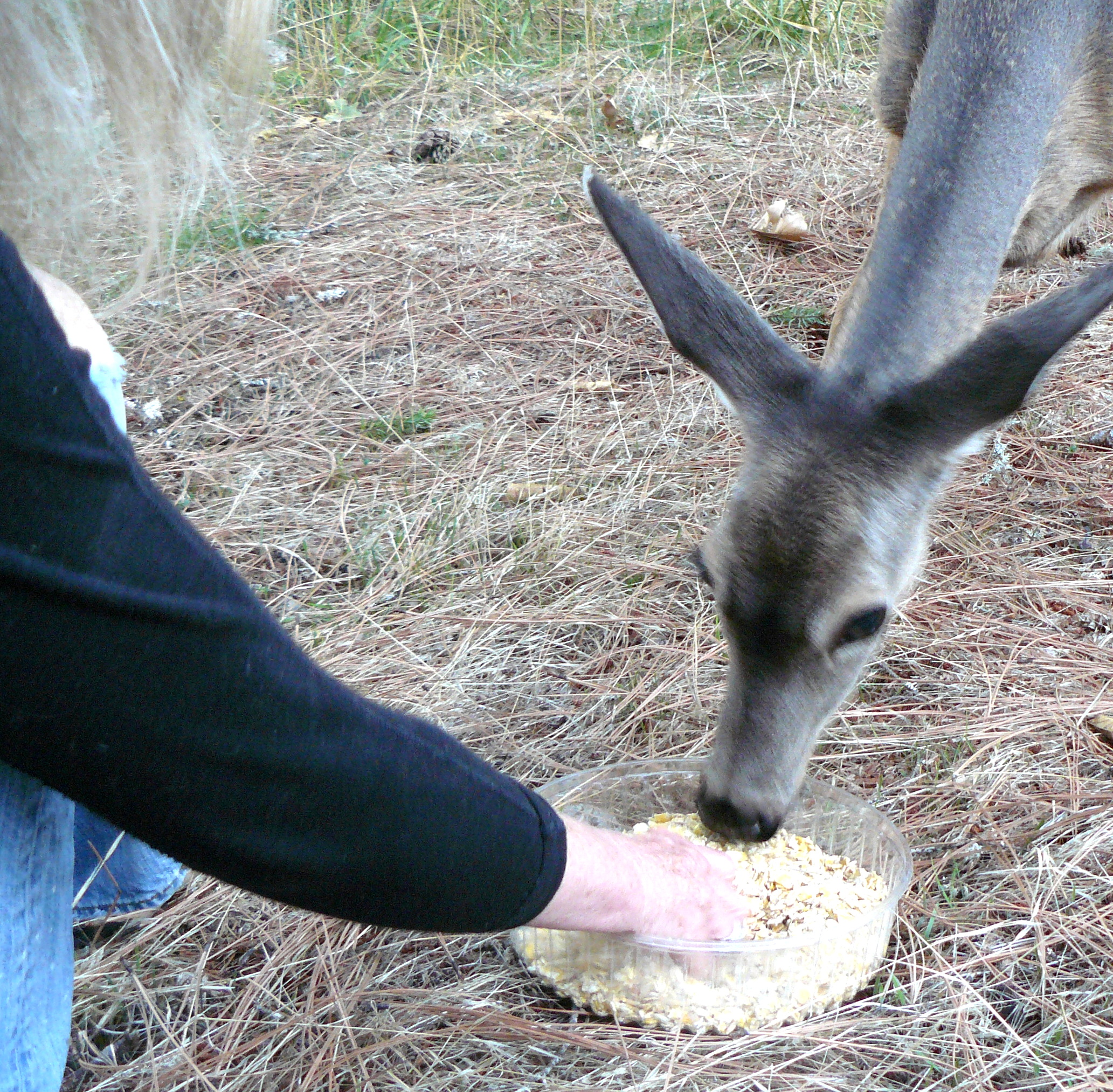
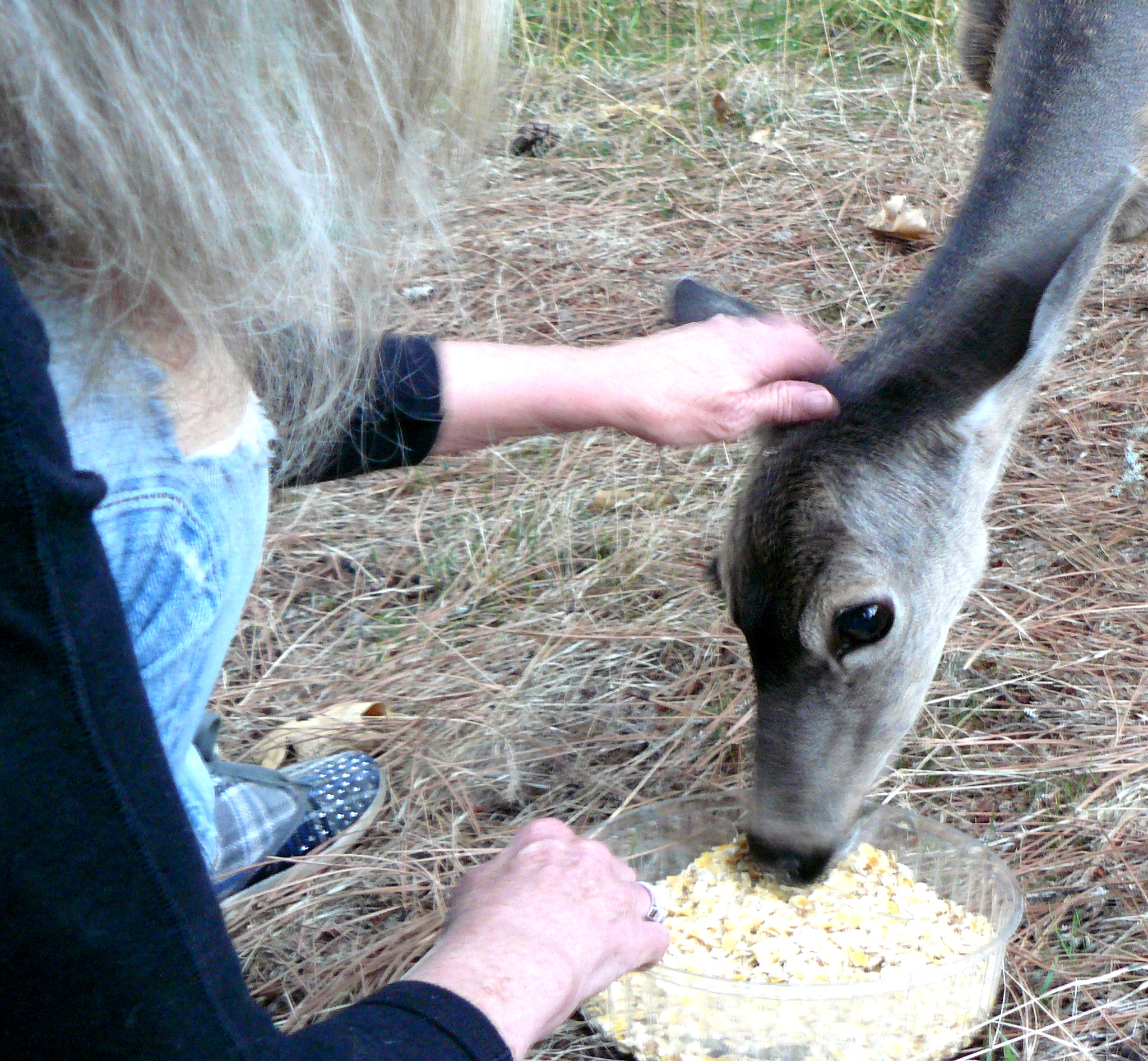
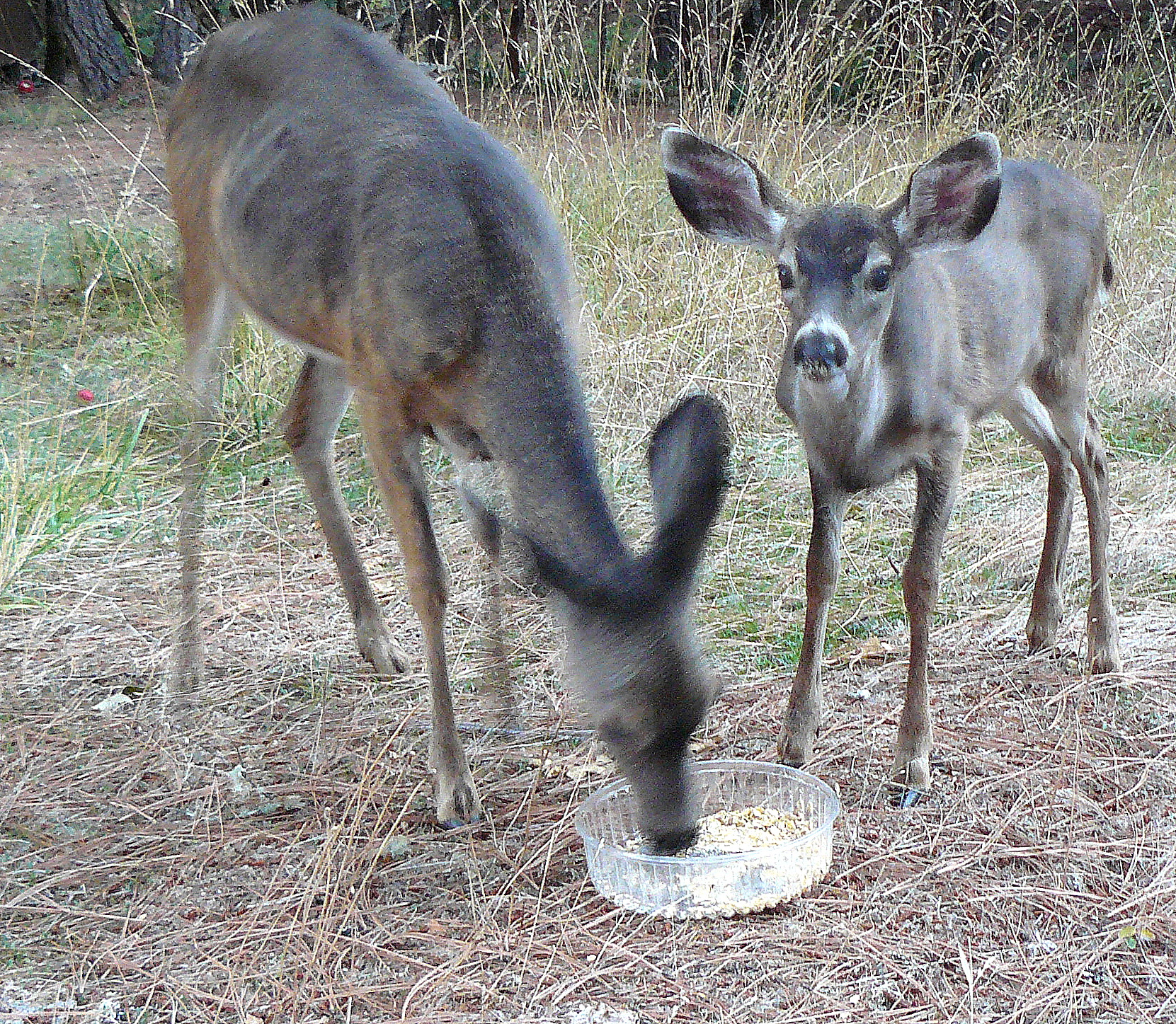
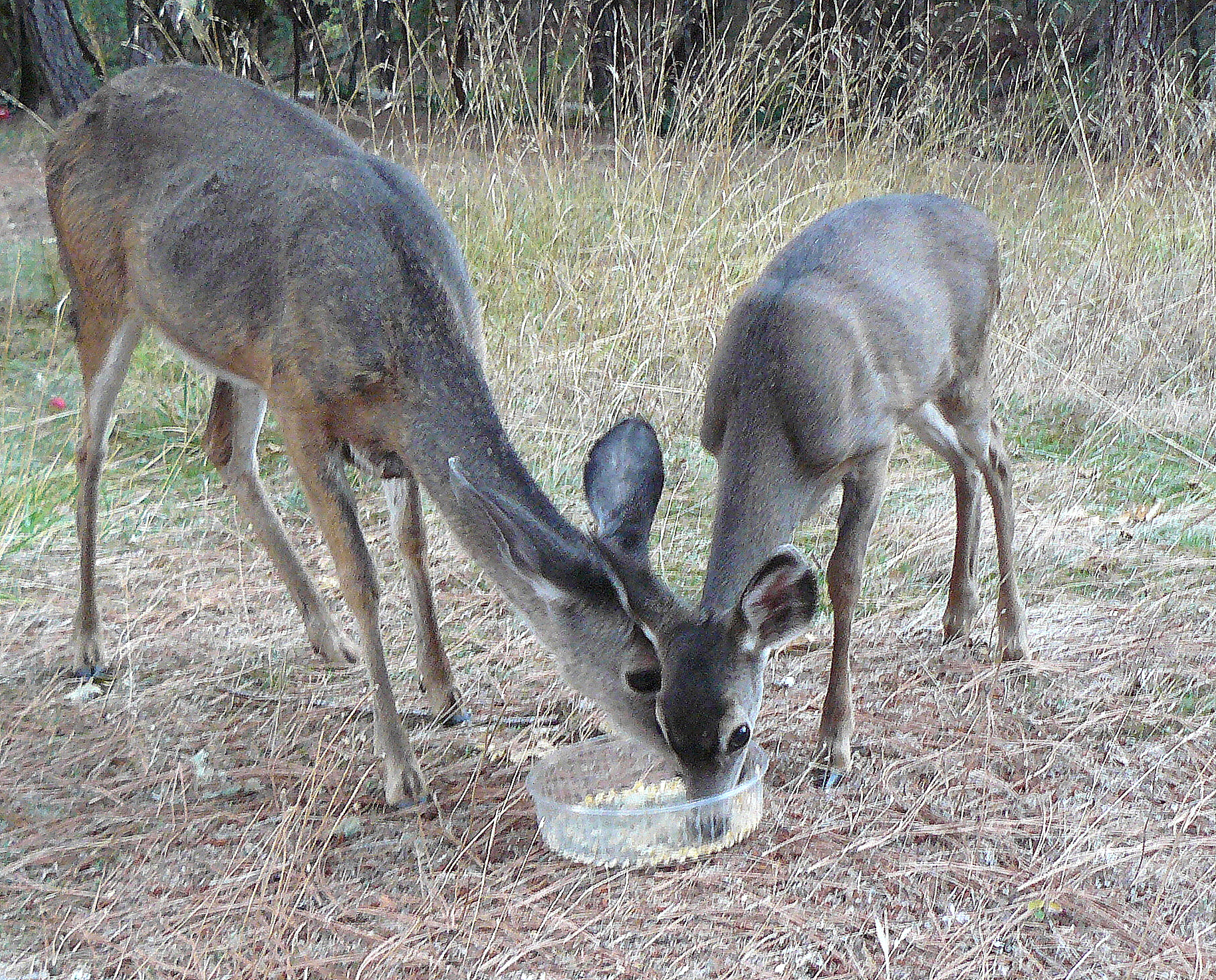
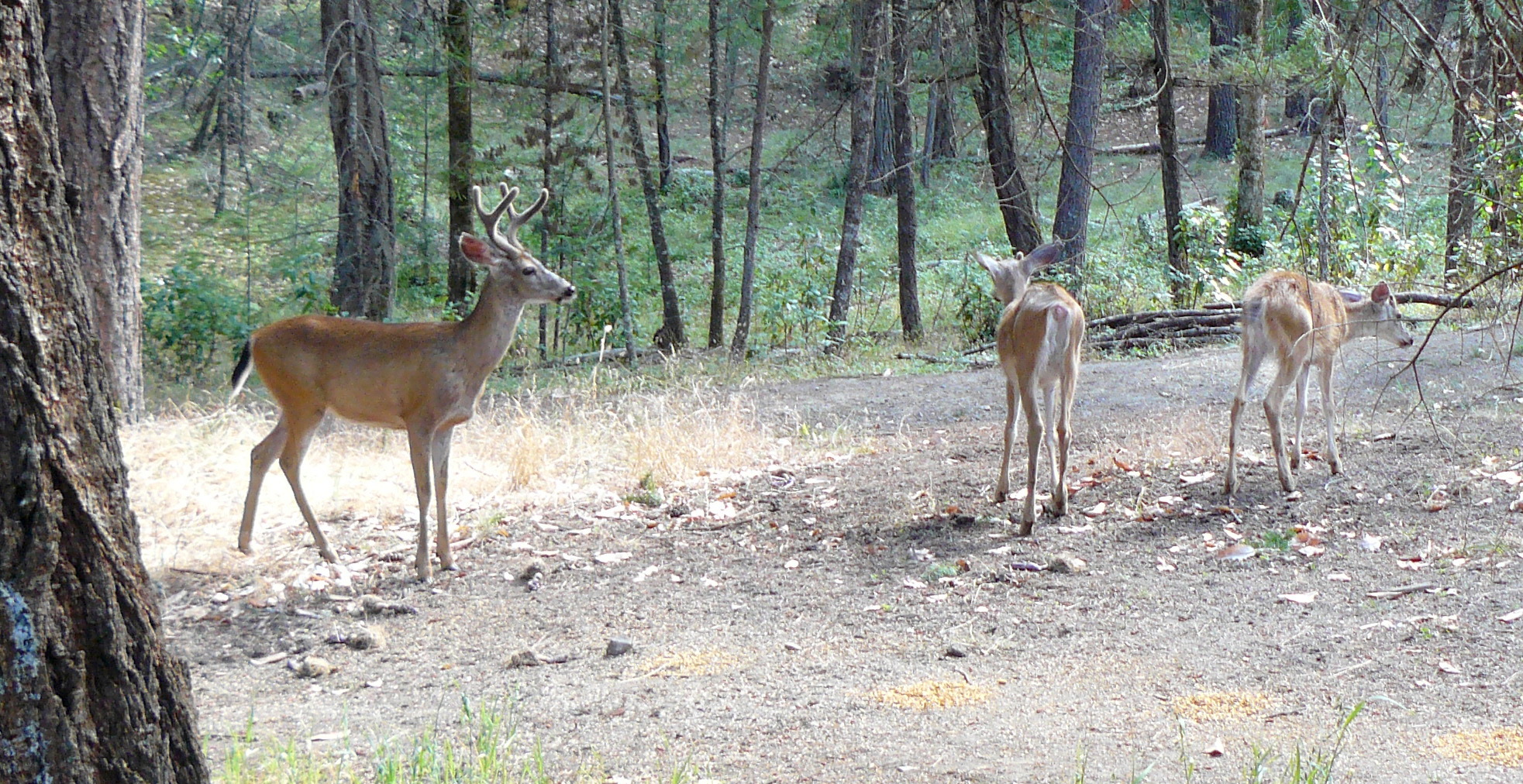
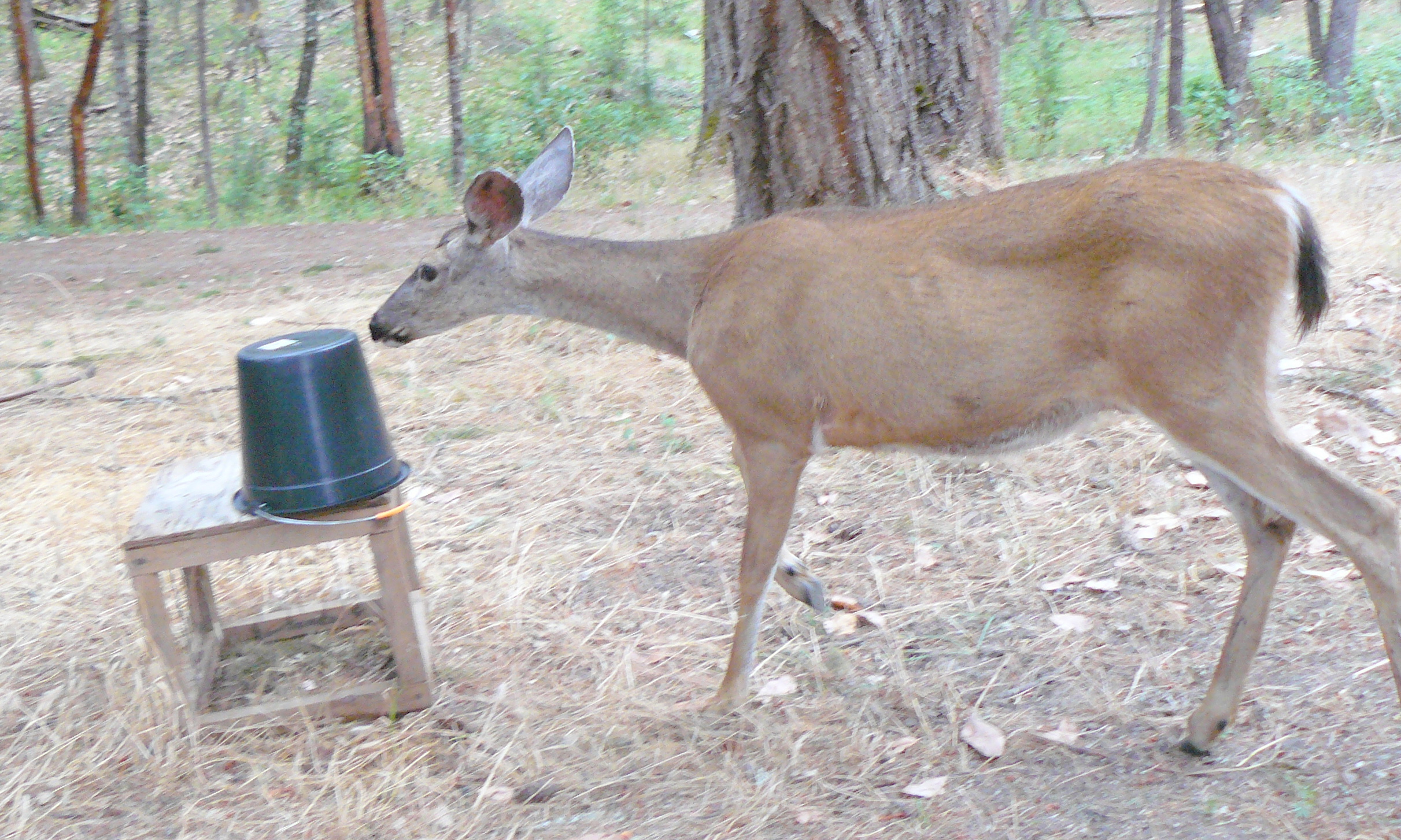
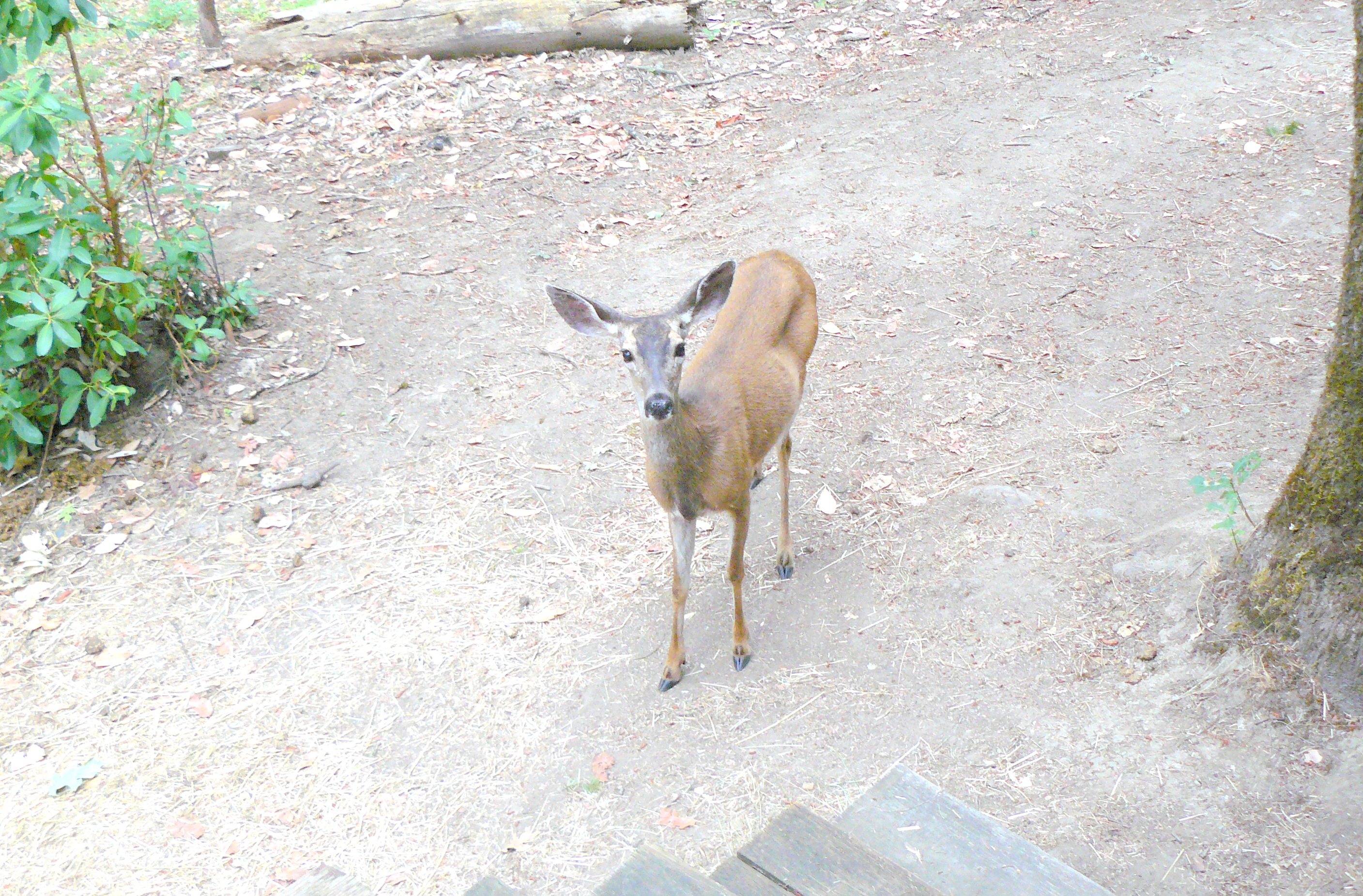
Feeding the deer has been featured before on Learning from Dogs but I just wanted to devote today and next Sunday to nothing more sophisticated than photographs; all of them taken here at home.
Photograph taken mid-January, 2014
oooo
A deer reaches down to feed; the tray is about three feet in front of Jean and me. (October, 2014)
oooo
Jean reaches forward and gently draws the tray closer to us. The deer continues to feed. (October, 2014)
oooo
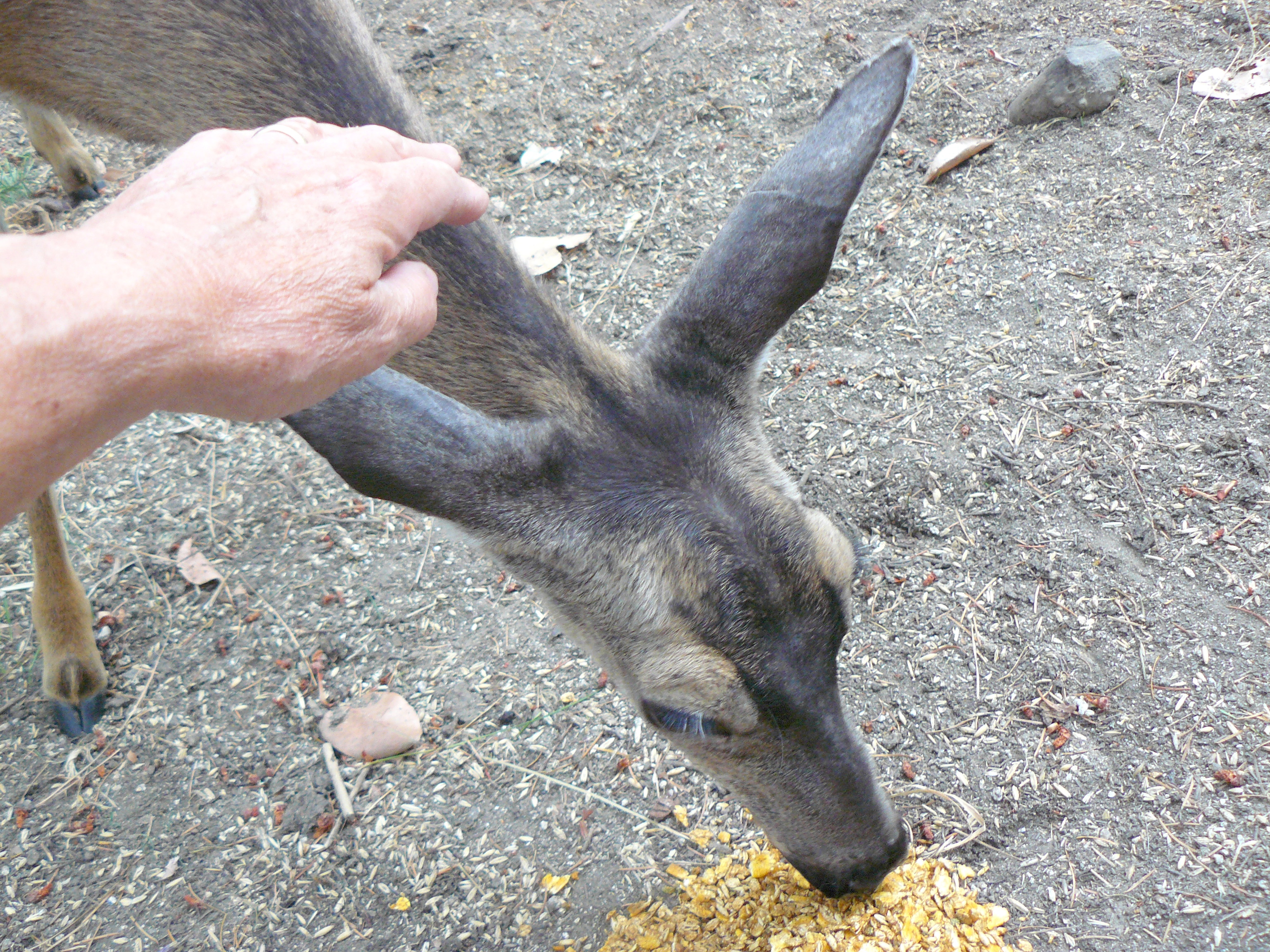
Then, unbelievably, the wild deer continues feeding as Jean fondles the deer’s head and neck. (October, 2014)
oooo
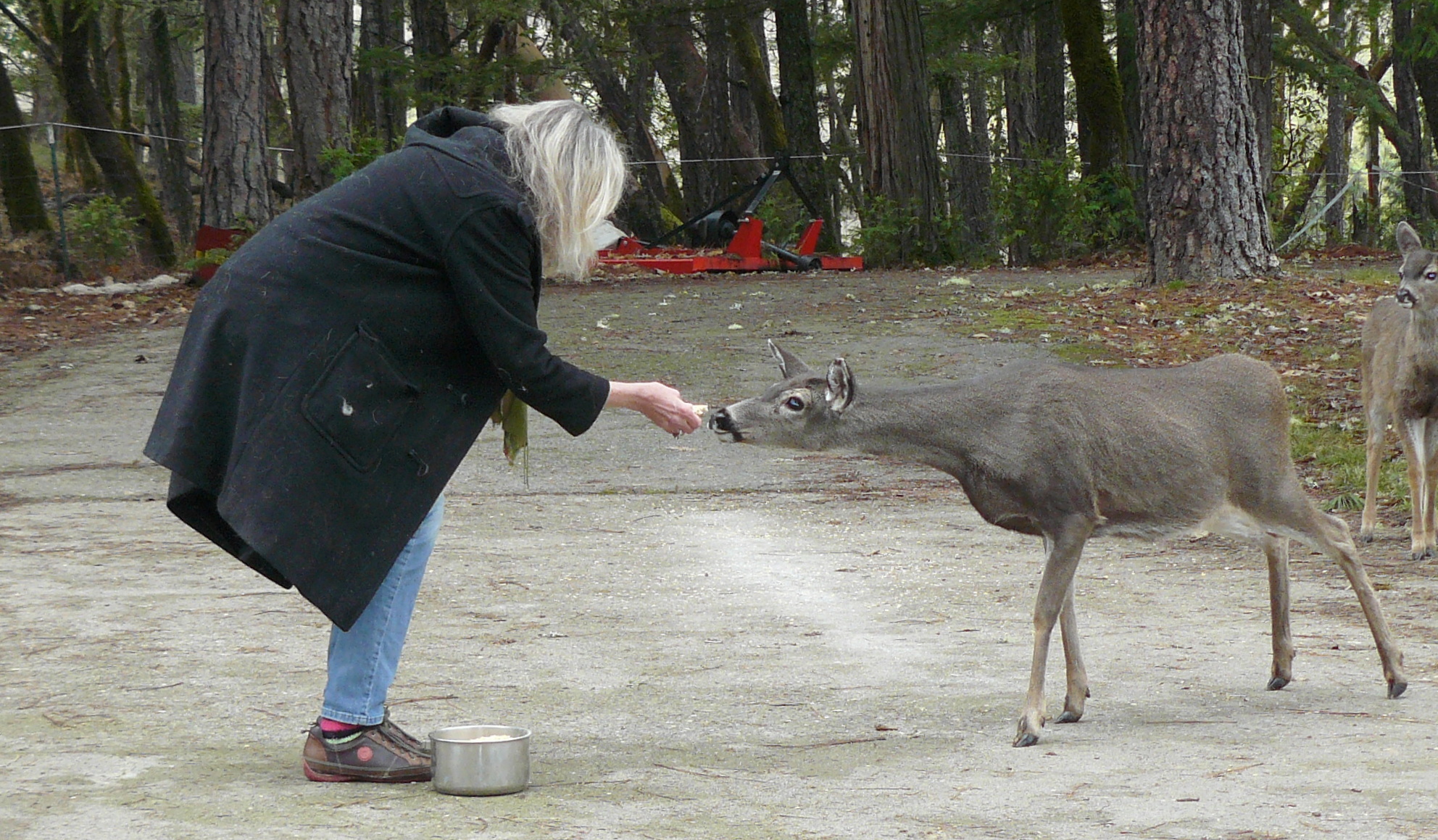
The trust between the deer and Jean then enabled the deer to feed from Jean’s hand. (October, 2014)
oooo
Then there was a rustle in the leaves some twenty feet away and we saw the fawn watching her mother feeding on the cob. Jean and I backed away, just by a few feet, and the fawn came right up to her mother. (October, 2014)
oooo
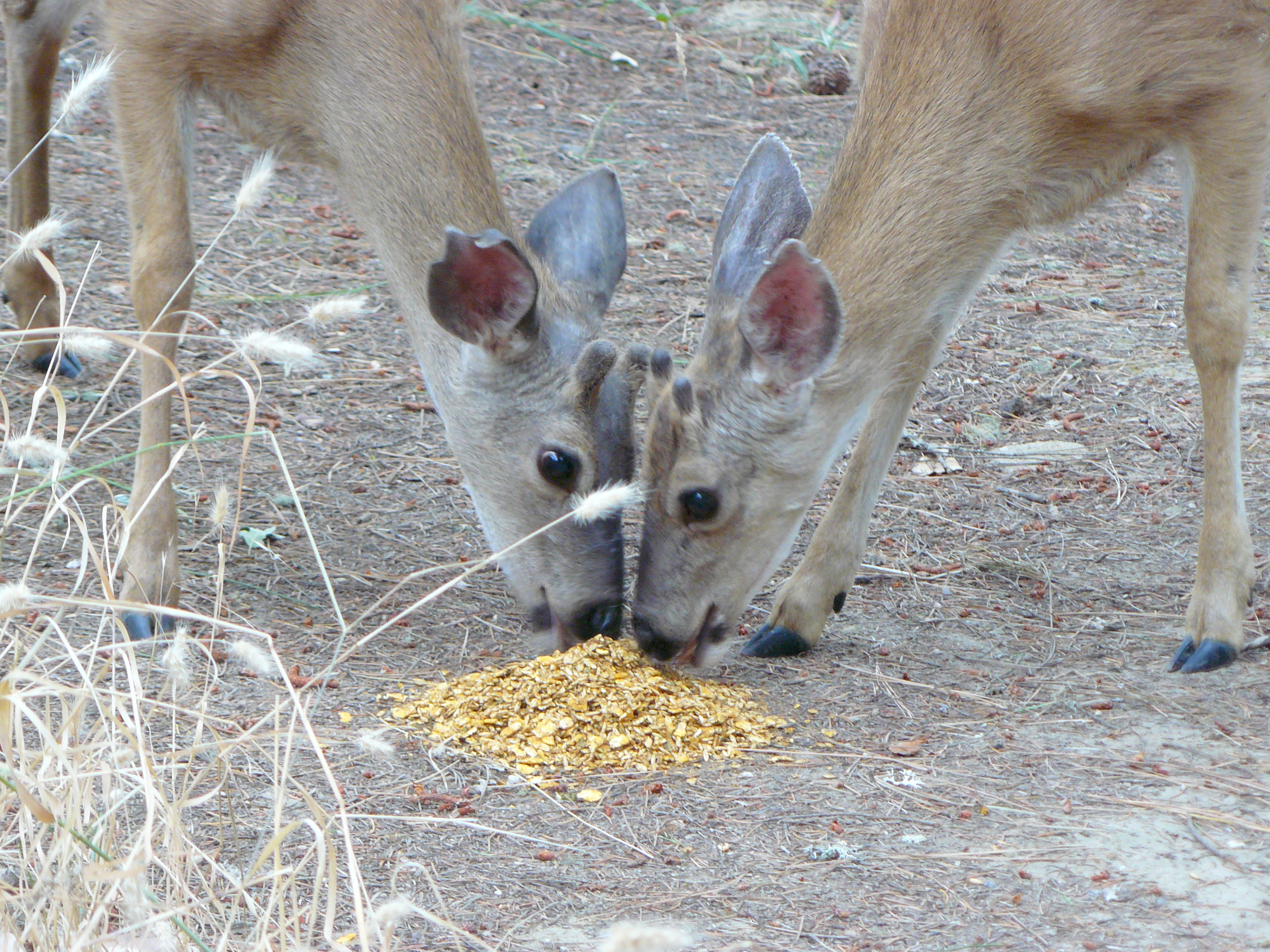
The culmination of the most magical of experiences: mother deer and her fawn eating together some three feet in front of us. (October, 2014)
I was speaking recently with John Hurlburt whom Jean and I knew well when we were living in Payson, AZ. Subsequently, John sent me a wonderful essay with his permission for me to share it with all you good folks!
A quick web search found a photograph of Wildcat Canyon and that is at the end of today’s guest post.
ooOOoo
Midnight in Wildcat Canyon
The dirt road maze in our Arizona forests covers hundreds of miles. It’s quite possible to drive all day without encountering another human being. I once ended up at a place called Wildcat Canyon at midnight after taking a wrong turn on a wet rocky mountain road.
Cell phones are problematical in the high country. It would have helped if there had been a back woods road map on board. Fortunately there was a GPS that worked.
Wildcat Canyon in the moonlight was well worth visiting. The heavens were open above without a trace of man made light. The impact was awe inspiring. As we intuitively agree, everything fits together or we’d be random atoms.
Although, it may seem random to the casual observer, we scientifically know that the cosmos is unified from the quantum level of physics up with the classical level of physics and back again through fundamental forces we have barely begun to understand.
Einstein’s theories prove that the cosmos turns inside out without breaking. Slight earthly energy shifts can modify and potentially eliminate all life on earth. There’s no need to contribute to the problem by aggravating the negative effects of climate shift through either our deliberate negative action or our thoughtless lack of action.
It’s difficult to understand why we’re fussing and fuming as though we owned the earth, the moon, the sun, and the stars. There’s consensus on the body of scientific fact that supports a holistic understanding of our relative insignificance and our corresponding responsibilities as a consciously aware biological species which is presently the dominate life form on a remote garden planet.
Signs of our cultural crisis of consciousness are clear. Science is ignored or denied unless convenient and/or profitable. World economics are systemically corrupt. Slick politicians twist reality on its ear without regard for truth, justice, liberty, or equality.
Knowledge, understanding and wisdom are disparaged.
Insanity, driven by both conscious and unconscious human fears, masquerades as truth and reason. War is profitable and encouraged. Our politicians know better if they have any awareness or compassion at all in their hearts and souls. It seems that even when most politicians are aware of reality to some degree, they simply don’t care for much beyond themselves in the long run. Political ends justify the means without regard and without regret. Hyper concentrated economic power takes no prisoners.
Insanity is cold. We light a fire to keep us warm and to heat our food.
As the flame burns, we realize that matter and energy are interchangeable. We realize that the earth is finite. We know that we’re energized by the universe. We are children of the light. We are the voice of life and the hope of the future and we’ve lost our moral compass.
Nature always wins and doesn’t care about the quarterly bottom line. Peace is a verb.
Without a unifying purpose, surrender and unilateral acceptance are dubious. What could be more unifying than our instinctive need to survive? Our common objective is to sustain our natural balance. Our immediate practical objective is to save our planetary farm.
We don’t become fully consciously aware until we are born. We begin learning about our world in our cribs. Consider that we live in a garden cradle at the edge of the Milky Way. Change is constant as our universe emerges. Adapting to change is the prime directive for all life forms.
Our problems are complex. The simple answer is found in all our human wisdom traditions. “Be of service to the Earth which sustains all planetary life.” The answer to our political quandary is similarly simple. We can vote for the Nature of Creation or we can vote for Mammon.
We can vote for Sanity (Greek: sanos; balance, wholeness and well being) or we can vote for the meaningless night shades of human insanity. We may vote for Nature or we may vote for global corporate financial interests.
It’s important to note that the unaided human mind is limited. Dumb comes with the territory with no additional charge. Our lives are a learning experience with an ongoing purpose of growth and service.
It took about an hour to get back to a main highway from Wildcat Canyon. It was a matter of back tracking through landmarks noted along the way such as the occasional miniature lake in the middle of the trail or a stretch of jagged rocky out cropping. It was a relief to return to an asphalt road about an hour later.
A wave is breaking. Take care and maintain an even strain.
an old lamplighter
ooOOoo
Wildcat Canyon
You all have a very peaceful weekend. (Oh, and you may want to drop across to Sustainable Rim Country, a fabulous project that John and others have under way.)

 That page explains:
Everyone from the competitors, volunteers and race crew fell in love with this little dog that captured all our hearts. Gobi took a shine to me and over the week we developed an unbreakable bond as I shared my sleeping space, food/water and ultimately our companionship.



 Together, they have discovered the joy and laughter in life and the value of friendship.
 They have found more than a friendly shoulder to lean on.











Diane, as someone who previously has run his own business and then, after selling it in 1986, spent a number of years as a mentor with the Prince’s Youth Business Trust in the UK, I have come to the conclusion that the best role model we adults can offer our ‘students’ is this: “Be the best you can be!” That flows from being fully aware of the person that one is. For self-awareness is the key to understanding oneself and, consequently, of understanding others. Understanding why people think and behave the way they do, for good and bad, is the only effective way of engaging with others and seeking that ‘civic engagement’ so critically important.
Apologies, that paragraph sounds like a damn speech! I didn’t intend it to be so. Plus, my own journey of self-awareness has been a long and tortuous one – but that doesn’t change my view just expressed.
Coincidentally, I have been having some informal chats with Jan Schmuckle: http://www.janconsults.com/home
Her recently released book on the effectiveness of Role Montage in building leadership skills is highly relevant to today’s students. In Jan’s words (and I have no commercial or financial link with Jan):
Role Montage: A Creative New Way to Discover the
Leader Within You is written from Jan’s experience
with her client work and her research. It helps
leaders explore self-awareness and leadership using
the role montage process.
I’ll creep back into my hole!