Category: Health

Eating human food?

For our precious dogs, that is!

Dog Food Selector recently published a post about whether or not dogs can eat human foods.

As one might anticipate the answer is neither an unqualified yes nor a no. The article included a detailed list of human foods and an analysis of their potential risks as well as a useful graphical summary.

But first to the article.

ooOOoo

Can Dogs Eat Human Foods?

The most important recommendation for introducing new foods to your dog’s diet is to do so progressively.

Because introducing new foods into your dog’s diet may lead to digestive problems.

Our advice is to introduce only one new food at a time, in small amounts at first and observe your dog for any reactions to the change.

Keep in mind that every dog is different, so if you have any doubts please check with your veterinarian to see which ingredients are appropriate for your dog.

But how about foods you eat?

We’re sure you sometimes wonder yourself: Can my dog eat this? Is this food bad for him? Are human foods for dogs OK?

The following list includes numerous foods organized by alphabetical order.

Every food is marked with the potential risk to induce gastrointestinal or toxicity problems in dogs.

The risk is classified as:

0: Minimal risk if given in controlled amounts
1: Low risk
2: Moderate risk
3: High Risk
We advise you not to give your dog foods marked with risk 2 and 3.

Anyhow, you should always consult a vet to get a specific overview of the human foods’ risks on your dog.

ooOOoo

Then follows an extensive list of foods in alphabetical order. Here’s an example:

Food: Apricot Risk: 2 Comments: The seeds, leaves, and stems contain cyanide. Additionally, the pits can be a potential choking hazard or cause an intestinal obstruction.

But as well as the detailed list of foods with their associated Risk factor and additional comments, the article included the following ‘infographic’.

Produced by DogFoodSelector.com

I think that’s a most useful reference.

What are your thoughts as to how useful this chart is?

Senior Smiles

Adopting dogs who are no longer young animals.

A trip to your local animal shelter reveals that dogs of all types, backgrounds, and ages may usually be seen. Inevitably, those dogs that are no longer in ‘the first flush of youth’ are frequently seen as less adoptable than younger animals. While that is understandable from a prospective owner’s point of view there’s no reason at all to disfavor the older dog.

Both Casey and Pedy were dogs that Jean and I adopted when they were well into their middle years, or six-years-old to put a number to it.

Casey, shown above, had been in the animal shelter for over a year and on top of being six had the added burden of being a Pit Bull breed.

Hi Pedy, I'm the bossman around here. Name's Pharaoh and you'll be OK.
Hi Pedy, I’m the bossman around here. Name’s Pharaoh and you’ll be OK.

So when the Care2 blogsite published a post about adopting senior dogs I thought that this was most certainly something to be shared with you.

Here it is.

ooOOoo

What Advice Would You Offer Someone Adopting a Senior Dog?

1388615.large

By: Vetstreet.com August 18, 2016

About Vetstreet.com
Those of us who have been fortunate enough to share our hearts and homes with a senior dog know just how special those gray-muzzled darlings can be. Earning the love of an aging pup who truly needs you creates a special bond that’s hard to put into words.

True, they may have some age-related health issues (like arthritis, dental disease or failing vision or hearing) that require attention or treatment. But older dogs have lots of pros, too, like the fact that they’re likely to be better trained than a puppy and they’re probably game to lounge around with you and take it easy. And when it comes to adopting a senior dog, you have the benefit of knowing what you’re getting in terms of size and in most cases, personality.

Our readers recently shared some great tips for people getting their first dog or cat — and in fact, we know that many of you have opened your homes to adult dogs. So when we wanted to offer tips to people looking to welcome an older canine into the family, we turned to our Vetstreet Facebook followers and asked: What’s the one piece of advice you’d give someone adopting a senior dog? And, as we suspected, our readers came through with some excellent — and touching — words of wisdom.

Advice for Someone Adopting a Senior Dog

Many readers expressed the importance of showering your senior dog with love. “Love them unconditionally, as you don’t know how long you will have them,” said Peggy Lowe-Brooks. “Enjoy each day they are in your life.”

Rich Dunn agreed, saying, “Love them, love them. Treat them like family, be there to the end and hope someday to see them on the other side!” Dee Davis added, “Make sure you’re committed to love, care and cater to them for them the rest of their lives.”

Mike Carroll suggested remembering that, for some dogs, age might be just a number: “Have fun with them; they still have a lot of energy and the desire to do most anything they ever did before. Baby them big time and be ready to be on the receiving end of some serious love and affection from them. Just let them enjoy the rest of their life like never before.”

William West Patience’s experience backs up Carroll’s suggestion. “I have had dogs that lived until 15, then I adopted one that was 16 because no one else would,” he said. “It has been a rewarding experience and has taught me so much. Except for some mobility issues he doesn’t know he’s an old dog.”

Of course, it’s important to remember that taking on a dog during his golden years can be a big responsibility, and potential owners should be ready for that. “…Remember they may have expensive medical bills; be prepared to give them the medical care they will need,” said Priscilla Leuliette.

Susan Holt Stanley was of a similar mind, saying, “Love them with your heart, care for them medically and tell them a million times how special they are!”

And Sarah Vaughn reminded us of the golden rule: “Be patient! One day you’re going to be elderly and you don’t want someone yelling at or getting frustrated with you because you move so slowly and have accidents because you can’t make it outside (or to the facilities) in time.”

If you’re considering bringing a senior dog into your home, there are numerous things you can do to help him enjoy his senior years. You might take steps to pet-proof your home in a way that makes it easier for him to get around. And believe it or not, teaching your old dog new tricks isn’t only possible, it’s a great way to help your new-old pup stay mentally and physically sharp! Getting him to the vet for regular exams and keeping an eye out for any physical or behavioral changes is important for dogs of all ages, but becomes perhaps even more important as he ages.

Care2 readers, what advice do you have for people adopting senior dogs? Tell us below in the comments. [Ed: as comments left on this post.]

By Kristen Seymour | Vetstreet.com

ooOOoo

Keeping an eye out for any physical or behavioral changes doesn’t just apply to aging dogs! 😉

The harmonious order of things!

The wisdom of balance.

Let me start off with a quote:

thomasmerton385072

Thomas Merton was an author who was born January 31st, 1915 and died on December 10th, 1968.

As part of the process of slowing down the progress of Parkinson’s Disease Jean is participating in three therapy sessions each week at the Outpatient’s Clinic at our local Three Rivers Hospital. One of the those sessions is physical therapy. I sat in on the initial introductory session and was fascinated by how much emphasis was placed on Jean’s ability to balance properly (and she was very good – better than me at times). Apparently a decline in one’s balance is an indicator of the brain not functioning as it should.

Psychologically and emotionally maintaining “an even keel” is vital to dealing with the countless ‘events’ that come our way every day.

I have been a follower of Val Boyco’s blog Find Your Middle Ground for some time and frequently read posts that reach out to me way beyond the words on the screen. As it was with a post published last Thursday: Steps to Find your Middle Ground.

It is republished here with Val’s very kind permission.

ooOOoo

Steps to Find your Middle Ground

Posted on August 18, 2016 by Val Boyko

dscf1561

This list is for all the list people out there. Enjoy the steps I have discovered in finding my own middle ground and living life in balance 💛

    • Notice! Take time to pause and be aware of the incredible gift of life that you share with others and with nature. Wake up to the little things. Wake up to your self. Wake up to it all. This is called living mindfully. Become a keen observer.
    • Accept that life has ups and downs. Really! Some one told us when were little that life should be a breeze. This is called wishful thinking. Be grateful for the highs and graceful in the lows. This is called living life well.
    • Become present. Stop lamenting the past or worrying about tomorrow. Living is in each moment. Now. Take a deep breath. Then another. Notice you are still here… not there.
    • Get to know yourself. Take that first scary step of self-discovery. Turn off the tv. Sit for a while. Journal about what comes up. Have a meaningful conversation. Listen more to others. Listen more to yourself.
    • Let go of judgments. We think that judging others or ourselves makes us feel strong. Judgments come from fear of not being in control and having things go our way. Our way is not the way. There is nothing wrong, so stop trying to be right. Stop comparing, criticizing and start letting others be. Let yourself be.
    • Realize that you are not your thinking. You are the one who is aware of your thoughts. You are awareness within a physical body, with an imaginative and fearful ego-mind that creates stories. Your thinking is not the truth about who you are or the world around you.
    • Find the peace within. Beyond the next breath and the next thought there is a deep reservoir of peace waiting to be stepped into. This cool refreshing stillness has always been there and will always be there for us to access. To connect to this wondrous pool becomes our practice… whether it’s in mindfulness meditation, yoga, sitting in nature, or while commuting on the train, realize that you too can find your own middle ground.

This blog is my way of helping people get their feet wet.

Photo by Larry Hobbell

ooOOoo

Now go and read that quote again by Thomas Merton.

Spreading love and kindness

The huge gift we receive from therapy animals.

Our Brandy is a Pyrenean Mastiff!

I know there are times when giving Brandy a big hug feeds something very deep inside me. That unconditional affection Brandy shows me has a very strong healing sense.

I know that Jean shares my sense of being loved by Brandy, and by all our other dear dogs.

I am without doubt that hundreds of thousands of other people experience this.

Yet there must always be room for more therapy dogs which is why an item on Care2 just a few days ago is being shared with you today.

(P.S. When a photo of me hugging Brandy was sought his nibs did not comply!)

ooOOoo

Could Your Pet Become a Therapy Animal?

3187027.large

If you have a pet who’s mellow and loves being around people, and the idea of helping your pet bring joy to others appeals to you, you might just have a therapy animal in the making.

Accompanied by their owners, therapeutic visitation animals – which are most commonly dogs, but can also be cats, rabbits, pot-bellied pigs, horses, etc. – regularly visit people in hospitals, nursing homes, schools and other facilities, providing furry comfort and compassion.

“Four-footed therapists give something special to enhance the health and well-being of others,” says the website of  Therapy Dogs International (TDI), a nonprofit organization that regulates, tests and registers therapy dogs and their handlers. “It has been clinically proven that through petting, touching and talking with animals, patients’ blood pressure is lowered, stress is relieved and depression is eased.”

What It Takes to Be a Therapy Animal

Therapy animals are “born, not made,” according to TDI. They must have an outstanding temperament, and be outgoing and friendly to people of all ages. They must also behave well with other animals.

 In general, therapy animals must also be at least one year old; current on all vaccines required by local laws; and be clean and well groomed when visiting people.

As for dogs, along with the ability to obey basic commands like “Sit,” “Stay,” “Come” and “Leave it,” they are tested by therapy dog certification organizations to ensure they can do the following, according to TDI (most of these requirements apply to other species of potential therapy animals as well):

  • Listen to their handlers
  • Allow strangers to touch them all over
  • Not jump on people when interacting
  • Not mind strange noises and smells
  • Be calm for petting
  • Not be afraid of people walking unsteadily

Getting Your Pet Certified as a Therapy Animal

Think your pet has the right stuff to be a therapy animal? To get an idea of the type of testing involved, this TDI brochure describes each of the 13 tests a dog must pass in order to be certified. The tests are similar for other animals.

Some therapy animal organizations, including Pet Partners, offer workshops so you and your pet can practice the required skills before being tested for certification.

The AKC website has a list of therapy animal organizations all across the U.S. from which your pet can receive certification. Contact the one nearest you for further information.

The Difference Between Therapy and Service Animals

Although the two are often confused, therapy animals are not the same as service animals, which “have been individually trained to do work or perform tasks for the benefit of a person with a disability,” according to the Americans with Disabilities Act (ADA).

“An example of a service dog is a dog who guides an owner who is blind or assists someone who has a physical disability,” the American Kennel Club (AKC) explains. “Service dogs stay with their person and have special access privileges in public places such as planes, restaurants, etc.”

Therapy dogs, on the other hand, are privately owned. Unlike service animals and their handlers, in most U.S. states, therapy animals and their owners don’t have protections under federal law (ADA, the Fair Housing Act, etc.), reports the National Service Animal Registry.

Additional Resources

You can find out more about therapy animals and getting your pet certified from these organizations:

Photo credit: Thinkstock

ooOOoo

Closing this post with some photographs Jean took yesterday afternoon. Me with Pharaoh and Cleo.

(OK, they were staged for this post as the look on Cleo’s face rather suggests!)

P1160423oooo

P1160414oooo

P1160419Have a very huggable weekend!

Life’s Lottery!

A traumatic accident to Casey is very professionally dealt with.

Our nine dogs are divided into two groups. One group lives in the kitchen/dining-room area (Casey, Paloma and Ruby) and the other dogs in the living-room/bedroom area (Pharaoh, Sweeny, Pedy, Oliver, Cleo and Brandy).

These two groups are separated by a gate, as seen here with Pharaoh resting on his bed and Casey at ease just on the other ‘kitchen’ side.

P1160402Both Jean and I go between the two areas via the gate many times daily.

Last Sunday evening, as Jean was going to the kitchen, Casey stuck his head through one of the vertical spaces in the gate and must have become stuck albeit what then happened was upon us in a flash. For Brandy grabbed the left-hand side of Casey’s face with his own jaw and the two dogs were locked together. It was a bit of a struggle to separate Brandy from Casey and when we took a look at Casey’s face it was clear that there was a laceration along his lower, left-hand lip. However, he did not appear to be in pain and we all proceeded to bed.

On the Monday morning after I had returned from my bike ride with a local group of neighbours I queried with Jean whether or not we should just check that Casey wasn’t too badly injured despite the fact that Casey was showing no signs of discomfort. Nevertheless, his wound was not a pretty sight and a quick call to our neighbour Jim Goodbrod, who is also a Doctor of Veterinary Medicine (DVM), resulted in Jim saying to bring Casey round to his place then and there.

We are glad that we did for Jim quickly discovered that the laceration was not only to Casey’s lower lip but that much of his gum below the gum line along Casey’s teeth had been torn away exposing the jaw bone. Jim said that this required specialist attention and had no hesitation in recommending Southern Oregon Veterinary Speciality Center (SOVSC) in Medford, about 40 miles to the South. Jim went inside his house and made an appointment for us to take Casey to SOVSC for 2pm that afternoon.

P1160385We had previously been to SOVSC with Hazel and were impressed with their level of expertise and experience and the fact that they were open twenty-four hours every day of the week!

By the time we arrived Casey had been allocated to be seen by Dr. Adam Reiss, DVM, and very soon after arrival we were shown into a side room awaiting Dr. Reiss’s medical assistant.

P1160382Dr. Reiss then arrived and explained that Casey’s lip and gum would require suturing under a general anesthetic but that they could fit it in that afternoon albeit Casey would not be ‘back on his feet’ until 6pm at the earliest. Of course, we agreed and shortly thereafter Casey quietly and calmly was led away by Dr. Reiss’s assistant.

Jean and I then went the short distance to the centre of Medford, did a bit of shopping, had an early dinner and returned to SOVSC shortly before 6pm.

While we were waiting for news I was interested to read a prominently displayed sign setting out what constituted a veterinary specialist. (I’ve included the image at a larger size to make it easier for you to read it.)

P1160388Clearly there is more to caring for one’s pet than meets the eye.

Indeed, SOVSC’s web site introduces readers in this fashion:

At Southern Oregon Veterinary Specialty Center, we understand the special bond between a pet and their human family. Our team of highly trained doctors, certified technicians and support staff partner with your family veterinarian to provide specialized diagnostics, surgery and emergency care for your pet upon a referral or emergency basis. Our clinic is staffed 24 hours-a-day, 7 days a week, to receive emergency cases and to monitor our critical care patients. The clinic’s board-certified veterinary specialists and staff are committed to providing exceptional compassionate care utilizing state-of-the-art technology and treatments.

The relationships we have with partner veterinarians are vital to the success of treating your pet. We will keep them apprised of the patient’s status to provide a smooth and cohesive experience.

Jim Goodbrod speaks highly of the Center.

P1160387Dr. Reiss duly came out to speak with us and explained that all had gone well although Casey was still groggy but back on his feet. Despite the smiling face Dr. Reiss looked pretty tired. Not surprising when one reflects that the time was well past 6pm.

In an earlier conversation with some of the staff it was reported that, on average, some thirty animals were seen every day!

That’s commitment to the cause in any language!

Then it wasn’t long before our dear Casey was being led back into the front waiting area.

P1160389To be followed moments later by the assistant (apologies for not making a note of her name) setting out the details of how Casey had to be cared for over the coming hours and days.

P1160391The verbal guidance was supported by extensive notes.

Then it was a case of yours truly paying for all the services that had been provided for Casey and time to go home.

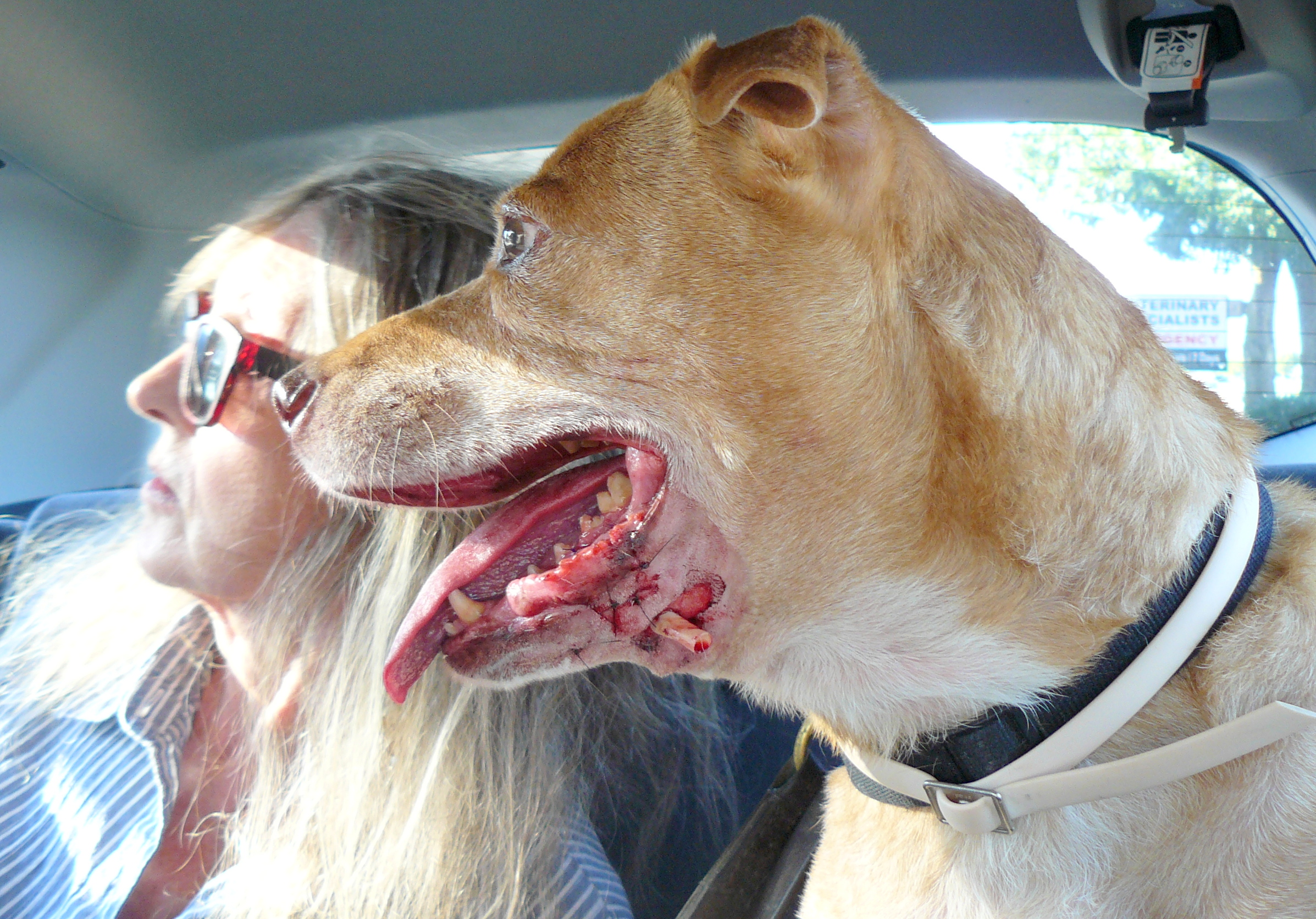
The car was rearranged to give room for Casey to sit on the rear seats with Jean next to him. I took the opportunity to take a photograph of the two of them that showed clearly the extent of the suture and the drain that had been inserted into Casey’s mouth.

P1160394It was beyond me to comprehend how Casey was so nonchalent to what in any human’s experience would have been hurting big time.

An hour later we were all home and getting dogs, cats and horses fed a lot later than normal.

Miracle of miracles Casey made it comfortably through the night and the following photograph was taken a little after 9:30 am yesterday morning.P1160400Well done all involved!

Thank you to Jim and all the doctors and staff at SOVSC but the biggest thank you of them all must go to Casey!!

Life’s Lottery: For humans and animals alike!

No post today!

We had a medical emergency with one of our dogs yesterday.

We only returned home a little after 8pm.

The details, and it was a good outcome, will comprise tomorrow’s post.

Just takes one’s breath away.

The incredible story of one stray dog and a desert racer.

This has been widely reported in many other places but, nonetheless, seemed a perfect fit for a blog called Learning from Dogs!

This is the story of a stray dog that took a liking to a runner participating in the 2016 Gobi March 4 Deserts race in China. I first saw the story when it was carried on the Care2 Causes site.

How hard are you willing to work to improve your position in life? For one stray dog, the answer is: pretty darn hard.

During the 2016 Gobi March 4 Deserts race in China, extreme runner Dion Leonard from Scotland was racing through the rugged terrain of the Tian Shan mountain range. That’s when a stray female pooch (eventually and aptly named) Gobi started following him.

The runner figured that she’d tire out eventually. She was a small dog, so keeping up with a life-sized human (who is an extreme jogger) probably didn’t seem likely. But amazingly, the little dog kept up.

That Care2 report linked to the UK’s Independent Newspaper who opened the story thus:

Man who befriended stray dog during extreme desert marathon launches reunion appeal

The dog ran alongside Dion Leonard for 124 kilometres

May Bulman Tuesday 2 August 2016

Mr Leonard hopes to be reunited with the dog who ran with him during the 250 kilometre race in the Gobi desert 4Deserts.com / Omni Cai

An extreme marathon runner has launched an appeal to be reunited with a stray dog with whom he formed an “unbreakable bond” during a 250-kilometre (155 mile) race in the Gobi desert in China.

Dion Leonard, 41, hopes to raise the funds that will allow him to be reunited with the dog, named Gobi, who joined him during the annual 4 Deserts Race Series in March.

Gobi began running alongside the 101 competitors as they ran through the Tian Shan mountain range. Despite her small size the dog managed to run half of the race.

Later on in that Independent article it is reported:

Mr Leonard set up the crowdfunding page to raise funds towards organising for Gobi to be transported from China to live with him in Scotland.

The process will take up to four months and cost £5,000, with the dog having to be medically checked and quarantined before she can be cleared for entry.

A simple mouse click then takes the reader to that Crowdfunding page where the headline then shows that already over £19,000 has been raised.

90358That page explains:

Gobi, a friendly stray dog joined 101 other competitors running 250km over the Tian Shan Mountains down to the Black Gobi Desert during a 6 stage 7 day self sufficiency foot race. Gobi ran 4 stages including the final 10km stage to the finish line, showing unique strength and stamina for a little dog to keep up with the runners in such grueling conditions.

90358-0742f368adef57f7a59875929a05e67dEveryone from the competitors, volunteers and race crew fell in love with this little dog that captured all our hearts. Gobi took a shine to me and over the week we developed an unbreakable bond as I shared my sleeping space, food/water and ultimately our companionship. 

Now let’s hear from Dion.

Time and time again our wonderful dogs inspire us to reach out; to never say never!

Have a lovely day!

The lesson of love from our dogs just keeps rolling along.

Neighbour Dordie had the following sent to her in an email and, subsequently, passed it on to me.

I share it with you and hope that it brightens your day.

ooOOoo

After losing his parents, this three-year-old orangutan was so depressed he wouldn’t eat and didn’t respond to any medical treatments.  The veterinarians thought he would surely die from sadness.

ATT00001The zoo keepers found an old sick dog on the grounds in the park at the zoo where the orangutan lived. They took the dog to the animal treatment center; the dog arriving at the same time that the orangutan was there being treated.

ATT00002The two lost souls met and have been inseparable ever since. The orangutan found a new reason to live and each always tries his best to be a good companion to his new-found friend. They are together 24-hours-a-day in all their activities.

ATT00003They  live in Northern California where swimming is their favorite past-time, although Roscoe (the orangutan) is a little afraid of the water and needs his friend’s help to swim.

ATT00004Together, they have discovered the joy and laughter in life and the value of friendship.

ATT00005They have found more than a friendly shoulder to lean on.

ATT00006Long Live Friendship!
I don’t know… some say life is too short, others say it is too long.

But, I know that nothing that we do makes sense if we don’t touch the hearts of others… While it lasts!

May you always have – Love to Share, Health to Spare, and Friends who Care… Even if they are a little hairy at times.

ooOOoo

Shared with you with the fondest love of Jean and me and all our furry friends.

A wonderful step forward.

Setting a fabulous example of what an animal shelter should be like!

The chances are that the great majority of domestic animal lovers have an impression of the standard animal shelter. The chances are that this impression is not one of wall-to-wall approval. It is tragic that animal shelters are required but it is a fact of life that they are needed. Many of them depend heavily on volunteers and donated money.

But that’s not to say that there can’t be a shelter setting a very high example of how a shelter should be.

My prelude to the following article seen recently over on the Care2 site. Read and enjoy!

ooOOoo

All Shelters Should Look Like This

3185924.large

We are what we think of most!

A republication of a recent post from Val Boyko.

Yesterday, Val published a post over on her blog Find Your Middle Ground that really ‘spoke’ to me. That’s not to imply, by the way, that her other posts don’t very often reach out to me and, undoubtedly, to many others.

Val’s post was called The Depths of our Relationships and explored the different levels of relationships that we have with others in and around our lives.

Instinctively most people would regard us humans as far more complex than our animal companions. As the old Devon (South-West England) expression goes, “There’s now’t so queer as folk.”

Yet, once we have really got to know a dog there will be many who will see behind those fabulous eyes a sense of a depth of character, a soul comes to mind, that suggests that the brain of the dog offers a canine psychological complexity most of us don’t allow for.

To support that proposition just look at the eyes of Pharaoh in this photograph going back to June, 2007.

Pharaohjun2007However, today I am  republishing Val’s recent post and I do so with great pleasure.

ooOOoo

The Depths of our Relationships