The other day we went to buy more hay and feed from our local supplier The Red Barn on Upper River Road in Grants Pass.
Tyler, the owner, was distraught having just returned from urgently running his dog in to see Dr. Russ at local Lincoln Road Vet Clinic. The reason being that his dog had eaten some rat poison that he had put out on one of the upper floors of the barn.
Later I was discussing this with our good friend, Jim Goodbrod, also a Doctor of Veterinary Medicine (DVM), and Jim said that so long as the dog is caught quickly and taken to a vet it is unlikely that it would leave the dog with any permanent harm.
However, Jim then went on to say that especially at this time of the year the thing that vets see far too often is dogs who have drunk antifreeze that car owners put into their radiators ahead of the winter season.
Jim stressed that dogs very rarely are unharmed after having contact with antifreeze. Even a teaspoonful was sufficient to kill a cat and cause severe kidney damage in dogs!
So it was essential to spread the word.
No better done than by offering you this video. Watch it! Especially through to the end where Dr. Barker offers clear advice as to what to do if you suspect antifreeze poisoning of your dog or cat.
http://healthypets.mercola.com/sites/… Dr. Karen Becker, a proactive and integrative wellness veterinarian, talks about antifreeze poisoning, which often occurs when an animal encounters an antifreeze leak from a car radiator.
If this prevents even a single dog or cat from being poisoned by antifreeze then that’s a win!
Last October 4th, just three weeks ago tomorrow, I introduced Emily Ridgewell to you. She had written a guest post for us Return to the Movies. It was well-received.
For many, the next few weeks are an important time of the year to do a spot of gardening. A time when dog-owners allow their loved ones to ‘help’, especially in the digging department. But are our gardens as safe for dogs as many of us might like to believe? Emily’s second guest post addresses that question.
ooOOoo
How to Create a Dog-Friendly Garden
by Emily Ridgewell, October 18th, 2017
Being a pet owner is not only a great pleasure but also a huge responsibility. While most of the people think that taking care of dog only included feeding and walking it three times a day, the truth is that being a good dog owner means much more than that. There are plenty of unobvious things that might pose potential threats to the health and wellbeing of dogs, and plants from home garden is a telling example of such threats.
Before listing all home plants and flowers that might pose threat to your dog, it makes sense to say a bit about general rules of creating a dog-friendly garden. After all, it is not about the right or wrong plants only.
If possible, choose robust plants
Young plants or plants with especially delicate stems might not survive if your dog will run through them every now and then. That’s why you are strongly advised to plant large and robust plants like astilbe, hardy geranium, or lavender.
Remember to protect your garden
If you don’t want your home garden to be ruined by a happy running dog, make sure your garden has clearly defined boundaries and borders. Low-growing box hedge serves perfectly for this matter.
Be careful using chemicals
The importance of this point is paramount. Plenty of gardeners use non-organic slug pellets and other chemicals when taking care of a garden. If you own a dog, the only option for you is to learn how to deal with snails and slugs organically and avoid any chemicals altogether.
Choose gentle materials
If you want garden decorations, avoid sharp stones and kinds of materials that might become extremely hot under the sun or too slippery when wet.
Which home plants and flowers are not dog-friendly?
By now you know the most common rules you should follow when creating a dog-friendly garden. Now it is time to learn which particular plants and flowers might be dangerous for dogs and should be avoided at all cost.
All poisonous plants range from slightly toxic (those that might cause vomiting, but nothing more serious) to extremely toxic (those that might cause serious health problems, including death). The list of plants that are dangerous to dogs is long, so it makes sense to divide all plants into subcategories.
In the case with perennial flowers, you should avoid Foxglove, Mums, Lenten Rose, Bleeding Hearts, Hosta, Lily-of-the-valley, Monkshood, Yarrow, and Iris. Speaking of vines, your home garden should not have Morning Glory, English Ivy, Clematis, Bittersweets, Boston Ivy, and Wisteria. As for annuals, you’d better stay away from Lantana and Begonia. The list of poisonous shrubs includes Rose of Sharon, Hydrangea, Yew Bushes, Burning Bush, Azalea Genus, Boxwood, Daphne, and Andromeda. You should also be careful with certain trees, including American Holly, Golden Chain, Oak Trees, Yellow Bird of Paradise, and Oleander.
Armed with this information, you should not have any problems creating a beautiful and dog-friendly home garden. Just make sure to double-check all plants that you decide to plant and refer to common sense when choosing home garden decorations.
ooOOoo
I thought this was valuable information and a very helpful article from Emily.
Then wanted to close this post by sharing with you an example of how our dogs help with the gardening around here.
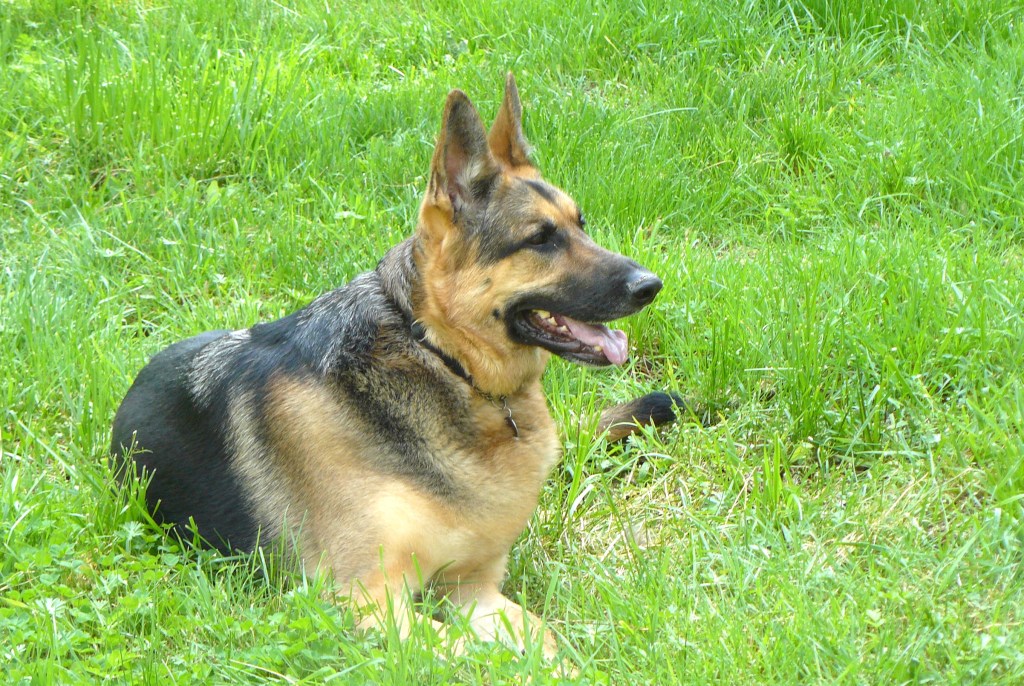
But all I could find was this photograph of Cleo ‘thinking’ of doing the front lawn.
But sometime during that panicked retreat from the house on Wikiup Bridge Way, the family dog, Izzy, bolted away.
Trying to find her amid the chaos of fire proved too dangerous.
And so this family, like countless others in California’s wine country, left more than just their home behind. When they drove through sheer walls of flame and across an uncertain wooden bridge to get to safety — they left their hearts back on Wikiup Bridge Way.
It turned out, it was the one thing they couldn’t leave behind.
A day and a half later, while the area was still smoldering and roads were still closed, Jack Weaver and Patrick Widen made the nearly-three-mile trek back to the house.
“It was incredibly important,” Weaver, who grew up in that house, tells MNN. “My mother was a wreck for having gone through that. Nobody wanted us to go back because they were worried we would get injured.”
‘I can see …’
In a video of their return, posted on Facebook and shared below, you can hear the men laboring to catch their breath amid blackened trees and still-crackling ruins.
“Izzy!” Weaver is heard calling into the smoky veil. Over and over again.
They push farther and farther ahead. “Izzy!”
“Almost to the house,” Weaver says in the video. “I can see … the gate. The gate’s still standing.”
The Weaver family home was gone. (Photo: Jack Weaver)
A moment later, he adds, “I don’t see the house at all. F$#k.”
It had burned to the ground.
But someone was still standing.
“Izzy’s here!” Weaver calls, his voice choked with emotion. “Izzy!”
“Oh my God! Come here, baby!”
The giant dog bounces into view, her tail whirring like a helicopter.
Izzy had stood faithfully by the burnt-down family home. (Photo: Jack Weaver)
“When she same running around — you can probably hear it in my voice — we were shocked and ecstatic,” Weaver says later. “I wish I could have filmed longer, the happy reunion, but I was so happy I dropped my phone.”
Since the family posted the video, it’s been shared more than 4,000 times. Maybe it’s a testament to the need for all of us to find a happy ending amid heartache.
In any case, Izzy is where she belongs now — in the arms of her family — a testament to faith under fire.
“She didn’t have a burn on her,” Weaver says. “It definitely lifted my family’s spirits.”
Izzy is back where she belongs. (Photo: Beckyjean Widen)
ooOOoo
YouTube also carried a video:
Well done, Izzy, and Jean and I send you fondest hugs!
Well during the last week I was referred by my local doctor to see a urologist in connection with a query regarding my ‘back end’. Dr. N, the urologist pointed out that the human body, especially the brain, places such demands on ensuring that water is readily available (non-scientific description!) that it will ‘steal’ water from the bowel. Ergo, when I do my bike rides in the morning I was told to drink the water that I carry with me but previously have not been consuming. For even my hour’s ride three times a week will cause sufficient perspiration that other parts of my body will remove water from my bowel.
All of which seems more than sufficient introduction to today’s post that I first read on the Care 2 site.
Editor’s note: This Care2 favorite was originally posted on June 14, 2015. Enjoy!
Water makes up around 80 percent of a dog’s body. It’s essential for optimum health — for both humans and pets — but how much is enough for our pets? And is there such thing as too much water?
Looking after an animal is a major responsibility, since they depend on humans for their needs. We tend to assume that as long as we provide our dogs with a water bowl, they will drink the necessary amount, but unfortunately this is not always true.
Some dogs are under-hydrated, while others may drink too much. Here’s what every pet owner should know about hydration.
Water’s Vital Role in the Body
Water is the basis of life, as it hydrates, nourishes and cleanses the body. While your dog can survive for a long time without food, insufficient water consumption can seriously damage the body. In a relatively short period of time, just a 10 percent drop in hydration can be fatal.
From mental alertness and ease of breathing, to optimum digestion and bowel movements, every metabolic process in a dog’s body will be affected by its level of hydration.
Blood flow pumps oxygen through the body and removes toxins, but poor hydration can lead to a buildup of toxins in the muscles and organs, causing a huge array of health issues. Dogs regulate their heat by panting, and this heavy breath causes a lot of moisture to leave the body — especially on hot days or while exercising.
Lack of water can result in dehydration, organ failure and kidney stones or other urinary tract problems, but apart from these direct health issues, insufficient water intake can be an indicator of existing problems.
Water Consumption Can Be a Health Indicator
Dogs who are not drinking enough water or who have an insatiable thirst could be displaying signs of more serious health problems — and that’s why it’s essential to keep a close eye on their drinking habits.
Dogs with illnesses such as parvovirus, pancreatitis and leptospirois — as well as many others — do not tend to drink much water, so if you notice that your dog is barely drinking anything, it may be worth taking them for a check-up. On the flip side, dogs with bladder infections, diabetes and Cushing’s disease — among others — are often extremely thirsty and can be observed drinking excessive amounts of water.
While it’s important to monitor how much your dog is drinking, remember to keep things in perspective with their other behaviors, temperature conditions and so on, so that you don’t become overly concerned every time your dog has a big drink of water!
So How Much Water Does Your Dog Need?
A dog’s water needs vary from breed to breed, and they also depend on size, age, diet, activity level and environmental conditions.
The recommended water intake for a dog is approximately one ounce of water per pound of bodyweight, per day.
Your dog’s diet will play a big role in the amount of water that it needs to consume. For instance, dogs who solely eat dry biscuits or kibble will get significantly less hydration from their food than those on moisture-rich diets.
During the hot weather, if your dog is very thirsty after a long walk or play session, it’s a good idea to let him or her rehydrate over an extended period of time, rather than letting the dog guzzle down too much water at once.
If your dog finishes all the water in its bowl, wait for half an hour before refilling it, so that your pup has time to rest and digest. You can also help keep dogs hydrated during exercise by giving them access to water — little and often is best.
To test whether your dog may be dehydrated, you can lift the skin on the back of the neck and watch to see how quickly it returns to its normal position. If it forms a sort of tent, and doesn’t fall back into place immediately, then your dog may be dehydrated.
Nobody knows your dog better than you, and by keeping a close eye on your dog’s behavior you can tell if he or she is happy and healthy — or showing signs of dehydration or illness. Regularly monitoring water intake should become a habit, as it can tell you a lot about your dog’s health and wellness.
Thus picking up on that recommended water intake, a 20lb dog should be drinking 20 oz of water a day. And for your reference:
USA system: 16 USA ounces to the USA pint
Imperial system (old British system): 20 imperial fluid ounces to the imperial pint
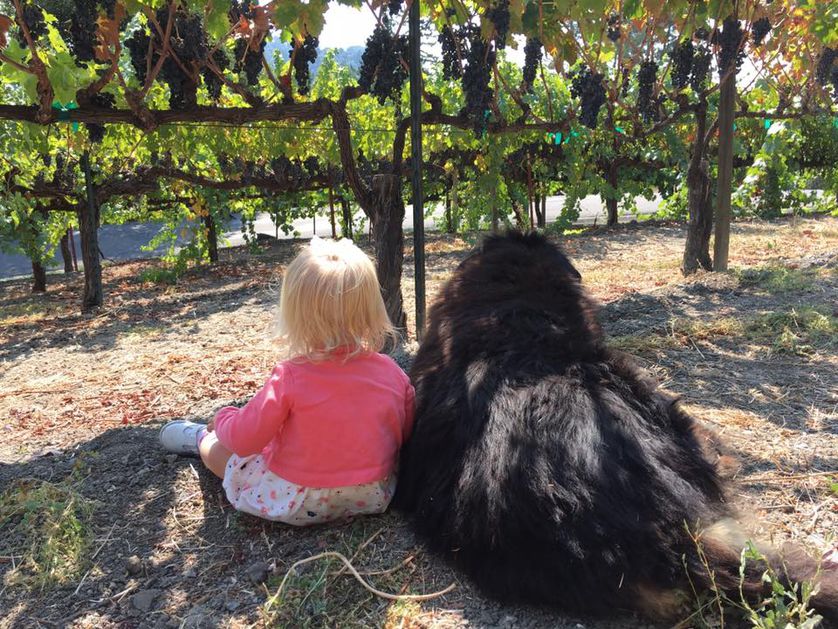
So Brandy, who weighs in at 140 lbs, should be drinking 8.75 US pints or more than 1 gallon of water a day!
Our Brandy!
Back to what you and I should be drinking? Sound advice in this Mayo Clinic article (that includes this):
So how much fluid does the average, healthy adult living in a temperate climate need? The National Academies of Sciences, Engineering, and Medicine determined that an adequate daily fluid intake is:
About 15.5 cups (3.7 liters) of fluids for men
About 11.5 cups (2.7 liters) of fluids a day for women
These recommendations cover fluids from water, other beverages and food. About 20 percent of daily fluid intake usually comes from food and the rest from drinks.
Not that long ago I received an email out-of-the-blue from Linley Achtenhagen. Linley wanted to tell me, and all of you, what having a dog had meant to her.
ooOOoo
How It All Started
by Linley Achtenhagen
Before I start talking about all of the things I have learned from having a dog, I should probably tell the story of how this crazy journey started.
My sophomore year of college was probably one of the most difficult years I’ve had. I was struggling with anxiety issues and I had just quit basketball, which was the hardest decision I’ve ever made. Why? Well, I had been playing basketball from the time I could walk and the day that I decided I was done was a very difficult, yet relieving day.
Me playing basketball had become unhealthy for me and caused me so much stress and anxiety that it was hurting me more than it was helping me, but that’s a different story.
Anyways, once I was done playing college basketball I felt relieved, but also empty. All I had really ever known was basketball, so now I felt like I wasn’t doing anything with my life other than going to school and studying things that I didn’t care about. I knew that something was missing!
I have always been an animal lover. Growing up we had everything from cats, to dogs, to horses and even a pet bird. Dogs were my favorite though (sorry cat lovers) and I thought, “why not see if there’s a dog that needs a home”.
So I went online and of course, I found, literally, thousands of dogs that needed homes. After months of searching and convincing my parents that I could do this, I adopted Luna.
Luna came from a high-kill shelter in Missouri, meaning that if she wasn’t adopted in a certain time frame she was going to be put to sleep. Lucky for me, Tiny Paws Small Dog Rescue in Milwaukee, Wi transported her and about 10 other dogs from the shelter up to Wisconsin.
Luna was about 15 pounds underweight and for a 40-pound dog that’s dangerously skinny. When I would pet her I could feel every single bone on her body. She was skinny, shy, and had patches of fur missing, yet the trust this animal gave me right from the start was amazing. This animal had gone through only God knows what, and trusted me immediately. It was an eye-opening thing to watch.
Now, I’m not going to lie and say that it was all butterflies and rainbows when I adopted Luna. The first few days I was panicked and thought, “what on earth did I get myself into”. But I knew that I had made a commitment to this dog and I couldn’t give her away. I have always hated change, in fact, it is one of the things that gives me pretty bad anxiety, and I knew that giving Luna back would be the easy way out. Sure enough, in about a week, this dog became my best friend and it’s like we had a mutual understanding that we were in this together.
Since getting Luna I went from not knowing what I wanted to do with my life to declaring my major as entrepreneurship and knowing that one day I want to open my own pet supply store.
I want to share all of the knowledge that I have gained about dogs from having Luna with other pet and dog lovers. I have found that big, franchise pet stores just don’t have the same knowledge that small, local pet stores do. I am also not saying that I know everything there is to know about dogs because I still learn new things every single day. But I want to share everything I have learned with dog owners and help them give their pet the best life possible. I also hope to learn new things from all the people that (hopefully) come in and out of my store every day.
In the posts to come, I will share everything I have learned about life, love, animals, and everything in between from my life with Luna.
ooOOoo
If only all decisions in life were as easy as me wanting to publish Linley’s account of her meeting Luna!
All we now need is a photograph of the happy couple!
A plea to choose a shelter dog before other sources!
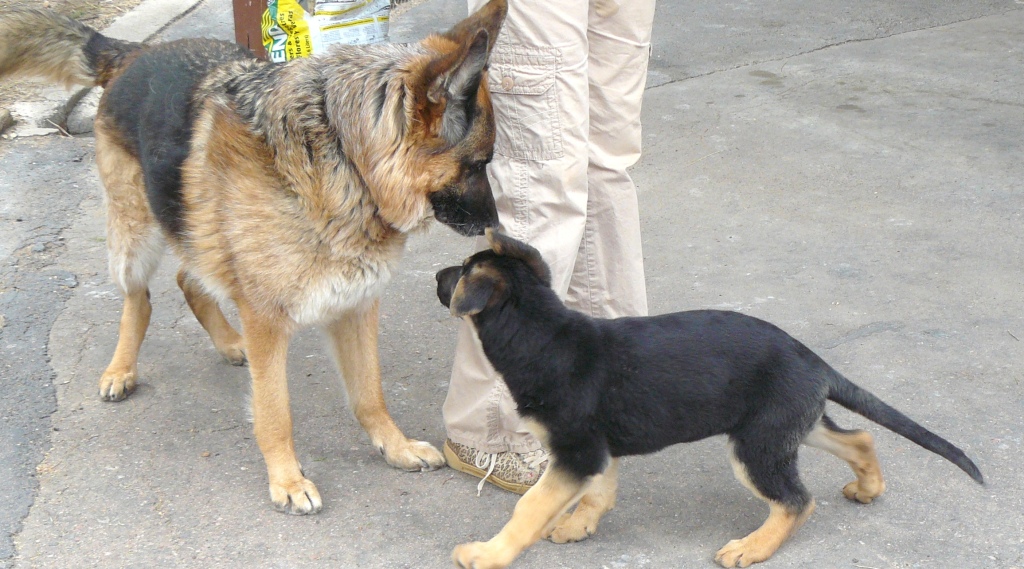
Of the six dogs that we have here at home only one, Cleo, came to us from a breeder. That was because we specifically wanted a GSD puppy to be a playmate for Pharaoh as he was getting into his final years.
Pharaoh demonstrating his benevolent status with puppy Cleo. April 2012.
The other five are all dogs that we took from rescue shelters or, in the case of Brandy, from a couple that couldn’t handle such a big dog despite him being the most placid and loving dog one could ever come across.
The Care2 blogsite recently published an article that hammered home the reasons why everyone should (nay, must!) consider a shelter dog first.
Please read and share this. For the sake of those thousands of dogs that never have the joy of loving owners in their lives.
ooOOoo
6 Common Myths About Shelter Animals (and the Truth About Them)
Adopting a dog doesn’t mean you’re inheriting someone else’s problem. Learn the truth and some common myths about shelter animals.
It’s a sad fact that each year approximately 670,000 dogs are euthanized in animal shelters across the United States. It happens because too many dogs enter the shelter and too few people consider adoption when it comes to getting a new pet. Many buy into one of the most common myths that when you adopt a dog from a shelter you are inheriting someone else’s problem.
The truth is that shelters and rescues are brimming with happy, healthy pets just waiting for someone to take them home. Most shelter pets are surrendered because of a human problem like a move or a divorce, not because the animals did anything wrong. Many are already housetrained and used to living with families.
“When you adopt a shelter dog you are most likely bringing home a dog who has good manners, is leash trained and knows some commands,” said Ellen Ribitzki, kennel manager for the Bloomingdale Regional Animal Shelter Society (B.A.S.S.) in New Jersey. “In addition, shelter dogs are temperament tested so adopters will have an idea of a pet’s personality―whether he/she gets along with other dogs or with cats and young children.”
In late August the Herrera family visited B.A.S.S. to find a companion for their rescue dog, Charlie. The family had just lost their beloved Roxy, a 12-year-old boxer, and all of them―including Charlie―were mourning the loss.
“We started visiting our local shelters because we know what love rescue dogs can give,” Robin Herrera said. “We knew that we didn’t want a puppy but we were looking for a dog young enough to be playful. We also knew that Charlie had to approve of the new dog.”
At B.A.S.S. they fell in love with Sophia, an 18-month-old German shorthair pointer mix, an energetic fun-loving and playful dog. Luckily Charlie approved and Sophia is now a much-loved addition to the family.
The Herrera family fell in love with Sophia, a German shorthaired pointer mix, for adoption at the Bloomingdale Regional Animal Shelter in NJ. Image courtesy of the Robin Herrera
“Sophia and Charlie are constantly hunting for chipmunks in our yard,” Herrera said. “They love long walks together and enjoy snuggling with us at night.”
Ribitzki said that dogs are rarely returned to B.A.S.S., and when it does happens it’s because of health or life changes―for example, allergies or a job change―and not behavioral issues.
“The majority of dogs and cats are surrendered to B.A.S.S. by heartbroken owners in tears because they can no longer care for their beloved pet,” Ribitzki said. “Unfortunately, with the recent catastrophic hurricanes, there will be a lot more animals impacted and more demands on rescues and shelters.”
Shelter dog Sophia (standing) was recently adopted by the Herrera family in New Jersey and has become a loving member of the household. Image courtesy: Bloomingdale Regional Animal Shelter
October is Adopt a Shelter Dog Month and a perfect time to help dogs in shelters across the country find loving forever homes. If you’re thinking of adding a dog to the family, please consider adopting your next animal companion.
6 Common Myths about Shelter Animals
Myth #1: Dogs only end up in shelters because they have behavior problems or are sick.
Truth: Some dogs do end up in shelters and rescue groups because their owners can’t handle their perceived behavior problems (which may be as easy to fix as an older puppy reluctant to housebreaking), but most of them end up in shelters because of a combination of these reasons:
They were strays―either they never had a home or they ran away and their owners didn’t reclaim them.
The owner moved and couldn’t take his/her pet along.
Owners were too busy to take care of their pets, or couldn’t afford to due to job loss or medical emergencies.
Owners didn’t know how to train their pet to behave appropriately.
Owners got rid of their pet when their baby was born.
Owner or family members developed allergies to the pet.
The pet required a medical procedure that the owner couldn’t afford.
Owners and their family simply lost interest in the pet, this is especially true for older puppies.
Myth #2: You never know what you’re getting with a shelter or rescue pet.
Truth: When you deal with a reputable shelter or rescue group that gets all vetting done―spay/neuter, vaccinations, deworming and heartworm preventative―and temperament tests all of their adoptable pets, you do know what you’re getting!
Myth #3: You have to start the bonding process when your pet is a baby.
Truth: Rescued pets are often noted as being “grateful” for their new lease on life. Forming a bond with an animal whose life you saved comes naturally for most people. Dogs become attached to the people who take care of their basic needs, no matter when those people came into their lives.
Forming a bond with an animal whose life you saved comes naturally for most people. Image credit: Thinkstock
Myth #4: Shelter animals are not as clean as pet store animals.
Truth: Not only is this untrue, but the conditions of many breeding facilities or puppy mills (which supply pet stores that sell dogs) are nothing short of horrific. Puppies born in puppy mills are usually removed from their mothers at just 6 weeks old and are housed in overcrowded and unsanitary wire-floored cages, without adequate veterinary care, food or water.
Myth #5: Adopting big or very strong dogs is a bad idea if you have little children.
Truth: There’s no evidence that big dogs are more likely than small dogs to harm children. A dog’s behavior is a function of many factors including breeding, socialization, training, environment and treatment by owners.
Myth #6: Getting animals from breeders is safer because the breeders know the animal’s bloodline and family history.
Truth: As a result of their breeding, purebred dogs very often have genetic disorders and medical issue predispositions, certainly no less often than shelter dogs. Also, while bloodlines and histories are useful tools to assess an animal’s value, they are limited in terms of predicting behavior. On the other hand, shelters are motivated to save lives and make strong matches. Some use science and sophisticated tools to appropriately pair up animals and owners and are happy to share everything they know about each animal.
The Humane Society of the United States offers the top reasons to adopt a pet.
ooOOoo
Did you notice that link on the very last line of this article, the one regarding The Humane Society offering the reasons why everyone should adopt? If that link was followed then one would read the most important reason to adopt a pet (my emphasis):
Because you’ll save a life.
Each year, 2.7 million adoptable dogs and cats are euthanized in the United States, simply because too many pets come into shelters and too few people consider adoption when looking for a pet.
The number of euthanized animals could be reduced dramatically if more people adopted pets instead of buying them. When you adopt, you save a loving animal by making them part of your family and open up shelter space for another animal who might desperately need it.
Here’s what HSUS are doing for the poor dogs out in Puerto Rico.
From time to time we do donate a few cents to The Humane Society of the United States (HSUS) because their size and huge support from so many people does allow them to step up to the really big needs.
And Hurricane Maria certainly left a big need in its wake for dogs.
The HSUS Animal Rescue Team (ART) assists with animal rescue and response following Hurricane Maria on the island of Vieques, Puerto Rico. (Photo: Dennis M. Rivera Pichardo/AP Images for The HSUS)
In the wake of Hurricane Maria, hundreds of dogs, as well as cats, horses and even a few pigs, are getting off the island.
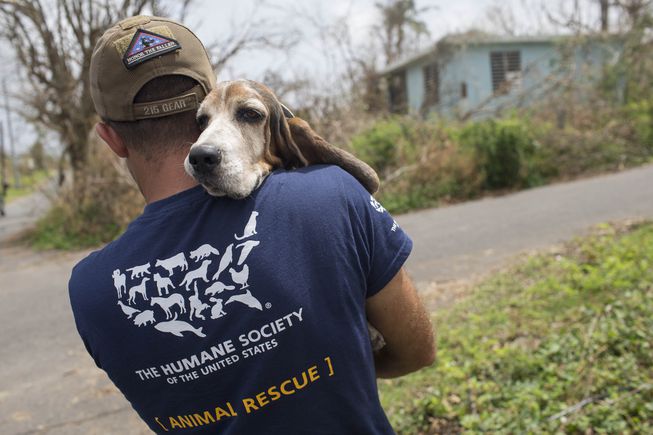
Several rescue groups, including the Humane Society of the United States, have waded into the breach to rescue some of the island’s most defenseless residents: its burgeoning population of stray dogs, as well as those currently in shelters.
HSUS has a history with the territory, helping with law enforcement training and horse care, and working closely with animal shelters across the island.
“Since the storm hit, we’ve been doing our best to stay in contact, given the communication challenges, with all of our shelter partners and other partners on the island,” Inga Fricke, director of pet retention programs for HSUS, tells MNN.
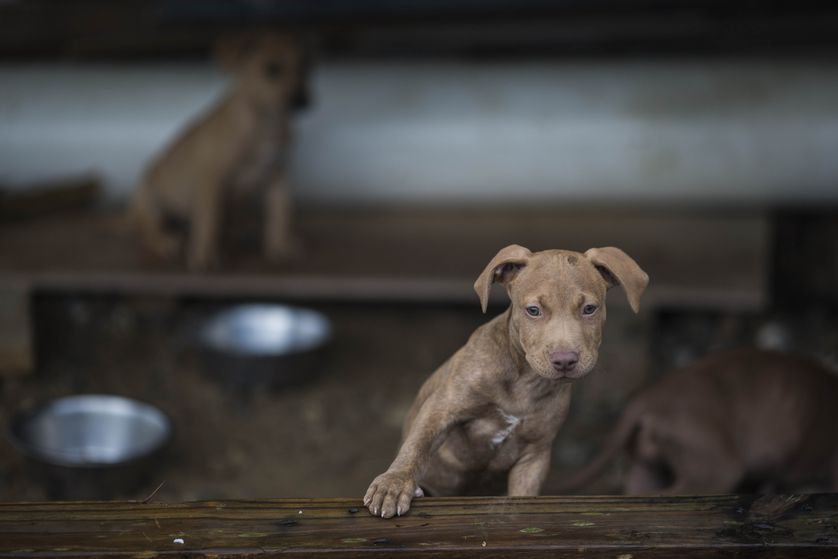
Puppies under a house in Vieques, Puerto Rico. (Photo: Dennis M. Rivera Pichardo/AP Images for The HSUS)
This week, the organization — with help from partners like Wings of Rescue and St. Hubert’s Animal Welfare Center — began airlifting dogs from stressed island shelters to a processing center in New Jersey.
“They get vetted there, get the care they need and then get parceled out to other partners around the country,” Fricke says.
Not every animal survived Maria’s onslaught. Notably, a southeast corner of the island once teeming with strays — nicknamed “Dead Dog Beach” — was found to be desolate when rescuers arrived.
“We’re hearing from our rescuers who have a feeding area where they go every day and we are hearing that most of those dogs have perished,” Twig Mowatt, co-founder of All Sato Rescue, tells MNN.
While the organization is based in San Juan, Puerto Rico, Mowatt is just outside of Boston, coordinating with the Humane Society of Puerto Rico to get vulnerable dogs airlifted to the mainland.
“I’m kind of like an air traffic controller these days,” she says. “My group is largely rescue and transport but we partner with the humane society for those really badly affected.”
“We were able to get dogs out on Friday and then yesterday,” Mowatt adds.
John Peaveler, an inspector with HSUS, does a field inspection in Vieques. (Photo: Dennis M. Rivera Pichardo/AP Images for The HSUS)
Described as “apocalyptic,” the hurricane left much of the island in the dark, without electricity or communications. And while the humanitarian relief effort is ongoing — much of the island was still without power in early October — the search for animals in distress may be even more complicated.
With an estimated 150,000 dogs in Puerto Rico and not enough animal shelters, there’s no space for dogs found roaming at large. As a result, many of them are put down immediately.
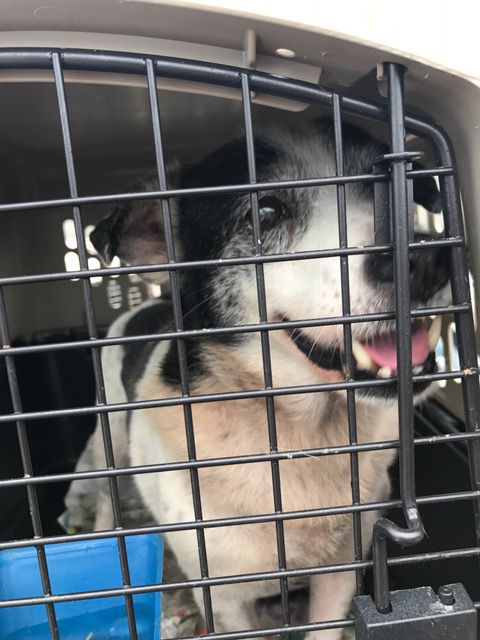
A crated dog is prepared for transport to New Jersey. (Photo: Dennis M. Rivera Pichardo/AP Images for The HSUS)
“We have even done several transports, even just this year, to try and alleviate some of the overcrowding and the pressures on the shelters across the island,” Fricke explains.
“But certainly our focus now, after the hurricane, is to try and remove as many of the sheltered animals as possible so we can allow them to make room for animals that unfortunately have been affected by the storm and can’t be kept by their families any more for any reason.”
Six days after Mexico City was ravaged by an earthquake, there seemed little hope of finding anyone alive among the rubble.
But a Japanese rescue team was thrilled to find one more tiny survivor — a schnauzer, who they managed to pull from the ruins of a collapsed apartment building.
The lucky dog was checked out by vets, and had somehow managed to remain in good health. Authorities now hope to reunite the schnauzer with her family as soon as possible.
Thank you to rescuers who travelled from around the world to save lives — both human and animal — in the wake of this tragic disaster.
ooOOoo
The video and news item was carried by the New York Post and for reasons I am unsure about I couldn’t include the video in this post. But you can view that video by going here. Luckily other newspapers carried the wonderful event and the following photograph appeared in The Independent newspaper two days ago.
A schnauzer dog who survived the quake is pulled out of the rubble from a flattened building by rescuers in Mexico City 24 September. ALFREDO ESTRELLA/AFP/Getty Images
My guess is that dogs and humans have been saving each other for thousands of years and long may it continue.
With the recent earthquakes in Mexico being a glorious example of that!
Nobody would have missed out on the news of the terrible catastrophe of the recent earthquakes in Mexico.
As seen on the NBC news site.
Mexico Earthquake Death Toll Climbs as Dozens Sleep on Streets
byThe Associated Press
JUCHITAN, Mexico — The death toll from one of the most powerful earthquakes ever recorded in Mexico rose to at least 61 early Saturday as workers scrambled to respond to the destruction just as Hurricane Katia struck its coastline.
The 8.1 quake off the southern Pacific coast just before midnight Thursday toppled hundreds of buildings in several states. Hardest-hit was Juchitan, Oaxaca, where 36 people died and a third of the city’s homes collapsed or were otherwise rendered uninhabitable, President Enrique Pena Nieto said late Friday in an interview with the Televisa news network.
It’s impossible to truly appreciate the terror of such an event unless one has had the misfortune of already living through such an earthquake. Likewise, almost as difficult to appreciate the terror of being trapped.
But thank goodness for dogs that are trained to sniff out those trapped persons. Such as Frida who saved so many lives down in Mexico. Here’s the account of Frida’s special deeds as carried on the Care2 site.
ooOOoo
Frida, the Heroic Rescue Dog, Saves Lives After Mexico’s Earthquake
Photos and videos of a rescue dog named Frida have gone viral — complete with her cute-yet-necessary work uniform: doggie goggles, vest and four protective, Velco-strapped booties. She has become a four-legged symbol of hope during these dark times in Mexico.
Although, contrary to some early news reports, Frida didn’t really rescue 52 people after the devastating 7.1 earthquake struck Mexico Sept. 19, the 7-year-old yellow Labrador retriever has nonetheless become a media sensation.
What’s true is that prior to the earthquake, Frida (she’s named after the artist Frida Kahlo) had helped rescue 12 people and recover the bodies of 40 people during her career as a disaster rescue dog with the Mexican Navy’s (SEMAR) Canine Unit.
Working with 14 other dogs in the unit, she has located 12 victims of the Sept. 19 quake so far.
Frida’s first mission after the earthquake struck was to find survivors at the Enrique Rebsamen School in Mexico City. Eleven children were found alive by other emergency workers. Tragically, 19 children and six adults did not survive.
Frida suffered from exhaustion after searching the school Sept. 20, her handler, Israel Arauz Salinas, told the Los Angeles Times. After napping and drinking plenty of water with electrolytes, she was in better spirits the following day and ready to go back to work.
Frida has two colleagues in the Canine Unit, Evil and Echo, who are both one-year-old Belgian Malinois dogs. Because Frida is getting on in years, Evil and Echo enter collapsed buildings before she does. If they find someone, Frida enters and spends no longer than 20 minutes inside the building.
The disaster rescue dogs can reach areas that are inaccessible to human responders, including spaces that are less than 20 inches high. When they find a victim who’s alive, the dogs bark. Otherwise they stop and slowly approach the body. “They act afraid,” Salinas told the L.A. Times. “That indicates to us that there is a cadaver.”
Like the other dogs in the Canine Unit, Frida began training when she was just two months old. The skills the dogs show in training determine whether they will go on to detect people, narcotics or explosives.
To train dogs to find people, they are first taught to fetch toys and balls. Once they learn how to do that, their trainers run with the toy or ball in their hands. The dogs learn to associate the smell of the person with the reward of the ball, Salinas told the L.A. Times. Before they’re ready to be dispatched to disaster areas, the dogs train for about three hours a day for a year.
Just two weeks before the Sept. 19 earthquake, Frida helped locate the body of a policeman after a massive 8.1 quake struck Juchitan. She also worked in Ecuador after an earthquake there in April last year.
Before Frida won the hearts of the rest of the world, even the president of Mexico, Enrique Pena Nieto, was a fan of hers (or at least the person in charge of his official Twitter account was).
“She is @Frida, belongs to the #SEMAR_mx and has helped save 52 lives in various natural disasters at the national and international levels,” says a @PresidenciaMX tweet on Sept. 13.
ooOOoo
I’m going to finish off today’s post with a recent video aired by Quebec News. (Actually, a series of still photographs.)
Quebec NEWSPublished on Sep 21, 2017
Thousands of emergency services, military, and civilians are currently searching through rubble across the country for survivors. Among them are Frida, a rescue dog who has saved 52 people throughout her career, according to the office of Mexico’s President. Frida’s adorable outfit has a purpose. The goggles are to protect her eyes from smoke and debris, while the boots protect her feet from rough terrain. A massive 7.1 earthquake rocked Mexico earlier this week,It was the second major earthquake to hit Mexico in two weeks













 Learning from Dogs