Category: Health

Day Six of Tom and Chica’s walk

The walking tour of Spain continues!

Once more I will keep my introduction very short. Except to say that the original was here.

It’s turning into a fabulous walk!

ooOOoo

Day 6: Castillo de Castellar to Jimena de la Frontera 22k

By Tom and Chica, 18th January, 2020

Written by Tom’s wife.

Today was the longest walk so far and didn’t actually start until late as we decided to shift base. By the time we had the caravan installed on a site in Jimena de la Frontera and I’d driven Tom and Chica back to Castillar it was 2pm. Chica was obviously refreshed after her day off and keen to go. Castillar again looked amazing and it was great to know the start is downhill on a tarmac path through more lovely woodland.

As it levelled out, the tarmac gave way to a gravel track through scrub and grazing land occupied mainly by local brown retinto beef cattle. A huge old farmhouse had seen better days and seemed unoccupied, at least by humans. The scenery changed again as they entered the first cultivated area they had come across since the start. No idea what the crop is though.

The route met up with the railway track and would stay with it all the way to Jimena. There was a pony grazing here. Despite having a rug and being quite friendly, the white hairs on its nose indicate it has been put in a seraton – a noseband with spikes that dig into the soft flesh of the muzzle. These are still used a lot in Spain. Nearby there was a donkey that was hobbled – which is now illegal. Equines get a rough deal here sometimes.

A grand entrance

There were a few dwellings as they approached Jimena – one with a very impressive gate. The shell motif is associated with St James and is a common one on caminos (pilgrim trails) although more usually found on the famous Santiago de Compostela in northern Spain.

The light was fading fast and the last hour or so was done in virtual darkness with Jimena castle luminations acting as beacon to the weary traveller.

ooOOoo

Wonderful. And what a lovely job of writing it all up.

Keep it coming, Mrs. Tom.

There’s no escaping it!

Getting old is inevitable.

Becoming wiser as one ages less so!

I am minded to start today’s post with that reflection because quite simply it was the way to introduce my republication of Wibble’s post.

The article is about Dexter and is just lovely. It is called Older or wiser.

Enjoy!

ooOOoo

Older or wiser

By Dexter, February 19th, 2020

I’m sitting here and the rain is drizzling down the window. It’s February, its windy, we’ve had two winter storms in quick succession and they are digging up the road outside my house. Do they not know I am trying to sleep. Even more surprising but equally as joyous, Lenny isn’t trying to bite me. Now if you have read some of my recent blogs, you will know I have been somewhat contemplative. If you are hoping for shenanigans in this article, then I fear you will again be somewhat disappointed. Earlier today I was wondering to myself about becoming older and, apparently, wiser.

Being older is a bit obvious really. I have more grey hair, I eat my dinner more slowly and I don’t need to walk as far as I used to. I’ve even missed scenting rabbits and squirrels according to assorted parents I have been attached to when these alleged missed sightings have taken place. I can still play bitey face with Lenny, and give him what for, but I tend to duck out of said prolonged snout jousting after a short time. Being beagles we are docile chaps and even when we are in full cry with sofa covers flying around, furniture being rearranged and rugs being ruffled, we manage to stop for a breather on fairly regular occasions. Sometimes it takes a parent stepping in between us to remind the warring parties that its time for a break but, on the whole, we tend to cease and desist quite readily. I am then happy to retire to one of my six or so beds to snooze. However Lenny seems to have a little extra bounce in his paws although I think that is because he is around eighteen months old and I am, allegedly, going to be ten next birthday. No one truly knows how old I am due to me being a rescue but the wise money is on nearly ten now. I am happy for him to run around a little longer, chew what remains of one of my toys and then fall asleep on the sofa. Usually this is interspersed with trying to bite me but again, being docile, I try and fend him off without sending clear signals that I just want to rest.

Older?

As for being wiser, I don’t really know what that entails. If it means that I have seen things, been places and done stuff, then yes I am wiser. If it means that having done said activities, I have learned from the experiences, then not necessarily. For example I have been on the tube and train to London quite a few times, however I still want to investigate what those wonderful smells are down on the track. Thank goodness for a lead and attached human apparently. Another example, is that I have lived here for seven Christmases and, despite the jolly red faced man delivering me many wonderful things but nothing closely resembling a pizza tasting gift, it is wrapping paper I am still fascinated by. I can’t eat it, I know I can’t, but does it stop me from trying? Of course not. Many winters have I seen here, many dirty puddles have I walked through in a Moses style and many times have I been told “Dex, no, ugh good grief you look like the Creature from the Black Lagoon”. Does it stop me stomping through puddles in the most triumphal fashion? No, of course not. I have stopped chasing pigeons in the garden and that’s not because I am banned from the garden. Far from it, for I merely allow my protege to chase them for me. Young whipper-snapper legs are faster than these old bones of mine. I have stopped chewing my toys to a misshapen soggy jumble of fabric, with an accompanying scene of death and destruction wrought across the rugs. Again I leave the dental lobotomisation of toys to Lenny, as he seems to have picked up the baton fairly quickly and extremely proficiently.

Wiser?

If growing older and wiser means seeing things, going places, enjoying the view, smelling more flowers and generally knowing that I should take my time to appreciate and immerse myself in all the things I rushed to see previously, then I am older and wiser. I still have adventures, I still walk and pull on the lead, stick my head down rabbit holes and try to climb the banks along the lanes and byways I explore. I still look in awe at the beauty of the countryside I visit, gaze at the buildings and people in the city. But I let it sink in now, I actually look at what is in front of me and then usually fall asleep soon after, twitching and dreaming. I am trying to pass on my perceived wisdom to Lenny. He is often too busy bouncing around, trying to sniff everything, meet every fur and being a very lovable pest in as quick a time as possible. I see much in Lenny that I had in my youth and this gives me a warm feeling. I hope I can help him to understand that, at some point, he will sit and watch the world go by, with a peace and calmness that I seem to be achieving more often.

Who knows, maybe that is the secret to being older and wiser.

ooOOoo

Just read that last paragraph again. Especially the first sentence: “If growing older and wiser means seeing things, going places, enjoying the view, smelling more flowers and generally knowing that I should take my time to appreciate and immerse myself in all the things I rushed to see previously, then I am older and wiser.

In my opinion dogs do this so much better than we humans. Yet another lesson to be learned from dogs!

Because both for dogs and their human friends, it’s only a matter of time!

A further word about natural supplements

Stick to the major brands and you should be alright!

Following my republication of the article in The Conversation two days ago, I have now come to a conclusion. That is that if one sticks to major brands or supplements made in the USA then one should be perfectly safe.

Margaret of Tasmania made a recommendation to use ConsumerLab.com and it appears a brilliant suggestion.

Day Five of Tom and Chica’s Walk

Seeing parts of Spain that the tourists rarely see.

Again, I’ll keep my introduction really short. After all you came here to read of Tom and Chica’s walk along GR7.

ooOOoo

Day 5: Castillo de Castellar (new town) to Castillo de Castellar (old town and castle) 14k

By Tom & Chica, 17th January, 2020

Written by Tom’s wife

After his adventure yesterday, Merlin was up early this morning bounding around shouting ” Me! Me! Me!” Chica opened one eye (she’s not good in the morning) and made it clear that she was happy for him to deputise for her today. She had a lie-in while Tom and Merlin headed back up to Castillar and as you can see, later she helped me deal with her social media fans!

Day 6 started as day 5 ended, by the road. This proved less hazardous than the next section which was on a track by the main road along which groups of lycra-clad cyclists flew in both directions. It was with relief that T & C were able to turn onto a lovely quiet road that wound through the oak forest towards the castillo (castle) high on a rocky outcrop ahead.

Inviting paths
Inviting paths

After a few kilometres, a very inviting track appeared to the right of the road and despite the marker not being for the GR7, Tom couldn’t resist, wanting to be off tarmac for a while. A bit further on, a post bearing the red and white stripes of the GR routes was a welcome sight and the path through the wood was cool and easy on the feet (all six).

A short cut.
Yay, A cold beer after a steep climb.

The path eventually came back out onto the road and the castle could now be seen high above. As it started to climb, the road also started to wind so Tom thought he’d try and cut off the corners. But we all know that cutting corners rarely works and sure enough, he soon had to retrace his steps. Eventually, a cobbled path did appear but it proved a steep slog. Plucky little Merlin who’d been trotting along happily up until now started to flag. His tail had been vertical all the way but now began to droop a little. Both were very pleased to see the bar at the top.

The castle
Information sign.

It is beautiful spot with wonderful views and the history of the village goes back to the Bronze Age. The prehistoric presence is still evident in the many caves around the area, where enthusiasts can see the wonderful cave drawings. It played an important role in the wars between the Spanish and the Muslims. In such an advantageous strategic position, many cultures wanted to control this strong vantage point.

In the 1960s the new town, where we started today, was built 7 km away in a more convenient location next to the road and the train station. This new model Andalucian town was inaugurated in 1971.

Two years later the Rumasa Group acquired the old village and in 1983 the Spanish government expropriated Castellar and declared it an ‘Historical and Artistic Monument’. By this time, the place was in a state of neglect and the Town Hall invested the equivalent of around £100,000 to restore the old castle and village.

If you ever find yourself in this part of Spain, we strongly recommend a visit.

ooOOoo

I can’t do any better than to repeat what I said after the last:

Keep it going, Tom. For the description of your walk is very engaging. To be honest, it is Tom’s wife, Gilliwolfe, who deserves as much credit. For without her then we would not be reveling in Tom’s walk.


What to make of natural supplements

Yet another dog-free post!

I read this a few days ago and vowed to republish it in this place. Because I had assumed that supplements were safe to take. This copy of a recent article in The Conversation suggests otherwise.

Read it and then let me know your thoughts.

ooOOoo

Natural supplements can be dangerously contaminated, or not even have the specified ingredients

February 14, 2020 5.23pm EST. Updated February 17, 2020 5.43pm EST
By Professor Michael White, Professor and Head of the Department of Pharmacy Practice, University of Connecticut

Some supplement products contain substances that are harmful. Getty Images / David Malan

More than two-thirds of Americans take dietary supplements. The vast majority of consumers – 84% – are confident the products are safe and effective.

They should not be so trusting.

I’m a professor of pharmacy practice at the University of Connecticut. As described in my new article in the Annals of Pharmacotherapy, consumers take real risks if they use diet supplements not independently verified by reputable outside labs.

What are the risks?

Heavy metals, which are known to cause cancer, dementia and brittle bones, contaminate many diet supplements. One study of 121 products revealed 5% of them surpassed the safe daily consumption limit for arsenic. Two percent had excess lead, cadmium and aluminum; and 1% had too much mercury. In June 2019, the Food and Drug Administration seized 300,000 dietary supplement bottles because their pills contained excessive lead levels.

Bacterial and fungal contamination in dietary supplements is not uncommon. In one assessment, researchers found bacteria in all 138 products they investigated. Toxic fungi were also in many of the supplements, and counts for numerous products exceeded the acceptable limits set by the United States Pharmacopeia. Fungal contamination of diet supplements has been linked to serious liver, intestinal and appendix damage.

From 2017-18, dozens were hospitalized with salmonella poisoning after ingesting kratom, a highly addictive natural opioid. Thirty-seven of the kratom products studied were contaminated.

There are ways consumers can verify the quality and safety of supplements. Getty Images / Tanya Constantine

Some dietary supplements contain drugs, yet the manufacturers don’t disclose that information to consumers. Frequently, the concealed drugs are experimental and, in some cases, removed from the market because they’re dangerous. Hundreds of weight-loss, sexual-dysfunction and muscle-building products are adulterated with inferior or harmful substances.

Sometimes, the herb you think you’re buying contains little to no active ingredient. Occasionally, another herb is substituted.

The consequences for consumers are considerable. When manufacturers replaced the herb Stephania tetrandra with the herb Aristolochia fangchi in 2000, more than 100 patients developed severe kidney damage; 18 more got kidney or bladder cancer. Although the herb is now banned by the U.S., a 2014 investigation found Aristolochia fangchi in 20% of the Chinese herbal products sold on the internet.

In an assessment of CBD products, only 12.5% of vaporization liquids, 25% of tinctures and 45% of oils contained the promised amount of CBD. In most cases they held far less. A few CBD products had enough THC to put the user in legal jeopardy of marijuana possession.

Embarrassed by a New York Attorney General’s Office investigation suggesting widespread and fraudulent under-dosing of active ingredients in dietary supplements, CVS pharmacies analyzed 1,400 products that it previously sold in its stores. Seven percent, or about 100 products, failed, resulting in updates to the supplement facts panel or removal of the product from shelves.

It can be difficult for the FDA to adequately oversee supplements. Associated Press / Andrew Harnik

What should consumers do?

The Dietary Supplement Health and Education Act of 1994 allows manufacturers to sell dietary supplements without providing proof of their quality to the FDA. Instead, it’s up to the FDA to prove a product is unsafe and take it off the market. That’s an incredibly tall order, and woefully inadequate. But it’s unlikely to change.

In the meantime, I recommend that consumers should not purchase supplements without verification from one of three highly regarded independent laboratories: the aforementioned United States Pharmacopeia, NSF International and ConsumerLabs.com. The United States Pharmacopeia is an organization that sets reference and quality standards for prescription medication and food in the U.S.; the NSF International is an independent group that assesses safety and risk for food, water and consumer products; and ConsumerLabs.com is a company started to verify product quality for consumers that are paying members. These laboratories conduct an initial analysis and then perform periodic unannounced assessments of the products; those with the appropriate amount of active ingredient, and without contamination or adulteration, can put the United States Pharmacopeia, NSF and ConsumerLabs.com seals on their bottles. CVS announced that all products sold at its stores going forward will need to provide the company proof of quality. Other major retailers should follow suit.

Some manufacturers conduct quality testing and post certificates of analysis on their websites. But the autonomy of the laboratory, and its standards, are often not known. Sometimes, labs may select an inappropriate testing method, intentionally or unintentionally. Sometimes they perform the test incorrectly, or simply make up results.

Because the FDA can’t fully protect you from quality issues in dietary supplements – at least not right now – you must protect yourself. Even if a celebrity or “health guru” recommends a product, that doesn’t mean it’s high-quality. Before you put any supplement into your body, demand proof.

[Deep knowledge, daily. Sign up for The Conversation’s newsletter.]

ooOOoo

I was about to close it there and then I saw another report, in the same vein, come up on the Harvard Health Blog.  Now I can’t republish it in full but essentially it is a reprint of the above. But here’s a taster:

Harmful effects of supplements can send you to the emergency department

Susan Farrell, MD

Contributing Editor

For many people, a healthy lifestyle means more than eating a good diet and getting enough exercise — vitamins, supplements, and complementary nutritional products are also part of the plan. But though there is much publicity about their potential benefits, there is less awareness of their possible harmful effects.

In fact, using these products can land you in the emergency department.

A study published today in The New England Journal of Medicine found that adverse effects of supplements were responsible for an average of about 23,000 emergency department (ED) visits per year. That’s a lot for something that is supposed to be good for you.

Now we too take a fair handful of supplements.

I’ve stopped all of them while I do more research.

I shall be happy to share our findings.

Day Four of Tom and Chica’s walk

The walk along GR7 continues

This walk is really getting under way. In day four they achieve the stretch from Los Barrios to Castillo de Castellar.

ooOOoo

Day 4: Los Barrios to Castillo de Castellar 15k

By Tom & Chica, 16th January, 2020

Written by Tom’s wife.

In complete contrast to yesterday, this morning there was a clear blue sky – a truly glorious day. We all set off together for the first mile or two but when I turned to go, Merlin dug his paws in and and absolutely refused to come with me. So he carried on with Tom and Chica while Arthur and I returned to the car.

Mules

Mules are still used in Spain both as personal transport and as pack animals. Here in the forest, they haul wood and cork. These two look in good condition and don’t have any of the white patches or scarring that indicates poor loading or ill-fitting harness that is often seen. Happily, it is now illegal to hobble equines (ie chain the front feet together to severely restrict movement). This is a very recent change and six years ago when we first came to this area it was a common sight. To restrict the movement of a prey animal that naturally depends on flight for survival is very cruel, in my view, so it’s good to see it dying out.

View across Algeciras to Gibraltar

Today’s route wound gently uphill past an army camp until, at the high point, there was a fantastic view across the top of Algeciras, the main port, to the rock of Gibraltar. After that it continued to through pasture and cork oaks until the enormous rubbish dump made its presence felt well before it was visible in what appeared to be a disused quarry.

Eventually, the path came out on the road, which though not very busy was less pleasant to walk on and all three members of the party were quite happy to be picked up after 15k in very warm weather.

ooOOoo

Keep it going, Tom. For the description of your walk is very engaging. To be honest, it is Tom’s wife, Gilliwolfe, who deserves as much credit. For without her then we would not be reveling in Tom’s walk.

Day Three of Tom and Chica’s walk

The journey continues!

I made a mental note to republish this wonderful story more often than hitherto.

Certainly, if I am do the story justice, and I do want to do that, then a couple of republications a week is needed.

So we are at Day Three.

ooOOoo
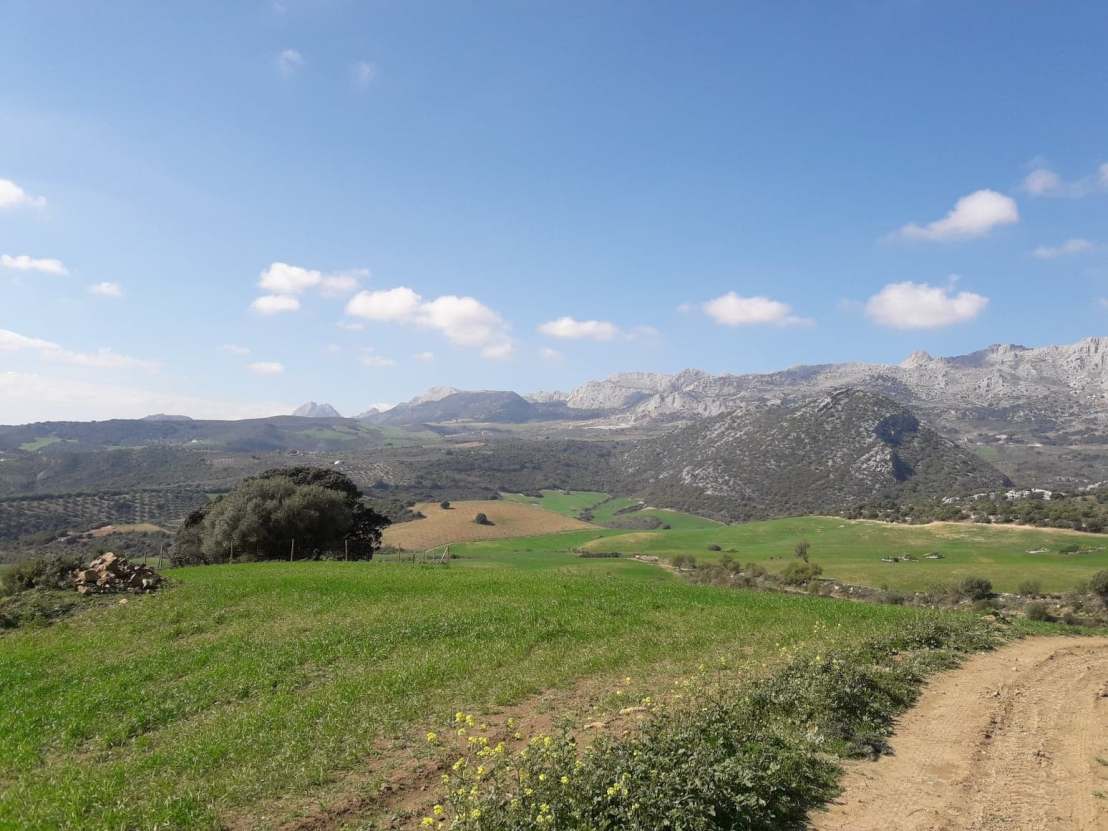
Day 3: Embalse de Almodovar to Los Barrios 20k

By Tom and Chica, 15th January, 2020

Written by Tom’s wife.

Silent sentinels

This was the first cold and cloudy morning we’ve had since we arrived in Tarifa – a bit of a shock! The lack of wind, which is a rarity here, meant that all the wind turbines were motionless – like silent sentinels guarding the the hills.


Silly Billy!

oooo

Back on the stony track.

oooo

Don’t run them over!

We reached the start point (What Three Words location: dashes.outlived. plums) at around 10.15. Frustratingly, the route is barred by an electronic gate and notices warn that vehicles are prohibited, although google maps shows it as a through route. This wasn’t a problem this morning but made for a long drive for the pick up later.

After yesterday’s day off both dog and man keen to get going and set a brisk pace to keep warm. The lizards referred to in the sign weren’t in evidence – it was definitely too cold. The same very stony track caused less problems for Tom today with medium rather than light weight boots. The route climbed steadily to a high open valley to Puerto de Ojen giving views of the Sierra del Nino to the north. There used to be a bar here offering refreshment to walkers but sadly only a rather angry little dog and a donkey there now but a brief lunch break was taken anyway.

Puerta de Ojen

oooo

Paths of the prisoners.

This sign on the right (Ed. the last one above.) was a little further down the road. A brief translation tells us that, as a result of the Spanish civil war, prisons were overflowing so Franco decided to create disciplinary battalions, an organized group of political prisoners to perform forced labour. After the outbreak of WWII, he launched the Fortification Plan on the northern shore of the Strait of Gibraltar, with the aim of fortifying and defending the area from possible attacks from the coast. To do this, he built a network of roads in this coastal area of ​​southern Spain from Conil to the Guadiaro River and the path of the prisoners is part of this network of roads built by disciplinary battalion number 22 that was located between Venta de Ojén and Cerro del Rayo from 1940 to 1943.

Rustic bread oven

oooo

Further along they came cross this old bread oven that is currently being restored. Tom is a builder specialising in stone work so was able to determine that it was a good example of modern stonework. He was unable to fully translate the sign but it said that bread was a very important part of the diet and this was oven was a vital resource used by many people.

All in all, an interesting and reasonably easy route. The weather had improved as the day went on and it reached 18 deg but after 20k both Tom and Chica were quite happy to see the car, I think.

Pooped!

ooOOoo

I am so grateful for being given permission by Tom’s wife to republish this amazing journey along the GR7 path.

I’m assuming that you all are enjoying this!


The continuing GR7 journey

Where does the time go!

It is now ten days since I last reported on Tom and Chica’s great walk; so much for my couple of postings a week!

But they continue to walk the GR7 path in Spain and I will continue to republish their posts of this great trip.

So now, so far as republishing goes, we are up to Day Two.

ooOOoo

Day 2: La Pena to Embalse de Almodovar 16k

By Tom and Chica, 13th January, 2020

Written by Tom’s wife.

Human breakfast!

All walking days will start with the full monty for Tom. He is a very practiced breakfast chef so I leave him to it. It did seems to take a while this morning so I think we may have to start getting up a bit earlier. For this week, at least, I will be dropping him off and picking him up so he doesn’t have to carry the full pack with the tent etc, giving him time to get some fitness back first after the flu virus.

The start


So it was 10am before we got to the start at La Pena (What Three Words location: crafted.indecisive.barbecued.) and already a really glorious day; full sun and a gentle breeze. The route wound up into the hills giving wonderful views back down to the sea and across to the Moroccan coast. The path continued on a variety of surfaces, some tarmac, some sand and some stony tracks. The latter proved a bit uncomfortable and Tom now thinks that his more sturdy boots might be better, despite being a bit heavier. He has metal rods in both his feet, the result of a climbing accident about twenty years ago. So it’s extra important that his feet are well supported.

Goats on the move
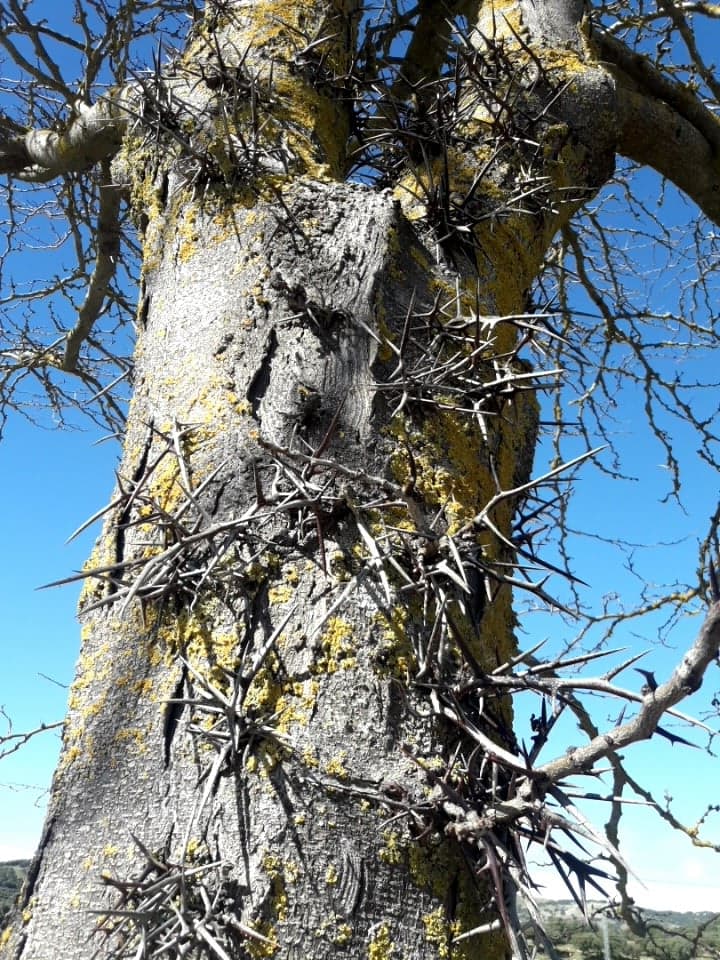
Very spiny cactus with fruit – name anyone?


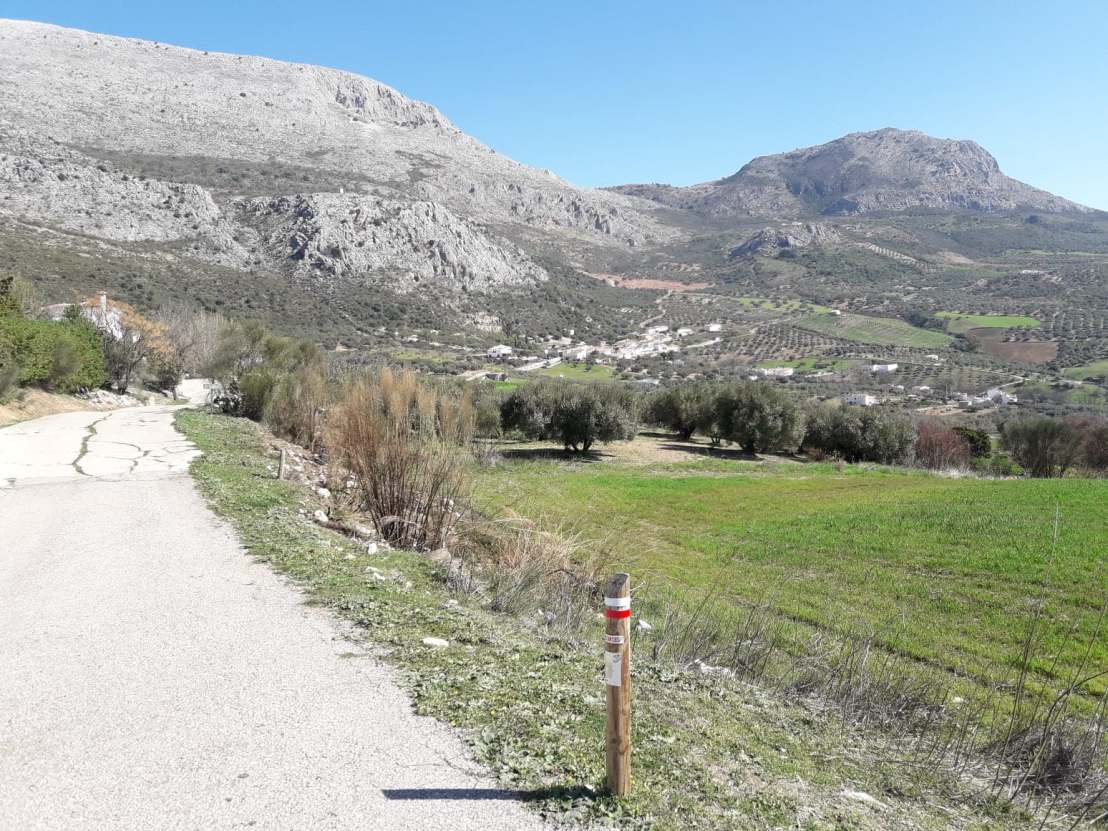
The landscape was quite rocky with olive and other hardy shrubs and trees, and lots of cacti too. Not much wildlife spotted but plenty of goats with their melodic bells. The route ended at a large lake on a inaccessible track so they walked back to the road where we met, conveniently close to a bar for a much appreciated cold beer (for Tom)and long drink of water (for Chica).

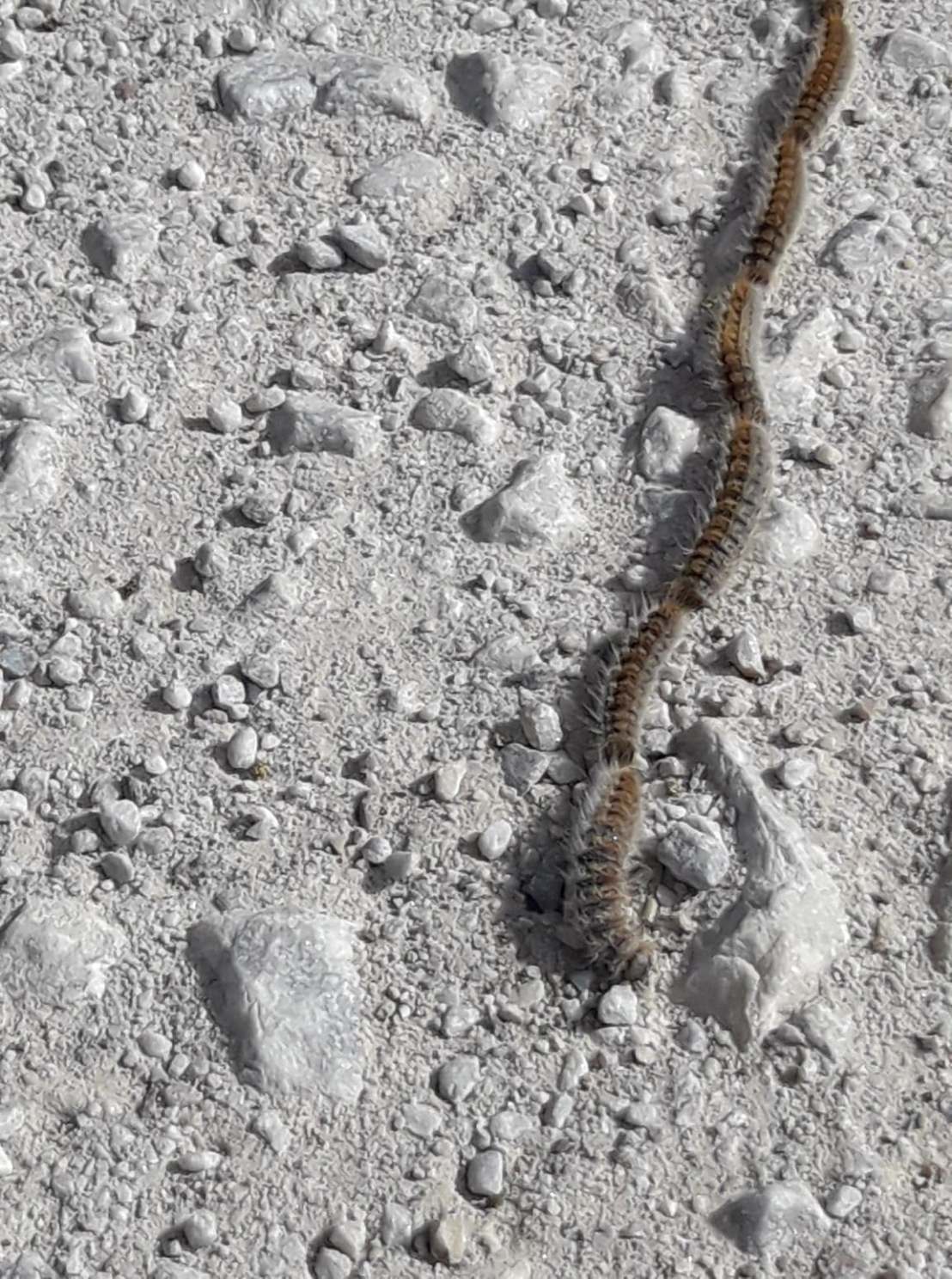
Meanwhile, back at the campsite, there was a minor crisis as a neighbour discovered a number of processionary caterpillars. These are nasty critters with highly irritant hairs that can cause a painful rash in humans but are even more dangerous for dogs. As the name suggests, the caterpillars form a chain when they move and, of course, most dogs want to investigate but if they ingest the hairs it can cause real problems. The nests can easily be spotted as dense webs on the tips of pine branches. The site maintenance staff were very prompt in coming along to remove the nests but we will remain vigilant. It was probably a bit daft to choose a plot under the pines and it’s a lesson learned for the future. One of many to come, no doubt.


ooOOoo

This is such an amazing trip. Words hardly express my admiration for what Tom.

And, as before, please do follow Tom and Chica directly.

Six Great Ways to Help with Your Dog’s Anxiety

Yet another guest post!

One of the lovely things about writing a blog about dogs is that frequently people ‘pop up’ and offer a guest post. So it was with Eliza, or Eliza Gilbert to give to  her her full name. This is a brief background that she sent me.

ooOOoo

NB: It’s the morning of Tuesday, the 11th February, 2020 and I have had to do something for the very first time. That is delete a guest post.

It turned out that Eliza was pushing me to include a link for her client and it was far from being a guest post, more like a commercial arrangement between Eliza and her client. I hope everyone understands.

ooOOoo

Hardly signs of anxiety! Thank goodness. Pedy on the left; Oliver on the right.

Yet another bonus of having dogs in our lives.

There really is no end to the sense of smell that a dog has.

I was browsing online The Smithsonian magazine and came across a long article that was all about the dog’s sense of smell in terms of sniffing out citrus greening disease.

There’s no end of articles about the dog’s sense of smell and I have written about it before. But first I’m going to reproduce the article on Animal Planet because it gets to the point.

Dogs rule. Or, at least, they do when it comes to their sense of smell, which crushes that of humans. According to the Alabama Cooperative Extension System (ACES), a dog’s sense of smell is about 1,000 times keener than that of their two-legged companions — and many dog experts claim it’s millions of times better — thanks to the construction of their often-slobbery, wet schnozzes. So what, exactly, is going on in there?

A dog sniffs at scents using his nose, of course, and also his mouth, which may open in a sort of grin. His nostrils, or nares, can move independently of one another, which helps him pinpoint where a particular smell is coming from. As a dog inhales a scent, it settles into his spacious nasal cavity, which is divided into two chambers and, ACES reports, is home to more than 220 million olfactory receptors (humans have a measly 5 million). Mucus traps the scent particles inside the nasal chambers while the olfactory receptors process them. Additional particles are trapped in the mucus on the exterior surface of his nose.

Sometimes, it takes more than one sniff for a dog to accumulate enough odor molecules to identify a smell. When the dog needs to exhale, air is forced out the side of his nostrils, allowing him to continue smelling the odors he’s currently sniffing.

Dogs possess another olfactory chamber called Jacobson’s organ, or, scientifically, the vomeronasal organ. Tucked at the bottom of the nasal cavity, it has two fluid-filled sacs that enable dogs to smell and taste simultaneously. Puppies use it to locate their mother’s milk, and even a favored teat. Adult dogs mainly use it when smelling animal pheromones in substances like urine, or those emitted when a female dog is in heat.

Top Sniffers

What all of this sniffing and processing really means is that a dog’s sense of smell is his primary form of communication. And it’s a phenomenal one, because dogs don’t just smell odors that we can’t. When a dog greets another dog through sniffing, for example, he’s learning an intricate tale: what the other dog’s sex is, what he ate that day, whom he interacted with, what he touched, what mood he’s in and — if it’s a female — if she’s pregnant or even if she’s had a false pregnancy. It’s no wonder, then, that while a dog’s brain is only one-tenth the size of a human brain, the portion controlling smell is 40 times larger than in humans.

So, who’s top dog when it comes to sniffing? While all canines have an incredible sense of smell, some breeds — such as bloodhounds, basset hounds and beagles — have more highly refined sniffers. This is a result of several factors. Dogs with longer snouts, for example, can smell better simply because their noses have more olfactory glands. Bloodhounds, members of the “scent hound” canine group, also have lots of skin folds around their faces, which help to trap scent particles. And their long ears, like those of Bassets, drag on the ground, collecting more smells that can be easily swept into their noses.

Of course, dogs are individuals as well, so it’s certainly possible to find a non-scent-hound who can outperform one. And as Dr. Sandi Sawchuk, a clinical instructor at the University of Wisconsin School of Veterinary Medicine, notes: “There are lots of breeds that can be trained to sniff out certain items — for example, cadaver-sniffing dogs, drug-sniffing dogs, etc.”

Now to that longer Smithsonian article.

ooOOoo
Can Disease-Sniffing Dogs Save the World’s Citrus?

Once trained, canines can detect citrus greening disease earlier and more accurately than current diagnostics

By Katherine J. Wu ,    smithsonianmag.com
Feb. 3, 2020

A detector dog named Szaboles, trained to sniff out the bacterial pathogen Candidatus Liberibacter asiaticus in a citrus orchard. (Courtesy of Tim R. Gottwald)

Tim Gottwald will never forget the sight: the mottled yellow leaves, the withered branches, the small, misshapen fruits, tinged with sickly green. These were the signs he’d learned to associate with huanglongbing, or citrus greening—a devastating and wildly infectious bacterial infection that slashed the United States’ orange juice yields by more than 70 percent in the span of a decade.

“It’s like a cancer,” says Gottwald, a plant pathologist with the United States Department of Agriculture. “One that’s metastasized, and can’t be eradicated or cured.”

Once they’ve begun to sport splotchy foliage and stunted fruit, trees can be diagnosed with a single glance. A symptomatic plant, Gottwald says, is a diseased one. Unfortunately, the converse isn’t true: Infected trees can appear normal for months, sometimes years, before visibly deteriorating, leaving researchers with few reliable ways to suss out sick citrus early on—and giving the deadly bacteria ample opportunity to spread unnoticed.

Now, Gottwald and his colleagues may have a creative new strategy to fill this diagnostic gap—one that relies not on vision, but smell. They’ve taught dogs to recognize the telltale scent of a huanglongbing infection—an odor that eludes the attention of humans, but consistently tickles the super-sensitive schnozz of a mutt. Once trained up, canines can nose out the disease within weeks of infection, trouncing all other available detection methods in both timing and accuracy, the researchers report today in Proceedings of the National Academy of Sciences.

“This is a major step in the development of what could be a really important early detection tool,” says Monique Rivera, an entomologist and citrus pest expert at the University of California, Riverside who wasn’t involved in the study. “It could give growers information about potential exposure … to the causative bacteria.”

First described in China in the early 1900s, huanglongbing has now crippled orchards in more than 50 countries around the globe. Fifteen years ago, the scourge took hold in Florida, where infected trees are now the norm; the state’s $9 billion citrus industry, once the second largest in the world, is now on the verge of collapse. From oranges to grapefruits to lemons, no variety of citrus is immune.

As the disease continues to creep into new regions, researchers worldwide are scrambling to contain it. But the task has proved difficult: No effective treatments, cures or vaccines exist for huanglongbing, the product of a bacterium called Candidatus Liberibacter asiaticus (or CLas, pronounced “sea lass”) that’s ferried from tree to tree by winged insects. Scientists have also found the microbes to be extraordinarily difficult to grow and study in the lab.

The 20 canines in the study trained to detect CLas-infected citrus trees. (Gottwald et al., PNAS, 2020)

Currently, the only surefire way to curb citrus greening’s spread is to extract and eliminate infected trees. This strategy depends entirely on early detection—“one of the biggest problems in the field right now,” says Carolyn Slupsky, a plant pathologist at the University of California, Davis who wasn’t involved in the study. Spotting an asymptomatic infection by eye is essentially impossible. And though genetic tests can sometimes pinpoint microbes in apparently healthy trees, their success rates are low and inconsistent, due in part to the patchiness with which CLas distributes itself in plant tissue.

In many ways, huanglongbing is “the perfect storm of a disease,” Slupsky says.

But canines may just be the perfect candidates to lend a helping paw. With a sense of smell that’s 10,000 to 100,000 times more powerful than a human’s, dogs are superstar sniffers, capable of nosing out everything from bombs to drugs. In recent years, they’ve even been deployed to detect pathogenic diseases like malaria. Infections, it turns out, stink—and dogs definitely take notice.

To see if pooches’ powers of perception might extend to huanglongbing, Gottwald and his team taught 20 dogs to pick up on the smell of citrus plants with known infections, rewarding the pups with toys when they identified the correct trees. After just a few weeks of training, the newly-minted citrus sniffers were picking out infected trees with about 99 percent accuracy. Put in pairs to corroborate each other’s results, the dogs got close-to-perfect scores.

Gottwald was floored. “I wasn’t surprised [the dogs] could do it,” he says. “But I was surprised by how well they could do it. It was pretty amazing.”

The team then pitted the pups against a common but expensive laboratory test that’s often used to verify the presence of CLas DNA in suspicious-looking citrus. After spiking the microbes into 30 trees, the researchers mixed the newly-infected plants into rows of healthy ones and allowed the dogs to inspect them on a weekly basis. Within a month, the canines had collectively homed in on every single CLas-positive plant.

The DNA test, on the other hand, had no such luck: Seventeen months into the infection, it was still failing to identify a third of the diseased trees.

If Gottwald’s team sees continued success, “this could be very exciting for [citrus] growers,” who could someday keep dogs around as a fast and relatively inexpensive way to survey their orchards, says Phuc Ha, a microbiologist at Washington State University who wasn’t involved in the study. For now, the most immediate applications lie in disease prevention. But, she adds, should researchers develop treatments for huanglongbing, canines could eventually play a role in curing the condition as well.

Gottwald and his team have already begun to send small teams of citrus-sniffer dogs to inspect vulnerable trees in California and Texas. In both locations, the canines have alerted the researchers to trees that have yet to test positive in the lab.

This, however, evokes the double-edged sword of early detection research: The dogs are so much faster at finding potentially diseased trees that their picks can’t actually be confirmed, Slupsky points out. Maybe they’re more sensitive than the molecular test, and the disease is more widespread than researchers feared. Or maybe the canine’s noses are leading them astray. “Specificity is always an issue,” Slupsky says, “because you’re comparing them to an imperfect test.”

Dogs also come with their own drawbacks. They can tire; they can be distracted. They’re not machines. And while they can make fast work of orchards where infections are rare, their performance will probably plummet in heavily afflicted groves. In an ideal world, Slupsky says, the dogs would serve strictly as a first line of defense, screening trees for further monitoring or testing in the lab. She and her colleagues are hard at work on one such diagnostic, built to detect the unique suite of chemicals infected leaves produce early on.

Many questions remain unanswered. Gottwald still isn’t sure what exactly the dogs are smelling on the plants, though a series of experiments indicate the scent is probably coming from the CLas bacteria themselves. That theory may be tough to test: Though researchers like Washington State’s Ha have now grown CLas in the presence of other microbes, no one has yet managed to isolate the strain in a pure culture, hampering efforts to understand its basic biology and develop precise treatments.

While exciting, the team’s dog-nostic developments ultimately underscore “just how distant we still are from understanding a lot of the mechanistic processes that are going on [with this disease],” Rivera says. But with more collaboration and multidisciplinary work, she adds, “I think we’ll keep heading toward solutions.”

ooOOoo

When one watches a dog closely it’s very clear that their nose is their primary sense. At least a thousand times better than our human sense of smell and some people put it much higher. That is impossible to understand. The best we can do is to wonder at the sort of world that dogs ‘see’ with their noses.

I will close with an old photograph of Pharaoh helping a prospector look for gold in our creek.

Pharaoh, instinctively, thought that a dog’s nose would raise the odds of a find.