I was looking through my LfD future posts folder and came across this story about a rescue dog in Kentucky River, in Kentucky, a long way from here ( Merlin, OR).
But that doesn’t diminish in the slightest how beautiful this story is and how generous are the management and staff of Home Depot.
Read it and see what I mean. Thanks to The Dodo for publishing it.
ooOOoo
Dog Is Literally The Cutest Home Depot Employee Ever
“She finds who needs her and gives them that smile” 😍
Luckily, her mom found the perfect place to help her come out of her shell — Home Depot.
JACKIE RAKERS
“The Home Depot runs started as a way to help her with her fears,” Rakers told The Dodo. “She was nervous about new places and new sounds, so we’d go for five minutes and she’d get all the treats. Then we started going longer and longer and exposing her to more and more things within the store.”
The large, dog-friendly store was the perfect place for Heaven to socialize, and the pup was such a good girl on her visits that she earned her own tiny employee apron.
JACKIE RAKERS
Now, Heaven knows that when the apron comes out, she’s about to go to her favorite place.
“I keep it in the car so we are always ready,” Rakers said. “As soon as she can tell we are in the parking lot, she just quivers until I put [the apron] on her and then she takes off towards ‘work.’”
“She walks around like she owns the place,” Rakers added.
JACKIE RAKERS
Heaven has become a bit of a celebrity at her local Home Depot, where all the staff knows her by name, and there’s even a picture of her in the break room.
And while she may not be an official employee, when she’s at her favorite store, she offers excellent customer service.
“She walks around minding her own business and then suddenly insists on meeting someone,” Rakers said. “She just sits and stares. They always end up saying how they needed that pick-me-up. It’s like she has a sense of who needs to be shown they are loved that day — and one of her favorite places to do that is Home Depot!”
JACKIE RAKERS
Heaven loves running errands with her mom, and everywhere they go, she finds someone having a rough day who needs her smile.
“She was scared of everything, but with a lot of training and patience she learned to trust and now it’s like she pays it forward,” Rakers said. “She finds who needs her and gives them that smile and a cuddle.”
JACKIE RAKERS
The only downside of all their Home Depot runs is that every time they visit, Rakers comes up with a new home improvement project. But all the retail therapy is worth it when she sees how happy Heaven is and how far she’s come.
“She’s the perfect example of what happens when you meet someone where they are at and love unconditionally,” Rakers said. “She went from so scared and so sad to the happiest dog.”
ooOOoo
Thank goodness our local Home Depot here in Grants Pass (Oregon) don’t have a Heaven in the store. For if they did Jean and I would be in the store every day of the year. OK, maybe a small exaggeration but only a small one!
Seriously, Home Depot are to be congratulated. It’s good for the store. It’s good for the employees. It’s good for the customers. But it is fantastic for Heaven!
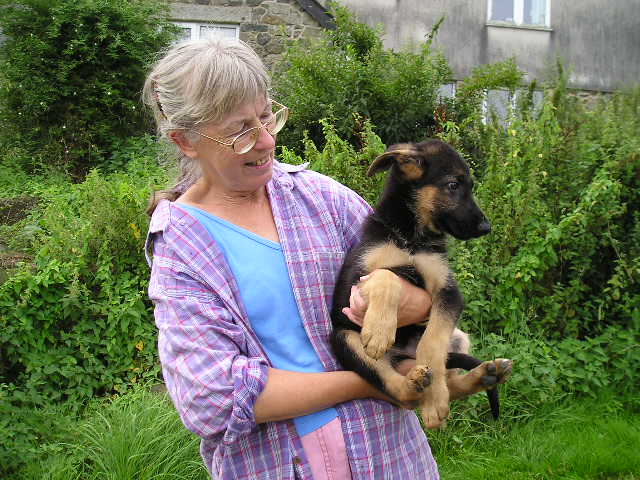
The first day that Pharaoh was passed across to me. He is being held by Sandra Tucker of Jutone Kennels, Bovey Tracy, Devon, Pharaoh was born on the 3rd June 2003. I picked him up on the 12th August.
oooo
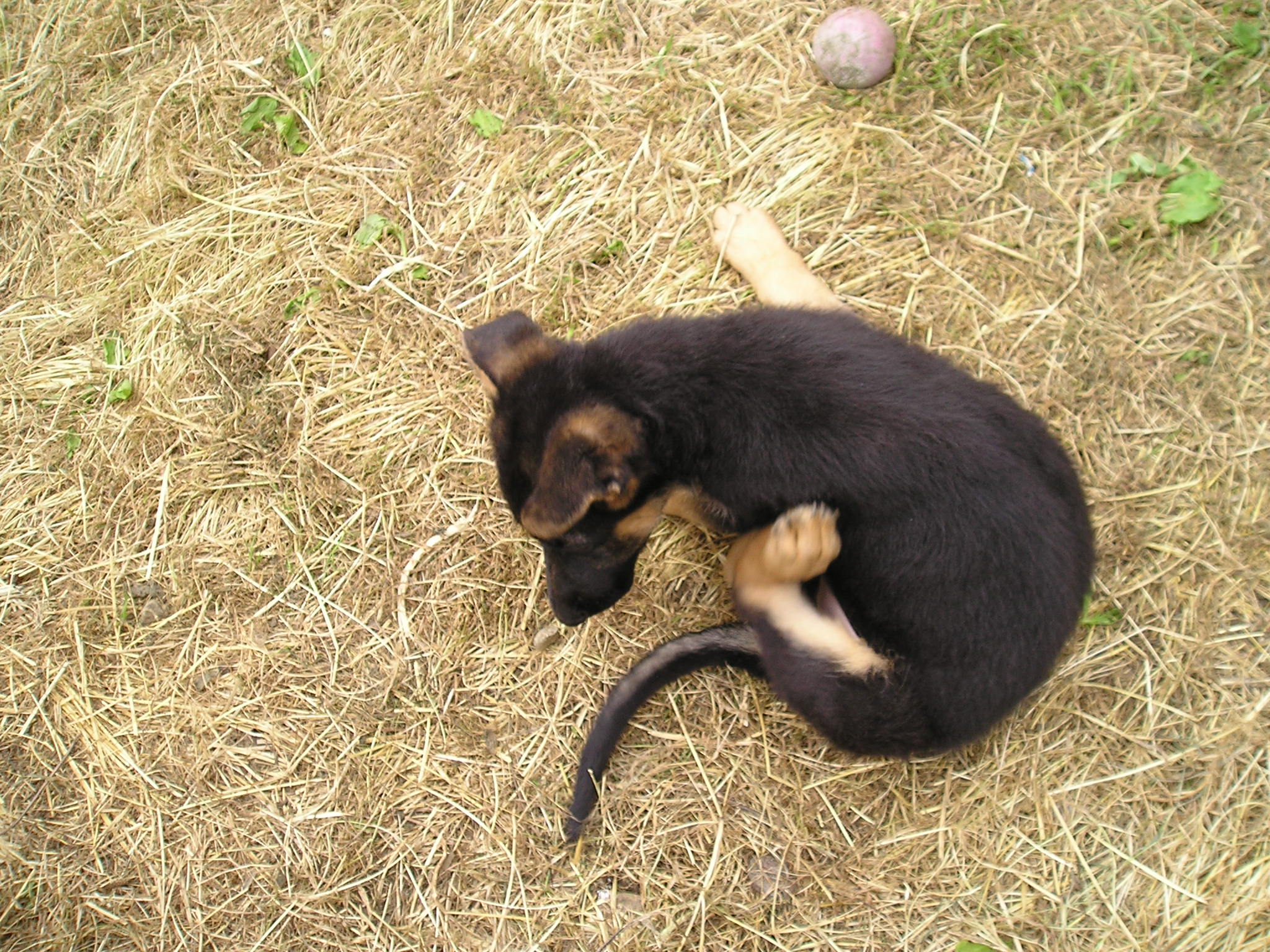
Pharaoh settling in at home soon after he was collected from Jutone. This is about mid-August, 2003. Home being Upper Barn, Harberton, Devon, just three miles from Totnes.
oooo
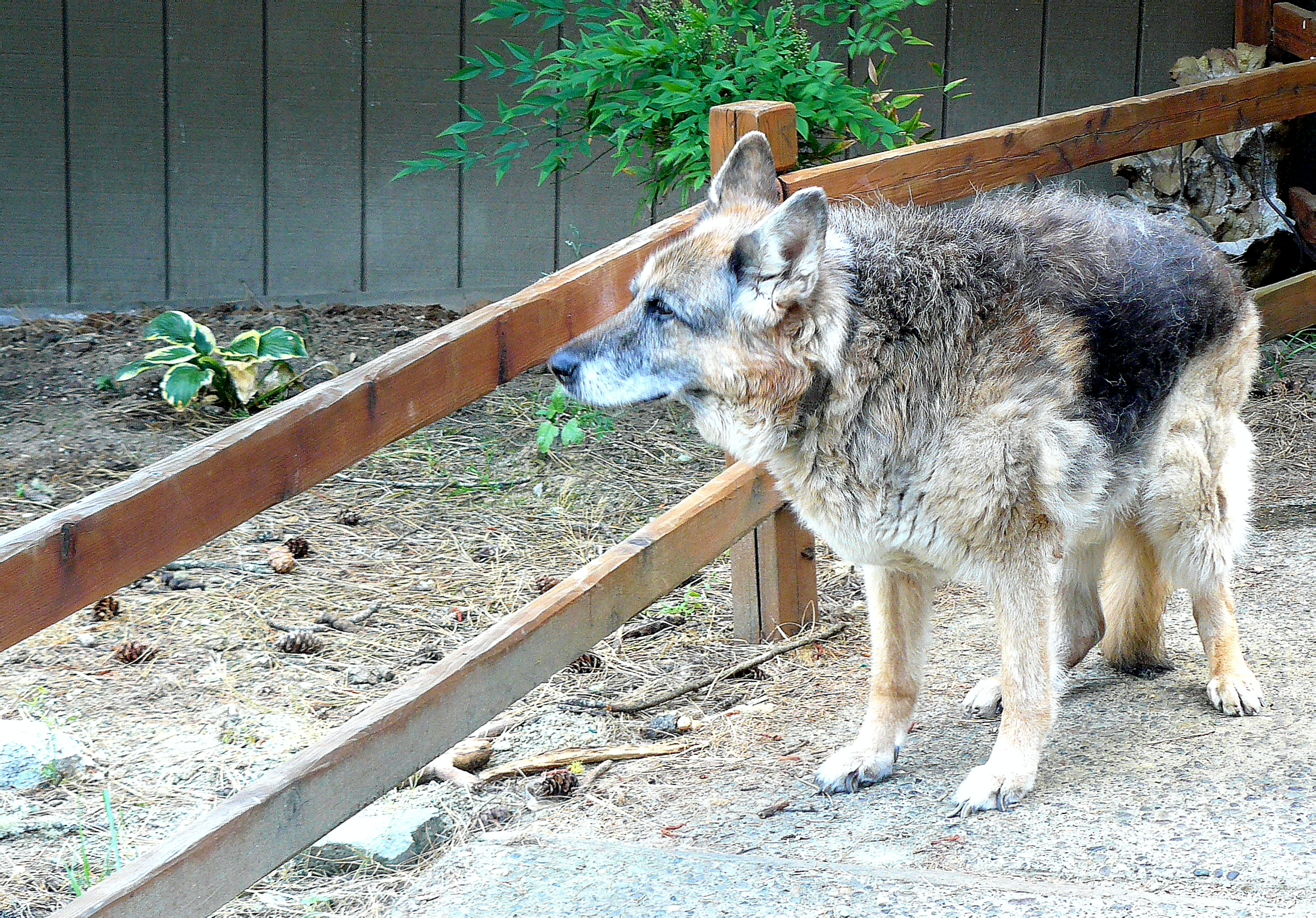
At the other end of the scale! Pharaoh just turned 14 outside our house in Merlin, Oregon. The date June 3rd, 2017.
I am writing another book; my third. It is about the changing planet.
But first I want to tell you a story.
I know Scott Draper. He is the founder and CEO of the Club Northwest. It is the club that Jean goes for her Rock Steady class, and she has been going there for some time.
Indeed Scott and I have struck up a friendship and we now meet up at Scott’s home.
At our first meeting at Scott’s home he lent me the National Geographic’s Earth Day, 50th Anniversary Special Issue printed in April, 2020. It is a magazine that may be flipped and read from either end. On one side there is “A Pessimist’s Guide to Life on Earth in 2070”. On the flip side there is “An Optimist’s Guide to Life on Earth in 2070”. It was a very powerful read.
For on one hand the pessimist’s opinion was speaking of now, of current trends, of the fact that if we don’t change, and change relatively soon, say within the next five years, “our reckless consumption and abuse of resources have made the world a deadlier place for us and for the rest of life on Earth”. It conveys despair!
On the other hand the optimist’s opinion is that life will be different in 2070 and also warmer, “but we will find ways to limit carbon emissions, embrace nature, and thrive”. It conveys hope!
I asked Scott which opinion he supported. Scott told me the following:
There is a legend of two people; a grandfather and his grandson. The grandfather explains to his grandson that there are two wolves fighting inside of him, that they will always be there as he grows up and becomes an adult.
“I have a fight going on in me, even at the age I am,” the wise old man says. “It is taking place between these two wolves. One is evil; he is anger, envy, sorrow, regret, greed, arrogance, self-pity, guilt, resentment, inferiority, lies, false pride, superiority, and ego.”
The grandfather paused and looked at his grandson, and then continued; “The other wolf embodies the best of our emotions. He is joy, peace, love, hope, serenity, humility, kindness, benevolence, empathy, generosity, truth, compassion, and faith. Both wolves are fighting to the death. It is a fight that is going on inside you and indeed every other person, too.”
The grandson thought for some time about what his grandfather had just said. Then he looked up at his grandfather and quietly asked, “Which wolf will win?”
The grandfather gave his reply: “The one we feed”
Now this is an image that serves as a metaphor for our inner sense of conflict. This parable is a powerful reminder of the fight that every human being must face. Regardless of the type of person you are or what kind of life you lead, you will find yourself battling two conflicting emotions at many points in your life. Whether the fight is between anger and peace or resentment and compassion, it is important to recognise the conflicting feelings inside you and to feed the values and choices that matter most to you.
Now I am of an age where I won’t be alive in 2070.
But I am interested in the opinions of others who will be.
I want to ask the following questions:
First Name: Surname: DOB:
Email Address:
Do You Support An Optimist’s Guide to Life on Earth in 2070: Yes / No (please circle one)
Do You Support A Pessimist’s Guide to Life on Earth in 2070: Yes / No (please circle one)
How Many Years Before It Is Too Late To Demand Change: (Please tick your answer.)
Less than 5 years
Between 6 and 10 years
Between 11 and 20 years
Between 21 and 50 years
More than 50 years
How concerned are you? (5 is highest, as in very) 1, 2, 3, 4, 5 (Please circle one.)
Please leave a message if you want to:
Please will you consider helping me.
I am not going to present another post this week. In other words, I will leave this up until the end of Saturday, 26th June.
If you are happy to help me then send me your email address (to paulhandover ‘at’ gmail ‘dot’ com) and I will send out the above survey on the 28th June, 2021. All the recipients will be a bcc.
The survey feedback will be required by a week later; July 5th, 2021.
I will publish the results just as soon as they have been collated.
John is becoming a regular contributor to Learning from Dogs. He was last here on March 26th, this year with a guest post Reasons to get a pet portrait.
This is a timely and pertinent post.
ooOOoo
Five Questions you need to ask a Boarding Kennel
If you’re planning a vacation or a work trip, you’ll need to decide what to do with your beloved pooch. This can be a stressful event for both you and your pup, but things will go a lot easier if you pick the right boarding kennel.
How do you know whether you’ve picked a good kennel?
The best way to determine the quality of a kennel is by asking appropriate questions. Not sure what those would be? Never fear! We’ve got you covered!
Read on to learn what questions to ask to help you choose the best available pet hotels or kennels.
Five Questions to Ask a Kennel or Pet Hotel
One – Is Your Kennel or Pet Hotel Certified?
Certification is not mandatory for kennels. However, certified kennels have to comply with 250 standards in 17 areas of pet care facility operation. This certification is known as the Voluntary Facilities Accreditation (VFA) certificate. If they have a certificate, you can assume several things about the facility:
They have put time and money into making sure they have the best facility possible for the animals they care for. They care about reassuring pet parents that their dogs will be well cared for. They have all the necessary space and equipment to take excellent care of your pooch. Your pup will be secure and safe while you’re away.
Two – Can I Tour The Kennel?
You must always ask to tour the facilities. Just like you put in research when you book a hotel, you need to be equally as fastidious when you book a kennel. Therefore, you should look for the following:
Is the kennel odor-free?
A clean kennel will not smell because all urine and feces will have been cleaned up quickly and appropriately.
Is it loud or quiet?
Dog kennels will be noisy, but an extreme amount of noise usually signals that the pups are unhappy.
Are there enough staff?
There should be a 1-to-10 staff to dog ratio. The higher the people to animal ratio, the more individual attention your dog will get.
Are the living and playing areas clean?
Are there feces, urine, and debris? Or are the areas open and clean?
Do all animals have proper bedding and water?
The pooches should look content and stress-free and have both comfortable bedding and ample water. If a kennel doesn’t let you take an impromptu tour, do not leave your pup there.
Three – What Will the Facility Do if Your Dog Gets Sick?
The kennel must have a procedure in place for dealing with small issues like diarrhea and broken toenails and more significant problems like medical emergencies. Ideally, they will ask you to pre-approve an amount for vet services. They should also know basic pet first-aid.
Four – How Knowledgeable Are the Staff?
Kennel staff, like the facility, are not required to be certified in animal behavior or training. However, what’s more, important than a certificate is the staff’s attitude and attentiveness. Good staff can tell you details about each animal under their care.
When you enter the kennel, staff should welcome your dog and take meticulous notes about your pup’s diet, exercise needs, medications, and any other pertinent information. Take note of whether they are patient, friendly, and seem genuinely interested in your pooch’s welfare.
Five – What Do the Exercise and Play Programs Look Like?
You must look at the package your kennel is offering. Some kennels have one playtime, whereas others don’t include any in their base fee.
Good kennels will have a system for playtime where they divide dogs by style, size, age, etc., to keep the pups safe and happy.
Dogs that need more exercise should get walked by a kennel assistant. So, if you own a dog that needs regular walking, make sure that the kennel offers this service and has enough staff to meet your pup’s needs.
Furthermore, not all kennels offer toys for your pooch to play with. So it’s important to find out ahead of time if you need to provide your own toys.
To Sum Up…
We know you love your dog, so you should plan where they will stay while you’re away as carefully as you planned your vacation. The most essential thing to look for when visiting different kennels or pet hotels is how the environment makes you feel. Listen to your gut. If you feel comfortable and you get along well with the staff, then there’s a high probability that your pup will feel at ease there as well. While no kennel can replace the feeling of home for your dog, it should come close. This way, you’ll be able to go on your trip knowing your pooch is safe, sound, and well cared for.
ooOOoo
This is a very useful list from John. One that will provide guidance to everyone but especially to the new dog owners.
As can happen from time to time, I was contacted by Ray Dunthorne in England. He very kindly said that he had been following Learning from Dogs for a while and also was aware of my previous interest in flying.
So I emailed Ray saying that I would love to publish his account as a guest post and lo and behold in came the following story.
ooOOoo
The Story of Lulu
Ah hello again, I’ll try ever so hard not to give you my full life story, but just stuff you might find interesting and relevant, but can’t promise to get the balance right!
Willows Activity Farm St Albans
My adult dog journey began with Lulu, 15 years ago, but the seed was sown some 5 years earlier at a city farm. We’d gone with the then middle-born five-year-old for his birthday party. The shepherd who did herding demonstrations was over from New Zealand and had two dogs who’d just had a litter of puppies, which we were shown. We’d never heard of the New Zealand Huntaway, it was described as a combination of German Shepherd, Border Collie and Labrador, with a few other breeds thrown in for good measure.
They’d been consistently bred in, yes, you guessed it, New Zealand for over 100 years, specifically to help move large herds of sheep or cattle over long distances. The agile New Zealand Huntaway became known for its ability to move across packed, penned herds by leaping from the back of one sheep to another. Its loud LOUD bark was also required, as if not busy barking to get cattle or sheep moving, the Huntaway would be sent after a sheep or lamb that had strayed out of sight, hold it down (I don’t know how) and BARK so the shepherd could locate the unruly pair.
Little thought was given to the New Zealand Huntaway for a few years, when – on the other side of divorce – my then ex-wife and I decided to get a dog to raise collaboratively, to keep the disparate family united in some way. Divorce-wise, it wasn’t so amicable initially, as these things usually aren’t, but soon settled down with the three growing boys being the priority.
Lime End Farm, Sussex
Of course we couldn’t agree on the type of dog. I’d always wanted a German Shepherd, madame a Border Collie and a Labrador was a popular choice with Stanley, Arthur and Sidney (the aforementioned three boys). I bet you can tell where this is going. Yes, I remembered the New Zealand Huntaway. In 2006, it was a lot harder to find a litter in the UK than it is now, but I did. Down on a farm in Sussex. Lulu’s mum and dad were also over from New Zealand with a shepherd, this one herding cattle at Lime End Dairy Farm.
Lime End is in Herstmonceux, East Sussex, which is as Olde English countryside as it sounds, with a castle and an annual Medieval festival to complete the picture.
As soon as we arrived in the classic farm yard, all the puppies bumbled out to say hello, emerging three at a time from under an old caravan where they’d been sheltering from the sun. Their dad, Lord Toro was tied to a nearby barn, doing some general barking ‘he’s frightened of the puppies’ the lady told us. The nine puppies all toppled about us for a few minutes, then all rushed off to find dinner. All except one.
Eight week old Lulu came back with me, Sidney and Helen, my new girlfriend at the time, who I’d charmingly had to borrow the £300 needed to secure Lulu from. It was a four or five hour round trip for the three of us, four including Lulu. A bonding opportunity all round.
I always remember that – to add to the idyllic Sussex farm scene, as if it wasn’t enough like a scene from a film Hugh Grant drives a Mini in – just as we were leaving, an old barn door got pushed open from the inside and a litter of Border Collie puppies and their mum and dad ran out, to say hello to the remaining Huntaways and good bye to us.
Best Laid Plans
The wisdom of bringing that hard-working herding dog into two separate St Albans houses didn’t cross my mind. It probably should have, especially as my ‘house’ was a rented Maisonette, no dogs aloud. The theory was Lulu would be at the children’s house in the week, mine along with the children at the weekends. It didn’t turn out like that.
After a few months both me and my ex-wife got short contracts that meant heading off to work in an office for the day. Far from ideal, but no money at that point meant no choice. At least it was only temporary. Lulu would have been about six months old by then and absolutely should not have been left alone FOR A SECOND.
The office was just 15 minutes away (PC World, Maylands, Hemel Hempstead). I did manage to pop back at lunchtime most days and a child would pop round a few hours later after school. New Zealand Huntaways are like any puppy only more so. They need a lot of exercise and mental stimulation, or else you will pay.
A novice dog guardian then, I learned everything the hard way. Before her first birthday, Lulu had removed the floor covering in the kitchen and the lounge. She’d moved a large old cathode ray TV across the room, knocked bookshelves over and generally done over £1,000 of damage. I know it was that much because I got a bill from the landlord. I paid.
What dogs do
I will cut to the end here. That was in the first year of Lulu’s life.
The contract I mentioned was my first proper BIG company for the digital stuff I was doing, without it I wouldn’t have been able to have the career I’ve had, which started late as I accidentally tried to be a musician for ten years. Not too successfully. That doesn’t matter though.
The 14 years has gone by and even Sidney, who was about five years old when he came with us to East Sussex to meet Lulu, has gone off to university, the older two long-since moved away, to Nottingham and London respectively, leaving me, Lulu and my Helen, that new girlfriend who’d come to Sussex with us on that early date, who moved in a year or so later and is still here.
What Lulu did was tie us all together. Yes, she was a nightmare initially. Yes, she would run away, out of sight chasing imaginary deer, for 30 or 40 minutes at a time. Yes, she’d bark at everything, constantly herding the children when they were small, stopping them from fighting among each other as they got bigger, becoming more and more generally in control and charming with each year. Almost without us noticing. All of a sudden, she was one of us. Not a pet, not a ‘furry friend’, not even a dog really.
She could sense when someone was ill or in distress and would attend accordingly. She loved small children and even when in a fierce mood, if a small child the same size as her approached, she would sit down and raise her head waiting for a pair of tiny arms to be thrown around her. It had all just got normal for us. Pretty much every time when we were out with her, she’d do something that would further add to our respect for her understanding of what’s going on. She WAS one of us.
Lulu loved an air show, going to several with us over the years. Here she is at Eastbourne air show, enjoying the Lancaster Bomber and a Spitfire from the Battle of Britain Memorial Flight.
Now it’s all gone
It’s only when Lulu was finally gone I noticed everything else that’s passed too. All that time, pretty much my entire career, moving from acrimoniously divorced to getting along just fine and concentrating on giving the three boys as good a start as we could manage. The three boys no longer the children they were when Lulu was working out her role in the family, now all long-since scarpered and working harder than I ever have.
My career is pretty much done too. I’m finding it harder to get new contracts or jobs in digital. ‘What are you doing working in digital? I thought that was a young man’s game’ one marketing director interviewing me for a dull digital role I didn’t want tactfully said, almost ten years ago too. I won’t say where, for reasons of professional discretion (David Lloyd Leisure, Hatfield, Monday 4th March 2013)
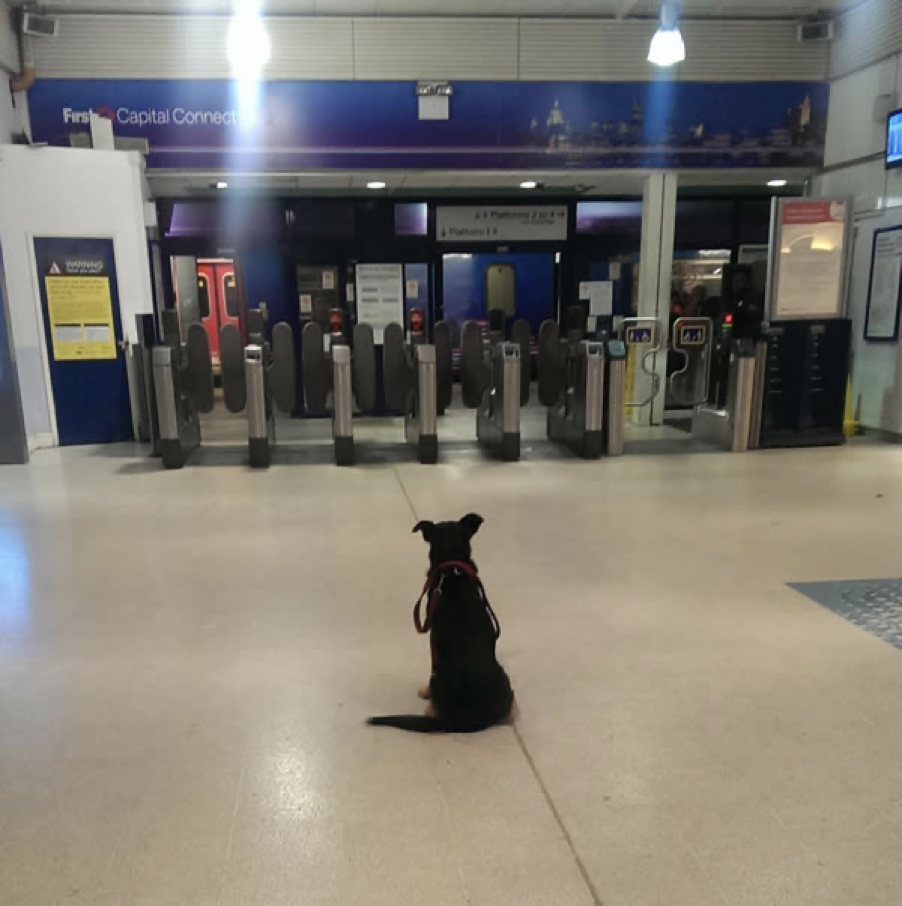
When I was working from home and madame, who I now call Mrs Tagmaster, was coming home from London, me and Lulu would go and pick her up. I trained Lulu to sit in the middle of the station and wait for Mrs Tagmaster for as long as 10 minutes, which meant several packed commuter trains unloaded past her. I’d hide out of sight, watching to see how many pats on the head she got. Usually several.
Lulu’s Legacy is Ten Year Tags
Phew, we’re getting up to date at last. Lulu lost dog name tags like it was something she was born to do. Sometimes in a few months, sometimes in a few days. We got through dozens. I’m a bit slow on the uptake, it took me a while to work out the dog name tags on the market just might not be up to the job.
It took about a year of fact-finding, market assessment and trying to work out how to make a better dog name tag before I was ready to start planning the equipment we needed. Having wasted months liaising with companies in China to get the tags made in volume, I gave up on that idea to both keep our carbon footprint down AND have more control over any supply chain and not have to worry about any one critical supplier.
With over 9 million dogs in the UK alone, there’s a good sized market. Research quickly revealed this ubiquitous, low price point product has largely been ignored, especially digitally. Consequently many competitors are getting away with minimal product quality and poor customer experience (I’ll come back to this). This surprised me, as not many products pretty much anyone can manufacture are actuallyrequired by law in the UK courtesy of a stupidly out of date Dog Tag Law.
I pretty much, at least subliminally, thank Lulu for every tag I press out and when it’s a busy day that started at 6 am and is only drawing to a close with a 6pm trip to the sorting office with a sack of 50 or more orders, I’m ever so grateful to Lulu, as without her showing us the flaws in all those substandard products over the years, patiently waiting until Raymond here got the hint, we probably wouldn’t be coping at all right now. Lulu is still looking after us.
ooOOoo
Thank you, Ray.
This is such a delightful story. So much so that I am going to post another story for Saturday. Namely, a short article, broadly written by Ray, and featuring the Spitfire.
Ray’s company Ten Year Tags is linked to Ray’s website.
It is shared with you all exactly as it came in to me.
ooOOoo
Freshpet Dog Food Recall
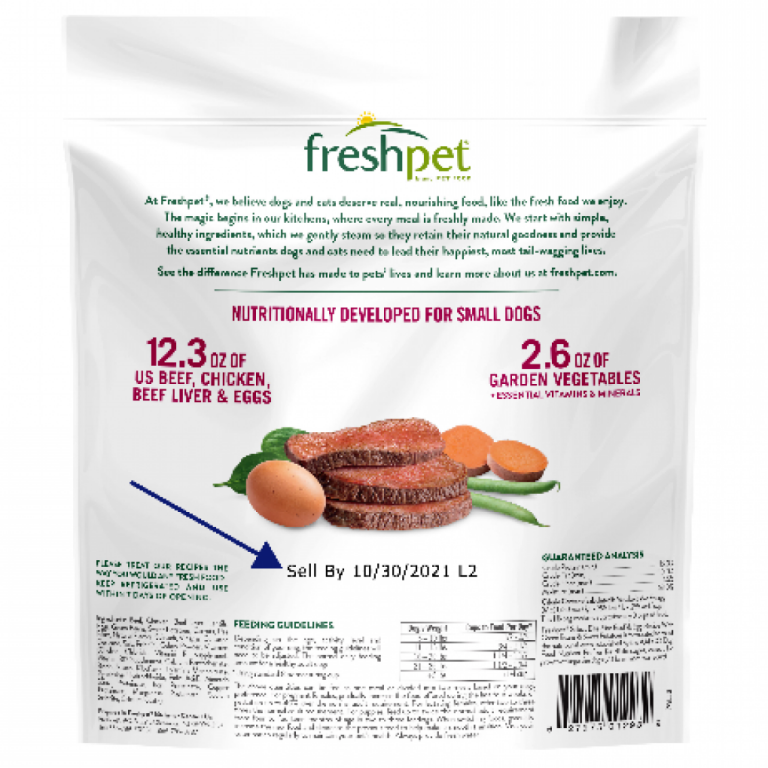
June 13, 2021 — Freshpet Inc. of Secaucus, New Jersey, is recalling a single lot of Freshpet Dog Food due to potential contamination with Salmonella bacteria.
What’s Recalled?
The following defective dog food is being recalled:
Freshpet Select Small Dog Bite Size Beef and Egg Recipe
Package size: 1 pound bags
Sell by date: 10/30/2021
Sell by date, along with UPC code and lot code, can be found on the bottom and back of each bag. Product images are posted below.
No other Freshpet products or lot codes are impacted by this recall.
What Caused the Recall?
Workers at Freshpet discovered a single lot of dog food that was contaminated with Salmonella bacteria… and had designated it for destruction.
However, the contaminated product was accidentally shipped to retailers in limited geographic markets between June 7 to June 10, 2021.
Where Was the Product Sold?
The recalled products may have been sold at: Publix in Florida, South Carolina, and Georgia. It was also distributed at limited Target locations in Arizona and Southern California.
Most of the product was intercepted at retailer distribution warehouses and not delivered to retail stores.
According to the company, “Freshpet has received no reports of illness, injury, or adverse reaction to date, and has issued this recall because of our deep commitment to the safety of our pet parents and their dogs.”
About Salmonella
Salmonella can affect animals eating the product and there is risk to humans from handling contaminated products, especially if they have not thoroughly washed their hands after having contact with the products or any surfaces exposed to these products.
Healthy people infected with Salmonella should monitor themselves for some or all of the following symptoms: nausea, vomiting, diarrhea or bloody diarrhea, abdominal cramping and fever.
Rarely, Salmonella can result in more serious ailments, including arterial infections, endocarditis, arthritis, muscle pain, eye irritation, and urinary tract symptoms.
Consumers exhibiting these signs after having contact with this product should contact their healthcare providers.
Dogs with Salmonella infections may be lethargic and have diarrhea or bloody diarrhea, fever, and vomiting.
Some dogs will have only decreased appetite, fever and abdominal pain.
Infected but otherwise healthy dogs can be carriers and infect other animals or humans.
If your dog has consumed the recalled product and has these symptoms, please contact your veterinarian.
What to Do?
If pet parents have products matching the description above, they should stop feeding it to their dogs and dispose of it immediately.
Consumers are asked to call the company if you have any of the recalled product in your possession.
Pet parents who have questions or would like to report adverse reactions should call 1-866-789-3737, Monday through Friday, 9 am to 9 pm ET and Saturday through Sunday, 9 am to 1 pm ET… or visit www.freshpet.com.
U.S. citizens can report complaints about FDA-regulated pet food products by calling the consumer complaint coordinator in your area.
Humans are great inventors! Indeed, a better way to describe H. sapiens ever since we separated from the chimpanzees, some 5 or 6 million years ago, is to describe us as explorers both outwards and inwards constantly in search for new worlds and new insights into meaning.
Thus this naturally caught me eye as Doug Thron uses a modern device, a drone, to search for animals in distress, a very ancient behaviour!
ooOOoo
Drone Pilot Rescues Animals After Natural Disasters
Doug Thron goes to devastated areas to save pets and wildlife.
Doug Thron with Duke, a dog he rescued after California wildfires.”Doug to the Rescue”
For nearly three decades, seaplane and drone pilot Doug Thron has been a professional photographer and cinematographer, primarily for nature shows and magazines. A few years ago he was using his drone to film the devastation left behind after wildfires in California when he teamed up with rescuers to help find lost pets and reunite them with their owners.
A long-time animal lover and environmentalist, Thron realized he could combine those passions, using his aerial skills. He now travels wherever there is need, using his drone to help communities dealing with the destruction after natural disasters.
Thron is featured in a six-part documentary series “Doug to the Rescue”streaming on CuriosityStream beginning June 10.
He talked to Treehugger about his first animal rescues, his drones, and some of the challenges he’s faced.
Treehugger: Which came first: the animal rescue work or the drone?
Dough Thron: I was using drones for filming for TV shows, commercials, and real estate clients before doing the animal rescue work.
Were you involved in animal rescue and realized that your drone work could come in handy?
Definitely. I was doing animal rescue work after the wildfires in Paradise, California. I was working with an expert cat rescuer named Shannon Jay, and I saw him using an infrared scope at night to help find the cats. We talked about how incredible it would be to put one on a drone and when the opportunity came up about 10 months later in the Bahamas after the category 5 Hurricane Dorian, that’s what I did and it worked incredibly.
I had raised orphaned baby animals as a kid and worked with animals such as possums, raccoons, squirrels, beavers, and even mountain lions. I’ve been using drones since 2013 for cinematography, so I’ve used them for quite a while before I got involved in the actual rescuing of animals with drones.
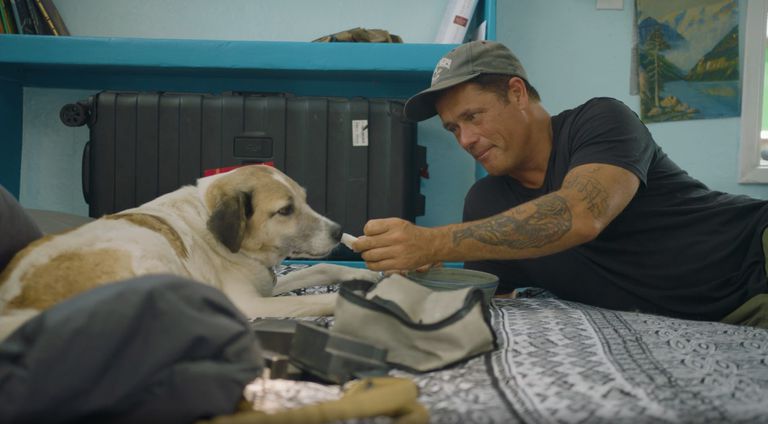
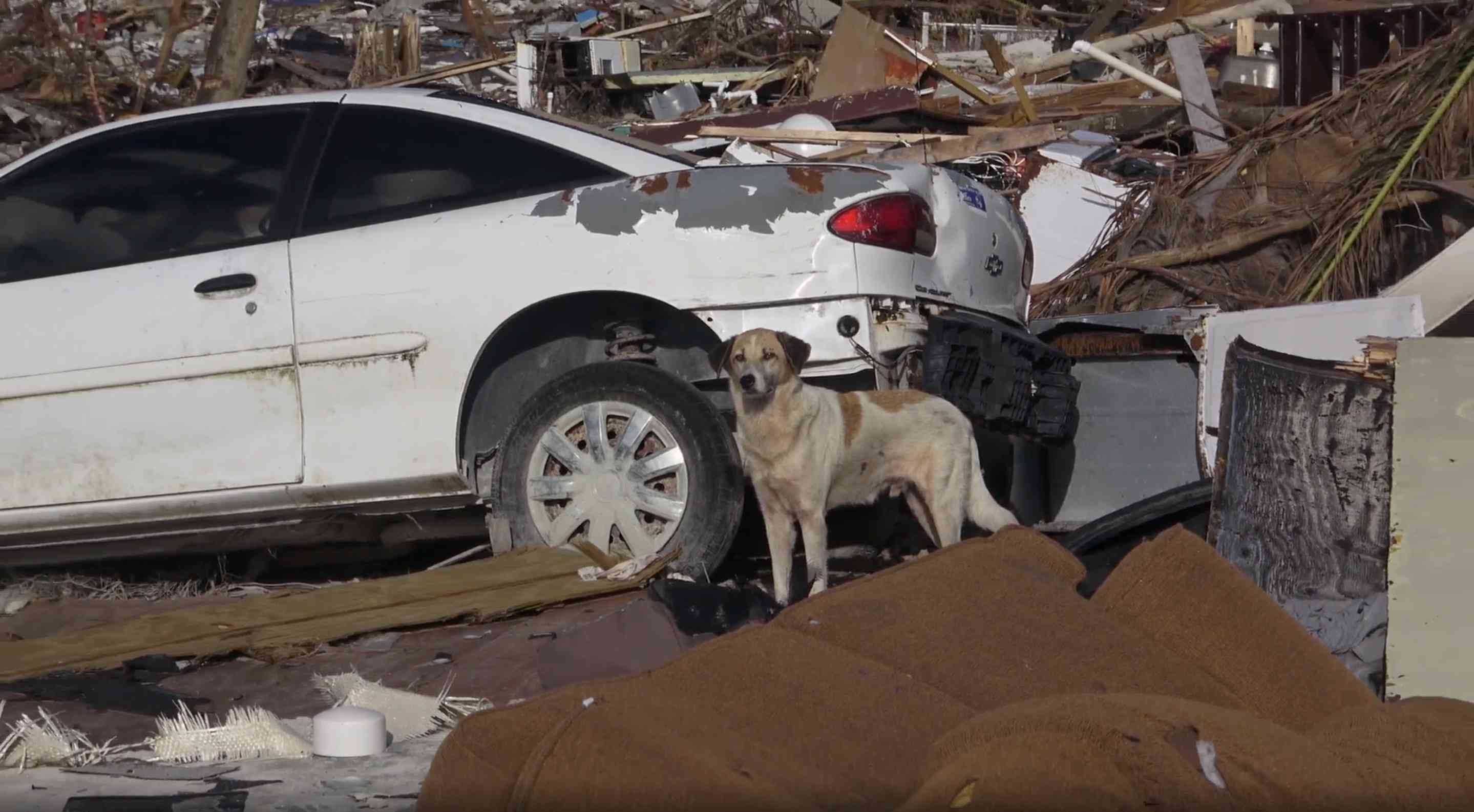
Duke in the Bahamas.Doug Thron / “Doug to the Rescue”
What was your first big rescue using a drone?
My first big rescue using a drone was in the Bahamas after Hurricane Dorian. I was there helping to deliver aid and film the destruction when I spotted a dog roaming around the mountains of debris. He obviously hadn’t had any water or much food for days. He was really apprehensive at first, but warmed up over the course of the day, as I just sat with him. Dog food and water helped! The next day, some animal rescuers came with me to get him. He’s such an incredible dog, and meant so much to me, so I adopted him and named him Duke after a sign I’d seen where I found him.
Where are some of the places you’ve gone to help stranded animals?
The Bahamas, Australia, Oregon, California, and Louisiana.
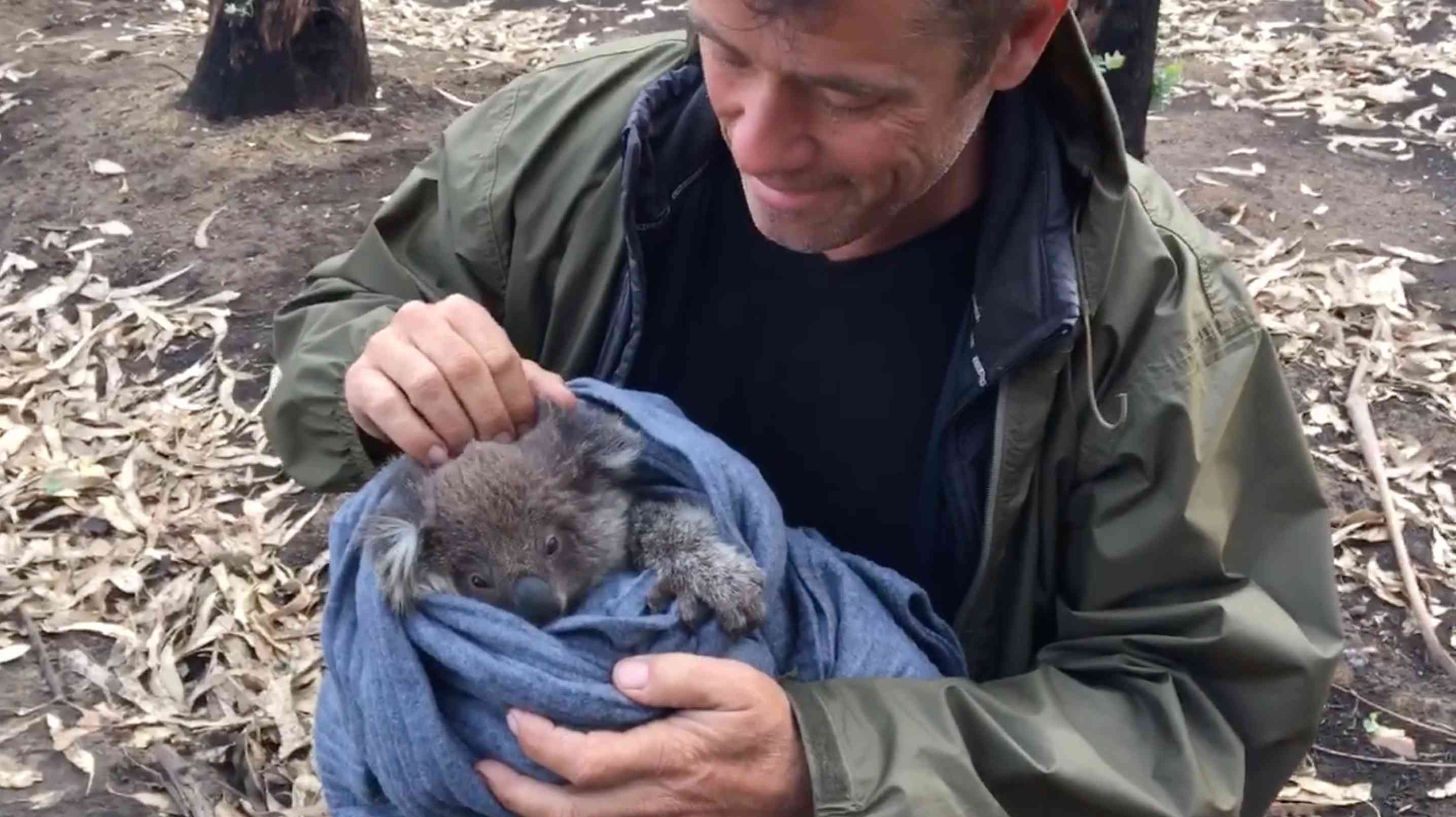
Thron with a rescued koala.”Doug to the Rescue”
What were some of the most challenging circumstances?
In Australia, it was challenging because the hurt koalas were deep in burnt out forests, often with a dense canopy. It was so hot out you had to fly strictly at night with spotlights and infrared and fly the drone pretty far and often drop it down through the trees to see the animals, which takes a lot of skill. Koalas are also very aggressive and strong, and not always thrilled when you go to grab them out of a tree to rescue them. On almost all these rescues, Australia and everywhere else, it’s countless long hours of work—generally about 20 hours a day—which can certainly wear you down day after day.
What is it like when you spot an animal in an area of devastation where there is no other sign of life?
It’s great to be able to rescue these animals so much more efficiently and faster and, in many cases, find animals that never would have been found. It’s different everywhere I go—finding animals when there aren’t any others alive nearby is always really hard. But in places like Louisiana, where I was searching in so many neighborhoods, it gives you a feeling of hope when you find a cat or dog, knowing it was someone’s pet.
In other places, like Australia, I’d be covering dozens of miles a night, sometimes and only finding an occasional animal. It’s really sad because you realize how many thousands of animals didn’t make it. It’s also really hard to see how fires and other natural disasters as a result of climate change are taking out the last patches of unentered habitat and endangered animals.
A dog rescued in Louisiana.”Doug to the Rescue”
How heart-wrenching can it be?
It can be really heart-wrenching to find animals that are severely wounded, but it’s wonderful to be able to save them.
How euphoric is it when you make a great save?
It’s awesome to be able to save people’s cats and dogs because frequently, that might be the only thing they have left after a fire or hurricane. Obviously, for the animal’s sake, it’s so incredible because without the infrared drone, in many cases, the animal would have never been found and would have died, sometimes a slow and painful death.
Thron with his drone.”Doug to the Rescue”
What is your drone like?
The Matrice 210 V2 are the drones I use with an infrared camera, spotlight, and 180x zoom lens. The combination of using those three attachments for animal rescue has never been done before.
How much time do you spend doing animal rescue work? What else do you do?
The rescue work is pretty continuous for 9 to 10 months during the fire and hurricane seasons. After that, there are occasional lost pets to be found.
What else do you want to accomplish?
I hope to make using infrared drones for animal rescue as popular as helicopters are for rescuing people after a natural disaster. So many more animals can be saved when you can find them so much faster and find ones that never would have been found on foot because there is just too much area to cover.
ooOOoo
This account makes me want to choke up. Doug is clearly used to being a professional photographer and, also, works with others in the field of animal rescue. But this story is about Doug and he is engaged with animal rescue with his heart as well as his head!
Doug has been reported widely I am delighted to say and there’s a YouTube video that you can watch.
A report from BBC Future suggests there is a hidden reason
With six dogs feeding them is quite an exercise. I don’t really take much notice of what Jeannie does although I do know that we feed them kibbles, canned food and Jean cooks up beef for the dogs as well.
Recently BBC Future had a report saying that there is a hidden reason that processed foods are addictive. I am going to share that article with you.
ooOOoo
The hidden reason processed pet foods are so addictive
From potently smelly additives to offal concentrates, pet food companies turn to some surprising ingredients in the quest to make kibble delicious.
The cue might be a hand in a pocket, the opening of a cupboard door, or even a word said carelessly aloud – “dinner”. Before you know it, you’re tripping over a pet excitedly awaiting a portion of… dull-brown dried pellets. What’s in these mysterious morsels, that makes them as delectable as roasted chicken, wild salmon, or bundles of fresh herbs?
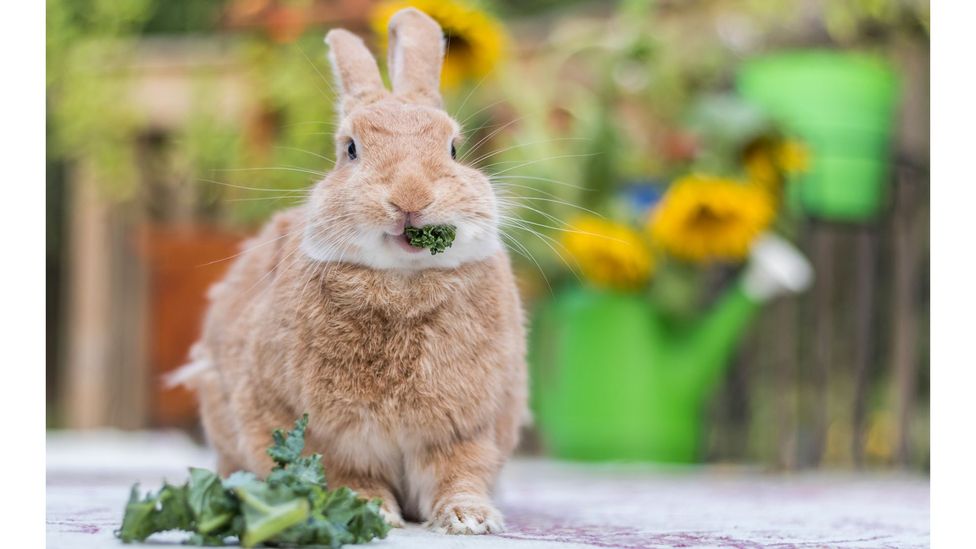
Take my flatmate, a small black rabbit. For a large part of every day, he can be found sitting attentively with his paws on his empty food bowl, awaiting his next portion of kibble – even though it looks like his droppings and smells equally unappetising. He used to have an automatic dispenser with a timer, but he learnt to throw it across the room to access its contents prematurely. No matter what delicacies I place before him – home-grown parsley, soft-cut hay, fresh carrot-tops, organic kale – he would always rather eat processed pet food.
It seems that this is not unusual. Anecdotes abound about pets whose thoughts are largely preoccupied with kibble, such as the cat that has a daily panic attack when it realises it has eaten all its pellets and the pragmatic German shepherd found carrying a bag of dog food around the streets of Houston after Hurricane Harvey.
As it happens, this addictive quality is carefully engineered. Big Pet Food is a multi-billion-dollar industry which invests heavily in research into “palatants” – ingredients that make our pets want to eat their products. And from potently smelly chemicalsusually found in rotting meat to an additive commonly added to potatoes to stop them discolouring, the quest to make the most scrumptious pet food has led to some surprising insights.
“Big [pet food] companies have huge departments that make palatants,” says Darren Logan, head of research at the Waltham Petcare Science Institute, part of the company Mars Petcare. “Just like we make them for humans, we make them for pets as well.”
Upper-class dogs
The first pet food was invented in 1860 by James Spratt, an enterprising lightning-rod salesman from the US state of Ohio. Legend has it that he had travelled to England for his business, and was looking out over the docks of Liverpool one day when he noticed stray dogs knocking back leftover hardtack biscuits.
This was a revelation for two reasons.
Rabbits eat fresh vegetables in the wild, but many kept as pets feast instead on processed pellets (Credit: Getty Images)
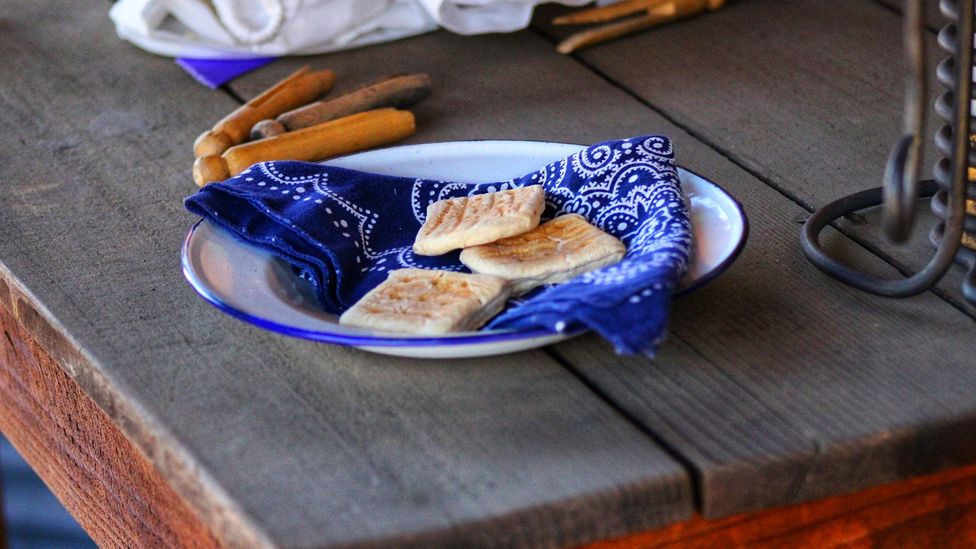
Firstly, hardtack were famously unappealing – loathed by generations of the soldiers and sailors who ate them, these simple slabs of baked flour and water were tougher than wood and sometimes hard enough to break your teeth. Their nicknames included “sheet iron” and “worm castles“, the latter because of the high proportion that were infested with maggots and weevils. The oldest piece of surviving hardtack was baked just nine years before Spratt’s dock visit, and still looks suspiciously well-preserved 170 years later.
Secondly, until that moment it hadn’t occurred to anyone to check what their pets would like to eat – or that this could be monetised. For as long as we had kept domesticated animals, they had been fed more or less the same food as humans, or expected to fend for themselves.
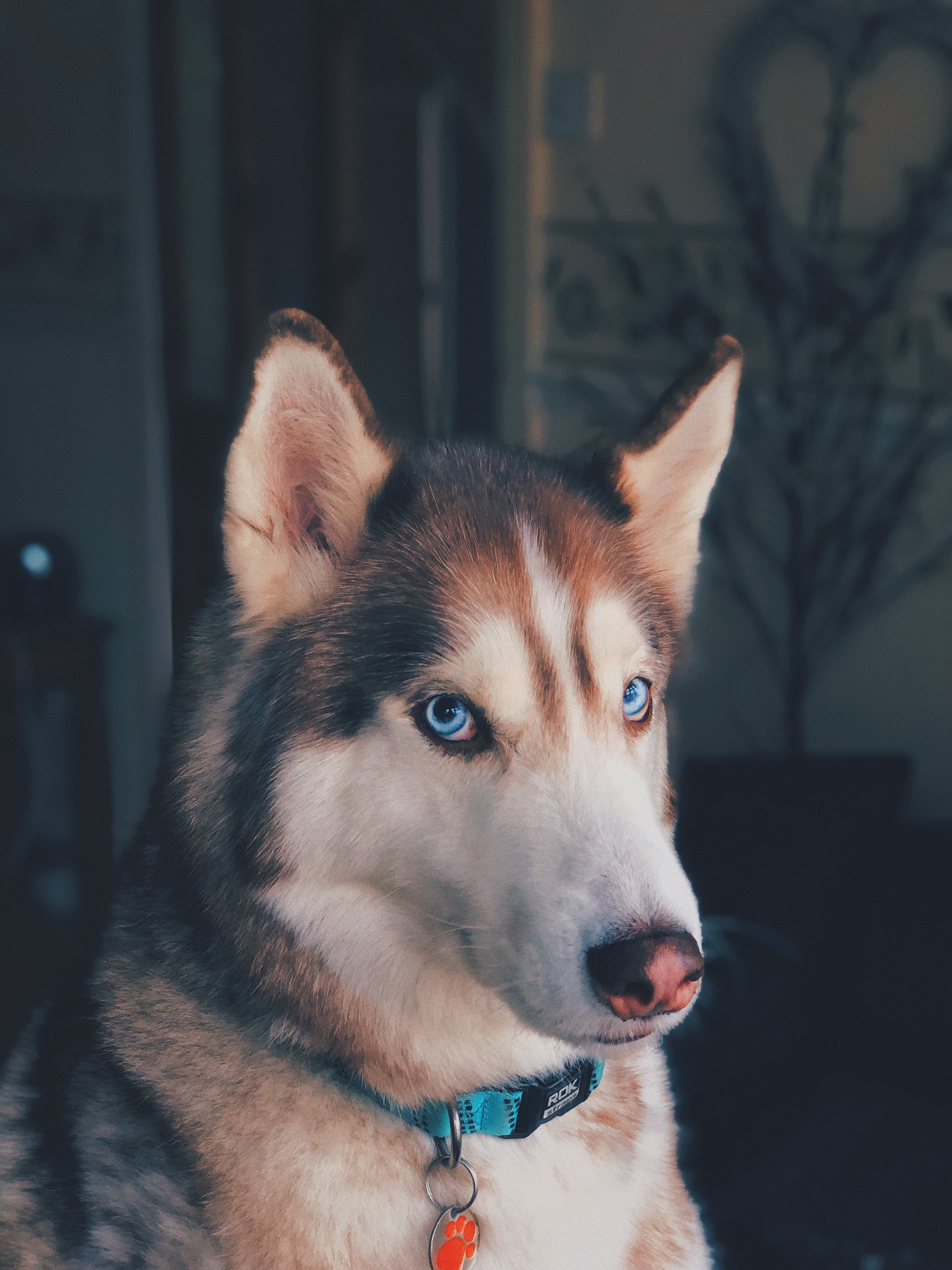
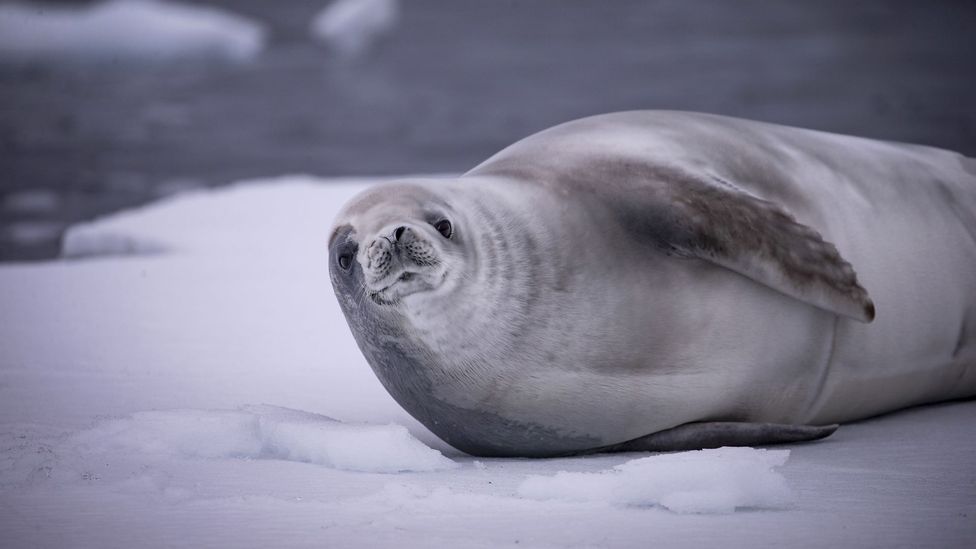
One striking example is the husky. In their native territory of Arctic Greenland, Canada and Alaska, Inuit hunter-gatherers have traditionally fed these dogs on seal meat, which comprises the majority of their own diet. Sled-dogs are so well-adapted to this that when the British Antarctic Survey brought them to Antarctica as a form of transport in 1945, they found that they struggled to digest commercial dog food. In the end, they had to kill a number of local seals each year, just to feed the dogs, before they were largely replaced with skidoos in the 1960s and 70s.
Spratt’s innovation coincided with a cultural revolution in the way people saw their pets
Meanwhile in Victorian London, dogs that were lucky enough to be looked after were either given table scraps or gruel. Even specialist exotic animals were fed everyday human food – the 20,000 or more tortoises imported from Morocco each year were mostly expected to survive on ordinary garden vegetables or bread soaked in water. Cats were considered street animals and rarely fed.
But Spratt had hit upon something entirely new. Over the coming months he developed the “Meat Fibrine Dog Cake”, a biscuit-like concoction of beetroot, vegetables, grains and beef of dubious origins that claimed to meet all the nutritional needs of his customers’ hounds. (While its packaging implied that it was the finest prairie beef, what it was actually made from was a secret he took to his grave.)
Spratt’s innovation coincided with a cultural revolution in the way people saw their pets – dogs and cats went from being viewed as mere utility animals or borderline-vermin to beloved family members to be coddled. Consequently, the Meat Fibrine Dog Cake was marketed as a luxury food for aristocratic pets.
The husky dogs taken on early Antarctic voyages had to be fed with freshly killed seals (Credit: Ozge Elif Kizil/Anadolu Agency/Getty Images)
The adverts labelled them “Dog’s Delight” and included gushing testimonials from wealthy customers. Ironically, Spratt’s also promoted the fact that they were chosen to feed the sled dogs on Captain Scott’s 1901 trip to the Antarctic, though we now know they would much rather have eaten seal.
Eventually the company branched out into cat food – “Spratt’s puts pussy into fine form!”, they said – and the rest is history. However, the science of pet food palatants still had some way to go.
Disgusting smells
Today it’s possible to buy specialised kibble for almost any kind of pet, from frogs to sugar gliders (a small marsupial). Most follow roughly the same formula – they usually contain some kind of base carbohydrate, assorted proteins and fats, sugars, a source of fibre, antioxidants or other preservatives, emulsifiers (which keep the fat in the food and prevent it from separating), vitamins and minerals, and colouring agents
More sophisticated versions may also contain probiotics or digestibility enhancers – such as chicory, which is often added to dog food – as well as enzymes, anti-parasitic compounds and minerals to prevent the build-up of tartar on teeth.
Oddly, there is very little relationship between how healthy a pet food is and its inherent deliciousness
To turn these ingredients into a dry pet food, it’s formed into a paste and “extruded” via a process that involves heating it up and forcing it through a plate with holes in it, to form an aerated product that matches the shape of the holes. It’s the same process that’s used to make puffed snack foods, with flavourings added in the final step – in the case of pet food, they’re either sprayed on or added as a powder.
Oddly, there is very little relationship between how healthy a pet food is and its inherent deliciousness. That’s because in the US, the EU and many other parts of the world, in order to describe one as “complete” – containing everything the body needs to be healthy – it must meet certain nutritional standards. These set out acceptable ranges for most ingredients, so manufacturers can’t just load up on sugar and fat to make it compelling.
“From my standpoint as a nutritionist, all pet foods are the same,” says Marion Nestle, professor emerita of nutrition, food studies, and public health at New York University.
The first processed dog foods were luxury products which ushered in the idea of the “pampered pet” (Credit: Kirn Vintage Stock/Corbis via Getty Images)
Instead, companies turn to chemistry.
Many animals rely heavily on smell to navigate the world around them, and this is often the main sense that’s targeted. While human noses contain around 50 million olfactory receptors, cats have 67 million, rabbits have 100 million and dogs have around 220 million. On the other hand, their sense of taste is generally less discriminating than ours – our relatively high density of taste receptors is thought to have evolved to help us cope with our diverse omnivorous diets.
The catch is that appealing to animals that find the smell of roadkill, sweaty socks, and vomit utterly enchanting – as carnivorous pets often do – while not making their human companions feel violently ill, is extremly tricky. “There is a slight paradox there, because the smells that cats particularly but also dogs seem to like are often the opposite of what humans like,” says Logan.
Nestle puts it more bluntly – “animals eat faeces”, she says. “They like strong animal odours and pet food manufacturers have a really difficult time, because they have to make it disgusting enough so that the animal will eat it, but not so disgusting that the owners won’t buy it.”
Pet food manufacturers have a really difficult time, because they have to make it disgusting enough so that the animal will eat it, but not so disgusting that the owners won’t buy it – Darren Logan
Examples include putrescine and cadaverine, colourless chemicals produced naturally by the breakdown of proteins. They’re largely responsible for the revolting smell of rotting flesh – and cats love them. While in human food, their levels are sometimes closely monitored as a way of ensuring the freshness and safety of meat, they’re often actively added to cat and dog food, either as offal extracts or lab-made additives.
In the case of naturally vegan animals, such as rabbits and guinea pigs, irresistible smells such as mint and oregano are sometimes added in the form of concentrates.
Japanese-inspired cuisine
Other insights are arguably more surprising. A recent study identified nine volatile compounds in common pet food flavourings that are linked to how delicious they are to dogs, including heptanal, nonanal, and octanal, which all have strong, fruity odours.
However, taste is also important – and here the preferences of carnivorous pets are not so different from ours.
One of the most popular additives in human food is the enigmatic “hydrolysed protein”, which is formed by breaking down the long strands of proteins into their constituent amino acids, usually using enzymes or hydrochloric acid. It imparts a flavour similar to that achieved by meat or vegetable stock, and often comes with MSG, which is produced as a by-product of the same reaction and is responsible for the savoury taste of tomatoes, cheese and Iberico ham.
Though hydrolysed proteins are produced artificially, the process is similar to what happens when you cook food for a long period of time – it’s a kind of pre-digestion, and is thought to contribute to the enticing smell of many brands of kibble.
Early processed dog food resembled the tooth-challenging hard-tack biscuits often taken on long sea voyages (Credit: Getty Images)
“The understanding of cat palatability is very similar to Japanese or Asian cuisine, where there’s a lot of focus on umami and another taste modality called kokumi,” says Logan.
Kokumi was discovered in Japan in 1989, and has been proposed as the sixth taste in humans, after sweetness, saltiness, bitterness, sourness and umami. It’s described as a kind of mouth-feel rather than a flavour per se – a texture that imparts richness and “thickness” to foods. Unlike the others, kokumi hasn’t yet been linked to a specific set of compounds, but foods that conjure this sensory experience include scallops, soy sauce, shrimp paste, yeast and beer.
While cats are particularly drawn to Japanese food, which is rich in meat and seafood, you’re unlikely to find them stealing ice-creams or doughnuts
The sixth taste is thought to be particularly popular with carnivorous animals, which may discern it via receptors in their mouths that evolved to detect calcium. And as you would expect, pet food companies have already begun targeting it with cocktails of flavour-enhancing chemicals.
But there are some flavours that you will never find in certain pet foods.
For example, most wild carnivorous animals lack the receptors for tasting sugar or carbohydrates. And unlike dogs, which have been living around humans and feasted off our scraps for up to 40,000 years, domestic cats have only been around for about 4,300. For the majority of that time, they were considered a kind of free pest-control that could fend for themselves.
So, while cats are particularly drawn to Japanese food, which is rich in meat and seafood, you’re unlikely to find them stealing ice-creams or doughnuts – unlike dogs, they simply haven’t been around humans for long enough to have evolved the ability to taste sugar.
Cats are irresistibly drawn to the chemical compounds found in rotting fish (Credit: Getty Images)
On the other hand, because vegan animals eat exclusively vegetable matter, which is often rich in fibre and carbohydrates, they tend to prefer sweeter pet food.
Finally, no list of palatants would be complete without pyrophosphate, described in Popular Science as “cat crack”. This common additive performs a number of roles in human food, such as preventing potato products from going dark after they’re cooked – none of which involve improving its taste. Nevertheless, cats go nuts for it, possibly because it intensifies the flavour of amino acids.
Pet food companies are now so successful at making food delicious that they’re increasingly encountering a dilemma – it’s almost too good. “The danger for cats and dogs today is the same as for people, it’s overconsumption,” says Andrew Knight, a professor of animal welfare and ethics at the University of Winchester.
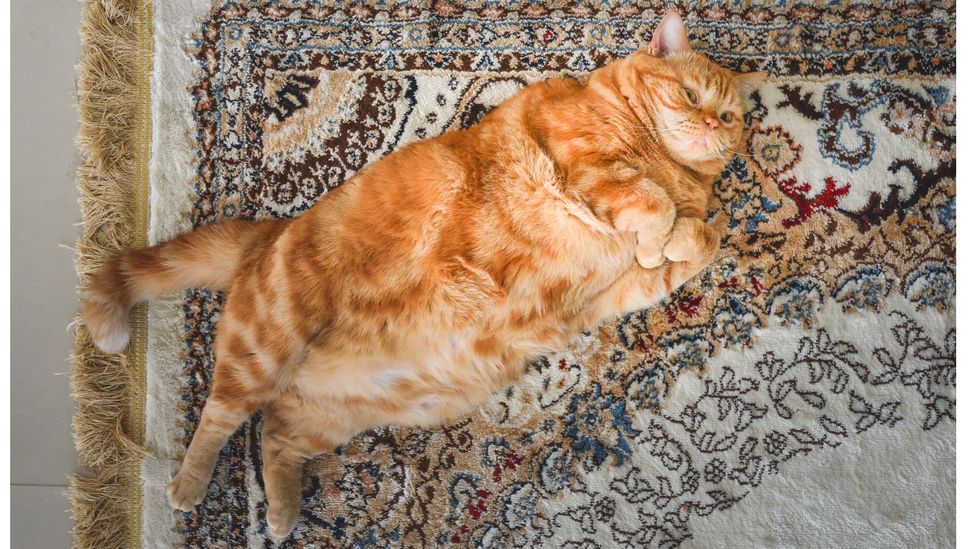
Pet obesity is a growing problem in the developed world, with one survey of veterinary professionals at a vet show in London suggesting that around 51% of dogs, 44% of cats and 29% of small mammals are now overweight or obese.
Pet foods made from more sustainable ingredients such as insects or soya are generally just as acceptable to carnivorous pets as the real deal
According to Logan, this is not down to the way pet food is formulated, but humans succumbing to their beloved pets’ pleading gazes. “The reason we make pet food palatable is that if they don’t eat all the food that we give them, it won’t meet the nutritional needs that they require,” he says. “The real problem is owners feeding them too much – pets can’t open the packets themselves.”
However, there is an upside. There are mounting concerns about the environmental impact of pet food, too – in 2009, two New Zealand scientists estimated the planetary cost of keeping a dog as roughly twice that of having a medium-sized SUV.
Pets given too much calorific processed food may, just like humans, put on extra weight (Credit: Getty Images)
This is where palatants come in. Because most pet foods comprise a fairly tasteless base that is spruced up with delicious flavourings and smells, pet foods made from more sustainable ingredients such as insects or soya are generally just as acceptable to carnivorous pets as the real deal. (Though cats cannot be fed a diet that is meat free.)
“According to this really large-scale study that we’ve just finished, the animals on vegan pet foods seem to be just as happy as animals on meat ones,” says Knight, who is hopeful about their future potential.
“There is a broad recognition that the need to be more sustainable will have a big impact on the pet food business,” says Logan, who explains that the pet food company he works for has just released its own brand of insect-based pet food.
So, why do our pets find pet food so addictive? Well, because it’s been made that way. Just like us, our pets find it hard to say no to the food we have designed to be tasty.
* Zaria Gorvett is a senior journalist for BBC Future and tweets at @ZariaGorvett
ooOOoo
That is a really useful article that goes a very long way to explaining how ‘big business’ interferes with the food that our pets eat.
And did you read right at the end of the article: “According to this really large-scale study that we’ve just finished, the animals on vegan pet foods seem to be just as happy as animals on meat ones,” says Knight.
Dog owners might not be too impressed when they’re able to point out a fallen piece of chicken or a thrown stick to their pooch, but dogs’ ability to follow that seemingly simple gesture places them in rare air in the animal kingdom. Some research suggests that even chimpanzees, our closest evolutionary relatives, don’t understand pointing as well as dogs.
For decades, researchers have debated whether dogs obtain their ability to understand pointing by spending time with humans and learning it or if our furry companions are born with a capacity to comprehend this deceptively complex feat of communication.
ooOOoo
And if one follows that link above then one comes to Current Biology and, again, an extract:
ooOOoo
Summary
Human cognition is believed to be unique in part because of early-emerging social skills for cooperative communication.1Comparative studies show that at 2.5 years old, children reason about the physical world similarly to other great apes, yet already possess cognitive skills for cooperative communication far exceeding those in our closest primate relatives.2,3 A growing body of research indicates that domestic dogs exhibit functional similarities to human children in their sensitivity to cooperative-communicative acts. From early in development, dogs flexibly respond to diverse forms of cooperative gestures.4,5 Like human children, dogs are sensitive to ostensive signals marking gestures as communicative, as well as contextual factors needed for inferences about these communicative acts.6, 7, 8 However, key questions about potential biological bases for these abilities remain untested. To investigate their developmental and genetic origins, we tested 375 8-week-old dog puppies on a battery of social-cognitive measures. We hypothesized that if dogs’ skills for cooperating with humans are biologically prepared, then they should emerge robustly in early development, not require extensive socialization or learning, and exhibit heritable variation. Puppies were highly skillful at using diverse human gestures, and we found no evidence that their performance required learning. Critically, over 40% of the variation in dogs’ point-following abilities and attention to human faces was attributable to genetic factors. Our results suggest that these social skills in dogs emerge early in development and are under strong genetic control.
ooOOoo
And I am going to sneak one of the photographs in the original article!
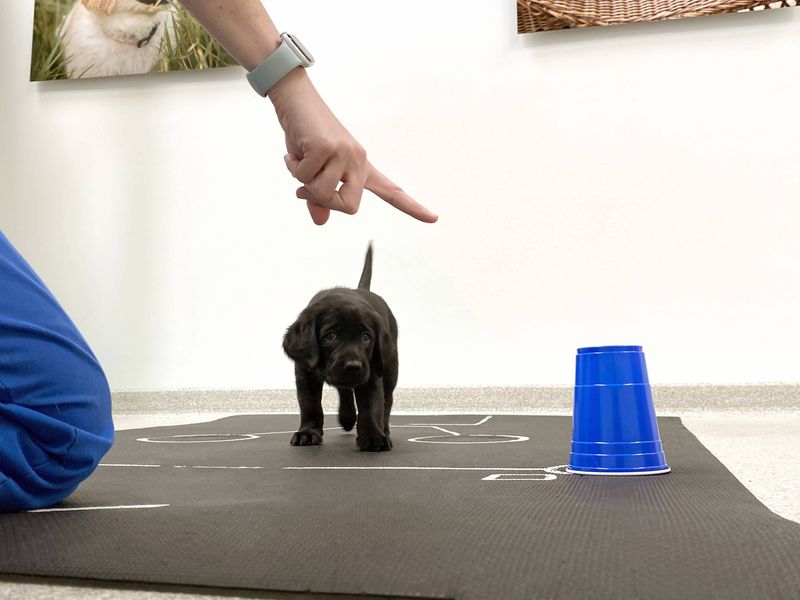
A young puppy responds to a human pointing to a treat during an experiment conducted by scientists at the University of Arizona. (Canine Companions for Independence)
And what better to close the post that one of the photos I showed yesterday of dear Joy.






:max_bytes(150000):strip_icc()/MaryJoDiLonardo-bw-d4a8600bf85f47c793a3a283f74ff222.jpg)

 Learning from Dogs