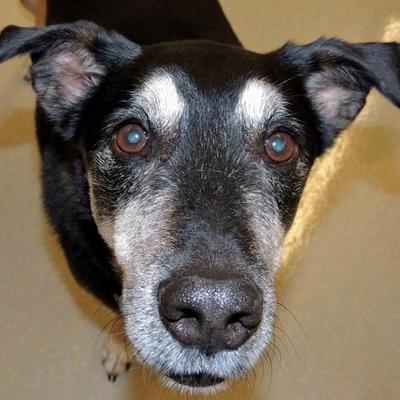
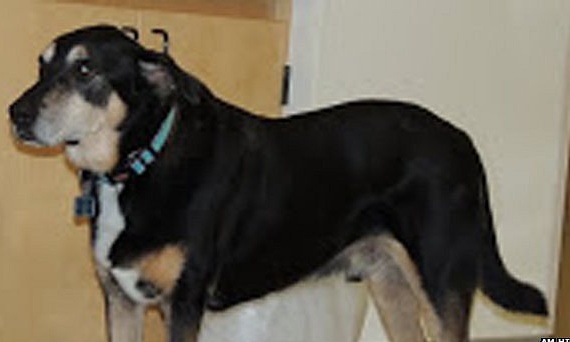
Dearest Suzann, who invited me out to San Carlos, Mexico, for the Christmas of 2007, leading to Jean and me meeting, is heavily involved in rescuing the many feral dogs found in that part of the world.
She recently sent me the following:
Shepherd Boy will be euthanized in a few days at the CA state kennel he is at and Jeannie Wade is trying to help save his life….do you guys know of anyone? Let me know asap.
He is located in the Central Coast area of California and goes by the name ‘Shepherd Boy’ and is one year old.
He is in a high kill shelter and has days to live.
Shepherd Boy is shy and sweet tempered and the volunteers at the shelter feel he will make a very good companion/pet for a nice family or couple.
Paul, If I were up there, I would take him in a heartbeat!
Suzann
Please, please share this as far and wide as possible – urgently.
Shepherd Boy may be found at the Central Coast SPCA, Orcutt, California 93457
Suzann has given me the name of Jeannine Wade and she may be emailed at: centralcoastspca@yahoo.com
A reposting of a blog from Dog Leader Mysteries about a dog food recall.
Quickly stepping over the observation that today’s post is about as far removed, topic wise, from yesterday’s post as one could possibly imagine, nonetheless this is important and needs to be widely shared.
ooOOoo
Raw food recall: J J Fuds Frozen Pet Food
J. J. Fuds Raw dog food recall expands
Dear Fellow Dog Lover,
Because you signed up on my website and asked to be notified, I’m sending you this special recall alert.
On January 27, 2015, J. J. Fuds of Valparaiso, Indiana, announced it is expanding its recall of select lots of J. J. Fuds Raw Frozen Pet Food to include 2 other products due to unspecified contamination.
I copied this email notice from The Dog Food Advisor. I highly recommend you sign up for this list.
Please share to save dogs’ lives
We don’t feed Sydney raw meat. We do feed organic raw vegetables in limited quantities. We care about pets and want our readers to share this important news. Also we want you to know that we receive the Dog Food Advisor’s updates. Mike Sagman never stuffs our email box, but sends out notices as fast as he receives them. We asked our local pet stores if they receive notices before opening each day. You can do that. Ask when and how pet foods get pulled from their shelves, your pet’s life depends on this.
In yesterday’s post, I wrote about using a biofeedback device promising to explain more today.
Also yesterday, I touched on the benefits of meditation and how the video from quantum physicist John Hagelin PhD seemed so interesting.
So let’s start with that sixteen-minute talk from John Hagelin.
In this intro video, quantum physicist and certified TM teacher John Hagelin, PhD explains the Transcendental Meditation technique and its benefits from a scientific perspective.
Now while I had been aware of transcendental meditation, seemingly for years, I had never really taken steps properly to understand exactly what it is all about. Clearly, John Hagelin does an excellent job in that video in giving one a good basic understanding of TM.
The picture is taken from the company’s website where, as one might expect, there are many glowing reports about its effectiveness. But the key benefit to my mind is that it is a, “FDA-cleared, non-drug, non-invasive hypertension treatment device”.
I purchased it, for $99 plus S&H, because I was aware of having an elevated blood pressure and it came recommended by long-term friend, Dan Gomez. I have been using it now for about 8 weeks.
Essentially, one clips an elasticated strap incorporating a strain gauge around one’s midriff, inserts the ear-pieces into the ears and settles back somewhere comfortable in a quiet room.
While my blood pressure is still too high, the unit most definitely has an incredible calming effect and in approximately twenty minutes my breathing rate drops from about ten breaths per minute (BPM) to five or even just below five BPM. The calming effect stays around for quite some time afterwards.
That why the item about deep breathing from Val Boyco referred to yesterday seemed so apt. No less apt that the comment left by blogger Raj.
Deep breathing exercise also insists on holding the deeply inhaled breath, and releasing it in gradual phases, with a pause between each release, till entire air is exhaled; followed by three to four cycles of same process… One of the purposes of this structured format is to keep the mind in the now and thereby relax the practitioner… Best wishes… Raj.
Not sure what else to add other than be very happy to answer any questions – assuming I know the answer!
In these modern times, when we are bombarded by so much from so many directions, the benefits of deep meditation, of slowing down so naturally, as our dogs demonstrate every single day, could be of tremendous value.
Just watch this short video of the Maharishi Mahesh Yogi, speaking at Lake Louise, Canada in 1968.
Uploaded on Apr 3, 2009
The Transcendental Meditation technique uses the natural tendency of the mind to go toward greater happiness, so the mind effortlessly transcends to its most silent state.
I’ve written before about how our breath is connected with our wellbeing and emotional state. Noticing how we are breathing is a tool that we can use to monitor how we are doing.
There is another pause that comes with our breath which is also revealing. The pause at the end of the exhale before we take in more air. When we are distracted, stressed or in an anxious state, there is no pause. We don’t trust we have enough air and we don’t allow ourself to relax and let go.
Just take a moment to tune into how you are breathing right now. Just notice without judgment.
Pausing at the end of an exhale can only happen when we are relaxed and in tune with our mind and body. When our body and mind are aligned in the present moment.
I then left a reply in the comments section:
Excellent advice. For the last few weeks I have been using a biofeedback unit that through guiding one to breathe in harmony with a musical phrase allows one to slow the whole body down. Down to about 4.8 breaths per minute. It really underlines how slow one’s breathing rate can be and, supporting your post, the glorious pauses after each inhale and exhale.
And offered to write a post about the unit and my experiences. (Coming out tomorrow.)
However, what I wanted to do as a ‘lead-in’ to that post was to discover if there was any research into the benefits, as in scientific benefits, of slowing one’s body down in this fashion. What is surely nothing more than a form of meditation. Where to start looking? Needn’t have worried; there were many items on YouTube that covered the benefits of meditation.
There was a video from the AsapSCIENCE guys Mitchell Moffit and Gregory Brown, but I found it too jazzy and irritating, rather ironically! Then there was one from physicist John Hagelin that seemed much more appropriate to my tastes (and that is featured tomorrow as well).
By now it was coming up to 4:30pm and I had a dozen other things to do, plus try and fit in a biofeedback session – I could feel the stress rising within me.
Then I dipped into Terry Hershey’s latest Sabbath Moment and, guess what! Here’s what I read:
Learning to let go
January 26, 2015
Some of us think holding on makes us strong, but sometimes it is letting go. Herman Hesse
Uncertainty is the only certainty there is, and knowing how to live with insecurity is the only security. John Allen Paulos
When you let go of trying to get more of what you don’t really need, it frees up oceans of energy to make a difference with what you have. Lynne Twist
——-
Today I am sitting in a café (and bar) in Vaison-la-Romaine, in the Provence region of France, nursing my espresso.
No, wait… that was last week.
It just sounds sexier than saying, “Today I’m looking out my window at a gloomy winter sky, here in the Pacific Northwest, with a Thesaurus in hand hoping for a gushing synonym for gray.”
Welcome home. Home for me is always awaited and valued, but still elicits a bout of scotoma (selective vision), where we end up comparing the life we have, for the “life we deserve” (the actual wording for a recent advertised e-course).
My favorite part of my recent France trip was visiting family run wineries, spending time with the owner / wine-maker, with the permission to linger, sensing a comfort grounded in story and connection. Said one (when we asked him about being a small winery–in a world where big is everything), “I am glad. I am not alone. I work with family.” (Referring to his son and three daughters.)
And it makes me wonder about this mental sleight of hand we use, thinking about the life we are destined for, as somehow different (or better) from the life we now we live.
There is a Tibetan story about an earnest young man seeking enlightenment. (Earnest people must think this quite unfair–since they play a central role in most parables and stories about enlightenment.)
A famous sage passes through the man’s village. The man asks the sage to teach him the art of meditation. The sage agrees. He tells the man, “Withdraw from the world. Mediate every day in the specific way I will teach you. Do not waver and you will attain enlightenment.”
The earnest man follows the sage’s instructions to the letter. Time passes — and no enlightenment. Two years, five, ten, twenty pass.
It happens that the sage once again passes through the man’s village. The man seeks him out, grumbling that despite his best intentions and devotion and diligent efforts, he does not achieve enlightenment. “Why?”
The sage asks, “What type of meditation did I teach you?”
The man tells him.
The sage says, “Oh, what a terrible mistake I made! That is not the right meditation for you. You should have done another kind altogether. Too bad, for now it is too late.”
Disconsolate, the man returns to his cave. Staking his life on the sage’s instructions, and now believing he is without hope, the man abandons all his wishes and efforts and need to control his road to enlightenment. He does not know what to do. So, he does what he knows best: he begins meditating. And in a short while, much to his astonishment, his confusion begins to dissolve, and his inner world comes to life. A weight falls away and he feels lighter, and regenerated. When he walks out of the cave, the sky is bluer, the snow capped mountains whiter, and the world around him more vivid.
There is no doubt that all too often, our efforts–to succeed or achieve or attain–get in the way of our living. It brings to mind my favorite Robert Capon quote, “We live life like ill-taught piano students. So inculcated with the flub that will get us in dutch, we don’t hear the music, we only play the right notes.”
I understand. I was weaned on a spirituality that predicated itself on artifice. In other words, the importance is placed upon appearance, rather that just being. (It was vital to “look spiritual.” Which begs the question, “What do spiritual people look like?” As a boy, I always thought the “spiritual people” looked as if some part of their clothing was a size too small.)
What is it we are holding on to–so rigid, so firm, white-knuckled in our determination?
At some point, we’ve got to breathe.
Just breathe.
Without realizing it (and after the sage’s disheartening news), the man in the story “let go.”
He let go of the need to see life as a problem to be solved. He let go of the need to have the correct answers (or experiences) for his “enlightenment.” He let go of the need to see his spiritual life in terms of a formula. He let go of the restraints that come from public opinion.
Abandon your masterpiece, sink into the real masterpiece. Leonard Cohen
Without realizing it, he took Leonard Cohen’s advice. He abandoned his “masterpiece”–the perception of what he needed to accomplish, or how he needed to appear, or what he needed to feel–in order to allow himself to sink down into this life, this moment, even with all of its uncertainty and insecurity.
For the first many years, meditation or prayer was a requirement or compulsion. In his emptiness, meditation and prayer was an offering of thanks, freely given, and without constraint. True spiritual enlightenment, it seems, happens when you are not trying to impress anyone, or score any points with heavenly bookkeepers.
It sounds easy doesn’t it? But here’s the deal: My best intentions to play the right notes can fabricate an armor that keeps me from the vividness of life–whether it be to pray or meditate or notice or give or mourn or dance or play or grieve or laugh or celebrate or love… or just to walk.
I never did find a good enough synonym for the gray (although I’ll keep looking). Gladly, the sun has broken through. And there is enough warmth to persuade us that spring may arrive tomorrow. Daffodil shoots everywhere–up through the leaves and debris–help the ruse. So it’s garden time this afternoon, turning manure into the vegetable garden beds, beginning to cut back and clean some of the perennial beds. Enough work for the back to call a time out and request reprieve. I’m headed to the swing under the maple, when I look up to see the sun illuminating the red-twig dogwood shrubs, 10 foot canes glowing, a bright cranberry red. It catches my breath. And I am glad to be alive.
People say that what we’re all seeking is a meaning for life. I don’t think that’s what we’re really seeking. I think what we’re seeking is an experience of being alive… of the rapture of being alive. Joseph Campbell
Such power in those words. Then how moments later what I had read from Terry made so much sense to me. So perfectly connected with yesterday’s post Animals make us human. So relevant that quotation yesterday about animal happiness. This one:
Neuroscience key to animal happiness
“…research in neuroscience has been showing that emotions drive behavior, and my thirty-five years of experience working with animals have shown me that this is true. Emotions come first. You have to go back to the brain to understand animal welfare.”
Animals Make Us Human : Creating the best life for Animals
by Temple Grandin & Catherine Johnson
Such a close parallel with that well-known saying about us humans: ‘we are what we think‘. How our own happiness, just as it is with our animals, has its roots in our emotions.
How letting go, how staying in the present, is so good for us. How dogs do that so perfectly.
How we humans have so much to learn from our dogs.
Pure, deep peace radiating out from Hazel’s loving eyes.
As I have mentioned in the past and undoubtedly will do so again in the future, one of the most wonderful aspects of this world of blogging is the way that connections are made. Just a few weeks ago, a connection was made between Learning from Dogs and Dog Leader Mysteries. DLM’s byline is: Saving dogs’ lives and dog lovers’ sanity. Dog Leader Mysteries is written by author Deborah Taylor-French.
Anyway, out of the exchanges that have taken place between Deborah and myself, came a reference to a post about animal happiness that was published on Deborah’s blog in October, 2013. It is very interesting and I am delighted to be given permission to share it with you.
ooOOoo
Neuroscience key to animal happiness
“…research in neuroscience has been showing that emotions drive behavior, and my thirty-five years of experience working with animals have shown me that this is true. Emotions come first. You have to go back to the brain to understand animal welfare.”
Animals Make Us Human : Creating the best life for Animals
by Temple Grandin & Catherine Johnson
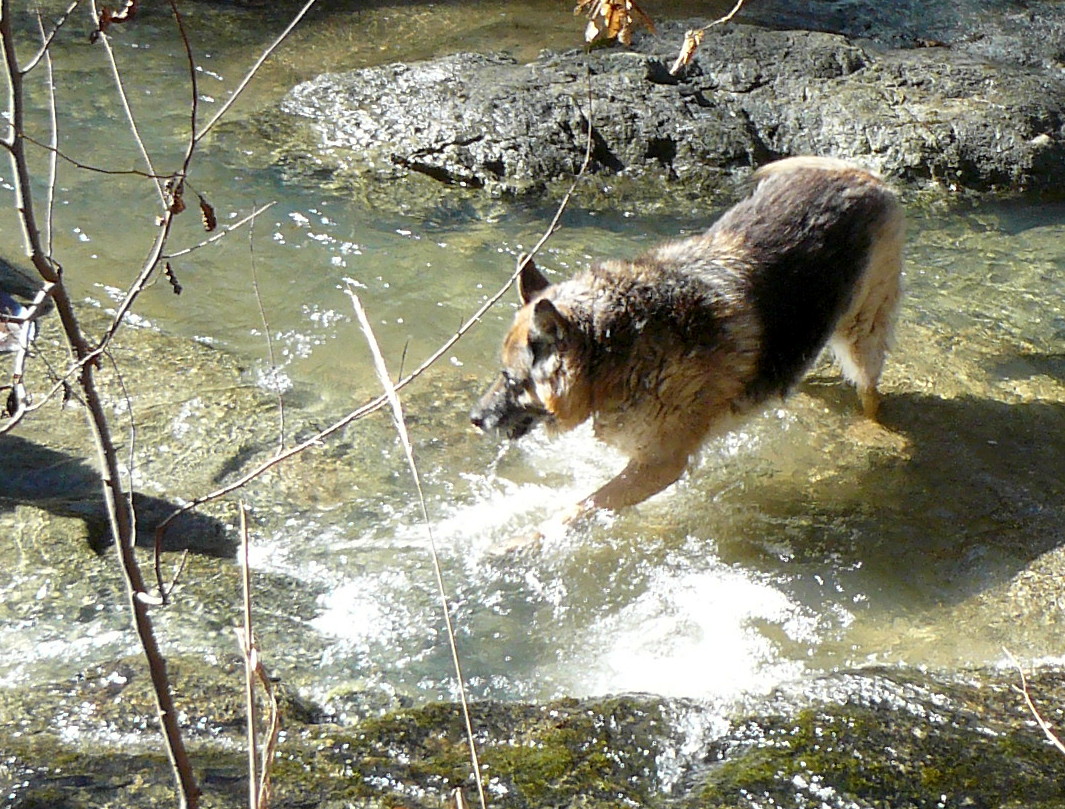
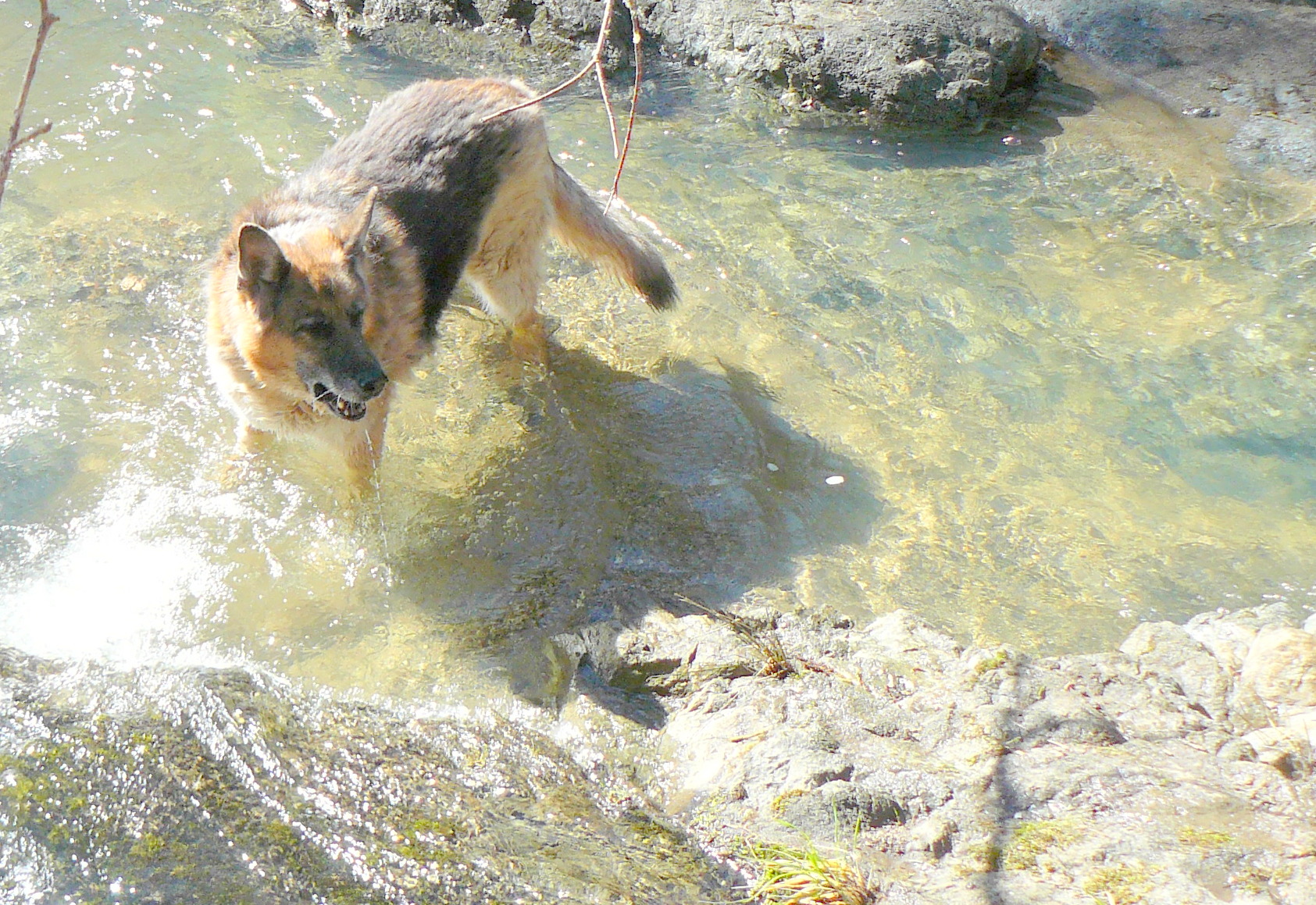
Water dogs having a blast in Spring Lake Park.
By Deborah Taylor-French
Those of us who live and/or work with animals know…
animals have emotions.
Temple Grandin has made the understanding, care and handling of farm animals her life’s work. I refer to her book Animals Make Us Human because not only has she studied farm animals, but she also loves and lives with pets. In her books, especial this one, she insists that we must understand how animals brains work, how they see, hear and smell every sensory detail in their surroundings.
Animals emotions drive their behavior.
To make a better life for our pets, for domestic and wild animals we must understand the main emotions that drive behavior. This will help us to turn on their positive emotions and avoid turning on FEAR, RAGE and GRIEF.
Example: Rabbits and horses are prey animals.
Never chase either rabbits or horses.
Teach your pet rabbit or horse to come to you.
Always reward them for recognizing their name and coming when called.
When you chase a prey animal, you make him or her fearful of you!
Emotions are the gifts of our ancestors. We have them and so do other animals. We must never forget this. When it comes to animal welfare we can always do better. Most of the time “good welfare” is not “good enough.”
The Emotional Lives of Animals by Marc Bekoff.
Dogs Depend on us for freedom from fear and safety
Never tie up your dog unless it is in your company in a human training session.
A dog needs to feel he can flee to safety.
Be sensitive to your dog’s fear signals and show him you will protect and calm him.
Increase your dogs positive emotions by interesting, but not overstimulating activities.
Always stop training before your dog gets tired.
Dogs are the only animals that live with us inside of their flight zone.
Dogs depend on us for positive and playful lives
When you help increase an animal’s curiosity, you turn on his or her positive emotions of SEEKING and PLAY.
Example: Dogs love to play.
Find a time and place when both you and your dog seem relaxed.
Invite your dog to play by doing a play bow or picking up his favorite toy.
Use an excited and happy tone of voice to call your dog.
Run away.
When your dog chases you, stop.
Wait for your dog to run then chase.
Always stop before your dog seems fearful or overexcited.
Dogs love this game, which dog lovers know dogs play every chance they get.
Winter wonderland four, the last of the series. (One was here, two was here, and three was here.)
Background information is after the last photograph.
oooo
oooo
oooo
oooo
oooo
oooo
oooo
These animals were photographed just north of the Barber Lake on a highway near Mine Center, Ontario, Canada. The odds of seeing an albino moose are astronomically rare; let alone seeing two of them. It really doesn’t matter the colour of their fur; white or dark brown.
Once in a while there is an opportunity to take in a piece of nature that most of us may never see ‘in the wild’.
A huge thank you to Dordie for forwarding all the pictures featured over the last four weeks.
Trying to make sense of our place in the world – and probably failing!
Yesterday’s post, Making sense of who we are?, was built upon a recent essay from George Monbiot: A Small and Shuffling Life. It is a terrific essay, in the very best tradition of George Monbiot. I really hope you read it in yesterday’s post because today’s introspective jaunt is built on that essay. Two particular paragraphs of his essay really ‘spoke’ to me.
The opening paragraph:
Live free or die: this is the maxim of our age. But the freedoms we celebrate are particular and limited. We fetishise the freedom of business from state control; the freedom not to pay taxes; the freedom to carry guns and speak our minds and worship whom we will. But despite – in some cases because of – this respect for particular freedoms, every day the scope of our lives appears to contract.
Later:
We carry with us the psychological equipment, rich in instinct and emotion, required to navigate that world. But our survival in the modern economy requires the use of few of the mental and physical capacities we possess. Sometimes it feels like a small and shuffling life. Our humdrum, humiliating lives leave us, I believe, ecologically bored.
In that second paragraph I sense something from Mr. Monbiot that is felt by me and Jean and appears to be shared very widely. A sense that something about today’s society is broken. That the last, say fifty years, of increasing living standards, health and prosperity, albeit not universally embraced, have brought us no closer to a golden future. That, as so clearly voiced in the preceding paragraph, “… our survival in the modern economy requires the use of few of the mental and physical capacities we possess.”
My guess is that George Monbiot and Terry Hershey have never met. One might suggest that their backgrounds are as different as two people might be. Take their respective ‘About’ pages on their blogsites. Here are their closing paragraphs.
First, George:
My work is more sedentary than it used to be, so I temper it with plenty of physical activity: sea kayaking, ultimate frisbee, running and some heavy duty gardening: growing my own vegetables and much of my own fruit.
Here are some of the things I love: my family and friends, salt marshes, arguments, chalk streams, Russian literature, kayaking among dolphins, diversity of all kinds, rockpools, heritage apples, woods, fishing, swimming in the sea, gazpacho, ponds and ditches, growing vegetables, insects, pruning, forgotten corners, fossils, goldfinches, etymology, Bill Hicks, ruins, Shakespeare, landscape history, palaeoecology, Gavin and Stacey and Father Ted.
Here are some of the things I try to fight: undemocratic power, corruption, deception of the public, environmental destruction, injustice, inequality and the misallocation of resources, waste, denial, the libertarianism which grants freedom to the powerful at the expense of the powerless, undisclosed interests, complacency.
Here is what I fear: other people’s cowardice.
I still see my life as a slightly unhinged adventure whose perpetuation is something of a mystery. I have no idea where it will take me, and no ambitions other than to keep doing what I do. So far it’s been gripping.
Now, Terry:
I used to ask of myself and others: what have you accomplished? Where are your credentials? What does your job and your bank account say about who you are?
Now, my questions are different: Are there butterflies in your garden? What are the color of loved ones’ eyes, when they are looking at you with hope? And when was the last time your house smelled of paper-white narcissus? Do sunsets make you smile? When was the last time you stood in stocking feet just to stare at the rising moon? Have you ever seen a sunflower bloom? Does the laughter of children do your heart good? At what angle does the sun enter your house?
Do I understand that life is full of complications, obligations and distractions? Yes. I do. My wife and I raise a teenage son. We run two businesses. So, yes, I know a bit about down-to-earth realities.
But this, too, is reality:
I love to watch the hummingbirds dance. I love that my son likes to put on his dancing shoes. I love to join him when we play old-time rock and roll. I love to stretch out on a garden bench on a warm summer day. I love a hot shower and drying with an expensive, oversized cotton towel. I love books, delight in poetry, and find sustenance in writing. I treasure the certainty that grace gives us all many second chances. I value the times I can simplify life by letting go of my need to validate my humanity through productivity. And I love to lose track of time in a garden.
I also know that sharing this with you – offering my practices for pausing, resources for doing less and living more, reflections in my blog —feeds me.
So I invite you, too, to join us — and together we’ll share, remind, and support each other, to “do less, live more.”
Yet, despite the differences in backgrounds, cultures and much more, to me there is a common openness, an honesty shared, and a passion for the truth.
All of which is a very long introduction to this week’s Sabbath Moment from Terry; republished in full.
ooOOoo
Finding sanctuary and grace
January 19, 2015
Today I am sitting in a café (and bar) in Vaison-la-Romaine, in the Provence region of France, nursing my espresso. The old men of the village (actually all of them are about my age) gather. They unload, swap stories, sip pastis, and watch petanque on TV. Some read the newspaper–with stories about Charlie Hebdo and photos of “Somme Nous Charlie“–carrying reminders of hope in our fragile and broken world.
I am glad to be here. Today. In this place. There is an air of familiarity among the men, and comfort in their ritual. I am grateful for reminders and invitations to live well into a place. Not just a physical space, but a tonic and sanctuary to the spirit. The invitation is a permission to settle down. (In the words of Jesus, “to come away and rest awhile.”) A sanctuary is a place that restores us, replenishes us, nourishes us. In this renewal, we are reminded, once again, of what really is important.
I agree that it is easy to sentimentalize. But living into the moment doesn’t smooth the edges of our life. It allows us to pay attention. I like to think that we can name the edges, to welcome and invite them into the sanctuary.
Outside a bicycle club gathers in the village center parking lot, ready for their weekend excursion. Their spirit is eager, their uniform bearing homage to their journey to the top of Mont Ventoux.
Sitting in the café, my thoughts meander, with no agenda or responsibilities to tether them. So I let them wander, a gift to embrace. But my reverie is interrupted with worry … I need a Sabbath Moment. And I don’t have a clue (I tell myself). It’s not easy on vacation. Especially without wi-fi.
I am on my annual trip to Europe with my good friend Bill McNabb to taste wine. He’s a wine writer (and pastor) in the San Francisco area. But mostly, he’s a friend. I’m his aide-de-camp and connoisseur.
We travel to wine regions and are blessed to taste beverages that we cannot afford, but offer us a glimpse of heaven.
Yes I’m biased. But then wine is not a beverage here; it is an experience. Your choice is to savor and take delight.
We visited wineries harvesting grapes from vines 100 years old. These are businesses passed down through the generations, grandfather to father to son (and now thankfully, often to daughter). A world where terroir is king, the personality of the soil. Meaning that this wine is born of a place, a very specific place. Here in the Rhone Valley, I’m honored to be in the company of crafts people. Like being with a great gardener. The men and women I met coddle their vines–they call them trees–lovingly.
Unlike Peter Mayle, I don’t have “A Year in Provence.” I only have a few days. But that’ll do… It is my first visit and I’m sure won’t be my last.
We’re in our gite–a rural rental property in France–we relish the evening light, a layer of bruised purple (pourple) above the slopes in Provence (Cotes du Rhone). Below the hills, vineyards roll through the landscape, the vines–still in winter and pruned–pose as menorah renderings in the dusk light.
Yes, this scene is a tonic. There is something about these moments that carry significance, because they are reminders, and they are sacraments. Partial, yes, but containing the full sustenance of grace.
And I think of the question a friend asks me, “What holds you?”
In other words… What sustains you, and carries you gently through your days?
Ryoken, a Zen master, lived the simplest kind of life in a little hut at the foot of a mountain. One evening a thief visited the hut, only to discover there was nothing in it to steal. Ryoken returned and caught him in the act.
“You may have come a long way to visit me,” he told the disillusioned prowler, “and you should not return empty-handed. Please take my clothes as a gift.”
The thief was bewildered. But he took the clothes and slunk away.
Ryoken sat naked, watching the moon, “Poor fellow,” he mused. “I wish I could have given him this beautiful moon.”
Sometimes I feel like that thief. Standing–in my own home, or in front of an audience, or in a crowd, or all alone–I am looking for something, for whatever ails me or creates a hole or emptiness; but, like that thief, not finding it. “What am I missing?” I ask myself. What am I wanting, yearning for, that I find myself in such a pell-mell-hurry or weighted down… hoping to fix it, or find it, or mend it. So I run and race and call on God, or the sky, or roll the dice with some prayer from my childhood. This will solve it, I tell myself. But the more I push, the more I ask, the more I beseech, the further I move from the center.
Here’s the deal: In my state of distraction, I cannot see that the core of my identity, the place where I stand in this moment (even at times without clarity, or stability, or faith, or answers)… I stand smack dab in the center of an awesome and illogical grace. Smack dab in the center of the sacred present.
If I do have the permission to see that place, I know that I am grounded. I am now able to breathe in and out, and rest in this acceptance.
Last night, above the slopes to the south, a slivered crescent moon rests, the sky a cobalt blue canvas. It is visceral, arresting, piercing. And for whatever reason, reassuring. This snapshot is imprinted, and I know in my heart that it is in some way essential, indispensable. I accept this gift of the moon, even though I don’t yet know why.
I don’t know what to tell you to do, exactly. Only that I too, wish I could give you the gift of that crescent moon.
I know this for certain: when we do not pay tribute, we are like the thief in the Zen story–without even knowing it–and we settle for less. So much less. So it is not just a question of what hold us, but of what holds us back… from being wholehearted, true to our self, fully alive, unafraid of uncertainty, and grateful for the gift of this moment.
Lord knows we look for ways to bottle it and sell it, when I reckon we should just get out of the way.
Our gite sits squarely in a vineyard and a working farm. A perfect setting to replenish. For years I’ve been writing about sanctuary and the need for restoration. And I’m my own worst enemy. There’s not a week that goes by that a Sabbath Moment friend doesn’t remind me to follow my own advice to pause… and let my soul catch up with my body. Gladly, this week I did.
ooOOoo
My penultimate reflection to today’s post is with a short, six-minute video from Professor Dan Gilbert. The video is entitled: The psychology of your future self. I hope you see it as offering a calming perspective to two days of inner psychological ramblings!
Published on Jun 3, 2014
“Human beings are works in progress that mistakenly think they’re finished.” Dan Gilbert shares recent research on a phenomenon he calls the “end of history illusion,” where we somehow imagine that the person we are right now is the person we’ll be for the rest of time. Hint: that’s not the case.
My final reflection is the lesson that dogs teach us; that one about living in the present.
But first some thoughts for the newer followers of this blog.
Being the author of this blog I have no idea how people find this place, and more importantly, what they make of it! It wouldn’t surprise me in the slightest if it is as a result of a web search associated with dogs. Let’s face it, the blog is called Learning from Dogs!
It also wouldn’t surprise me if many don’t drop in to the About this blog page and read:
The underlying theme of Learning from Dogs is about truth, integrity, honesty and trust in every way. We use the life of dogs as a metaphor. The first Post was published on the 15th July 2009.
All of which is my way of explaining why, more often than not, the daily post has nothing to do with our beautiful canines. But I do hope if a post is not about dogs then it is about “truth, integrity, honesty and trust in every way.”
So with that off my chest, let me use the rest of this post to republish in full the final broadcast from Bill Moyers, the link to which was kindly sent to me by friend John Hurlburt. Thanks John.
The Bill Moyers programme is less than 30-minutes long. It is extraordinarily fine viewing, especially for the younger viewer. Do share it widely.
ooOOoo
Full Show: The Children’s Climate Crusade
January 1, 2015
The very agencies created to protect our environment have been hijacked by the polluting industries they were meant to regulate. It may just turn out that the judicial system, our children and their children will save us from ourselves.
The new legal framework for this crusade against global warming is called atmospheric trust litigation. It takes the fate of the Earth into the courts, arguing that the planet’s atmosphere – its air, water, land, plants and animals — are the responsibility of government, held in its trust to insure the survival of all generations to come. It’s the strategy being used by Bill’s recent guest, Kelsey Juliana, a co-plaintiff in a major lawsuit spearheaded by Our Children’s Trust, that could force the state of Oregon to take a more aggressive stance against the carbon emissions.
It’s the brainchild of Mary Christina Wood, a legal scholar who wrote the book, Nature’s Trust, tracing this public trust doctrine all the way back to ancient Rome.
Wood tells Bill: “If this nation relies on a stable climate system, and the very habitability of this nation and all of the liberties of young people and their survival interests are at stake, the courts need to force the agencies and the legislatures to simply do their job.”
Producer: Robert Booth. Editor: Rob Kuhns.
ooOOoo
So having explained why dogs often aren’t featured in posts, there’s only one way to close today. That’s with a picture of young Ollie, our latest member of the family, taken last June.
Turn aside if you are looking for a bright, optimistic start to the week.
Two separate experiences have come together to offer, well anyway for me, a sense of now not recognising the world I grew up in. The first was Episode One of a programme on BBC Television, broadcast last Thursday, and the second was an essay from Ann Jones on the TomDispatch site, published yesterday.
First, that BBC programme. Despite not being able to view it directly here in Oregon, both the programme details and a first-hand account from a British viewer confirm the essence of this two-part series. Here’s what is on the BBC iPlayer website:
The Super Rich and Us
First shown: 8 Jan 2015
Britain has more billionaires per head than any other country on earth, yet we’re also the most unequal nation in Europe. We were told the super-rich would make us richer too, so why hasn’t that happened, and what does the arrival of their astronomical wealth really mean for the rest of us? In programme one of this two-part series, Jacques Peretti looks at how the super-rich first exploited an obscure legal loophole to make Britain one of the most attractive tax havens on earth. He argues this was no accident. Wooing the super-rich was a deliberate strategy by government to reconfigure the British economy, under the belief their wealth would trickle down to the rest of us. But it didn’t. The OECD now say the British economy would have been 20 per cent bigger had we not pursued the super-rich. So who sold us the fallacy and why?
Jacques meets the super-rich themselves – from those buying premiership football clubs to the billionaires who are breaking ranks to criticise the decisions that made them richer and society more unequal.
Jacques challenges the architects of these policies, as well as tracking down the foreign multimillionaires who are buying up Britain and turning us from a nation of property owners to a nation of renters. He uncovers new research that shows growing inequality has been driven by this key factor of unaffordable property, and the far-reaching effect this will have on every aspect of our lives. Inequality is reshaping Britain into two simple classes: the 99 per cent and the one per cent. This is the story of how it happened and what it means for all of us.
While, for obvious reasons, the programme can’t be included in this post, one can get a flavour of the degree of inequality in Britain from this BBC News item from last May.
The second experience was reading the latest post published over on the TomDispatch site; an essay from Ann Jones (see bio at end). Some while ago, Tom Engelhardt, he of TomDispatch, was sufficiently generous to give a blanket permission for his essays to be republished on Learning from Dogs. Here is that essay from Ann. (NB: In the original there are numerous hyperlinks to other materials, too many for me to transfer across: Apologies.)
ooOOoo
Tomgram: Ann Jones, Answering for America
Posted by Ann Jones at 8:00am, January 11, 2015.
One of the grimmer small events of recent American life occurred just as 2014 was ending. A mother had her two-year old toddler perched in a shopping cart at an Idaho Wal-Mart. He reached into her purse, specially made for carrying a concealed firearm (and a Christmas gift from her husband), found his mother’s pistol in it, pulled it out, and shot and killed her. And she wasn’t the only victim of a child who came upon a loaded weapon. Between 2007 and 2011, at least 62 children 14 or younger died in similarly nightmarish accidents with loaded weapons.
Nor was this specific incident an anomaly. In fact, if you are an American, you are statistically in less danger of dying from a terrorist attack in this country than from a toddler shooting you. And by the way, you’re 2,059 times more likely to die by your own hand with a weapon of your choosing than in a terrorist attack anywhere on Earth. You’re also more than nine times as likely to be killed by a police officer as by a terrorist.
And remind me, how many American taxpayer dollars have gone into “security” from terrorism and how many into security from weaponry? You know the answer to that. In fact, guns of just about every variety seem to circulate ever more freely in this country as the populace up-armors itself in yet more ways. Think of it as a kind of arms race. Emboldened by the National Rifle Association (NRA), Americans are ever more weaponized. There were an estimated 300-310 million guns in the U.S. in 2009 (a figure that has undoubtedly risen), and up to four million Americans now own assault rifles — one popular weapon of choice, by the way, for mass killers. In the meantime, the percentage of Americans who favor a ban on handguns (25%) has fallen to an all-time low.
As for “carrying,” it’s now legal in every state in America and allowed in ever more situations as well. In the last year, for instance, Idaho, where that mother died, became the seventh state to green-light the carrying of concealed guns on college campuses. To put all this in perspective, less than two decades ago, fewer than a million concealed weapons were being legally carried in the U.S.; now, more than one million people are permitted to carry such weapons in Florida alone. In twenty-first-century America, the “right to bear arms” has been extended in every direction, while there has also been a “sharp rise” in mass killings.
Meanwhile — since what’s an arms race without a second party? — the police, mainlining into the Pentagon, have been up-armoring at a staggering pace. It’s no longer an oddity for American police officers to be armed with assault rifles and grenade launchers as if in a foreign war zone or to arrive on the scene with a mine-resistant ambush-protected vehicle previously used in our distant wars. And by the way, while much anger has been displayed, by the police in particular, over the recent murders of two patrolmen in Brooklyn by a disturbed man carrying a Taurus semiautomatic handgun, that anger seems not to extend to his ability to arm himself or to the pawnshop filled with weaponry that originally sold the gun (but not to him).
One mistake you shouldn’t make, however, is to imagine that Americans consider the right to bear arms universal. Just consider, for example, the CIA’s “signature drone strikes” in Pakistan and elsewhere. Over the last two presidencies, the Agency has gained the “right” to drone-kill young men of military age bearing arms — in societies where arms-bearing, as here, is the norm — about whom nothing specific is known except that they seem to be in the wrong place at the right time. The NRA, curiously enough, has chosen not to defend them.
If, to a visitor from Mars or even (as TomDispatch regular Ann Jones points out) Europe, all this might seem like the definition of madness, it’s also increasingly the definition of a way of life in this country. What was once the “tool” of law enforcement types, the military, and hunters is now the equivalent of an iPhone, a talisman of connection and social order. It’s something that just about anyone can put in a pocket, a purse, or simply strap on in the full light of day in a land where all of us, even toddlers, seem to be heading for the O.K. Corral. Jones, author of They Were Soldiers: How the Wounded Return From America’s Wars — The Untold Story, has seen her share of carnage and experienced her share of stress. Today, however, she considers another kind of stress, the pressure to explain to others a country whose citizens don’t even notice how inexplicable they are becoming. Tom
Americans who live abroad — more than six million of us worldwide (not counting those who work for the U.S. government) — often face hard questions about our country from people we live among. Europeans, Asians, and Africans ask us to explain everything that baffles them about the increasingly odd and troubling conduct of the United States. Polite people, normally reluctant to risk offending a guest, complain that America’s trigger-happiness, cutthroat free-marketeering, and “exceptionality” have gone on for too long to be considered just an adolescent phase. Which means that we Americans abroad are regularly asked to account for the behavior of our rebranded “homeland,” now conspicuously in decline and increasingly out of step with the rest of the world.
In my long nomadic life, I’ve had the good fortune to live, work, or travel in all but a handful of countries on this planet. I’ve been to both poles and a great many places in between, and nosy as I am, I’ve talked with people all along the way. I still remember a time when to be an American was to be envied. The country where I grew up after World War II seemed to be respected and admired around the world for way too many reasons to go into here.
That’s changed, of course. Even after the invasion of Iraq in 2003, I still met people — in the Middle East, no less — willing to withhold judgment on the U.S. Many thought that the Supreme Court’s installation of George W. Bush as president was a blunder American voters would correct in the election of 2004. His return to office truly spelled the end of America as the world had known it. Bush had started a war, opposed by the entire world, because he wanted to and he could. A majority of Americans supported him. And that was when all the uncomfortable questions really began.
In the early fall of 2014, I traveled from my home in Oslo, Norway, through much of Eastern and Central Europe. Everywhere I went in those two months, moments after locals realized I was an American the questions started and, polite as they usually were, most of them had a single underlying theme: Have Americans gone over the edge? Are you crazy? Please explain.
Then recently, I traveled back to the “homeland.” It struck me there that most Americans have no idea just how strange we now seem to much of the world. In my experience, foreign observers are far better informed about us than the average American is about them. This is partly because the “news” in the American media is so parochial and so limited in its views both of how we act and how other countries think — even countries with which we were recently, are currently, or threaten soon to be at war. America’s belligerence alone, not to mention its financial acrobatics, compels the rest of the world to keep close track of us. Who knows, after all, what conflict the Americans may drag you into next, as target or reluctant ally?
So wherever we expatriates settle on the planet, we find someone who wants to talk about the latest American events, large and small: another country bombed in the name of our “national security,” another peaceful protest march attacked by our increasingly militarized police, another diatribe against “big government” by yet another wannabe candidate who hopes to head that very government in Washington. Such news leaves foreign audiences puzzled and full of trepidation.
Question Time
Take the questions stumping Europeans in the Obama years (which 1.6 million Americans residing in Europe regularly find thrown our way). At the absolute top of the list: “Why would anyone oppose national health care?” European and other industrialized countries have had some form of national health care since the 1930s or 1940s, Germany since 1880. Some versions, as in France and Great Britain, have devolved into two-tier public and private systems. Yet even the privileged who pay for a faster track would not begrudge their fellow citizens government-funded comprehensive health care. That so many Americans do strikes Europeans as baffling, if not frankly brutal.
In the Scandinavian countries, long considered to be the most socially advanced in the world, a national (physical and mental) health program, funded by the state, is a big part — but only a part — of a more general social welfare system. In Norway, where I live, all citizens also have an equal right to education (state subsidized preschool from age one, and free schools from age six through specialty training or university education and beyond), unemployment benefits, job-placement and paid retraining services, paid parental leave, old age pensions, and more. These benefits are not merely an emergency “safety net”; that is, charitable payments grudgingly bestowed upon the needy. They are universal: equally available to all citizens as human rights encouraging social harmony — or as our own U.S. constitution would put it, “domestic tranquility.” It’s no wonder that, for many years, international evaluators have ranked Norway as the best place to grow old, to be a woman, and to raise a child. The title of “best” or “happiest” place to live on Earth comes down to a neighborly contest among Norway and the other Nordic social democracies, Sweden, Denmark, Finland, and Iceland.
In Norway, all benefits are paid for mainly by high taxation. Compared to the mind-numbing enigma of the U.S. tax code, Norway’s is remarkably straightforward, taxing income from labor and pensions progressively, so that those with higher incomes pay more. The tax department does the calculations, sends an annual bill, and taxpayers, though free to dispute the sum, willingly pay up, knowing what they and their children get in return. And because government policies effectively redistribute wealth and tend to narrow the country’s slim income gap, most Norwegians sail pretty comfortably in the same boat. (Think about that!)
Life and Liberty
This system didn’t just happen. It was planned. Sweden led the way in the 1930s, and all five Nordic countries pitched in during the postwar period to develop their own variations of what came to be called the Nordic Model: a balance of regulated capitalism, universal social welfare, political democracy, and the highest levels of gender and economic equality on the planet. It’s their system. They invented it. They like it. Despite the efforts of an occasional conservative government to muck it up, they maintain it. Why?
In all the Nordic countries, there is broad general agreement across the political spectrum that only when people’s basic needs are met — when they can cease to worry about their jobs, their incomes, their housing, their transportation, their health care, their kids’ education, and their aging parents — only then can they be free to do as they like. While the U.S. settles for the fantasy that, from birth, every kid has an equal shot at the American dream, Nordic social welfare systems lay the foundations for a more authentic equality and individualism.
These ideas are not novel. They are implied in the preamble to our own Constitution. You know, the part about “we the People” forming “a more perfect Union” to “promote the general Welfare, and secure the Blessings of Liberty to ourselves and our Posterity.” Even as he prepared the nation for war, President Franklin D. Roosevelt memorably specified components of what that general welfare should be in his State of the Union address in 1941. Among the “simple basic things that must never be lost sight of,” he listed “equality of opportunity for youth and others, jobs for those who can work, security for those who need it, the ending of special privileges for the few, the preservation of civil liberties for all,” and oh yes, higher taxes to pay for those things and for the cost of defensive armaments.
Knowing that Americans used to support such ideas, a Norwegian today is appalled to learn that a CEO of a major American corporation makes between 300 and 400 times as much as its average employee. Or that governors Sam Brownback of Kansas and Chris Christie of New Jersey, having run up their state’s debts by cutting taxes for the rich, now plan to cover the loss with money snatched from the pension funds of workers in the public sector. To a Norwegian, the job of government is to distribute the country’s good fortune reasonably equally, not send it zooming upward, as in America today, to a sticky-fingered one percent.
In their planning, Norwegians tend to do things slowly, always thinking of the long term, envisioning what a better life might be for their children, their posterity. That’s why a Norwegian, or any northern European, is aghast to learn that two-thirds of American college students finish their education in the red, some owing $100,000 or more. Or that in the U.S., still the world’s richest country, one in three children lives in poverty, along with one in five young people between the ages of 18 and 34. Or that America’s recent multi-trillion-dollar wars were fought on a credit card to be paid off by our kids. Which brings us back to that word: brutal.
Implications of brutality, or of a kind of uncivilized inhumanity, seem to lurk in so many other questions foreign observers ask about America like: How could you set up that concentration camp in Cuba, and why can’t you shut it down? Or: How can you pretend to be a Christian country and still carry out the death penalty? The follow-up to which often is: How could you pick as president a man proud of executing his fellow citizens at the fastest rate recorded in Texas history? (Europeans will not soon forget George W. Bush.)
Other things I’ve had to answer for include:
* Why can’t you Americans stop interfering with women’s health care?
* Why can’t you understand science?
* How can you still be so blind to the reality of climate change?
* How can you speak of the rule of law when your presidents break international laws to make war whenever they want?
* How can you hand over the power to blow up the planet to one lone, ordinary man?
* How can you throw away the Geneva Conventions and your principles to advocate torture?
* Why do you Americans like guns so much? Why do you kill each other at such a rate?
To many, the most baffling and important question of all is: Why do you send your military all over the world to stir up more and more trouble for all of us?
That last question is particularly pressing because countries historically friendly to the United States, from Australia to Finland, are struggling to keep up with an influx of refugees from America’s wars and interventions. Throughout Western Europe and Scandinavia, right-wing parties that have scarcely or never played a role in government are now rising rapidly on a wave of opposition to long-established immigration policies. Only last month, such a party almost toppled the sitting social democratic government of Sweden, a generous country that has absorbed more than its fair share of asylum seekers fleeing the shock waves of “the finest fighting force that the world has ever known.”
The Way We Are
Europeans understand, as it seems Americans do not, the intimate connection between a country’s domestic and foreign policies. They often trace America’s reckless conduct abroad to its refusal to put its own house in order. They’ve watched the United States unravel its flimsy safety net, fail to replace its decaying infrastructure, disempower most of its organized labor, diminish its schools, bring its national legislature to a standstill, and create the greatest degree of economic and social inequality in almost a century. They understand why Americans, who have ever less personal security and next to no social welfare system, are becoming more anxious and fearful. They understand as well why so many Americans have lost trust in a government that has done so little new for them over the past three decades or more, except for Obama’s endlessly embattled health care effort, which seems to most Europeans a pathetically modest proposal.
What baffles so many of them, though, is how ordinary Americans in startling numbers have been persuaded to dislike “big government” and yet support its new representatives, bought and paid for by the rich. How to explain that? In Norway’s capital, where a statue of a contemplative President Roosevelt overlooks the harbor, many America-watchers think he may have been the last U.S. president who understood and could explain to the citizenry what government might do for all of them. Struggling Americans, having forgotten all that, take aim at unknown enemies far away — or on the far side of their own towns.
It’s hard to know why we are the way we are, and — believe me — even harder to explain it to others. Crazy may be too strong a word, too broad and vague to pin down the problem. Some people who question me say that the U.S. is “paranoid,” “backward,” “behind the times,” “vain,” “greedy,” “self-absorbed,” or simply “dumb.” Others, more charitably, imply that Americans are merely “ill-informed,” “misguided,” “misled,” or “asleep,” and could still recover sanity. But wherever I travel, the questions follow, suggesting that the United States, if not exactly crazy, is decidedly a danger to itself and others. It’s past time to wake up, America, and look around. There’s another world out here, an old and friendly one across the ocean, and it’s full of good ideas, tried and true.
Ann Jones, a TomDispatch regular, is the author of Kabul in Winter: Life Without Peace in Afghanistan, among other books, and most recently They Were Soldiers: How the Wounded Return From America’s Wars — The Untold Story, a Dispatch Books project.
Follow TomDispatch on Twitter and join us on Facebook. Check out the newest Dispatch Book, Rebecca Solnit’s Men Explain Things to Me, and Tom Engelhardt’s latest book, Shadow Government: Surveillance, Secret Wars, and a Global Security State in a Single-Superpower World.
ANN JONES is a journalist, photographer, and the author of ten books of nonfiction. She has written extensively about violence against women. Since 2001, she has worked intermittently as a humanitarian volunteer in conflict and post-conflict countries in the Middle East, sub-Saharan Africa, and central and south Asia. From Afghanistan and the Middle East, she has reported on the impact of war upon civilians; and she has embedded with American forces in Afghanistan to report on war’s impact on soldiers. Her articles on these and other matters appear most often in The Nation and online at www.TomDispatch.com. Her work has received generous support from the Radcliffe Institute for Advanced Study at Harvard University, where she held the Mildred Londa Weisman Fellowship in 2010-11, the John Simon Guggenheim Memorial Foundation (2011-12), and the Fulbright Foundation (2012). She lives in Oslo, Norway, with two conversational cats.
oooo
My apologies if you, too, have been disheartened by today’s post. However, these fundamental issues about how nations serve their peoples really do need to be very widely broadcast.