(NB: By the time you read this, I will be away for three days with my son enjoying the Wintry delights of Bend, Or and Mount Bachelor.)
I spoke yesterday about the many writers who follow this place and, in turn, are followed by me. Val Boyco is one such example. Val writes the blog Find Your Middle Ground and it is with her permission that I republish a recent post of hers.
ooOOoo
Inspiration – Self Observation
Posted on February 24, 2015 by Val Boyko
A reminder for all of us who are working on self observation and dealing with our inner critic.
Be gentle with yourself on this part of the journey.
Self-Observation Without Judgment
Release the harsh and pointed inner voice.
It’s just a throwback to the past, and holds no truth about this moment.
Let go of self-judgment, the old, learned ways of beating yourself up for each imagined inadequacy.
Allow the dialogue within the mind to grow friendlier, and quiet.
Shift out of inner criticism and life suddenly looks very different.
I can say this only because I make the choice a hundred times a day to release the voice that refuses to acknowledge the real me.
What’s needed here isn’t more prodding toward perfection, but intimacy – seeing clearly, and embracing what I see.
Love, not judgment, sows the seeds of tranquility and change.
The strong case for maintaining the very best of emotional hygiene.
As is the way of things, last night, after I had read out aloud to Jean yesterday’s conclusion to my personal story entitled The Pen (the first part was on Monday), Jean and I were looking around for something to watch. We dipped into TED Talks and found a recent addition from a Dr. Guy Winch, a licensed psychologist, keynote speaker and author. Here is that talk that so perfectly rounds off the previous two days.
Published on Feb 16, 2015
We’ll go to the doctor when we feel flu-ish or a nagging pain. So why don’t we see a health professional when we feel emotional pain: guilt, loss, loneliness? Too many of us deal with common psychological-health issues on our own, says Guy Winch. But we don’t have to. He makes a compelling case to practice emotional hygiene — taking care of our emotions, our minds, with the same diligence we take care of our bodies.
Dr. Guy Winch
If you want to learn more about Guy Winch then his website is here, and there is an item about Dr. Winch on the Psychology Today website.
(Please note that this is a long post that potentially may be upsetting for some readers. Please trust me when I say there is no intention to upset anyone. I should add that the motivation for writing The Pen is from reading Sue Dreamwalker’s recent post Cracking our Inner Shells.)
Yesterday, I wrote about the circumstances of my father’s death on December, 20th 1956. I wrote:
I became twelve-years-old in November, 1956. Just six weeks after my twelfth birthday, on the evening of December 19th, 1956, my mother, as normal, came into my bedroom to kiss me goodnight. However, what transpired was very far from normal.
For she sat down on the edge of the bed and told me that my father was not well and may not live for much longer. To this day, I can still see her sitting on the edge of the bed, adjacent to my knees covered by the sheet and bedcover, a very drawn look on her face.
I had been aware of my father being at home in bed for a while but had no notion whatsoever, prior to this moment, that he was seriously unwell. In hindsight, it was more than I could emotionally embrace for not only did I not go back into my parent’s bedroom and again say goodnight to my father, I went off to sleep without any problem.
During that night, in the early hours of December 20th, my father died, the family doctor attended and my father’s body was removed; I slept through it all and awoke in the morning to find my father gone.
It’s also relevant to reveal that it was deemed potentially too upsetting for my sister, Elizabeth, my junior by four years, and me to attend my father’s cremation.
Upper Barn, Harberton.
OK! Fast forward to 2006. I was happily married to Julie, my third wife, and had been since the year 2000. Her daughter from a previous marriage, Amy, was also part of the family. We were living in a three-bedroomed converted stone barn known as Upper Barn in the village of Harberton, a few miles west of Totnes, Devon, South-West England. A lovely tranquil home in a very tranquil village; population 300 persons.
I had my two wonderful sisters, Corinne and Rhona, from my father’s first marriage, living within short distances. My work, home-based, involved offering entrepreneurial mentoring to local business owners, and my wife and I had a wonderful local network of good friends. Indeed, in the last months of 2006 I had been working with a professional psychotherapist, Jon, as he was expanding his client base from individuals to working within companies. And Pharaoh had been in the family since 2003! It seemed about as perfect as it could be for me.
December 20th, 2006 was the fiftieth anniversary of my father’s death. I could never settle into the pre-Christmas mood until after the 20th December each year and this anniversary day seemed more poignant than ever. I had missed my father since the day he had died in 1956.
As it happened, that same day Julie seemed off-colour. She was frequently in the bathroom during the day and, naturally, I was concerned. Towards the end of the day I asked what was troubling her. Julie replied that she had had a miscarriage earlier that afternoon. A year after my son and daughter had been born to my first wife in 1972/1973, I had opted to have a vasectomy! Julie’s miscarriage was not of my making.
I won’t go into the details of how my life exploded but will just say that it was traumatic in every way imaginable.
In desperation, a few weeks into the New Year of 2007, I called my psychotherapist business client, Jon, and begged him to take me on as his client. He was initially uncertain, stating that we already had a relationship, but agreed on the understanding that if he thought the counselling relationship wasn’t properly established then he would ask me not to continue working with him. Of course, I agreed.
I want to offer what has been written elsewhere by me, explaining what happened in my fourth counselling session with Jon back in 2007. Clearly my memory of what was said can’t be word perfect but the essence of the dialogue is accurate.
“Paul, when we had our first session and I asked you to relate the key life events that came to you, the first event you spoke of was the death of your father. Tell me more about that time of your life.”
“I don’t have clear memories of my father much before he died that year. He was a lot older than my mother, some eighteen years, and I had been the product of a liaison between them; my father being married at the time. They met when they were both members of an amateur orchestra in London during the height of the Second World War. My father had had two daughters with his wife and longed for a son. I came along just six months before the end of the war.”
I paused for a few moments, sensing how dipping back to that December in 1956 was making me feel uncomfortable.
“I had turned twelve-years-old in early November 1956. Just finished my first term at Grammar School. To be honest, I can’t recall when my father became ill and how long he had been bed-ridden. But on the evening of December 19th, after I had kissed my father goodnight and jumped into my bed next door, my mother came in, closed my bedroom door, sat on the edge of my bed and told me that my father was very ill and that he may not live for much longer.
It clearly didn’t register with me at any significant emotional level because I went off to sleep without any problem. But when I awoke in the morning, Mum told me that my father had died during the night, the family doctor had attended and my father’s body had been removed from the house.”
Jon looked at me and quietly asked, “What feelings do you have about that night and that morning?”
“To be honest, Jon, I have an almost complete absence of feelings. I’ve often tried to discover what I truly felt at the time or, indeed, what I feel all these years later. But the best I have ever been able to come up with is that I was never able to say goodbye. In fact, because it was decided that it would be too upsetting for me, I wasn’t even present at the funeral and cremation, thus reinforcing my sense of not saying goodbye to my father.”
There was a pause before Jon asked his next question. “So, Paul, you have a son and a daughter. What are their ages?”
“My son, Alex, is now thirty-five and my daughter, Maija, thirty-four.”
Jon put his hands together fingers-to-fingers and lent his chin against them. “So your son would have been twelve in 1984. That was when you were very busy running your own business, if I recall.”
I nodded in reply.
“So Paul, let’s say that during that year of 1984 you had been diagnosed with some terminal illness, say cancer, as with your father. That you were given a life expectancy of six months or so. What thoughts come to mind?”
“Jon, you mean in the sense of what it would have meant for Alex and Maija?”
Jon nodded.
“Wow, what a truly terrible thing to reflect upon. But what comes to mind without doubt is that I would have walked away from my business immediately. After all, it very soon wasn’t going to be my business. My kids were still living at home, of course. I would have wanted to share every minute of my life with them. Try to let them understand as much about me, who I was, what I believed in, what made Paul Handover the person he was.”
Jon almost breathed the next question into the air of the room. “Translate the circumstances of the death of your father across to your son. What I mean by that is Alex experiencing the same circumstances from your death. What’s your reaction to that situation, admittedly hypothetical situation, thank goodness?”
I reacted with an immediate passion. “To know that I was terminally ill and to keep that from my son and daughter; that’s terrible, no it’s disgusting. Then to compound it by having everything associated with my death and the disposal of my body denied to Alex and Maija …..,” I left the sentence unfinished before adding, “It’s cruel beyond description. My poor children wouldn’t have a clue as to why they were excluded from what is, whether or not one agrees with it, one of life’s most important moments.”
Jon seemed to hold my anger in the room all about us, as he asked, “How would you reword your last sentences in the manner of a headline; in just a few words?”
I hardly hesitated. “The word that comes to mind is rejection. Alex and Maija, aged twelve and eleven, losing their father in a way that suggested they weren’t important. Yes, that’s it. They would see it as a total rejection of them by their father. Not unreasonably, I might add.”
There was a silence in the room that seemed to go on forever. Then Jon said, “Paul, we are not quite up to the hour but I’m going to suggest you just sit here quietly with Pharaoh and let yourself out when you are confident of being OK to drive home.”
He added, almost as an afterthought, “Just let today settle itself into your consciousness just however it wants to. Don’t force your thoughts either way, neither dwelling on today nor preventing thoughts naturally coming to the surface of your mind. As we have discussed before, pay attention to your dreams. Maybe have a notebook by your bedside so you can jot down what you have been dreaming about. I’ll see you next Friday same time, if that’s alright with you.”
When a crossroads is neither a roadway, nor a choice of pathways, when that crossroads is in our minds, we seldom know it’s there or that we’ve made the choice to take one path and not the other until it’s long past. Sometimes, the best you can do is look for the tiniest clues as to which path one has taken in life and where one is really heading.
I had read that in a book quite recently although, typically, could no longer remember the name of the said book. It had spoken to me in a way that I couldn’t fathom, but of sufficient strength and clarity for me to jot it down on a sheet of paper. I had been sorting papers out on my desk on the Sunday following that last session with Jon when I came across the sheet. The words hammered at me again, but in a way that was now so much more full of meaning than the first time around.
Because, to my very great surprise, my nights’ sleeps on Friday and Saturday had not only been dream free but had taken me to a place of such sweet contentment that it was almost as though I had been reborn. Alright, perhaps reborn was a little over the top, but there was no question that I was in an emotional place quite unlike anything I could ever before recall. Almost as if for the first time in my life I truly liked who I was.
On the Sunday morning, after I had taken Pharaoh over to the woods for our regular walk, I called in on Corinne and shared a cup of tea with her. As I was leaving, Corinne asked me if I was alright. In querying why she had asked, Corinne simply said, “Oh, I don’t know. There’s something different about you today that I can’t put my finger on. A happiness about you that I haven’t seen in ages, possibly never seen in you.”
I gave my sister a long and deep hug and gently said, “I miss our father at times, don’t you?”
She answered, “Oh, I miss him too, miss him so much at times. He was such a wonderful, gentle man who lived for his children. Then to die at such a young age.”
As the week rolled by, I found a truth that had been denied me for the whole of my life. I couldn’t wait to share it with Jon. As I drove across to Torquay, I was full of what I wanted to say.
Jon could tell that I was fit to burst. Indeed, I had hardly sat down on the chair when Jon asked me how my week had gone.
“Jon, It’s been an amazing week. I’ve at last understood some fundamental aspects of my life.”
“That sounds wonderful, Paul, do tell me more.”
“Well, it’s this. I have now realised the emotional consequences of the way my father’s death was handled. In other words, what became hidden deep in my subconscious, far from sight, so to speak, was a belief of having been emotionally rejected. That despite that being so far down in my subconscious world, it clearly explained two conscious ways in which I behave.”
Jon’s demeanour, his wonderful listening demeanour, encouraged me to continue. “The first thing that came to me was the reason why I have been so unfortunate in my relationships with women. Well this is how I figured it out. Whenever a woman took a shine to me, I would do anything and everything to come over as a potentially attractive spouse. In other words, I was being driven by a terrible fear of rejection, rather than rationally wondering if this woman had the potential to be a woman I would love as a wife. Ergo, I oversold myself and, inevitably, made poor long-term relationships; Julie being the classic example.”
I paused and took a sip from the glass of water that was on the small table by my side.
“But the positive aspect of my fear of rejection is that throughout the whole of my business and professional life, I have been successful. Because, I have always put the feelings of the other person above my own as a means of avoiding rejection. Jon, I can’t tell you what a release this has been for me.”
“Paul, that’s a fabulous example of how when we really get to know the person we are, how it then gives us a psychological freedom, a freedom to be the person we truly are, to be happy with ourselves.”
He continued, “One thing I should mention is this. It’s likely that what happened to you back in December 1956 is not necessarily ‘hard-wired’ but certainly is a very deep-rooted emotional aspect of who you are. This new-found awareness will be of huge value to you but that sensitivity to rejection is not going to disappear; probably never will. The difference is that you are now aware of it and quite quickly you will spot the situations, as they are happening, that stir up those ancient feelings. The difference is this new self-awareness will deliver a much deeper emotional understanding of who you are and why you behave in the way you do.”
There was a wonderful sense of peace and calm in the room that ran on for some minutes.
Then Jon just voiced what seemed like the perfect closing thought. “Paul, this mindfulness you have so beautifully revealed is wonderful. You do know you are fine, don’t you!”
I was motivated to reveal these details of my past by what Sue wrote in her recent post Cracking our Inner Shells. She included these words:
Sometimes we have to go within to the silent places we all have in order to find out what is really going on with our emotional bodies. Even knowing all the things I do, we are within our Human form to learn and grow..
I needed to ask myself a few questions as to why I was feeling so lost, depressed and sad… More was going on than just bereavement. Yes the fall I had had,both bruised and shook me, but what else was shaking me to the core?
For those who know a little about my Soul Journey, You will also know that my own Mother and I had not spoken for 10 years prior to her passing some eleven years ago now….Despite many attempts I knew I was only wounding myself more by continually trying to bridge the rift, to be continually rejected.. So this rejection and other issues related to overwork and stress, resulted in a Nervous Breakdown in my mid forties..
So when my Mother died, while I was sad, I guess I never really grieved her loss. Because to me.. I had grieved her long before her death as lost to me.. As I had had to shut down my emotions to cope with her rejection.. I had undergone counselling within my breakdown, and my Mother jumped up at every dark corner of why even in my teens I had suffered from deep depression.
We often go through whole chapters of our lives creating a protective shell around ourselves because we need it in order to heal from some early trauma. I know I had built many such Layers of shell around myself from various experiences over the years..
But more than that, I recommend that if you have any sense of there being hidden parts of your consciousness that would be better brought to the light, then you involve a professional counsellor or psychotherapist. For the reward will be beyond measure.
As mine was.
For on December 14th, 2007 I first met Jean when invited to San Carlos in Mexico for the Christmas period by Suzann and Don Reeves; Suzann being the sister of my very long-term Californian friend Dan Gomez.
Jean and I have now known each other for over seven years and have been married for over four years. I love her beyond imagination. Because I can reveal to Jean the strange, quirky, often fragile person that I am. And I am loved for who I am by Jean.
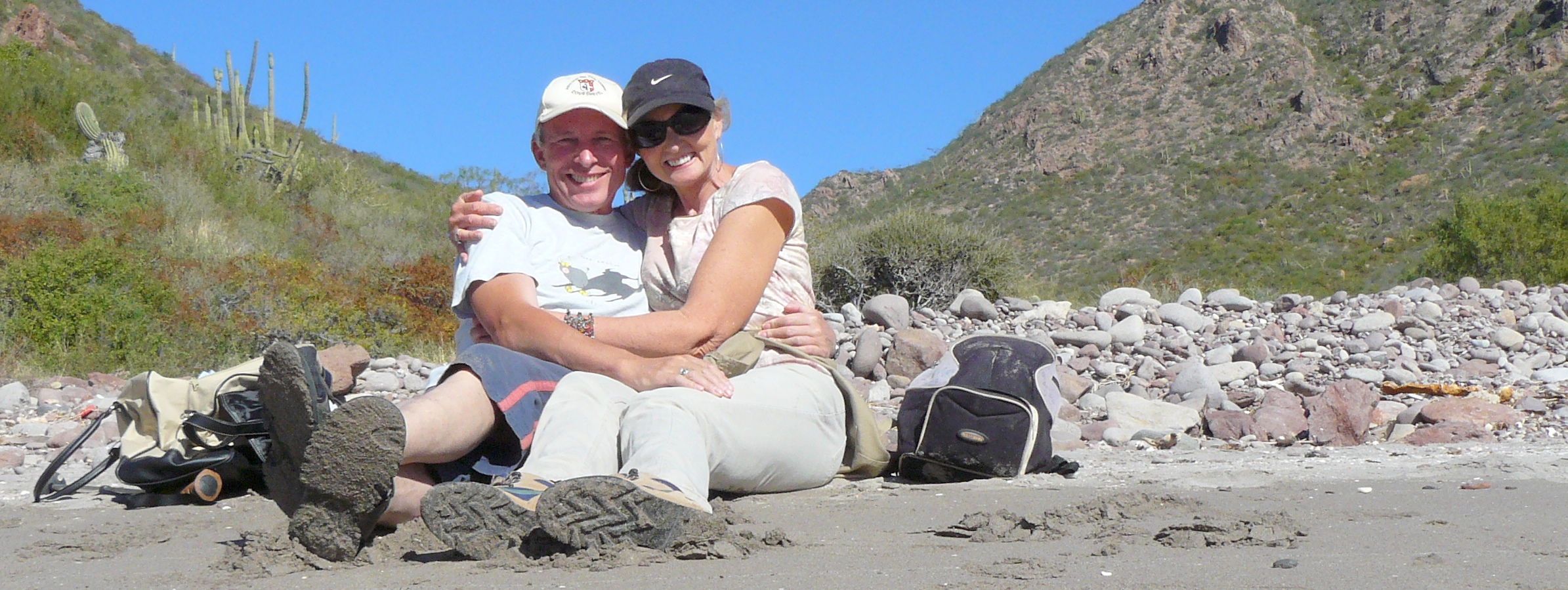
6th January, 2008. Jean and me on a beach in Mexico.
This is the poem I wrote for Jean for this Valentine’s Day just gone.
What’s in a number?
Numbers spell out so much.
From a year of birth,
To a year of death,
From a chance event,
To a predictable breath.
Numbers spell out so much more.
From the day that we met,
To the year we were joined,
From the day we married,
To this day of love today.
So many days of happiness.
Yet numbers that spill beyond the digits.
For they are reflections of times a past,
And they are beacons of our lives,
Numbers that carry so much meaning,
To places so far beyond their count.
Yet today there is a number,
A number that carries all thoughts of love,
Almost endless thoughts of love from me to you,
Two little figures that say seventy-four.
For seventy-four months ago,
This very day,
I met you,
And you met me.
I loved you so soon,
Loved you so well.
And still do.
If you have read this far then well done! 🙂 If only one person has been touched by my experiences then that is wonderful.
I shall close by publishing a paragraph towards the end of Sue’s blog post.
Only you can know the how’s and why’s of your life. The answers that you seek can be found when you start answering your own questions, Sometimes we have to get a little lost in order to find oneself again.. But the journey in finding oneself is all part of our Earth Journey.
Embracing St. Valentines Day and the power of love. (With huge gratitude to Sue Dreamwalker who included the following song from Bette Midler in Sue’s tribute to the loss of her dear Aunt on January 28th, 2015.)
Possibly the most important lesson to be learnt from dogs.
As is the way, a number of separate happenings seemed to be ‘singing from the same song sheet’ in bringing about today’s post.
Earlier yesterday morning Jean and I had a meeting with the executive director of an important charity that is helping the many homeless and disadvantaged young persons in this part of Oregon. For example, Jean and I were told that there were 300-500 homeless teenagers in Josephine County alone (Josephine County is where our home is.)
One of the ideas that was floated in the conversation was how kids are so loving to animals and whether our dogs and horses might help.
Then later, when back home, I recalled that over two years ago I published a post called Sticks and stones.
It wasn’t a long post and is republished now.
oooo
Sticks and stones
I make no apologies for today’s post being more emotional and sentimental. The phrase ‘sticks and stones may break my bones but names will never hurt me‘ is well known throughout the English-speaking world and surprisingly goes back some way. A quick web search found that in the The Christian Recorder of March 1862, there was this comment:
Remember the old adage, ‘Sticks and stones will break my bones, but words will never harm me’. True courage consists in doing what is right, despite the jeers and sneers of our companions.
So if in 1862 the saying was referred to as an ‘old adage’ then it clearly pre-dated 1862 by some degree. A few days ago, Dusty M., here in Payson, AZ, sent me a short YouTube video called The Power of Words. I’m as vulnerable as the next guy to needing being reminded about what’s important in this funny old world.
Then I started mulling over the tendency for all of us to be sucked into a well of doom and gloom. Take my posts on Learning from Dogs over the last couple of days, as an example. There is no question that the world in which we all live is going through some extremely challenging times but anger and negativity is not going to be the answer. As that old reference spelt out so clearly, “True courage consists in doing what is right, despite the jeers and sneers of our companions.” So first watch the video,
then let me close by reminding us all that courage is yet something else we can learn from dogs.
Togo the husky
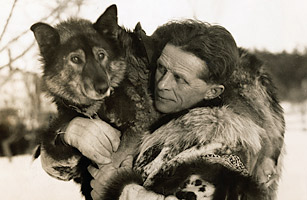
In 1925, a ravaging case of diphtheria broke out in the isolated Alaskan village of Nome. No plane or ship could get the serum there, so the decision was made for multiple sled dog teams to relay the medicine across the treacherous frozen land. The dog that often gets credit for eventually saving the town is Balto, but he just happened to run the last, 55-mile leg in the race. The sled dog who did the lion’s share of the work was Togo. His journey, fraught with white-out storms, was the longest by 200 miles and included a traverse across perilous Norton Sound — where he saved his team and driver in a courageous swim through ice floes.
More about Togo another day.
oooo
One of the comments left to that post back in November, 2012 was from Virginia Hamilton. Her website, Canine Commandos, is about just that: dogs helping youngsters. This is what Virginia wrote:
Our sermon today was about sticks and stones which is perfect timing because my sixth graders are throwing words at each other and it is hurting. So I looked up the phrase and found you. We were shown the video in a faculty meeting and since you tie into dogs I was hoping to find “the answer.” When you look at the website you’ll see out community project where I have twenty schools training in three shelters. One would think that because these kids are so loving to the animals that they could pass that kindness to each other. Any words of wisdom? Also check this out. Thank you, Virginia.
Now I would be the first to admit that there’s a difference between a homeless young person and a gifted young person. Yet the difference may not be so great. In this one sense: that caring for an animal changes lives and what young people, from all backgrounds and circumstances, need to learn is the power of unconditional love.
Not just caring for dogs, horses and cats, by the way.
Tomorrow, I want to offer the example of someone who has been sufficiently strong to take one small step back to sanity.
What I am offering is the reposting of an item in 2013 on Transition Network over in the UK. As you read it, do bear in mind that the references to Amazon are, in the main, to Amazon in the United Kingdom.
I’ve done it. I’ve closed my Amazon account. I now stand before you as an ex-Amazon account-holder. I feel curiously shaky, but at the same time empowered, excited even. While opening a new Amazon account is easy as pie, closing one is another matter altogether. I’d like to share with you how, and why, I did it.
Was it the recent Panorama programme about working conditions in those vast Amazon ‘fulfilment centres’ that tipped me across into doing something? Was it the stories about the appallingly low levels of tax Amazon pay in the UK? Was it the recent video showing Amazon’s plans to be delivering across the UK within 30 minutes through the use of drones? Was it hearing the level of taxpayers’ money that goes in sweeteners to attracting Amazon to open up in different communities, while the profits generated pour out of those same places? What actually tipped me across was a conversation I had with a book seller in my town. It was that that led me, finally, to build the steely resolve needed to close down my Amazon account.
Yes, I confess, I had an Amazon account. I buy music from my local record shop, I support my local book shops, but there are times when I need a book quickly, or feel I do, and it’s just easier and more convenient. And, if I’m honest, I love getting exciting parcels in the post. And isn’t it cheap? But as Carole Cadwalladr, who went undercover in Amazon’s Swansea ‘fulfilment centre’ for The Guardian puts it:
Our lust for cheap, discounted goods delivered to our doors promptly and efficiently has a price. We just haven’t worked out what it is yet.
I’ve always had that nagging conscience that it’s not OK really, but I have just had it ticking away in the background and carried on using it on occasion. The conversation that tipped it for me, with my local bookseller, was around “what would it take for you to stop supporting Amazon?” His example was Primark, recently implicated in child labour in the manufacturing of some its clothes. We know that’s the case, but we still shop there. If we knew that 8 year olds work there, would we stop shopping there? Or 5 year olds? If we knew that every day they arrive for work they get hit with a stick, would we still pop in there for a cheap new shirt? And if they got hit 3 times, and then again in the middle of the day? Where do we draw the line?
Our tendency is to draw a line, but then for that line to slip. What swung it for me was thinking that actually, what I already know should be enough to make me withdraw my support. Also, it was thinking about where the world will be in 5 years time if we continue to give Amazon our support. More and more low paid jobs, with little Union protection, in conditions described in the BBC documentary as “… all the bad stuff at once. The characteristics of this type of job, the evidence shows increased risk of mental illness and physical illness.”
We’ll see Amazon ‘fulfilment centres’ that look like a wasp’s nest, with drones flying in and out. High streets swept clean of bookshops, indeed of most shops, as Amazon spread into selling virtually everything that local economies sell, but far cheaper. It made me think about what kind of a world I’m creating for my sons as they enter the work place. What kind of opportunities will Amazon offer them, as they gut local economies and focus economic activity into vast warehouses along the side of motorways?
I give so much of my time every day to trying to create a different, more just, more resilient world, yet my shopping decisions undermine that. There is also an extraordinary arrogance to thinking that it is OK for you to fill peoples’ airspace, the sky above their heads, with your drones, delivering your products to people for your profit. What happens for a company to get so huge that that is considered acceptable? It is about getting too big. Amazon is too big. Far too big. But it clearly sees that it has only just started. That’s not good.
So, decision made, and with a commitment to source those things in other ways, I went to the website to close my account. Closing an account with Amazon is like breaking up with a girlfriend whose level of obsessive denial is such that the possibility you might want to split up with her doesn’t even enter her consciousness. It’s a fascinating process. Opening an account with Amazon is so easy. Closing an account is, as my 15 year-old son might put it, a right mission.
Click on ‘Your account’ and there is no option anywhere of “Close my account”. Nothing. Like it’s not even a possibility that it might entertain. I had to Google (and don’t get me started on them) “closing your Amazon account”. If you search the Amazon site for “close my account” it yields no results. See below:
The Google link took me to their Help section, on pages that bear the slogan “we’re the people with the smile on the box”, prompting the thought that the inside of their box-like warehouses are probably somewhat bereft of smiles. If offers you a drop-down menu under the helpful title “what can we help you with?”. Surely that’s where I’ll find “Close my Account”? No. You get a range of choices, “An order I placed”, “Kindle”, “Digital services” and, er, “Something else”. Guess I’m “something else” then. So I click that.
I’m then given another 4 options, none of which are “Close my account”. I’m asked to “tell us more about your issue”, and given another list where my option is “other non-order question”. Given that still, the idea that I might have got this far could mean I want to close my account is clearly unimaginable, I am then given an option to email, to phone, or to “chat”. So I click on “chat”, and am told “a customer service associate will be here in a moment”.
A charming man then begins to chat with me. Here’s how our conversation went:
Me: I want to close my account please. How do I do that?
Tom (not his real name): Thank you for contacting Amazon.co.uk. My name is Tom. May I know your name, please?
Me: Rob
Tom: Thank you. I’m sorry to hear that you want to close the account. May I know the reason for closing the account please?
Me: Certainly. I am appalled by the way Amazon operate as highlighted in the recent BBC Panorama programme. I am appalled at the recent story on Amazon considering deliveries in future by drone. I am appalled by the low level of tax Amazon pay in the UK. I have been a customer for years, but I feel Amazon has become too big, and eats everything in its path. It is no longer something I wish to support.
Tom: I’m sorry for the situation. For confidentiality reasons, I’m not able to close your account for you in chat, so I’m going to send you an e-mail with the information to close the account. When you receive it, please respond to that e-mail so that we will close your account.
Me: Thank you Tom. I would really like my reasons for leaving to be registered somehow, as I think a lot more people will be closing their accounts for similar reasons, and it would be good for that to be noted by those in charge. Will that be possible?
Tom: Unfortunately we will not be able to comment on this issue. However, I will send you an email regarding the closing of the account. Is there any thing else I can help you with?
Me: I am not asking you to comment on the issue. I am asking you to make sure that the reasons for my closing my account are passed on to management. If I ran a business I would want to know why my customers were closing their accounts. Is that not the case at Amazon?
Tom: Sure, all the information’s will be recorded and forwarded to the appropriate department.
Me: Thank you Tom. I appreciate your help.
Tom: Thanks for your understanding. We hope to see you again soon! Have a Nice Day!
I later received an email from Customer Support to say:
“We appreciate your feedback and have forwarded it to the appropriate team internally. We are proud to provide a safe and positive working environment for all of our associates. Information about working at our fulfilment centres can be found at the following link: www.amazon.co.uk/fcpractices“
Amazon may be cheap, but cheap comes at a cost for someone else. And, after all, much of what is bought on there is throwaway rubbish. As Carole Cadwalladr puts it:
The warehouse is 800,000 square feet, or, in what is Amazon’s standard unit of measurement, the size of 11 football pitches (its Dunfermline warehouse, the UK’s largest, is 14 football pitches). It is a quarter of a mile from end to end. There is space, it turns out, for an awful lot of crap.
Me, I resolve to buy less, but better. Less, but longer-lasting. Less, but local. The thought of where we will end up in 5 years time, 10 years time, 20 years time, if companies like Amazon continue as they are, really frightens me. It’s not good, it’s not right. It’s not about our needs, it’s about the needs of huge investors. I want a different world for my boys.
I can’t, on my own, do that much about it. I can’t insist that the UK government legislate so that, as in Holland, the Recommended Retail Price (RRP) is the legal minimum at which any book can be sold, although I think that is grounds for a really timely campaign. Because of that, Amazon don’t really operate in Holland. Bring back the RRP for books here, and let’s have a level playing field. As I say, I can’t do much, but I can withdraw my support. I just have withdrawn my support. It feels surprisingly unsettling, as one does after ending a relationship, but it was the right thing to do. It may be a drop in the ocean, but if enough people do it….
ooOOoo
As you might expect, I do have an Amazon account but will look closely into alternatives. In that regard, I just want to expand on the link underneath the earlier phrase, “commitment to source those things in other ways“. The link takes you to an article in the Guardian newspaper, online version, dated the 16th May, 2013. Here are the opening paragraphs:
Amazon’s tax bill is in the news again, after a Guardian investigation put the spotlight on its financial arrangements. There’s a growing swell of people who want to use an alternative place to buy – including my colleague Patrick Collinson who wrote about his attempts to kick the Amazon habit in November.
But it is not always easy to find good alternatives online: if you want to buy either the latest Dan Brown novel (and clearly some people do), Mad Men series five on DVD, or even a packet of Pampers nappies, Amazon seems to come top of the search pages.
To close today’s post, just spend four minutes watching the following video.
Why growth and the environment can’t coexist
Published on Feb 9, 2015
Featuring: Sam Bliss
Production: Daniel Penner
Animation + Illustration: Amelia Bates
Music: “Nincompoop (No Vocals)” by Josh Woodward (http://www.joshwoodward.com/)
“Favorite Secrets” by Waylon Thornton (http://waylonthornton.tumblr.com)
Footage: Prelinger Archives
The background to the video, first seen referred to on the Grist blogsite, is republished here:
Watch our juicy explainer about the environment’s growing economics problem.
Consume less, share more. Those are some basic principles behind degrowth, an idea and movement that rejects economic growth as a goal for society. This video explains degrowth with oranges, juice, and peels.
But wait, you ask, isn’t growth a good thing? In an age when we’re conditioned to equate growth with progress, degrowth sounds insane. In reality, pursuing endless exponential expansion of the economy is insane — and impossible. Humans already use resources faster than Earth can replenish them and produce wastes, like carbon emissions, faster than Earth can assimilate them. Hence, degrowth.
Degrowth isn’t about making everyone poorer; it’s about redefining wealth to acknowledge that real well-being can’t be measured in dollars. It’s about breaking down the artificial barrier between life and work; it’s about valuing cooperation over competition; it’s about democracy, autonomy, solidarity, and climate justice. Most importantly, degrowth means sharing society’s surplus for awesome art projects and epic, week-long gatherings.
I freely admit that I have been putting off today’s post, and I’m not sure why.
Maybe it’s the continuing escalation of words between the West and Russia over the Ukraine? (But for some clarity do read this analysis written by Anatol Lieven, Professor, Georgetown University’s School of Foreign Service in Qatar.)
Maybe it’s because my last republication of a George Monbiot essay was so hopeful. Indeed, the blog post was called Voting for hope.Whereas today’s Monbiot essay is very sad.
Maybe it’s because I am not immune to the temptations that are described.
But whatever the reasons, there can be no denying that there is a real sense of finding the modern world increasingly strange and frequently upsetting.
That theme continues today with the republication of a George Monbiot essay that he released on his blog a week ago.
ooOOoo
Lost in the 21st Century
3rd February 2015
Consumerism has broken its promise. Perhaps now we can begin to reconnect.
By George Monbiot, published in the Guardian 4th February 2015
A woman walks into a department store. She takes in the racks and stacks of stuff, the sugared music, the sale signs, the listless customers shuffling through the aisles, and is moved – suddenly and to her own astonishment – to shout. “Is this all there is?!”. An assistant comes round from behind his till. “No madam. There’s more in our catalogue.”
This is the answer we have been given to everything, the only answer. We might have lost our attachments, our communities, our sense of meaning and purpose, but there will be more money and more stuff with which to replace them. Now that the promise has evaporated, the size of the void becomes intelligible.
It’s not that the old dispensation was necessarily better: it was bad in different ways. Hierarchies of class and gender crush the human spirit as effectively as atomisation. The point is that the void that was filled with junk is a void that could have been occupied by a better society, built on mutual support and connectedness, without the stifling stratification of the old order. But the movements that helped to smash the old world were facilitated and co-opted by consumerism.
Individuation, a necessary response to oppressive conformity, is exploitable. New social hierarchies, built around positional goods and conspicuous consumption, took the place of the old. The conflict between individualism and egalitarianism, too readily ignored by those who helped to break the oppressive norms and strictures, does not resolve itself.
So we are lost in the 21st Century, living in a state of social disaggregation that hardly anyone desired, but that is an emergent property of a world reliant on rising consumption to avert economic collapse, saturated with advertising and framed by market fundamentalism. We inhabit a planet our ancestors would have found impossible to imagine: 7 billion people, suffering an epidemic of loneliness. It is a world of our making but not of our choice.
Now it appears that the feast to which we were invited is only for the few. Figures released last week show that wages in the United Kingdom are lower than they were 13 years ago(1). A fortnight ago, Oxfam revealed that the top 1% now possesses 48% of the world’s wealth(2); by next year it will own as much as everybody else put together. On the same day, an Austrian company unveiled its design for a new superyacht. It will be built on the hull of an oil tanker, 918 feet long(3). There will be 11 decks, three helipads, theatres, concert halls and restaurants, electric cars to take the owner and his guests from one end of the ship to the other, and a four-storey ski slope.
In 1949, Aldous Huxley wrote to George Orwell, to argue that his dystopian vision was the more convincing(4). “The lust for power can be just as completely satisfied by suggesting people into loving their servitude as by flogging and kicking them into obedience. … The change will be brought about as a result of a felt need for increased efficiency.” I don’t believe he was wrong.
Consumerism is at odds with common purpose: you could pay your taxes or you could spend the money on a new car(5). It stifles feeling, dulling our concern for other people. Freedom to spend displaces other freedoms, as lotus eating allows us to forget our losses. Most forms of peaceful protest are now banned, but no one stops us from devouring the resources upon which future generations will depend. All this helps the global oligarchs to rip holes in the social safety net, find relief from the constraints of both democracy and taxation, and enclose and privatise our common weal.
Just as human society has been pulled apart by consumerism and materialism, pushing us into an unprecedented Age of Loneliness(6), so ecosystems have been shattered by the same forces. It is the consumerist mindset, raised to the global scale, that now threatens us with climate breakdown, catalyses a sixth great extinction, imperils global water supplies and strips the soil upon which all human life depends(7).
But nor do I believe that the acceptance of servitude Huxley envisaged is a permanent state. Wage stagnation, the brutality of the new conditions of employment, the breaking of the link between educational attainment and social advancement, the impossibility, for many young people, of finding good housing, all these confront us with the question that could be deferred only during conditions of rising general prosperity: is this all there is?
As the growth of Syriza and Podemos suggests, we cannot build political movements to challenge these issues unless we also build society. It is not enough to urge people to change their politics: we must create not only communities of interest but also communities of mutual support, offering the security, survival and respect that the state will no longer provide.
In a remarkable series of contemplations, extending beyond its familiar brief, Friends of the Earth has begun to explore how we might reconnect(8), with each other and with the natural world. It is looking, for example, at new models for urban living(9), based on sharing rather than competitive consumption: the sharing not just of cars and appliances and tools, but also of money (through credit unions and micro-finance) and power. This means community-led decision-making, over transport, planning and, perhaps, rent levels, minimum and maximum wages, municipal budgets and taxation. Such initiatives are not a substitute for government action – like David Cameron’s Big Society they are meaningless without facilitation from the state – but they can bring people together with a sense of shared purpose, ownership and mutual support that centralised decision-making can never provide.
Friends of the Earth also supports the empathy revolution championed by the author Roman Krznaric(10), and lifelong education that might counter the ever narrower schooling now inflicted on our children, whose purpose is to prepare people for jobs they will never have, in the service of an economy ordered for the benefit of others.
In these ideas and movements we find the glimmerings of an answer to the question: no, this is not all there is. There is attachment. Despite the best efforts of those who believe there is no such thing as society, we have not lost our ability to connect.
5. See also the discussion of Rami Gabriel’s work (2013. Why I buy: Self, taste, and consumer society in America. University of Chicago Press) in Friends of the Earth, December 2013. Consumption and identity: A review of literature which is relevant to the question: ‘what is a better foundation for people’s identity than consumption?’ http://bit.ly/1ECZopQ
Yet again, another example of a post almost writing itself.
Let me explain.
Yesterday, I published a post about being sensitive to the world around us.
Then this morning there was a new post from Sue Dreamwalker under the title of Fear of the Future. It was uncharacteristically downbeat for Sue.
Now most who follow me know I try to bring a positive touch within my posts… Yet to be quite honest with you all I am really struggling right now to lift myself from the doldrums of my own thoughts.
The key to conquering our fears lies in awareness. When we identify the irrational thoughts that frighten us and replace them with positive affirming ones.
Argh… all easier said than done..
You would think with my inner Knowing, and my Spiritual mind I should be the last person to take a nose dive into that Pit of depression.. Especially when I dredged its depth before and vowed that I had been there done that and worn the T-shirt and I refuse to wear it again.
I could blame it on my Fall which left me feeling bruised with aching, muscles which are still healing.. And I could blame it on grief as I lost a very beloved Aunt last week. I could blame my fatigue on me deciding to move a whole wall of books out the spare bedroom with wrists still recovering from the sprains of the fall.. And I could blame it on the weather being cold and miserable.. I could even blame it on the state of the world, or the Planets .. I have a whole host of excuses I could fall back upon to justify why I am feeling tired and jaded..
Many left comments including me. I spoke of the reward of hugging a dog. My words included:
I don’t have answers other than to feel what you are feeling. All I hang onto when I spend too much time thinking of my own mortality is that the answer, the answer to the moment, is to bury one’s face into the warm, soft fur of a dog. They seem to sense my need at these times. (And that isn’t meant to sound like me devaluing the love and affection that I receive from Jean!)
In other words, that contact with the warm dog holds me in the present and before long the reinforcement of living that present, loving moment puts the unknown future into perspective.
Another comment was left by blogger Rajagopal that included this wonderful tale:
The only thing that I have seen working in my life is to keep living, as much as possible, in the present. There is nothing to fear, either of the now or of the future.
In this context, wish to leave you with the story of the pregnant deer; in a forest, a pregnant deer is about to give birth. She finds a remote field near a strong-flowing river, that looks like a safe place, as she starts going into labour. At the same moment, dark clouds gather in the sky and streaks of lightning sets off a forest fire. The deer looks to her left and sees an approaching hunter with arrow pointed at her. To her right, the deer spots a hungry lion speeding towards her. What can the pregnant deer do? She is in labour! What will happen? Will the deer survive? Will she give birth to the fawn and will it survive? Or will everything be burnt by the forest fire? Or will she perish to the hunter’s arrow? Or does a horrible end await her at the hands of the hungry lion? Constrained by the fire on one side, the flowing river on the other and boxed in by her natural predators, the deer is apparently left with no option. What does she do? Well, she focuses on delivering and giving birth to a new life.
The sequence of events that follows is the Lightning strikes and blinds the hunter, who releases the arrow which zips past the deer and strikes the hungry lion. It starts to rain heavily and the forest fire is slowly doused by rain water. The deer gives birth to a healthy fawn….In our life too there are moments when we are confronted with negative thoughts and possibilities on all sides, so powerful as to overwhelm us. May be we can learn from the deer. The priority of the deer at that given moment was to give birth as safely as possible.
The rest was not in her hands and any change in her focus would have most likely impeded giving birth to the fawn. In the midst of the severest storm, we just have to maintain presence of mind and do what is in our control…the Cosmic power will take care of the rest…best wishes… Raj.
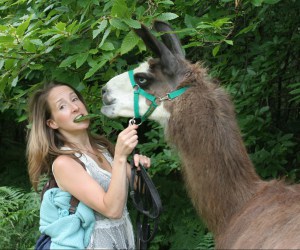
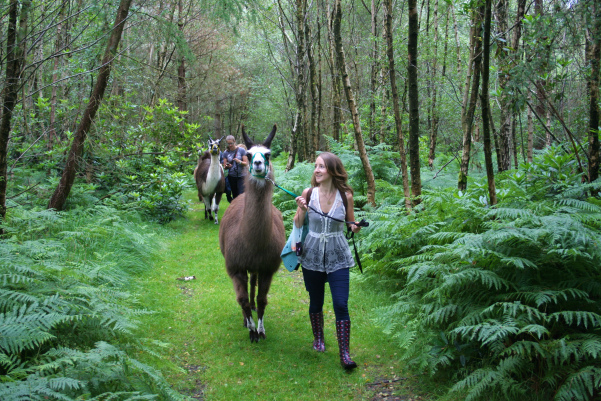
Finally, there was a recent new follower of this place. Her name is Emma and she writes the blog The Muse in the Mirror. Emma was kind enough to grant me permission to republish a post from last December about the healing power of Llamas. Enjoy!
ooOOoo
Llama Loving; The healing power of Llamas
It’s official; I LOVE llamas. There, I said it, put out there for the world to know! I love their gentle, sensitive nature, friendly disposition and most of all their goofy, giggle-worthy expressions, which never fail to bring a smile to my face! Concerned that my llama loving status was bordering on obsession, I was beginning to question whether my love for these comical camelids was founded on anything other than sheer amusement! Thankfully as I researched further my findings confirmed that these beautiful animals are much more than a pretty (funny) face!!!
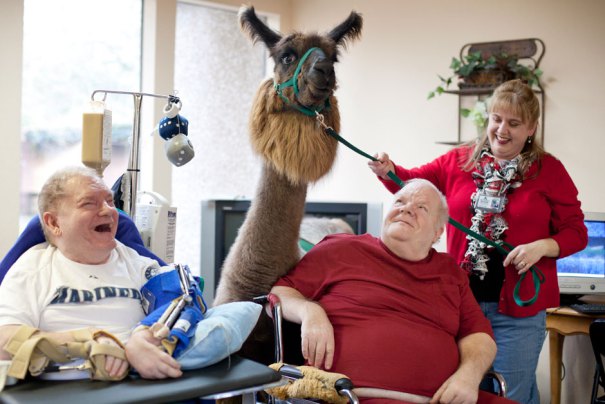
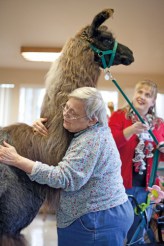
in USA. The adorable photo’s lay testament to the happiness that llama’s bring to residents at Bellingham Health and Rehabilitation Center in Washington, USA. Llama Marisco (pictured above), and Llama N.H. Flight of the Eagle (pictured right) are trained therapists, who spread comfort and joy as they stop at each bed to kiss the patients or have a hug. Resident Holly Barto remarked that…
“It was heaven. Just emotionally – to be able to touch an animal and hold an animal close.”
Another example of the profound healing benefits of llama’s can be seen in this adorable video below showing Rojo the therapy llama and Napoleon the therapy alpaca from Mtn Peaks Therapy Llamas & Alpacas, in Vancouver, WA USA. A non-profit corporation, which offers therapy teams to visit hospitals and schools in the area. The expressions on people’s faces are heart warming to say the least!
“Who knew such fluffed-up, carrot munching mammals could bring so much joy.”
Laughter is the best medicine.
Llama Dave is disgruntled by the fact I was munching in on his dinner!
If I am having an off day, the first thing I reach for is a funny llama picture. Better still, a visit to the local llama park soon blasts my bad moon into infinity and beyond! A good giggle-fest at the Ashdown Forest Llama park, in East Sussex, dissolves the blues and confirms that laughter really is the best medicine! (See my picture gallery below to see me with some of the residents of the Ashdown Forest Llama park!).
There’s a very good reason behind the saying Laughter is the best medicine. Research suggests that people feel less pain after a good laugh, because it causes the body to release chemicals that act as a natural painkiller. ‘Professor Robin Dunbar of Oxford University, who led the research, believes that uncontrollable laughter releases chemicals called endorphins into the body which, as well as generating mild euphoria, also dull pain.’ (BBC)
It is common knowledge that animals in general make us happier and brighten our spirits. A growing body of scientific research now suggests that interacting with animals can make us not only happier, but healthier too. That helps explain the increasing use of animals for therapeutic purposes in hospitals, hospices, nursing homes, schools, jails and mental institutions.
The use of pets in medical settings actually dates back more than 150 years, says Aubrey Fine, a clinical psychologist and professor at California State Polytechnic University. Fine who has written several books on the human-animal bond says:
“One could even look at Florence Nightingale recognizing that animals provided a level of social support in the institutional care of the mentally ill,”
So there you have it, next time you’re feeling blue, you know what to do! Head on out to your nearest llama park to insight those warm fuzzy feelings from a fluffy four legged llama! Check out my favourite selection of Llama and Alpaca pics below, guaranteed to bring a smile to any face!!
ooOOoo
Note: That last photograph above is only one of a wonderful collection of Llama photographs that Emma included in her blog post. Do drop across there and admire all the wonderful pictures.
The incredible healing power of hugging an animal.
It is a very common, understandable trait of us humans to put our own lives first. I mean that much more in the psychological sense than in the sense of our daily activities although what we think and feel, inevitably, influences how we behave. One of the fabulous qualities of our dogs is that they are so much more sensitive to the world around them than to their own internal thoughts and feelings. Right from the early years of having Pharaoh in my life I was aware that he ‘read’ my emotions easily and soon became an instinctive ‘friend’, especially when I was troubled.
Years later, all of the dogs love it when Jean and I are in happy, positive places and you can see how our human states of mind link so directly to the mood of our dogs.
All of which is my introduction to an essay recently read over on the Big Think blogsite. Specifically, one about living empathically. The essay is called: Let’s Make 2015 “The Year of Living Empathetically” and here are the opening paragraphs:
Let’s Make 2015 “The Year of Living Empathetically”
I began the new year on a very positive – and inspiring – note after reading Eric Liu’s latest commentary on “Radical Empathy”.
The founder and CEO of Citizen University, Liu shows us that laying aside our egos – our need to be in the right – in favor of standing in the shoes of others, is key to addressing so many of the problems that we (once again) confronted in 2014.
This insight – without question – is a wake-up call to our country as 2015 unfolds.
That’s why I think we should resolve to make 2015 “The Year of Living Empathetically.”
We need to make the practice of empathy our New Year’s exercise regimen, our social-emotional diet for the next 365 days.
Let’s practice empathy at home, with our spouses and kids.
Let’s practice empathy in the workplace, as we give and receive feedback, and credit others’ contributions generously.
Let’s practice empathy in the classroom, especially when kids are struggling and need our support.
Let’s practice empathy in public service, as we encounter people who look different from us, and whose lives matter every bit as much as our own.
Let’s practice empathy as we encounter people on the street, who may be less fortunate, and are just as human.
Let’s practice empathy when resolving conflict, whether interpersonally or on a global-political level.
And let’s practice empathy in local and state governments, and in the halls of Congress, so that we might truly listen in order to solve real problems
If all this sounds like a tall order – you’re right; it is.
As Brene Brown, a research professor at the University of Houston Graduate College of Social Work, points out, empathy is a challenging personal choice that requires us to become vulnerable in an effort to connect with another person.
It is not a long essay, so do drop across to here and finish reading it.
As is the way of ideas, serendipity is always actively working ‘under the hood’.
Why do I say that?
Because as soon as I was clear about what I wanted to offer you for today, in to my ‘in-box’ came the latest TED Talk. A talk from Ben Ambridge entitled: 10 myths about psychology: Debunked. It so resonated with today’s theme and is offered below.
Published on Feb 4, 2015
How much of what you think about your brain is actually wrong? In this whistlestop tour of dis-proved science, Ben Ambridge walks through 10 popular ideas about psychology that have been proven wrong — and uncovers a few surprising truths about how our brains really work.
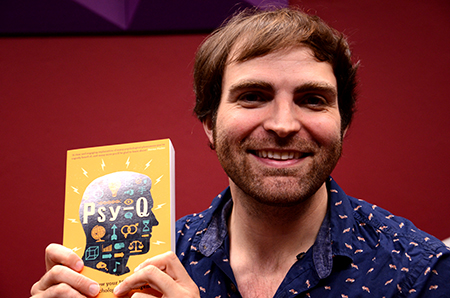
Ben Ambridge is the author of “Psy-Q,” a sparkling book debunking what we think we know about psychology.
Why you should listen?
Ben Ambridge is a senior lecturer in psychology at the University of Liverpool, where he researches children’s language development. He is the author of Psy-Q, which introduces readers to some of the major findings in psychology via interactive puzzles, games, quizzes and tests.
He also writes great newsy stories connecting psychology to current events. His article “Why Can’t We Talk to the Animals?” was shortlisted for the 2012 Guardian-Wellcome Science Writing Prize. Psy-Q is his first book for a general audience.
Dr. Ben Ambridge with his book: Psy-Q.
If you want to learn more about the good Professor, here is his webpage on the University of Liverpool‘s website. And here is Ben Ambridge’s personal webpage that lists many, if not all, of his publications.
I honestly can’t find a better picture to close today’s post about sensitivity and empathy than this one below:
Dearest Suzann, who invited me out to San Carlos, Mexico, for the Christmas of 2007, leading to Jean and me meeting, is heavily involved in rescuing the many feral dogs found in that part of the world.
She recently sent me the following:
Shepherd Boy will be euthanized in a few days at the CA state kennel he is at and Jeannie Wade is trying to help save his life….do you guys know of anyone? Let me know asap.
He is located in the Central Coast area of California and goes by the name ‘Shepherd Boy’ and is one year old.
He is in a high kill shelter and has days to live.
Shepherd Boy is shy and sweet tempered and the volunteers at the shelter feel he will make a very good companion/pet for a nice family or couple.
Paul, If I were up there, I would take him in a heartbeat!
Suzann
Please, please share this as far and wide as possible – urgently.
Shepherd Boy may be found at the Central Coast SPCA, Orcutt, California 93457
Suzann has given me the name of Jeannine Wade and she may be emailed at: centralcoastspca@yahoo.com