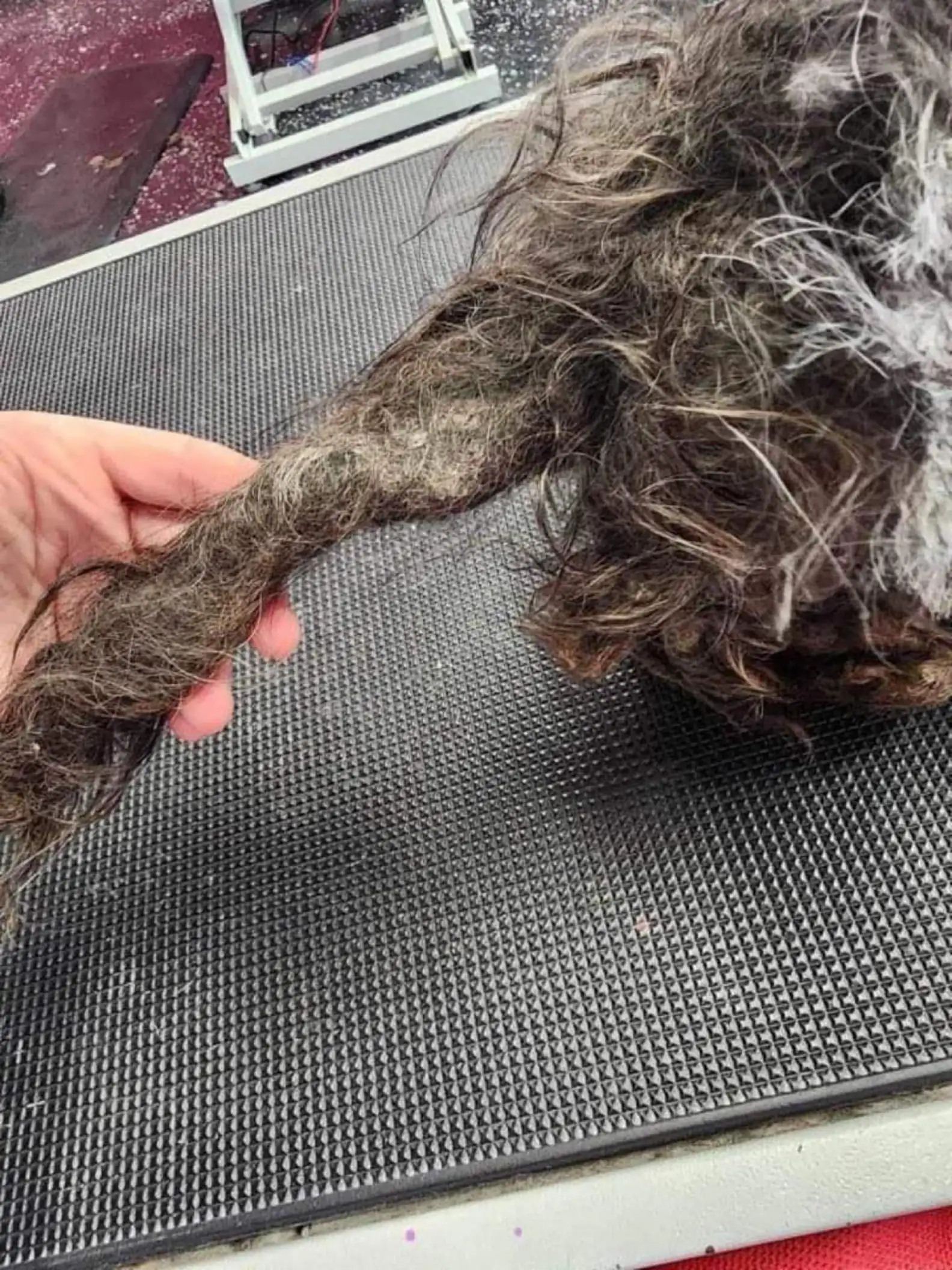
Recently, staff at the Wyandotte Animal Shelter in Michigan took in a dog whose condition was described as among the worst they’d ever seen. Pixie, as the dog is named, had fur so overgrown and matted that she could hardly move.
Gazing upon Pixie, one might never guess that an adorable dog existed beneath it.
Wyandotte Animal Shelter
According to staff at the shelter, Pixie was surrendered by her owner, who, regrettably, had neglected to give her the care and attention she needed — leading to her severely unkempt condition. Ultimately, though, his decision to surrender her is what Pixie needed most.
“He had a hard time letting her go but surrendered her to us so we could ensure she would go to someone who could give her the life she deserved,” the shelter wrote.
With that, Pixie’s world was about to change forever — and it would have to start with a much-needed haircut.
Wyandotte Animal Shelter
Staff at the shelter reached out to The Downriver Grooming Co. for what would be an emergency grooming session to help Pixie escape from her matted prison.
“[They got] her in within minutes of our call, and for [three] hours they spent freeing her from that matted fur,” the shelter wrote.
Wyandotte Animal Shelter
After all was said and done, the real Pixie had emerged.
She was totally unrecognizable from her former self.
Wyandotte Animal Shelter
“This little girl was only 5.5 pounds, but she seemed twice her size due to the matted fur,” the shelter wrote, adding that she was in remarkably good health, despite her ordeal beneath that overgrown coat.
Pixie’s world had changed for the better — but it wouldn’t be long until it improved even more.
Wyandotte Animal Shelter
Within days of Pixie’s transformation, thanks to the kindness of those who’d helped her, the little dog got the second chance she so desperately needed.
“Pixie was adopted,” a spokesperson for the Wyandotte Animal Shelter told The Dodo. “Her new family reports that she is doing very well in her new home.”
ooOOoo
We all need second chances from time to time, humans and dogs.
It is about Whale songs and is just a fabulous sound!
Last Friday there was an item on the BBC about whale song. It appears I can publish the article for you all. It is my choice over my regular Sunday Picture Parade. I hope you agree! Update: The track just 26 seconds long cannot be reproduced in this post.
ooOOoo
Whale song mystery solved by scientists
21 February 2024, By Helen Briggs and Victoria Gill,Science correspondents, BBC News
Humpback whale breaching near Bering Island, Kamchatka, Russia – Olga Filatova, University of Southern Denmark
Scientists have worked out how some of the largest whales in the ocean produce their haunting and complex songs.
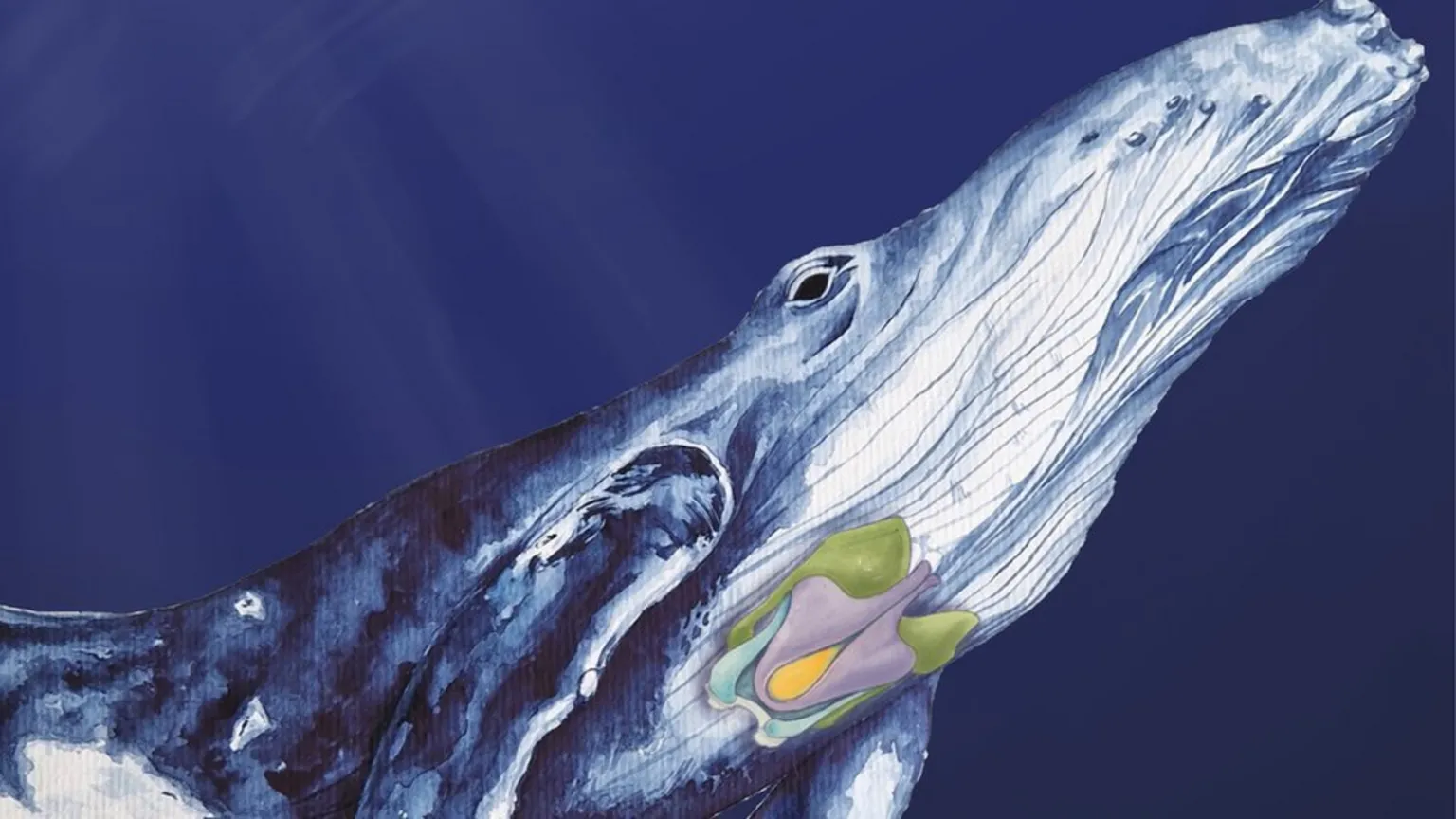
Humpbacks and other baleen whales have evolved a specialised “voice box” that enables them to sing underwater.
The discovery, published in the journal Nature, has also revealed why the noise we make in the ocean is so disruptive for these ocean giants.
Whale song is restricted to a narrow frequency that overlaps with the noise produced by ships. “Sound is absolutely crucial for their survival, because it’s the only way they can find each other to mate in the ocean,” explained Prof Coen Elemans, of the University of Southern Denmark, who led the study.
“[These are some] of the most enigmatic animals that ever lived on the planet,” he told BBC News. “They are amongst the biggest animals, they’re smart and they’re highly social.”
Humpback whale song (For whatever reason the track cannot be listened to on this blog. That is a great shame as the song is magnificent. So please go to the BBC website for this; the link is https://www.bbc.com/news/science-environment-68358414 )
Baleen whales are a group of 14 species, including the blue, humpback, right, minke and gray whale. Instead of teeth, the animals have plates of what is called baleen, through which they sieve huge mouthfuls of tiny creatures from the water.
Exactly how they produce complex, often haunting songs has been a mystery until now. Prof Elemans said it was “super-exciting” to have figured it out.
A diver descends between three juvenile humpback whales the size of buses – Karim Iliya
He and his colleagues carried out experiments using larynxes, or “voice boxes”, that had been carefully removed from three carcasses of stranded whales – a minke, a humpback and a sei whale. They then blew air through the massive structures to produce the sound.
In humans, our voices come from vibrations when air passes over structures called vocal folds in our throat. Baleen whales, instead, have a large U-shaped structure with a cushion of fat at the top of the larynx.
This vocal anatomy allows the animals to sing by recycling air, and it prevents water from being inhaled.
Artwork indicating the cartilages of the larynx in a humpback whale – Patricia Jaqueline Matic, Vienna
The researchers produced computer models of the sounds and showed that baleen whale song is restricted to a narrow frequency which overlaps with noise produced by shipping vessels.
“They cannot simply choose to, for example, sing higher to avoid the noise we make in the ocean,” explained Prof Elemans.
His study demonstrated how our ocean noise could prevent whales from communicating over long distances. That knowledge could be vital for the conservation of humpbacks, blue whales and other endangered giants of the sea.
It also provides insight into questions that researchers have been asking for decades about these eerie songs, which some sailors used to attribute to ghosts or mythical sea creatures.
Whale communication expert Dr Kate Stafford, from Oregon State University, called the study “groundbreaking”.
“The production and reception of sound is the most important sense for marine mammals, so any studies that elucidate how they make sounds has the potential to move the field forward,” she told BBC News.
Researchers say evidence of the harm ocean noise pollution can do has been building for decades – Alamy
The research also paints an evolutionary picture – of how the ancestors of whales returned to the oceans from the land, and the adaptations that made it possible to communicate underwater.
The way so-called toothed whales produce sound is better understood, because the animals are easier to study. These marine mammals, which include dolphins, orcas, sperm whales and porpoises, blow air through a special structure in their nasal passages.
Dr Ellen Garland, from the Sea Mammal Research Unit at the University of St Andrews, said: “I’ve always wondered exactly how baleen whales – especially humpbacks, which my research is focused on – actually produce the variety of sounds they do.
“Studying large whales is extremely challenging at the best of times, but trying to uncover how they produce sound when you may not even be able to see them underwater while vocalising is an added level of difficulty, so these researchers have been very creative.”
Dr Stafford added that the mammals’ ability to make such complex vocal signals was “remarkable” and highlighted “how special these animals are”.
ooOOoo
There! I do hope you all agree that this was very worthwhile. Plus, you all got to listen to those twenty-six seconds of the very beautiful sound.
I came across this post yesterday and thought that it would make a good article for today. But the truth is that I, and I expect many other readers, do not understand the article.
ooOOoo
Employees Heartbroken When They See Someone Tied To ‘Do Not Abandon Animals’ Sign
Outside the front door of the Harbor Humane Society sits a sign. “Do not abandon an animal here,” the sign reads. “Wait until business hours. No fee for bringing an animal to HHS. For the sake of the animal, please be humane.” An older, outdated version of the same sign sits at the back of the shelter, too, near some picnic tables where employees can take a break. When they arrived at work one morning recently, there were no animals waiting for them out front.
Harbor Humane Society
Sadly, the same could not be said for the sign in the back.
Tied to the base of the “do not abandon animals” sign was a tiny dog who had been abandoned there the night before. Security footage showed the dog, later named Trixie, had been tied to the sign around 9 p.m. and wasn’t found until 7:30 a.m. the next morning, meaning she’d waited there for 11 hours.
Harbor Humane Society
“Our team member was just about to unarm the building (had just arrived to start their morning shift) when she noticed the dog tied to the signpost near our intake door located toward the back side of the shelter,” Jen Nuernberg, director of marketing and strategic initiatives at Harbor Humane Society, told The Dodo. “Initially, she was nervous and scared, barking at her. But once she crouched down and gave her some time, she quickly warmed up and crawled right into her lap. She has been very friendly ever since!”
Harbor Humane Society
Trixie was terrified out there all alone, wondering why she’d ended up there. As soon as she met her rescuer, though, all was well. She was rushed inside and eventually met the rest of the staff members, who were just as heartbroken by the situation. Thankfully, Trixie seemed to be pretty healthy, just a little confused — as was everyone at the shelter.
“When someone abandons an animal without any information, we are just left to guess,” Jen Self Aulgur, executive director at Harbor Humane Society, told The Dodo. “So we can assume she is about 3 to 4 years old, but we don’t know her story, her name, her likes, her favorite treats or toys. This is all information we try to get on animals when they are surrendered to the shelter.”
Harbor Humane Society
The shelter employees are still hoping someone might come forward to give them some information about Trixie before she’s adopted, just to make sure she’s getting the best care possible.
“This pup deserves to have her story and history known,” Self Aulgur said. “We do not want to shame or get you in trouble — we just want to help this poor pup.”
Harbor Humane Society
Trixie is safe now and will be available for adoption in about a week or so. Until then, she’s getting as many kisses and cuddles as the staff can give her while she dreams of her loving forever family.
ooOOoo
Let me add my wishes to the Harbor Humane Society in hoping that very soon Trixie will be adopted by that loving family.
As 99% of you know, Jean, my wife, has Parkinson’s Disease. One of the characteristics of the disease is the effect it has on sleeping; Jean frequently has a bad night. Plus, our two dogs, Cleopatra and Oliver sleep in the bedroom on dog beds.
But if I was on my own I would find it difficult not to encourage our dogs to sleep on our double bed. That’s my assessment, at least! Over to The Conversation on the topic.
ooOOoo
Could sharing a bedroom with your pets be keeping you from getting a good night’s sleep?
Sleeping with your dog in the same room could be negatively affecting your sleep quality, according to my team’s recently published research in Scientific Reports.
We recruited a nationally representative sample of more than 1,500 American adults who completed questionnaires assessing their sleep habits. Overall, about half of the participants reported co-sleeping with pets – defined in our study as sleeping in the same room with your pet for at least part of the night.
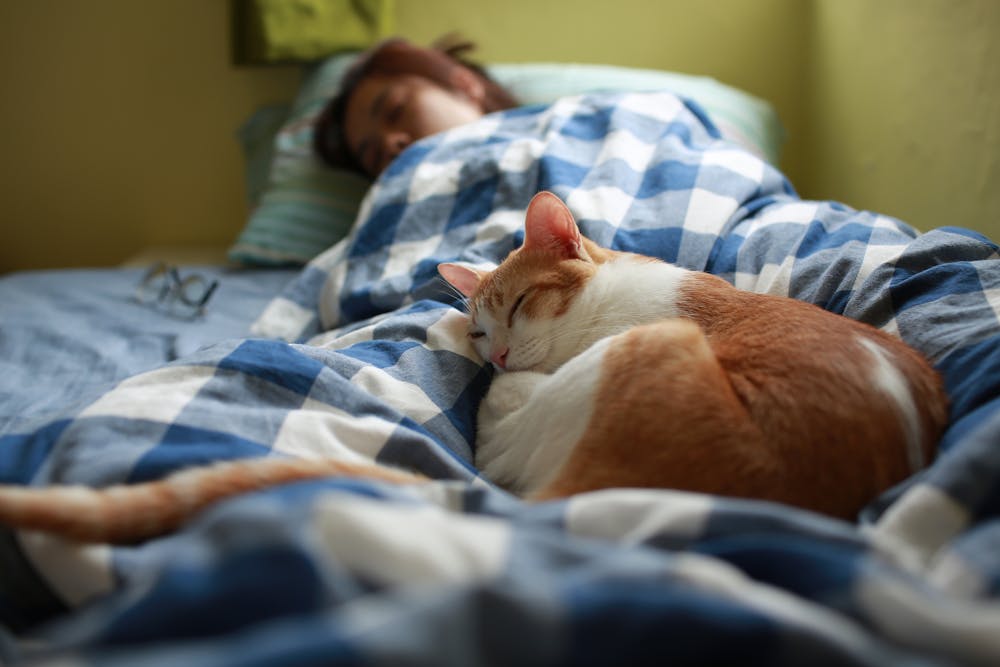
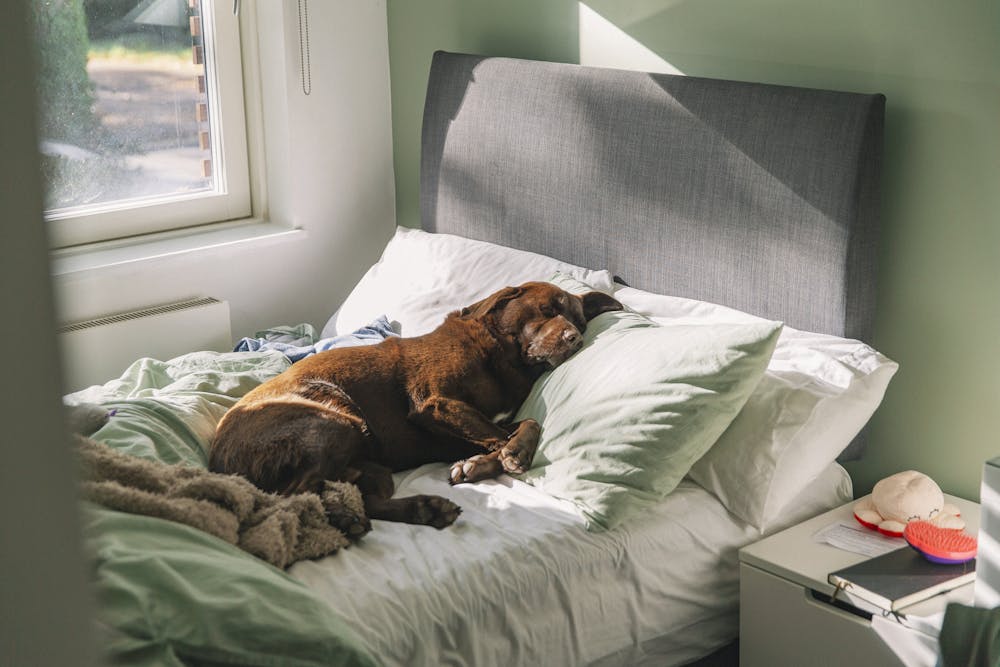
Next, our research team compared the sleep habits of people who did and didn’t co-sleep with pets. Our analyses revealed that participants who co-slept with pets had poorer sleep quality and more insomnia symptoms than those who did not. These findings persisted even after accounting for demographic differences between these groups. When considering pet type, we found evidence for a negative effect on sleep when co-sleeping with dogs but no evidence for a negative effect on sleep when co-sleeping with cats.
Surprisingly, 93% of people in our study who co-slept with their pets believed that their pets had either a positive or neutral overall effect on their sleep. Although more research is needed, these findings could suggest that most people are unaware of the potential negative effects their pets may have on their sleep.
However, our study fills an important knowledge gap by indicating that co-sleeping with pets can affect sleep quality. Good sleep is a pillar of health and wellness. Even though pets may have an overall positive effect on mental health, it is possible that some of this benefit may be undermined if they are also causing you to lose sleep at night.
Although some people report that co-sleeping with their pets can provide them with a sense of comfort or intimacy, it is important for people sharing a bedroom with their pets to be aware of their potential to serve as a source of nighttime noise, heat or movement that can disrupt your ability to fall or stay asleep.
What still isn’t known
Survey-based studies like ours are unable to prove that co-sleeping with pets causes disrupted sleep, although there is some evidence suggesting that this could be the case.
It probably isn’t realistic for most people to just stop co-sleeping with their pets. So, what should someone do to improve their sleep if they already share a bed with their pets?
Some expert tips include choosing a mattress that is large enough for you and your pets, washing and changing your bedding regularly, and establishing and maintaining a consistent bedtime routine with your pets. Further research is needed to identify more specific habits and routines that pet owners can adopt to ensure a good night’s sleep when sharing the bedroom with their pets.
The Research Brief is a short take about interesting academic work.
Coming back to Jean and me at least we have a pretty regular routine with us going to our bedroom around 7pm to 8pm. In the morning over our daily coffees I always ask Jean what sort of night she had. Yesterday morning Jean replied that she had had a poor night. My judgement is that Jean has roughly one in two poor nights.
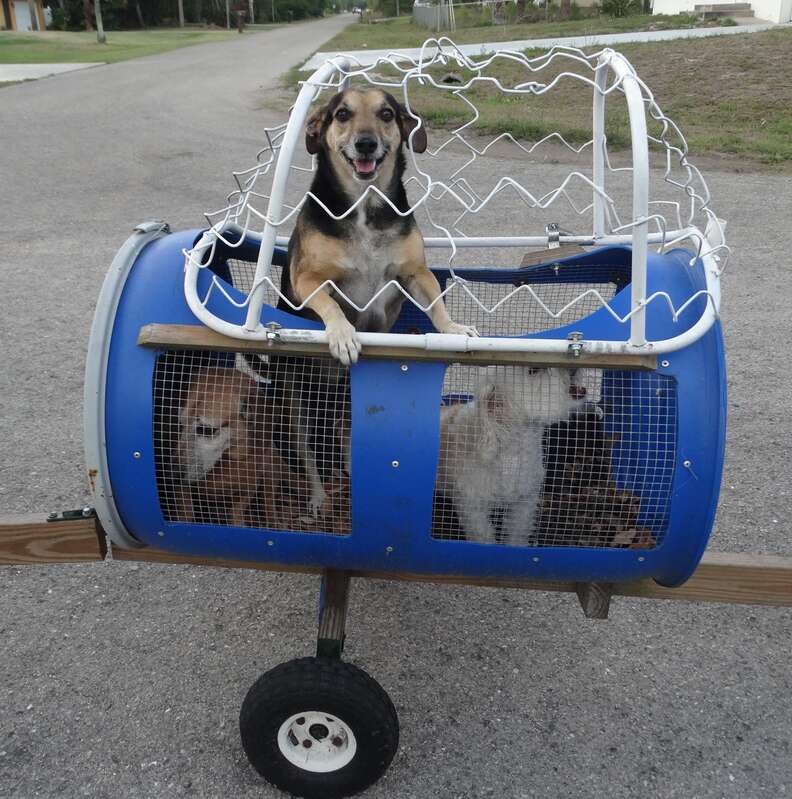
On Friday evenings, just before sunset, the din of traffic on the roads around Lehigh Acres, Florida, gives way to a sound far more pleasing — the cheerful chorus of happy pups on the move.
It’s at this time, like clockwork, a dog train takes to the streets just to brighten the lives of its furry passengers.
Alice E. Herrick
Alice Johnston and her husband, Paul, moved to Lehigh Acres about eight years ago, after years spent operating an animal rescue shelter in Costa Rica. But they didn’t relocate alone. They also brought along the more than a dozen dogs under their care there — all of whom had been saved from the streets.
Now in the suburbs, the Johnstons decided to get creative.
Alice E. Herrick
“We have so many dogs, of course we couldn’t walk them all or put them in the car to take them for a ride,” Alice Johnston told The Dodo. “So, my husband build a train so that we could take them out, drive around the community. He pulls the train with a lawnmower, and I ride a little scooter behind him to keep an eye on things, to make sure they’re safe.”
“The dogs get so excited. They just love it. They absolutely love it,” Johnston said. “They know it’s Friday better than we do. It’s amazing how they know.”
But the pups aren’t the only ones thrilled about their weekly trips.
“We have people who wait for us every week [to pass by on the street],” Johnston said. “Some people come out and give the dogs treats. They really enjoy it.”
The Johnstons have put all that attention the train gets to some very good use.
“My husband has signs all over the train encouraging people to adopt, and not shop,” Johnston said. “There are so many homeless dogs, and they make wonderful pets. Anything we can do to encourage people to give these dogs a chance, we are happy to do it.”
The Johnstons don’t aim to publicize their Wonderland Express dog train, though they are glad people are happy to see it. For them, it’s all about their dogs’ enjoyment — and spreading the word about the joy of adopting.
“It gives us so much joy to know that dogs are getting a second chance,” Johnston said. “And it really gives us satisfaction knowing we’re giving our dogs a good life.”
ooOOoo
That last image I had real trouble with but I left it in the post just in case when it is published it comes out. But even without that photograph one gets the clear idea of the pleasure the Johnstons give to their dogs.
I shall be 80 in November and I find myself thinking about death more often than I did a few years ago. As an example of how my mind has changed, yesterday I was contemplating renewing my subscription to the Free Inquiry magazine and wondering if I should renew it for two or three years? In other words will I still be alive in three years time? Silly but it is the truth. And that is not taking into account that I go to the Club Northwest two days a week and try and bike ride another two or three times a week.
Then let us not get into the topic of whether I will die before Jean or the reverse. That is an enormous subject and, thank goodness, where we live in Oregon one has the choice to die: “Two states, Oregon and Washington, currently have statutes providing a procedure for a terminally ill patient to request medication to end his or her life. These laws are sometimes referred to as “death with dignity” or “physician-assisted suicide” laws.“
All of which is an introduction to a recent article published in The Conversation that I republish below:
ooOOoo
Loneliness can kill, and new research shows middle-aged Americans are particularly vulnerable
Middle-aged Americans are lonelier than their European counterparts. That’s the key finding of my team’s recent study, published in American Psychologist.
Our study identified a trend that has been evolving for multiple generations, and affects both baby boomers and Gen Xers. Middle-aged adults in England and Mediterranean Europe are not that far behind the U.S. In contrast, middle-aged adults in continental and Nordic Europe reported the lowest levels of loneliness and stability over time.
We used survey data drawn from over 53,000 middle-aged adults from the U.S. and 13 European nations from 2002 to 2020. We tracked their reported changes in loneliness every two years across the midlife years of 45 to 65. This span provided us data from the so-called silent generation of people born between 1937 and 1945; baby boomers, born between 1946 and 1964; and members of Generation X, born between 1965 and 1974.
Our study makes clear that middle-aged Americans today are experiencing more loneliness than their peers in European nations. This coincides with existing evidence that mortality rates are rising for working-age adults in the U.S.
We focused on middle-aged adults for several reasons. Middle-aged adults form the backbone of society by constituting a majority of the workforce. But they also face increasing challenges today, notably greater demands for support from both their aging parents and their children.
Loneliness is considered a global public health issue. The U.S. surgeon general released an advisory report in 2023 documenting an epidemic of loneliness and a pressing need to increase social connection. Other nations, such as the U.K.and Japan, have appointed ministers of loneliness to ensure relationships and loneliness are considered in policymaking.
You can be lonely even when surrounded by people.
What still isn’t known
Why are middle-aged Americans exceptional when it comes to loneliness and poorer overall mental and physical health?
We did not directly test this in our study, but in the future we hope to zero in on the factors driving these trends. We think that the loneliness Americans are reporting compared to peer nations comes down to limited social safety nets and to cultural norms that prioritize individualism over community.
Individualization carries psychological costs, such as reductions in social connections and support structures, which are correlates of loneliness. Relative to the other nations in our study, Americans have a higher tendency to relocate, which is associated with weak social and community ties.
One of the reasons why we chose countries from across Europe is that they differ dramatically from the U.S. when it comes to social and economic opportunities and social safety nets. Social and economic inequalities likely increase one’s loneliness through undermining one’s ability to meet basic needs. Generous family and work policies likely lessen midlife loneliness through reducing financial pressures and work-family conflict, as well as addressing health and gender inequities.
Our findings on loneliness in conjunction with previous studies on life expectancy, health, well-being and cognition suggest that being middle-aged in America is a risk factor for poor mental and physical health outcomes.
The Research Brief is a short take on interesting academic work.
And on yesterday afternoon, the Sunday, I went for a bike ride of 22 miles. I loved the ride especially as I listened to music all the way; I have a portable speaker that clips near the front handlebars and plays tracks from my iPhone.
Then there was an article in March from the University of Bristol: “Happiness can be learnt, but we have to work at it – study finds.“
It reads:
Press release issued: 11 March 2024
We can learn to be happy, but only get lasting benefits if we keep practising, a first-of-its-kind study has revealed.
The team behind the University of Bristol’s ‘Science of Happiness’ course had already discovered that teaching students the latest scientific studies on happiness created a marked improvement in their wellbeing.
But their latest study found that these wellbeing boosts are short-lived unless the evidence-informed habits learnt on the course – such as gratitude, exercise, meditation or journaling – are kept up over the long-term.
Senior author Professor Bruce Hood said: “It’s like going to the gym – we can’t expect to do one class and be fit forever. Just as with physical health, we have to continuously work on our mental health, otherwise the improvements are temporary.”
Launched in 2018, the University of Bristol’s Science of Happiness course was the first of its kind in the UK. It involves no exams or coursework, and teaches students what the latest peer-reviewed studies in psychology and neuroscience say really makes us happy.
Students who took the course reported a 10 to 15% improvement in wellbeing. But only those who continued implementing the course learnings maintained that improved wellbeing when they were surveyed again two years on.
Published in the journal Higher Education, it is the first to track wellbeing of students on a happiness course long after they have left the course.
Professor Hood said: “This study shows that just doing a course – be that at the gym, a meditation retreat or on an evidence-based happiness course like ours – is just the start: you must commit to using what you learn on a regular basis.
“Much of what we teach revolves around positive psychology interventions that divert your attention away from yourself, by helping others, being with friends, gratitude or meditating.
“This is the opposite of the current ‘selfcare’ doctrine, but countless studies have shown that getting out of our own heads helps gets us away from negative ruminations which can be the basis of so many mental health problems.”
Professor Hood has distilled the Science of Happiness course into a new book, out on March 10. ‘The Science of Happiness: Seven Lessons for Living Well’ reveals an evidence-informed roadmap to better wellbeing.
The other paper authors are fellow University of Bristol academics Catherine Hobbs and Sarah Jelbert, and Laurie R Santos, a Yale academic whose course inspired Bristol’s Science of Happiness course.
We went to a Humanists garden party on Tuesday afternoon and two other attendees had brought their dogs with them. The dogs were so friendly and gentle, as well as being highly sociable, that the conversation frequently was about dogs.
In a similar vein, on The Dodo yesterday was this:
Dande
Rescue Vizsla mix, 3.5 years old.“Dande was rescued from Waco,Texas, after a hurricane and flooding. She probably got separated from her humans. She was very skittish and afraid of everything when I first rescued her. She has come a long way. She is the most affectionate dog of the four that I have owned. I love her so much!” — her person
In a world which seems so strange at present, thank goodness we have our dogs.

































 Learning from Dogs