For the last two days we have had some major tree work done.
A couple of weeks ago, our neighbour Clarence came across to our land to point out a dying pine. It was alongside the house together with two other trees, another pine and a fir. The pines were over a hundred feet tall.
They had to come down reasonably quickly otherwise they would crash into the roof with terrible consequences.
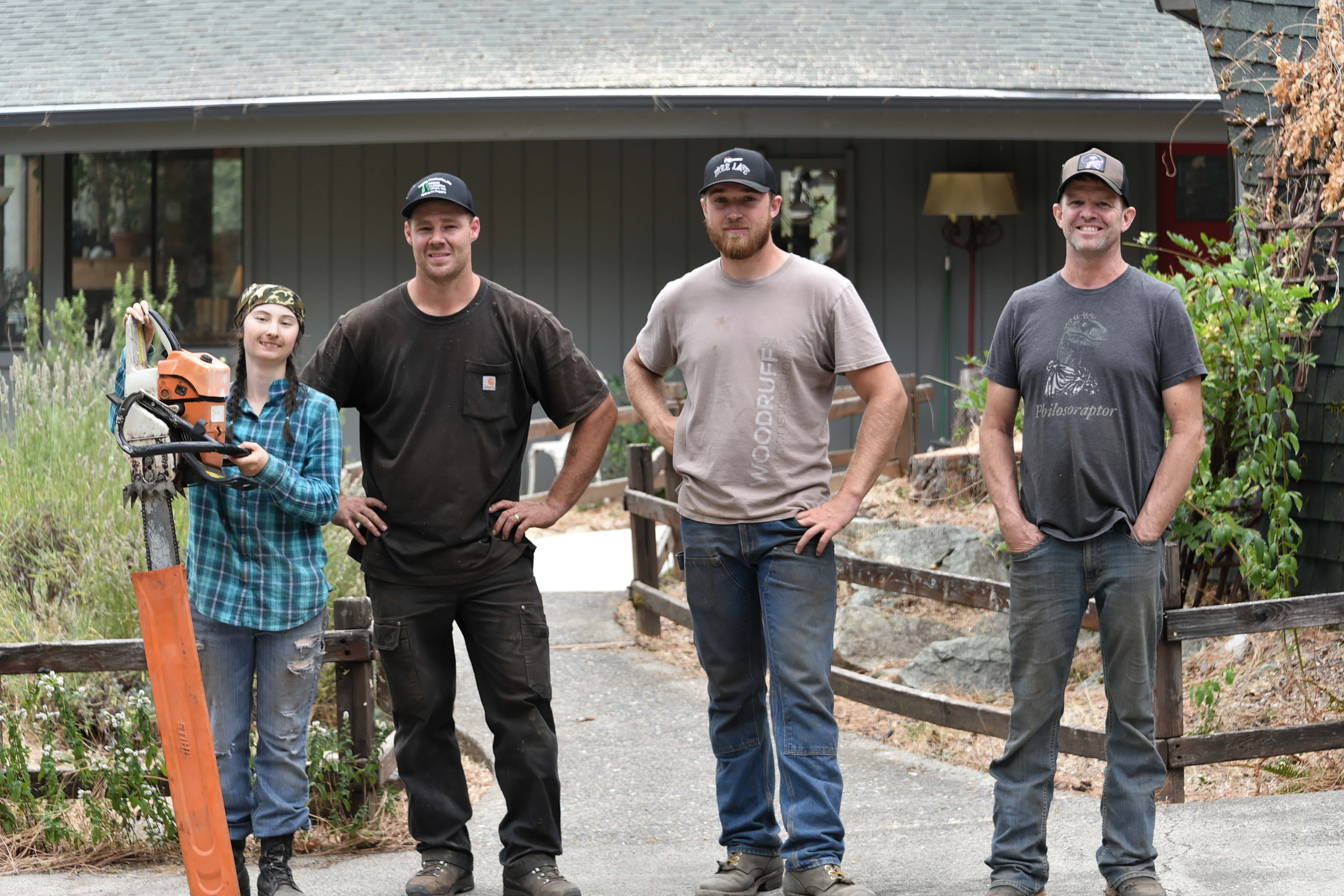
And on Tuesday and Wednesday they came to do the job. They had a great deal of equipment plus lots of experience. They were four of them. And the two pines were very far gone.
At the end of the project I took two photographs and here they are:
Any dog owner can tell you there’s nothing like having a loyal companion. Dogs are good pets for people of any age, as long as you choose the right dog for your lifestyle.
If you’re an older adult looking to find a furry, four-legged friend, here are a few things you should consider.
Why Get a Dog?
It’s a big responsibility, but the benefits are worth the work. Dogs can give you joy, companionship, and unconditional love. They can bring warmth and comfort into your life.
Better health. Decades of studies have shown the health benefits of spending time with dogs. Dog owners tend to have better heart and blood vessel health, including lower blood pressure, than those who don’t have a pet pup. That’s because dogs get people moving. Walking a dog regularly can help you boost how much exercise you get each day.
Less lonely. Dogs offer companionship just by being around. They might also help you be more social. Taking your dog on walks gives you a chance to meet neighbors or other canine owners at the local dog park.
Much happier. Looking at your dog can release a hormone that makes you feel happier. Science shows that gazing into your dog’s eye releases oxytocin. Known as the love hormone, oxytocin quickly boosts your mood.
Caring for a Dog
Before you get a furry pal, you should think about what you can offer the dog, as well as what they can offer you. You want to make sure to choose a dog that will be happy with the kind of life you lead. Consider these things when you start looking for a new pet.
Space. How much room do you have indoors and outdoors? You need to pick a dog that will be happy with the space you have to offer.
Exercise. Some dogs need a lot of exercise, while others are happy hanging out on the couch all day. Think about how much exercise time you can give your pup. Also, think about how fit you are. You may not want a large, strong dog that could tug hard on the leash and cause you to get hurt on a walk.
Cost. All dogs need vet care, food, and toys. If they need a lot of grooming, you need to consider paying a professional groomer.
Age. Puppies are cute, but they’re also a lot of work. Older dogs may already have some training, but they might be set in their ways. Spend some time thinking about what you’re willing to accept in dog behavior.
Best Breeds for Seniors
Here are a few breeds that are natural choices for older adults.
Bichon Frise. These dogs are very small and cute. Their fluffy coats need regular grooming. They’re happy in small homes and apartments, and they only need moderate exercise.
Cocker spaniels. These dogs are known for their beautiful, soft coats, which need regular grooming. They’re gentle and friendly, and usually weigh under 30 pounds. They need regular walks to stay fit, but they aren’t highly energetic.
Beagles. They’re small, smart, and make wonderful companions. Their short coats are easy to groom. Beagles are energetic and need a lot of exercise every day.
Greyhounds. They can run fast, but they don’t always want to. They’re happiest lounging around indoors, but they need walks to stay fit. They’re large, usually weighing around 60 pounds, but they have short coats that don’t require a lot of grooming.
Pugs. These happy little dogs make great companions. They’re usually around 15 pounds and have short, easy-to-groom coats. They need more exercise than they want because they’re prone to be overweight. Regular walks can take care of that.
If you’re an older adult looking for a four-legged companion, you can speak to a veterinarian or a dog trainer in your area for more information. They can help you choose the perfect pet.
ooOOoo
I am certain there are many people who will find this a practical help in deciding what dog to get.
In my own case we currently have two dogs, Cleo and Oliver, and I frequently ponder on what Jean and I do when the last of them dies.
This article reminds me and Jean that at whatever age we are it is better to have a dog than not!
I follow Patrice Ayme and have done for many years. Some of his posts are super-intellectual and those I struggle to understand.
But a post published on September 8th, 2024 was very easy for me, and countless others no doubt, to understand and I have pleasure in republishing it on Learning from Dogs today.
I doubt that there are civilizations around. We are facing a galaxy devoid of intelligent aliens: little green mats out there, not little green men.
First, we don’t see them. With foreseeable technology (hibernation, nuclear propulsion, compact thermonuclear reactors, bioengineering, AI, quantum computers) we should be able to send very large interstellar spaceships at 1,000 kilometers per second… Thus it would take a millennium to colonize the Centaur tri-star system…. 25,000 years to colonize a 200 light years across ball… And the entire galaxy in ten million years… Wars would only accelerate the expansion. So if there was a galactic civilization, within ten million years it would have spanned the entire galaxy and its presence should be in sight.
Second, life took nearly four billion years to evolve animals. Bacterial life could have been nearly extinguished on Earth many times…. Be it only during the Snowball Earths episodes. A star whizzing by could have launched a thousand large comets. The large planets could have fallen inward.
Third, ultra intelligent life may not be able to have hands or tentacles and thus develop industry. Once intelligent life forms have evolved, say sea lions or parrots, let alone wolves, they may just be sitting ducks for the next disaster which would revert life to the bacterial level, erasing billions of years of evolution.
Fourth, when civilization is launched, it can fail… And not get a second chance (from lack of availability of mines after easy picking during the initial civilization).
So I don’t expect little green men… Besides those sent by the perverse Putin…
Just when we thought we knew of all the stress, here is another one: if we go extinct, the universe loses its soul! We have thus found a new Superior Moral Directive: SUS, Save Unique Soul!
Expect little green mats, not little green men.
Patrice Ayme
ooOOoo
A couple of weeks ago I gave a talk to our local Freethinkers group and called it The Next Ten Years. It began, thus:
This presentation is about the world of the future; of the near future. And the biggest issue, most agree, is the change in the climate.
The Global Temperature anomaly, as of last year, 2023, is 1.17 Centigrade, 2.11 Fahrenheit, above the long-term average from 1951 to 1980. The 10 most recent years are the warmest years on record.
Antoine de Saint-Exupéry is quoted as saying that ‘a goal without a plan is just a wish.’ So my plan is to show you how we can change, no let me put that more strongly, how we must change in the next ten years. Because our present habits are ruining the world.
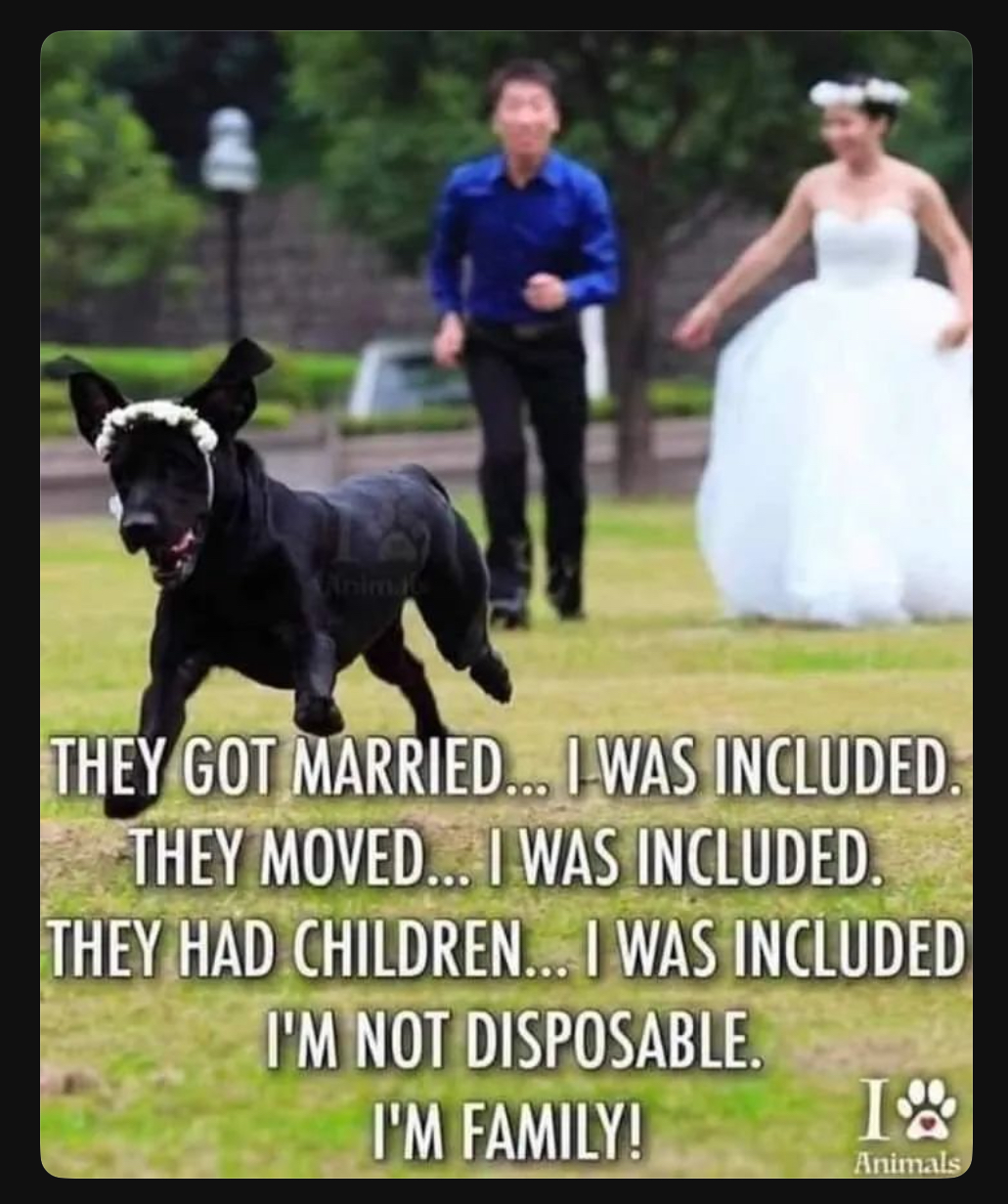
Ellie Woods’ family dog Bobby has always been an important part of her love story with her wife Georgie Woods. When Ellie brought Georgie home for the first time, the family member she was most anxious for Georgie to meet was Bobby.
When the couple got engaged and started planning their wedding, they decided it would be fun to try to document the wedding from Bobby’s unique perspective. So right before the ceremony started, they attached a GoPro to Bobby’s back and then set him loose.
For some dogs, walking around with a camera on their back might take some getting used to — but not for Bobby. He immediately felt comfortable.
“He loves being the center of attention,” Georgie told The Dodo. “He just loved it.”
Georgie and Ellie said having Bobby at their wedding was incredibly meaningful for them.
@SASHALEEPHOTOGRAPHY
“Animals are really important to queer couples,” Ellie said. “[I]t was so important to have him … as part of our big day.
When the newlyweds sat down to watch the footage Bobby had captured, what they saw surprised and delighted them. The GoPro had caught Bobby stealing hors d’oeuvres and even walking in on Georgie’s sister in the bathroom. While Bobby is an expert videographer, he is still a dog, after all.
Of course, Bobby’s camera recorded much more than shenanigans. Georgie and Ellie loved watching themselves walk down the aisle together from Bobby’s perspective.
“It captured some really special moments,” Ellie said. “[W]e couldn’t be happier for how it came out because it’s just so organic and such an interesting, different perspective.”
ooOOoo
Dogs are just incredible. As much as I have already said that, time and time again there comes a story that just reinforces that previous sentence.
When staff members and volunteers at Saving Hope Rescue noticed a box had been dumped on their property, their hearts sank. As they got closer, they saw the box had “puppies her” written on the side of it and had a feeling they knew who was inside.
Saving Hope Rescue
When they opened the box, the rescuers came face-to-face with a whole pile of all-white puppies. Even though their rescue was already at capacity, they knew they couldn’t turn their backs on the sweet little family. They put out a call for help to the community in order to get some support and began to get the pups settled in.
Saving Hope Rescue
As everyone at the rescue started getting to know the abandoned puppies, they realized that the pups had been hiding something: Apparently, they were all visually and hearing impaired to some degree.
“At first, they were all deemed blind and deaf,” Lauren Anton of Saving Hope Rescue told The Dodo. “Eventually, as time went by and they developed some more, we discovered that some puppies are more impaired than others.”
Saving Hope Rescue
It’s possible that this was the reason the puppies were abandoned in the first place, but it’s hard to know for sure. Either way, it didn’t change anything for the puppies’ rescuers. Even if they might need a little extra help, they were still members of the Saving Hope family.
As the puppies grew, their unique personalities began to shine through, and their rescuers were also able to start getting an accurate picture of their different abilities.
Saving Hope Rescue
“Mate is a good example of the slightly impaired puppies,” Anton said. “We don’t know how much she can see and hear, for sure, but we do know that she can hear being called, knows when we shake the food bag, and will approach people when called to come over … Koala, on the other hand, is much more impaired … We aren’t sure how much he can see. Maybe just shadows.”
Everyone is doing their best to get to know the puppies and their individual needs so they’ll know how to best help them as they grow. One thing is for sure though, the puppies are happy and thriving.
Saving Hope Rescue
“Over the last few weeks, they’ve gone from sleepy babies to rambunctious puppies,” Anton said. “They’re constantly playing and wrestling with each other. They’ve learned that human pets and snuggles feel nice, and they love to sleep in our arms.”
These puppies may have been abandoned, but now they’re getting the second chance they deserve.
ooOOoo
That is a beautiful story. Lauren and the staff are to be congratulated on doing what they did, and that was giving these puppies a new lease of life.
Before I share the article with you, I felt I should mention that I haven’t found a link to share the Live Science item and it may need to be moved. We will see what happens.
ooOOoo
Dogs can smell their humans’ stress, and it makes them sad.
Dogs can smell when people are stressed, and it seems to make them feel downhearted.
A new study shows that dogs pick up on our emotions through their sense of smell. (Image credit: Catherine Falls Commercial via Getty Images)
Humans and dogs have been close companions for perhaps 30,000 years, according to anthropological and DNA evidence. So it would make sense that dogs would be uniquely qualified to interpret human emotion. They have evolved to read verbal and visual cues from their owners, and previous research has shown that with their acute sense of smell, they can even detect the odor of stress in human sweat. Now researchers have found that not only can dogs smell stress—in this case represented by higher levels of the hormone cortisol—they also react to it emotionally.
For the new study, published Monday in Scientific Reports, scientists at the University of Bristol in England recruited 18 dogs of varying breeds, along with their owners. Eleven volunteers who were unfamiliar to the dogs were put through a stress test involving public speaking and arithmetic while samples of their underarm sweat were gathered on pieces of cloth. Next, the human participants underwent a relaxation exercise that included watching a nature video on a beanbag chair under dim lighting, after which new sweat samples were taken. Sweat samples from three of these volunteers were used in the study.
Participating canines were put into three groups and smelled sweat samples from one of the three volunteers. Prior to doing so, the dogs were trained to know that a food bowl at one location contained a treat and that a bowl at another location did not. During testing, bowls that did not contain a treat were sometimes placed in one of three “ambiguous” locations. In one testing session, when the dogs smelled the sample from a stressed volunteer, compared with the scent of a cloth without a sample, they were less likely to approach the bowl in one of the ambiguous locations, suggesting that they thought this bowl did not contain a treat. Previous research has shown that an expectation of a negative outcome reflects a down mood in dogs.
The results imply that when dogs are around stressed individuals, they’re more pessimistic about uncertain situations, whereas proximity to people with the relaxed odor does not have this effect, says Zoe Parr-Cortes, lead study author and a Ph.D. student at Bristol Veterinary School at the University of Bristol. “For thousands of years, dogs have learned to live with us, and a lot of their evolution has been alongside us. Both humans and dogs are social animals, and there’s an emotional contagion between us,” she says. “Being able to sense stress from another member of the pack was likely beneficial because it alerted them of a threat that another member of the group had already detected.”
The fact that the odor came from an individual who was unfamiliar to the dogs speaks to the importance of smell for the animals and to the way it affects emotions in such practical situations, says Katherine A. Houpt, a professor emeritus of behavioral medicine at Cornell University’s College of Veterinary Medicine. Houpt, who was not involved in the new study, suggests that the smell of stress may have reduced the dogs’ hunger because it’s known to impact appetite. “It might not be that it’s changing their decision-making but more that it’s changing their motivation for food,” she says. “It makes sense because when you’re super stressed, you’re not quite as interested in that candy bar.”
This research, Houpt adds, shows that dogs have empathy based on smell in addition to visual and verbal cues. And when you’re stressed, that could translate into behaviors that your dog doesn’t normally display, she says. What’s more, it leaves us to wonder how stress impacts the animals under the more intense weight of an anxious owner. “If the dogs are responding to more mild stress like this, I’d be interested to see how they responded to something more serious like an impending tornado, losing your job or failing a test,” Houpt says. “One would expect the dog to be even more attuned to an actual threat.”
Sara Novak is a science writer based on Sullivan’s Island, S.C. Her work has appeared in Discover, Sierra Magazine, Popular Science, New Scientist, and more. Follow Novak on X (formerly Twitter) @sarafnovak
ooOOoo
Dogs are such perfect animals and Sara brings this out so well. As was pointed out in the article dogs have learned to live with us humans over thousands of years.