Category: Government

In memory of Neil.

There will only ever be one Neil Armstrong.

Like millions of others on this planet, I was held spellbound by the historic and epic moment of man placing his mark on another heavenly body, the Moon.  I had been so wrapped up in NASA’s space missions that I took a holiday from work (I was working at the time for ICIANZ in Sydney, Australia) for the week of July 16th, 1969.

It was, of course, July 16th when the Apollo 11 Mission launched from the Kennedy Space Center culminating at precisely 20:17:39 UTC on July 20, 1969, the moment when the Lunar Module made lunar contact.

But in terms of me writing my own obituary for Neil, what could I offer?

Then a couple of items changed my mind.

Neil Armstrong (August 5, 1930 – August 25, 2012)

The first was reading the obituary printed in The Economist.  I have long admired the many, many beautiful obituaries that have been published by this newspaper and this one was no exception.  Take this extract from the Neil Armstrong obituary,

He had an engineer’s reserve, mixed with a natural shyness. Even among the other astronauts, not renowned for their excitability, he was known as the “Ice Commander”. Mike Collins, one of his crew-mates on the moon mission, mused that “Neil never transmits anything but the surface layer, and that only sparingly.” He once lost control of an unwieldy contraption nicknamed the Flying Bedstead that was designed to help astronauts train for the lunar landing. Ejecting only seconds before his craft hit the ground and exploded, he dusted himself off and coolly went back to his office for the rest of the day. There was work to be done.

Then the beautiful words that bring the obituary to a close,

Earth’s beauty

Over half a century, the man who never admitted surprise was surprised to observe the fading of America’s space programme. The Apollo project was one of the mightiest achievements of the potent combination of big government and big science, but such enterprises came to seem alien as well as unaffordable. Mr Armstrong, who after his flight imagined bases all over the moon, sadly supposed that the public had lost interest when there was no more cold-war competition.

Yet the flights had one huge unintended consequence: they transformed attitudes towards Earth itself. He too had been astonished to see his own planet, “quite beautiful”, remote and very blue, covered with a white lace of clouds. His reserve, after all, was not limitless. One photograph showed him in the module after he and Buzz Aldrin had completed their moon-walk, kicking and jumping their way across the vast, sandy, silver surface towards the strangely close horizon. He is dressed in his spacesuit, sports a three-day beard, and is clearly exhausted. On his face is a grin of purest exhilaration.

” … they transformed attitudes towards Earth itself. He too had been astonished to see his own planet, “quite beautiful”, remote and very blue, covered with a white lace of clouds.”   For that reason alone, we need to celebrate the achievement of the Apollo 11 mission for putting our own planet into perspective within the enormity of the universe.

The second item that persuaded me to write this was a wonderful historic insight into how a potential catastrophy on the surface of the Moon would have been handled by President Nixon.  This historic item was published on Carl Milner’s blog the other day, the specific item being  What if the Moon Landing Failed?  Republished with the very kind permission of Carl.

What if the Moon Landing Failed?

Posted on September 1, 2012 by 

When Richard Nixon was the President of the United States, they had a speech ready for him to deliver to the world just in case the 1969 moon landing had ended in disaster. In fact many experts believed there was a big chance that Neil Armstrong and Edwin ‘Buzz’ Aldrin could have really gotten stuck on the moon. It’s something we don’t really think about now because we all know it was such a success. American Archives have unearthed the speech that would have been delivered if the late great Armstrong and Aldrin had never made it back to earth. This is such a great piece of history that I thought I might never see.

Give it a read, It’s such a moving and well prepared speech, and such a good thing that President Nixon never had to delivered it.

So, as with millions of others, I am delighted that this speech remained unspoken and instead we experienced: “At 5:35 p.m. (US EDT), Armstrong and Aldrin successfully docked and rejoined Collins, and at 12:56 a.m. on July 22 Apollo 11 began its journey home, safely splashing down in the Pacific Ocean at 12:50 p.m. on July 24.

Neil Armstrong’s legacy is not only being part of the wonderful team that allowed man to make the first footprint on the Moon but also bringing into our human consciousness that this blue, wonderful planet we all live on is the only home we have.

First Full-View Photo of Earth
Photograph courtesy NASA Johnson Space Center
This famous “Blue Marble” shot represents the first photograph in which Earth is in full view. The picture was taken on December 7, 1972, as the Apollo 17 crew left Earth’s orbit for the moon. With the sun at their backs, the crew had a perfectly lit view of the blue planet.

Strikes me that celebrating July 20th each year as Blue Planet Day might not be a bad idea!  Any takers?  Now that would be a legacy for Neil!

Understanding Europe!

A delightful tale sent to me by Richard Maugham.

Richard and I go back too many years!  He has been a dear friend despite the obvious hurdle that when we first met, he declared that he was a typewriter salesman for Olivetti in the UK with me admitting that I was a typewriter salesman for IBM UK!  Here’s the story.

oooOOOooo

WHAT WENT WRONG IN EUROPE – SIMPLY EXPLAINED!

Not Helga’s Bar!!

Helga is the proprietor of a bar. She realizes that virtually all of her customers are unemployed alcoholics and, as such, can no longer afford to patronize her bar. To solve this problem she comes up with a new marketing plan that allows her customers to drink now, but pay later.

Helga keeps track of the drinks consumed on a ledger (thereby granting the customers’ loans).

Word gets around about Helga’s “drink now, pay later” marketing strategy and, as a result, increasing numbers of customers flood into Helga’s bar. Soon she has the largest sales volume for any bar in town.

By providing her customers freedom from immediate payment demands, Helga gets no resistance when, at regular intervals, she substantially increases her prices for wine and beer – the most consumed beverages.

Consequently, Helga’s gross sales volumes and paper profits increase massively. A young and dynamic vice-president at the local bank recognises that these customer debts constitute valuable future assets and increases Helga’s borrowing limit. He sees no reason for any undue concern, since he has the debts of the unemployed alcoholics as collateral.

He is rewarded with a six figure bonus.

At the bank’s corporate headquarters, expert traders figure a way to make huge commissions, and transform these customer loans into DRINKBONDS. These “securities” are then bundled and traded on international securities markets.

Naive investors don’t really understand that the securities being sold to them as “AA Secured Bonds” are really debts of unemployed alcoholics. Nevertheless, the bond prices continue to climb and the securities soon become the hottest-selling items for some of the nation’s leading brokerage houses.

The traders all receive six figure bonuses.

One day, even though the bond prices are still climbing, a risk manager at the original local bank decides that the time has come to demand payment on the debts incurred by the drinkers at Helga’s bar. He so informs Helga. Helga then demands payment from her alcoholic patrons but, being unemployed alcoholics, they cannot pay back their drinking debts. Since Helga cannot fulfil her loan obligations she is forced into bankruptcy. The bar closes and Helga’s 11 employees lose their jobs.

Overnight, DRINKBOND prices drop by 90%. The collapsed bond asset value destroys the bank’s liquidity and prevents it from issuing new loans, thus freezing credit and economic activity in the community.

The suppliers of Helga’s bar had granted her generous payment extensions and had invested their firms’ pension funds in the BOND securities. They find they are now faced with having to write off her bad debt and with losing over 90% of the presumed value of the bonds. Her wine supplier also claims bankruptcy, closing the doors on a family business that had endured for three generations; her beer supplier is taken over by a competitor, who immediately closes the local plant and lays off 150 workers.

Fortunately though, the bank, the brokerage houses and their respective executives are saved and bailed out by a multibillion dollar no-strings attached cash infusion from the government.

They all receive a six figure bonus.

The funds required for this bailout are obtained by new taxes levied on employed, middle-class, non-drinkers who’ve never been in Helga’s bar……………………….!

oooOOOooo

I can add not a single word to this!

A new NEON light beckons.

A wonderful investment in studying America’s ecology is just starting.

I am indebted to The Economist for including in their issue of the 25th August a story about NEON, something I had previously not heard about.

It was then an easy step to locate the main website for the National Ecological Observatory Network, or NEON.  (Just an aside that I can’t resist – NEON is such a fabulous acronym that one wonders how much push and shove there was to come up with the full name that also fitted the word ‘NEON’!  Sorry, it’s just me!)

Anyway, back to the plot.  The following video gives a very good idea of the projects aims.  When I watched it, I found it inspiring because it seemed a solid example of how the nation, that is the USA, is starting to recognise that evolving to a new, sustainable way of life has to be  built on good science.  NEON strikes me as excellent science.  You watch the video and see if you come to the same conclusion.

There’s also a comprehensive introduction to the project from which I will republish this,

In an era of dramatic changes in land use and other human activities, we must understand how the biosphere – the living part of earth – is changing in response to human activities. Humans depend on a diverse set of biosphere services and products, including air, water, food, fiber, and fuel. Enhancements or disruptions of these services could alter the quality of human life in many parts of the world.

To help us understand how we can maintain our quality of life on this planet, we must develop a more holistic understanding of how biosphere services and products are interlinked with human impacts. This cannot be investigated using disconnected studies on individual sites or over short periods of observation. Further, existing monitoring programs that collect data to meet natural resource management objectives are not designed to address climate change and other new, complex environmental challenges.

NEON, the first continental-scale ecological observatory, will provide comprehensive data that will allow scientists to address these issues.

Later on there’s more detail, as follows,

NEON has partitioned the U. S. into 20 eco-climatic domains, each of which represents different regions of vegetation, landforms, climate, and ecosystem performance. In those domains, NEON will collect site-based data about climate and atmospheresoils and streams and ponds, and a variety of organisms. Additionally, NEON will provide a wealth of regional and national-scale data from airborne observationsand geographical data collected by Federal agencies and processed by NEON to be accessible and useful to the ecological research community. NEON will also manage a long-term multi-site stream experiment and provide a platform for future observations and experiments proposed by the scientific community.

The data collected and generated across NEON’s network – all day, every day, over a period of 30 years — will be synthesized into information products that can be used to describe changes in the nation’s ecosystem through space and time. It will be readily available in many formats to scientists, educators, students, decision makers and the general public.

For some reason I couldn’t find on the NEON website the informative map that was included in The Economist so I grabbed that one, and offer it below:

These eco-climatic domains are fully described here on the NEON website.

The benefits of this fabulous project are described thus, “The data NEON collects and provides will focus on how land use change, climate change and invasive species affect the structure and function of our ecosystems. Obtaining this kind of data over a long-term period is crucial to improving ecological forecast models. The Observatory will enable a virtual network of researchers and environmental managers to collaborate, coordinate research, and address ecological challenges at regional, national and continental scales by providing comparable information across sites and regions.

As they say in business, if you can’t measure it, you can’t manage it!  So reading in the above the sentence, ‘Obtaining this kind of data over a long-term period is crucial to improving ecological forecast models.‘ is cheering to the soul.

The United States quite rightly gets a huge bashing over it CO2 emissions but to condemn the USA for that and not to applaud this sort of wonderful research is utterly unjustified.  As I have hinted before, America has, more than any other country in the world, the energy to make things better over the coming years.

As Professor Sir Robert Watson highlighted here recently said, ‘… deep cuts in CO2 emissions are possible using innovative technologies without harming economic recovery.’

Amen to that!

Too hot to handle!

A stark reminder that more of the same will hurt us.

On the 14th August I published a post with the title of From feeling to doing.  The post was a 15-minute video presented by David Roberts of Grist showing, in essence, how fundamentally simple was the issue of climate change and how profound the implications if we didn’t halt the rise in the temperature of Planet Earth.

I’m not going to insert that video in this post because you can click on the link above and do that yourself.  What I will do is to draw your attention to the accompanying article on Grist under the title of Climate change is simple: We do something or we’re screwed. That article includes the slides that were in the video, such as this one:

So with that in mind, here’s what the BBC published on their news website yesterday morning,

Science advisor warns climate target ‘out the window’

Pallab GhoshBy Pallab Ghosh, Science correspondent, BBC News

One of the Government’s most senior scientific advisors has said that efforts to stop a sharp rise in global temperatures were now unrealistic.

Professor Sir Robert Watson said that the hope of restricting the average temperature rise to 2C was “out the window”.

He said that the rise could be as high as 5C – with dire conseqences.

Professor Watson added the Chancellor, George Osborne, should back efforts to cut the UK’s CO2 emissions.

He said: “I have to look back (on the outcome of sucessive climate change summits) Copenhagen, Cancun and Durban and say that I can’t be overly optimistic.

“To be quite candid the idea of a 2C target is largely out of the window.”

As the BBC points out Professor Watson is a highly respected and world renown scientist on climate change policy and is currently Chief Scientist at the Department for Food and Rural Affairs (DEFRA) and a former Chair of the Intergovernmental Panel on Climate Change.  Professor Watson was also with the World Bank and an advisor to former Vice President Al Gore.  The BBC item goes on,

Professor Watson, who is due to step down from his role at Defra next month, suggested that the Chancellor, George Osborne, reconsider his opposition to tough measures to reduce carbon dioxide emissions.

Mr Osborne has said that the UK’s ambitious targets for CO2 should be relaxed so as not to drive businesses to countries which have set themselves much lower targets.

“I would say to George Osborne, ‘work with the public sector. Work with the public on behavior change. Let’s demonstrate to the rest of the world that we can make significant progress here” Professor Watson argues that the UK and Germany should continue to take the lead in driving efforts to reach an effective international treaty.

Hurt Poorest

“If we carry on the way we are there is a 50-50 chance that we will get to a 3 degree rise,” he said.

“I wouldn’t rule out a 5 degree world and that would be quite serious for the people of the world especially the poorest. We need more political will than we currently have”.

The IPCC 2007 assessment summarised the probable impact of various temperature rise sceanrios.

It shows that the impact on human health, the availability of food and water, the loss of coastlines becomes progressively worse as the average temperature of the planet rises.

The 2C target was agreed at the United Nations Framework Convention on Climate Change meeting in 2010.

The majority of countries though prefer a lower target of 1.5C.

A number of analyses have also concluded that the 2C would be missed. The most recent was by the International Energy Agency earlier this year.

Professor Watson added that deep cuts in CO2 emissions are possible using innovative technologies without harming economic recovery.

“This doesn’t take a revolution in energy technology, an evolution would get us there.”

What I would add to this report that has been widely circulated is that while it’s natural to assume, ‘We need more political will than we currently have‘, that political will flows from the will of the people.

Take the effect of a 4C rise, as David Roberts explains,

Which is described in the Grist article as,

Here’s the edition of the Royal Society journal that came out of the conference on 4 degrees C of warming. Read through it and see if you think “hell on earth” is an exaggeration. Desertification, water shortages, agricultural disruptions, rising sea levels, vanishing coral, tropical forest die-offs, mass species extinctions, oh my. Kevin Anderson, one of the lead scientists involved, was moved to say that “a 4 degrees C future is incompatible with an organized global community, is likely to be beyond ‘adaptation’, is devastating to the majority of ecosystems, and has a high probability of not being stable.”

So come on people, get real!  Make sure that the democratic systems work and that our leaders know the sort of change that has to take place.  As the wise Professor highlighted, ‘… deep cuts in CO2 emissions are possible using innovative technologies without harming economic recovery.’  Sort of makes sense to me.  How about you?

Avoiding the catastrophe of indifference.

Doing nothing is not an option.

Introduction

So back to non-doggy stuff although I hope the themes of truth and integrity continue to rein supreme though this blog!

In the last couple of weeks, I have devoted a number of posts to the subject of change, as in how do we humans change.  The first post was Changing the person: Me where I started examining the process of change; by process I mean the models of change commonly understood in, say, management change.

The next post was You have to feel it! which drew heavily on research from Ezra M. Markowitz & Azim F. Shariff regarding the psychological aspects posed by climate change to the human moral judgement system.

The final post was From feeling to doing.  In this post, David Roberts of Grist showed that one could put aside all the ‘head stuff’ about change and in just 15 minutes cover all that one would ever want to know about the biggest issue of all facing this planet.

So rather a long introduction to two guest posts that today and tomorrow set out the case for what we all have to consider; doing nothing is just not a viable option.  The first is from Martin Lack of the popular and hard-hitting blog Lack of Environment.

oooOOOooo

Avoiding the catastrophe of indifference.

by Martin Lack.

Paul has very kindly invited me to follow-up his recent post regarding David Roberts’ item on the Grist blog entitled ‘Why climate change doesn’t spark moral outrage, and how it could’ followed by a second post in which was embedded David Roberts’ excellent video ‘Climate change is simple – we do something or we’re screwed’.

So my guest post is an expansion of a comment I submitted in response to the first of those two posts, You have to feel it.  However it would be wrong not to first add my voice to all those that have applauded David Roberts for all his excellent work.

Clive Charles Hamilton

In 2010, the Australian social anthropologist Clive Hamilton published Requiem for a Species: Why we Resist the Truth About Climate Change – one of the scariest but most important books I think I have ever read.

Reading Hamilton’s book was one of the reasons I decided, as part of my MA in Environmental Politics, to base my dissertation on climate change scepticism in the UK.

In the process, I read much but Hamilton’s book was one of very few that I actually read from cover to cover – I simply did not have time to read fully all the books for my research. However, because I have a background in geology and hydrogeology, my greatest challenge was learning to think like a social scientist.

I was all for taking these climate change sceptics head on and demolishing their pseudo-scientific arguments or taking them to task for the ideological prejudices that drive them to reject what scientists tell us. Thus, it fell to my dissertation supervisor to mention politely but firmly that I needed to disengage with the issues and analyse patterns of behaviour and frequency of arguments favoured by different groups of people.  In short, I needed to stop trying to prove the scientific consensus correct and start understanding the views held by those that dispute that consensus.

Having said how I read Professor Hamilton’s book in full, I must admit to learning about a load of other equally-scary sounding books since subscribing to Learning from Dogs;  Lester Brown’s World on the Edge: How to Prevent Environmental and Economic Collapse being just one that comes to mind!

David Roberts

Then of course there is what David Roberts himself says, which is just as scary. I think we have good reason to be scared. However, as Hamilton points out, we must move beyond being scared, which is simply debilitating, and channel our frustration into positive action.

Because if we do not, there is a great deal of circumstantial evidence to suggest that civilisation may well fail. If that means engaging in acts of civil disobedience, as it has done for James Hansen and many others, well, so be it. I suspect that nothing worthwhile has ever been achieved without someone breaking the law in order to draw attention to injustice – the abolition of slavery and child labour, the extension for all of the right to vote including women, come to mind.

That is the conclusion of Hamilton’s book; that civil disobedience is almost inevitable (p.225). Just as turkeys won’t vote for Christmas, our politicians are not going to vote for climate change mitigation unless we demand that they do so.

So it was the steer from my dissertation supervisor that lead me to read David Aaronovitch’s Voodoo Histories: How Conspiracy Theory Has Shaped Modern History, and much more about psychology. All of which guided the Introductory section of my dissertation, which summarised the philosophical roots of scepticism, the political misuse of scepticism, and the psychology of denial; see a recent post on my blog Lack of Environment.   In terms of what I want to say here, it is an elaboration of the last of those topics, the psychology of denial.  Indeed, it formed the preamble to the findings of my research.

To help me research this unfamiliar subject, my dissertation supervisor sent me a PDF copy of a paper written by Janis L. Dickinson in 2009 and published in Ecology and Society.  It was called ‘The People Paradox: Self-Esteem Striving, Immortality Ideologies, and Human Response to Climate Change’ and dealt with a challenging, almost taboo subject, namely our own mortality.

Despite my initial reluctance to learn about psychology, the more I read the more I realised just how central psychology was to explaining why we humans have failed to address the problem of climate change.

I ended up summarising the work of Dickinson, together with other sources of material, in the following manner.

In considering reasons for the collective human failure to act to prevent anthropogenic global warming (AGW), a number of authors appear to have been influenced by Ernest Becker’s The Denial of Death (1973). For example, Aaronovitch proposed that we try to avoid the “catastrophe of indifference” that a world devoid of meaning or purpose represents (p. 340).  Hamilton suggested that climate disruption “has the smell of death about it” (p. 215).

Janis Dickinson elaborates a little more, exploring what she describes as “…one of the key psychological links between the reality of global climate change and the difficulty of mobilizing individuals and groups to confront the problem in a rational and timely manner”, then referring to what psychologists call terror management theory (TMT) – Dickinson also categorises denial of climate change; denial of human responsibility and immediacy of the problem as proximal responses (Dickinson 2009).

Furthermore, as referenced here, both Dickinson and Hamilton suggest that other distal TMT responses, such as focussing on maintaining self-esteem or enhancing self-gratification, can be counter-intuitive and counter-productive. Dickinson summarises the recent work of Tim Dyson by saying “[b]ehavioral response to the threat of global climate change simply does not match its unique potential for cumulative, adverse, and potentially chaotic outcomes” (ibid).

Based on the evidence of the most frequently used arguments for dismissing the scientific consensus regarding climate change, I collated the findings of my research and which might be summarised as follows:

Having analysed the output of such UK-based Conservative think-tanks (CTTs), along with that of scientists, economists, journalists, politicians and others, it would appear that the majority of CTTs dispute the existence of a legitimate consensus, whereas the majority of sceptical journalists focus on conspiracy theories; the majority of scientists and economists equate environmentalism with a new religion; and politicians and others analysed appear equally likely to cite denialist or economic arguments for inaction.

As I find myself saying quite frequently, the most persistent arguments against taking action to mitigate climate change are the economic ones.

However, as all the authors mentioned have suggested, or at least inferred, I think it is undoubtedly true that the most potent obstacle to people facing up to the truth of climate change is our psychological reluctance to accept responsibility for something that is obviously deteriorating – namely our environment!

Nevertheless, all is not yet lost.  We do not all need to go back to living in the Dark Ages to prevent societal and environmental collapse but we do need to accept a couple of fundamental realities:

  1. Burning fossilised carbon is trashing the planet. Therefore, fossil fuel use must be substituted in every possible process as rapidly as possible. Unfortunately, it is not substitutable in the most damaging process of all; aviation.  That merely increases the urgency of substituting where we can (i.e. power, lighting and temperature control).
  2. Poor people in developing countries have a legitimate right to aspire to having a more comfortable life but the planet definitely cannot cope with 7 to 10 billion people living like we do in the “developed” countries.

Once we accept these realities, we will learn to use less fossil fuels and, if we can become self-sufficient using renewable energy sources, we can have a flat-screen TV in every room and leave them on standby and the A/C on full power 24/7 and still have a clear conscience. However, we must get off fossil fuels ASAP.

oooOOOooo

I am indebted to Martin for writing such an insightful analysis of how we all have to change.  Tomorrow, another guest post further exploring the options that face us all as we work towards a sustainable future.  As I opened this post, doing nothing is not an option!

The Curiosity Mission.

Just a personal muse!

This has very little to do with anything other than my lifelong fascination in exploring space, which is why just over 21 hours ago I published the taster for this Post.  That ‘Earthrise’ photograph and the one below changed forever how we feel about the home we all live on.

The famous “Blue Marble” shot.

First Full-View Photo of Earth
Photograph courtesy NASA Johnson Space Center

This famous “Blue Marble” shot represents the first photograph in which Earth is in full view. The picture was taken on December 7, 1972, as the Apollo 17 crew left Earth’s orbit for the moon. With the sun at their backs, the crew had a perfectly lit view of the blue planet.

December 7th, 1972.  Coming up to 40 years ago. I was in my late-20s.  This photograph touched me in ways that I still don’t understand.  This is such a beautiful planet.

Thus Curiosity: NASA’s latest Mars rover is due to touch down at 05:31 UTC Monday 6th August.  I decided to publish this at 04:31 UTC on the 6th one hour before the crucial and novel landing, or in terms of local time here in Payson, Arizona, 9.31 pm on the 5th August.

Wishing the Mission and all the hard-working people who have spent so many years working towards this critical point in time in space history the very best of luck!  It will be wonderful wherever one is on this Planet to wake up on the 6th and hear that Curiosity has landed safely! And if you want to follow the Mission then NASA have a website devoted to the latest news.

Let me close by offering you a couple of videos from the fabulous BBC Horizon science series, full hour-long programme about NASA’s latest Mission to Mars.

NASA Engineer Adam Stelzner describes how he hopes the Curiosity rover will land.

Chief Project Scientist John Grotzinger talks about Curiosity’s scientific instruments.

Stop, read, reflect and Act!

The latest from Bill McKibben has to be read and shared.

Introduction

We live in a world where there’s a great fondness for shortness, whether it’s headlines, soundbites, Twitter length ‘conversations’, text messages, and the rest.  However, I’m introducing an essay from Bill McKibben that is long.  When I use the word long I mean both literally, the essay is a shade under 6,200 words, and subjectively, the essay is long, very long, on meaning.

It was published in the August 2nd, 2012 issue of Rolling Stone.  As Allyse of the 350.org team wrote in a widely distributed email,

Here at 350.org, we do a lot of our internal communication via online chat, and our written shorthand for “YES!” and “totally awesome!” and “you rock!” is “++”. Which is why I say to you: ++ Social Media Team, ++. You all rock.

Bill McKibben’s article in Rolling Stone—which we asked you to spread around the internet last week—has been shared on Facebook almost 100K times and seen by hundreds of thousands of people. Great work. If you haven’t read it yet, please do.

This article really lays out the intellectual framework for much of our work in the weeks, months, and years ahead. We want to keep pushing these ideas out there, especially this one: our objection to the fossil fuel industry is structural—these businesses are in fact planning to wreck the planet!

So we took a quote from Bill’s article and made it into a graphic that’s already been shared almost 2,500 times on Facebook. Will you help us push it past 5,000? Click here to share.

As you know if you’ve read the article, this is really an all-hands-on-deck moment for humanity. Thanks for doing your part—in ways both large and small.

Onward,

Allyse

Will you put aside some time, settle down in a comfortable chair, and read the article?  Please do!

It crossed my mind to split it over a couple of days but I decided against that.  But I have inserted a ‘click to reveal more’ about 1,100 words into the article – please do read on when you reach that point.  And just as important, do comment!

Oh, want to see that image on Facebook that has been shared so widely?  Here it is:

A’int that the truth!

Finally, feel free to share this as far and wide as you want.  Thank you.

oooOOOooo

(Apart from the first image from Edel Rodriguez, all the other photographs have been inserted by me and are not in the original Rolling Stone production – I decided to insert them to make reading the article more visually attractive on a screen.)

Global Warming’s Terrifying New Math

Three simple numbers that add up to global catastrophe – and that make clear who the real enemy is

Illustration by Edel Rodriguez

By Bill McKibben
July 19, 2012 9:35 AM ET

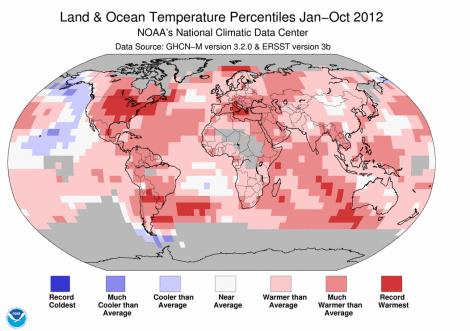
If the pictures of those towering wildfires in Colorado haven’t convinced you, or the size of your AC bill this summer, here are some hard numbers about climate change: June broke or tied 3,215 high-temperature records across the United States. That followed the warmest May on record for the Northern Hemisphere – the 327th consecutive month in which the temperature of the entire globe exceeded the 20th-century average, the odds of which occurring by simple chance were 3.7 x 10-99, a number considerably larger than the number of stars in the universe.

Meteorologists reported that this spring was the warmest ever recorded for our nation – in fact, it crushed the old record by so much that it represented the “largest temperature departure from average of any season on record.” The same week, Saudi authorities reported that it had rained in Mecca despite a temperature of 109 degrees, the hottest downpour in the planet’s history.

Not that our leaders seemed to notice. Last month the world’s nations, meeting in Rio for the 20th-anniversary reprise of a massive 1992 environmental summit, accomplished nothing. Unlike George H.W. Bush, who flew in for the first conclave, Barack Obama didn’t even attend. It was “a ghost of the glad, confident meeting 20 years ago,” the British journalist George Monbiot wrote; no one paid it much attention, footsteps echoing through the halls “once thronged by multitudes.” Since I wrote one of the first books for a general audience about global warming way back in 1989, and since I’ve spent the intervening decades working ineffectively to slow that warming, I can say with some confidence that we’re losing the fight, badly and quickly – losing it because, most of all, we remain in denial about the peril that human civilization is in.

When we think about global warming at all, the arguments tend to be ideological, theological and economic. But to grasp the seriousness of our predicament, you just need to do a little math. For the past year, an easy and powerful bit of arithmetical analysis first published by financial analysts in the U.K. has been making the rounds of environmental conferences and journals, but it hasn’t yet broken through to the larger public. This analysis upends most of the conventional political thinking about climate change. And it allows us to understand our precarious – our almost-but-not-quite-finally hopeless – position with three simple numbers.

Continue reading “Stop, read, reflect and Act!”

The West in flames

Yet another stunningly powerful essay on TomDispatch.

Introduction

I do hope that as a result of Tom Engelhardt giving me written blanket permission to republish essays that appear on TomDispatch, for which I am ever grateful, many readers have gone across to the TomDispatch website and, consequently, quite a few of you have subscribed.  The regular flow of essays from major names across the many fields of life is impressive.

Plus I want to harp back to a theme that I touched on during my introduction to Dianne Gray’s guest post on the 25th last, Dogs and life.  That is that the vision of Learning from Dogs is to remind all of us that we have no option in terms of the long-term viability of our species than to acknowledge the power of integrity, so beautifully illustrated by our closest animal companion for tens of thousands of years, the domestic dog.

So with that in mind, settle back and read,

Tomgram: William deBuys, The West in Flames

Posted by William deBuys at 9:20AM, July 24, 2012

[Note for TomDispatch Readers: Check out my hour on Media Matters with Bob McChesney on Sunday, where he and I talked about the militarization of the U.S. and of American foreign policy, and I discussed my latest book, The United States of Fear, as well as the one I co-authored with Nick Turse, Terminator Planet: The First History of Drone Warfare, 2001-2050.  Tom]

The water supply was available only an hour a day and falling.  People — those who hadn’t moved north to cooler climes — were dying from the heat.  Food was growing ever scarcer and the temperature soaring so that, as one reporter put it, you could “cook eggs on your sidewalk and cook soup in the oceans.”  The year was 1961 and I was “there,” watching “The Midnight Sun,” a Twilight Zone episode in which the Earth was coming ever closer to the sun.  (As it was The Twilight Zone, you knew there would be a twist at the end: in this case, you were inside the fevered dreams of a sick woman on a planet heading away from the sun and growing ever colder.)

In 1961, an ever-hotter planet was a sci-fi fantasy and the stuff of entertainment.  No longer.  Now, it’s the plot line for our planet and it isn’t entertaining at all.  Just over a half-century later, we are experiencing, writes Bill McKibben in Rolling Stone, “the 327th consecutive month in which the temperature of the entire globe exceeded the 20th-century average, the odds of which occurring by simple chance were 3.7 x 10-99, a number considerably larger than the number of stars in the universe.”

Speaking personally, this summer, living through a staggering heat wave on the East coast (as in much of the rest of the country), I’ve felt a little like I’m in that fevered dream from The Twilight Zone, and a map of a deep-seated drought across 56% of the country and still spreading gives you a feeling for just why.   Never in my life have I thought of the sun as implacable, but that’s changing, too.  After all, the first six months of 2012 in the U.S. were 4.5 degrees Fahrenheit above the long-term norm and Colorado, swept by wildfires, was a staggering 6.4 degrees higher than the usual.  TomDispatch regular William deBuys, author of A Great Aridness: Climate Change and the Future of the American Southwest, catches the feel of living in a West that’s aflame and drying out fast.  (To catch Timothy MacBain’s latest Tomcast audio interview in which deBuys discusses where heat, fire, and climate change are taking us, click here or download it to your iPod here.) Tom

oooOOOooo

The Oxygen Planet Struts Its Stuff 
Not a “Perfect Storm” But the New Norm in the American West 
By William deBuys

Dire fire conditions, like the inferno of heat, turbulence, and fuel that recently turned 346 homes in Colorado Springs to ash, are now common in the West. A lethal combination of drought, insect plagues, windstorms, and legions of dead, dying, or stressed-out trees constitute what some pundits are calling wildfire’s “perfect storm.”

They are only half right.

This summer’s conditions may indeed be perfect for fire in the Southwest and West, but if you think of it as a “storm,” perfect or otherwise — that is, sudden, violent, and temporary — then you don’t understand what’s happening in this country or on this planet. Look at those 346 burnt homes again, or at the High Park fire that ate 87,284 acres and 259 homes west of Fort Collins, or at the Whitewater Baldy Complex fire in New Mexico that began in mid-May, consumed almost 300,000 acres, and is still smoldering, and what you have is evidence of the new normal in the American West.

For some time, climatologists have been warning us that much of the West is on the verge of downshifting to a new, perilous level of aridity. Droughts like those that shaped the Dust Bowl in the 1930s and the even drier 1950s will soon be “the new climatology” of the region — not passing phenomena but terrifying business-as-usual weather. Western forests already show the effects of this transformation.

If you surf the blogosphere looking for fire information, pretty quickly you’ll notice a dust devil of “facts” blowing back and forth: big fires are four times more common than they used to be; the biggest fires are six-and-a-half times larger than the monster fires of yesteryear; and owing to a warmer climate, fires are erupting earlier in the spring and subsiding later in the fall. Nowadays, the fire season is two and a half months longer than it was 30 years ago.

All of this is hair-raisingly true. Or at least it was, until things got worse. After all, those figures don’t come from this summer’s fire disasters but from a study published in 2006 that compared then-recent fires, including the record-setting blazes of the early 2000s, with what now seem the good old days of 1970 to 1986. The data-gathering in the report, however, only ran through 2003. Since then, the western drought has intensified, and virtually every one of those recent records — for fire size, damage, and cost of suppression — has since been surpassed.

New Mexico’s Jemez Mountains are a case in point. Over the course of two weeks in 2000, the Cerro Grande fire burned 43,000 acres, destroying 400 homes in the nuclear research city of Los Alamos. At the time, to most of us living in New Mexico, Cerro Grande seemed a vision of the Apocalypse. Then, the Las Conchas fire erupted in 2011 on land adjacent to Cerro Grande’s scar and gave a master class in what the oxygen planet can do when it really struts its stuff.

The Las Conchas fire burned 43,000 acres, equaling Cerro Grande’s achievement,in its first fourteen hours. Its smoke plume rose to the stratosphere, and if the light was right, you could see within it rose-red columns of fire — combusting gases — flashing like lightning a mile or more above the land. Eventually the Las Conchas fire spread to 156,593 acres, setting a record as New Mexico’s largest fire in historic times.

It was a stunning event. Its heat was so intense that, in some of the canyons it torched, every living plant died, even to the last sprigs of grass on isolated cliff ledges. In one instance, the needles of the ponderosa pines were not consumed, but bent horizontally as though by a ferocious wind. No one really knows how those trees died, but one explanation holds that they were flash-blazed by a superheated wind, perhaps a collapsing column of fire, and that the wind, having already burned up its supply of oxygen, welded the trees by heat alone into their final posture of death.

It seemed likely that the Las Conchas record would last years, if not decades. It didn’t. This year the Whitewater Baldy fire in the southwest of the state burned an area almost twice as large.

Half Now, Half Later?

In 2007, Tom Swetnam, a fire expert and director of the laboratory of Tree-Ring Research at the University of Arizona, gave an interview to CBS’s 60 Minutes.Asked to peer into his crystal ball, he said he thought the Southwest might lose half its existing forests to fire and insects over the several decades to come. He immediately regretted the statement.  It wasn’t scientific; he couldn’t back it up; it was a shot from the hip, a WAG, a wild-ass guess.

Swetnam’s subsequent work, however, buttressed that WAG. In 2010, he and several colleagues quantified the loss of southwestern forestland from 1984 to 2008. It was a hefty 18%. They concluded that “only two more recurrences of droughts and die-offs similar or worse than the recent events” might cause total forest loss to exceed 50%. With the colossal fires of 2011 and 2012, including Arizona’s Wallow fire, which consumed more than half-a-million acres, the region is on track to reach that mark by mid-century, or sooner.

But that doesn’t mean we get to keep the other half.

In 2007, the Intergovernmental Panel on Climate Change forecast a temperature increase of 4ºC for the Southwest over the present century. Given a faster than expected build-up of greenhouse gases (and no effective mitigation), that number looks optimistic today. Estimates vary, but let’s say our progress into the sweltering future is an increase of slightly less than 1ºC so far. That means we still have an awful long way to go. If the fires we’re seeing now are a taste of what the century will bring, imagine what the heat stress of a 4ºC increase will produce. And these numbers reflect mean temperatures. The ones to worry about are the extremes, the record highs of future heat waves.  In the amped-up climate of the future, it is fair to think that the extremes will increase faster than the means.

At some point, every pine, fir, and spruce will be imperiled. If, in 2007, Swetnam was out on a limb, these days it’s likely that the limb has burned off and it’s getting ever easier to imagine the destruction of forests on a region-wide scale, however disturbing that may be.

More than scenery is at stake, more even than the stability of soils, ecosystems, and watersheds: the forests of the western United States account for 20% to 40% of total U.S. carbon sequestration. At some point, as western forests succumb to the ills of climate change, they will become a net releaser of atmospheric carbon, rather than one of the planet’s principle means of storing it.

Contrary to the claims of climate deniers, the prevailing models scientists use to predict change are conservative. They fail to capture many of the feedback loops that are likely to intensify the dynamics of change. The release of methane from thawing Arctic permafrost, an especially gloomy prospect, is one of those feedbacks. The release of carbon from burning or decaying forests is another. You used to hear scientists say, “If those things happen, the consequences will be severe.” Now they more often skip that “if” and say “when” instead, but we don’t yet have good estimates of what those consequences will be.

Ways of Going

There have always been droughts, but the droughts of recent years are different from their predecessors in one significant way: they are hotter. And the droughts of the future will be hotter still.

June temperatures produced 2,284 new daily highs nationwide and tied 998 existing records. In most places, the shoe-melting heat translated into drought, and the Department of Agriculture set a record of its own recently by declaring 1,297 dried-out counties in 29 states to be “natural disaster areas.” June also closed out the warmest first half of a year and the warmest 12-month period since U.S. record keeping began in 1895. At present, 56% of the continental U.S. is experiencing drought, a figure briefly exceeded only in the 1950s.

Higher temperatures have a big impact on plants, be they a forest of trees or fields of corn and wheat. More heat means intensified evaporation and so greater water stress. In New Mexico, researchers compared the drought of the early 2000s with that of the 1950s. They found that the 1950s drought was longer and drier, but that the more recent drought caused the death of many more trees, millions of acres of them. The reason for this virulence: it was 1ºC to 1.5ºC hotter.

The researchers avoided the issue of causality by not claiming that climate changecaused the higher temperatures, but in effect stating: “If climate change is occurring, these are the impacts we would expect to see.” With this in mind, they christened the dry spell of the early 2000s a “global-change-type drought” — not a phrase that sings but one that lingers forebodingly in the mind.

No such equivocation attends a Goddard Institute for Space Studies appraisal of the heat wave that assaulted Texas, Oklahoma, and northeastern Mexico last summer. Their report represents a sea change in high-level climate studies in that they boldly assert a causal link between specific weather events and global warming. The Texas heat wave, like a similar one in Russia the previous year, was so hot that its probability of occurring under “normal” conditions (defined as those prevailing from 1951 to 1980) was approximately 0.13%. It wasn’t a 100-year heat wave or even a 500-year one; it was so colossally improbable that only changes in the underlying climate could explain it.

The decline of heat-afflicted forests is not unique to the United States. Global research suggests that in ecosystems around the world, big old trees — the giants of tropical jungles, of temperate rainforests, of systems arid and wet, hot and cold — are dying off.

More generally, when forest ecologists compare notes across continents and biomes, they find accelerating tree mortality from Zimbabwe to Alaska, Australia to Spain. The most common cause appears to be heat stress arising from climate change, along with its sidekick, drought, which often results when evaporation gets a boost.

Fire is only one cause of forest death. Heat alone can also do in a stand of trees. According to the Texas Forest Service, between 2% and 10% of all the trees in Texas, perhaps half-a-billion or so, died in last year’s heat wave, primarily from heat and desiccation. Whether you know it or not, those are staggering figures.

Insects, too, stand ready to play an ever-greater role in this onrushing disaster. Warm temperatures lengthen the growing season, and with extra weeks to reproduce, a population of bark beetles may spawn additional generations over the course of a hot summer, boosting the number of their kin that that make it to winter. Then, if the winter is warm, more larvae survive to spring, releasing ever-larger swarms to reproduce again. For as long as winters remain mild, summers long, and trees vulnerable, the beetles’ numbers will continue to grow, ultimately overwhelming the defenses of even healthy trees.

We now see this throughout the Rockies. A mountain pine beetle epidemic has decimated lodgepole pine stands from Colorado to Canada. About five million acres of Colorado’s best scenery has turned red with dead needles, a blow to tourism as well as the environment. The losses are far greater in British Columbia, where beetles have laid waste to more than 33 million forest acres, killing a volume of trees three times greater than Canada’s annual timber harvest.

Foresters there call the beetle irruption “the largest known insect infestation in North American history,” and they point to even more chilling possibilities. Until recently, the frigid climate of the Canadian Rockies prevented beetles from crossing the Continental Divide to the interior where they were, until recently, unknown. Unfortunately, warming temperatures have enabled the beetles to top the passes of the Peace River country and penetrate northern Alberta. Now a continent of jack pines lies before them, a boreal smorgasbord 3,000 miles long. If the beetles adapt effectively to their new hosts, the path is clear for them to chew their way eastward virtually to the Atlantic and to generate transformative ecological effects on a gigantic scale.

The mainstream media, prodded by recent drought declarations and other news, seem finally to be awakening to the severity of these prospects. Certainly, we should be grateful. Nevertheless, it seems a tad anticlimactic when Sam Champion, ABC News weather editor, says with this-just-in urgency to anchor Diane Sawyer, “If you want my opinion, Diane, now’s the time we start limiting manmade greenhouse gases.”

One might ask, “Why now, Sam?” Why not last year, or a decade ago, or several decades back? The news now overwhelming the West is, in truth, old news. We saw the changes coming. There should be no surprise that they have arrived.

It’s never too late to take action, but now, even if all greenhouse gas emissions were halted immediately, Earth’s climate would continue warming for at least another generation. Even if we surprise ourselves and do all the right things, the forest fires, the insect outbreaks, the heat-driven die-offs, and other sweeping transformations of the American West and the planet will continue.

One upshot will be the emergence of whole new ecologies. The landscape changes brought on by climate change are affecting areas so vast that many previous tenants of the land — ponderosa pines, for instance — cannot be expected to recolonize their former territory. Their seeds don’t normally spread far from the parent tree, and their seedlings require conditions that big, hot, open spaces don’t provide.

What will develop in their absence? What will the mountains and mesa tops of the New West look like? Already it is plain to see that scrub oak, locust, and other plants that reproduce by root suckers are prospering in places where the big pines used to stand. These plants can be burned to the ground and yet resprout vigorously a season later. One ecologist friend offers this advice, “If you have to be reincarnated as a plant in the West, try not to come back as a tree. Choose a clonal shrub, instead. The future looks good for them.”

In the meantime, forget about any sylvan dreams you might have had: this is no time to build your house in the trees.

(Buy from Amazon)

William deBuys, a TomDispatch regular, is the author of seven books, most recently A Great Aridness: Climate Change and the Future of the American Southwest (Oxford, 2011). He has long been involved in environmental affairs in the Southwest, including service as founding chairman of the Valles Caldera Trust, which administers the 87,000-acre Valles Caldera National Preserve in New Mexico. To listen to Timothy MacBain’s latest Tomcast audio interview in which deBuys discusses where heat, fire, and climate change are taking us, click here or download it to your iPod here.

Copyright 2012 William deBuys

More reflection on being human!

The voice of reason from James Howard Kunstler.

Yesterday, I published a Post that I called What it is to be human.  It was inspired and based on the compelling film I AM‘ by Tom Shadyac.  As so often seems to happen, shortly after completing yesterday’s Post, an item from Chris Martensen’s Blog caught my eye.

Chris publishes the blog Peak Prosperity and on July 14th Chris had an item featuring James Howard Kunstler.

Let me give you an idea of that item from Chris.

Author and social critic James Howard Kunstler has been one of the earliest, most direct, and most articulate voices to warn of the consequences — economic and otherwise — of modern society’s profligate wasting of the resources that underlie its growth.

In his new book, Too Much Magic, Jim attacks the wishful thinking dominant today that with a little more growth, a little more energy, a little more technology — a little more magic — we’ll somehow sail past our current tribulations without having to change our behavior.

Such self-delusion is particularly dangerous because it is preventing us from taking intelligent, constructive action at the national level when the clock is fast ticking out of our favor. In fact, Jim claims that we are past the state where solutions are possible. Instead, we need a response plan to help us best brace for the impact of the coming consequences. And we need it fast.


James Howard Kunstler

Mr. Kunstler is the author of the very successful book The Long Emergency and his latest book, as mentioned above, Too Much Magic expands on his alarming argument that our oil-addicted, technology-dependent society is on the brink of collapse, ergo that the long emergency has already begun.  His website is here.

Anyway, back to the Chris Martenson’s piece.  Chris goes on to quote Mr. Kunstler, as follows:

[We now live in] this weird, peculiar period in American history when the delusional thinking has risen to astronomical levels — predictably, really — in response to the stress levels that our society feels. And it is expressing itself as sort of “waiting for Santa Claus and the Tooth Fairy” to deliver a set of rescue remedies to us so that we can continue running Wal-Mart, Walt Disney World, Suburbia, the U.S. Army, and the Interstate Highway System by other means. That is the great wish out there. It is kind of understandable, because that is the stuff that we have, and people tend to defend the stuff that they have in any given society and the systems and platforms that they run on. But it is probably a form of collective behavior that is not really going to benefit us very much and really amounts to simply wasting our time, and wasting our dwindling resources, and even our spiritual resources when we could be doing things that are a lot more intelligent.

Here is something I have detected as I travel around the country: There is a clamor for “solutions.” Everywhere I go, people say “Don’t be a doomer; give us solutions.” And I discovered that the subtext to all that is they really want solutions for allowing them to keep on living exactly the way they are living now. To keep on running Wal-Mart, and keep on running Suburbia, and keep on running the highway system, and the whole kit of parts. And what that really means is that they are looking for ways to add on additional complexity to a society that is already suffering from too much complexity.

(Read the full article here.)

There is a podcast of the interview with James Kunstler here and also on YouTube, as below.

My own reflection on this item, as with so many other articles, essays and items available to read online, is that the power of the Web is informing and educating millions of people around the world in a way that Governments and the media have failed to so do.

That promises change and, maybe, sooner than we might expect.

Food and health

The good, bad and the ugly.

Four days ago, there was a post on Learning from Dogs under the heading of We are what we eat!  As is often the way, subsequently after writing that article (back on the 8th), there was a flurry of other associated items that I wanted to bring to your attention today.

The first was on the website of The Permaculture Research Institute of Australia.  It was a very inspiring two-part article written by Anthea Hudson under the title of Preparing Our Children For a Resilient Future.

Part One was all about recycling and our role as facilitators.  Here’s a little challenge for you, lifted from that first part,

Landfill — Our Dirty Legacy

Let’s begin by understanding a bit about how long the things we send to landfill last, before they break down.

Have a look at the list below and see if you can guess the order these items should be placed in, from the things that break down quickest, to those that take the longest. Then have a guess as to how long you think each one will take to break down.

  • paper bag
  • plastic jug
  • cigarette butt
  • glass bottle or jar
  • banana
  • aluminium can (soft drink can)
  • leather boot or shoe
  • plastic 6-pack rings
  • Styrofoam cup
  • cotton pillowcase
  • rubber sole of the leather boot (above)
  • wool sock or scarf
  • tin can (e.g. baked beans or soup can)

Don’t cheat by looking at the answers below, until you have made your own list.

Think you have worked it out?  Now go here and check your answers!  You may be suprised.

Part One is very comprehensive and Part Two even more so.  Indeed, it serves as a wonderful check-list of all the reasons why and how we can be more responsible for what goes into our stomachs.  It really is a most comprehensive review, nay tutorial, on how to grow your own.  It includes such gems as this,

This video was created by the 2009 spring plant physiology class at Plymouth State University.

Next to the bad and ugly stuff.

Anyone who was shocked by the revelation of the harm being done to bees highlighted in my recent Post (the full article is on Food Freedom News) and to us humans,

A recent study showed that every human tested had the world’s best-selling pesticide, Roundup, detectable in their urine at concentrations between five and twenty times the level considered safe for drinking water.

will be further shocked, alarmed and (fill in your words) by this two-hour film introduced by Gary Null. We all need to watch it and yet I’m bound to say it will ruin your day!  Jean and I have watched it in full and to all my readers, especially American ones, I say this – do watch this video, Please!

Progressive Radio Network presents
A Gary Null Production
WAR ON HEALTH: The FDA’s Cult of Tyranny
Introduced by the director (from his speech at the world premiere in New York City, June 15, 2012)

In the near future, American medical practice may change dramatically for the worse. No longer will maximal dose natural supplements—vitamins, natural compounds, and scientifically proven medicinal herbs—be available over the counter in local health and grocery stores. Holistic practice, which relies upon non-prescription natural treatments instead of Big Pharma drugs prescribed life-long, will diminish. American healthcare will be imprisoned, patients will be forced to abide by a single medical paradigm defined by corporate drug and food executives and dictated by a government enforcement agency, the Food and Drug Administration (FDA). This is the bleak scenario if the FDA succeeds in limiting Americans’ options to prevent and treat diseases.

‘War on Health’ is the first documentary detailing and challenging the FDA agenda and its allegiance with the international Codex Alimentarius, which hopes to establish a monolithic food and health regime. Betraying its founding mandate to assure drug, food and chemical safety in the interests of public health, the FDA today is a repressive bureaucracy serving pharmaceutical and agricultural greed and profits. Vaccines, medical devices, prescription drugs are fast tracked at alarming rates through the FDA at the expense of scientific oversight to assure their efficacy and safety. The
result is hundreds of thousands premature deaths annually from pharmaceutical drugs, vaccines and medical devices and an epidemic of medical incompetence and fraud sanctioned by federal health officials.

Featuring many pioneering American and European attorneys, physicians, medical researchers and advocates of health freedom, War on Health lifts the veil on FDA’s militaristic operations against organic food providers and alternative physicians. The film’s conclusion is perfectly clear: the FDA is a tyrannical cult founded upon the denial of sound medical science with little intention to improve the nation’s health and prevent disease.

Written and Directed by Gary Null
Produced by Valerie Van Cleve
Associate Producer: Richard Gale
Editor: Richie Williamson
Offline Editing: Valerie Van Cleve, L.A. Jones
Camera Operators: Marcello Coppuchino, Peter Bonilla, David Grier, L.A. Jones
Gregory Jason Russ, Jake Hammer Mesmire, Edson Tanakae, Valerie Van Cleve, Richie Williamson

As my dear friend of many, many years, Richard M., has a habit of saying, “Must go now, need to get back to Planet Earth!