Category: Government

Underground magic

A trip to the Oregon Caves National Monument & Preserve.

A week ago when our family guests were staying with us we decided it would be a treat for all of us to visit the very famous Oregon Caves – it was not a disappointment.

P1160302
Morten and Marius gathering information.

The history of the caves does involve a dog.

Apparently Elijah Davidson discovered the caves in 1874 when he was out with Bruno, his dog, and it disappeared. The dog had fallen down a fissure that Elijah managed to squeeze into and, bingo!, there was the most incredible deep cave ahead of him. (Watch the video below for a fuller description of how the cave was discovered.)

Joaquin Millers Chapel This is a room seen on the cave tour. It is called Joaquin Miller's Chapel and it is named after the author, Joaquin Miller because he wrote about Oregon Caves in Sunset magazine.
Joaquin Millers Chapel
This is a room seen on the cave tour. It is called Joaquin Miller’s Chapel and it is named after the author, Joaquin Miller because he wrote about Oregon Caves in Sunset magazine.

Clearly today’s visitors to the cave enter in a more gentle fashion!

P1160309WikiPedia has a very good description of the caves, from which I quote:

Oregon Caves National Monument and Preserve is a National Monument and Preserve in the northern Siskiyou Mountains of southwestern Oregon in the United States. The main part of the 4,558-acre (1,845 ha) park, including the marble cave and a visitor center, is located 20 miles (32 km) east of Cave Junction, on Oregon Route 46. A separate visitor center in Cave Junction occupies 4 acres (1.6 ha) of the total. Both parts of the monument, managed by the National Park Service, are in southwestern Josephine County, near the Oregon–California border. The climate is generally mild even at the cave’s elevation of about 4,000 feet (1,200 m) above sea level, but icicles can form at the cave entrance, and winter snow sometimes blocks the park highway.

Elijah Davidson, a resident of nearby Williams, discovered the cave in 1874. Over the next two decades, private investors failed in efforts to run successful tourist ventures at the publicly owned site. After passage of the Antiquities Act by the United States Congress, President William Howard Taft established Oregon Caves National Monument, to be managed by the United States Forest Service, in 1909. The popularity of the automobile, construction of paved highways, and promotion of tourism by boosters from Grants Pass led to large increases in cave visitation during the late 1920s and thereafter. Among the attractions at the remote monument is the Oregon Caves Chateau, a six-story hotel built in a rustic style in 1934. It is a National Historic Landmark and is part of the Oregon Caves Historic District within the monument. The Park Service, which assumed control of the monument in 1933, offers tours of the cave from mid-April through early November. In 2014, the monument was expanded by about 4,000 acres (1,600 ha) and re-designated a National Monument and Preserve. In addition, the River Styx, which flows through the cave and emerges as Cave Creek, was named to the National Wild and Scenic Rivers System.

Oregon Caves is a solutional cave, with passages totaling about 15,000 feet (4,600 m), that formed in marble. The parent rock was originally limestone that metamorphosed to marble during the geologic processes that created the Klamath Mountains, including the Siskiyous. Although the limestone formed about 190 million years ago, the cave itself is no older than a few million years. Valued as a tourist cave, the cavern also has scientific value; sections of the cave that are not on tour routes contain fossils of national importance.

Daughter Maija, grandson Morten and your truly just having exited the cave.
Daughter Maija, grandson Morten and yours truly just having exited the cave.

Between Marius and myself we took a great number of photographs but many of them can’t compare to the quality of photos found on the web.

For example here’s one of my pictures:

P1160322and here’s one taken from the National Parks Service website:

These are formations known as soda straws and like soda straws they are hollow tubes. They are made up of the mineral calcite.

Won’t go on! (But I will post a collection of photographs, both from me and Marius and found online in a future Picture Parade.)

What I will do is to close with this YouTube video. It is 17 minutes long but very interesting and, hopefully, an inspiration to others to come and visit this incredible geological site.

Happy Holidays to all!

Puppy Rescue

Sharing a recent Care2 story with you.

ooOOoo

Nearly One Million Watch Police Rescue Puppy at Home Depot

3183766.large By: Laura S. July 15, 2016

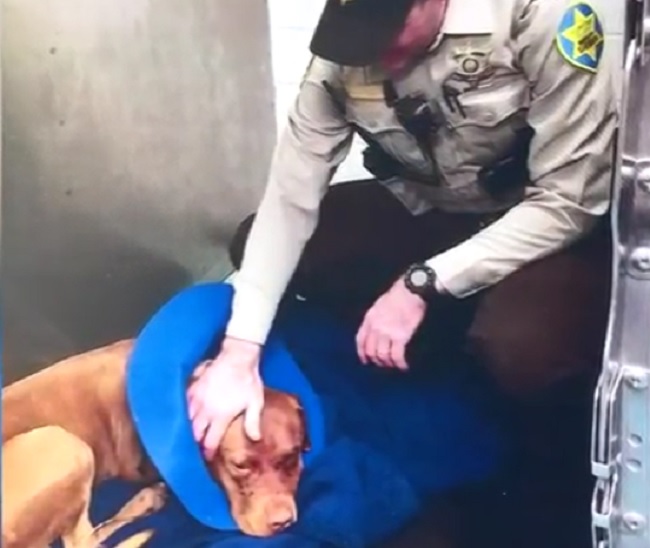
“I’m 15 feet away and I can hear a two pound dog crying,” Great Plains SPCA’s Scott Poore says with frustration dripping in his voice, almost as much as the sweat on his brow in the 90 degree sun. “We’re going on about 45 minutes with this little dog in the back seat of this car.”

Standing in the parking lot of a Home Depot in Merriam, Kansas, Scott films a live stream broadcast that gives Facebook fans real-time access to the situation that every animal lover dreads: a dog locked inside a hot car.

But the circumstances of this particular rescue are even more bizarre than usual. First of all, this Home Depot allows dogs inside the store. Second, the puppy inside the vehicle was extremely young, only weeks old. Third, the woman went inside to shop without even slightly cracking the windows of the vehicle (although that would be of little benefit). Fourth, she actually lost her car keys so she wasn’t able to open the vehicle when she arrived.

“When the lady came out, she was absolutely blown away that anybody had an issue with this,” Scott said. “And that’s pretty typical.”

A misguided sense of affection actually seems to be at the root of most instances of dogs being left in hot cars. People bring the dogs along because they feel that the dogs will be lonely at home, but they don’t take into account the very real threat to the dog’s physical welfare.

According to the local news station, KCTV, the puppy was returned to his “owner” who was issued a citation. Watch the video and decide for yourself if the law enforcement action available to police under the current law will be sufficient to safeguard this puppy from additional neglect.

ooOOoo

Words fail me! But well done the police!

All change at 10 Downing Street!

Well, perhaps not completely all change!

There will be few who can’t have heard of the enormous changes going on in my old country, with Teresa May now Britain’s second female Prime Minister. Talk about out with the old and in with the new!

But as this lovely story recently published over on the Smithsonian Magazine website illustrates, it’s not total change.

ooOOoo

10 Downing Street’s “Chief Mouser” Is Keeping His Job Despite Brexit

Larry the Cat will outlast David Cameron at the Prime Minister’s residence
Larry, Chief Mouser to the Cabinet Office (Her Majesty's Government)
Larry, Chief Mouser to the Cabinet Office (Her Majesty’s Government)
By Danny Lewis  smithsonian.com
July 14, 2016

In the weeks since British citizens voted to leave the European Union in a national referendum, the government of the United Kingdom has seen its share of political turmoil. Following the results of the vote, then-Prime Minister and “Remain” supporter David Cameron announced that he would be stepping down, and has now been replaced by his successor, Theresa May. But while Cameron has officially left the Prime Minister’s residence and offices at 10 Downing Street in London, at least one of his appointees will remain in May’s service: a brown and white tabby cat named Larry.

“It’s a civil servant’s cat and does not belong to the Camerons—he will be staying,” a government official tells the BBC.

Larry first came to 10 Downing Street in 2011, when Cameron adopted him from a rescue home in hopes that the feline would help handle a mouse infestation plaguing the Prime Minister’s residence. As the first cat to hold the title of Chief Mouser to the Cabinet Office, Larry has become a familiar face in and around the building over the years.

“Larry spends his days greeting guests to the house, inspecting security defenses and testing antique furniture for napping quality,” an official government website detailing the history of 10 Downing Street writes. “His day-to-day responsibilities also include contemplating a solution to the mouse occupancy of the house. Larry says this is still ‘in tactical planning stage.’”

However, despite being touted as a “good ratter” with “a high chase-drive and hunting instinct,” some reports suggest that Larry is not as good at his job as official statements might lead one to believe. Indeed, Larry has faced harsh scrutiny for slacking on the job, as his love of long naps often gets in the way of his hunting duties, Jack Goodman reports for Atlas Obscura. In one incident, Cameron reportedly was forced to throw a silver fork at a mouse to shoo it away during a meeting with other government officials, even after Larry was brought on board to handle the problem. However, despite his lack of progress on the mouse problem, Larry has managed to continue to retain his position.

While Larry may be the first cat to hold this particular title, he isn’t the first cat to make his home at 10 Downing Street. During the 1920s, Prime Minister Ramsay MacDonald brought along his cat, Rufus of England, and, in the 1930s and ’40s, the so-called “Munich Mouser” ran rampant throughout the residence, the BBC reports. In the 1970s, a cat named Wilberforce took up guard. Upon retirement, he was replaced by a stray who wandered into the offices during Margaret Thatcher’s premiership (he was called Humphrey). The last cat before Larry to hold court at 10 Downing Street was Sybil, who belonged to former Chancellor Alastair Darling. However, she reportedly did not care for city life, and later retired with Darling to his home in the Scottish countryside.

Whatever other effects the decision to leave the European Union will have on the United Kingdom’s government in the coming weeks, Larry’s position as “top cat,” at least, remains assured.

ooOOoo

 Well done, Larry!

Brexit – now what happens?

Here’s what is going to happen.

In the run-up to the EU referendum by the UK this Brit was tempted several times to offer an opinion on what I thought was the best decision. But I resisted. (I was qualified to vote as an overseas voter and had voted for Remain.)

My resistance was because it seemed inappropriate to pass any form of opinion before the die had been cast, so to speak. I hadn’t been living in the country for over eight years and, inevitably, was out of touch with feelings.

The Conversation blogsite yesterday had a series of articles on the aftermath of the Brexit decision but the one that seemed most useful to share with you all was an article by Gavin Barrett,  a Professor of European Constitutional and Economic Law at University College in Dublin. For many readers, including me, both within and without the UK this seemed a valuable primer.

ooOOoo

Britain votes to leave the EU, Cameron quits – here’s what happens next

June 23, 2016 11.41pm EDT

image-20160624-30267-wvhvty
Leave ahead. Anthony Devlin / PA Wire

Author

Into the Future.

These are deeply interesting times.

Among the many impressive qualities of the dog is one that we humans must envy so much at times.

I’m not speaking of a dog’s ability to seek out food or, at the other end of things, the dog’s way of keeping it’s backside clean! 😉 No, I’m referring to the way a dog lives in the present. Presumably unworried as to what the future might mean.

We humans, however, as hard as we try to be rooted in the ‘here and now’ also depend on assessing the future and determining the best way to respond to that uncertainty. I’m sure that assessing and managing risk is one of the ways that have made us such a successful species.

In terms of voicing these uncertain times I really was drawn to a comment from ‘John D’ over on Richard Murphy’s Tax Research UK blogsite. I’m going to republish that comment in full before moving on to the central theme of today’s post: Into the Future.

John D says:
June 10 2016 at 4:58 pm
Paul, I share your apprehension. I believe ‘the world’ has entered a cycle of almost unprecedented uncertainty. So many issues. So few solutions being articulated in the mainstream. However, shift happens and Richard is right to say that there is always opportunity for change. Gramsci, an underrated theorist, summed it up in his ‘Prison Notebooks'(1929-35) writing: “The crisis consists precisely in the fact that the old is dying and the new cannot be born; in this interregnum a great variety of morbid symptoms appear.”

The stranglehold Neo-liberalism has exercised on orthodox economics for the past 40 years is difficult to understand but, given that its major protoganists have held all the aces, it’s not really surprising. Under Reagan there was a major ‘re-education’ programme in the Universities where any heterodox economic teaching was eliminated from the ‘Economics 101’ curriculum. Acording to Richard Wolff an entire generation of students graduated from the major universities without ever having studied Marx in any context.

(For anyone interested here’s a succinct history of Neo-liberalism – http://www.newleftproject.org/index.php/site/article_comments/a_short_history_of_neoliberalism_and_how_we_can_fix_it).

The good news is nothing lasts forever. The seeds of change have already been sown and will eventually blossom, possibly in unexpected locations. Sadly, as Ivan says, there has been irretrievable damage to lives and livelihoods in the US, UK and many EU countries. Michael Hudson recently spelled out its negative effects – http://www.counterpunch.org/2016/06/07/the-wages-of-neoliberalism-poverty-exile-and-early-death.

Like many, I don’t think radical change will come about until enough people are hurting enough. Maybe a real property crash will be a wake-up call. However, in or out of the EU isn’t going to trigger a change in the economic agenda any time soon. Personally I believe that a vote for Brexit (ominously a possibilty) will set-back any fundamental reforms, especially in the UK. But I don’t want to open up that can of worms again here!

The perennial question is ‘what to do?’. And the answer is always the same: ‘do something, anything, to nurture the seeds into saplings’. Every little helps! It’s going to be a rough ride, not without some collateral damage in terms of still more unnecessary deaths. Usually I’m not as optimistic as Richard but because it’s Friday afternoon and the sun is shining I feel the beginning of the end is within our grasp. I so hope so. Back to Gramsci – the immediate worry is what will fill the intervening vacuum. Happy weekend!

The seeds of change have already been sown and will eventually blossom, possibly in unexpected locations.

The perfect introduction to an email that Dan Gomez sent me on Thursday.

ooOOoo

Below  is a summary by Udo Gollub of the findings at a recent futurist conference in Germany. This’s  – they predict – is how the world will operate in 10 to 20 years time.

For those of us who are about to amble into the sunset on our Zimmer frames, this is simply interesting. We inhabited a world where people used cosy concepts like pension, nest egg, job security, promotion in the work place and other reassuring socio economic terms.

For those who are in mid career or are only entering the world of (non) work now, this makes for scary/exciting reading – depending on how ready you are to change in mid air  — if it is at all possible.

And for the generation still in their nappies … well, it is a matter of how parents prepare them for an unimaginable world when they enter the world of ‘work’ in 20 years time.

GERT CLAASSEN
Hermanus
Into the future
By Udo Gollub at Messe Berlin, Germany

I just went to the Singularity University summit. Here are the key points I gathered.

Rise and Fall. In 1998, Kodak had 170,000 employees and sold 85% of all photo paper worldwide. Within just a few years, their business model disappeared and they were bankrupt. What happened to Kodak will happen in a lot of industries in the next 10 years – and most people don’t see it coming. Did you think in 1998 that 3 years later you would never take pictures on paper film again?

Yet digital cameras were invented in 1975. The first ones only had 10,000 pixels, but followed Moore’s law. So as with all exponential technologies, it was a disappointment for a long time, before it became superior and mainstream in only a few short years. This will now happen with Artificial Intelligence, health, self-driving and electric cars, education, 3D printing, agriculture and jobs.
Welcome to the 4th Industrial Revolution.  Welcome to the Exponential Age. Software and operating platforms will disrupt most traditional industries in the next 5-10 years.

Uber is just a software tool. They don’t own any cars, but they are now the biggest taxi company in the world. Airbnb is the biggest hotel company in the world, although they don’t own any properties.

Artificial Intelligence: Computers become exponentially better in understanding the world. This year, a computer beat the best Go player in the world, 10 years earlier than expected. In the US, young lawyers already don’t get jobs. Because of IBM Watson, you can get legal advice, (so far for more or less basic stuff), within seconds. With 90% accuracy, compared with 70% accuracy when done by humans. So if you are studying law, stop immediately. There will be 90% fewer generalist lawyers in the future; only specialists will be needed. ‘Watson’ already helps nurses diagnose cancer, four times more accurately than doctors. Facebook now has pattern recognition software that can recognize faces better than humans. By 2030, computers will have become ‘more intelligent’ than humans.

Cars: In 2018 the first self driving cars will be offered to the public. Around 2020, the complete industry will start to be disrupted. You don’t want to own a car anymore. You will call a car on your phone; it will show up at your location and drive you to your destination. You will not need to park it, you only pay for the driven distance and you can be productive whilst driving. Our kids will never get a driver’s licence and will never own a car. It will change the cities, because we will need 90-95% fewer cars for our future needs. We can transform former parking spaces into parks. At present,1.2 million people die each year in car accidents worldwide. We now have one accident every 100,000 kms. With autonomous driving, that will drop to one accident in 10 million km. That will save a million lives each year.

Electric cars will become mainstream around and after 2020. Cities will be cleaner and much less noisy because all cars will run on electricity, which will become much cheaper.

Most traditional car companies may become bankrupt by tacking the evolutionary approach and just building better cars; while tech companies (Tesla, Apple, Google) will take the revolutionary approach and build a computer on wheels. I spoke to a lot of engineers from Volkswagen and Audi. They are terrified of Tesla.

Insurance companies will have massive trouble, because without accidents, the insurance will become 100 times cheaper. Their car insurance business model will disappear.

Real estate values based on proximities to work-places, schools, etc. will change, because if you can work effectively from anywhere or be productive while you commute, people will move out of cities to live in a more rural surroundings.

Solar energy production has been on an exponential curve for 30 years, but only now is having a big impact. Last year, more solar energy was installed worldwide than fossil. The price for solar will drop so much that almost all coal mining companies will be out of business by 2025.

Water for all: With cheap electricity comes cheap and abundant water. Desalination now only needs 2kWh per cubic meter. We don’t have scarce water in most places; we only have scarce drinking water. Imagine what will be possible if everyone can have as much clean water as they want, for virtually no cost.

Health: The Tricorder X price will be announced this year – a medical device (called the “Tricorder” from Star Trek) that works with your phone, which takes your retina scan, your blood sample and your breath. It then analyses 54 biomarkers that will identify nearly any diseases. It will be cheap, so in a few years, everyone on this planet will have access to world class, low cost, medicine.
3D printing: The price of the cheapest 3D printer came down from 18,000$ to 400$ within 10 years. In the same time, it became 100 times faster. All major shoe companies started printing 3D shoes. Spare airplane parts are already 3D-printed in remote airports. The space station now has a printer that eliminates the need for the large amount of spare parts they used to need in the past.
At the end of this year, new smart phones will have 3D scanning possibilities. You can then 3D scan your feet and print your perfect shoe at home. In China, they have already 3D-printed a complete 6-storey office building. By 2027, 10% of everything that’s being produced will be 3D-printed.

Business opportunities: If you think of a niche you want to enter, ask yourself: “in the future, do you think we will have that?” And if the answer is yes, then work on how you can make that happen sooner. If it doesn’t work via your phone, forget the idea. And any idea that was designed for success in the 20th century is probably doomed to fail in the 21st century.

Work: 70-80% of jobs will disappear in the next 20 years. There will be a lot of new jobs, but it is not clear that there will be enough new jobs in such a short time.

Agriculture: There will be a 100$ agricultural robot in the future. Farmers in 3rd world countries can then become managers of their fields instead of working in them all day. Aeroponics will need much less water. The first veal produced in a petri dish is now available. It will be cheaper than cow-produced veal in 2018. Right now, 30% of all agricultural surfaces are used for rearing cattle. Imagine if we don’t need that space anymore. There are several start-ups which will bring insect protein to the market shortly. It contains more protein than meat. It will be labelled as “alternative protein source” (because most people still reject the idea of eating insects).

Apps: There is already an app called “moodies” which can tell the mood you are in. By 2020 there will be apps that can tell by your facial expressions if you are lying. Imagine a political debate where we know whether the participants are telling the truth and when not!

Currencies: Many currencies will be abandoned. Bitcoin will become mainstream this year and might even become the future default reserve currency.

Longevity: Right now, the average life span increases by 3 months per year. Four years ago, the life span was 79 years, now it is 80 years. The increase itself is increasing and by 2036, there will be more than a one-year increase per year. So we all might live for a long, long time, probably way beyond 100.

Education: The cheapest smartphones already sell at 10$ in Africa and Asia. By 2020, 70% of all humans will own a smartphone. That means everyone will have much the same access to world class education. Every child can use Khan Academy for everything he needs to learn at schools in First World countries. Further afield, the software has been launched in Indonesia and will be released in Arabic, Swahili and Chinese this summer. The English app will be offered free, so that children in Africa can become fluent in English within half-a-year.

ooOOoo

Interesting times, indeed!

You all have a very good weekend!

Pitchforks or Pens.

The extreme importance of engaging in the fight for better societies.

I must warn you that today’s post is nothing about dogs. Unless, as with me, you see dogs as well as being the most gorgeous of creatures as being critically important metaphors for what societies need now! Or as I present elsewhere in this place:

Because of this closeness between dogs and man, we (as in man!) have the ability to observe the way they live.  Now I’m sure that scientists would cringe with the idea that the way that a dog lives his life sets an example for us humans, well cringe in the scientific sense.  But man seems to be at one of those defining stages in mankind’s evolution where the forces bearing down on the species homo sapiens have the potential to cause very great harm.  If the example of dogs can provide a beacon of hope, an incentive to change at a deep cultural level, then the quicker we ‘get the message’, the better it will be.

Dogs:

  • are integrous ( a score of 210) according to Dr David Hawkins
  • don’t cheat or lie
  • don’t have hidden agendas
  • are loyal and faithful
  • forgive
  • love unconditionally
  • value and cherish the ‘present’ in a way that humans can only dream of achieving
  • are, by eons of time, a more successful species than man.

richard-murphySo what’s this all leading up to!

Regular followers of this place (and you are always appreciated – never forget that) will know that previously I have mentioned Professor Richard Murphy. I have been following and reading his blog Tax Research UK for some time.

Many of the good Professor’s posts are specific to what is going on in the UK and, inevitably, Europe and the EU referendum.

But on the wider horizon these seem to be such terrible times. Here’s a comment I left to another of Richard’s posts that opened with the sentence, I am so bored by the EU referendum campaign.

My comment being:

It’s coming up to 5:30 am here in Southern Oregon and, as per usual, I have dipped into the latest postings from Tax Research. Part of me, a large part of me, is sickened by what seems to be going on in this world with the EU referendum and the US Presidential election being the two most glaringly terrible examples. But this old Brit (London-born in 1944) has this sense that the way that Richard and so many of his supporters can now ‘shout’ out the truth will, in the end, deliver a better future. Indeed, my own blog post today is called The Power of Open Opinions.

So keep on banging your truthful drum, Richard!

However, last Tuesday Richard published a post that seemed to speak to me, and presumably countless others, about the dilemma as to whether to be active in speaking up about what is right or wrong, or to just huddle up with one of your dogs on a nice (oversized) dog bed!

In my estimation that post from Richard should be widely circulated and it is republished in full now with Richard’s kind permission.

ooOOoo

To engage or not; that is the question

Posted on7:57 am May 31 2016

It would seem I have touched a raw nerve for some regular commentators by suggesting that I welcome the IMF article, recently published, that appeared to recognise the failure of neoliberalism to tackle inequality and the inappropriateness of much of the austerity agenda.

It now seems that this article has attracted a vicious backlash from the FT, which clearly sees it as touching on neoliberal heresy. In that case to suggest, as some do, that this article is inconsequential is, in my opinion, wrong.  If nothing else, it has revealed the true opinion of the FT, and the sharp divide between its editorial stance and the opinion of its lead economic  columnist, Martin Wolf.

It is also safe to assume that if this has been the response outside the organisation then the debate within it has been at least as heated,  and all this on an article which says it can find merit in some parts of the neoliberal agenda.

Why come back to the issue then?  I think there are three good reasons for doing so.

First, how to respond to such an article from such an organisation opens up one of the more difficult questions in campaigning, which is whether to engage or not with those organisations that you criticise?  It is not possible to be a tax justice campaigner and to not have been critical of the IMF and its approach over the last few decades.  I have been of the IMF, the World Bank and, of course, of the Washington Consensus  that they have promoted.  But, a long time ago I decided that the only viable way  in which I could help deliver tax justice was by engaging with those people and organisations whose opinions I wished to change.

Over the years I’ve been criticised for this, and  been told that the policy would undermine my chances of success.  So, variously,  I was told that it was a mistake to serve on George Osborne’s General Anti-Abuse Rule  committee.  Likewise, engaging with the  OECD BEPS  process was described as a mistake by some because the terms of engagement were clearly biased against developing countries.  Others have also suggested that it was a mistake not to object to Jeremy Corbyn  using some of my policy ideas.   I suspect some would also criticise the fact that I went to the World Bank last week  and there were definitely those who suggested that I should not accept an appointment at City University, precisely because it has got links to the City of London. As for the Fair Tax Mark; some say that is a sell out.

In all cases I disagree.  It is my job to  create ideas  that might effect change.  My purpose for doing so is, I hope clear:  my aim is to create a more  genuinely prosperous, more equal, more democratic, more accountable, more sustainable,  more tolerant  and so more enjoyable world in which we might live.  More is an important word in that sentence:  it could be prefaced with ‘much’  in many cases but I do not think we will ever create  utopia.  I want better because I doubt that the best I believe possible is actually achievable within the necessary compromises that human society requires, not just now but ever.

That, then, brings me to my second point.  I am not seeking a revolution, but an evolution.  I respect those who wish to be perpetual outsiders because they believe that the only way forward is to sweep away all that is in their path to create an entirely new society, but their’s is not a path I would ever choose.  There is good reason for that: I believe that the cost of such change is too high, and the uncertainty of the outcome too great for any such risk to be taken.  The chance  that what we have will be replaced by tyranny is also too significant to justify this approach, in my opinion.

But, perhaps, most of all,  and thirdly, I believe that the power of an idea at the right time is sufficiently strong to ensure that such a revolutionary approach is wholly unnecessary.  I stress, I am not claiming that my ideas are in this category;  I am suggesting that ideas can be.  Neoliberalism arose because it was an idea in the right place at the right time, even if I fundamentally disagree with the prescription that it offered.  The post-war consensus was similarly created in this way.

I regret that as yet we have not reached a point where a similar replacement idea has been sufficiently developed to capture, unambiguously, the common political narrative.  Discussion of sustainability is become mainstream, but not in reality commonplace.  Disquiet with austerity is deep-rooted, but has not yet displaced the obsession with balanced budgets.  Debate on inequality  in its many egregious forms is taking place, but is not yet reversing trends. Some  political developments  now arising are deeply  antagonistic to democracy. But, and I stress the point,  the fact that all these things are happening is, in itself, indication that something really important is going on and that we may, in my opinion, be reaching a point where real change is possible.

I stress, in the context the IMF article is, in my opinion  important even though it is not  as radical as that  which many people would wish to read.  But that is how change takes place: very few of us are really capable of embracing giant leaps. Most of us have to, inevitably, partake in incremental steps on the way to a bigger goal.

I accept, and embrace that fact,  which I perceive to be a reality.  That is not to say there is no place for the campaigner who demands, with reason, more radical change.  Whilst I see many of the attractions of being a ‘no compromiser’  that is not the path I have chosen to follow, even with tax havens (as my Plan B for Jersey made clear).  If the choice is between a pitchfork and a pen, then I choose the pen,  believing that at the end of the day this is the way to  create real change. But as a result I also choose to engage, without apology.

ooOOoo

We must never forget that the pen is mightier than the sword! And we must never stop engaging!

The power of open opinions

We can never turn aside from cruelty, in all its forms.

The rather rosy mood engendered by my post about the relationship between a Brazilian fisherman and a penguin published on the 31st May and the saving of a dog from a culvert by a serving police officer in Rhode Island was bound not to last. But I didn’t anticipate that it would turn so bleak by the following petition that was highlighted to me and everyone by a recent comment to a post by John Zande.

This was the petition.

ooOOoo

497417-1434490365-wideDemanding Justice for Dog Crushed to Death by a Garbage Man

BY: June Haggar

TARGET: Cidade de Presidente Figueiredo Mayor Neilson da Cruz, Brazil

A garbage man can be seen in pictures, attached, as he deliberately went on to the sidewalk to hit a dog and then stopped the truck to put a chain around his neck and drag and throw him into the truck’s compactor to be crushed to death.
Although the article claims that the man was fired, we hereby implore the Mayor Neilson da Cruz to prosecute Jadson James Franca to the fullest extent of the law with jail time and fines. We also want the garbage company ViaLimpa to fire the 2 co-workers in the photos laughing and allowing this madman to crush the dog.
Mr. Mayor: If you do not prosecute this man with jail time, you are sending a message to the youth of Brazil that this is acceptable conduct to innocent animals that have done nothing wrong other than to walk on the sidewalk. This Jadson James Franca is clearly a sociopath who enjoys the torture and murder of animals. He is a danger to the people of Brazil, while he is still walking free. It is a known fact that sociopaths begin to torture and murder animals and then move on to people. ALL serial killers started out with torturing and murdering animals and Jadson Franca is no different. What will you do if he kills his wife, child, neighbor or an innocent person on the street and you could have done something to stop it by prosecuting him now?

I ask all to sign this petition to stop this murdering rampage that is happening on the streets of Brazil and send a message that this blatant murder of an innocent dog will not be tolerated by the citizens of the world.

ooOOoo

I can do no better in terms of my own feelings than to highlight what June wrote, “This Jadson James Franca is clearly a sociopath who enjoys the torture and murder of animals. He is a danger to the people of Brazil, while he is still walking free.”

Well over 30,000 people signed that petition including John and myself. In doing further research, however, it became clear that this group anger and disgust worked, assuming the British Daily Mail newspaper is reporting the story accurately.

For in their online edition of May 31st, their online reporter, Matt Roper published this:

A binman has been sacked after he was caught dragging an injured dog across a road before throwing the terrified animal in the back of his rubbish truck to be crushed alive.

Jadson James Franca, 35, mounted the pavement of the street in Presidente Figueiredo, northern Brazil and hit the stray dog, according to shocked residents.

The council binman then stopped the garbage truck and tied a chain around the neck of the whimpering animal, which had had both of its legs broken.

As his colleagues looked on, Franca then dragged the frightened dog along the pavement before tossing it into the compacting mechanism of the collection vehicle.

Later on in that same article Matt Roper reported:

Brazilian TV presenter Xuxa, who once dated football legend Pele, also posted the shocking photos to her 4.4million Facebook followers.

She wrote: ‘This little dog, who wasn’t bothering anyone, had its legs broken, and in agony was tied up and dragged by the neck, before being brutally murdered by this individual, being thrown and crushed alive in the back of the garbage truck.’

This monster can still appeal against a fine and will still be walking the streets in freedom! Are we going to let that happen?? Let’s do something?? Together we can.’

Yesterday Presidente Figueiredo’s mayor, Neilson da Cruz, told Brazil’s A Critica newspaper that the binman had been sacked and the refuse collection company, ViaLimpa, would face an unspecified fine.

That Daily Mail article also has more photographs but without permission to republish them here all I can do is give you the links included in my ‘copy and paste’ of those two extracts above.

Read more: http://www.dailymail.co.uk/news/article-3105342/Brazilian-binman-sacked-pictured-dragging-injured-dog-road-throwing-animal-rubbish-truck.html#ixzz4AMsr2xRG
Follow us: @MailOnline on Twitter | DailyMail on Facebook

Thank goodness for the power of mass opinions now offered to us by this online world of ours.

Foreign lands.

These seem like times where very little makes sense.

Blogger Patrice Ayme posted an item on Wednesday under the title of Doomed Dems. It was, inevitably, a commentary on the recent news regarding Donald Trump. Here’s how Patrice’s post opens:

So Donald Trump will be the Republican committee ( 😉 ) for the presidency. And Trump will, probably, be elected US president. Why? Because people want change, and they did not get it. Instead they got more of the drift down, after the reign of the teleprompter reading president. Average family income is DOWN $4,000 since (“Bill”) Clinton’s last year as president. According to a FOX News poll, 64% of Americans blame Wall Street. Meanwhile in a vast report in the New York Times, Obama celebrates, in May 2016, the alliance he said he made with Wall Street in 2008.

Later on in that same post, Patrice goes on to write about the horrific fire in Alberta, Canada, and the damage to trees in Yosemite National Park in California. At first sight those two events would appear disconnected. But not according to Patrice:

Meanwhile a friend of mine went to Yosemite ten days ago. She told me she could not believe the devastation of the forest. Most of it is fiery red. It is devastated by the Pine Bark Beetle. To kill the Beetle, one needs twenty days well below freezing. However, this hard freeze is now a memory. So the Beetle invades, and kills forest. Treating tree by tree is hopelessly expensive, and futile. Yes, the forests will burn soon, adding to CO2 in the atmosphere. And it is all the way like that to Alaska.

Fort McMurray, Alberta may not have seen the worst of a devastating wildfire.

Massive walls of flames prompted authorities to order the evacuation of all the city’s more than 80,000 residents last night. The blaze has been caused by un-naturally high temperatures. Such giant fires are our immediate future. Nobody said the Greenhouse crisis was going to be nice. More evacuations coming.

Anything to do with dogs? Well, yes!

For this coming Saturday I am giving a talk about my book, Learning from Dogs, to our local Rogue Valley Humanist and Freethinkers (both Jean and I are members) and it struck me that what Patrice wrote about and what we see all around us are part of the same big picture. That we need to be reminded of a few fundamentals. As I will be saying in my talk:

Dogs are creatures of integrity! Wow! Now you might see where this is leading to!

But more than that, much more than that, they offer us humans a model for a range of behavioural qualities that we ignore at our peril:

I then list the qualities that we see in our dogs, and continue:

Hold those values close to you for just a few moments. Imagine what would flow out across the world if those were the characteristics, the behavioural values, of us humans!

Finally, towards the end of that talk on Saturday I will be saying:

Nature will always have the last word regarding her natural world, to which we humans are so intricately linked. Standing alongside and respecting nature as the future comes to us will be so much wiser than pushing back against nature, and ultimately failing, trying to “convert” nature to some form of materialistic human resource. Because that route will only return those of us who survive to a life of hunting and gathering. Which, so many thousands of years previously, is where early dogs started humankind on the long journey leading to now.
Dogs have been the making of humans and a viable future for humankind on this beautiful planet depends on us never forgetting this oldest relationship of all, the one between dog and human.

Because if we, as a global society, don’t understand that when it comes to power all the plutocrats and all of their money come to naught in contrast to the power of nature then these present lands are going to become very strange indeed!

And nature is rapidly encroaching on these lands that we are now traversing.

Keep shouting it out!

The force of public opinion has never been more important; critically so!

As you all know this world of blogging: authors; followers; readers, is a great number of wonderful communities right across the planet. It is nothing like the traditional media, now owned and controlled by just a handful of large corporations, because the vast majority of blogging participants are free to say what they want, when they want.

Here’s an example.

Martin Lack is an Englishman who is the author of the blog Lack of Environment. As his home page quietly states:

Although scientificly trained (with degrees in Geology and Hydrogeology – see my About page), this blog arises from my having also got an MA in Environmental Politics and, as such, as the tagline indicates, is a blog on “the politics and psychology underlying the denial of all our environmental problems”… I hope you will take this on board; and enjoy the discussion.

“There is something fundamentally wrong in treating the Earth as if it were a business in liquidation” – Herman E. Daly (former World Bank economist).

The science about the chemistry of climate change especially the new danger of methane is clear. The commitment of our political leaders is less clear. But that doesn’t mean that we shouldn’t keep shouting out loud.

As Martin Lack did recently.

ooOOoo

Open Letter to David Cameron

29 March 2016

The Rt. Hon. David Cameron MP

The Prime Minister
10 Downing Street
London, SW1A 2AA

Dear Prime Minister,

Whatever happened to the greenest government ever?

Given my experience of working in environmental consultancy or regulation, I understand the importance of making pragmatic, risk-based decisions (as opposed to dogmatic, opinion-based ones).  I therefore believe that government policy should be formulated this way.  Unfortunately, however, this does not always seem to be the case.

As a pragmatic scientist, I am not ideologically opposed to nuclear power.  However, I do question the logic of pursuing ‘Hinkley Point C’ when equivalent investment in distributed renewable technologies – from domestic solar PV to submarine tidal stream – could probably generate more electricity faster.  Indeed, as Greenpeace has recently pointed out, the UK could meet nearly all its electricity generation needs from renewable energy sources by 2030.[1]

With regard to risk, the scientific consensus is that, in order to minimise anthropogenic climate disruption (ACD), the World must now embark upon the fastest-possible transition to a zero carbon economy.  Therefore, I also question the logic of simultaneously promoting investment in shale gas; discouraging investment in renewables; and cancelling investment in Carbon Capture and Storage research.

It is now over 50 years since scientists started warning of the climatic implications of continuing to burn fossil fuels;[2] and 50 years since fossil fuel company executives started spending huge sums of money on being “Merchants of Doubt”.[3]  As such, along with their counterparts in the tobacco industry, they have clearly not acted in the long-term interest of humanity as a whole.

However, as with the individual health benefit of ceasing to smoke tobacco, the sooner we stop burning fossil fuels the greater the collective environmental benefit will be. Therefore, I am pragmatically opposed to shale gas exploration because burning it is not consistent with the need to transition away from fossil fuels as fast as possible.

I am certain that you would like to secure an enduring political legacy; and would therefore like to ask just one question:

What could be better than being remembered as the Prime Minister that committed the UK to meeting nearly all its electricity generation needs from renewable energy sources by 2030?

Yours sincerely,

Martin C. Lack

————
[1] See: http://www.greenpeace.org.uk/blog/climate/uk-can-be-almost-entirely-powered-renewable-energy-2030-new-study-shows-20150921.

[2] Nuccitelli, D. (2015), ‘Scientists warned the US president about global warming 50 years ago today’, Guardian newspaper, 5 November 2015: London.

[3] Oreskes, N. & Conway E. (2010), Merchants of Doubt,  New York: Bloomsbury. See: http://www.merchantsofdoubt.org/

ooOOoo

Let me finish today’s post by republishing an exchange between Patrice Ayme and Martin over on a recent PA essay, that I republished in full in this place: Runaway Antarctica.

Martin:

I know I am wasting my time writing letters to David Cameron; and I know my opinions are irrelevant. However, the facts of history are not; nor will they be in the future.

Patrice:

I know you are doing the right thing. Writing to Cameron is entirely correct. But of course, he is a guy with just a salary and a few “savings”, a few tens of millions dollars of savings, maybe, or maybe not, and knew nothing about his recently deceased father having a fund of around 50 million dollars sheltered by shell companies, out there, somewhere related to Panama, or the British Virgin Islands, or the Bahamas, or Bermuda, whatever…

OK, David’s wife, officially, has a fund of more than twenty million pounds….

Martin:

For the record: I am socially-conservative (i.e. as opposed to liberal) but under no illusion as to the folly of what has been called ‘money fetishism’ (Karl Marx); and ‘growthmania’ (Herman E. Daly).

Patrice:

Hi Martin, thanks for the comment. I spent a whole hour reading the hard cover version of the paper the electronic version of which I criticized above. It’s quite a bit different. They use RCPs (Reasonable Carbon Projections, or the like in meaning). Yet, they don’t explain what they consist of exactly. All I know is that we are around 500 ppmv, and they work with 400 ppmv, in the 130 K-115 K years BP, when orbital conditions were cooler than now.

Plus we are going to be at 550 ppmv within ten years, at the present rate. The earliest date they have for the failure of Larsen C in their worst RCP 8.5 is 2055 CE. I would be surprised if it did not fail within ten years.

However, the paper version is more insistent on the danger of AIR warming, not just subsurface.

Also the Hansen paper has a scenario, which is suitably apocalyptic, but not apocalyptic enough in my book. Temperatures over the Arctic were strikingly high this winter, of the order of 4 to 5 degrees Centigrade higher than normal, and sometimes more. Nobody expected this sort of jumps. Except for yours truly!😉

Martin:

Thanks for the explanation, Patrice. This is all very reminiscent of the position of (Arizona) Professor Guy McPherson, who believes most scientists are in denial about the consequences of multiple positive feedback mechanisms we can already see operating:
http://lackofenvironment.wordpress.com/2013/02/19/what-on-earth-are-we-doing/

You all have a wonderful weekend and keep hugging those dogs of yours!

Runaway Antarctica

Do you hear the turnstile about to click!

Not so long ago I wrote a series of three posts under the titles of Interconnections One, Interconnections Two and, yes you guessed it 😉 , Interconnections Three. They were about the consequences of rising sea levels.

Now one might argue that this has nothing whatsoever to do with Learning from Dogs but I would disagree. For as I declare in The Vision of this blog:

It seems to me that a Vision statement should encapsulate just why the owners of the enterprise are committed to that venture.  The author of Learning from Dogs is committed to this project; here is the Vision.

Our children require a world that understands the importance of faith, integrity and honesty

Learning from Dogs will serve as a reminder of the values of life and the power of unconditional love – as so many, many dogs prove each and every day

Constantly trying to get to the truth …

The power of greater self-awareness and faith; faith that the only way forward for us is through the truth …

For in a very real and devastating way even a small rise in global sea level is going to cause tens of thousands of dogs, and their loving owners, to become homeless. We are long overdue a commitment from our global leaders and power-brokers to that, “.. faith, integrity and honesty.”

However, championing that greater self-awareness is what blogger Patrice Ayme does almost all of the time. With his kind permission, I republish his latest post on the state of the Antarctic Ice.

ooOOoo

Runaway Antarctica

I have written for years that a runaway Antarctica was certain, with half the icy continent melting rather spectacularly on an horizon of two centuries at most, and probably much less than that. This rested on the fact that half of Antarctica rests on nothing but bedrock at the bottom of the sea. At the bottom of what should naturally be the sea, in the present circumstances of significant greenhouse gas concentrations.

Visualize this: until sometimes in the Nineteenth Century, GreenHouse Gas (GHG) concentration was 280 ppm (280 parts per million), including the man-made sort. Now we are close to 500 ppm, using a variety of exotic gases we produce industrially, among them, CO2. In CO2 alone we are at:  Week beginning on March 20, 2016: 405.62 ppm. Weekly value from 1 year ago: 401.43 ppm. Weekly value from 10 years ago: 382.76 ppm. So the CO2 alone is augmenting at a bit more than 1% a year. Thus we will be at an equivalent of 550 ppm in ten years (including the full panoply of all the other man-made greenhouse gases, not just CO2). There is evidence that, with just 400 ppm, disaster is guaranteed.

Now visualize this:

antarctica-truth-revealed-nyt-2016-450
How Antarctica would appear if its ice melted: it’s half under the sea.

Why so watery? Because the enormous glaciers, up to nearly 5,000 meter thick, press down on the continent with their enormous weight. Since the end of the last glaciation, 10,000 years ago, Scandinavia has been rising, and is still rising (I long used a picture with a similar information about Antarctica’s bedrock.)

A paper published on line in Nature on March 30, 2016, that is, two days ago, “Contribution of Antarctica to past and future sea-level rise” opines that:

Polar temperatures over the last several million years have, at times, been slightly warmer than today, yet global mean sea level has been 6–9 metres higher as recently as the Last Interglacial (130,000 to 115,000 years ago) and possibly higher during the Pliocene epoch (about three million years ago). In both cases the Antarctic ice sheet has been implicated as the primary contributor, hinting at its future vulnerability. Here we use a model coupling ice sheet and climate dynamics—including previously underappreciated processes linking atmospheric warming with hydrofracturing of buttressing ice shelves and structural collapse of marine-terminating ice cliffs—that is calibrated against Pliocene and Last Interglacial sea-level estimates and applied to future greenhouse gas emission scenarios. Antarctica has the potential to contribute more than a metre of sea-level rise by 2100 and more than 15 metres by 2500, if emissions continue unabated. In this case atmospheric warming will soon become the dominant driver of ice loss, but prolonged ocean warming will delay its recovery for thousands of years.

Notice that the scenario evoked in the last sentence is different from my  very old scenario, which is similar to the one advanced in November 2015 by the famous Hansen and Al. (I raised the alarm before Hansen, at least seven years ago). In my scenario, and Hansen’s the ice sheets melt from below, due to warm sea water intrusion.

The West Antarctic Ice Sheet is larger than Mexico.

Here is a taste of the paper (I have a Nature subscription):

“Reconstructions of the global mean sea level (GMSL) during past warm climate intervals including the Pliocene (about three million years ago)1 and late Pleistocene interglacials2, 3, 4, 5 imply that the Antarctic ice sheet has considerable sensitivity. Pliocene atmospheric CO2 concentrations were comparable to today’s (~400 parts per million by volume, p.p.m.v.)6, but some sea-level reconstructions are 10–30 m higher1, 7. In addition to the loss of the Greenland Ice Sheet and the West Antarctic Ice Sheet (WAIS)2, these high sea levels require the partial retreat of the East Antarctic Ice Sheet (EAIS), which is further supported by sedimentary evidence from the Antarctic margin8. During the more recent Last Interglacial (LIG, 130,000 to 115,000 years ago), GMSL was 6–9.3 m higher than it is today2, 3, 4, at a time when atmospheric CO2 concentrations were below 280 p.p.m.v. (ref. 9) and global mean temperatures were only about 0–2 °C warmer10. This requires a substantial sea-level contribution from Antarctica of 3.6–7.4 m in addition to an estimated 1.5–2 m from Greenland11, 12 and around 0.4 m from ocean steric effects10.”

So notice: when CO2 ppm per volume was at 280 130,000 to 115,000 years ago, sea level was up to ten meter higher than now. And now we are at 500 ppmv…

And notice again: When CO2 ppmv was at 400, sea level was up to 30 meters (100 feet) higher than today. And now we are at 500 ppm, and, in a blink, in ten years, at 550 ppm.

Here is another example from the paper. I said all of this before, but to have scientists paid to do research in this area write it black on white in the world’s most prestigious scientific magazine, will no doubt endow me with greater, and much desired, gravitas. So let me indulge, not so much for my greater glory, but because it should help taking what I have long said more seriously.

“Much of the WAIS sits on bedrock hundreds to thousands of metres below sea level (Fig. 1a)13. Today, extensive floating ice shelves in the Ross and Weddell Seas, and smaller ice shelves and ice tongues in the Amundsen and Bellingshausen seas (Fig. 1b) provide buttressing that impedes the seaward flow of ice and stabilizes marine grounding zones (Fig. 2a). Despite their thickness (typically about 1 km near the grounding line to a few hundred metres at the calving front), a warming ocean has the potential to quickly erode ice shelves from below, at rates exceeding 10 m yr−1 °C−1 (ref. 14). Ice-shelf thinning and reduced backstress enhance seaward ice flow, grounding-zone thinning, and retreat (Fig. 2b). Because the flux of ice across the grounding line increases strongly as a function of its thickness15, initial retreat onto a reverse-sloping bed (where the bed deepens and the ice thickens upstream) can trigger a runaway Marine Ice Sheet Instability (MISI; Fig. 2c)15, 16, 17. Many WAIS grounding zones sit precariously on the edge of such reverse-sloped beds, but the EAIS also contains deep subglacial basins with reverse-sloping, marine-terminating outlet troughs up to 1,500 m deep (Fig. 1). The ice above floatation in these East Antarctic basins is much thicker than in West Antarctica, with the potential to raise GMSL by around 20 m if the ice in those basins is lost13. Importantly, previous ice-sheet simulations accounting for migrating grounding lines and MISI dynamics have shown the potential for repeated WAIS retreats and readvances over the past few million years18, but could only account for GMSL rises of about 1 m during the LIG and 7 m in the warm Pliocene, which are substantially smaller than geological estimates.”

I said it before. Including the details. So the evidence was clear, and out there. The optimism (it will take 5 centuries for 50 feet of sea level rise) is not supported by evidence. Actually collapsing channels coming from inverted rivers running up on the bellies of ice sheets are now obvious on satellite pictures and collapse of major ice shelves is going to be a matter of years, not centuries.

But science is made by tribes and these tribes honor the gods (of plutocracy) who finance them, and their whims. So they don’t want to make their sponsors feel bad. So they say unsupported, optimistic stuff, contradicted by a first order analysis.

Science is good, metascience, better. Metascience includes the sociological reasons which explain why some scientists will take some “facts” for obvious (although, coming from another sociology, they are not).

Deep in the Nature paper, in the quote above, or in four drawings and graphs of future sea level rise, one can find projections according to what various models “predict”… 130,000 years ago (!) The “Old Physics” model predicts one meter rise of the sea (this is the official UN maximal prediction for 2100). The new model, again starting with the present conditions, predict more than a six meter rise (!) This is a case of metascience playing with sea level.

This way, the authors of the paper will be able to say, one day: we told you so. While at the same time not irritating their sponsors now (because to understand what they are really saying takes quite a while, and has to be understood as tongue in cheek, when they pretend to apply the analysis to 130,000 years ago… What they really mean is six meters now, not just one meter… Bye bye Wall Street. Punished by its own instruments…)

The question is not whether we will be able to avoid a twenty meter sea level rise: that’s, unbelievably, a given (barring unforeseeable, yet imaginable technological advances to extract quickly a lot of CO2 from the atmosphere). The question is whether we will avoid a 60 meter rise.

Patrice Ayme’

ooOOoo

Let me add a footnote.

Namely, that on Yves Smith’s Naked Capitalism blog on Saturday was an item under the heading of A Wake-Up Call on Climate Change and Clean Energy.

By Eric Beinhocker, Executive Director, INET Oxford. Originally published at the Institute for New Economic Thinking website

A stark warning from Institute researchers on the probability that ‘2°C capital stock’ will be reached in 2017

A new study from the Institute for New Economic Thinking at the Oxford Martin School and the Smith School for Enterprise and Environment, University of Oxford, shows that we are uncomfortably close to the point where the world’s energy system commits the planet to exceeding 2°C.

In the paper, to be published in the peer-reviewed journal Applied Energy, the authors calculate the Two degree capital stock – the global stock of electricity infrastructure from which future emissions have a 50% probability of staying within 2°C of warming. The researchers estimate that the world will reach Two degree capital stock next year, in 2017.

Read the full item here.

It’s enough to make us all feel angry and hopeless. That would be understandable but wrong.

Go and read my Inconnections Three for within that post is this:

Want to fight climate change? Here are the 7 critical life changes you should make.

For the sake of millions of us and our wonderful pets stay with it and demand change from our politicians and leaders in every way that you can.