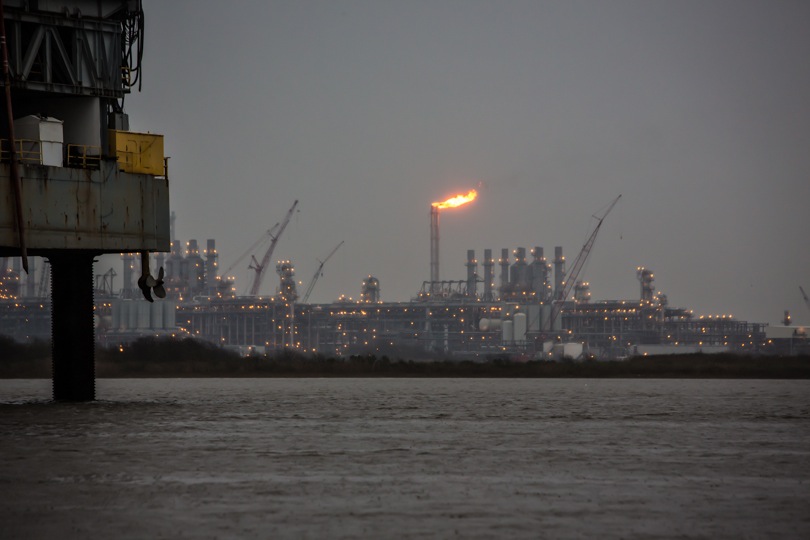
To be honest, at a personal level I just don’t know the answer to that question. It seems to depend on the mood that Jean and I are in at any particular time. All I can fall back on is that well-used saying from me: “Never underestimate the power of unintended consequences”.
In other words, we shouldn’t underestimate the strength of millions of good people when their demands start reaching out to those in power. (And whatever your reaction to this post, please don’t miss watching the inspirational Al Gore speech towards the end of this post.)
Recently over on the Grist site there was an article about the critical changes that each and every one of us should be making. I want to share it with you in full.
ooOOoo
Want to fight climate change? Here are the 7 critical life changes you should make
A few months ago, the U.S. and 195 other countries signed this thing in Paris in which all parties involved kind of sort of agreed to stop messing with the world’s climate. It was very exciting.
So what if we, as Americans, were going to join in as individuals in order to help the U.S. meet its emissions goals? What would we do differently? Two researchers at the University of Michigan’s Transportation Research Institute, Michael Sivak and Brandon Schoettle, recently set out to answer those questions. (Here is the abstract of their report.) Their conclusion: The largest single source of greenhouse gas emissions is making things (industry, clocking in at 29 percent of greenhouse gas emissions). After that, there’s moving people and things around (transportation, 27 percent), then the energy we use at home (17 percent) followed by the energy used by non-industrial businesses (17 percent) and the energy used in agriculture (10 percent).
Most of this energy is stuff that you don’t have any control over: If you are looking at a row of lawn chairs at the store, you don’t have any way of knowing how much energy it took to produce each one. You cannot, on a personal level, decide to have your contact-lens solution delivered to your local pharmacy by cargo bicycle instead of long-haul trucker.
So, given the imperfections of this world, what is a lone wolf such as yourself to do? Here are some conclusions gleaned from this study:
1. Buy the most fuel-efficient car you can afford, then drive it as little as possible
You might notice that Sivak and Schoettle don’t even consider the option of going without a car — even though their own graph suggests that, if having an efficient car is good, having none at all is even better:
To be sure, many people live in cities and work at jobs where living without a car is virtually impossible — and these are the people who this report is written for.
Currently, the average car on the road gets about 21.4 miles per gallon. If that went up to just 31 mpg, Sivak and Schoettle claim that the amount of carbon that the U.S. emits would drop by 5 percent — as long as we didn’t go crazy and drive a lot more. If the average fuel economy rose to 56 mpg, total U.S. emissions would be reduced by 10 percent.
That said, I would like to see Sivak and Schoettle have a conversation with my (very nice) Motor City-born mom about why she should get the most fuel-efficient car she can afford when she loves her damn Jeep and gas right now is less than $2 a gallon. Since they both live in Michigan, maybe they have already.
2. Drive your fuel-efficient car until it’s so old that it turns into dust — actually, use everything you own for so long that it turns into dust
The average age of a car on the road right now is 11.5 years. The average 3,000-pound car takes the equivalent of 260 gallons of gasoline to make. It’s not like you can compare among different manufacturers to see which one is the most energy-efficient carmaker any more than you can compare lawn-chair makers or cellphone manufacturers.
But unless you’re trading it in for something that is significantly more energy efficient than what you have already, keep the old stuff around. That goes for cars, clothes, shoes, remodeling your kitchen, and so on and so forth. There is no law requiring you to buy a new cellphone every two years, and though that’s what we do in the U.S., in other countries people keep them much longer.
3. Drive your fuel-efficient car like it is a leaf on the breeze
According to Sivak and Schoettle, frequent hard stops and rapid acceleration have a dramatic effect on fuel efficiency. They assume that the average driver can reduce overall fuel consumption by 5 percent by chilling out a little while driving. Also: Since engines don’t use gasoline efficiently past a certain speed, a hypothetical driver could reduce emissions even more by never driving faster than 61 mph.
I will also say that, based on my experience growing up with a dad whose default driving speed was about 60, driving at that speed on many U.S. highways and backcountry roads is going to piss a lot of people off. They will honk, tailgate, flash their brights at you, and jokingly and not-so-jokingly pretend like they’re about to run you off the road when they do pass you. It’s a little harder to maintain zen composure under those circumstances, but that will just make those times that you do accomplish it even more impressive.
4. Fly coach
Or, well, don’t fly at all. But when taking a train from SF to NY takes four days, and flying takes about six hours, it’s not hard to see why a lot of people fly. In some cases, flying can produce less emissions than driving (if you drive alone — not if you take a train or the bus).
There’s also some information out there about which airlines are the most fuel efficient. (Spoiler: This more or less correlates precisely with which carriers pack flyers in like sardines and make them pay extra to check their bags.)
5. Fly nonstop
Planes use a disproportionate amount of fuel during takeoff, so minimizing the number of takeoffs is relatively easy (if more expensive). If you need to take a connecting flight, choose the option that gives you the least number of miles traveled.
6. Turn down the thermostat
Right. And put on a sweater. While people who use air conditioning inspire all those summer energy conservation think pieces, according to Sivak and Schoettle’s stats, it’s heating the air and water around us to a temperature that we like that is the greater problem.
7. Eat low on the food chain
Sivak and Schoettle cite stats (published in Climatic Change in 2014) suggesting that the average vegetarian diet produces 32 percent lower emissions than the average omnivore diet. Are there ways around this? Sivak and Schoettle don’t get into this, but yeah, it gets complicated. Some processed vegetarian food has a pretty hefty carbon footprint, and if you live somewhere with an abundant white-tailed deer or squirrel population, you’ve got some low-carbon meat nearby. Still, this is about averages, not your Hunger Games lifestyle.
Sivak and Schoettle also suggest that we all try reducing our collective caloric input by 1 percent, eating 25 fewer calories a day (if we’re men) or 20 fewer a day (for women) — about a tablespoon of hummus, or a single egg white, if you even think measuring things in calories makes sense (I don’t). Their excuse? “Given that 69 percent of American adults are overweight (CDC, 2015), most of us could safely lose some weight.” Dudes. Really. The low-carbon agricultural revolution will not come any faster because you fat-shamed America.
So: I have read a lot of reports like this one before. This one is particularly weird, though, because it focuses so much on personal choice, and ease of that choice. And because its definition of “ease” makes no sense.
As Sivak and Schoettle put it:
This study did not exhaustively examine all possible actions that an individual can take to reduce greenhouse gas emissions. The emphasis was on selected actions that do not require substantial effort and time, do not require much in the way of changing one’s lifestyle, and are relatively easy to quantify in terms of their effects. Examples of actions not considered are increasing home insulation (takes both substantial effort and time), eliminating the use of drive-through banks and restaurants, and thus eliminating the associated idling (requires a change, albeit small, in one’s lifestyle), and buying locally sourced products (effects are not easy to generalize because they vary from product to product).
I’m not quite sure what to make of the fact that the study’s authors have somehow decided that going vegetarian, or figuring out how to consistently eat a tablespoon less of hummus than you usually do, is less arduous than parking your car, getting out of it, and going into a building to order food.
Let’s take this study at face value. What can a hypothetical person do to cut emissions easily, when they are not trying very hard to do anything? The answer to that question is, by far and away, this one: Buy a more fuel-efficient car.
But here’s the thing. The only reason we have fuel-efficient cars to buy is because of political pressure, rather than individual choice — the first Corporate Average Fuel Economy (CAFE) standards were created by Congress in 1975. The newest CAFE standards, which are intended to get the average mpg up to 54.5 mpg by 2025, were the result of hard bargaining — and an auto industry that had been weakened by the recession. At the time that the standards were finalized in 2005, only two cars (the Chevy Volt and a thing called a Ford Focus BEV FWD) met that standard — even the much-hyped Toyota Prius didn’t qualify. Now there are a handful that get nearly double that — but the average mpg of cars sold actually fell slightly between 2014 and 2015, probably because of lower gas prices.
Meanwhile, for way too long, the low-income people with long commutes who would have the most practical incentive to drive a fuel-efficient car have been locked out of the market for one, even as the current housing status quo pushes them farther out into the suburbs. Individual choice only goes so far: Sometimes you need the whammy of regulation to change the available options before you can get to the point where you have a choice.
On paper, it’s totally possible for the U.S. to transition to lower carbon emissions and still have a strong economy. But looking at the numbers alone leaves out the huge political and social obstacles — angry oil barons, stick-in-the-mud utilities, car companies that would rather roll out old models than develop new tech — that have to be overcome to make that happen. You can’t buy fuel-efficient vehicles until companies are under pressure to actually make them — and to make them affordable. You can’t reduce the amount of time you spend driving unless your city or suburb actually has the infrastructure (sidewalks, transit, zoning that allows jobs and housing and shopping to coexist) that makes such changes possible.
Climate change is not something that we can conserve our way out of individually or easily. As Maggie Koerth-Baker put it in her excellent book Before the Lights Go Out, if we Americans were going to conserve our collective way out of climate change, we would have to reduce our emissions to less than one ton per person. While one ton seems like a big number, getting to it is much harder than it sounds:
One ton of greenhouse gas emissions buys a year’s worth of heat for one average home in the United States … That’s not including electricity, clothes, food, or transportation. Do you travel a lot for business? Maybe you could spend your one ton of emissions on airline flights instead. On that yearly budget, you can afford to fly 10 thousand miles in coach. Of course, again, that leaves you with no food to eat, no clothes to wear, and no house to come home to.
Getting to less than a ton per person — in the U.S., anyway — would involve a level of change that hasn’t been seen since WWII. Back then, tires, automobiles, typewriters, bicycles, gasoline, sugar, coffee, meat, cheese, butter, firewood, and coal were all rationed. Factories stopped making consumer products and concentrated on the war effort.
The national speed limit was set to 35 mph to conserve fuel. All forms of automobile racing were banned. Driving for “sightseeing” was banned. Special courts were set up to deal with those who broke the law — people who were found to be driving “for pleasure” had their gasoline rations taken away.
I’m not suggesting we go full WWII on climate change. (For one thing: We had more trains then. For another thing: We could get a lot done with just a Cold War approach.) What I am saying is that, yes, we can change our individual ways — and we should. But with a problem as big as climate change, we shouldn’t pretend that we can go it alone.
For example, that half of all urban water consumption is spent on landscaping seems to have sunk in, as has a greater appreciation for the hardiness of lawn grass. In Northern California at least, lawns that went brown in the summer and fall are now green — following the natural cycle of the foothills.
“It is hard to kill grass,” Marcus said. “And while I don’t think in the long run it’s realistic to think people are going to keep their lawns brown forever, I do think folks have learned they don’t need as much water as they have been dumping on them.… So that is a real ‘aha’ for people.” [Ed: Marcus refers to Felicia Marcus, chair of the state water board.]
Also demonstrated through eight months of mandatory cutbacks is that reducing consumption by nearly 25% is doable — a mark Marcus feared would be unattainable when the order went out.
Marcus grows most animated when discussing a movement underway at many local agencies up and down the state — one aimed toward integrating traditional water delivery with enhanced recycling, storm-water capture, underground storage and the like.
To conclude my proposition that only an optimistic attitude is going to sort this out for our heirs let me close with this recent TED Talk given by Al Gore. Mr. Gore supplies all the power we need to be optimistic about the future.
Al Gore has three questions about climate change and our future. First: Do we have to change? Each day, global-warming pollution traps as much heat energy as would be released by 400,000 Hiroshima-class atomic bombs. This trapped heat is leading to stronger storms and more extreme floods, he says: “Every night on the TV news now is like a nature hike through the Book of Revelation.” Second question: Can we change? We’ve already started. So then, the big question: Will we change? In this challenging, inspiring talk, Gore says yes. “When any great moral challenge is ultimately resolved into a binary choice between what is right and what is wrong, the outcome is foreordained because of who we are as human beings,” he says. “That is why we’re going to win this.”
Do drop across and consider joining. Because by so doing you will become, “… part of a growing community of millions of people worldwide who have come together in support of taking urgent steps to halt the growing climate crisis.”
Let this be the time of all of our lives where we say, “Enough is enough”, and vote and act, both individually and collectively, for positive change!
6. Sea levels could rise another 1.3 meters (4.3 feet) in the next 80 years.
This map shows areas that would flood (marked in red) due to 1-meter sea-level rise. (Photo: NASA)
In another study published this month, scientists report that global sea levels will likely rise 0.5 to 1.3 meters (1.6 to 4.3 feet) by the end of this century if greenhouse gas emissions aren’t rapidly reduced. Even if last year’s Paris Agreement does spur ambitious climate policy, sea levels are still projected to rise 20 to 60 cm (7.8 to 23.6 inches) by 2100. Taken with the longer-term effects from melting ice sheets in Greenland and Antarctica, that means any strategy to endure sea-level rise must involve adaptation plans as well as efforts to slow the trend.
7. Up to 216 million people currently live on land that will be below sea level or regular flood levels by 2100.
Higher sea levels can exacerbate storm surges, like this 2013 flood in Wenzhou, China. (Photo: STR/AFP/Getty Images)
Of the estimated 147 million to 216 million people in harm’s way, between 41 million and 63 million live in China. Twelve nations have more than 10 million people living on land at risk from sea-level rise, including China as well as India, Bangladesh, Vietnam, Indonesia and Japan. Bangladesh is especially vulnerable, identified by the U.N. as the country most in danger from rising seas. Once the ocean rises by 1.5 meters (4.9 feet) next century, it will affect 16 percent of Bangladesh’s land area and 15 percent of its population — that’s 22,000 km2 (8,500 mi2) and 17 million people.
The situation is also urgent for low-lying island nations like Kiribati, the Maldives, the Marshall Islands and the Solomon Islands, where land is already so close to sea level that a few inches make a world of difference. Some are even mulling mass relocations — the government of Kiribati, for one, has a web page outlining its strategy for “migration with dignity.” A town on Taro Island, the capital of Choiseul Province in the Solomon Islands, is also planning to move its entire population in response to rising seas. The small community of Newtok, Alaska, has already begun the difficult process of transplanting itself away from the encroaching coast.
8. Sea-level rise can contaminate water used for drinking and irrigation.
Sea-level rise can aid saltwater intrusion of freshwater aquifers, as seen in this schematic illustration. (Image: NRC.gov)
In addition to surface flooding, sea-level rise can both push up the freshwater table and contaminate it with seawater, a phenomenon known as saltwater intrusion. Many coastal areas rely on aquifers for drinking water and irrigation, and once they’re tainted by saltwater they may be unsafe for humans as well as crops.
It is possible to remove salt from water, but the process is complex and costly. San Diego County recently opened the Western Hemisphere’s largest desalination plant, for example, and several other sites are proposed in the state. Yet that may not be practical for many coastal communities, especially in less wealthy nations.
9. It can also threaten coastal plant and animal life.
Floods fueled by rising seas may harm baby sea turtles, like these South African loggerheads. (Photo: Jeroen Looyé/Flickr)
Humans aren’t the only ones who’ll suffer as sea levels rise. Any coastal plants or animals that can’t quickly move to new, less flood-prone habitats could face dire consequences. As one 2015 study noted, sea turtles have a long-established habit of laying eggs on beaches, which need to stay relatively dry for their babies to hatch.
Inundation for one to three hours reduced egg viability by less than 10 percent, the study’s authors found, but six hours underwater cut viability by about 30 percent. “All embryonic developmental stages were vulnerable to mortality from saltwater inundation,” the researchers write. Even for hatchlings that do survive, being starved of oxygen in the egg could lead to developmental problems later in life, they add.
Other beach life may also be at risk, including plants. A recent study found that some salt marshes can adapt, both by growing vertically and by moving inland, but not all flora will be so fortunate. “Trees have to work harder to pull water out of salty soil; as a result, their growth can be stunted — and if the soil is salty enough, they will die, a common sign of sea-level rise,” Climate Central explains. “Even trees that are especially suited to salty soil can’t survive repeated flooding by seawater.”
10. Global flood damage for large coastal cities could cost $1 trillion a year if cities don’t take steps to adapt.
This Google Earth simulation shows a Tokyo neighborhood with 1.3-meter sea-level rise. (Image: Google Earth)
The average global losses from flooding in 2005 were about $6 billion, but the World Bank estimates they’ll rise to $52 billion per year by 2050 based on socioeconomic changes alone. (That means things like increasing coastal populations and property value). If you add the effects of sea-level rise and sinking land — which is happening even faster in some places — the cost could surge to $1 trillion per year.
11. It’s too late to stop sea-level rise — but not too late to save lives from it.
A full moon shines over an iceberg that broke off Greenland’s Jakobshavn Glacier. If the entire Greenland ice sheet melted, sea levels would rise about 6 meters, or 20 feet. (Photo: Joe Raedle/Getty Images)
Unfortunately, CO2 emissions linger in the atmosphere for centuries, and today’s CO2 levels have already committed Earth to dangerous sea-level rise. About 99 percent of all freshwater ice resides in two ice sheets: one in Antarctica and one in Greenland. Both are expected to melt if humanity’s CO2 output isn’t curbed quickly, but the question is when — and how much damage we still have time to prevent.
The Greenland ice sheet is smaller and melting more quickly. If it completely melted, sea levels would rise by about 6 meters (20 feet). The Antarctic ice sheet has been more buffered from warming so far, but it’s hardly immune, and would raise the ocean by 60 meters (200 feet) if it melted. (Estimates vary widely on how long these ice sheets might survive — while most expect they’ll take centuries or millennia to melt, a controversial 2015 paper suggested it could happen much more quickly.)
Sea levels have naturally risen and receded for billions of years, but they’ve never risen this quickly in modern history — and they’ve never had so much human help. It’s unclear what effect they’ll have on our species, but what is clear is that our descendants will still be dealing with this problem long after we’re all gone. Giving them a head start on a solution is the least we can do.
“With all the greenhouse gases we already emitted, we cannot stop the seas from rising altogether, but we can substantially limit the rate of the rise by ending the use of fossil fuels,” says Anders Levermann, a climate scientist at Columbia University and co-author of the new study on future sea-level rise. “We try to give coastal planners what they need for adaptation planning, be it building dikes, designing insurance schemes for flooding or mapping long-term settlement retreat.”
As another recent study pointed out, any policy decisions made in the next few years and decades “will have profound impacts on global climate, ecosystems and human societies — not just for this century, but for the next ten millennia and beyond.”
ooOOoo
Tomorrow, in the final part of this three-part posting I will look at some positive things that we can all be doing now.
But let me leave you with a rather beautiful consequence of these changing times. As seen over on Grist:
ooOOoo
Incredible glacier art pays homage to our disappearing ice
Diane Burko has a penchant for glaciers. Her paintings and photographs of frozen landscapes evoke the sensation that you’re standing on ice that could soon melt away — as ice these days is wont to do.
“I always say that I think ice is a real indicator of climate change,” Burko says. “It’s sort of my niche.”
ooOOoo
Now go across to here and admire Burko’s wonderful images (that for copyright reasons are not shown here).
The Butterfly Effect is a concept that small causes can have large effects. Initially, it was used with weather prediction but later the term became a metaphor used in and out of science.[1]
In chaos theory, the butterfly effect is the sensitive dependence on initial conditions in which a small change in one state of a deterministic nonlinear system can result in large differences in a later state. The name, coined by Edward Lorenz for the effect which had been known long before, is derived from the metaphorical example of the details of a hurricane (exact time of formation, exact path taken) being influenced by minor perturbations such as the flapping of the wings of a distant butterfly several weeks earlier. Lorenz discovered the effect when he observed that runs of his weather model with initial condition data that was rounded in a seemingly inconsequential manner would fail to reproduce the results of runs with the unrounded initial condition data. A very small change in initial conditions had created a significantly different outcome.
We all live in an interconnected world. Frankly, it’s such an obvious statement that one presumes that very few would not agree with the sentiment expressed within it.
But (and you knew there was a ‘but’ coming, didn’t you!) very few of us (and I include Jean and me to a very great extent) really understand, “A very small change in initial conditions had created a significantly different outcome.”
Take these few items; more or less randomly read over the last few days.
Abstract: update on Sea Level Rise. The meat of the essay is at the end, in the section “THE SITUATION IS ACTUALLY CATACLYSMIC“.
Heard of The Flood? As in the Bible? Sea level rose 120 meters (400 feet), in the period centered around 10,000 years ago. The cause? More than half of Earth’s ice melted in a few millennia, During the rest of the early Holocene, the rate of rise of the world’s ocean reached peaks as high as 60 millimeters (2.5 inches) per year. The melting of the ice happened because Earth’s positional and orbital parameters had made northern hemisphere’s summers too warm (most of the ice shields rested on the large continents of the north). Nowadays only two enormous ice shields are left: Greenland and Antarctica.
Those who enjoy catastrophes will love it: we have 75 meters of further sea rise to enjoy pretty soon, on our way to a Jurassic climate (the Jurassic was characterized by gigantic warm shallow seas on top of the continents). Here was the situation in the Miocene, when CO2 was at 500 ppm (where we will be at in ten years, see conclusion below).
Patrice said that the essence, the meat, of his essay was at the end. Here are his closing words:
Three scientific papers published in the last two months support my, admittedly drastic, point of view. One observed the collapse of a colossal glacier in northwest Greenland, eaten by a current at one degree C. It was a miniature reproduction of what to expect for entire ice shields. Two others observed the past, and that Antarctica was unstable at 500 ppm CO2. What they did not say is how dramatic the situation was. Indeed, sounding moderate is how they get funded by a benevolent, plutocratically ruled government (and by government, I also mean the corrupt Supreme Court, not just the latest elected buffoons). The scientists who evoked the 500 ppm of CO2 omitted two significant details, where the devil lurks. They claimed that it would take 30 years to get there. That’s not correct; at the present rate, we will add 100 ppm of CO2 within 25 years. But not just that: there are other man-made GreenHouse Gases (GHG): CH4, NOx, Fluorocarbons, etc. All these gases warm up the lower atmosphere much more than CO2. So the correct measurement is not CO2 ppm, but CO2 EQUIVALENT ppm.
We are right now ABOVE 450 ppm in EQUIVALENT CO2, and will be at 500 ppm within ten years. Let’s hope there will be more boats than on the Titanic.
Patrice Ayme’
P/S: If anything, the preceding is a conservative estimate. Indeed very serious scientists evaluated already the man-made greenhouse gases at 478 ppm in 2013. This means we will be above 500 ppm in CO2 equivalent within six years, in line with my previous analyses, such as “Ten Years To Catastrophe“. See:
Now it’s not all ‘doom and gloom’ and there is much that each and every one of us can do. More of that in Interconnections Three on Thursday.
But to continue with this ‘wake up call’ I’m going to republish in full an item that was recently published over on Mother Nature Network: 11 alarming facts about sea-level rise. To stop today’s post being excessively long, I’m going to split that MNN article over today and tomorrow. Here are the first 5 alarming facts. (Don’t read them just before turning the light out when going to bed tonight!)
Up to 216 million people currently live on land that will be below sea level or regular flood levels by 2100. (Photo: Shutterstock)
The ocean is coming for us. Global sea levels are now rising by 3.4 millimeters per year, up from an average rate of 1.4 mm per year last century. In just 80 years, the ocean could be a full 1.3 meters (4.3 feet) taller than it is today.
That kind of planetary sea change can be hard to fathom — unless you live in a low-lying place like Miami, the Maldives or the Marshall Islands, where the effects of sea-level rise are already apparent. But within just a few decades, the problem will become unavoidable in major coastal cities around the world, from New Orleans, New York and Amsterdam to Calcutta, Bangkok and Tokyo.
We all know why this is happening. Rising seas are one of the most salient effects of man-made climate change, triggered by thermal expansion of seawater as well as the influx of melting glaciers. Yet many people still see it as a distant risk, failing to grasp how (relatively) quickly the sea is swallowing shores worldwide. And since half of all humans now live within 60 kilometers (37 miles) of a coast, this isn’t a niche issue.
To help put things in perspective, here’s a deeper look at the problem:
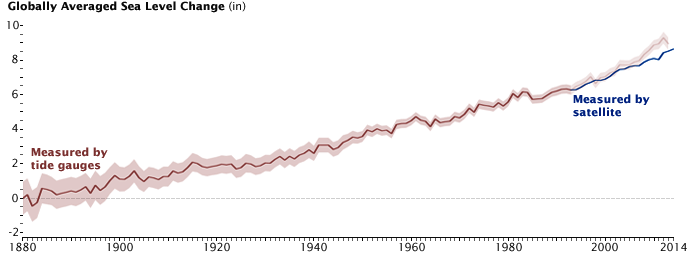
1. Global sea levels have already risen by 8 inches (200 mm) since 1880.
The chart above was produced by NASA’s Earth Observatory, based on data from the U.S. National Oceanic and Atmospheric Administration (NOAA) and Australia’s Commonwealth Scientific and Industrial Research Organization (CSIRO). Most of those historical data come from tide-gauge measurements, which are now complemented by satellite observations.
2. Not only are sea levels rising; the rate of their rise is rising.
Average global sea-level rise is now 3.41 mm per year, but the rate varies widely by location. (Image: NASA GSFC)
On average, sea levels rose by 1.4 mm from 1900 to 2000. The yearly pace had surpassed 3 mm by 2010, and now it’s up to 3.4 mm per year.
3. That’s the fastest sea-level rise Earth has experienced in 3,000 years.
If not for surging carbon dioxide in the atmosphere, sea levels should have only risen about an inch or two last century, and might have even fallen. Instead, thanks to the highest CO2 levels at any point in human history, global sea levels rose by 5.5 inches (14 cm) between 1900 and 2000. That’s the fastest oceanic advance in 27 centuries, according to a study published Feb. 22, and it’s still speeding up.
“The 20th century rise was extraordinary in the context of the last three millennia — and the rise over the last two decades has been even faster,” says lead author Robert Kopp, a climate scientist at Rutgers University, in a statement.
“Scenarios of future rise depend upon our understanding of the response of sea level to climate changes,” adds co-author Benjamin Horton. “Accurate estimates of sea-level variability during the past 3,000 years provide a context for such projections.”
4. Every vertical inch of sea-level rise moves the ocean 50 to 100 inches inland.
Rising seas worsen regular flooding — like this 2015 high tide in Miami Beach — for many coastal cities. Miami is in the midst of a five-year, $400 million effort to upgrade its stormwater pump program. (Photo: Joe Raedle/Getty Images)
5. That’s already causing flood problems in many big coastal cities.
As the ocean invades coastal cities, the first signs of trouble are often urban saltwater floods. These can also happen naturally, though, so to determine the influence of rising seas, a new report by Climate Central models “alternative histories simulating the absence of anthropogenic climate change” at 27 U.S. tide gauges.
Out of 8,726 days since 1950 when unaltered water levels exceeded the National Weather Service thresholds for local “nuisance” floods, 5,809 didn’t exceed those thresholds in the alternative histories. “In other words,” the report explains, “human-caused global sea level rise effectively tipped the balance, pushing high-water events over the threshold, for about two-thirds of the observed flood days.”
Coastal flooding days have more than doubled in the U.S. since the 1980s, according to the report, in places ranging from Miami, Virginia Beach and New York to San Francisco, Seattle and Honolulu. According to a 2014 report, at least 180 floods will strike Annapolis, Maryland, during high tides every year by 2030 — sometimes twice a day. The same will be true for about a dozen other U.S. cities by 2045, not to mention many other low-lying urban areas around the world.
Albeit, a slightly tongue-in-cheek fix from this ex-Brit.
I thought after yesterday’s pretty grim and turgid post that today’s offering should be connected but not in nearly such a dark manner.
The following came to me having done quite a few rounds so it’s not clear whom I should thank. But it’s an interesting proposition; nonetheless.
ooOOoo
A MESSAGE FROM THE QUEEN
To the citizens of the United States of America from Her Sovereign Majesty Queen Elizabeth II:
In light of your failure to nominate competent candidates for President of the USA and thus to govern yourselves, we hereby give notice of the revocation of your independence, effective immediately. (You should look up ‘revocation’ in the Oxford English Dictionary.)
Her Sovereign Majesty Queen Elizabeth II will resume monarchical duties over all states, commonwealths, and territories (except North Dakota, which she does not fancy).
Your new Prime Minister, David Cameron, will appoint a Governor for America without the need for further elections.
Congress and the Senate will be disbanded. A questionnaire may be circulated next year to determine whether any of you noticed.
To aid in the transition to a British Crown dependency, the following rules are introduced with immediate effect:
———————–
The letter ‘U’ will be reinstated in words such as ‘colour,’ ‘favour,’ ‘labour’ and ‘neighbour.’ Likewise, you will learn to spell ‘doughnut’ without skipping half the letters, and the suffix ‘-ize’ will be replaced by the suffix ‘-ise.’ Generally, you will be expected to raise your vocabulary to acceptable levels. (look up ‘vocabulary’).
————————
Using the same twenty-seven words interspersed with filler noises such as ”like’ and ‘you know’ is an unacceptable and inefficient form of communication. There is no such thing as U.S. English. We will let Microsoft know on your behalf. The Microsoft spell-checker will be adjusted to take into account the reinstated letter ‘u” and the elimination of ‘-ize.’
——————-
July 4th will no longer be celebrated as a holiday.
—————–
You will learn to resolve personal issues without using guns, lawyers, or therapists. The fact that you need so many lawyers and therapists shows that you’re not quite ready to be independent. Guns should only be used for shooting grouse. If you can’t sort things out without suing someone or speaking to a therapist, then you’re not ready to shoot grouse.
———————-
Therefore, you will no longer be allowed to own or carry anything more dangerous than a vegetable peeler. Although a permit will be required if you wish to carry a vegetable peeler in public.
———————-
All intersections will be replaced with roundabouts, and you will start driving on the left side with immediate effect. At the same time, you will go metric with immediate effect and without the benefit of conversion tables. Both roundabouts and metrication will help you understand the British sense of humour.
——————–
The former USA will adopt UK prices on petrol (which you have been calling gasoline) of roughly $10/US gallon. Get used to it.
——————-
You will learn to make real chips. Those things you call French fries are not real chips, and those things you insist on calling potato chips are properly called crisps. Real chips are thick cut, fried in animal fat, and dressed not with catsup but with vinegar.
——————-
The cold, tasteless stuff you insist on calling beer is not actually beer at all. Henceforth, only proper British Bitter will be referred to as beer, and European brews of known and accepted provenance will be referred to as Lager. South African beer is also acceptable, as they are pound for pound the greatest sporting nation on earth and it can only be due to the beer. They are also part of the British Commonwealth – see what it did for them. American brands will be referred to as Near-Frozen Gnat’s Urine, so that all can be sold without risk of further confusion.
———————
Hollywood will be required occasionally to cast English actors as good guys. Hollywood will also be required to cast English actors to play English characters. Watching Andie Macdowell attempt English dialect in Four Weddings and a Funeral was an experience akin to having one’s ears removed with a cheese grater.
———————
You will cease playing American football. There is only one kind of proper football; you call it soccer. Those of you brave enough will, in time, be allowed to play rugby (which has some similarities to American football, but does not involve stopping for a rest every twenty seconds or wearing full kevlar body armour like a bunch of nancies).
———————
Further, you will stop playing baseball. It is not reasonable to host an event called the World Series for a game which is not played outside of America. Since only 2.1% of you are aware there is a world beyond your borders, your error is understandable. You will learn cricket, and we will let you face the South Africans first to take the sting out of their deliveries.
——————–
13.. You must tell us who killed JFK. It’s been driving us mad.
—————–
An internal revenue agent (i.e. tax collector) from Her Majesty’s Government will be with you shortly to ensure the acquisition of all monies due (backdated to 1776).
—————
Daily Tea Time begins promptly at 4 p.m. with proper cups, with saucers, and never mugs, with high quality biscuits (cookies) and cakes; plus strawberries (with cream) when in season.
God Save the Queen!
ooOOoo
Can’t beat that for advice!
Preliminaries taking place in a very genteel (British) fashion!
Note: This is a long and pretty depressing post yet one that contains a critically vital message. Just wanted to flag that up.
This is not the first time I have used this expression as a header to a blogpost. The first time was back in August 2013 when I introduced the TomDispatch essay: Rebecca Solnit, The Age of Inhuman Scale.
I am using it again to introduce another TomDispatch essay. Like the Solnit essay a further reflection on the incredible madness of these present global times.
To Stay Below 2C, CO2 Emissions Have To Stop Now. We Are On The Red Trajectory: Total Disaster
Adding:
Tempo depended upon the CO2 concentration, pitch upon the Earth global temperature, distortion upon the energy balance on land in watts per square meter. The numbers used were past and anticipated. After 2015, the graphs became two: one was red, the bad case scenario, the other was blue, and represented the good scenario.
As I looked at the blue graphs, the optimistic graphs, I got displeased: the blue CO2 emissions, the blue temperature, and the blue power imbalance, had a very sharp angle, just in 2016. First a sharp angle is mathematically impossible: as it is now, the curves of CO2, and temperature are smooth curves going up (on the appropriate time scale). It would require infinite acceleration, infinite force. Even if one stopped magically any human generated greenhouse gases emissions next week, the CO2 concentration would still be above 400 ppm (it is 404 ppm now). And it would stay this way for centuries. So temperature would still rise.
The composer, who was on stage, had been advised by a senior climate scientist, a respectable gentleman with white hair, surrounded by a court, who got really shocked when I came boldly to him, and told him his blue graph was mathematically impossible.
I told him that one cannot fit a rising, smooth exponential with a sharp angle bending down and a line. Just fitting the curves in the most natural, smooth and optimistic way gives a minimum temperature rise of four degrees Celsius. (There is a standard mathematical way to do this, dating back to Newton.)
However, I find the malaise gripping us in these times to be infinitely more difficult to understand than what is or is not mathematically possible. I just can’t get my mind around the possibility that we are in an era where greed, inequality and the pursuit of power and money will take the whole of humanity over the edge.
But rather than acknowledging the climate risk posed by further expansion of LNG export infrastructure, the U.S. Congress and the Obama administration are moving in the opposite direction.
The natural gas export industry may grow even more rapidly if the first new bipartisan energy legislation drafted since 2007 passes. The Energy Policy Modernization Act of 2015, known as S. 2012, would expedite permitting for LNG export terminals.
The bill’s passage was considered imminent until it derailed with the introduction of an amendment that would provide emergency aid towards solving the lead-contaminated water crisis in Flint, Michigan. Now the passage of the bill hinges on whether the Senate will come to terms on aid to Flint.
Lobbying for the bill has been heavy. As DeSmog’s Steve Horn reported: “The list of lobbyists for S.2012 is a who’s who of major fossil fuel corporations and their trade associations: BP, ExxonMobil, America’s Natural Gas Alliance, American Petroleum Institute, Peabody Energy, Arch Coal, Southern Company, Duke Energy and many other prominent LNG export companies.”
I highlighted the name ExxonMobil in that extract because that company is the subject of Tom Engelhardt’s essay from Bill McKibben. Republished here with Tom’s kind permission.
ooOOoo
Tomgram: Bill McKibben, It’s Not Just What Exxon Did, It’s What It’s Doing
The time scale should stagger you. Just imagine for a moment that what we humans do on this planet will last at least 10,000 more years, and no, I’m not talking about those statues on Easter Island or the pyramids or the Great Wall of China or the Empire State Building. I’m not talking about any of our monumental architectural-cum-artistic achievements. Ten thousand years from now all the monuments to our history may be forgotten ruins or simply obliterated, while what we’re doing at this very moment that’s truly ruinous may outlast us all. I’m thinking, of course, about the burning of fossil fuels and the sending of carbon dioxide (and other greenhouse gases) into the atmosphere. It’s becoming clearer by the month that, if not brought under control relatively quickly, this process will alter the global environment in ways that will affect humanity and everything else living on this planet for what, from a human point of view, is eternity.
In essence, there’s no backsies when it comes to climate change. Once you’ve begun the full-scale destabilization and melting of the Greenland ice sheet and of the vast ice sheets in the Antarctic, for instance, the future inundation of coastal areas, including many of humanity’s major cities, is a foregone conclusion somewhere down the line. In fact, a recent study, published in the journal Nature Climate Change by 22 climate scientists, suggests that when it comes to the melting of ice sheets and the rise of seas and oceans, we’re not just talking about how life will be changed on Planet Earth in 2100 or even 2200. We’re potentially talking about what it will be like in 12,200, an expanse of time twice as long as human history to date. So many thousands of years are hard even to fathom, but as the study points out, “A considerable fraction of the carbon emitted to date and in the next 100 years will remain in the atmosphere for tens to hundreds of thousands of years.” The essence of the report, as Chris Mooney wrote in the Washington Post, is this: “In 10,000 years, if we totally let it rip, the planet could ultimately be an astonishing 7 degrees Celsius warmer on average and feature seas 52 meters (170 feet) higher than they are now.”
Even far more modest temperature changes like the two degree Celsius rise discussed at the recent Paris meeting, where 196 nations signed onto a climate change agreement, would transform the face of the planet for thousands of years and result in the drowning of a range of iconic global cities “including New York, London, Rio de Janeiro, Cairo, Calcutta, Jakarta, and Shanghai.”
This, in other words, is what the hunt for yet more fossil fuels and more profits by the planet’s giant energy companies actually means — not tomorrow, but on a scale we don’t usually consider. This is why those who continue to insist on pursuing such a treasure hunt (for a few companies and their shareholders), despite knowing its grim future results, will truly be in the running with some of the monsters of our past to become the ultimate criminals of history. In this light, consider what Bill McKibben, TomDispatch regular, founder of 350.org, and author most recently of Oil and Honey: The Education of an Unlikely Activist, has to say about one of those companies, ExxonMobil, and its pivotal role in our warming world. Tom Exxon’s Never-Ending Big Dig Flooding the Earth With Fossil Fuels
By Bill McKibben
Here’s the story so far. We have the chief legal representatives of the eighth and 16th largest economies on Earth (California and New York) probing the biggest fossil fuel company on Earth (ExxonMobil), while both Democratic presidential candidates are demanding that the federal Department of Justice join the investigation of what may prove to be one of the biggest corporate scandals in American history. And that’s just the beginning. As bad as Exxon has been in the past, what it’s doing now — entirely legally — is helping push the planet over the edge and into the biggest crisis in the entire span of the human story.
Back in the fall, you might have heard something about how Exxon had covered up what it knew early on about climate change. Maybe you even thought to yourself: that doesn’t surprise me. But it should have. Even as someone who has spent his life engaged in the bottomless pit of greed that is global warming, the news and its meaning came as a shock: we could have avoided, it turns out, the last quarter century of pointless climate debate.
The results of all that work were unequivocal. By 1982, in an internal “corporate primer,” Exxon’s leaders were told that, despite lingering unknowns, dealing with climate change “would require major reductions in fossil fuel combustion.” Unless that happened, the primer said, citing independent experts, “there are some potentially catastrophic events that must be considered… Once the effects are measurable, they might not be reversible.” But that document, “given wide circulation” within Exxon, was also stamped “Not to be distributed externally.”
So here’s what happened. Exxon used its knowledge of climate change to plan its own future. The company, for instance, leased large tracts of the Arctic for oil exploration, territory where, as a company scientist pointed out in 1990, “potential global warming can only help lower exploration and development costs.” Not only that but, “from the North Sea to the Canadian Arctic,” Exxon and its affiliates set about “raising the decks of offshore platforms, protecting pipelines from increasing coastal erosion, and designing helipads, pipelines, and roads in a warming and buckling Arctic.” In other words, the company started climate-proofing its facilities to head off a future its own scientists knew was inevitable.
But in public? There, Exxon didn’t own up to any of this. In fact, it did precisely the opposite. In the 1990s, it started to put money and muscle into obscuring the science around climate change. It funded think tanks that spread climate denial and even recruited lobbying talent from the tobacco industry. It also followed the tobacco playbook when it came to the defense of cigarettes by highlighting “uncertainty” about the science of global warming. And it spent lavishly to back political candidates who were ready to downplay global warming.
Its CEO, Lee Raymond, even traveled to China in 1997 and urged government leaders there to go full steam ahead in developing a fossil fuel economy. The globe was cooling, not warming, he insisted, while his engineers were raising drilling platforms to compensate for rising seas. “It is highly unlikely,” he said, “that the temperature in the middle of the next century will be significantly affected whether policies are enacted now or 20 years from now.” Which wasn’t just wrong, but completely and overwhelmingly wrong — as wrong as a man could be.
Sins of Omission
In fact, Exxon’s deceit — its ability to discourage regulations for 20 years — may turn out to be absolutely crucial in the planet’s geological history. It’s in those two decades that greenhouse gas emissions soared, as did global temperatures until, in the twenty-first century, “hottest year ever recorded” has become a tired cliché. And here’s the bottom line: had Exxon told the truth about what it knew back in 1990, we might not have wasted a quarter of a century in a phony debate about the science of climate change, nor would anyone have accused Exxon of being “alarmist.” We would simply have gotten to work.
But Exxon didn’t tell the truth. A Yale study published last fall in the Proceedings of the National Academy of Sciences showed that money from Exxon and the Koch Brothers played a key role in polarizing the climate debate in this country.
The company’s sins — of omission and commission — may even turn out to be criminal. Whether the company “lied to the public” is the question that New York Attorney General Eric Schneiderman decided to investigate last fall in a case that could make him the great lawman of our era if his investigation doesn’t languish. There are various consumer fraud statutes that Exxon might have violated and it might have failed to disclose relevant information to investors, which is the main kind of lying that’s illegal in this country of ours. Now, Schneiderman’s got backup from California Attorney General Kamala Harris, and maybe — if activists continue to apply pressure — from the Department of Justice as well, though its highly publicized unwillingness to go after the big banks does not inspire confidence.
Here’s the thing: all that was bad back then, but Exxon and many of its Big Energy peers are behaving at least as badly now when the pace of warming is accelerating. And it’s all legal — dangerous, stupid, and immoral, but legal.
On the face of things, Exxon has, in fact, changed a little in recent years.
For one thing, it’s stopped denying climate change, at least in a modest way. Rex Tillerson, Raymond’s successor as CEO, stopped telling world leaders that the planet was cooling. Speaking in 2012 at the Council on Foreign Relations, he said, “I’m not disputing that increasing CO2 emissions in the atmosphere is going to have an impact. It’ll have a warming impact.”
As a start, investigations by the Pulitzer-Prize winning Inside Climate News, the Los Angeles Times, and Columbia Journalism School revealed in extraordinary detail that Exxon’s top officials had known everything there was to know about climate change back in the 1980s. Even earlier, actually. Here’s what senior company scientist James Black told Exxon’s management committee in 1977: “In the first place, there is general scientific agreement that the most likely manner in which mankind is influencing the global climate is through carbon dioxide release from the burning of fossil fuels.” To determine if this was so, the company outfitted an oil tanker with carbon dioxide sensors to measure concentrations of the gas over the ocean, and then funded elaborate computer models to help predict what temperatures would do in the future.
Of course, he immediately went on to say that its impact was uncertain indeed, hard to estimate, and in any event entirely manageable. His language was striking. “We will adapt to this. Changes to weather patterns that move crop production areas around — we’ll adapt to that. It’s an engineering problem, and it has engineering solutions.”
Add to that gem of a comment this one: the real problem, he insisted, was that “we have a society that by and large is illiterate in these areas, science, math, and engineering, what we do is a mystery to them and they find it scary. And because of that, it creates easy opportunities for opponents of development, activist organizations, to manufacture fear.”
Right. This was in 2012, within months of floods across Asia that displaced tens of millions and during the hottest summer ever recorded in the United States, when much of our grain crop failed. Oh yeah, and just before Hurricane Sandy.
He’s continued the same kind of belligerent rhetoric throughout his tenure. At last year’s ExxonMobil shareholder meeting, for instance, he said that if the world had to deal with “inclement weather,” which “may or may not be induced by climate change,” we should employ unspecified “new technologies.” Mankind, he explained, “has this enormous capacity to deal with adversity.”
In other words, we’re no longer talking about outright denial, just a denial that much really needs to be done. And even when the company has proposed doing something, its proposals have been strikingly ethereal. Exxon’s PR team, for instance, has discussed supporting a price on carbon, which is only what economists left, right, and center have been recommending since the 1980s. But the minimal price they recommend — somewhere in the range of $40 to $60 a ton — wouldn’t do much to slow down their business. After all, they insist that all their reserves are still recoverable in the context of such a price increase, which would serve mainly to make life harder for the already terminal coal industry.
But say you think it’s a great idea to put a price on carbon — which, in fact, it is, since every signal helps sway investment decisions. In that case, Exxon’s done its best to make sure that what they pretend to support in theory will never happen in practice.
Consider, for instance, their political contributions. The website Dirty Energy Money, organized by Oil Change International, makes it easy to track who gave what to whom. If you look at all of Exxon’s political contributions from 1999 to the present, a huge majority of their political harem of politicians have signed the famous Taxpayer Protection Pledge from Grover Norquist’s Americans for Tax Reform that binds them to vote against any new taxes. Norquist himself wrote Congress in late January that “a carbon tax is a VAT or Value Added Tax on training wheels. Any carbon tax would inevitably be spread out over wider and wider parts of the economy until we had a European Value Added Tax.” As he told a reporter last year, “I don’t see the path to getting a lot of Republican votes” for a carbon tax, and since he’s been called “the most powerful man in American politics,” that seems like a good bet.
The only Democratic senator in Exxon’s top 60 list was former Louisiana solon Mary Landrieu, who made a great virtue in her last race of the fact that she was “the key vote” in blocking carbon pricing in Congress. Bill Cassidy, the man who defeated her, is also an Exxon favorite, and lost no time in co-sponsoring a bill opposing any carbon taxes. In other words, you could really call Exxon’s supposed concessions on climate change a Shell game. Except it’s Exxon.
The Never-Ending Big Dig
Even that’s not the deepest problem.
The deepest problem is Exxon’s business plan. The company spends huge amounts of money searching for new hydrocarbons. Given the recent plunge in oil prices, its capital spending and exploration budget was indeed cut by 12% in 2015 to $34 billion, and another 25% in 2016 to $23.2 billion. In 2015, that meant Exxon was spending $63 million a day “as it continues to bring new projects on line.” They are still spending a cool $1.57 billion a year looking for new sources of hydrocarbons — $4 million a day, every day.
As Exxon looks ahead, despite the current bargain basement price of oil, it still boasts of expansion plans in the Gulf of Mexico, eastern Canada, Indonesia, Australia, the Russian far east, Angola, and Nigeria. “The strength of our global organization allows us to explore across all geological and geographical environments, using industry-leading technology and capabilities.” And its willingness to get in bed with just about any regime out there makes it even easier. Somewhere in his trophy case, for instance, Rex Tillerson has an Order of Friendship medal from one Vladimir Putin. All it took was a joint energy venture estimated to be worth $500 billion.
But, you say, that’s what oil companies do, go find new oil, right? Unfortunately, that’s precisely what we can’t have them doing any more. About a decade ago, scientists first began figuring out a “carbon budget” for the planet — an estimate for how much more carbon we could burn before we completely overheated the Earth. There are potentially many thousands of gigatons of carbon that could be extracted from the planet if we keep exploring. The fossil fuel industry has already identified at least 5,000 gigatons of carbon that it has told regulators, shareholders, and banks it plans to extract. However, we can only burn about another 900 gigatons of carbon before we disastrously overheat the planet. On our current trajectory, we’d burn through that “budget” in about a couple of decades. The carbon we’ve burned has already raised the planet’s temperature a degree Celsius, and on our present course we’ll burn enough to take us past two degrees in less than 20 years.
At this point, in fact, no climate scientist thinks that even a two-degree rise in temperature is a safe target, since one degree is already melting the ice caps. (Indeed, new data released this month shows that, if we hit the two-degree mark, we’ll be living with drastically raised sea levels for, oh, twice as long as human civilization has existed to date.) That’s why in November world leaders in Paris agreed to try to limit the planet’s temperature rise to 1.5 degrees Celsius, or just under three degrees Fahrenheit. If you wanted to meet that target, however, you would need to be done burning fossil fuels by perhaps 2020, which is in technical terms just about now.
That’s why it’s wildly irresponsible for a company to be leading the world in oil exploration when, as scientists have carefully explained, we already have access to four or five times as much carbon in the Earth as we can safely burn. We have it, as it were, on the shelf. So why would we go looking for more? Scientists have even done us the useful service of identifying precisely the kinds of fossil fuels we should never dig up, and — what do you know — an awful lot of them are on Exxon’s future wish list, including the tar sands of Canada, a particularly carbon-filthy, environmentally destructive fuel to produce and burn.
Even Exxon’s one attempt to profit from stanching global warming has started to come apart. Several years ago, the company began a calculated pivot in the direction of natural gas, which produces less carbon than oil when burned. In 2009, Exxon acquired XTO Energy, a company that had mastered the art of extracting gas from shale via hydraulic fracturing. By now, Exxon has become America’s leading fracker and a pioneer in natural gas markets around the world. The trouble with fracked natural gas — other than what Tillerson once called “farmer Joe’s lit his faucet on fire” — is this: in recent years, it’s become clear that the process of fracking for gas releases large amounts of methane into the atmosphere, and methane is a far more potent greenhouse gas than carbon dioxide. As Cornell University scientist Robert Howarth has recently established, burning natural gas to produce electricity probably warms the planet faster than burning coal or crude oil.
Exxon’s insistence on finding and producing ever more fossil fuels certainly benefited its shareholders for a time, even if it cost the Earth dearly. Five of the 10 largest annual profits ever reported by any company belonged to Exxon in these years. Even the financial argument is now, however, weakening. Over the last five years, Exxon has lagged behind many of its competitors as well as the broader market, and a big reason, according to the Carbon Tracker Initiative (CTI), is its heavy investment in particularly expensive, hard-to-recover oil and gas.
In 2007, as CTI reported, Canadian tar sands and similar “heavy oil” deposits accounted for 7.5% of Exxon’s proven reserves. By 2013, that number had risen to 17%. A smart business strategy for the company, according to CTI, would involve shrinking its exploration budget, concentrating on the oil fields it has access to that can still be pumped profitably at low prices, and using the cash flow to buy back shares or otherwise reward investors.
That would, however, mean exchanging Exxon’s Texan-style big-is-good approach for something far more modest. And since we’re speaking about what was the biggest company on the planet for a significant part of the twentieth century, Exxon seems to be set on continuing down that bigger-is-better path. They’re betting that the price of oil will rise in the reasonably near future, that alternative energy won’t develop fast enough, and that the world won’t aggressively tackle climate change. And the company will keep trying to cover those bets by aggressively backing politicians capable of ensuring that nothing happens.
Can Exxon Be Pressured?
Next to that fierce stance on the planet’s future, the mild requests of activists for the last 25 years seem… well, next to pointless. At the 2015 ExxonMobil shareholder meeting, for instance, religious shareholder activists asked for the umpteenth time that the company at least make public its plans for managing climate risks. Even BP, Shell, and Statoil had agreed to that much. Instead, Exxon’s management campaigned against the resolution and it got only 9.6% of shareholder votes, a tally so low it can’t even be brought up again for another three years. By which time we’ll have burned through… oh, never mind.
What we need from Exxon is what they’ll never give: a pledge to keep most of their reserves underground, an end to new exploration, and a promise to stay away from the political system. Don’t hold your breath.
But if Exxon seems hopelessly set in its ways, revulsion is growing. The investigations by the New York and California attorneys general mean that the company will have to turn over lots of documents. If journalists could find out as much as they did about Exxon’s deceit in public archives, think what someone with subpoena power might accomplish. Many other jurisdictions could jump in, too.
At the Paris climate talks in December, a panel of law professors led a well-attended session on the different legal theories that courts around the world might apply to the company’s deceptive behavior. When that begins to happen, count on one thing: the spotlight won’t shine exclusively on Exxon. As with the tobacco companies in the decades when they were covering up the dangers of cigarettes, there’s a good chance that the Big Energy companies were in this together through their trade associations and other front groups. In fact, just before Christmas, Inside Climate Newspublished some revealing new documents about the role that Texaco, Shell, and other majors played in an American Petroleum Institute study of climate change back in the early 1980s. A trial would be a transformative event — a reckoning for the crime of the millennium.
But while we’re waiting for the various investigations to play out, there’s lots of organizing going at the state and local level when it comes to Exxon, climate change, and fossil fuels — everything from politely asking more states to join the legal process to politely shutting down gas stations for a few hours to pointing out to New York and California that they might not want to hold millions of dollars of stock in a company they’re investigating. It may even be starting to work.
Vermont Governor Peter Shumlin, for instance, singled Exxon out in his state of the state address last month. He called on the legislature to divest the state of its holdings in the company because of its deceptions. “This is a page right out of Big Tobacco,” he said, “which for decades denied the health risks of their product as they were killing people. Owning ExxonMobil stock is not a business Vermont should be in.”
The question is: Why on God’s-not-so-green-Earth-anymore would anyone want to be Exxon’s partner?
Let me close this tale of modern madness with the closing words from Patrice’s essay:
American plutocrats are always one step ahead of the propaganda game. After spending decades claiming the Earth was not warming, now they are pretending, thanks to this impossible blue graph, that we stop the deleterious effects on the biosphere on a dime, should the USA want it.
And the scientists are playing along… because they want the money. And the influence. And the plutocrats in the audience. And the American population confusedly feel that the USA is better off with cheap gas.
As I explained, the Moral Imperative is to think correctly, and the first imperative of scientists should be to teach what is impossible. It’s impossible to stop the nefarious effects on the biosphere on a dime. There is huge inertia in the world climate and geophysics. Right now, climate change is happening at a rate 100,000 times the rate of the preceding great extinctions (they probably had to do with huge, sustained volcanism, direct from the core).
In the best scenario of business as usual, most of energy from fossil fuels, we are on 4 degree Centigrade global warming scenario. And that means the poles will melt entirely. That will make the present Middle East disarray feel as if it had been a walk in a pleasant park.
Patrice Ayme’
Pure unadulterated madness! And I feel utterly powerless to stop it!
That sub-heading is a very old proverb supporting the idea “that even when the outcome of an event seems certain, things can still go wrong.”
That proverb came to me when I was reading a TomDispatch essay that was published last Tuesday. I couldn’t make up my mind about whether or not to continue with yesterday’s mood of “Living in interesting times” but in the end decided to so do. Because Peter Van Buren’s essay, published as a Tomgram, needs to be widely read so that as many as possible appreciate the need to reach out to those that should be supported.
I am very grateful to Tom Engelhardt for his continuing permission for me to republish his TomDispatch essays.
ooOOoo
Tomgram: Peter Van Buren, Minimum Wage, Minimum Chance
To say that we live on a 1% planet isn’t just a turn of phrase. In fact, it would undoubtedly be more accurate to speak of a .1% or a .01% planet. In recent years, wealth and income inequalities have grown in a notorious fashion in the United States — and, as it turns out, globally as well. In January, Oxfam released a report on the widening gap between global wealth and poverty. It found that, between 2010 and today, the wealth of the poorest half of the planet’s population fell by a trillion dollars, a drop of 41%, while that of the richest 62 people (53 men and 9 women) increased by half a trillion dollars. Put another way, those 62 billionaires were wealthier than the bottom 50% of the world’s people, while the richest 1% owned more than the other 99% combined. The direction in which we’re heading is obvious. Just consider that, in 2010, it took 388 of the super-rich to equal the holdings of the bottom 50%; now, that number is 326 people smaller.
Keep that trend line in mind as you read about TomDispatch regular Peter Van Buren’s latest adventures in the minimum-wage economy. Back in 2014, he described for this site how, having lost his State Department job for being a whistleblower on the Iraq War, he fell for a time into the low-wage world. As he wrote, “And soon enough, I did indeed find myself working in exactly that economy and, worse yet, trying to live on the money I made. But it wasn’t just the money. There’s this American thing in which jobs define us, and those definitions tell us what our individual futures and the future of our society is likely to be. And believe me, rock bottom is a miserable base for any future.” His experiences in a big-box retail store inspired him to write his novel, Ghosts of Tom Joad: A Story of the #99Percent. As last year ended, he returned to the minimum-wage world, now — thanks in particular to Bernie Sanders — part of the national conversation. And here’s what he found. Tom
Nickel and Dimed in 2016 You Can’t Earn a Living on the Minimum Wage
By Peter Van Buren
When presidential candidate Bernie Sanders talks about income inequality, and when other candidates speak about the minimum wage and food stamps, what are they really talking about?
Whether they know it or not, it’s something like this.
My Working Life Then
A few years ago, I wrote about my experience enmeshed in the minimum-wage economy, chronicling the collapse of good people who could not earn enough money, often working 60-plus hours a week at multiple jobs, to feed their families. I saw that, in this country, people trying to make ends meet in such a fashion still had to resort to food benefit programs and charity. I saw an employee fired for stealing lunches from the break room refrigerator to feed himself. I watched as a co-worker secretly brought her two kids into the store and left them to wander alone for hours because she couldn’t afford childcare. (As it happens, 29% of low-wage employees are single parents.)
At that point, having worked at the State Department for 24 years, I had been booted out for being a whistleblower. I wasn’t sure what would happen to me next and so took a series of minimum wage jobs. Finding myself plunged into the low-wage economy was a sobering, even frightening, experience that made me realize just how ignorant I had been about the lives of the people who rang me up at stores or served me food in restaurants. Though millions of adults work for minimum wage, until I did it myself I knew nothing about what that involved, which meant I knew next to nothing about twenty-first-century America.
I was lucky. I didn’t become one of those millions of people trapped as the “working poor.” I made it out. But with all the election talk about the economy, I decided it was time to go back and take another look at where I had been, and where too many others still are.
My Working Life Now
I found things were pretty much the same in 2016 as they were in 2012, which meant — because there was no real improvement — that things were actually worse.
This time around, I worked for a month and a half at a national retail chain in New York City. While mine was hardly a scientific experiment, I’d be willing to bet an hour of my minimum-wage salary ($9 before taxes) that what follows is pretty typical of the New Economy.
Just getting hired wasn’t easy for this 56-year-old guy. To become a sales clerk, peddling items that were generally well under $50 a pop, I needed two previous employment references and I had to pass a credit check. Unlike some low-wage jobs, a mandatory drug test wasn’t part of the process, but there was a criminal background check and I was told drug offenses would disqualify me. I was given an exam twice, by two different managers, designed to see how I’d respond to various customer situations. In other words, anyone without some education, good English, a decent work history, and a clean record wouldn’t even qualify for minimum-wage money at this chain.
And believe me, I earned that money. Any shift under six hours involved only a 15-minute break (which cost the company just $2.25). Trust me, at my age, after hours standing, I needed that break and I wasn’t even the oldest or least fit employee. After six hours, you did get a 45-minute break, but were only paid for 15 minutes of it.
The hardest part of the job remained dealing with… well, some of you. Customers felt entitled to raise their voices, use profanity, and commit Trumpian acts of rudeness toward my fellow employees and me. Most of our “valued guests” would never act that way in other public situations or with their own coworkers, no less friends. But inside that store, shoppers seemed to interpret “the customer is always right” to mean that they could do any damn thing they wished. It often felt as if we were penned animals who could be poked with a stick for sport, and without penalty. No matter what was said or done, store management tolerated no response from us other than a smile and a “Yes, sir” (or ma’am).
The store showed no more mercy in its treatment of workers than did the customers. My schedule, for instance, changed constantly. There was simply no way to plan things more than a week in advance. (Forget accepting a party invitation. I’m talking about childcare and medical appointments.) If you were on the closing shift, you stayed until the manager agreed that the store was clean enough for you to go home. You never quite knew when work was going to be over and no cell phone calls were allowed to alert babysitters of any delay.
And keep in mind that I was lucky. I was holding down only one job in one store. Most of my fellow workers were trying to juggle two or three jobs, each with constantly changing schedules, in order to stitch together something like a half-decent paycheck.
In New York City, that store was required to give us sick leave only after we’d worked there for a full year — and that was generous compared to practices in many other locales. Until then, you either went to work sick or stayed home unpaid. Unlike New York, most states do not require such a store to offer any sick leave, ever, to employees who work less than 40 hours a week. Think about that the next time your waitress coughs.
Minimum Wages and Minimum Hours
Much is said these days about raising the minimum wage (and it should be raised), and indeed, on January 1, 2016, 13 states did raise theirs. But what sounds like good news is unlikely to have much effect on the working poor.
In New York, for instance, the minimum went from $8.75 an hour to the $9.00 I was making. New York is relatively generous. The current federal minimum wage is $7.25 and 21 states require only that federal standard. Presumably to prove some grim point or other, Georgia and Wyoming officially mandate an even lower minimum wage and then unofficially require the payment of $7.25 to avoid Department of Labor penalties. Some Southern states set no basement figure, presumably for similar reasons.
Don’t forget: any minimum wage figure mentioned is before taxes. Brackets vary, but let’s knock an even 10% off that hourly wage just as a reasonable guess about what is taken out of a minimum-wage worker’s salary. And there are expenses to consider, too. My round-trip bus fare every day, for instance, was $5.50. That meant I worked most of my first hour for bus fare and taxes. Keep in mind that some workers have to pay for childcare as well, which means that it’s not impossible to imagine a scenario in which someone could actually come close to losing money by going to work for short shifts at minimum wage.
In addition to the fundamental problem of simply not paying people enough, there’s the additional problem of not giving them enough hours to work. The two unfortunately go together, which means that raising the minimum rate is only part of any solution to improving life in the low-wage world.
At the store where I worked for minimum wage a few years ago, for instance, hours were capped at 39 a week. The company did that as a way to avoid providing the benefits that would kick in once one became a “full time” employee. Things have changed since 2012 — and not for the better.
Four years later, the hours of most minimum-wage workers are capped at 29. That’s the threshold after which most companies with 50 or more employees are required to pay into the Affordable Care Act (Obamacare) fund on behalf of their workers. Of course, some minimum wage workers get fewer than 29 hours for reasons specific to the businesses they work for.
It’s Math Time
While a lot of numbers follow, remember that they all add up to a picture of how people around us are living every day.
In New York, under the old minimum wage system, $8.75 multiplied by 39 hours equaled $341.25 a week before taxes. Under the new minimum wage, $9.00 times 29 hours equals $261 a week. At a cap of 29 hours, the minimum wage would have to be raised to $11.77 just to get many workers back to the same level of take-home pay that I got in 2012, given the drop in hours due to the Affordable Care Act. Health insurance is important, but so is food.
In other words, a rise in the minimum wage is only half the battle; employees need enough hours of work to make a living.
About food: if a minimum wage worker in New York manages to work two jobs (to reach 40 hours a week) without missing any days due to illness, his or her yearly salary would be $18,720. In other words, it would fall well below the Federal Poverty Line of $21,775. That’s food stamp territory. To get above the poverty line with a 40-hour week, the minimum wage would need to go above $10. At 29 hours a week, it would need to make it to $15 an hour. Right now, the highest minimum wage at a state level is in the District of Columbia at $11.50. As of now, no state is slated to go higher than that before 2018. (Some cities do set their own higher minimum wages.)
So add it up: The idea of raising the minimum wage (“the fight for $15”) is great, but even with that $15 in such hours-restrictive circumstances, you can’t make a loaf of bread out of a small handful of crumbs. In short, no matter how you do the math, it’s nearly impossible to feed yourself, never mind a family, on the minimum wage. It’s like being trapped on an M.C. Escher staircase.
The federal minimum wage hit its high point in 1968 at $8.54 in today’s dollars and while this country has been a paradise in the ensuing decades for what we now call the “One Percent,” it’s been downhill for low-wage workers ever since. In fact, since it was last raised in 2009 at the federal level to $7.25 per hour, the minimum has lost about 8.1% of its purchasing power to inflation. In other words, minimum-wage workers actually make less now than they did in 1968, when most of them were probably kids earning pocket money and not adults feeding their own children.
In adjusted dollars, the minimum wage peaked when the Beatles were still together and the Vietnam War raged.
Who Pays?
Many of the arguments against raising the minimum wage focus on the possibility that doing so would put small businesses in the red. This is disingenuous indeed, since 20 mega-companies dominate the minimum-wage world. Walmart alone employs 1.4 million minimum-wage workers; Yum Brands (Taco Bell, Pizza Hut, KFC) is in second place; and McDonald’s takes third. Overall, 60% of minimum-wage workers are employed by businesses not officially considered “small” by government standards, and of course carve-outs for really small businesses are possible, as was done with Obamacare.
Keep in mind that not raising wages costs you money.
Those minimum wage workers who can’t make enough and need to go on food assistance? Well, Walmart isn’t paying for those food stamps (now called SNAP), you are. The annual bill that states and the federal government foot for working families making poverty-level wages is $153 billion. A single Walmart Supercenter costs taxpayers between $904,542 and $1.75 million per year in public assistance money, and Walmart employees account for 18% of all food stamps issued. In other words, those everyday low prices at the chain are, in part, subsidized by your tax money.
If the minimum wage goes up, will spending on food benefits programs go down? Almost certainly. But won’t stores raise prices to compensate for the extra money they will be shelling out for wages? Possibly. But don’t worry — raising the minimum wage to $15 an hour would mean a Big Mac would cost all of 17 cents more.
Time Theft
My retail job ended a little earlier than I had planned, because I committed time theft.
You probably don’t even know what time theft is. It may sound like something from a sci-fi novel, but minimum-wage employers take time theft seriously. The basic idea is simple enough: if they’re paying you, you’d better be working. While the concept is not invalid per se, the way it’s used by the mega-companies reveals much about how the lowest wage workers are seen by their employers in 2016.
The problem at my chain store was that its in-store cafe was a lot closer to my work area than the time clock where I had to punch out whenever I was going on a scheduled break. One day, when break time on my shift came around, I only had 15 minutes. So I decided to walk over to that cafe, order a cup of coffee, and then head for the place where I could punch out and sit down (on a different floor at the other end of the store).
We’re talking an extra minute or two, no more, but in such operations every minute is tabulated and accounted for. As it happened, a manager saw me and stepped in to tell the cafe clerk to cancel my order. Then, in front of whoever happened to be around, she accused me of committing time theft — that is, of ordering on the clock. We’re talking about the time it takes to say, “Grande, milk, no sugar, please.” But no matter, and getting chastised on company time was considered part of the job, so the five minutes we stood there counted as paid work.
At $9 an hour, my per-minute pay rate was 15 cents, which meant that I had time-stolen perhaps 30 cents. I was, that is, being nickel and dimed to death.
Economics Is About People
It seems wrong in a society as wealthy as ours that a person working full-time can’t get above the poverty line. It seems no less wrong that someone who is willing to work for the lowest wage legally payable must also give up so much of his or her self-respect and dignity as a kind of tariff. Holding a job should not be a test of how to manage life as one of the working poor.
I didn’t actually get fired for my time theft. Instead, I quit on the spot. Whatever the price is for my sense of self-worth, it isn’t 30 cents. Unlike most of this country’s working poor, I could afford to make such a decision. My life didn’t depend on it. When the manager told a handful of my coworkers watching the scene to get back to work, they did. They couldn’t afford not to.
By the way, when I copied across that image of Peter Van Buren’s book the Buy The Book link didn’t work. If you are interested in buying the book then Amazon have it listed here.
My closing thought is directed as much to me and Jean as it is to you, my dear reader. It is this. Don’t read this post and think it’s too big a social problem for you. Find some way of making a difference. If you have recommendations as to how we lucky ones can make a difference please share them today! Thank you!
Dogs ‘teaching’ man to be so successful a hunter enabled evolution, some 20,000 years later, to farming, thence the long journey to modern man. But in the last, say 100 years, that farming spirit has become corrupted to the point where we see the planet’s plant and mineral resources as infinite. Mankind is close to the edge of extinction, literally and spiritually.
I continue that theme in Part Two of my book (Chapter 7: This Twenty-First Century)
Bad news sells! Bad news also causes stress and worry. In my previous explanation, I explained that the last thing you want is a catalogue of all the things that have that power to cause you stress and worry. However, I do see three fundamental aspects of this new century that have their roots in that loss of principles that I referred to in the previous chapter. They are
1. the global financial system,
2. the potential for social disorder, and
3. the process of government.
Because they are at the heart of how the coming years will pan out.
The first aspect, our global financial system, was selected because it underpins all our lives in so many ways. When I was living in southwest England I was a client of Kauders Portfolio Services[1]. The founder of the company, David Kauders, published[2] a book, The Greatest Crash, in 2011. It was an obvious read for me at that time and I still have the book on my shelves here in Oregon.
David explained that whether we like it or not, our lives are inextricably caught up in the twin dependencies of the global financial system: credit and debt. As he wrote in his opening chapter:
Households can barely afford their existing debts, let alone take on more. Since households now prefer not to borrow, indeed some even choose to pay back debt, it follows that those who have already borrowed, as a group, can no longer contribute to economic expansion.
People can be divided into borrowers and savers. With existing borrowers unable to afford or unwilling to take on extra debt, can new borrowers be found instead? Those who do not need to borrow are unlikely to volunteer. Except for the young wishing to buy houses, facing the reality that house prices are beyond their pockets, where are the new borrowers?
Businesses are also under pressure. There has been an inadequate recovery from recession, business prospects are poor as households cut back their spending. Lack of bank lending is a symptom rather than a cause, for if existing businesses were to be given more credit, they would probably be unlikely to find profitable growth opportunities in a world of austerity.
Later on in the book David describes this as “the financial system limit”. In other words, the period of growth and expansion, especially of financial and economic expansion, has come to an end in a structural sense. This was his perspective from 2011.
Recently, I chose to reread The Greatest Crash. What struck me forcibly, reading the book again some four years later on, was how visible this “system limit” appeared in the world today. Everywhere there are signs that the era of growth has come to an end. Many countries are now indebted to a point that reinforces the proposition of there being a financial system limit. The United States is greatly in debt[3] but the only thing mitigating that situation, for the time being anyway, is that the American dollar is the quasi dominant global currency.
The changing nature of the global population is also reinforcing the fact that this is the end of a long period of growth. Even without embracing the question of how much longer we can increase the number of people living on a finite planet, the demographics spell out a greater-than-even chance of a decline in consumption and economic activity. Simply because in all regions of the planet, except for India where there is still a growing youth element in the country, people are ageing. To state the obvious, ageing persons do not consume as much as middle-aged and younger persons.
Thus, the world’s economy that is just around the corner is certainly going to be very different to what it has been in the past. It is not being widely discussed. Worse than that, there is a widespread assumption adopted by many governments that a return to the “normal” economic growth of previous times is a given. Many do not share that assumption.
The second aspect that isn’t being spoken about is the potential for massive, widespread social disorder. All summed up in just three words: greed, inequality, and poverty. Just three words that metaphorically appear to me like a round, wooden lid hiding a very deep, dark well. That lifting this particular lid, the metaphorical one, exposes an almost endless drop into the depths of where our society appears to have fallen.
Even the slightest raising of awareness of where this modern global world is heading is scary. I have in mind the author Thomas Piketty who warned[4] that, “the inequality gap is toxic, dangerous.” Then there was the news in 2015[5] that, “Billionaires control the vast majority of the world’s wealth, 67 billionaires already own half the world’s assets; by 2100 we’ll have 11 trillionaires, while American worker income has stagnated for a generation.”
The third and final aspect that isn’t being widely discussed is the process of government. Not from the viewpoint of “left” or “right”, Labour or Conservative, Democratic or Republican (insert the labels appropriate to your own country), that is being discussed ad nauseum, but from the viewpoint of good government. It might be a terrible generalisation but it is still a fair criticism to say that many peoples of many countries have lost faith in their governments.
There appears to be a chronic absence of open debate about the need for good government, what that good government would look like, and how do societies bring it about.
If we were a dog pack, then our leader, our female mentor dog, would have moved us all to a new, pristine territory!
So, dear reader, you can understand why a recent article over on Naked Capitalism spoke to me. It was penned by Satyajit Das, a former banker and the author of a number of books. Both Satyajit and Yves, of Naked Capitalism, were delighted to offer me permission to republish the full post.
Yves here. If you’ve read Das regularly, one of the characteristics of his writing is wry detachment. The shift to a sense of foreboding is a big departure.
By Satyajit Das, a former banker and author whose latest book, The Age of Stagnation, is now available. The following is an edited excerpt from Age of Stagnation (published with the permission of Prometheus Books)
If you look for truth, you may find comfort in the end; if you look for comfort you will not get either comfort or truth, only . . . wishful thinking to begin, and in the end, despair. C.S. Lewis
The world is entering a period of stagnation, the new mediocre. The end of growth and fragile, volatile economic conditions are now the sometimes silent background to all social and political debates. For individuals, this is about the destruction of human hopes and dreams.
One Offs
For most of human history, as Thomas Hobbes recognised, life has been ‘solitary, poor, nasty, brutish, and short’. The fortunate coincidence of factors that drove the unprecedented improvement in living standards following the Industrial Revolution, and especially in the period after World War II, may have been unique, an historical aberration. Now, different influences threaten to halt further increases, and even reverse the gains.
Since the early 1980s, economic activity and growth have been increasingly driven by financialisation – the replacement of industrial activity with financial trading and increased levels of borrowing to finance consumption and investment. By 2007, US$5 of new debt was necessary to create an additional US$1 of American economic activity, a fivefold increase from the 1950s. Debt levels had risen beyond the repayment capacity of borrowers, triggering the 2008 crisis and the Great Recession that followed. But the world shows little sign of shaking off its addiction to borrowing. Ever-increasing amounts of debt now act as a brake on growth.
Growth in international trade and capital flows is slowing. Emerging markets that have benefited from and, in recent times, supported growth are slowing.
Rising inequality and economic exclusion also impacts negatively upon activity.
Financial problems are compounded by lower population growth and ageing populations; slower increases in productivity and innovation; looming shortages of critical resources, such as water, food and energy; and manmade climate change and extreme weather conditions.
The world requires an additional 64 billion cubic metres of water a year, equivalent to the annual water flow through Germany’s Rhine River. Agronomists estimate that production will need to increase by 60–100 percent by 2050 to feed the population of the world. While the world’s supply of energy will not be exhausted any time soon, the human race is on track to exhaust the energy content of hundreds of millions years’ worth of sunlight stored in the form of coal, oil and natural gas in a few hundred years. 10 tons of pre-historic buried plant and organic matter converted by pressure and heat over millennia was needed to create a single gallon (4.5 litres) of gasoline.
Europe is currently struggling to deal with a few million refugees fleeing conflicts in the Middle East. How will the world deal with hundreds of millions of people at risk of displacement as a resulting of rising sea levels?
Extend and Pretend
The official response to the 2008 crisis was a policy of ‘extend and pretend’, whereby authorities chose to ignore the underlying problem, cover it up, or devise deferral strategies to ‘kick the can down the road’. The assumption was that government spending, lower interest rates, and the supply of liquidity or cash to money markets would create growth. It would also increase inflation to help reduce the level of debt, by decreasing its value.
It was the grifter’s long con, a confidence trick with a potentially large payoff but difficult to pull off. Houses prices and stock markets have risen, but growth, employment, income and investment have barely recovered to pre-crisis levels in most advanced economies. Inflation for the most part remains stubbornly low.
In countries that have ‘recovered’, financial markets are, in many cases, at or above pre-crisis prices. But conditions in the real economy have not returned to normal. Must-have latest electronic gadgets cannot obscure the fact that living standards for most people are stagnant. Job insecurity has risen. Wages are static, where they are not falling. Accepted perquisites of life in developed countries, such as education, houses, health services, aged care, savings and retirement, are increasingly unattainable.
In more severely affected countries, conditions are worse. Despite talk of a return to growth, the Greek economy has shrunk by a quarter. Spending by Greeks has fallen by 40 percent, reflecting reduced wages and pensions. Reported unemployment is 26 percent of the labour force. Youth unemployment is over 50 percent. One commentator observed that the government could save money on education, as it was unnecessary to prepare people for jobs that did not exist.
Future generations may have fewer opportunities and lower living standards than their parents. A 2013 Pew Research Centre survey conducted in thirty-nine countries asked whether people believed that their children would enjoy better living standards: 33 percent of Americans believed so, as did 28 percent of Germans, 17 percent of British and 14 percent of Italians. Just 9 percent of French people thought their children would be better off than previous generations.
The Deadly Cure
Authorities have been increasingly forced to resort to untested policies including QE forever and negative interest rates. It was an attempt to buy time, to let economies achieve a self-sustaining recovery, as they had done before. Unfortunately the policies have not succeeded. The expensively purchased time has been wasted. The necessary changes have not been made.
There are toxic side effects. Global debt has increased, not decreased, in response to low rates and government spending. Banks, considered dangerously large after the events of 2008, have increased in size and market power since then. In the US the six largest banks now control nearly 70 percent of all the assets in the US financial system, having increased their share by around 40 percent.
Individual countries have sought to export their troubles, abandoning international cooperation for beggar-thy-neighbour strategies. Destructive retaliation, in the form of tit-for-tat interest rate cuts, currency wars, and restrictions on trade, limits the ability of any nation to gain a decisive advantage.
The policies have also set the stage for a new financial crisis. Easy money has artificially boosted prices of financial assets beyond their real value. A significant amount of this capital has flowed into and destabilised emerging markets. Addicted to government and central bank support, the world economy may not be able to survive without low rates and excessive liquidity.
Authorities increasingly find themselves trapped, with little room for manoeuvre and unable to discontinue support for the economy. Central bankers know, even if they are unwilling to publicly acknowledge it, that their tools are inadequate or exhausted, now possessing the potency of shamanic rain dances. More than two decades of trying similar measures in Japan highlight their ineffectiveness in avoiding stagnation.
Heart of the Matter
Conscious that the social compact requires growth and prosperity, politicians, irrespective of ideology, are unwilling to openly discuss the real issues. They claim crisis fatigue, arguing that the problems are too far into the future to require immediate action. Fearing electoral oblivion, they have succumbed to populist demands for faux certainty and placebo policies. But in so doing they are merely piling up the problems.
Policymakers interrogate their models and torture data, failing to grasp that ‘many of the things you can count don’t count [while] many of the things you can’t count really count’. The possibility of a historical shift does not inform current thinking.
It is not in the interest of bankers and financial advisers to tell their clients about the real outlook. Bad news is bad for business. The media and commentariat, for the most part, accentuate the positive. Facts, they argue, are too depressing. The priority is to maintain the appearance of normality, to engender confidence.
Ordinary people refuse to acknowledge that maybe you cannot have it all. But there is increasingly a visceral unease about the present and a fear of the future. Everyone senses that the ultimate cost of the inevitable adjustments will be large. It is not simply the threat of economic hardship; it is fear of a loss of dignity and pride. It is a pervasive sense of powerlessness.
For the moment, the world hopes for the best of times but is afraid of the worst. People everywhere resemble Dory, the Royal Blue Tang fish in the animated film Finding Nemo. Suffering from short-term memory loss, she just tells herself to keep on swimming. Her direction is entirely random and without purpose.
Reckoning Postponed
The world has postponed, indefinitely, dealing decisively with the challenges, choosing instead to risk stagnation or collapse. But reality cannot be deferred forever. Kicking the can down the road only shifts the responsibility for dealing with it onto others, especially future generations.
A slow, controlled correction of the financial, economic, resource and environmental excesses now would be serious but manageable. If changes are not made, then the forced correction will be dramatic and violent, with unknown consequences.
During the last half-century each successive economic crisis has increased in severity, requiring progressively larger measures to ameliorate its effects. Over time, the policies have distorted the economy. The effectiveness of instruments has diminished. With public finances weakened and interest rates at historic lows, there is now little room for manoeuvre. Geo-political risks have risen. Trust and faith in institutions and policy makers has weakened.
Economic problems are feeding social and political discontent, opening the way for extremism. In the Great Depression the fear and disaffection of ordinary people who had lost their jobs and savings gave rise to fascism. Writing of the period, historian A.J.P. Taylor noted: ‘[the] middle class, everywhere the pillar of stability and respectability . . . was now utterly destroyed . . . they became resentful . . . violent and irresponsible . . . ready to follow the first demagogic saviour . . .’
The new crisis that is now approaching or may already be with us will be like a virulent infection attacking a body whose immune system is already compromised.
As Robert Louis Stevenson knew, sooner or later we all have to sit down to a banquet of consequences.
Loving our wilderness is another vital loving relationship
I quite deliberately named today’s post so that it would extend the theme of loving relationships posted yesterday.
So the recent announcement from the White House, “White House announced President Obama signed proclamations Friday to protect almost 2 million acres of pristine lands.” is to be welcomed with open arms. The article published in The Press Enterprise explained that those millions of acres were in California.
The Castle Mountains, shown, will be declared a national monument in the Mojave Desert, along with Sand to Snow and Mojave Trails. KURT MILLER, STAFF PHOTOGRAPHER
President Barack Obama established three national monuments today, Feb. 12, that cover almost 2 million acres in the Mojave Desert, the White House announced.
Obama used his power under the Antiquities Act to sign a proclamation designating the Mojave Trails, Sand to Snow and Castle Mountains national monuments. The move bypasses similar legislation, introduced by Sen. Dianne Feinstein, D-Calif., that has languished for years in Congress.
Feinstein asked the president in August to use his executive power to create the monuments. She praised the action in a statement: “I’m full of pride and joy knowing that future generations will be able to explore these national monuments and that the land will remain as pristine and as it is today. To a city girl like me, this expanse of desert, with its ruggedness and unique beauty, is nothing short of awe-inspiring.”
While on the subject of California, there is more good news from the Canis lupus 101 blog.
ooOOoo
Wolves get a grudging welcome from Northern California ranchers
By Tim Holt February 11, 2016
Photo: Oregon Fish And Wildlife
Wolves such as OR 25, a 3-year-old male, have crossed the Oregon border, and Northern California ranchers are preparing to accommodate them.
We are going to have a viable population of wolves in the far northern reaches of California, and it will be with the grudging cooperation of our ranchers.
That was the takeaway from a public hearing held last month in Yreka (Siskiyou County), where the state’s Department of Fish and Wildlife invited public comment on its draft plan for accommodating our new four-footed residents, and where there were as many Stetsons in the audience as you’d see at a cowboy poetry convention.
Where are the wolves?
Yes, there was some foaming at the mouth, some evidence of the government-hating libertarianism this region is known for. “We don’t want people in Sacramento telling us how to live our lives,” grumbled one rancher.
But on the whole, there was a lot of thoughtful comment by those in attendance, and the beginnings of a dialogue between those who are charged with facilitating the wolves’ re-entry, and those who will be most affected by it. There was a focus on practical, down-to-earth matters — the threat to one’s livelihood when livestock are killed by predators, and the impracticality of maintaining 24-hour surveillance on sprawling ranch lands.
There was not much discussion of the nonlethal methods that can be used to ward off wolf depredations, although a number of speakers strongly urged that radio collars be put on wolves so ranchers can be warned if they’re getting near their cattle or sheep. That idea is already in the draft wolf management plan, as well as hazing techniques that include spotlights and air horns, as well as guard dogs and mobile electric fences.
Suzanne Asha Stone was on hand as the Rocky Mountain field representative for Defenders of Wildlife. After listening to some of the ranchers’ comments, she said, “This is verbatim what we heard in Idaho 20 years ago,” when wolves were introduced in Yellowstone National Park. Ranchers in that state were naturally concerned about the impact those wolves would have on their livelihoods. Two decades later, through programs Stone and her organization have helped implement, nonlethal strategies have reduced wolf kills of livestock in Idaho to “near zero,” she said. And that’s with a wolf population than now totals 770.
According to Stone, “It takes a while living with wolves before people realize that their worst fears won’t come true.”
I think most ranchers in California’s far north respect the wildlife around them, but their relationship with it is complicated by the need to make a living. Looking closely at the strategies used in Idaho would be a good first step in helping convince them that there are ways to reconcile ranching with the presence of this new predator.
John Wayne has long been a conservative icon, the personification of rugged individualism in the Wild West. In the 1963 movie “McLintock,” made late in his career, Wayne plays a cattle rancher and land baron. At one point he tells his daughter what he plans to do with his holdings after he dies: “I’m gonna leave most of it to the nation, really, for a park, where no lumber mill (can) cut down all the trees for houses with leaky roofs, nobody’ll kill all the beavers for hats for dudes, nor murder the buffalo for robes.”
John Wayne was no tree hugger. But neither, like the ranchers up here, should he be reduced to a simple stereotype.
ooOOoo
Back to Governments or is this case the U.S. Government and a little-known unit known as Wildlife Services. Another arm reaching out to love our wilderness? H’mmm. Not according to Wolves of Douglas County blog:
PUBLISHED FEBRUARY 12, 2016
Wildlife Services—ever heard of it? No, not the U.S. Fish and Wildlife Service. That’s something different. The Fish and Wildlife Service is part of the Department of the Interior, charged with enforcing wildlife laws, restoring habitat, and protecting fish, plants, and animals. Wildlife Services isn’t your state fish and game commission, either, which issues hunting and fishing licenses and manages local wildlife.
Wildlife Services is a federal agency under the U.S. Department of Agriculture, and it specializes in killing wild animals that threaten livestock—especially predators such as coyotes, wolves, and cougars. Outside the ranching community, Few have heard of Wildlife Services.
Since 2000, the agency has killed at least two million mammals and 15 million birds. Although it’s main focus is predator control in the West, Wildlife Services also does things like bird control nationwide at airports to prevent crashes and feral pig control in the South.
The challenges facing the European Union ripple out across the whole of the free world.
I note that this is the second Friday where there is an abrupt change from the run of posts during the previous few days. For last Friday I republished a George Monbiot article on Rigging the Market and today there is another Monbiot article that I want to share with you; shared with you with the kind permission of Mr. Monbiot.
Unlike last Friday’s Monbiot article that clearly had global implications, at first sight this article about the European Union has no relevance to those of us not living with EU boundaries. But that would be wrong. For the importance of protecting a country’s sovereignty and the democratic processes within that country is supreme across all democratically elected governments.
ooOOoo
The Lesser Evil
10th February 2016
I am starting to hate the European Union. But I will vote to stay in.
By George Monbiot, published in the Guardian, 10th February 2016
By instinct, like many on the left, I am a European. I recognise that many issues – perhaps most – can no longer be resolved only within our borders. Among them are grave threats to our welfare and our lives: climate change and the collapse of the living world; the spread of epidemics whose vectors are corporations (obesity, diabetes and diseases associated with smoking, alcohol and air pollution); the global wealth-grab by the very rich; antibiotic resistance; terrorism and conflict.
I recognise that the only legitimate corrective to transnational power is transnational democracy. So I want to believe; I want to belong. But it seems to me that all that is good about the European Union is being torn down, and all that is bad enhanced and amplified.
Nowhere is this clearer than in the draft agreement secured by David Cameron. For me, the most disturbing elements are those which have been widely described in the media as “uncontroversial”: the declarations on regulations and competitiveness. The draft decisions on these topics are a long series of euphemisms, but they amount to a further dismantling of the safeguards defending people, places and the living world.
What David Cameron described in parliament as “pettifogging bureaucracy” are the rules that prevent children from being poisoned by exhaust fumes, rivers from being turned into farm sewers and workers from being exploited by their bosses. What the European Commission calls reducing the “regulatory burden for EU business operators” often means increasing the costs the rest of us must carry: costs imposed on our pockets, our health and our quality of life. “Cutting red tape” is everywhere portrayed as a good thing. In reality, it often means releasing business from democracy.
There is nothing rational or proportionate about the deregulation the European Commission contemplates. When Edmund Stoiber, the conservative former president of Bavaria, reviewed European legislation, he discovered that the combined impact of all seven environmental directives incurred less than 1% of the cost to business caused by European law. But, prodded by governments like ours, the Commission threatens them anyway. It is still considering a merger and downgrading of the habitats and birds directives, which are all that impede the destruction of many of our precious places and rare species.
Alongside such specific threats, the European Union is engineering treaties that challenge the very principle of parliamentary control of corporations. As well as the transatlantic trade and investment partnership (TTIP), it has been quietly negotiating something even worse: a trade in services agreement (TISA). These claim to be trade treaties, but they are nothing of the kind. Their purpose is to place issues in which we have a valid and urgent interest beyond the reach of democratic politics. And the European Commission defends them against all comers.
Are such tendencies accidental, emergent properties of a highly complex system, or are they hardwired into the structure of the European Union? The more I see, the more it seems to me that the EU’s problems are intrinsic and systemic. The organisation that began as an industrial cartel still works at the behest of the forces best equipped to operate across borders: transnational corporations. The European Commission remains a lobbyists’ paradise: opaque, sometimes corruptible, almost unnavigable by those without vast resources.
So should those who seek a decent, protective politics vote to stay or vote to leave? If you wish to remain within the European Union because you imagine it is a progressive force, I believe you are mistaken. That time, if it ever existed, has passed. The EU is like democracy, diplomacy and old age. There is only one thing to be said for it: it is not as bad as the alternative.
If you are concerned about arbitrary power, and the ability of special interests to capture and co-opt the apparatus of the state, the UK is in an even worse position outside the European Union than it is within. Though the EU’s directives are compromised and under threat, they are a lot better than nothing. Without them we can kiss goodbye to the protection of our wildlife, our health, our conditions of employment and, one day perhaps, our fundamental rights. Without a formal constitution, with our antiquated voting arrangements and a corrupt and corrupting party funding system, nothing here is safe.
The government champs and rears against the European rules that constrain it. It was supposed to have ensured that all our rivers were in good ecological condition by the end of last year: instead, lobbied by Big Farmer and other polluting businesses, it has achieved a grand total of 17%. On behalf of the motor industry, it has sought to undermine new European limits on air pollution, after losing a case in the Supreme Court over its failure to implement existing laws. Ours is the least regulated labour market in Europe, and workers here would be in an even worse fix without the EU.
On behalf of party donors, old school chums, media proprietors and financial lobbyists, the government is stripping away any protections that European law has not nailed down. The EU’s enthusiasm for treaties like TTIP is exceeded only by David Cameron’s. His defence of national sovereignty, subsidiarity and democracy mysteriously evaporates as soon as they intrude upon corporate power.
I believe that we should remain within the union. But we should do so in the spirit of true scepticism: a refusal to believe anything until we have read the small print; a refusal to suspend our disbelief. Is it possible to be a pro-European Eurosceptic? I hope so, because that is what I am.
Two things come to mind by way of finishing today’s post.
The first is that quotation by Douglas Adams:
To give real service you must add something which cannot be bought or measured with money, and that is sincerity and integrity.
“.. sincerity and integrity.” As we see day after day in the behaviour of our dogs.
The second is Section 1 of ARTICLE 1 of The Constitution of The United States of America.
All legislative Powers herein granted shall be vested in a Congress of the United States, which shall consist of a Senate and House of Representatives.