I read a recent article posted by Rob Hopkins on the Transition Culture blogsite, a blog that I subscribe to. Those who are unfamiliar with Rob, the Transition Culture site has his background, from which I quote this snippet:
Rob Hopkins, with a familiar Totnes building in the background.
“Rob Hopkins brings humour, imagination and vision to the great challenges of our time, and argues that what is needed, above all else, at this time in history, is “engaged optimism”. The rapidly-spreading Transition movement which he was pivotal in establishing, is an embodiment of that. Nicholas Crane, presenter of BBC2’s recent ‘Town’ series, recently referred to Transition as “the biggest urban brainwave of the century”.
Anyway, back to the article. It struck me as so absurd that I tried my hand at asking Rob for permission to republish. Back, almost immediately, came his positive reply. Thank you, Rob.
Oh, and before going to Rob’s article, for those that, like me, are a bit rusty on the composition of the G8, here’s a Wikipedia extract:
The Group of Eight (G8) is a forum for the governments of the world’s eight wealthiest countries. The forum originated with a 1975 summit hosted by France that brought together representatives of six governments: France, West Germany, Italy, Japan, the United Kingdom, and the United States, thus leading to the name Group of Six or G6. The summit became known as the Group of Seven or G7 the following year with the addition of Canada. The G7, that is active even after the creation of the G8, is composed by 7 of 8 of the wealthiest countries on Earth (as net wealth and not GDP). In 1997, Russia was added to the group which then became known as the G8. The European Union is represented within the G8 but cannot host or chair summits.
Now without any further ado, here is that article.
oooOOOooo
12 Jun 2013
Why even the G8 prefer vibrant, diverse local economies really …
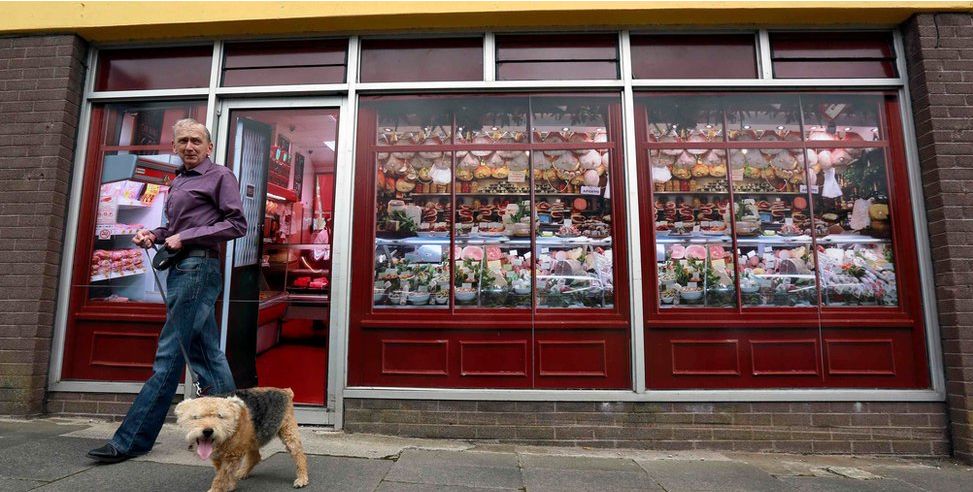
If there was one picture that captured the times we are living through it is this. It appeared on the BBC website recently with the following caption:
Kevin McGuire walks his dog past a vacant shop in Belcoo, Northern Ireland. The empty shop is one of a number that have had graphics placed on the windows to make them look like working shops ahead of the G8 summit which takes place nearby later this month.
Let’s take that a bit more slowly. Here is a shop, one of many that has gone out of business due, among other things, to the growth-fixated policies of the G8, situated in a place G8 ministers will be driven past en route to their summit. Rather than their being able to see how things are actually unfolding in the real world, the division and misery being caused by their approach to the economy, the windows have been plastered with stickers that present it as a fully-stocked, thriving shop. As singer/comic Mitch Benn put it on BBC Radio 4′s The Now Show on Friday, ”the last thing you’d want would be for a bunch of people meeting to fix the economy to see how bad the economy’s got”.
County Fermanagh’s district council sanctioned the fake retail units as part of a £1m makeover before it hosts the G8 summit. The event takes place on 17 and 18 June at the Lough Erne golf resort near Enniskillen. The chief executive of Fermanagh District Council has defended the optical illusion.
“It was aimed at undeveloped sites at the entrance to the town and then right throughout the county in terms of the other towns and villages, looking at those vacant properties and really just trying to make them look better and more aesthetically pleasing,” says Brendan Hegarty
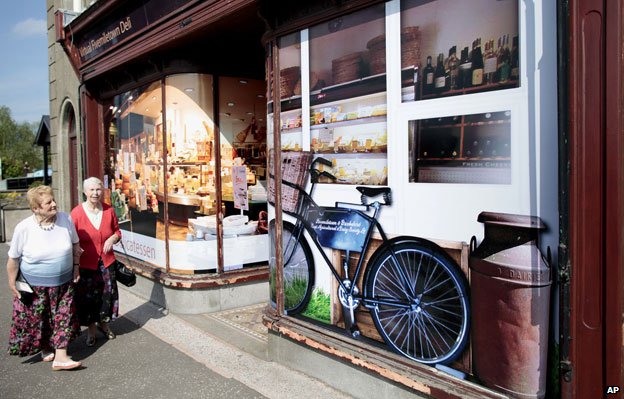
Here’s the thing that fascinated me most though. It’s the kind of shop they chose to portray it as. They didn’t print up large stickers that would present the shop as being a Tesco Metro, a Sainsbury’s Local, an Aldi perhaps, or even branch of one of the banks that contributed significantly to our getting into this mess in the first place. They didn’t make one huge sticker, one false façade, that showed a new shopping precinct, glittering with all the usual chain stores that dominate every such precinct. Or a Travelodge perhaps. Rather they set out deliberately and in considerable detail to portray the kind of vibrant, local, independent business that has either become extinct, or which survives in spite of, rather than because of, the policies of the G8. Here’s another one…
The windows are hung with delicious-looking hams, the display features meats and a whole range of delicious local produce, beautifully arranged. Although the cut-and-paste nature of the graphic design rather gives the game away (the same arrangements of hams appear two or three times), what they are trying to portray here is that most endangered of species, the local, independent butcher.
In the mid-1990s there were 22,000 butchers in the UK, by 2010 there were just 6,553. The independent butcher is making something of a spirited fightback though, although certainly not aided, in any sense, by the G8. The butcher that would have occupied that shop no longer exists, most likely because a supermarket opened nearby and completely shifted the balance of the Belcoo economy (any readers from Belcoo who might like to write in and tell us what led to this shop’s demise would be most welcome).
The other day I spoke to Nick Sherwood of REconomy Herefordshire, who has co-ordinated the Herefordshire Economic Evaluation (the second such piece of work, the Totnes one already being published, and Brixton’s coming soon). Our conversation will be published here soon, but one of the things that really struck me was the following:
We estimate that the top five major supermarkets in Herefordshire account for between 71% – 83% of all household expenditure on ‘brought home’ food and drink, or up to £180m annually. In addition, around £30m per year is spent in the smaller ‘chain’ supermarkets.
Their conclusion is that the true ‘local spend’ figure, i.e through local, independent businesses in Herefordshire, could be around 16% of the total. In terms of a national version of that figure, the best I can find is the figure from the Portas Review that states that 8,000 supermarkets now account for over 97% of all UK grocery sales. Although clearly other smaller supermarkets account for some of the remaining sales, let’s assume, for argument’s sake, that nationally, 3% of what we spend on groceries goes out through local and independent businesses.
I would imagine that everyone seeks an economy that is able to provide jobs, economic activity, stronger and happier communities and community resilience, while also skilfully reducing its carbon emissions on the scale required. The question of our times though, as far as I’m concerned, is whether that is best achieved by expanding the 97% of our economy currently dominated by huge supermarkets, the kinds of enterprise that the UK government and the G8 see as leading the push for growth, or protecting and enhancing the 3%?
It’s a vital question, because at the moment the push to eradicate the 3% altogether, or at least squeeze it a lot harder, continues apace. Yet that 3% is better suited to meeting those core needs of ours. As the recent report by Localise West Midlands on ‘community economic development’ states:
Our research has found strong evidence that local economies with higher levels of SMEs and local ownership perform better in terms of employment growth (especially disadvantaged and peripheral areas), the local multiplier effect, social and economic inclusion, income redistribution, health, civic engagement and well-being than places heavily reliant on inward investment where there are fewer, larger, remotely owned employers.
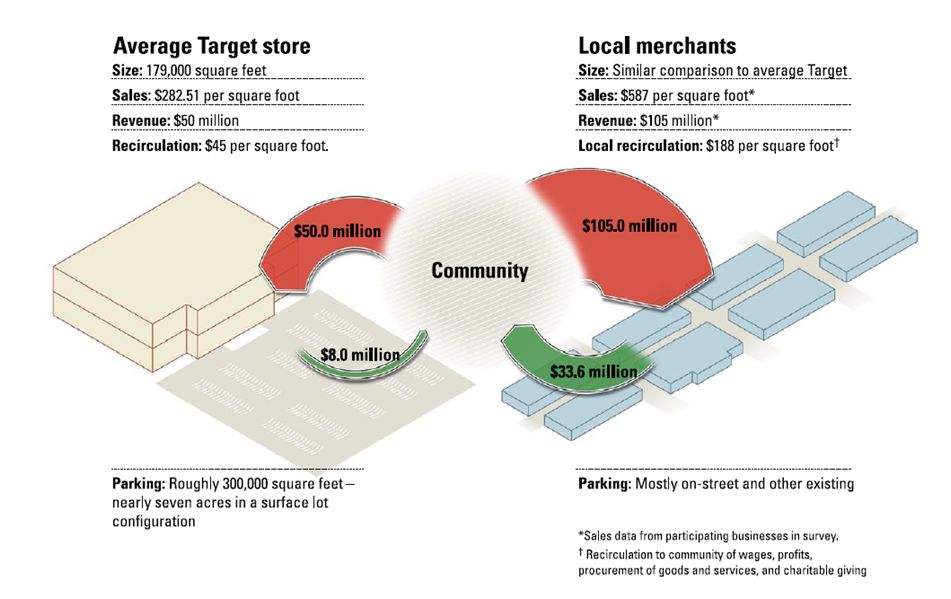
A study focusing on New Orleans compared 179,000 square feet of retail space that is home to 100 independent businesses to the same-sized space that is home to a single supermarket. The former generated $105 million in sales with $34 million staying in the local economy, while the latter generated $50 million in sales with just $8 million staying locally, and necessitated 300,000 square feet of parking space (see graphic below).
Santander’s ‘Market of Hope’ which I wrote about here last year is a great example of how a city can be fed by looking at large retail spaces in such a way that they boost and support the local independent economy rather than undermine it. When Sir Terry Leahy, CEO of Tesco, was asked whether there was any alternative to supermarkets, replied:
“… queueing at one store than trudging down Watford High Street in the rain to another shop … is this what people actually want to go back to?”
But no, it’s not about “going back”, rather about going forward in a way that meets our needs rather than those of the City of London. What we now know is that even G8 ministers would rather pass through High Streets populated with small, independent butchers, bakers, grocers, would rather see shop windows overflowing with delicious food, trusting that the relationship they have built up with the shopkeeper over many years will mean that he/she stocks the best produce they can find. It feels right. It’s human scale. It makes sense. It’s an economy that is ours, it belongs to local people, to the local economy. Even G8 ministers would now appear to prefer a shopping experience that actually involves interacting with other human beings rather than wandering anonymously around a superstore and then cashing yourself out at the end.
The core argument of The Power of Just Doing Stuff, published on Friday, is that if we really want to achieve our goals of jobs, economic activity, stronger and happier communities and community resilience, while also skilfully reducing our carbon emissions on the scale required, we’d be better off focusing on growing the 3% rather than the 97%. It’s a pretty simple idea, and, to me at least, a blindingly obvious one, but that doesn’t mean it’s easy.
However, the experience is that this fightback has already begun. The explosion of new bakeries, pop-up shops, community renewable energy projects, craft breweries, independent record shops, complementary currencies and communities acquiring their own assets is already happening around us, but it needs us to get behind it, to put our shoulders, our spending power, our sheer bloody will, to making it 10%, 30% 70%. If we want a stable climate, reduced energy vulnerability, economic stability, and a healthy human culture, we really have no choice. As Maria van der Hoeven of the IEA said recently at the launch of a World Energy OutlookSpecial Report, Redrawing the Energy-Climate Map, ”the path we are currently on is more likely to result in a temperature increase of between 3.6 °C and 5.3 °C”.
Fortunately, it’s a push that is life-enhancing, thrill-generating and in which we discover a resourcefulness, a kindness and a passion in ourselves that we may have forgotten was there. I’ll leave you with a quote from the book, from Helen Cunningham of DE4 Food, a social enterprise food hub in Derbyshire that grew out of Transition Matlock. The project grew from helping a local farmer with lambing and has grown into an innovative new business:
“Never in my life did I imagine that I’d be able to bring lambs into the world! It wasn’t a skill I ever expected to have. It was such a different thing from what we were doing in the rest of our lives, and I think from then we’ve all thought “OK, we can learn these new skills, we can learn how to lamb, we can learn how to grow vegetables and learn how to do Excel Profit and Loss sheets and whatever.” I think we all just really wanted to change the way we live, and change our own personal lives and to change things and live different lives ourselves as well as a different life in our community”.
You can pre-order your copy of The Power of Just Doing Stuff here.
oooOOOooo
As has been said before, and undoubtedly will be said many times more, it really is a very strange world we live in!
Reinforcing my long-time respect for Prince Charles.
HRH The Prince of Wales, more familiarly known as Prince Charles, is a man I have longed admired and respected.
Many years ago, I worked as a volunteer teacher/mentor with what was then known as The Prince’s Youth Business Trust (PYBT). Later, it became incorporated into The Prince’s Trust. The PYBT enjoyed passionate and active support from HRH, and with good cause. Essentially, the PYBT offered socially-disadvantaged youngsters, who had very little chance of getting a job, the opportunity to be mentored on the skills of being an entrepreneur. Many of those youngsters went on to get decent jobs and many others started their own businesses, some with considerable success. Simply because thinking like an entrepreneur is impossible if you don’t have faith in your own abilities. That self-confidence shows in so many walks of life, especially when one is going through a job interview!
The Prince has also long been known for his concerns over the way we treat our planet, going right back to the days when it was regarded rather quaint by the mainstream media. But as Wikipedia reveals, “He has long championed organic farming and sought to raise world awareness of the dangers facing the natural environment, such as climate change. As an environmentalist, he has received numerous awards and recognition from environmental groups around the world.”
So it was lovely, but no great surprise, to see how well a recent speech was received on the subject of Regional Food Security given at Langenburg Castle in Baden-Wurttenberg, Germany. The full text is available on The Prince of Wales website. Let me give you a taste (whoops, pun unintended!) of what The Prince said,
Ladies and Gentlemen, if I may say so, this is a very important conference. I am sure what you have heard so far about the problems we face and the obstacles to tackling them has given you a clear context in which to be able to consider what comes next this afternoon.
The aim here is to think through how we might create a much more local model of food production and distribution. But also, how that might fit with producing healthy food using far more sustainable methods and how we might do all of this without damaging business. Indeed, how this could improve business.
As you have heard, the urgency for this comes from the fact that there is not sufficient resilience in the system as it currently stands. It may appear that things are well. Big global corporations may appear to be prospering out of operating on a global monocultural scale but, as I hope you have seen, if you drill down into what is actually happening, things are not so healthy. Our present approach is rapidly mining resilience out of our food system and threatening to leave it ever more vulnerable to the various external shocks that are becoming more varied, extreme and frequent.
So see the relevance of The Prince’s speech as he continued:
The drive to make food cheaper for consumers and to earn companies bigger profits is sucking real value out of the food production system – value that is critical to its sustainability. I am talking here about obvious things like the vitality of the soil and local eco-systems, the quality and availability of fresh water and so on, but also about less obvious things, like local employment and people’s health. It is, as I fear you know only too well, a complex business.
The aggressive search for cheaper food has been described as a “drive to the bottom”, which I am afraid is taking the farmers with it. They are being driven into the ground by the prices they are forced to expect for their produce and this has led to some very worrying short cuts. The recent horsemeat scandals are surely just one example, revealing a disturbing situation where even the biggest retailers seem not to know where their supplies are coming from. And it has also led to a very destructive effect on farming. We are losing farmers fast. Young people do not want to go into such an unrewarding profession. In the U.K., I have been warning of this for some time and recently set up apprenticeship schemes to try to alleviate the problem; but the fact remains that at the moment the average age of British farmers is fifty-eight, and rising.
One more extract from the speech:
In the U.K., as elsewhere – but particularly I think in the U.S. – the consequences of this are ever more apparent in the deteriorating state of our public health. We all know that Type 2 Diabetes and other obesity-related conditions are rapidly on the increase. The public bill for dealing with these is already massive and I am told it could become completely unaffordable if we do not see a shift in emphasis. And, of course, it will be cities that carry the heaviest part of that burden. It is a peculiar trend.
Am I alone, ladies and gentlemen, in wondering how it is that those who are farming according to organic, or agro-ecological principles – in other words, sustainably, for the long-term, by operating in a way that reduces pollution and contamination of the natural environment to a minimum and maximizes the health of soil, biodiverse ecosystems and humanity – are then penalized? They find that their produce is considered too expensive and too “niche market” to be available to everyone. How is it, then, that systems of farming which do precisely the opposite – with increasingly dire and damaging effects on both the terrestrial and marine environments, not to mention long-term human health – are able to sell their products in mass markets at prices that in no way reflect the immense and damaging cost to the environment and human health? A cost that then has to be paid for over and over again elsewhere – chiefly, in all probability, by our unfortunate children and grandchildren, whose welfare I happen to care about. Surely this is a truly perverse situation which, you would have thought, could be turned on its head to make genuinely sustainably-produced food accessible to everyone, and the polluter to pay the real costs for the side effects of industrialized food? It is to be wondered at how this state of affairs persists – and yet to suggest standing it on its head and transforming the situation is to invite the predictable chorus of vitriolic accusations that you are anti-science, anti-progress, out of touch with commercial pressures and not living in the “real world.”
“No excellent soul is exempt from a mixture of madness.”
So wrote Aristotle .
But it offers little comfort in response to some recent essays that I have been reading. I closed yesterday’s essay from ‘Our unsustainable way of life‘ with the comment, “If it strikes you as utter, complete madness trust me, you are not alone.” The madness is still coming! Stay with me!
George has a new book being published by Allen Lane today under the title of Feral: searching for enchantment on the frontiers of rewilding. I would offer you the link to the book on the Allen Lane website but at the time of writing this post that link is not functioning. It’s certainly a book I want to read. You may learn more here.
Anyway, some recent Monbiot essays in the UK Guardian newspaper have been setting the scene for his new book.
On the 22nd May, there was an essay published under the heading of What’s Missing from this Picture? (the link is to George Monbiot’s website). The essay starts, thus:
Somehow almost all of us have missed the real story behind the disappearance of our wildlife.
By George Monbiot, published on the Guardian’s website, 22nd May 2013
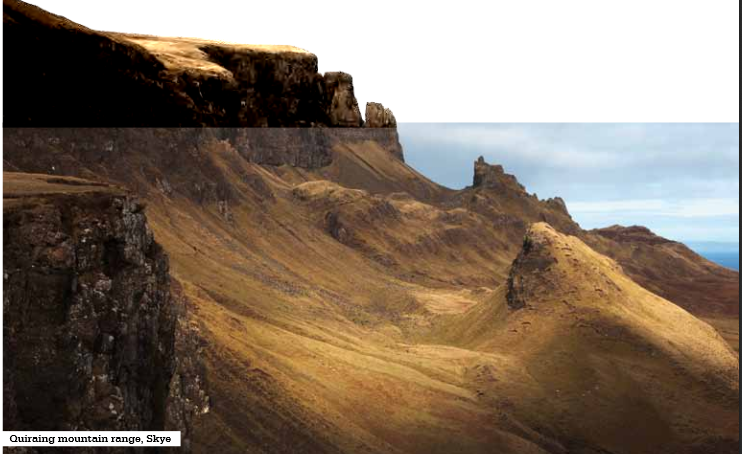
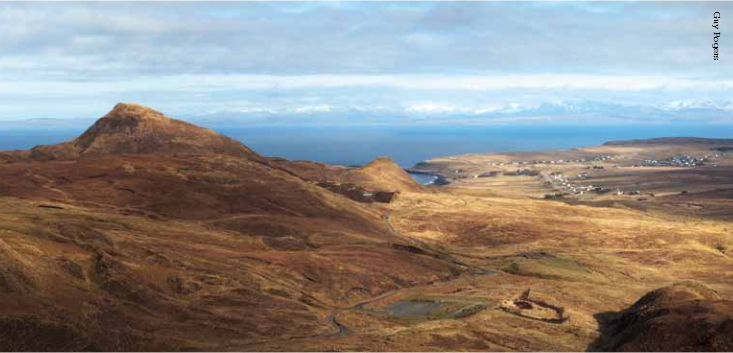
Even before you start reading the devastating State of Nature report, you get an inkling of where the problem lies. It’s illustrated in the opening pages with two dramatic photographs of upland Britain. They are supposed to represent the natural glories we’re losing. In neither of them (with the exception of some distant specks of scrub and leylandii in the second) is there a tree to be seen. The many square miles they cover contain nothing but grass and dead bracken. They could scarcely provide a better illustration of our uncanny ability to miss the big picture:
The majority of wildlife requires cover: places in which it can shelter from predators or ambush prey, places in which it can take refuge from extremes of heat and cold, or find the constant humidity that fragile roots and sensitive invertebrates require. Yet, in the very regions in which you might expect to find such cover (trees, scrub, other dense foliage) there is almost none. I’m talking about the infertile parts of Britain, in which farming is so unproductive that it survives only as a result of public money. Here, in the places commonly described as Britain’s “wildernesses”, almost nothing remains. And the “almost” has become radically smaller over the past 20 years.
Then a few paragraphs later, comes this:
The uplands of Britain are astonishingly unproductive. For example, 76% of the land in Wales is devoted to livestock farming, mostly to produce meat. But, astonishingly, by value Wales imports seven times as much meat as it exports. Six thousand years of nutrient stripping and erosion have left our hills so infertile that their productivity is miniscule. Even relatively small numbers of livestock can now keep the hills denuded.
Without subsidies, almost all hill-farming would cease. That’s not something I’m calling for, but I do believe it’s time we began to challenge the system and its outcomes. Among them is a policy that’s almost comically irrational and destructive.
So what was it that came at me as utter madness?
It was this:
The major funding that farmers receive is called the single farm payment, which is money given by European taxpayers to people who own land. These people receive a certain amount (usually around £200 or £300), for every hectare they own. To receive it, they must keep the land in what is called “Good Agricultural and Environmental Condition” (GAEC). It’s a term straight out of 1984.
Among the compulsory standards in the GAEC rules is “avoiding the encroachment of unwanted vegetation on agricultural land”. What this means is that if farmers want their money they must stop wild plants from returning. They don’t have to produce anything: to keep animals or to grow crops there. They merely have to prevent more than a handful of trees or shrubs from surviving, which they can do by towing cutting gear over the land.
Oh, and then we learn:
The government of Northern Ireland has been fined £64 million for (among other such offences) giving subsidy money to farms whose traditional hedgerows are too wide. The effect of these rules has been to promote the frenzied clearance of habitats. The system ensures that farmers seek out the remaining corners of land where wildlife still resides, and destroy them.
Leading to the bizarre (and that’s putting it kindly) situation where:
A farmer can graze his land to the roots, run his sheep in the woods, grub up the last lone trees, poison the rivers with sheep dip and still get his money. Some of the farms close to where I lived in mid-Wales do all of those things and never have their grants stopped. But one thing he is not allowed to do is what these rules call “land abandonment”, and what I call rewilding. For no good reason, public money is used both to engineer the mass destruction of habitats through grazing and clearing, and to prevent any significant recovery.
There’s nothing I can add. Except this. I am collecting ideas and essays that are going to focus on the positive aspects of this ‘new world order’. I’m going to offer some examples of the power of positive change because as Rebecca Solnit wrote recently there is a case for hope!
We recently heard of some chickens that were facing the cooking pot unless a home could be found. We gave in. It wasn’t hard because there was an existing chicken house on our property.
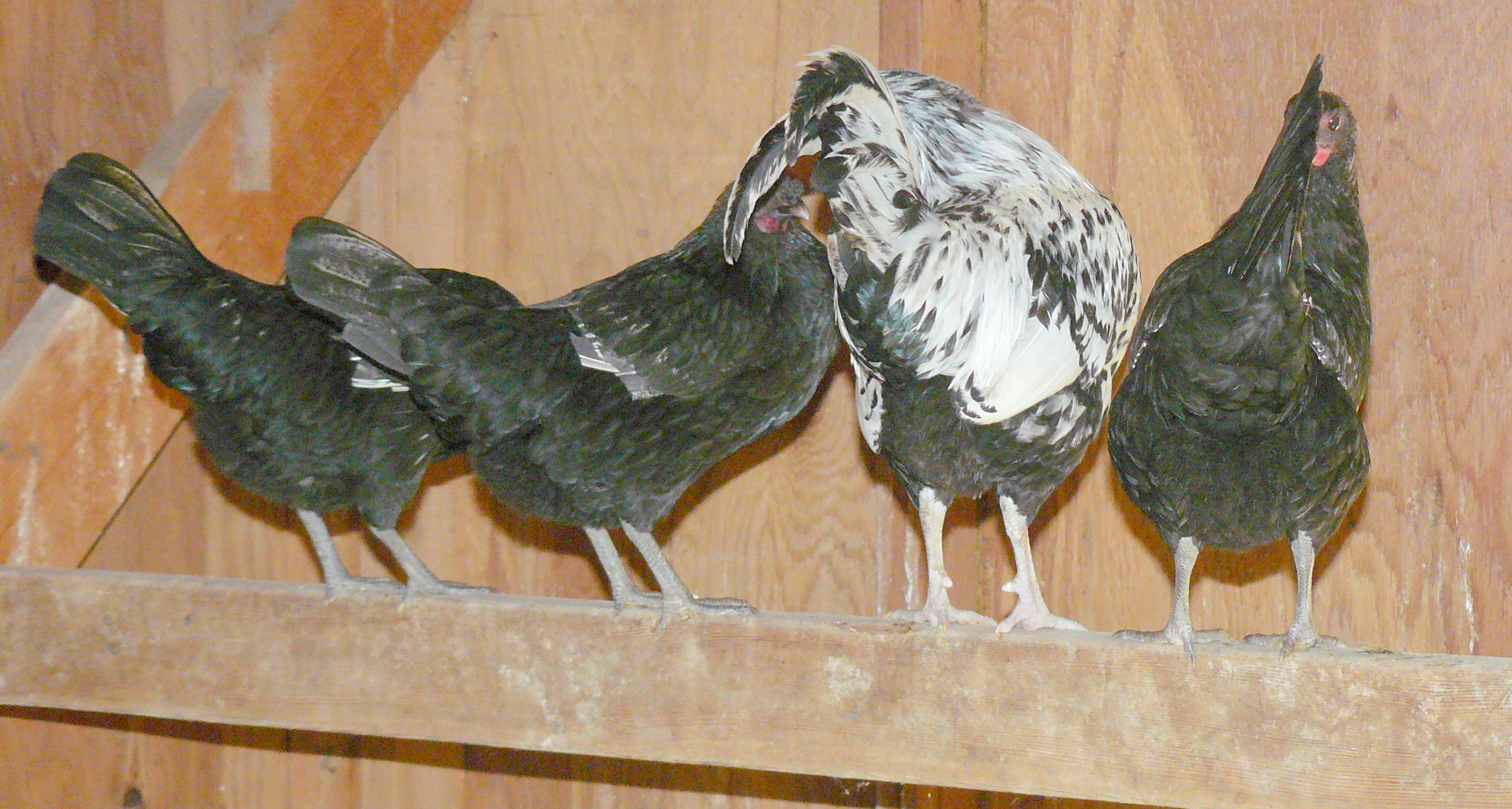
The chickens are adult bantams rescued from the wild.
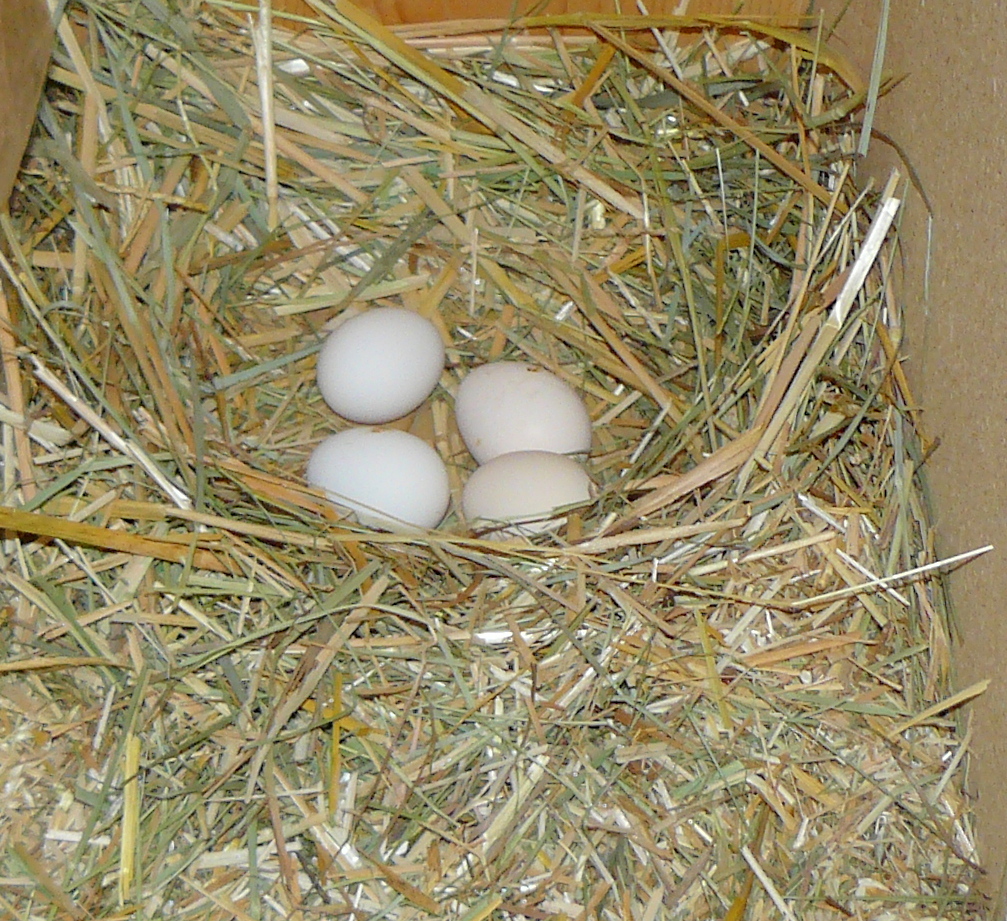
Which brings us to 9 dogs, 5 cats, 2 miniature horses and 4 chickens. As the old saying goes, “One doesn’t need to be mad to live here, but it helps!”
A few pictures to share with you.
Jean, meet your new chickens!
Jean learning a few details about our new arrivals.
We spent some enjoyable time with neighbours Dordie and Bill yesterday afternoon from where my sub-heading quote comes. Perhaps, a tad tongue-in-cheek, but only a tad!
Yesterday, the bulk of my post The new tomorrows consisted of a powerful essay from William deBuys ‘Phoenix in the Climate Crosshairs‘, courtesy of TomDispatch. It painted in very stark terms the impact of climate change on the metropolitan city of Phoenix in Arizona; a city of over 4 million people, indeed home to more than two-thirds of Arizona’s population.
So, today, I wanted to wander through some other aspects of this new world order.
Here’s a recent item on Climate Crocks examining the changes in March’s weather, 2013 vs 2012. From which I quote:
Much Different March. Same Reason?
Dittohead reasoning: “So when it’s warm, you blame it on climate change. When its cold, you blame it on climate change. It can’t be both.”
I think we’ve passed the point of tolerance with these ceaseless storms. Gone are the days when viewers would flood our inboxes with pretty pictures of their pets and kids frolicing in the snow. Constant cleanup has made us snippy and short – even a few plow guys have hoisted the white flag. The holidays are long past, the winter is stale, and the people just want spring…
…and accountability. Instead of pictures, I get questions in my inbox. “Why are we getting so much snow? Why did it turn on a dime? And when will it stop?”
Those are fair questions. But with the limits of the long range (10-14 day) forecasts, I’m not ready to answer the last question. We may sail out of this in April, but so far the first week of the month isn’t looking much different from the first week in March. The ultimate question is why.
The jetstream has taken on an odd path. [my emphasis]
Now just look at this:
Forecast sea level pressure departures from average from the GFS computer model. This shows the large area of unusually high atmospheric pressure over Greenland. Image from Weatherbell
Later on that article says:
Recent research suggests that rapid Arctic climate change, namely the loss of sea ice cover, may be contributing to blocking patterns like we’re seeing right now. That rapid decline in Arctic sea ice since the beginning of the satellite record in 1979 may be altering weather patterns both in the Far North and across the U.S.. Some studies have shown that sea ice loss favors atmospheric blocking patterns such as the pattern currently in place, while others have not shown statistically significant changes in blocking patterns across the Northern Hemisphere, at least not yet. Arctic sea ice extent declined to a record low during the 2012 melt season.
The last Winter in North-West Europe has been ‘interesting’, to say the least! A follow-up to that Climate Crock’s essay reports:
A study published in 2012 showed that by changing the temperature balance between the Arctic and mid-latitudes, rapid Arctic warming is altering the course of the jet stream, which steers weather systems from west to east around the northern hemisphere. The Arctic has been warming about twice as fast as the rest of the Northern Hemisphere, due to a combination of human emissions of greenhouse gases and unique feedbacks built into the Arctic climate system. The jet stream, the study said, is becoming “wavier,” with steeper troughs and higher ridges.
A new study published in the journal Environmental Research Letters shows that reduced sea ice cover can favor colder and stormier winters in the northern midlatitudes
Did you fully take in that paragraph? The one about “The Arctic has been warming about twice as fast as the rest of the Northern Hemisphere …“?
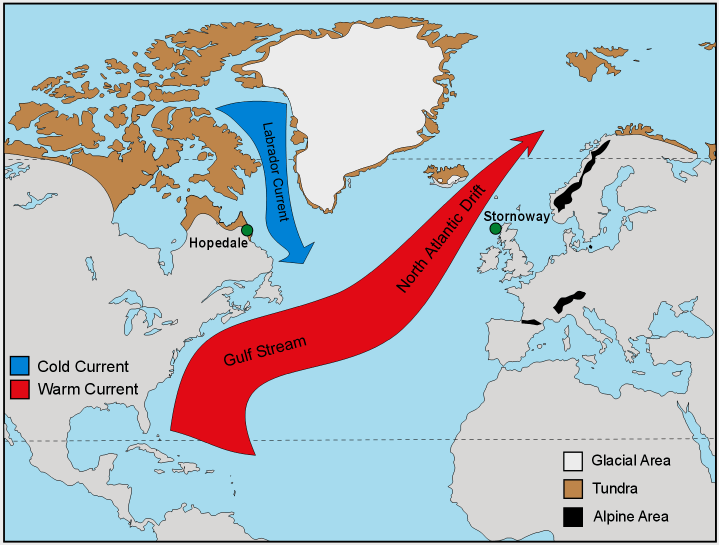
The other great ‘river’ in the North Atlantic is the thermohaline circulation or to put it in more familiar terms: The Gulf Stream. Has that been changing? You bet! In more ways than one might expect.
Here’s a snippet from an item from last October’s issue of Nature journal:
Recent changes to the Gulf Stream causing widespread gas hydrate destabilization
The Gulf Stream is an ocean current that modulates climate in the Northern Hemisphere by transporting warm waters from the Gulf of Mexico into the North Atlantic and Arctic oceans. A changing Gulf Stream has the potential to thaw and convert hundreds of gigatonnes of frozen methane hydrate trapped below the sea floor into methane gas, increasing the risk of slope failure and methane release.
How the Gulf Stream changes with time and what effect these changes have on methane hydrate stability is unclear. Here, using seismic data combined with thermal models, we show that recent changes in intermediate-depth ocean temperature associated with the Gulf Stream are rapidly destabilizing methane hydrate along a broad swathe of the North American margin.
As the diagram below shows all too clearly, the cold waters from above the Arctic circle directly affect the Gulf Stream.
Average sea ice extent for February 2013 was 14.66 million square kilometers (5.66 million square miles). This is 980,000 square kilometers (378,000 square miles) below the 1979 to 2000 average for the month, and is the seventh-lowest February extent in the satellite record.
Less ice means more cold water. QED!
OK, moving on.
We met recently with Wayne over at Rogue Valley Firewood here in Merlin. Not to buy more firewood but because Wayne has started into hugelkultur. Jean and I hadn’t heard of the term before. Come back to that in a moment.
In musing with Wayne about how rapidly life is changing for us all, he spoke of the consequence of rising fuel prices and the rising costs of putting petrol (OK, he used the word ‘gas’!) in one’s car. Wayne pointed out the obvious. That the inevitable effect of those rising costs would be to steadily reduce one’s range for ‘affordable’ car journeys. Many people will no longer be able to afford to drive longer distances.
In other words, local will increasingly become more relevant to daily life. Or to use a better word than local, community will return to the centre stage of our world. And of all the things important to a community, none is more so than access to food.
Back to Hugelkultur. Watch this video:
Wayne is committed to seeing just what can be grown for the local community of Merlin using this form of raised garden bed. You can read more here.
The USDA’s new Food Access Research Atlas is a map of all the places in the country where people live in food deserts — places where it’s difficult to access fresh food.
The message that hits me from that map is the consequence for millions of people, especially those in rural areas or unable to afford a car, when it comes to getting hold of fresh food. Another reason why community food programs are going to be a feature of the new tomorrows.
Finally, take a look at a recent item on Paul Gilding’s blogsite.
Paul Gilding
Paul is an independent writer, advisor and advocate for action on climate change and sustainability. He recently published Victory at Hand for the Climate Movement?From which I offer:
There are signs the climate movement could be on the verge of a remarkable and surprising victory. If we read the current context correctly, and if the movement can adjust its strategy to capture the opportunity presented, it could usher in the fastest and most dramatic economic transformation in history. This would include the removal of the oil, coal and gas industries from the economy in just a few decades and their replacement with new industries and, for the most part, entirely new companies. It would be the greatest transfer of wealth and power between industries and countries the world has ever seen.
To understand this incredible potential we first have to step back and understand the unique structure of this social change movement, which may rank among the most influential in history. It is simplistic to characterise it as an alliance of grass roots organisations and activists pitched against a rich and well connected adversary. While that is part of the story, it is more accurately understood as an idea whose tentacles reach into every tier of government, the world’s largest companies and financial institutions, and throughout the academic and science communities.
Because of this, it is winning the battle from within: Its core arguments and ideas are clearly right; being endorsed by the world’s top science bodies and any significant organisation that has examined them.
Strikes me that in one very important way, we will be reverting to how our ancient hunter-gatherer ancestors lived. I mean reverting to living our lives as relatively small interdependent communities almost exclusively at the local level.
Guess what! Yet another aspect of learning from dogs. In the wild, dogs live in groups of about 50 animals with clear boundaries to their territory. Just like the ancestors of the domesticated dog and the wild dog: The grey wolf Canis Lupus.
Last week I had to travel from Merlin in Southern Oregon up to Portland, a round-trip distance of 480 miles. The vast majority of the journey was along Highway I5, most of which is a 2-lane highway, significantly harder driving than a 3 or more laned highway.
It was the first time I had driven North along I5 since Jean and I moved to Merlin last October. What staggered me were the huge number of trucks on the highway, many of them food trucks from California and beyond. Also noticed at regular intervals were very large industrial buildings that were described as food distribution centres.
Another connection to today’s reflections is that I am about 50 pages into Barbara Kingsolver’s book Animal, Vegetable, Miracle. The book is the account of Barbara’s family spending a year deliberately eating home-grown and local food. The book’s subtitle is ‘A Year of Food Life‘ and, inevitably, the book has a website here.
So the book and the journey to Portland got me thinking about food miles and the huge transport distances of so much of what we eat today.
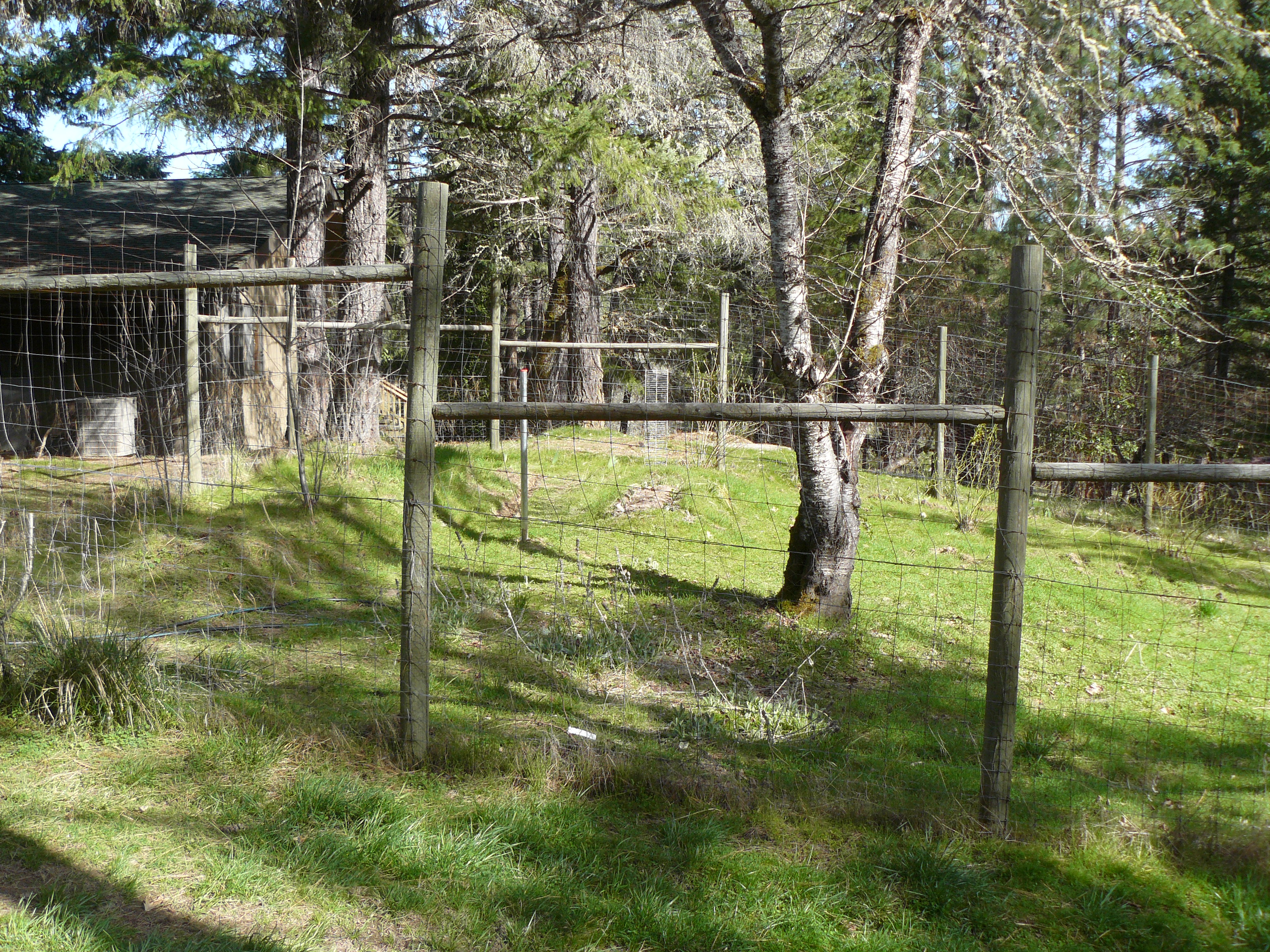
Jean and I were incredibly lucky when we bought this property last year to discover that it had a mature vegetable garden surrounded by a deer-proof fence, as the following photograph partially shows.
So even before considering the food miles we are saving from ‘grow-your-own’, we were enthusiastically planting a whole variety of vegetables. Here’s a rhubarb plant that went in last Saturday.
Anyway, I’m rather meandering along – anyone still awake!
The whole point of this long introduction is to highlight a fabulous film that we have watched over the weekend. Called Edible City: Grow The Revolution we came across it on Top Documentary Films, great source of films by the way if you don’t know it.
Luckily it is on YouTube as well.
Here’s the full film:
It’s an inspiring account of what it means for a community to take control of their food, ergo a strong recommendation to watch it in full.
If you want a taste of the film (pardon the pun!), here are two trailers.
So why don’t you join the millions of people already buying from their local Farmers’ Market. For the USA you can find your nearest market using this website and for the United Kingdom try the Local Foods website.
Not only will it give you access to much healthier food, it is a very practical way of reducing our use of energy.
It is nearly 50 years since Rachel Carson wrote here seminal book Silent Spring. Why are we humans so stupid that we do not learn even the most basic of lessons? It is time to put the environmental protection before commercial profit.
This email from Avaaz was sent to me almost 24 hours ago so, if you live in the EU, please sign the petition immedaitely. The politicians clearly want to do the right thing; please help ensure that big business (in this case Bayer) do not persuade them to fail to learn from the past.
——
Dear friends,
Bees around the world are dying off and Europe’s food watchdog just said certain pesticides are part of the problem.We’ve got 48 hours before key meetings – let’s get a 2-million-person swarm to save the bees.Click to take urgent action now:
Quietly, globally, billions of bees are dying, threatening our crops and food. But in 48 hours the European Union could move to ban the most poisonous pesticides, and pave the way to a global ban that would save bees from extinction.
Four EU countries have begun banning these poisons, and some bee populations are already recovering. Days ago the official European food safety watchdog stated for the first time that certain pesticides are fatally harming bees. Now legal experts and European politicians are calling for an immediate ban. But Bayer and other giant pesticide producers are lobbying hard to keep them on the market. If we build a huge swarm of public outrage now, we can push the European Commission to put our health and our environment before the profit of a few.
We know our voices count! Last year, our 1.2 million strong petition forced US authorities to open a formal consultation on pesticides — now if we reach 2 million, we can persuade the EU to get rid of these crazy poisons and pave the way for a ban worldwide. Sign the urgent petition and send this to everyone – Avaaz and leading MEPs will deliver our message ahead of this week’s key meeting in Brussels:
Bees don’t just make honey, they are vital to life on earth, every year pollinating 90% of plants and crops — with an estimated $40bn value and over one-third of the food supply in many countries. Without immediate action to save bees, many of our favourite fruits, vegetables, and nuts could vanish from our shelves.
Recent years have seen a steep and disturbing global decline in bee populations – some bee species are already extinct and some US species are at just 4% of their previous numbers. Scientists have been scrambling for answers and now the European Food Safety Authority is saying that toxic chemicals called neonicotinoid pesticides could be responsible for the bee deaths. France, Italy, Slovenia and even Germany, where the main manufacturer Bayer is based, have banned one of these bee-killing pesticides. But Bayer continues to export its poison across the world.
Now the issue is coming to a boil. EU parliamentarians are stepping up their pressure on the European Commission and key governments to push new legislation to ban the deadly pesticides, and we can offer them the public support they need to counter the powerful pesticide lobby. Sign the urgent petition to Europe’s leaders, then forward this email widely:
Our world is beset with threats to what makes it habitable, and to what fills it with wonder. The Avaaz community comes together to defend both — large or small. Whether winning a battle to keep the International Whaling Commission from sanctioning the murder of these giants, or saving bees, the tiny creatures upon which so much depends, we will come together and stand up for the world we all want.
With hope,
Luis, Ari, Alice, Iain, Ricken, David, Alaphia, and the Avaaz team
Do go to Martin’s post here if not only to read the comment from Lionel:
I get my honey from local producers it is has far more flavour and texture than the insipid brand names.
Talking to them I learned about their concerns, including vandalism which is sad, and quizzed them on CCD (Colony Collapse Disorder) having read this book:
I saw a CountryFile (BBC) segment some two or more years ago and John Craven was very soft-footed with a Bayer rep’ as they talked in a field, I was rather disappointed as John let him off the hook rather.
I have taken an interest in photographing Bumble Bees and have an excellent reference on those common, or once common in the UK.
A thought-provoking presentation on the role of food in our society.
The last time I used this title for a post was back on July 20th. However, the topic then was very different to today’s theme. Then I wrote about how the genetic modification of our food represents as big a danger to the long-term survival of man as does the damage to our biosphere.
So this comes as a very pleasant contrast. I am indebted to Yves Smith’s blog Naked Capitalism for drawing this presentation to my attention. As was written in that NK post,
This is a super presentation by Ray Patel for Michael Pollan’s class at Berkeley, Edible Education 103. The presentation and the question period together come to about an hour. Ray Patel follows after Michael Pollan handles administrative stuff and then does an introduction.
There are plenty of charts, but I really enjoy the anecdote on Northern Malawi at minute 43:54 — too long for me to transcribe, so I’ll quote Patel’s closing line:
What makes it really sail is not just the democracy, but the joy which comes through people cooking together as equals and eating together as equals.
Bon apetit!
Published on Dec 7, 2012
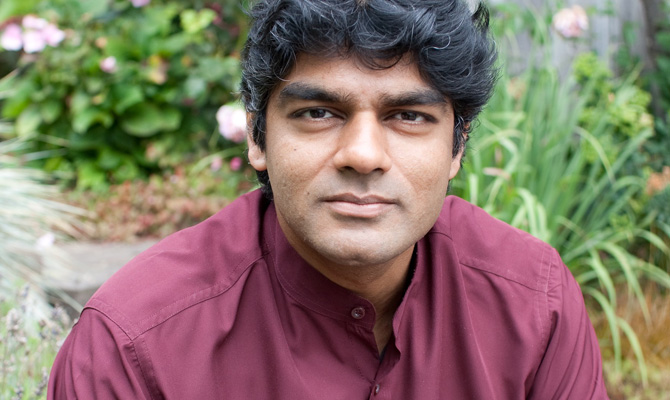
Raj Patel is an award-winning writer, activist, and academic. He has degrees from the University of Oxford, the London School of Economics, and Cornell University, has worked for the World Bank and WTO, and protested against them around the world.
He’s currently a visiting scholar at UC Berkeley’s Center for African Studies, an Honorary Research Fellow at the School of Development Studies at the University of KwaZulu-Natal, and a fellow at The Institute for Food and Development Policy, also known as Food First. He is currently an IATP Food and Community Fellow.
He has testified about the causes of the global food crisis to the U.S. House Financial Services Committee and is an Advisor to the United Nations Special Rapporteur on the Right to Food. In addition to numerous scholarly publications, he regularly writes for The Guardian, and has contributed to the LA Times, NYTimes.com, The San Francisco Chronicle, The Mail on Sunday, and The Observer. His first book was Stuffed and Starved: The Hidden Battle for the World Food System and his latest, The Value of Nothing, is a New York Times best-seller.
Raj Patel’s website is a great reference so do spend a little time wandering through the material. For example, this item jumped off the page for me.
The good folk at Canada’s Globe & Mail asked me to write a piece called “What I Did This Summer.” Never having written one before, I thought I’d channel my inner 12 year old.
Cuzco, Peru: This summer I started to write a book and film a documentary with my hero. His name is Steve James. He filmed ‘Hoop Dreams’ which was about basketball and hope and disappointment and race and inequality and America. Our film is called “Generation Food”. It is about how we will eat in the future.
So I went to Japan. People used to live long lives in Okinawa because of the traditional diet. Lots of people lived until 100. Now grandparents are burying their children. They don’t eat as they used to. When the Americans came with their military base, they brought fast food for the GIs. Everybody eats it now. I visited farmers who plant crops on US bases. They did it so often that the Americans gave up and just let them do it. I ate goat sashimi because it would have been rude not to.
Won’t reproduce it in full as I haven’t sought permission. So do go here to read it. But I just can’t resist offering you Raj Patel’s closing words.
I have learned that: People are kind. Everyone has contradictions. Raw goat tastes funny, but it’s not as bad as Cuban food. The world is more beautiful than I imagined. There is more hope for the future of food than I dared to believe, against impossible odds. And it comes from unlikely places.
I have mentioned the website of the Permaculture Research Institute of Australia before. It’s a fabulous resource for many aspects of moving towards a more sustainable lifestyle, and not just for Australians.
A few days ago, their regular posting included a link to this:
Dirt: The Movie
DIRT! The Movie — directed and produced by Bill Benenson and Gene Rosow — takes you inside the wonders of the soil. It tells the story of Earth’s most valuable and underappreciated source of fertility — from its miraculous beginning to its crippling degradation. The opening scenes of the film dive into the wonderment of the soil. Made from the same elements as the stars, plants and animals, and us, “dirt is very much alive.” Though, in modern industrial pursuits and clamor for both profit and natural resources, our human connection to and respect for soil has been disrupted. “Drought, climate change, even war are all directly related to the way we are treating dirt.”
DIRT! the Movie — narrated by Jaime Lee Curtis — brings to life the environmental, economic, social and political impact that the soil has. It shares the stories of experts from all over the world who study and are able to harness the beauty and power of a respectful and mutually beneficial relationship with soil.
DIRT! the Movie is simply a movie about dirt. The real change lies in our notion of what dirt is. The movie teaches us: “When humans arrived 2 million years ago, everything changed for dirt. And from that moment on, the fate of dirt and humans has been intimately linked.” But more than the film and the lessons that it teaches, DIRT the Movie is a call to action.

 Their conclusion is that the true ‘local spend’ figure, i.e through local, independent businesses in Herefordshire, could be around 16% of the total. In terms of a national version of that figure, the best I can find is the figure from the Portas Review that states that 8,000 supermarkets now account for over 97% of all UK grocery sales. Although clearly other smaller supermarkets account for some of the remaining sales, let’s assume, for argument’s sake, that nationally, 3% of what we spend on groceries goes out through local and independent businesses.











 Learning from Dogs
