This was received yesterday afternoon regarding G and C Raw Dog and Cat Food Recall
ooOOoo
G and C Raw Dog and Cat Food Recall
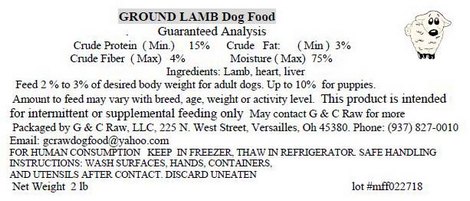
August 3, 2018 — G & C Raw of Versailles, OH is recalling 30 1–pound containers of Pat’s Cat Turkey Cat Food and 40 2-pound containers of Ground Lamb Dog Food because they have the potential to be contaminated with Listeria monocytogenes.
About Listeria Infections
Listeria monocytogenes can cause serious and sometimes fatal infections in animals eating the products.
Furthermore, there is risk to humans from handling contaminated pet products, especially if they have not thoroughly washed their hands after having contact with the products or any surfaces exposed to these products.
Healthy people infected with Listeria monocytogenes should monitor themselves for some or all of the following symptoms: nausea, vomiting, aches, fever, and diarrhea.
Listeria monocytogenes infections can also spread through the bloodstream to the nervous system (including the brain), resulting in meningitis and other potentially fatal problems.
Pregnant women are especially susceptible to Listeria infection, which can result in abortion.
The young, the elderly, and people with weakened immune systems also are more vulnerable.
Consumers exhibiting these signs after having contact with this product should contact their healthcare providers.
Pets with Listeria monocytogenes infections are rare, and pets may display symptoms such as mild to severe diarrhea, anorexia, fever, nervous, muscular and respiratory signs, abortion, depression, shock, and death.
In addition to the possibility of becoming sick, such infected animals can shed Listeria monocytogenes through their feces onto their coats and into the home environment and thus serve as sources of infection to humans and other animals in the household.
If your pet has consumed the recalled product and has these symptoms, please contact your veterinarian.
Where Was the Product Sold?
Pat’s Cat Turkey and Ground Lamb Dog Food products were distributed in OH, MI, IN, PAN, KY, NC, and GA.
They were also distributed by direct delivery by G & C Raw, LLC.
What’s Being Recalled?
The Pat’s Cat Turkey is sold in 1-pound clear plastic containers with the Lot number WWPKTF051618.
The Ground Lamb product is sold in a 2-pound plastic container with the Lot number MFF022718.
The Lot number codes are listed on the bottom right corner of the label.
No illnesses have been reported to date.
About the Recall
The recall was as the result of a routine sampling program by the Ohio Department of Agriculture which revealed that the finished products contained the bacteria
The company has ceased the production and distribution of the product as the company continues its investigation as to what caused the problem.
What to Do?
Consumers who have purchased Pat’s Cat Turkey Cat Food with the lot number, WWPKTF051618, OR Ground Lamb Dog Food with the lot number MFF022718 are urged to return it to G & C Raw, 225 N. West Street, Versailles, OH, for a full refund.
Consumers with questions may contact: G & C Raw, LLC at 937-827-0010 ET, or by email at gcrawdogfood@yahoo.com.
U.S. citizens can report complaints about FDA-regulated pet food products by calling the consumer complaint coordinator in your area.
TIME magazine published a double-issue in February of this year How To Live Longer Better!
The article, on Page 47, opens:
Old age demands to be taken very seriously – and it usually gets its way!
Then later on in that same article one reads:
Exactly how much – or how little – exercise it takes to begin paying dividends has been one of the happy surprises of longevity research. A 2016 study found that elderly people who exercised for just 15 minutes a day, at an intensity level of a brisk walk, had a 22% lower risk of early death compared to people who did not exercise.
Then two sentences later:
Researchers from McMaster University in Canada even found that breaking a sweat for just 60 seconds may be long enough to improve health and fitness (as long as it’s a tough workout).
As part of Jean’s commitment to slowing down the progression of her Parkinson’s Disease (PD) she attends every Monday and Wednesday a special class at our local Club Northwest in Grants Pass. The class runs for 90 minutes and is a boxing class! The instructor, Mark Whiting, is a boxing coach and the class, called the Rock Steady class, is specifically for PD sufferers. One of the exercises involves rapid punching of a punch bag.
Dr. Laurie Mischley of SIM had a telephone consultation with Jean a few days ago. It was Dr. M following up Jean’s consultation with Dr. Nutt in Portland on the 10th that I wrote about in my post Jeannie’s PD Journey. Dr. M commented as to how well Jean was doing.
Possibly, vigorous exercise seems to be offering something that many in their elder years may not have cottoned on to.
Readers may recall Patrice Ayme leaving a comment in my recent Facing up to PD post:
The one and only countermeasure we have is violent neurological activity. As in powerlifting. This has been indicated by research published in 2018… But it was long obvious. So the way to “comfort” is the discomfort of maximum motor-neurological… hmmm… violence. Too much local gentleness doesn’t optimize overall comfort and gentleness… I guess that’s one of my overall philosophical messages… Not one popular with the PC crowd…
Now I’m still trying to get to bottom of this link between vigorous exercise and long-term health and have reached out to McMaster University in Canada seeking academic backing for the link.
More from me as I learn more.
Turning to diet.
In that same TIME magazine, on page 53, there is a single page listing five places around the world known as Blue Zones.
Global life expectancy averages out to 71.4 years. That means. of course, that some parts of the world see much shorter spans, while others enjoy far greater longevity.
Five places, in particular, fall into the latter category. They’re know as Blue Zones – named for the blue circles researchers drew to identify the first one on a map – and they’re home to some of the oldest and healthiest people in the world. Dan Buettner, author of The Blue Zones and The Blue Zones Solution, told TIME why residents of these places live so long – and how you can steal their habits
Those five places are listed below with me republishing just a small extract regarding diet from four of those five place descriptions.
Sardinia, Italy – “A largely plant-based diet ….”
Okinawa, Japan – No mention of diet.
Nicoya, Costa Rica – “The Costa Rican people traditionally get the majority of their caloric intake from beans, squash and corn, plus tropical fruits. This plant-forward, nutrient-dense diet ……”
Loma Linda, Calif., USA – “Adventists live 10 years longer than their fellow Americans. Many avoid meat and eat plenty of plants, whole grains and nuts.”
Ikaria, Greece – ” …. and a strict adherence to the Mediterranean diet – eating lots of fruits, vegetables, beans, whole grains, potatoes and olive oil – propels 1 in 3 ikarians to live into their 90s, often free of dementia and chronic disease.”`
You will just love this story about Terri and Zero.
Enough said!
ooOOoo
My Heart Dog
So what is a “heart dog”? I have heard this saying in the past and was never sure of exactly what it meant. I found a great description and definition from the site Jenna and Snickers. Here is what she writes…
“In my opinion, your heart dog is that once in a lifetime – maybe twice if you’re truly blessed – soul mate dog. He or she is the one you click with similarly to, but different from, how people in love click. There’s an understanding, a bond stronger than most, and a special level of communication. Your heart dog “gets” you and you get him or her right back.”
This is so me and Zero! I have had a couple of dogs in the past when I was growing up, but none have been my dog … my heart dog … like Zero has.
So how did I end up with this amazing dog in my life?
When my son ,Dylan, was younger he started going through that phase of wanting a little brother or a sister. Well, since I wasn’t even dating at the time, I knew that wasn’t going to happen so I figured it was time for a dog!
Side Note: I often joke that if I had the dog first, I might not have had the kid. I mean, if I tell Zero to sit, she just sits…right then…no questions, no complaining, no whining, she just does it. So much easier! LOL
We found Zero at our local Humane Society. She was just under a year and a half old and had been picked up as a stray so they didn’t know anything about her. When we got her out of her kennel and into the big yard so we could see her more, she hardly even came over to us. There was just something about her, though, and we knew she was the one.
We brought her home and the next day when we took her to the vet, learned that she had heart worms…bad. My mom reminded me that the humane society said they would take her back if it was within 72 hours but I just couldn’t do that. First, I was afraid nobody else would adopt her knowing she had heart worms, and second, she was my dog. Like we already totally bonded and I just knew she was my dog.
Long story short, we put her though the pretty intensive heart worm treatment, killed all those little buggers off and she was healthy!
We also learned that she was a pretty fearful dog…scared of so much. She would not walk up the stairs to our apartment so I had to carry her up and down for about a month until we finally coaxed her to walk up and down the entire flight by herself. She had no idea what the TV was and would hide behind my chair whenever it was on. She had no idea how to play with toys. When I would try to teach her fetch and I would throw the ball she would just look at me like, “well, that was stupid…why did you do that?”. She had no idea of anything.
To help socialize her more and build her confidence, we put her in agility with Dylan as the handler. They did great! He was about nine at the time and they even competed and won a couple of times! After that she continued to blossom. She learned how to play with toys, learned a ton of commands (she’s so super smart!) and she even got her CGC (Canine Good Citizen) certificate.
It was so great seeing her come out of her shell and watch her confidence grow. Also during this time she was becoming closer and closer to Dylan and I. We were her pack and she was not happy unless we were all together. In fact, when Dylan would run her in agility trials, I would have to go hide because if she saw me she would stop in the middle of her run and charge over to me. Same would happen if I ran her…she would have to search for Dylan. She likes it when all three of us are together.
Now she is thirteen years old and still going strong. The vet even told me at Zero’s last check up that she can’t believe Zero is thirteen and would never guess she was that old by looking at her. She “checks out” to appear much younger. That is 100% okay with me. I have already told Zero she cannot get any older and she must live forever.
She truly is my heart dog. We just know what the other one is thinking. We have our routine, our habits, and our quirks. She loves me unconditionally and I love her back just the same.
Zero Facts:
What type of breed is she? I don’t know for sure. Someone asked me once if she was a kelpie. I had not even heard of that breed before so I looked it up and found pictures online that I could swear were Zero! So, by looks alone yes, I would think she is kelpie. What do you think?
ooOOoo
Of course, I was interested in Terri’s background and this what she wrote me:
As far as my background…had many jobs in the past but the longest was most recent when I worked as a personal trainer. I was in the fitness industry for about 10 years. Got a little burned out and was trying to figure out what’s next. Knew I wanted to roam and when my son moved out I figured now is the time, so I started planning. Zero and I will be taking off in mid-August to roam and explore the US in my Honda Civic and a tent. Can’t wait!!
Plus Terri explained how Zero took on that name:
One of our favorite movies at the times was ‘The Nightmare Before Christmas’ (I still jam out to that soundtrack #soGood). The main character (Jack Skellington) has a dog named…yep…you guessed it…Zero.
With Terri going on to add the commands and tricks that Zero has learnt.
Sit
Stay
Bang aka Play Dead
Be a bear (stands up on back feet)
Be sneaky (crawls with her belly on the floor)
Shake Hands
High Five
Roll Over
Here (Runs to me and sits at my feet)
Then a list of Zero’s favorite games:
Hide and Seek (with me and/or Dylan)
Find It : basically hide and seek except I hide her toy and make her find it
Keep Away with her frisbee (Dylan and I throw her frisbee back and forth and she’s in the middle jumping up and trying to get it..she freaking loves that game!)
Fetch with her tennis ball
Finally, Terri offers some random facts [Ed: “she” being Zero not Terri!!]:
She likes apples but wont eat a piece unless it’s peeled #soPicky
She looks up at the sky more than any dog I’ve ever seen. She loves gazing at the sky day or night.
She does not like any delivery truck. Fed Ex, UPS, Mailman, etc…Other trucks are fine
She hates storms and shakes like a leaf when there’s thunder
She’s awesome at soccer and it’s almost impossible to get the ball past her
Her favorite toy is her tennis ball
Her middle name is “Marie”. Not sure why, it just slipped out of my mouth one day when she was in trouble..lol….Zero Marie…
She would always help me get Dylan up in the mornings by burrowing under him and raising him up out of bed
So there you have it; a little bit about my heart dog and my best friend. I really can’t imagine life without her. She’s my protector, my companion, my best friend, my partner in crime … pretty much my everything. She makes my life so much better and I have learned as much from her as she has me.
(All the photographs are by Terri.)
ooOOoo
There are millions out there that have the most beautiful and loving relationships with their dogs.
There are far, far fewer who can articulate just what that love means to the level that Terri has done!
“Happiness resides not in possessions, and not in gold, happiness dwells in the soul.”
So wrote the philosopher Democritus who was born in 460 BCE (although some claim his year of birth was 490 BCE). He acquired fame with his knowledge of the natural phenomena that existed in those times and history writes that he preferred a contemplative life to an active life, spending much of his life in solitude. The fact that he lived to beyond 100 suggests his philosophy didn’t do him any harm.
OK! Before I continue, please let me state, as before, that I write to you purely as Jean’s husband. I have no medical skills or knowledge at all and if you are at all affected by any of the following make an appointment to see your own doctor!
The crux of this post is Jean’s relationship with a naturopathic doctor at a practice in Seattle. The practice is Seattle Integrative Medicine (SIM) and a number of the doctors at SIM specialise in patients with PD. That’s how Jean was connected with Dr. Laurie Mischley. (Dr. M)
When one goes to the web page for Dr. M one reads:
Dr M conducted tests including testing her ear wax*, extensive blood analysis and an analysis of a sample of Jean’s hair.
* Dr. M has a dog that can reliably smell the presence of PD in human ear wax!
The favourite drug for those with PD is Levadopa. Within 48 hours of Jean taking Levadopa she had a serious allergic response to that drug.
Back to Dr. M’s tests. All three tests were non-indicative of PD. A while later, in a subsequent telephone conversation, Dr. M wondered if Jean really did have PD. She recommended a referral to the Oregon Health and Science University (OHSU) in Portland. Specifically to their Department of Neurology and to Dr. John Nutt. His background may be viewed here. From which one notes:
John Nutt, M.D.
Co-founder and Director Emeritus of the OHSU Parkinson Center and Movement Disorders Program
Professor of NeurologySchool of Medicine Expertise
Neurology
Special focus on Parkinson’s and Movement Disorders
Jean’s appointment was at 08:30 on Tuesday, 9th July. In terms of the timeline of all of us, Jean was diagnosed as suspected of having PD in December, 2015.
Dr. Nutt saw us promptly at 8:30 and immediately revealed a listening, caring attitude. He also quietly admitted that he had been a doctor specialising in neurology and movement disorders for 39 years! There was no question in my mind that we had landed in front of the ideal physician under these circumstances.
Over the next hour, Dr. Nutt examined Jean in a great number of ways. From her stretching her arms out, Dr. Nutt examining Jean’s arm joints, watching Jean walk along the corridor outside his examining room, and much more.
Eventually he paused and looked us both in the eyes. He then spoke quietly: “Jean is displaying a number of classic symptoms of Parkinson’s disease. I have no doubt that Jean does have the disease.”
Of course it wasn’t long before I mentioned Laurie Mischley’s opinion that Jean might not have PD. But Dr. Nutt was very clear with his reply. Namely that PD cannot be determined from hair and blood tests alone and that the potential sufferer must be examined physically.
Dr. Nutt asked me if I had noticed that when Jean held her arms straight out in front of her at shoulder height the tremors in her right hand ceased yet when she was relaxed with her hands in her lap the tremor in her right hand was very noticeable? I had not spotted that.
“Paul, that is a classic Parkinson’s characteristic.”
Dr. Nutt went on to say that watching Jean walk gave him another indicator of PD. Because although Jean walks well she doesn’t swing her arms. Classic PD!
Without doubt, Dr. Nutt’s impression was Idiopathic Parkinson’s disease.
But Dr. Nutt also said that Jean was doing incredibly well taking into account that she would have been suffering from the disease for at least 4 to 5 years and that her commitment to lots of exercise including her RockSteady class, that he was aware of, and her vegetarian diet was critically valuable.
It was now time to turn to medication for Jean. Dr. Nutt said that of all the drugs Levadopa was the ideal to combat the loss of dopamine in the brain. He was puzzled as to why Jean had had such a strong allergic reaction to the drug. He wondered if it was a reaction to the Carbidopa that in the USA was so often a component of the Levadopa medication. If so, that could be worked around. Dr. Nutt even mused that he had known of a patient who was allergic to the yellow dye that is sometimes in that medication.
His medication plan for Jean was for her to start on a 1/2 tablet of carbidopa-levadopa 25-100 mg tablets just once a day and if she has no bad reaction in a week then up that to two 1/2 tablets a day. If no adverse effects then increase by 1/2 tablet every week until taking 1 tablet three time a day.
So here we are, a week and a day after we returned from OHSU and, touch wood, Jean has had no adverse effects and is now on two 1/2 tablets a day.
But a postscript to that consultation with Dr. Nutt. At the very end I said that I had two questions. Dr. Nutt welcomed me to ask them.
“My first question is to do with the trend for PD. Is it getting worse?”
“Paul, here in the USA we are seeing a slow but definite decline in the incidence of Parkinson’s. What was your second question?”
“Dr. Nutt, my next question was whether or not science was pointing a finger at the cause of Parkinson’s disease?”
He replied without hesitating: “We are seeing a strong correlation between pesticides and Parkinson’s disease.”
Upon hearing that, Jeannie immediately spoke up recalling her times out in the Mexican fields when the crop-spraying aircraft flew right overhead. Adding that she had at times been drenched by the spray.
But, please, let us not forget: Association is not causation!
That’s enough for today. Because I was going on to include information about the importance of exercise. About managing one’s life really well. About the importance of diet and overall health. In a sense, not just for PD sufferers but for anyone the wrong side of 60 years old!!
That will be coming along soon!
I will close by thanking everyone at OHSU. The quality of care, attentiveness and experience of the staff backed by world-class resources was second-to-none!
To be in their system, so to speak, is a privilege.
I deliberately chose that sub-heading because Wednesday’s post is going into the details of a consultation that Jean had with Dr. John Nutt, MD, a neurologist at the Oregon Health and Science University (OHSU) in Portland, last Monday, 9th July.
Jean wants me to share the details with you because it is quite likely, nay, almost certainly, that some of you dear readers know of someone close to you that has Parkinson’s Disease (P.D.).
The balance of today’s post, to be continued tomorrow, is a reposting of something I published on February 24th, 2016.
ooOOoo
Life is a one-way track.
Those of you who follow this place on a regular basis know that last Friday I published a post under the title of Friday Fondness. You will also know that later that same day I left this comment to that post:
Sue, and everyone else, we returned from seeing Dr. Lee, the neurologist, a little under two hours ago. Dr. Lee’s prognosis is that Jean is showing the very early signs of Parkinson’s disease, and Jean is comfortable with me mentioning this.
Everyone’s love and affection has meant more than you can imagine. I will write more about this next week once we have given the situation a few ‘coatings of thought’.
Jean sends her love to you all!
Thus, as heralded, I am going to write some more.
You would not be surprised to hear that the last few days have been an emotional roller-coaster, for both Jean and me. Including on Monday Jean hearing from our local doctor here in Grants Pass, OR, that a recent urine test has shown that Jean has levels of lead in her bones some three times greater than the recommended maximum. While our doctor is remaining open-minded it remains to be seen whether Jean is exhibiting symptoms of lead poisoning, whether the lead is a possible cause of the Parkinson’s disease (PD), see this paper, or whether it is a separate issue to be dealt with.
However, I want to offer some more from the consultation that Jean had with the neurologist Dr. Eric Lee last Friday. Shared with the full support of Jean who has read the whole of today’s post yesterday evening; as she does with every post published in this place.
But before so doing, please understand that while I was present throughout the complete examination of Jean, what you are about to read carries no more weight than that of any casual onlooker. If you are at all affected by any of the following make an appointment to see your own doctor!
Jean’s examination lasted for about an hour. It consisted of a great number of checks and tests on how her body responded to many different tests and stimulations. At the end of the examination Dr. Lee said that while he wasn’t 100% certain the balance of probability was that Jean was demonstrating the very early signs of PD. For example, showing such signs as walking and not swinging both arms in a normal, balanced manner. Or having a very slow blink rate. Then she was exhibiting some difficulty with rapid finger-to-thumb taps.
However, Dr. Lee did say that Jean was at the very early stages of PD and that we would have to wait another six months to see if the PD indicators were firming up. He also said that he had PD patients who had had the disease for twenty, even thirty years. Some of the general indicators that PD is progressing include a stooped gait, decreasing size of handwriting, and a quieter speaking tone. The NINDS website has more information on this. Here’s a little of what they explain about PD:
What is Parkinson’s Disease?
Parkinson’s disease (PD) belongs to a group of conditions called motor system disorders, which are the result of the loss of dopamine-producing brain cells. The four primary symptoms of PD are tremor, or trembling in hands, arms, legs, jaw, and face; rigidity, or stiffness of the limbs and trunk; bradykinesia, or slowness of movement; and postural instability, or impaired balance and coordination. As these symptoms become more pronounced, patients may have difficulty walking, talking, or completing other simple tasks. PD usually affects people over the age of 60. Early symptoms of PD are subtle and occur gradually. In some people the disease progresses more quickly than in others. As the disease progresses, the shaking, or tremor, which affects the majority of people with PD may begin to interfere with daily activities. Other symptoms may include depression and other emotional changes; difficulty in swallowing, chewing, and speaking; urinary problems or constipation; skin problems; and sleep disruptions. There are currently no blood or laboratory tests that have been proven to help in diagnosing sporadic PD. Therefore the diagnosis is based on medical history and a neurological examination. The disease can be difficult to diagnose accurately. Doctors may sometimes request brain scans or laboratory tests in order to rule out other diseases.
But here’s the good news regarding my darling wife – there are three things that Dr. Lee strongly recommends:
Hang on to a positive mental attitude for the body actively produces dopamine when in a positive mental state.
At least 30-minutes of good aerobic exercise three times a week,
And physiotherapy.
In addition, Dr. Lee said to always THINK BIG! Big in voice, big in attitude, big in stature.
Finally, let me share with you what was posted on the Visible Procrastinations blog back in 2009. Reposted with the author’s permission.
ooOOoo
That article first seen on Visible Procrastinations will be republished tomorrow. Once more I must stress that I write to you purely as Jean’s husband. I have no medical skills or knowledge at all and if you are at all affected by any of the following make an appointment to see your own doctor!
The idea that humanity will not prevent the approaching disaster is beyond belief!
One of the results of all you great people signing up to follow Learning from Dogs is that it encourages me to share things that strike me as so, so important.
Another of the results in there being, as of today, 3,349 following this place, is that I get the sense of what many of you good people also feel is important. Ergo, it is clear to me, clear beyond doubt, that caring and loving a dog or two makes you a person who cares and loves passionately this beautiful planet that is our home.
The emotion that is spilling out of me via these words to you is a result of having just read an essay published recently on The Conversation site and shared with you today.
Directly, it has nothing to do with our dear dogs. Yet, in a way, it does!
ooOOoo
7.5 billion and counting: How many humans can the Earth support?
By Andrew D. Hwang, Associate Professor of Mathematics, College of the Holy Cross, July 9th 2018.
Humans are the most populous large mammal on Earth today, and probably in all of geological history. This World Population Day, humans number in the vicinity of 7.5 to 7.6 billion individuals.
Can the Earth support this many people indefinitely? What will happen if we do nothing to manage future population growth and total resource use? These complex questions are ecological, political, ethical – and urgent. Simple mathematics shows why, shedding light on our species’ ecological footprint.
The mathematics of population growth
In an environment with unlimited natural resources, population size grows exponentially. One characteristic feature of exponential growth is the time a population takes to double in size.
Exponential growth of world population
It took 127 years for the world population to double from one billion to two. By contrast, it took only 47 years, from 1927 to 1974, to double from two billion to four. Since 1960, world population has grown by about one billion every 13 years. Each point represents an additional one billion people.
Exponential growth tends to start slowly, sneaking up before ballooning in just a few doublings.
To illustrate, suppose Jeff Bezos agreed to give you one penny on Jan. 1, 2019, two pennies on Feb. 1, four on March 1, and so forth, with the payment doubling each month. How long would his $100 billion fortune uphold the contract? Take a moment to ponder and guess.
After one year, or 12 payments, your total contract receipts come to US$40.95, equivalent to a night at the movies. After two years, $167,772.15 – substantial, but paltry to a billionaire. After three years, $687,194,767.35, or about one week of Bezos’ 2017 income.
The 43rd payment, on July 1, 2022, just short of $88 billion and equal to all the preceding payments together (plus one penny), breaks the bank.
Real population growth
For real populations, doubling time is not constant. Humans reached 1 billion around 1800, a doubling time of about 300 years; 2 billion in 1927, a doubling time of 127 years; and 4 billion in 1974, a doubling time of 47 years.
On the other hand, world numbers are projected to reach 8 billion around 2023, a doubling time of 49 years, and barring the unforeseen, expected to level off around 10 to 12 billion by 2100.
This anticipated leveling off signals a harsh biological reality: Human population is being curtailed by the Earth’s carrying capacity, the population at which premature death by starvation and disease balances the birth rate.
World population projections
In 2020, the UN predicts that there will be 7,795,482 people worldwide.
Humans are consuming and polluting resources – aquifers and ice caps, fertile soil, forests, fisheries and oceans – accumulated over geological time, tens of thousands of years, or longer.
According to the Worldwatch Institute, an environmental think tank, the Earth has 1.9 hectares of land per person for growing food and textiles for clothing, supplying wood and absorbing waste. The average American uses about 9.7 hectares.
These data alone suggest the Earth can support at most one-fifth of the present population, 1.5 billion people, at an American standard of living.
A man works recycling plastic bottles outside Hanoi, Vietnam. REUTERS/Kham
Water is vital. Biologically, an adult human needs less than 1 gallon of water daily. In 2010, the U.S. used 355 billion gallons of freshwater, over 1,000 gallons (4,000 liters) per person per day. Half was used to generate electricity, one-third for irrigation, and roughly one-tenth for household use: flushing toilets, washing clothes and dishes, and watering lawns.
If 7.5 billion people consumed water at American levels, world usage would top 10,000 cubic kilometers per year. Total world supply – freshwater lakes and rivers – is about 91,000 cubic kilometers.
World Health Organization figures show 2.1 billion people lack ready access to safe drinking water, and 4.5 billion lack managed sanitation. Even in industrialized countries, water sources can be contaminated with pathogens, fertilizer and insecticide runoff, heavy metals and fracking effluent.
Freedom to choose
Though the detailed future of the human species is impossible to predict, basic facts are certain. Water and food are immediate human necessities. Doubling food production would defer the problems of present-day birth rates by at most a few decades. The Earth supports industrialized standards of living only because we are drawing down the “savings account” of non-renewable resources, including fertile topsoil, drinkable water, forests, fisheries and petroleum.
The drive to reproduce is among the strongest desires, both for couples and for societies. How will humans reshape one of our most cherished expectations – “Be fruitful and multiply” – in the span of one generation? What will happen if present-day birth rates continue?
Population stays constant when couples have about two children who survive to reproductive age. In some parts of the developing world today, couples average three to six children.
We cannot wish natural resources into existence. Couples, however, have the freedom to choose how many children to have. Improvements in women’s rights, education and self-determination generally lead to lower birth rates.
As a mathematician, I believe reducing birth rates substantially is our best prospect for raising global standards of living. As a citizen, I believe nudging human behavior, by encouraging smaller families, is our most humane hope.
ooOOoo
This essay from Professor Hwang is one of those articles that one frequently sees online that comes across as really interesting but, in the end, only gets a skim read; at best.
So if you didn’t fully comprehend what the good Professor included then ‘Stop‘ and go back and read it all very carefully.
Don’t just be alarmed at Professor Hwang writing:
This anticipated leveling off signals a harsh biological reality: Human population is being curtailed by the Earth’s carrying capacity, the population at which premature death by starvation and disease balances the birth rate.
Or:
Though the detailed future of the human species is impossible to predict, basic facts are certain. Water and food are immediate human necessities. Doubling food production would defer the problems of present-day birth rates by at most a few decades. The Earth supports industrialized standards of living only because we are drawing down the “savings account” of non-renewable resources, including fertile topsoil, drinkable water, forests, fisheries and petroleum.
Be concerned that each and every one of us, as in you and me, can only prevent the train crash by making a change in how we live: Today!
Otherwise ….
In so many ways we are such a clever and inventive race, capable of exploring the farthest reaches of outer space and the innermost aspects of quantum mechanics. Surely we must learn to live sustainably on beautiful Planet Earth!
So many times this old blog of mine seems like one great family! Which is why I am sharing an exchange between Lisa and me.
For last Friday in came the following email from Lisa (republished with Lisa’s permission.):
Hi Paul,
I still receive your blog every day and love it! I contributed a couple of blogs to you about our Sabrina which you published on Learning from Dogs.
I have a question for you and perhaps your community.
A picture of Sabrina from an earlier guest post written by Lisa.
Sabrina is experiencing some anxiety at breakfast time. She begins whimpering and crawling on the floor. It happens a few times a week. She usually doesn’t eat her breakfast right away after these episodes. Her behavior is normal the rest of the day.
I’ve told our vet about it and she thinks it’s some kind of anxiety and is willing to prescribe medication. I’d rather not medicate her all the time as this episode happens infrequently.
We may have some blood test taken as our next approach.
Have you ever experienced this kind of thing with one of your dogs or heard of it happening with someone else’s dog?
Also, another question I’ve been meaning to ask you writer-to-writer. I recall you telling me you are from a small town near Cornwall or Devon? I’d love to find some type of writer’s residency in that area and wondering if you know any association or grant available? It’s difficult for me to learn of residency opportunities in the UK being in the USA. No big deal, just thought I’d ask you.
Hope all is well with you and glad to hear you and Jean are going vegan! I’m a former vegan/vegetarian. We are eating more vegetarian these days and I especially love to COOK vegan. I am going to look into the Halo Garden of Vegan dog food too. Great tip.
Thank you!!
Best,
Lisa.
I discussed this with Jean and then sent the following reply to Lisa:
Lisa,
Jean is recommending changing Sabrina’s routine. Such as feeding her in a different place. Plus, trying a proprietary stress relief medicine. We used Bach Rescue Remedy, a homeopathic formula, for our dogs when we moved from Arizona to Oregon back in 2012.
Keep us in the loop with this!
Best wishes,
Paul
Back came Lisa:
Hi Paul!
Thank you to you and Jean for your two emails. Dennis and I were just talking about Sabrina’s behavior and it occurred to me it could be separation anxiety. Dennis gets up at 4:30, feeds her, gets ready for work and is out of the house by 5:30. Sabrina favors him and I’m thinking as much as she loves to eat, it means he’s about to leave and be gone from her all day.
I will pick definitely pick up the Bach’s Rescue Remedy and have Dennis feed her in a different area of the house.
Oh, yes, and please, if interested make the subject of Sabrina’s behavior a post and yes, yes, yes on soliciting for a writer’s retreat in the UK for me 🙂
Thanks a million!
Best,
Lisa.
To which I then responded, thus:
I think you may have solved Sabrina’s behaviour issue. An easy thing to try out is to ask Dennis not to feed Sabrina at that time and you to feed her instead. Would take a few days for her to get accustomed to the change but within a week you would know if this was the fix!
And, thanks for the permission. It will be coming out next week.
So, good people, any other ideas to add to assist Lisa in settling down Sabrina in the morning? And what about that writer’s retreat in the UK?
Any thoughts?
Finally, I am going to be pretty distracted these next 48 hours so apologies if I am not very attentive to your responses. Plus there will be no post tomorrow.
I know I frequently use Saturday for something light-hearted. But there was a very interesting article about burning body fat published over on The Conversation site and I wanted to share it with you. It seemed to make sense to republish it, with permission I should add, this week.
ooOOoo
How does your body ‘burn’ fat?
By David Prologo Associate Professor, Department of Radiology and Imaging Sciences, Emory University, June 27th, 2018
Many of us may be considering “burning some fat” so we feel better in our bathing suits out on the beach or at the pool. What does that actually mean, though?
The normal fat cell exists primarily to store energy. The body will expand the number of fat cells and the size of fat cells to accommodate excess energy from high-calorie foods. It will even go so far as to start depositing fat cells on our muscles, liver and other organs to create space to store all this extra energy from calorie-rich diets – especially when combined with a low activity lifestyle.
Historically, fat storage worked well for humans. The energy was stored as small packages of molecules called fatty acids, which are released into the bloodstream for use as fuel by muscles and other organs when there was no food available, or when a predator was chasing us. Fat storage actually conferred a survival advantage in these situations. Those with a tendency to store fat were able to survive longer periods without food and had extra energy for hostile environments.
But when was the last time you ran from a predator? In modern times, with an overabundance of food and safe living conditions, many people have accumulated an excess storage of fat. In fact, more than one-third of the adult population in the United States is obese.
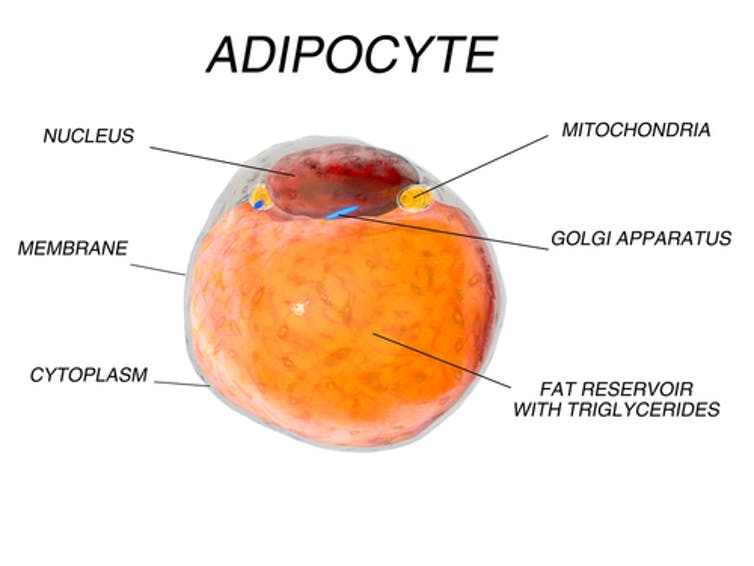
The major problem with this excess fat is that the fat cells, called adipocytes, do not function normally. They store energy at an abnormally high rate and release energy at an abnormally slow rate. What’s more, these extra and enlarged fat cells produce abnormal amountsof different hormones. These hormones increase inflammation, slow down metabolism, and contribute to disease. This complicated pathological process of excess fat and dysfunction is called adiposopathy, and it makes the treatment of obesity very difficult.
A fat cell is loaded with triglycerides, or fatty deposits, and does not resemble other cells in our body. Pavel Chagochkin/Shutterstock.com
When a person begins and maintains a new exercise regimen and limits calories, the body does two things to “burn fat.” First, it uses the energy stored in the fat cells to fuel new activity. Second, it stops putting away so much for storage.
The brain signals fat cells to release the energy packages, or fatty acid molecules, to the bloodstream. The muscles, lungs and heart pick up these fatty acids, break them apart, and use the energy stored in the bonds to execute their activities. The scraps that remain are discarded as part of respiration, in the outgoing carbon dioxide, or in urine. This leaves the fat cell empty and renders it useless. The cells actually have a short lifespan so when they die the body absorbs the empty cast and doesn’t replace them. Over time, the body directly extracts the energy (i.e., calories) from food to the organs that need them instead of storing it first.
As a result, the body readjusts by decreasing the number and size of fat cells, which subsequently improves baseline metabolism, decreases inflammation, treats disease, and prolongs lives. If we maintain this situation over time, the body reabsorbs the extra empty fat cells and discards them as waste, leaving us leaner and healthier on multiple levels.
Mr. George Monbiot offers a deeply personal, deeply powerful reason to change!
I have long followed George Monbiot’s writings. Both for his writing skills and the many times he really spells it out. As in spelling out the madness of our present ways! Frequently I find him very inspiring. However, his latest essay In Memoriam is one of the best ones that I have read. It is a plea from George Monbiot to see what we are doing to our wildlife and our ecosystems.
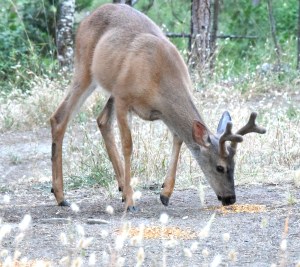
It is republished here with George Monbiot’s very kind permission. I have taken the liberty of including a few recent photographs of the wildlife that graces our acres here in Oregon.
ooOOoo
In Memoriam
As our wildlife and ecosystems collapse, remembering is a radical act.
By George Monbiot, published in the Guardian 29th June 2018
It felt as disorientating as forgetting my pin number. I stared at the caterpillar, unable to attach a name to it. I don’t think my mental powers are fading: I still possess an eerie capacity to recall facts and figures and memorise long screeds of text. This is a specific loss. As a child and young adult, I delighted in being able to identify almost any wild plant or animal. And now it has gone. This ability has shrivelled from disuse: I can no longer identify them because I can no longer find them.
Perhaps this forgetfulness is protective. I have been averting my eyes. Because I cannot bear to see what we have done to nature, I no longer see nature itself. Otherwise, the speed of loss would be unendurable. The collapse can be witnessed from one year to the next. The swift decline of the swift (down 25% in five years) is marked by the loss of the wild screams that, until very recently, filled the skies above my house. My ambition to see the seabird colonies of the Shetlands and St Kilda has been replaced by the intention never to visit those islands during the breeding season: I could not bear to see the empty cliffs, whose populations have crashed by some 90% this century.
I have lived long enough to witness the vanishing of wild mammals, butterflies, mayflies, songbirds and fish that I once feared my grandchildren would experience: it has all happened faster than even the pessimists predicted. Walking in the countryside or snorkelling in the sea is now as painful to me as an art lover would find her visits to a gallery, if on every occasion another Old Master had been cut from its frame.
The cause of this acceleration is no mystery. The United Nations reports that our use of natural resources has tripled in 40 years. The great expansion of mining, logging, meat production and industrial fishing is cleansing the planet of its wild places and natural wonders. What economists proclaim as progress, ecologists recognise as ruin.
We have a fatal weakness: a failure to perceive incremental change. As natural systems shift from one state to another, we almost immediately forget what we have lost. I have to make a determined effort to remember what I saw in my youth. Could it really be true that every patch of nettles, at this time of year, was reamed with caterpillar holes? That flycatchers were so common I scarcely gave them a second glance? That the rivers, around the autumn equinox, were almost black with eels?
Others seem oblivious. When I have criticised current practice, farmers have sent me images of verdant monocultures of perennial rye grass, with the message “look at this and try telling me we don’t look after nature”. It’s green, but it’s about as ecologically rich as an airport runway. One of my readers, Michael Groves, records the shift he has seen in the field beside his house, where the grass, that used to be cut for hay, is now cut for silage. Watching the cutters being driven at great speed across the field, he realised that any remaining wildlife would be shredded. Soon afterwards, he saw a roe deer standing in the mown grass. She stayed throughout the day and the following night. When he went to investigate, he found her fawn, its legs amputated. “I felt sickened, angry and powerless … how long had it taken to die?”. That “grass-fed meat” the magazines and restaurants fetishise? This is the reality.
When our memories are wiped as clean as the land, we fail to demand its restoration. Our forgetting is a gift to industrial lobby groups and the governments that serve them. Over the past few months, I have been told repeatedly that the environment secretary, Michael Gove, gets it. I have said so myself: he genuinely seems to understand what the problems are and what needs to be done. Unfortunately, he doesn’t do it.
He cannot be blamed for all of the fiascos to which he has put his name. The 25-year plan for nature was, it seems, gutted by the Prime Minister’s office. The environmental watchdog he proposed was defanged by the Treasury (it has subsequently been lent some dentures by Parliament). Other failures are all his own work. In response to lobbying from sheep farmers, he has allowed ravens, a highly intelligent and long-lived species just beginning to recover from centuries of persecution, to be killed once more. There are 24 million sheep in this country and 7400 pairs of ravens. Why must all other species give way to the white plague?
Responding to complaints that most of our national parks are wildlife deserts, Gove set up a commission to review them. But governments choose their conclusions in advance, through the appointments they make. A more dismal, backward-looking and uninspiring panel would be hard to find: not one of its members, as far as I can tell, has expressed a desire for significant change in our national parks, and most of them, if their past statements are anything to go by, are determined to keep them in their sheepwrecked and grouse-trashed state.
Now the lobbyists demand a New Zealand settlement for farming after Brexit: deregulated, upscaled, hostile to both wildlife and the human eye. If they get their way, no landscape, however treasured, will be safe from broiler sheds and mega-dairy units, no river protected from run-off and pollution, no songbird saved from local extinction. The merger between Bayer and Monsanto brings together the manufacturer of the world’s most lethal pesticides with the manufacturer of the world’s most lethal herbicides. Already the concentrated power of these behemoths is a hazard to democracy; together they threaten both political and ecological disaster. Labour’s environment team have scarcely a word to say about any of it. Similarly, the big conservation groups, as usual, have gone missing in inaction.
We forget even our own histories. We fail to recall, for example, that the Dower report, published in 1945, envisaged wilder national parks than we now possess, and that the conservation white paper the government issued in 1947 called for the kind of large-scale protection that is considered edgy and innovative today. Remembering is a radical act.
That caterpillar, by the way, was a six spot burnet: the larva of a stunning iridescent black and pink moth that once populated my neighbourhood and my mind. I will not allow myself to forget again: I will work to recover the knowledge I have lost. For I now see that without the power of memory, we cannot hope to defend the world we love.
More evidence that supports the sense, the very great sense, in going vegan!
Some three weeks ago, on June 15th to be exact, I published a post called On Veganism. Jean and I had just watched a film What The Health and what it presented in terms of eating chicken and fish convinced us to immediately go the final step, as in going from being vegetarians to vegans.
Many of you offered kind words and encouragement. Colette Bytes included a link to a blog post that she published in April, 2017. It is called Vegan Future and with her kind permission that post is republished today.
It is chock full of information and videos so do settle down and let all the information provided by Colette ‘speak’ to you! This is really worthy of an evening spent watching all the videos!
ooOOoo
Vegan Future
by Colette Bytes, April 21st 2017
Seventeen percent of human caused greenhouse gases, come from meat and dairy production. It is actually a greater figure than all CO2 produced by global transportation!
Posted by The Daily Conversation
But is it enough, just to reduce our animal consumption, or should we look at the compelling evidence that we need a Vegan future!
Animal and Environmental Ethics
On a previous blog, I mention the documentary ‘Earthlings’ narrated by Hollywood actor, and lifelong Vegan, Joachim Phoenix. ‘Earthlings’ is the definitive Vegan film on exposing the meat and dairy industry in the US. And while other countries may not have factory farming on such a broad scale, many of the same procedures occur on a smaller scale. No member of the general public is allowed into the kill sections of slaughter houses for a very good reason. It is horrendous to watch a fear-ridden animal that wants to live, face its painful death.
This filmed reaction of a viewer watching ‘Earthlings’ is an average reaction. It is a moving experience for anyone with compassion. Posted by Raw Vegan, Fruitarian, Michael Lanfield, it is worth watching if you cannot bring yourself to actually watch the devastating, but common images of the meat, dairy and egg industry.
Switching your food intake to a plant-based Vegan diet, (eliminating all meat, dairy, egg and seafood), is the biggest change with the most impact that you can possibly make to reduce climate warming, land and water degradation, extinction rates, deforestation, pollution, human and animal suffering, and war (often over lack of food and water resources). And It is the number one thing you can do to improve your own health. It can also cut the cost of your food bill while you continue to eat a healthy diet.
There is no downside to this change if you keep your diet healthy and balanced. You can even eat processed plant-based, meat-like products if you want, but they may cost a similar amount to having meat in your diet.
The United Nations has already stated that we need to switch to a plant based diet if we are to survive.
Australian, James Aspey, a survivor of thyroid cancer, has become a Vegan Speaker (on ending animal cruelty) with his own Youtube channel, but he is also one of an exponentially growing number of people who have improved their own health through a plant based diet switch.
Lots of new Ethical, Healthy Vegan Ready Made meals like this brand are appearing now on Super market shelves. So even if you don’t ‘do cooking’ you can still find nutritious Vegan options. And Vegan restaurants, holidays and lifestyles are all available now.
And new research is beginning to show that meat and dairy are actually toxic to our body.
Meat is a neurotoxin, Posted by 8/10/10 in London
And for when you have time, do listen to this amazing and life changing Cardiologist’s 1:20:00 hrs talk…on your likelihood of developing heart disease, diabetes, and other life threatening diseases on a meat based diet…and also look at doctor Greger’s work and videos too (links below)
Robert Ostfeld, Cardiologist and Director of a US Cardiology Centre. Posted by Jeanne Schumacher, ‘Plant Power’ YouTube channel
Elite Athletes and Hollywood Icons
You’d be surprised how many top athletes eat a vegan diet just to be at the top of their sport…Names like Serena and Venus Williams, Novak Djokovic, and Andy Murray, are all Vegans. Winner of the world Strongman competition is Vegan. Many top boxers eat vegan. Look at PlantBased News on YouTube for lots of informative videos on who is Vegan. And see their 100 countdown of awesome Vegan celebrities.
Top 2017 Vegans posted by PlantBased News
Making the change to Vegan
Eating junk plant-based foods is not advisable as it will lead to nutrient deficiencies…and ultimately a disease state, so you can’t survive on potato crisps, popcorn, and bread….there is a responsibility to eat a balanced fresh food diet to be healthy.
You do need to eat proteins (nuts, legumes, grains, beans, some veggies). You will need to supplement with Vitamin B12, a soil- based, active nutrient essential for our brain & nervous system which we do not get in our diet as we no longer forage and eat unwashed food like our ape ancestors. And you may need to supplement Vit D3 for bone health as we no longer spend enough time outside in the sunshine. Essential oil, Omega 3 can be obtained from flax and hemp seeds. The rest, you should be able to get from a ‘good’ Vegan diet with lots of vegetables, fruits, legumes, beans, grains and nuts. Just 15 grams of nuts per day will give you enough protein to be healthy. Eating Kale and other dark leafy plants, beans, whole grain rice, legumes and some nuts, sweet potatoes are all sources of Calcium. The key to health is to have a full, varied selection of whole plant-based food!
Meat and Dairy Industry Scare Tactics
The Meat and Dairy industry packers are worried that they will lose their industry and are fighting back with their political power and disinformation campaigns designed to scare us, but the smart companies will begin to think about how they can profit from exponential growth in the Vegan food industry.
Corporate Panick, posted by PlantBased News Research
There are so many online sources to help you buy, and cook a healthy plant-based diet. Just type ‘Vegan Recipies’ into a search engine and you will find fantastic yummy recipes. You will love the variety and the taste of your new diet. And if you are not into cooking, mainstream supermarkets are now starting to stock a growing variety of vegan ready made meals, and starting to label Vegan choices.
An all round informative website on Vegan trends, news headlines, and increasing popularity of healthy lifestyles including a plant- based diet. Medical based RESOURCES on how to stay healthy on a Vegan diet
Dr Michael Greger, MD, author of Best Seller, ‘How Not to Die’ and distributer of free videos and research on how plant based diets affect us. I have followed his work for years and he backs it all up with science based studies…his short videos and reports are packed with hundreds of supportive reports for a plant based diet.
Vegan Junction list of Plant-Based Diet health professionals More Videos
Open Your Eyes – Toronto Pig Save posted by Bite-Size-Vegan
How not To Die – plant based diet by Dr Michael Greger Latest documentaries to look up
Carnage (only on BBC iPlayer)
The Game Changers
Eating our way to Extinction
What the Health!
Plant Pure Nutrition
And there are so many more resources out there ! Join the growing trend to make this a better world for everyone, by making the biggest difference you can when you shop for food. Pick whole, plant-based, foods and kick the ‘animal eating’ habit to be healthy, stop animal cruelty, and save the environment and reduce global greenhouse gases. What could be a more worthy goal?
This is so much more than just a blog post from Colette. It is a fantastic source of information, from a variety of sources, about why it makes such good sense to become a vegan.
I shall include it as a link from the home page of Learning from Dogs so it may serve as a reference long after it was republished today.
Then what about dogs eating a vegan diet? Sounds a bit strange? Maybe not! I shall be exploring that option with Halo, a company based in Florida, who claim:
Can dogs be vegan? Unlike cats, who are obligate carnivores, dogs can be fed a vegan diet as long as it’s high quality and nutritionally balanced like Halo®Garden of Vegan® dog food.
More on this next week.
In the meantime, I’m taking a day off tomorrow but please do read George Monbiot’s latest post, being republished here on Friday, 6th July.


 We found Zero at our local Humane Society. She was just under a year and a half old and had been picked up as a stray so they didn’t know anything about her. When we got her out of her kennel and into the big yard so we could see her more, she hardly even came over to us. There was just something about her, though, and we knew she was the one.
 [Ed: Text taken from a chart


 see what we have done to nature, I no longer see nature itself. Otherwise, the speed of loss would be unendurable. The collapse can be witnessed from one year to the next. The swift decline of the swift (
 I have lived long enough to witness the vanishing of
  my readers, Michael Groves, records the shift he has seen in the field beside his house, where the grass, that used to be cut for hay, is now cut for silage. Watching the cutters being driven at great speed across the field, he realised that any remaining wildlife would be shredded. Soon afterwards, he saw a roe deer standing in the mown grass. She stayed throughout the day and the following night. When he went to investigate, he found her fawn, its legs amputated. “I felt sickened, angry and powerless … how long had it taken to die?”. That “grass-fed meat” the magazines and restaurants fetishise? This is the reality.


Sue, and everyone else, we returned from seeing Dr. Lee, the neurologist, a little under two hours ago. Dr. Lee’s prognosis is that Jean is showing the very early signs of Parkinson’s disease, and Jean is comfortable with me mentioning this.
Everyone’s love and affection has meant more than you can imagine. I will write more about this next week once we have given the situation a few ‘coatings of thought’.
Jean sends her love to you all!