The story that could run for an awfully long time!
I rather revealed my newness as a US resident by posting my review of David Kauders’ book The Greatest Crash over 2 days last week, one of them being Thanksgiving Day. Despite that 1,895 people viewed my review which was entitled The end of an era.
A week has now passed since that review. I was curious to see what sorts of headlines had been making the news in the last 7 days. It’s just a random trawl through those items that have captured my attention.
The eurozone really has only days to avoid collapse
By Wolfgang Münchau
In virtually all the debates about the eurozone I have been engaged in, someone usually makes the point that it is only when things get bad enough, the politicians finally act – eurobond, debt monetisation, quantitative easing, whatever. I am not so sure. The argument ignores the problem of acute collective action.
Last week, the crisis reached a new qualitative stage. With the spectacular flop of the German bond auction and the alarming rise in short-term rates in Spain and Italy, the government bond market across the eurozone has ceased to function.
Wolfgang concludes his article thus,
Italy’s disastrous bond auction on Friday tells us time is running out. The eurozone has 10 days at most.
Then my print copy of The Economist that arrived on the 26th had this lurid cover page,
Unless Germany and the ECB move quickly, the single currency’s collapse is looming
Past financial crises show that this downward spiral can be arrested only by bold policies to regain market confidence. But Europe’s policymakers seem unable or unwilling to be bold enough. The much-ballyhooed leveraging of the euro-zone rescue fund agreed on in October is going nowhere. Euro-zone leaders have become adept at talking up grand long-term plans to safeguard their currency—more intrusive fiscal supervision, new treaties to advance political integration. But they offer almost no ideas for containing today’s conflagration.
and a few paragraphs later, this,
This cannot go on for much longer. Without a dramatic change of heart by the ECB and by European leaders, the single currency could break up within weeks. Any number of events, from the failure of a big bank to the collapse of a government to more dud bond auctions, could cause its demise. In the last week of January, Italy must refinance more than €30 billion ($40 billion) of bonds. If the markets balk, and the ECB refuses to blink, the world’s third-biggest sovereign borrower could be pushed into default.
ICAP Plc is preparing its electronic trading platforms for Greece’s potential exit from the euro and a return to the drachma, senior executives at the inter-dealer broker said Sunday.
ICAP is the latest firm to disclose such preparations, joining the growing ranks of banks, governments and other key players in the global financial system whose officials are worried enough about the stability of the common currency to be making contingency plans for a possible break-up.
Investors sent Europe’s politicians a painful message last week whenGermany had a seriously disappointing government bond auction. It was unable to sell more than a third of the benchmark 10-year bonds it had sought to auction off on Nov. 23, and interest rates on 30-year German debt rose from 2.61 percent to 2.83 percent. The message? Germany is no longer a safe haven.
and concluded,
Ultimately, an integrated currency area may remain in Europe, albeit with fewer countries and more fiscal centralization. The Germans will force the weaker countries out of the euro area or, more likely, Germany and some others will leave the euro to form their own currency. The euro zone could be expanded again later, but only after much deeper political, economic and fiscal integration.
Tragedy awaits. European politicians are likely to stall until markets force a chaotic end upon them. Let’s hope they are planning quietly to keep disorder from turning into chaos.
Finally, on the 29th the BBC News website carried details of the Autumn Statement made by British Chancellor, George Osborne, to Parliament.
Osborne confirms pay and jobs pain as growth slows
Chancellor George Osborne has said public sector pay rises will be capped at 1% for two years, as he lowered growth forecasts for the UK economy.
The number of public sector jobs set to be lost by 2017 has also been revised up from 400,000 to 710,000.
Borrowing and unemployment are set to be higher than forecast and spending cuts to carry on to 2017, he admitted.
Just look at that figure of public sector job losses – 710,000!
Well that’s more than enough from me but it does surely endorse the opening views that David Kauders expounded in his book, as carried in my review, and reproduced here,
Starting with the first sentence, David sets out the core problem;
This book argues that it is impossible to expand the financial system much further.
expanding this a few paragraphs later,
This is the financial system limit: lack of new borrowing plus excessive weight of debt obligations from past borrowing combine to slow economies down. This is the barrier whichever way policy makers turn. It is like the lid on a boiling kettle. Enough steam can lift it for a while but it always snaps back into place. The financial system limit is a roadblock preventing growth.
A few pages later in this opening chapter ‘The roadblock preventing growth‘ this limit is explained thus,
Policy contradictions also show us that the financial system has reached a roadblock. The glaring conflict between bailout and austerity is at the core. Each bailout or stimulus requires creation of more credit, leading to false financial speculation, and for a short while markets recover their poise. The threat of inflation returns. Later, bad debts rise, the markets tumble again and a new crisis emerges. Austerity, the alternative policy, cuts spending thereby cutting the immediate level of economic activity and bringing economic decline more quickly than the stimulus alternative. Whichever way they turn, the authorities are damned.
You can understand why I called this Post a ‘footnote’ not an endnote.
A review of David Kauder’s recently published book, The Greatest Crash.
Details of the availability of the book are included at the end of the review.
Extracts from the book included are with grateful thanks to Sparkling Books.
Part One of this review was published yesterday which needs to be read before Part Two.
——————-
Chapter 5 continues by examining the over-bearing consequences of excessive public spending, excessive Government regulations, substitute taxation, weakness of Treasury forecasts, and so on. While these are UK issues, there is no doubt that similar restraints of free enterprise exist in many other western nations.
In Chapter 6, ‘Group Think‘, David looks at the strange ways in which we form opinions. It’s a topic that has been discussed and written about widely but the point behind this chapter is that people have in great part lost the ability to discern truth from fiction, with terrible implications when it comes to understanding how individuals are affected by government and bureaucratic institutions.
The chapter closes;
One of the remarkable points that I have found in writing this book is that many of the detailed errors, incorrect policies et al, have already been amply documented by others. But we never learn. The delegated society, the strength of lobby groups and vulnerability of our political system to pressure, the sheer volume of noise in the media and on the Internet, the immediacy of the demands of daily life, all combine to make our collective memory rather short.
Amen to that!
Chapter 7, ‘Academic differences of opinion‘, was surprisingly short at just 6 1/2 pages. One would have thought the subject worthy of a much longer review especially as David was exploring the fundamental differences between Keynesian and Ricardian economic theories and opportunities for alternative theories. Must say that that I laughed out loud (David’s book is a little short on humour!) at the sentence on p.127 that ran, “One correspondent writing to the Financial Times proposed that economics should be declared a failing discipline, economists as not fit for purpose, and a physicist put in charge of sorting their theories out.”
Chapter 8, ‘The dark side of capital markets‘, is the penultimate chapter and quite a technical one at that. But David manages to trip through esoteric aspects, well esoteric to the lay reader, in a manner that keeps one involved. Here’s an example from early on in the chapter.
Capital markets follow a long cycle beyond the experience of most practitioners, detectable only by understanding history and then applying this understanding to contemporary conditions.
It didn’t mean much to me. Then the next sentence;
The principles are identical for any market where prices depend on the supply of credit: equities, bonds, property and commodities are all markets where the prices must relate to the availability of credit.
That, at least, was understood but still the penny hadn’t dropped. Then came;
Bond prices prosper when credit is lacking while the other three prosper when credit is abundant.
That then made sense to me but still only at some academic level. David then followed those sentences with these two paragraphs;
The whole market cycle consists of bull market followed by bear market, as surely as night follows day. The bull market in assets is driven by an increasing supply of credit and economic expansion, since more credit leads to higher prices. The bear market in assets is driven by less credit and economic contraction; there is no purchasing power to keep asset prices high. Only fixed interest bonds are contra-cyclical, declining in price as credit expands and rising in price as credit sinks.
There are two useful theories for analysing the whole market cycle: conversion flow and Dow theory.
So in half-a-page of text, the book effectively educated me and then showed the relevance of that learning to the world I was living in. Cleverly done!
Chapter 9, ‘The attitude change‘, is, without doubt, a clincher of a close to this fascinating book. The sentiments conveyed in this chapter are so unexpected that, forgive me, it would be wrong to explicitly refer to them. Buy the book!
Let me just say that the last chapter fully endorsed me calling this review The End of an Era.
Overall conclusions
This is an important book from a writer who has both the academic and professional experience to enable him to form the views that he expresses. Only time will tell if the whole scenario that is envisaged by Mr. Kauders will play out as he expects. My personal view is that it will.
For individuals and business alike, reading The Greatest Crash will inform you in a manner that I would argue is critical when one notes the precarious and potentially unstable period we are living through. The decisions readers make after reading the book are beyond the remit of this review and, of course, David Kauders, but, at least, read the book!
Prof. Myddelton in the book’s introduction wrote, “But one of the things we need now is new thinking on the fundamentals.” Perhaps not new thinking on fundamentals, as the Prof. puts it, but a reinstatement of core fundamental values.
I am not alone from sensing that the world, especially the western world, is transitioning from an era of greed and materialism, seeing a world of unlimited resources, to a different societal relationship with planet Earth, the only planet we have. A transition across all layers of society towards the values of truth, integrity and compassion; values whose day has come.
The Greatest Crash reinforces immensely my notion that this truly is the end of an era.
——————
Want to buy The Greatest Crash? The ebook was published in October worldwide, the paperback published in the UK on the 1st November UK, the hardcover being released any day now in the UK. For North America both the paperback and hardcover versions are being published on 1st February, 2012.
Full details from the Sparkling Books webpage here.
A review of David Kauder’s recently published book, The Greatest Crash.
Details of the availability of the book are included at the end of both parts of my review, part two is published tomorrow.
Extracts from the book included are with grateful thanks to Sparkling Books.
Personal introduction.
Back in the late 90s, when I was living in England, I attempted to bolster my self-employed income by investing and trading in equities. It was a frustrating game, game being the right word! One day I was lamenting this to a close friend and he gave me the name of David Kauders at Kauders Portfolio Management and suggested I might like to contact him.
I followed my friend’s recommendation and met with David. What he outlined at that meeting all those years ago was mind-blowing, no other way of putting it. Essentially, David predicted a financial and economic crisis of huge proportions. He convinced me of the likelihood of that crisis and in November 2001 I became a fee-paying client. As the world now knows that prediction came to fruition. My anticipated residency in the USA meant continuing to be a client was not possible, and I ceased being a client of Kauders Portfolio Management in June 2010.
Thus not only am I deeply indebted to my friend for referring me to David but also unable to write this review from an unprejudiced point of view.
The Greatest Crash
The book, released in paperback in England in October 2011, published by Sparkling Books, is subtitled ‘How contradictory policies are sinking the global economy‘. Frankly, that subtitle doesn’t do much for me. A clearer message that comes from the book is this: the economic world has reached a ‘systems limit’. Indeed, the term systems limit is used widely throughout the book.
In his introduction to the book, Professor D. R. Myddelton, Chairman of the Institute of Economic Affairs, writes,
Adam Smith said ‘There’s a deal of ruin in a nation’, and it would be a mistake to despair. But one of the things we need now is new thinking on the fundamentals. That is what David Kauders provides in his book ‘The Greatest Crash’.
Without doubt, David achieves that.
Starting with the first sentence, David sets out the core problem;
This book argues that it is impossible to expand the financial system much further.
expanding this a few paragraphs later,
This is the financial system limit: lack of new borrowing plus excessive weight of debt obligations from past borrowing combine to slow economies down. This is the barrier whichever way policy makers turn. It is like the lid on a boiling kettle. Enough steam can lift it for a while but it always snaps back into place. The financial system limit is a roadblock preventing growth.
A few pages later in this opening chapter ‘The roadblock preventing growth‘ this limit is explained thus,
Policy contradictions also show us that the financial system has reached a roadblock. The glaring conflict between bailout and austerity is at the core. Each bailout or stimulus requires creation of more credit, leading to false financial speculation, and for a short while markets recover their poise. The threat of inflation returns. Later, bad debts rise, the markets tumble again and a new crisis emerges. Austerity, the alternative policy, cuts spending thereby cutting the immediate level of economic activity and bringing economic decline more quickly than the stimulus alternative. Whichever way they turn, the authorities are damned.
In the next chapter, ‘Evolution by trial and error‘, David writes about economic cycles and reminds his readers that the long economic cycle is often “beyond the practical experiences of our working lifetimes“. Then later suggesting that because we have seen the greatest period of inflation ever since the end of World War Two, ergo “the unwelcome lesson from history is that the greatest deflation should follow.”
In Chapter 4, ‘An Era of Wishful Thinking‘, the spotlight is put on the horrific policy errors that have been made for decades, try these three examples (there is a longer list in the book),
Policy makers believed that debt could expand indefinitely, at no cost.
Nobody realised that interest rate rises would make existing borrowing unaffordable and cause a wave of defaults.
The world was swamped with so many detailed requirements and standards that nobody could understand how they all fitted together. It was assumed that ‘transparency’, i.e. extensive detail, would solve the inability to comprehend how the parts made the whole.
Part Two of the review, continuing with Chapter 5 is tomorrow.
Want to buy The Greatest Crash? The ebook was published in October worldwide, the paperback published in the UK on the 1st November UK, the hardcover being released any day now in the UK. For North America both the paperback and hardcover versions are being published on 1st February, 2012.
Full details from the Sparkling Books webpage here.
A President with more speech writers than one could imagine.
Got a vested interest or a strong view? Then draft a speech for the President of the United States of America. Many do. Some are clearly very tongue-in-cheek, some are pertinent. The following from CASSE fits into the latter category. Enjoy.
President Obama’s (Hoped for) “Amaze Speech”
Speechwriter: Brian Czech
President Obama’s hoped-for speech first appeared in the Daly News on August 7. We reprint it this week in anticipation of the President’s September 8th speech.
Pres. Obama
Fellow Americans, this evening I have a special message for you. It’s an unprecedented and surprising message, but ultimately it will resonate with your common sense, good will, and patriotic spirit. It turns out that the recessionary cloud we’re under does have an extremely valuable silver lining. I know; it sounds like something only a politician would say, but wait. I think you’ll be surprised to hear my explanation.
Now before I elaborate on the silver lining, I want to make it clear that the cloud has some rain, too. As a nation, we are struggling with debt, credit ratings, and worst of all, the painful experience of unemployment. The last thing I want is to mislead you into thinking these are problems I take lightly, or problems that will be automatically solved by the markets or policy makers. These problems were many years in the making — decades in fact — and it’s going to take years of diligence and readjustment to solve them.
Yet none of these problems can deny us the silver lining, which is this: the economic turmoil we experience today will change the course of history in such a way as to secure the future for American posterity, starting with our children and grandchildren. Let me reiterate, our own kids and grandkids — the most precious American treasure — will have a secure future as a result of the problems we face today. Here’s why…
Far from the trading floors of Wall Street and the policy meetings of the Federal Reserve, crucial discoveries have been made by scientists, economists, anthropologists, historians, and others collaborating under a broad umbrella called “sustainability science.” No, they haven’t discovered an unlimited energy source, a pollution-free car, or a method to stabilize our climate at optimum conditions. They’ve discovered something far more important and exciting: the key to permanent economic security.
For the past few years, as time has allowed, I and my economic advisors, with the assistance of numerous scholars, have studied this key to economic security. The theory and evidence for it is absolutely irrefutable. The only reason this key to security hasn’t broken into public dialog is because it serves no short-term vested interests; no wealthy corporations, think tanks, or political parties that would stand to profit before the next shareholders meeting or election cycle. But that’s also the beauty of it: the key to security is a non-partisan, scientifically sound approach to the long-run interests of all, especially our kids and grandkids. Fortunately for us, it’s surprisingly simple as well.
What is this key to a secure future? We could coin a new phrase to get credit for the idea or to improve its political flavor, but I believe the clearest term is what the scientists already call it: the “steady state economy.” Political advisors think it’s a bit on the dry side, but after what we’ve been through – stock market crashes, insurance crises, banker bailouts, panic over the debt ceiling, having our credit downgraded — doesn’t a “steady state economy” sound like just what the doctor ordered?
In the coming weeks and months, I and my Cabinet will be helping to introduce fellow Americans to the basics of steady state economics, especially what it means for producers, consumers, and public policy. We’ll do this through a series of public announcements, publications, and townhall meetings. Meanwhile, this evening, I’ll provide a brief summary, first by noting what a steady state economy is not.
A steady state economy is not communism, Marxism, or anything at odds with the Constitution of the United States. A steady state economy is not a stagnant, flat-lined economy but is rather continuously dynamic and creative. A steady state economy is not established overnight with draconian policies; instead it evolves as a matter of consumer preference and prudent policy. Most importantly, a steady state economy is in no way opposed to jobs and full employment. To the contrary, a steady state economy is the only economy that can ensure full employment, for your kids and theirs.
The most fundamental feature of the steady state economy is stability. The idea is to stabilize good conditions; stable agriculture, stable manufacturing, stable services, stable production and consumption, stable currency, stable markets, stable international trade, stable impact on the environment, stable air and water, stable climate… You get the picture, and remember, all this stability is at a good level — a level that ensures life, liberty and happiness for us and future generations. At this point in history, the steady state economy is the right goal, and the first step in getting there is recognizing it.
Perhaps you find this amazing. I think you should be amazed. After all, I haven’t said a word about economic growth; in fact I’ve called growth into question. The closest thing to this in presidential history is when President Carter encouraged Americans to consume a little less after the OPEC oil embargo. But President Carter was before his time, and his speech was maligned as the “malaise speech.”
Well, at this point in history, we can no longer afford — literally or figuratively — to pull out all the stops for economic growth. Therefore, tonight you’re hearing the “amaze speech,” the speech that introduces our nation to steady state economics, the alternative to growth.
I understand the adjustment in thinking that this will entail. I’ve gone through it myself. With the exception of President Carter in 1979, my predecessors for over 50 years have prioritized economic growth in their speeches, campaigns, and policies. None even mentioned steady state economics in a speech. Yet with every new president, the pursuit of economic growth has become less realistic, less sustainable, and even less desirable.
Earlier I mentioned the profound developments in sustainability science. Among the sustainability scholars are behavioral scientists and psychologists who have found compelling evidence that economic growth stopped contributing to a happier United States somewhere from the 1950′s to the 1970′s. After that, our gross domestic product continued to rise, but our happiness did not. If you’re like me — meaning old enough to remember — this probably resonates with you. Somewhere along the line the brighter lights, bigger houses and fancier cars stopped making us better off. In fact, all the new “stuff” started working against us. Now we struggle to find enough oil, water, “green space,” solitude, free time, and the peace of mind that comes with a stable climate. It’s all the sign of an economy grown too big.
They say the definition of insanity is doing the same thing over and over again and expecting a different result. I think we’ve all done some crazy things in life, but I don’t want to go down in history as the insane president who kept trying every trick in the book to “stimulate the economy,” when stimulating the economy was neither bound to work nor even desirable by that point in history. I don’t want to oversee more banker bailouts, more stimulus spending, more loosening of environmental protections in a vain attempt to increase GDP growth. That would be insane. Instead, I’m going to tell it like it is: the pursuit of economic growth has become a dangerous obsession that we must overcome. I say this with the backing of sound science, the lessons I’ve learned, and the concern I have for the future of America.
I’m going to test your common sense now. Do you think there is a limit to economic growth? Remember, economic growth is increasing production and consumption of goods and services. It means more and more people, more and more stuff. It takes more energy, water, space to operate in, and places to put out the trash.
Now as a politician, I can assure you that, in the coming days, well-paid pundits will conjure up magical concepts of perpetual growth based on “dematerializing” the economy. Well when they’re ready to dematerialize it, maybe they can beam us up. Meanwhile, the rest of us in the real economy know what perpetual GDP growth would take: evermore people, evermore stuff. And we know we’re running out of evermore room, resources, and patience for unreal notions of evermore growth.
I know that for some, and perhaps for many, this is hard to swallow. For decades we Americans have been encouraged to believe in the notion of continual economic growth. But look at it this way: to think there is no limit to economic growth on Earth is like thinking we could fit a stabilized economy into a perpetually shrinking area. For example, with computers, robots, nanotechnology and the like, we could squish the $70 trillion global economy into North America, then the United States, then Iowa, then into the foyer of the Des Moines Chamber of Commerce, leaving the rest of the world as a designated wilderness area! It’s a ludicrous notion, and it’s precisely as ludicrous as thinking there’s no limit to economic growth in Des Moines, the United States, or Earth.
Now, let’s consider some of the problems we will face if we continue pulling out all the stops for economic growth. The first is inflation. Typically we use monetary policy — such as increasing the money supply — to stimulate growth. But when the real economy isn’t meant to grow as easily as increasing the money supply, the result is inflation. Nothing could be more harmful to our economy at this point than inflation, which is like a devastating tax on the nation.
Another problem is debt. As you know, my Administration injected a major fiscal stimulus into the economy. It helped somewhat and spun off some jobs, but it did not produce the wave of jobs we’d get in an economy with plenty of room to grow. Meanwhile, it added to our deficit and ultimately our debt. Now our credit is coming into question, as with so many nations in a global economy bumping up against the limits to growth.
Of course, there is no shortage of special interests to pounce on the news of faltering fiscal policy. The answer, they say, is to turn over as much as possible to Wall Street. “Take care of national security,” they say, “and let the markets take care of the economy.” The problem with that approach is that national security is about more than having the biggest military. National security starts with a sustainable economy, which requires a stable environment to support the agricultural, fishing, logging, mining, and ranching activities that have always been and always will be the foundation of the American and global economy. Our manufacturing and service sectors — the best in the world — are the best because we have the biggest and best agricultural and extractive sectors. And we have those because we have protected the environment from overuse, pollution, and displacement.
Consider what will happen if we take an unbalanced approach and prioritize economic growth even more over environmental protection. Does anyone really question whether we will have more environmental problems, including devastating problems? More oil spills in the Gulf of Mexico and Gulf of Alaska, more mountaintop mining in the Appalachians, more scraping for shale oil in the Rockies, more nuclear waste, more endangered species, more greenhouse gas emissions, and all the while less water, less fish and wildlife, less wilderness, less nature, less beauty. Does anyone question whether such trends diminish the quality of life for future generations? No, the problems caused by economic growth are unquestionable. It’s just that, for much of American history, the benefits of increasing GDP outweighed the costs. That’s no longer the case, and I’m confident that most of us can sense it.
In fact, the more I thought about this speech, the more amazed I became. Why did it take us so long, in America, to have an open discussion of limits to growth and alternatives to growth? The principles are irrefutable. Neither growth nor recession is sustainable in the long run; a steady state economy is the obvious policy for long-run security. Yet based on the politics of the past 50 years, you’d think economic growth had supplanted apple pie as the companion to motherhood.
Well, now we’re entering a new era of dealing squarely with sustainability. It turns out that economic growth was not a good companion to motherhood, not in the long run. We want apple pie back. We want loving homes for our children, quality time with family and friends, the occasional escape to the great outdoors, and peace. That’s the American dream in a nutshell, and it’s too valuable to sacrifice for economic growth.
So let’s roll up our sleeves and wash our hands of the dirty business of growth at all costs. We know what the right goal is, and malaise won’t get us there. We have work to do to stabilize the economy for our children and grandchildren. Our decisions — what we eat, what we drive, what we build, and frankly how many kids we have — all these will determine the quality of life for the kids that we do have. Meanwhile, those of us privileged to hold public office are responsible for developing the policies to help you thrive in a steady state economy, and for avoiding the policies that force us onto an unsustainable pathway of evermore growth. You could say we are tasked now with “steady statesmanship.”
To conclude, my fellow Americans, do stay tuned. In the coming days and weeks we’ll be discussing the details of transitioning from growth to a steady state. We’ll be talking with you about employment, population growth, stock markets, the banking system, and more. Don’t fear any shocks to the system; you’ve seen most of the shocks already as the policies of economic growth have failed. One by one, we’re going to turn these “failures” into steady state successes.
I am about a third into Paul Gilding’s book The Great Disruption. It’s proving to be a very-thought provoking read that I will review in more detail over the coming weeks.
However, I just wanted to quote from the start of Chapter 5, Addicted to Growth,
Indeed, as argued by economist Kenneth Boulding: “Anyone who believes exponential growth can go on forever in a finite world is either a madman or an economist.”
Very little that can be argued about that statement. It rather puts into context a couple of items read recently. Both from the blogsite New Economic Perspectives. The first on June 10th by Stephanie Kelton,
Earlier this week, President Obama talked about the weakening state of the economy, telling us that he’s not worried about a double-dip recession and that the nation should “not panic.” It’s hard to imagine a more alarming assessment at this juncture.
The recovery is faltering. Our economy is growing at annual rate of just 1.8 percent. Manufacturing just grew at its slowest pace in 20 months. More than 44 million Americans – one in seven – rely on food stamps. Employers hired only 54,000 new workers in May, the lowest number in eight months. Jobless claims increased to 427,000 in the week ended June 4. The unemployment rate rose to 9.1 percent. Nearly half of all unemployed Americans have been without work for more than 6 months. About 25% of all teenagers who are looking for work are unemployed. Eight-and-a-half million Americans are underemployed – i.e. working part-time because their hours have been cut or because they can’t find full-time work. There are, on average, 4.6 unemployed people for every 1 job opening. And even if all the open positions were filled, there would still be 10.7 million people looking for work.
Today’s unemployment data suggests that we are experiencing something far worse than a mere “bump in the road”, as our President described it last month. In fact, if last month was the time to panic, as Stephanie Kelton argued here, then today’s data should create real palpitations in the White House. This isn’t just a “bump,” but a fully-fledged New York City style pot hole.
First the headline number everyone looks at: non-farm payrolls. Up 18,000 in June, the increase was 100,000 less than expectations. In addition the prior two month payroll increases were revised down by -44,000 overall. That’s weak – but not terrible.
Dig a bit deeper into the data and it looks absolutely awful: The household measure of employment fell by -445,000. Okay, it’s a noisy number. But, as Frank Veneroso has pointed out to me in an email correspondence, this measure of employment which is never revised now shows no employment growth over the last five months and very negative employment growth over the last three.
But it gets worse: The work week was down one tenth. Overtime was down one tenth. The labor participation rate at 64.1% was the lowest since 1984. The broad U6 unemployment rate rose from 15.8% to 16.2%. In other words, as Frank suggested to me this morning, “many other employment indicators in this report confirm the deep disappointment in the payroll series and the much more negative message of the household series.”
Now here’s the latest item published by Paul Gilding in his Blog, The Cockatoo Chronicles. (I have republished it in full, hopefully without upsetting Mr. Gilding – couldn’t see advice on reproduction – but copyright remains, of course, fully with Paul Gilding.)
Like a Grenade in a Glasshouse
June 29, 2011
It’s going to hit hard and it’s going to hurt – made worse because most aren’t expecting it. They think the world is slowly returning to our modern “normal” – steadily increasing growth, with occasional annoying but manageable interruptions. After all, the global recession wasn’t so bad was it? Sure there was pain and things got shaky but Governments responded, bailed out companies, stimulated economies, got things back on track. While it’s still a bit bumpy, Greek wobbles, US debt, extreme weather, high oil and food prices etc, it’ll work out. It always does….
If only it were so. In fact we are blindly walking towards the next in a series of inevitable system shaking and confidence sapping crises, deluded in the belief that the worst is behind us.
Each crisis will be a little worse than the last. Each one will shake our denial a little more. This is what happens when systems hit their limits. They don’t do so smoothly, but bump up against the wall, hitting hard, then bouncing off equally hard. It is the behaviour of a system trying to break through. But if the limits are solid, as is the case with our economic system hitting the limits of the planet – defined by unchangeable physical capacity and the laws of physics, chemistry and biology – then it can’t find its way through. So eventually, when the pain of hitting the wall gets too much, it stops.
Then it will hit. Like a grenade in a glasshouse, shattering denial and delusion and leaving it like a pile of broken glass on the floor of the old economic model. Then we’ll be ready for change.
I’ve been arguing the inevitability of this moment since 2005, mostly inside the business community. Before the 2008 financial crisis hit, the idea was almost universally rejected, with a belief in the indomitable power of globalised markets to overcome all challenges and keep growth on track. Most audiences believed that while markets always wobbled, they also always recovered. My suggestion, that this level of arrogance was the hallmark of empires before they fell, landed on deaf ears. They were the masters of the universe and markets and growth would always reign supreme.
Now the response is different. The financial crisis saw many break off from the pack and start to ask the difficult questions. I now find as I tour the world speaking about The Great Disruption to community gatherings, corporate executives and policy makers that minds are increasingly open. While not the dominant view, the previous confidence in the inevitably of growth has become shaky and the group asking the challenging questions is rapidly expanding.
As I argue in the book, the fundamental cause of what’s coming is resource constraint and environmental breakdown, which when combined with an overstretched financial system and high levels of debt puts unbearable tension into the global economy. While no one can know what event will pull the pin out of the grenade, the underlying pressures make that moment inevitable. Yes, the dominant commentary still blames each individual problem on unique circumstances, but the underlying systemic causes are clear for those who wish to look.
The continued level of denial still surprises me, especially given the pressures driving this are not esoteric and can be measured in clear economic indicators. A good example was recently published by one of the more interesting voices to join the growing chorus that we have a system-wide problem. The legendary contrarian and fund manager Jeremy Grantham is co-founder of the Boston based firm GMO, with over $100 billion of assets under management. So this guy is a solid capitalist and market advocate, pursuing wealth for the wealthy. But he sees the data and is raising the alarm, calling this moment “one of the giant inflection points in economic history” – referring to the end of a 100-year steady decline in commodity prices. His views were echoed by Stephen King, group chief economist at HSBC, who wrote in the FT: “After the biggest meltdown since the Great Depression, economic theory tells us that world commodity prices should not be this high. But they are and the West quickly needs to wake up to this new economic reality. Commodity prices are now permanently higher.”
Grantham provides the detail, pointing out that the 100 year trend of falling prices in the 33 most important commodities, except for oil, were wiped out with a price surge from 2002 to 2010 – a surge even greater than experienced in WW2. We have now reached what Grantham calls the Great Paradigm shift; not a price spike but a new reality. Within this new reality, Grantham says: “if we maintain our desperate focus on growth, we will run out of everything and crash.”
This is why hitting the wall is inevitable – because limits are not philosophies, they are limits. We can understand what to expect – and why the grenade will shatter the glasshouse of economic growth – by going back to how systems behave when they hit their limits. Our economic system first hit the wall in 2008 – that was when The Great Disruption began with food and oil prices hitting record highs and a credit crisis driven by reckless monetary policy pursuing growth at all costs. The resulting recession meant we backed away from those limits (bouncing off the wall), and then borrowed massive amounts of money from our children (think Greece) to try to get the economy moving again.
Now that the global economy is slowly entering a so-called “recovery”, the prices of commodities (representing our use of earth’s resources for food and materials) are on the way up, accelerated, in the case of food, by climate change. Of course if significant growth kicks in, the prices of oil, food and other commodities will surge, this timestarting from near record highs. Then we will bounce back into recession and prices will back off again. Hit the wall, bounce off. Hit the wall, bounce off. Ouch.
By itself this would pose enough of a challenge to growth. But now we also have the debt we used to get the economy moving again. This debt can only be paid off with significant economic growth – but such significant growth is impossible as outlined above. So the debt itself becomes an enormous additional tension in the system, as argued by Richard Heinberg in his important forthcoming book The End of Growth. With the global economy and ecosystem now both burdened by unmanageable debt, effective global default is only a matter of time.
So we’re living in a glass house with the grenade sitting there for all to see. Who knows what will pull the pin. It could be Greece, a Chinese food crisis, peak oil or any number of other triggers. But it’s coming.
The question to ask yourself is simple. Are you ready?
Back to Kenneth Boulding: “Anyone who believes exponential growth can go on forever in a finite world is either a madman or an economist.”
Forgive me for making this a much shorter contribution but the efforts of the previous two posts took rather a long time!
This is about the debt situation in the United States of America and, as always, Learning from Dogs trying to get to the underlying truth.
It’s from the BBC and it’s a radio programme that is included in this Post.
But why the headline referring to Churchill? Well in the programme Justin Webb, of the BBC, reminds the world of a characteristic of the American Nation noted by Sir Winston Churchill, “Americans can always be counted on to do the right thing…after they have exhausted all other possibilities.” (But caution about the precise wording of that quote – see here!)
Here’s the article that accompanied the BBC broadcast, the radio programme is after this article,
Is the US in denial over its $14tn debt?
Is America in denial about the extent of its financial problems, and therefore incapable of dealing with the gravest crisis the country has ever faced?
This is a story of debt, delusion and – potentially – disaster. For America and, if you happen to think that American influence is broadly a good thing, for the world.
The debt and the delusion are both all-American: $14 trillion (£8.75tn) of debt has been amassed and there is no cogent plan to reduce it.
The figure is impossible to comprehend: easier to focus on the fact that it grows at $40,000 (£25,000) a second. Getting out of Afghanistan will help but actually only at the margins. The problem is much bigger than any one area of expenditure.
The economist Jeffrey Sachs, director of Columbia University’s Earth Institute, is no rabid fiscal conservative but on the debt he is a hawk: “I’m worried. The debt is large. It should be brought under control. The longer we wait, the longer we suffer this kind of paralysis; the more America boxes itself into a corner and the more America’s constructive leadership in the world diminishes.”
The author and economist Diane Coyle agrees. And she makes the rather alarming point that the acknowledged deficit is not the whole story.
The current $14tn debt is bad enough, she argues, but the future commitments to the baby boomers, commitments for health care and for pensions, suggest that the debt burden is part of the fabric of society:
“You have promises implicit in the structure of welfare states and aging populations that mean there is an unacknowledged debt that will have to be paid for by future taxpayers, and that could double the published figures.”
Richard Haass of the Council on Foreign Relations acknowledges that this structural commitment to future debt is not unique to the United States. All advanced democracies have more or less the same problem, he says, “but in the case of the States the figures are absolutely enormous”.
Mr Haass, a former senior US diplomat, is leading an academic push for America’s debt to be taken seriously by Americans and noticed as well by the rest of the world.
He uses the analogy of Suez and the pressure that was put on the UK by the US to withdraw from that adventure. The pressure was not, of course, military. It was economic.
Britain needed US economic help. In the future, if China chooses to flex its muscles abroad, it may not be Chinese admirals who pose the real threat, Mr Haass tells us. “Chinese bankers could do the job.”
Because of course Chinese bankers, if they withdrew their support for the US economy and their willingness to finance America’s spending, could have an almost overnight impact on every American life, forcing interest rates to sky high levels and torpedoing the world’s largest economy.
Not everyone accepts the debt-as-disaster thesis.
David Frum is a Republican intellectual and a former speech writer to President George W Bush.
He told me the problem, and the solution, were actually rather simple: “If I tell you you have a disease that will absolutely prostrate you and it could be prevented by taking a couple of aspirin and going for a walk, well I guess the situation isn’t apocalyptic is it?
“The things that America has to do to put its fiscal house in order are not anywhere near as extreme as what Europe has to do. The debt is not a financial problem, it is a political problem.”
Mr Frum believes that a future agreement to cut spending – he thinks America spends much too big a proportion of its GDP on health – and raise taxes, could very quickly bring the debt problem down to the level of quotidian normality.
‘Organised hypocrisy’
I am not so sure. What is the root cause of America’s failure to get to grips with its debt? It can be argued that the problem is not really economic or even political; it is a cultural inability to face up to hard choices, even to acknowledge that the choices are there.
I should make it clear that my reporting of the United States, in the years I was based there for the BBC, was governed by a sense that too much foreign media coverage of America is negative and jaundiced.
The nation is staggeringly successful and gloriously attractive. But it is also deeply dysfunctional in some respects.
Take Alaska. The author and serious student of America, Anne Applebaum makes the point that, as she puts it, “Alaska is a myth!”
People who live in Alaska – and people who aspire to live in Alaska – imagine it is the last frontier, she says, “the place where rugged individuals go out and dig for oil and shoot caribou, and make money the way people did 100 years ago”.
But in reality, Alaska is the most heavily subsidised state in the union. There is more social spending in Alaska than anywhere else.
To make it a place where decent lives can be lived, there is a huge transfer of money to Alaska from the US federal government which means of course from taxpayers in New York and Los Angeles and other places where less rugged folk live. Alaska is an organised hypocrisy.
Too many Americans behave like the Alaskans: they think of themselves as rugged individualists in no need of state help, but they take the money anyway in health care and pensions and all the other areas of American life where the federal government spends its cash.
The Tea Party movement talks of cuts in spending but when it comes to it, Americans always seem to be talking about cuts in spending that affect someone else, not them – and taxes that are levied on others too.
And nobody talks about raising taxes. Jeffrey Sachs has a theory about why this is.
America’s two main political parties are so desperate to raise money for the nation’s constant elections – remember the House of Representatives is elected every two years – that they can do nothing that upsets wealthy people and wealthy companies.
So they cannot touch taxes.
In all honesty, I am torn about the conclusions to be drawn. I find it difficult to believe that a nation historically so nimble and clever and open could succumb to disaster in this way.
But America, as well as being a place of hard work and ingenuity, is also no stranger to eating competitions in which gluttony is celebrated, and wilful ignorance, for instance regarding (as many Americans do) evolution as controversial.
The debt crisis is a fascinating crisis because it is about so much more than money. It is a test of a culture.
It is about waking up, as the Americans say, and smelling the coffee. And – I am thinking Texas here – saddling up too, and riding out with purpose.
Some thought-provoking articles on the need, or otherwise, of continued growth.
Intellectually, most people, if they stopped and thought about it, would not challenge the absurdity of the notion that a finite rock in space, Planet Earth, can handle an infinite increase in the demands and resources of that finite planetary body, our home in space!
Yet the reality is very different. For many complex reasons, way beyond the competencies of this writer to fully explain, we, as in the peoples of Planet Earth, continue to behave as though there are no limits to the resources of this beautiful planet that is home for all of us.
Here are some extracts from some recent items that have passed across my ‘in-box’.
What If We Stopped Fighting for Preservation and Fought Economic Growth Instead?
by Tim Murray
Seriously.
Each time environmentalists rally to defend an endangered habitat, and finally win the battle to designate it as a park “forever,” as Nature Conservancy puts it, the economic growth machine turns to surrounding lands and exploits them ever more intensively, causing more species loss than ever before, putting even more lands under threat. For each acre of land that comes under protection, two acres are developed, and 40% of all species lie outside of parks. Nature Conservancy Canada may indeed have “saved” – at least for now – two million acres, but many more millions have been ruined. And the ruin continues, until, once more, on a dozen other fronts, development comes knocking at the door of a forest, or a marsh or a valley that many hold sacred. Once again, environmentalists, fresh from an earlier conflict, drop everything to rally its defense, and once again, if they are lucky, yet another section of land is declared off-limits to logging, mining and exploration. They are like a fire brigade that never rests, running about, exhausted, trying to extinguish one brush fire after another, year after year, decade after decade, winning battles but losing the war.
Just read again the sentence, “For each acre of land that comes under protection, two acres are developed, and 40% of all species lie outside of parks.” Powerful ideas.
Anyway, do read the article in full and see if it changes your attitude. Here’s how it ends.
Sir Peter Scott once commented that the World Wildlife Fund would have saved more wildlife it they had dispensed free condoms rather invested in nature reserves. Biodiversity is primarily threatened by human expansion, which may be defined as the potent combination of a growing human population and its growing appetite for resources. Economic growth is the root cause of environmental degradation, and fighting its symptoms is the Labor of Sisyphus.
The next article is from The Christian Science Monitor writing about how scientists are getting a new idea about the rate of loss of polar ice.
The seasonal cooling effect of light-reflecting snow and ice in the Northern Hemisphere may be weakening at twice the rate predicted by climate models, a new study shows, accelerating the impact of global warming.
A long-term retreat in snow and ice cover in the Northern Hemisphere is weakening the ability of these seasonal cloaks of white to reflect sunlight back into space and cool global climate, according to a study published this week.
Indeed, over the past 30 years, the cooling effect from this so-called cryosphere – essentially areas covered by snow and ice at least part of the year – appears to have weakened at more than twice the pace projected by global climate models, the research team conducting the work estimates.
This is a well-constructed article, easy to read with obvious conclusions. Towards the end, the author writes:
Snow appears to have its maximum cooling effect – reflecting the most sunlight back into space – in late spring, as the light strengthens but snow cover is still near its maximum extent for the year. Sea ice in the Arctic Ocean has its biggest effect in June, before its annual summer melt-back accelerates, explains Don Perovich, a researcher at the US Army Corps of Engineers Cold Regions Research and Engineering Laboratory in Hanover, N.H., and a member of the team reporting the results.
The final article that I want to include is one from the website Foreign Policy. I’m going to take the liberty of reproducing it in full because it strikes me as an extremely intelligent commentary on where mankind is in terms of our attitudes to growth.
Humanity has made great strides over the past 2,000 years, and we often assume that our path, notwithstanding a few bumps along the way, goes ever upward. But we are wrong: Within this century, environmental and resource constraints will likely bring global economic growth to a halt.
Limits on available resources already restrict economic activity in many sectors, though their impact usually goes unacknowledged. Take rare-earth elements — minerals and oxides essential to the manufacture of many technologies. When China recently stopped exporting them, sudden shortages threatened to crimp a wide range of industries. Most commentators believed that the supply crunch would ease once new (or mothballed) rare-earth mines are opened. But such optimism overlooks a fundamental physical reality. As the best bodies of ore are exhausted, miners move on to less concentrated deposits in more difficult natural circumstances. These mines cause more pollution and require more energy. In other words, opening new rare-earth mines outside China will result in staggering environmental impact.
Or consider petroleum, which provides about 40 percent of the world’s commercial energy and more than 95 percent of its transportation energy. Oil companies generally have to work harder to get each new barrel of oil. The amount of energy they receive for each unit of energy they invest in drilling has dropped from 100 to 1 in Texas in the 1930s to about 15 to 1 in the continental United States today. The oil sands in Alberta, Canada, yield a return of only 4 to 1.
Coal and natural gas still have high energy yields. So, as oil becomes harder to get in coming decades, these energy sources will become increasingly vital to the global economy. But they’re fossil fuels, and burning them generates climate-changing carbon dioxide. If the World Bank’s projected rates for global economic growth hold steady, global output will have risen almost tenfold by 2100, to more than $600 trillion in today’s dollars. So even if countries make dramatic reductions in carbon emissions per dollar of GDP, global carbon dioxide emissions will triple from today’s level to more than 90 billion metric tons a year. Scientists tell us that tripling carbon emissions would cause such extreme heat waves, droughts, and storms that farmers would likely find they couldn’t produce the food needed for the world’s projected population of 9 billion people. Indeed, the economic damage caused by such climate change would probably, by itself, halt growth.
Humankind is in a box. For the 2.7 billion people now living on less than $2 a day, economic growth is essential to satisfying the most basic requirements of human dignity. And in much wealthier societies, people need growth to pay off their debts, support liberty, and maintain civil peace. To produce and sustain this growth, they must expend vast amounts of energy. Yet our best energy source — fossil fuel — is the main thing contributing to climate change, and climate change, if unchecked, will halt growth.
We can’t live with growth, and we can’t live without it. This contradiction is humankind’s biggest challenge this century, but as long as conventional wisdom holds that growth can continue forever, it’s a challenge we can’t possibly address.
Thomas Homer-Dixon is the CIGI chair of global systems at the Balsillie School of International Affairs in Waterloo, Canada.
As Rob Dietz of CASSE wrote in a recent email to me, “I’m a big Thomas Homer-Dixon fan. His book, The Upside of Down, is outstanding.”
“Economic growth may one day turn out to be a curse rather than a good, and under no conditions can it either lead into freedom or constitute a proof for its existence” Hannah Arendt (1906-1975).
Will Hutton’s book continues to impress me; greatly.
On 28tTh October, I wrote an article about Will Hutton‘s impressive book, Them and Us. I had got to page 120 or thereabouts and could resist no longer the urge of reading the book to the end before commenting on Learning from Dogs.
Now I am reading through page 260 and, again, find myself incapable of waiting until the book is completed before offering further thoughts!
Despite being very optimistic about the long-term future, I sense that the period that we have been in since 2008 may turn out to be one of the darkest in recent history – I touched on this aspect in a recent post called Faith in a (new) future.
One of the things that strikes me is the complete lack of openness from the British Government about the likely growth scenarios over the next decade. Here was how the latest ‘growth’ figures were presented a couple of weeks ago, “The economy grew by 0.8% in the three months to September – double the rate that had been predicted by analysts.”
UK output increases by 0.8 per cent 4Q 2010
But here’s Will Hutton,
Britain is going to be much poorer than it anticipated just a few years ago.
They paint a sober picture of prolonged loss of output, high unemployment and depressed asset prices, and warn that there is no precedent for what happens after the kind of global crisis through which we have just lived. (My italics)
Hutton says that growth would need to accelerate to 3.25 per cent in order for output to reach its predicted level if the recession had not taken place.
He then says that a more plausible scenario if growth remains at 2.75 per cent (average level in recent years leading up to the credit crunch) “then it might never recover sufficiently to converge with the old trajectory.”
Hutton continues,
However, even that may be optimistic. The reality is that between the economic growth troughs of 1991 and 2009, growth in Britain actually averaged just over 2 per cent.
That would lead to a cumulative loss of output of more than £5 trillion!
It could be even worse. The economics team at Barclays believe that is it perfectly plausible for growth to average just 1.75 per cent for the first half of the current decade.
And all of this before the huge budget cuts announced by the UK Coalition Government start to bite!
So the reality is that we are a long way away from any form of real recovery, despite what the politicians are saying!
What is so impressive about the book is that Will Hutton is meticulous in his research (there are 23 pages of referenced notes at the end of the book) and from Chapter 9 starts setting out how Britain “has the opportunity to put things right fast.” So this is a book from a well-respected author that sets out carefully and logically the cause of the recession and then presents some powerful options for change.
The bottom line is that Britain has to be a much more fairer society. Not just Britain. Here’s an extract from a recent posting on Tom Engelhardt’s Blog. Tom is the author of the book, The American Way of War.
I’m no expert on elections, but sometimes all you need is a little common sense. So let’s start with a simple principle: what goes up must come down.
For at least 30 years now, what’s gone up is income disparity in this country. Paul Krugman called this period “the Great Divergence.” After all, between 1980 and 2005, “more than 80%of total increase in Americans’ income went to the top 1%” of Americans in terms of wealth, and today that 1% controls 24% of the nation’s income. Or put another way, after three decades of ”trickle-down” economics, what’s gone up are the bank accounts of the rich.
In 2009, for instance, as Americans generally scrambled and suffered, lost jobs, watched pensions, IRAs, or savings shrink and houses go into foreclosure, millionairesactually increased. According to the latest figures, the combined wealth of the 400 richest Americans (all billionaires) has risen by 8% this year, even as, in the second quarter of 2010, the net worth of American households plunged 2.8%
I say that not because I have sufficient financial knowledge to evaluate his writings from a technical point of view but because he puts in huge effort, I mean hundreds of hours a month, to support his perspective.
An article published on the 10th demonstrates both Denninger’s commitment to his audience and some very specific dangers potentially coming out of Europe. Called “A Round-Up Of Current Idiocy” it includes this conclusion:
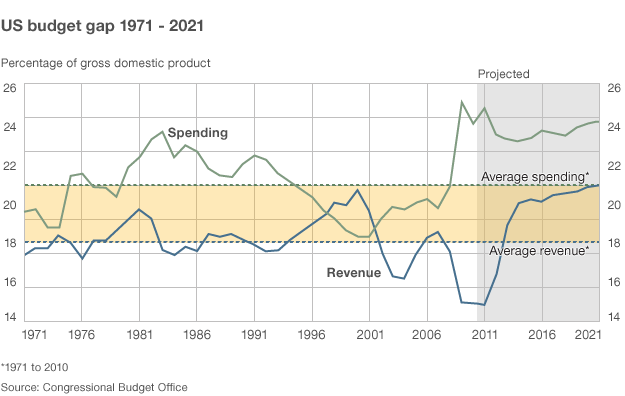
Since we keep drinking more as an economy (debt and deficits) the violence and incidence of these “undesirable outcomes” is going to continue to increase. We had one nasty in 2000, and then again in 2007. From the so-called “recovery” (2003) to the onset of the last mess was about four years. We’re now about two years in from the so-called “bottom” of this latest train wreck (Lehman), and if we keep on-path, and we are as the below chart shows, our fuse should go inside the box for this next mess somewhere between now and the end of 2011.
I hope you’re ready, because this next one, coming with no real recovery having taken place in employment or private economic activity, may be the one that takes us well beyond the misery we suffered in the 1930s.
And if it does, it will be our – that’s right – our – fault, since we simply will not accept that there is no such thing as a free lunch.
Note the copyright please.
Despite it being quite a technical piece with some aspects that weren’t clear to me, no surprise!, it’s still got many important messages for all those concerned about our savings and assets. Do read it.
Amazed they don’t just tax Fun and leave it at that!
Lemonade isn't a substitute!
Once again the British Politically Correct nanny-state lobby seems about to pounce by reducing the drink-driving limit to 50 mg. This is yet another fatuous knee-jerk “Let’s give the image that we are responsible and doing something” initiative.
No, I do NOT favour driving while drunk, but at 80 mg per ml you are not “drunk” or even impaired. The introduction of the 80 mg limit was a great step, but more would be a mg too far.
I know for an absolute fact that if I drink one pint of beer I am in no way more dangerous than if I drink nothing. Don’t ask me how I know; I just do. I’ve been driving all over Europe for 40 years; and experience counts for something after all.
Yes, I do want to see road accidents reduced, but let’s see something REALISTIC and EFFECTIVE. Why are most accidents caused? (apart from people way over the limit, unlicenced or driving unroadworthy cars and so on)
arrogance and lack of imagination: “It can’t happen to me.”
impatience: overtaking dangerously to save 45 seconds on a two-mile journey
driving too fast in the wrong place at the wrong time.
driving without consideration for others
not driving as if every other driver was an idiot
failing to give yourself enough of a margin for error
failing to understand statistics
The last two points are perhaps crucial. Drive on the périphérique in Paris and you’ll see examples of both. Of course, the French are, in general, brilliant drivers and 99.9% of the time they can get away with driving up someone’s boot, but statistics tell us that there is 0.01% of the time when this will NOT be OK.
What steps COULD be taken instead of clobbering the one pinter?
Start with the apparent ONE MILLION people in Britain driving either unlicensed and/or in uninsured or unroadworthy cars.
Ban rich Daddy’s boys from driving high-powered sports cars: nobody under 25 should be able to drive anything over 80 bhp for a start.
Where is the logic in manufacturing cars that can drive at three times the speed limit? BAN THEM. BE LOGICAL.
Make the viewing of video of the aftermath of accidents a compulsory part of the driving test so that people came reeling out of the room white and vomiting at the sight of accident victims with their faces smashed up and/or their heads severed. This is the REALITY of accidents. Let’s GET REAL.
Prevent people from driving for TOO LONG. Tiredness is a MAJOR factor in accidents, but there is ABSOLUTELY NO CONTROL over the hours that private motorists can drive. Modern technology could do something here.
Make the punishments for careless and/or dangerous driving SEVERE.
Make people AFRAID of causing an accident.
The truth is that a car is as dangerous as a gun and people should treat them as such. Sadly, familiarity breeds contempt and people too often forget the basic principles.
Every time I get in my car I tell myself the following:
Drive with as much care as when you first drove so nervously and gingerly on your first trip with your new licence.
Every journey could be your last. Just because the last n days have been trouble-free it doesn’t mean that today will. (statistics again)
There could be an idiot around the next corner, so drive defensively. (there is always a percentage of idiots, so statistically you are CERTAIN to meet one now and again)
Going too fast in the wrong place and/or conditions isn’t worth the risk. (stats again)
You have no right to maim or kill anyone else by bad driving and causing “an accident”‘.
Be afraid – think of what a serious injury or even your death would mean to your family.
It’s no good being “sorry” afterwards ……
Let’s hope the new British government has a bit of commonsense about this.
PS The Police could do their bit, too. A significant number of people are killed by policemen rushing about.
By Chris Snuggs
IAM Logo
A P.P.S. from the Editor. In fact, one of the best things that could be done is create an
incentive for passing the Institute of Advanced Driving driving test. I passed the test in 1966 and it has been the best investment I have ever made.
Why doesn’t the UK Government give a free year’s road-tax for every person who passed the IAM test. All this proposed change in the drink/drive limit will do is to put yet more British pubs out of business. G’rrr.





 Learning from Dogs