I am referring to the result of the British election that was held last Thursday.
Now I am well aware that many readers will not have the same relationship with the outcomes of British elections as your faithful scribe. But I am also aware that we live in a very connected world. I am also acutely aware that for many, many years I was a devoted listener to the 15-minute weekly radio broadcast on the BBC by Alistair Cooke Letter from America.
So for me, and many others I don’t doubt, the views of America as to what goes on across the pond are just as fascinating today as they have always been.
But in the absence of dear Mr. Cooke (20 November 1908 – 30 March 2004) passing on his experienced assessment on what the outcomes of British elections mean for America then I turn to a recent item on The Conversation site and republished here within the terms of that site.
ooOOoo
How populism explains May’s stunning UK election upset: Experts react
June 9, 2017 6.04am EDT
Editor’s note: U.K. Prime Minister Theresa May’s election gamble failed badly as her Conservatives lost 12 seats, leaving them with 318, shy of a majority. It was a stunning loss for a party earlier projected to gain dozens of seats. Without a majority, the Conservatives will have to rely on another party to govern – known as a hung Parliament. If they’re unable to forge a coalition, rival Labour leader Jeremy Corbyn – whose party gained 31 seats – would be able to give it a go. We asked two experts to offer their insights on what Americans should make of the election and its results.
May had a bad night and may face a struggle over her party’s leadership
The results of this election show how similar, and yet how different, British politics are from what is happening in America.
As in the United States, there has been an explosion of populism in Britain, most recently evidenced by the Brexit referendum. This new political force is translating into less liberal policies from the major parties.
In continental Europe, the new populism is mostly embodied by the resurgent far right. But in Britain, as in America, it is being filtered through the existing two-party system – though the U.K.‘s smaller parties do complicate the electoral map.
To accommodate the political winds, May and her Conservatives decided to shift their electoral strategy away from Margaret Thatcher’s pro-market economic approach toward a greater focus on immigration, security and economic nationalism.
Labour leader Jeremy Corbyn, for his part, deserted the more centrist “New Labour” ideas of Tony Blair in favor of a more robust form of social democracy.
The American left, like its British counterpart, has also become increasingly skeptical of unbridled markets. But among Republicans, a traditional hostility to “big government” makes pro-worker redistributive policies, some of which the Tories have adopted to win votes, hard to stomach. For this reason, populism on the American right has mostly taken the form of protectionist and anti-immigrant policies, as embodied by Donald Trump.
Yesterday’s results were devastating for May and indicate that the Conservatives were ultimately unable to balance their new populist message with their traditional support for neo-liberal policies.
Corbyn, for his part, will use this unexpected victory (of sorts) to solidify his hold over the Labour Party and to move it further to the left.
It remains to be seen whether the election will result in a minority or a coalition government, or whether the parties will be well and truly deadlocked. Whatever happens, the British electorate, like its cousin across the pond, has shown itself to be highly polarized.
Still, at a minimum, Britain’s parliamentary structure, along with the ability of the Labour leadership to co-opt disillusioned voters, seems to have spared Britain the fate of America – the takeover of government by a populist insurgent.
Corbyn and his Labour Party had reasons to smile on election night. AP Photo/Frank Augstein
May took a calculated political risk and lost. While the market reaction has been severe, with the pound plunging, it’s nothing new to companies, which take calculated risks like that every day – some pay off and some do not.
So first of all, U.S. corporate executives will need to take a deep breath. Assuming a combination of other parties do not cobble together at least 322 seats – despite winning seven seats, Northern Ireland’s Sinn Fein will not send MPs to London – the Conservatives will dominate a coalition government and have considerable sway over policy.
This means a “hard Brexit,” as outlined by May in January, and as seen in the European Union’s tough negotiating guidelines, is unlikely to change. But this is what most U.S. companies have been planning for anyway since last June’s Brexit vote. Many companies, particularly banks and financial institutions, are already planning to move some of their U.K. operations to other EU countries to take advantage of the single market rules.
This process will continue no matter who’s in power, since only the low-polling Liberal Democrat and Green parties promised a Brexit revote.
Second, a weakened Conservative Party will need more foreign friends, and that includes U.S. companies. Since Brexit, some foreign businesses have threatened to downsize or close their U.K. operations as leverage for obtaining government subsidies. Expect more companies to use this strategy with a weaker U.K. government.
As I argue in my recent book, the business environment of Europe is much more than the U.K. market, and U.S. companies have become increasingly aware of this since Brexit.
In other words, it’s business as usual, and that means the continued segmenting of companies’ U.K. and EU strategies, regardless of who is governing in London.
ooOOoo
Expect things to continue to be interesting for some time. Or as more eloquently put by Tariq Ramadan “Times have changed; so must the lenses through which we see the political future.”
Back to Alistair Cooke. There are many of his broadcasts available on the BBC Radio website and on YouTube.
I’m closing with just a small part of Charlie Rose interviewing Alistair Cooke in May, 1996.
Uploaded on Sep 25, 2011
Tuesday, May 7, 1996
Charlie Rose: An interview with Alistair Cooke
Alistair Cooke celebrates the 50 year anniversary of his BBC broadcast, “Letter from America”, a 15-minute talk about life in America for British listeners.
Recorded some twenty-one years ago. Somethings don’t seem to change!
Sound UK produces extraordinary musical encounters for all
That sub-heading is the banner statement you will read if you go across to the Sound UK website. You may recall that I featured Sound UK in a post last June under the title of Sonic Journeys. I also presented the fact that my daughter is one of two directors of Sound UK. As in:
Sound UK is run by Directors Polly Eldridge and Maija Handover. We work alongside a crack team of freelancers and consultants across production, marketing, design, participation and fundraising. These include Tim Hand (production), Becky Morris Knight at Shipshape Marketing (digital marketing), Beth Fouracre (participation), John Gilsenan at IWant (design), Sarah Coop (fundraising) plus many more.
The reason I am featuring Sound UK again is because I wanted to share with you an exciting new project. I am republishing this from the Sound UK site.
ooOOoo
Tom Phillips – Irma: an opera
Sound UK is a music charity developing a major new project to mark the 80th birthday of one of Britain’s most treasured artists
We need your support to produce the first multimedia production of Royal Academy artist Tom Phillips’ Irma: an opera at South London Gallery this September.An exquisite miniature opera and audio visual installation, Irma is drawn from his masterpiece A Humument, which he recently completed after 50 years. This unique production celebrates Phillips’ extraordinary output in art and music.
Tom Phillips RA: Phillips has had major exhibitions in national galleries, painted figures such as John Gielgud and Iris Murdoch and created works for the Imperial War Museum, Westminster Abbey and Westminster Cathedral. His work can also be seen on the streets of Peckham where he has lived and worked for most of his life. You may even own one of his artworks; the Benjamin Britten 50p piece.
Tom Phillips in his Peckham studio
In the 1960s, Phillips was at the centre of the vibrant art school scene where music and art collided. He brought over key composers of that era to the UK – Morten Feldman, John Cage, performed with Cornelius Cardew – and even taught Brian Eno, who he introduced to ideas that had a great influence on Eno’s music. This landmark event recognises Phillips’ work as a composer and wider influence on the world of music.
Excerpt from Irma: an opera full score 2014
The Creative team: Sound UK is working with one of the UK’s most gifted opera designer / directors Netia Jones and her company Lightmap, with music director Anton Lukoszevieze and his leading ensemble Apartment House.
“Netia Jones is the most imaginative director of opera working in Britain today” The Observer
“One of the most innovative and exciting chamber ensembles in Europe” Royal Philharmonic Society on Apartment House
We need YOU to be part of Irma!
We have already raised the majority of our funding with the generous support of Arts Council England and Hinrichsen Foundation. We are also grateful for major in kind support from South London Gallery, where Phillips first showed his work as a student.
YOU can play a key role in Phillips’ new artwork. We need to raise £5,000 to help pay for rehearsals and the creation of the video for this extraordinary artwork.
To thank you for your invaluable support, we have put together a selection of unique rewards based on Irma characters – view by scrolling up on the right of this page – including an exclusive limited edition print created by Tom Phillips and mementos of his work.
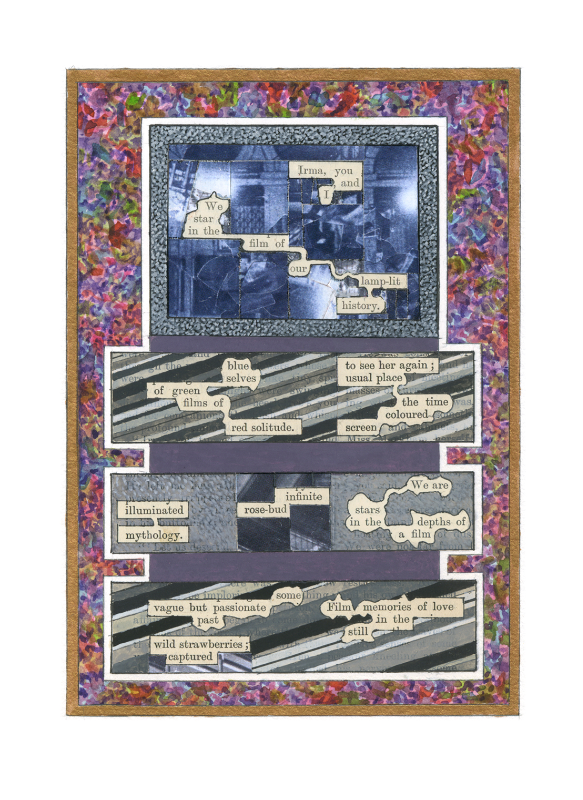
Image of Tom Phillips limited edition print – Irma: Our Lamplit History
Paper size h:28.4cm x w:21cm
Limited edition of 50
A unique print created by Tom Phillips in support of the world premiere full version of his opera Irma, at South London Gallery, September 2017, directed / designed by Netia Jones, musical direction Anton Lukoszevieze, performed by Apartment House with video by Lightmap.
Digital print with silkscreen 2017
All prints are sent signed and numbered by the artist.
Why can’t we leave nature to do what’s best for our world!
Now, I would be the first to ‘tut-tut’ a little over my sub-heading. For here I am sitting in front of a computer in a room in a reasonably-sized home that undoubtedly has denuded the natural world formerly underneath the present foundations.
Thirteen acres orientated West-East.
Plus, as the property boundary shown on the above picture confirms, about 50% of our acreage is no longer wilderness.
Ergo, it is impossible for humans to live on this planet without there being consequences that conflict with the natural order of the wild.
But homes to live in are one thing. A planned madness for the Lake District in Northern England is another thing altogether.
The attempt to turn the Lake District into a World Heritage site would be a disaster
By George Monbiot, published in the Guardian 9th May 2017
If this bid for power succeeds, the consequences for Britain will be irreversible. It will privilege special interests over the public good, shut out the voices of opposition and damage the fabric of the nation, perhaps indefinitely. No, I’m not writing about the election.
In the next few weeks Unesco, the UN’s cultural organisation, will decide whether or not to grant World Heritage status to the Lake District. Once the decision is made, it is effectively irreversible.
Shouldn’t we be proud that this grand scenery, that plays such a prominent role in our perceptions of nationhood, will achieve official global recognition? On the contrary, we should raise our voices against it. World Heritage status would lock the Lake District into its current, shocking state, ensuring that recovery becomes almost impossible.
Stand back from the fells and valleys and try to judge this vista as you would a landscape in any other part of the world. What you will see is the great damage farming has inflicted: wet deserts grazed down to turf and rock; erosion gullies from which piles of stones spill; woods in which no new trees have grown for 80 years, as every seedling has been nibbled out by sheep; dredged and canalised rivers, empty of wildlife and dangerous to the people living downstream; tracts of bare mountainside on which every spring is a silent one. Anyone with ecological knowledge should recoil from this scene.
This photo was used as the frontispiece of the “State of Conservation” section of the bid documents. It is meant to show how beautiful the fells are. If we saw it anywhere else, we would recognise it as an environmental disaster.
The documents supporting the bid for world heritage status are lavishly illustrated with photos, that inadvertently reveal what has happened to the national park. But this slow-burning disaster goes almost unmentioned in the text. On the contrary, the bid repeatedly claims that the park is in “good physical condition”, and that the relationship between grazing and wildlife is “harmonious”. Only on page 535, buried in a table, is the reality acknowledged: 75% of the sites that are meant to be protected for nature are in “unfavourable condition”.
This is another photo from the bid document, showing St John’s Beck in Thirlmere. The beck is notorious for its flashy response to rainfall – rising dangerously fast. It’s not hard to see why. As the photo shows, it has been dredged and canalised on behalf of the farmers in the valley, and now contains almost no natural features that can slow the flow.
This great national property has degenerated into a sheepwrecked wasteland. And the national park partnership, that submitted the bid, wants to keep it this way: this is the explicit purpose of its attempt to achieve world heritage status. It wants to preserve the Lake District as a “cultural landscape”. But whose culture? Whose landscape? There are only 1080 remaining farms in the district. Should the entire national park be managed for their benefit? If so, why? The question isn’t raised, let alone answered.
I can see the value and beauty of the traditional shepherding culture in the Lake District. I can also see that the farming there, reliant on subsidies, quad bikes and steel barns, now bears little relationship to traditional practice. As the size of landholdings has increased, it looks ever more like ranching and ever less like the old system the bid describes. The bid’s claim that farming there is “wholly authentic in terms of … its traditions, techniques and management systems” is neither intelligible nor true. Remnants of the old shepherding culture tend to be represented ceremonially, as its customs are mostly disconnected from the farm economy.
Shepherding is not the only cultural legacy in play. The other is that the Lake District is the birthplace of the modern conservation movement. Inspired by the Picturesque and Romantic movements, much of our environmental ethic and the groups representing it, such as the National Trust, originated here. Attempts to preserve natural beauty in the district began in the mid-18th century, with complaints against the felling of trees around Derwent Water. Today, the national park cares so little for this legacy that, as the bid admits, “there are no data available” on the condition of the Lake District’s woodlands.
The small group favoured by this bid sees environmental protection as anathema. Farmers’ organisations in the Lake District have fought tooth and nail against conservation measures. They revile the National Trust and the RSPB, whose mild efforts to protect the land from overgrazing are, with the help of a lazy and compliant media, treated like bubonic plague. As one of these farming groups exults, world heritage status “gives us a powerful weapon” that they can wield against those who seek to limit their impacts. If the plan is approved, this world heritage site would be a 230,000-hectare monument to overgrazing and ecological destruction.
30 years ago, this was a bare sheep pasture (with a couple of seeding birch trees). This is a photo I took (with my failing phone) on a hill elsewhere in Britain. It gives an idea of what parts of the Lake District fells could look like if they were allowed to recover.
This is not the only sense in which the bid is unsustainable. Nowhere in its 700 pages is Brexit mentioned. It was obviously written before the referendum, and has not been updated. Yet the entire vision relies, as the bid admits, on the economic viability of the farming system, which depends in turn on subsidies from the European Union.
Without these payments, there would be no sheep farming in the Lake District: it operates at a major loss. European subsidies counteract this loss, delivering an average net farm income of £9,600. Unsurprisingly, people are leaving the industry in droves: the number of farms in the national park is declining by 2% a year. And this is before the payments cease.
What is the national park partnership, that prepared this bid, going to do – march people onto the fells at gunpoint and demand they continue farming? Or does it hope that the government, amid the massacre of public investment that will follow Brexit, will not only match but exceed the £3bn of public money currently being passed to UK farmers by the European Union? Your guess is as good as mine. This omission alone should disqualify the bid.
The failure to mention this fatal issue looks to me like one of many attempts to pull the Herdwick wool over Unesco’s eyes. The entire bid is based on a fairy tale, a pretence that the rural economy of the Lake District hasn’t changed for 200 years. If Unesco grants world heritage status on these grounds, it will inflict irreparable harm on both our natural heritage and its own good standing.
The hills, whose clothes so many profess to admire, are naked. The narrative we are being asked to support is false. The attempt to ensure that the ecological disaster zone we call the Lake District National Park can never recover from its sheepwrecking is one long exercise in woolly thinking.
When one reads this one is left with a feeling of great sadness. A sadness that our ‘movers and shakers’ can’t resist the urge to meddle. Can’t understand the beauty that is found in nature in the raw.
Earlier on I illustrated how our own property has ‘interfered’ with the wilderness of this most beautiful Oregonian countryside. But as I hope to show you with the following photographs taken on our property back in 2014 that wild beauty can be hung on to in some measure.
Looking upstream along Bummer Creek from the driveway bridge.
I have sent a message to Unesco asking if the views of the public are being taken into account and, if so, how those views are to be communicated to Unesco. If you wish to contact them then the details are on this page: http://whc.unesco.org/en/world-heritage-centre/
Any replies from Unesco will be posted here.
UPDATE 0815 PDT May 22nd.
My email yesterday to Unesco was ‘bounced back’ as an invalid email address (despite me using the email address on the Unesco website!!).
But following George Monbiot’s reply to me, giving me the name of James Bridge (jbridge@unesco.org.uk) at Unesco, I have now sent Mr. Bridge the following email:
Dear Mr. Bridge,
I write as a British citizen, born a Londoner in 1944, to protest in the strongest possible terms to the proposal to turn the English Lake District into a World Heritage Site. This is your Tentative List reference http://whc.unesco.org/en/tentativelists/5673/.
Would you please provide me with the details of where or whom within Unesco I can write setting out in detail my objections to this proposal?
Your soonest reply would be very much appreciated.
Sincerely,
Paul Handover
I won’t hold my breath over getting a quick reply.
A week-and-a-half ago I published a post called Little by Little. It was the story of “9 Dogs Successfully Rescued From Backyard Breeder Thanks to George and Amal Clooney.”
Thanks, you two!
Well a few days ago there was an email that contained more wonderful news about these nine dogs.
ooOOoo
UPDATES on the nine dogs rescued from the backyard breeder (now known as the “Mojave 9 dogs”)
It’s been all kinds of hectic with the intake of nine dogs all at once. What we were most unprepared for was that every single one of these dogs had never been to a vet in their entire lives.
The medical bills have been piling up so quickly and we’ve been asking for donations for the last several weeks.
Abigail, the girl with the massive mammary tumors that were hanging down and dragging on the ground, she had a bi-lateral mastectomy and her biopsies came back clear! Yaaay!
Piper had her cherry eye surgery, and a half of a mastectomy for some smaller mammary tumors up and down her right side of her mammary chains. Her biopsies just came back clear as well (whew!).
McKenna just had a double ear ablation surgery (ouchie!). There was no avoiding this, her ear drums were destroyed and her middle ears were so painful from years of untreated infections, it’s amazing she is still such a sweet doggie.
Hunter is on the waiting list for a right ear ablation surgery.
Abigail just had her dental this week and needed 19 teeth extracted! (dogs have 42 teeth) Her mouth is going to be feeling a whole lot better once the bacteria and inflammation goes away. Poor girl, she really has had it the worst of all these dogs, yet she is happy and wagging her tail and so eager to get any human interaction.
All nine dogs have needed dentals (several are on the upcoming schedule in the next few weeks, we’ve had to stage everything so we can raise donations). Six spay surgeries, a cherry eye surgery, a full mastectomy, a half mastectomy, two ear ablation surgeries, blood work, urinalysis, thyroid tests, deep ear cleanings/antibiotics, it’s all turning out to be one of THE most expensive rescues ever in the history of Camp Cocker.
We need your help now more than ever!
Please consider making a donation and no amount is too small.
For the rest of the month of May, we have a matching donation campaign going on, click HERE to DONATE!
ooOOoo
Please don’t go until you have watched this video of the surgeries that have been carried out so far.
It takes so little good news to uplift one’s heart!
For reasons I can’t readily put my finger on it’s been feeling like a bit of a struggle recently. But that’s enough of that! For our gorgeous dogs have yet another lesson for me: How little it takes for a dog to wag it’s tail!
I so frequently share stuff that I read over on the Care 2 site and why not because as the home page declares:
40,107,687 members: the world’s largest community for good
Just three days ago there was a wonderful article shared on the Care 2 site about some dogs being rescued from a so-called backyard breeder. Better than that, it highlighted the wonderful consequence of a donation from George and Amal Clooney.
Here’s the story.
ooOOoo
9 Dogs Successfully Rescued From Backyard Breeder Thanks to George and Amal Clooney
Nine lucky dogs have just had their world turned upside down in the best way possible.
Camp Cocker Rescue, based in California, just took in the “Mojave 9″ who were being kept by a backyard breeder. They’ll be getting all the love and veterinary care they desperately need thanks to a generous donation made by George and Amal Clooney.
The nine dogs have had little human contact, and are all in need of extensive veterinary treatment for health issues ranging from mammary tumors and dental disease to skin and ear infections to ingrown toenails. The organization relies on donations, and expenses for this rescue operation were quickly rising.
“We literally didn’t know how we were even going to begin to start paying for all of these new dogs that we took in on the same day,” Camp Cocker’s founder Cathy Stanley told PEOPLE.
Now, the organization is celebrating a generous and unexpected donation of $10,000 made by George and Amal Clooney, who are parents to two adopted cocker spaniels from Camp Cocker — Einstein and Louie.
Their donation is going to help cover the cost of care for these dogs, who have never been to a vet. The Clooney’s will also be matching donations up to $10,000 for the rest of May.
“After we all did happy dances and cried with happiness for this unbelievable matching donation offer – we then asked the donors if (and only if they gave us their permission) . . . if we could reveal their names to our supporters in order to help us reach our big goal this month. They were so very gracious to give us permission to reveal their names,” Camp Cocker wrote in an update.
While this was a huge boost for them, Camp Cocker is quick to point out that no donation is too small to help.
“We have a philosophy where we want to be very inclusive of all of our supporters and it’s important to us that no matter how small of a donation, every person feels like their donation is meaningful and that we appreciate them,” Stanley added.
Hopefully news about the Mojave 9 and the attention it’s getting will help raise awareness about rescue and inspire more people to get involved … and will help find each of these precious dogs their perfect forever home.
For more on how to help, and info on how to adopt one of these dogs, check out Camp Cocker Rescue and follow updates on Facebook.
Last week, under the post title of Group Goodness, I put out a plea for anyone who felt so minded to make a donation to this fund. That donate page for this fund being here.
Now it’s very fair to say that there wasn’t a rush of donations. It would be more accurate to say that there were no donations for several days. In fact it is only in the last twenty-four hours that the amount donated has gone from 216 to 244 Australian dollars. (The fund will be transferring those Aussie dollars across to assist John Zande and his lovely wife soon. The currency being used is because it is the sister of John’s wife who is raising the money and she lives in Australia.)
Now it would be very wrong of me to seek the reasons why not a single follower or reader of this place chose not to make a donation. But I will offer this perspective. In that Jean and I wanted to make a second donation and it has taken several days to figure out why our gift wasn’t being processed; the reason being a rather cautious (our) bank attitude to debit card payments being made overseas. So if anyone else has tried to make a donation and the system has got in the way then please do find a solution.
Here’s why!
Because John and his wife, Dionete, are totally immersed in doing their best to help the homeless and abandoned dogs in Sao Paulo, Brazil.
Here are copies of recent emails that John and Dionete have sent me over the last few days.
20th. April
Morning Paul, I took a camera this morning just to show you the new boy I’m helping. Gorgeous fellow, and young. It never stops. They never stop showing up… which is something I’m sure Jean understands all too well from her work in Mexico.
Again, thank you for your help and posting the campaign.
I queried if this new boy had a name?
No name yet. Can you think of one? I found him on the corner of a street where I feed two (sometimes 3) cats every morning. G’s mum and dad used to live in that street and her dad would feed them. He loved cats, and after he died (and G’s mum moved closer to us) I’ve kept going back. It’s been over a year now that I go there every day, and despite every effort to capture them, I’ve failed. They’re quite feral, but I can’t bring myself to letting them to fend for themselves.
And these are those photos.
oooo
John then continued that same day:
Anyway, the boy showed up about 9 days ago, so on my daily run I feed and water him. G put his pictures on Facebook this morning and a girl (Luiza) responded saying she knows of another lady who’s also feeding him. I saw food there once, on day 2 I think, but none since, so I’m not sure what that’s all about. The girl who actually responded is a part of this loose Vista Verde group. I’ve never met her, but I know of her. We’re helping her as she took in a dog a few months ago that had been hit by a car and is paralysed, but, to her credit, she’s refused to give in and has him in physio (including water treadmills), which is actually showing some positive signs. That’s sort of how it all works. Here’s some pictures and video of that case. Gorgeous dog.
The boy is relatively safe where he is. He has shelter, and doesn’t appear to be in any mood to move on, which is good. If he stays put we can help. Finding a home for him is not easy, but after we can find some place as a temporary shelter we’ll get him into the vet, neutered, treated for whatever, then settled. The huge problem is, there simply aren’t any shelters we can just take him to, so we can’t get him off the street and into the vet immediately. Every shelter is over-full, and that makes rescues just that much harder. It’s not the case of simply finding a dog (or cat) and getting them to safety… which is heartbreaking. You just have to hope they stay put. A few times I’ve put a dog in the car and taken them from danger (like near a main road) and brought them up to our area where there are parks and plenty of shelter and people to help. It’s a safe place, and if they stay put we often have successes… But that takes time. But, as I said, he doesn’t seem to want to move on, and he’s starting to put on weight. He was desperately thin, but 500g of mince and a big bowl of dry food every day seems to be doing the trick.
Here’s hoping to a good ending for him.
In speaking with Jeannie about this poor dog she very quickly suggested the name of Socks. John happily went with Jean’s suggestion.
21st April
Hi Paul, just a quick update on socks. Luiza (the girl I mentioned yesterday) has found temporary shelter for Socks for one month. It’s not long, but will give us the chance to neuter him and do all necessary blood work. Finding him a home is the next hill, but I spent time with him this morning, just sitting with him, and he’s really a lovely, gentle fellow, so here’s hoping.
24th April
Socks update: His shelter home is ready today, we’ve been told. That, however, might now not be needed. Sunday I saw he now has a huge dog house on the footpath, with blankets, food and water. He wasn’t interested in the mince I brought him, so I just left some chewing treats. Same thing this morning (I’ve just gotten back). So, we’ll go back later today just to speak (again) to the people in the street (we don’t know who exactly put the dog house there), and it might be the case that he just goes straight to the vet for neutering, maybe a few days in the shelter for recovery, then back to his house while (if still needed) we look for a permanent home/family.
April 25th.
Hello Paul – I can see you’ve been playing “email tennis” with the gofundme staff – good to read they (finally) managed to sort it out.
We saw Socks today. Apparently a bunch of neighbours got together to feed and take care of him, albeit on the street (he was given a 2nd-hand doghouse & doona (oops, duvet)). One of the guys has been thinking of taking him to his country house; an acquaintance of mine knows of somebody who might adopt him. Yes, everything’s still in the air, but he has it much much better than other dogs we’ve found and helped.
Now we can book his neutering/vaccine.
As for me, I don’t have enough words to thank you & Jean. Truth to be told it feels a bit weird to be the beneficiary of a campaign. We’ve always helped others and suddenly seeing ourselves in this position is a tad uncomfortable, actually – which doesn’t mean this money is not welcome, considering all the cases we’ve had so far this year.
Fingers crossed it all works out for Socks. We’ll keep you posted.
So, good people, this is why I beseech you to please support what John, Dionete and his close group are doing on behalf of those dogs down in Brazil. Please make a donation!
(And, please, make a note of my final remark at the end of today’s post.)
Those who are regular visitors to this place will know that John Zande, who lives in Brazil, is a good friend, and, for that matter, I try to be a good friend of his place. (If you didn’t read my recent review of John’s latest book On The Problem of Good then it is here.)
So when a couple of days ago I received the following email from John you can imagine my positive response to his request.
Paul, hi, I have a favour to ask.
My wife’s sister, Dee (who lives in Australia) has started a gofundme campaign to help cover a rash of vet surgery bills we’ve had recently. These past few months (most of summer, really) has been appalling with the number of dumped animals in our area.
Together with a few other people in our loose group we rescued about ten and got them adopted out to good homes. Plus, we have three in temporary shelters as we nurse them back to health. We took one into our house, Nina, thus making eleven here now, who had her tail amputated last Tuesday. We were fortunate in that our vet worked for free (a 3hr operation) and only charged us for the anesthetist.
We’re lucky to have these wonderful people around, but we’re a tad snowed under right now with the accumulated surgeries and medicines, which is why Dee started this little campaign.
Now there was no question that Jean and I wanted to help. Not only by making a modest donation ourselves but by promoting Dee’s campaign. I emailed a reply to John saying just that.
John then responded with more details, including some photographs:
Dee is married to a very good friend of mine from Uni. She started this campaign to help Dionete, my wife, and I (and if possible a few other Vista Verde folk who’re in our rescue network) here in Brazil. Dee was here just before Christmas and saw the problem first hand. She actually helped us rescue a wonderful little fellow, Terrorista, who now lives a few streets away with a wonderful family.
I didn’t know, but Dionete was chatting to her a week or two ago and it came up just how many vet/surgery/medicine expenses we’d accumulated over the summer. Without either of us knowing, she, Dee, then started this gofundme campaign to lend a hand and help clear the vet bills. We’re not an NGO (we actually help four here in Sao Jose dos Campos, two in Sao Paulo, and Sandra’s Maxmello in another city south of Sao Paulo). Because we’re not an NGO we’ve never thought about doing a campaign ourselves, so was surprised when Dee started this one. It’s quite modest, $1,000 Australian dollars (the goal) converted to Brazilian Reis will make a sizable dent in our backlog of vet surgery bills. Our bills are tiny compared to a guy we know who does have an NGO and owes his network of vets 90,000. He’s a wonderful fellow and I’m actually working with him to try and get a mobile neutering unit started here in Sao Jose dos Campos. But that’s another story. So, to be clear, the campaign is for us here in Vista Verde, which is sadly a dumping ground for animals. Surrounding districts seem to think we’re all wealthy here and therefore they can dump their animals. It’s infuriating, and the animals never stop coming.
I am sure that Jean and I aren’t the only ones that want to help.
And John could offer no better reason for seeking some financial support from the wider world. Here’s some of his later email:
My apologies if there was some confusion. I’m actually heading out right now to feed a new fellow I found a few days ago and is sleeping outside a house in another district. When I get back I’ll send some more photos, OK.
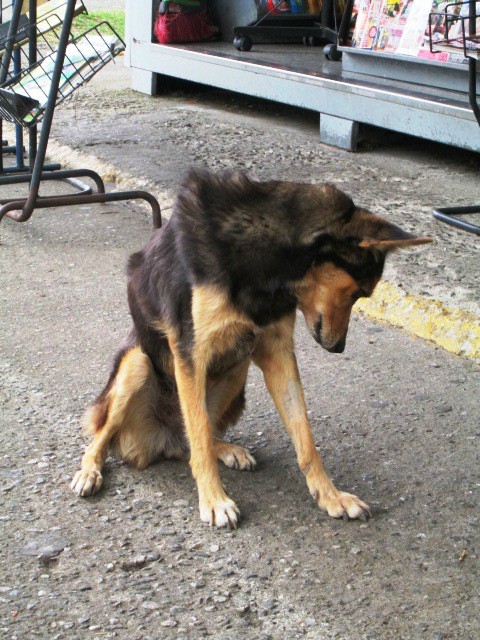
Let me close with some more photos of dogs that have been helped by John, Dionete and the rest of the great band of the Vista Verde Fund.
oooo
oooo
oooo
Finally!
Please offer whatever you can to help. Even the smallest amount makes a real difference.
As you all know, my world is dominated by love. My love for my Jeannie and all the wonderful creatures that inhabit this home and these few acres here in Southern Oregon. Time and time again I share with you stories and articles that I come across that underpin that loving umbrella. Time and time again I am deeply moved by your interest in my scribbles. As I said, my world is dominated by love, and your friendship across this blogging world added to Jean’s love for and attachment to me, has created a little paradise for me.
But! (And you may have sensed there was a ‘But’ coming up.)
But that doesn’t mean that I am immune to being deeply affected by other, more worldly issues, that are as far away from love as one could imagine; more accurately, as far away from love for this wonderful planet as one could imagine.
So for today and the next two days I am going to share with you the pain and angst that I do feel, and feel all too easily, at what we, as in the collective global ‘we’, are up to. Madness doesn’t even seem to touch it!
Today, I am going to republish a recent TomDispatch essay, with Tom’s very kind permission. Tomorrow, I am going to contrast what fellow Brit James Lovelock has been predicting for years with where we really are heading in terms of the future of Planet Earth. Then on Friday, I will finish up with an essay by Professor Ronald Pies regarding the “twisted relationships to truth”.
Donald Trump, now preparing to lead the country into the latest version of our endless wars, recently offered this look back at American military prowess: “We have to start winning wars again. I have to say, when I was young, in high school and college, everybody used to say we never lost a war. We never lost a war, remember?… And now we never win a war. We never win. And don’t fight to win.”
It was a curious bit of “history.” Logically, his memories should have been of victory-less wars, given the ones of his growing up years: Korea and Vietnam (which he evidently avoided thanks to a trumped-up medical condition and whose massive oppositional movement he seems to have ignored).
Born in July 1944, [Ed: I’m a November 1944 baby.] I’m two years older than President Trump and so understand just where he’s coming from: the movies. In those years of his youth and mine, sitting in the darkness catching Hollywood’s vivid version of reality, we both watched Americans win wars ad infinitum. In fact, this is hardly the first time I’ve thought about the on-screen wars of my childhood, actual war, and an American president. Here’s what I wrote back in January 2006, while considering the experiences of George W. Bush and Dick Cheney:
“In the 1940s and 1950s, when the generation of men now ruling over us were growing up, boys could disappear into a form of war play — barely noticed by adults and hardly recorded anywhere — that was already perhaps a couple of hundred years old. In this kind of play, there was no need to enact the complicated present by recreating a junior version of an anxiety-ridden Cold War garrison state… For children in those years, there was still a sacramental, triumphalist version of American history, a spectacle of slaughter in which they invariably fell before our guns. This spectacle could be experienced in any movie theater, and then played out in backyards and on floors with toy six guns (or sticks) or little toy bluecoats, Indians, and cowboys, or green, inch-high plastic sets of World War II soldiers. As play, for those who grew up in that time, it was sunshine itself, pure pleasure. The Western (as well as its modern successor, the war film) was on screen everywhere then.
“When those children grew up (barely), some of them went off to Vietnam, dreaming of John Wayne-like feats as they entered what they came to call ‘Indian country,’ while others sallied off to demonstrate against the war dressed either in the cast-off World War II garb of their fathers or in the movie-inspired get-ups of the former enemy of another age — headbands and moccasins, painted faces, love beads… as well as peace (now drug) pipes. Sometimes, they even formed themselves into ‘tribes.’
“As it turns out, though, there was a third category of young men in those years: those who essentially steered clear of the Vietnam experience, who, as our vice president put it inelegantly but accurately, had ‘other priorities in the sixties.’ Critics have sometimes spoken of such Bush administration figures as ‘chickenhawks’ for their lack of war experience. But this is actually inaccurate. They were warriors of a sort — screen warriors. They had an abundance of combat experience because, unlike their peers, they never left the confines of those movie theaters, where American war was always glorious, our military men always out on some frontier, and the Indians, or their modern equivalents, always falling by their scores before our might as the cavalry bugle sounded or the Marine Hymn welled up. By avoiding becoming either the warriors or the anti-warriors of the Vietnam era, they managed to remain quite deeply embedded in centuries of triumphalist frontier mythology. They were, in a sense, the Peter Pans of American war play.
“…From that same childhood undoubtedly came President Bush’s repeated urge to dress up in an assortment of ‘commander-in-chief’ military outfits, much in the style of a G.I. Joe ‘action figure.’ (Think: doll). It’s visibly clear that our president has long found delight — actual pleasure — in his war-making role, as he did in his Top Gun, ‘mission accomplished’ landing on that aircraft carrier back in 2003…”
Only the other day, Donald Trump made his own landing on an aircraft carrier and strode its deck togged out in a USS Gerald R. Ford green bomber jacket and baseball cap, showing similar pleasure in the experience. It should have had an eerie resonance for us all as we pondered just where our next movie commander-in-chief might lead us. Who could have imagined that, so many decades after the onscreen childhood that The Donald and I shared, we’d all still be at the movies and, as TomDispatch regular and American Nuremberg author Rebecca Gordon points out today, in an American world of forever war as well? Tom American Carnage Fighting the Forever War
By Rebecca Gordon
In his inaugural address, President Trump described a dark and dismal United States, a country overrun by criminal gangs and drugs, a nation stained with the blood seeping from bullet-ridden corpses left at scenes of “American carnage.” It was more than a little jarring.
Certainly, drug gangs and universally accessible semi-automatic weapons do not contribute to a better life for most people in this country. When I hear the words “American carnage,” however, the first thing I think of is not an endless string of murders taking place in those mysterious “inner cities” that exist only in the fevered mind of Donald Trump. The phrase instead evokes the non-imaginary deaths of hundreds of thousands of people in real cities and rural areas outside the United States. It evokes the conversion of millions of ordinary people into homeless refugees. It reminds me of the places where American wars seem never to end, where new conflicts seem to take up just as the old ones are in danger of petering out. These sites of carnage are the cities and towns, mountains and deserts of Iraq, Afghanistan, Yemen, Libya, and other places that we don’t even find out about unless we go looking. They are the places where the United States fights its endless wars.
During the 2016 election campaign, Donald Trump often sounded like a pre-World War II-style America First isolationist, someone who thought the United States should avoid foreign military entanglements. Today, he seems more like a man with a uniform fetish. He’s referred to his latest efforts to round up undocumented immigrants in this country as “a military operation.” He’s similarly stocked his cabinet with one general still on active duty, various retired generals, and other military veterans. His pick for secretary of the interior, Montana Congressman Ryan Zinke, served 23 years as a Navy SEAL.
Clearly, these days Trump enjoys the company of military men. He’s more ambivalent about what the military actually does. On the campaign trail, he railed against the folly that was — and is — the (second) Iraq War, maintaining with questionable accuracy that he was “totally against” it from the beginning. It’s not clear, however, just where Trump thinks the folly lies — in invading Iraq in the first place or in failing to “keep” Iraq’s oil afterward. It was a criticism he reprised when he introduced Mike Pompeo as his choice to run the CIA. “Mike,” he explained, “if we kept the oil, you probably wouldn’t have ISIS because that’s where they made their money in the first place.” Not to worry, however, since as he also suggested to Pompeo, “Maybe we’ll have another chance.” Maybe the wrong people had just fought the wrong Iraq war, and Donald Trump’s version will be bigger, better, and even more full of win!
Perhaps Trump’s objection is simply to wars we don’t win. As February ended, he invited the National Governors Association to share his nostalgia for the good old days when “everybody used to say ‘we haven’t lost a war’ — we never lost a war — you remember.” Now, according to the president, “We never win a war. We never win. And we don’t fight to win. We don’t fight to win. So we either got to win, or don’t fight it at all.”
The question is, which would Trump prefer: Winning or not fighting at all? There’s probably more than a hint of an answer in his oft-repeated campaign promise that we’re “going to win so much” we’ll “get tired of winning.” If his fetish for winning — whether it’s trade wars or shooting wars — makes you feel a little too exposed to his sexual imagination, you’re probably right. In one of his riffs on the subject, he told his audience that they would soon be pleading they had “a headache” to get him to stop winning so much — as if they were 1950s housewives trying to avoid their bedroom duty. But daddy Trump knows best:
“And I’m going to say, ‘No, we have to make America great again.’ You’re gonna say, ‘Please.’ I said, ‘Nope, nope. We’re gonna keep winning.’”
There’s more than a hint of where we’re headed in Trump’s recent announcement that he’ll be asking Congress for a nearly 10% increase in military spending, an additional annual $54 billion for the Pentagon as part of what he calls his “public safety and national security budget.” You don’t spend that kind of money on toys unless you intend to play with them.
Trump explained his reasoning, in his trademark idiolect, his unique mangling of syntax and diction:
“This is a landmark event, a message to the world, in these dangerous times of American strength, security, and resolve. We must ensure that our courageous servicemen and women have the tools they need to deter war and when called upon to fight in our name only do one thing, win. We have to win.”
So it does look like the new president intends to keep on making war into the eternal future. But it’s worth remembering that our forever wars didn’t begin with Donald J. Trump, not by a long shot.
The Forever Wars
Joe Haldeman’s 1974 novel, The Forever War, which won the three major science fiction prizes, a Hugo, a Nebula, and a Locus, was about a soldier involved in a war between human beings and the Taurans, an alien race. Because of the stretching of time when traveling at near light-speed (as Einstein predicted), while soldiers like Haldeman’s hero passed a few years at a time at a front many light-years from home, the Earth they’d left behind experienced the conflict as lasting centuries. Published just after the end of the Vietnam War — fought for what seemed to many Americans like centuries in a land light-years away — The Forever War was clearly a reflection of Haldeman’s own experience in Vietnam and his return to an unrecognizable United States, all transposed to space.
In 1965, Haldeman had been drafted into that brutal conflict, probably one of those that Donald Trump thinks we didn’t “fight to win.” It certainly seemed like a forever war while it lasted, especially if you included the French colonial war that preceded it. But it did finally end, decisively, with an American loss (although, in a sense, it’s still being fought out by the thousands of Vietnam veterans who live on the streets of our country).
After the attacks of 9/11 and George W. Bush’s declaration of a Global War on Terror, some people found the title of Haldeman’s novel a useful shorthand for what seemed to be an era of permanent war. It gave us a way of describing then-Secretary of Defense Donald Rumsfeld’s vision of a new kind of war against an enemy located, as he told NBC’s Meet the Press on September 30, 2001, “not just in Afghanistan. It is in 50 or 60 countries and it simply has to be liquidated. It has to end. It has to go out of business.”
More than 15 years later, after a decade and a half of forever war in the Greater Middle East and parts of Africa, al-Qaeda and the Taliban are still in business, along with a set of new enemies, including Boko Haram in Nigeria, Chad, Niger, and Cameroon; al-Shabaab in Somalia; and ISIS, which, if we are to believe the president and his cronies, is pretty much everywhere, including Mexico. In a war against a tactic (terrorism) or an emotion (terror), it’s hardly surprising that our enemies have just kept proliferating, and with them, the wars. It’s as if Washington were constantly bringing jets, drones, artillery, and firepower of every sort to bear on a new set of Taurans in another galaxy.
Decades before Haldeman’s Forever War, George Orwell gave us an unforgettable portrait of a society controlled by stoking permanent hatred for a rotating cast of enemies. In 1984, the countries of the world have coalesced into three super-nations — Oceania, Eurasia, and Eastasia. Winston Smith, the novel’s protagonist, recalls that, since his childhood, “war had been literally continuous, though strictly speaking it had not always been the same war.” Smith joins thousands of other citizens of Oceania in their celebration of Hate Week and observes the slick substitution of one enemy for another on the sixth day of that week:
“…when the great orgasm was quivering to its climax and the general hatred of Eurasia had boiled up into such delirium that if the crowd could have got their hands on the two thousand Eurasian war-criminals who were to be publicly hanged on the last day of the proceedings, they would unquestionably have torn them to pieces — at just this moment it had been announced that Oceania was not after all at war with Eurasia. Oceania was at war with Eastasia. Eurasia was an ally.”
Except that there is no actual announcement. Rather, the Party spokesman makes the substitution in mid-oration:
“The speech had been proceeding for perhaps twenty minutes when a messenger hurried onto the platform and a scrap of paper was slipped into the speaker’s hand. He unrolled and read it without pausing in his speech. Nothing altered in his voice or manner, or in the content of what he was saying, but suddenly the names were different. Without words said, a wave of understanding rippled through the crowd. Oceania was at war with Eastasia!
And it had always been thus. “Oceania was at war with Eastasia. Oceania had always been at war with Eastasia.”
1984 is, of course, a novel. In our perfectly real country, human memories work better than they do in Orwell’s Oceania. Or do they? The United States is at war with Iraq. The United States has always been at war with Iraq. Except, of course, when the United States sided with Iraq in its vicious, generation-destroying conflict with Iran in the 1980s. Who today remembers Ronald Reagan’s “tilt toward Iraq” and against Iran? They’re so confusing, those two four-letter countries that start with “I.” Who can keep them straight, even now that we’ve tilted back toward what’s left of Iraq — Trump has even removed it from his latest version of his Muslim ban list — and threateningly against Iran?
Many Americans do seem to adapt to a revolving enemies list as easily as the citizens of Oceania. Every few years, I ask my college students where the terrorists who flew the planes on 9/11 came from. At the height of the (second and still unfinished) Iraq War, when many of them had brothers, sisters, lovers, even fathers fighting there, my students were certain the attackers had all been Iraqis. A few years later, when the “real men” were trying to gin up a new opportunity to “go to Tehran,” my students were just as sure the terrorists had been from Iran. I haven’t asked in a couple of years now. I wonder whether today I’d hear that they were from Syria, or maybe that new country, the Islamic State?
I don’t blame my students for not knowing that the 9/11 attackers included 15 Saudis, two men from the United Arab Emirates (UAE), one Egyptian, and one Lebanese. It’s not a fact that’s much trumpeted anymore. You certainly wouldn’t guess it from where our military aid and American-made weaponry goes. After Afghanistan ($3.67 billion) and Israel ($3.1 billion), Egypt is the next largest recipient of that aid at $1.31 billion in 2015.
Of course, military aid to other countries is a windfall for U.S. arms manufacturers. Like food money and other forms of foreign aid from Washington, the countries receiving it are often obligated to spend it on American products. In other words, much military “aid” is actually a back-door subsidy to companies like Boeing and Lockheed Martin. Being wealthy oil states, the Saudis and the UAE, of course, don’t need subsidies. They buy their U.S. arms with their own money — $3.3 billion and $1.3 billion worth of purchases respectively in 2015. And they’re putting that weaponry to use, with U.S. connivance and — yes, it should make your head spin in an Orwellian fashion — occasional support from al-Qaeda in the Arabian Peninsula, by taking sides in a civil war in Yemen. U.S.-made fighter planes and cluster bombs have put more than seven million Yemenis in imminent danger of starvation.
War Without End, When Did You Begin?
When did our forever war begin? When did we start to think of the president as commander-in-chief first, and executor of the laws passed by Congress only a distant second?
Was it after 9/11? Was it during that first Iraq war that spanned a few months of 1990 and 1991? Or was it even earlier, during the glorious invasion of the tiny Caribbean island of Grenada in 1983, codenamed Operation Urgent Fury? That was the first time the military intentionally — and successfully — kept the press sequestered from the action for the first 48 hours of that short-lived war. They did the same thing in 1989, with the under-reported invasion of Panama, when somewhere between 500 and 3,500 Panamanians died so that the United States could kidnap and try an erstwhile ally and CIA asset, the unsavory dictator of that country, Manuel Noriega.
Or was it even earlier? The Cold War was certainly a kind of forever war, one that began before World War II ended, as the United States used its atomic attacks on Hiroshima and Nagasaki to, as we now say, “send a message” to the Soviet Union. And it didn’t end until that empire imploded in 1991.
Maybe it began when Congress first abdicated its constitutional right and authority to declare war and allowed the executive branch to usurp that power. The Korean War (1950-1953) was never declared. Nor were the Vietnam War, the Grenada invasion, the Panama invasion, the Afghan War, the first and second Iraq wars, the Libyan war, or any of the wars we’re presently involved in. Instead of outright declarations, we’ve had weasely, after-the-fact congressional approvals, or Authorizations for the Use of Military Force, that fall short of actual declarations of war.
The framers of the Constitution understood how important it was to place the awesome responsibility for declaring war in the hands of the legislative branch — of, that is, a deliberative body elected by the people — leaving the decision on war neither to the president nor the military. Indeed, one of the charges listed against King George III in the Declaration of Independence was: “He has affected to render the Military independent of and superior to the Civil power.”
Thomas Jefferson, John Adams, and the others who met in the stifling heat of that 1776 Philadelphia summer, close enough to battle to hear the boom of British cannons, decided they could no longer abide a king who allowed the military to dominate a duly constituted civil government. For all their many faults, they were brave men who, even with war upon them, recognized the danger of a government controlled by those whose sole business is war.
Since 9/11, this country has experienced at least 15 years of permanent war in distant lands. Washington is now a war capital. The president is, first and foremost, the commander-in-chief. The power of the expanding military (as well as paramilitary intelligence services and drone assassination forces, not to mention for-profit military contractors of all sorts) is emphatically in presidential hands. Those hands, much discussed in the 2016 election campaign, are now Donald Trump’s and, as he indicated in his recent address to Congress, he seems hell-bent on restoring the military to the superiority it enjoyed under King George. That is a danger of the first order.
For those looking for answers to the crisis in liberal democracy, this may well be it.
In yesterday’s post Tensions abound in many societies I offered a viewpoint that the ‘left’ arguing with the ‘right’ in politics was utterly inappropriate. Simply for we, as in the people who live on this planet, have to start working together if we wish to have a future for mankind on Planet Earth.
Yesterday’s post also referred to Inductive and Deductive Reasoning with me proposing that the future had to be built on a universally acknowledged relationship between ’cause’ and ‘effect’. A relationship that was built on a clear axiom, or theorem; as we see all around us in both the physical and natural worlds.
This idea does take a little time to filter through and I would be the first to say that I had to spend quite a while reflecting on the idea to fully understand the difference, the power, of deductive reasoning. Plus how something that was a behaviourial ‘law’ could be seen as much as an axiom as is, for example, the calculation of the speed of light, or the relationship of gravity to mass.
His thesis is that there is a direct relationship between “… about how well dispersed economic decision-making power is and how much control and financial security people have over their lives.“
That relationship is the core message of his essay.
In other words, as I see it, there is an axiom, a theorem, that governs the relationship between the leadership process of a country and the degree to which that country’s society could be classed as a democratic society.
If 2016 brought Brexit, Donald Trump and a backlash against cosmopolitan visions of globalisation and society, the great fear for 2017 is further shocks from right-wing populists like Geert Wilders in Holland and Marine Le Pen in France. A new mood of intolerance, xenophobia and protectionist economics seems to be in the air.
In a world of zero-hour contracts, Uber, Deliveroo and the gig economy, access to decent work and a sustainable family income remains the main fault line between the winners and losers from globalisation. Drill into the voter data behind Brexit and Trump and they have much to do with economically marginalised voters in old industrial areas, from South Wales to Nord-Pas-de-Calais, from Tyneside to Ohio and Michigan.
These voters’ economic concerns about industrial closures, immigrants and businesses decamping to low-wage countries seemed ignored by a liberal elite espousing free trade, flexible labour and deregulation. They turned instead to populist “outsiders” with simplistic yet ultimately flawed political and economic narratives.
Much has been said about the crisis of liberal political democracy, but these trends look inextricably linked with what is sometimes referred to as economic democracy. This is about how well dispersed economic decision-making power is and how much control and financial security people have over their lives. I’ve been involved in a project to look at how this compares between different countries. The results say much about the point we have reached, and where we might be heading in future.
The index
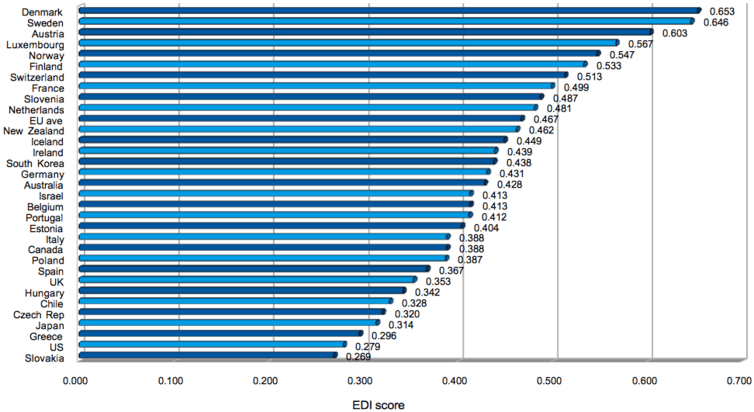
Our economic democracy index looked at 32 countries in the OECD (omitting Turkey and Mexico, which had too much missing data). While economic democracy tends to focus on levels of trade union influence and the extent of cooperative ownership in a country, we wanted to take in other relevant factors.
We added three additional indicators: “workplace and employment rights”; “distribution of economic decision-making powers”, including everything from the strength of the financial sector to the extent to which tax powers are centralised; and “transparency and democratic engagement in macroeconomic decision-making”, which takes in corruption, accountability, central bank transparency and different social partners’ involvement in shaping policy.
What is striking is the basic difference between a more “social” model of northern European capitalism and the more market-driven Anglo-American model. Hence the Scandinavian countries score among the best, with their higher levels of social protection, employment rights and democratic participation in economic decision-making. The reverse is true of the more deregulated, concentrated and less democratic economies of the English-speaking world. The US ranks particularly low, with only Slovakia below it. The UK too is only 25th out of 32.
Economic Democracy Index, figures from 2013. Andrew Cumbers
Interestingly, France ranks relatively highly. This reflects its strong levels of job protection and employee involvement in corporate decision-making – the fact that the far right has been strong in France for a number of years indicates its popularity stems from race at least as much as economics.
Yet leading mainstream presidential candidates François Fillon and Emmanuel Macron are committed to reducing France’s protections. These are often blamed – without much real evidence – for the country’s sluggish job creation record. There is a clear danger both here and in the Netherlands that a continuing commitment to such neoliberal labour market policies might push working class voters further towards Le Pen and Wilders.
One other notable disparity in the index is between the scores of Austria and Germany, despite their relatively similar economic governance. Germany’s lower ranking reflects the growth of labour market insecurity and lower levels of job protection, particularly for part-time workers as part of the Hartz IV labour market reforms in the 1990s that followed reunification.
The index also highlights the comparatively poor levels of economic democracy in the “transition” economies of eastern Europe. The one very interesting exception is Slovenia, which merits further study. It might reflect both its relatively stable transition from communism and the civil war in the former Yugoslavia, and the continuing presence of active civil society elements in the trade union and cooperative movements. Southern European economies also tend to rank below northern European countries, as does Japan.
Poverty and inequality
The index provides strong evidence that xenophobic politics may be linked to changing levels of economic participation and empowerment – notwithstanding the French data. We found that the greater the poverty and inequality in a country, the lower the rates of economic democracy.
These findings suggest, for example, that the Anglo-American-led attack on trade unions and flexible labour policies may actually drive up poverty and inequality by cutting welfare benefits and driving up individual employment insecurity. While the OECD itself advocated these policies until recently, countries with high levels of economic democracy such as Norway, Denmark and Iceland have much lower levels of poverty than countries such as the US and UK.
Far right activists in Budapest, Hungary, February 2016. EPA
Far-right populism is on the march everywhere, including the Nordic countries. But Brexit, Trump and the more serious shift to the far right in Eastern Europe have been accompanied by diminishing economic security and rights at work, disenfranchised trade unions and cooperatives, and economic decision-making concentrated among financial, political and corporate elites.
We will monitor these scores in future to see what happens over time. It will be interesting to see how the correlations between economic democracy, poverty and voting patterns develop in the coming years. For those looking for answers to the crisis in liberal democracy, this may well be it.
ooOOoo
I shall be writing to Professor Cumbers asking if my analysis of that relationship is supported by his research.
For if it is then we do have a very clear axiom that few would disagree with. That is the political consensus this world needs now.
This is no sinecure – the future of mankind is at risk.
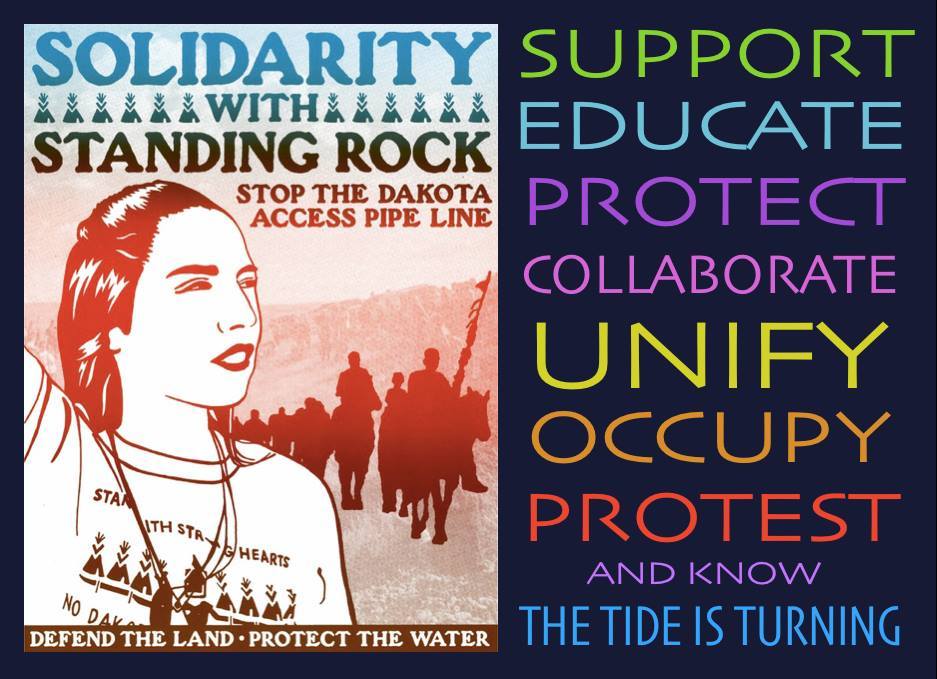
Very often I find a topic for Saturday that is easy on the mind. But I make no apologies for republishing, with Jennifer’s permission, a post that she published over on Transition Times yesterday. When you read it you will see clearly that promoting this today is right. For many readers may well be able to join thousands of others in showing their support for the Standing Rock Sioux tribe.
Thousands of Native Americans, members of a whole host of tribes, have gathered at Standing Rock, North Dakota, to protest the North Dakota Access Pipeline (#NoDAPL), which was sited by the Army Corps of Engineers to run dangerously close to the Missouri River and the Standing Rock Reservation.
If there is anyone to look back at this turbulent period in human history on Earth—now coming to be known as the Anthropocene—they will surely wonder at the suicidal tendency of human civilization in the 20th and early 21st centuries.
Why, they will ask, would such an intelligent species willingly—even enthusiastically—engage in the poisoning of its waterways and underground water resources; the destruction of its forests; the chemical contamination of its soils and oceans; the overheating of its precious atmosphere by relentless burning of fossil fuels? Why would humans put so much of their intelligence and technological prowess into developing ever more lethal weapons of mass destruction, used to bludgeon each other? Why would they preside blithely over the extinction of millions of other species, the vicious ripping of the great ecological web of life on Earth?
Why indeed?
I know it’s hard for any of us to escape the clutter of our everyday lives, with the constant pressures and worries that beset us on the personal level. But this is precisely what is being asked of us now.
The courageous defenders out at Standing Rock dropped their ordinary lives to be part of the historic encampment protesting the stranglehold of the oil companies on our waterways and our lands. They are fighting in the courts, through the media, and most importantly with their physical presence, standing up to the bulldozers, the attack dogs and the pepper spray.
Image source: Democracy Now!
This is what McKibben’s World War Three looks like—it’s already begun. It will be fought locally, as communities and individuals wake up to the implications of the destruction and decide that hell no, they won’t take it any more.
In my own corner of the world, we are under assault from General Electric, wanting to create toxic waste dumps right in the middle of our small rural towns. We have a gas pipeline being constructed, despite vehement protests, through a pristine old-growth state forest. We have oil tanker trains running constantly right through our communities. Despite a thriving organic and biodynamic farm renaissance, we still have far too many pesticides, herbicides and fungicides being used locally, and too many trees being cut down.
I have been thinking and writing for some time now about how important it is to align the personal, political and planetary in our own lives and in the way we relate to the world around us. On all three of these levels, 21st century American life is way out of balance.
It is time to focus, each one of us, on using our brief lifetimes to create balance and harmony on Earth. Sometimes the way to harmony leads through protest and discord, as is happening now in Standing Rock. Sometimes it can be as simple as choosing to support local, low-impact agriculture rather than industrial agriculture. Leaning on our political representatives to move faster on policy that will shift our society to renewable energy is key.
There are so many ways to get involved in this War for the Planet, many of them quite peaceful. The important thing is to get off the sidelines. Get involved. Feel the potential of this moment—it’s literally a make or break period for the future of humanity on Earth, and many other living beings too.
The brave defenders at Standing Rock are reminding us that we are all “natives” of this Earth, and we all have a stake in protecting her. Which side are you on?
ooOOoo
Yes, we are all natives of this world and that includes our dear animals and our wonderful animal companions.
Make a promise to yourself to make a difference; even one small difference. With that in mind, if you want to find an event close to you then the Sierra Club have a page where you can look up which event you would like to attend.









 Let me close with some more photos of dogs that have been helped by John, Dionete and the rest of the great band of the Vista Verde Fund.





 Learning from Dogs