The most important thing, without a doubt, to learn from dogs.
Last Tuesday, Learning from Dogs published the first of the three parts of Martin Lack’s essay From Environmentalism to Ecologism. It generated a fascinating discussion. One of the commentators was Chris Snuggs who writes his own blog under the name of Nemo Insula Est. Here is the essence of a discussion with Martin Lack and Patrice Ayme. (Without reading the following comments, my closing opinion will make little sense; assuming they do at the best of times!)
Chris: The problem with politics at the moment is that the choices come down to A) being socialist, moral and bankrupt or B) capitalist and immoral but at least with a chance of avoiding poverty and chaos.
Martin: I think I am very much in agreement with you, Chris. It says a l lot when a practicing Catholic can admit that his Church needs to ditch its anthropocentric bias and stop treating the Earth as if we are the only species that matters…
Chris: One of the big questions for me is this. Is the world of our perceptions ONLY what we see, hear, smell and touch or is there another dimension which we cannot sense? Personally, I believe the former, which is why I cannot believe in: God, aliens, ghosts, an afterlife, fairies or indeed a sensible socialist economic policy.
I sometimes feel this makes me boring (or if you like, it just another feature of my boringness), but on the other hand I feel more or less in tune with what I understand “The Enlightenment” to have meant. It would be much more reassuring to know that there is a God (caring if possible, though it is hard to see how he would be) and indeed aliens, as long as they were friendly. But until there is some sound evidence, I cannot. And there IS no evidence that would stand up in court, is there?
So, we are alone; the universe is as it is; how it came into being we do not know and it is perhaps unknowable; the planet Earth cares not a jot about us or our feelings; we have no particular right to exist: we just do, by natural accident (until proven otherwise). I am not a fan of the “There are billions of stars in the universe, so there must be other forms of life elsewhere.” argument. “must be” is not “is”.
So if WE do not ensure our survival by looking after the planet then nobody or nothing will. As for “ecology”, good people are trying to do a lot of things, but as far as I can see:
A) It is too late and too little. Even if we were doing all the right things NOW (which we obviously are not), the time lag before our actions start to correct othe damage done will be too great; we may well have died out by then.
B) Despite all that is being done, CO2 emissions are going up, countries have STILL found no economic model that does not insist on growth and you cannot have growth without increased energy use, which for the moment and foreseeable future means fossil fuel extraction. And THIS of course continues apace with many countries now desperately trying to frack their way to growth, in the case of the USA rather successfully.
Martin: All very interesting, Chris, although I am not sure why your atheism necessitates rejection of socialism. For many people the two are inextricably linked. However, this is all off-topic… All I wanted to point out was that anthropocentrism is a mistake that can be made by both theists and atheists alike; and that it is good to see the former admitting they have made this mistake.
Paul: Chris/Martin, To my way of thinking, there is a more fundamental issue at work. That is the corrupting effect of power. I’m certain you know the famous saying. Thus whatever fine motives propel a person to enter politics, that person seems unable to avoid the call of power and its corrupting effect. The only hope is that key countries, and none so key as the USA, evolve a better, more representative, political process. Otherwise, I fear for the coming years.
Patrice: I agree with Paul 100%. I saw the call of power. Unimaginable. People just get insane. There are also filtering systems to insure they get that way (it starts right away with one week retreats in extremely posh resorts; does not matter if you are capitalist, socialist, blueist, reddist, ecologist, independentist, etc.).
Chris: Agreed. It has been clear time and time again throughout history. Well, so much is obvious, but WHAT TO DO about it?
A) We must end the practice of having career politicians: you serve a maximum of TEN years, at the end of which you go.
B) Inherited wealth allowing the building up of immensely powerful family dynasties over generations must be ended. It is simply untenable. The rich-poor gap is getting obscene everywhere, and money is of course power. My “Abolish inheritance” idea will be wildly unpopular because we are naturally acquisitive and “greedy” and of course would hit those with most to lose who also therefore have the most power.
Patrice: With all due respect, Chris and Martin sound rather naïve… Huge wealth and power is where it’s at. And it attracts to politics first, foremost, and soon uniquely, those it attracts most, namely the basest sort.
Chris:
A) All a question of balance: SOME ambition is essential; it is when there is too much that it is dangerous.
B) I would have maximum terms for political service. plus:
C) Nobody should be allowed to be a public representative until they have fulfilled certain conditions, for example (but to be debated): worked in the private sector; some experience of life in a factory; nobody under 30; high achievement in some industrial, commercial, academic or social field, and so on
Ed Milliband grew up in a Marxist family, went to a posh school and then straight to university from where he went straight into politics as an “advisor”, thence to become a Minister and now leader of the opposition and possible OM.
THAT is not the proper background for a national leader, but the House of Commons is full of such people. The % of MPs from “working-class” backgrounds is going down and down and down. In the USA, Congress is over-represented by the rich, famous and/or connected. Where are the mailmen, bus drivers and burger-servers? “You need more intelligent Congresspeople than that.”
Sorry, I can’t take that argument from a country that elected Dan Quayle, George Bush and Sara Palin!!!!!
Patrice: Right. Glad to see every body agrees. It’s even worse than that. “Representative” politics is intrinsically demonic, as it vests great power in some individuals. That, per se is not just a crime, but absolutely corrupting.
Representative politics has got to be eliminated. Switzerland has eliminated it at the legislative level. Why can’t all other countries of the West do the same? Because the present plutocracy rules through the representatives, esp. in the USA? After we have done the legislative, the executive could be handled along Roman Republican lines and Athenian lines. Roman Consuls, for example, had full power only for one month at a time. In Athens enormous quora (say, 8% of the potential electorate) had to be found, before any decision.
Martin:Excellent synopsis, Patrice. All of the things you mention would be made possible by a return to localism and/or bioregionalism, which may well come to pass by default (i.e. as a result of those in power now being in denial about what is happening to our planet).
Now the reason that I offered up this lengthy transcript of the conversation was that it clearly showed to me that bright, well-educated people agree that there is much wrong with many, if not most, countries that offer a representative democratic form of Government. Bright, well-educated people are also not afraid to offer answers. Patrice went on to write a most engaging post over at his place under the title of Representative Politics Is Dictatorship. It opens:
Representative Dictatorship Is Not Democracy
I know a young lady who was elected for the first time in California. She is sent to a posh resort for a week to learn the basics of her new job, being a “Democratic” politician. Everything is wrong with this picture (not just the mansion she lives in and her million dollar family income, while claiming to be a leftie). Everything is wrong, but it’s typical: all elected representatives in the USA are treated very well, and get to meet who, it dawns on them after a while, can insure for them, and their families, much nicer lives. (The New York Times, to its discredit, just discovered this PACS trick in 2014.)
A gigantic manipulation industry has developed, with its own strategists. Barack Obama seemed to have come out of nowhere, but, even before he started to score big, he was viewed as the anointed one, by the highest powers in “Democratic” circles: Axelrod, a professional manipulator who had just led Kerry’s campaign, was sent to Obama, just a modest Senator. Obama then gave a keynote speech at the Kerry convention, etc. When he campaigned, Wall Street money started to flow, more than towards any other candidate, by orders of magnitude, etc. No wonder Obama has found so hard to bite the hand that fed him.
Let me draw this all together. Possibly in a manner that will cause readers to sigh and say the old fella is losing the plot!
Because what I am about to say strikes me as so obvious, so massively demonstrated day-in, day-out by the planet’s sentient, warm-blooded creatures (even man can do it!).
It is this.
We have lost sight of the fact that animals offer an endless set of examples of living in the present and offering unconditional love to those creatures, humans included, that do not threaten them. These are very difficult times for us and all the creatures on this planet. Unconditional love for the planet we live on and for all those that do not threaten us is the only way forward!
Let me close with three photographs that provide all the evidence that we need to embrace love and tenderness for everything in our lives.
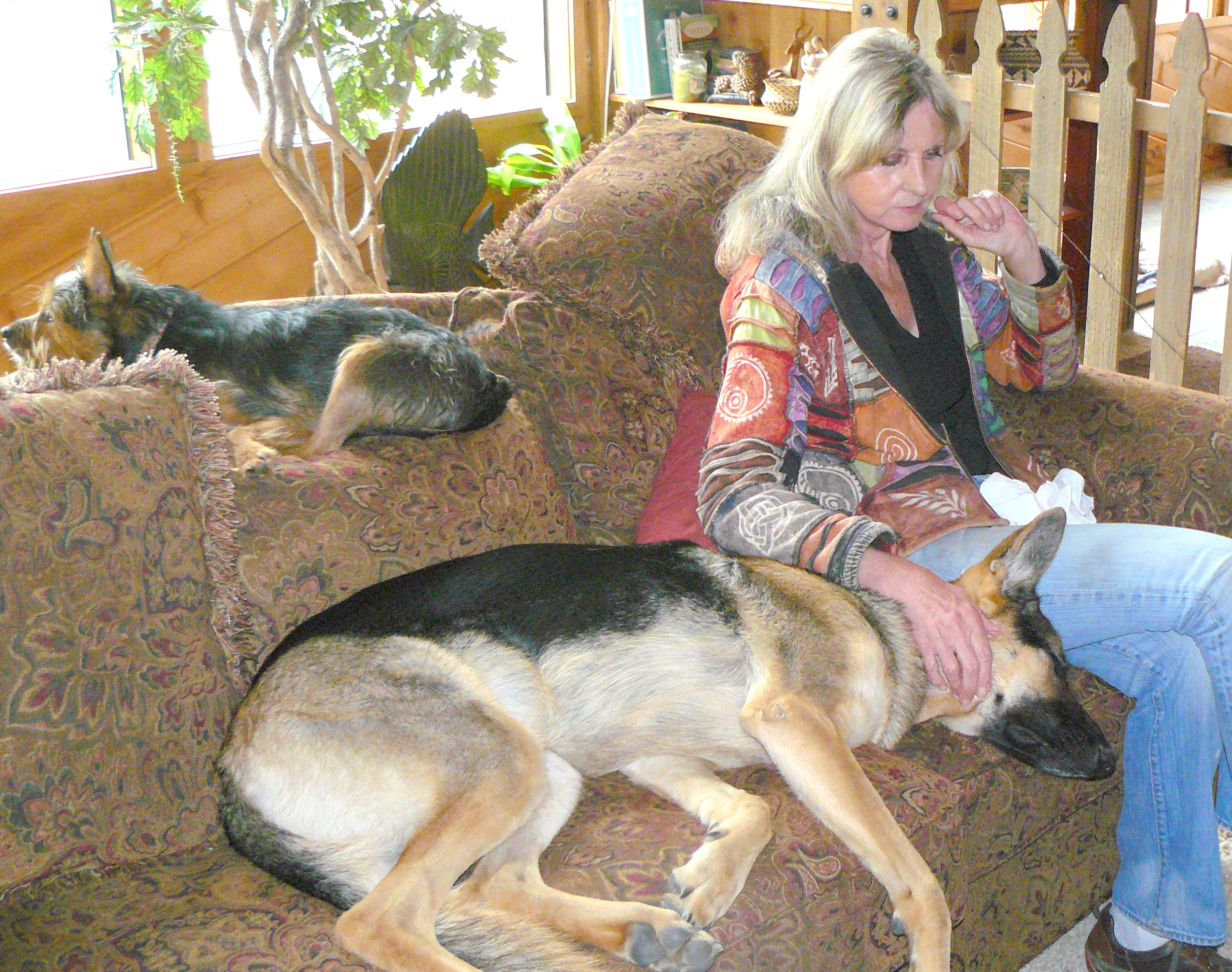
Sweeny on back of settee, Cleo loving Jean.
oooo
Dhalia’s unconditional love for Jean.
oooo
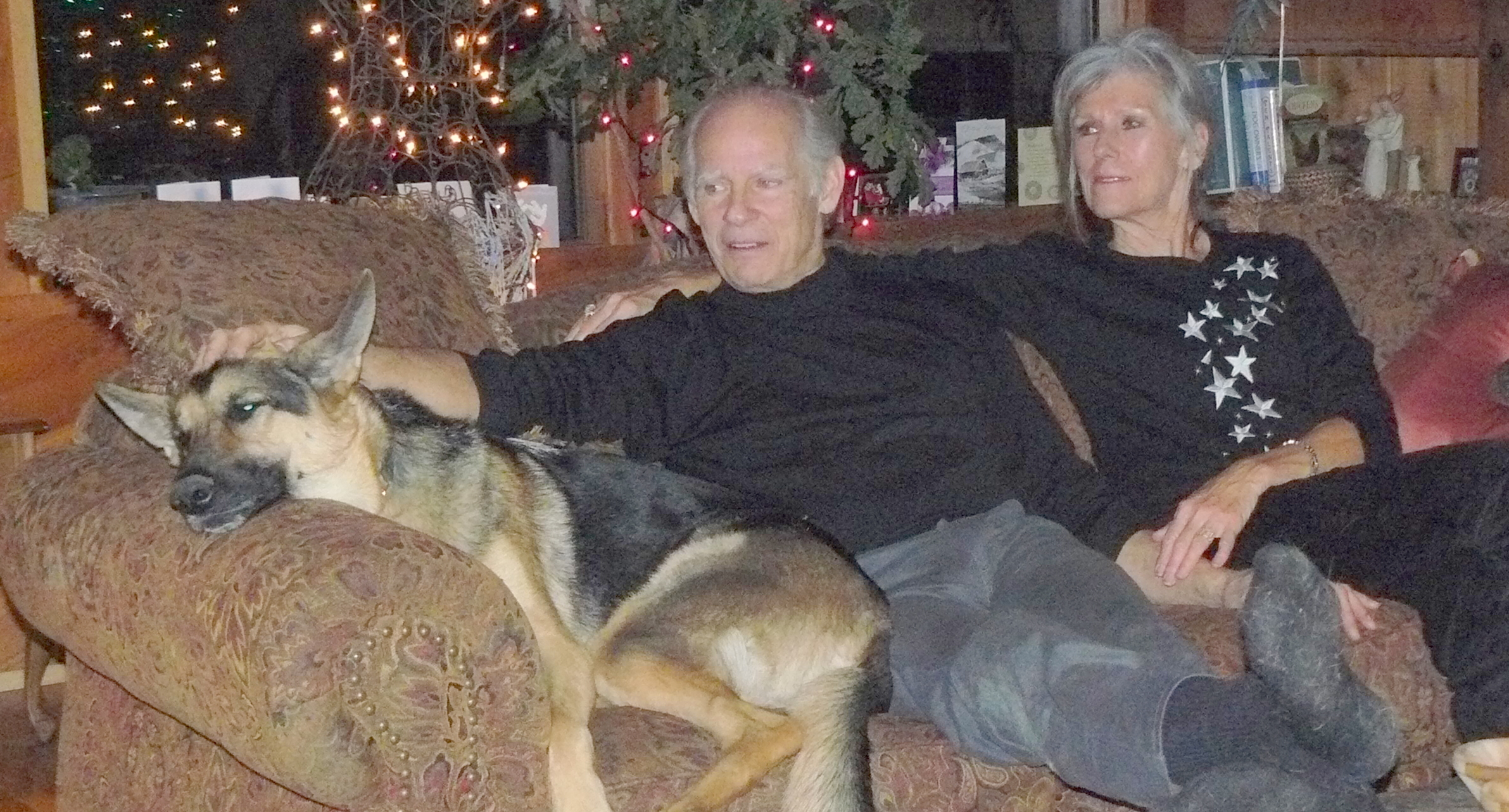
Neighbours Bill and Dordie under the influence of Cleo’s unconditional love.
Can ecologism be regarded as an ideology in its own right? (Part 3)
Therefore, having now surveyed all the relevant “territory”, we shall now consider the third and final part of the answer to the question as proposed in the Introduction.
Ecologism – Neither left nor right, but out in front?
According to Philip Shabecoff, it was members of the European Green parties that were the first to assert that they are “neither left nor right but out in front” (2000: 109).
For this to be true, ecologism would have to represent a new paradigm that rejects (or at least challenges) beliefs central to conventional politics (of any orientation). This, it is here argued, is indeed the case: In a discussion of the libertarian ideas of John Locke and Adam Smith, William Ophuls observed that they “…have not gone unchallenged, but with very few exceptions, liberals, conservatives, socialists, communists, and other modern ideologies have taken abundance for granted and assumed the necessity of further growth” (Ophuls 1977: 145).
What is the problem with modernity?
As suggested by Anthony Giddens, modernity encompasses “…modes of social life or organisation which emerged in Europe from about the seventeenth century onwards and which subsequently became more or less worldwide in their influence” (Giddens 1991: 1).
The problem is that the accumulation of personal wealth has become the sole objective of many people in modern society; and perpetual growth is posited as a means whereby even the poorest might achieve it.
Karl Marx (as cited by Jon Elster) coined the term “money fetishism” to describe the belief that money (and/or precious metals) have intrinsic (use) value rather than just instrumental (exchange) value, which Marx felt was as misguided as the religious practice of endowing inanimate objects with supernatural powers (Elster 1986: 56-7).
However, whereas Karl Marx saw capitalism as the problem, the ideology that he gave his name to is just as guilty of Daly’s “growthmania”. For example, whereas Jack Goody accepts that capitalism has been “…connected with the growth of rationality and of secularisation; more recently with urbanisation and industrialisation”, he also notes that for Marxist regimes “…modern meant industrialisation without capitalism” (Goody 2004: 6).
The terms “use value” and “exchange value” were first put forward by Aristotle (384-322 BC) who, according to Daly, also recognised the danger of focusing on the latter (i.e. whereby the accumulation of wealth becomes an end in itself) and, alluding to Marx’s criticism, Daly suggested that the paperless economy (where no useable commodities actually change hands) is the logical end-point for money fetishism (Daly 1992: 186).
Finally, on the subject of the consequences of “the problem”, although the centrally-planned economies of the former USSR and China would appear to have had their day, the flaws of the capitalist system they seem so keen to embrace have also revealed themselves in recent time. For example, when John Gray came to write the introduction to the second edition of his book “False Dawn: The Delusions of Modern Capitalism”, he included the following comment:
In the first edition of this book, published in March 1998, I wrote: ‘Today’s regime of global laissez-faire will be briefer than even the belle époque of 1870 to 1914, which ended in the trenches of the first world war’… Not much more than a decade ago this seemed outlandish, but there have since been many signs that global capitalism was heading for a fall (Gray 2009: xii).
Does ecologism provide the answers?
The starting point for ecologism is the concept of carrying capacity (the maximum population of a species) that an ecosystem can support in perpetuity (Dryzek 2005: 27). In this instance, the species is Homo sapiens and the ecosystem is the planet Earth. Therefore, in 1968, Hardin suggested that these limits exist and must be faced. In 1993, frustrated by the absence of discussion on population growth in international politics, he pointed out that:
Two centuries of intermittent wrestling with population problems have produced useful insights about the reality and nature of limits… Four centuries of sedation by the delusion of limitlessness have left humanity floundering in a wilderness of rhetoric… From this it must be inferred that someday political conservatism will once again be defined as contented living within limits. The limitless world view will have to be abandoned (Hardin 1993: 5-6).
In 1968, his solution had been “...mutual coercion, mutually agreed upon by the majority of the people affected” (Hardin 1968: 1247). However, in an apparent reference to the work of an array of scholars including Malthus, Hardin, Meadows, Ehrlich and others, Daly lamented that:
Anyone who asserts the existence of limits is soon presented with a whole litany of things that someone once said could never be done but subsequently were done… Continuing to study economies only in terms of the [exchange value of money] is like studying organisms only in terms of the circulatory system, without ever mentioning the digestive tract. (Daly 1992: 185-186).
Much more recently, Daly has reminded us that, “Ecological limits are rapidly converting ‘economic growth’ into ‘uneconomic growth’-that is throughput growth that increases costs by more than it increases benefits, thus making us poorer not richer” (Daly 2007: 39).
So, it would seem that the challenge of living “within our planet’s means” remains significant; one that few politicians are willing to discuss (because there are no votes to be gained in doing so). It is this fact that the environment cannot speak for itself (i.e. it is disenfranchised) that led Goodin to the conclusion that “nature has interests… as deserving of protection as anyone else’s, which must be ‘encapsulated’ as part of a discursive participatory democracy” (Goodin 1996: 835).
Similarly, whereas Goodin used the term “encapsulated interests” (to describe how one party’s interests are incorporated in those of another), Dobson suggested that non-human animals and future generations of humans (and maybe even other species) are “new environmental constituencies” requiring human representatives to look after their interests (Dobson 1996: 125).
All that needs to be decided is who we shall admit into the “community of justice” (i.e. how radical you want to be).
Citing Low and Gleeson (1998) and Baxter (1999), Derek Bell therefore distinguishes environmental and ecological justice as follows: Environmental justice concerns the distribution of environmental benefits and burdens among human beings. Whereas ecological justice is concerned with justice between human beings and the rest of the natural world (Bell 2006: 208). Furthermore, Bell also spells out the importance of this distinction (just in case any reader has not appreciated it yet) as follows:
Advocates of environmental justice merely insist that the instrumental value of the environment to humans should be recognised in a theory of social justice or justice among humans. Ecological justice makes the much more radical claim that justice extends beyond relations among humans so that we can talk about ‘justice to nature’ (Bell 2006: 208).
Conclusions
The question that has been addressed herein is whether or not ecologism can or should be regarded as a political ideology in its own right given that both socialists and conservatives can lay claim to some aspects of ecological politics.
In order to provide a defensible answer to this question, it was necessary to define what is meant by ecological politics (i.e. the pursuit of policies that are concerned with the environment; but which are not merely or predominantly anthropocentric) and ecologism (i.e. the pursuit of environmental policies that are biocentric or ecocentric). This therefore highlighted the fact that the two are not the same thing; and that ecological politics also includes anthropocentric environmentalism.
However, it has been demonstrated that, rather than being a simple dividing line within the field of ecological politics, anthropocentrism and ecocentrism represent opposite ends of a spectrum along which it is possible to adopt a variety of philosophical positions. Furthermore, although it has also been demonstrated that it is very difficult to be entirely one thing or the other, when faced with difficult policy decisions, almost everyone (both socialists and conservatives included), tends to favour self-preservation. Therefore, the default position of all humans tends to be towards the anthropocentric end of the spectrum.
Nevertheless, to avoid the tautological response to the question (“ecologism must be regarded as a distinctive political ideology in its own right because it is!”), it was deemed necessary to demonstrate how and why both socialists and conservatives can lay claim to ecological politics (although the majority of both socialists and conservatives do not do so) and, therefore, how and why the ecologism that both find so challenging must be regarded as a political ideology in its own right.
In so doing, it has been shown that some socialists find common cause with those that seek equal rights for the environment; whereas some conservatives may do so in pursuit of maintaining the status quo. However, both generally assume the necessity of further growth (Ophuls); what Daly called ‘growthmania’. Furthermore, capitalism is fixated upon the inherent value of things we may consume; whereas Marxism (an extreme form of socialism) is fixated upon the inherent value of things we may produce. However, ecologism insists that nature has inherent – if not intrinsic – value in and of itself; independent of our finding a use for it.
Ecologically-minded scientists and economists have pointed out that the Earth is finite and its capacity to accommodate humans is finite; whereas the evidence of at least the last 40 years is that many prefer to refuse to accept this reality and, as Schumacher pointed out, are spending environmental capital as if it were income. Therefore, because ecologism demands justice that is ecological (ecocentric) – not just environmental (anthropocentric), it represents a fundamental challenge to conventional politics and, as such, must be regarded as a distinctive political ideology in its own right.
References
Baxter, B. (1999), Ecologism: An Introduction. Edinburgh: Edinburgh University Press.
Bell, D. (2006), ‘Political Liberalism and Ecological Justice’ [online], Analyse & Kritik 28, pp.206-22. [Paper originally presented at ECPR General Conference, Marburg, 18–21 September 2003]. Available at <http://analyse-und-kritik.net/2006-2/AK_Bell_2006.pdf> [accessed 18 April 2011].
Daly, H. (1992), Steady State Economics (2nd edition). London: Earthscan.
Daly, H. (2007), Ecological Economics and Sustainable Development, Selected Essays of Herman Daly. Cheltenham: Edward Elgar.
Dobson, A. (1996), ‘Representative democracy and the environment’, in Lafferty, W. and Meadowcroft, J (eds), Democracy and the Environment: Problems and Prospects. Cheltenham: Edward Elgar, pp.124-39.
Dryzek, J. (2005), The Politics of the Environment (2nd edition). Oxford: Oxford University Press.
Ehrlich, P & Ehrlich, A. (1996), Betrayal of Science and Reason. New York: Island Press.
Elster, J. (1986), An Introduction to Karl Marx. Cambridge: Cambridge University Press.
Giddens, A. (1991), The Consequences of Modernity. Cambridge: Polity Press.
Goodin, R. (1996), ‘Enfranchising the earth, and its alternatives’, Political Studies, 44, pp.835-49.
Goody, J. (2004), Capitalism and Modernity: The Great Debate. Cambridge: Polity Press.
Gray, J. (2009), False Dawn: The Delusions of Modern Capitalism, 2nd edition. London: Granta.
Hardin, G. (1993), Living Within Limits: Ecology, Economics, and Population Taboos. Oxford: Oxford University Press.
Low, N. and Gleeson, B. (1998), Justice, Society and Nature: An Exploration of Political Ecology. London: Routledge.
Malthus, T. (1798), An Essay on the Principle of Population. London: J Johnson.
Ophuls, W. (1977), Ecology and the Politics of Scarcity. San Francisco: Freeman & Co..
Shabecoff, P., (2000), Earth Rising: American Environmentalism in the 21st Century, Washington DC: Island Press.
ooOOoo
I know a good number of readers have followed Martin’s essay since Tuesday and I would like to thank Martin, on my own account and on behalf of all LfD readers, for giving me the opportunity to republish the essay.
Part Two of the three-part guest essay by Martin Lack.
The background to this major essay was covered yesterday, in the introduction to Part One.
ooOOoo
Can ecologism be regarded as an ideology in its own right? (Part 2)
A question of values
According to Carter (2007: 14-15), there is no consistent use of terminology regarding the value ascribed to different entities, so it would seem sensible to use that which he outlines:
Instrumental value: The value which something has for someone as a means to an end (also known as utility value).
Inherent value: The value which something has because it is considered desirable (e.g. precious metals such as silver, gold and platinum).
Intrinsic value: The value which something has because of what it is – typically essential for the existence of life (e.g. sunlight, clean air, and clean water).
As Carter points out (2007: 15), as well as being inconsistently applied to individual entities by those doing the valuing, these terms are not mutually exclusive (i.e. “being valuable in one way does not preclude being valuable in another way”). However, what is clear is that the value judgements that any individual makes will determine their attitude towards consumption and/or pollution of the Earth’s natural resources.
In setting out his “Green Theory of Value”, Robert Goodin boldly acknowledged that, ideally, it should “tell us both what is to be valued and why” (Goodin 1992:19). However, before explaining his own theory of value, Goodin identifies the two main alternatives as capitalist (consumer-based) value; and Marxist (producer-based) value (Goodin 1992: 23-4). Goodin’s green theory of value is thus distinct from both of these because the value-imparting properties are neither those of the consumer nor producer; they are (or at least should be) “natural resource based”; although he specifically does not claim that his theory “is correct utterly to the exclusion of all others” (Goodin 1992: 25-6).
Applying Carter’s typology of value (above) to Goodin’s argument, capitalists would appear to be focussed upon the inherent value of things they consume; and Marxists upon the instrumental value of the things they produce. In contrast to both of these, Goodin seeks to justify the assertion that nature itself should always be considered, independent of the presence or activity of humans, to have inherent – if not intrinsic – value. However, he seems to shy away from the logical conclusion of his argument; that all nature has intrinsic value that does not require the presence of valuers (Goodin 1992: 42-45). This is presumably part of an appeal to reason, which such an extreme view would probably not have.
A question of perspective
If anthropocentrism is a way of thinking “…that regards humans as the source of all value and is predominantly concerned with human interests”, then, in simplistic terms, ecocentrism is one “…that regards humans as subject to… ethical, political and social prescriptions… equally concerned with both humans and non-humans” (Carter 2007: 14). However, as with most things in life, it is not as simple as these definitions imply. For example, from an anthropocentric perspective, it is possible to be concerned about the welfare of individual domesticated animals; and yet not be concerned about the survival of entire endangered species.
Equally, one of the biggest debates in ecological politics may revolve around how one defines “moral persons” (Rawls, 1972: 504-5); or legitimate “recipients of justice” (Garner 2003: 11), although many would probably agree with what Jeremy Bentham (1748-1832) said: “The question is not, can they reason? Not, can they talk? But, can they suffer?” (cited in Dobson 2006: 220-1). However, the contentious and unresolved nature of this debate has led to the appearance of terms such as “shallow” and “deep”; which may be applied to anthropocentrism and ecocentrism alike (with “deep” denoting a more extreme position in either case). Therefore:
Rather than define different perspectives according to which side of the ecocentric/anthropocentric divide they lie, they can be located along a continuum, which moves from ecocentrism through various gradations of anthropocentrism to ‘strong anthropocentrism’ (Carter 2007: 36).
Once it is recognised that there is a range of possible positions that may be adopted (rather than a choice that has to be made), it is possible – as Eckersley has done – to characterise at least five different positions, which are as follows:
Resource conservation – the wise use of natural resources for human benefit: Eckersley suggests that the conservation movement was founded upon the Judeao-Christian notion of humans having “dominion” over the Earth; rather than any duty of “stewardship”, as exemplified by Gifford Pinchot (the first chief of the US Forest Service) (Eckersley 1992: 35).
Human welfare ecology – an appeal to enlightened self-interest: Eckersley cites Barry Commoner’s “four laws of ecology”as (1) everything is connected to everything else; (2) everything must go somewhere; (3) nature knows best; and (4) there’s no such thing as a free lunch (Eckersley 1992: 37-8).
Preservationism – seeking the aesthetic preservation of wilderness areas: Whereas Gifford Pinchot wanted to preserve nature for development (i.e. maximise the utility of natural resources for human benefit), John Muir (of the Sierra Club) wanted to preserve nature from development (i.e. minimise the human impact on the natural environment) (Eckersley 1992: 39).
Animal liberationism – the prevention of cruelty to certain animals: A comparatively modern, radical, development; which can trace its heritage back to “humane” societies formed in the eighteenth and nineteenth centuries, such as the RSPCA (Eckersley 1992: 42).
Ecocentrism – seeking the preservation of nature for its own sake (Eckersley, 1992: 46).
With regard to the latter, given that Eckersley recognised the fact that these positions lie upon a “wide spectrum of differing orientations towards nature”, whose end-points are anthropocentrism and ecocentrism (1992: 33), this could be better defined as deep ecocentrism. However, even using these five labels, it is not hard to see why it is difficult to categorise people: For example, the human welfare ecologists could be regarded as quite ecocentric (if they recognise the validity and/or importance of each and every one of Barry Commoner’s “four laws of ecology”); whereas animal liberationists could be regarded as quite anthropocentric (if they are only concerned about domesticated pets and/or individual animals).
The ecocentric end of the spectrum has also been described as that of “deep ecology” (Devall and Sessions 1985: 70), and “biospherical egalitarianism” (Naess 1989: 170). However, whilst preferring the term “biocentric egalitarianism” for the latter, Carter points out that – as indeed was conceded by Naess (1989: 28) – food is an essential requirement for life and, therefore, an entirely egalitarian position is untenable:
Certainly, any principle along the lines of biocentric egalitarianism would be impossible to implement. Taking it to the extreme, how could a human justify killing any animal or fish, or consuming a vegetable, bean or berry? All involve some restraint on another entity’s capacity to live and flourish (Carter 2007: 36).
So, it would seem that an entirely ecocentric position is hard to maintain, but can the same be said for an entirely anthropocentric position? This, as we shall now see, has been the subject of much debate.
A question of justice
When someone says, “I want justice!” it is normally because they feel they have been wronged in some way; and want what they feel they deserve (i.e. fairness). Hence, Paul Sterba opens his chapter in “Political Theory and the Ecological Challenge” on this subject by saying, “Justice requires giving what is deserved” (Sterba 2006: 148). However, within the sphere of environmental politics, when faced with difficult choices, human beings tend to ‘circle the wagons’ and protect their own kind.
In the introduction to his book “Theory of Ecological Justice”, Brian Baxter uses the example of Sir David Attenborough’s response to the prospect of humans causing species extinctions (i.e. “Surely, it is sad indeed that our descendants should inherit a natural world that is more impoverished than the one we inherited?”) to suggest that all humans are almost incapable of being anything other than anthropocentric (Baxter 2005: 1). However, Attenborough was probably deliberately making the question rhetorical; just as Baxter was probably being provocative in order to retain the interest of readers. Nevertheless, in a wide-ranging consideration of the subject, Baxter discusses the work of numerous authors, to advocate the case for “moral consideration” to be given to sentient non-humans (Baxter 2005: 45).
This would appear to be in accordance with Bentham’s conclusion that it is the ability to suffer that should confer the right to fair treatment. Indeed, one such author Baxter considered, David DeGrazia, proposed the principle of “equal consideration” for all sentient non-humans but pointed out that this could not guarantee justice; merely a fair hearing. He also pointed out that granting equal consideration would not automatically confer upon them the right to moral consideration, but it would be revolutionary; because much animal experimentation (he uses the term “exploitation”) would then seem to be unjustifiable (DeGrazia 1996: 37-38).
Dobson has written a great deal on the subject of justice. In a characteristically thought-provoking contribution to a recent collection of essays on the subject (regarding the difficulties of combining social justice and environmental sustainability; in effect asking “What is to be sustained and for whose benefit?”), he discusses who should be the legitimate “recipients of justice”; and what should be the consequential scope of the “community of justice” thus determined (Dobson 2003: 87-94).
Baxter sees the three main principled objections to the notion of ecological justice as being that justice need only be distributed to (1) those able to voluntarily co-operate to produce and/or preserve environmental benefits; (2) those with property rights; and (3) those capable of reciprocity (Baxter 2005: 77). Baxter deals with the first and last of these reasonably easily, as follows: (1) bacteria are beneficial and slaves were not volunteers (2005: 78-9); and (3) mentally-incapacitated people do not cease to be human because they cannot interact with their surroundings or respond to stimuli (2005: 77-8). However, objection (2) seems a little more intractable (2005: 86). Finally, Baxter concludes that if these objections can indeed be rejected, ecological justice represents a fundamental challenge to the laissez-faire attitude of liberalism (2005: 94).
However, for now, the final word on the question of justice will be given to Dobson, who almost seemed to be responding to Baxter, by saying: “Just who is throwing down the gauntlet here? Is political ecology a challenge for citizenship, or is citizenship a challenge for political ecology?” (Dobson 2006: 216). Whilst acknowledging the historical existence of at least two types of citizenship; namely liberal and civic republican (stressing right-claiming and responsibility-taking respectively), Dobson highlights at least two fundamental challenges to any notion of citizenship (i.e. feminism and cosmopolitanism) (2006: 217-8). However, much more space is given to the ways in which the notion of citizenship is a challenge to ecological politics. Again, this is indicative of the fact that ecologism should be regarded as a distinctive political ideology in its own right.
References
Baxter, B. (2005), A Theory of Ecological Justice. London: Routledge.
DeGrazia, D. (1996), Taking Animals Seriously: Mental Life and Moral Status. Cambridge: Cambridge University Press.
Devall, B. and Sessions, G. (1985), Living as if Nature Mattered. Layton UT: Peregrine and Smith.
Dobson, A. (2003), ‘Social justice and environmental sustainability: ne’er the twain shall meet?’, in Agyeman, J., Bullard, R., and Evans, B. (eds.), Just Sustainabilities: Development in an Unequal World. London: Earthscan, pp.83-95.
Dobson, A. (2006), ‘Citizenship’, in Dobson, A. and Eckersley, R., Political Theory and the Ecological Challenge. Cambridge: Cambridge University Press, pp.216-231.
Garner, R. (2003) ‘Animals, politics and justice: Rawlsian liberalism and the plight of non-humans’, Environmental Politics, 12 (2), pp.3-22.
Goodin, R. (1992), Green Political Theory. Cambridge: Polity Press.
Naess, A. (1989), Ecology, Community and Lifestyle. Cambridge: Cambridge University Press
Rawls, J. (1972), A Theory of Justice. Oxford: Oxford University Press.
Sterba, P. (2006), ‘Justice’, in Dobson, A. and Eckersley, R., Political Theory and the Ecological Challenge. Cambridge: Cambridge University Press, pp.148-64.
ooOOoo
The final part, Part Three, will be published tomorrow.
A few days ago, I remarked that for the time being posts on Learning from Dogs were frequently going to be based on the material of others. It was the only way that I could keep this blog going yet at the same time edit (code for re-write!) a 60,000-word novel that was completed, as a first pass, last November.
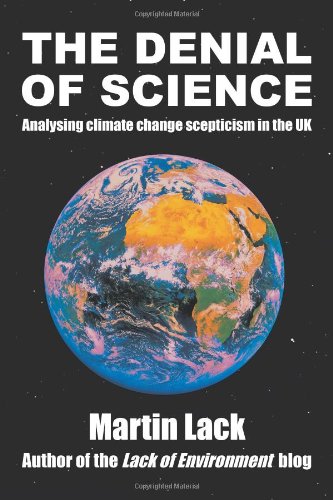
Martin Lack is one major step ahead of yours truly. Not because he, too, writes a blog but because, unlike yours truly, he is a published author! His book is called The Denial of Science; he blogs under the name of Lack of Environment.
Thus I was extremely grateful when a short while ago, Martin offered a major essay of his as a guest post for Learning from Dogs. Better than that, Martin happily accepted my recommendation to send me his essay in three parts.
It may not be the easiest read out in the ‘blogosphere’ but, trust me, Martin’s essay is profoundly important.
ooOOoo
Can ecologism be regarded as an ideology in its own right? (Part 1)
Introduction
Although it might well be assumed that one does not have to define what is meant by ‘socialists’ or – in UK terms at least – ‘conservatives’, it is certainly necessary to define ‘ecologism’: For the purposes of answering the above question, therefore, the latter should be understood as including thinking, behaviour, and the pursuit of policies that are concerned with the environment; but which are not merely or predominantly anthropocentric (i.e. those concerned with human needs and interests).
In a way, the question is nonsensical because use of the term ‘ecologism’, as coined by Andrew Dobson, appears to pre-suppose that ecological politics is indeed a “new political ideology” (2000: 163). If so, to respond to the above question by saying, in effect, ‘just because both socialists and conservatives (can) lay claim to ecological politics does not change the fact that ecologism is a distinctive political ideology in its own right’, would clearly be tautological. Therefore, to provide a defensible answer “Yes” to the above question – as is the intent herein – it is necessary to explain how and why:
both socialists and conservatives can lay claim to ecological politics;
the majority of both socialists and conservatives do not do so; and
the ‘ecologism’ that both find so challenging must therefore be considered as a distinctive political ideology in its own right.
The Socialist claim
One does not have to be an eco-socialist in order to believe or appreciate that there is a great deal of common ground shared by socialist and environmental politics. Socialism is a broad left-of-centre church that, it could be argued, includes everything from social democrats to communists. However, if socialism can be summed-up in the tripartite “Liberté, égalité, fraternité” motto of France (with its origins in the French Revolution of 1789-99), whose English translation would be “Freedom, equality, and brotherhood”, then it is not hard to see why socialists would find common cause with those whose goal is, in effect, to seek equal rights for the environment.
The “four pillars” of ecological politics are – as cited by Neil Carter – those devised by the German Green Party in 1983: ecological responsibility, grassroots democracy, social justice, and non-violence (Carter 2007: 48). Clearly, grassroots democracy and social justice are part of the socialist agenda. Therefore, despite the global dominance of free-market economics, Mary Mellor has asserted that far from being a challenge to socialism, “ecology greatly enhances the case for a redefined and refocused socialism” (Mellor 2006: 35).
The Conservative claim
Although by no means a monolithic entity, environmental politics is usually seen as being a predominantly left-of-centre entity (e.g. Carter 2007: 78); and it is often seen as being easier to define what it opposes than to define what it seeks. If so, ecological politics is essentially a reaction against anthropocentric thinking and the selfish pursuit of individual gain without regard for others or the environment. However, some philosophers such as Roger Scruton have therefore tried to distinguish between such selfish, libertarian, goals and those of traditional conservatives who, as their name suggests, seek the preservation of the status quo for the benefit of both the current generation and those that will follow (Scruton 2006: 7-8). Indeed, as early as 1993, in the wake of the Rio Earth Summit, Scruton was advocating the need for a radical re-think of right-wing politics:
Conservatives need to explore, with greens and others, as yet unthought-of dilemmas of life in societies which are no longer buoyed up by the prospect of incessant economic growth or by modernist pseudo-religions of endless world improvement” (Scruton 1993: 173).
However, in 1993, the idea that there might be limits to growth was hardly new; being based on Garrett Hardin’s Tragedy of the Commons article (1968); the Massachusetts Institute of Technology (MIT) Limits to Growth report for the Club of Rome (Meadows et al., 1972); E. F. Schumacher’s highly influential book Small is Beautiful (1973). For example:
The illusion of [mankind’s] unlimited powers, nourished by astonishing scientific and technological achievements, has produced the concurrent illusion of having solved the problem of production… based on the failure to distinguish between income and capital where this distinction matters most… A businessman would not consider a firm to have solved its problems of production and to have achieved viability if he saw that it was rapidly consuming its capital… (Schumacher 1974: 11).
Therefore, although the dilemmas were not “as yet unthought-of”, Scruton had, nevertheless, identified the source of the challenge that does indeed, it is here argued, begin to transform ecological politics into the distinctive political ideology that is ecologism.
Limits to Growth – a political and economic challenge
Although much disputed (by those that point to the fact that commodity prices have generally fallen over time, or that dire predictions have not yet come true), the Limits to Growth argument is based on the reality of the physical constraints of the planet on which we live.
For example: “Infinite growth is impossible in a closed system. With continued growth in production, the economic subsystem must eventually overwhelm the capacity of the global ecosystem to sustain it” (Daly & Farley 2004: 64). However, this is merely a comparatively recent re-statement of (former World Bank economist) Herman E Daly’s longstanding belief in the need for steady-state growth.
Furthermore, Daly and Farley cite Rudolf Clausius has having “coined the term ‘entropy’ for the Second Law [of Thermodynamics], derived from the Greek word for transformation, in recognition of the fact that entropy was a one-way street of irreversible change; a continual increase in the disorder of the universe” (Daly & Farley 2004: 65).
This is a fundamental tenet of modern physics; one that Daly has been repeating (like a “voice in the wilderness” proclaiming a message that nobody wants to hear) for a long time: It was over 35 years ago that he began an article entitled ‘The Economics of the Steady State’ with a quote from the famous scientist Sir Arthur Eddington, who once said, “But if your theory is found to be against the Second Law of Thermodynamics, I can give you no hope; there is nothing for it but to collapse in deepest humiliation” (as cited in Daly 1974: 15).
With this in mind, perhaps, the Union of Concerned Scientists (UCS) issued the “World Scientists’ Warning to Humanity” on 18 November 1992, from which the following excerpt is taken:
The earth is finite. Its ability to absorb wastes and destructive effluent is finite. Its ability to provide food and energy is finite. Its ability to provide for growing numbers of people is finite. And we are fast approaching many of the earth’s limits. Current economic practices which damage the environment, in both developed and underdeveloped nations, cannot be continued without the risk that vital global systems will be damaged beyond repair (UCS 1992).
Today, we are now well beyond these limits. According to the Global Footprint Network (GFN), humanity is now using the resources of at least 1.5 Earth’s (GFN, 2010). The most recent update to the Limits to Growth report was produced in 2005 and, in a section entitled “why technology and markets alone can’t avoid overshoot”, the authors suggested that:
…the more successfully society puts off its limits through economic and technical adaptations, the more likely it is in the future to run into several of them at the same time… the [model] does not run out of land or food or resources or pollution absorption capacity, it runs out of the “ability to cope” [i.e. too much industrial output has to be diverted to solving problems]… Given enough time, we believe humanity possesses nearly limitless problem solving abilities. [However] exponential growth… shortens the time for effective action. It loads stress on a system faster and faster, until coping mechanisms that have been adequate with slower rates of change finally begin to fail (Meadows et al 2005: 223).
Arguably, it could be said that the evidence for this is already becoming clear in the form of widespread social unrest around the globe, as a result of the increasing cost of – or difficulty in gaining access to – food, water, and energy.
For Robyn Eckersley, the reality of limits to growth and the magnitude of the ecological challenge is something from which we need to be emancipated; and it is also the raison d’être for environmentalism:
The environmental crisis and popular environmental concern have prompted a transformation of Western politics… Whatever the outcome of this realignment… the intractable nature of the environmental problems will ensure that environmental politics… is here to stay (Eckersley 1992: 7).
The latest UN projections for global population (published on 3 May 2011) suggests that stabilisation at about 10 billion by 2100AD is still most likely; but use probabilistic methods to account for the uncertainty in future fertility trends. Therefore, depending on changes in fertility rates in differing countries, the press release also indicates that global population could also peak at 8 billion in 2050 and then fall to 6 billion in 2100, or reach 10 billion by 2050 and continue to rise to 15 billion by 2100 (UN 2011: 1).
The key question the UN press release does not address is, “How many humans is too many?” Furthermore, although it depends on average rates of resource consumption, it is quite probable that there are already too many. However, this raises philosophical and/or ethical issues that form the other main aspect of ecological politics, which ensures that ecologism is a distinct political ideology in its own right.
From Environmentalism to Ecologism – the philosophical and ethical challenge
What’s in a name?
In the introduction above, ‘ecological politics’ was, in effect, defined as being environmentally-friendly and ecocentric (i.e. ecologism). For the avoidance of any doubt, therefore, it should be noted that this implies that it is possible to be concerned for the environment but be anthropocentric (i.e. environmentalism). It is precisely because the two things are not the same that Dobson has asserted that “…environmentalism and liberalism are compatible, but ecologism and liberalism are not” (2000: 165). The reason for this is examined below. (Ed. As in tomorrow!)
References
Carter, N. (2007), The Politics of the Environment (2nd edition). Cambridge: Cambridge University Press.
Daly, H. & Farley, J. (2004), Ecological Economics: Principles and Applications. Washington DC: Island Press.
Daly, H. (1974), ‘The Economics of the Steady State’, The American Economic Review, 64(2), pp.15-21.
Dobson, A. (2000), Green Political Thought, (3rd edition). London, Routledge.
Eckersley, R. (1992), Environmentalism and Political Theory. London: UCL Press.
Hardin, G. (1968), ‘The tragedy of the commons’, Science, 168, pp.1243-8.
Meadows D, et al (1972), The Limits to Growth. New York: Universe Books.
Meadows D, et al (2005), Limits to Growth: the 30-Year Update, London: Earthscan.
Mellor, M. (2006), ‘Socialism’, in Dobson, A. and Eckersley, R., Political Theory and the Ecological Challenge. Cambridge: Cambridge University Press, pp.35-50.
Schumacher, E.F. (1974), Small is Beautiful: A study of Economics as if Small People Mattered, London: Abacus.
Scruton, R. (1993), Beyond the New Right. London: Routledge.
Scruton, R. (2006), ‘Conservatism’, in Dobson, A. and Eckersley, R., Political Theory and the Ecological Challenge. Cambridge: Cambridge University Press, pp.7-19.
UN (2011), World Population Prospects: The 2010 Revision – Press Release. [Online] UN. Available at <http://esa.un.org/wpp/index.htm> [accessed 11/05/2011].
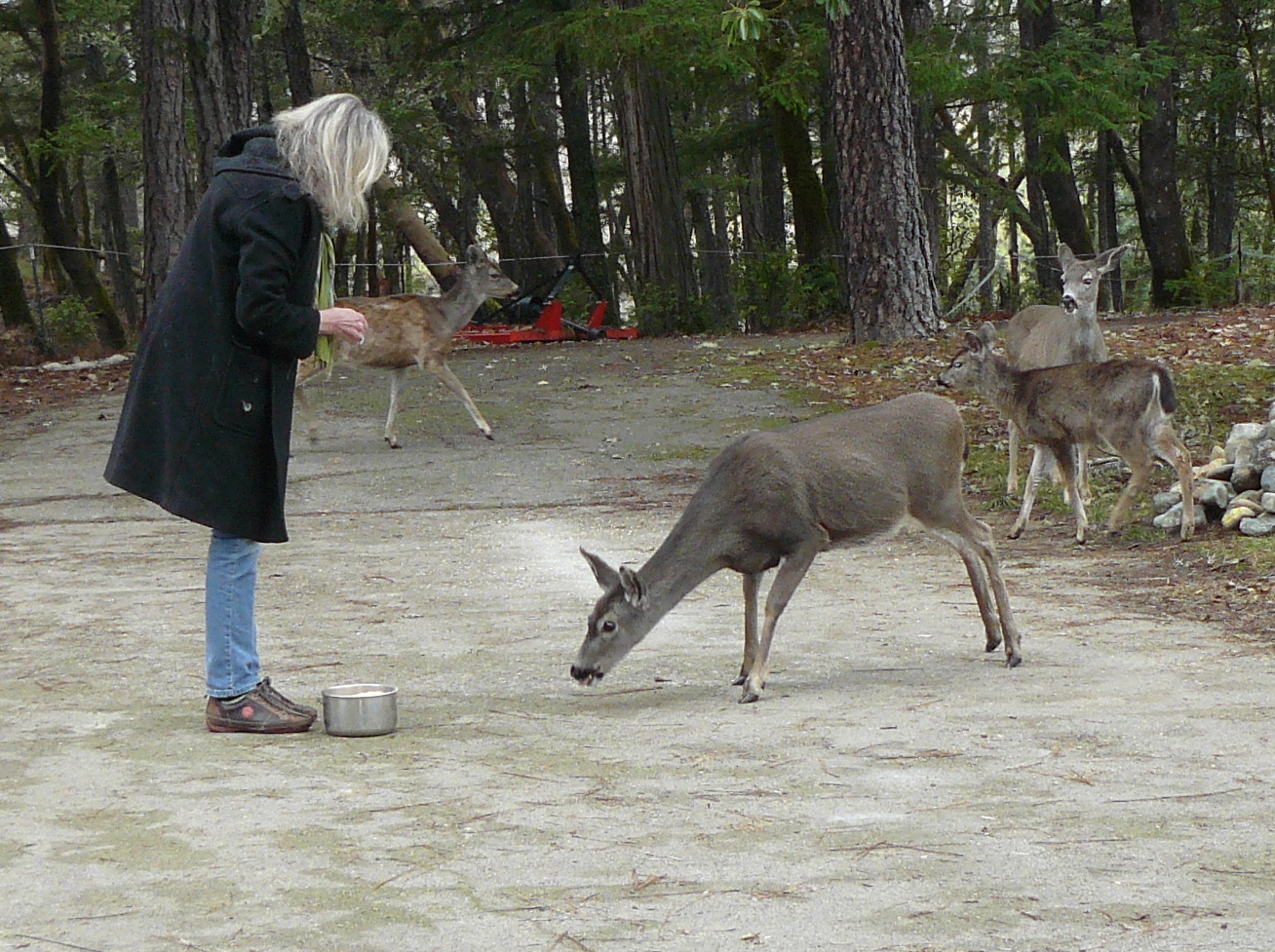
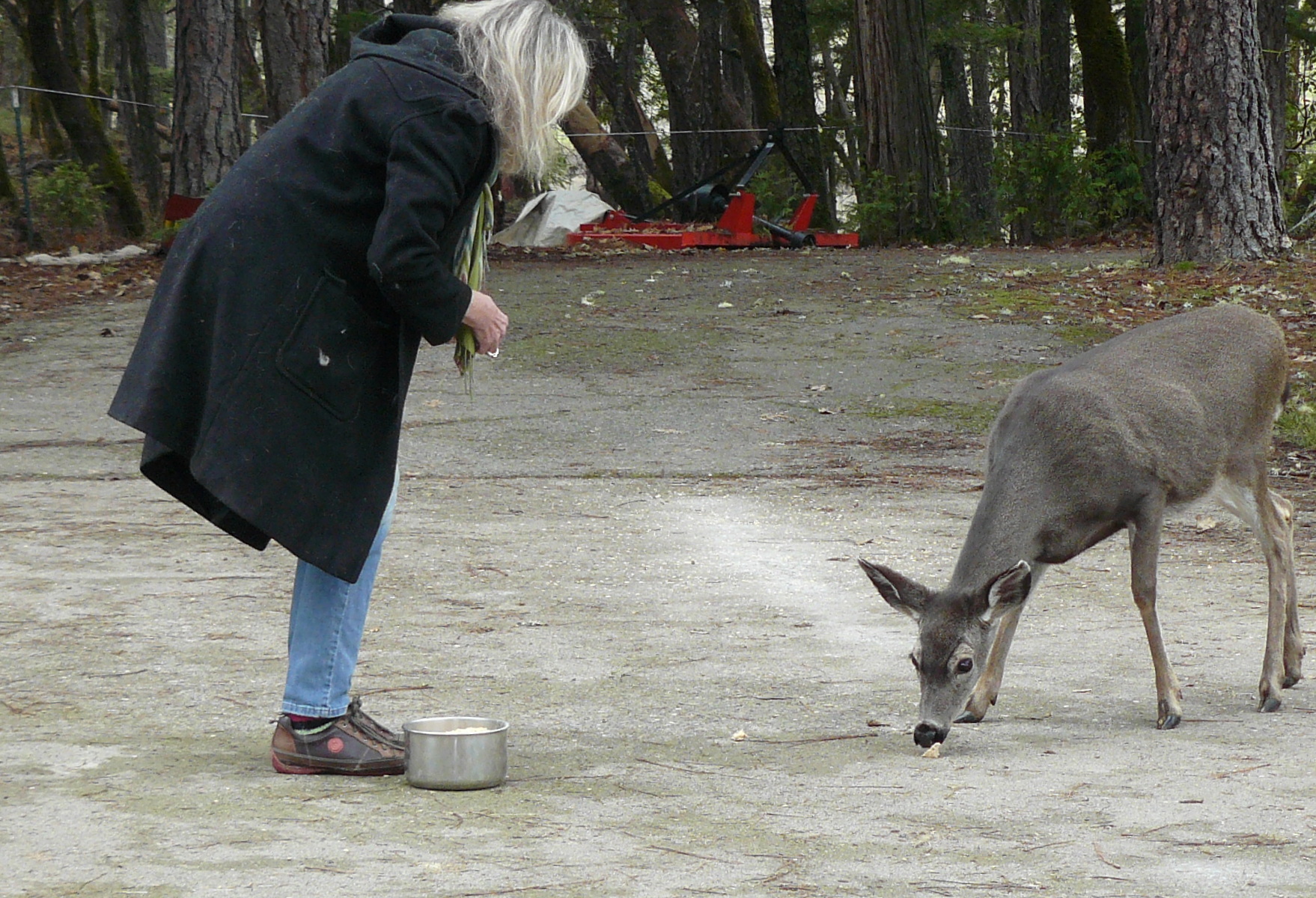
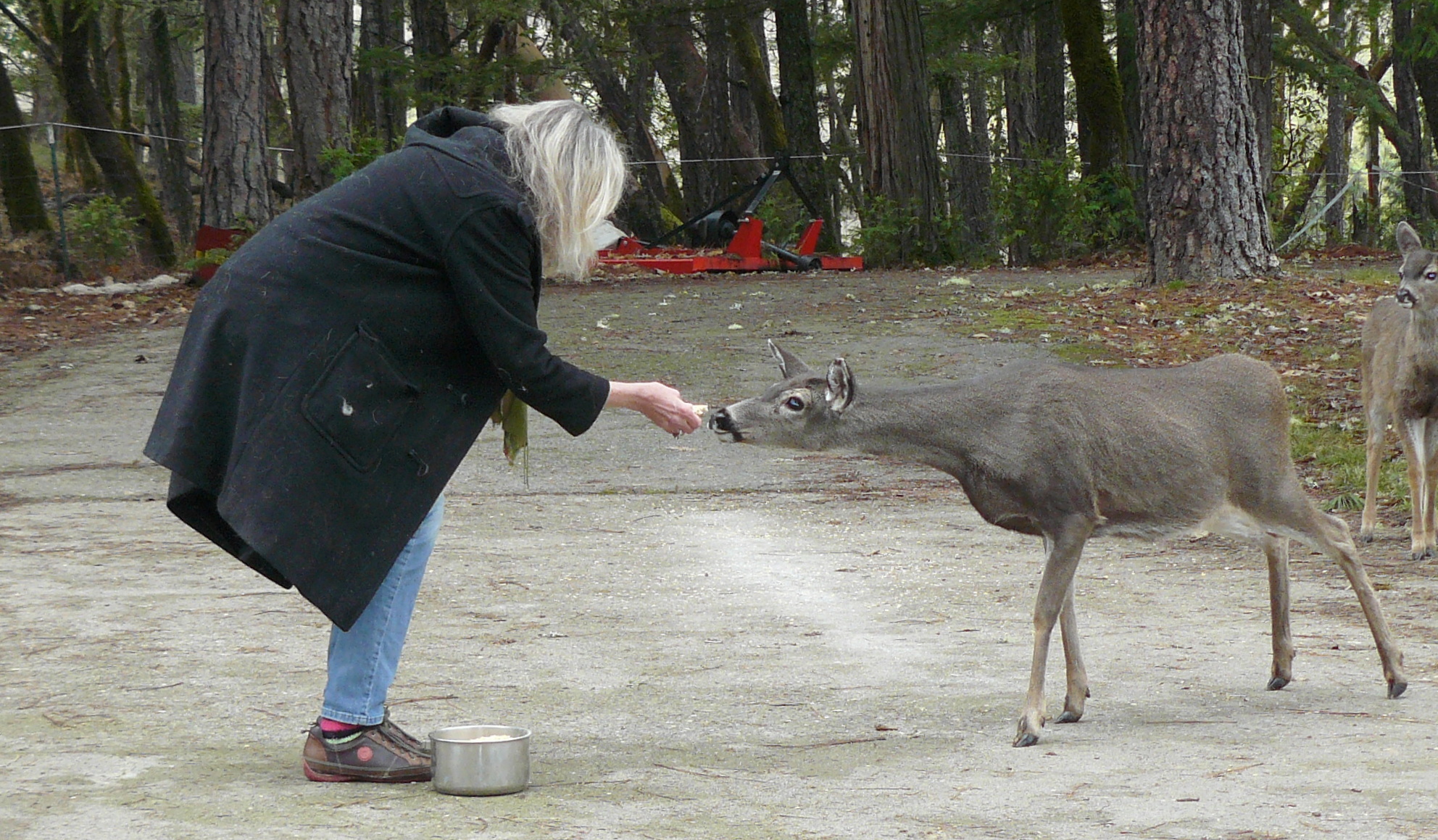
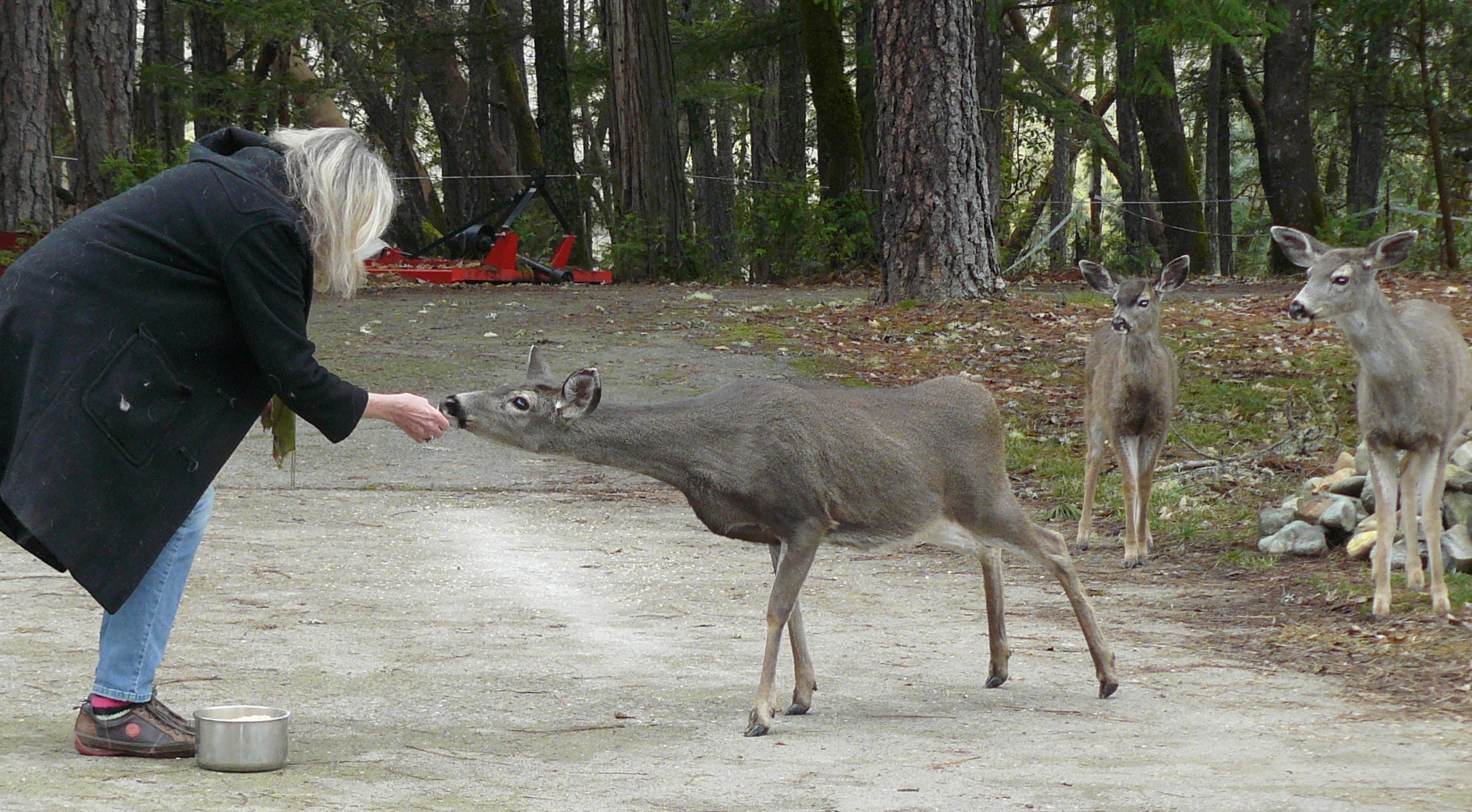
But it is a National Holiday for the USA, Martin Luther King Jr. Day, and these images taken two days ago seemed an appropriate ‘holiday’ post.
Follows of Learning from Dogs will remember that back on the 15th December I devoted a Sunday post, Picture parade twenty-one, to pictures of deer cautiously coming to feed when Jean was in their presence.
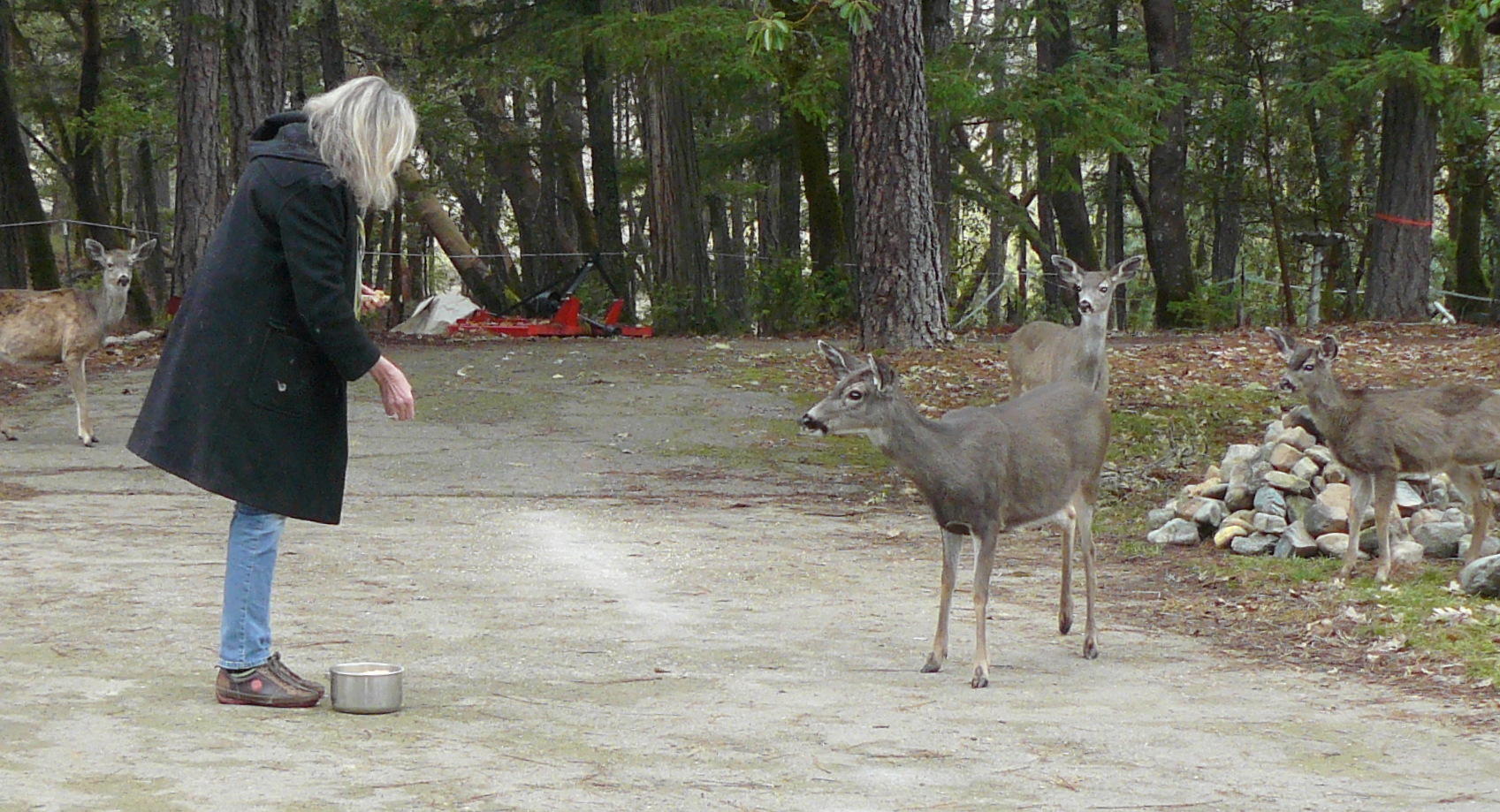
Now, some five weeks later, one of those deer has overcome fear to the point of taking a piece of bread from Jean’s hand. Here is the sequence of photographs taken last Saturday afternoon. N.B. We do not feed the deer bread as a routine; it’s not good for them.
Cars travel through flood water in Helston, south-west Cornwall – Daily Mail August, 2013
You can tell, undoubtedly, from the title and sub-title to today’s post that I am feeling somewhat forlorn about the way that we humans work things out! As the old saying goes, “Question:Why has Planet Earth never been visited by an alien species?Answer:Because they have seen no signs of intelligent life!“
This feeling is a result of reading a recent essay from George Monbiot, Drowning in Money. It is republished here within his terms of sharing.
Now before you read it, if you are not living in the UK it would be easy to reject the messages as being only relevant to the United Kingdom. But when you do read it, you will agree that this level of government policy stupidity is not the sole reserve of the UK. The ‘virus’ is alive and well elsewhere!
ooOOoo
George Monbiot
Drowning in Money
January 13, 2014
The hidden and remarkable story of why devastating floods keep happening. By George Monbiot, published in the Guardian 14th January 2014.
We all know what’s gone wrong, or we think we do: not enough spending on flood defences. It’s true that the government’s cuts have exposed thousands of homes to greater risk, and that the cuts will become more dangerous as climate change kicks in (1). But too little public spending is a small part of problem. It is dwarfed by another factor, which has been overlooked in discussions in the media and statements by the government: too much public spending.
Vast amounts of public money – running into the billions – are spent every year on policies that make devastating floods inevitable. This is the story that has not been told by the papers or the broadcasters, a story of such destructive perversity that the Guardian has given me twice the usual space today in which to explain it.
Flood defence, or so we are told almost everywhere, is about how much concrete you can pour. It’s about not building houses in stupid places on the floodplain, and about using clever new engineering techniques to defend those already there (2). None of that is untrue, but it’s a small part of the story. To listen to the dismal debates of the past fortnight you could be forgiven for believing that rivers arise in the plains; that there is no such thing as upstream; that mountains, hills, catchments and watersheds are irrelevant to the question of whether or not homes and infrastructure get drowned.
The story begins with a group of visionary farmers at Pontbren, in the headwaters of Britain’s longest river, the Severn. In the 1990s they realised that the usual hill farming strategy – loading the land with more and bigger sheep, grubbing up the trees and hedges, digging more drains – wasn’t working. It made no economic sense, the animals had nowhere to shelter, the farmers were breaking their backs to wreck their own land.
So they devised something beautiful. They began planting shelter belts of trees along the contours. They stopped draining the wettest ground and built ponds to catch the water instead. They cut and chipped some of the wood they grew to make bedding for their animals, which meant that they no longer spent a fortune buying straw. Then they used the composted bedding, in a perfect closed loop, to cultivate more trees (3).
One day a government consultant was walking over their fields during a rainstorm. He noticed something that fascinated him: the water flashing off the land suddenly disappeared when it reached the belts of trees the farmers had planted. This prompted a major research programme, which produced the following astonishing results: water sinks into the soil under the trees at 67 times the rate at which it sinks into the soil under the grass (4). The roots of the trees provide channels down which the water flows, deep into the ground. The soil there becomes a sponge, a reservoir which sucks up water then releases it slowly. In the pastures, by contrast, the small sharp hooves of the sheep puddle the ground, making it almost impermeable: a hard pan off which the rain gushes.
One of the research papers estimates that, even though only 5% of the Pontbren land has been reforested, if all the farmers in the catchment did the same thing, flooding peaks downstream would be reduced by some 29% (5). Full reforestation would reduce the peaks by around 50% (6). For the residents of Shrewsbury, Gloucester and the other towns ravaged by endless Severn floods, that means, more or less, problem solved.
Did I say the results were astonishing? Well, not to anyone who has studied hydrology elsewhere. For decades the British government has been funding scientists working in the tropics, and using their findings to advise other countries to protect the forests or to replant trees in the hills, to prevent communities downstream from being swept away. But we forgot to bring the lesson home.
So will the rest of the Severn catchment, and those of the other unruly waterways of Britain, follow the Pontbren model? The authorities say they would love to do it (7). In theory. Natural Resources Wales told me that these techniques “are hard wired in to the actions we want land managers to undertake.” (8) What it forgot to say is that all tree planting grants in Wales have now been stopped. The offices responsible for administering them are in the process of closing down (9). If other farmers want to copy the Pontbren model, not only must they pay for the trees themselves; but they must sacrifice the money they would otherwise have been paid for farming that land.
For – and here we start to approach the nub of the problem – there is an unbreakable rule laid down by the Common Agricultural Policy. If you want to receive your single farm payment – by the far biggest component of farm subsidies – that land has to be free from what it calls “unwanted vegetation” (10). Land covered by trees is not eligible. The subsidy rules have enforced the mass clearance of vegetation from the hills.
Just as the tree planting grants have stopped, the land clearing grants have risen. In his speech to the Oxford Farming Conference, made during the height of the floods, the environment secretary Owen Paterson boasted that hill farmers “on the least-productive land” will now receive “the same direct payment rate on their upland farmland as their lowland counterparts.” (11) In other words, even in places where farming makes no sense because the land is so poor, farmers will now be paid more money to keep animals there. But to receive this money, they must first remove the trees and scrub that absorb the water falling on the hills.
And that’s just the start of it. One result of the latest round of subsidy negotiations – concluded in June last year – is that governments can now raise the special mountain payments, whose purpose is to encourage farming at the top of the watersheds, from €250 per hectare to €450 (12). This money should be renamed the flooding subsidy: it pays for the wreckage of homes, the evacuation of entire settlements, the drowning of people who don’t get away in time, all over Europe. Pig-headed idiocy doesn’t begin to describe it.
The problem is not confined to livestock in the mountains. In the foothills and lowlands, the misuse of heavy machinery, overstocking with animals and other forms of bad management can – by compacting the soil – increase the rates of instant run-off from 2% of all the rain that falls on the land to 60%(13).
Sometimes, ploughing a hillside in the wrong way at the wrong time of the year can cause a flood – of both mud and water – even without exceptional rainfall. This practice has blighted homes around the South Downs (that arguably should never have been ploughed at all). One house was flooded 31 times in the winter of 2000-2001 by muddy floods caused by ploughing (14). Another, in Suffolk, above which the fields had been churned up by pigs, was hit 50 times (15). But a paper on floods of this kind found that “there are no (or only very few) control measures taken yet in the UK.” (16)
Under the worst environment secretary this country has ever suffered, there seems little chance that much of this will change. In November, in response to calls to reforest the hills, Owen Paterson told parliament “I am absolutely clear that we have a real role to play in helping hill farmers to keep the hills looking as they do.” (17) (Bare, in other words). When asked by a parliamentary committee to discuss how the resilience of river catchments could be improved, the only thing he could think of was building more reservoirs (18).
But while he is cavalier and ignorant when it comes to managing land to reduce the likelihood of flooding, he goes out of his way to sow chaos when it comes to managing rivers.
Many years ago, river managers believed that the best way to prevent floods was to straighten, canalise and dredge rivers along much of their length, to enhance their capacity for carrying water. They soon discovered that this was not just wrong but counterproductive. A river can, at any moment, carry very little of the water that falls on its catchment: the great majority must be stored in the soils and on the floodplains.
By building ever higher banks around the rivers, by reducing their length through taking out the bends and by scooping out the snags and obstructions along the way, engineers unintentionally did two things. They increased the rate of flow, meaning that flood waters poured down the rivers and into the nearest towns much faster. And, by separating the rivers from the rural land through which they passed, they greatly decreased the area of functional floodplains (19, 20, 21).
The result, as authorities all over the world now recognise, was catastrophic. In many countries, chastened engineers are now putting snags back into the rivers, reconnecting them to uninhabited land that they can safely flood and allowing them to braid and twist and form oxbow lakes. These features catch the sediment and the tree trunks and rocks which otherwise pile up on urban bridges, and take much of the energy and speed out of the river. Rivers, as I was told by the people who had just rewilded one in the Lake District – greatly reducing the likelihood that it would cause floods downstream – “need something to chew on” (22, 23).
There are one or two other such projects in the UK: Paterson’s department is funding four rewilding schemes, to which it has allocated a grand total of, er, £1 million (24). Otherwise, the secretary of state is doing everything he can to prevent these lessons from being applied. Last year he was reported to have told a conference that “the purpose of waterways is to get rid of water” (25). In another speech he lambasted the previous government for a “blind adherence to Rousseauism” in refusing to dredge (26). Not only will there be more public dredging, he insists: but there will also be private dredging: landowners can now do it themselves (27).
After he announced this policy, the Environment Agency, which is his department’s statutory adviser, warned that dredging could “speed up flow and potentially increase the risk of flooding downstream.” (28) Elsewhere, his officials have pointed out that “protecting large areas of agricultural land in the floodplain tends to increase flood risk for downstream communities.” (29) The Pitt Review, commissioned by the previous government after the horrible 2007 floods, concluded that “dredging can make the river banks prone to erosion, and hence stimulate a further build-up of silt, exacerbating rather than improving problems with water capacity.” (30) Paterson has been told repeatedly that it makes more sense to pay farmers to store water in their fields, rather than shoving it off their land and into the towns.
But he has ignored all this advice and started seven pilot projects in which farmers will be permitted to drag all that messy wildlife habitat out of their rivers, to hurry the water down to the nearest urban pinch point (31). Perhaps we shouldn’t be surprised to discover that Paterson has demanded massive cuts at the Environment Agency, including many of the staff responsible for preventing floods (32).
Since 2007, there has been a review, a parliamentary enquiry, two bills, new flood management programmes (33), but next to nothing has changed. Floods, because of the way we manage our land and rivers, remain inevitable. We pay a fortune in farm subsidies and river-mangling projects to have our towns flooded and homes and lives wrecked. We pay again in the form of the flood defences necessitated by these crazy policies, and through the extra insurance payments – perhaps we should call them the Paterson tax – levied on all homes. But we also pay through the loss of everything else that watersheds give us: beauty, tranquility, wildlife and, oh yes, the small matter of water in the taps.
In the Compleat Angler, published in 1653, Izaac Walton wrote this. “I think the best Trout-anglers be in Derbyshire; for the waters there are clear to an extremity.” (34) No longer. Last summer I spent a weekend walking along the River Dove and its tributaries, where Walton used to fish. All along the river, including the stretch on which the fishing hut built for him by Charles Cotton still stands, the water was a murky blueish brown. The beds of clean gravel he celebrated were smothered in silt: on some bends the accretions of mud were several feet deep.
You had only to raise your eyes to see the problem: the badly-ploughed hills of the mid-catchment and above them the drained and burnt moors of the Peak District National Park, comprehensively trashed by grouse shooting estates. A recent report by Animal Aid found that grouse estates in England, though they serve only the super-rich, receive some £37m of public money every year in the form of subsidies (35). Much of this money is used to cut and burn them, which is likely to be a major cause of flooding (36). Though there had been plenty of rain throughout the winter and early spring, the river was already low and sluggish.
A combination of several disastrous forms of upland management has been helping Walton’s beloved river to flood, with the result that both government and local people have had to invest heavily in the Lower Dove flood defence scheme (37). But this wreckage has also caused it to dry up when the rain doesn’t fall.
That’s the flipside of a philosophy which believes that land exists only to support landowners, and waterways exist only “to get rid of water”. Instead of a steady flow sustained around the year by trees in the hills, by sensitive farming methods, by rivers which are allowed to find their own course and their own level, to filter and hold back their waters through bends and braiding and obstructions, we get a cycle of flood and drought. We get filthy water and empty aquifers and huge insurance premiums and ruined carpets. And all of it at public expense.
4. M. R. Marshall et al, 2013. The impact of rural land management changes on soil hydraulic properties and runoff processes: results from experimental plots in upland UK. Hydrological Processes, DOI: 10.1002/hyp.9826. http://onlinelibrary.wiley.com/doi/10.1002/hyp.9826/abstract
9. I talked to one of the employees over the weekend: everyone is being made redundant as all funding has ceased.
10. Official Journal of the European Union, 31st January 2009. Council Regulation (EC) No 73/2009 of 19 January 2009, establishing common rules for direct support schemes for farmers under the common agricultural policy and establishing certain support schemes for farmers, amending Regulations (EC) No 1290/2005, (EC) No 247/2006, (EC) No 378/2007 and repealing Regulation (EC) No 1782/2003. Annex III. http://eur-lex.europa.eu/LexUriServ/LexUriServ.do?uri=OJ:L:2009:030:0016:0016:EN:PDF
15. R. Evans, 2010. Runoff and soil erosion in arable Britain: changes in perception and policy since 1945. Environmental Science and Policy 13, pp 1 4 1 – 1 4 9. doi:10.1016/j.envsci.2010.01.001
23. I hope before long to write up the extraordinary story I was told by a representative of United Utilities about the sharply differing responses of the rewilded River Liza in Ennerdale and the still-canalised St John’s Beck in Thirlmere to the famous 2009 downpour.
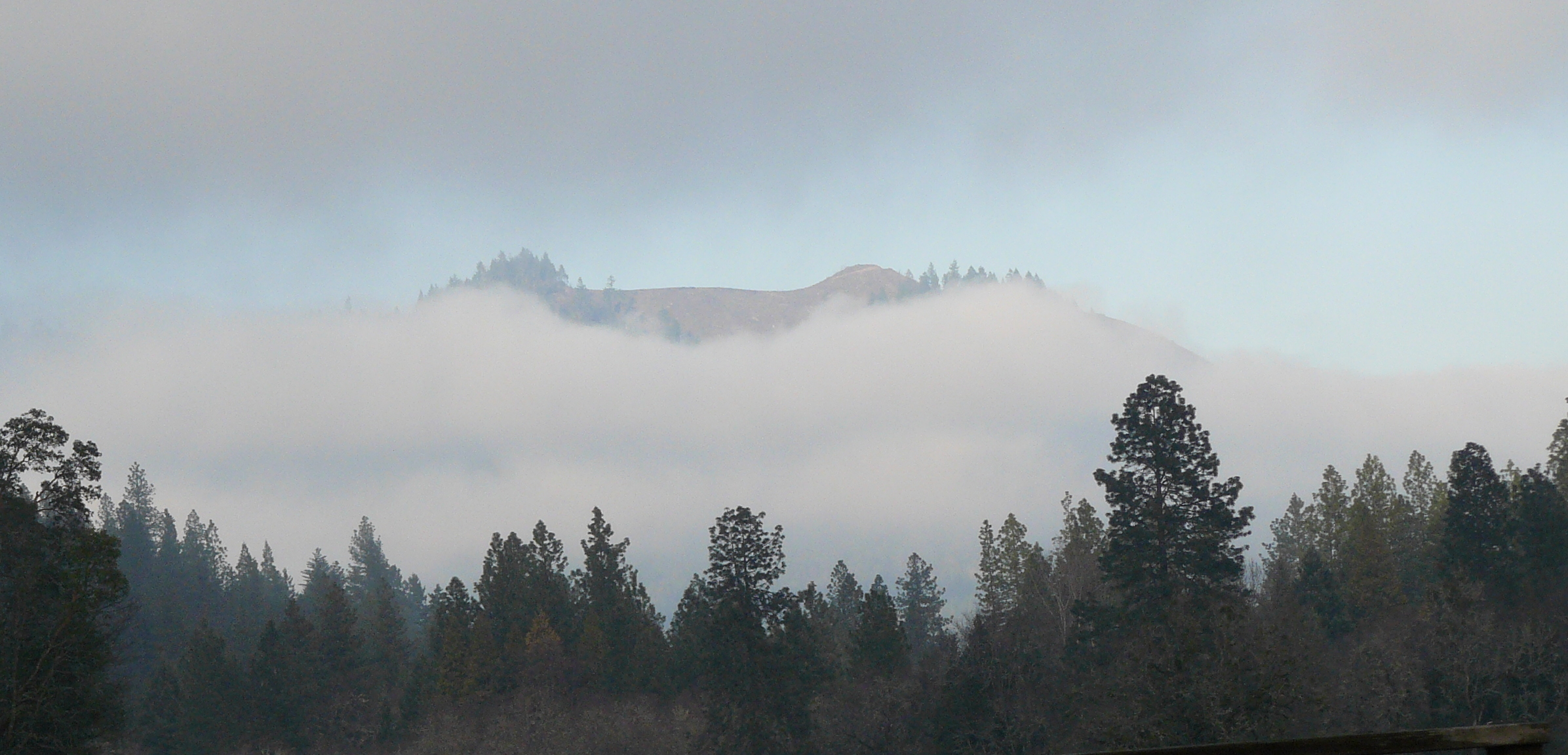
Just to underline that message of it not being only the UK with crazy policies, the photograph below is of a forest ridge within sight of the house here in Oregon.
A local ridge demonstrating ‘clear-cutting’ mania poking above the valley mist.
On Monday and Tuesday of the week I posted Legitimate Anger and Legitimate Hope. (And please see the footnote to today’s post)
Patrice Ayme left the following comment to the Legitimate Hope post:
It’s hard to live with elephants, especially in poor, crowded conditions. I remember bathing in Africa as a child with a bull elephant 200 meters away, on the other side of a stream, and being extremely worried, with all in attendance.
Europe used to have elephants, and North America, two species. Time to reintroduce them, and live according to our discourse.
Rewilding Euramerica can be done, and should be done, for the deepest philosophical and emotional reasons, and will create new, very productive jobs.
PA
Then on Friday came an email from reader and blogger Martin Lack:
It was but a moment to go across to The Conversation website (rather liked what I saw, by the way) and find the article that Martin linked to. It is republished here within the terms of The Conversation site.
ooOOoo
Restore large carnivores to save struggling ecosystems
By William Ripple, Oregon State University
We are losing our large carnivores. In ecosystems around the world, the decline of large predators such as lions, bears, dingoes, wolves, and otters is changing landscapes, from the tropics to the Arctic. Habitat loss, persecution by humans and loss of prey have combined to inflict great losses on these populations.
In fact more than 75% of the 31 largest carnivore species are declining, and 17 species now occupy less than half their former ranges. Southeast Asia, southern and East Africa, and the Amazon are among areas in which multiple large carnivore species are declining. And with only a few exceptions, large carnivores have already been exterminated from much of the developed world, including areas of Western Europe, and the eastern United States.
Top dogs keep ecosystems in order
Many of these large carnivore species are endangered and some are at risk of extinction, either in specific regions or entirely. Ironically, they are vanishing just as we are learning about their important ecological effects, which is what led us to write a new paper in the journal Science to document their role.
From a review of published reports, we singled out seven species that have been studied for their important ecological role and widespread effects, known as trophic cascades. These are the African lion, leopard, Eurasian lynx, cougar, gray wolf, sea otter and dingo.
Based on field research, my Oregon State University co-author Robert Beschta and I documented the impact of cougars and wolves on the regeneration of forest tree stands and riverside vegetation in Yellowstone and other national parks in western North America. Fewer predators, we found, lead to an increase in browsing animals such as deer and elk. More browsing disrupts vegetation, reduces birds and some mammals and changes other parts of the ecosystem. From the actions of the top predator, widespread impacts cascade down the food chain.
Similar effects were found in studies of Eurasian lynx, dingoes, lions and sea otters. For example in Europe, absence of lynx has been closely tied to the abundance of roe deer, red fox and hare. In Australia, the construction of a 3,400-mile dingo-proof fence has enabled scientists to study ecosystems with and without dingoes which are closely related to gray wolves. They found that dingoes control populations of herbivores and exotic red foxes. The suppression of these species by dingoes reduces predation pressure, benefiting plants and smaller native prey.
In some parts of Africa, the decrease of lions and leopards has coincided with a dramatic increase in olive baboons, which threaten crops and livestock. In the waters off southeast Alaska, a decline in sea otters through killer whale predation has led to a rise in sea urchins and loss of kelp beds.
Predators are integral, not expendable
We are now obtaining a deeper appreciation of the impact of large carnivores on ecosystems, a view that can be traced back to the work of landmark ecologist Aldo Leopold. The perception that predators are harmful and deplete fish and wildlife is outdated. Many scientists and wildlife managers now recognise the growing evidence of carnivores’ complex role in ecosystems, and their social and economic benefits. Leopold recognised these relationships, but his observations were ignored for decades after his death in 1948.
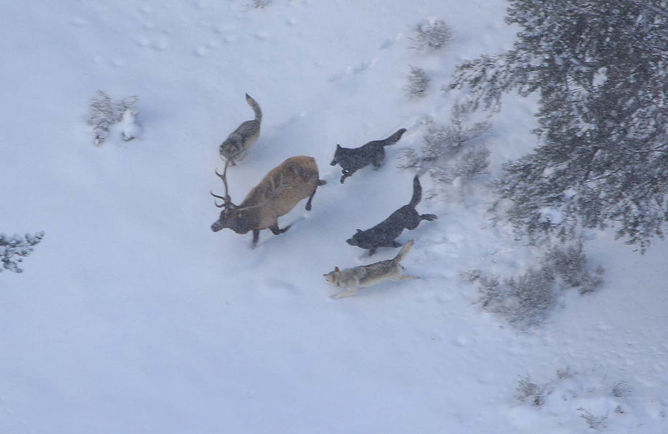
Top carnivores, at work keeping things in check. Doug Smith
Human tolerance of these species is the major issue. Most would agree these animals have an intrinsic right to exist, but additionally they provide economic and ecological services that people value. Among the services documented in other studies are carbon sequestration, restoration of riverside ecosystems, biodiversity and disease control. For example, wolves may limit large herbivore populations, thus decreasing browsing on young trees that sequester carbon when they escape browsing and grow taller. Where large carnivore populations have been restored – such as wolves in Yellowstone or Eurasian lynx in Finland – ecosystems appear to be bouncing back.
I am impressed with how resilient the Yellowstone ecosystem is, and while ecosystem restoration isn’t happening quickly everywhere in this park, it has started. In some cases where vegetation loss has led to soil erosion, for example, full restoration may not be possible in the near term. What is certain is that ecosystems and the elements of them are highly interconnected. The work at Yellowstone and other places shows how species affect each another through different pathways. It’s humbling as a scientist to witness this interconnectedness of nature.
My co-authors and I have called for an international initiative to conserve large carnivores in co-existence with people. This effort could be modelled after a couple of other successful efforts including the Large Carnivore Initiative for Europe, a non-profit scientific group affiliated with the International Union for the Conservation of Nature, and the Global Tiger Initiative which involves all 13 of the tiger-range countries. With more tolerance by humans, we might be able to avoid extinctions. The world would be a scary place without these predators.
William Ripple does not work for, consult to, own shares in or receive funding from any company or organisation that would benefit from this article, and has no relevant affiliations.
In 2011, more African elephants were killed than any other year in history. The figures for 2012 and 2013 are not yet known, but are likely to be even higher. At current rates, in twelve years, there will be none left.
It is a familiar cause, but it has never been more urgent. Poaching has turned industrial. Armed militia fly in helicopters over jungle clearings, machine gunning down entire herds. Their tusks are then sold to fund war and terrorism throughout the continent and the wider world. Ivory is still illegal, but as China booms, it is more popular than ever.
This campaign will raise money to support rangers on the ground to protect Kenya’s elephants from armed poachers, together with Space for Giants’ longer term work to create new wildlife sanctuaries where elephants will be safe, forever. More can be found about the charity at Space for Giants
The article above includes two videos. A shorter one that can be viewed on the paper’s campaign website. Then there is a longer, five-minute, video also on YouTube and included below.
Jean and I wanted to make a donation but found that without a UK bank account/UK Visa card it wasn’t possible. We contacted Space for Giants and received the following email from Amy.
Hi Paul
Sorry for the difficulties and thank you for your perseverance!
You can donate in USD through our CrowdRise page at www.crowdrise.com/spaceforgiants1. These funds are sent to TUSK USA who will then allocate them to us.
Alternatively, you can make out a cheque to ‘TUSK USA’ and send to TUSK USA, 40 East 94th Street, Apt 3A, New York, NY 10128 – please attach a covering note confirming that you would like your donation to be used to support the work of Space for Giants.
Many thanks,
Amy.
So if there’s anyone else out there not in the UK who would like to donate, here’s another option.
Please, for all our sakes, help these beautiful creatures.
Many will have read yesterday’s post about the slaughter of elephants by ivory poachers and felt, as I did, a feeling of despair in the pit of one’s soul. We seem to be living in such challenging times with so much madness about us. It’s incredibly easy to feel as if this is some sort of ‘end of times’ period.
Today’s post tells us that there is always hope.
Let’s remind ourselves that elephants are very intelligent animals. As I wrote last November in a post with the title of Smart Animals:
There was a fascinating article on the BBC news website a few weeks ago that went on to explain:
10 October 2013
Elephants ‘understand human gesture’
By Victoria GillScience reporter, BBC News
African elephants have demonstrated what appears to be an instinctive understanding of human gestures, according to UK scientists. In a series of tests, researcher Ann Smet, of the University of St Andrews, offered the animals a choice between two identical buckets, then pointed at the one containing a hidden treat.
From the first trial, the elephants chose the correct bucket.
In 2011, more African elephants were killed than any other year in history. The figures for 2012 and 2013 are not yet known, but are likely to be even higher. At current rates, in twelve years, there will be none left.
It is a familiar cause, but it has never been more urgent. Poaching has turned industrial. Armed militia fly in helicopters over jungle clearings, machine gunning down entire herds. Their tusks are then sold to fund war and terrorism throughout the continent and the wider world. Ivory is still illegal, but as China booms, it is more popular than ever.
This campaign will raise money to support rangers on the ground to protect Kenya’s elephants from armed poachers, together with Space for Giants’ longer term work to create new wildlife sanctuaries where elephants will be safe, forever. More can be found about the charity at Space for Giants
The article above includes two videos. A shorter one that can be viewed on the paper’s campaign website. Then there is a longer, five-minute, video also on YouTube and included below.
Then there is the David Sheldrick Wildlife Trust helping animals in Africa. And, finally, the campaign over at Bloody Ivory where one can sign a petition and donate towards stopping elephant poaching.
Thus, like so many aspects of life, never give up trying to help those less fortunate.
What a greedy, selfish race of people we can be at times!
I’m writing about the subject of elephants. Or, to put it more precisely and distastefully, the murder of elephants. For the ivory in their tusks.
The post was prompted by a recent item over on Chris Snuggs’ blog Nemo Insula Est. Chris and I have known each other for quite a few years now; since the time that he was Head of Studies at the French college, ISUGA, in Quimper, France and where I attended as a visiting teacher running a class on Sales & Marketing.
Chris has allowed me to republish the piece in full. Please read today’s post and then come back tomorrow to see in what ways we can all help.
ooOOoo
The Human Shame in Northern Kenya
03JAN
One of my NYRs was to stop reading bad news, but that lasted about 6 hours ….. there is of course so much of it, and so much that is utterly depressing. One of the first of 2014 was an article in “The Independent”:
Elephant Appeal: Few are willing to say just how bad the poaching crisis is – the elephant population may easily fall into terminal decline
Tragic, to the extreme!
You can get all the details from the article – which is pretty harrowing, with surviving elephants described as being “stricken with grief” as they cluster round their slaughtered brethren – but basically, elephants in the Tsavo East National Park in Northern Kenya are under threat of extinction from poachers from Somalia. This provoked a number of reactions on my part:
DEMAND
The price of ivory depends on the demand and supply. The former is very strong and apparently rising, especially in China. For extraordinarily moronic and selfish reasons, ivory is considered artistic and – for example – tiger and rhinoceros parts medicinal and/or possessing aphrodysiac properties.
Can China really do NOTHING to stop this cultural abomination? People in the west for the most part stopped acquiring ivory years ago.
If China – and other Asia nations – cannot or will not do anything, should the west not apply more pressure? Same applies of course to China’s support of North Korea. YES, sanctions are painful, but nothing NON-painful is likely to work.
THE POACHERS
They are execrable, of course …… and yet, many may be extremely poor, and indeed ignorant. There is no excuse in the strictest sense, but it may to some extent be understandable if they see a chance to make several years’ normal income in a single day. This is no different from City bankers, or indeed the Enron directors and many others: greed is sadly rampant on our planet.
There are insufficient funds to patrol the parks properly. Kenya is just one more corrupt African state where politicians earn a fortune while basic needs and services are severely underfunded.
MORALITY
So, there is a lack of funds to prevent the poacher-killers. Yet a few hundred miles away, vast sums of money are squandered on obscene luxuries.
I always wonder what if anything goes through the minds of those who spend these obscene sums on frippery and personal self-glorification. Do they ever think that their money could do immense good elsewhere? Would WE be just the same in their shoes?
Is there any solution to this greed?
ooOOoo
Chris wrote his post motivated by the article in The Independent UK newspaper. But that newspaper was not alone in promulgating the despicable killings of these smart and magnificent creatures. Here’s a story that was in the UK Daily Telegraph newspaper a year ago.
Horror as entire family of elephants slaughtered for ivory
Armed wildlife rangers on Tuesday night fanned out across eastern Kenya in pursuit of ivory poachers who killed an entire family of 12 elephants in the country’s worst single such slaughter since the 1980s.
Eleven adults and one infant calf died in a “targeted and efficient” attack highlighting the growing professionalism of poachers bankrolled by international criminals supplying soaring demand for ivory in the Far East.
Six of the animals lay in one heap, their tusks hacked out with machetes.
None of the family group managed to flee further than 300 yards before they were gunned down and their ivory removed.
The calf, less than a year old, is believed to have been crushed by its dying mother as she fell to the ground.
“It is unimaginable, a heinous, heinous crime,” said Paul Udoto, spokesman for the KenyaWildlife Service (KWS).
“We have not seen such an incident in recent memory, it’s the worst single loss that we have on record, and our records go back almost 30 years.
“These were professional killers. The attack was targeted and efficient.”
The poachers, armed with automatic rifles, had already fled but there were hopes last night that a massive search involving foot patrols, a dozen vehicles and three aircraft could still find them.
“Every possible resource is being deployed to track down these criminals,” Mr Udoto said. “They will feel the full force of the law.”
But the area where the elephants were killed, in the north of Kenya’s largest wildlife reserve, Tsavo East National Park, is sparsely populated, has few roads, and lies close to Kenya’s border with Somalia.
Privately, conservationists said they feared the poachers and their haul of 22 tusks, worth an estimated GBP175,000 on the Asian market, would already have escaped.
The attack was the latest in a surge of elephant deaths that has seen the number of the animals killed for their ivory in Kenya increase sevenfold in five years, from fewer than 50 in 2007 to 360 in 2012, according to KWS figures.
The increase has led many wildlife experts to declare the current situation a crisis worse even than the mass slaughter of Africa’s elephants in the 1970s and 1980s, which led to a global ivory trade ban in 1989.
I don’t have permission to republish the article so please go here and read the full piece and view a couple of harrowing photographs.
Then come back tomorrow and explore how you and I can do something to help. Please.
The first of the New Year and dedicated to Sue of Sue Dreamwalker.
A week ago, Sue left a nice comment about our ‘backyard’ here in Oregon. Specifically with regard to the two photographs of deer feeding in front of the house. I replied by saying that today I would offer a selection of views of our property.
First off, an aerial view with the property boundary line overlaid, taken from the sale particulars. The right-hand, Eastern boundary follows the edge of Hugo Road. We are some four miles from Merlin in Southern Oregon.
Thirteen acres orientated West-East.
The solid blue line is the course of Bummer Creek that flows from top to bottom of the image. The thin, dotted blue line is the driveway that runs from Hugo Road up to the house, a distance of a 1/4 mile. The house is close to the Western boundary almost hidden from sight in this picture by the trees. There is a faint label ‘The House’ just below the building.
From left to right: Pharaoh, Sweeny, Cleo and Hazel.
The above photograph was taken from a point about half-way along the driveway, the house being behind the camera. Ahead, the driveway dips down to cross the bridge over the Creek, as the following picture reveals. Luckily the boundary fence is dog-proof!
oooo
Dogs and water!
Pharaoh in Bummer Creek just downstream of the bridge.
Looking further downstream from the bridge.
oooo
Looking upstream from the bridge.
The barrier across the Creek seen in the upper half of the photograph is a flood irrigation dam installed many years ago, presumably for agricultural purposes before the plot was sold for house building prior to 1977. One installs an iron pole on a centre bolt embedded in the dam and then places a stout plank across the flow on top of the dam. The plank can just be seen to the right of the dam, resting on the bank. Never tried the dam but going to some day!
Looking to the West up towards the house.
The above picture was taken close to where the previous one was shot. Simply by swinging around to the left and looking back up. The house is barely visible in the background behind the metal gate and wooden fence posts in the middle of the photograph.
Corinne’s field visible through the trees and undergrowth.
Again, the picture above is taken not far removed from where the previous two were taken. If one looks at the aerial view of the property in the first picture, in the top-right corner there is a small area of grassland; what would have been an offshoot of our neighbour’s grassland in previous times. After my sister, Corinne, died in the Summer of 2013 we named that area of grassland Corinne’s field.
A general view down over the main area of grass.
So now we are back standing just outside the Eastern side of the house looking South-East out over the main area where the dogs are walked twice a day. The picture was taken a little before noon and shows the low mist that has been with us for about two weeks.
Nature’s beauty.
Above, another photograph picking up on the mist that has been with us for some days. Until yesterday!
This is what I call a Winter day!
Yesterday dawned cold, clear and frosty. As this picture of one of our tall pine trees so vividly demonstrates. (The tree edges our driveway, about half-way to the house.)
So will close today’s post with three more pictures of a frosty Saturday morning in Merlin, Oregon, USA.
A frosty yet sunny morning.
oooo
Frost on a bamboo tree.
oooo
It really is a beautiful world at times.
oooo
So there you are, Sue!
Needless to say, Jean and I are reminded almost daily how lucky we and all our animals are at finding such a beautiful place to live. I can’t ever imagine taking it for granted.